



Abstract
The purpose of this study is to determine the validity of the work engagement construct among mentally ill workers and to develop a nomological network delineating the relationship of work engagement with its antecedents, and its consequences in this specific population. Three hundred and ten people with mental disorders employed in Italian social enterprises accepted to take part in this longitudinal study and filled out the Utrecht Work Engagement scale (UWES-9) and questionnaires on severity of symptoms perceived, social support from coworkers and supervisor, and occupational self-efficacy. Individuals who were still eligible at the 12-month follow-up phase of the study completed a questionnaire on future working plans. Confirmatory factor analysis and path analysis were used to validate the UWES-9 and test its nomological network. The results indicated how work engagement, as well as its drivers, impacted important work outcomes, such as to work in the open labor market, in workers with mental disorders.
Introduction
The nature of today’s labor market requires organizations to be productive and competitive to survive and grow, since they are constantly confronted with the pressure to be profitable as fast as possible. Thus, workers are expected to be psychologically connected to their work, proactive, and committed to high-quality performance standards, to collaborate with others, to be energetic and dedicated, and to be absorbed by their work (Bakker, Albrecht, & Leiter, 2011). Simply put, “today’s organizations are in need of engaged employees” (Bakker & Shaufeli, 2008, p. 150). Schaufeli, Salanova, Gonzalez-Roma, and Bakker (2002, p. 74) define engagement as “a positive, fulfilling, work-related state of mind” characterized by (1) vigor (VI), meaning high levels of energy while working, persistence, and willingness to invest effort in one’s work, even in the face of difficulties; (2) dedication (DE), meaning a sense of significance, enthusiasm, inspiration, pride, and challenge; and (3) absorption (AB), meaning to be fully concentrating on work, so that time at work passes quickly and one has difficulty in detaching oneself from work. Among the general population and individuals suffering from other disabilities, people with mental disorders face severe difficulties in participating and integrating in the contemporary work world (Committee on the Environment, Public Health and Food Safety, 2009), despite the evidence that they have the potential and desire to work (Anthony & Blanch, 1989; Boardman, Grove, Perkins, & Shepherd, 2003; South Essex Service Research Group, Secker & Gelling, 2006). A valid alternative to the regular job market and existing vocational programs (e.g., supported employment) for people with mental disability is the social enterprise (Corbière & Lecomte, 2009; Svanberg, Gumley, & Wilson, 2010). In Italy, these new initiatives are mainly organized into cooperatives, in particular the so-called B-type social cooperative, which are created with the specific aim to integrate disadvantaged people (e.g., people with mental disabilities) into the labor market. The ultimate goal of these initiatives is to provide people with the extra skills and confidence needed to work permanently in the open labor market (Borzaga & Loss, 2002).
Given that work engagement is positively related to health, workability, job satisfaction, and job performance (Bakker, 2011; Bakker & Demerouti, 2008; Bakker et al., 2011; Hakanen, Bakker, & Schaufeli, 2006; Xanthopoulou, Bakker, Demerouti, & Schaufeli, 2009), we were interested in investigating the construct among a population of workers, such as mentally ill workers, who face difficulties and barriers during their work integration process. To our knowledge, these studies have not been conducted. In 2009, Bakker also suggested examining the validity of the work engagement model in different occupational groups (e.g., people with mental disorders) and different countries. Thus, the present study examines the internal consistency and factorial validity of the Utrecht Work Engagement scale (UWES-9) in a sample of mentally ill workers employed in Italian social enterprises. We then developed a nomological network delineating work engagement’s relationship with its antecedents and consequences in this specific population, in order to discuss the discriminant validity of the construct as applied to workers with mental disorders. To do so, we conducted an analysis of the literature to identify work engagement’s antecedents and outcomes. Several recent studies conducted on occupational groups not suffering from mental disorders have consistently shown that job and personal resources are important antecedents of work engagement (Bakker, 2009; Bakker & Demerouti, 2007; Bakker, Schaufeli, Leiter, & Taris, 2008; Christian, Garza, & Slaughter, 2011; Macey & Schinder, 2008; Schaufeli & Bakker, 2004). In particular, social support from coworkers and supervisor is a job resource likely associated with engagement (Christian et al., 2011). Recently, Riggle, Edmondson, and Hansen (2009) found that perceived organizational support had a strong positive effect on job satisfaction and a strong negative effect on intentions to leave. Even for people with mental disorders social support is a fundamental variable that positively influences vocational outcomes, such as job tenure (MacDonald Wilson, Rogers, Massaro, Lyass, & Crean, 2002), return to work (Tse & Yeats, 2002), and intentions to stay or leave the job (Huff, Rapp, & Campbell, 2008). Other studies (Killeen & O’Day, 2004; Tse & Yeats, 2002; Woodside, Schell, & Allison-Hedges, 2006) have shown the importance of assistance from work colleagues to generate a sense of being welcomed, respected, and supported at work for people with mental illness. With this in mind, we hypothesized that social support from the organization is a job resource significantly and positively related to work engagement in people with mental disorders (Hypothesis 1). Personal resources such as self-efficacy, self-esteem, and optimism have been shown to help workers control and successfully impact their work environment (Bakker et al., 2008; Luthans, Norman, Avolio, & Avey, 2008). In particular, occupational self-efficacy was found to be an important resource for individuals in organizations (Rigotti, Schyns, & Mohr, 2008) and to be directly related to job satisfaction (Judge & Bono, 2001) and performance (Judge & Bono, 2001; Stajkovic & Luthans, 1998). In people with mental disorders, occupational self-efficacy was also found to moderately influence vocational outcomes (Bejerholm & Eklund, 2007; Grove & Membrey, 2005; Waghorn, Chant, & King, 2005). We hypothesized that occupational self-efficacy is a personal resource significantly and positively associated with the three dimensions of work engagement (Hypothesis 2). Since participants in this study were identified as having a mental disorder, we assessed the severity of symptoms perceived and we hypothesized (Hypothesis 3) that the gravity of the mental illness may significantly and negatively influence the level of energy, mental resilience, persistence, and well-being of participants (VI), but not the sense of significance and enthusiasm (DE) and the state of positive state of mind while working (AB). As an outcome, we were interested in exploring whether work engagement was positively associated with the intention to work in the regular labor market. As previously mentioned, Italian B-type cooperatives were created with the primary goal of integrating disadvantaged workers into the competitive labor market or, in the case of high disability, to create a permanent job inside the social enterprise (Borzaga & Loss, 2002). Since the literature on the general population shows that engaged employees perform well and are willing to go the extra mile (Bakker, Demerouti, & Verbeke, 2004), it is important to investigate whether the three dimensions of work engagement play a significant role in influencing the intention to work of people with mental disorders in the open labor market. In particular, we hypothesized that higher levels of energy, the ability to be not easily fatigued, and persistence in the face of difficulties, as indicated by the VI dimension of work engagement, are positively and significantly related to the intention to work in the open labor market (Hypothesis 4).
Method
Data used for this study were drawn from a larger longitudinal research project concerning the work integration of mentally ill workers and were collected in the context of social enterprises located in Northern Italy. The recruitment was based on the following selection criteria: (1) being identified by the employer as having a psychiatric diagnosis; (2) being 18 years or older and; (3) being employed in a B-type social cooperative, with specific working tasks and well-defined working hours. The participants were all willing and cognitively competent to give informed consent. A total of 310 individuals (205 men) employed by 36 social enterprises consented between June 2009 and June 2010 to take part in the study. They ranged in age from 20 to 64 years (M = 41.17; SD = 8.51). The participants’ level of education included 136 (54.8%) people who had completed middle school or less, 98 (39.5%) who had completed some high school, and 10 (4%) who had completed a university-level education. After 12 months, 12 social enterprises were contacted again for the follow-up phase and confirmed their involvement in the research project. The potential number of participants at follow-up was 223 (71.9% of the total sample). Of these, 121 were still available to complete the battery of questionnaires. The Phase 2 subsample (N = 121) was not significantly different from the initial sample (N = 310) in sociodemographics and education. Participants received compensation for their time. The Ethics Committee of the University of Trento reviewed and approved the study.
Study participants were required to complete a battery of questionnaires, one of which was demographic in nature. The scales used were translated from English into Italian using Brislin’s (1970) classic back translation model. The instruments we used to assess work engagement, its antecedents, and its consequences in people with mental disorders are discussed here.
Work Engagement
Work engagement was measured using the UWES-9 (Schaufeli & Bakker, 2003), in which three dimensions of engagement can be distinguished: VI, DE, and AB. All items are scored on a 7-point asymmetrical rating scale ranging from 0 (never) to 6 (always). In terms of internal consistency, reliability coefficients for the three subscales have been determined between .85 and .90 (Schaufeli & Bakker, 2003).
Social Support
To measure the social support from coworkers and supervisor, we used the scores from the social support scale of the Job Content Questionnaire designed by Karasek et al. (1998). The social support scale consists of 11 items that measure the impact of support received from coworkers and supervisors from an efficiency and socioemotional point of view. Responses range from 1 (not at all) to 5 (always). The coefficient α in this study was .71.
Occupational Self-Efficacy
As a measure of personal resources, we used the Occupational Self-Efficacy short form introduced by Schyns and von Collani (2002). It consists of 8 items that can be rated on a six-level response scale ranging from 1 (not at all true) to 6 (completely true). High values reflect high occupational self-efficacy. The coefficient α in this study was .82.
Severity of Symptoms
To assess the severity of symptoms perceived, we used the 53-item Brief Symptom Inventory (BSI; Derogatis & Melisaratos, 1983). For our study, we used data collected using the global symptom index, which provides a summary of the severity of the symptoms perceived (global score). Each item of the BSI is rated on a 5-point scale of distress from 0 (not at all) to 4 (extremely). The coefficient α in this study was .97.
Working Plans
As a measure of working plans, at the 12-month follow-up we used an ad hoc measure that consisted of 2 items, scored on a 5-point scale ranging from 1 (completely disagree) to 5 (completely agree), developed to identify the willingness of individuals to work in the private or public sector of the regular labor market.
Results
The data (N = 310) were first examined using visual scans of data plots, means, standard deviations, skew, kurtosis, and scale minimums and maximums. Table 1 reports the UWES-9 items and associated descriptive statistics obtained from the data set. Interestingly, the mean values of the items suggested that all dimensions of work engagement were experienced relatively frequently by the participants. Confirmatory factor analysis (CFA) on the UWES-9 was performed using LISREL 8.71. Since all of the items of the UWES-9 presented a significant skew, the robust maximum likelihood method was used to estimate parameters. The one-factor (M1) and the three-factor (M2) models were fitted to the total sample (N = 310). The CFA results were evaluated using the χ2 statistic, including its normed version (Jöreskog, 1969), and a variety of other more practical fit indices: the root mean square error of approximation (RMSEA), the non-normed fit index (NNFI), and the comparative fit index (CFI). Suggested cutoff values for these criteria have been proposed (see Schweizer, 2010). Values for the RMSEA lower than .08 were considered acceptable. Values for the NNFI and CFI equal to or higher than .90 were considered acceptable, while values close to .95 or higher were considered good. Table 2 reports the χ2 and other fit indices of CFA. The three-factor solution was clearly superior in terms of fit to the one-factor solution, which was not acceptable. The RMSEA of the three-factor solution was slightly higher than the suggested threshold of .08; however, the other fit indices (particularly the CFI and NNFI) were good (i.e., > .95). Of note is that the emerged RMSEA for the three-factor solution was in line with that found for the same solution in a sample from the general working population in Italy (Balducci, Fraccaroli, & Schaufeli, 2010) and other countries (see Schaufeli & Bakker, 2003, p. 29). The standardized factor loadings for the final three-factor model were all statistically significant with p < .001, and ranged from .65 to .93, while the intercorrelations between the latent factors were high (r between .78 and .85). These results paralleled those emerging from previous research (Balducci et al., 2010). Overall, we considered the three-factor solution of the UWES-9 to be acceptable. The internal consistency reliability (Cronbach’s α) of the scale was excellent (.94), as was the internal consistency of the VI, DE, and AB subscales (.86, .90, and .85, respectively; see Table 3).
Descriptive Statistics of the UWES-9 Items on the Sample.
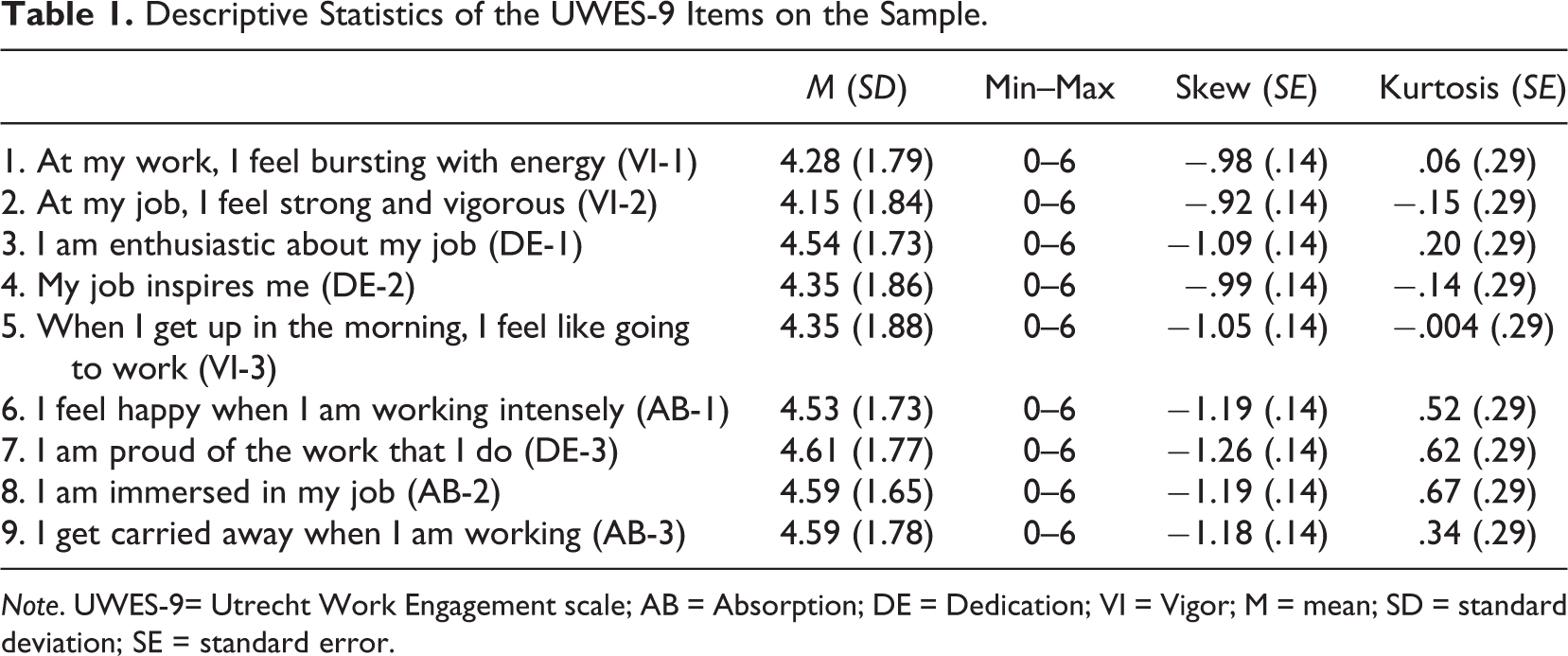
Note. UWES-9= Utrecht Work Engagement scale; AB = Absorption; DE = Dedication; VI = Vigor; M = mean; SD = standard deviation; SE = standard error.
Goodness-of-Fit Indices for Confirmatory Factor Analysis.

Note. N=310. χ2 = Chi-square test; df = degrees of freedom; χ2/df = normed chi-square; RMSEA = root mean suare error of approximation; NNFI = non-normed fit index; CFI = comparative fit index.
Means, Standard Deviations, Cronbach’s αs (on the Diagonal) and Correlations Among the Study Variables.

Note. N = 121; M = mean; SD = standard deviation.
*p < .05. **p < .01.
Path Analysis was used on individuals who were still eligible at the 12-month follow-up phase of the study (n = 121) to examine the relationships between drivers and outcome of work engagement as well as to test the study hypotheses about how they fit together. Table 3 presents means, standard deviations, Cronbach’s αs, and correlations among study variables. All constructs had satisfactory internal consistency and all correlations were in the expected direction. Figure 1 shows the standardized parameter estimates for the model of work engagement and the other variables. The model showed reasonable fit, χ2(6) = 3.43 (p = .75); CFI = 1.00; RMSEA = 0.0; NNFI = 1.03. In support of Hypothesis 1, Figure 1 shows a significant and positive path between social support from coworkers and supervisor and two work engagement dimensions (DE, CR 1 = 2.81; AB, CR = 2.87). No significant paths were detected between social support from the organization and the work engagement dimension of VI. In support of Hypothesis 2, Figure 1 shows that the results related to occupational self-efficacy were significant for all dimensions of work engagement (VI, CR = 4.31; DE, CR = 3.77; AB, CR = 4.53). A significant and negative path was found between severity of symptoms perceived and the work engagement dimension of VI (VI, CR = −2.02), while no significant paths between psychiatric symptoms and the other two dimensions of work engagement (DE and AB) were found. These results support Hypothesis 3. The relationship between the three work engagement dimensions and the intention to work in the competitive labor market had a significant and positive path between VI and the selected working plan (CR = 2.83), as shown in Figure 1. Moreover, nonsignificant paths resulted between DE (CR = −1.02) and AB (CR = −0.48) on one hand, and intention to work in the open labor market on the other. These results support Hypothesis 4.
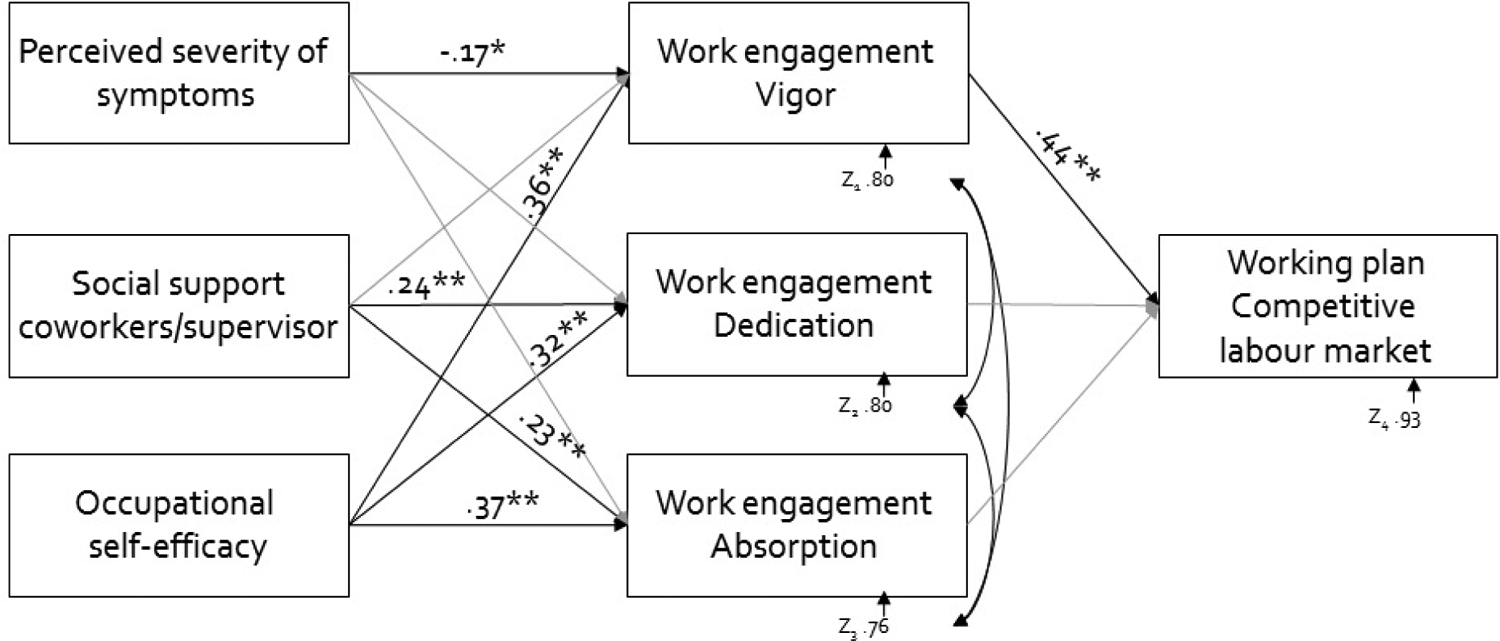
Model of work engagement, perceived severity of symptoms, job support and occupational self-efficacy, and intention to work in the competitive labor market.
Discussion
Given the lack of examples assessing the work engagement construct in people with mental disorders appearing in the literature, we used the UWES-9 to explore the nomological network of related constructs. An exploratory model including severity of symptoms perceived, social support from coworkers and supervisor, and occupational self-efficacy as antecedents of work engagement was tested and showed acceptable fit indexes. Furthermore, we examined the role of the three dimensions of engagement on the most important work outcome of social enterprises, which is the link with the regular labor market (e.g., work plan to work in the regular labor market). The results showed that individuals enrolled in social enterprises who receive support from coworkers and supervisors develop a strong sense of belonging, are enthusiastic, inspired, fully concentrated, and engrossed in their working tasks and fully integrated in the workplace. In short, they are dedicated and absorbed in their work-related goals (Hypothesis 1). In the model tested, occupational self-efficacy was related to all three dimensions of work engagement (Hypothesis 2), while in line with previous studies highlighting a positive relationship between work engagement and health (see Bakker et al., 2011 for a review), the severity of symptoms perceived was negatively related to the VI dimension of work engagement. Of the three dimensions of work engagement, VI seemed to be the crucial dimension for enhancing well-being, as shown by Shirom (2003). Thus, it was no surprise to find a negative relationship between gravity of psychiatric symptoms perceived and this dimension of work engagement. In contrast, as expected, the severity of symptoms perceived did not influence the sense of significance, enthusiasm, inspiration, pride, and concentration while working in people with mental disorders, providing further evidence of the capacity and willingness to work of this population. Finally, we predicted that engagement would affect the intention to work in the regular labor market (Hypothesis 4). The results suggested that the dimension of VI affected the selected working plan. The intention to work in the open labor market, which is the main goal of social enterprises, seems to be achievable for people with mental disorders who find their workload to be manageable, and who feel a high level of energy and resilience.
This study had some limitations we would like to address. First, all data were based on self-reports. Second, the sample size at follow-up was limited (n = 121) and, more specifically, the sampling method was based on convenience. Third, the model was tested in a specific context, the social enterprise, which, by definition, provides higher levels of organizational support and generates a strong sense of belonging and identification in its employees. This limitation notwithstanding, this study has provided interesting information about how work engagement, as well as its drivers, impacts on important work outcomes for workers with mental disorders. In particular, we highlighted the important role played by the VI dimension in this population as a mechanism through which individuals feel better at work and feel ready to take the next step of working in the open labor market.
Conclusion
The UWES-9 has been a useful instrument for measuring work engagement not only in the general working population but also in workers with mental disorders. In particular, the negative relationship between the dimension of VI, as assessed using the UWES-9, and the severity of symptoms shown in this study appeared to be of little concern for employers and different stakeholders involved in the work integration process of people with mental health issues. Employees who experienced high levels of energy and resilience felt better, had a tendency to explore, and were more likely to invest their resources in an attempt to work in the open labor market. An important starting point for employers could be the baseline measurement of engagement and its drivers (e.g., occupational self-efficacy and severity of symptoms perceived) among mentally ill employees, for example, by using the work engagement model presented in this article. Indeed, on the basis of this assessment, different working plans could be implemented for different individuals (e.g., to be prepared to work in the open labor market). In terms of individual-level interventions, programs designed to increase work engagement could focus on building personal resources such as occupational self-efficacy for employees.
Footnotes
Declaration of Conflicting Interests
The authors declared no potential conflicts of interest with respect to the research, authorship, and/or publication of this article.
Funding
The authors disclosed receipt of the following financial support for the research, authorship, and/or publication of this article: This research was funded by The Municipality of Rovereto (Italy) and the Federation of Cooperation in Trentino.