



Abstract
The purpose of this longitudinal study was to determine whether the degree of science interests and educational aspirations in students’ first year of university would significantly differentiate those students who graduated with a science major from those students who did not graduate with a science major. Moreover, the authors expected that educational aspirations would moderate the relation between science interests and graduating with/without a science major. First-year college students in introductory science courses were surveyed in their first semester and then again upon graduation. These 166 students’ science interests and educational aspirations were assessed at Time 1; their educational major was assessed upon graduation. The findings supported both hypotheses. Science interests and educational aspirations significantly differentiated whether or not students graduated with science majors. Moreover, the interaction of science interests and educational aspirations also significantly differentiated whether or not students graduated with a science major. In short, students who graduated with science majors, compared to their counterparts who graduated with nonscience majors, had significantly higher interests only when they also had higher educational aspirations.
Students who graduate with science majors, compared to those students who chose other fields, may be better prepared to enter a highly competitive, global job market in which scientific knowledge is exploding and technological skills are required. Moreover, science graduates are well positioned to pursue highly valued postsecondary education in the science, technology, engineering, and mathematics (STEM) fields. Although choice of science major as an outcome early on in students’ university education has been examined (e.g., Larson, Bonitz, Werbel, Wu, & Mills, 2011), we located a small number of longitudinal studies (e.g., Ware & Lee, 1988), and none whereby researchers had followed students to determine science degree completion. This is a serious omission since first- and second-year students commonly change majors several times before graduation (Gordon, 2007). Sheu and colleagues (2010), who meta-analytically reviewed cross-sectional findings related to intentions to choose a major, argued that there was a need for more longitudinal studies examining choice. They also noted that insufficient research has been conducted measuring choice variables beyond intentions to major in a particular program.
The purpose of this study was to address these shortcomings in the literature. We conducted a longitudinal study examining a critical choice variable, that was measured at the time students received their bachelor’s degrees rather than at the beginning of their education when academic majors are likely to change (Gordon, 2007). Specifically, we examined whether or not students completed a bachelor’s degree with a science major. We intentionally sampled students who were enrolled in introductory science courses. The predictor variables we examined were science interests and educational aspirations, which have been related in the literature to choice of educational major (e.g., Gasser, Larson, & Borgen, 2007; Ware & Lee, 1988).
Science Interests and Educational Major Choice
Vocational interests guide, direct, and sustain people to move toward certain activities in their environment and to move away from other activities (Low & Rounds, 2007). Vocational counselors have used interest assessments to assist undecided undergraduate students navigate toward majors that match their interests. The reliance on interest assessment by practitioners is well grounded in over 50 years of research. Interests have been shown to be stable for single individuals over many years (Hansen & Swanson, 1983; Low & Rounds, 2007; Rottinghaus, Coon, Gaffey & Zytowski, 2007; Strong, 1955; Swanson & Hansen, 1988). Moreover, investigative interests, one of John Holland’s (1997) Big Six (Realistic, Investigative, Artistic, Social, Enterprising, and Conventional), have been shown to help differentiate among families of educational majors (e.g., Gasser et al., 2007; Harmon, Hansen, Borgen, & Hammer, 1994; Larson, Wu, Bailey, Gasser, et al., 2010; Ralston, Borgen, Rottinghaus, & Donnay, 2004; Rottinghaus, Betz, & Borgen, 2003). Science interests are assessed under the umbrella of investigative interests, which also includes mathematics interests. Science interests in particular, along with other basic domains of interest beyond Holland’s Big Six, have also been shown to distinguish among different families of majors (Gasser et al., 2007; Larson, Wu, Bailey, Borgen, & Gasser, 2010; Ralston et al., 2004; Rottinghaus et al., 2003).
This substantial evidence highlighting the important role of investigative interests and science interests in the separation of educational major families is impressive; however, these studies were primarily cross-sectional rather than longitudinal. A few relevant studies have been longitudinal in design; however, they pertained to engineering interests and measured intention to declare an educational major rather than actual choice of major (e.g., Lent, Sheu, Gloster, & Wilkins, 2008; Lent et al., 2010), or they pertained to mathematics interests (Lapan, Shaughnessy, & Boggs, 1996; Ma, 2011). Only two studies were located that measured science interests specifically. Nauta and Epperson (2003), in a sample of Midwestern high school girls attending a career conference, showed that science interest was significantly related to whether or not students declared a science or mathematics major 4 years later when they were mostly juniors in college. Additionally, Larose, Ratelle, Guay, Senecal, and Harvey (2006) showed that science interests significantly predicted whether or not Canadian high school students persisted in science-related programs through their second year of postsecondary education. Notably, however, neither set of authors measured students’ major at graduation. Based on these two longitudinal studies and the cross-sectional studies described earlier, we expected in this study that science interests in undergraduate students’ first year of university would significantly predict whether or not they would graduate with a science major.
Educational Aspirations and Educational Major Choice
Educational aspirations, defined as the highest level of education an individual would like to attain, are viewed conceptually as the foundation of future career choice (Rojewski, 2005). However, despite solid empirical support, they have not been emphasized by vocational counselors. Like vocational interest, they appear to be stable starting around eighth grade (Rojewski & Kim, 2003) and are predictive of occupational aspirations 6 years later (Rojewski & Yang, 1997). Researchers have also provided evidence that educational aspirations play a significant role in predicting whether or not high school seniors endorsed science majors as second-year students in college (Ware & Lee, 1988). This relation was based on a 1980 sample, so these findings may or may not hold true today. However, this evidence led us to expect that first-year students in science reporting higher educational aspirations would also be more likely to graduate with a science major.
Educational Aspirations and Science Interests in Predicting Choice of Educational Major
Studies to date have examined interests and educational aspirations as predictors of choice as we have reviewed earlier. We wanted to extend the examination of these two constructs by examining their potential interaction, specifically educational aspirations as a moderator of the relation of science interests and choice of educational major. Although not directly examined in the literature, one study conducted by Swanson and Hansen (1988) over 25 years ago was highly relevant. They examined the predictive validity of the Strong-Campbell Interest Inventory (SCII; 1981) to predict college major 3.5 years later. Although not examining educational aspirations, they examined something very similar, namely the Academic Comfort Scale (ACS) of the SCII, which was a scale developed specifically to differentiate people who would be comfortable in an academic environment beyond the bachelor’s degree. The normative sample of this scale was college professors, mathematicians, and psychologists (Campbell & Hansen, 1981). Swanson and Hansen (1988) showed that the SCII had an excellent hit rate for predicting college major at Time 2 only when the ACS was high but not when it was low. This study provided some empirical foundation for examining educational aspirations as a moderator.
One other related study was located that showed that investigative interests were predictive of higher educational aspirations (Rottinghaus, Lindley, Green, & Borgen, 2002); however, we were unaware of studies that have included both science interests and educational aspirations as determinants of whether or not students would graduate with science majors.
Past research (e.g., Rojewski & Kim, 2003) suggests that students with higher educational aspirations may be more invested in their future careers and educational training. It is also possible that, since these students plan to pursue advanced degrees, they might be particularly drawn toward pursuing an academic area in which they are quite interested. Thus, if students have higher science interests, they may be even more motivated to graduate with science majors in order to pursue their next educational goals in the area of science. Moreover, science major completion may serve as the foundation upon which these students plan their future academic pursuits. Conversely, students with lower educational aspirations do not foresee education beyond the bachelor’s degree; obtaining immediate employment is paramount.
Based on the Swanson and Hansen (1988) findings, we explored the possible moderating effect of educational aspirations as influencing the role of science interests in differentiating who would and would not graduate with a science major. A moderator may affect the outcome variable such that both the predictor and moderator influence the outcome in the same direction, thereby having a synergetic effect (Cohen, Cohen, West, & Aiken, 2003; Frazier, Tix, & Barron, 2004). Conceptually, science interests and educational aspirations should propel students in introductory science courses toward completion of a science major upon graduation. Although they both may likely contribute individually, educational aspirations may also moderate the effect of first-year science interests on the criterion variable, whether or not university students graduate with science majors. That is, it may be that the effect of science interests on completing a science major is different depending on whether students have lower versus higher educational aspirations.
The first hypothesis of the present study was that science interests and educational aspirations measured during the first year of university (Time 1) would predict whether or not a student would complete a science major upon graduation (Time 2). The second hypothesis was that educational aspirations would moderate the effect of science interests on group membership (whether or not someone would complete a science major), such that higher aspirations would make students more likely to graduate with a science major. We chose to use hierarchical binary logistic regression (Peng, Lee, & Ingersoll, 2002), as it is well suited to analyze predictors of dichotomous group membership. Binary logistic regression also allows for examination of moderator effects.
Method
Participants
First Year (Time 1)
The original sample consisted of 242 undergraduate students who were recruited from several introductory science courses at a large upper Midwestern university at Time 1. Of those students, the participants in this study constituted only those students who had received their bachelor’s degree at Time 2, an average of 9.22 semesters later. These 166 students in the current sample comprised 68.6% of the original sample; the remaining 32.4% had either dropped out or were still taking courses. This retention rate of 68.6% is in the upper range based on official reports from the sample’s university. Of that proportion, 33.3% of students graduate in 4 years, and 31.4% graduate in 5 years (range for a sample of 242 students would be 81-152 students). The current sample’s average ACT questionnaire (ACT, Inc., 2009) score was representative of the larger population of entering first-year students (24.3 vs 24.5). Researchers also examined whether the students in the current sample were significantly different from the students who had dropped out or had not yet graduated on the major variables of interest in the study. Students in the sample who had graduated compared to those who had not were not significantly different from each other in terms of Time 1 educational aspirations, science interests, age, or gender representation, ps > .05.
Students in introductory science major courses (e.g., biology, microbiology) were sampled in their first year enrolled at the university. The mean age was 18.49 years (standard deviation [SD] = 0.62); most students were in their first year (98%) and unmarried (98.2%). The sample consisted of 104 women, 61 men, and 1 person who did not indicate gender. About 85% of the sample were Caucasian, 4.8% were Asian American, 3.0% were African American, 3% were Hispanic American, 3% indicated “Other”, and 2 students were international students. Students who identified the biological and physical sciences as their majors constituted 50% of the sample; students who identified pre health professional programs (e.g., premed) constituted 40% of the sample. The remaining sample identified as health and human performance majors (7%; e.g., kinesiology) or undecided (3%).
Graduation (Time 2)
Participants’ transcripts were collected upon graduation. Based on the majors listed on their transcripts, students in the sample were classified as graduating with either a science major (n = 114) or a nonscience major (n = 52). About 84% of the science majors were (from largest to smallest) biology (n = 47), kinesiology (n = 28), biochemistry (n = 7), microbiology (n = 7), genetics (n = 3), chemistry (n = 3), and biological and premedical illustration (n = 3). The 20 remaining transcripts listed 13 additional majors that were classified as science major 1 About 75% of the nonscience majors were from the social sciences (n = 13), business (n = 13), child and family studies (n = 6), liberal studies (n = 4), and elementary education (n = 3). The 13 remaining transcripts listed 10 additional majors that were classified as nonscience majors. (Note. Social science majors were not classified as science majors in this study.) The average number of semesters completed at the university prior to graduation was 9.22 semesters (SD = 1.53).
Measures
Demographics
The demographic form contained questions concerning age, year in school, academic major, and educational aspirations. Students responded to the educational aspiration item, “What are your current educational aspirations?” by checking one of the following categories: some college/no degree, associate degree, bachelor’s degree, master’s degree, medical degree, doctorate, or law degree. The educational aspiration item was recoded as bachelor’s degree or below (Lower Aspirations; n = 43) and master’s degree or above (Higher Aspirations; n = 123).
Science Interests
The Fouad-Smith Scales for Subject Matter Specific Social-Cognitive Constructs (Smith & Fouad, 1999) were developed to assess self-efficacy, interests, and goals across different academic domains. Only the science interests subscale was used in the present study. The response format was a 6-point Likert-type scale, with higher scores indicating more interest in science. Subscale scores were calculated by averaging the responses, which resulted in a response range of 1 to 6. The interest subscale of the measure included 15 items for science. Example items include “Indicate the extent to which you like or dislike working in a science laboratory” and “Indicate the extent to which you like or dislike watching a science program on TV.” Smith and Fouad (1999) reported an internal reliability coefficient for the combined mathematics/science interest subscale as α = .94; the internal consistency coefficient in the current sample was α = .89 for science interest.
Procedure
Participants were invited by their course instructors at the beginning of a class period to participate in the study. After students signed the informed consent, which included permission to access their ACT scores and college transcripts, participants completed the demographic information and science interest measures. Transcripts were obtained from the registrar’s office which identified participants’ majors upon graduation and certification that they had graduated.
Results
Descriptive Analyses
Means and SDs by level of educational aspiration (bachelor’s or below vs master’s or above) and major (science vs nonscience) for the variables are shown in Table 1. A 2 (educational aspiration) × 2 (major) analysis of variance (ANOVA) was conducted for the dependent variable, science interests. Significant main effects were present for both educational aspiration, F(1, 165) = 12.11, p = .001, and major, F(1, 165) = 5.77, p = .02. A significant interaction was also present, F(1, 165) = 5.20, p = .03. As can be seen in Table 1, the science majors who had aspired to obtain a master’s degree or beyond reported significantly more interest in science than the other three groups.
Means and Standard Deviations of Science Interests by Educational Aspirations and Graduating With/Without a Science Major (N = 166).a
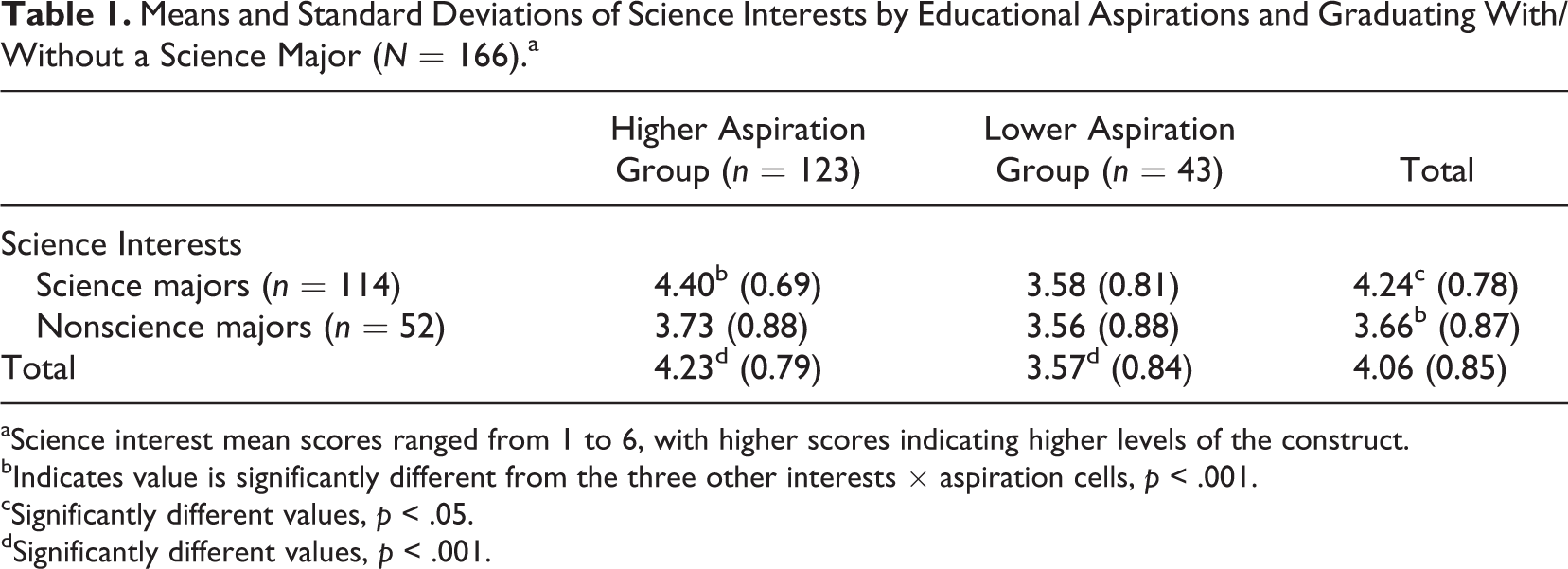
aScience interest mean scores ranged from 1 to 6, with higher scores indicating higher levels of the construct.
bIndicates value is significantly different from the three other interests × aspiration cells, p < .001.
cSignificantly different values, p < .05.
dSignificantly different values, p < .001.
Main Analyses
Using the Statistical Package for the Social Sciences (SPSS), a binary hierarchical logistic regression (Peng et al., 2002) was conducted to test the hypothesis that educational aspiration would moderate the effect of science interests in predicting whether or not participants would graduate with a science major. In the first step, the predictor variable, science interests, and the moderator variable, educational aspirations, were entered into the model. In the second step, the interaction term, Science Interests × Educational Aspiration, was added. The interaction term was created by computing the product of the standardized predictor (science interests) and the moderator variable (educational aspiration). The predictor, science interests, was standardized in order to reduce multicollinearity among the main effect and the interaction term (Cohen et al., 2003; Frazier et al., 2004).
In the first step, science interests and educational aspirations significantly differentiated between those who did and did not graduate with a science major, χ2(2) = 21.10, p < .001, and predicted approximately 11.9% of the variance using the Cox and Snell (1989) R 2 statistic, which is meant to approximate the R 2 statistic in multiple regression. These findings support the first hypothesis that science interests and educational aspirations would significantly differentiate whether or not students would graduate with a science major. An examination of the individual predictors in the first step revealed that both predictors were significant in the binary logistic regression (science interests: β = −.63, p = .002; educational aspirations: β = −.78, p = .05).
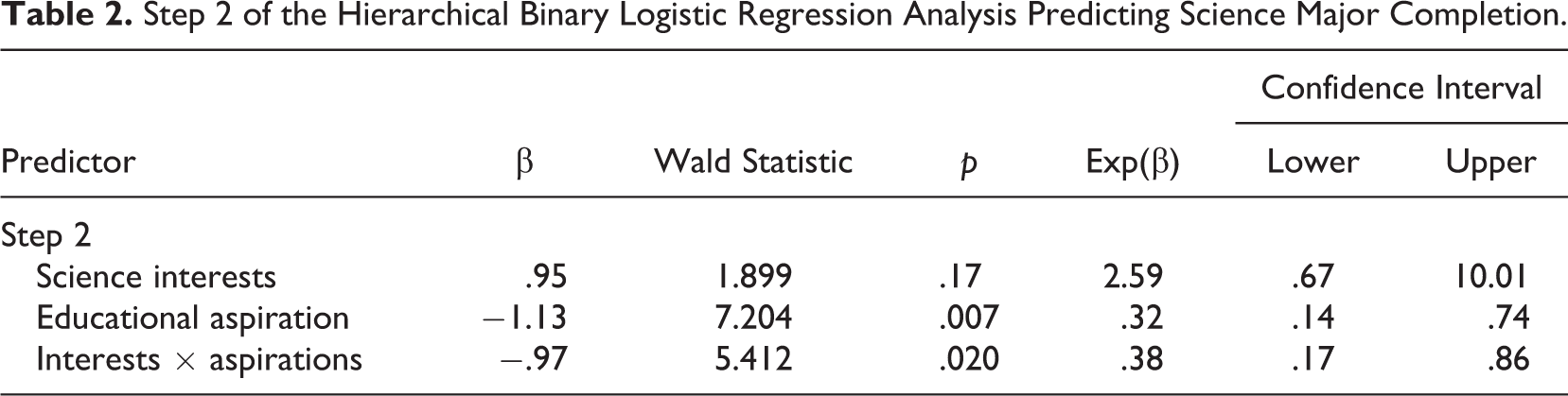
The interaction term was added in Step 2 to examine the hypothesis that educational aspirations would moderate the effect of science interests on group membership (science/nonscience major at graduation). Adding the interaction term led to significant improvement in the model χ2(1) = 5.51, p = .019. That is, educational aspiration moderated the effect of science interest on group membership. The overall model predicted 14.8% of the variance and remained significant χ2(3) = 26.62, p < .001. Table 2 presents the standardized coefficients, the odds ratios, and the confidence intervals for the odds ratio for Step 2 only. As can be seen in Table 2, the interaction was significant β = −.97, p = .02. These findings support our second hypothesis, demonstrating that educational aspirations of first-year students moderated the contribution of science interests in predicting whether or not students would graduate with a science major.
Step 2 of the Hierarchical Binary Logistic Regression Analysis Predicting Science Major Completion.
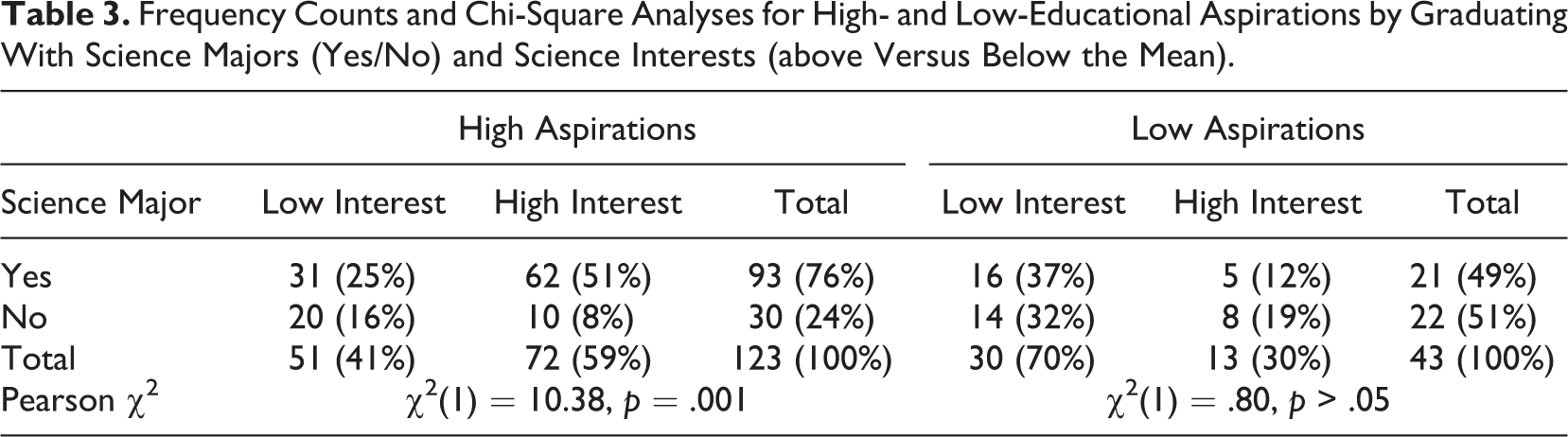
To visually display the interaction, the standardized science interest scores were dichotomized. Table 3 presents the frequency counts of graduating with a science major (yes/no) by high/low science interests when students’ educational aspirations are high and low. When students’ educational aspirations are high, high science interests significantly increase the proportion of students who will graduate with science majors, p = .001; when students’ educational aspirations are low, science interests are unrelated to whether students’ will graduate with a science major, p > .05 As seen by Figure 1, the level of interest differentiated the science from the non-science students only in the high aspiration group not the low aspiration group.
Frequency Counts and Chi-Square Analyses for High- and Low-Educational Aspirations by Graduating With Science Majors (Yes/No) and Science Interests (above Versus Below the Mean).
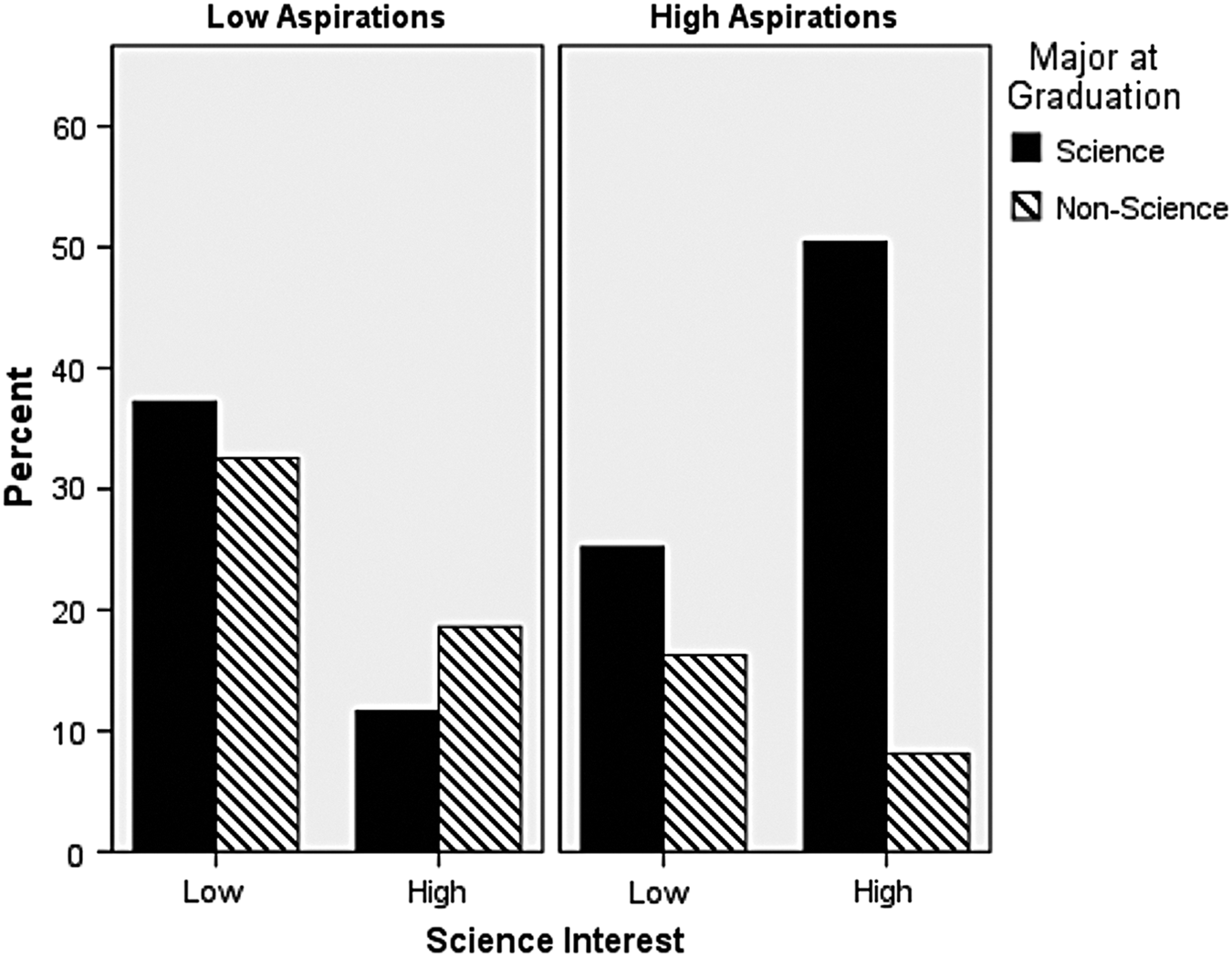
Percentage of science and nonscience majors with high and low science interests separated by educational aspiration level.
Discussion
Two major findings emerged from the current study. First, as predicted, science interests measured in first-year university students significantly contributed to whether or not students graduated with a science major 4 to 5 years later. Second, as predicted, the contribution of science interests to whether or not students graduated with science majors depended on the students’ level of educational aspirations.
Science interests in first-year students significantly contributed to differentiating between students who would and would not graduate with science majors. These findings support prior cross-sectional research that showed that investigative interests and science interests were influential in differentiating among families of educational majors (e.g., Gasser et al., 2007; Harmon et al., 1994; Larson Wu, Bailey, Gasser, et al., 2010; Larson, Wu, Bailey, Borgen, et al., 2010; Ralston et al., 2004; Rottinghaus et al., 2003). These findings are also consistent with two longitudinal studies showing that high school seniors’ levels of science interests were predictive of whether or not they were pursuing science majors in the middle of their postsecondary education (Larose, Ratelle, Guay, Senecal, & Harvey, 2006; Nauta & Epperson, 2003). The current study provides solid evidence that students’ science interests help propel them to graduate with science majors 4 to 5 years later.
The second finding from this study, namely that science interests contributed to whether or not students graduated with science majors only for those students with higher educational aspirations, tempers the first finding. The moderation effect of educational aspirations in current study is consistent with the findings by Swanson and Hansen in 1988, where they showed that vocational interests were more predictive of educational major at graduation when students reported high rather than low academic comfort scores. The emergence of educational aspirations as a moderator of the effects of science interests on the outcome, graduating with or without a science major, is novel in the vocational literature. Although Rottinghaus and colleagues (2002) showed that investigative interests were related to higher educational aspirations, no researchers have intentionally examined the interaction of science interests and level of educational aspirations. In the current study, the role of science interests was salient in determining whether or not students would persist in graduating with a science major but only for those students who have higher rather than lower educational aspirations (see Table 3 and figure 1). We hypothesized that educational aspirations would moderate the effect of science interest on whether or not students graduated with science majors, since the students aspiring to advanced educational degrees are looking beyond the bachelor’s degree. Moreover, they are likely viewing the bachelor’s degree as only the first step toward a professional career. For these students, their degree of interest in the sciences is going to propel them toward (or away) from graduating with science majors.
It should be noted that in the present study, the sample at Time 1 consisted of students recruited from introductory science courses who were planning to major in the sciences. The moderating effect of educational aspirations on science interests would need to be examined in other populations beyond students intending on majoring in the sciences. In the case of university science students who are already immersed in programs preparing them for high-demand jobs in our ever technologically advancing society, the range of advanced degree program options is expansive, and the prestige alluring. It seems that science interests are particularly motivating for high-aspiring university students. If these results are replicated, it may compel vocational counselors to ascertain motivating factors in addition to interests for those students with lower educational aspirations. Values, salary, or job availability, for example, also may be important to the career decision processes of these individuals who are not quite as driven by their vocational interests. Exploring other influences in their lives may be helpful in finding academic majors that are satisfying. Future researchers should replicate these findings across Holland’s six interest domains (e.g. enterprising). Nonetheless, this study offers a potentially helpful consideration for career counselors: Science interests combined with higher educational aspirations in science students may both be necessary for them to persist in graduating with science majors.
Footnotes
Authors’ Note
Dr Tsui Feng Wu is now an assistant scientist II in the Veterinary Medicine Administration.
Declaration of Conflicting Interests
The author(s) declared no potential conflicts of interest with respect to the research, authorship, and/or publication of this article.
Funding
The author(s) received no financial support for the research, authorship, and/or publication of this article.