



Abstract
Having a strong vocational identity is a prelude to the formation of individuals’ overall identity. Hence, vocational identity has long been a variable of interest in vocational research. However, most existing studies utilized Holland, Gottfredson, and Power’s My Vocational Situation (MVS) vocational identity subscale to measure vocational identity. Due to how its items are worded, we contend that the MVS was not able to accurately capture vocational identity as a stable construct. Its dichotomous response scale also limits researchers’ attempts to evaluate its psychometric properties. To address these issues, we developed and validated a new “Vocational Identity Measure (VIM)” that utilizes Likert-type responses. The VIM seeks to measure how aware individuals are of their stable career goals, interests, and abilities. Results (Studies 1 and 2) suggest that the VIM possesses sound internal reliability, a stable single-factor structure, and incremental validity over the MVS. The scale also has good convergent validities with relevant constructs such as career decision self-efficacy and exploration. Based on these findings, the strengths and limitations of the VIM scale are discussed, and future research directions are proposed.
Identity refers to one’s understanding and conceptualization of oneself, and has far-reaching impacts on individuals’ lives because of its influence on cognition and behavior (Stets & Burke, 2000). In the area of vocational research, scholars have found that vocational identity provides a good framework to understand career decision-making processes (Holland, Gottfredson, & Power, 1980). Vocational identity reflects knowledge regarding stable patterns of career interests, goals, and abilities, and emerges from the integration of life experiences (Holland et al., 1980). In particular, individuals with a strong vocational identity have a clearer picture of their career goals, interests, abilities, and will be more successful in identifying suitable occupational options for themselves (Holland, 1996).
Vocational Identity in Existing Studies
Many scholars have demonstrated and acknowledged the influential role of vocational identity in the process of career development and decision making among adolescents and young adults, who are at the critical stage of balancing beginning a career while establishing their self-identities (Gushue, Scanlan, Pantzer, & Clarke, 2006; Raskin, 1989; Robitschek & Cook, 1999). In fact, Skorikov and Vondracek (1998) noted that vocational identity preludes the formation of overall self-identity.
In the existing literature, vocational identity has been studied as a predictor of various outcomes. For example, Savickas (1993) found that individuals with a stronger vocational identity reached identity foreclosure earlier and made career decisions earlier. De Goede, Spruijt, Iedema, and Meeus (1999) conducted a study on 1,222 adolescents and young adults, and found that those with a stronger vocational identity had better mental health, such as lower stress and depression.
Other studies focused on elucidating factors that contributed to the formation of vocational identity. For instance, differences in individual stable traits predicted the strength of vocational identity. Lopez (1989) found trait anxiety was negatively related to vocational identity in both male and female undergraduates, as individuals who felt anxious experienced greater difficulty in exploring career options and determining their goals and strengths, and thus had weaker vocational identities. In another study, Gushue, Clarke, Pantzer, and Scanlan (2006) found that self-efficacious individuals were more likely to have a stronger vocational identity. This was because individuals with high self-efficacy had greater confidence in their abilities to reach their career goals, and thus had an easier time reinforcing their vocational identity (Gushue, Clarke, et al., 2006).
Contextual factors also play a role in the formation of vocational identity. Hargrove, Creagh, and Burgess (2002) found that individuals from families that emphasized achievement orientation had a strong vocational identity. Similarly, Johnson, Buboltz, and Nichols (1999) found that family cohesion and family expressiveness were beneficial for formation of vocational identity among adolescents. This is because family expressiveness encouraged adolescents to communicate their vocational goals and interests openly and directly with their family members, and thus helped them attain a vocational identity (Johnson, Buboltz, & Nichols, 1999). Similarly, Turner et al. (2006) found that exploring career options aided the process of forming a strong vocational identity. These studies highlight the importance of vocational identity as a framework in understanding individuals’ career development and decision making.
Gaps in Existing Literature and Contributions of This Study
Most of the abovementioned studies measured vocational identity using Holland, Gottfredson, and Power (1980) My Vocational Situation (MVS) vocational identity subscale. This vocational identity subscale contains 18 items and in recent years, the MVS subscale has often been administered as a stand-alone scale to assess vocational identity in vocational research (Holland, Johnston, & Asama, 1993). Theoretically, vocational identity is a relatively stable construct tapping into an individuals’ global awareness about their career goals and interests, whereas vocational situation is a specific construct that measures an individuals’ current perceptions of their career. Although Holland’s subscale is labeled as a vocational identity subscale, and also uses a similar conceptual definition of vocational identity as us (Holland et al., 1993), a close examination of this MVS vocational identity subscale (e.g., “I am not sure that my present occupational choice or job is right for me”) suggests that this subscale is more focused on assessing how individuals feel about their career situation at the current moment, instead of their stable awareness of their vocational goals and interests.
Supporting our claim concerning the differences between vocation identity and vocational situation, Savickas (1985) noted that since Holland et al.’s (1980) MVS vocational identity subscale is based on an assessment of the current career-related situation, it is unable to adequately capture the full content of vocational identity because it does not recognize that vocational identity is a crystallized product based on life experiences. In order to fill the existing gap in the definition of vocation situation which is based on in the moment career perception, it is necessary to create a vocational identity measure (VIM) based on a definition that expands the present one and that includes a better understanding of career goals, interests, and abilities over the life span.
Additionally, the MVS uses a dichotomous true–false response to its scale items. This forces respondents to make a choice for each item even if they are neutral about the item content, thus distorting correlations between items and causing it to be more difficult for psychometric evaluation such as exploratory factor analysis (EFA) to be conducted (Reise, Waller, & Comrey, 2000).
These shortcomings prompted a need to develop and validate a new VIM that would enable researchers and career counselors to capture individuals’ stable vocational identity more accurately. Specifically, our measure aims to update Holland et al.’s (1980) scale to improve on its construct validity (i.e., to reflect vocational identity as a stable construct), and to use a Likert-type scale in order to facilitate the examination of the measure’s psychometric properties subsequently. The new VIM will hopefully provide a better tool for individuals to assess their career identity status and to help scholars investigate relationships between vocational identity and other variables more precisely. In addition, future research could be conducted to compare the relative validity and utility of the current VIM in comparison to Holland et al.’s (1980) MVS.
Scale Construction
We utilized a rational–theoretical approach to write the items for this measure. After reviewing the literature on how vocational identity is defined, used, and measured in existing studies, the first and second authors of this study decided to follow Holland’s (1996) definition of vocational identity as one’s knowledge of his or her stable pattern of career goals, interests, and abilities, in order to construct items for the new scale. Based on this definition, we expected the construct to be unidimensional, tapping mainly on how much one is aware of his or her career aspirations. Following this line of reasoning, the first author created 23 items for the measure. The second author read the items and revised them for clarity. The final 23 items were agreed upon by both authors and are shown in Table 1. Of the 23 items, 2 items (Item 12 and Item 17) were reverse-worded, such as “I cannot make a decision about what I want to do for a living.” According to Sudman and Bradburn (1983), including reverse-worded items in a measure helps researchers prevent and detect acquiescence response bias where respondents agree with all items indiscriminately. In addition, we decided to use a 5-point Likert (1 = strongly disagree; 5 = strongly agree) for the response options. We chose a Likert-type scale instead of an ipsative scale or a dichotomous yes–no scale because there is a midpoint in a Likert-type scale which allows participants to neither agree nor disagree with an item instead of being forced to make a choice. In addition, continuous ratings, as opposed to dichotomous ratings, would enable factor analysis to be conducted more easily to explore the factorial structure of this scale.
Item Contents, Descriptive Statistics, and Factor Loadings.

Note. Factor loadings based on principal axis factoring and oblique rotation. Only one factor was extracted, hence no rotation. [R] Reverse-coded items.
aItems 2, 3, and 22 were removed during preliminary analyses and not included in exploratory factor analysis (EFA) and Study 2.
Study 1
Study 1 was conducted to examine the factorial structure and internal consistency of the initial VIM items in order to refine the scale. We also wanted to examine the incremental validity of the VIM over Holland et al.’s (1980) MVS scale in predicting whether respondents were decided or undecided on their desired career choice. In a review of 15 studies, Gordon (1998) found that vocational identity predicts whether adolescents were decided or undecided about their career paths. To exhibit incremental validity, VIM should significantly predict respondents’ decidedness on their desired career choice beyond Holland et al.’s (1980) scale.
Method
Respondents
Two hundred and fifty-four undergraduates were recruited via the university subject pool. Of the respondents, 99.2% were below 25 years old, 40.2% were males, and 85.8% were Caucasian Americans with the rest being African Americans, Asian Americans, Hispanics/Latinos, and mixed races.
Procedure
Respondents completed a questionnaire containing 23 items of our new VIM and 18 items from Holland et al.’s (1980) MVS scale in exchange for course credits. We also asked respondents for their desired career choice, with the option of filling in an occupation name or indicating “undecided.” Responses were coded 0 if respondents indicated that they were undecided on their desired career choice and 1 if respondents indicated a desired occupation.
Results
Descriptive Statistics
Table 1 documents the means and standard deviations (SDs) of the 23 items. The means of the items ranged from 3.03 to 4.23, with SDs between .69 and 1.24. The skewness of the items ranged between .06 and −.92. Since the skewness values were within −1.00 to +1.00, the data distribution was deemed to be generally normal. However, it should be noted that Item 2 had the highest mean (M = 4.23), lowest SD (SD = .69), and the most negative skewness (skewness = −.92). This suggests the possibility of a ceiling effect on the responses to Item 2.
Interitem and Item-Total Correlations
Zero-order correlations between the items ranged from .06 (between Item 13 and Item 22) to .83 (between Item 14 and Item 23). Items 2, 3, and 22 had particularly low correlations with other items, with average interitem correlations being .28, .45, and .18, respectively. Corrected item total ranged from .24 (Item 22) to .89 (Item 23). Three items (Items 2, 3, and 22) had particularly low item-total correlations of .35, .57, and .24, respectively. Average interitem correlations and item-total correlations are reported in Table 1. These results implied that Items 2, 3, and 22 were not hanging together with the rest of the scale. In addition, as raised earlier, Item 2 had relatively more skewed responses and a plausible ceiling effect. Therefore, after thorough discussion, the authors decided to remove these 3 items from the scale and from further analyses, resulting in a final 20-item VIM.
EFA
An EFA was conducted on the final 20-item VIM. The scale yielded .97 on the Kaiser–Meyer–Olkin measure of sampling adequacy. This suggested adequate common variance among the items, and justified conducting a factor analysis on the scale. Using a principal axis extraction with oblique rotation, the results revealed only one factor with an Eigenvalue larger than 1.00. This was congruent with our expectation of the scale being unidimensional. The single factor accounted for 65.71% of the total variance in the scores. Factor loadings ranged between .62 (Item 9) and .91 (Item 23).
Reliability
The 20-item scale reported a reliability of α = .97, supporting strong internal reliability within the scale. Results also indicated that removal of any 1 of the 20 items would result in a lower reliability coefficient.
Correlation With MVS Score
Our 20-item VIM score was positively correlated with Holland et al.’s (1980) MVS score (r = .72, p < .01), indicating that our VIM had some overlap with the MVS but still possessed some degree of discriminant validity from it.
Incremental Validity
In order to examine VIM’s incremental validity over Holland et al.’s (1980) MVS in predicting whether respondents were decided or undecided about their career choices, we conducted a logistic regression using desired career choice (0 = undecided; 1 = decided) as the outcome variable, and the MVS and VIM scores as the predictors. The MVS score was entered in the first step, and the VIM score was entered in the second step. A test of the full model as compared to a constant-only model showed statistical significance, indicating that the MVS and VIM scores collectively predicted whether respondents were decided or undecided about their desired career choices (χ2 = 51.86, df = 2, p < .01). Overall prediction success was 86.2%. The Wald statistics suggested that our VIM (Wald = 13.53, p < .01) incrementally predicted career decidedness over Holland et al.’s (1980) MVS (Wald = 5.03, p < .02). After controlling for the MVS in the model, the Exp(B) of 3.71 for the VIM score indicated that when VIM score was raised by 1.00, respondents were 3.71 times more likely to be decided about their desired career.
Discussion
In summary, we created and administered the scale to undergraduates in Study 1. Based on the results, we revised the scale by eliminating 3 items with low item-total correlations, and ended up with a 20-item VIM scale. This final scale showed a strong single-factor structure in the EFA conducted, and high reliability, which supported our theory that vocational identity was a unidimensional construct. It was positively correlated but not entirely overlapped with the MVS, indicating its discriminant validity from the MVS. In addition, our VIM showed incremental validity over the MVS in predicting if respondents were decided or undecided on their desired career choice. Taken together, these findings provide support that our VIM assesses a distinct construct from the MVS.
Study 2
The purpose of Study 2 was to cross-validate the results of Study 1 on a sample of high school students in order to further assess the factorial structure of the 20-item VIM. High school students are at a life developmental stage where they are exploring their vocational identities (Gushue, Clarke, et al., 2006; Gushue, Scanlan, et al., 2006), and are thus an ideal sample to cross-validate our measure. We also wanted to examine the convergent and discriminant validities of the scale in this study by looking at the relationships between the VIM score, and vocational exploration and commitment (VEC), career decision self-efficacy (CDSE), career discussion with parents, and parents’ educational level. In particular, we hypothesized that VIM would be positively related to exploration of career options and also career discussion with parents. This is because previous findings have shown that exploring career options help individuals become aware of their strengths and the requirements of certain careers, and contribute to the building of their vocational identity (Leal-Muniz & Constantine, 2005; Werbel, 2000). Also, existing studies have demonstrated that discussing and communicating career plans with family helps adolescents think about and forge their vocational identities (Hargrove, Creagh, & Burgess, 2002; Johnson et al., 1999). Expanding on this point, we also hypothesized that VIM would not be related to parents’ educational levels. This is because vocational identity is reinforced by parents’ willingness to discuss career plans with their children and that is independent of their educational levels (Kracke, 1997).
Method
Respondents
Two hundred and fourteen students from several Midwestern high schools completed our questionnaire in exchange for a gift card. Of the respondents, 53.7% were males, 69.4% were Caucasian Americans, 11.1% were Asian Americans, 6.9% were African Americans, and the rest were Hispanics/Latinos and mixed races. Their mean age was 17.04 (SD = 1.03).
Procedure and Measures
Procedure
Respondents completed a questionnaire containing items from the vocational identity scale, VEC scale, and the CDSE scale. They also rated how much they discussed their career options with their parents, and their parents’ educational levels. Finally, they reported demographics information such as age, gender, and ethnicity.
Vocational identity scale (VIM)
There were 20 VIM items, and respondents rated them on a 5-point Likert-type scale (1 = strongly disagree; 5 = strongly agree). Items 12 and 17 were reverse-coded. Ratings on the 20 items were aggregated to form a composite VIM score, where higher scores indicated a strong vocational identity. The Cronbach’s α for this scale was .96.
VEC scale
The VEC scale was an 18-item measure developed by Blustein, Ellis, and Devenis (1989) to assess the degree to which individuals have progressed from an uncommitted exploratory phase to a committed and explored phase in their vocational development. A sample item is “I am able to commit myself firmly to a specific career goal.” Respondents rated the items on a 7-point scale (1 = never true; 7 = always true). The VEC yielded a high internal reliability of α = .91 in the current study.
CDSE
This scale was developed by Taylor and Betz (1983) to measure how confident respondents felt about making career decisions for themselves. There were 25 items, rated on a 5-point Likert-type scale (1 = not confident at all; 5 = completely confident). A sample item is “Determine the steps you need to take to successfully complete your chosen major.” All the ratings were aggregated to form a composite CDSE score, where a higher score represented higher CDSE. The reliability for this scale was high at α = .94 in the current study.
Career discussion with parents and parents’ educational level
Respondents also reported how much they discussed their career options with their parents in the last 6 months on a 5-point Likert-type scale from not at all to very much, and their father’s and mother’s educational levels (1 = elementary school or lower; 5 = master’s degree or higher). The parents’ (father and mother) educational levels were aggregated to form the composite parents’ educational level score.
Results
Descriptive Statistics
The means and SDs of the 20 items are reported in Table 1. The means of the items ranged from 3.11 to 3.69 on a 5-point scale, with SDs between .74 and 1.32. The skewness ranged between −.13 and −.83. Although these values indicated slight negative skewness, they were within −1.00 to +1.00; hence, the data distribution was deemed to be generally normal.
Confirmatory Factor Analysis
The VIM contains 20 items, which is a large number of items for CFA to be conducted on the data. In order to proceed with CFA, we followed the parceling procedure by Little, Cunningham, Shahar, and Widaman (2002) to group the 20 items randomly into four parcels. Next, we conducted CFA using AMOS 21.0 on covariance matrices, and generated solutions using maximum likelihood estimation. The one-factor model we tested is shown in Figure 1. We set the regression weights of each residual to each parcel to be 1.0, and the variance of the latent VIM factor to be 1.0 too. The indices obtained supported that the one-factor model had a good fit, χ2(2, N = 214) = 4.510, p = .105; root mean square error of approximation = .077; goodness of fit = .990; Tucker–Lewis Index = .993; comparative fit index = .998. Factor loadings of the model are shown in Figure 1 as well.
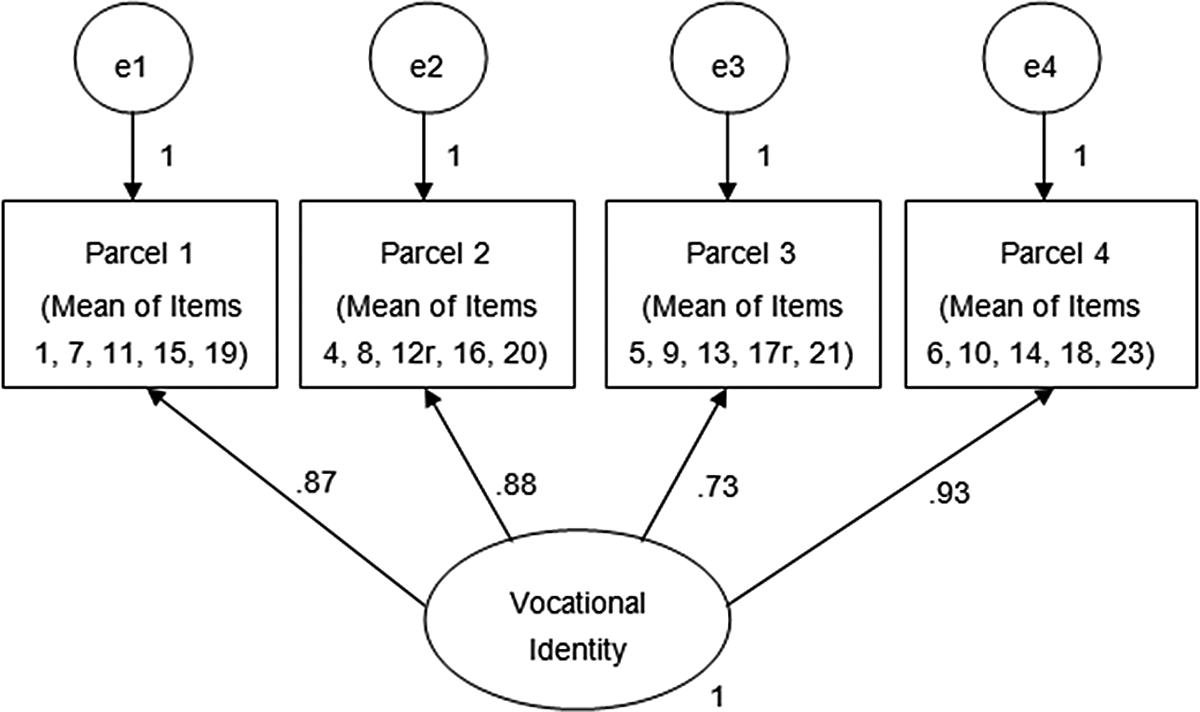
One-factor model for confirmatory factor analysis.
Reliability
The 20 items in the VIM yielded a reliability of α = .96, which indicated high internal consistency within the scale.
Convergent and Divergent Validities
The VIM composite score was correlated with the VEC score, the CDSE score, career discussion with parents, and parents’ educational level (Table 2). The VIM showed positive correlations with career exploration and commitment (r = .64, p < .01), CDSE (r = .53, p < .01), and career discussion with parents (r = .22, p < .01). On the other hand, it did not correlate significantly with parents’ educational level (r = −.09, p = n.s.). These results were expected and are discussed in greater detail in the subsequent section.
Correlations Between Vocational Identity and Other Variables.
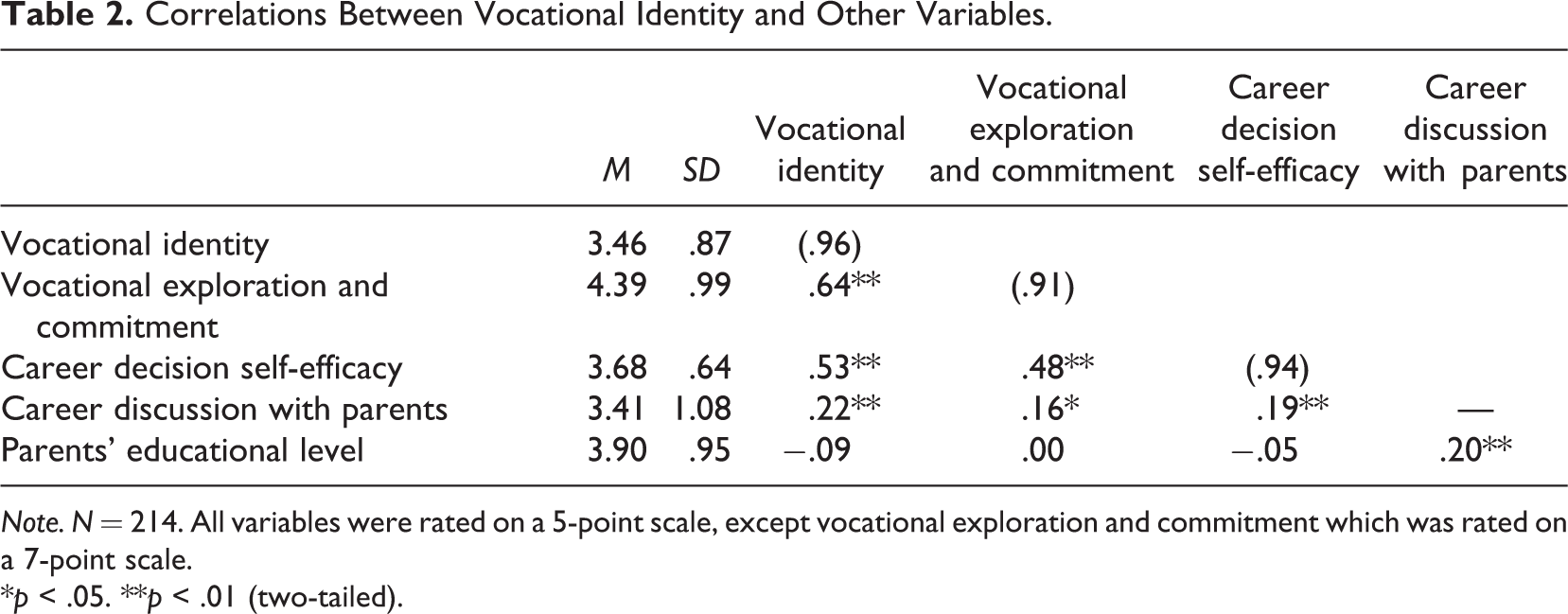
Note. N = 214. All variables were rated on a 5-point scale, except vocational exploration and commitment which was rated on a 7-point scale.
*p < .05. **p < .01 (two-tailed).
Discussion
In this article, we developed and validated the VIM, by conducting EFA, reliability assessment, confirmatory factor analysis, and tests of convergent and divergent validities on two sets of data. Here, we discuss the results and evaluate the psychometric properties of the VIM.
Strengths
Findings from our EFA in Study 1 and confirmatory factor analysis in Study 2 provided strong support for the unidimensional factor structure of the VIM. Our reliability assessment also indicated that the scale had good internal consistency.
Next, our validity assessment demonstrated good convergent and discriminant validities of the VIM. In particular, the VIM scores were strongly positively related to career exploration and commitment, and CDSE. This replicates previous findings that exploration of career options helps individuals build their vocational identity (Holland, 1996; Leal-Muniz & Constantine, 2005; Werbel, 2000) and that a strong vocational identity is a prerequisite for being efficacious in making career decisions (Gushue, Scanlan, et al., 2006; Taylor & Betz, 1983). In addition, the VIM’s positive relationship with career discussion with parents suggests that discussing career options with parents helps to reinforce one’s vocational identity, which was expected since previous literature has illustrated that an open and direct communication about career goals and interests within the family will facilitate the formation of vocational identity in adolescents (Hargrove et al., 2002; Johnson et al., 1999). However, the correlation of .22 instead of a higher correlation suggests that there are other factors, besides discussion with parents, which contribute to one’s vocational identity, and this reinforces existing propositions that vocational identity is formed from a dynamic interaction of life experiences (Holland, 1996).
Also, as hypothesized, the VIM did not correlate significantly with parents’ educational levels. This means that it is the process of discussing career options with parents, but not the educational levels of parents, which helps to reinforce vocational identity. This was expected because existing literature has shown that parents’ openness to discuss career topics with children would predict vocational exploration, and this relationship was independent of parents’ educational levels (Kracke, 1997). Therefore, our insignificant correlation between the VIM and parents’ educational levels is consistent with the existing literature, and demonstrates discriminant validity of the VIM.
Limitations and Future Directions
Although results from both studies have provided strong support for the VIM as a psychometrically sound measure, we acknowledge the following limitations in our study and make some suggestions to address them. First, our second study validating the scale did not administer Holland et al.’s (1980) vocational situation scale to respondents due to constraints on the length of survey. As a result, we were not able to investigate whether our VIM had incremental validity over Holland et al.’s (1980) vocational situation measure (MVS). Future studies should consider examining the relationships between the two scales, and between the two scales and other criterion variables. This will help appraise how distinct the two scales are from each other and how effectively they are able to capture vocational identity, respectively.
Second, our study did not examine the test–retest reliability of the scale. Test–retest reliability helps to establish the temporal reliability of scales to ensure that findings associated with these measures could apply across time (Guttman, 1945). Unfortunately, due to constraints posed by our data collection method, we were not able to obtain follow-up data from respondents. It would be ideal for future research to examine the test–retest reliability of the VIM in order to examine if vocational identity is indeed a stable construct. Related to this, researchers may also be interested in looking at the measurement invariance of the VIM and investigate whether individuals will respond to the scale in a similar fashion at different life stages (such as at adolescence vs. at retirement). This will provide insights into the dynamics of vocational identity across the life span.
Finally, future research could examine the incremental validity of the VIM beyond existing career measures in predicting career decision achievement and satisfaction. This could be done by longitudinal studies following high school students or undergraduates for several years to investigate if having a strong career identity would indeed result in an easier career decision-making process and career pursuit, and higher satisfaction with their career decisions eventually.
Findings from our study suggest that individuals and career counselors can use this scale to help them during the career decision-making process because it assesses and informs individuals of how aware they are about their career goals, interests, and abilities. In the case where individuals have weak vocational identity, interventions can be implemented in order to encourage individuals to explore their interests and career options available to them, so as to build up their vocational identity. However, it is necessary to also recognize that career decisions are dynamic processes influenced by both personality and situational factors (Feldman & Bolino, 1996), and a comprehensive evaluation of these factors has to be conducted in order to understand how to enhance one’s career identity. In conclusion, we have developed a psychometrically sound measure of vocational identity that can be used in future studies. It serves as a viable alternative to Holland et al.’s (1980) MVS.
Footnotes
Declaration of Conflicting Interests
The author(s) declared no potential conflicts of interest with respect to the research, authorship, and/or publication of this article.
Funding
The author(s) received no financial support for the research, authorship, and/or publication of this article.