



Abstract
Based on a sample of 611 employed parents in Israel, the study aimed to examine how occupying multiple roles on the one hand and satisfying roles on other hand are related to a sense of meaning in life (MIL). In addition, the contribution of two types of role conflict—interference of work with family (WIF) and interference of family with work (FIW) —to explaining MIL was examined. The findings revealed that the number of roles as well as the proportion of satisfying roles was directly related to a sense of MIL. Moreover, the number of roles and the proportion of satisfying roles occupied by the participants were indirectly related to their sense of MIL: The relation between the number of roles and sense of MIL was mediated by FIW conflict, whereas the relation between the proportion of satisfying roles and the sense of MIL was mediated by both types of role conflict (FIW and WIF). Men showed a greater tendency than women to experience WIF conflict, whereas no gender differences were found with regard to FIW conflict. Long hours of work outside of the home were positively related to WIF conflict and negatively related to FIW conflict.
Keywords
Most of the early studies dealing with the impact of multiple roles on well-being were conducted among women, following their massive entry into the labor market (Brody, 1981). At that time, many women enlarged their role set by adding paid employment outside of the home to their traditional roles as wives and mothers. However, changes in gender role attitudes in recent years have also affected men's role set (Davis & Greenstein, 2009; Lendon & Silverstein, 2012), as reflected in the terms “new men” (Marsiglio, 1993) and “new fathers” (Johansson & Klinth, 2008). Especially in the young generation, men are more involved in household tasks and in child care than they were in the past (Ishii-Kuntz, 2013; Kulik, 2013). As fathers today may also experience strain due to the conflicting demands of work and family spheres, the impact of multiple roles on men's well-being has become a popular topic among researchers in the fields of family and career studies (Brown & Sumner, 2013; Jones, Burke, & Westman, 2013). More specifically, both working mothers and fathers can experience two types of role conflict: family–work conflict, where family demands interfere with the work domain (FIW), and work–family conflict, where the demands of work interfere with family and household responsibilities (WIF—Greenhaus & Powell, 2006).
Today, besides occupying the role of worker and parent, individuals may occupy a large set of roles relating to the family as well as to self-development and community (Kulik & Liberman, 2013). Thus, based on an Israeli sample of working parents, we examined two main questions in the present study: How are the number of roles and the proportion of satisfying roles occupied by working parents today related to WIF and FIW conflict? In addition, we examined how the number of roles and the proportion of satisfying roles occupied by working parents are related to well-being as expressed in the sense of meaning in life (MIL).
Multiple Roles Among Working Parents Today
In light of technological developments and normative changes, both men and women perform more roles than in the past in the domains of family, work, and community as well as in the area of self-development. For example, following medical advancements that have increased life expectancy, there is a growing population of elderly persons who require long-term care from family members (Keck & Saraceno, 2010). Medical advancements have also enabled women to remain fertile for longer, so that oftentimes working parents need to care simultaneously for their elderly parents as well as for their young children. Essentially, these parents represent a new generation that researchers have referred to as the “sandwich generation” (Malach-Pines, Hasan, Hammer, & Neal, 2010). Concomitantly, working parents in midlife are often asked to take care of grandchildren in order to enable their adult children to develop a career and establish their own families (Kulik, 2007).
Furthermore, owing to the increasing emphasis on the value of self-actualization (Sagiv & Schwartz, 2000), people are investing more time and energy in leisure activities, hobbies, and continuing education than in the past. Besides these roles, the value of contributing to society is manifested in the increased prevalence of community activities, volunteer work, and other altruistic activities (Ogilvie, 2004). In light of the larger role set that characterizes working parents today, and in light of the growing emphasis on individual quality of life, the relation between multiple roles and well-being has become an increasingly relevant issue for many researchers in the fields of family and career studies (for a recent meta-analysis, see Allen et al., 2012). A leading theoretical framework for examining the relation of multiple roles to the experience of role conflict (WIF and FIW conflict) and to well-being is the well-known enrichment theory (Marks, 1977).
Enrichment Theory: Strengths and Pitfalls
Enrichment theory assumes that multiple roles usually have more positive than negative implications for individuals (Blom et al., 2007; Carlson, Kacmar, Wayne, & Grzywacz, 2006). According to this approach, performing multiple roles can have three types of benefits. First, multiple roles can increase the supply of resources that people have at their disposal (e.g., financial resources gained from work and social resources gained from cooperation with colleagues). Second, success in one role can compensate for a sense of failure in another role, and thus mitigate the negative effects of failure on personal well-being. Third, when people engage in multiple roles, they might feel that they are realizing their potential, and this can foster their sense of self-worth and MIL (Greenhaus & Powell, 2006).
Over the years, there has been impressive empirical support for the enrichment perspective, as reflected in the direct and indirect relation between multiple roles and well-being (see for example Blom et al., 2007; Carlson et al., 2006; Kikuzawa, 2006). Moreover, besides the direct relation between occupying multiple roles and well-being, Kulik and Liberman (2013) also found an indirect relation between the two variables. When working mothers performed more roles, the intensity of home–work conflict was lower, and this was related to lower levels of emotional distress. However, notwithstanding the strong support for enrichment theory, it was rejected by some researchers (e.g., Amstad, Meier, Fasel, Elfering, & Semmer, 2011; Baltes & Heydens-Gahir, 2003; Lapierre & Allen, 2006). As a result, the enrichment theory was reexamined by some researchers. For example, in an early review of research on multiple roles, Thoits (1986) noted that researchers have examined a limited number of roles such as spouse, parent, and employee while ignoring other central roles occupied by individuals such as friend, church member, and organization member. Therefore, Thoits (1986) expanded the role enrichment hypothesis and examined the relation of occupying eight roles to well-being. In light of the increasing number of roles occupied by working parents today, we further expanded the examination of the relation between multiple roles and well-being among working parents by examining 11 roles that reflect the different life domains addressed in the present study: family roles, work roles, self-development roles, and social and community roles.
Another criticism of the enrichment approach relates to its reliance on the quantitative aspect of role assessments as reflected in the number of roles a person occupies, whereas the qualitative dimensions of multiple roles have been ignored. According to this criticism, the number of multiple roles occupied by individuals is not necessarily the only key to understanding well-being. Rather, the characteristics of the roles that people occupy can be related to the experience of conflict or enrichment. In this vein, various studies have focused on examining the importance that individuals attribute to their roles (Noor, 2004), and the centrality of those roles in their lives (Carr, Boyar, & Gregory, 2008; Martire, Stephens, & Townsend, 2000). However, except for a few studies (Baruch & Barnett, 1986; Martire, Stephens, & Atienza, 1997), there is a lack of research dealing with the contribution of multiple roles as reflected in the extent of satisfaction derived from those roles. Thus, besides examining the contribution of multiple roles to explaining well-being, we also examined whether the proportion of satisfying roles occupied by working parents contributes to explaining the experience of MIL over and above the contribution of the number of roles they occupy. Moreover, in the present study we examined well-being by assessing the participants' perceptions of MIL.
MIL
Sense of MIL is a central aspect of philosophical and psychological discourse (Auhagen, 2000; Seligman, 2011). Studies have revealed that sense of MIL is a dimension of well-being (Seligman, 2011). Most researchers have found that the concept of MIL includes components of purposefulness, which is achieved through activities that are consistent with one's value system and world view (for a review, see Steger, 2010). Moreover, the sense of MIL is related to the feeling of self-realization (Ryan & Deci, 2001), the fulfillment of human potential (Maslow, 1962; Rogers, 1951), the experience of significance, and goal achievement (Kierkegaard, 1988, Maddi, 1970). According to scholars, MIL can be achieved by human experience and behavior (for a review see Auhagen, 2000). The various roles that individuals perform may lead to experiences that are either meaningful or have no meaning (Jarvis, 1987). Satisfying roles performed by individuals may provide them with a sense of self-worth, significance, purpose, control, and growth (Baruch & Barnett, 1986; Martire et al., 1997). Moreover, when people engage in satisfying roles, they might feel that they are realizing their potential, and this can foster their sense of self-worth and MIL (Greenhaus & Powell, 2006). Thus, in our view, occupying satisfying roles may foster a sense of MIL.
Controlled Background Variables
In examining the impact of multiple roles on MIL, we controlled the impact of the following background variables, which can be related to the experience of role conflict and to occupying multiple roles: the participants' gender, hours of work, and age. As for gender, despite changes within the work and family spheres, gender differences are still expected to exist due to the different social roles occupied by men and women. In addition, there are still substantial differences between men and women in terms of the demands on their time. Consistent with this claim, Gutek, Searle, and Klepa (1991) found that women experience more WIF than men, even when they work for an identical number of hours. Moreover, Fu and Shaffer (2001) found that women experience higher levels of FIW conflict, whereas men experience higher levels of WIF conflict (Gutek, Searle, & Klepa, 1991). In addition, a positive correlation has been found between number of work hours and WIF conflict: The more hours one spends at work, the more one experiences interference of work demands with family life (Lu, Gilmour, Kao, & Wang, 2006). Finally, a recent study conducted by Kulik and Liberman (2013) revealed that age is related to occupying multiple roles among working parents. As they grow older, working parents add more roles to their role set such as caregiving to elderly family members, grandparents, and community roles.
Research Goal and Hypotheses
Based on structural equation modeling, we examined the overall contribution of the research variables—background variables (the controlled variables), types of multiple roles (general number of roles and proportion of satisfying roles), and role conflict (WIF and FIW)—to explaining the sense of MIL among working parents. In addition to this general goal, we tested the following hypotheses on the basis of the theoretical and empirical background.
The more roles the participants occupy, the higher their sense of MIL will be.
The more roles the participants occupy, the lower their levels of WIF and FIW conflict will be.
The intensity of role conflict (both WIF and FIW) will mediate the relation between number of roles and the participants' sense of MIL: the more roles the participants perform, the lower the intensity of their role conflict will be; and low intensity of role conflict will be related to an increased sense of MIL.
The higher the proportion of satisfying roles the participants occupy, the higher their sense of MIL will be.
The higher the proportion of satisfying roles the participants occupy, the lower their levels of WIF and FIW conflict will be.
Method
Sample
There were 611 participants in the study (300 men and 311 women). All of them performed at least two main roles: they were parents and they worked for pay outside of the home. Participants ranged in age from 22 to 66 years (mean [M] = 44.93, standard deviation [SD] = 13.27). With regard to education, 5% of the participants had partial secondary education; 33.1% had completed a secondary diploma; and 61.9% had postsecondary education (academic or other). As for religiosity, 38% of the participants defined themselves as secular, 24% defined themselves as traditional, 36% defined themselves as religious, and 2% defined themselves as ultra-Orthodox. The average number of hours of work per week was 37.72 (SD = 14.21), although significant differences were found between men and women in this variable: t (609) = −6.26, p<.001. That is, the men worked more hours per week than did the women (M = 41.27, SD = 14.80, and M = 34.29, SD = 14.80, respectively). In addition, gender differences were found with regard to employment in managerial positions: 57% of the men worked in managerial positions versus 33.1% of the women, χ2(1) = 35.21, p < .001.
Instruments
The research instrument consisted of five measures: two measures of multiple roles (number of roles and proportion of satisfying roles), two measures of role conflict (WIF and FIW), a measure of MIL and a background questionnaire.
Number of roles
Based on a questionnaire developed by Kulik and Liberman (2013), participants were presented with a list of 11 different roles reflecting different life domains: family roles (spouse, parent, sibling, son/daughter, grandparent), work roles (the worker role), self-development roles (student, leisure activities, hobbies), and social and community roles (volunteer work or other community activity, friend). Participants were asked to indicate whether or not they occupy each specific role on the basis of a dichotomous scale 0 (not occupying the role) and 1 (occupying the role). One score was derived for each participant, which reflects the general number of roles occupied.
Proportion of satisfying roles
For each occupied role the participants were asked to mention the extent of their satisfaction with the role on a scale ranging from 1 (not at all) to 5 (to a very great extent). Occupied roles ranking 4–5 on the response scale were counted as satisfying roles, and a score reflecting the number of satisfying roles was calculated for each participant. Afterward, we calculated the proportion of satisfying roles out of the general number of roles occupied by each participant. We transformed these numbers into logistic units, for example, log(number of satisfying roles/number of roles)
Role conflict
The original questionnaire was developed by Frone and Rice (1987), and examined the intensity of role conflict generated by the demands of family and the workplace. The questionnaire included 18 items, which were divided in two factors: 9 items relating to role conflict caused by interference of family with work demands (FIW—e.g., “Because of pressure at home, I am often concerned with family matters at work”) and 9 items relating to role conflict cause by interference of work with family demands (WIF—e.g., “Because of my work, I do not participate in as many family activities as I would like to”). The scale of responses ranged from 1 (not true at all) to 5 (very true). For each factor, one score was derived by calculating the mean of the items in the factor: the higher the score, the greater the intensity of each type of role conflict. The Cronbach’s α reliability of the items representing FIW in the present study was .85 and the reliability of the items representing WIF was .85.
MIL
This variable was measured on the basis of the Life Regard Index, which was developed by Battista and Almond (1973), and included 28 statements relating to the participants' sense of MIL (e.g., “I feel that I have found a set of life goals that provide a meaningful framework for my life”). The scale of responses ranged from 1 (not true at all) to 5 (very true). One score was derived by calculating the mean of the items in the questionnaire. The Cronbach’s α reliability was .88.
Background questionnaire
The questionnaire provided data on the following variables: age, marital status, profession, religiosity (secular, traditional, religious, or ultra-Orthodox), number of children, number of children living at home, and children's ages.
Procedure
Research questionnaires were distributed at workplaces throughout the country. The criterion that guided the selection of organizations for sampling of participants in the study was representation of organizations in Israel by the type of activity they engage in: industrial organizations, service organizations, and commercial organizations. Based on this criterion, questionnaires were distributed in a diverse range of organizations: high-tech companies, government ministries, educational institutions, industrial plants, and business organizations. After making arrangements with the directors of the organizations, questionnaires were distributed to workers who met the criteria for participation in the study, that is, parents who were employed in full-time or part-time jobs and who had children living at home. All of the participants responded to the questionnaires voluntarily. In each organization, workers were sampled randomly and approached to participate in the study. Some of the participants filled out the questionnaires at the time they were distributed and returned them to the research assistants on the same day. Others filled out the questionnaires at home and returned them later to the research assistants. The time required to fill out the questionnaire was about 25 min and the response rate was about 80%.
Data Analysis
Data analysis was conducted in two stages. In the first stage, we developed a measurement model that aimed to formulate operative indices representing the number of satisfying roles and the proportion of satisfying roles, as well as the intensity of role conflict (FIW and WIF), and MIL. In the second stage, a structural model was designed to test the hypotheses. The model aimed to examine the relationships between the exogenous variables (background variables) and the two types of roles variables, the mediating variables (the two types of role conflict—FIW and WIF), and the endogenous variable – MIL. The measurement model and the structural model were examined on the basis of structural equation modeling (SEM) using the MPLUS (2010) program (Muthen & Muthen, 2007). This method combined factor analysis and multiple regression as a means of examining the measurement characteristics and the structural characteristics of the causal relationships between latent variables that have measurement errors and standardized residuals. To fill in the missing data, we conducted multiple imputations. That is, based on regressions of existing data, missing values were replaced with values that we expected to obtain on the assumption that there is a linear relationship between them (Enders, 2010; Schlomer, Bauman, & Card, 2010). In the process of filling in the missing data, 10 data sets were imputed—that is, each missing data point was replaced with 10 plausible values. This procedure was adopted in order to moderate the uncertainty in the exact values of the missing data.
Findings
Confirmatory Factor Analysis
First, the loadings of the measures on the latent variables (WIF conflict, FIW conflict, and sense of MIL) were examined. Because the number of roles and the proportion of satisfying roles were measured on an ordinal scale (as count variables), we tested the model on the basis of maximum likelihood estimation (Llorens, Byrne, Yates, Nistelberger, & Coates, 2012). Examination of the fit coefficients for the final measurement model revealed that the model meets the criteria for a good fit: Tucker–Lewis index (TLI) = 0.933, comparative fit index (CFI) = 0.943, root mean square error of approximation (RMSEA) = 0.034, standardized root mean square residual (SRMR) = 0.062, df = 737, χ2 = 1245.018, p < .001.
Table 1 presents the correlations between the measures that were developed on the basis of the measurement model, which include the main research variables (overall number of roles, proportion of satisfying roles, FIW conflict, WIF conflict, and sense of MIL) as well as the background variables (gender, age, and hours of work per week). The main findings presented in the table reveal a difference in the correlation patterns of the two measures of multiple roles (overall number of roles and proportion of satisfying roles) with the measures of role conflict (FIW and WIF). In addition, differences were found in the correlations between the two measures of multiple roles and sense of MIL. Whereas the overall number of occupied roles did not correlate significantly with the measures of role conflict or with the participants' sense of MIL, the proportion of satisfying roles correlated significantly with those variables: the higher the proportion of satisfying roles, the lower the levels of WIF and FIW conflict, and the greater the participants' sense of MIL. This indicates that the number of roles a person performs per se is not related to measures of role conflict or to sense of MIL. Rather the proportion of satisfying roles that a person performs is a key factor in these relations. In addition, the two measures of role conflict correlated negatively with sense of MIL: the more the participants experienced FIW and WIF conflict, the lower their sense of MIL. Participants who reported high levels of WIF conflict also experienced high levels of FIW conflict. Moreover, a negative correlation was found between the two measures of occupying multiple roles: when the participants occupied a larger number of roles, the proportion of satisfying roles was lower.
Matrix of Correlations, Means, and Standard Deviations for the Factors in the Measurement Model.
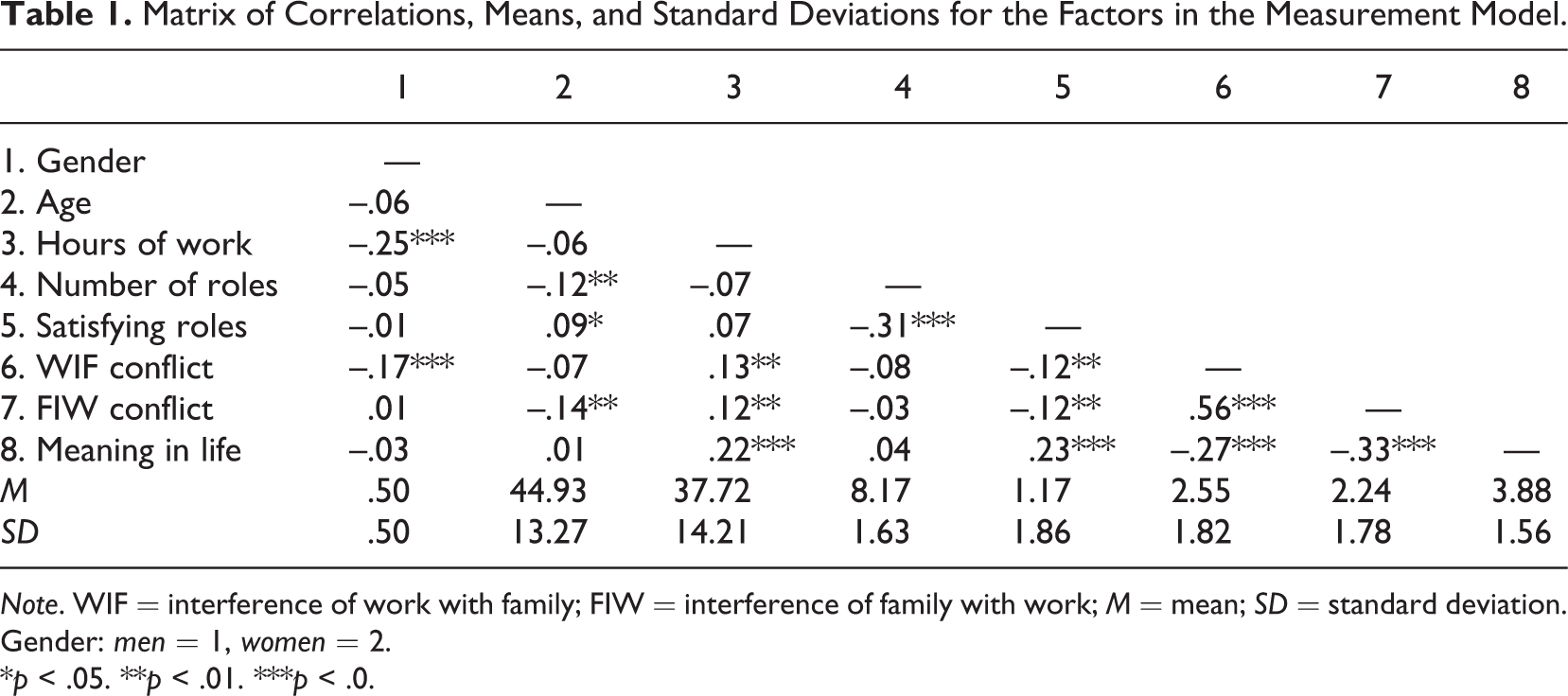
Note. WIF = interference of work with family; FIW = interference of family with work; M = mean; SD = standard deviation. Gender: men = 1, women = 2.
*p < .05. **p < .01. ***p < .0.
Examination of the correlations between background variables and the two types of role conflict reveals different correlation patterns for each of the role conflict dimensions. The older the participants, the lower their levels of FIW were. However, no significant relations were found between age and the intensity of WIF. Moreover, age was positively related to the proportion of satisfying roles as well as to the overall number of roles occupied by the participants: the older the participants were, they occupied a larger number of roles as well as a higher proportion of satisfying roles. Long hours of work outside of the home were also related to experience of WIF and FIW conflict, but the correlations with each type of conflict were in the opposite direction: the more hours the participants worked, the higher the intensity of WIF and the lower the intensity of FIW. Notably, whereas no gender differences were found with regard to the experience of FIW conflict, the men experienced higher levels of WIF conflict than did the women.
The Structural Equation Model
In accordance with the research hypotheses derived from the theoretical background (see Figure 1), the direct and indirect relations between the research variables were examined on the basis of structural equation modeling (see Figure 2).
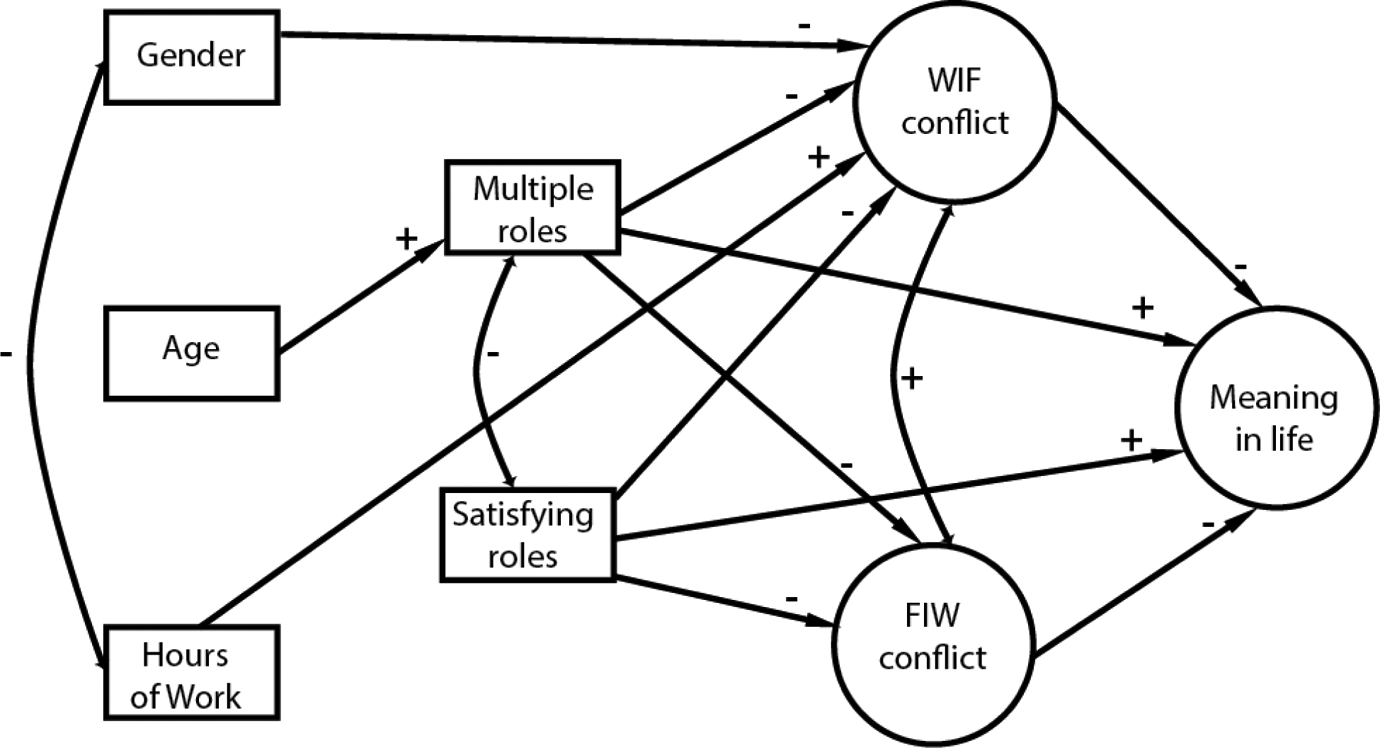
The hypothesized model.

The structural model.
Examination of the fit for the final measurement model revealed measures that met the criteria for a satisfactory fit: TLI = 0.91, CFI = 0.920, RMSEA =.04, SRMR = 0.061, df = 932, χ2 = 1,699.682, p < .001. All of the research variables together (background variables, multiple role variables, and measures of role conflict) explained 23% of the variance in the participants' sense of MIL: R 2 = .23, p < .001.
As shown in Figure 2, the two measures of occupying multiple roles (the overall number of roles and the proportion of satisfying roles) were significantly related to the participants' experience of MIL: the larger the overall number of roles and the higher the proportion of satisfying roles they occupied, the higher their sense of MIL. In addition, occupying a large number of roles was related to lower intensity of WIF conflict, but no relation was found between multiple roles and FIW conflict. In contrast, the higher the proportion of satisfying roles, the lower the intensity of both types of role conflict (WIF and FWI) and the greater the participants' sense of MIL. Furthermore, the findings revealed an indirect relation between the proportion of satisfying roles and sense of meaning of life, which was mediated by the WIF conflict (β = .03, SE = .05, p < .05). Another finding relates to the direct negative relation between the two dimensions of role conflict and sense of MIL: the higher the intensity of FIW and WIF conflict as expressed by the participants, the lower their sense of MIL.
The findings also revealed that working more hours outside of the home was related to occupying fewer roles (β = −.08, p < .05). However, the older the participants were, the larger the number of overall roles they occupied (β = .11, p < .05) and the higher the proportion of satisfying roles they occupied (β = .09, p < .05). Additionally, the more hours the participants worked outside of the home, the higher the proportion of satisfying roles they occupied (β =.08, p < .05). Hours of work outside of the home were also related to both dimensions of role conflict and to the sense of MIL. The more hours the participants worked outside of the home, the more they experienced WIF conflict (β = .09, p < .05) and the less they experienced FIW conflict (β = −.15, p < .01). Moreover, the more hours the participants worked outside of the home, the higher their sense of MIL (β = .22, p < .01). In addition, the participant's gender was related to the experience of WIF conflict (β = −.16, p < .001) but not to the experience of FIW conflict. That is, working fathers reported higher levels of WIF conflict than did working mothers, but no gender differences were found in the experience of FIW conflict.
Finally, the participants' age was directly related to FIW conflict (β = −.15, p < .05). That is, older participants experienced lower levels of FIW conflict than did younger participants. In addition, two indirect relations were found between the participants' age and some of the research variables. The relation between age and sense of MIL was mediated by the number of roles occupied by the participants (β = .016, SE = .008, p < .05) as well as by the proportion of satisfying roles that the participants occupied (β = .023, SE = .011, p < .05). That is, the older participants were, the larger the overall number of roles and the larger the proportion of satisfying roles they occupied. The two measures of multiple roles were also related to a higher sense of MIL.
Discussion
The main goal of the study was to examine how the number of multiple roles and the proportion of satisfying roles individuals occupy are related to the experience of role conflict (WIF and FIW), as well as to the sense of MIL among working parents. Before discussing the research hypotheses, it is important to note that on the whole, although the number of roles occupied by working parents was related to the experience of role conflict, the relation between the proportion of satisfying roles and the two role conflict variables was more significant.
Regarding the research hypotheses, consistent with the results of previous research (e.g., Blom et al., 2007; Carlson et al., 2006; Kulik & Liberman, 2013), a larger number of roles was significantly associated with a sense of MIL among working parents (supporting Hypothesis 1). However, occupying a large number of roles was related only to the experience of WIF conflict and not to FIW conflict (partially supporting Hypothesis 2). Moreover, in contrast to the research hypothesis, only WIF conflict mediated the relation between performing multiple roles and sense of MIL (partially supporting Hypothesis 3). Thus, performing multiple roles did not alleviate the strain derived from the interference of family demands with the work domain. A possible explanation for the differences in the relation of multiple roles occupied by the participants to the experience of WIF versus FIW conflict may attribute to the emotional nature of the conflict in which family interferes with work. Notably, when working parents are overloaded with family demands (e.g., care of children or elderly parents), the experience of FIW distresses them in a manner that cannot be alleviated by the benefits derived from performing multiple roles. This explains why multiple roles did not contribute significantly to empowering working parents and reducing FIW conflict, in contrast to the case of WIF conflict.
Moreover, regarding the contribution of the number of roles versus the proportion of satisfying roles to explaining the two types of role conflict (WIF and FIW) and sense of meaning life, the proportion of satisfying roles contributed more significantly to explaining those variables. The larger the proportion of satisfying roles occupied by the participants, the more they experienced a sense of MIL (supporting Hypothesis 4). In addition, a high proportion of satisfying roles was significantly and negatively related to both types of role conflict. This finding suggests that occupying a large proportion of satisfying roles empowered the working parents and enhanced their resilience, so that they were able to cope better with the adverse effects of both types of conflict (supporting Hypothesis 5).
Besides the direct relationship between performing a large proportion of satisfying roles and sense of MIL, the indirect relation is also noteworthy. That is, working parents who occupy a large proportion of satisfying roles experienced lower levels of WIF conflict as well as lower levels of FIW conflict; and low levels of both types of role conflict were related to an increased sense of MIL. It may therefore be concluded that performing a large proportion of satisfying roles empowers and strengthens working parents from two perspectives. First, satisfying roles are negatively related to the intensity of the two types of role conflict that derive from continuous juggling between the two demanding domains. Second, satisfying roles enable working parents to experience a high sense of MIL. It may therefore be argued that the contribution of performing satisfying roles to explaining the experience of MIL is significant, over and above the contribution of the number multiple roles per se.
Owing to the substantial contribution of both types of role conflict (FIW and WIF) to explaining different dimensions of well-being as revealed in the research literature (for a meta-analysis, see Allen et al., 2012), some of the research hypotheses dealt specifically with variables that explain the two dimensions of role conflict as well as with the relations of those variables to the sense of MIL. First, the findings indicated that both types of role conflict (FIW and WIF) were interrelated. That is, when participants experienced one type of conflict, they also experienced the other. A possible explanation for this relationship is that both types of conflict derive from the same source, that is, the limited supply of time and energy that people have at their disposal to meet the simultaneous demands of work and home (Beutell & Greenhaus, 1983; Brotheridge & Lee, 2005). In addition, our findings indicate that high levels of role conflict were related to a low level of MIL. This finding has been well documented in studies on the relations between the intensity of role conflict and other measures of well-being (Giebels & Janssen, 2004; Kinnunen, Geurts, & Mauno, 2004).
Besides the contribution of the main research variables (as reflected in the numbers of roles, the proportion of satisfying roles, and the two types of role conflict) to explaining the sense of MIL, the substantial contribution of the background variables examined in the research model is noteworthy. Regarding the contribution of gender, differences were found between men and women only with regard to the experience of WIF conflict. Men experienced WIF conflict more than women, but no gender differences were found with regard to FIW conflict. The gender differences in the intensity of WIF conflict can be attributed to differences in the definitions of masculine and feminine roles that persist to this very day. Despite the major changes in these definitions in recent years, men still occupy more senior positions at work than women (Schein, 2001), and men's commitment to these roles also interferes more with family life than that of women’s commitment. However, the mixed findings regarding gender differences in the experience of role conflict (i.e., differences in the experience WIF but not in the experience FIW) are consistent with the results of other studies in the field (Giebels & Janssen, 2004; McElwain, Korabik, & Rosin, 2005) and reflect the changes in gender roles in the contemporary era, which are mainly evident in the area of household tasks (Kulik, 2013). It is possible that because men tend to participate more actively in household tasks today than they did in the past, the interference of family demands with work affects both genders to the same extent (Gaunt & Bouknik, 2012; Goñi-Legaz, Ollo-Lopez, & Bayo-Moriones, 2010), as the findings of the present study revealed.
In this context, it is also important to mention gender differences in the number of hours of work outside of the home. Specifically, men tend to work longer hours outside of the home in order to establish their status in their jobs (Stier, 2010). In addition, the findings revealed that hours of work outside of the home was related to both dimensions of role conflict (WIF and FIW). As expected, the more hours the participants worked outside of the home, the greater the extent of role conflict WIF conflict. However, contrary to expectations, long hours of work outside of the home were related to lower levels of FIW conflict. In this connection, it can be assumed that people who work long hours usually have more economic resources at their disposal, so that they can acquire more services to alleviate the interference of the family domain with work responsibilities.
Regarding the relation between age and the experience of role conflict, the research findings reflect changes in the nature of work and family commitments throughout the life cycle. As people grow older and the burden of child care is reduced, there is a decline in FIW conflict (Kulik & Liberman, 2013).
In sum, the findings indicate that besides the contribution of occupying multiple roles to explaining FIW conflict, the proportion of satisfying roles also contributed to explaining that variable. Thus, the findings of the present study expand the role enrichment theory. Notably, the contribution of the quality of multiple roles as reflected in the extent of role satisfaction to explaining the experience of role conflict as well as the sense of MIL among working fathers and mothers cannot be ignored.
Limitations of the Research
The study had several limitations that need to be addressed in future research. First, data on the explanatory variables and outcome variables were collected from one source, that is, the working parents. This data collection method can bias the results, because the participants' responses regarding the explanatory variables can influence their evaluations of the outcome variables. Therefore, in future studies an attempt should be made to collect data on the experience of role conflict and well-being from more than one source. Moreover, the qualitative dimension of occupying multiple roles was examined from only one perspective, which related to the participants' overall satisfaction with a given role. Hence, it would also be worthwhile to examine other qualitative aspects of multiple roles such as the extent of role centrality or the extent of importance that individuals attribute to their roles. The integration of these measures with the measure of role satisfaction may shed further light on the relation between the qualitative dimensions of multiple roles and the experience of role conflict as well as life meaning among working parents today.
Practical Recommendations
The results of this study elicit several practical recommendations for vocational counselors and other therapeutic professionals. In light of the finding that satisfying roles were negatively related to both types of role conflict and positively related to MIL even if they may create a sense of overload, the empowering effect of satisfying roles on working parents should be emphasized in the process of vocational and family counseling. Specifically, vocational counselors should encourage people to take on multiple roles as long as they are a source of satisfaction. Moreover, two additional findings of the study should be addressed by counselors in an attempt to help working parents minimize the experience of conflict between work and family roles. First, in contrast to the prevailing assumption regarding gender differences in the experience of FIW conflict, working fathers and mothers reported the same levels of FIW conflict. This finding suggests that in order to reduce the impact of role conflict on the well-being of working parents, counselors should make efforts to teach both mothers and fathers effective strategies for coping with role conflict. Specifically, this can be done through enrichment workshops offered at workplaces or at community centers.
Finally, the age differences in the intensity of role conflict are noteworthy. Specifically, the finding that younger working parents experienced higher levels of WIF conflict than did older working parents highlights the importance of identifying the specific stressors that typify parents at different stages of the life cycle. Moreover, efforts should focus on teaching strategies for coping with role conflict that are appropriate for the parents' life stage and that are relevant to a dynamic reality where working parents are actively involved in multiple roles.
Footnotes
Declaration of Conflicting Interests
The author(s) declared no potential conflicts of interest with respect to the research, authorship, and/or publication of this article.
Funding
The author(s) received no financial support for the research, authorship, and/or publication of this article.