



Abstract
This study aimed to examine the contribution of multiple roles to explaining home–work conflict and sense of meaning in life (MIL) among a sample of 616 Israeli working parents. A distinction between three types of multiple roles was made on the basis of the extent of the participants’ role satisfaction, that is, satisfying roles (high role satisfaction), unsatisfying roles (low role satisfaction), and neutral roles (neutral role satisfaction). Satisfying roles contributed both directly and indirectly to the participants’ sense of MIL. Neutral roles contributed to intensifying role conflict and had an indirect impact on MIL. Moreover, the contribution of the number of unsatisfying roles to explaining the intensity of the participants’ role conflict and sense of MIL was insignificant. Men experienced more intense work–family conflict (work interfere with family and household responsibilities) than did women, but no gender differences were found for family–work conflict (family demands interfere with the work domain).
It is commonly believed that the role set of working parents today is larger than it was in the past and covers a variety of roles in many areas of life such as work, family, self-development, and community activity. The expanded role set of working parents can be attributed to technological developments as well as to normative changes. For example, following medical advancements that have increased life expectancy, there is a growing population of elderly persons who require long-term care from family members (Keck & Saraceno, 2010). Thus, working parents are caregivers for old and needy family members for a longer period than in the past. Medical advancements have also enabled women to remain fertile for longer so that oftentimes working parents in midlife need to care simultaneously for young children as well as for their own elderly parents. Essentially, these parents represent a new generation that researchers have referred to as the “sandwich generation” (Malach-Pines, Hasan, Hammer, & Neal, 2010). Concomitantly, working parents in midlife are often asked to take care of grandchildren in order to enable their adult children to develop a career and establish their own families (Kulik, 2007).
In addition, there has been an increasing emphasis on the value of self-actualization (Sagiv & Schwartz, 2000), so that people invest more time and energy in leisure activities, hobbies, and continuing education than they did in the past. Besides these roles, the value of contributing to society is manifested in the increased prevalence of community activities, volunteer work, and other altruistic activities (Ogilvie, 2004). Notably, the large set of roles that working parents perform today may impact the various dimensions of well-being (Allen et al., 2012). In light of the larger role set that characterizes working parents today, and as a result of the growing emphasis on individual quality of life, the relationship between multiple roles and well-being has become an increasingly relevant issue for many researchers in the fields of family and career studies (for a recent meta-analysis, see Allen et al., 2012).
There are two main theoretical approaches that relate to the impact of multiple roles on well-being. One approach is “role conflict theory” (Greenhaus & Powell, 2006) also known as “role scarcity theory” (Goode, 1960). The other approach is “role enrichment theory” (Marks, 1977) also known as “role accumulation theory” (Sieber, 1974). Based on these approaches, and in an attempt to examine the impact of multiple roles on well-being, researchers have focused mainly on examining the quantitative dimension of roles as expressed in the number of roles performed by individuals (e.g., Kulik & Liberman, 2013). However, qualitative dimensions such as subjective perceptions of roles have been ignored. Thus, the main contribution of this study is its examination of the impact of multiple roles on meaning in life (MIL) on Israeli working parents, based on one of the qualitative dimensions of roles, namely the extent of role satisfaction (satisfying roles, neutral roles, and unsatisfying roles).
Multiple Roles and Well-Being: Conflict or Enrichment?
Role conflict theory is based on the assumption that individuals have a limited supply of emotional and physical energy as well as a limited amount of available time. Therefore, working parents who perform multiple roles can experience two types of role conflict, namely, family–work conflict, where family demands interfere with the work domain (FIW), and work–family conflict, where the demands of work interfere with family and household responsibilities (WIF—Greenhaus & Powell, 2006). According to this approach, irrespective of the type of conflict that ensues, individuals may experience a feeling of distress that is manifested in a decline in physical health (Lapierre & Allen, 2006) and in emotional well-being (Baltes & Heydens-Gahir, 2003).
In contrast, enrichment theory, which was originally proposed by Marks (1977) and further elaborated by other researchers (Carlson, Kacmar, Wayne, & Grzywacz, 2006; Greenhaus & Foley, 2004), argued that experiences in one role improve the quality of life in other roles as expressed in performance or affect. According to this approach, performing multiple roles can have three types of benefits. First, multiple roles can increase the supply of resources that people have at their disposal (e.g., financial resources gained from work, and social resources gained from cooperation with colleagues). Second, success in one role can compensate for a sense of failure in another role and thus mitigate the negative effects of failure on personal well-being. Third, when people engage in multiple roles, they might feel that they are realizing their potential, and this can foster their sense of self-worth and MIL (Greenhaus & Powell, 2006).
Studies based on these two theoretical frameworks have yielded inconsistent results. Some have supported role conflict theory and others have supported enrichment theory. For example, in line with role conflict theory, which argues that multiple roles have a negative impact on well-being, findings have revealed that work–family conflict resulting from multiple roles is negatively associated with work-related factors such as job satisfaction (Perrewe, Hochwarter, & Kiewitz, 1999), organizational commitment (e.g., Shaffer, Harrison, Gilley, & Luk, 2001), and burnout (e.g., Peeters, Montgomery, Bakker, & Schaufeli, 2005).
In contrast, many of the researchers who support enrichment theory have revealed that performing family roles can contribute to improving performance in the workplace and vice versa. In this connection, studies have indicated that workers believe their family roles have taught them new ways of interacting with coworkers as well as conflict resolution strategies, which have improved their ability to multitask on the job (Kirchmeyer, 1992; Ruderman, Ohlott, Panzer, & King, 2002). Moreover, when individuals leave work in a positive mood they are likely to respond more positively, patiently, and happily to family members, which can enhance their affect and improve their performance as a parent or spouse (Rothbard, 2001).
The inconsistent findings yielded from these two approaches have provided an incentive for researchers to seek new directions of investigation in an attempt to gain further insights into the impact of multiple roles on the well-being of individuals (e.g., Barnett, 1993; Martire, Stephens, & Atienza, 1997). According to one of the new approaches to investigating the relationship between performing multiple roles and well-being, the number of roles performed by individuals is not necessarily the main factor that explains well-being, and subjective aspects can also determine whether conflict or enrichment ensues as a result of performing multiple roles. These subjective aspects of role characteristics may be reflected in perceived role centrality or in satisfaction derived from performing the roles.
Based on this approach, various studies have examined the importance that individuals attribute to the roles they perform (Noor, 2004) and the extent of role centrality in their life (Carr, Boyar, & Gregory, 2008; Martire, Stephens, & Townsend, 2000). However, there is a lack of research dealing with the contribution of multiple roles by extent of role satisfaction to explaining individual well-being. Thus, rather than examining the validity of enrichment versus role conflict theory based on the number of roles that working parents perform, we focused on the extent of satisfaction derived from the roles. Specifically, we examined the contribution of role satisfaction to sense of MIL, which researchers consider to be one aspect of well-being (Seligman, 2011). In this vein, a recent study by Kulik, Shilo-Levin, and Liberman (2014) revealed that the larger the number of satisfying roles individuals perform, the greater their sense of MIL. However, that study did not examine the whole range of satisfaction derived from performing the roles, that is, emphasis was placed on satisfying roles, whereas neutral and unsatisfying roles were neglected. In this study, a distinction was made between three types of roles, namely, satisfying roles, unsatisfying roles, and neutral roles. For each type of role, we examined the relationship between the number of roles that participants performed and one dimension of well-being, that is, MIL.
Multiple Roles and MIL
Sense of MIL is a central aspect of philosophical and psychological discourse (Auhagen, 2000; Seligman, 2011). It is considered to be an indicator of well-being (Seligman, 2011) as well as a resource that facilitates adaptive coping (Park & Folkman, 1997). MIL includes components such as purposefulness, which is achieved through activities that are consistent with the value system and world view of individuals (for a review, see Steger, 2007). Other components include a sense of coherence in one’s life (Battista & Almond, 1973; Reker & Wong, 1988) and goal directedness (e.g., Ryff & Singer, 1998). Frankl (1963) argued that humans are characterized by an innate drive to find meaning in and significance of their lives and that failure to achieve meaning results in psychological distress. Researchers have examined MIL from the point of view of the individual’s experience rather than in universal terms (for a review, see Steger, Frazier, Oishi, & Kaler, 2006). As such, each individual must create meaning in his or her own life (Battista & Almond, 1973; Frankl, 1963). This can be done through the pursuit of important goals (Klinger, 1977), through the development of a coherent life narrative (Kenyon, 2000), or through meeting needs for value, purpose, efficacy, and self-worth (Baumeister, 1991). Meaningful living has been referred to as authentic living (Kenyon, 2000) and has been reflected in theories of well-being, which focus on personal growth (Maslow, 1971). In this context, the various roles that individuals perform lead to experiences that are either meaningful or have no meaning (Jarvis, 1987).
In this context, Barnett (1993) argued that satisfactory experiences in marital and parental roles have a positive impact on women’s well-being. Similarly, Martire, Stephens, and Atienza (1997) found that satisfaction with caregiving and satisfaction with work are directly associated with well-being. Moreover, a meta-analysis of studies on this topic revealed that job satisfaction has been positively associated with life satisfaction, happiness, and with the absence of negative effects (Bowling, Eschleman, & Wang, 2010). Based on the results of these studies, we argue that satisfying roles may provide individuals with a sense of fulfillment and growth and therefore foster a sense of MIL. In contrast, unsatisfying or neutral roles may lead to emptiness and therefore inhibit the sense of MIL.
Besides examining the direct relationships between multiple roles as reflected in the extent of role satisfaction and sense of MIL among working parents, we focused on examining the indirect relationships between these variables as well. This examination was based on a recent Israeli study conducted among working mothers, which revealed an indirect relationship between multiple roles and well-being that was mediated by the experience of role conflict (Kulik & Liberman, 2013). The more roles the women performed, the lower the intensity of family–work conflict (FIW), and the lower the intensity of FIW, the lower the women’s level of emotional distress. The explanation provided by the researchers for this finding is that performing a large number of roles has an empowering effect on working mothers, which increases their hardiness. This, in turn, leads to a decline in the experience of emotional distress. However, as mentioned, no research has been conducted to date on the direct and indirect relationships between unsatisfying roles and neutral roles on one hand and MIL on the other. Based on the argument that individuals have a drive for authentic living (Kenyon, 2000) and a desire to achieve meaning through daily actions (King & Hicks, 2012; Steger, Shin, Shim, & Fitch-Martin, 2013), we hypothesized that performing unsatisfying or neutral roles will have a negative impact on individuals. Thus, performing neutral or unsatisfying roles will be related to a high sense of role conflict (both WIF and FIW); in turn, these types of role conflict will be related to a low sense of MIL.
Research Goal and Hypotheses
Based on structural equation modeling (SEM), we examined the overall contribution of the explanatory research variables—background variables (the controlled variables), types of multiple roles by extent of role satisfaction (satisfying, neutral, and unsatisfying), and role conflict (WIF and FIW)—to explaining the sense of MIL among working parents. Using the SEM method, the two dimensions of role conflict (FIW and WIF) were measured both in terms of their direct effects on MIL and in terms of their indirect effect as mediators in the relationship between types of multiple roles by extent of satisfaction on one hand and MIL on the other. These direct and indirect relationships were integrated into our hypotheses. Overall, SEM aimed to estimate the simultaneous relationships between the variables as expressed in the set of hypotheses presented subsequently:
Method
Sample
There were 611 participants in the study (300 men and 311 women). All of them performed at least two main roles:They were parents and they worked for pay outside the home in various occupations that cover a broad range of categories (the criteria guiding the selection of organizations for sampling the participants are described in the procedure section). The average number of children was 2.82 (SD = 14.21), and participants ranged in age from 22 to 75 years (M = 44.93, SD = 13.27). With regard to education, 5% of the participants had partial secondary education, 33.1% had completed a secondary diploma, and 61.9% had postsecondary education (academic or other). As for religiosity, 38% of the participants defined themselves as secular, 24% defined themselves as traditional, 36% defined themselves as religious, and 2% defined themselves as ultra-Orthodox. The average number of hours of work per week was 37.72 (SD = 14.21), although significant differences were found between men and women in this variable, t(609) = 6.26, p < .001. That is, the men worked more hours per week than did the women (M = 41.27, SD = 14.80, and M = 34.29, SD = 14.80, respectively). In addition, gender differences were found with regard to employment in management positions, that is, 57% of the men worked in management positions versus 33.1% of the women, χ2(1) = 35.21, p < .001.
Instruments
The research instrument consisted of four subquestionnaires.
Multiple roles by extent of satisfaction
Based on a questionnaire developed by Kulik et al. (2014), participants were presented with a list of 11 different roles representing four life domains, namely, family roles (spouse, parent, sibling, son/daughter, and grandparent), work roles (the worker role), self-development roles (student, leisure activities, and hobbies), and social and community roles (volunteer work or other community activity and friend). For each role, participants were asked to indicate the extent of their satisfaction on a scale ranging from 1 (not at all) to 5 (to a very great extent). In addition, the questionnaire contained an option of “0” if the participant did not perform a specific role. Three scores were calculated for each participant on the basis of the number of roles they perform in each of the three categories, that is, satisfying roles (ranking 4–5 on the scale of responses), neutral roles (ranking 3 on the scale of the scale of responses), and unsatisfying roles (ranking 1–2 on the scale of responses). The higher the score, the larger the number of roles in each category.
Role conflict
The original questionnaire was developed by Frone and Rice (1987) and examined the intensity of role conflict generated by the demands of family and the workplace. The questionnaire included 18 items that were divided in two factors, that is, 9 items relating to role conflict caused by interference of family with work demands (FIW—e.g., “Because of pressure at home, I am often concerned with family matters at work”) and 9 items relating to role conflict caused by interference of work with family demands (WIF—e.g., “Because of my work, I do not participate in as many family activities as I would like to”). The scale of responses ranged from 1 (not true at all) to 5 (very true). For each factor, one score was derived by calculating the mean of the items in the factor: The higher the score, the greater the intensity of each type of role conflict. Somech and Drach-Zahavy (2007) found a relationship between the two measures of role conflict and various strategies for coping with stress. The Cronbach’s α reliability values of the two factors found by Kulik and Liberman (2013) were .88 and .87 for FIW and WIF, respectively. In this study, the Cronbach’s α reliability values were .86 and .85 for FIW and WIF, respectively.
MIL
This variable was measured on the basis of the Life Regard Index (LRI), which was developed by Battista and Almond (1973) and included 28 statements relating to the participants’ sense of MIL. Based on the recommendation of Steger (2007), we derived the following two categories of factors from the items in the LRI: One category represented positive aspects of these dimensions or factors that foster MIL (e.g., “I feel that I have found a set of life goals that provide a meaningful framework for my life”—henceforth “fostering factors”) and another category represented negative aspects or factors that inhibit MIL (e.g., “I waste most of my time on things that are not important to me—henceforth “inhibiting factors”). The scale of responses ranged from 1 (not true at all) to 5 (very true). For each factor, one score was derived by calculating the mean of the items in the factor. The index distinguished between people who are happy and satisfied with their lives versus those who are unhappy and dissatisfied (Debats, 1990). The Cronbach’s α reliability values of the items in the questionnaire used in this study were .88 and .85 for fostering factors and inhibiting factors, respectively.
Background questionnaire
The questionnaire provided data on the following variables: age, marital status, profession, religiosity (secular, traditional, religious, or ultra-Orthodox), number of children, number of children living at home, and children’s ages.
Procedure
Research questionnaires were distributed at workplaces throughout the country. The criterion that guided the selection of organizations for sampling of participants in the study was the representation of various categories of organizations in Israel, namely, industrial organizations, service organizations, and commercial organizations. Based on this criterion, questionnaires were distributed in high-tech companies, government ministries, educational institutions, industrial plants, and business organizations. After making arrangements with the directors of the organizations, questionnaires were distributed to workers who met the criteria for participation in the study, that is, parents who were employed in full-time or part-time jobs and who had children living at home.
All of the participants responded to the questionnaires voluntarily. In each organization, workers were sampled randomly and approached to participate in the study. Some of the participants filled out the questionnaires at the time they were distributed and returned them to the research assistants on the same day. Others filled out the questionnaires at home and returned them later to the research assistants. The time required to fill out the questionnaire was about 25 min, and the response rate was about 80%.
Methods of Measurement and Estimation
Data analysis was conducted in two stages. In the first stage, we developed a measurement model that aimed to formulate operative indices representing the number of satisfying, unsatisfying, and neutral roles as well as the intensity of role conflict (FIW and WIF) and MIL (fostering and inhibiting factors). In the second stage, a structural model was designed to test the hypotheses. The model aimed to examine the relationships between the exogenous variables (background variables and the three types of role satisfaction factors), the mediating variables (the two types of role conflict—FIW and WIF), and the endogenous variables (factors that foster meaning and factors that inhibit meaning). The measurement model and the structural model were examined on the basis of SEM using the MPLUS V.7.0 program (Muthén & Muthén, 2010). This method combined factor analysis and multiple regression analysis as a means of examining the measurement characteristics and the structural characteristics of the causal relationships between latent variables that have measurement errors and standardized residuals (Bentler, 1989). To fill in the missing data, we conducted multiple imputations. That is, based on regressions of existing data, missing values were replaced with the values that we expected to obtain on the assumption that there is a linear relationship between them (Enders, 2010). In the process of filling in the missing data, 10 data sets were imputed—that is, each missing data point was replaced with 10 plausible values. This procedure was adopted in order to moderate the uncertainty in the exact values of the missing data.
Results
Confirmatory Factor Analysis
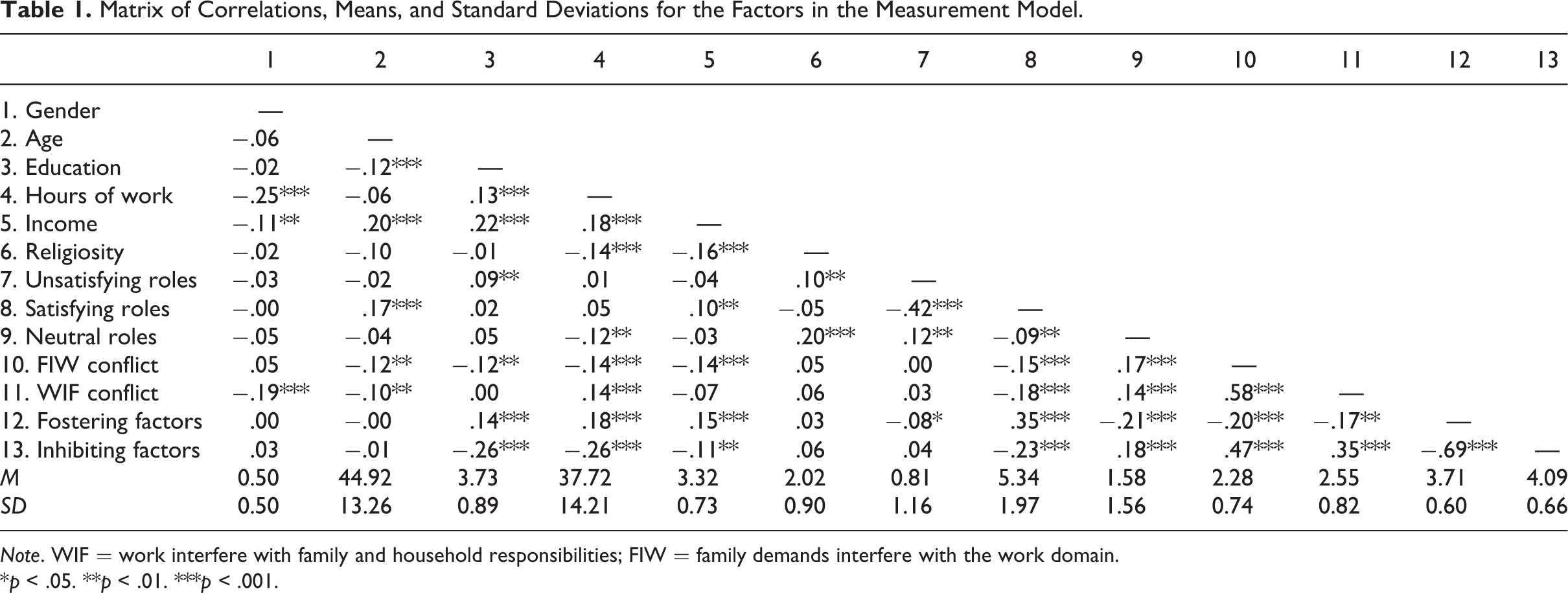
First, we examined the loadings of the measures on the latent variables (the two role conflict measures and the two measures of MIL). Table 1 presents the means, standard deviations, and relationships between the research variables. It is important to bear in mind that because the number of roles was measured on an ordinal scale, maximum likelihood estimation was used for that variable (Llorens, Byrne, Yates, Nistelberger, & Coates, 2012). The goodness-of-fit measures for the model were Tucker–Lewis index (TLI) = 0.901, comparitive fit index (CFI) = 0.915, root mean square error of approximation (RMSEA) = 0.038, standardized root mean square residual (SRMR) = 0.047, df = 933, χ2 = 1,747.04, p < .001. According to Wang and Wang’s (2012) values of TLI, CFI measures greater than .90 are a satisfactory fit. Both RMSEA and SRMR are within the “close fit” range (<.06; Hu & Bentler, 1999).
Matrix of Correlations, Means, and Standard Deviations for the Factors in the Measurement Model.
Note. WIF = work interfere with family and household responsibilities; FIW = family demands interfere with the work domain.
*p < .05. **p < .01. ***p < .001.
Table 1 presents the relationships between the measures that were constructed through the model, which include the main research variables as well as background variables (gender, age, education, years of work, income level, and religiosity).
Background variables, WIF and FIW
The findings in Table 1 show that participants with higher levels of education and income and those who worked more hours outside the home reported more factors that fostered meaning in their lives. In addition, relationships were found between several background variables and the two role conflict factors, although the relationships were different for each type of role conflict (WIF and FIW). The younger the participants, the lower their levels of education and income, and the fewer hours they worked outside the home, the higher the intensity of FIW they experienced. Notably, no gender differences were found with regard to FIW, but levels of WIF were higher for men than for women. Moreover, younger participants and participants who worked more hours outside the home reported higher levels of WIF.
Multiple roles, WIF, and FIW
The data in Table 1 show a negative relationship between the number of satisfying roles and the two types of role conflict (FIW and WIF) and a positive relationship between the number of neutral roles and the two types of role conflict. This finding indicates that when participants performed fewer satisfying roles and more neutral roles, the intensity of both types of role conflict was greater. Notably, no significant relationship was found between the number of unsatisfying roles and the intensity of both types of role conflict.
Multiple roles and MIL factors
Several relationships were found between the number of roles and both MIL factors (fostering and inhibiting factors). First, the number of satisfying roles was positively associated with fostering factors and negatively associated with inhibiting factors. Thus, the more the participants performed satisfying roles, the more fostering factors and the fewer inhibiting factors they reported. The opposite pattern was found with regard to the relationship between neutral roles and MIL factors. That is, the more the participants performed neutral roles, the more inhibiting factors and the fewer fostering factors they reported. A low negative relationship was found between unsatisfying roles and fostering factors. That is, the more unsatisfying roles the participants performed, the fewer factors there were that fostered meaning in their lives. However, no significant relationship was found between the number of unsatisfying roles and inhibiting factors.
Structural Equation Model
The direct and indirect relationships between the research variables were examined through SEM in accordance with the research model, which was designed on the basis of the theoretical and empirical background presented earlier and on the basis of the research hypotheses (see Figure 1). The goodness-of-fit coefficients for the research model reveal a good model data fit: TLI = 0.899, CFI = 0.913, RMSEA = 0.038, SRMR = 0.051, df = 936, χ2 = 1,770.44, p < .001.
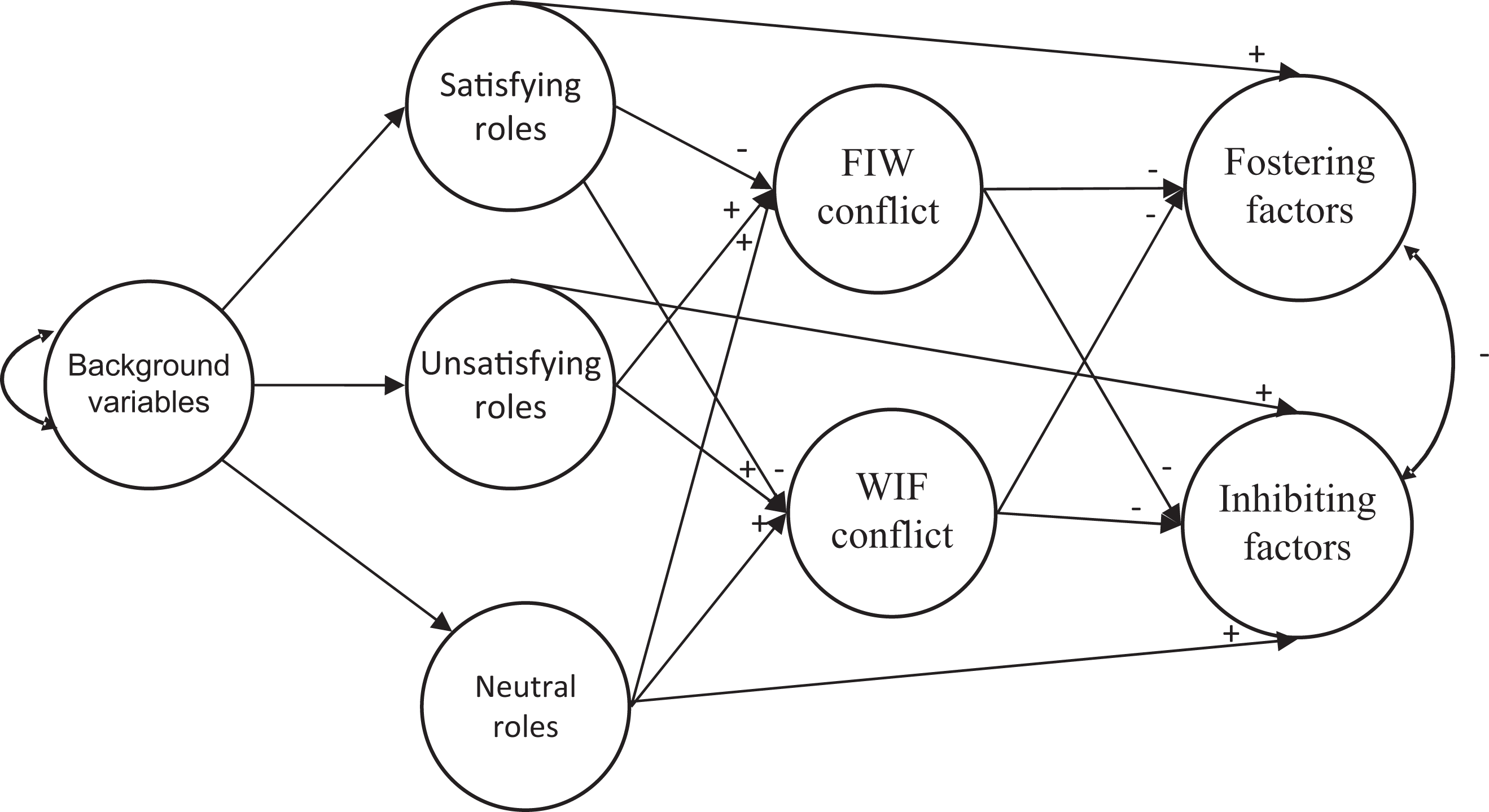
The hypothesized model.
Altogether, the research variables (background variables, types of roles by role satisfaction, and the two role conflict factors) explained 20% of the variance in the participants’ reports of factors that foster MIL (R 2 = .20, p < .001) and 31% of the variance in the participants’ reports of factors that inhibit MIL (R 2 = .31, p < .001). Regarding the main research question, the research findings showed that overall, satisfying roles contributed both directly and indirectly to the participants’ sense of MIL. Moreover, the negative contribution of neutral roles to explaining MIL was manifested indirectly by increasing the participants’ sense of role conflict. However, unsatisfying roles were not found to have any impact on the experience of either type of role conflict or on the sense of MIL.
Satisfying Roles
The paths in the model (Figure 2) illustrate the main findings concerning the relationships between the number of satisfying roles and the intensity of WIF as well as the relationships between the number of satisfying roles and the factors that foster/inhibit MIL. That is, when participants performed more satisfying roles, they reported lower levels of WIF conflict, more fostering factors, and fewer inhibiting factors. In addition, the findings indicated that the number of satisfying roles had an indirect positive effect on the participants’ perceptions regarding fostering factors, which was mediated by the intensity of WIF conflict (β = .02, standard error [SE] = .001, p < .05), that is, the more satisfying roles the participants performed, the lower the intensity of WIF and that type of role conflict was related to fostering factors. In addition, there was an indirect negative relationship between the number of satisfying roles and the factors that inhibit MIL, which was mediated by the intensity of WIF (β = .03, SE = .011, p < .05), that is, the more satisfying roles participants performed, the lower the intensity of WIF conflict and WIF conflict was related to inhibiting factors. In sum, the findings indicate that the number of satisfying roles had a direct effect on the intensity of role conflict (WIF), as well as a direct effect on fostering factors of meaning in life, and an indirect effect on inhibiting factors of meaning in life that was mediated by WIF conflict.
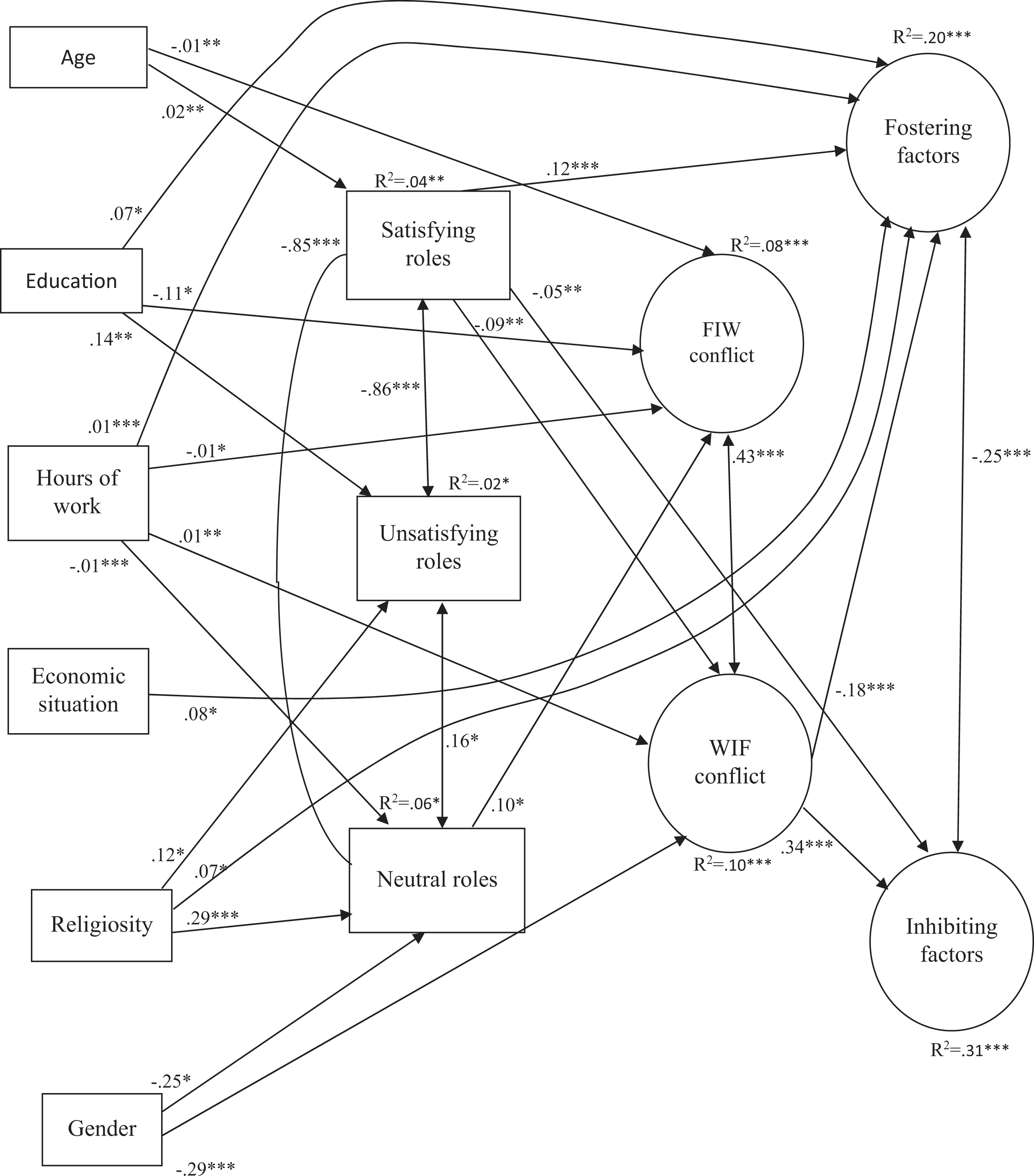
The structural model.
Neutral Roles
Although the number of neutral roles did not have a direct effect on factors that foster or inhibit MIL, these roles did have an indirect effect, which was mediated by the intensity of FIW conflict. Thus, the more neutral roles the participants performed, the greater the intensity of FIW conflict; and the greater the intensity of FIW conflict, the greater the intensity of WIF conflict. Moreover, the experience of WIF conflict had a direct effect on the fostering and inhibiting factors (a positive effect on inhibiting factors, and a negative effect on fostering factors). Thus, the greater the intensity of WIF conflict, the more the participants reported inhibiting factors and the less they reported fostering factors.
Unsatisfying Roles
The number of unsatisfying roles did not contribute significantly to explaining factors that foster or inhibit MIL nor did they contribute to explaining role conflict (FIW and WIF). However, significant relationships were found among the three types of roles (satisfying, neutral, and unsatisfying): a large number of satisfying roles was associated with fewer unsatisfying and neutral roles. In addition, a positive relationship was found between the number of unsatisfying roles and the number of neutral roles, that is, when the participants performed a larger number of unsatisfying roles, they also performed a larger number of neutral roles.
Background Variables
The relationships between the background variables and types of roles (satisfying, neutral, and unsatisfying) on one hand and the two MIL factors on the other should be mentioned. Participants with a high level of education occupied a larger number of unsatisfying roles, whereas those who worked more hours per week outside the home occupied fewer neutral roles. In addition, several direct and indirect relationships were found between the background variables and sense of MIL as well as between those variables and role conflict. For example, age was found to have two indirect relationships with the research variables. One indirect relationship was found between age and fostering factors, which was mediated by the number of satisfying roles (β = .003, SE = .001, p < .001), that is, older participants performed a larger number of satisfying roles, which, in turn, were positively related to factors that fostered meaning in their lives and negatively related to factors that inhibited meaning in their lives. Age also had an indirect negative effect on inhibiting factors, which was mediated by the number of satisfying roles and the intensity of WIF conflict. That is, older participants performed a larger number of satisfying roles, which were negatively related to WIF conflict. In turn, the less the participants experienced WIF conflict, the fewer inhibiting factors they reported.
Furthermore, an indirect negative relationship was found between hours of work outside the home and fostering factors, which was mediated by WIF conflict, β = .001, SE = .001, p < .05. That is, the more hours a week the participants worked for pay outside the home, the greater the intensity of WIF conflict; and the greater the intensity of WIF conflict, the fewer fostering factors there were. However, the paths of the relationships were completely different for hours of work per week and inhibiting factors. Hours of work per week had an indirect positive effect on inhibiting factors, which was mediated by WIF conflic, β = .002, SE = .001, p < .01. That is, the more hours the participants worked outside the home per week, the greater the intensity of WIF conflict. In turn, the intensity of that type of conflict was positively related to inhibiting factors. Moreover, a positive relationship was found between religiosity and factors that foster MIL. In addition, religiosity was positively related to performing a large number of unsatisfying and neutral roles, whereas no relationship was found between religiosity and number of satisfying roles.
As for gender differences, men performed more neutral roles than did women. A negative indirect relationship was also found between gender and inhibiting factors, which was mediated by WIF conflict, β = .098, SE = .026, p < .001. That is, men experienced more intense WIF conflict than did women, and WIF conflict was related to more inhibiting factors.
Discussion
The findings portray a complex situation: Satisfying and neutral roles contributed to explaining the participants’ sense of MIL, whereas unsatisfying roles did not (confirming Hypothesis 1 and partially confirming Hypothesis 2). When working parents performed a large number of satisfying roles, they reported more factors that foster meaning in their lives and fewer inhibiting factors. Moreover, the contribution of satisfying roles to enhancing the participants’ sense of MIL was mediated by the experience of role conflict in which work interferes with family responsibilities (WIF). Notably, of the two types of role conflict (FIW and WIF), only WIF was found to mediate the relationship between the number of satisfying roles and factors that inhibit MIL (confirming Hypothesis 3 and partially confirming Hypothesis 4). Apparently, satisfying roles empower individuals and enhance their resilience in the face of obstacles and frustration. Therefore, they reduce the negative feelings aroused by the interference of work with family responsibilities. Thus, the findings suggest that when the intensity of WIF declines, there will be fewer factors that inhibit MIL among working parents.
However, the findings also indicated that a large number of satisfying roles did not contribute significantly to reducing FIW conflict. The penetration of family responsibilities into the domain of work reflects the unresolved problems in family life that spillover to the workplace of employed parents. Because the family is a primary group based on emotional ties, family problems are especially significant for individuals. Therefore, it can be concluded that in contrast to WIF, the experience of FIW reflects a situation in which the conflict relates to people who are emotionally close to the individual. As a result, the positive contribution of performing satisfying roles cannot alleviate the experience of role strain, and the experience of FIW conflict does not decrease.
The relationship between neutral roles and FIW conflict is also noteworthy. The more neutral roles the participants performed, the more they felt that family responsibilities interfered with work; the more they experienced FIW conflict, the greater the intensity of WIF conflict was; and the greater the intensity of WIF conflict, the more factors there were that inhibited MIL. It can therefore be argued that even if the impact of neutral roles on MIL was not direct, these roles might contribute indirectly to explaining MIL through the two types of role conflict. However, unsatisfying roles did not contribute at all to explaining the participants’ sense of MIL (both in terms of fostering and inhibiting factors), nor did they contribute to explaining either type of role conflict (WIF and FIW, partially confirming Hypothesis 5).
A possible explanation for this unexpected finding relates to the hedonistic aspect of human nature as reflected in the desire for pleasure in life (King & Hicks, 2012). It can be assumed that because human nature is hedonistic, people will not perform unsatisfying roles of their own good will. Hence, we can infer that when individuals perform unsatisfying roles, these roles are important to them. For example, unsatisfying roles may be essential for one’s own survival or for the survival of close family members. Research findings have also revealed that adverse or unsatisfying experiences can elicit a sense of meaningfulness (for a review, see Steger, 2012). Thus, in some cases, the feelings of necessity and the meaningfulness accompanying an unsatisfying role may compensate for the negative emotions following the performance of this role. Therefore, overall, no relationship was found between unsatisfying roles and MIL in this study. However, owing to the tentative nature of this explanation, it deserves to be examined in future research.
With regard to background variables, the contribution of religiosity to explaining MIL should be emphasized. The findings revealed that participants with higher levels of religiosity performed more unsatisfying and neutral roles than did participants with lower levels of religiosity. A possible explanation for this finding is that the faith of religious individuals empowers them to cope with the burden of performing undesirable roles. Moreover, in keeping with the findings of other researchers (Martos, Thege, & Steger, 2010), it can be argued that religious individuals are empowered by experiencing a high level of MIL as expressed by fostering factors. As for the impact of age, the finding that levels of FIW conflict decreased among older parents is noteworthy. This result can be attributed to the decrease in the family demands among older parents as their children mature and become more independent. Moreover, the paths in the structural research model as well as the correlation patterns indicated that as parents grow older, WIF conflict decreases. However, the impact of the age on WIF is mediated by performing satisfying roles. Thus, the older parents performed more satisfying roles and consequently experienced lower levels of WIF. A possible explanation for this finding is that because the economic situation of older parents is better than that of younger parents, they can afford to purchase some services to help them with managing the household and child care. This can make it easier for them to perform their roles and increase their satisfaction. Moreover, because the experience of satisfying roles may empower the older participants, they are less affected by the interference of work responsibilities with family responsibilities and consequently experience WIF to a lesser extent than younger parents.
Finally, gender differences in the experience of role conflict are noteworthy. The findings revealed that husbands experienced more intense WIF conflict than did women, whereas no gender differences were found in the experience of FIW. There are several possible explanations for the similarity in the experience of FIW conflict. First of all, in light of the developments in telecommunication technology (e.g., cell phones, Facebook, WhatsApp), children can contact both parents simultaneously, so that mothers and fathers can experience FIW role conflict to the same extent. Moreover, the similarity between the genders can be attributed to the changing patterns of fatherhood, such as the “new father” who enjoys being involved in his children’s life (Marsiglio, Amato, Day, & Lamb, 2000).
However, when it comes to the experience of WIF conflict, the findings indicate that the fathers experienced it more than the mothers. Notably, despite the progress that women have made in the labor market today, men continue to occupy more demanding positions. This argument is based on the lower percentage of women versus men in full-time jobs in Israel. Of all women in the labor force in 2013, 66.75% were employed in full-time jobs compared to 86.6% of all men. The demanding positions of men as compared to women are also reflected in the types of jobs occupied by women versus men. For example, in 2013, although women comprised more than 50% of the entire population of Israel, their proportion in high-tech jobs was only 35.6%. Similarly, the proportion of women out of all managers in Israel was 32.6% as evidenced in the higher rates of male managers in the sample of this study. Moreover, a large proportion of women in Israel are concentrated in occupational niches such as education, where they benefit from vacations and are able to integrate their job demands with care for their children (Israel Central Bureau of Statistics, 2014). Thus, because men have more demanding jobs than women, they may face more demands at work that interfere with family life. The finding that the fathers experienced more WIF than mothers is consistent with the results of other studies, which indicate that today fathers bear a heavier burden than mothers in the attempt to reconcile the interference of work demands with family sphere (Fu & Shaffer, 2001).
To conclude, the theoretical contribution of the study lies in the challenging of two main theories on the relationship between multiple roles and well-being, that is, role conflict theory and role enrichment theory. Our findings indicate that multiple roles lead to enrichment only when the roles are satisfying. Moreover, role conflict theory was only partially confirmed by the finding that neutral roles contributed indirectly and negatively to explaining the factors that inhibit MIL, whereas unsatisfying roles did not contribute to the experience of MIL at all. Finally, the findings of the study suggest that the greatest danger to the experience of MIL derives from performing neutral roles and not from performing unsatisfying roles.
Limitations of the Research and Recommendations for Future Research
The study had several limitations that need to be addressed in future research. First, the examination of outcome variables should be expanded. Thus, instead of only examining the impact of performing multiple roles on the participants’ sense of MIL, outcome variables relating to other family members should also be examined, such as the well-being of the spouse or children. Specifically, the following questions should be explored in future studies: Does the experience of the role incumbent spill over to the closest family member? Do the children or spouses of the role incumbent experience strain or enrichment?
Another limitation relates to the qualitative dimension of occupying multiple roles, which was examined only in terms of the participants’ overall satisfaction with a given role. In future studies, it would also be worthwhile to integrate more subjective measures of roles (e.g. role centrality) with the measure of role satisfaction. This integrative approach may shed further light on the relationship between the qualitative dimensions of multiple roles and the measures of MIL examined in this study.
It would also be worthwhile for researchers to expand the examination of the impact of multiple roles on well-being to other cultural contexts. As Spector, Zapf, Chen, and Frese (2000) noted, most studies on work–family conflict and well-being to date have been conducted in Western countries, which share common characteristics in terms of economic conditions, family patterns, and cultural values. Thus, in order to enhance understanding of the impact of multiple roles on MIL, further research should be conducted in diverse cultural contexts that have different values and norms regarding work and family domains.
Practical Recommendations
Professionals should bear in mind that neutral roles, which can be meaningless and uninspiring for individuals, might also increase the intensity of role conflict. Thus, professionals should help their clients understand how those roles became neutral and encourage their clients to avoid performing these roles when possible. However, because it is not always possible to avoid performing neutral roles, counselors should guide working parents to adopt other ways of coping, such as reframing the necessity of these roles. In addition, counselors can help working clients understand that most of the roles are not homogeneous in nature, and most of them consist of various components. With this understanding, counselors should engage in role analysis with their clients in an attempt to identify the role components that have the potential to be satisfying and the components that have the potential to be less satisfying. Thus, although it is not always possible to give up the entire role, counselors can help their clients increase their satisfaction by encouraging them to give up components of the roles that are not satisfying. Finally, because younger participants were found to experience more WIF and FIW conflict, career counselors should focus mainly on the younger population of working parents and suggest training programs for effective strategies of coping with both types of role conflict in the work setting as well as in the community setting. Efforts should also be made to teach strategies for coping with role conflict that are appropriate for the parents’ life stage and that are relevant to the dynamic reality of working parents who actively engage in multiple roles.
Footnotes
Declaration of Conflicting Interests
The author(s) declared no potential conflicts of interest with respect to the research, authorship, and/or publication of this article.
Funding
The author(s) received no financial support for the research, authorship, and/or publication of this article.