



Abstract
Vocational interest surveys have traditionally employed a typology (i.e., the Realistic, Investigative, Artistic, Social, Enterprising, and Conventional [RIASEC] model) to distinguish individuals. Within this framework, respondents are identified as representing various types of people based on their interests in work-related activities. However, much of the existing literature on vocational interest testing has focused almost exclusively on traditional variable-centered approaches to understanding the nomological network around vocational interest variables. Therefore, the focus of the current article is an application of a person-centered approach, latent profile analysis (LPA). Using LPA, we found evidence of eight qualitatively and quantitatively distinct subgroups or types of individuals differentiated on the basis of interests in the RIASEC variables. Further, across the five-factor model and Dark Triad personality variables, minor, yet theoretically sound, differences across the eight vocational interest subgroups were found. Theoretical and practical implications are discussed.
Keywords
Vocational interest surveys have traditionally played an important role in counseling psychology (see Rounds, 1995) and are currently gaining traction in industrial and organizational psychology (see Barrick, Mount, & Gupta, 2003; Van Iddekinge, Putka, & Campbell, 2011). Vocational interest surveys often use typologies to distinguish individuals. One such typology is Holland’s Realistic, Investigative, Artistic, Social, Enterprising, and Conventional (RIASEC) model (1959, 1997), which is arguably the most popular framework for understanding career interests and vocational choice (Fouad, 2007). The RIASEC model distinguishes among six distinct vocational interest types, namely, realistic, investigative, artistic, social, enterprising, and conventional. Within this framework, respondents are assigned a type code based on the highest scoring RIASEC variables (see Jackson, 2000; Strahan & Severinghaus, 1992). Such a method of distinguishing among individuals would be considered a person-centered approach; however, the existing vocational interest literature has almost exclusively used variable-centered approaches. Although discussed in further detail subsequently, we propose that variable-centered approaches may reflect a mismatch with the use of typologies, and thus represents a lack of congruence between theory and analysis. In the current study, we argue that a person-centered approach may be a more appropriate approach to investigate the profiles and types of individuals that emerge from a vocational interest survey and to explore the nomological network around each emergent vocational interest profile.
To set the stage for the current study, we rely on the definition of vocational interests from Van Iddekinge, Putka, and Campbell (2011): “relatively stable individual differences that influence behavior through preferences for certain work activities and work environments” (p. 14). Van Iddekinge et al. suggested that there are three noteworthy facets to this definition. First is the aspect of stability. For example, Rottinghaus, Coon, Gaffey, and Zytowski (2007) found that over a period of 30 years, vocational interest scores exhibited minor mean difference changes and moderate to strong intraindividual stability estimates and test–retest reliabilities. This would suggest a strong dispositional element to the determination of one’s vocational interests. Second, consistent with Holland’s (1959, 1997) theoretical perspective and more recent person–environment fit propositions (see Nauta, 2010), vocational interests stem from one’s preferences for certain workplace environments and the activities typically required by different types of environments and occupations. This suggests that one’s interest in particular vocational domains is due, in part, to one’s preference for the activities and environments typical of particular occupations. Finally, at-work behavior is partially influenced by one’s interest in the activities he or she is required to perform. For example, with greater interest in the activities required for effective job performance, one may be more motivated to perform those activities (Van Iddekinge et al., 2011).
The RIASEC Model
Holland’s (1959, 1997) RIASEC model has been the focus of many previous investigations, thus accumulating a considerable amount of evidence supporting the model (see Fouad, 2007) and obtaining an important and “dominant position in the vocational interest literature” (Armstrong, Day, McVay, & Rounds, 2008, p. 2; see also Gottfredson, 1999; Nauta, 2010). Van Iddekinge et al. (2011) noted that a central tenet of the RIASEC framework is the categorization and classification of individuals into one of the six types. Individuals classified with predominantly realistic interests generally prefer physical work activities or machine-oriented activities. Individuals classified with predominantly investigative interests prefer logical work activities that may involve using mathematics, science, and technology to solve problems. Individuals classified as artistic types enjoy expressing themselves through work activities that include acting, dancing, or creating musical or visual art methods. Individuals classified with predominantly social interests tend to show a strong affinity for work that involves the welfare of others. Individuals categorized as enterprising may tend to prefer leadership, supervision, or sale work activities. Finally, individuals classified as having conventional interests may prefer routine work activities, especially those present in an environment typical of large organizations. Thus, the RIASEC categorization has often been used to represent the types of individuals that may be predisposed to have interest in completing the activities of a wide range of occupations. However, a foundational attribute of the RIASEC model is the assumption of bipolarity or mutual exclusion between opposite interests. In other words, individuals’ preference for realistic vocational activities should exclude interests in social vocational interests. Prediger (1982) asserted that this would mean that individuals should only be interested in “things” or “people,” but not both.
Tay, Drasgow, Rounds, and Williams (2011) recently sought to examine the propositions of bipolarity between the six RIASEC types. Through the use of meta-analysis combined with structural equation modeling, Tay et al.’s results suggested little support for a bipolar framework and the traditional conceptualizations of RIASEC types. Although the bipolarity assumptions required strongly negative (e.g., −1.00) correlations between opposites (Realistic–Social, Investigative–Enterprising, and Artistic–Conventional), Tay et al.’s results suggested modest positive relations between opposite vocational interest variables (e.g., individuals with Realistic interests also had interests in Social work activities, ρ = .16) and provided greater support for a bivariate conceptualization of vocational interests.
A bivariate perspective, as suggested by Tay et al. (2011), permits patterns of vocational interest that would not be allowed according to bipolar conceptualizations, such as having substantial interest in both things and people, having interest in things or people only, or in neither. A bivariate perspective may also be more generalizable than the bipolar perspective because the bipolar perspective would provide the same score for individuals who display a lack of interest and those who have strong interests in both of the interests concerned (i.e., people and things). In regard to the RIASEC framework, although simultaneous interests in Enterprising and Investigative work activities would be considered mutually exclusive by traditional frameworks of vocational interest and not permitted, Tay et al.’s findings suggested that such a pattern of interests might represent some individuals’ true vocational interests (e.g., a manager at an information technology organization). Thus, Tay et al. proposed that vocational interests might be more appropriately conceptualized in a nonmutually exclusive framework.
In the current study, we examine the types of vocational interest patterns that emerge from the RIASEC variables. The current research is poised to contribute to the existing literature by enhancing our understanding of the different patterns and types of vocational interests that, in opposition to a bipolar framework, may more appropriately model the vocational interests of individuals.
Types of Vocational Interest
As noted earlier, a defining feature of the RIASEC model is its ability to categorize individuals with specific vocational interests into distinct types. Yet, the vast majority of previous research on the RIASEC model, and explorations of its relation to external criteria (e.g., individual job performance, Van Iddekinge et al., 2011; job satisfaction, Spokane, 1985; turnover, Wille, De Fruyt, & Feys, 2010), has used traditional variable-centered analyses (e.g., correlation, regression). However, the use of typologies may reflect a mismatch with the use of variable-centered analytical approaches. Thus, despite numerous important theoretical and empirical studies, the vocational interest literature may be typified by a misalignment between theory and analysis. For example, an individual is often thought of or discussed in classification terms, characterized by individual, or combinations of RIASEC dimensions (i.e., “predominantly interested in Enterprising work activities”; “he has an R-I type of interests”), but these classifications do not align with the statistical analyses predominantly used in vocational interest research.
As an example, Van Iddekinge et al. (2011) used regression to examine the incremental prediction of job performance from the six RIASEC dimensions, over and above cognitive ability and personality. Although we do not wish to call into question the contribution of Van Iddekinge et al.’s study, we wish to point out the mismatch between using scores for each RIASEC dimension and the bipolar conceptualization of the RIASEC typology. Each individual may indeed have nonzero scores on each RIASEC dimension (see Tay, Drasgow, Rounds, & Williams, 2011) but in accordance with Holland’s theory, the true bipolar nature of relations between vocational interests and job behavior outcomes may be disguised without considering the distinct typologies that may classify each individual (see Morin, Morizot, Boudrias, & Madore, 2011).
Morin et al. (2011) suggested that although variable-centered methods represent important approaches for research, they “simply ignore the fact that the participants may come from different subpopulations in which the observed variables may differ, quantitatively and qualitatively” (p. 59). Subpopulations in this case would refer to individuals who are members of unobserved types within the greater population. Person-centered approaches, on the other hand, categorize individuals into quantitatively and qualitatively distinct groups that have similar patterns of responses.
Variable- Versus Person-Centered Approaches
Traditional variable-centered approaches focus on examining relationships among variables. These approaches assume that a sample is homogenous and that all relationships generalize to all members. In contrast, person-centered approaches focus on differences between individuals. Person-centered analytical approaches attempt to identify individuals who share the same configuration or pattern of scores on a number of different variables, such that relationships among individuals are examined (Bauer & Curran, 2004). Those individuals who share a similar pattern of scores are then assigned to a specific subgroup or type based on their “profile” of scores. More traditional variable-centered approaches, on the other hand, focus on examining relations among variables. There is an intuitive appeal to the use of person-centered approaches over variable-centered approaches in the analysis of vocational interest data. Person-centered approaches allow for the discussion of individuals, or types of individuals, whereas in variable-centered approaches, the focus of any discussion is limited to the variables involved with an analysis. Thus, the application of person-centered analytics presents an opportunity to more appropriately discuss the nature of the participants with the actual analyses conducted.
Another considerable advantage of person-centered approaches is that it can also allow for interactions to be implicitly modeled (Morin et al., 2011; Pastor, Barron, Miller, & Davis, 2007). Strahan and Severinghaus (1992) noted that three-letter codes (e.g., RIA, ESC), representing the three highest scores from the RIASEC variables, have often been used to distinguish among individuals. Strahan and Severinghaus further stated that the use of three-letter codes can increase the complexity of vocational interest analyses because the “interrelations among the three interests must be considered” (p. 261; i.e., that interactions may be present) and may need to be modeled to more appropriately predict behavior. Thus, by implicitly modeling the relations among RIASEC variables, person-centered analyses may provide an analytical tool that better approximates the interactions between vocational interest variables than would variable-centered approaches.
Person-centered analyses can take several forms such as cluster analysis and latent profile analysis (LPA). Median (or otherwise) splits also resemble person-centered analytics, but given their numerous methodological shortcomings, their use is generally not recommended (e.g., Cohen, 1983; Irwin, & McClelland, 2003; MacCallum, Zhang, Preacher, & Rucker, 2002). Cluster analysis develops a classification scheme by grouping together individuals who have similar values on a set of variables, such that the within-cluster variation is minimized while the between-cluster variation is maximized (Everitt, Landau, & Leese, 2001). For cluster analysis, however, there exist few rigorous or reliable guidelines to inform researchers about the number of classes to maintain and interpret (see Pastor et al., 2007). Furthermore, cluster analysis is predominantly seen as an exploratory technique in which the results may be difficult to compare across studies (Marsh, Ludtke, Trautwein, & Morin, 2009; Pastor et al., 2007).
LPA is a variant of an analytical framework referred to as mixture modeling (see Magidson & Vermunt, 2004; McLachlan & Peel, 2000) 1 and addresses several of the shortcomings of cluster analyses. Mixture refers to the notion that data may be sampled from separate underlying populations, and thus, the observed distribution of scores represents a “mix” of parameters from separate subpopulations or classes. LPA can be conceptualized as being similar to traditional factor analytical methods, but rather than assuming the latent variable is of a continuous nature as in factor analysis, LPA assumes a categorical latent variable. This conceptual difference is also exhibited in that “the common factor model decomposes the covariances to highlight relationships among the variables, whereas the latent profile model decomposes the covariances to highlight relationships among individuals” (Bauer & Curran, 2004, p. 6). In sum, LPA represents a powerful, yet flexible analytical method that can be leveraged to investigate the presence, and nature of, subpopulations within a sample of individuals.
LPA also presents an advantageous framework because it is a model-based technique that includes more objective criteria for assessing model-data fit than does cluster analysis. For example, Nylund, Asparouhov, and Muthén (2007) suggested that an optimal class solution (i.e., number of classes to extract) should have a bootstrap likelihood ratio test (BLRT; which evaluates a model with k classes fitting the data better than a k-1 class model; McLachlan & Peel, 2000) of p < .05 and have the lowest Bayesian Information Criterion (BIC) and sample-size adjusted BIC (aBIC) values. The use of the BLRT and a comparison of BIC values across LPA models can allow for more objective decisions to be made on the number of classes present than cluster analysis.
Previous research on vocational interests has yet to leverage mixture models, despite their advantages. Furthermore, Taber (2013) called for applications of LPA to the domain of vocational interests. To our knowledge, only Johnson and Bouchard’s (2009) examination of ability and interests used LPA to explore the presence of subpopulations of individuals differentiated on the basis of vocational interest. However, Johnson and Bouchard “explicitly rejected the presumption that individuals actually belong to latent interest taxons” (p. 12), thus disregarding the propositions of the RIASEC model and the common conceptualization of distinct vocational interests (Tay et al., 2011). Therefore, with a central focus on the number and nature of profiles that emerge, we aim to better understand the construct space of the RIASEC vocational interests.
Sex, Personality, and the Nomological Network of Vocational Interests
Differences in vocational interest are often found across men and women, and studying these differences may help increase our understanding of the RIASEC model. According to Su, Rounds, and Armstrong (2009), researchers have been trying to better understand why women are underrepresented in science, technology, engineering, and mathematics fields since the 1930s. Su et al. meta-analytically examined the role of sex differences on interest scores and found substantial sex differences across nearly all of the RIASEC types (only the Enterprising variable had an effect size with a 95% confidence interval that crossed zero). Men were found to have substantially higher Realistic scores (d = .84) and women were found to have substantially greater Social scores (d = −.68). The average effect size across all of the RIASEC variables was .45 (in favor of men) which in terms of Cohen’s (1988) conventions borders on a medium effect. Thus, it is of considerable importance to examine sex differences across the classes of vocational interests that emerge from LPA.
Further, personality variables can be used to understand the nature of specific profiles of vocational interests (Armstrong & Anthoney, 2009). As such, there is a considerable literature on the overlap between personality variables (e.g., the five-factor model [FFM]: Neuroticism, Extraversion, Openness to Experience, Agreeableness, and Conscientiousness; Costa & McCrae, 1992) and the RIASEC variables. Barrick, Mount, and Gupta (2003) meta-analytically summarized the relations among the FFM variables and the six RIASEC variables and provide evidence for substantial relations. For example, Barrick et al. found a .41 correlation between Extraversion and Enterprising, a correlation of .39 between Openness to Experience and Artistic, and a .19 correlation between Conscientiousness and Conventional. These results suggest that the FFM and RIASEC variables share significant proportions of variance (see also Larson, Rottinghaus, & Borgen, 2002; McKay & Tokar, 2012).
Therefore, in the current study, we aim to better understand the nomological network and substantive nature of each vocational interest class by examining the mean levels of the FFM variables across vocational interest classes. This will allow the current study to contribute additional information about the members of each vocational interest class.
In light of the importance placed on the overlap of vocational interests and personality, researchers have encouraged an exploration of the overlap between vocational interest variables and personality traits beyond the FFM (Larson et al., 2002; Mount, Barrick, Scullen, & Rounds, 2005; see also Lippa, 2010; Paunonen & Jackson, 2000). Thus, in addition to the FFM, the current study aims to examine the Dark Triad personality variables in relation to each vocational interest class.
The Dark Triad comprises Machiavellianism, narcissism, and psychopathy individual differences that can exist in subclinical levels in normal personality and may represent the dark side of human nature (Paulhus & Williams, 2002). Machiavellianism refers to interpersonal behaviors that focus on self-interest, deception, and manipulating others. Individuals high in narcissism typically have a grandiose self-concept and maintain a sense of perceived entitlement and superiority over others. Psychopathy refers to antisocial behavioral tendencies that reflect individual differences in selfishness, callousness, low interpersonal affect, and superficial charm.
From a theoretical standpoint, individuals with high scores on the Machiavellianism, narcissism, and psychopathy personality variables could potentially excel in corporate environments that may require cutthroat “getting ahead” rather than “getting along” behavioral tendencies. Therefore, there might be career options to which those with high scores on the Dark Triad traits may be better suited. This is supported by a growing literature on the dark side of leadership (e.g., Hogan & Kaiser, 2005; Mathieu, Neumann, Hare, & Babiak, 2014). For example, recent research and reports have suggested that individuals with high scores on the Dark Triad traits may readily rise to senior or top management positions (Babiak & Hare, 2006; Hogan & Hogan, 2001). Additionally, the meta-analysis of O’Boyle, Forsyth, Banks, and McDaniel (2012) has shown that the Dark Triad traits negatively relate to the quality of work produced and positively relate to counterproductive work behavior (e.g., theft, absenteeism). In particular, O’Boyle et al. suggested that individuals high in Machiavellianism would be more successful when their work environment was less structured. Grijalva, Harms, Newman, Gaddis, and Farley (2014) also demonstrated that a curvilinear relation might best describe the relation between narcissism and leadership effectiveness, indicating that for optimal leadership, a moderate level of narcissism may be desirable. Therefore, consideration of the Dark Triad, in addition to the FFM, may help improve the congruence between one’s personality and the career options made available during vocational counseling. Thus, an investigation into the relations between the Dark Triad and FFM traits and the RIASEC vocational interest variables is necessary, which may assist in building an understanding of whether individuals high on the Dark Triad traits are attracted to certain vocational types.
Current Study
The contribution of the current study is built upon a thorough examination of the vocational interest types that emerge from a LPA. Thus, the current study aims to investigate the number of vocational interest classes that emerge and to subsequently examine the nature of each class using sex, the FFM, and the Dark Triad.
As the application of LPA to the domain of vocational interest variables represents a relatively new line of inquiry, we refrained from posing explicit hypotheses about the number of latent profiles that we expected and about the nature of each profile that emerged. Instead, we proposed three broad research questions:
Method
Participants
We collected vocational interest data from 300 undergraduate students at a large Canadian university. Participation was solicited in exchange for course credit. Participants were predominantly female (235; 78.3%) and Caucasian (191; 63.7%). Students represented a diversity of enrolment in various faculties and programs across the university (i.e., Business, Engineering, Life Sciences, Social Sciences, Sciences, Visual Art, etc.).
Measures
Vocational interest
The Jackson Career Explorer (JCE; Schermer, MacDougall, & Jackson, 2012) was used to assess participants’ interest in several broad vocational domains (i.e., Creative Arts, Teaching, Social Service, Life Science, Finance, etc.). The JCE is a modified version of the Jackson Vocational Interest Survey (JVIS; Jackson, 2000). The JCE contains 170 items that assess 34 subscales (5 items on each subscale) that tap interest in activities and behaviors associated with various jobs. Items are responded to on a 1 (Strongly Dislike) to 5 (Strongly Like) Likert-type scale. Schermer and MacDougall (2011) have presented compelling evidence for the validity and reliability of the JCE. In particular, Schermer and MacDougall noted that the JCE scales had an average Cronbach’s α estimate of .81 and that the JCE’s scales aligned with the scales of the Career Directions Inventory (Jackson, 2003) in a theoretically sound manner, which supports the JCE’s reliability, construct validity, and convergent validity.
Although the JCE was not explicitly constructed to assess the six RIASEC variables, several research efforts have provided evidence for the theoretical and conceptual alignment of the facet scale comprising the JCE and the RAISEC model. First, the initial developmental effort and factor analysis by Schermer and Vernon (2008) suggested a high congruence between the RIASEC model and the underlying structure of the 34 Basic Interest Scores. Second, a recent review and meta-analysis by Su, Rounds, and Armstrong (2009) provided a conceptual alignment of the JCE’s 34 Basic Interest Scales into the six factors of the RIASEC framework. Finally, Schermer (2012) demonstrated a pattern of correlations between the JCE’s scales and the RIASEC scales of Holland’s Vocational Preference Inventory (VPI; Holland, 1985), which supports the JCE’s convergent validity with the RIASEC model.
FFM
A 50-item questionnaire assessing the FFM personality traits (10 items for each factor) was developed from items in the International Personality Item Pool (Goldberg et al., 2006). Items were rated on a 1 (Strongly Disagree) to 5 (Strongly Agree) Likert-type scale. Sample items include “I often feel blue” (Neuroticism) and “I feel comfortable around people” (Extraversion). Internal consistency was also estimated to be at sufficiently high levels, as the average Cronbach’s α value was .79.
Dark Triad
Paulhus and Jones’ (2011) Short Dark Triad (SD3) measure was used to assess participants’ Dark Triad personality variables. The SD3 contains 28 items that were responded to on a 5-point Likert-type scale, ranging from 1 (Strongly Disagree) to 5 (Strongly Agree). The Machiavellianism scale has 10 items (α = .72), the Psychopathy scale has 9 items (α = .67), and the Narcissism scale has 9 items (α = .66).
Analytical Method
The analyses for the current study utilized Mplus 7 (Muthén & Muthén, 2012) and used a robust maximum likelihood estimator. Following the recommendations of Pastor, Barron, Miller, and Davis (2007) and Marsh, Ludtke, Trautwein, and Morin (2009), we explored the optimal class solution by initially specifying a two-class model and adding classes in subsequent models. As noted earlier, several criteria were considered to determine the optimal class solution. Class solutions with the lowest BIC, aBIC, and which demonstrated a significant BLRT were favored. We also preferred solutions that did not have classes with a small number of individuals and class solutions that allowed individuals to be clearly classified into a single class (i.e., have low posterior probability of being assigned to multiple classes).
Traditional LPA assumes conditional independence of the variables included in the model. The assumption of conditional independence denotes that the correlations among variables should be a function of class membership, such that class membership should explain correlations between variables (Marsh et al., 2009). Previous researchers have suggested, however, that this assumption may be too stringent (Morin et al., 2011). Bauer and Curran (2003) suggested that if conditional independence is assumed, but not supported, then additional classes, potentially of a spurious nature, might be required to demonstrate adequate fit to the data. In the current study, conditional independence may be an untenable assumption due to the moderate correlations among many of the RIASEC variables (see Tay et al., 2011). Thus, a common factor model was estimated in conjunction with the LPAs. Analyses of this type are also known as factor mixture analyses (FMA; Lubke & Muthén, 2005).
According to Morin et al. (2011), FMA represents an efficient and flexible methodology that can allow users to derive a classification scheme but can parsimoniously model nonindependence when conditional independence assumptions are likely violated. The factor model implemented in an FMA can account for the covariation among variables that may otherwise influence class membership. The interpretation of FMA results does not differ from LPA, as FMA allows for intercepts to vary across classes, thereby providing the ability to estimate different profiles. Our choice for FMA is also supported by evidence for a general factor of vocational interest. Johnson and Bouchard (2009) suggested that a general factor accounted for 31% of variance in JVIS data, and Tay et al.’s (2011) meta-analytically derived correlation matrix suggested that a general factor accounted for 41% of variance in vocational interest data. Modeling a single-factor model that is common across all classes would account for the role of the general vocational interest factor; thus, we proceeded with FMA-based LPA to explore the number of vocational interest classes present. 2
Following the development of a taxonomy for vocational interests by way of LPA, the next phase of our analytical method involved examining the differences in personality variables (FFM and Dark Triad) and sex across the vocational interest classes. Covariates can be included in the specification of a LPA as causal variables or distal outcomes (see Marsh et al., 2009; Morin et al., 2011) but can also be included as auxiliary variables that can be tested for equal means across classes (see Asparouhov & Muthén, 2013). We preferred the auxiliary approach in the current study because of the exploratory nature of deciding on the number of classes and because the defining characteristics and the theoretical role personality and sex may play in influencing membership in each vocational interest class were also unclear.
Results
Table 1 presents the intercorrelation matrix of the RIASEC, FFM, Dark Triad, and sex variables. Table 2 presents the results from our LPAs. In line with the above-noted criteria for LPA fit and to address Research question 1, we determined that an eight-class solution was optimal. The eight-class solution provided a significant BLRT p value (< .05), indicating that the eight-class solution was superior to the seven-class solution, whereas the BLRT results suggested that the nine-class solution did not significantly improve model data correspondence. As the posterior probabilities contained in Table 3 are reasonably high, these results also suggest that the profiles constituting the eight-class solution are relatively distinct from one another. Thus, while Profile 7 may have low membership, there is a reasonably high likelihood that the individuals classified into this profile constitute a separate class. Figure 1 presents the means of the RIASEC variables across the eight classes and suggests meaningful differences across classes.
Intercorrelation Matrix of Study Variables.

Note. Correlations greater than |.12| significant at p < .05; correlations greater than |.15| significant at p < .01. Sex coded as Male = 1, Female = 2. Cronbach’s α internal consistency estimates given on diagonal in italics.
Latent Profile Analysis Model Fit Statistics.
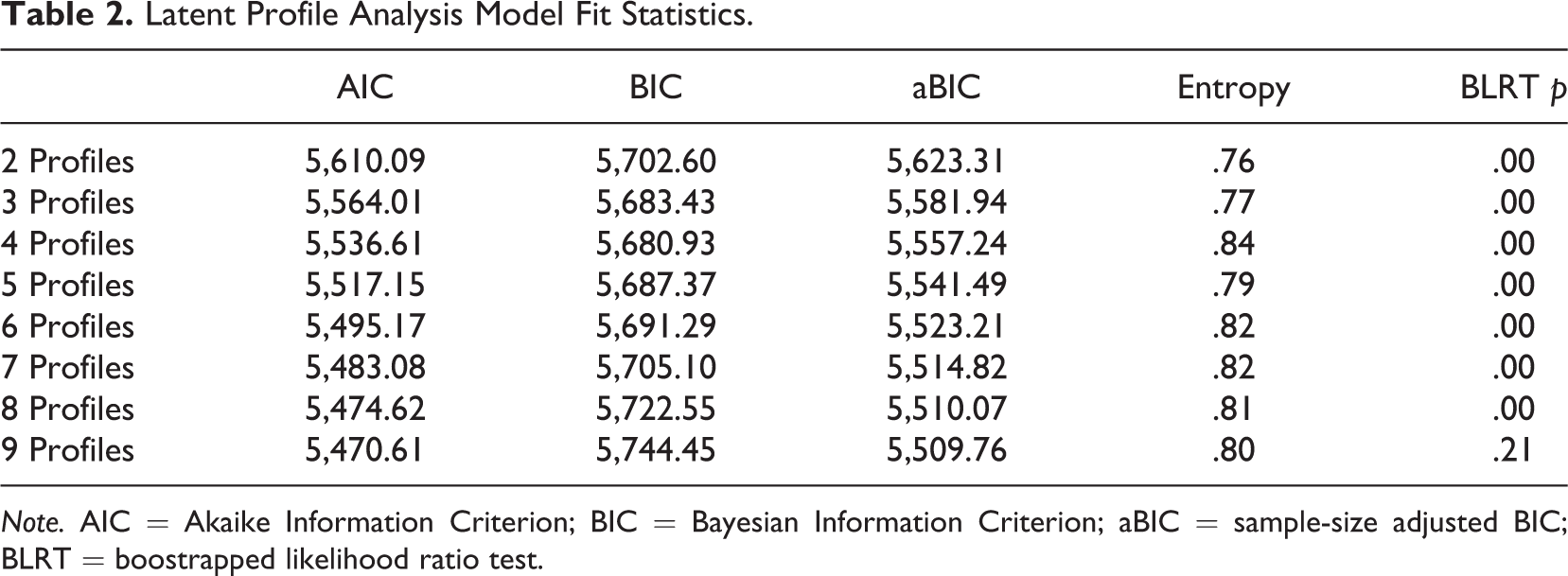
Note. AIC = Akaike Information Criterion; BIC = Bayesian Information Criterion; aBIC = sample-size adjusted BIC; BLRT = boostrapped likelihood ratio test.
Classification Posterior Probabilities for the Eight-Profile Solution.

Note. Values in boldface are the average posterior probability associated with the class to which individuals were assigned.
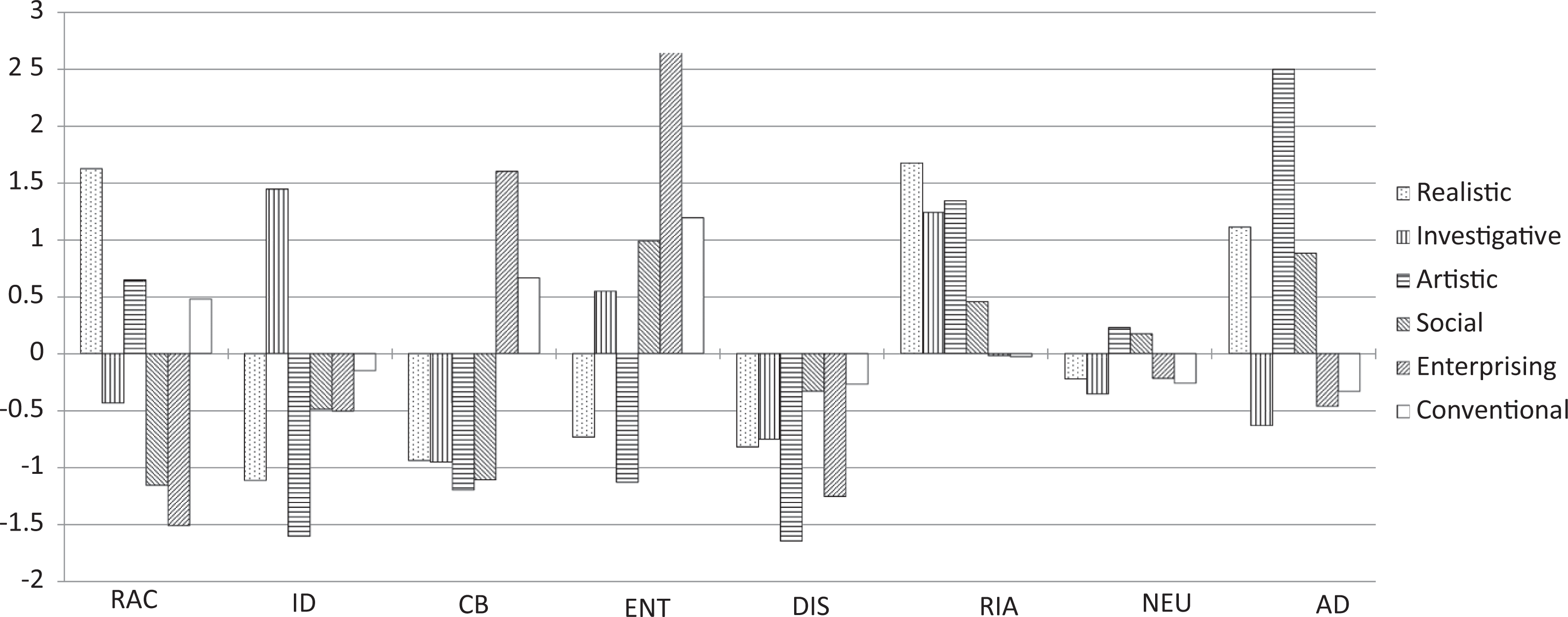
RIASEC variable means across the eight different career interest profiles. Note. RAC = Realistic–Artistic–Conventional; ID = Investigative-Dominant; CB = Conventional Business; ENT = Entrepreneur; DIS = Disinterested; RIA = Realistic–Investigative–Artistic; NEU = Neutral; AD = Artistic-Dominant; Variable means were standardized to assist with interpretation.
Profile Interpretation
Similar to the process of labeling factors in exploratory factor analysis, using LPA, a label can also be assigned to the group of individuals who comprise a particular class. Thus, to assist in addressing Research question 2, we used the profiles depicted in Figure 1 to assist with labeling. Profile 1 (n = 32) was labeled as Realistic–Artistic–Conventional (RAC), as its members demonstrated comparatively higher mean scores on those three RIASEC variables. Profile 2 was labeled as Investigative-dominant (ID; n = 30), as scores on the Investigative variable were considerably higher than the scores on the other RIASEC variables. Profile 3 was named Conventional Business (CB; n = 43), as high scores on the Enterprising and Conventional RIASEC variables dominated this profile. Profile 4 was labeled Entrepreneur (ENT; n = 50), as high scores on the Enterprising RIASEC variable dominated this profile but was also characterized by moderate levels of Social and Conventional.
Profile 5 was labeled the Disinterested class (DIS; n = 85) of individuals. This label was assigned because mean scores on all the RIASEC variables reflected comparatively lower levels of interest than the other classes. On the other hand, moderately high levels on the Realistic, Investigative, and Artistic RIASEC variables distinguished Profile 6 from the other classes. As such, a label of Realistic–Investigative–Artistic (RIA; n = 17) was assigned. Profile 7 (n = 7) was thought to represent individuals who had some, albeit modest, interest in a wide range of vocational activities. For this class, a label of Neutral (NEU) was thought to be most appropriate to describe individuals’ similar scores in each of the RIASEC variables. Finally, Profile 8 was labeled as Artistic-dominant (AD; n = 35), as scores on the Artistic RIASEC variable were considerably higher than scores on the remaining RIASEC scales.
Table 4 presents the mean scores for each of the RIASEC variables across the eight profiles. Post hoc comparisons of the mean scores of each RIASEC variable were conducted across all eight classes. Comparisons were conducted using a Wald χ2 test to test for equivalent parameters. Equivalence was tested for each RIASEC variable across all eight classes (i.e., using a global Wald test) and simultaneously with pairwise Wald tests. Table 4 also provides the global and pairwise Wald test results. In general terms, according to differences across the RIASEC variables, the pairwise comparisons suggest that the profiles can be meaningfully differentiated from one another in multiple ways.
Variable Means Across the Eight-Profile Solution.
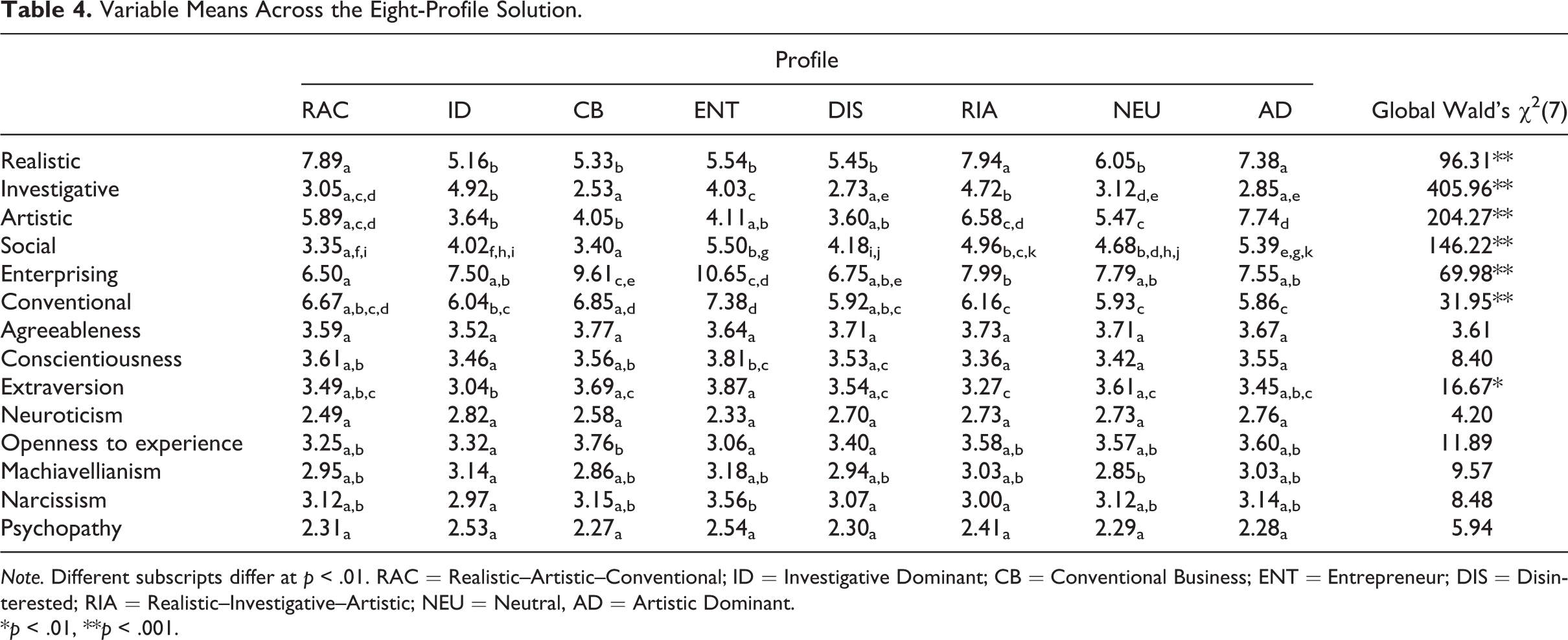
Note. Different subscripts differ at p < .01. RAC = Realistic–Artistic–Conventional; ID = Investigative Dominant; CB = Conventional Business; ENT = Entrepreneur; DIS = Disinterested; RIA = Realistic–Investigative–Artistic; NEU = Neutral, AD = Artistic Dominant.
*p < .01, **p < .001.
The proportion of men and women in each class was examined across each emerging vocational interest class to address Research question 3. The RAC class had a fairly even split between men (n = 17) and women (n = 15), while the CB class was approximately 60% women (n = 26, men: n = 17). In line with the sex distribution of the current sample, the ENT (men: n = 12, women: n = 38), RIA (men: n = 5, women: n = 12), and the DIS (men: n = 11, women: n = 74) classes demonstrated a greater proportion of female (∼80%) membership. Over 90% of the individuals assigned to the AD class were women (men: n = 3, women: n = 32) whereas the NEU and ID types were 100% women.
As detailed in Table 4, the mean scores for the FFM and Dark Triad variables were very similar across each vocational interest class. Equality of means for the personality variables was tested across each vocational interest class using the auxiliary procedure discussed by Asparouhov and Muthén (2013). Figure 2 presents the mean personality scores across the eight vocational interest classes. There were no significant differences across any of the classes for Agreeableness, Neuroticism, and psychopathy. Minor differences were found for Conscientiousness (higher in ENT compared to ID, RIA, and NEU), Extraversion (lowest in ID as compared to the means in CB, ENT, DIS, and NEU), and Openness to Experience (highest in CB as compared to ID, ENT, and DIS). Differences across the Dark Triad variables suggested that Machiavellianism was greater in ID as compared to NEU and narcissism was higher in ENT than in ID, DIS, and RIA. These results would suggest that several FFM and Dark Triad personality variables might have a minor role in differentiating among profiles of vocational interests.

Means of five-factor model and dark triad personality variables across the eight different career interest profiles. RAC = Realistic–Artistic–Conventional; ID = Investigative-Dominant; CB = Conventional Business; ENT = Entrepreneur; DIS = Disinterested; RIA = Realistic–Investigative–Artistic; NEU = neUtral; AD = Artistic-Dominant. Variable means were standardized to assist with interpretation.
Discussion
Our objective in the current study was to investigate the profiles of vocational interest that emerge from a LPA of the variables associated with Holland’s RIASEC model. We offer a contribution to the literature by way of using person-centered analyses to examine the different types of individuals represented by the domain of vocational interest variables. We also present a novel application of LPA to the RIASEC variables, which is in response to a recent recommendation from Tay et al. (2011) to compliment the study of vocational interests with person-centered approaches (see also Wang & Hanges, 2011; Woo, 2011). The results from this study suggest that a LPA model with eight distinct types of vocational interests provided an optimal solution.
Although strict adherence to the RIASEC model would suggest the presence of six profiles, each dominated in turn by one of the RIASEC variables, our results suggest such profiles may not exist. Our results provide evidence for the presence of much more complex types of individuals. For example, the RIA class (see Figure 1) suggests that Realistic interests operate in conjunction with Investigative and Artistic interests. This would suggest the presence of a RIA-dominant type rather than separate classes of individuals who have distinct interests in Realistic, Investigative, and Artistic work activities. According to O*NET, such a pattern of interest may suggest career paths toward occupations like geneticist and biochemist, architect, or even musical instrument tuner. Despite the varied nature of these occupations, our results suggest a fair amount of overlap in the work behaviors constituting each of these occupations. With a reliance on traditional methods of determining interests via “the highest scores” on the RIASEC variables, the similarity between the tasks and the behaviors among occupations like these may be overlooked and, as a result, may reflect a missed opportunity insofar as attention may not be given to these occupations as potential career options.
Our results also presented two profiles that seem to fall outside the traditional conceptualization of vocational interest. The DIS label was assigned to the profile that had individuals who scored comparatively low on the RIASEC variables. This class could represent those individuals who have no particular interest in any domain of work activities or those individuals who serially change jobs (i.e., “hobos”; Woo, 2011). Alternatively, this class of individuals could represent those with postmodern work interests (e.g., “hipsters”; see Lanham, 2003) that do not fit into any of the RIASEC variables. Given that the DIS class had the largest membership of the current sample (28.4%), this may mark a departure from the ability of the RIASEC model to capture the work-related interests of most individuals.
The NEU class also seems to fall outside of the traditional RIASEC framework. Individuals in this class were categorized as having neutral interests because scores on each of the RIASEC variables were approximately even. Thus, individuals in this class may have well-rounded interests or may have yet to solidify their interests and, as a result, may be interested in pursuing nearly every occupational domain. Such a pattern of interests may suggest that any particular interest will not be pursued at the expense of interest in an alternative occupation, thus perhaps complicating career or academic choices. It would, however, be of interest to investigate whether the NEU class emerges in alternative samples in future research. For example, if participants have not been exposed to a wide range of educational topics (as during undergraduate education), they may be more able to reflect on what work activities are interesting and what activities are not to provide greater differentiation on the RIASEC variables.
Although traditional variable-centered approaches require the explicit specification of interactions (e.g., Cohen, Cohen, Aiken, & West, 2003), person-centered approaches encompass the ability to account for interactions between variables that function in an implicit manner. This constitutes one of the many advantages presented for the use of LPA in the analysis of vocational interest variables because the nature, or even presence, of the interactions between RIASEC variables is not well understood (see Strahan & Severinghaus, 1992). Our results suggest that the RIASEC vocational interest variables combine, and function, in complex and interesting ways. Future research, however, will be required to investigate the likelihood of individuals in each of these latent profiles pursing occupations related to each typology. Furthermore, future research is needed to investigate the resulting job performance, turnover, satisfaction, and commitment of individuals in relation to occupations that may or may not be within their latent vocational interest profile.
We have begun an exploration of the presence of distinct vocational interest classes represented within the RIASEC framework. Further, we have provided a preliminary investigation into the nature of each emergent latent vocational interest class by first developing a label for each class based on the highest scoring RIASEC variables and then subsequently examining the differences in personality each class. Conscientiousness was found to have differential mean levels across several of the profiles. For example, those in the ENT class were found to be significantly higher on Conscientiousness (as compared to the ID, RIA, and NEU classes), but also significantly lower in Openness to Experience (as compared to those in CB class). Although presenting a counterintuitive finding (as higher Conscientiousness may be related to less risk taking and lower Openness to Experience may be related to consistency across day-to-day activities; see Costa & McCrae, 1992), we argue that this may speak to the need to consider the role of variables outside the traditional RIASEC domain to more appropriately direct individuals toward viable career paths. These results would suggest that those higher in Openness to Experience could be encouraged to explore more traditional business-related occupations, while individuals higher in Conscientiousness be given exposure to new business initiatives. To help explain these counterintuitive relations with the FFM variables, the finding that the ENT class had greater narcissism than several of the other classes (ID, DIS, and RIA) corresponds to the discussion of common entrepreneur qualities (e.g., Kets de Vries, 1996). Thus, pursuing entrepreneurial activities may help Narcissists satisfy the inflated and overly positive view that they have of themselves (Campbell & Foster, 2007).
Additionally, the current study was able to explore sex differences across the latent vocational interest classes. In line with the overall sex distribution of the current study, the emergent classes were predominantly women, which may support many previous findings of substantial sex differences across the RIASEC variables, such as women demonstrating stronger Artisitic interests (see Su, Rounds, & Armstrong, 2009). On the other hand, approximately equal numbers of males and females were found for the RAC and CB classes. Note however that through the application of LPA, men and women classified into each interest class would actually tend to have very similar mean scores and would thus be unlikely to demonstrate substantial mean differences.
Despite these insights, given the novel application of LPA, the results of the current study may be considered to provide preliminary evidence of the presence and nature of latent vocational interest classes, and thus, future research, with an eye to replicating the results of the current study, will be required.
Theoretical Implications
Tay et al. (2011) advocated that vocational interests be considered in a bivariate fashion rather than a strict bipolar fashion (people–things, data–ideas; Prediger, 1982). Although Tay et al. noted that a bivariate conceptualization of interests could allow for more flexibility in explaining individuals’ patterns of interests, our study provides evidence for a multivariate vocational interest framework that may provide an improved framework and fit to vocational interest data. This multivariate framework is characterized by nonmutually exclusive variables that combine and interact in a complex manner. The perspective taken in the current research examined the patterns of interests underlying the RIASEC model, which may be the most widely used framework for vocational counseling and research (Armstrong et al., 2008; Fouad, 2007). Thus, in building upon the contributions of Tay et al., we presented an empirical examination of the different types of vocational interests individuals may have in various work activities, and suggested that there are multiple, distinct types of interests that characterize individuals.
Additionally, our results suggested a need for researchers and practitioners to reconceptualize what it means to interpret an individual’s RIASEC scores. As Tay, Drasgow, Rounds, and Williams (2009) noted, the common scoring procedure of assigning a code based on an individual’s highest scoring RIASEC scales “neglects the full RIASEC profile and the structural relations among RIASEC codes” (p. 1300). By examining the profiles that emerge, we were able to present a more accurate representation of the pattern of interests that individuals have in particular work behaviors. Interests in various work activities may combine in more complex, interactive ways than traditionally conceptualized by using a traditional RIASEC code procedure to assign individuals to interest groups. Such a reconceptualization and theoretical implication may realize, in future research and practice, advances and improvements in vocational counseling.
Practical Implications
By adjusting how an individual is assigned to a representative categorization of vocational interests, improvements might be witnessed in terms of matching individuals to appropriate occupations. Furthermore, by better aligning interests to the requirements of a job, gains in performance, commitment, satisfaction, and employee well-being may also be realized. However, further research will be required to provide empirical estimates of the gains provided by leveraging the current study’s methods and results. Motivation for continued research along these lines may be supported by the recent findings of Van Iddekinge et al. (2011) who noted that vocational interest variables account for incremental variance in job performance, over and above cognitive ability and personality variables. Thus, with a better understanding of an individual’s profile of preferred work activities, improved prediction of later on-the-job performance may be facilitated.
We contend that the results of the current study may offer an improved categorization and classification of individuals based on their self-report interest in a diverse array of vocational interests and work activities. With improved classification, researchers and practitioners will be able to better, and more accurately, differentiate among individuals, assist with vocational counseling initiatives, and investigate research questions surrounding vocational interest. The traditional means of assigning a RIASEC code may arbitrarily differentiate individuals who through the current framework may be seen as being more similar. For example, one individual with traditional RIASEC codes of RAS and one individual with an SAR code may be seen as having quite different interests and may be better suited to distinct occupations. However, results of the current study would suggest that even though Realistic interests are higher in the first individual, the manner in which interest work activities combine might be similar, thereby warranting a consideration of similar occupations for both individuals. Thus, despite the increased complexity associated with transitioning to a person-centered analytical framework from a variable-centered framework, the finding that individuals previously considered distinct may be more similar could assist the vocational counseling process by allowing counselors to provide more in-depth services to fewer types of individuals.
Limitations
To best weigh the contributions of the current study, we must highlight several limitations. The sample used in the current study was primarily female and therefore replication using more balanced samples of men and women should be undertaken. Despite the greater proportion of women comprising the current study’s participants, we contend that this has not adversely affected our results. Several of the profiles were characterized by high scores on Realistic and Investigative interests, which, according to Su et al. (2009), have substantially higher scores in men. If a predominance of women were to have biased the emergence and nature of the profiles, then it would be unlikely that these Realistic- and Investigative-laden profiles, which would typically be dominated by men, would have emerged in our analyses.
Additionally, the findings of the current study were based on a single sample, using a single measure of vocational interest, which may limit the interpretability of the current findings and their generalizability. Further applications of LPA to differentiate individuals on the basis of the RIASEC interests will be necessary to demonstrate the robustness of the current study’s findings. Particularly, efforts to replicate the current study’s findings should involve assessing the RIASEC variables with a vocational interest inventory that was specifically designed to assess the RIASEC constructs (e.g., the VPI). Although the overall sample size was in line with several previous studies that have leveraged LPA (e.g., Meyer, Stanley, & Parfyonova, 2012; Morin et al., 2011), replication may also be useful to assess the generalizability of the profiles in larger, more diverse samples. Thus, future researchers should endeavor to assess the replicability of our findings across other vocational interest inventories and different samples.
Summary and Conclusion
In sum, this study has revealed that it may not be sufficient to conceptualize, analyze, and interpret career interest survey results as unidimensional. In other words, although an individual may have a stronger interest in one particular area (i.e., Realistic interests), vocational interest variables may combine in a complex manner to influence one’s actual interest. We encourage future researchers and practitioners to evaluate the use of person-centered approaches, such as latent profile analyses, as applied to vocational interest variables to further examine the nature of the different types of individuals represented by the domain of vocational interests. Such a pursuit will not only assist in achieving alignment between taxonomic theories (such as the RIASEC model) and analytical methods, but could also reveal interesting associations between individuals and outcomes that might otherwise be overlooked by focusing exclusively on variable-centered methods.
Footnotes
Declaration of Conflicting Interests
The author(s) declared no potential conflicts of interest with respect to the research, authorship, and/or publication of this article.
Funding
The author(s) received no financial support for the research, authorship, and/or publication of this article.