



Abstract
Career/vocational counsellors and researchers have traditionally focused on career interest surveys as a way of better matching client to careers that they will find both interesting and rewarding. However, recent research has demonstrated that personality is also an important, significant predictor of vocational choice, though is distinct from career interests. Only recently have researchers begun to explore personality in a broader context, by examining personality constructs outside of the five-factor model (FFM). In the current study, we explored whether the Dark Triad would add incremental prediction in broad scales of career interests beyond that of the FFM. Our findings indicated that the Dark Triad accounted for incremental prediction and unique variance in career interests as measured by the Jackson Career Explorer. The implications of this are discussed.
A primary goal of career/vocational counseling is to match clients to careers that they will find both interesting and rewarding. As such, researchers and practitioners have traditionally focused on career interest surveys as one way of attaining this goal. However, in the last 20–30 years, there has been increasing interest in the relation between career interests and personality (see Larson, Rottinghause, & Borgen, 2002). John Holland (1978, 1997) was a major proponent in theorizing this link and claimed that career interests might be another aspect of personality. Other researchers and practitioners, however, have argued that career interests and personality are conceptually distinct and that any observed relations between the two should not be meaningful (Fryer, 1931; Super, 1957; Waller, Lykken, & Tellegen, 1995). However, recent research has demonstrated that both career interests and personality are significant predictors of vocational choice, work values, job satisfaction, success at work, success at home, and future career transitions (Larson et al., 2002; Mount, Barrick, Scullen, & Rounds, 2005; Tokar, Fischer, & Subich, 1998). In addition, recent meta-analyses (e.g., Barrick, Mount, & Gupta, 2006; Larson et al., 2002; Mount et al., 2005) have concluded that although career interests and personality are correlated, each represents a distinct group of constructs.
However, the relations between career interest and personality have typically only been investigated using more traditional measures of personality, such as the five-factor model (FFM; Conscientiousness, Extroversion, Agreeableness, Openness to Experience, and Emotional Stability). The purpose of the current study is to extend the investigation of the relation between career interests and personality to nontraditional measures of personality. In particular, the current study aims to examine the relation between the Dark Triad, a measure of three traits that refer to a dark, socially destructive personality characterized by grandiosity, emotional coldness, manipulation, and aggressiveness (Paulhus & Williams, 2002), and career interests.
Career Interests and Personality
Both personality and career interests are important to personnel psychology because they may affect behavior through one’s motivation (Mount et al., 2005). Both attributes influence how individuals choose which tasks and activities to do, how much effort to exert, and how long to persist at a task (Barrick et al., 2006). According to Mount, Barrick, Scullen, and Rounds (2005), there is much to be gained in terms of enhancing our understanding of the theory and practice of motivation through the joint investigation of career interests and personality, rather than by studying each in isolation. Although motivation may be influenced by both career interests and personality, both constructs are uniquely important because they may affect motivation in different ways (Mount et al., 2005) and can affect job choice and job performance (Campbell, 1991). This concept is well captured by Mount et al. (2005) who explained that although social interests and Extroversion influence one’s motive to interact with others, the way they influence one’s motives is different. Social interests motivate individuals to search for environments with social activities. Extroversion does the same but, additionally, influences how an individual operates in that environment. It explains how that individual interacts with the environment.
Congruence between career interests and personality also affects motivation and performance through several other pathways. According to theory on person–organization fit, employees should be more motivated when their career interests and personality match that of their organization (Barrick et al., 2006). In fact, a meta-analysis by Judge, Thoresen, Bono, and Patton (2001) demonstrated that those who work at their preferred jobs are better performers. Therefore, the congruence between career interests and personality should be important to work-related outcomes.
From a practical perspective, Gottfredson, Jones, and Holland (1993) suggested that career interests and personality do not overlap enough to be considered a substitute for one another. There has been an increasing trend for counselors to employ multiple psychological assessments (e.g., career interests, personality, and abilities) to assuage this issue (Chartrand & Bertok, 1993; Lowman, 1991, 1993; Subich & Billingsley, 1995; Swanson, 1993). Personality can help both the counselor and client “understand the client’s strengths and weaknesses and, thus, make more appropriate and realistic occupational choices” (Costa & McCrae, 1995, p. 130). For example, a client’s career interests could match with the job of sales manager but that might not necessarily be a good career choice for someone who scores low on Extroversion.
In light of the importance placed on the congruence of career interests and personality, researchers have encouraged an exploration of the overlap beyond the FFM of personality (Larson et al., 2002; Mount et al., 2005). Some researchers have argued that there are a multitude of traits beyond the FFM that may be useful for predicting various criteria (Paunonen & Jackson, 2000). McKay and Tokar (2012) examined the overlap of career interests with the HEXACO model of personality (Ashton & Lee, 2001). The HEXACO model consists of six factors with variations of the five factors from the FFM, and the addition of a sixth factor, Honesty-Humility. The Honesty-Humility factor assesses an individual’s fairness, sincerity, and modesty. McKay and Tokar examined whether the HEXACO would add incremental variance beyond the FFM in the prediction of each RIASEC career interest (Holland, 1997). Interestingly, the HEXACO explained 3–44% of the variance in RIASEC interests and the FFM only explained 4–28%. They also tested whether the HEXACO significantly added to the prediction of career interests over and above the FFM. Hierarchical regressions revealed that the HEXACO accounted for a 4–23% increase over the FFM in the prediction of the RIASEC, whereas, for the reverse, the FFM only accounted for a 1–11% increase over the HEXACO. Therefore, the authors concluded that the HEXACO variables could help explain career interests in addition to the FFM. The authors demonstrated that not only is personality important in the explanation of career interests but that additional personality variables may be able to explain even more variance in career interests.
However, there may be other personality variables, outside of the FFM that may explain additional overlap between personality and career interests. One possibility is the Dark Triad (Paulhus & Williams, 2002) constellation of three traits. Those high on Machiavellianism are described as manipulative, controlling, deceitful, and cold (Paulhus & Williams, 2002; Sherry, Hewitt, Besser, Flett, & Klein, 2006). Those high on Psychopathy are described as lacking empathy for others, being callous, and having a propensity for antisocial and risk-taking behaviors (Williams, Paulhus, & Hare, 2007). Finally, those high on Narcissism are egotistic, self-enhancing, and believe they are entitled and superior to others (Paulhus & Williams, 2002). These traits are considered “dark” because they’re associated with a callous-manipulative interpersonal style (Jones & Paulhus, 2010).
The Dark Triad traits have garnered an increasing amount of attention from industrial/organizational psychologists in recent years due to the accumulating body of evidence of relations between the Dark Triad and important individual and organizational outcomes. For instance, the Dark Triad has some relations to the FFM. It has been found to significantly correlate with the negative pole of Agreeableness and Conscientiousness, and with the positive pole of Neuroticism (Jakobwitz & Egan, 2006). Also, perhaps not surprisingly, these traits have been strongly related to counterproductive work behaviors (O’Boyle, Forsyth, Banks, & McDaniel, 2012). Furthermore, some individuals with high scores on the Dark Triad appear to do quite well in corporate settings that require rational, emotionless behaviors, a strong need for achievement, a willingness to take risks, and charisma (DePaulo, 2010; O’Boyle et al., 2012; Yang & Raine, 2008). Therefore, despite the Dark Triad’s negative connotation, there might be some careers in which those who score highly on the Dark Triad do well.
Present Study
The goal of the current study was to empirically examine whether the FFM and Dark Triad traits can serve as viable constructs for explaining additional variance between personality and career interests. Broadly speaking, we proposed that the three dimensions of the Dark Triad would have meaningful relations to career interests and may account for nonoverlapping variance with the FFM in the prediction of these career interests. This potential incremental prediction was first explored using hierarchical regression. It was predicted that the Dark Triad traits would add significant incremental prediction beyond the FFM in the prediction of the career interests. The hierarchical regressions were also supplemented with relative weights analyses (see Johnson, 2000; Tonidandel & LeBreton, 2011, for a review). By leveraging this combination of analytical procedures (hierarchical regression and relative weights analysis), unique contributions of the Dark Triad may be revealed. The relative weights analysis was used to partition the explained variance among the predictors (both FFM and Dark Triad) to help better understand what each predictor is contributing to prediction. By doing so, one could determine the proportion of a hierarchical regression’s R 2 that is uniquely accounted for by each predictor. In addition, this type of analysis was particularly beneficial for any multicollinearity issues that could have arisen (Tonidandel, LeBreton, & Johnson, 2009), as multicollinearity can “wreak havoc on parameter estimates and standard errors” (Edwards, 2001, p. 277).
The Expressive general occupational theme (GOT) is characterized by artistic work and creative activities (see Table 1 for descriptions of all GOTs), which would likely be endorsed by those high on Narcissism, as this definition would play to their vanity. Therefore, it was predicted that:
Descriptions of General Occupational Themes (GOTs).

High scorers on the Logical GOT have “rational judgment and precision” and use “sound reasoning to make decision” (SIGMA Assessment Systems, 2011). These descriptions are likely appealing to individuals high on Psychopathy who do not rely on emotions to make their decisions (i.e., they have a callous nature). Also, the “intellectually stimulating and challenging work” description would likely be endorsed by those high on Narcissism. Therefore:
Psychopaths have a need for stimulation and are prone to boredom (Hall, Benning, & Patrick, 2004). Therefore, they are likely to identify with the Inquiring GOT.
The Practical GOT is unlikely to be related to the Dark Triad. Its description of an individual avoiding “activities that require you to be the center of attention” is unlikely to appeal to those high on Narcissism. Also, the description that someone high on Practical “may not enjoy exerting influence over others” is unlikely to appeal to those high on Machiavellianism. Finally, the description that someone high on Practical prefers jobs that ensure “the comfort and well-being of others” is unlikely to appeal to an individual high on Psychopathy. Therefore, the Practical GOT was not included in the hypotheses. However, it was still tested to serve as supplementary data.
The description of the Assertive GOT seemed directly linked to Machiavellianism, as it describes individuals as having a “preference for being in control and occupying a position of authority over others.” It also may have appealed to those high on Psychopathy, because those high on Assertive feel that they “can make [their] own decisions without seeking advice or assistance from others.” It is postulated that:
The Socialized GOT is descriptive of individuals who prefer not to take risks. Given that psychopathy has been linked to risk taking:
Those who “enjoy social interaction” and who are “described as kind, comforting, sympathetic, supporting, charitable, and cooperative” are high on the Helping GOT. All three of the Dark Triad traits are likely to have negative correlations with this description. Therefore:
Those high on the Conventional GOT enjoy “overseeing office work,” “making decisions, and supervising others.” These descriptions may appeal to those high on Machiavellianism.
The Enterprising GOT involves persuading and influencing others and being motivated by social status and influence. The description thus applies to all three Dark Triad traits.
Finally, the Communicative GOT involves enjoyment, thinking about topics in great depth, reading, attending lectures, studying, and participating in thoughtful discussion, which is likely to be endorsed by someone who has a strong need for admiration and affirmation, as would be the case for an individual with a high level of Narcissism (American Psychiatric Association, 2000). Therefore, the following is predicted:
Method
Participants
The sample consisted of 251 undergraduate students (61 males and 190 females) enrolled in at least one psychology course at a large Canadian university. Their ages ranged from 16 to 29 (M = 18.21, SD = 1.25). For ethnicity, 62.2% of the sample was Caucasian, 15.9% East Asian, 7.6% South Asian, 5.6% Southeast Asian, 1.6% African North American, 1.6% West Asian/Arab, 0.4% First Nations, 3.2% mixed race, and 2% marked “Other.” In the previous 3 years, 215 participants had been employed (85%), with the vast majority working part-time (less than 30 hr per week) or during the summer months.
Measures
FFM of personality
Personality data were collected using 10-item International Personality Item Pool (IPIP) measures of Conscientiousness, Agreeableness, Extroversion, Emotional Stability, and Openness to Experience (Goldberg, 1999). These measures have been designed to capture the same dimensions as the NEO Personality Inventory–Revised (Costa & McCrae, 1992). These scales had internal consistency estimates ranging from .77 and .86 and have demonstrated adequate evidence of validity in previous research (Goldberg, 1999). Participants responded to the FFM items on a 5-point Likert-type scale (1 = strongly disagree, 5 = strongly agree).
The Dark Triad
Machiavellianism, Narcissism, and Psychopathy were assessed using the Jones and Paulhus (2014) short dark triad (SD3) measure of the Dark Triad. The scale consists of 9 Machiavellianism items, 9 Narcissism items, and 10 Psychopathy items, which are measured using a 5-point Likert-type scale, with 1 = strongly disagree and 5 = strongly agree. The authors reported convergent validities of .77 with Machiavellianism-IV (Christie & Geis, 1970), .68 with Narcissistic Personality Inventory (Raskin & Hall, 1979), and .81 with Self-Report Psychopathy-III (Paulhus, Neumann, & Hare, 2015). Also, the SD3 correlated significantly with an informant (e.g., peer and spouse) assessment of the Dark Triad, demonstrating further construct validity evidence (for Narcissism, r = .42, p < .05; for Machiavellianism, r = .34, p < .05; for Psychopathy, r = .57, p < .05; Jones & Paulhus, 2014).
The Jackson Career Explorer (JCE)
The JCE (SIGMA Assessment Systems, 2011) is a shortened version of the Jackson Vocational Interest Survey (Jackson, 2000) that uses 5-point Likert-type items, instead of forced choice. The JCE consists of 170 items that assess 34 basic interests, which measure 10 broader GOT scales (see Table 1 for definitions). The GOT scales were based on a solid, internally consistent foundation of the basic interest scales, which have a reported Cronbach’s α of .81. The JCE’s GOT scales assess career interest variables similar in nature to those of the RIASEC model, but the JCE taps a wider breadth of interest domains as it measures four additional dimensions. Participants rated their degree of interest in certain activities on a 1 (would not be interested in doing this activity) to 5 (would be very interested in doing this activity) Likert-type scale. The JCE has demonstrated adequate evidence of convergent validity with the Career Directions Inventory (Jackson, 2003).
Procedure
Participants completed the demographic questionnaire, the FFM, and Dark Triad measures as part of a separate mass testing study, where students were asked to complete a variety of psychological assessments at the beginning of the academic year. A subsample of these students later enrolled in an additional research study and completed the JCE.
Results
Cronbach’s α reliabilities, means, standard deviations, and correlations for each of the FFM, Dark Triad, and GOT scales are reported in Table 2.
Scale, Reliabilities, and Correlations Between Personality and Career Interests.
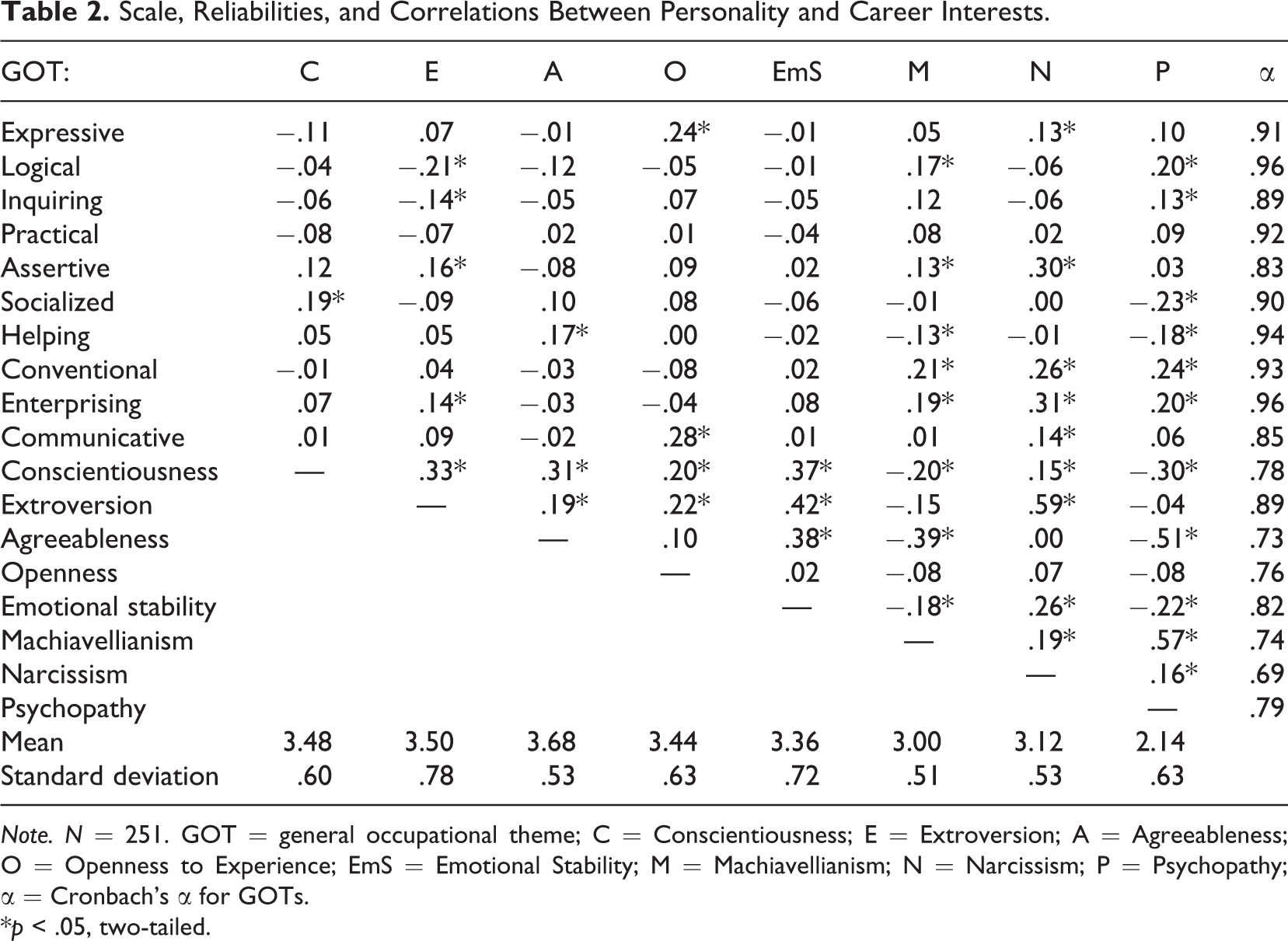
Note. N = 251. GOT = general occupational theme; C = Conscientiousness; E = Extroversion; A = Agreeableness; O = Openness to Experience; EmS = Emotional Stability; M = Machiavellianism; N = Narcissism; P = Psychopathy; α = Cronbach’s α for GOTs.
*p < .05, two-tailed.
As Hypothesis 1 asked whether the Dark Triad variables accounted for incremental variance beyond the FFM in the prediction of each of the GOTs, hierarchical regression analyses were conducted. The Dark Triad demonstrated significant incremental prediction beyond the FFM for five of the nine GOTs (see left-hand side of Table 3). The Dark Triad added significant incremental prediction to Logical (ΔR 2 = .04, p < .05), Assertive (ΔR 2 = .07, p < .05), Socialized (ΔR 2 = .06, p < .05), Conventional (ΔR 2 = .12, p < .05), and Enterprising (ΔR 2 = .11, p < .05) beyond the FFM. Thus, Hypotheses 2a, 4a, 5a, 7a, and 8 were supported.
Hierarchical Regressions in the Prediction of General Occupational Themes.

Note. N = 251. Adjusted R 2s are in parentheses.
*p < .05.
For a better understanding of the incremental prediction, a second set of hierarchical regressions were conducted in which the predictors were reversed: the Dark Triad traits were entered first, followed by the five FFM traits. This allowed us to assess the extent to which the FFM could predict the GOTs beyond the Dark Triad. If the FFM accounted for a large amount of incremental prediction beyond the Dark Triad, this would limit the findings from the first set of hierarchical regressions. However, this was not the case, as there were fewer significant findings for the hierarchical regressions when a reverse entry of the predictors was used: the FFM only accounted for significant incremental prediction beyond the Dark Triad for Expressive (ΔR 2 = .08, p < .05), Logical (ΔR 2 = .05, p < .05), Socialized (ΔR 2 = .06, p < .05), and Communicative (ΔR 2 = .08, p < .05; see right-hand side of Table 3). Therefore, both sets of hierarchical regressions did lend support to the Dark Triad’s potential as a predictor of career interests.
As can be seen in Table 4, the percentages from the relative weights analysis yielded some interesting results. Again, these analyses were included to supplement the hierarchical regression results to help better understand what each predictor is uniquely contributing to the prediction of each GOT variable. Relative weights analysis allows one to determine the proportion of R 2 uniquely accounted for by each predictor, rather than across the set of predictors (FFM or Dark Triad). Other than for the Expressive, Inquiring, Practical, and Socialized GOTs (see Table 1 for definitions), Machiavellianism, Narcissism, and Psychopathy accounted for at least two of the top three largest percentages of R 2 for each GOT. This is quite a large contribution that the Dark Triad makes for the prediction of career interests. Individually, Narcissism accounted for a significant percentage of the R 2 for the prediction of Assertive (53.86%), Psychopathy for Socialized (37.56%), Narcissism for Enterprising (48.35%), and both Narcissism and Psychopathy for Conventional (42.14% by Narcissism and 28.43% by Psychopathy). Therefore, dimensions of the Dark Triad contributed significant R 2s for the prediction of several GOTs. However, the dimensions of the FFM also contributed significant R 2s for the prediction of several GOTs, as Openness to Experience accounted for a significant percentage of the R 2 for the prediction of Expressive (58.81%), Extroversion for Logical (38.85%), and Openness to Experience for Communicative (76.16%). Therefore, the FFM traits are still important for the prediction of career interests.
Percentages of Relative Weights Analysis.

Note. N = 251. The percentages represent the percentage of R 2 that is attributable to each individual predictor. For ease of interpretation, the highest three percentages for each GOT have been indicated in bold. GOT = general occupational theme; C = Conscientiousness; E = Extroversion; A = Agreeableness; O = Openness to Experience; EmS = Emotional Stability; M = Machiavellianism; N = Narcissism; P = Psychopathy.
*p < .05.
Discussion
As predicted, the Dark Triad accounted for significant incremental prediction beyond the FFM for the majority of GOTs. Incremental validity was found for the Logical GOT (ΔR 2 = .04, p < .05), as predicted, supporting Hypothesis 2a. With 28.98% of the unique variance in the GOT was accounted for by Psychopathy, it appears that psychopaths may find the descriptions of “rational judgment and precision” and the use of “sound reasoning to make decisions” appealing. However, that percentage of variance was not statistically significant. This could largely be due to Extroversion being the significant source of unique variance, accounting for 38.85% of the variance in Logical. It was also unexpected that only 5.42% of the unique variance was accounted for by Narcissism. Perhaps narcissists did not find the “intellectually stimulating and challenging work” as appealing. Thus, Hypothesis 2b was only partially supported.
The Dark Triad also significantly predicted the Assertive GOT beyond the FFM (ΔR 2 = .07, p < .05), supporting Hypothesis 4a. However, Hypothesis 4b was not supported. Although only 2.55% of the unique variance was accounted for by Psychopathy, and 11.09% by Machiavellianism, Narcissism accounted for the majority of the unique variance (53.86%) in Assertive. Perhaps those high on Narcissism have a strong preference for being in positions of authority over others.
As predicted in Hypothesis 5a, the Dark Triad had incremental prediction over the FFM for the Socialized GOT (ΔR 2 = .06, p < .05). As anticipated, Psychopathy accounted for the majority of the unique variance (37.56%) in Socialized. Thus, Hypothesis 5b was supported.
Conventional was another GOT in which the Dark Triad demonstrated significant incremental prediction (ΔR 2 = .12, p < .05). Thus, Hypothesis 7a was supported. As expected, the significant incremental prediction was likely due to the large unique variance accounted for by Machiavellianism (42.14%), supporting Hypothesis 7b. However, Psychopathy also uniquely accounted for 28.43% of the variance in Conventional. Conventional focuses on business settings, and the literature on Psychopathy has indicated that psychopaths prefer business environments (Babiak, Neumann, & Hare, 2010).
Supporting Hypothesis 8, the Dark Triad accounted for significant incremental prediction of Enterprising beyond the FFM for Enterprising (ΔR 2 = .11, p < .05). Although 13.52% of the variance was uniquely accounted for by Machiavellianism and 19.82% by Psychopathy, the majority of the variance was significantly accounted for by Narcissism (48.35%). It appears that Narcissism is the most important trait in predicting Enterprising.
Although Hypothesis 1a was not supported, Hypothesis 1b was. Of the Dark Triad traits, Narcissism accounted for the majority of the unique variance in Expressive (13.05%). Hypothesis 3a was not supported but Hypothesis 3b was, with Psychopathy account for the majority of the variance among the Dark Triad in the prediction of Inquiring (28.98%). Hypothesis 6 was not supported. Finally, Hypothesis 9a was not supported but Hypothesis 9b was. Of the Dark Triad traits, Narcissism accounted for the majority of the unique variance (15.07%) in the prediction of Communicative.
Overall, the findings supported that the Dark Triad traits do have meaningful relations with career interest variables. Furthermore, the Dark Triad and its traits can account for unique variance in career interest beyond the FFM. With this new insight, researchers and practitioners may wish to consider using the Dark Triad, and other personality traits outside of the traditional FFM framework (see Paunonen & Jackson, 2000), to assess the congruence between personality and career interests. Practitioners and counselors may also wish to consider the use of the Dark Triad to broaden their view of psychological assessments that may be useful for career counseling initiatives. This may provide counselors an enhanced understanding of how their clients’ strengths, weaknesses, predispositions, and behavioral tendencies can be leveraged to inform more fulfilling career choices. For example, based on the results of the current study, those high on the Dark Triad may be better served to enter careers relating to Enterprising or Conventional career interests. The unique variance accounted for by the Dark Triad in these GOTs was high (48.35% for Narcissism’s prediction of Enterprising; 42.14% and 28.43% for Narcissism and Psychopathy’s prediction of Conventional). Careers in these areas may better lend themselves to the individual’s strengths and weaknesses. For instance, narcissists tend to have slightly higher Conscientiousness and Achievement Motivation scores (Furtner, Rauthmann, & Sachse, 2011), which could be invaluable in Enterprising careers such as marketing or managing. If only using the FFM for assessment, this insight would be overlooked.
Limitations and Future Research Directions
As in McKay and Tokar (2012), the current study was largely comprised of female university students, and future examination of the generalizability of these findings to different populations is warranted. Also, self-reports were used because they were deemed to be the best way to assess individuals’ own interests in careers, and they are commonly used in vocational counseling (Hughes & Karp, 2004). As a result, there is potential for common method variance. However, the current study’s measures were collected at different times, which helps mitigate potential measurement context effect concerns (Podsakoff, MacKenzie, Lee, & Podsakoff, 2003).
Future research should examine the possibility that if individuals’ Dark Triad personality traits are a benefit to certain jobs rather than a hindrance, they may engage in less counterproductive work behavior. For example, if an individual with highly narcissistic tendencies was placed in a job with low prestige and with fewer chances to persuade or influence others, would they be more prone to engage in counterproductive behaviors? Although Gottfredson and Holland (1990) did not report a significant relation between desired and current career congruence and counterproductive behavior across individuals, perhaps this relation is moderated by the Dark Triad, such that only career incongruence for individuals high on the Dark Triad is positively related to counterproductive behaviors.
However, the general nature of the Dark Triad has a negative connotation. It has been linked to counterproductive work behaviors (O’Boyle et al., 2012) and even the name itself has dark undertones. Therefore, future researchers should consider the possibility that these traits will relate to negative outcomes even if a career counsellor accurately matches their Dark Triad personality to relevant career interests. If that is the case, then future studies should address how a career counsellors should approach dealing with clients high on Dark Triad traits. For instance, for those high on Psychopathy, would it be beneficial to focus on developing useful social skills in tandem with any career counselling initiative?
Additionally, the findings should be generalized to other career interest models, such as the RIASEC. Also, the increment of the Dark Triad beyond the FFM and the HEXACO models of personality in the prediction of career interests should be examined.
Summary and Conclusions
The current study broadened the investigation of personality’s relation to career interests to traits outside of the FFM by examining the relations between the Dark Triad and the career interest variables. The findings supported that, to varying degrees, the FFM and the Dark Triad increase the understanding of broad domains of career interest variables. The Dark Triad accounted for incremental and unique variance in career interests beyond the FFM, and Dark Triad traits accounted for unique variance in the GOTs. The inclusion of the Dark Triad to existing FFM personality measurement may provide opportunities for richer, and ultimately more accurate, interpretations in research and counseling applications to help provide viable career options for clients.
Footnotes
Declaration of Conflicting Interests
The author(s) declared no potential conflicts of interest with respect to the research, authorship, and/or publication of this article.
Funding
The author(s) received no financial support for the research, authorship, and/or publication of this article.