



Abstract
Significant research on emotion and career development has transpired in the past few decades. Regrettably, certain aspects of emotional functioning germane to the career decision-making process remain ambiguous. Specifically, kinds and frequency of affective reactions to career options along with helpful ways to assimilate this emotional information in the counseling experience are unclarified. In contrast, this study operationalized an intervention designed to facilitate emotional awareness and tested it with a sample of 451 undergraduates exploring career information. Using a descriptive research design, a frequency distribution of 40,207 affective responses revealed six noticeable recurring emotions resulted from participants’ reflections on career possibilities. This pattern, consistent over a 3-year interval, comprised the majority (59%) of total elicited affect. Moreover, a statistically significant higher percentage of positive emotional responses emerged with college students’ self-assigned occupations relative to computer-generated careers. Practical applications of the affective information for career counseling purposes are also discussed.
Forty-one years ago, Staats, Gross, Guay, and Carlson (1973) published a study applying the attitude-reinforcer-discriminative (A-R-D) theory of learning to items of the Strong Vocational Interest Blank (SVIB). One of their research objectives investigated the A-R-D principle contending that “the verbal labels for emotion-eliciting [environmental] events should display the same characteristic as the events themselves” (p. 252). For instance, if an attractive female model arouses a positive affective reaction in a young man, then the words, “female model,” can have the same response.
Results indicated that items on the SVIB evoked emotional reactions. Explaining the outcome, Staats et al. (1973) noted that the questions, including those with lists of occupations, “sample the events that have learned emotional value for individuals” (p. 258). Interestingly, Holland (1992) referred to this same study almost 20 years later and concluded these specific findings support his assumption that “[a career] interest inventory is a record of a person’s reinforcement history” (p. 9).
Since affective responses transpired while participants reflected on the items in the SVIB, can the results of career interest measures (i.e., vocations) also arouse emotions? If so, what kinds of emotional reactions emerge within career decision makers when they review the occupations? Also, how might career specialists practically facilitate emotional awareness associated with these occupations and marshal the information for the benefit of career decision makers?
The ensuing discussion seeks to answer these questions. A rationale for and outcomes from a descriptive study on the kinds, frequency, and variations of emotions elicited when undergraduates reflect on self-assigned or computer-generated career options are addressed. And, practical applications along with “process questions” to utilize with individuals seeking occupational guidance are presented.
Emotion and Career Development
Several salient features of emotional functioning associated with the career development process have been underscored in research literature. These contributions including the discovery of Staats et al. (1973) that SVIB items operate as stimulus events help move vocational psychology toward a holistic paradigm of the human condition (Hartung, 2010). For the purposes of this study, four notable directions of research warrant attention.
First, information has been garnered on the deleterious impact of anxiety and indecisiveness on career decision making (CDM; Gloria & Hird, 1999; Hardin, Varghese, Tran, & Carlson, 2006). The focus on poorly managed negative affect (NA) prompted researchers to develop helpful interventions for these common barriers bedeviling career decision makers (Rector, 2006). Yet, the concentration on these specific maladaptive affects suggests questions about other possible negative emotions being elicited in the CDM process and whether there are adaptive purposes with them.
Second, there are studies investigating a wider range of emotional states, positive affect (PA) and NA, with occupational variables. Connolly and Viswesvaran (2000) noted PA as directly associated to job satisfaction while NA was inversely related. Emmerling (2003) proposed several hypotheses concerning the impact of PA and NA on CDM tasks such as self-exploration, risk management, information processing, ambiguity tolerance, personal agency, and decision-making styles. For instance, people with high levels of PA would tend to engage in less career choice riskiness, while high levels of NA would lead to more impulsive decisions. Rottinghaus, Jenkins, and Jantzer (2009) reported PA and NA were unrelated to career choice status (decided, tentatively decided, and undecided). Kafetsios, Maridaki-Kassotaki, Zammuner, Zampetakis, and Vouzas (2009) stated people with preferences for business and science careers had a higher level of PA than those with preferences for social science careers.
These investigations offer several important contributions. The authors considered emotional states other than maladaptive ones, emphasized the importance of positive affectivity, and differentiated trait and state affect within career development. The former, trait affect, was described as more permanent, personality-like qualities while the latter, state affect, was defined as transient emotional experiences. Yet, it remains unclear as to which positive or negative emotions surface more frequently in the CDM process and how these feelings can be integrated into decision making.
Third, attention has swelled concerning emotional intelligence (EI) and its relationship with constructs connected to adaptive career development. High EI has been related to less dysfunctional career thinking (Dahl, Austin, Wagner, & Lukas, 2008), less career choice anxiety (Puffer, 2011), greater career decision-making self-efficacy, and higher willingness to explore vocational options and to commit to appealing possibilities (Brown, George-Curran, & Smith, 2003). EI also positively associates with high levels of vocational identity (Puffer, 2011), career choice readiness (Di Fabio & Palazzeschi, 2008, 2009), and several vocational personalities such as Social, Artistic, and Conventional (Caruso, Mayer, & Salovey, 2002; Puffer, 2011).
These findings highlight the importance of emotional skills and suggest a possible role for EI in the “process of arranging and re-arranging information into a choice of [vocational] action” (Gelatt, 1989, p. 255). Interestingly, Emmerling (2003) also hypothesized high levels of perception, facilitation, and understanding of emotion, EI abilities from Salovey and Mayer’s (1990) model, would increase persons’ self-exploration skills. And, a high level of regulation of emotion was predicted to increase the ability of individuals to tolerate ambiguity. Yet, how are the EI talents practically applied in the CDM process? For instance, in the selection or elimination of career options, how can “understanding emotion” help career decision makers?
Fourth, a qualitative study by Young, Paseluikho, and Valach (1997) cataloged the kinds of emotions that emerged during conversations between adolescents and their parents. The dialogues centered on the youths’ occupational aspirations including topics such as specific vocational preferences (i.e., engineer, teacher, and politician) along with personal criteria required for occupations (i.e., personality, ambition, and values). When the parent–youth dyads were in agreement with similar career goals, the discussions preceded smoothly eliciting satisfaction and pride. Dissimilar goals are ones that conflicted germinated anger, ambivalence, tension, frustration, and disappointment. Also, desirable careers were described with adjectives such as exciting and challenging while boring and scary were the words connected to undesirable ones.
The results of Young et al. (1997) documented a variety of common affective reactions when people explore career possibilities. Both positive and negative emotions along with observations as to when they emerged in the CDM interactions were recorded. Unfortunately, their findings have not been replicated, and frequency is missing from their contribution. Questions as to how often the reported emotions emerged, whether certain feelings were more frequently evoked relative to others, and applications of the information from each affect are still unanswered.
A Proposal
CDM is a complicated process (Vondracek, Lerner, & Schulenberg, 1986); many tasks require attention. Efficient navigation of the complexity necessitates a full range of information. Alongside cognition and behavior (Hartung, 2010), vocational specialists need to “understand and respond to the affective side of [occupational] concerns” (Loman, 1991, p. 8). In other words, they should “engage in the meanings and contributions of emotion to human experience” (Greenberg, 2011, p. 3) to assist their clients in operating with “all possible available information to guide their actions” (Greenberg & Johnson, 2010, p. 5).
In light of Loman’s (1991) suggestion, one possible response by career counselors is to help their clients become explicitly cognizant of their state affect at strategic times. Specifically, the author proposes that in the counseling appointments when career decision makers contemplate careers options, results from vocational interest inventories, career counselors pursue two goals. They facilitate emotional awareness in conjunction with the occupations and process the affective information with clients as an additional step in the CDM journey. This insight can help career decision makers “make sense of what each emotion is telling them and to identify the goal/need/concern that it is organizing them to attain” relative to their vocational selections (Greenberg, 2008, p. 90).
To investigate the author’s proposal and address the aforementioned gaps in the research literature, a sample of undergraduates interested in exploring career information were recruited. Aspects of an intervention from Emotion Focused Therapy (EFT), emotional awareness, were operationalized (Greenberg, 2004). Two tasks, “attending to and describing emotion,” in the EFT intervention were utilized to pursue three research questions. First, what kinds of emotions are elicited when college students reflect on career options associated with results from vocational interest instruments? Second, are certain emotions evoked more frequently than others? Is there a pattern to the evoked affect? Third, are there differences in the kinds of emotions elicited when careers are self-assigned versus computer generated?
The research questions enlist a descriptive research orientation. By nature, the approach has an observational bent. The goal is to “carefully [map] out a situation…to describe as carefully as possible what is observed” (Rosenthal & Rosnow, 2008, p. 21). Qualitative designs “allow the researcher to explore the meanings people give to their experiences…[and provide insight into] how people think about their world, their lived-world experiences” (Biggerstaff, 2012, p. 197). Yet, in this study, the author embraced a few broad assumptions regarding possible outcomes. It was assumed that results associated with career interest measures, specifically lists of vocations, can elicit affective reactions (Holland, 1992; Staats, Gross, Guay, & Carlson, 1973). The occupations would serve as stimulus events (Immordino-Yang, 2008; Lewis, 2008). As for kinds of evoked emotions, the “lived-world” state affect, the variety was anticipated to be comparable to the set reported by Young et al. (1997). Among the elicited emotions reported by participants, a higher percentage of PA with self-prescribed vocations was predicted due to familiarity with the careers while a higher percentage of NA was projected with computer-generated careers due to the novelty of the occupations.
Method
Participants and Procedures
Undergraduates attending a university in the Midwest participated in this study. The 451 college students (70% female and 30% male) who were voluntary participants averaged 19.2 years of age. The majority were European American (90%). Three and one-half percent of the participants self-identified as Hispanic American, 2½% as African American, 1% as Asian American, ½% as Native American, and 2½% as undesignated.
The participants expressed an interest in career exploration and comprised of sophomores (n = 164) enrolled in a seminar, “Life Calling and Career Planning,” and freshmen (n = 287) taking general psychology. They were informed of the purposes for and risks in the study along with the freedom to withdraw without penalty. And, incentives for participation included class participation points for completion of three “in-class” assignments for the sophomores and extra credit for freshmen.
Data Collection
The research process covered 3 years. Data from undergraduates in the seminar were collected over three consecutive fall semesters. In the third year, the sample was expanded with the students in general psychology sections. Their data were obtained in the fall and spring semesters. The decision to expand with freshmen was predicated on their similarity to the sophomores in age and career-planning experience and that their course already had an objective in the curriculum to process results from a career interest inventory.
Interpretative Encounters (IEs)
IEs were developed to simulate common career counseling activities such as learning and processing results from vocational interest measures. These meetings afforded the management of large numbers of participants at one time. Environmental variables such as time, instructions for the exercises, and collection of observations were also easily controlled.
IEs lasted approximately 55 min and were led by a doctoral level researcher experienced in career counseling or a trained research assistant seasoned in vocational research. In each IE, two important tasks were accomplished. First, participants heard an explanation of their results associated with a particular career interest inventory that had been administered prior to the meeting. Second, the undergraduates engaged in a “reflection exercise” requiring them to list career selections and circle affective words that described their elicited feelings for each occupation.
For example, the first IE, which all participants experienced, occurred after an administration of the My Vocational Situation (MVS; Holland, Daiger, & Power, 1980). Participants copied the Top 3 career selections that had been listed on the first side of the MVS onto a provided form and then indicated emotional reactions to each vocational option. These occupations were considered self-assigned; they were prompted only by the directions on the MVS.
The second IE, which only seminar students experienced, transpired after a discussion of their results from the Strong Interest Inventory (SII; 2004). Participants enumerated their Top 15 career options on the provided form. Specifically, they were to select careers that had a standard score of ≥40 (midrange to similar) and then circle evoked feelings connected to the occupation. These vocations were regarded as computer generated.
The third IE, which all participants experienced, happened after a discussion of their results from the personal career development profile (PCDP; Walter, 2000), which is associated with the 16 Personality Factors (16PF; Cattell, Cattell, & Cattell, 1993). Undergraduates recorded their Top 15 career options and any elicited affect with each selection. The occupations had to have a sten score between 6 and 10; the priority was to start the list with careers having a sten of 10 and then record those with 9, and so on. Again, these careers were considered computer generated.
Notably, there were variations in the number of IE experienced by participants. Students in the seminar had three, all during class time, while the freshmen had two, one in class and one outside class time. Certain factors prompted the variations. First, time constraints affected participants in the general psychology sections; the amount of extra credit called for a 2-hr commitment. Second, an important priority was to demonstrate the reflection exercise, the proposed method for facilitating emotional awareness, with as many well-known career interest instruments as possible. Yet, it is important to note that these variations would not, positively or negatively, impact the purposes in this study. In other words, the number of IE experienced by participants would not dictate the kinds of emotions evoked by careers. For instance, fewer IE relative to more IEs would not prompt more or less positive or negative affective reactions.
Regarding, the reflection exercise, participants utilized a form to record their vocational and emotional information. Specifically, there was a line for a career option followed by the set of 18 affective words. The number of lines for the careers depended on how many vocational selections (3 or 15) were requested.
Furthermore, the two subtasks, attending to and describing emotion within the EFT intervention, “emotional awareness,” were operationalized in the reflection exercise (Greenberg, 2004). Once a career was listed by participants, they had a chance to attend to their feelings which entailed alerting themselves to any emotions associated with the occupation (Ekman, 2003; Lewis, 2008; Staats et al., 1973). Then, they were to describe the evoked emotions by symbolizing them with words; this was accomplished by circling the appropriate affective labels. The circled words were considered self-report data of the participants (Rosenthal & Rosnow, 2008).
Eighteen Affective Words
The 18 options for emotions resemble a brief, self-report checklist. According to Rosenthal and Rosnow (2008), “the popular word checklist has a long history in the psychological assessment field…[It employs a] categorical judgment [which] is a simple yes (circle the emotion) or no (don’t circle it)” (p. 141).
In each IE, participants were instructed to circle as many emotions as appropriate for each vocational option; no limit was recommended. Also, the arrangement of the 18 emotions was altered per IE in an attempt to control for order effect. Because the undergraduates’ feelings were anticipated to be brief or transient experiences, the checklist was labeled the State Affect Checklist (SAC).
Certain priorities directed the assembly of the SAC. First, the checklist should have a sufficient number of options. Rosenthal and Rosnow (2008) stated, the “optimal number of response alternatives…becomes a matter of intuition…[yet] more alternatives yield practical benefits” (p. 137). Second, the checklist should meld information from research findings in both vocational psychology and emotion science. Third, it should include words that would have apparent usefulness for undergraduates in a career counseling encounter.
From the career development literature, Young et al. (1997) drew attention to 11 emotional terms that emerged in conversations between adolescents and parents; 7 were utilized in this study. Puffer (2011) suggested two words, attraction and disgust, from his work with EI of undergraduates and their vocational personality. In emotion science, Ekman (1970) and Izard’s (1977, 1991) studies with universally recognized affect, mostly via facial expressions, provided lists of feelings that are fairly well known in pop culture (Ekman, 2003). Five of the six basic emotions in Ekman’s research were used; 8 of the 11 fundamental emotions mentioned in Izard’s list were tapped.
Collectively, there were 30 possible emotions from the four aforementioned sources. Twelve options were eliminated for the following reasons. First, duplicates existed for five affect—surprise, sadness, fear, anger, and disgust—warranting the removal of one set. Second, some feelings—pride, ambivalence, frustration, and disappointment—from the study by Young et al. (1997) were attributed to a parent or were due to relational dynamics. For instance, pride was a father’s emotion toward his adolescent, not how the youth viewed a career. Ambivalence emerged from the parent–adolescent interaction due to conflicting agendas (i.e., finances) between the two—again, not how the teen perceived a vocational option. Third, guilt, shame, and shyness from Izard’s list represent self-conscious feelings often associated with negative self-evaluations (Kalat & Shiota, 2007). The heightened risk for dissonance within a participant made them potentially more problematic than beneficial for the objectives of this study. In a different setting and under different time restraints, the significance of these emotions (i.e., needs, values, and goals) might be better harnessed.
Finally, the 18 emotional terms can be divided into two mood dimensions resembling the Positive and Negative Affect Schedule (PANAS; Watson, Clark, & Tellegen, 1988). Yet, the ratio of negative to positive is not even; it is intentionally skewed, 11 negative to 7 positive. This decision mimics Ekman’s (1970, 2003) lopsided ratio of four negative to two positive in his basic pattern of emotions and the prevalence of more negative affective terms in the English language. The latter has been explained by a few reasons. The focus on the comprehension and elimination of psychopathology within psychology has generated more negative terms over time (Fredrickson & Cohn, 2008). According to Greenberg (2004), “evolution has blessed humanity with more negative basic emotions than positive ones, in order to aid in survival…Healthy adaptation necessitates learning to be aware of…negative emotionality” (p. 4).
Results
The frequency distributions of undergraduates’ state affect in the three IEs are presented in Table 1. As can be seen, participants indicated a wide range of emotional reactions during each IE. Collectively, the undergraduates reflected on 10,578 occupations and self-reported 40,207 elicited emotions. Chi-square tests per IE reveal something other than chance accounts for these observations (Salkind, 2000); for Top 3, χ2(17) = 5512.6, p < .001, for Top 15-SII, χ2(17) = 5428.62, p < .001, and for Top 15-16PF, χ2(17) = 8605.13, p < .001.
Frequency Distribution of State Affect in Interpretative Encounters.
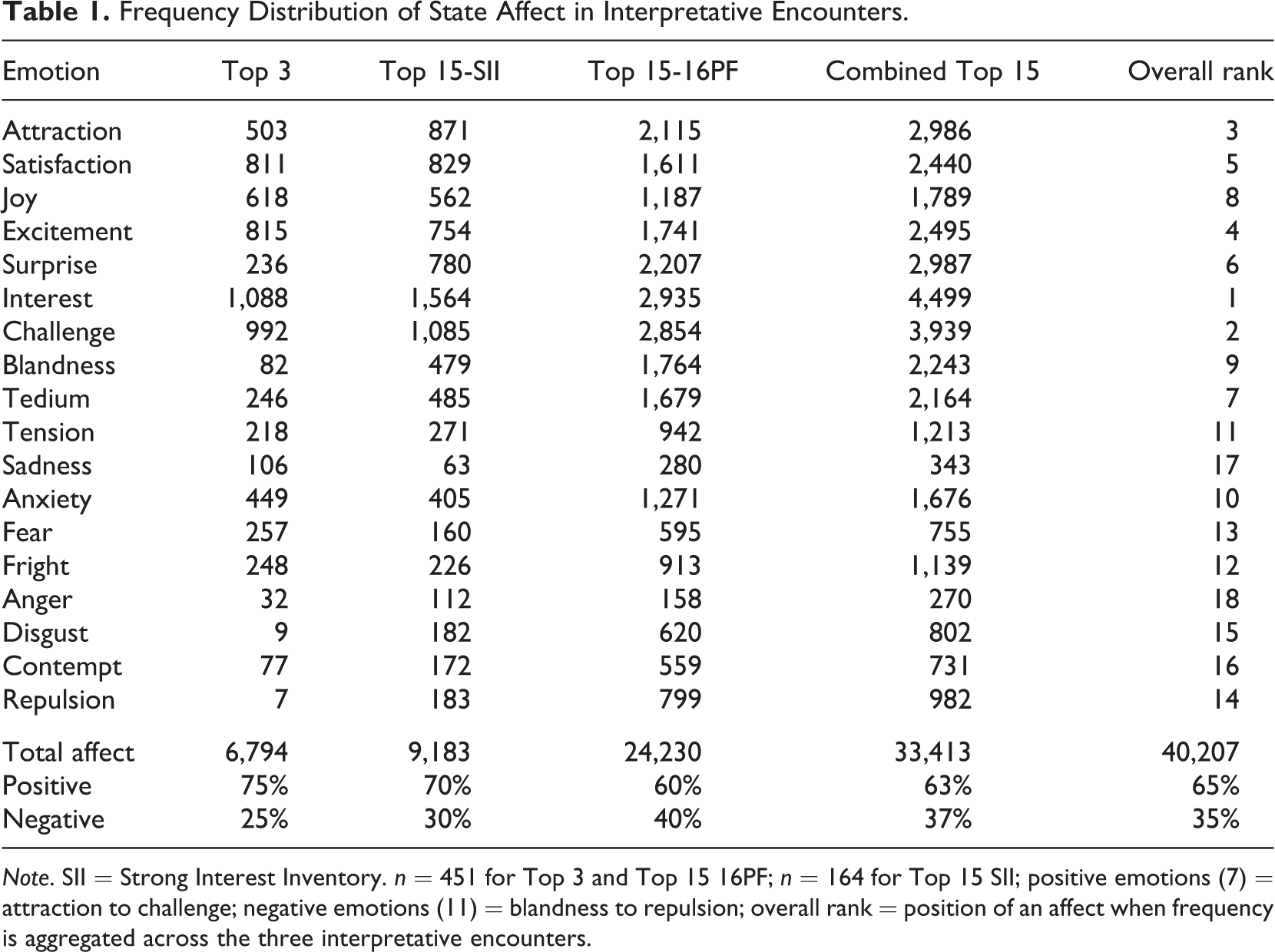
Note. SII = Strong Interest Inventory. n = 451 for Top 3 and Top 15 16PF; n = 164 for Top 15 SII; positive emotions (7) = attraction to challenge; negative emotions (11) = blandness to repulsion; overall rank = position of an affect when frequency is aggregated across the three interpretative encounters.
The Top 6 Emotions
Examining the overall rank, the Top 6 recurring state affect over the 3-year interval were interest, challenge, attraction, excitement, satisfaction, and surprise, respectively. The six account for 59% of the overall emotional reactions. In other words, one third of the emotions in the SAC were reported more often than the other two thirds.
Interest and challenge were consistently ranked first and second, respectively, in each IE. The other four emotions in the Top 6 varied in rank placement across the IEs. For instance, attraction was third in overall rank and the combined Top 15, but sixth in the Top 3. Surprise was sixth overall, fourth in the combined Top 15, an eleventh in the Top 3.
The Two Mood Dimensions
When the 18 terms are collapsed into the two mood dimensions, the college students symbolized their emotional reactions with more positive than negative terms in each IE. In the Top 3, the ratio was three positive to each negative term while in the combined Top 15 the ratio was nearly 2:1. Also, each of the Top 6 state affect in overall rank was positive. These findings corroborate Hartung’s (2010) suggestion for increased attention toward positive affectivity in career development.
Self-Prescribed or Computer-Generated Careers
Self-prescribed vocations (Top 3) had the highest percentage of positive emotional reactions (75%) relative to elicited affect from computer-generated (63%) careers in the combined Top 15. To substantiate the outcome, a one-sample test of proportions was employed (Weiers, 2008). The distinction was found statistically significant, z = 5.02, p = .0001, an outcome supporting the author’s hypothesis. Similarly, there was a higher percentage of negative emotions (37%) with computer-generated occupations (combined Top 15) relative to self-prescribed careers (25%) in the Top 3, z = −5.02, p = .0001. This finding partially supports the author’s hypothesis since the majority of elicited emotions in the combined Top 15 were positive.
Moreover, when the Top 6 emotions in each IE were collectively analyzed for possible distinctions, three affect were noteworthy. Joy was evoked more often in the Top 3, the self-prescribed careers; it ranked fifth (9% of total affect) in that encounter relative to seventh (6%) in Top 15-SII and tenth (5%) in Top 15-16PF. These differences were statistically significant; z = 2.64, p = .004 between Top 3 and Top 15-SII and z = 4.13, p = .0001 between Top 3 and Top 15-16PF.
Yet, surprise and blandness were evoked more often in the Top 15 encounters, the computer-generated occupations. Surprise was ranked fifth in Top 15 SII (8% of total affect) and third in Top 15 16PF (9%), while it was ranked eleventh (3%) in the Top 3. One-sample tests for proportions indicate the disparities as being statistically significant; between Top 3 and Top 15-SII, z = −3.82, p = .0001 and between Top 3 and Top 15-16PF, z = −4.16, p = .0001. Regarding blandness, it was ranked 5th (7%) in the Top 15-16PF and 9th (5%) in the Top 15-SII while it was ranked 14th (1%) in the Top 3. Tests of significance substantiate the distinctions: between Top 3 and Top 15-SII, z = −3.83, p = .0001 and between Top 3 and Top 15-16PF, z = −4.96, p = 0001.
Discussion
Tomkins (1962) opined, “Reason without affect would be impotent [and] affect without reason would be blind” (p. 112). His vision for an accommodating relationship between cognition and emotion has great potential for career psychology. This study described a portion of the emotional world of college students while they explored vocational information. Kinds, frequency, and variations of emotions elicited when the undergraduates reflected on career options in an interpretative setting were noted. It also demonstrated the plausibility of a means to facilitate emotional awareness in the context of career counseling. Several aspects of the findings warrant further discussion.
Eliciting Emotional Reactions
The assumption that vocational options can evoke emotional responses has plausibility. The careers appeared to be meaningful stimuli (Larsen, Berntson, Poehlmann, Ito, & Cicioppo, 2008) creating at least one to several reactions (Plutchik, 1980). Similar to the items of the SVIB (Staats et al., 1973), the occupations associated with the MVS along with the interpretative reports for SII and PCDP seem to have eliciting capabilities.
The descriptive nature of this study precludes cause–effect statements. Yet, the outcomes parallel what emotion researchers discuss concerning the causes for emotions. According to Larsen et al. (2008), feelings are elicited by a variety of meaningful cues or stimulus events. Lewis (2008) noted internal and external stimuli. Internal ones can be physiological states (i.e., tiredness) or complex cognitive activities (i.e., problem solving) while external stimulus events tend to be social (i.e., divorce) or environmental (i.e., an abrupt screeching noise). Ekman (2003) distinguished innate triggers, ones genetically coded for survival purposes, and learned triggers, ones connected to individuals’ learning history.
The vocational options in this study most likely represented external and learned triggers. Lewis (2008) distinguished external elicitors as easier to manipulate than internal ones. In each IE, participants listed careers. These terms or English words were visible, tangible, and malleable entities in the environment of undergraduates. Regarding their learning history, participants presumably became familiar with the careers over time through various experiences (i.e., interviewing a lawyer for a high school assignment and a vocational discussion with a friend’s parent whose career is intriguing) or from varied sources of information (i.e., Google, movies, parents, friends, books, and magazines; Ekman, 2003). Familiarity with the occupations would have varied; levels of awareness probably ranged from superficial (i.e., they only know the career label) to thorough (i.e., they studied the career in depth). If the undergraduates had attached an emotional reaction to the vocational constructs in their past, a “learned association” would have been created. Therefore, the occupational “words” associated with each career development measure (MVS, SII, PCDP) conceivably became stimulus events evoking feelings or retrieving ones from the emotional memory system of participants (Bechara, Tranel, & Damasio, 2000; LeDoux, 2008; Lewis, 2008).
Furthermore, the reflection exercise, specifically the subtasks of attending to emotions and describing them via the SAC, successfully brought participants’ emotional information to an explicit or conscious level. In particular, 40,207 feelings surfaced. This type of information, often overlooked when results of career interest measures are interpreted, can function as an important source of knowledge (Greenberg & Johnson, 2010). Emotional awareness, in the EFT model, is the first step toward change. “When people know what they feel, they reconnect to their needs and are motivated to meet them…[They have] access both to the adaptive information and the action tendency in the emotion” (Greenberg, 2011, p. 74). Put another way, when emotional knowledge is tapped, career decision makers have another means to enhance personal fitness through the pursuit of opportune situations and avoidance of misfortune (Nesse & Ellsworth, 2009).
Kinds of Elicited Emotions
As anticipated, the emergent pattern of feelings was similar to the array in the study by Young et al. (1997). Seven of the emotions used in this project had the following overall rank: challenge (second), excitement (fourth), satisfaction (fifth), boring as tedium (seventh), boring as blandness (ninth), tension (eleventh), scary as fright (twelfth), and anger (eighteenth). Although the intention of Young et al. was to explore a role for emotions, not a pattern of emotions, the findings in this study corroborate the commonness of and apparent usefulness of the same affective terms. Yet, the major distinction between the two studies is frequency. It was discovered that certain state affects were evoked more often relative to others. Put another way, career specialists may encounter challenge, excitement, and satisfaction more frequently in an interpretative appointment than tension, fright, and anger.
For real-world applications of the Top 6 emotions in this study, there are several suggestions about what to know about the feelings and how to incorporate the affective information into an interpretative conversation. The following ideas illustrate a practical use for the EI talent, “understanding emotion” of Salovey and Mayer’s model (1990). Moreover, each state affect can potentially function like a “therapeutic compass” helping to organize a discussion between client and therapist (Greenberg, 2011, p. 37). Not only can this knowledge benefit clients in the thick of the career decision-making process, but it can also serve therapists as they try to assist their clients in creating a “coherent story of the [themselves]” (Greenberg, 2011, p. 32) and in operating with “all possible available information to guide their actions” (Greenberg & Johnson, 2010, p. 5).
Interest
The most frequently evoked feeling in this study, interest, is also the most commonly experienced positive emotion. According to Izard (1977), it is “one of the innate fundamental emotions…considered the most prevalent of all emotions in normal, healthy human beings” (p. 236). Often, it is referred to as the feeling of curiosity and fascination. Change and novelty are its main determinants or activators (Greenberg & Paivio, 2003).
Izard (1991) indicated interest is “present in ordinary consciousness at all times” (p. 106). This seems fitting since the term means “to be among or to dwell in” (Greenberg & Paivio, 2003, p. 259). Moreover, interest is vital for healthy adaptation. When persons are interested they pursue their environment, are receptive to information, explore possibilities, sustain attention, and achieve competency (Izard, 1991).
In processing an interest reaction, career specialists can inquire about the interesting nature of a particular occupation. Several targeted questions can be offered. Is the career a familiar or novel option? If the latter, what stands out? If the former, how long has he or she considered it? What about the career generates a sense of curiosity or fascination? Does interest in the vocation provide motivation to pursue more information about it or to grapple with barriers in obtaining the career? Would the client consider interviewing a professional presently in the occupation? Can the client imagine being motivated to pursue specific experiences (i.e., volunteering and summer employment) to increase future marketability for the vocation?
Challenge
As far as the author can ascertain, the second most popular term, challenge, is not considered a state affect by emotion researchers. Its inclusion in this study was predicated on the vocational research of Young et al. (1997). The word emerged within parent–adolescent conversations about occupational goals. “Those career possibilities deemed…challenging are perceived as having the necessary ‘passion’ to spur the adolescent into the action required to pursue that choice and to sustain the adolescent’s interest over time” (p. 43).
However, the popularity of challenge in this study underscores its importance among the other reactions. Possibly, the undergraduates used this term because a career was inviting, like an appealing call to test their present skills, knowledge, or character (Challenging, 2013). Maybe an occupation inspired or awakened them to go beyond their current status quo (Ehrlich, Flexner, Carruth, & Hawkins, 1980).
To process a challenge designation, career counselors can inquire as to how a vocational option is invigorating and stimulating. Would the career test current knowledge and skills? How so? Does the career spur or propel clients outside their comfort zone? If so, can they describe where it would direct them? Moreover, although challenge was perceived in the study by Young et al. (1997) as a positive reaction, it may be prudent to inquire if an occupation were challenging in a negative sense such as being overwhelming and exhausting, and then ask the client to expound.
Attraction
Based on the tree-structured list of emotions by Shaver, Schwartz, Kirson, and O’Connor (2001), attraction is a tertiary emotion connected to affection, a secondary affect, which is associated with love, a primary emotion. The latter is regarded as foundational to the human condition (Greenberg & Paivio, 2003). Love is a drive for attachment, a “momentary surge of extreme pleasure and engagement” with another (Ekman, 2003, p. 201). Hence, love connects people helping them to build and maintain close relationships (Kalat & Shiota, 2007). Izard (1991) remarked love often involves other positive emotions such as joy, excitement, and interest.
Building on the “connection” theme of its primary emotion, attraction is also a feeling combining charm and allurement. Something has considerable appeal which has aroused attention (Urdang & LaRoche, 1978). The pleasing nature draws a person (Ehrlich et al., 1980). Applied to a vocational context, a connection or attachment can be in the making with the future vocational possibility. The career appears enticing and the career decision maker is allured to it.
Processing an attraction reaction, therapists can safely assume certain occupations have some level of appeal and the client has been drawn to them. Possible probes include the following: Can he or she describe the appeal of this vocation? What has captivated or enchanted him or her? Can the client make an attachment to it? Why? If not, what would it take for the person to make a commitment to it? What does he or she know about the vocation (i.e., career tasks) that is alluring? How do these features in the career fit the client’s mission statement, work values, or personality?
Excitement
Izard (1991) combined excitement, the fourth most popular feeling, with interest in his list of fundamental emotions. Yet, Ekman (1970) described excitement as being more intense and less cerebral than interest. In this study, the two were kept separate as Watson, Clark, and Tellegen (1988) selected to do in their set of 10 positive emotions in the PANAS. Regarding this emotion, Young et al. (1997) wrote, “[The] choices adolescents and parents appraise as scary, boring, or not fun or exciting are considered undesirable. Alternatively, those career possibilities deemed exciting…are perceived as having the necessary ‘passion’ to spur the adolescent into action” (p. 43).
A person who is excited about something “rapidly explores [the] object, breathes rapidly, and actively tries to maximize information about that object” (Greenberg & Paivio, 2003, p. 259). There is an intensity that motivates and energizes. People who are excited have been stimulated, invigorated, activated, or sparked (Urdang & LaRoche, 1978).
Responding to an excitement reaction, career specialists have two options: Combine excitement and interest using the probes previously mentioned for interest or keep the feelings separate. The latter approach can lead to the following questions: What about the occupation (i.e., career tasks) sparks a fire within the client? Is there someone in the client’s life who has this same career? What has the client observed or heard which motivates him or her to do the same when entering the world of work? Has the client shadowed that person who had the career? What was thrilling about the experience? What information about the occupation does the client still need to actively pursue?
Satisfaction
The fifth state affect in overall rank, satisfaction, was interchanged for happiness, one of Ekman’s (1970) original basic emotions. The decision was based on Kalat and Shiota’s (2007) description for happiness, a “sense of contentment…with life” (p. 165). Behaviorally speaking, happiness is often detected by smiling and laughing (Greenberg & Paivio, 2003). In the study by Young et al. (1997), satisfaction was explained as “a sense of comfort, fit, or rightness about choosing one’s career…as opposed to doubt or uncertainty when the choice is considered to be right” (p. 40). Both Ekman (2003) and McLaren (2010) describe this emotion as a state of inner calm as if “all is well” in the world.
Building on the theme of “happy contentment,” a satisfaction reaction could indicate the occupation is suitable, adequate, and sufficient to a client (Urdang & LaRoche, 1978). Counselors can ask the following: Is there a sense of contentment with the career? What is that like? What in the occupation is comfortable? Is the client smiling or laughing? What makes him or her smile or laugh when contemplating the vocation? Is the person convinced about how the occupation fits him or her? On a scale of 1–5 with 1 being low and 5 as very high, how assured is the person of the fit? What perceptions of the career give him or her that assurance?
Surprise
The sixth state affect in overall rank is surprise which appears to have a unique role with computer-generated lists of occupations. Surprise is considered a reaction to change, elicited by a “sharp increase in stimulation…any sudden and unexpected event” (Izard, 1991, p. 177). Interestingly, the duration of surprise is exceptionally brief for the mind apparently blanks and thinking stops momentarily. An important function of surprise is to clear the nervous system of any feelings and thoughts to attend to the sudden change (Izard). Tomkins (1962) referred to it as the “channel-clearing” affect.
Moreover, surprise has a unique status among emotion researchers. Shaver et al. (2001) did not label it a basic emotion, as they did with love, joy, anger, sadness, and fear. Ekman (1970) and Izard (1977) regarded it a basic or fundamental affect. But Ekman (2003) designated surprise as a neutral emotion, neither a positive or negative feeling, and related it to fear. His research with facial expression indicates photographs of surprise are often confused with photographs of fear. In this study, surprise was placed in the PA category because of its adaptive tendencies in forming expectations and nonexpectations about persons’ environment (Izard, 1991).
Processing surprise reactions to career options warrants more attention. Career specialists will need to alter their strategy in an interpretative appointment, allowing more time to unpack its meaning via specific probes. Why is the person surprised? How does he or she interpret this sudden change? Is the change perceived positively or negatively? Why? Is the interpretation fear related? How so? Does the surprising occupation lead him or her toward a new career path or confirm the status quo? How so?
Emotional Variations with Self-Prescribed Versus Computer-Generated Careers
Comparisons of the three sets of “Top 6” among the IEs revealed some notable variations. As mentioned earlier, joy was elicited more often with self-prescribed vocations (Top 3) while surprise (Top 15 SII) and blandness (Top 15 16PF) were evoked more frequently with computer-generated occupations. The author hypothesized “familiarity versus novelty” with the careers as the key reason for the variations.
For the Top 3 encounter, it was assumed undergraduates would self-disclose current musings. These would be familiar and desired vocational preferences, ones often mulled over in their minds eliciting mainly PA. As the results indicate, the author’s hypothesis was supported. The finding also corroborates Fredrickson and Cohn’s (2008) trend; people order their lives to handle several positive feelings and few negative ones.
With both Top 15s, it was anticipated that college students would not be familiar with many of the computer-generated occupations. This novelty should have led to more negative emotive responses. Put another way, the assigned careers in interpretative reports that are unexpected, perplexing, annoying, and even disconcerting were expected to prompt negativity. Interestingly, this hypothesis was not confirmed. The undergraduates overwhelmingly had more positive feelings than negative, 63% versus 37% (in the combined Top 15). Yet, there was a higher percentage of NA reported in the Top 15s (37%) relative to the Top 3 (25%).
Novelty did not preclude positive affectivity. Possibly, if participants were unacquainted, caught off guard, or even annoyed by certain careers, another positive emotion, surprise, might have been prompted. Curiously, the only NA among the Top 6 for both Top 15 IEs was blandness. Instead of novelty, a plausible reason for this affective response may have been displeasure with career options.
Practically speaking, there are several ideas about what to know about the affective variations and how to integrate the emotional knowledge into a counseling appointment. Each feeling, joy or blandness, can potentially help a career specialist identify needs, values, and goals of their clients. After identification, therapists can provide assistance on how to attend to those assessed needs or goals (Greenberg, 2004, 2011).
Joy
The first variation, joy, is regarded as “the ‘queen’ of all emotions” (McLaren, 2010, p. 369). A derivative of happiness, it is defined as an intense pleasurable “experience in response to a surprising gain or success” (Kalat & Shiota, 2007, p. 185). As excitement is considered an intense form of interest, so joy is referred to as a more intense happiness (Ekman, 2003). Moreover, joy affords social responsiveness, an adaptive advantage since it “attracts the care of caretakers and enhances mutual responsiveness” (Greenberg & Paivio, 2003, p. 261).
Vocationally speaking, a counselor can inquire with the following queries to a joyful reaction. What in the career creates a sense of wonder or intense pleasure? Has the client observed someone in the position having a deep sense of happiness with the responsibilities of the career? If so, how does that appeal to him or her? What level of success would the client predict for himself or herself in this occupation? Why? How does the prediction enable him or her to look forward to the future with this career?
Blandness
Another notable variation is blandness, one of the two words in the SAC interchanged for the term, boring, discovered in the study by Young et al. (1997). They mentioned, “Those choices that adolescents and parents appraise as scary, boring, or not fun or exciting are considered undesirable” (p. 43). Blandness appears to describe something as dull, vanilla, generic, or mediocre (Urdang & LaRoche, 1978), the opposite of challenge, interest, and excitement (Ehrlich et al., 1980). Hence, it can be designated the “vanilla feeling” or the affect of disinterest or boredom. McLaren (2010) associated boredom with apathy, a dissociated, disengaged, and squelching emotion. McLaren also related apathy to anger; the former operates as a veil or mask for the latter.
Vocationally speaking, counselors might regard a blandness reaction as elimination—an emotive response that jettisons an option. Some possible questions can include as follows: What about the career is unappealing or mediocre? How does it not fit the individual’s mission or work values? If the client had this occupation or position, what would it be like? What would the friends, parents, siblings of the client say if he or she were hired for this career? Is the client disregarding the career? How comfortable is the person with this elimination?
Furthermore, these notable emotional variations also substantiate certain principles in the emotion science literature. First, people tend to experience “a stream of emotional responses” (Ekman, 2003, p. 70) and order their lives in such a manner to handle multiple positive feelings and few negative ones (Fredrickson & Cohn, 2008). Regardless of the origin of the vocations, personally assigned or computer-generated ones, undergraduates tended to have positive reactions to them. Second, negative affective reactions are not useless pieces of information; they can offer helpful insight (i.e., diagnostic possibilities and occupational dislikes). Hess and Parrott (2010) shared, “Negative emotions signal the cares and concerns that give our lives meaning” (p. 7). For example, one participant in this study recorded “art therapist” in his or her Top 3 list and circled satisfaction, joy, excitement, interest, challenge, and fright. His or her stream of emotions included five positive feelings and one negative. Something in this future occupational preference was perceived scary. What bothered him or her is unknown. Yet, the term, fright, provides a diagnostic clue for a career counselor to explore. A possible result from the discussion can be this person pursuing more world-of-work information which in turn can lead to a more precise prediction/decision for this vocation.
Limitations and Future Directions
The results of this study should be considered in light of certain limitations. First, because of the descriptive research design, no relational or cause–effect conclusions about the reported state affect can be made. Also, regarding self-report data, it was assumed that participants understood the questions that were posed to them and answered in a genuine and honest manner (Rosenthal & Rosnow, 2008). Second, although instructions in the reflection exercise directed undergraduates to list occupations with certain standard scores, self-selection of equally valued career options could have taken place—potentially skewing the number of positive affective reactions versus negative ones. Third, the IEs were facsimiles of an actual counseling appointment. Certain nuances of a face-to-face encounter between a client and therapist (i.e., undistracted attention and an empathic alliance) were not fully replicated. Finally, generalizations from the findings are restricted to populations similar to the features of this sample.
These limitations notwithstanding, research on the role for emotion within a career counseling context must continue. Future research projects can include the development of methods which help educate undergraduates in telling “the story of [their] emotion” relative to the CDM process (Ekman, 2003, p. xv). The protective benefits of negative state affect (Hess & Parrott, 2010) warrant attention. Moreover, relative to this study’s sample, the experiences of other ethnic groups with state affect need exploration.
Conclusion
Sherlock Holmes famously remarked to Dr. Watson, “You see, but you do not observe” (Baring-Gould, 1967, p. 349). In vocational psychology, emotion is seen as an important aspect of the human condition (Loman, 1991). Yet, what is largely undetected in established theoretical formulations and therapeutic practices is how emotional experiences shape and structure the life of career decision makers and subsequently their CDM efforts (Magai & Haviland-Jones, 2002). In contrast, this descriptive study pursued lived-world affective knowledge for career developmental purposes (Biggerstaff, 2012). The results provided a glimpse of the emotional world of undergraduates while they explored career information. Six positive emotions—interest, challenge, attraction, excitement, satisfaction, and surprise—consistently recurred when they reflected on assigned occupations over a 3-year interval. A simple means for facilitating emotional awareness was demonstrated as a feasible theory-based strategy. Suggestions for integrating affective information in a counseling setting were also offered. Collectively, these contributions for working with emotion in a vocational context help prompt movement toward “a holistic portrait of human functioning within a career development paradigm” (Puffer, 2011, p. 146).
Footnotes
Author’s Note
Data collection and article editing in this study resulted from the untiring and valuable assistance from Dorothy Easterly, BJ Fratzke, Lauren Jones, Sarah Limberger, Stephanie Metzler, Kris Pence, Abner Rivera, Marisa Spencer, and Leslie Whonsetler.
Declaration of Conflicting Interests
The author(s) declared no potential conflicts of interest with respect to the research, authorship, and/or publication of this article.
Funding
The author(s) received no financial support for the research, authorship, and/or publication of this article.