



Abstract
This two-wave longitudinal study investigated the reciprocal relations between five possible predictors of career calling (presence of life meaning, search for life meaning, career decision self-efficacy, personal growth initiative, and intrinsic religiousness) among a sample of undergraduate college students over a 6-month period. Using structural equation modeling, two models were tested. The first model included all five predictor variables and was a poor fit for the data; the second model included only search for life meaning and personal growth and displayed improved model fit. Results from the second model indicated that search for life meaning and personal growth at Time 1 significantly predicted calling at Time 2, whereas calling at Time 1 was a nonsignificant predictor of either Time 2 outcomes. These findings suggest the more one is searching for his or her meaning in life and intentionally engaging in self-improvement, the more likely she or he is to later experience a calling.
Introduction
Career calling has emerged as a pertinent construct in vocational research not only due to its high prevalence in college student and working adult populations, but also due to its positive relation to work and general well-being outcomes. The concept of a calling has its roots in a religious framework (i.e., being called to do God’s work through an occupation; Hardy, 1990; Thornton-Duesbery, 1957; Weber, 1958, 1963). However, the scope has broadened to include secular conceptualizations (Dobrow, 2007; Elangovan, Pinder, & McLean, 2010; Hagmaier & Abele, 2012; Hall & Chandler, 2005; Wrzesniewski, McCauley, Rozin, & Schwartz, 1997). Recently, Dik and Duffy (2009) reviewed the calling literature to develop an integrated definition of calling; they defined calling as a life role that is motivated by a form of transcendent summons (i.e., God, societal need, family legacy) and fulfills one’s life meaning and prosocial goals. In other words, a calling is considered to be an externally motivated means through which one may experience and enact a sense of life purpose and service to others.
Thus far, only one published study has investigated the variables that predict the development of a calling (Duffy, Manuel, Borges, & Bott, 2011c). The current study aims to fill a critical gap in the literature by measuring predictors of career calling among a previously untested population: undergraduate students. Specifically, in the current study, we examine the extent to which life meaning, the search for life meaning, career decision self-efficacy (CDSE), personal growth initiative, and intrinsic religiousness predict career calling after a lapse of 6 months. Additionally, because this is the first study to longitudinally test many of these variables in relation to calling, we also test the reciprocal relations among the constructs—whether calling best functions as a predictor or an outcome variable. To set the foundation for our research goals and hypotheses, a brief overview of the literature is provided which addresses the prevalence of calling endorsements among undergraduates, relations of calling to work and well-being outcomes, and findings from existing longitudinal studies on calling. Moreover, rationale is provided to support the inclusion of the presence of and search for life meaning, CDSE, personal growth, and religiousness as possible predictors of career calling within the present study.
Prevalence of Calling and Links to Career and Well-Being Outcomes
Researchers have consistently found career calling to be pertinent to the career experience of college students and working adults. In Duffy and Sedlacek’s (2010) study with over 5,000 incoming college freshmen, they found 40% of students believed it was mostly or totally true that calling applied to their career, and 30% were currently in search of a calling. Similarly, Hunter, Dik, and Banning (2010) showed 68% of college students identified calling as applicable to their career decision–making process. In working adult samples, research suggests one third to one half of adults view their career as a calling (Serow, 1994; Wrzesniewski et al., 1997). Considering the prevalence of career calling among these two populations, these findings suggest that calling is a construct that is highly applicable to the career development of a large percentage of the U.S. population. As such, researchers have examined how endorsing a calling relates to career development and well-being outcomes in college students and working adults.
Among college student samples, career calling has been linked to greater career maturity and well-being. Duffy and Sedlacek (2007) surveyed 3,091 incoming college students and found that those who more strongly espoused a calling demonstrated significantly greater career decidedness, career choice comfort, and self-clarity. Similarly, calling has been related to positive work-related outcome expectations, intrinsic work motivation, positive work attitudes, and increased work enjoyment (Dik, Sargent, & Steger, 2008; Steger, Pickering, Shin, & Dik, 2010). In terms of well-being outcomes, calling has been linked to increased academic satisfaction, life meaning, and life satisfaction in college students (Duffy, Allan, & Dik, 2011a; Duffy & Sedlacek, 2010).
Research on working adults reflects a similar positive relation between calling and career and well-being factors. In their qualitative study on zookeepers, Bunderson and Thompson (2009) found that those with a calling experienced occupational identification and importance, perceived organizational duty, and willingness to make personal sacrifices to their work. Additional research demonstrates calling’s link with increased occupational commitment, work meaning, and enthusiasm for work, and with decreased absenteeism (Duffy, Bott, Allan, Torrey, & Dik, 2012; Duffy, Dik, & Steger, 2011b; Peterson, Park, Hall, & Seligman, 2009; Wrzesniewski et al., 1997). Moreover, calling has correlated with improved well-being, characterized by positive relations with job satisfaction, life satisfaction, and health and negative relations to stress and depression (Duffy et al., 2012; Treadgold, 1999; Wrzesniewski et al., 1997).
The current literature succeeds in evidencing significant relations between career calling and positive career and well-being outcomes in both college students and working adults; however, the cross-sectional nature of the aforementioned studies fails to inform the directions of these relations. Researchers have had a tendency to conceptualize career calling as the predictor of career and well-being outcomes within their studies, but for the most part have failed to test this directionality or consider the opposite relation: Which variables might predict calling? As such, the current study aims to test the directionality of these relations by assessing whether associated variables are better explained as predictors of, or predicted by, career calling.
Longitudinal Research
To date, only three published studies have tested the longitudinal relations between calling and work and well-being variables, and only one of these has specifically measured the predictors of calling. In the following section, we review each of these studies and the related theoretical and empirical findings in order to build the hypotheses for the current study.
Most recently, Hirschi and Herrmann (2012) surveyed 269 German college students at two time points separated by 6 months. They found calling predicted vocational identity 6 months later, vocational identity significantly mediated the relation between Time 1 (T1) calling and Time 2 (T2) life satisfaction, and calling negatively related to life satisfaction when vocational identity was removed. Although these results are important in that they address the longitudinal relation between calling and vocational identity and life satisfaction over a 6-month period, the authors note the need to test how calling relates to a wider array of variables over time (Hirschi & Herrmann, 2012).
Dobrow and Tosti-Kharas (2011) measured the correlations between calling and multiple variables in two longitudinal studies with high school students. In a four-wave longitudinal study with high school musicians, calling was found to significantly relate to intrinsic motivation 6 weeks later and to music satisfaction, career-related self-efficacy, professional identity, career insight, and intent to professionally pursue their calling 3.5 and 7 years later. Among a sample of high school artists, calling at the first time point was related to intrinsic motivation, satisfaction with art, and intent to professionally pursue a calling 6 weeks later. Although these researchers measured the relation between calling and a larger number of variables than was tested by Hirschi and Herrmann (2012), this study focused specifically on how calling related to these factors at multiple later time points, as opposed to whether these factors might predict one’s calling.
Duffy, Manuel, Borges, and Bott’s (2011c) two-wave longitudinal study on first- and third-year medical students is the only existing study of which we are aware that tested not only factors that calling may predict but also those that may predict calling. The researchers tested calling as a predictor and an outcome of vocational development and life meaning. Intriguingly, over a 2-year period, life meaning and vocational development were found to predict calling, not to be predicted by calling. Students who were more advanced in their vocational development and evidenced greater life meaning at the start of medical school were more likely to endorse a calling 2 years later. These results directly inform the hypotheses of the current study.
Potential Predictors of Calling
Considering the limited number of variables that have been temporally measured in relation to calling and the even fewer number of factors that have been tested as predictors of calling, the present study’s hypotheses are primarily informed by theoretical and cross-sectional results in addition to the aforementioned longitudinal findings. First, consistent empirical results suggest a moderate to strong positive correlation between calling and life meaning (see Duffy et al., 2011a, 2011c; Duffy & Sedlacek, 2010). Moreover, life meaning has been found to be a significant predictor of calling among medical students 2 years later (Duffy et al., 2011c), suggesting that the presence of life meaning may predict calling in the current student sample. As such, the presence of life meaning will be included in the current model (Predictor 1).
Second, researchers have proposed that one may not necessarily need to experience the presence of life meaning in order to find a calling, but rather one must be in search of meaning. As postulated by Elangovan, Pinder, and McLean (2010), one must have the urge to find life meaning in order to identify one’s calling. In consideration of this theoretical proposition and previous studies which have differentiated between the presence of life meaning and the search for life meaning in relation to the experience of a calling (Duffy & Sedlacek, 2010), search for life meaning will also be included in the present study (Predictor 2).
Third, theoretical and empirical findings support the measurement of CDSE as a possible predictor of career calling. Hall and Chandler (2005) explain that self-confidence in one’s ability to perform a task (i.e., choose and pursue a career track) aids an individual in gaining clarity about his or her identity. Considering the proposal that one’s identity is closely tied to one’s calling (Pratt & Ashforth, 2003), it follows that increased CDSE may improve one’s clarity about his or her calling. Additionally, repeated empirical findings suggest that CDSE correlates with the presence of a calling (Dik et al., 2008; Duffy et al., 2011a), and two longitudinal studies have found calling to relate to similar career variables (career-related self-efficacy and vocational development) at two time points separated by several years (Dobrow & Tosti-Kharas, 2011; Duffy et al., 2011c). More specifically, Duffy et al. (2011c) found vocational development to predict calling 2 years later among a medical student sample. Based on these findings, it is anticipated that CDSE may demonstrate similar relations with calling in the present study and will, thus, be included in the current model (Predictor 3).
Fourth, research points to personal growth initiative as a possible predictor of career calling. Pratt and Ashforth (2003) assert that calling involves identity and roles, where one must be aware of one’s actual, ought, and ideal selves in order to discover meaningful work that fulfills the self. Moreover, Hall and Chandler (2005) propose that in order to increase the likelihood of finding one’s calling, one must not only possess self-awareness but also the ability to take action to actualize one’s identity. Consistent with Robitschek’s (1998) definition of personal growth initiative, an “active, intentional engagement in the process of personal growth” (p. 184), and findings that suggest a strong correlation between personal growth and vocational identity (Robitschek & Cook, 1999), personal growth initiative may contribute to the discovery of one’s calling. As such, it will be tested in the present model (Predictor 4).
Finally, researchers have found significant relations between calling and religiousness (Dik et al., 2008; Dobrow & Tosti-Kharas, 2011; Duffy & Sedlacek, 2010; Steger et al., 2010). Davidson and Caddell (1994) found that as the salience of religion increases among working adults so does the likelihood that one has identified his or her work as a calling. Specific to college students, Steger, Pickering, Shin, and Dik (2010) found that religiously committed students who experience intrinsic religiousness were more likely to have a calling. Accordingly, intrinsic religiousness will be measured in the current model (Predictor 5).
The Present Study
The goal of the present study was to examine how calling links to proximal variables over time among undergraduate students. We sought to identify the directionality of the relation between calling and five variables: life meaning, search for life meaning, CDSE, personal growth, and religiousness. Namely, we examined whether these variables were predictors versus outcomes of calling. In light of previous empirical and theoretical research, we hypothesized that the presence of life meaning (Hypothesis 1), search for life meaning (Hypothesis 2), career decision self-efficacy (CDSE; Hypothesis 3), personal growth initiative (Hypothesis 4), and religiousness (Hypothesis 5) would predict calling at T2 and that T1 calling would not predict this set of variables at T2 (Hypothesis 6).
To test the aforementioned hypotheses, two models were tested using structural equation modeling. The primary model was the full model in which all paths from T1 calling to T2 variables and from T1 variables to T2 calling were analyzed. The fit of this model was compared to the fit of a second, simplified model whereby all nonsignificant paths were removed.
Method
Participants
Data were collected from 443 undergraduate college students at Time 1 (T1) from a large, public Southeastern university. The average age of participants was 19.27 (standard deviation = 1.85, range = 18–22 years), and 114 (26%) participants identified as male, 326 (74%) as female, and 3 did not identify their sex. Two hundred and ninety-four participants identified as White (66%), 79 (18%) as Hispanic, 47 (11%) as African American, 38 (9%) as Asian American, 18 (4%) as Caribbean, 7 (2%) as Middle Eastern, and 6 (1% each) as American Indian or Pacific Islander. The academic years of the participants were as follows: freshman (228; 52%), sophomore (82; 19%), junior (81; 18%), and senior (52; 12%). Considering the average age was only about 19 and a little more than half of the sample identified as being freshmen, we examined whether the younger students (age 18) and lower standing academic students (freshmen) were just as likely to experience a calling and CDSE as older and more advanced students. We conducted independent-samples t-tests to examine whether calling and CDSE differed based on age (Group 1: 18 years of age vs. Group 2: 19 and older) and academic year (Group 1: freshmen vs. Group 2: sophomore or greater). Adding to previous research findings that showed college freshmen and even students who are just entering college to be in search of and espouse a career calling (Duffy & Sedlacek, 2010; Hunter, Dik, & Banning, 2010), there was a nonsignificant difference in the presence of calling based on age and academic year in the present study. Moreover, CDSE nonsignificantly differed based on age and academic year, suggesting that 18-year-olds and freshmen in the present study were not less likely than older or more academically advanced students to sense a calling or CDSE. As such, participants representing the full array of ages and academic years within the present sample were deemed appropriate to the present study’s investigation of career calling.
Approximately 6 months after T1, 140 participants (32% of initial sample) completed the survey at T2. Although previous longitudinal calling studies have found less than half of their participants to participate at the second time point (i.e., Hirschi & Hermann, 2012), it is important to consider the source of the attrition rate. The major difference between the T1 and T2 survey procedures involved the means of compensation. More specifically, as is further described in the Procedure section, T1 participants were compensated with extra course credit, whereas T2 participants were compensated with a US$5 gift card. It may be that the extra credit versus monetary compensation substantiated a greater rate of participation at T1 rather than at T2. Moreover, with the exception of the decrease in participants who identified as Pacific Islander from T1 to T2 (6 vs. 0 participants, respectively), there was no significant difference in age, sex, race/ethnicity, or academic year between those who participated at T1 and the final sample. Additionally, there was a nonsignificant difference in the scores of the primary variables (i.e., calling, presence of life meaning, personal growth, etc.) between those who participated only at T1 and the final sample.
From the 140 T2 participants, data were excluded from participants who did not respond to the primary scales (6 participants at T1; 14 participants at T2). Additionally, 30 participants failed to mark the correct item on a validity check item on the T2 survey, which resulted in the removal of their data and a final sample of 90.
Procedure
After receiving approval from the institutional review board, the survey was made available to students in psychology courses at a large, Southeastern university via two online methods: (1) students in introductory psychology courses could participate via the psychology pool system; (2) students in upper level psychology courses could complete the same survey on Qualtrics, an online survey system. Students were first directed to a page containing the informed consent form. Only after giving consent were students allowed to access the survey, and students received extra course credit for participation. At T1, participants were asked to provide a code name consisting of their mother’s first name and four numbers of their choosing. The code name provided an anonymous means to match each participant’s T1 data to that from T2. Additionally, participants were asked to provide an e-mail address by which to be invited to participate in the survey at the second time point. E-mail addresses were not connected with the survey results so as to maintain participants’ confidentiality.
Six months after completion of the T1 survey, all T1 participants were invited via e-mail to participate at T2. Based on the previous longitudinal study designs on calling (Hirschi & Herrmann, 2012) and considering changes that students experience over the period of a semester (i.e., exposure to different coursework, social experiences, reflection on selected major/minor), six months was considered to be a sufficient time interval for students to experience a potential change in their perception of a career calling. In the e-mail, participants were provided with their code name from T1, informed they could choose a US$5 gift card to either a local grocery store or Amazon.com for participation at T2, and were presented with a link to the survey on Qualtrics; the link directed them to an informed consent page before providing access to the T2 survey (identical to the survey provided at T1). Up to two reminder e-mails were sent to T1 participants who did not participate after the initial e-mail invitation.
Measures
Calling
The presence of a career calling was assessed using the Brief Calling Scale (BCS; Dik, Eldridge, Steger, & Duffy, 2012). The scale consists of the following 2 items: “I have a calling to a particular kind of work” and “I have a good understanding of my calling as it applies to my career.” Participants answered items on a 5-point Likert-type scale ranging from not at all true of me to completely true of me. Although the BCS has been questioned due to the simplicity of its unidimensional assessment approach and the fact that it relies upon participants’ personal definition of a calling, a multitude of career calling research studies have used this measure (i.e., Dik et al., 2008; Duffy, Allan, Autin, & Bott, 2013; Duffy, Bott, Allan, Torrey, & Dik, 2012; Duffy et al., 2011c) because it is efficient, allows participants to identify their overall belief about having a calling, and overcomes limitations of categorization-based calling measures (which have been reported to have questionable reliability and limit the assessment of participants’ full range of calling experience; Dik et al., 2012). Even among college students—who some might question as to whether they have the developmental awareness to identify their own calling experience, researchers have found the BCS to be a valid and reliable measure (i.e., Duffy & Sedlacek, 2007, 2010; Steger et al., 2010). More specifically, Dik, Eldridge, Steger, and Duffy (2012) surveyed undergraduates with a mean age of 19.33 (similar to the present sample’s average age) and found a significant, positive correlation between participants’ self-reported BCS score and informant reports of those participants’ behavioral demonstration of having a calling. This finding suggests that not only did undergraduates perceive a calling, but also their perception of a calling was corroborated by others, thus supporting the BCS’s validity as a measure for undergraduates’ calling experience. Moreover, the BCS has been found to positively relate to other calling measures (Dik et al., 2012), meaning in life, career development, and prosocial work orientation (Dik et al., 2012; Duffy & Sedlacek, 2007). Previous researchers have found the 2 BCS items to highly correlate (r = .81 in Duffy & Sedlacek, 2007). Similarly, the estimated internal consistency reliability of scale scores in the present study was α = .83 at T1 and α = .88 at T2.
Life meaning
The Meaning in Life Questionnaire (MLQ; Steger, Frazier, Oishi, & Kaler, 2006) was used to measure the degree to which participants felt they had life meaning and were searching for life meaning. The MLQ is a 10-item scale that is composed of two 5-item subscales that measure presence of or search for life meaning. Items are rated on a 7-point Likert-type scale ranging from absolutely untrue to absolutely true. “I understand my life’s meaning” and “I am seeking a purpose or mission for my life” are example items. Findings suggest that the MLQ scale scores have good internal consistency (presence: α = .82, search: α = .87). Presence of life meaning has been found to correlate in expected directions with life satisfaction (r = .46) and depression (r = −.48); search for life meaning, on the other hand, has been shown to correlate positively with depression (r = .36; Steger et al., 2006). The estimated internal consistency reliability of presence of and search for life meaning scale scores was α = .87 and .90 at T1 and α = .93 and .91 at T2, respectively.
CDSE
The short form of the Career Decision Self-Efficacy Scale (CDSE-SF; Betz, Hammond, & Multon, 2005) was used to measure whether participants felt confident in their ability to engage in tasks related to career decision making. Participants answered 25 items according to a 5-point Likert-type scale that ranges from no confidence at all to complete confidence. Example items include, “How much confidence do you have that you could: determine what your ideal job would be” and “decide what you most value in an occupation.” Good internal consistency reliability has been established for scales scores (α = .94), and the scale has been show to positively correlate with vocational identity and career decision variables (Betz et al., 2005). The internal consistency reliability of scales scores in the present study was α = .95 at both T1 and T2.
Personal growth initiative
The degree to which one actively engages in personal development was measured using the Personal Growth Initiative Scale (PGIS; Robitschek, 1998). The PGIS is a 9-item scale in which participants rate items, such as “I have a good sense of where I am headed in my life” and “I know how to change specific things that I want to change in my life,” on a 6-point Likert-type scale that ranges from strongly disagree to strongly agree. Findings suggest good internal consistency of scale scores (α = .78 to .90 among college students) and correlations in expected directions with internal locus of control (r = .56) and chance locus of control (r = −.24; Robitschek, 1998). The internal consistency reliability estimates of scale scores in the present study at T1 and T2 were α = .90 and α = .89, respectively.
Religiousness
Intrinsic religiousness was measured using Gorsuch and McPherson’s (1989) Intrinsic/Extrinsic Religiosity (I/E-R) Scale. The scale consists of 14 items that are rated on a 5-point Likert-type scale ranging from strongly disagree to strongly agree. The scale measures two subscales: intrinsic and extrinsic religiousness. For the purposes of the present study, the 8 items comprising the intrinsic religiousness subscale were used. Sample items include, “I have often had a strong sense of God’s presence” and “I try hard to live all my life according to my religious beliefs.” Gorsuch and McPherson (1989) found the subscale scores to have acceptable internal consistency reliability (α = .83), and the current study found the internal consistency reliability of scale scores to be α = .84 and α = .85 at T1 and T2, respectively.
Results
Preliminary Analyses
Normality was assessed for all six variables at T1 and T2. None of the variables had skewness or kurtosis levels above one, which suggests normality. Thus, the data were retained in their original form. Preliminary bivariate correlations indicated that at T1, calling was significantly correlated with T1 presence of life meaning (.46), personal growth (.45), and CDSE (.35). At T2, calling was significantly correlated with T2 presence of life meaning (.60), personal growth (.44), and CDSE (.30; Table 1). Additionally, paired samples t-tests were completed to determine whether there was a significant change in the variables over 6 months. Results indicate there were nonsignificant differences between T1 and T2 scores of each variable, with the exception of CDSE, for which there was a significant decrease from T1 to T2, t(89) = −2.00, p = .05.
Bivariate Correlations With Calling at Time 1 and Time 2.

Note. T1 = time 1; T2 = time 2; Life Meaning (P) = presence of life meaning; Life Meaning (S) = search for life meaning; CDSE = career decision self-efficacy; SD = standard deviation.
*p < .05, **p < .01.
Structural Models
To determine whether the five variables (presence of and search for life meaning, CDSE, personal growth, and religiousness) predicted calling and/or were predicted by calling, structural equation modeling using maximum likelihood estimation was conducted using AMOS 18 (Arbuckle, 2007). We tested the full model and a simplified model. To identify which model was a better fit for the data, several fit indices were considered: chi-square (χ2), comparative fit index (CFI), and root mean square error of approximation (RMSEA). A nonsignificant χ2 indicates good fit (Tabachnick & Fidell, 2007). The CFI compares the fit of an independence model, in which variables within the model are considered to be uncorrelated to the current model. This fit statistic has been found to be a good estimator of model fit in small samples (Bentler, 1990). Values of .95 or higher suggest good model fit (Hu & Bentler, 1999). The RMSEA compares the current model to a fully saturated model; values that are greater than .10 suggest poor fit and nonsignificance indicates the result is significantly different from chance (Browne & Cudeck, 1993). However, Hu and Bentler (1999) found that the RMSEA tends to overreject the actual model in small samples. This will be taken into consideration when determining model fit, such that CFI will be given more weight in assessing whether the model is in fact an acceptable fit for the data, considering the small sample size.
In the full model (Figure 1), paths were tested from each T1 variable to T2 calling and from T1 calling to each T2 variable in addition to accounting for autoregressive paths and covariances among all T1 variables. The fit indices suggested a poor model fit, χ2(35) = 124.76, p = .00; CFI = .84; RMSEA = .17, p = .00. Within this model, T1 search for life meaning and personal growth initiative were significantly and weakly correlated with T2 calling. However, presence of life meaning, CDSE, and religiousness at T1 nonsignificantly predicted calling at T2. Paths testing the opposite direction of these relations indicated that T1 calling was a nonsignificant predictor of all five variables. Each autoregressive path was significant, suggesting that each variable was related at T1 and T2.
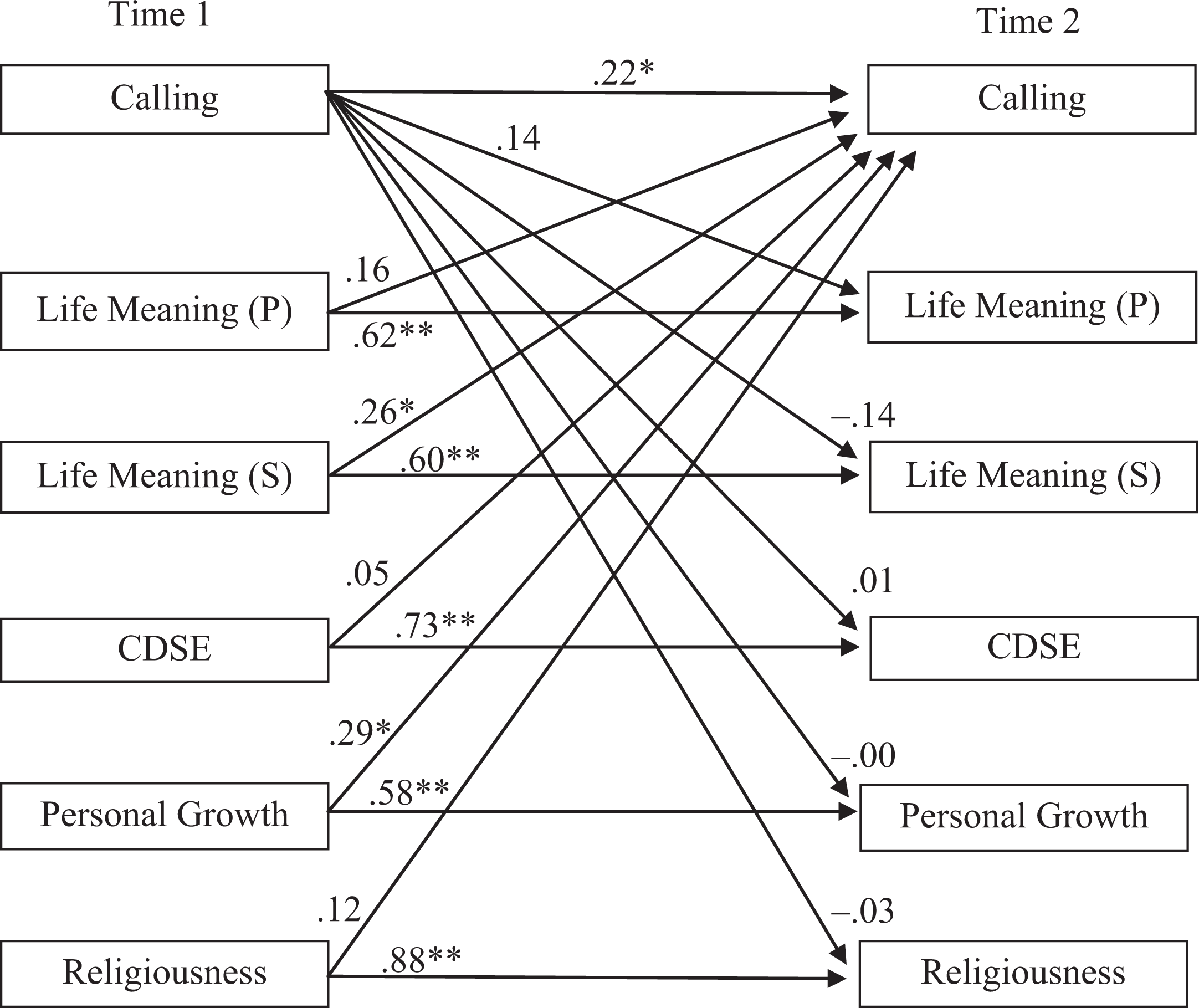
Paths estimated in the full model. Although not depicted in the figure, T1 presence of life meaning, search for life meaning, career decision self-efficacy, personal growth, and calling were allowed to covariate, and the unique variances were measured for all T2 variables. Note. Life Meaning (P) = presence of life meaning, Life Meaning (S) = search for life meaning, CDSE = career decision self-efficacy. *p < .05. **p < .01.
Considering that poor model fit might be due to the relatively high number of model paths that were nonsignificant, the decision was made to remove variables from the model which were neither a predictor of, nor predicted by, calling. More specifically, calling was nonsignificantly related to CDSE, life meaning, and religiousness in either direction, and as such, these variables and their associated model paths were removed. The paths from T1 calling to T2 search for life meaning and personal growth were also nonsignificant; thus, these paths were also removed.
The second, simplified model tested the paths from T1 search for life meaning and personal growth to T2 calling, in addition to the autoregressive paths (Figure 2). Covariances among all T1 variables were also accounted for. This model was a much better fit for the data, χ2(7) = 13.55, p = not statistically significant (ns); CFI = .95; RMSEA = .10, p = ns. Ideally, all fit statistics indicate good model fit. However, considering the small sample size and the tendency for the RMSEA to overreject true models in small samples, it is not surprising that RMSEA is .10. Considering that good model fit is suggested by the remainder of the fit indices—one of which (CFI) has been shown to be a good estimator among small samples (Bentler, 1990)—this model suggests adequate fit for the data. Similar to the findings in the first model, all autoregressive paths were significant, T1 search for life meaning significantly and weakly predicted T2 career calling, and T1 personal growth initiative significantly and moderately predicted T2 career calling. This model accounted for 32% of the variance of T2 calling.
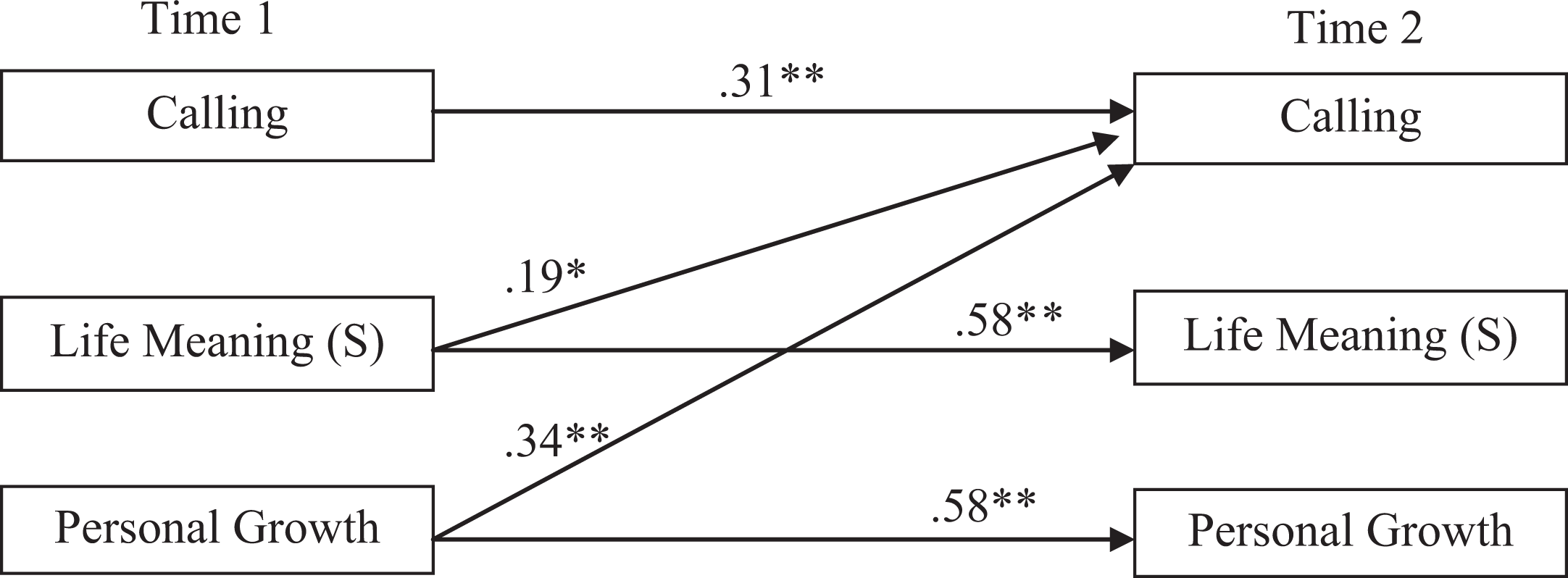
Paths estimated in the simplified model. Although not depicted in the figure, T1 search for life meaning, personal growth, and calling were allowed to covariate, and the unique variances were measured for all T2 variables. Note. Life Meaning (S) = search for life meaning. *p < .05. **p < .01.
Discussion
Mirroring findings from previous studies (e.g., Dik et al., 2008; Duffy & Sedlacek, 2010), the preliminary data analyses suggested significant and strong relations between calling and presence of life meaning and significant and moderate relations between calling and CDSE. Moreover, the results demonstrated the consistency of these relations at Time 1 (T1) and Time 2 (T2). This finding, which emulates Duffy et al.’s (2011c) findings on the moderate and consistent link between life meaning and career maturity with calling over 2 years, suggests that those who experience the presence of a career calling are also likely to sense meaning in their lives and efficaciousness in their career decisions. As the first study to measure the relation between calling and personal growth, the strong and significant relation between calling and personal growth initiative at both time points suggests that those with a calling are likely to have cognitions and be presently engaging in behaviors that contribute to their self-improvement.
The results from the structural equation model provide the most interesting insights into the longitudinal relations between the variables. Filling a critical gap in the literature, and in support of Hypotheses 2 and 4, search for life meaning and personal growth both significantly predicted calling 6 months later. This finding suggests that those who are actively searching for meaning in their lives and those who are engaging in behaviors and cognitions to support their personal growth were more likely to feel a calling 6 months later. Experiencing a calling may be a more specific form of experiencing life meaning and growth in one’s career, and as such, searching for meaning and having initiative to experience growth may predict experiencing a calling. Implications based on these findings are discussed in the practical implications section.
In contrast to several of the hypotheses, presence of life meaning, CDSE, and religiousness were nonsignificant predictors of career calling. The nonsignificant relation between T1 presence of life meaning and CDSE with T2 calling contradicts the significant relations found in Duffy et al.’s (2011c) study of calling among medical students. It could be that meaning in life and CDSE do not significantly predict calling for college students in contrast to medical students, because college students might be at an earlier developmental stage. Or, the difference in findings might be due to the fact that overall vocational development, as was measured in Duffy et al.’s study, might predict calling whereas CDSE does not. Future research is needed to examine these research questions. Considering this is the first study to measure whether religiousness predicts calling, the nonsignificant relation is neither supported nor contradicted by previous findings and suggests that one’s level of religiousness may not significantly influence whether one will find his or her calling in the future.
Finally, supporting Hypothesis 6, career calling was a nonsignificant predictor of the presence of life meaning, search for life meaning, CDSE, personal growth, and religiousness. In accordance with Duffy et al.’s (2011c) findings, calling nonsignificantly predicted life meaning and CDSE at T2. It is important that future researchers test these longitudinal relations with samples of working adults versus undergraduate or medical students. The absence of significance in these relations, especially life meaning and CDSE, may be due in part to students not currently living out their calling through work.
Practical Implications
The results from the current study may have important implications for vocational and general counselors who seek to support undergraduate students in their vocational development. Considering repeated findings that suggest a positive relation between the presence of a career calling and desirable well-being and vocational outcomes (e.g., Duffy & Sedlacek, 2007, 2010), a myriad of authors have honed in on the importance of incorporating career calling into counseling interventions. Adding to this recommendation, the current findings provide further guidance as to how a counselor might help students assess and increase the likelihood of finding their career calling.
Although future outcome research is needed to verify the causal relations proposed in the following implications, the present findings may suggest that helping a client increase his or her search for life meaning and engagement in initiative taking toward self-improvement may increase his or her likelihood of experiencing a calling to his or her career. As such, clinicians are encouraged to ask clients to complete a calling assessment packet, consisting of Steger, Frazier, Oishi, and Kaler’s (2006) MLQ, Robitschek’s (1998) PGIS, and the BCS (Dik et al., 2012). When working with clients who do not espouse a calling, as reflected by their respective BCS score, clinicians may use the results from the MLQ and PGIS to identify areas of concentration for vocational treatment planning. For instance, if clients have low search for meaning scores, it is recommended that therapists support clients in beginning their search for purpose within their own lives. Counselors may do this by helping clients explore their life themes according to Savickas’ (1989, 1995, 2005) narrative approach or coconstruct, deconstruct, and construct life roles according to the constructivist approach (Brott, 2005). Duffy and Dik (2009) additionally note the importance of helping clients search for meaning, as it specifically relates to identified career paths and duties.
If clients’ PGIS scores are low, counselors are encouraged to assist them in increasing their personal growth initiative by helping them determine not only which cognitive, affective, or behavioral changes might heighten self-improvement but also how to actively engage in these self-changes (Robitschek, 1998). For instance, counselors might help clients set goals in one or more areas of their lives in which personal improvement is desired and/or locate resources or opportunities that might contribute to their continued development (Robitschek & Cook, 1999). Clients might also benefit from discussing which factors might contribute to or impede their active engagement in the personal growth process, paying particular attention to how to overcome obstacles to taking initiative.
Based on the findings from the present study, in helping clients increase their search for meaning in life and engagement in personal growth-oriented changes, clients may be more likely to find their career calling. Moreover, by using the calling assessment packet, counselors may be better able to assess clients’ baseline experience of calling and calling-predictive factors, clients’ subsequent changes in these calling-related factors throughout the therapeutic process, and the effectiveness of the therapeutic process in increasing search for life meaning, personal growth, and resulting career calling.
Limitations and Future Directions
The conclusions from the present study must be considered in light of several limitations, which also provide direction for future research. First, the current findings are based on the experience of a relatively small sample of undergraduate students after attrition from Time 1. The final small sample not only challenges the generalizability of the findings but also contributed to decreased power, which limited the likelihood of finding significance in the tested models. If the sample had been larger, it is possible that several of the paths that were nonsignificant but trending (e.g., calling negatively predicting search for life meaning and positively predicting presence of life meaning) could have reached significance. Second, building from the present study’s research design, future researchers are encouraged to use similar forms of compensation at each time point, which may decrease the rate of attrition. Additionally, to provide more power and to counteract two primary criticisms of two-point longitudinal studies (e.g., change scores are likely to be unreliable and regress toward the mean), it is ideal to test a model composed of latent constructs. However, considering the number of participants, testing such a model in the present study could have resulted in unstable and misleading parameter estimates. For similar reasons, additional possible predictors of career calling could not be tested within this single model. Thus, it is suggested that future research repeat and build on the methodologies set forth in the present study by surveying a larger number of students, using similar compensation methods at each time point, testing participants at more than two time points or using a model comprising latent constructs, and adding more variables to account for more than 32% of the variance of calling.
Another limitation is that participants were tested after a lapse of only 6 months. It is possible that in order for one’s experience of a calling, presence of life meaning, CDSE, and so on to significantly change over time, a longer lapse of time may be required between assessments. Future research is needed to determine the length of time necessary between time points in order for variables to have sufficient time to affect change in one’s calling or for calling to influence factors related to one’s career development and well-being.
Conclusion
Overall, the current study contributes to the existing literature in three ways. Foremost, this is the first longitudinal study to investigate predictors of career calling among an undergraduate college student sample. Second, this is the only currently existing study that has measured the relation of search for life meaning, personal growth initiative, and intrinsic religiousness to calling over time. Third, the present findings suggest that search for life meaning and personal growth initiative predict calling after 6 months. These findings provide useful implications not only for counseling practice but also for future research in the area. More specifically, counselors are encouraged to assess the degree to which clients are searching for life meaning, engaging in personal growth, and perceiving a calling at the onset of therapy and use these results to inform the degree to which therapeutic interventions should address heightening search for meaning in life, engagement in personal growth activities, and calling. Researchers are encouraged to build on the present study by testing alternate possible predictors of career calling and factors predicted by a calling in larger samples of undergraduates.
Footnotes
Declaration of Conflicting Interests
The author(s) declared no potential conflicts of interest with respect to the research, authorship, and/or publication of this article.
Funding
The author(s) received no financial support for the research, authorship, and/or publication of this article.