



Abstract
The present study examined the differences in the experience of a calling among working adults in the Unites States and India. First, we examined group differences in perceiving a calling and living a calling between Americans and Indians, with Indians being more likely to endorse perceiving and living out a calling than Americans. Second, we tested a moderated, multiple mediator model to investigate the mediating role of life meaning and job satisfaction in the relation of living a calling to life satisfaction and the moderating role of nationality. Supporting prior research, both life meaning and job satisfaction were found to mediate the relation between living a calling and life satisfaction. Furthermore, we found that nationality moderated the living calling–life meaning and living calling–job satisfaction links. These results indicate the importance of nationality in the link between living a calling and life satisfaction. Implications for research are discussed.
The concept that work can be a calling has become increasingly popular in the last decade. In a recent review of the literature, Duffy and Dik (2013) suggested that a calling is best conceptualized as a career that is integral to an individual’s life meaning, is prosocial in nature, and can arise from either an internal or external summons. With general samples of working adults, feeling a calling has been consistently linked to positive work and well-being outcomes, especially when individuals are living out their calling (Duffy, Allan, Autin, & Bott, 2013; Duffy & Dik, 2013). Analogues findings exist when examining the role of a calling in specific populations, including parents (Coulson, Oades, & Stoyles, 2012), zookeepers (Bunderson & Thompson, 2009), medical students (Duffy, Manuel, Borges, & Bott, 2011), musicians (Dobrow & Tosti-Kharas, 2012), individuals who are unemployed (Torrey & Duffy, 2012), and individuals who are lesbian, gay, and bisexual (Allan, Tebbe, Duffy, & Autin, 2015).
To date, however, the vast majority of studies on calling have been conducted with samples of college students and adults from the United States (Douglass & Duffy, 2015; Duffy et al., 2013; Duffy, Allan, Autin, & Douglass, 2014; Duffy, Autin, Allan, & Douglass, 2015; Duffy, Douglass, Autin, & Allan, 2014; Steger, Pickering, Shin, & Dik, 2010; Wrzesniewski, McCauley, Rozin, & Schwartz, 1997). The small cadre of studies with non-U.S. populations have surveyed individuals from Western countries such as Canada and Germany, which have approaches to work very similar to those of the United States (Domene, 2012; Hagmaier & Abele, 2012; Hirschi, 2011, 2012; Hirschi & Herrmann, 2012, 2013). This represents a major gap in the calling literature, and many scholars have encouraged researchers to examine how the concept of a calling applies to individuals in non-Western societies (Dik & Duffy, 2009; Dik, Duffy, & Eldridge, 2009; Duffy & Dik, 2013; Elangovan, Pinder, & McLean, 2010; Hirschi, 2012). In the current study, we seek to address this gap by examining differences in the experience of a calling among samples of working adults from the United States and India. Specifically, we examine group differences in both perceiving and living a calling, explore the degree to which nationality serves as a moderator in an established calling-life satisfaction model, and test the strength of the direct and indirect effects in this model for both groups.
Calling and Life Satisfaction
One of the more consistent findings in the calling literature is the connection between calling and life satisfaction. Over a dozen quantitative studies have demonstrated that feeling called to a particular line of work is associated with increased life satisfaction across a variety of samples, including college students, medical students, working adults, and unemployed adults (e.g., Davidson & Caddell, 1994; Duffy et al., 2013; Duffy, Allan, & Bott, 2012; Duffy, Manuel, et al., 2011; Duffy & Sedlacek, 2010; Peterson, Park, Hall, & Seligman, 2009; Steger et al., 2010; Wrzesniewski et al., 1997). These results are mirrored by qualitative studies, which have shown that individuals who endorse a calling frequently endorse high levels of happiness and fulfillment (Bunderson & Thompson, 2009; Duffy, Foley, et al., 2012; Hernandez, Foley, & Beitin, 2011). When linking calling and life satisfaction, it appears especially critical to assess whether an individual is actually living out their calling. In several studies that have assessed both perceiving and living a calling, for example, the correlations of living a calling to life satisfaction are much stronger than simply having a calling (Allan et al., 2015; Duffy et al., 2013; Duffy, Allan, et al., 2012). As Duffy et al. (2013) demonstrated, living a calling fully mediated the perceiving a calling to life satisfaction relation, indicating that perceiving a calling is important in promoting life satisfaction so long as someone is actually living that calling.
Several studies have examined what explains the link between having or living a calling and life satisfaction. With a sample of college students, Steger et al. (2010) revealed that intrinsic religiousness was a significant mediator in the link of perceiving a calling to life satisfaction for highly religious individuals and that life meaning was an important mediator regardless of religiosity. Duffy, Allan, et al. (2012) substantiated the above findings, indicating that life meaning and academic satisfaction fully mediated the perceiving a calling–life satisfaction link in a sample of undergraduates. Other studies have tested similar models positioning living a calling as the primary predictor. Duffy et al. (2013) found life meaning and job satisfaction to each serve as significant mediators in the link of living a calling to life satisfaction among a large sample of working adults, and Allan et al. (2015) found identical results when testing this model with a sample of lesbian, gay, bisexual, and transgender adults.
In sum, research has consistently found that perceiving and/or living a calling is linked with greater life satisfaction. Two studies have specifically focused on mediators linking living a calling to life satisfaction among adults, finding life meaning and job satisfaction to each significantly mediate this relation (Allan et al., 2015; Duffy et al., 2013). These findings suggest that the reason why living a calling links to increased life satisfaction may be due to increased life meaning and job satisfaction. As such, in the current study, we hypothesize these findings will replicate and that life meaning (Hypothesis 1) and job satisfaction (Hypothesis 2) will mediate the relation of living a calling to life satisfaction.
Calling and Nationality
Researchers have long acknowledged the history of the conceptualization of calling as rooted in Western Protestantism (Dik & Duffy, 2009) and have thus brought into question the cultural generalizability of the construct (Duffy & Dik, 2013). To date, researchers have found that despite the religious connotations of having a calling, the term has been, to a great extent, secularized, and even individuals who do not identify as religious often identify as being called to a specific line of work (Duffy & Sedlacek, 2010). Furthermore, studies have shown that the benefits of having a calling are just as salient for nonreligious as religious individuals (Duffy & Sedlacek, 2010). These findings indicate that aspects of having a calling may be overarching and that the construct may be relevant across different groups. Although scholars have asserted the need to study how calling functions across cultures, most of the research on calling has been conducted with individuals living in North America; furthermore, most samples consist of predominately White participant bases of individuals who are either working or are in college (Duffy & Dik, 2013).
To date, only a handful of studies on calling have been conducted outside the United States (Hagmaier & Abele, 2012; Hirschi, 2011, 2012; Hirschi & Herrmann, 2012, 2013), and only one known study has examined calling cross-culturally. In a validation study of the Multidimensional Calling Measure, Hagmaier and Abele established cross-cultural generalizability of their scale developed in Germany with a sample from the United States. In addition to finding that the concept of having a calling was applicable to both Germany and the United States, they found differences regarding which aspects of having a calling were most highly endorsed. Specifically, the German sample endorsed higher mean levels of identification with work, whereas the U.S. sample more highly endorsed items that reflected deriving a sense of purpose and meaningfulness from work. These findings highlight nuances in the expression of calling across cultures but also underscore the idea that the concept of calling is recognized outside the United States.
Though Hagmaier and Abele (2012) made the important contribution of cross-cultural research to the calling literature, we believe that because calling is a traditionally Western concept, it is particularly important to assess cross-cultural validity between non-Western cultures. Thus, in the current study, we focus on differences in the experience of calling between individuals living in the United States, a traditionally Western culture, and India, a traditionally Eastern culture.
Nationality and Work Orientation
Previous studies examining work in the United States and India have found important differences in work values and orientations toward work that may shed light on how the experience of career calling might differ cross-nationally. These differences provide mixed support for the extent to which calling may be relevant across nations. On one hand, Indian workers are less likely to feel a sense of identification with their work and be committed to work (Agarwala, 1978), constructs that positively correlate with feeling called (Duffy, Dik, & Steger, 2011; Markow & Klenke, 2005). Moreover, Indian workers have been shown to be more concerned with job-context factors, be less competitive, prefer personalized relationships at work, and place less importance on job enrichment and enlargement and detailed individual performance appraisal (Agarwala, 1978; Fusilier & Durlabhji, 2001; Gupta, 1991; Peters, Chakraborty, Mahapatra, & Steinhardt, 2010; Sinha & Kanungo, 1997).
This orientation toward work is in contrast to that in the United States where personal industry and commitment to work are cultural norms (Weber, 1958). From this perspective, work is often viewed as an obligation and idealized as a form of personal expression that takes on a central and salient role in life. In other words, there is a long history in the United States of work being viewed as one of the primary purposes of a person’s existence (Weber, 1958). This cultural lens of calling is consistent with the reported experience of those who are living out a calling. For example, people who feel called report a willingness to do their jobs regardless of pay, work conditions, and time commitment (Bunderson & Thompson, 2009), demonstrating the worldview that work is a central part of life. From a theoretical standpoint, the above-mentioned characteristics of American workers seem to be more consistent with what is known about feeling called.
Additionally, socioeconomic factors may increase the likelihood of Indian workers focusing their energies on survival needs, leaving little room for focus on higher order needs that are pivotal in living out a calling (Blustein, Kenna, Gill, & DeVoy, 2008; Maslow, 1968). In regard to poverty, 33% of the world’s poor live in India (Varadharajan, Thomas, & Kurpad, 2013), and 29.8% of Indians (vs. 15.3% of Americans) lived below the poverty line in 2009–2010 (Kotecha, 2011; U.S. Bureau of the Census, 2011). Previous work has shown that the ability to live out a calling is positively correlated with education and income (Duffy & Autin, 2013). Based on these findings, it may be that the high level of poverty in India might temper one’s ability to live out a calling as compared to the United States.
On the other hand, broader cultural values within India may be more consistent with the factors that contribute to feeling called than cultural values in the United States. Specifically, India and the United States tend to differ in the extent to which individualism and collectivism are valued. Scholars examining individualism and collectivism cross-nationally have suggested that American culture tends more toward individualism and Indian culture tends more toward collectivism (Hofstede, 1980; Randall, 1993; Sinha, 1997). Generally, an individualistic worldview is focused on inner-directedness and personal identity, and a collectivistic worldview is centered on the idea of social units with common goals and values. In individualistic cultures, the self is viewed as distinct from others, whereas collectivistic cultures view the self as a part of a larger group (Brewer & Chen, 2007; Oyserman, Coon, & Kemmelmeier, 2002; Oyserman & Lee, 2008; Triandis, 2001; Waterman, 1984). Two of the distinguishing characteristics of a calling are that a calling is (a) prosocial and (b) provides meaningfulness. Inherent in collectivism is interdependence, a prosocial disposition, and being part of something larger than one’s self (Dik & Duffy, 2009). Thus, it is possible that broader collectivistic values found in India provide more support for a person to live out their calling.
In summary, previous research points to aspects of both Indian and U.S. culture that may be supportive of living out a calling. Although specific work values in the United States are more consistent with the calling construct than work values in India, broader Indian cultural values seem to be more consistent with calling than those in the United States. These mixed findings call for a greater understanding of how nationality influences the experience of having and living a calling. As such, examining the experience of calling among these two cultures and how calling relates to well-being outcomes are key exploratory research questions in this study.
The Present Study
In the current study, we seek to (a) explore group differences in the experience of having and living a calling between working adults in the United States and India; (b) replicate results from prior studies (Allan et al., 2015; Duffy et al., 2013), suggesting that life meaning and job satisfaction mediate the link between living a calling and life satisfaction; (c) examine the degree to which nationality moderates the links of living a calling and life meaning and living a calling and job satisfaction within this model; and (d) determine the strength of the indirect effects of living a calling on life satisfaction, as mediated by life meaning and job satisfaction, for both groups. After testing for group differences, we will first test the simple moderating effects of nationality on the links of living a calling to life meaning and job satisfaction. Next, a moderated, multiple mediator model will be run to simultaneously examine the mediating effects of life meaning and job satisfaction and the moderating effects of nationality. Based on the literature on living a calling and related constructs, we have two hypotheses for the current study: (1) the relation of living a calling to life satisfaction will be mediated by life meaning and (2) the relation of living a calling to life satisfaction will be mediated by job satisfaction. Finally, indirect effects will be computed using bootstrapping techniques to explore the indirect effects by nationality.
Method
Participants
The total sample consisted of 255 adults and was comprised of two subsamples. Sample 1 consisted of 154 adults from India with a mean age of 30.9 years (SD = 9.5 years). Participants in Sample 1 self-identified as female (37%) and male (63%). Sample 1 was mainly comprised of individuals who self-identified as Asian Indian (90.3%) but also included Asian (4.5%), Pacific Islander (.6%), Caucasian (0.6%), and Other (3.9%). Sample 2 consisted of 101 adults from the United States with a mean age of 38.9 years (SD = 14.7 years). In Sample 2, participants self-identified as female (56.4%), male (41.6%), and transgender (2%). Participants in Sample 2 mostly self-identified as Caucasian (76.2%) but also included Asian American (11.9%), African American (5.9%), Hispanic/Latina/Latino American (4%), and Native American (2%).
Instruments
Perceiving a calling
The degree to which participants perceived their current career to be a calling was assessed using the 12-item Presence subscale of the Calling and Vocation Questionnaire (CVQ; Dik, Eldridge, Steger, & Duffy, 2012). Participants were instructed to answer items on a 4-point scale ranging from 1 (not at all true of me) to 4 (absolutely true of me). The Presence subscale of the CVQ is comprised of three subscales that measure transcendent summons, purposeful work, and prosocial orientation, and scores from the three subscales are summed to calculate a total Presence score. Example items include “I believe that I have been called to my current line of work,” “My career is an important part of my life’s meaning,” and “My work contributes to the common good.” Convergent validity for the Presence subscale of the CVQ has been demonstrated through its strong positive correlations with a search for calling and intrinsic work motivation, and weaker positive correlations with career decision self-efficacy, extrinsic work motivation, and life satisfaction (Dik et al., 2012). In the instrument development study, the test–retest coefficients for the three Presence subscales ranged from r = .63 to r = .67 with r = .75 for the total Presence score, and the internal consistency reliabilities of the three Presence subscales ranged from α = .85 to α = .88 with α = .87 for the total Presence subscale (Dik et al., 2012). In the current study, the estimated internal consistency reliability for the total Presence subscale was α = .89.
Living calling
The degree to which participants sensed that they were currently living out their calling was assessed using the 6-item Living Calling Scale (LCS; Duffy, Allan, et al., 2012). Example items include “I am consistently living out my calling” and “I am living out my calling right now in my job.” Participants answered each item on a 7-point Likert-type scale ranging from 1 (strongly disagree) to 7 (strongly agree) with an additional option (not applicable) included for those who felt they had no sense of a calling. The scale has been found to correlate in the expected directions with work-related outcomes such as career commitment (.68) and work meaning (.62), which established convergent and divergent validity, and the scale scores have demonstrated strong internal consistency reliability ranging from α = .85 to α = .95 (Duffy, Allan, et al., 2012; Duffy & Autin, 2013). In the current study, the estimated internal consistency reliability was α = .95.
Life meaning
The degree to which participants perceived having meaning in life was measured with the 5-item Presence subscale of the Meaning in Life Questionnaire (MLQ; Steger, Frazier, Oishi, & Kaler, 2006). Participants responded on a 7-point scale ranging from 1 (absolutely untrue) to 7 (absolutely true), and example items include “My life has a clear sense of purpose” and “I have a good sense of what makes my life meaningful.” In regard to validity, the Presence subscale of the MLQ has been shown to positively correlate with life satisfaction and related vocational outcomes, such as career commitment and job satisfaction, in a sample of working adults in the United States (Duffy et al., 2013). The Presence subscale of the MLQ has been shown to have high internal consistency reliability with coefficient αs ranging from the low to high .80s (Strack, 2007). Duffy et al. found the internal consistency of the Presence subscale of the MLQ to be α = .90, and in the present study, the estimated internal consistency reliability was α = .88.
Job satisfaction
The degree to which participants felt satisfied with their job was assessed with the 36-item Job Satisfaction Survey (JSS; Spector, 1985). All 9 subscales of the JSS were used in this study to compile a total score, and respondents answered items on a 6-point scale ranging from 1 (disagree very much) to 6 (agree very much). Example items include “I like doing the things I do at work,” “I feel satisfied with my chances for salary increases,” and “I like the people I work with.” Spector demonstrated major evidence for discriminant and convergent validities by meeting all four criteria of Campbell and Fiske (1959). In the same study, the test–retest reliability was .71, and the internal consistency reliability for the total scale scores was α = .91. For the present study, the estimated internal consistency reliability was α = .93.
Life satisfaction
The degree to which participants felt satisfied with life was assessed using the 5-item Satisfaction with Life Scale (SWLS; Diener, Emmons, Larsen, & Griffin, 1985). Participants were instructed to answer items on a Likert-type scale ranging from 1 (strongly disagree) to 7 (strongly agree). Example items include “The conditions of my life are excellent” and “So far I have gotten the important things I want in life.” In regard to validity, the SWLS has been shown to positively correlate with other measures of well-being, such as other measures of life satisfaction and positive affect, and the scale did not correlate with socially desirable responding in samples of undergraduate students (Diener et al., 1985). In the instrument development study, Diener et al. found the scales to have a test–retest reliability of .82 and a strong internal consistency of α = .87. The estimated internal consistency reliability for the present study was α = .92.
Procedure
After we obtained Institutional Review Board approval from our university, data were collected via the online data collection service Mechanical Turk (MTurk). As a result of MTurk’s recent gain in popularity, the generalizability, validity, and quality of data gathered through MTurk have been examined. Scholars have concluded that compared to college samples, MTurk provides samples that are more representative of the general population and also provides samples that are at least as diverse and reliable as commonly used samples (e.g., traditional Internet sources, community samples; Buhrmester, Kwang, & Gosling, 2011; Goodman, Cryder, & Cheema, 2013; Paolacci, Chandler, & Ipeirotis, 2010).
We posted a link including an informed consent page and the survey itself on MTurk. Participants were given US$.40 for participating in the study. Although compensation was US$.40, this falls within the average range for a survey of this length given on MTurk, and researchers have demonstrated that lower rates of compensation do not decrease the quality of data collected via MTurk (Buhrmester et al., 2011). Furthermore, Paolacci et al. revealed that while some individuals use MTurk as a secondary source of financial income, many users use MTurk to “kill time” and engage in leisure activities.
An initial sample of 315 participants completed the survey. Using the same methodology as Duffy, Bott, Allan, Torrey, and Dik (2012), we removed participants who answered that they “did not have a calling” on any of the items from the LCS; since we are assessing the construct of living calling, it is important to only analyze data from participants who feel they have some degree of calling. As a result of this procedure, we removed 51 participants, which brought our sample down to 264 participants who felt they had some degree of a calling. Of this group, nine had missing data; given this low number of participants with missing data, we decided to remove them from further analyses. As such, our final number of participants was 255.
At this point, we sorted our sample by Internet protocol (IP) addresses, such that we were able to identify in which country participants took the survey based on their IP addresses (Sofer, 2001). For example, individuals with IP addresses ranging from 146.114.0.0 to 146.114.255.255 took the survey in the United States and individuals with IP addresses ranging from 1.6.0.0 to 1.7.255.255 took the survey in India. We were able to use ranges such as this to divide our sample by country. Of the 255 final participants, 154 participants took the survey in India, and 101 participants took the survey in the United States.
Results
Preliminary Analyses and Group Differences
To ensure the quality and reliability of the data, we conducted preliminary analyses prior to the formal analyses. We assessed the normality of the core variables. None of these variables had skew or kurtosis levels approaching one, and upon visual inspection of the distributions, all appeared evenly distributed. Therefore, all of the core variables were kept in their original metric.
We also examined differences between the two nationalities. Individuals from India had higher mean scores on all of the core variables in the study, and independent samples t-tests revealed significant differences in scores for all variables except job satisfaction: (a) perceiving a calling, M = 35.30 versus M = 27.86, t(204.13) = 8.39, p < .01; (b) living calling, M = 32.30 versus M = 22.73, t(159.83) = 7.54, p < .01; (c) life satisfaction, M = 25.99 versus M = 19.66, t(217.16) = 7.29, p < .01; (d) life meaning, M = 26.91 versus M = 22.93, t(197.21) = 4.83, p < .01; and (e) job satisfaction, M = 135.10 versus M = 133.15, t(184.38) = .57, p = .57. These results suggest that nationality had a significant effect on scores of the core variables in the study. Specifically, individuals from India were significantly more likely to perceive and live out a calling, be more satisfied with life, and have higher levels of life meaning than individuals from the United States.
Hypotheses and Research Question
We explored our hypotheses and research questions in two steps. In Step 1, we examined correlations and simple moderations of nationality on the living calling–life meaning and living calling–job satisfaction links. In Step 2, we tested our moderated, multiple mediator model in which the relation of living a calling to life satisfaction was mediated by life meaning and job satisfaction, and the living calling–life meaning and living calling–job satisfaction links were moderated by nationality.
Correlations and moderations
Correlational analyses were completed to explore the bivariate relations among the core constructs. As seen in Table 1, living a calling was positively and strongly correlated with perceiving a calling (.70), life satisfaction (.61), and life meaning (.52), and moderately correlated with job satisfaction (.41).
Descriptive Statistics and Correlations of Perceiving Calling, Living Calling, Life Satisfaction, Life Meaning, and Job Satisfaction.
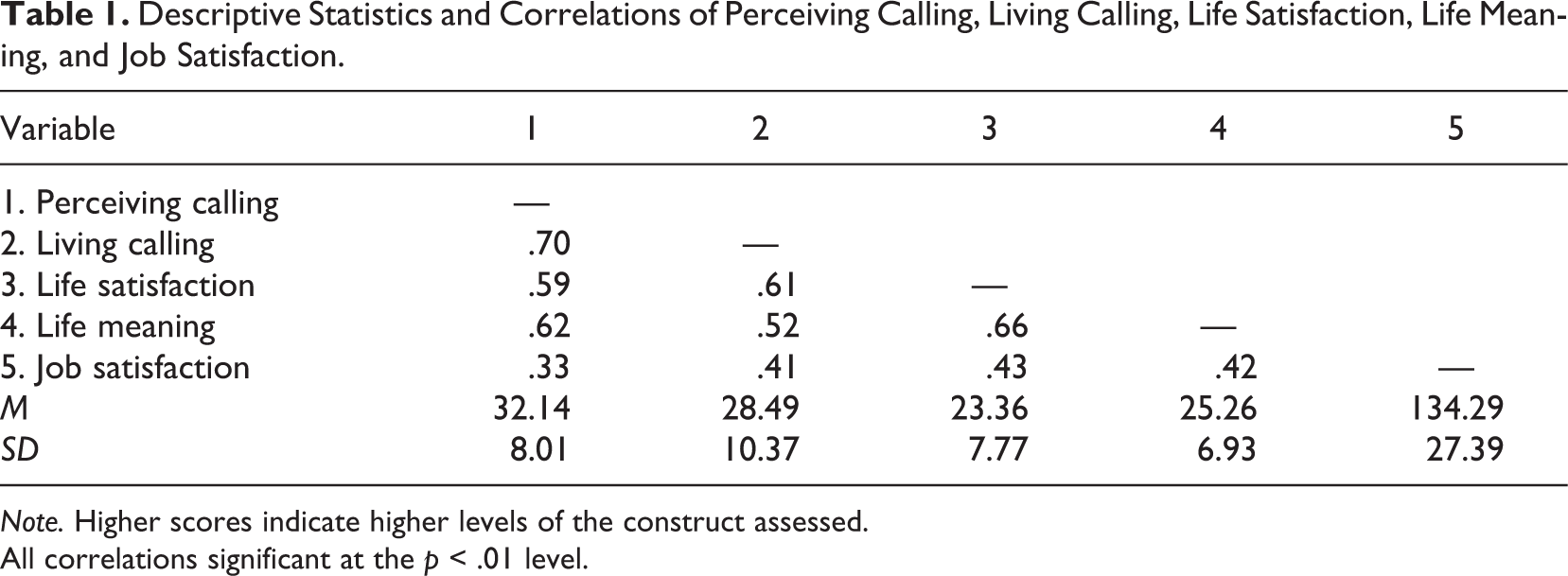
Note. Higher scores indicate higher levels of the construct assessed.
All correlations significant at the p < .01 level.
Next, we assessed whether nationality functioned as a significant moderator in the relation of living a calling to life meaning and living a calling to job satisfaction. We completed this step prior to testing the full model in order to first see whether simple moderating effects existed. We z-transformed all variables to reduce multicollinearity, and also, so that effect sizes could be compared. As seen in Table 2—following the guidelines proposed by Frazier, Tix, and Barron (2004)—we conducted two hierarchical regression analyses to explore the moderating effect of nationality. In each equation, in Step 1, we entered the standardized scores of living a calling and nationality, and in Step 2, we entered the interaction of these two scores. The interaction of living a calling and nationality was found to be a significant predictor of both life meaning and job satisfaction, even after accounting for the variance contributed by living a calling and nationality. These interactions are displayed in Figures 1 and 2, with two lines representing each nationality.
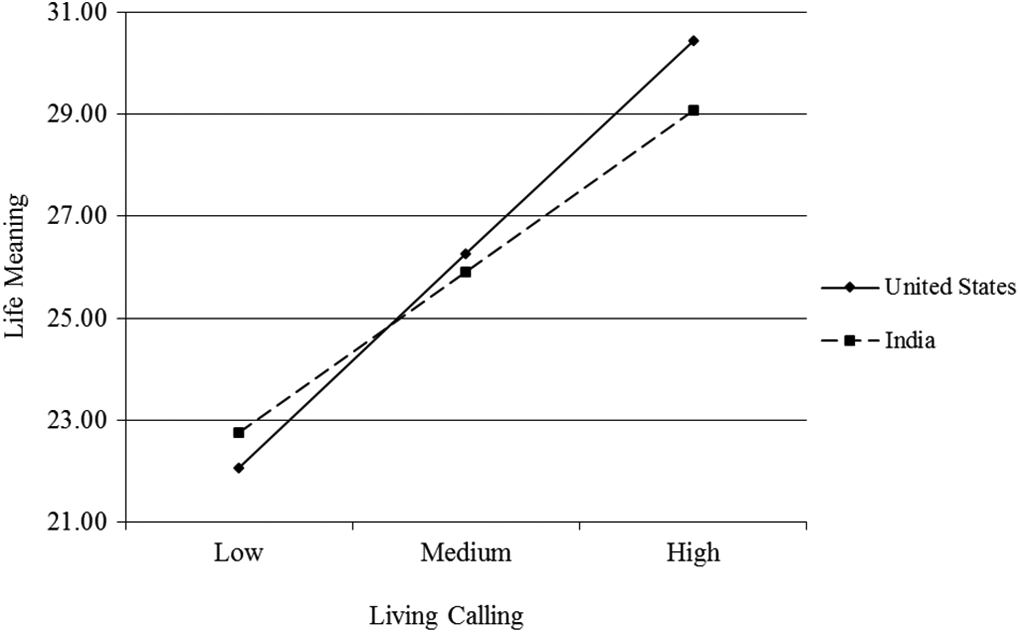
Nationality as a moderator between living a calling and life meaning.
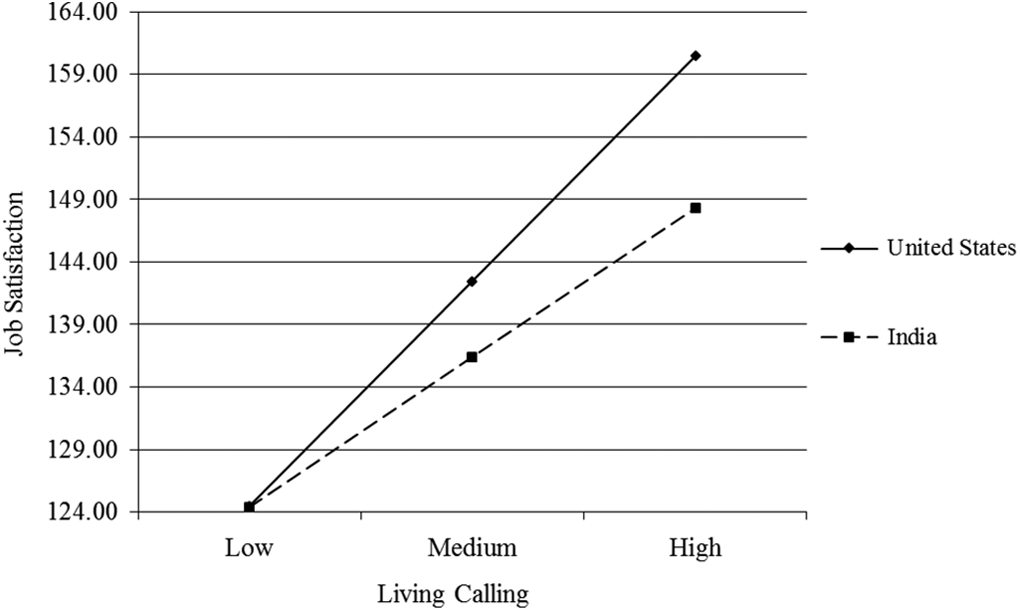
Nationality as a moderator between living a calling and job satisfaction.
Hierarchical Regression Analyses Exploring Nationality as a Moderator in the Relations of Living a Calling to Life Meaning and Job Satisfaction.
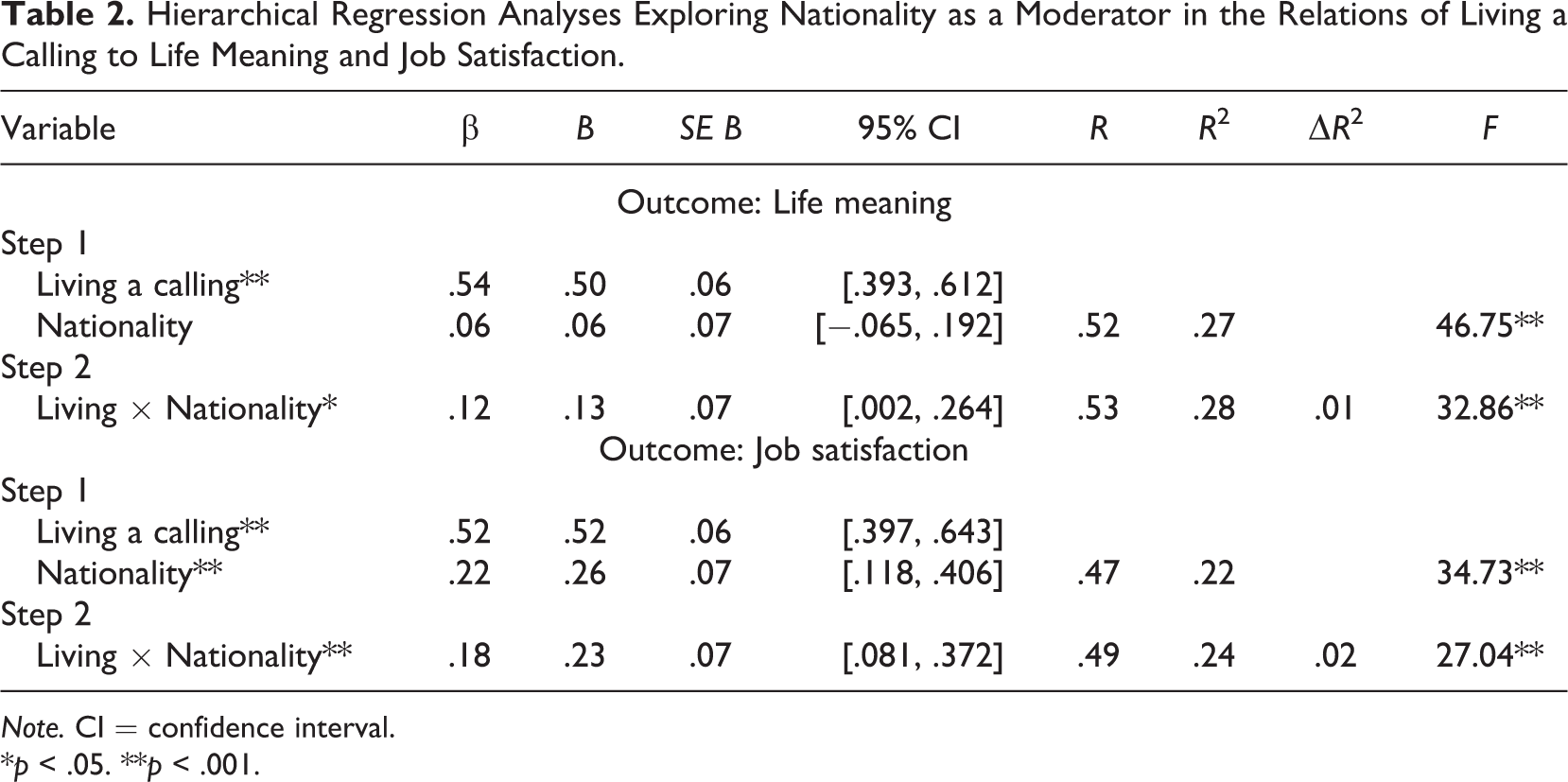
Note. CI = confidence interval.
*p < .05. **p < .001.
Moderated, multiple mediator model
Next, we tested a moderated, multiple mediator model examining the relation of living a calling to life satisfaction as mediated by life meaning and job satisfaction; these mediator relations were in turn hypothesized to be moderated by nationality. Here, our goal was to statistically test the indirect effects of living a calling on life satisfaction, via life meaning and job satisfaction, while simultaneously assessing how these indirect effects differed based on nationality as a moderator. Preacher and Hayes (2008) developed a program to test indirect effects for multiple mediator models; we utilized this program in the current study and tested the indirect effect for individuals of each nationality. More simply, we examined how the mediators—life meaning and job satisfaction—affected the relation between living a calling to life satisfaction for participants from the United States and from India. Testing this model allowed the examination of the mediators and moderator while accounting for all other model paths.
In this conditional model, we entered living a calling (for simplicity, LC throughout the rest of the Results section) as the independent variable, life satisfaction as the dependent variable, life meaning and job satisfaction as the mediators, and nationality as the moderator between the LC-life meaning and LC-job satisfaction relations. The full model is depicted in Figure 3. Matching our simple moderator findings, within the full model, nationality was found to moderate the LC-life meaning (β = .13, p < .05) and LC-job satisfaction relations (β = .23, p < .001). LC was found to have significant direct effects on life meaning (β = .48, p < .001), job satisfaction (β = .44, p < .001), and life satisfaction (β = .61, p < .001). Additionally, life meaning (β = .46, p < .001) and job satisfaction (β = .12, p < .001) were each significant predictors of life satisfaction after accounting for the shared variance among these two variables and LC. The relation of LC to life satisfaction (β = .32, p < .001) was weakened, but still significant, after including life meaning and job satisfaction in the model. This indicates partial mediation.
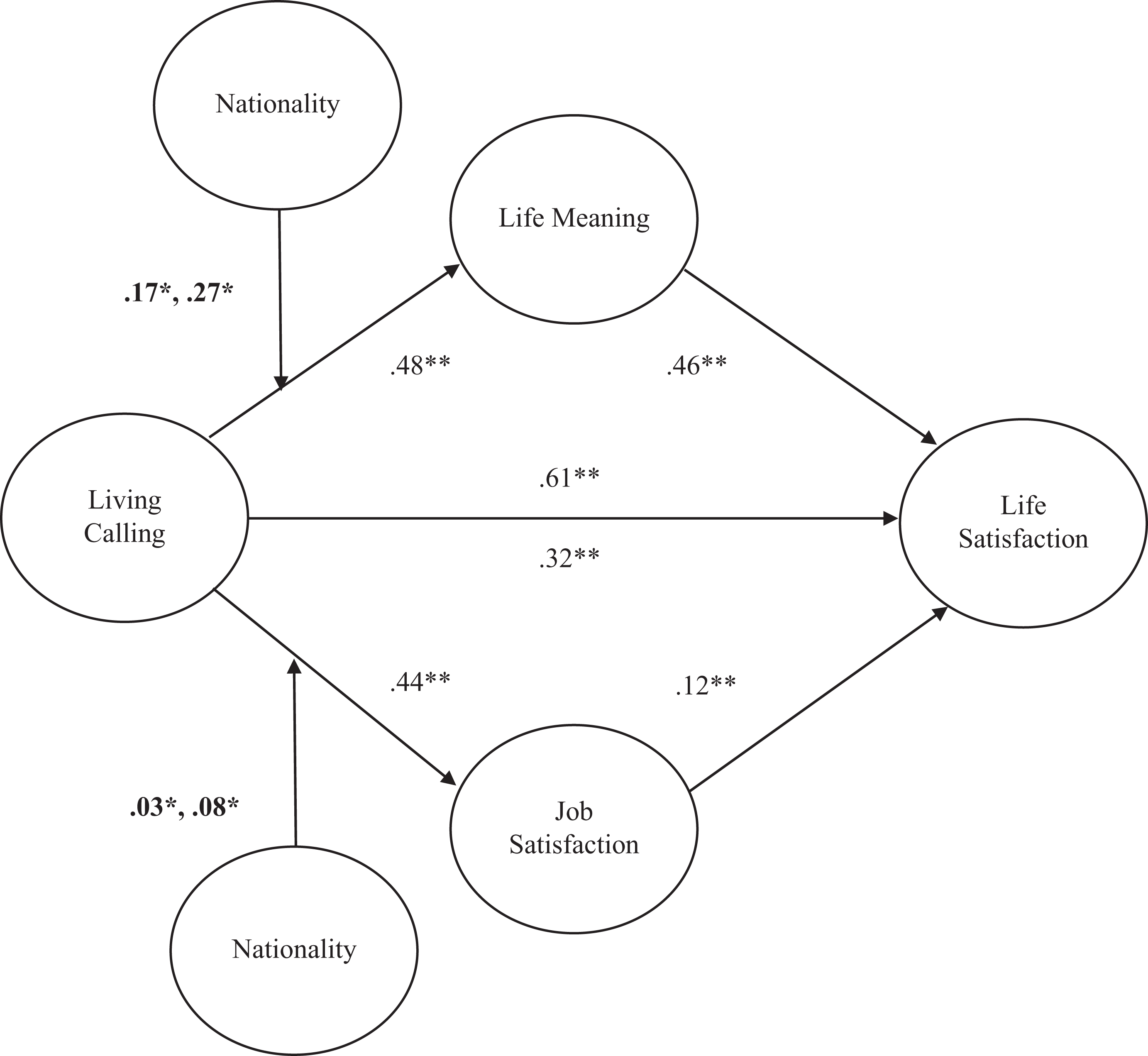
Moderated, multiple mediator model on the relation of living a calling to life satisfaction. Numbers within the model are standardized path coefficients of the direct relation of one variable to another. Numbers outside the model are the indirect effects of living a calling on life satisfaction as mediated by life meaning and job satisfaction. These indirect effects correspond to the two nationalities, India and the United States (in bold). Finally, the (.32) value within the model is the relation of living a calling to life satisfaction after accounting for the mediators. *p < .05. **p < .001.
Next, we assessed the indirect association of LC to life satisfaction as mediated by life meaning and job satisfaction. Here, the indirect effects were computed based on the two nationalities of the moderator: (a) India (–.71) and (b) United States (1.00). As seen in Figure 3, the indirect association of LC to life satisfaction as mediated by life meaning differed based on nationality. This indirect effect was significant for individuals from both India and the United States but more pronounced for United States individuals (β = .17, p < .05 and β = .27, p < .05, respectively). The indirect association of LC with life satisfaction as mediated by job satisfaction offered similar results. This indirect effect was also significant for individuals from both India and the United States, and again, was more pronounced for United States individuals (β = .03, p < .05 and β = .08, p < .05, respectively).
To further examine the significance of the indirect effects, we followed the guidelines proposed by Shrout and Bolger (2002), where we created 5,000 bootstrap samples using the same moderated, multiple mediator program. Across all 5,000 samples, the 95% confidence intervals were computed for the upper and lower potential limits of the two indirect effects for life meaning and two indirect effects for job satisfaction. The examination of these confidence intervals is recommended for determining significance of indirect associations (Shrout & Bolger, 2002). If zero is not included in the range of confidence intervals, the indirect effect is significant at the p < .05 level. Support was found for the indirect relation of LC to life satisfaction as mediated by life meaning for individuals from both India and the United States (95% CI = [0.07, 0.29] and 95% CI = [0.19, 0.39], respectively). Support was also found for the indirect relation of LC to life satisfaction as mediated by job satisfaction for individuals from both India and the United States (95% CI = [0.004, 0.09] and 95% CI = [0.004, 0.18], respectively).
Discussion
The goals of the current study were 4-fold: (1) To explore group differences in the experience of having and living a calling between working adults in the United States and India; (2) Show that life meaning and job satisfaction mediate the link between living a calling and life satisfaction; (3) Determine if nationality moderates the links of living a calling and life meaning and living a calling and job satisfaction within this model; (4) Examine the strength of the indirect effects of living a calling to life satisfaction, as mediated by life meaning and job satisfaction, for both groups.
The first goal of our study was to explore group differences in how individuals from India and the United States experience having and living a calling. Our data suggested that Indians had significantly higher scores on both constructs. Although further research is needed to fully understand this discrepancy in calling scores, we can draw from previous research on national differences between the United States and India to speculate as to why this might be. One explanation might be that underlying cultural variables in India create an environment that is more conducive to experiencing and living out a calling. One of the most researched cultural dimensions across nations is that of individualism and collectivism. Prior research has demonstrated that Indian society endorses more collectivistic values than American society (Hofstede, 1980; Randall, 1993; Sinha, 1997). Given the conceptual overlap of collectivism and the calling experience, it could be that aspects of career calling may be emphasized more in Indian society, where collectivism is more salient. Prosocial values, for instance, are likely to be more accessible in a collectivistic context due to the emphasis on prioritizing the good of the group over the good of the individual. Several studies have demonstrated a link between collectivism and prosocial behavior, with collectivism positively relating to altruism (Finkelstein, 2010; Yablo, 2007), helping behavior (Armenta, Knight, Carlo, & Jacobson, 2011; Yablo, 2007), and organizational citizenship behavior (Dávila de León & Finkelstein, 2011). Thus, it could be that concern for helping others and contributing to a greater good beyond the self is more pronounced in a collectivist context and in turn increases the likelihood of living out a calling. Of course, these conclusions are speculative, given the exploratory nature of the study.
A potential explanation for the lower calling scores in the United States is that work is typically viewed as an obligation, which would make it difficult to view work as a calling. In India, however, workers are inclined to feel committed at work, be less competitive, prefer personalized relationships on the job, and place less importance on things like detailed individual performance appraisal (Agarwala, 1978; Fusilier & Durlabhji, 2001; Gupta, 1991; Peters et al., 2010; Sinha & Kanungo, 1997). Finally, given the prevalence of poverty in India (Varadharajan et al., 2013), it may be that workers who are able to attain a job view their work not as an obligation but rather as an opportunity to meet their basic needs. The perception of work as the ability to secure basic needs (e.g., food, shelter; Maslow, 1968) may allow Indian workers to strive for the higher order needs typically associated with calling (Blustein et al., 2008).
With regard to our proposed model, initial mediation results supported our hypothesis that living out one’s calling relates to increased levels of life meaning and job satisfaction, which in turn relates to elevated life satisfaction. This is consistent with past research that has found life meaning and job satisfaction to serve as significant mediators in the living calling-life satisfaction relation (Allan et al., 2015; Duffy et al., 2013). Thus, the model in the present study builds upon the work of scholars that have examined the link between calling and life satisfaction (e.g., Duffy, Manuel, et al., 2011; Steger et al., 2010) and substantiates findings that life meaning and job satisfaction are significant mediators in the relation of living a calling to life satisfaction for American and non-American populations (Allan et al., 2015; Duffy et al., 2013).
Another goal of the present study was to determine if nationality moderates the links of living a calling to life meaning and living a calling to job satisfaction. Since we examined group differences in living a calling, we believed it was also desirable to explore how the links between living a calling and the other study constructs may vary cross-nationally. Perhaps the most intriguing finding of the current study is that although individuals from India were more likely to perceive and live out their callings, the indirect effects of living a calling on life satisfaction through life meaning and job satisfaction were stronger for the American sample. In other words, the participants from the Indian sample were more likely to have higher levels of all but one of our examined variables, but career calling seemed to be more important in experiencing meaning in life and satisfaction at work for the Americans. This finding may be explained by national differences in orientations to work. Previous research has demonstrated that work may be more central to the identity of Americans (Agarwala, 1978). Likewise, work in the United States has often been viewed as one of the primary purposes of an individual’s existence (Weber, 1958). Thus, it may be that the greater level of work centrality in the United States is related to the greater impact that living out a calling would have on one’s sense of purpose and satisfaction at work.
Another potential explanation is that contextual factors contribute to the decreased strength of the calling-life meaning/job satisfaction relations in the Indian sample. Multiple studies have underscored the idea that while perceiving a calling leads to positive outcomes, it is more important for individuals to be able to live out their callings (Duffy et al., 2013; Duffy & Autin, 2013). Our results suggest that while living a calling leads to life satisfaction through life meaning and job satisfaction for individuals from India, there are some factors that reduce the strength of these relations as compared to our U.S. sample. Considering the high level of poverty in India (Kotecha, 2011; Varadharajan et al., 2013), a contributing factor could be that people in India experience greater vocational barriers than people in the United States. Barriers such as lower income, education, and work volition have been linked with decreased ability to live out one’s calling (Duffy & Autin, 2013). Although the Indian sample actually was more likely to be living out their calling, it may be that the effects on their life satisfaction were tempered by the barriers and stressors associated with living in a developing nation. It is important to note that although we speculate the overall wealth disparity between the United States and India to be a contributing factor, more research is needed to fully understand the complexity of the impact of these national contextual factors.
Limitations and Future Directions
The results and conclusions of the present study need to be considered in light of a number of noteworthy limitations, each offering directions for future research. To begin, the current study utilized cross-sectional data, which prevents determinations of causality. The model tested in our study was based on theory and empirical research on the directionality of the constructs, but in order to further confirm the living calling-life satisfaction model, longitudinal or experimental studies are needed. Second, although we propose that vocational barriers may be the cause of the differences in how calling was experienced cross-nationally, we did not assess vocational barriers in this study. Future studies should include measures of vocational barriers in an attempt to determine the role barriers play across different nationalities. A third limitation is that all of our data are from self-report measures. In the future, researchers should examine how well scores on such instruments correspond to behavioral and informant data. Fourth, while we examined the IP addresses of participants to determine nationality, there is a chance that individuals took the survey while traveling and may not be from the United States or from India. Although our demographic information demonstrates that this chance is unlikely, future studies should take further steps to determine nationality by asking questions about native language, place of birth, and other similar questions.
A fifth limitation is that although this study gives us a glimpse into cross-national differences in calling, it is important to remember that both the United States and India are extremely diverse and complex cultures. Future studies should take this diversity into account and take a more nuanced look into what may be causing group differences. Sixth, both the Indian and U.S. samples were relatively small, and thus, only represent a small proportion of each population. Additionally, the U.S. sample was comprised of approximately 12% Asian Americans which could potentially confound the differences between the two samples; but given that this amount is only about double the amount of Asian Americans found in the U.S. population (U.S. Bureau of the Census, 2013), we do not believe this group was overrepresented in our sample. Also related to our samples, the small sample sizes limited our ability to detect significant moderation effects for our other model paths. Future studies should recruit larger samples from both the United States and India and try to prevent potential racial confounds in the samples. Finally, our study fails to address the distinction between living a calling in and outside of the workplace. Scholars have suggested that a calling can be enacted through experiences both on and off the job (Berg, Grant, & Johnson, 2010; Coulson et al., 2012; Hunter, Dik, & Banning, 2010). By distinguishing how living a calling is experienced at work and outside of work, we can examine how living a calling functions in both settings in relation to well-being and career outcomes.
Footnotes
Declaration of Conflicting Interests
The author(s) declared no potential conflicts of interest with respect to the research, authorship, and/or publication of this article.
Funding
The author(s) received no financial support for the research, authorship, and/or publication of this article.