



Abstract
Both career-related developmental indecision and chronic indecisiveness are manifested in the difficulties individuals experience when choosing a career. Developmental career indecision is often regarded as a normal stage that many individuals undergo, regardless of individual differences in various personality factors. Testing this premise was the focus of this study. Specifically, the associations between career decision-making difficulties (Career Decision-Making Difficulties Questionnaire, a measure of developmental career indecision) and the Big Five personality factors were investigated among participants from three educational settings: 248 high school students, 167 on-the-job training (OJT) interns, and 186 university students. The results revealed that university students experience less developmental career indecision than high school students and OJT interns, suggesting that individuals’ educational setting affects the prevalence of such difficulties. However, the personality factors of Extroversion and Neuroticism consistently explained a significantly larger percentage of variance in participants’ developmental career indecision levels in all three samples than did educational setting or age. These results suggest that developmental career indecision may in fact be more personality related than previously thought.
Keywords
The technological, sociological, and economic changes of the last few decades have led to the emergence of an unstable world of work, in which the question of what one wants to do professionally becomes increasingly more difficult to answer (Bright & Pryor, 2005; Gati, 2013; Gelatt, 1989; Krumboltz, 2009). The traditional view that career decisions are made only once in a person’s lifetime has become outdated and has been replaced with the view that career decision making is an ongoing iterative process that involves the creation of a professional narrative (Osipow, 1999; Savickas, 2011). Thus, although individuals once faced a one-time choice of a career path, today young adults often need to advance through several sequential decisions and frequently reevaluate their previous career decisions and adjust their behavior and goals (Krumboltz, 2009).
These changes in the world of work have led to an increase in the number of transitions from one job to another during one’s life (Bright & Pryor, 2005). While this is partially due to the changes in the characteristics of the world of work itself, it also results from the fact that the more career decisions individuals need to make, the more likely they are to encounter difficulties impeding their career decision making and possibly resulting in less satisfying career decisions that they might later want to change. In this respect, career-related decision-making difficulties can be regarded as hurdles that could prevent making a potentially better career decision or even any decision at all (Gati, Krausz, & Osipow, 1996; Slaney, 1988).
Vocational researchers and practitioners have devoted much attention to career indecision (cf. Gati, 2013; Osipow, 1999; Tinsley, 1992). From a historical point of view, most early theories and measures of career indecision focused on distinguishing between decided and undecided individuals (Gordon, 1998; Holland & Holland, 1977; Osipow, Carney, & Barak, 1976). Later, as part of the second- and third-generation approaches highlighting the need for a multidimensional model, distinguishing between undecidedness and indecisiveness has become more important (cf. Gati, 2013; Osipow, 1999). Career decision-making difficulties were then explicitly divided into those involving career indecision and those involving career indecisiveness. Specifically, career-related developmental indecision has been seen as a temporary developmental phase that individuals might undergo during several career decision stages of their lives; in contrast, career-related chronic indecisiveness has been thought of as a personality trait that would be evident across situations requiring decisions (Gati, 2013; Gati & Levin, 2014). For clarity, we use the terms career indecision and career indecisiveness to distinguish between these two types of career decision-making difficulties.
Previous studies have demonstrated the link between various personality constructs and career indecisiveness (Di Fabio, Palazzeschi, Asulin-Peretz, & Gati, 2013; Gati, Landman, Davidovitch, Asulin-Peretz, & Gadassi, 2010; Saka & Gati, 2007). Although career indecision is thought to constitute a normative developmental stage in people’s careers, there has been also a great deal of interest in the associations between career indecision and personality variables (Di Fabio & Blustein, 2010; Di Fabio & Kenny, 2011, 2012a; Di Fabio & Palazzeschi, 2008b; Di Fabio et al., 2013; Di Fabio, Palazzeschi, & Bar-On, 2012; Nilsson et al., 2007; Rossier, Wenger, & Berthoud, 2001). Indeed, Laethem, Mestdagh, and Vanderheyden (2003) pointed out that more research is still needed to determine the specific impact of personality on decision conflicts, whereas Guichard and Huteau (2001) suggested that decision-making strategies may in fact be mostly a function of the context and less connected to individual dispositions and tendencies. Consequently, the extent to which individual differences account for the emergence of career indecision is yet to be determined.
Individual Differences in Career Indecision
In an attempt to integrate previous research on career indecision and firmly ground practice in theory, Gati, Krausz, and Osipow (1996) proposed and empirically tested a multidimensional taxonomy of career indecision. In line with previous accounts of career indecision, one of the implicit assumptions of this model was that career indecision is more context-determined than personality related. Gati et al.’s taxonomy includes 10 difficulty categories grouped into 3 major difficulty clusters that are distinguished according to the stage in the decision-making process during which they typically occur: lack of readiness, lack of information, and inconsistent information.
The lack of readiness cluster is divided into three difficulty categories that typically emerge before the process is started: (1) lack of motivation, (2) general indecisiveness, and (3) dysfunctional beliefs. The general indecisiveness category essentially refers to career indecisiveness (cf. Gati & Levin, 2014). Difficulties that may be encountered after the process has begun typically involve lack of information or inconsistent information, which refers to difficulties related to the use of information. Four categories make up the lack of information cluster: (4) lack of information about the decision-making process, (5) lack of information about the self, (6) lack of information about occupations, and (7) lack of information about ways of obtaining additional information. Finally, the third difficulty cluster, inconsistent information, is composed of three categories: (8) unreliable information, (9) internal conflicts, and (10) external conflicts.
One of the most prominent measures of personality is Costa and McCrae’s (1992) Five-Factor Model of Personality. When personality is defined on the basis of this model, the factors of Extraversion and Neuroticism are often found to be associated with career indecision (Albion & Fogarty, 2002; Di Fabio & Palazzeschi, 2009; Di Fabio et al., 2013; Feldman, 2003). In contrast, the remaining three factors (Agreeableness, Conscientiousness, and Openness to Experience) have not been found to be associated with career indecision (Barrick & Mount, 1991; Feldman, 2003; Kanfer, Wanberg, & Kantrowitz, 2001; McCrae, 1996).
Caldwell and Burger (1998) suggested that Extraversion has a particularly critical role in career development, facilitating the search for information about possible careers. In addition, Kanfer, Wanberg, and Kantrowitz (2001) found that when extroverted individuals are faced with difficulties in searching for a job, they tend to seek more social support and are more persevering in their search. In contrast, Neuroticism was found to be negatively associated with problem-solving deficits and positively associated with a dependent style of decision making (Boudreau, Boswell, Judge, & Bretz, 2001; Tokar, Fischer, & Subich, 1998). Neurotic individuals seem to be more vigilant in job searching and more impulsive in their decision making to reduce their perceived stress level. These findings, taken together, present a picture in which Extraversion appears to be associated with better performance in the cognitive components involved in career decision making, whereas Neuroticism seems to be associated with underperformance due to the emotional components involved in the process.
When the impact of personality on career indecision is studied with the Career
The Relative Effects of Educational Setting and Personality on Career Indecision
As career development nowadays generally involves making repeated career decisions at different times (e.g., field of study, training, higher education institution, and job), one question that can be asked is whether later career decisions are easier to make than earlier ones. Thus, the first goal of this study was to investigate whether young adults in various early career stages experience different levels of career decision-making difficulties. This question was addressed in the present research by comparing the career decision-making difficulties experienced by Italian high school students, OJT interns, 1 and university students.
This study focused on students in the last 2 years of high school because they are approaching a critical stage in their career development that requires them to make important decisions regarding their future. In contrast, both OJT interns and university students have already made some of the career decisions that high school students are still facing. OJT interns are young workers engaged in professional training that alternates study and work time prior to committing themselves to a specific career (Lagabrielle, 2003). Finally, in Italy, university students select a major and a potential career trajectory before they begin their studies (Di Fabio & Palazzeschi, 2013). If indeed later career decisions are easier to make, then high school students should report having more career decision-making difficulties than OJT interns and university students.
In addition, as previous research has shown that personality plays an important role in career indecision, the second goal of this study was to investigate the contribution of personality to the emergence of career decision-making difficulties among the three groups of young adults. Specifically, we first sought to replicate findings about the associations of the five personality factors with the three major difficulty clusters. Then, we compared the contribution of the participants’ educational setting (high school students, OJT interns, and university students) with that of personality on career decision-making difficulties. In light of previous research, and since we conceptualize career indecision as a temporary normative developmental stage rather than personality related, we hypothesized that educational setting would explain a larger percentage of the variance in each of the three major difficulty clusters than personality factors.
Method
Participants
Three groups of participants filled out the research questionnaires without compensation. The first group comprised 248 Italian high school students enrolled in the last 2 years of high school in Tuscany, Italy (68 men and 180 [72.6%] women). The age of the participants in this group ranged from 16 to 20 (M = 17.49, standard deviation [SD] = 0.66). The second group included 167 Italian OJT interns enrolled in different training agencies in Tuscany (101 men and 66 women [39.5%]). The ages of these participants ranged from 18 to 29 (M = 21.16, SD = 2.15). The third group comprised 186 students at the University of Florence (53 men and 133 women [71.5%]). The ages of these participants ranged from 20 to 22 (M = 21.75, SD = 1.20).
Measures
The CDDQ
To measure career indecision, we used the Italian 34-item version of the CDDQ (Di Fabio & Palazzeschi, 2013). The CDDQ uses a 9-point Likert-type response scale (1 = does not describe me to 9 = describes me well). The Italian version of the CDDQ has adequate psychometric properties, and the structure of the CDDQ categories was verified by a confirmatory factor analysis with satisfactory fit indices (Di Fabio & Palazzeschi, 2010, 2013). In this study, the Cronbach’s α internal consistency reliabilities among high school students were .88, .89, .90, and .92 for lack of readiness, lack of information, inconsistent information, and the total CDDQ score, respectively; among the interns, they were .86, .88, .91, and .91; and among the university students, they were .89, .90, .92, and .93; for the three clusters and the total CDDQ score, respectively.
The Big Five Questionnaire
The Italian version of the BFQ (Caprara, Barbaranelli, & Borgogni, 1993) was used to assess individuals’ Big Five personality factors. The questionnaire has 132 items, with a 5-point Likert-type response scale (1 = absolutely false to 5 = absolutely true). It comprises 5 fundamental personality factors and 10 subdimensions (two for each factor). In this study, the internal consistency reliability estimates were .82, .81, and .80 for Extraversion; .75, .74, and .73 for Agreeableness; .83, .80, and .82 for Conscientiousness; .88, .91, and .90 for Neuroticism; and .76, .74, and .75 for Openness to Experience, for high school students, OJT interns, and university students, respectively.
Procedure
The questionnaires were filled out in groups of 10–30 participants and were administered by specialized personnel complying with the Italian Privacy Law. The order of the questionnaires was counterbalanced among participants.
Preliminary Analyses
To test the effects of gender or age on career decision-making difficulties, we first performed preliminary analyses to exclude the possibility that our results might stem from differences in the gender distribution or mean age of the three groups. First, a series of independent t-tests were performed to test for gender differences in the three major difficulty clusters, separately for each of the three groups. None of the results of these tests reached statistical significance after applying the Bonferroni correction for multiple comparisons (corrected α = .017). Thus, we report the analyses in the Results section across gender.
Second, we computed the Pearson correlations between the participants’ age and the three major difficulty clusters. We performed these analyses both for all participants and for each group separately. Across the three groups, the scores in all three major difficulty clusters were negatively but weakly correlated with age (r = −.20, −.18, −.23, p < .01, for lack of readiness, lack of information, and inconsistent information, respectively). However, none of the major cluster scores were significantly correlated with age when the correlations were computed separately for each group. Thus, overall, older participants seem to have fewer career decision-making difficulties in each of the three CDDQ clusters.
Finally, when computed across all participants, none of the BFQ factors was significantly associated with the participants’ age. We did find that the high school students’ age was weakly correlated with their Extraversion score (r = .17, p < .05). In light of the significant correlations between the participants’ age and some of the CDDQ and BFQ constructs, we first performed all the analyses with age as a covariate. However, in none of these analyses did age emerge as a significant covariate, so the analyses in the Results section were reported without using age as a covariate.
Results
The means and standard deviations of the three major difficulty cluster scores and the five factors of the BFQ are presented in Table 1, separately for high school students, OJT interns, and university students. To compare the career decision-making difficulties of the three groups, we conducted a multivariate analysis of variance (MANOVA) with the three groups as the independent variables and the three CDDQ clusters scores as the dependent variables. This analysis revealed a significant difference among the groups, F(2, 598) = 10.99, p < .001, η2 = .05. As can be seen in Table 1, subsequent analyses of variance (ANOVAs) showed that the three groups had different levels of difficulties in each of the three clusters. Specifically, university students’ difficulties were lower than those of high school students or OJT interns in all three major difficulty clusters: for lack of readiness–related difficulties, the university students’ mean score (M = 3.39) was significantly lower than that of both the high school students (M = 4.51; Duncan post hoc test, p < .05, η2 = .07) and the OJT interns (M = 4.33; Duncan post hoc test, p < .05, η2 = .06). For lack of information difficulties, the university students’ mean score (M = 4.08) was also significantly lower than that of both the high school students (M = 4.66; Duncan post hoc test, p < .05, η2 = .04) and the OJT interns (M = 4.48; Duncan post hoc test, p < .05, η2 = .05). Similarly, for the inconsistent information difficulties, the university students’ mean score (M = 3.58) was significantly lower than that of both high school students (M = 4.58; Duncan post hoc test, p < .05, η2 = .05) and OJT interns (M = 4.62; Duncan post hoc test, p < .05, η2 = .06). No differences between high school students and OJT interns emerged in any of the three major difficulty clusters. In sum, these results do not support our hypothesis: Our results indicate that university students report having fewer career decision-making difficulties than both high school students and OJT interns; while we had hypothesized that there would be a difference between university students and OJT interns, on one hand, and high school students, on the other.
Differences Among the Three Groups in Career Decision-Making Difficulties and Personality Traits.
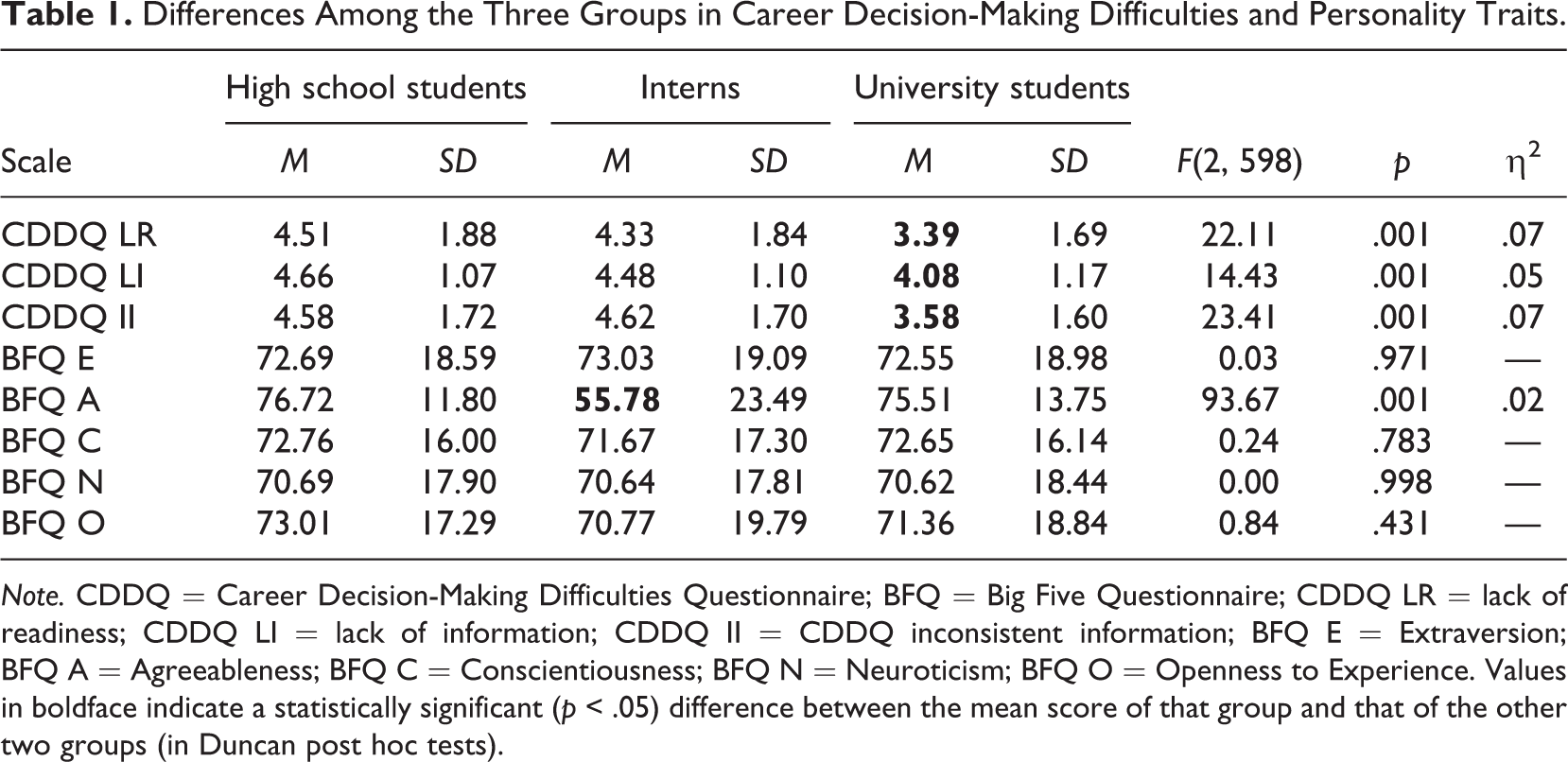
Note. CDDQ = Career Decision-Making Difficulties Questionnaire; BFQ = Big Five Questionnaire; CDDQ LR = lack of readiness; CDDQ LI = lack of information; CDDQ II = CDDQ inconsistent information; BFQ E = Extraversion; BFQ A = Agreeableness; BFQ C = Conscientiousness; BFQ N = Neuroticism; BFQ O = Openness to Experience. Values in boldface indicate a statistically significant (p < .05) difference between the mean score of that group and that of the other two groups (in Duncan post hoc tests).
Next, to test for group differences in the Big Five factors, we conducted a MANOVA with the three groups as the independent variables and the Five BFQ factors as the dependent variables. This analysis revealed a significant difference among the groups, F(2, 598) = 18.45, p < .001, η2 = .13. As can be seen in Table 1, subsequent ANOVAs showed that the three groups differed only in their Agreeableness score. Specifically, post hoc analysis revealed that Agreeableness was lower for the OJT interns (M = 55.78) than for the high school students (M = 76.72; Duncan post hoc test, p < .05, η2 = .03) or the university students (M = 75.51; Duncan post hoc test, p < .05, η2 = .02).
Table 2 presents the intercorrelations among the three CDDQ clusters and the five dimensions of the BFQ for the high school students (below the diagonal) and the OJT interns (above the diagonal); Table 3 presents the parallel results for the university students. As hypothesized, in all three groups, individuals with a higher Extraversion score reported fewer difficulties in all the three major difficulty clusters. Furthermore, as hypothesized, individuals with less Neuroticism reported having fewer difficulties in all three CDDQ clusters. The correlations among the three remaining BFQ factors (Agreeableness, Conscientiousness, and Openness to Experience) and the three CDDQ clusters were weak, with rs ≤ .20.
Correlations Between CDDQ and BFQ Among High School Students (N = 248, Below Diagonal) and OJT interns (N = 167, Above Diagonal).
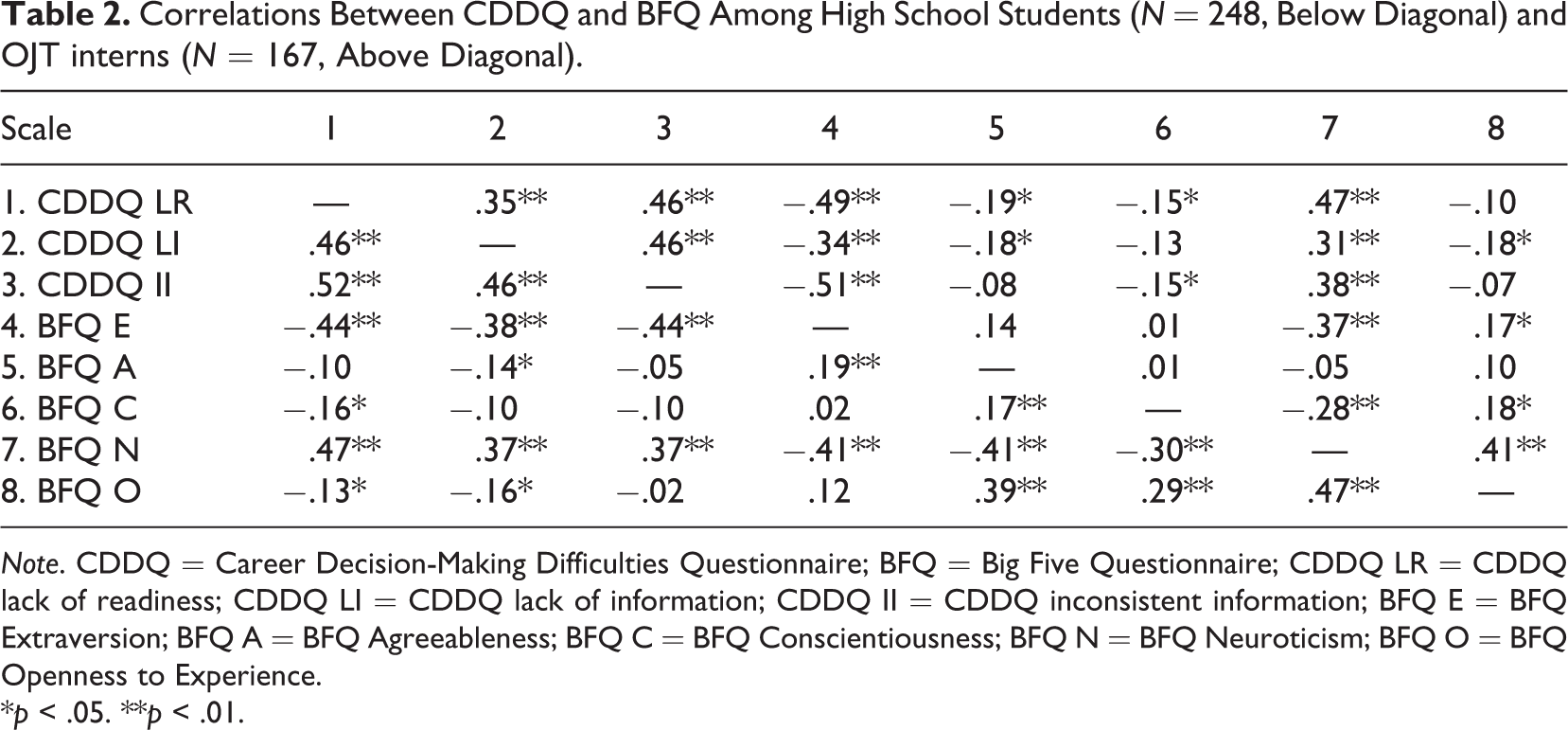
Note. CDDQ = Career Decision-Making Difficulties Questionnaire; BFQ = Big Five Questionnaire; CDDQ LR = CDDQ lack of readiness; CDDQ LI = CDDQ lack of information; CDDQ II = CDDQ inconsistent information; BFQ E = BFQ Extraversion; BFQ A = BFQ Agreeableness; BFQ C = BFQ Conscientiousness; BFQ N = BFQ Neuroticism; BFQ O = BFQ Openness to Experience.
*p < .05. **p < .01.
Correlations Between CDDQ and BFQ Among University Students (N = 186, Above Diagonal).
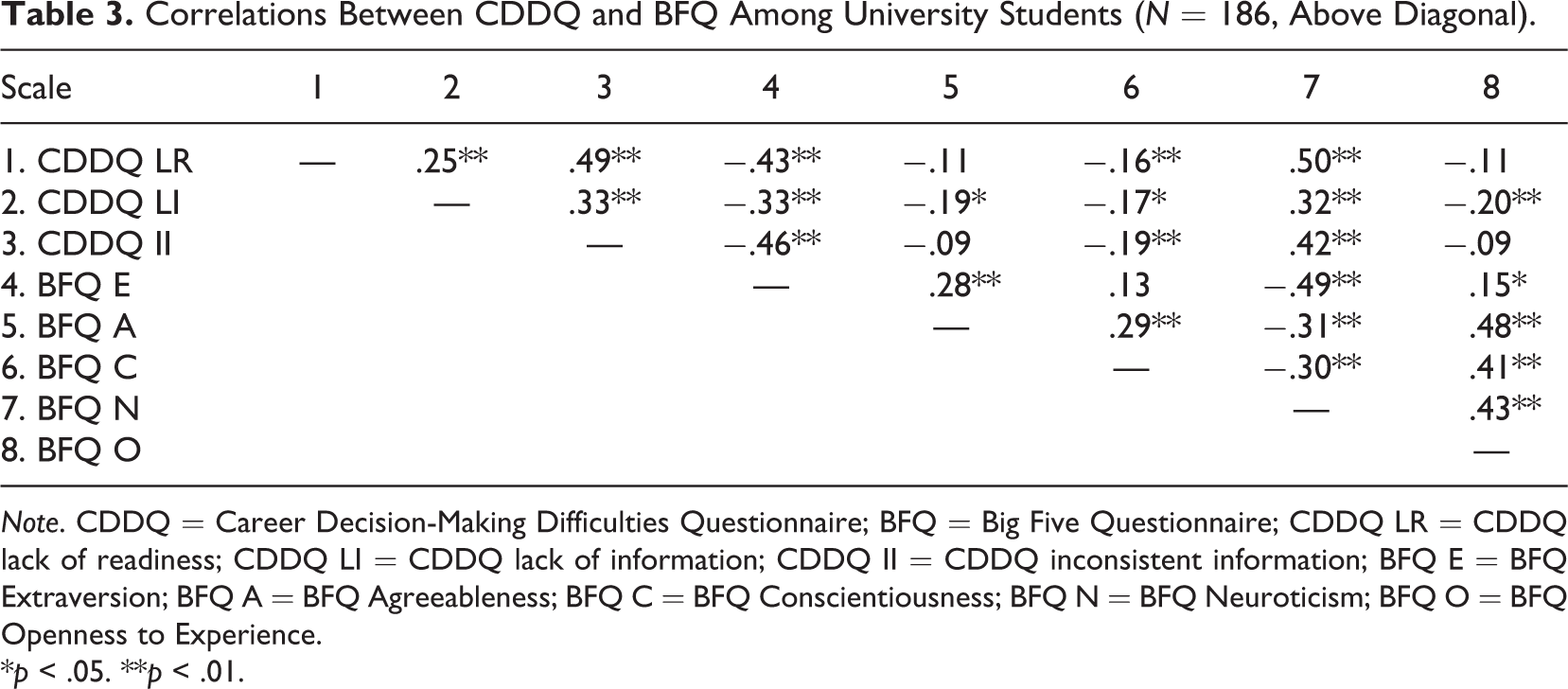
Note. CDDQ = Career Decision-Making Difficulties Questionnaire; BFQ = Big Five Questionnaire; CDDQ LR = CDDQ lack of readiness; CDDQ LI = CDDQ lack of information; CDDQ II = CDDQ inconsistent information; BFQ E = BFQ Extraversion; BFQ A = BFQ Agreeableness; BFQ C = BFQ Conscientiousness; BFQ N = BFQ Neuroticism; BFQ O = BFQ Openness to Experience.
*p < .05. **p < .01.
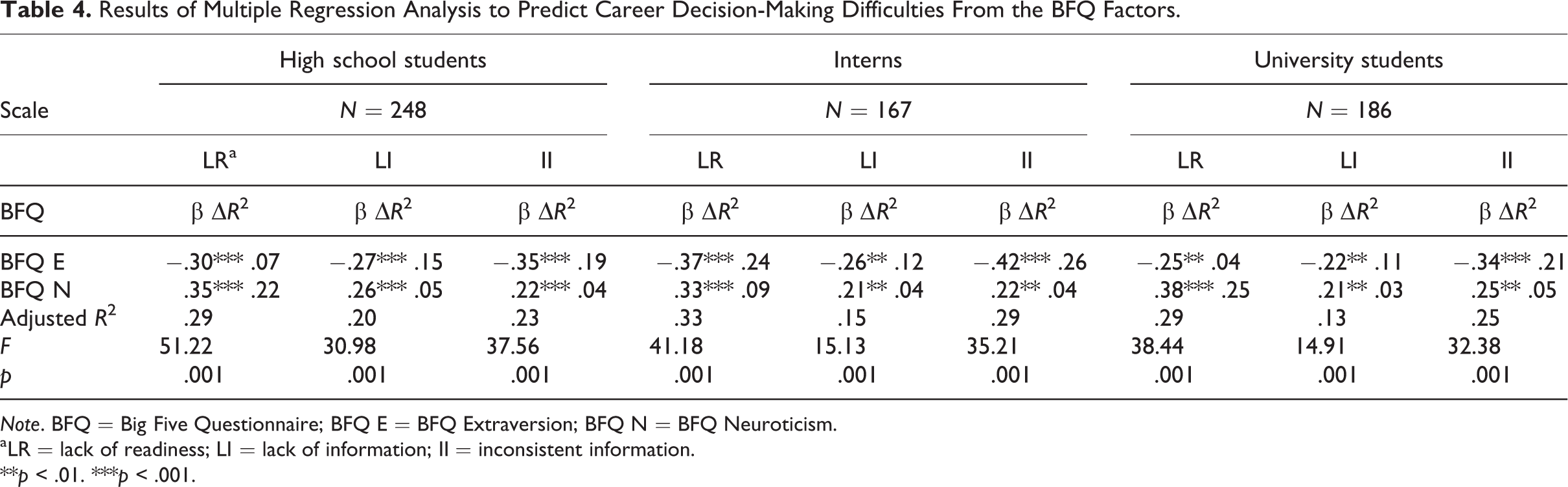
To further assess the association between the CDDQ and the BFQ, we carried out a stepwise multiple regression analysis using each of the three CDDQ difficulty clusters as the dependent variables and the Big Five factors as the independent variables, separately for each of the three groups. A summary of these analyses is presented in Table 4.
Results of Multiple Regression Analysis to Predict Career Decision-Making Difficulties From the BFQ Factors.
Note. BFQ = Big Five Questionnaire; BFQ E = BFQ Extraversion; BFQ N = BFQ Neuroticism.
aLR = lack of readiness; LI = lack of information; II = inconsistent information.
**p < .01. ***p < .001.
Lack of readiness
Similar results emerged for the prediction of lack of readiness among the three groups of participants with only two of the five BFQ factors predicting lack of readiness, F(2, 245) = 51.22, Adjusted R 2 = .29; F(2, 164) = 41.18, Adjusted R 2 = .33; F(2, 183) = 38.44, Adjusted R 2 = .29; for high school students, OJT interns, and university students, respectively. These factors were, as expected, Extraversion and Neuroticism: for high school students (β = −.30, ΔR 2 = .07; β = .35, ΔR 2 = .22, for Extraversion and Neuroticism, respectively), for OJT interns (β = −.37, ΔR 2 = .24; β = .33, ΔR 2 = .09, respectively), and for university students (β = −.25, ΔR 2 = .04; β = .38, ΔR 2 = .25, respectively).
Lack of information
Similar patterns of results also emerged for the prediction of difficulties involving lack of information, F(2, 245) = 30.98, Adjusted R 2 = .20; F(2, 164) = 15.13, Adjusted R 2 = .15; F(2, 183) = 14.91, Adjusted R 2 = .13; for high school students, OJT interns, and university students, respectively, again with only two of the five BFQ factors predicting lack of information. These factors were, as hypothesized, Extraversion and Neuroticism: for high school students (β = −.27, ΔR 2 = .15; β = −.26, ΔR 2 = .05, respectively), for OJT interns (β = −.26, ΔR 2 = .12; β = .21, ΔR 2 = .04, respectively), and for university students (β = −.22, ΔR 2 = .11; β = .21, ΔR 2 = .03, respectively).
Inconsistent information
A similar patterns of results emerged among the three groups for the prediction of the inconsistent information cluster scores by the BFQ factor scores, F(2, 245) = 37.56; Adjusted R 2 = .23, F(2, 164) = 35.21; Adjusted R 2 = .29, F(2, 183) = 32.38; Adjusted R 2 = .25, for high school students, OJT interns, and university students, respectively), with only two of the five BFQ factors predicting lack of readiness. These factors were, as hypothesized, Extraversion and Neuroticism: for high school students (β = −.35, ΔR 2 = .19; β = .22, ΔR 2 = .04, respectively), for OJT interns (β = −.42, ΔR 2 = .26; β = .22, ΔR 2 = .04, respectively), and for university students (β = −.34, ΔR 2 = .21; β = .25, ΔR 2 = .05, respectively).
Discussion
Assessing the career decision-making difficulties of high school students, OJT interns, and university students, as well as their personality traits in terms of the Big Five personality factors, allowed us to investigate the relative effects of individuals’ educational setting and personality on the frequency of career decision-making difficulties. As personality is thought to be fairly stable from the time of young adulthood (Cobb-Clark & Schurer, 2012; Terracciano, McCrae, & Costa, 2010; but see Specht, Egloff, & Schmukle, 2011), these results support the notion that career decision-making difficulties are associated with a developmental stage that many individuals undergo rather than with a distinct group of individuals. The fact that age was not significantly associated with career decision-making difficulties even in the OJT interns’ group (where the standard deviation of age was 3 times greater than among high school students) further supports this notion.
When we compared the level of difficulties among the three groups, we found that in general, university students reported fewer difficulties than high school students and OJT interns (although it should be acknowledged that the effect sizes were relatively small); interestingly, however, no significant difference was observed between the latter two groups in spite of the difference in age. As suggested in previous research (e.g., Gati & Saka, 2001; Lagabrielle, 2003), high school students in their last 2 years and OJT interns are similar in that they are going through a particularly critical period for their educational and vocational choice, much different from university students in Europe, most of whom have already selected a major. As such, these findings seem to support the notion that career decision-making difficulties are more likely to occur in some educational settings and are thus to some extent contextual.
Nevertheless, our study revealed significant and consistent associations between career decision-making difficulties and two of the personality characteristics measured by the BFQ. Specifically, similar to previous research (Di Fabio & Palazzeschi, 2009; Di Fabio et al., 2013; Feldman, 2003; Kanfer et al., 2001; Tokar et al., 1998) in all three groups of participants, more Extroversion and less Neuroticism were associated with reporting fewer career decision-making difficulties. In addition, in line with previous studies (Feldman, 2003; Kanfer et al., 2001), the results of our study did not reveal any association between the three major difficulty clusters and the other three personality factors—Agreeableness, Conscientiousness, and Openness to experience.
Moreover, the three stepwise regression analyses conducted for each group separately revealed, contrary to our initial hypothesis, that the personality factors of Extroversion and Neuroticism explain a larger percentage of the variance in the participants’ three major difficulty cluster scores than age or group affiliation. Specifically, while age explained only 3–5% of the variance (see preliminary analyses) and group affiliation only 5–7% of the three scores (see Table 1, right-hand side column), Extroversion and Neuroticism (combined) explained 13–33% of the variance in these scores (see Table 4). Thus, the two personality factors of Extroversion and Neuroticism combined were better predictors of all three major clusters than age and group affiliation combined.
Taken together, our results suggest that career decision-making difficulties are more pronounced in some educational settings than in others and tend to decrease with age during young adulthood. In addition to being a part of many individuals’ career development, however, career decision-making difficulties are personality related to a considerably greater degree. Regardless of the specific educational setting that young adults are currently at, those who are less extroverted and more neurotic are likely to experience more career indecision.
Furthermore, the results of this study seem to challenge the traditional conceptualization of career indecision. Career indecision is typically regarded as a temporary and context-specific inability to make career decisions or difficulty in making such decisions (Brown & Rector, 2008; Gati, 2013; Gati & Levin, 2014). Indeed, it is often referred to as developmental indecision, implying that it is a normative phase experienced by most people at some point in their career decision making (Dysinger, 1950; Gati, 2013; Guay, Ratelle, Senécal, Larose, & Deschênes, 2006). In contrast, difficulties in career decision making that are thought to be more personality related have often been considered part of career indecisiveness, also called chronic indecisiveness (Dysinger, 1950; Gati, 2013; Gati & Levin, 2014; Holland & Holland, 1977; Osipow, 1999; Salomone, 1982). Such difficulties are viewed as being more persistent and thus harder to treat.
The results of this study are compatible with those of Di Fabio et al. (2013), who investigated the associations between career indecision and indecisiveness, on one hand, and personality traits and emotional intelligence, on the other. The results found by Di Fabio et al. for the associations between the CDDQ and personality traits showed, as in this study, that only Extroversion and Neuroticism were associated with career indecision. Furthermore, Di Fabio and her colleagues found that the correlation of personality traits, and in particular, Extroversion and Neuroticism, with career indecisiveness, was higher than that with career indecision, supporting the claim that indecisiveness is more personality related than career indecision.
Therefore, our finding that personality factors are more predictive of individuals’ levels of career decision-making difficulties than age or educational setting is rather surprising. It was hypothesized that the CDDQ, as a measure of career indecision, would yield lower scores for individuals who already made a significant career decision (e.g., about their future plans after graduating from high school). Nevertheless, our results suggest that individuals with certain personality dispositions continue to experience career decision-making difficulties even after making a significant career decision. This implies that career indecision may be more persistent for individuals with certain personality traits. Indeed, the fact that the same two personality factors (Extroversion and Neuroticism) were associated with career decision-making difficulties across educational settings and age is compatible with this suggestion.
Despite the interesting results obtained in this study, it is necessary to point out limitations on the generalizability of the results found among specific Italian samples of high school students in their last 2 years, OJT interns, and university students. Future research should recruit individuals who are more representative of the Italian situation and verify the results in other international contexts as well. In addition, given that participants were not randomly assigned to the three groups, the differences between the groups may be confounded by preexisting group differences. Although we did rule out age and gender as possible confounders, socioeconomic background, for example, may had better explained our results. Future studies should directly measure such background variables to better account for the between-group differences. Finally, to better investigate the causality underlying the associations between personality and career indecision, future studies should adopt a longitudinal research design, following individuals over the course of their career development.
These limitations notwithstanding, the results of this study contribute to the in-depth exploration of the construct of career indecision, broadening our knowledge of its associations with personality traits and the way career decision-making difficulties differ in a variety of specific contexts. This study supports the need for further research on individual variables linked to career decision-making difficulties, as well as the possibility that career indecision should be reconceptualized to better describe its manifestations among different groups.
Footnotes
Acknowledgment
We thank Reuma Gadassi, Jerome Rossier, and Tirza Wilner for their helpful comments on an earlier version of this article.
Declaration of Conflicting Interests
The author(s) declared no potential conflicts of interest with respect to the research, authorship, and/or publication of this article.
Funding
The author(s) disclosed receipt of the following financial support for the research, authorship, and/or publication of this article: This research was supported by The Department of Psychology of the University of Florence and by the Samuel and Esther Melton Chair of Itamar Gati.