



Abstract
The goal of the present study was to investigate the distinctions between career indecision and indecisiveness. The different patterns of the associations between career indecision and indecisiveness, on one hand, and personality traits, career decision-making self-efficacy, perceived social support, and emotional intelligence, on the other, were studied in a sample of 361 university students. The results showed that career indecision, as measured by the Career Decision-making Difficulties Questionnaire, is most highly associated with emotional intelligence, whereas career indecisiveness, as measured by the Indecisiveness scale, is most highly associated with personality traits, and in particular with emotional stability. This pattern of results was obtained for both women and men; however, the prediction was stronger for indecision (R 2 = .76 and .55, for women and men, respectively) than indecisiveness (R 2 = .35 and .28, for women than for men, respectively). Possible explanations of these differences are discussed.
Keywords
Career decisions are one of the most complex and difficult decisions one has to make in the course of life. They involve many factors and aspects that need to be taken into consideration, such as skills and abilities, life goals, career preferences, dealing with one’s own expectations and often with those of significant others, as well as uncertainty and the frequent necessity of making compromises. Therefore, it is not surprising that difficulties in the career decision-making process are the general rule rather than the exception (Gati, 1986; Osipow, 1999).
Career indecision is a construct that refers to emergence of problems during the career decision-making process (Brown & Rector, 2008; Gati, Krausz, & Osipow, 1996; Osipow, 1999; Phillips & Pazienza, 1988). Indecision explains why some individuals are uncertain about their educational and vocational future, while others are more confident in making their choices (Wanberg & Muchinsky, 1992). Indecision is generally regarded as a normal stage through which almost everybody passes during their lifetime (Germeijs & Verschueren, 2007; Osipow, 1999; Saka & Gati, 2007; Skorikov & Patton, 2007).
In contrast to indecision, indecisiveness refers to a chronic inability to make decisions in various contexts and situations (Frost & Shows, 1993; Saka, Gati, & Kelly, 2008). It is therefore important to distinguish between indecision, which refers to a normal phase of life in which careers are chosen and pursued, and indecisiveness, which is a personality characteristic displayed in the individual’s difficulty in making decisions in various life contexts. Using a different framing, Savickas (2004) distinguished between undecided individuals—those with temporary indecision, a passing inability to choose, but with the potential make a decision in the near future—and indecisive individuals, who suffer from chronic indecisiveness, attributable to high anxiety and low problem-solving abilities. Thus, indecisiveness can be defined as a chronic state that stems from pervasive emotional and personality-related difficulties (Gati, Asulin-Peretz, & Fisher, 2012; Germeijs & Verschueren, 2007; Saka et al., 2008).
Career Indecision
Few other decisions influence individuals’ lives as much as career decisions (Hackett & Betz, 1995). Therefore, it is not surprising that understanding career indecision continues to be one of the major issues of vocational psychology (Brown & Rector, 2008; Phillips & Pazienza, 1988; Savickas, 1995; Skorikov, 2007). Identifying specific difficulties impeding individuals’ career decision-making process is one of the first steps in career counseling (Osipow, 1999). To achieve this goal, Gati et al. (1996) proposed and validated a taxonomy of difficulties in career decision making. According to the proposed taxonomy, there are 10 types of difficulties, which are divided into two groups, indicating a temporal distinction between the difficulties that often arise before one begins the decision-making process (Lack of Readiness) and the difficulties that typically arise only after the process has begun (Lack of Information and Inconsistent Information). To test this theoretical model, Gati et al. (1996) developed the Career Decision-making Difficulties Questionnaire (CDDQ), which was used in the present study to assess career indecision, and is described in detail in the Method section.
Finally, career decision difficulties have also been found to be associated with personality and emotional intelligence (Di Fabio & Palazzeschi, 2009). With regard to personality traits, the total CDDQ score and the three major difficulty clusters were found to correlate inversely with Extraversion and positively with Neuroticism; for emotional intelligence, it was found that the total CDDQ score and the three major difficulty clusters correlate inversely with emotional intelligence, particularly with the intrapersonal dimension.
Indecisiveness
Indecisiveness has been defined as the inability to make decisions in various contexts and situations (Frost & Shows, 1993; Gaffner & Hazler, 2002; Patalano & Wengrovitz, 2006; Saka & Gati, 2007). Individuals with high indecisiveness take more time to choose among different alternatives (Frost & Shows, 1993), use less effective decisional strategies (Ferrari & Dovidio, 2000, 2001), require more cognitive effort in decision making (Ferrari & Dovidio, 2001), feel more threatened by ambiguous situations (Rassin & Muris, 2005a), and are more likely to postpone decisions (Rassin & Muris, 2005b). Indeed, indecisive individuals have more difficulty choosing college majors (Gayton, Clavin, Clavin, & Broida, 1994) and making other life decisions (Germeijs & De Boeck, 2002).
Moreover, indecisiveness has been associated with individual characteristics such as neuroticism (Jackson, Furnham, & Lawty-Jones, 1999), low self-esteem (Burka & Yuen, 1983; Ferrari, 1991), procrastination (Beswick, Rothblum, & Mann, 1988; Effert & Ferrari, 1989; Ferrari, 1992), obsessive–compulsive tendencies (Frost & Shows, 1993; Gayton et al., 1994), and perfectionism (Frost & Shows, 1993; Gayton et al., 1994). More recently, Rassin, Muris, Franken, Smit, and Wong (2007) showed that indecisiveness, as measured by the Indecisiveness scale (IS; Frost & Shows, 1993), is negatively correlated with decision-making self-efficacy. Because of the typically unfavorable consequences of indecisiveness, locating factors associated with it is important for designing interventions aimed at reducing them.
Personality Traits
The role of personality in vocational choices has long been recognized (e.g., Borges & Savickas, 2002; Holland, 1997; Tokar, Fischer, & Subich, 1998). The study of personality traits in the context of career decision making has received increased attention in recent years (e.g., Gati et al., 2011; Nilsson et al., 2007). Guichard and Huteau (2001) showed that decision-making strategies may be a function of the context, but could nonetheless correspond to deeper personal tendencies as well. Previous studies found career decision-making difficulties to be associated with general personality factors, such as the Big-Five model of personality factors (e.g., Lounsbury, Hutchens, & Loveland, 2005). When personality traits are assessed in terms of Costa and McCrae’s Five-Factor Model (1992), Extraversion and Neuroticism seem to be more associated with the difficulties involving career decision making than with Agreeableness, Consciousness, or Openness to experience (Feldman, 2003; Kelly & Shin, 2009; Lounsbury et al., 2005). These results were replicated in a research that used the CDDQ (Gati et al., 1996) to measure career decision-making difficulties; negative correlations with Extraversion and positive correlations with Neuroticism emerged for the three clusters of the CDDQ (Di Fabio & Palazzeschi, 2009).
Career Decision-Making Self-Efficacy
Career decision-making self-efficacy is regarded as one of the significant factors that affect the career decision-making process. It is defined as the level to which the individual feels confident in his or her ability to successfully perform tasks in the career decision-making process, such as gathering occupational information, selecting goals, making plans for the future, and problem solving (Betz, Klein, & Taylor, 1996). Inverse associations between career decision-making self-efficacy and career indecision have consistently emerged (Betz et al., 1996; Creed, Patton, & Bartrum, 2004; Guay, Ratelle, Senécal, Larose, & Desch.es, 2006; Nota, Ferrari, Solberg, & Soresi, 2007; Osipow & Gati, 1998).
Perceived Social Support
Perceived social support may come from three groups (family, friends, and significant others; Zimet, Dahlem, Zimet, & Farley, 1988) who can facilitate or impede the individual’s career decision-making process. Indeed, the role of perceived social support in the career decision-making process has been widely acknowledged (Blustein, Prezioso, & Schultheiss, 1995; Blustein, Walbridge, Friedlander, & Palladino, 1991; Kenny & Bledsoe, 2005; Wolfe & Betz 2004; Young et al., 2001). In the context of career indecision, familial support emerged as particularly important (Blustein et al., 1995, 1991; Constantine, Wallace, & Kindaichi, 2005), and therefore it was also included in the present research.
Emotional Intelligence
Emotional intelligence has been defined as a blend of emotional and social competences that determine the way in which one relates to oneself and to others and deals with environmental pressures and demands (Bar-On, 2002). Because individuals with high emotional intelligence have a greater awareness of their emotions and a greater capacity to integrate emotional experience with thoughts and actions, emotional intelligence may have a role in career exploration and career decision making (Brown, George-Curran, & Smith, 2003; Di Fabio & Palazzeschi, 2009; Emmerling & Cherniss, 2003). Indeed, emotional intelligence has been recognized in the past decade as an additional critical variable in career choice (Di Fabio & Kenny, 2011); lower emotional intelligence has been associated with greater difficulties in each of the three clusters of the CDDQ (Di Fabio & Palazzeschi, 2008). Furthermore, emotional intelligence also appears to have a greater influence on each of three clusters of career decision-making difficulties than either personality traits, career decision-making self-efficacy, or perceived social support (Palazzeschi & Di Fabio, in press).
Gender Differences in Career Decision Making
Previous studies revealed gender differences in certain career decision-making variables. Gender differences in the levels of individuals’ career decision-making difficulties were fairly small (Gati, Osipow, Krausz, & Saka, 2000; Gati & Saka 2001), but nevertheless women were consistently found to be more indecisive than men (Hijazi, Tatar, & Gati, 2004; Rassin & Muris, 2005; Serling & Betz, 1990). In addition, a small gender difference was reported by Saka, Gati, and Kelly (2008) in anxiety about the process, one of the factors that are assumed to underlie general indecisiveness. Finally, a few consistent gender differences also emerged in the way men and women tend to make career decisions. Specifically, women tend to consult with others and to use intuition more than men (Gati, Gadassi, & Mashiah-Cohen, 2012; Gati & Levin, 2011) and they also tend to be more dependent than men (Mau, 2000).
The Present Research
The goal of the present research was to explore the differences between career indecision and career indecisiveness by studying their differential patterns of associations with personality traits, career decision-making self-efficacy, perceived social support, and emotional intelligence. Specifically, we hypothesized that different variables would be most closely associated with indecision and indecisiveness:
Hypothesis 1: Emotional intelligence will be more associated with career indecision than with indecisiveness (Palazzeschi & Di Fabio, in press).
Hypothesis 2: Personality traits will be more associated with indecisiveness than with indecision (Frost & Shows, 1993; Savickas, 2004).
Hypothesis 3: Career decision-making self-efficacy and perceived social support will be more associated with indecision than with indecisiveness (Osipow & Gati, 1998; Palazzeschi, & Di Fabio, in press).
In addition, in light of previous research that revealed gender differences in aspects of career decision making, we will investigate differences in the pattern of associations between career indecision and indecisiveness, on one hand, and personality traits, career decision-making self-efficacy, perceived social support, and emotional intelligence, on the other.
Method
Participants
The participants were 361 students (187 [52%] women and 174 men) from the University of Florence. Their age ranged from 23 to 27 (M = 24.04, SD = 1.91). Their majors were Agricultural Sciences (8.3%); Architecture (7.8%); Economics (8.9%); Pharmacy (7.2%); Law (9.1%); Engineering (7.5%); Humanities and Philosophy (8.3%); Medicine and Surgery (8.6%); Psychology (9.4%); Educational Science (7.8%); Mathematical, Physical, and Natural Sciences (9.1%); Political Science (8%); other (7.2%). They were sophomores (36.6%), juniors (29.4%), and seniors (34.1%). The participants were predominantly White Italians from middle-class backgrounds.
Instruments
The CDDQ
We used the Italian version of the 34-item CDDQ (Gati et al., 1996), as developed by Di Fabio and Palazzeschi (2010). As described in the Introduction, the CDDQ comprises 10 scales representing 10 possible difficulties, organized in three major difficulty clusters. Respondents are asked to report the degree to which each statement describes them on a 9-point Likert-type scale (1—Does not describe me to 9—Describes me well). The CDDQ has been found reliable and its structure is stable across cultures (Creed & Yin, 2006; Di Fabio & Kenny, 2011; Gati, Osipow, Krausz, & Saka, 2000; Lancaster, Rudolph, Perkins, & Patten, 1999; Mau, 2001). The positive correlations between the three clusters and 10 scales of the CDDQ, on one hand, and the Career Decision scale (Osipow, Carney, Winer, Yanico, & Koschier, 1976), on the other, as well as their negative correlation with the Career Decision Self-Efficacy scale–Short Form (CDSES-SF; Betz & Taylor, 2000; Di Fabio & Palazzeschi, 2010; Osipow & Gati, 1998), support the concurrent validity of the CDDQ. The concurrent validity of the CDDQ was also supported by the similarity between the conclusions drawn from it on the basis of career counselees’ responses to this questionnaire and the judgments of their career counselors (Gati, Osipow, Krausz, & Saka, 2000). The CDDQ was found to distinguish between decided and undecided students (Lancaster et al., 1999; Mau, 2001) and to evaluate the effectiveness of career interventions (Fouad, Cotter, & Kantamneni, 2009; Gati, Saka, & Krausz, 2001).
The Italian version of the CDDQ has been found to have adequate psychometric properties, with Cronbach’s α internal consistency reliability estimates of .86, .90, and .92, for Lack of Readiness, Lack of Information, and Inconsistent Information, respectively (Di Fabio & Palazzeschi, 2010). Furthermore, the structure of the 10 scales and the three major clusters was also supported by Exploratory and Confirmatory factor analyses (Di Fabio & Palazzeschi, 2010; Gati et al., 1996). The Cronbach’s α internal consistency reliability estimate of the total CDDQ score was .85 in the present sample.
The Indecisiveness scale (Frost & Shows, 1993)
To evaluate indecisiveness, we used the Italian version of the IS (Di Fabio, Busoni, & Palazzeschi, 2011). The scale measures indecisiveness using 15 items, with a 5-point Likert-type response scale (1—strongly disagree to 5—strongly agree). Examples are When ordering from a menu, I usually find it difficult to decide what to get; It seems that deciding on the most trivial thing takes me a long time. Exploratory factor analysis revealed a unidimensional structure (Di Fabio et al., 2011). The Cronbach’s α internal consistency reliability was .85, and its concurrent validity was adequate, having correlations ranging from .44 to .68 with dimensions of the Melbourne Decision Making Questionnaire (Mann, Burnet, Radford, & Ford, 1997) and a correlation of .67 with the general IS of the CDDQ in the present study. In the present sample, the Cronbach’s α internal consistency reliability estimate was .82.
The Big Five Questionnaire (BFQ)
The BFQ is composed of 132 items, with a 5-point Likert response scale (1—absolutely false to 5—absolutely true; Caprara, Barbaranelli, & Borgogni, 1993). The BFQ distinguishes among five fundamental personality dimensions (with two subdimensions for each of the five). The Cronbach’s α internal consistency reliability was .81 for Extraversion, .73 for Agreeableness, .81 for Conscientiousness, .90 for Emotional Stability, and .75 for Openness to experience (Caprara et al., 1993). The correlations with the Wechsler Adult Intelligence scale (Wechsler, 1981) were negligible (Caprara et al., 1993). The correlations with the State-Trait Anxiety Inventory, Form X (STAI, Form X, Spielberger, Gorsuch, & Lushene, 1968) were −.38 for Extraversion, −.15 for Agreeableness, −.23 for Conscientiousness, −.62 for Emotional Stability, and −.15 for Openness. The reliabilities of the five factors in the present study ranged from .76 to .89 (see Table 1, bottom row).
Correlations Among the CDDQ Total Score, Indecisiveness Scale, BFQ Personality Traits, CDSES–SF, the MSPSS Dimensions, and the Bar-On EQ-i Total Score (N = 361).
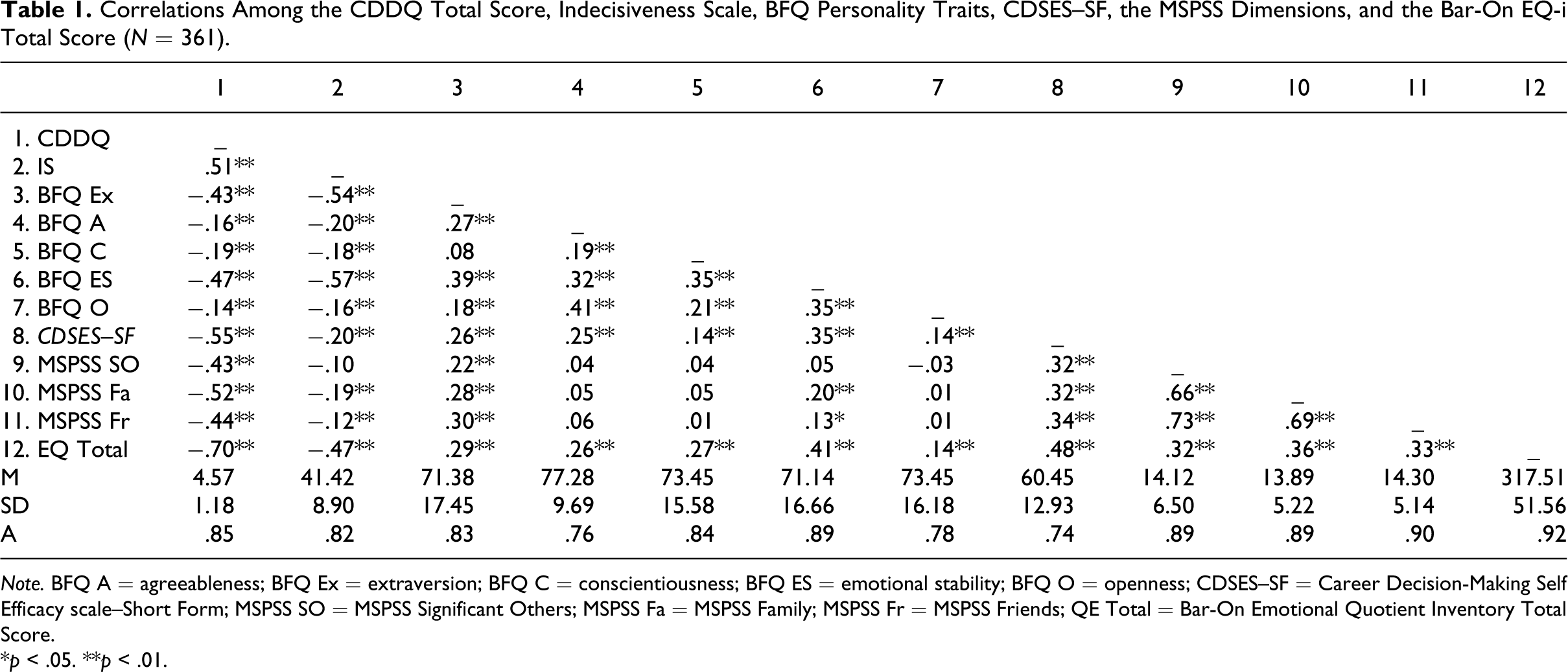
Note. BFQ A = agreeableness; BFQ Ex = extraversion; BFQ C = conscientiousness; BFQ ES = emotional stability; BFQ O = openness; CDSES–SF = Career Decision-Making Self Efficacy scale–Short Form; MSPSS SO = MSPSS Significant Others; MSPSS Fa = MSPSS Family; MSPSS Fr = MSPSS Friends; QE Total = Bar-On Emotional Quotient Inventory Total Score.
*p < .05. **p < .01.
CDSES-SF
We used the Italian version of the CDSES-SF (Betz et al., 1996; Betz & Taylor, 2000; Nota, Pace, & Ferrari, 2008). The Italian version comprises 20 items, with a 5-point Likert-type scale (1—I have no confidence to 5—I have complete confidence). The Cronbach’s α reliability of the total CDSE in the present study was .74.
The Multidimensional scale of Perceived Social Support (MSPSS)
We used the Italian version of the MSPSS (Di Fabio & Busoni, 2008; Zimet, Dahlem, Zimet, & Farley, 1988). The scale is composed of 12 items, with a 7-point Likert-type response scale (1—strongly disagree to 7—strongly agree). The instrument measures perceived support from family, friends, and significant others. Item examples are My family works very hard to help me, I can speak to my friends about my problems, and When I need someone, there is always a special person who stands by me. The Cronbach’s α of the Italian version is. 94, .93, and .94, for the dimensions of Family, Friends, and Significant others, respectively (Di Fabio & Busoni, 2008). A confirmatory factor analysis supported the original three-dimensional structure (Di Fabio & Busoni, 2008). In the present sample, the Cronbach’s α internal consistency reliability estimates were .89, .90, and .89, for the dimensions of Family, Friends, and Significant others, respectively.
The Bar-On Emotional Quotient Inventory (Bar-On EQ-I)
To assess emotional intelligence, we used the Italian version of the Bar-On EQ-I (Bar-On, 1997), which was developed by Franco and Tappatà (2009). It comprises 133 items, with a 5-point Likert-type response scale (1—not at all true for me to 5—absolutely true for me). The questionnaire measures five principal emotional intelligence dimensions: (a) intrapersonal, associated with awareness of one’s own emotions, strengths and weaknesses and the ability to express one’s feelings; (b) interpersonal, linked to social awareness and interpersonal relationships, and involving the ability to recognize others’ emotions, feelings, and needs and to establish and maintain cooperative, constructive, and satisfactory relationships; (c) adaptability, connected with the ability to cope flexibly with everyday problems; (d) stress management, the ability to cope with stressful situations adaptively and to manage one’s emotions beneficially; and (e) general mood, which is the capacity to be optimistic, express positive feelings, and enjoy the presence of other people. The Cronbach’s α internal consistency reliability estimates were .91, .84, .81 .87, and .83 for the five dimensions, respectively; Cronbach’s α was .95 for the EQ-i total score (Franco & Tappatà, 2009). The five-dimensional structure of the EQ-i was supported by a Confirmatory Factor Analysis (Franco & Tappatà, 2009). In the present sample, the Cronbach’s α internal consistency reliability estimate of the total EQ score was .92.
Procedure
All the questionnaires were included in a single booklet and filled out by participants in small groups of about 20–25 students, administered by specialized personnel and conforming to the Privacy Law. All the students filled out the questionnaires in the same order (CDDQ, IS, BFQ, CDSES-SF, MSPSS, Bar-On EQ-i), as part of a career intervention. Filling out the booklet took about 45–60 min.
Results
The means, standard deviations, Cronbach’s α internal consistency reliability estimates, and Pearson correlations among the CDDQ Total Score, IS, the five BFQ Dimensions (Extraversion, Agreeableness, Conscientiousness, Emotional Stability, and Openness), CDSES-SF Total Score, MSPSS dimensions (Significant others, Family, Friends), and the Bar-On EQ-i Total Score are presented in Table 1. As hypothesized, indecision, as measured by the CDDQ, was highly negatively correlated with the Emotional Intelligence scale (r = −.70); it was also negatively correlated with the CDSES (r = −.55). Noticeable negative correlations also emerged with perceived social support (r = −.52, −.44, and −.43, for Family, Friends, and Significant others, respectively), and with two dimensions of the Big Five—Emotional Stability (r = −.47) and Extraversion (r = −.43).
Although indecision and indecisiveness were moderately correlated (r = .51), the pattern of their correlations with the other variables were different. Indecisiveness was associated more strongly than indecision with Emotional Stability, r = −.57 vs. −.47, t(358) = 2.40, p < .05, and Extraversion, r = −.54 vs. −43, t(358) = 2.93, p < .01. In contrast, indecision correlated more strongly than indecisiveness with emotional intelligence, r = −.70 vs. −.47, t(358) = 6.26, p < .001).
To test the relative contribution of the different variables to the prediction of indecision and indecisiveness, we carried out a series of stepwise multiple regression analyses; these analyses were carried out separately for women and for men in order to test the consistency of the results. The results, presented in Tables 2 and 3, support the hypothesis that different research variables are associated with indecision and with indecisiveness. Specifically, as can be seen in Table 2, career indecision is best explained by emotional intelligence for both women and men (β = −.45 and −.39, respectively), less by perceived social support from family (β = −.24 and −.26, for women and men, respectively), even less by career decision-making self-efficacy (β = −.19 and −.22, for women and men), and Extraversion (β = −.19 only for women), and least by Emotional Stability (β = −.11 and −.16, for women and men, respectively). A few findings are noteworthy. First, all the βs are negative, as predicted. Second, except for the Extraversion dimension of the BFQ, the order of the variables contributing to the prediction of indecision was similar for women and men. Third, the prediction of indecision for women (R 2 = .76) was higher than that for men (R 2 = .55); part of this difference is attributable to the contribution of the Extraversion dimension of the BFQ for women, but not for men.
Predicting the CDDQ Score: Results of the Multiple Regression Analyses for Women and Men.
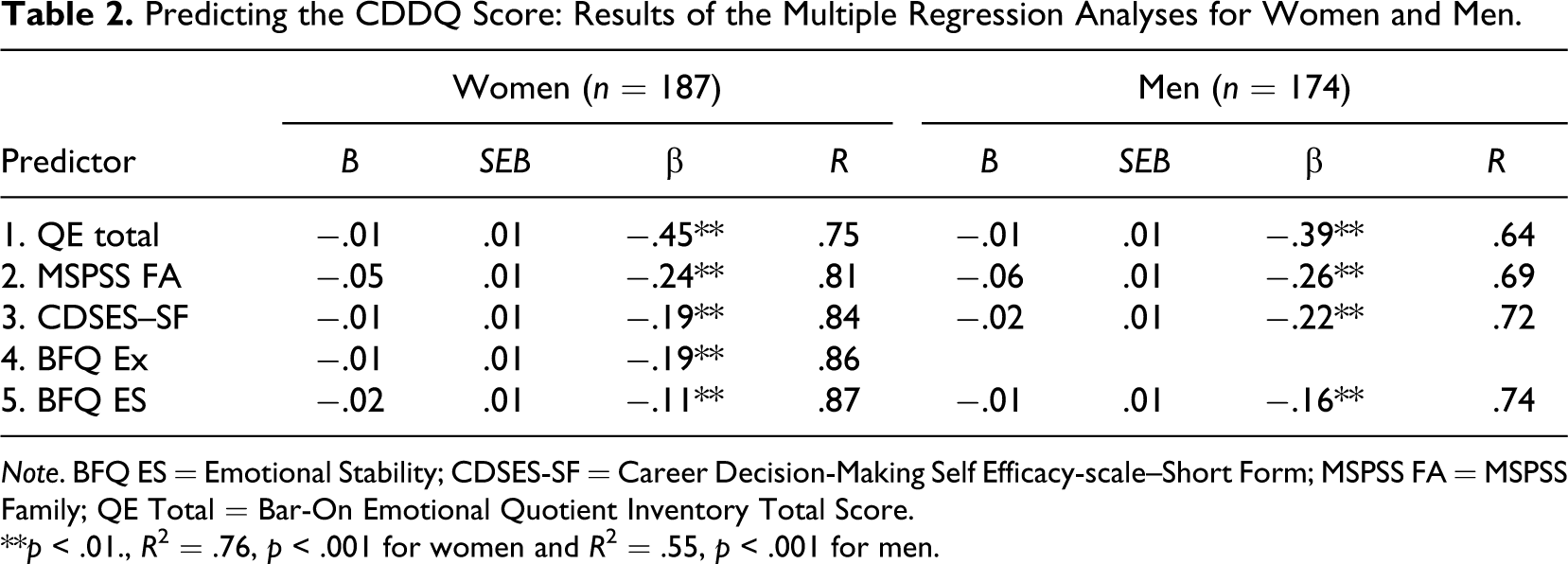
Note. BFQ ES = Emotional Stability; CDSES-SF = Career Decision-Making Self Efficacy-scale–Short Form; MSPSS FA = MSPSS Family; QE Total = Bar-On Emotional Quotient Inventory Total Score.
**p < .01., R 2 = .76, p < .001 for women and R 2 = .55, p < .001 for men.
Predicting the Indecisiveness Score: Results of the Multiple Regression Analyses for Women and Men.
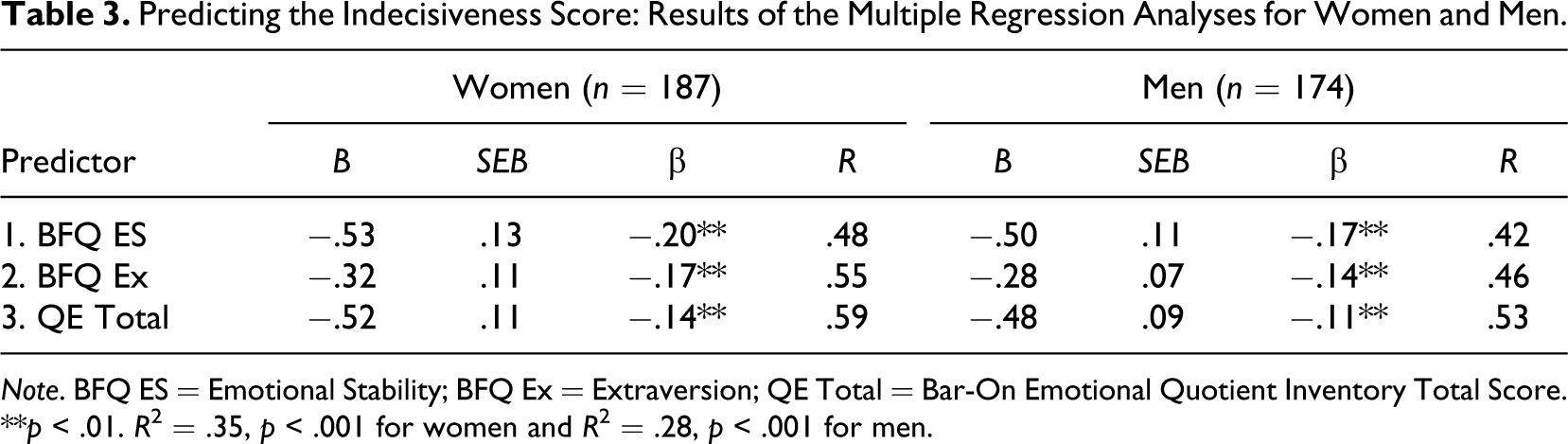
Note. BFQ ES = Emotional Stability; BFQ Ex = Extraversion; QE Total = Bar-On Emotional Quotient Inventory Total Score.
**p < .01. R 2 = .35, p < .001 for women and R 2 = .28, p < .001 for men.
Table 3 presents the results of the analyses carried out to predict indecisiveness, again separately for women and for men. As can be seen in Table 3, indecisiveness is best explained by Emotional Stability (β = −.20 and −.17, for women and men, respectively), less by Extraversion (β = −.17 and −.14, for women and men, respectively), and least by emotional intelligence (β = −.14 and −.11, for women and men, respectively). Again, as predicted, all β are negative. Second, the order of variables contributing to the prediction of indecisiveness was similar for women and men. Third, the prediction of indecisiveness for women (R 2 = .35) was higher than that for men (R 2 = .28).
Discussion
The present research studied the distinctions between career indecision and career indecisiveness by investigating factors that were hypothesized as being associated with them, including personality traits, career decision-making self-efficacy, perceived social support, and emotional intelligence. As hypothesized, we found that different sets of variables were associated with indecision and indecisiveness. Specifically, high emotional intelligence was the best predictor of low indecision, for both women and men; in fact, it accounted for more of the variance in indecision than all of the other variables put together. This result replicated the association recently reported between career indecision and emotional intelligence (Palazzeschi & Di Fabio, in press), further underlining the association of the latter with aspects of career decision-making process.
In addition, and in line with previous findings, negative correlations were found between career indecision and (a) Extraversion and Emotional Stability (Di Fabio & Palazzeschi, 2008; Feldman, 2003; Palazzeschi & Di Fabio, in press), (b) perceived social support (especially by the family; Blustein et al., 1991, 1995; Constantine et al., 2003), and (c) career decision self-efficacy (Creed et al., 2004; Gianakos, 1999; Luzzo, 1993). These results show that in addition to within-individual personality and cognitive characteristics, indecision is associated with external factors, specifically, perceived social support.
The second hypothesis was also confirmed. Indecisiveness was better explained by personality traits, especially low Emotional Stability, than by low emotional intelligence. This finding supports the claim made by Savickas (2004) that chronic indecisiveness is associated with difficulties in managing anxiety. It is also compatible with the findings of Gati et al. (2011) that, among the five dimensions of the BFQ, the dimension of Emotional Stability was most highly correlated with all three clusters of the Emotional and Personality related Career Difficulties Questionnaire (Saka & Gati, 2007), which measure career indecisiveness (Gati, Asulin-Peretz, & Fisher, 2012).
However, emotional intelligence was also associated with indecisiveness—its inclusion in the regression as an additional predictor of indecisiveness increased R 2 by 5% and 7% (for women and men, respectively), over the variance accounted for by the Emotional Stability and the Extraversion factors of the BFQ (30% and 21%, for women and men, respectively). It has been reported that emotional intelligence can be increased with specific training (Di Fabio & Kenny, 2011). The present findings suggest that such an increase in emotional intelligence could reduce not only indecision but also indecisiveness.
Emotional Stability was found to predict indecisiveness (R 2 = 23% and 18%, for women and men, respectively); however, although its contribution to the prediction of indecision was also statistically significant, it was negligible in terms of variance explained (ΔR 2 was only 2% and 3%, for women and men, respectively). This distinction supports the claim that indecisiveness has its roots in personality, supporting previous studies on the factors underlying indecisiveness (Gati et al., 2011; Saka & Gati, 2007; Saka, Gati, & Kelly, 2008).
Because of previous findings about gender differences in career decision making (e.g., Gati et al., 2010, 2011; Hijazi, Tatar, & Gati, 2004; Mau, 2000), the analyses were carried out separately for women and men. The similarity of the results for women and men, for predicting both indecision and indecisiveness, supports the generalizability of the results. However, an unpredicted pattern emerged: the variance accounted for both in indecision and in indecisiveness was consistently higher for women than for men. This unexpected result cannot be explained by the larger within-group differences in both indecision and indecisiveness for women as compared to men, because the SD was in fact slightly higher for men than for women in both measures. This difference, however, is compatible with previous reports about the inconsistency of the conclusions about gender differences in the associations between emotional intelligence and other measures (e.g., Brown et al., 2003). Thus, further research is required to test the consistency of the difference between women and men in the strength of associations between indecision and indecisiveness, on one hand, and the various measures used to predict them, on the other, and discover its source.
The other unexpected result—that the prediction of indecisiveness was much lower than that of indecision—reflects that indecisiveness is a more complex phenomenon, and therefore harder to predict. This account is supported by the fact that only 3 of the 10 possible predictors included in the regression analysis contributed to the prediction of indecisiveness; thus, other variables, for example, the individual’s career decision-making profile (Gati et al., 2010) or style (Harren, 1979), should also be considered in future research.
Limitations
Before discussing the implications, it is important to acknowledge the limitations of this research. The first limitation is that all data were collected in a single session; although the CDDQ and the IS were filled out before the other measures, future studies should use a longitudinal instead of a correlational design. Second, because the participants were students at the University of Florence, future research should test the associations between indecision and indecisiveness and the other measures in a more heterogeneous Italian sample, as well as samples from other countries. Another limitation involves the use of self-report measurements only; in particular, regarding the assessment of emotional intelligence, future research should use other instruments to assess ability-based emotional intelligence, such as the Mayer–Salovey–Caruso (2002) Emotional Intelligence Test.
Implications
The results of the present research contribute to the study of the constructs of career indecision and indecisiveness, highlighting similarities and differences. The distinction between indecision and indecisiveness is of interest because they differ in their severity and hence in their implications for the career counseling process (Gati, Amir, & Landman, 2010). The differential strength of the associations of career indecision and indecisiveness with emotional intelligence supports the theoretical distinction between the two, a distinction that has been repeatedly reported in previous studies (e.g., Gaffner & Hazler, 2002; Germeijs & De Boeck, 2002; Saka & Gati, 2007). The associations of these two constructs with emotional intelligence open novel intervention options on both career indecision and indecisiveness. Indeed, Di Fabio and Kenny (2011) demonstrated how a training program for enhancing emotional intelligence increased emotional intelligence (both ability-based and self-reported) according to the ability-based model (Mayer et al., 2002), and moreover reduced not only career decision-making difficulties but also general indecisiveness.
The development of emotional intelligence seems to be a strong factor (Hage et al., 2007) preparing individuals to cope adaptively with environmental demands by improving their social skills and facilitating their ability to succeed in life. It may therefore be suggested that, in a preventive perspective (Kenny, Horne, Orpinas, & Reese, 2009), emotional intelligence might also be a key ingredient in innovative interventions in career decision making.
Footnotes
Acknowledgments
The authors thank Reuma Gadassi, Naomi Goldblum, and Nimrod Levin for their comments on a previous version of this article. This research was supported in part by the Research Laboratory of Psychology for Vocational Guidance and Career Counseling at the University of Florence and the Samuel and Esther Melton chair of the last author.
Declaration of Conflicting Interests
The authors declared no potential conflicts of interest with respect to the research, authorship, and/or publication of this article.
Funding
The authors received no financial support for the research, authorship, and/or publication of this article.