



Abstract
This study examined the psychometric properties of a Korean translation of the Emotional and Personality-Related Career Decision-Making Difficulties–Short Form (EPCD-SF). The participants were 501 Korean students; 239 also completed a second survey to assess the test–retest reliability. The overall factor structure of the original EPCD was supported with the Korean EPCD-SF, but 2 items of the conflictual attachment and separation subcategory in self-concept and identity dimension showed low factor loadings, indicating that the 2 items might not be relevant to the Korean participants. The Korean EPCD-SF had a better model fit than the EPCD-Long Form did, and it was reliable and stable. The Korean EPCD-SF was positively related to other career indecision measures, such as career stress, external locus of control, and trait anxiety, and it was negatively related to career decision self-efficacy and self-esteem.
Keywords
Over the past several decades, career indecision has been a subject of keen interest to vocational and career counseling researchers. Career indecision is defined as a difficulty in the process of making career decisions (Gati, Krausz, & Osipow, 1996; Osipow, Carney, & Barak, 1976) and is associated with the interaction of personal and contextual factors (Brown & Rector, 2008). Career indecision was originally considered a unidimensional concept; however, subsequent studies supported multidimensional aspects of career indecision. In the 1960s, career indecision was regarded as a single dimension that was categorized as decided or undecided (Osipow, 1999). More recently, it has evolved into a multifaceted construct that is composed of complex dimensions (Hartman, Fuqua, & Jenkins, 1986).
Researchers have classified these dimensions differently. Some divided it into two dimensions of developmental indecision and career indecisiveness (Betz & Serling, 1993; Slaney, 1988), and others categorized it into four dimensions: lack of occupational information, lack of self-clarity, generalized indecisiveness, and low choice and work importance (Jones & Chenery, 1980). Considering its heterogeneous features and inconsistent classifications, researchers have endeavored to integrate meaningful subtypes through a meta-study and have categorized it into five clusters: chronic indecisiveness, unreadiness, unready indecisives, information deficits, and interpersonal conflicts and barriers (Brown & Rector, 2008). Chronically indecisive individuals may have an external locus of control and a dependent decision-making style (Lucas, 1993). Unready individuals are unable to feel the imperative need to make career decisions. Unready indecisive people might feel chronically indecisive and unready concurrently in a given period. Insufficient career knowledge overall and interpersonal conflicts and barriers also contribute to career indecision. As discussed, career indecision encompasses a wide range of factors, from intrapersonal to interpersonal and from informational to personality and emotional elements.
Career assessments have evolved to reflect the multidimensional facets of career indecision. Many researchers have categorized career indecision assessments into three generations (Kelly & Lee, 2002; Osipow, 1999). The first generation is represented by the Career Decision Scale (CDS; Osipow, 1987), which has been widely used as a diagnostic tool measuring the effectiveness of treatment (Osipow, 1991). The CDS was developed to reflect four factors of career indecision, including lack of structure and confidence, perceived external barriers, positive choice conflict, and personal conflict (Osipow, 1987). However, subsequent empirical studies failed to support the four-factor model structure, and some researchers argued that the CDS might indicate only a single factor (Martin, Sabourin, Laplante, & Coallier, 1991; Osipow, 1991).
The characteristics of second- and third-generation career indecision assessments can more precisely diagnose the reasons for career indecision compared to the first-generation assessments (Osipow, 1999). A second-generation career indecision instrument is the Career Factors Inventory (Chartrand, Robbins, Morrill, & Boggs, 1990). The scale was based on a hypothesis that career indecision can be categorized in two broad dimensions: information deficit and affective impediments (Chartrand et al., 1990). The informational dimension includes cognitive factors such as the need for occupational information and the need for self-information. The affective dimension includes generalized indecisiveness and career choice anxiety. Studies using the Career Factors Inventory have provided relatively stable support for its two-dimensional structure (Chartrand et al., 1990).
A more sophisticated third-generation instrument reflects the complexity of career indecision. Osipow (1999) was the first to suggest the Career Decision Difficulties Questionnaire (Gati et al., 1996) as a third-generation approach to measuring career indecision. This scale examined three dimensions: lack of readiness, lack of information, and inconsistent information (Gati et al., 1996). The first dimension, lack of readiness, pertains to one’s indecision prior to making a career decision, including lack of motivation, indecisiveness, and dysfunctional beliefs. The second dimension is lack of information about the decision-making process, about the self, about occupations, and about ways of obtaining information. The last dimension is inconsistent information resulting from unreliable information, internal conflicts, and external conflicts.
As previously discussed, career indecision assessments have been developed to examine more diverse dimensions of career indecision. However, they still focus heavily on information deficits and unreadiness, while personality and affective factors are included as an undifferentiated single dimension. The need for a career indecision assessment model focusing on personality and emotional dimensions has led to the development of the Emotional and Personality-Related Career Decision-Making Difficulties Scale (EPCD; Saka, Gati, & Kelly, 2008). It consists of three dimensions and 11 subcategories. The original EPCD consisted of 53 items, and later the 25-item EPCD–Short Form (EPCD-SF) was developed (Gati et al., 2011). The first main dimension is pessimistic views consisting of three subcategories concerning the process, the world of work, and one’s control. Pessimistic views reflect lowered career decision-making self-efficacy as well as negative and dysfunctional beliefs about the world of work. Individuals with pessimistic views may believe that the career decision-making process is controlled by external factors, including chance, powerful others, and the environment.
The second dimension is anxiety with subcategories of anxiety about the process, uncertainty, choice, and outcome. Anxiety dimension reflects emotional difficulties, including stress from career decision making and anxiety associated with the uncertainty of the future. Anxiety is considered to be rooted in low tolerance of ambiguity and fear of failing to fulfill the outcomes expected by others after making a choice.
The last dimension comprises self-concept and identity, which represent the developmental and personality traits associated with career indecision. This dimension is composed of subcategories of general anxiety, self-esteem, uncrystallized identity, and conflictual attachment and separation. Individuals with such difficulties tend to show trait-like anxiety, feel unworthy, exhibit delayed identity development, and feel unsupported by significant others. As a result, they may find it difficult to articulate their vocational preferences.
The EPCD assessment model can be a valuable framework from which to investigate Korean individuals’ career indecision. Emotional and personality aspects of career indecision have been recognized as critical by Korean researchers. Jung, Kim, and Kim (2008) explored factors associated with career indecision of Korean subjects by conducting a meta-analytic study of Korean studies from 1993 to 2006. They found that career identity, self-identity, and career decision-making self-efficacy had the biggest effect size, followed by dependent decision-making style and general self-efficacy, which had a medium effect size. Factors such as intuitive decision-making style and attachment had a small effect size. This finding supports the idea that noninformational factors such as identity are important in understanding career indecision among Koreans.
Furthermore, the cultural characteristics of Korean society may also contribute to career indecision associated with emotional and personality issues. Individuals in Asian countries, especially in Korea, endorse interdependence and collectivism to a greater extent than do those living in the Western society (Markus & Kitayama, 1991). These cultural values can interfere with the career decision-making process when individuals rely heavily on the advice of significant others and prioritize the opinions of family members rather than making decisions independently. In addition, unlike the finding in a Western study that vocational identity increased in accordance with students’ ages and academic grades, Korean studies showed that the development of vocational identity was unrelated to age and grades (Ryu, Hwang, & Kim, 2005).
Despite the possible importance of emotional and personality factors in career indecision for Koreans, there has been relatively little effort to develop a comprehensive assessment model that reflects these aspects of career indecision. The majority of Korean studies on career decisions investigating emotional and personality factors used generic instruments rather than using career-specific assessments. For example, the Korean Career Indecision Inventory (K-CII; Tak & Lee, 2003) has been widely adopted to measure students’ career indecision and anxiety in Korean research. This instrument consists of five clusters, including external constraints, inability to make decisions, lack of career information, lack of self-identity, and lack of necessity. This well-known Korean instrument underscores the informational dimension of career indecision and puts less emphasis on emotional factors. For this reason, validating the EPCD with a Korean sample can facilitate career indecision studies in Korea.
Min (2012) conducted a study that validated the 53-item EPCD-Long Form (EPCD-LF). She conducted an exploratory factor analysis that resulted in a factor structure different from that in the original study (Saka et al., 2008). The original study reported a factor structure with three dimensions and 11 subcategories, but Min’s study found three dimensions and seven subcategories. The first dimension was pessimistic views, including two subcategories concerning outcome expectation and one’s control. The second dimension indicated anxiety, with three subcategories being anxiety about process, anxiety about uncertainty, and anxiety about choice/outcome. The last dimension represented self-concept and identity consisting of two subcategories being general anxiety and self-esteem. While Min’s study supported the three dimensions of the original EPCD, discrepancies with the original study were found in the subcategories. Among subcategories, uncrystallized identity (self-concept and identity dimension) and conflictual attachment and separation (self-concept and identity dimension) were eliminated. Three subcategories within pessimistic views concerning the process, the world of work, and one’s control were not distinguished from each other, merged into two categories. Two subcategories of anxiety about process and anxiety about outcome in anxiety dimension were also composited into one subcategory. In addition, 13 items from the original EPCD were eliminated, leaving only 40 items.
Although the results of Min’s study (2012) showed that the factor structure of the EPCD might not fit well with Korean subjects, this finding may be inconclusive. The differences in factor structure could result from cultural differences, but they also could result from methodological characteristics. When exploratory factor analyses are used, factor structure often changes depending on samples. Moreover, the 53-item EPCD may include items with low factor loadings or cross loadings, leading to the removal of subcategories and items.
Thus, we decided to investigate the psychometric properties of the 25-item EPCD with a Korean sample. The 25-item EPCD is composed of items that are more representative of each subcategory and dimension. It is also easy to use because it requires less time to administer. As the 25-item EPCD was developed based on a theoretical framework and is empirically validated, we used a confirmatory factor analysis (CFA) to examine whether the original factor structure would also be supported with a Korean sample. Internal consistency and temporal stability were also investigated to test reliability. Finally, criterion-related validity was examined using correlation with relevant factors such as trait anxiety, self-esteem, locus of control, career stress, and another career indecision instrument.
Method
Participants
The participants were 501 undergraduate students from a large university in Seoul, South Korea. The sample comprised 169 men (33.2%) and 332 women (66.3%); 106 were freshmen (21.2%), 139 were sophomores (27.8%), 126 were juniors (25.1%), and 130 were seniors (25.9%). Of the 501 subjects, 239 (70 men and 169 women) participated in a second survey to assess the test–retest reliability. This included 65 freshmen (27.2%), 88 sophomores (36.8%), 46 juniors (20.5%), and 37 seniors (15.5%).
Instrument
Emotional and personality career difficulties scale
The long form of the Emotional and Personality-Related Career Decision-Making Difficulties Scale with 53 items (EPCD; Saka et al., 2008) was completed by the participants. The analyses on the short form with 25 items (EPCD-SF; Gati et al., 2011) were conducted by using the responses of the short form items. This scale measures emotional and personality aspects of career decision-making difficulties. First, as suggested by Hui and Triandis (1985), a translation and back translation were conducted. Two professors with experience in counseling psychology translated the original EPCD into Korean, and a professor who teaches English literature then translated the Korean version of EPCD back into English. Finally, six graduate students majoring in psychology reviewed the items and generated a final Korean version of the EPCD.
The original version of EPCD (EPCD-LF) consists of 53 items, including 1 warm-up item and 2 validity items. Eleven difficulty categories load on three major dimensions—pessimistic views, anxiety, and self-concept and identity. More specifically, the first dimension (i.e., pessimistic views) is divided into three categories: pessimistic views about the process, pessimistic views about the world of work, and pessimistic views about one’s control. The second dimension is divided into four categories: anxiety about the process, anxiety related to the uncertainty involved in choosing, anxiety about the process of choosing, and anxiety about the outcome. The third dimension is divided into four categories: self-esteem, general anxiety, uncrystallized and unstable vocational self-concept, and conflictual attachment and separation.
The EPCD-SF is adapted from the original 53-item version of the EPCD. It consists of 25 items in 11 difficulty categories that load on three major dimensions (i.e., pessimistic views, anxiety, and self-concept and identity) as in the original version of the EPCD. In addition, the 25 items of the short version also include 1 warm-up item and 2 validity items (original items: 1, 3, 4, 6, 7, 11, 12, 14, 16, 17, 23, 24, 29, 30, 32, 33, 36, 37, 38, 40, 41, 46, 47, 49, 51).
Respondents were asked to answer questions using a 9-point Likert-type scale (1 = does not describe me at all; 9 = describes me well). Example items are “I can’t find out enough about all the occupations to make the right choice” (pessimistic dimension), “I am worried about having to deal with the complex process involved in career decision-making” (anxiety dimension), and “Important people in my life are often displeased with the things that interest me” (self-concept and identity dimension).
Locus of control
The original version of the Locus of Control scale was developed by Levenson (1981), and the Korean version was validated by Yoon, Park, and Choi (2002) through translation and back translation. It consists of 15 items with three major clusters: internal scale, chance scale, and powerful other scale. Participants were asked to rate the items using a 6-point Likert-type scale (1 = strongly disagree; 6 = strongly agree). Examples of the items included are “Whether or not I get to be a leader depends mostly on my ability” (internal scale), “To a great extent, my life is controlled by accidental events” (change scale), and “I feel like what happens in my life is mostly determined by powerful people” (powerful other scale). The internal consistency from Yoon et al. was .65 for the internal control scale, .60 for the chance scale, and .74 for the powerful other scale. In this study, the internal consistency was .72 for the internal control scale, .61 for the chance scale, and .74 for the powerful other scale.
Self-esteem
A scale to measure self-esteem was developed by Rosenberg (1965) and translated by Chon (1974) in Korea. The instrument consists of 10 items and a 4-point Likert-type scale (1 = strongly agree; 4 = strongly disagree). Examples from this questionnaire include “I feel that I am a person of worth, at least on an equal plane with others” and “I feel I do not have much to be proud of.” According to the validation study by Lee, Nam, Lee, Lee, and Lee (2009), the internal consistency for college students was .87; in this study, it was .86.
Career decision self-efficacy
The Career Decision-Making Self-Efficacy–Short Form (CDSE-SF; Betz, Klein, & Taylor, 1996) was used to measure capability in handling specific tasks in the career decision-making process. This form was validated in South Korea by Lee and Lee (2000). The instrument consists of 25 items, and participants responded to each item on a 5-point Likert-type scale (1 = no confidence at all; 5 = complete confidence). Examples of items are “change majors if you did not like your first choice,” “prepare a good resume,” and “accurately assess your ability.” The internal consistency in the previous study was .94. In this study, the internal consistency was .91.
Trait anxiety
In order to measure general anxiety, the State Trait Anxiety Inventory developed by Spielberger (1972) was used. The Korean version was validated by Kim and Shin (1978). The instrument consists of 20 items, including “I am content,” “I feel blue,” and “I am happy.” According to Kim and Shin, the internal consistency of the Korean study was .86; in this study, the internal consistency was .89.
K-CII
To measure the level of career indecision, the Korean Career Indecision Scale (Tak & Lee, 2003) was used. The inventory consists of five subscales with 22 items, including lack of career information, lack of necessity recognition, indecisiveness, lack of self-identity, and external barriers. The participants responded with a 5-point Likert-type scale (1 = strongly disagree; 5 = strongly agree). Examples of items are “I don’t know how to gather information about a career,” “I don’t know what my interests are,” and “I don’t need to make a career choice at this time.” The internal consistency reported by Tak and Lee (2003) was .60 for external barrier, .72 for indecisiveness, .83 for lack of career information, .88 for lack of self-identity, and .62 for lack of necessity recognition. In this study, the internal consistency was .73 for external barrier, .82 for indecisiveness, .90 for lack of career information, .83 for lack of self-information, and .83 for lack of necessity recognition.
Career stress for college students
In order to measure college students’ career stress, we used the 8 items related to career stress from the 60-item Life Stress for College Students scale, developed by Chon, Kim, and Yi (2000). Responses were rated on a 4-point Likert-type scale (1 = never; 4 = always). This study adopted the short form of this scale. Sample items included “broke up with boyfriend/girlfriend” and “overwhelmed by school work.” The internal consistency of the 8 items related to career stress in this study was .87.
Procedure
Participants were recruited via advertisements on online community sites of a large university in Seoul, South Korea. Those who agreed to participate in the study completed the consent form and questionnaire online. The questionnaire included demographic information (gender and year in school) and the measures of self-esteem, locus of control, trait anxiety, EPCD, career decision self-efficacy, K-CII, and career stress for college students, in order. The second online questionnaire for assessing test–retest reliability of EPCD was completed after 6 months. A coupon worth US$5 was offered as an incentive for each participation.
Data Analysis
Standard deviations (SDs), means, and reliability were examined by using Statistical Package for the Social Sciences 20.0. In order to validate the EPCD-SF, we conducted a CFA using Amos (18.0). To evaluate the construct validity of the Korean EPCD-SF, we examined the various fit indices of the following three models. First, we tested the theoretical model of the Korean EPCD-SF (third-order factor model 11-3-1; Model 1) as proposed by Saka, Gati, and Kelly (2008). Second, as a competing model, we tested the three-factor model in which items were allowed to load on three major factors and a general factor (second-order factor model; 3-1; Model 2). The third model, another competing model, is a one-factor model in which all items were allowed to load on a single factor (one-factor model; Model 3). After identifying the final good fit of the Korean EPCD-SF model, we compared the fit of the Korean EPCD-SF model with the EPCD-LF. In order to evaluate the adequacy of the model fit, we used four measures: the relative χ2/degree of freedom (χ2/df), comparative fit index (CFI), Tucker–Lewis index (TLI), and root mean square error of approximation (RMSEA). According to Hu and Bentler (1999), a value greater than .90 for CFI and TLI indicates a good fit. For RMSEA, a value of .06 or less indicates a good model fit, and .08 is a reasonable fit as well (Schumacker & Lomax, 2004). In order to assess convergent and discriminate validity of the Korean EPCD-SF, we investigated the relationships between the Korean EPCD-SF and the measures reviewed previously. Finally, the group differences by gender and years in school were examined using one-way analysis of variance (ANOVA).
Results
The CFA of the EPCD-SF
We tested the various fit indices for Model 1 (11-3-1; research model), Model 2 (3-1; alternative Model 1), and Model 3 (single factor; alternative Model 2). The model fit for Model 1 was χ2(196, N = 501) = 596.568, p < .001, TLI = .913, CFI = .926, and RMSEA = .064. Although the fit indices were in an acceptable range, the standardized weights of 2 items in the conflictual attachment and separation category were extremely low (.27 for Item 49 and .14 for Item 51). Thus, we modified Model 1 by excluding these 2 items, leaving 10 categories and three dimensions. The model fit for the modified Model 1 was adequate for the data, χ2(158, N = 501) = 513.705, p < .001, TLI = .919, CFI = .932, RMSEA = .067. Next, we tested the fit of data for Model 2 (3-1) and Model 2 without items 49 and 51. The results showed an unacceptable fit to the data for Model 2, χ2(206, N =501) = 1,551.197, p < .001, TLI = .721, CFI = .751, and RMSEA = .114, and Model 2 without items 49 and 51, χ2(167, N = 501) = 1,467.238, p < .001, TLI = .718, CFI = .752, and RMSEA = .125. Finally, we also tested the competing one-factor model (Model 3) with and without items 49 and 51, and the results showed an inadequate fit to the data for Model 3 with items 49 and 51, χ2(209, N = 501) = 1,951.985, p < .001, TLI = .644, CFI = .678, RMSEA = .129, and without items 49 and 51, χ2(170, N = 501) = 1,856.957, p < .001, TLI = .641, CFI = .679, RMSEA = .141. Therefore, the results indicated that the modified Model 1 (third-order factor model; 10-3-1) was most satisfactory to the data. Thus, we chose the modified Model 1 as our final model for the Korean EPCD-SF. The final model is presented in Figure 1.
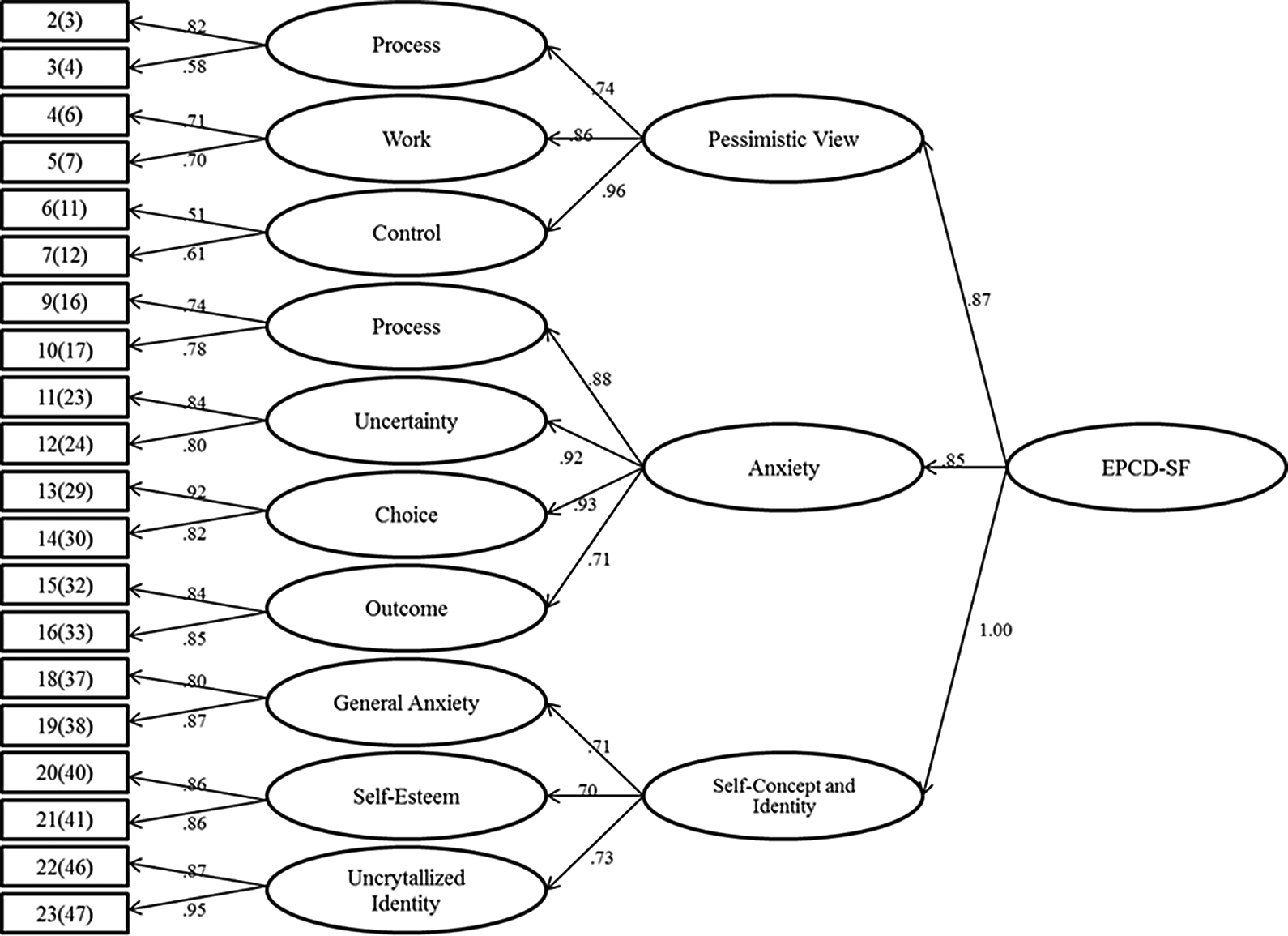
Standardized estimates of modified Model 1 (10-3-1; 20 items). All estimates were significant. Item numbers in EPCD-LF are listed in parentheses.
Model Comparison Between EPCD-LF and EPCD-SF
Following the identification of the most satisfactory theory-driven model (Model 3) for the Korean EPCD-SF, we then compared the goodness-of-fit indices of the original model of the EPCD-LF (11-3-1; Saka et al., 2008), the modified model of the Korean EPCD-LF (7-3-1; Min, 2012), and our model of the Korean EPCD-SF (10-3-1). The CFA results of the original model of the EPCD-LF (11-3-1) were as follows: χ2(1,161, N = 501) = 4,286.200, p < .001, TLI = .804, CFI = .814, and RMSEA = .073. Similar to the CFA results for the EPCD-SF, the items in the conflictual attachment and separation category of self-concept and identity dimension (items 48–53) had low standardized weights, ranging from .39 to .52 (except for item 48, which was .72). Furthermore, the analysis of the reliability of the items on conflictual attachment and separation showed low internal consistency (.66). Based on these results, the subsequent analyses were performed with a modified model consisting of 44 items, 10 categories, and three dimensions after excluding 6 items from the conflictual attachment and separation category of the self-concept and identity dimension. The original model of the EPCD-LF without the conflictual attachment and separation category (10-3-1) was tested with CFA and yielded worse fit indices than those of the EPCD-SF: χ2(889, N = 501) = 3,566.410, p < .001, TLI = .820, CFI = .831, RMSEA = .078. This indicated that the EPCD-SF had a better fit than the EPCD-LF. The CFA of the modified model of the Korean EPCD-LF (7-3-1) also resulted in worse fit indices than those of the EPCD-SF: χ2(619, N = 501) = 3,125.873, p < .001, TLI = .796, CFI = .810, and RMSEA = .090.
The Internal Consistency and Test–Retest Reliability of the Korean EPCD-SF
Table 1 presents the Means, SDs, the internal consistency (N = 501), and the 6-month test–retest reliabilities (N = 239) of the three respective dimension scores and the total EPCD scores. Reliability of the Korean EPCD-SF and its three dimensions was examined with internal consistency and test–retest reliability with a 6-month interval. The examination of internal consistency of the three dimensions yielded .74 for pessimistic view, .90 for anxiety, and .83 for self-concept and identity. The test of the internal consistency of self-concept and identity dimension showed that 2 items in the conflictual attachment and separation category within self-concept and identity dimension, those excluded from the CFA of the Korean EPCD-SF, had low item-total correlations as well (.39 for item 49 and .18 for item 51). After deleting these 2 items, internal consistency of self-concept and identity dimension was .83. Test–retest reliability was estimated with a 6-month interval. The Pearson’s correlation between Time 1 and Time 2 was .57 for pessimistic views, .70 for anxiety, and .73 for self-concept and identity.
Descriptive Statistics, Reliabilities, and Intercorrelations for the EPCD-SF.
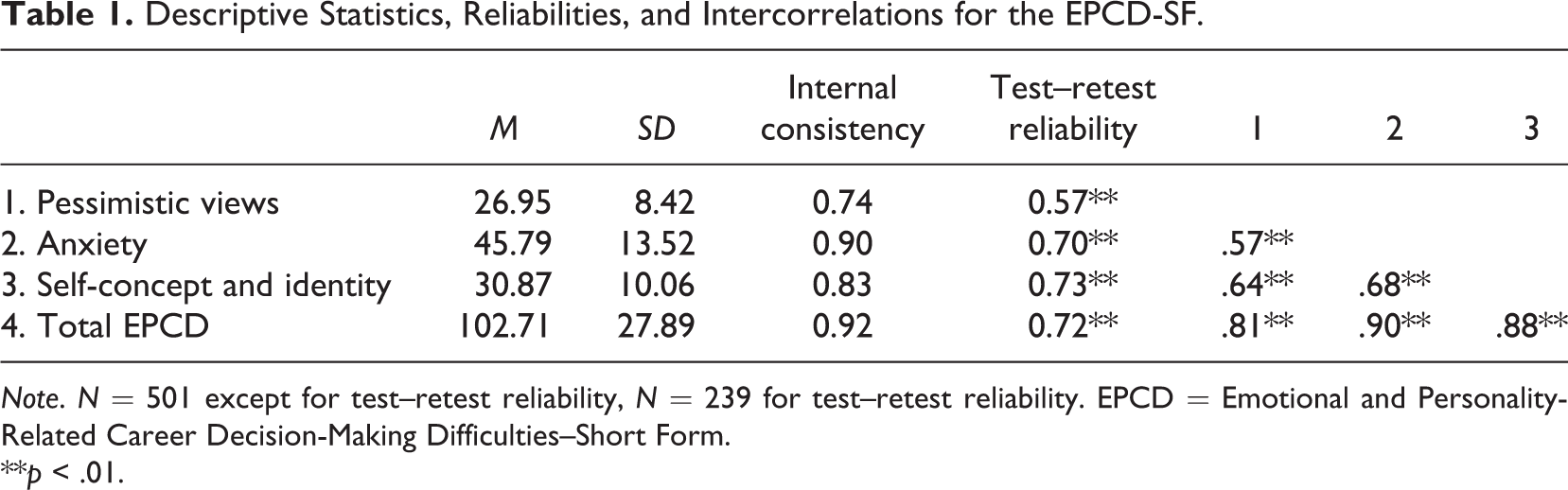
Note. N = 501 except for test–retest reliability, N = 239 for test–retest reliability. EPCD = Emotional and Personality-Related Career Decision-Making Difficulties–Short Form.
**p < .01.
The Convergent and Discriminate Validity of the Korean EPCD-SF and Group Differences by Gender and Years in School
The means, SDs, and the intercorrelation matrix among the related variables are presented in Table 2. As hypothesized, the results showed that the Korean EPCD-SF was negatively related to internal locus of control (r = −.33, p < .01) and positively to external loci of control (chance, r = .40, p < .01; others, r = .40, p < .01). The Korean EPCD-SF was strongly and positively related with trait anxiety (r = .59, p < .01) and career stress (r = .67, p < .01). Furthermore, it was negatively related with career decision self-efficacy (r = −.58, p < .01) and self-esteem (r = −.52, p < .01). A comparison of the Korean EPCD-SF to the Korean Career Indecision Inventory (K-CII) showed a strong association. Specifically, the Korean EPCD-SF was positively related with external barriers (r = .36, p < .01), indecisiveness (r = .64, p < .01), lack of career information (r = .57, p < .01), lack of self-information (r = .63, p < .01), and lack of need for necessity (r = .16, p < .01).
Means, Standard deviation, and Correlations of Related Variables.
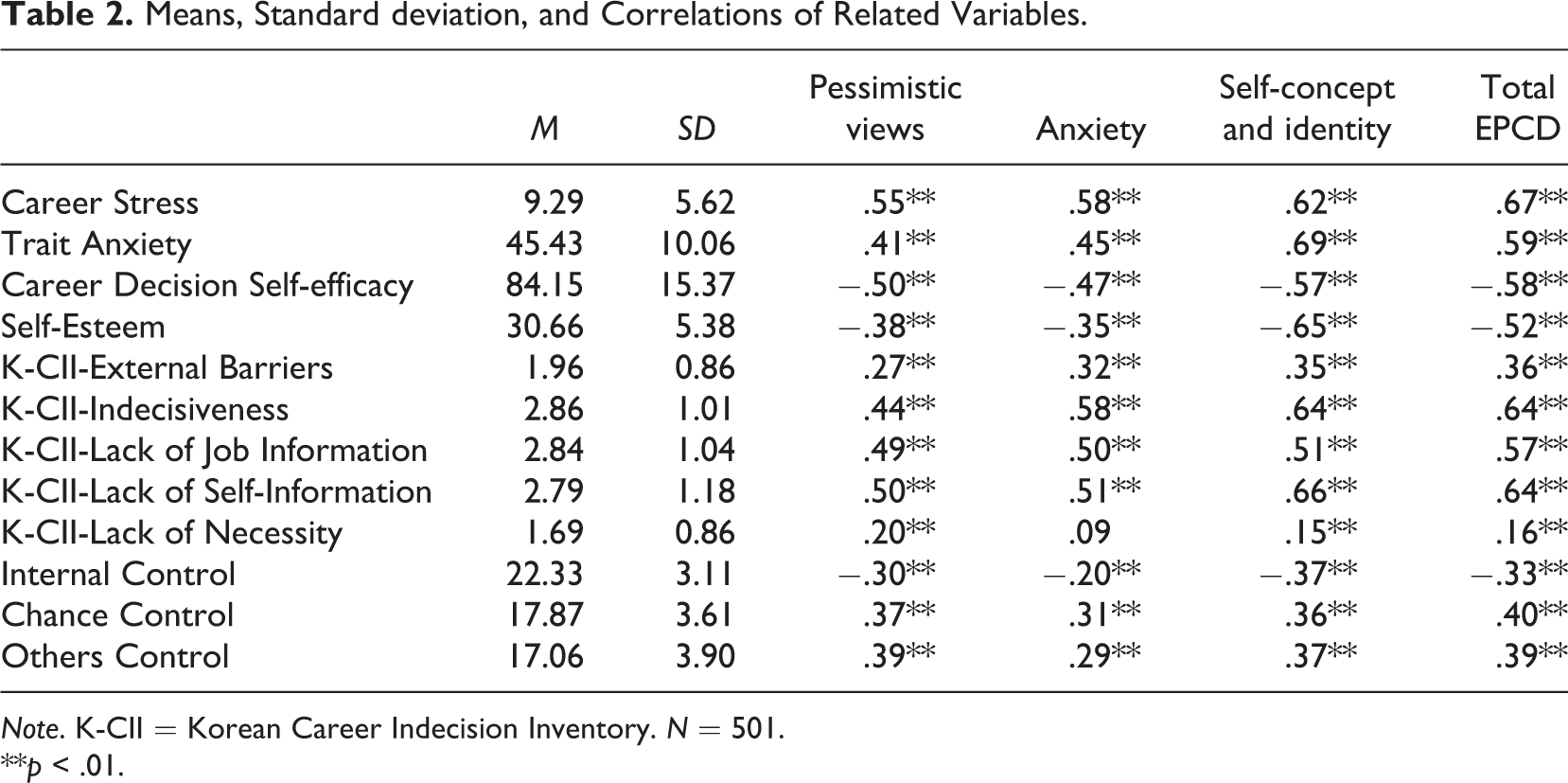
Note. K-CII = Korean Career Indecision Inventory. N = 501.
**p < .01.
To be specific, pessimistic view showed a positive relationship with external locus of control (chance, r = .38, p < .01; powerful others, r = .39, p < .01) and a negative relationship with internal locus of control (r = −.31, p < .01). In addition, pessimistic view was positively related to trait anxiety (r = .41, p < .01) and career stress (r = .55, p < .01), but it was negatively related to career decision self-efficacy (r = −.50, p < .01) and self-esteem (r = −.38, p < .01). In terms of K-CII, pessimistic view was positively related with each subscale: external barriers (r = .27, p < .01), indecisiveness (r = .44, p < .01), lack of career information (r = .49, p < .01), lack of self-information (r = .51, p < .01), and lack of need for necessity (r = .20, p < .01).
In relation to anxiety dimension of the Korean EPCD-SF, it was positively related to external locus of control (chance, r = .31, p < .01; powerful others, r = .30, p < .01) and negatively related to internal locus of control (r = −.20, p < .01). In addition, this dimension was positively related to trait anxiety (r = .45, p < .01) and career stress (r = .59, p < .01). However, it had a negative relationship with career decision self-efficacy (r = −.48, p < .01) and self-esteem (r = −.35, p < .01). Regarding K-CII, anxiety dimension was positively related to external barriers (r = .32, p < .01), indecisiveness (r = .58, p < .01), lack of job information (r = .50, p < .01), and lack of self-information (r = .51, p < .01).
Finally, self-concept and identity dimension of the Korean EPCD-SF was positively related to external locus of control (chance, r = .36; powerful others, r = .37, p < .01) and negatively related to internal locus of control (r = −.37, p < .01). In addition, this dimension was positively associated with trait anxiety (r = .68, p < .01) and career stress (r = .62, p < .01), but negatively associated with career decision self-efficacy (r = −.57, p < .01) and self-esteem (r = −.65, p < .01). Self-concept and identity dimension also showed positive relationships with external barriers (r = .35, p < .01), indecisiveness (r = .64, p < .01), lack of job information (r = .51, p < .01), lack of self-information (r = .66, p < .01), and lack of need for necessity (r = .15, p < .01) of the K-CII.
Additional tests on the group differences by gender and years in school were performed using ANOVA. Compared to male students (M = 42.50, SD = 12.88), female students (M = 47.46, SD = 13.55) reported a higher score on anxiety, F(1, 499) = 15.45, p < .001. Gender difference was also found in self-concept and identity, F(1, 499) = 5.66, p < .05, with female students (M = 31.63, SD = 10.08), reporting greater difficulties associated with self-concept and identity than male students (M = 29.38, SD = 9.87). Regarding years in school, the difference was found only in self-concept and identity, F(3, 497) = 2.91, p < .05. The first-year students scored highest (M = 32.10, SD = 9.26), followed by the second years (M = 31.81, SD = 10.21), the third years (M = 30.98, SD = 10.20), and the fourth years (M = 30.87, SD = 10.06).
Discussion
The EPCD-SF is a multifaceted instrument mainly focusing on emotional and personality-related career indecision. This study sought to validate this measurement with a Korean sample. First, the factor structure of the Korean EPCD-SF was compared with the original EPCD-SF using CFA. The results supported the hierarchical structure of the original measure, but 2 items in the conflictual attachment and separation of self-concept and identity dimension had low loadings. As these 2 items also had low item-total correlations, they were excluded from the subsequent analyses. The comparison between the Korean EPCD-SF and the EPCD-LF using CFA also showed that the EPCD-SF had a better fit. Second, the internal consistency and temporal stability of the Korean EPCD-SF after a 6-month interval indicated that it was a reliable and stable measure. The relationships between the Korean EPCD-SF and other personality and affective factors showed that the factors in the Korean EPCD-SF assessed what they were supposed to measure. Finally, female students reported greater difficulties in career indecision associated with Anxiety and self-concept and identity. Self-concept and identity was the only dimension that yielded the difference by years in school, indicating it is more sensitive to developmental stages.
This study found that the EPCD-SF appears to be appropriate for use with Koreans in general, but the subcategory of conflictual attachment and separation in self-concept and identity dimension may not be applicable. We found the overall factor structure was supported with the Korean sample; however, 2 items in the conflictual attachment and separation subcategory were rather distinctive from the rest of the items in other subcategories within self-concept and identity dimension. This finding is also consistent with a previous study that investigated the factor structure of the EPCD-LF with a Korean sample (Min, 2012). This result may imply that cultural differences influence this particular subcategory. According to Saka et al. (2008), individuals with a higher score on this category tend to believe that they “would not like to commit to a choice that is not approved by my family.” In other words, adherence to the opinions of family members can be a source of career decision-making difficulties. However, separation–individuation in collectivistic societies (e.g., Korea, China, and Japan) is based on Confucianism and may be distinctive from that in individualistic societies because parents in these countries do not encourage their children to achieve psychological separation and independence (Tang, 1992), and it is often the norm that significant others such as family members get deeply involved in the career decision-making process. Dien (1992) stated that separation–individuation might not necessarily apply to people who were raised in a collectivist culture, as it is not considered an important issue in this cultural background. Consistent with this idea, a recent study reported that Filipino-Americans’ separation–attachment did not predict career maturity (Bacarro, 2010). Accordingly, following others’ advice and avoiding unapproved choices would be more acceptable for those with that cultural background than for those in Western societies. Thus, seeking others’ approval when making career choices may not necessarily be related to career indecision in the Korean context.
Another finding is that the Korean EPCD-SF has a complex structure, and its subcategories are composed with heterogeneous constructs. When we compared one-level, two-level (3-1), and three-level (10-3-1) models, the three-level model had a superior model fit, supporting the hierarchical multidimensionality of the EPCD-SF (11-3-1; Saka et al., 2008). In addition, the Korean EPCD-SF (25 items) appears to be preferable to the Korean EPCD-LF. First, the EPCD-SF may be more efficient than the EPCD-LF because it includes all constructs in the EPCD-LF but with a smaller number of items. Second, the model fit of the EPCD-SF was better than that of the EPCD-LF. This may be because the EPCD-SF is composed of more representative items with greater factor loadings than the EPCD-LF.
Furthermore, the Korean EPCD-SF seems to be not only reliable but also temporally stable. Particularly, the correlation coefficients between Time 1 and Time 2 varied across the three dimensions. The dimensions of anxiety and self-concept and identity had higher temporal stability than did pessimistic views, and this result is consistent with the finding of the 3-year follow-up study on the original EPCD (Gati, Asulin-Peretz, & Fisher, 2012). The discrepancy in temporal stability may indicate that pessimistic views reflect one’s cognitive view or perspective toward their world of work, which changes with one’s experiences, but the other two clusters are associated more with emotional aspects that are intrapsychic and more stably maintained (Gati et al., 2012).
Finally, the correlations between the Korean EPCD-SF and other related factors offer evidence for criterion-related validity. Overall, the Korean EPCD-SF was positively related to various types of career indecision. Pessimistic views showed positive relationship with external loci of control (change, others) and negative relationships with internal locus of control and career decision self-efficacy, as expected. Individuals with a pessimistic view feel inadequate in making career decisions, perceive career options negatively, and believe that they do not have control over their decision making (Gati et al., 2011). Anxiety was associated with career stress, as this dimension reflects stress and anxiety involved in various stages of career decision making (Saka & Gati, 2007). Self-concept and identity reflects general anxiety, self-esteem, and identity diffusion (Gati et al., 2011), and our results showed its positive relationships with trait anxiety and self-esteem scales. However, the results did not show a differentiated relationship of each dimension with various related factors. For example, the theoretical model of the EPCD suggests that pessimistic view would be more closely related to external locus of control, anxiety would be closely related to career stress, and self-concept and identity would be closely related to trait anxiety and self-esteem. However, our results showed that self-concept and identity was more strongly associated with all of these related factors than the other two dimensions were. As discussed in previous studies (Gati et al., 2011; Saka & Gati, 2007), this may indicate self-concept and identity is a more fundamental dimension than the other dimensions are, as it reflects global personality characteristics that are related to overall life experiences as well as career indecisions.
This study has several limitations. First, the research participants were recruited from a single university in South Korea; therefore, the generalizability may be limited. Future studies may need to recruit participants from different institutions and geographical regions. Second, the findings of this study may reflect the characteristics of Koreans, but investigators should be cautious in applying them to other Asian or Korean Americans individuals. We found unique results that were distinctive from the previous studies conducted in Western societies, and we believe that they might reflect cultural factors such as collectivism. However, there would be heterogeneity even within collectivistic societies. The experiences of Korean and Korean American individuals may also be different, as their life contexts offer different opportunities and difficulties. Thus, there might be a need to examine the extent to which these findings would be applicable by comparing more diverse cultural groups. Finally, the internal consistency of the locus of control measure was low; thus, the findings should be interpreted with caution.
Despite these limitations, this study found that the EPCD-SF would be a useful measure to assess Koreans’ career indecision, focusing on emotional and personality characteristics. It may facilitate more diverse career indecision studies, which, in turn, would be the basis for the development of a more sophisticated system of diagnosis of and interventions for career problems. Moreover, this study found evidence that cultural differences might influence emotional and personality-related career indecision. Specifically, personality characteristics associated with interpersonal patterns (i.e., conflictual attachment and separation) may operate differently in cultures, leading to differences in their role in career indecision. Such a possibility can be further studied with extensive cross-cultural studies.
Footnotes
Declaration of Conflicting Interests
The author(s) declared no potential conflicts of interest with respect to the research, authorship, and/or publication of this article.
Funding
The author(s) disclosed receipt of the following financial support for the research, authorship, and/or publication of this article: This study was supported by a Korea University Grant.