



Abstract
The purpose of the present study was to examine the internal consistency and test–retest reliability, the internal structure, and construct validity of the Chinese version of the Emotional and Personality-Related Career Difficulties questionnaire (EPCD). Based on a sample of 540 Chinese university students, high-reliability coefficients for the overall scale (α = .93), the three clusters (.78, .85, and .93), and adequate reliability for its 11 difficulty categories (range from .64 to .85) were observed. The 2-week test–retest reliabilities of the overall scale, three clusters, and 11 difficulty categories were also adequate (ranging from .61 to .94). Confirmatory factor analysis of the original theoretical model (11 difficulty categories loaded on three major clusters and then one general factor) demonstrated acceptable model fit after deleting three small-loading items. The pattern of associations between the clusters of the EPCD and the Trait Anxiety Scale, the Career Decision Scale, and the Vocational Identity Scale supported its construct validity. The discussion of the use of EPCD in China and suggestions for future research are proposed.
Keywords
Career decision making is a major task for university students. Indeed, one common problem of university students is the difficulties they face while making a career decision during the transition periods (e.g., from high school to university and from graduation to work). The Emotional and Personality-Related Career Difficulties (EPCD) questionnaire is a recently developed measure to assess the sources of the difficulties individuals face before or during career decision-making process (Saka, Gati, & Kelly, 2008). The purpose of the present study is to test the reliability and validity of EPCD with a sample of Chinese university students. A valid Chinese version of EPCD can contribute significantly to the research and practice of career counseling in Chinese university contexts.
The specific Chinese social context suggests that current Chinese university students may face unique challenges and difficulties about making career decisions on their own. On one hand, the freedom of choosing a job has just emerged in the last two decades, before which people were assigned jobs through the national job-distribution system (Hou & Zhang, 2007). Along with this freedom to make choices in the job market is a demand for current university students to take responsibility for their own career development. Unfortunately, however, they do not have plenty of role models in the older generations to learn from. On the other hand, many Chinese parents and teachers consensually encourage students to exclusively focus on improving academic grades to get into prestigious universities, thus high school students are not motivated to concern over future career or explore about themselves and the world of work. After these students go to college, they would be overwhelmed by the enormous information and pressure while graduation is impending. Consequently, for the Chinese university students who have inadequate career role models and insufficient career concern or decision experience, the anxiety for finding a good job can be expected in their career decision process.
Therefore, helping students to make better decisions becomes an important task for career counselors in China. In order to implement interventions with specific targets for different types of undecided students, the accurate assessment of individuals’ specific career decision-making difficulties is pivotal.
Review of Career Decision-Making Assessment
Several assessment tools have been developed to measure career indecision. The earliest widely used assessment is the Career Decision Scale (CDS; Osipow, Carney, Winer, Yanico, & Koschier, 1976). However, studies using CDS revealed that, in spite of its wide use, disputes exist: Some researchers discovered a multidimensional structure of CDS in factor analysis (Feldt et al., 2010; Shimizu, Vondracek, Schulenberg, & Hostetle, 1988), others suggested that CDS was unidimensional (Laplante, Coallier, Sabourin, & Martin, 1994). Osipow (1994) recommended using the total score of CDS to represent the level of career indecision, while Savickas and Jarjoura (1991) proposed CDS to be an indecision type indicator. These inconsistent results suggested potential validity issues of CDS and have motivated further research efforts to develop other measures for assessing career indecision or career decision-making difficulty.
In existing literature, a number of later measures can be found, such as the My Vocational Situation Scale (MVS; Holland, Daiger, & Power, 1980), the Vocational Decision Scale (Jones & Chenery, 1980), the Career Decision Diagnostic Assessment (Bansberg & Sklare, 1986; Larson, Busby, Wilson, Medora, & Allgood, 1994), and the Career Factor Inventory (Chartrand, Robbins, Morrill, & Boggs, 1990). However, none of those assessment tools is based on a systematic and theoretical construct of career indecision or decision-making difficulty, so there is a need for a “new framework, which combines a theoretical analysis and empirical tests” (Gati, Krausz, & Osipow, 1996, p. 511). To address this need, Gati, Krausz, and Osipow (1996) developed the Career Decision-Making Difficulties Questionnaire (CDDQ). CDDQ was based on the premise that the ideal decision maker should be a person who is aware of the need to make a decision, has motivation to do it, and has competence to make the right decision. Anyone who deviates from the ideal decision maker will probably have difficulty to make a decision. Gati et al. (1996) proposed a hierarchical model, which classified the career decision-making difficulties into three major clusters: lack of readiness, lack of information, and inconsistent information, each of which comprises 3–4 difficulty categories. Unlike the CDS and other previous assessment tools, CDDQ was developed by integrating a theoretical framework of career decision with empirical data. This improvement facilitated later research studies in this realm.
However, CDDQ focuses more on the cognition-related difficulties of career decision making, disregarding the emotional and personality-related aspects (Jin, Nam, Joo, & Yang, 2014). Scholars have found that both emotion and personality play important roles in career decision-making process and career choices, but such constructs received relatively little research attention (Emmerling & Cherniss, 2003; Kidd, 1998; Young, Paseluikho, & Valach, 1997; Young & Valach, 1996). Among relevant studies, Saunders, Peterson, Sampson, and Reardon (2000) observed both depression and dysfunctional career thoughts had significant relationships with indecision. With the Chinese population, Li, Hou, and Jia (2015) found that the emotion of regret mediated the influence of social comparison on career choice certainty. Lounsbury, Hutchens, and Loveland (2005) and Fabio, Palazzeschi, Levin, and Gati (2014) reported that career decision-making difficulties were related to the Big Five model of personality. Studies by Leong and Chervinko (1996) and Yu (2008) supported the association between perfectionistic personality and career indecision. Gati, Amir, and Landman (2010) found that counselors rated personal and emotional causes of clients’ career issues as more severe and as those that needed longer treatment than external and cognitive causes. The above studies lent evidence for the important role of emotional and personality factors in career indecision and decision-making difficulties.
To address this “missing part,” the EPCD (Saka et al., 2008) was developed to assess the emotional and personality-related aspects of career decision making. Like the CDDQ, EPCD was also a theoretically based instrument consisting of three major clusters: pessimistic views, anxiety, and self-concept and identity. Compared to other indecision measures, EPCD focuses on the emotional and identity-related aspects that are argued as important components in career decision-making process. The pessimistic views cluster refers to the negative thinking, feeling, and expectation toward oneself, the world of work, self-efficacy, and self-control, and comprises three difficulty categories: pessimistic views about the process, about the world of work, and about the individual’s control. People who have higher levels of pessimistic views will have negative perception of the work world, do not believe they have personal control over their decision, and have low career decision-making self-efficacy. Consequently, they tend to have undesirable feelings like depression and are also likely to take avoidance-oriented behaviors during the career decision-making process. The anxiety cluster refers to the negative emotional state during the whole career decision process. People with high level of anxiety tend to express low tolerance level of uncertainty, ambiguity, and get into an undecided state. The anxiety cluster in EPCD includes anxiety emotions before, during, and after career decision-making process. The anxiety cluster comprises four categories: anxiety about the process, about the involved uncertainty, about choosing, and about the outcomes. The third major cluster in EPCD is self-concept and identity. It comprises four difficulty categories: self-esteem, general anxiety, uncrystallized identity, and conflictual attachment and separation. This major cluster assesses the difficulties related to individuals’ ideas about who they are and where they want to go during the decision-making process.
A number of studies investigated and supported the convergent, divergent, and predictive validity of EPCD. Gati, Gadassi, et al. (2010) studied the association between EPCD and Big Five personality, perfectionism, locus of control, and career decision-making self-efficacy in three different samples. They found that EPCD had moderate negative correlation with the conscientiousness and extraversion factors, positive correlation with agreeableness, and relatively high and negative correlation with career decision-making self-efficacy. People who scored higher on EPCD also had significantly higher level of need for cognitive closure, perfectionism, and external locus of control. In a longitudinal study with 747 university students in Israel, Saka and Gati (2007) found that EPCD not only had a good structural validity but could specifically capture some stable and enduring components of career decision-making difficulties, given that the students who showed higher level of decision-making difficulties measured by EPCD had less progress and lower choice confidence after a 24-week time period. Finally, in a 3-year follow-up study, Gati, Peretz, and Fisher (2011) found that participants who reported having made a career decision after 3 years scores lower on EPCD at the first administration than did those who remained undecided after 3 years. Furthermore, whereas the decided group showed a decrease in the EPCD scores during the 3-year interval, the undecided group showed no significant decrease.
It is important to note, however, that the aforementioned studies supporting the reliability and validity of EPCD were all conducted in Israel, and only three studies were identified in which EPCD was applied to individuals in other countries or cultures. In one study, Saka, Gati, and Kelly (2008) tested its cross-cultural validity with a sample of American university students and found that the internal reliabilities of 11 difficulty categories of EPCD in American sample (from .66 to .94) were similar to it in the Israeli sample (from .70 to .91). The structural validity of EPCD was also generally supported, although the uncrystallized identity difficulty category was located empirically under the self-concept and identity cluster in the Israeli sample in accordance with the theoretical model but was categorized into the anxiety cluster in the American sample. In another study, Oztemel (2013) tested the structure of EPCD with a sample of Turkish high school students. The exploratory cluster analysis showed a similar structure of EPCD-Turkish version with the hypothesized theoretical model by Saka et al. (2008) with one difference: The difficulty category “anxiety about the outcomes” was included in the self-concept and identity instead of anxiety cluster. However, the results of confirmatory factor analysis (CFA) still provided sufficient support for the hypothesized structure of EPCD in another study with a Turkish sample (Oztemel, 2013). The third study was conducted in Asian context with Korean university students (Jin et al., 2014). The results supported the factor structure of EPCD–Short Form with the exception of two low loading items in the conflictual attachment and separation difficulty category. The findings also provided evidence for the concurrent validity of EPCD in the Korean sample, given its significant correlations with relevant career decision-making measures like career stress, trait anxiety, and career decision self-efficacy.
These reviewed three studies, taken together, generally supported the reliability, structural validity, and concurrent validity of EPCD in various cultures (United States, Turkey, and Korea) other than the original Israeli context in which it was developed. However, minor discrepancies were also found that showed certain overlaps between the anxiety cluster and the self-concept and identity cluster, which called for necessary revisions of items under these two clusters. Given these findings and especially the shared cultural similarity between Korea and China (Sun, 2009), it could be speculated that the general factor structure of EPCD might generalize to the Chinese population and it might have good reliability and concurrent and predictive validity, but it is less certain that all the items would be cross-culturally valid. Moreover, as argued previously, a comprehensive measure of career decision-making difficulty is instrumental, given the current socioeconomic context of China. Research in the Chinese context suggested that career decision-making difficulties related to personality (Li, Hou, & Feng, 2013) and emotions (Li, Hou, & Jia, 2015) were very typical in Chinese university students, who particularly displayed anxiety and intolerance about the ambiguity and uncertainty in decision-making processes (Li, Wu, Tao, & He, 2012) due to the unique socioeconomic changes (Hou & Zhang, 2007). Therefore, EPCD may serve as a desirable option for assessing Chinese students’ career decision-making difficulties because of its relatively comprehensive theoretical bases as well as the inclusion of personality and emotion-related components.
In sum, while the reviewed evidence (sufficient reliability and satisfactory structural, concurrent, and predictive validity) suggested EPCD to be a potentially promising measure of career decision-making difficulties, most research supporting the use of EPCD was conducted with samples from the Israeli culture and only three published studies applied it to other cultural contexts. Therefore, more evidence is clearly called for to support the cross-cultural validity of EPCD and serve as the empirical base for its broader use in other cultures. Combined with the practical need to adapt a comprehensive measure to help assess Chinese university students’ career decision-making difficulties, this study was conducted to test the reliability and validity of EPCD in the Chinese social context. Specifically, we tested (1) the factor structure of EPCD–Chinese version; (2) its relationships with the established measure of CDS, trait anxiety, and vocational identity; and (3) associations with demographic variables (gender and academic year). We hypothesized that (1) EPCD–Chinese version would be compatible with the model consisting of three major clusters and 11 difficulty categories as originally hypothesized in Saka et al. (2008), (2) students scoring higher on EPCD would show higher level of trait anxiety and lower level of vocational identity, and (3) decision-making difficulties may show some variations across gender and academic year.
Method
Participants
Five hundred and sixty students from two universities in northern China participated in this study. Data from 20 participants were excluded in the preliminary analysis (see details in the Analysis section), resulting in 540 valid responses for the data analysis (253 males and 287 females). Participants’ age ranged from 16 to 25 years (M = 20.82, SD = 1.28). With regard to academic grade, 3.5% (n = 19) were freshmen, 32.2% (n = 174) were sophomores, 38.3% (n = 207) were juniors, and 25.9% (n = 140) were seniors. About 50% (n = 273) of participants majored in science and technology, 49.2% (n = 266) in liberal arts, and one student did not declare major. To collect test–retest data, 80 students were asked to fill out the whole set of questionnaires again after 2 weeks. Seventy-seven questionnaires were completed and valid.
Instruments
The EPCD scale
The EPCD is a self-report questionnaire with 53 items and includes 1 warm-up item, 2 validity items, and 50 items representing the 11 specific categories (Saka et al., 2008). Participants were asked to respond to each item on a 9-point Likert-type scale from 1 (does not describe me at all) to 9 (describes me well). Higher rating represents higher level of difficulties. The Cronbach’s α internal consistency reliabilities of the 11 scales, the three major clusters, and the total EPCD, as well as the 2-week test–retest reliabilities are presented in Table 1.
Means, Standard Deviations, and Internal Consistency Coefficients for EPCD–China Form.

Note. N = 540. EPCD = Emotional and Personality-Related Career Difficulties.
aAfter deleting 3 items.
Vocational identity
Vocational identity (VI) is a subscale of MVS (Holland et al., 1980), which assesses the clarity of respondents’ vocational goals and self-perceptions. VI contains 18 true–false items and the total number of false items represents the vocational identity level. Higher scores indicate higher level of identity development. Holland, Johnston, and Asama (1993) reported that vocational identity was related to pertinent constructs like ego identity, career indecision and indecisiveness, career beliefs, and occupational values. Hou (2002) used MVS with a sample of Chinese students, and its internal consistency reliability (Cronbach’s α = .79) was supported. This study also found that VI score negatively correlated with career decision-making difficulties. These results lent support to the validity of the VI scale and specifically for its application in the Chinese sample.
The Career Decision Scale
The CDS is a self-report instrument assessing a person’s career decision status (Osipow et al., 1976). The 16-item indecision subscale was used in the present study. Participants were asked to respond on a 4-point Likert-type scale (1 = not at all like me, 4 = exactly like me), and total scores were obtained by summing up all responses across items. High score in indecision scale indicates higher degree of indecision. The original CDS test–retest reliabilities ranged from .70 to .90 (Osipow, 1987), and internal consistency reliability estimates were between .80 and .90. The Chinese version of CDS was validated and used in Chinese populations (Bai, 2008). In the present study, the internal consistency reliability for the indecision scale was .79, and the test–retest reliability over 2 weeks was .88.
Trait Anxiety Scale (TAS, from the State-Trait Anxiety Inventory)
The Chinese version of TAS (Zheng & Li, 1997) used in this study has the same number of items and an identical factor structure with the original scale (Spielberger, Gorsuch, Lushene, Vagg, & Jacobs, 1983). It includes 20 statements, and the participants are asked to rate the degree to which they experience each of these emotions on a 4-point Likert-type scale (1 = almost never, 4 = almost all the time). Scores on all items are averaged as the total score for the scale, with higher score indicating higher degree of trait anxiety. The internal consistency was good to excellent in the U.S. sample (Cronbach’s α ranging from .86 to .93; Spielberger et al., 1983) and Israeli sample (Cronbach’s α = .90; Saka & Gati, 2007). And with the population of Chinese university students, good split-half reliability (.76) and internal consistency (.82) were demonstrated in Xiao and Zou (2000). Its internal consistency reliability estimate in the present study was .81.
Procedure
The first author translated the 53 original EPCD items from English into Chinese. Then, three master students in a counseling psychology program reviewed the translation to ensure language clarity in Chinese. After obtaining group consensus, a Chinese doctoral student who was studying counseling psychology in United States translated the Chinese items back into English. After that, the fourth author who participated in the construction of the original version of EPCD checked the correspondence between original English items and the back-translated items. The translation of 5 items was questioned because of phrasing. The main problems of these 5 items back-translation were related to the positive or negative phrasing a sentence. For example, the fourth author questioned the correspondence between the back-translated item “Most occupations are not really interesting” and the original item “Few careers are really interesting.” In fact, these two sentences were almost identical in Chinese. Based on such comments from the fourth author, the translation team discussed and modified the translation, until all research team members reached consensus. This procedure resulted in the EPCD–Chinese version, which was then administrated to university students.
All participants completed a battery of instruments, which consisted of the EPCD–Chinese version, VI scale (from MVS; Holland et al., 1980), CDS (Osipow et al., 1976), TAS (Spielberger et al., 1983), and a demographic questionnaire. Students were informed of the purpose of this study and voluntarily completed the questionnaires in classroom settings. Souvenirs were given to them afterward to express appreciation for their participation. Two weeks later, 80 students from the total sample were asked to complete the EPCD–Chinese version again. Students for retest were selected because they took the same course and would be convenient to follow up for research purposes. Seventy-seven of them actually filled out all instruments for the second time.
To examine the structural validity of EPCD with the Chinese sample, CFA with maximum likelihood estimation was conducted using Mplus 5.1 (Muthén & Muthén, 1998–2012). According to the theoretical EPCD structure (Saka et al., 2008), we hypothesized that the 50 items would load on 11 scales representing the 11 categories of difficulties and the 11 scales would load on the three major clusters and then one general factor.
Results
The Internal Consistency and Test–Retest Reliability
Means, standard deviations, and Cronbach’s α values of the 11 scales, three major clusters, and EPCD total score are presented in Table 1. The reliability coefficients of all 11 subscales were from moderate to high (ranging from .64 to .85), the reliability of the three clusters were .78, .91, and .85, and the reliability of the total EPCD score was .93. These coefficients, though slightly lower than those derived from Israeli and American samples, are psychometrically acceptable. Two weeks test–retest reliabilities ranged from .61 to .86 for the 11 scales; .81, .93, and .83 for three major clusters, respectively, and .94 for the total EPCD score. These findings supported the reliability of the Chinese version of the EPCD, including that of its 11 scales and the three main clusters.
Structural Validity
The intercorrelations among the 11 scale scores of EPCD, the three cluster scores, and the total EPCD score are presented in Table 2. As can be seen in Table 2, all correlation coefficients between the 11 scale scores are statistically significant (ps < .01), ranging from .19 to .60. We conducted CFA to test the structural validity of EPCD. Specifically, we tested the third-order factor model (50-11-3-1), as originally proposed in Saka et al. (2008): 50 items loaded onto the 11 categories as the first-order factors, 11 categories loaded onto the 3 clusters as the second-order factors, and the 3 clusters loaded onto one general EPCD as third-order factor. The overall fit of the model was satisfactory: χ2 = 3584.75, df = 1,161, root mean square error of approximation (RMSEA) = 0.066 (confidence interval [CI] = [0.064, 0.069]), comparative fit index (CFI) = 0.93, and non-normed fit index (NNFI) = 0.93. The factor loading of 11 categories on three major clusters all exceeded .50 and the loading of these three clusters on the 11 second-order categories were from .82 to .99. For all the three categories within the cluster of pessimistic views, the loading coefficients of 12 items on their corresponding categories ranged from .44 to .73. For the four categories within the cluster of anxiety, the loading coefficients of 21 items on the categories ranged from .51 to .91. Finally, for the three categories (self-esteem, general anxiety, and uncrystallized identity) within the cluster of self-concept and identity, the loading coefficients of 11 items ranged from .53 to .83. However, for the last category (conflictual attachment and separation) within this cluster, only three loading coefficients of items were above .40 (.59, .66, and .80, respectively), whereas the other three were too low (.06, .18, and .30, respectively). Therefore, we modified the model by deleting the three lower loadings items, and 3 items left in the conflictual attachment and separation category. The overall model fit for this 47-item questionnaire was also satisfactory: χ2 = 3175.66, df = 1,020, RMSEA = 0.066, CI = [0.064, 0.068], CFI = 0.94, NNFI = 0.94, and all loadings of 47 items on the 11 categories were higher than .44. Therefore, we used 47-item model for the following analysis. These results supported our first hypothesis.
Intercorrelations Among the 11 Scales, the Three Clusters, and Total in EPCD-China.
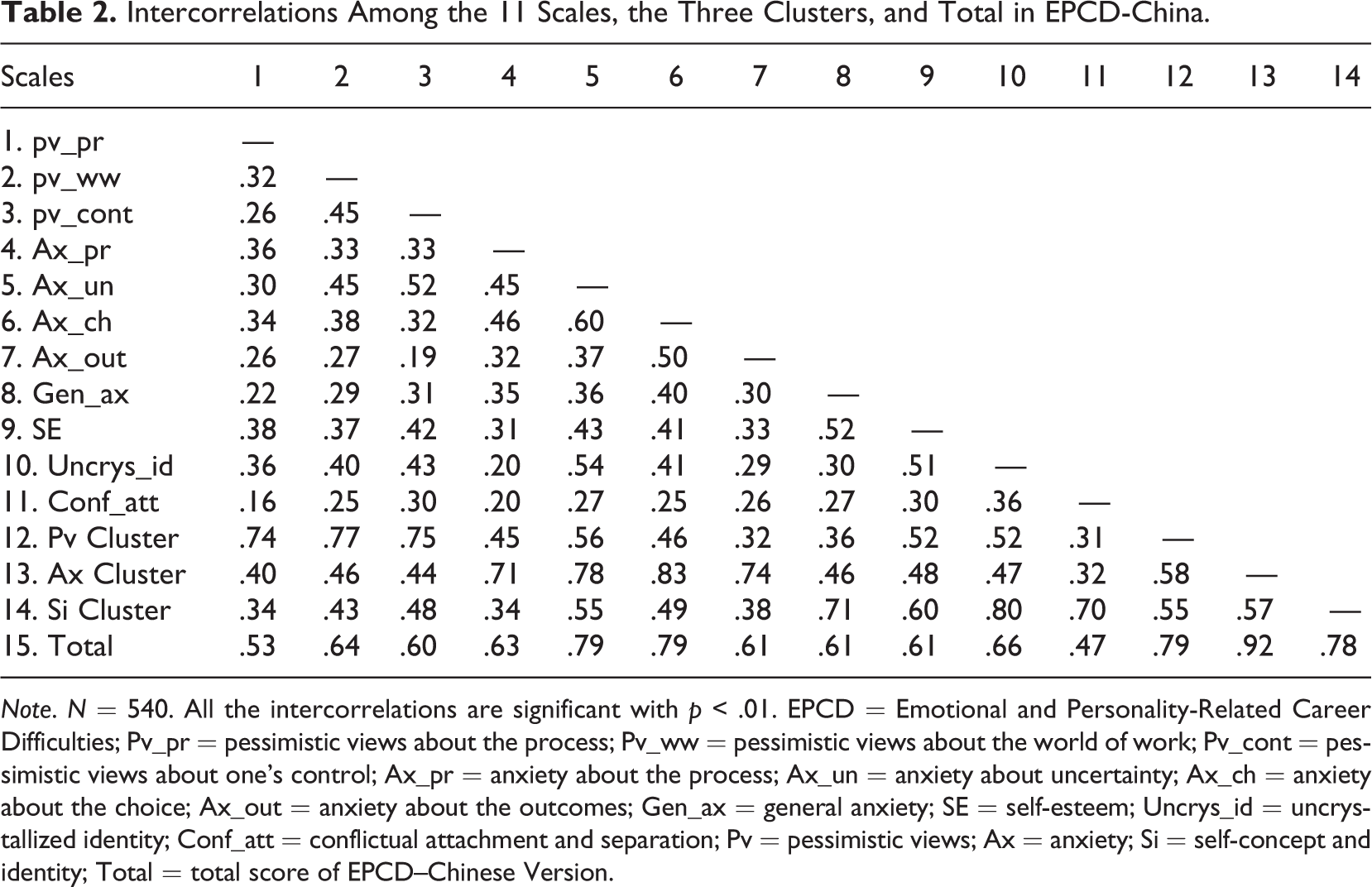
Note. N = 540. All the intercorrelations are significant with p < .01. EPCD = Emotional and Personality-Related Career Difficulties; Pv_pr = pessimistic views about the process; Pv_ww = pessimistic views about the world of work; Pv_cont = pessimistic views about one’s control; Ax_pr = anxiety about the process; Ax_un = anxiety about uncertainty; Ax_ch = anxiety about the choice; Ax_out = anxiety about the outcomes; Gen_ax = general anxiety; SE = self-esteem; Uncrys_id = uncrystallized identity; Conf_att = conflictual attachment and separation; Pv = pessimistic views; Ax = anxiety; Si = self-concept and identity; Total = total score of EPCD–Chinese Version.
To further test the structural validity of the original EPCD model, we conducted another set of CFA to rule out a possible alternative structure. After an exploratory factor analysis, Brown et al. (2012) suggested that the 11 difficulty categories of EPCD could be restructured under their four-factor model: pessimistic views about the process, anxiety about the process, anxiety due to uncertainty, anxiety about choosing, anxiety about outcome, and uncrystallized identity all loaded on Factor 1 (neuroticism/negative affectivity); general anxiety and self-esteem loaded on Factor 2 (choice/commitment anxiety); pessimistic views about the process, pessimistic views about world of work, pessimistic views about personal control loaded on Factor 3 (lack of readiness); and conflictual attachments loaded on Factor 4 (interpersonal conflicts). To test if this model provided a better fit, we performed a CFA according to this alternative structure. The model fit indices were χ2 = 237.61, df = 38, RMSEA = 0.099, CI = [0.087, 0.111], CFI = 0.896, and Tucker–Lewis index (TLI) = 0.849. Comparing these fit indices with those of the original 11-3 model (χ2 = 223.52, df = 41, RMSEA = 0.091, CI = 0.079, 0.103], CFI = 0.905, and TLI = 0.872), it could be seen that the original EPCD structure had better fit (manifested by the smaller χ2 and RMSEA and higher CFI and TLI) as well as greater parsimony. Therefore, the data supported the original EPCD structure over the four-factor alternative model as suggested in Brown et al. (2012) in the Chinese population.
Construct Validity
Table 3 presents the correlations between each of the three major clusters of EPCD, the EPCD total score, CDS total score, the TAS total score, and VI total score. As hypothesized, TAS positively correlated with the three difficulty clusters of EPCD. Furthermore, the correlation of TAS was higher with the self-concept and identity cluster of the EPCD, which includes the general anxiety scale (.53) than with the two other clusters (.37 and .37), Z = 4.62, p < .001.
Correlations Between the Three Clusters and Total EPCD, TAS, CDS, and VI.
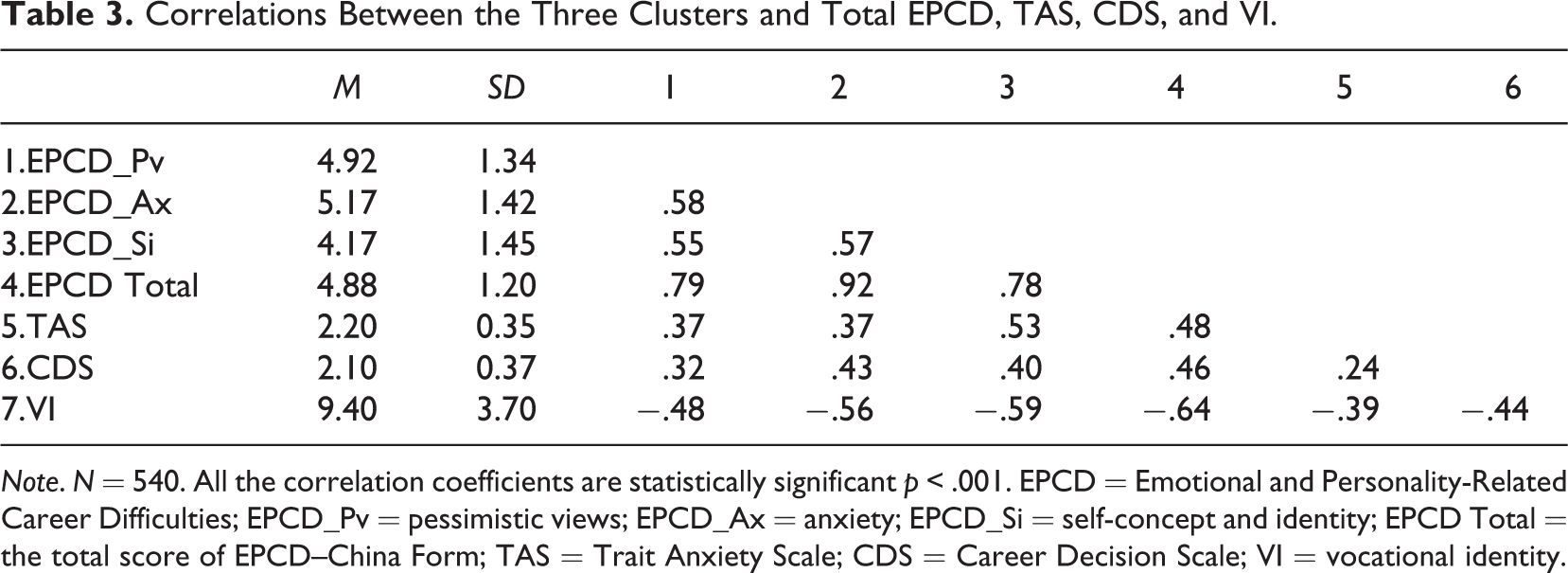
Note. N = 540. All the correlation coefficients are statistically significant p < .001. EPCD = Emotional and Personality-Related Career Difficulties; EPCD_Pv = pessimistic views; EPCD_Ax = anxiety; EPCD_Si = self-concept and identity; EPCD Total = the total score of EPCD–China Form; TAS = Trait Anxiety Scale; CDS = Career Decision Scale; VI = vocational identity.
Result also showed that CDS positively but only moderately correlated with the three difficulty clusters (r = .32, .43, and .40, respectively), and this result lent some support to EPCD’s discriminant validity since it means EPCD detect career decision making differently from CDS. However, the correlation of CDS with the pessimistic views cluster, that is more cognitively focused, was lower than with the other two major clusters (Z = 3.05, p < .001 and Z = 2.13, p < .05, for anxiety and self-concept and identity, respectively).
As can be seen in Table 3 and as expected, the VI had negative correlations with the three clusters of the EPCD. Furthermore, the associations between the three clusters of the EPCD were stronger with the VI than with the CDS (Z = 3.94, p < .001, Z = 3.44, p < .001, and Z = 5.05, p < .001, respectively). Finally, similarly as with respect to the CDS, the associations of the VI were stronger with the anxiety and the self-concept and identity clusters than with the pessimistic views cluster (Z = 2.47, p < .01 and Z = 3.34, p < .05, respectively). These results supported the convergent and divergent validity of EPCD. In sum, the pattern of associations between three EPCD clusters and the criterion measures (TAS, CDS, and VI) indicated good construct validity of the Chinese version of the EPCD.
Demographic Differences in EPCD Scores
Gender difference was only found in the self-concept and identity cluster of the EPCD: Male students (M = 4.35, SD = 1.50) reported higher difficulties than female students (M = 4.01, SD = 1.38) in this cluster, t(538) = 2.74, p < .01, Cohen’s d = 0.24. When we further examined gender difference for the four difficulty categories in this cluster, we found gender difference in two difficulty categories: Male students (M = 4.47, SD = 1.89) had higher score than females (M = 4.08, SD = 1.87) in the categories of uncrystallized identity, t(538) = 2.41, p < .05, Cohen’s d = 0.21, and male students (M = 3.63, SD = 1.97) also reported higher level of difficulties than female students (M = 3.17, SD = 1.77) in the cluster of conflictual attachment separation, t(538) = 2.86, p < .01, Cohen’s d = 0.25.
In addition, students from countryside, in comparison to those from cities, reported slightly higher levels of difficulties in anxiety related to uncertainty category, M = 4.91 vs. M = 4.58, t(538) = −2.07, p < .05, Cohen’s d = 0.18, and uncrystallized identity category, M = 4.44 vs. M = 3.93, t(538) = 3.01, p < .01, Cohen’s d = 0.28. Finally, no statistically significant differences were found across the academic year for both total score and three cluster scores.
Discussion
The goal of this study was to test the reliability and validity of the theoretical model of career decision-making difficulties as proposed by Saka et al. (2008) in the Chinese cultural context. The results from the sample of Chinese university students demonstrated adequate reliability for the 11 difficulty scales, the three major clusters, and the total EPCD score. The results also supported the original EPCD taxonomy proposed by Saka et al. (2008), namely, its hierarchical structure, in the Chinese cultural context. The second set of CFA that compared the original EPCD structural model and the four-factor model as proposed in Brown et al. (2012) showed that the original EPCD model provided better fit for the Chinese population. These results provided evidence from various aspects supporting the structural validity of EPCD–Chinese version. However, 3 items in the conflictual attachment and separation of self-concept and identity cluster had very low loadings and were excluded from subsequent analyses. Consequently, the final EPCD–Chinese version consisted of 47 items. The significant correlations between the total score and dimension scores of EPCD–Chinese version with the CDS, VI, and TAS scales supported the construct validity of the EPCD. Specifically, as suggested by Oztemel (2013), we included the TAS measure that comprises both emotion and personality-related components and the VI that measures the vocational identity component. The significant correlations between these scales and the corresponding clusters or categories in EPCD provided direct support to the emotional, personality, and identity-related components captured by EPCD. These results demonstrated that EPCD–Chinese version had adequate reliability and structural and construct validity, thus supporting its cross-cultural validity and its application in the Chinese population.
Worth noting is that the TAS correlated significantly more strongly with the self-concept and identity cluster than with the anxiety cluster, which seems to be paradoxical. However, a closer examination of the constructs under these clusters revealed that the anxiety cluster in fact taps more into the specific sources of the (state) anxiety about decision making (e.g., anxiety about the decision-making process, uncertainty, results, etc.), whereas the category of general anxiety included in the self-concept and identity cluster assesses one’s general feeling of anxiety and is more related to the construct of trait anxiety. This difference may account for the unexpected finding and suggests that trait anxiety is better captured in the self-concept and identity cluster in EPCD.
Interestingly, comparing the structure of EPCD–Chinese version obtained here to the revised EPCD-Korean version in Jin, Nam, Joo, and Yang (2014), low item loadings were observed in the conflictual attachment and separation category in both studies. Two possible reasons might underlie this consistent finding. From the cultural perspective, as Jin et al. (2014) stated, following the advice from significant others, especially family members, is accepted or even encouraged in collectivistic societies like China and Korea. Young adults’ attachment with family may be perceived as a kind of support instead of a source of difficulty. Researchers have found that during their career development, Chinese students actually depend on their families for various types of support—financial, informational, or emotional (Hou, Bai, & Yao, 2010). Thus, it is possible that attachment and separation operate differently in relation to career decision making in such cultural contexts from it in individualistic societies (e.g., the United States or Israel). Another possible explanation is that the items originally developed in the individualistic populations could not detect the unique difficulties, which Chinese students (or students in collectivistic cultures more generally) may have with their families. Observation from counseling practice in Chinese universities clearly shows that students do come to counseling because of career decision-making difficulties that are closely related to family factors. But more investigations are needed to unravel what specific family-related factors may contribute to Chinese students’ career decision-making difficulties, other than the notion of “conflictual attachment and separation,” which directly stem from development theories anchored in individualistic cultures. For example, some Chinese students who came for counseling indeed had anxiety about the decision that cannot meet their parents’ expectations because they have partly internalized their parents’ values and feel the urge to fit those values (Hou & Leung, 2011). Therefore, new items that may better capture the specific family-related career decision-making difficulties need to be developed in the Chinese cultural context.
Consistent with the results obtained in the Gati and Levin (2012) and Jin et al. (2014) study, where gender differences were observed, the present study also found significant gender differences in career decision-making difficulty in Chinese university students in self-concept and identity cluster. However, while Jin et al. (2014) found that women had more difficulties than men, in the present study, we found that men had more difficulties than women. These results, however, is different from the findings in Saka et al. (2008) and Oztemel (2013) who reported no gender difference in career decision-making difficulties. These mixed findings call for future study to investigate the career decision-making processes of different genders.
Respondents’ scores on three difficulty categories did not showed significant differences across academic years. Although in Jin et al. (2014) study differences in difficulties across the academic years emerged, in the present study no such differences emerged. These results deviate from our expectations and may need further investigation.
Implications for Career Counseling Practice
Several implications can be inferred from our research. The structural validity of EPCD supported in this study warrants the conceptualization of Chinese university students’ career decision-making difficulties using the three-cluster model by Saka et al. (2008) and the application of this assessment in the Chinese cultural context. Career practitioners may use it as a diagnostic tool together with CDDQ during the intake session to differentiate and locate the focuses and the sources of decision-making difficulties of their clients, especially university students. Based on the diagnosis, career practitioners may plan using different intervention strategies to help students. For example, if students have high score in the self-concept and identity cluster, career counselor may find it helpful to lead students to see their interpersonal conflicts with their parents or other significant others. Career counselors should also pay attention to those students who have high levels of general anxiety and self-esteem, which may signal their chronic problems (Brown et al., 2012) and the need for mental health counseling in addition to career guidance. Those students who score higher in the permissive domain may benefit from cognitive interventions directly addressing their negative beliefs about making career decisions.
Limitations and Future Research Directions
This research has several limitations that need to be noted. First, the students were from two Chinese universities. It might be possible that students in universities of different prestigious levels or geographic locations may be different in terms of their pattern of career decision-making difficulties. Future research may need to sample a wider range of universities and students to examine the generalizability of results in this study. Also, it would be important to administer this measure to a much larger sample of Chinese university students to develop representative norm scores as criteria for both research and counseling purposes.
Second, this study only included one other measure of career indecision, the CDS (Osipow et al., 1976), as criterion variable. Future studies may further investigate how EPCD relates to other different facets of career indecision like CDDQ (Gati et al., 1996), Career Thought Inventory (Sampson, Peterson, Lenz, Reardon, & Saunders, 1996), and Career Indecision Profile (Hacker, Carr, Abrams, & Brown, 2013), so as to explore the interrelationships between the various components or aspects of career decision-making difficulties, like emotional and personality-related difficulties, information-related difficulties, and irrational cognition-related difficulties. Thus, the pattern of correlations between different EPCD clusters and career decision-making difficulties from different perspectives will provide us more evidence of convergent and discriminant validity of EPCD.
Third, although the present study provided support for the structure and reliability of the EPCD in Chinese university students, more validity of the translated measures like discriminant validity and other emic measures (Fan, Meng, Gao, Lopez, & Liu, 2010; Leong, 1997) should be included in future studies. Both in our study and Jin et al. (2014) study, similar item loadings were observed in the conflictual attachment and separation category; however, neither of us examined how the cultural specific construct (Leong, 1997) related to these differences between Western and Asian countries. More research in the future is clearly needed to examine possible cultural specific factors accounting for the observed differences. Such investigations may also shed further light on the cross-cultural applicability of the EPCD.
In sum, this study investigated the use of EPCD in China and showed an adequate reliability and construct validity, providing preliminary support for using this measure in the Chinese population. It is hoped that future research would complement the existing studies in further testing the cross-cultural reliability and validity of EPCD, based on which within-culture norms and cross-culture comparisons could be established.
Footnotes
Declaration of Conflicting Interests
The author(s) declared no potential conflicts of interest with respect to the research, authorship, and/or publication of this article.
Funding
The author(s) disclosed receipt of the following financial support for the research, authorship, and/or publication of this article: This research was funded by the Fundamental Research Funds for the Central Universities. The grant number is SKZZY2014054.