



Abstract
Ingratiation is one of the most commonly studied social influence tactics that is used by employees to advance their career goals. Research examining predictors of ingratiation has rather shown inconsistent findings. To address these inconsistencies, this study drew on social cognitive theory to investigate the role of political skill as a moderator in the associations between two career-related psychological needs (i.e., need for achievement and need for power) and ingratiation. We tested these associations using independent 150 matched employee–peer dyads from Thailand. Results revealed that self-reported political skill exerted differential moderating effects on the associations among the two career-related psychological needs and peer-rated ingratiation. Whereas the association between need for achievement and ingratiation was positive under high levels of political skill, the association between need for power and ingratiation was positive under low levels of political skill.
In a continuously changing organizational environment, employees will likely experience more frequent transitions throughout their career and will have to take more ownership of their career aspirations and development. In this regard, research has called for more studies to examine how employees manage their careers strategically (Savickas, 2001). In response to this call, there is emerging research that acknowledges how social influence tactics, such as ingratiation, can be used to aid career advancement (Blickle, Frohlich, Ehlert, Pirner, Dietl, Hanes, & Ferris, 2001; Dorn, 1993; Higgins, Judge, & Ferris, 2003; Kacmar, Carlson, & Bratton, 2004; King, 2004; Sibunruang, Capezio, & Restubog, 2013). Ingratiation is regarded as one of the most commonly used social influence tactics by employees who are highly dependent on their superiors to achieve their personal career objectives (Higgins & Judge, 2004; Westphal & Stern, 2007). It involves behaviors, such as other enhancement, opinion conformity, and favor rendering (Kumar & Beyerlein, 1991). In the career context, past research has shown that enhanced liking as a result of ingratiation attempts should enable individuals to achieve career-related benefits, such as hiring recommendations (Gordon, 1996), salary progressions (Gould & Penley, 1984), promotion decisions (Thacker & Wayne, 1995), extrinsic and intrinsic career success (Judge & Bretz, 1994), and board appointments among members of the corporate elite (Stern & Westphal, 2010). As such, ingratiatory behaviors are often aimed at gaining the approbation of supervisors who have the controlling power over the career outcomes of employees (Tedeschi & Melburg, 1984).
Obtaining a job offer, a positive performance evaluation, a promotion, and a pay increase at work can stimulate employees’ self-interest motives, and accordingly behaviors designed to manage favorable impressions in the eyes of their supervisors (King, 2004). However, individuals are different in the extent to which they desire to influence others (Magee & Langner, 2008). Thus, we attempt to identify career-related psychological needs that differentiate those who are active in exercising ingratiation from those who are not. Indeed, people characterized with high need for achievement and high need for power are more likely to exercise ingratiation (Liu, Liu, & Wu, 2010; Mowday, 1978; Treadway, Hochwarter, Kacmar, & Ferris, 2005). Research has further shown that ingratiation is likely used by employees who display high levels of Machiavellianism (Pandey & Rastogi, 1981), extraversion (Cable & Judge, 2003), self-monitoring (Bolino & Turnley, 2003), internal locus of control (Harrison, Hochwarter, Perrewe, & Ralston, 1998), and low levels of self-esteem (Kacmar et al., 2004).
Despite the extensive research done on examining predictors of ingratiation, past findings have been shown to be inconsistent at best (Kacmar et al., 2004). For instance, although need for power was found to be positively associated with ingratiation in some studies (e.g., Kumar & Beyerlein, 1991), the same association was reported to be negative in others (e.g., Kacmar et al., 2004). To address these inconsistencies, this study identifies and tests political skill as a relevant boundary condition that may either strengthen or attenuate the extent to which career-related psychological needs, such as need for achievement and need for power, may be predicting employees’ engagement in ingratiation. The proposed model is depicted in Figure 1.

Proposed theoretical model.
The two career-related psychological needs examined in this study are explicit motives, indicating the use of self-reported measurements of achievement and power needs (Steers & Braunstein, 1976). Research on human motivation has clearly distinguished explicit motives from implicit motives. Whereas implicit motives refer to “motive dispositions as coded in imaginative thought from stories written to pictures” (McClelland, Koestner, & Weinberger, 1989, p. 690), explicit motives are determined by self-reported measures (Steers & Braunstein, 1976). Given that the current study attempts to examine how one’s motivation will be translated into actions, McClelland, Koestner, and Weinberger (1989) argued that this process could be best followed by asking subjects to report consciously on their desires for achievement and power.
This study contributes to the literature on ingratiation in three important ways. First, past research has mainly examined political skill as a moderator that would enhance the effectiveness of ingratiation in achieving higher performance evaluations (Harris, Kacmar, Zivnuska, & Shaw, 2007; Treadway, Ferris, Duke, Adams, & Thatcher, 2007) and subsequently other career-related benefits, such as salary progression and promotions (Gould & Penley, 1984; Judge & Bretz, 1994; Thacker & Wayne, 1995). This study, however, takes into consideration the fact that self-reported political skill reflects one’s evaluation of their ability to effectively influence social interactions at work (Ferris, Treadway, Kolodinsky, Hochwarter, Kacmar, Douglas, & Frink, 2005). Thus, self-reported political skill should also serve as a relevant boundary condition that influences one’s motivation to ingratiate at work.
Second, it is further argued that self-reported political skill would pose differential moderating effects on how need for achievement and need for power may determine ingratiation. These differential associations are explained by social cognitive theory (SCT; Bandura, 1986), which posits various basic human capabilities in predicting behaviors. Doing so helps provide a better understanding on how need for achievement and need for power may be operating differently when moderated by political skill and a more thorough understanding of a motivational analysis underpinning employees’ engagement in ingratiation.
Finally, research on ingratiation has mainly relied on data obtained from Western contexts (e.g., Harvey, Stoner, Hochwarter, & Kacmar, 2007; Treadway et al., 2007; Westphal & Stern, 2006). By conducting this study in Thailand, we take into account the fact that some cultures may be more conducive than others to the use of ingratiation. In a highly collectivistic culture, such as Thailand (Hofstede, 1984), research has shown that collectivists are more likely to engage in ingratiation to maintain in-group interpersonal relationships (Erdogan & Liden, 2006). In contrast, research conducted in Western settings has shown that people are likely to adopt a more assertive approach of social influence (Van Knippenberg, Van Knippenberg, Blaauw, & Vermunt, 1999).
Theory and Hypotheses
Political skill is determined by one’s perception of their ability to demonstrate an interpersonal style that “ … combines social astuteness with the capacity to adjust their behavior to different and changing situational demands in a manner that appears to be sincere, inspires support and trust, and effectively influences and controls the responses of others” (Ferris et al., 2005, pp. 127–128). Thus, politically skilled employees develop a personal security based on favorable evaluations of the self that result from their experience of successful interpersonal encounters over time (Ferris et al., 2005).
Need for Achievement
Need for achievement is defined as the need to excel, rival, and surpass others and increase self-regard by the successful exercise of talent (Murray, 1938). In a highly competitive work environment, it has been found that employees tend to resort to the use of ingratiation to manage their career achievements (Higgins et al., 2003).
We incorporate SCT to explain how political skill may influence achievement-driven employees’ motivation to engage in ingratiation. By capitalizing on their forethought capability, people evaluate probable outcomes of engaging in a particular behavior, termed outcome expectations (Bandura, 1986; Stajkovic & Luthans, 1998). In this regard, we argue that individuals with high levels of political skill are more likely to associate positive outcome expectations with their engagement in ingratiation. This may be derived from the positive self-evaluations that politically skilled employees have regarding their ability to effectively manage their social environment at work (Ferris, Treadway, Perrewe, Brouer, & Douglas, 2007). Thus, by affecting their belief about what they can do as well as what the likely outcomes of their ingratiation attempts would be, the forethought capability enables politically skilled employees to evaluate ingratiation as a favorable option that is associated with more benefits than costs (Bandura, 1986).
More specifically, we argue that achievement-driven employees will be motivated to engage in ingratiation when they believe that they can exercise the tactic in a politically astute manner to successfully manage their career achievements. In contrast, if achievement-driven employees do not believe that they are politically skilled to manage their career achievements, they are less likely to exercise ingratiation toward their supervisor. This is due to the anticipation of unsuccessful ingratiation attempts. In support of the foregoing argument, we hypothesize that:
Need for Power
Need for power is defined as an attempt to take control over one’s surrounding environment and to influence other people (Mowday, 1978). Kumar and Beyerlein (1991) argued that power-driven employees are more likely to engage in ingratiation because doing so enables them to influence how others perceive them. Accordingly, they found a positive association between need for power and ingratiation. On the other hand, Kacmar, Carlson, and Bratton (2004) found that power-driven employees were less likely to engage in ingratiation. Underlying their finding is the argument that employees with a high need for power generally have a desire to exert control over their environment, which is incongruent with the submissive nature of ingratiatory behaviors. To address these inconsistent findings shown by past research, we draw upon the principle of self-regulatory capability as posited by SCT (Bandura, 1986) to explain how political skill may influence power-driven employees’ motivation to ingratiate.
By capitalizing on their self-regulatory capability, individuals set specific standards, evaluate the discrepancy between the desired standard set and the actual performance, and subsequently react to minimize the experienced discrepancy (Bandura, 1986; Stajkovic & Luthans, 1998). Hence, we argue that power-driven employees with low levels of political skill are likely to experience a discrepancy between the desired state they seek to achieve and the current state they are in. This experienced discrepancy is caused by an incongruity between their desire to gain control over their work environment (i.e., high need for power) and their lack of self-perceived control they have over others in their work environment (i.e., low political skill; Ferris et al., 2007; Stajkovic & Luthans, 1998).
SCT further posits that if there is a discrepancy between the desired state and the existing state, individuals will be motivated to minimize the experienced incongruity (Stajkovic & Luthans, 1998). To minimize this incongruity, power-driven employees may be motivated to engage in ingratiation in an attempt to enhance their liking among their superiors. As Ralston and Elsass (1989) argued, the increased liking employees receive from exercising ingratiation toward their supervisor will enable them to regain control over their work environment. In contrast, power-driven employees with a high political skill are less likely to ingratiate. This is because employees who are already politically skilled (i.e., high levels of self-perceived control over their work environment) may find it somewhat demeaning to exercise a tactic that is associated with subservience. In support of this argument, we hypothesize that:
Method
Participants and Procedure
Participants were full-time employees coming from different organizations in Thailand. Considerable research has utilized self-reported data on ingratiation (e.g., Cable & Judge, 2003; Kacmar et al., 2004), which is likely to be contaminated by common method variance (Podsakoff, MacKenzie, & Podsakoff, 2012). To minimize these effects, we collected data from two data sources: employees and their respective peers. Accordingly, two separate questionnaire surveys were developed for employees and respective peers. Employees rated themselves on their levels of need for achievement, need for power, and need for political skill, whereas their respective peers reported ingratiatory behaviors of the focal employees. To match dyadic data sources, we asked the employees to create their own unique code identifier and further assign the code to their designated peers. All surveys were returned directly to the Human Resource department.
Two hundred employees received questionnaire surveys and were then advised to nominate a peer with whom they had regular interactions at work. Thus, 200 designated peers further received surveys. Of the 200 focal employees, 173 of them voluntarily participated (i.e., a response rate of 86.5%). Of the 200 designated peers, 180 of them voluntarily participated (i.e., a response rate of 90%). After deleting cases with missing data, mismatched dyads, and outliers (i.e., detected using Mahalanobis distance), this has resulted in 150 independent matched employee–peer dyads, representing a usable response rate of 75%. Among the focal employees, 57% were females, 55% were aged between 25 and 35, and 80.7% of them were holding at least a bachelor’s degree. Among the peer participants, 58% were females and 69% were aged between 25 and 35.
Measures
Unless otherwise specified, the response format for the following scale items, excluding the control variables, was a 7-point Likert-type scale (i.e., 1 = strongly disagree to 7 = strongly agree). Given that English is not a native language of Thai participants, we adopted the translation and back-translation procedures. Thus, the questionnaire surveys initially developed in English were first translated into Thai and back into English (Brislin, 1970). This is to ensure consistency across the original meaning and the translated meaning.
Need for achievement
Employees reported their need for achievement using a 5-item scale developed by Steers and Braunstein (1976). Example items include “I try to perform better than my coworkers” and “I take moderate risks and stick my neck out to get ahead.” Steers and Braunstein reported a Cronbach’s α of .72. To develop and validate this research instrument, Steers and Braunstein conducted three empirical studies. In the first study, the 5 items of need for achievement were generated based on the previous research and theory developed by Murray (1938). In the other two studies, the scale was further validated by testing its association with several work-related outcomes. Accordingly, need for achievement was reported to correlate moderately with measures of organizational commitment, job duties, promotional opportunities, organizational goals and values, and feedback on performance, with correlation coefficients ranging from .16 to .32 (Steers & Braunstein, 1976). Previous research that has adopted this scale also reported internal consistencies ranging between .69 and .72 (Fagenson, 1992; Steers & Spencer, 1977; Treadway et al., 2007). In this study, the Cronbach’s α was .73.
Need for power
Employees reported their need for power using a 5-item scale developed by Steers and Braunstein (1976). Example items are “I seek an active role in the leadership of a group” and “I strive to gain more control over the events around me at work.” Steers and Braustein reported a Cronbach’s α of .83. Similar to need for achievement, the need for power scale was validated through three empirical studies by Steers and Braunstein. The first study was conducted to identify 5 major items related to need for power. In Study 2, the scale was reported to correlate significantly with feedback on performance (r = 17). In the third study, the scale was reported to correlate moderately with leadership measures, such as delegation, control, persuasiveness, and self-confidence, with correlation coefficients ranging from .29 to .32 (Steers & Braunstein, 1976). Past research that has adopted this scale also reported acceptable internal consistencies (α = .71, Kacmar et al., 2004; α = .82, Valle & Perrewe, 2000). In this study, the Cronbach’s α was .81.
Political skill
Employees reported their political skill using the scale developed by Ferris and colleagues (2005). Given the constraints imposed by the participating organizations, we kept the surveys relatively short. Specifically, we selected 11 of the 18 items with the highest factor loadings (i.e., factor loadings above .60). Sample items include “I spend a lot of time and effort at work networking with others” and “I always seem to instinctively know the right thing to say or do to influence others.” Ferris et al. reported a Cronbach’s α of .89. Political skill was also reported to correlate with measures of self-monitoring, coalition, and political savvy, with correlation coefficients ranging from .28 to .47 (Ferris et al., 2005). In this study, the Cronbach's α was .86.
Ingratiation
The nominated peers reported the extent to which the corresponding employee has engaged in ingratiation using the 19-item ingratiation scale developed by Kumar and Beyerlein (1991). Sample items include “This person exaggerates the supervisor’s admirable qualities to convey the impression that he/she thinks highly of the supervisor” and “This person gives frequent smiles to express enthusiasm/interest about something the supervisor is interested in even if he/she does not like it.” Kumar and Beyerlein reported a Cronbach’s α of .92. Ingratiation was reported to correlate moderately with other social influence tactics, such as assertiveness (ranging from .08 to .28), coalition (ranging from .11 to .28), exchange (ranging from .23 to .35), and rationality (ranging from .09 to .26; Kumar & Beyerlein, 1991). In this study, the Cronbach’s α was .94.
Control variables
In order to rule out alternative explanations in our study findings, employee demographic characteristics were controlled for in the analysis. We controlled for age because research has shown that as employees increase in their age, they are likely to be more receptive to the use of ingratiation (Singh, Kumra, & Vinnicombe, 2002). Age was assessed in years. It has also been reported that women, in comparison to men, are less likely to engage in ingratiation (Singh et al., 2002). Gender was coded either as “0,” representing female, or “1,” representing male. Finally, Westphal and Stern’s (2006) study has shown that one’s educational background may have an impact on the use of ingratiation. Educational level was assessed using a scale ranging from 1 to 6, indicating high school diploma, college, associate degree, bachelor degree, graduate work, and postgraduate degree, respectively.
Results
Descriptive statistics, bivariate correlations, and reliability coefficients are presented in Table 1. All major variables tested have acceptable internal consistency reliabilities with their Cronbach’s αs being above .70. In terms of the multicollinearity, none of the zero-order correlations exceeds .75.
Descriptive Statistics and Intercorrelations of Study Variables.
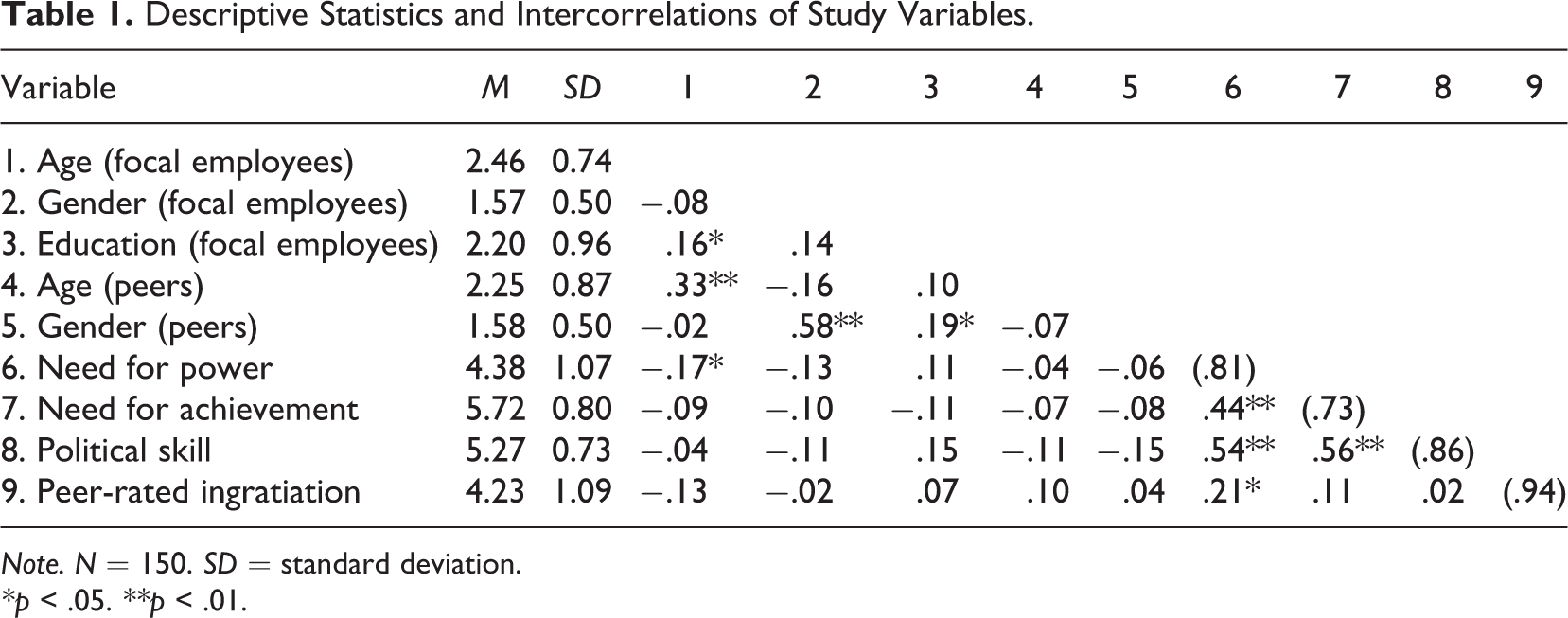
Note. N = 150. SD = standard deviation.
*p < .05. **p < .01.
We conducted a hierarchical multiple regression to test the hypothesized associations and to assess the incremental explanatory power of variables in each block. Following Aiken and West’s (1991) recommendation in conducting a hierarchical multiple regression, we entered control variables in the first step of the regression equation (i.e., age, gender, and levels of education). In the second step, we entered independent and moderator variables to test for main effects (i.e., need for achievement, need for power, and need for political skill). In the final step, two-way multiplicative terms were entered (Need for Achievement × Political Skill, and Need for Power × Political Skill). The independent and moderator variables were mean centered before computing the interaction terms (Aiken & West, 1991). As shown in Table 2, the entry of the interaction terms explained additional variance in predicting peer-rated ingratiation, ΔR 2 = .04, F(2, 139) = 24.28, over and above the main effects.
Hierarchical Regression Results.

Note. *p < .05.
Table 2 revealed that the association between need for achievement and ingratiation was positive and significant when it was moderated by political skill (β = .19, p < .05). Simple slope analysis suggests that the association was not significant for individuals with low levels of political skill, t(141) = .02, β = .002, p = .99. As shown in Figure 2, employees appear to equally engage in ingratiation regardless of their levels of need for achievement when they have a low political skill. However, there was a positive association between need for achievement and ingratiation at high levels of political skill, t(141) = 2.22, β = .46, p < .05. Thus, Hypothesis 1 was supported.

The interactive association between need for achievement and self-rated political skill in predicting peer-rated ingratiation.
The relation between need for power and ingratiation was negative and significant when it was moderated by political skill (β = −.21, p < .05). At high levels of political skill, the association between need for power and ingratiation was nonsignificant, t(141) = −0.22, β = −.03, p = .83. As shown in Figure 3, when political skill is high, there is no difference in the levels of ingratiation between individuals with high need for power from those with low need for power. In contrast, there was a positive association between need for power and ingratiation at low levels of political skill, t(141) = 2.91, β = .35, p < .01. Overall, Hypothesis 2 was supported.
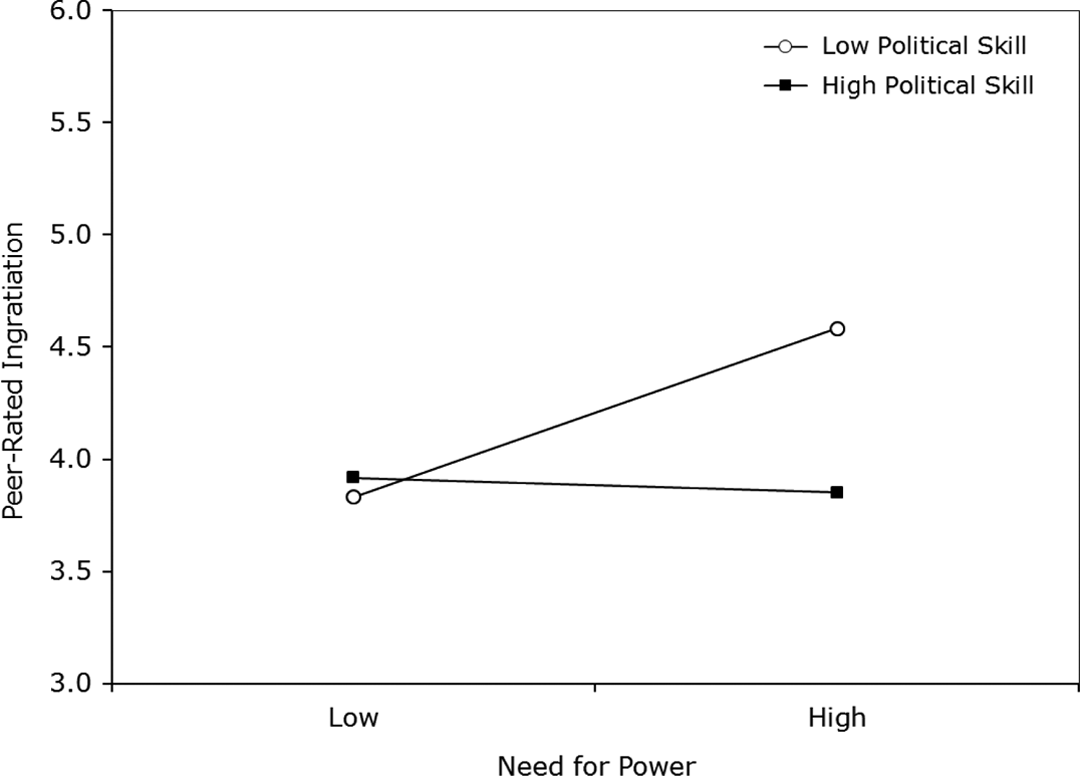
The interactive association between need for power and self-rated political skill in predicting peer-rated ingratiation.
General Discussion
This study proposed and empirically tested the differential moderating effects of political skill on the associations among need for achievement and need for power and ingratiation. Drawing on the principle of the forethought capability posited by SCT (Bandura, 1986), when achievement-driven employees believe that they are politically skilled to exercise ingratiation in a politically astute manner, they are likely to develop positive outcome expectations associated with their engagement in ingratiation. In the career context, research has shown that ingratiation can positively result in positive performance evaluations (Higgins et al., 2003), promotion decisions (Thacker & Wayne, 1995), and board appointments among members of the corporate elite (Stern & Westphal, 2010). Thus, political skill should strengthen achievement-driven employees’ motivation to exercise ingratiation toward their supervisors. In line with our prediction, our findings showed that the association between need for achievement and ingratiation became positive under high levels of political skill.
Furthermore, guided by the principle of self-regulatory capability posited by SCT (Bandura, 1986), when power-driven employees display low levels of political skill, they will experience a discrepancy between the desired state they seek to achieve (i.e., the desire to be in control of their work environment) and the actual state they are in (i.e., the lack of self-perceived control over their work environment). Consequently, employees will be motivated to minimize the discrepancy experienced (Stajkovic & Luthans, 1998), for example, by engaging in ingratiation. When employees become more likable in the eyes of their superiors as a result of their ingratiation attempts, they are better able to regain control over their work environment (Kacmar et al., 2004; Ralston & Elsass, 1989). As predicted, our findings showed that the relation between need for power and ingratiation was reported to be positive under low levels of political skill.
Our findings are notable in some important ways. First, an empirical examination of political skill as a relevant boundary condition helps explain inconsistent findings shown by past research concerning how career-related psychological needs may be predicting ingratiation (Kacmar et al., 2004). So far past research has mainly emphasized the relevance of political skill as a boundary condition in promoting the effectiveness of ingratiation in achieving career-related benefits (Harris et al., 2007; Treadway et al., 2007). In this study, self-reported political skill reflects the extent to which employees believe they can effectively influence others and social interactions at work. In this regard, we argued that political skill should also play a critical role in employees’ motivation to use ingratiation as a career strategy at work.
Second, we also examined the differential moderating effects of political skill by arguing how different basic human capabilities (i.e., forethought capability and self-regulation) posited by SCT (Bandura, 1986) may be utilized by employees. By capitalizing on their forethought capability, achievement-driven employees form positive outcome expectations associated with the engagement of ingratiation when they believe that they can exercise the tactic in a politically astute manner in order to manage their career achievements. Furthermore, by capitalizing on their self-regulatory capability, power-driven employees may become more inclined to ingratiate when they perceive that they lack the skill to gain control over their work environment (i.e., reflected in their low levels of political skill). The differential moderating effects of political skill as reported in this study provide a more thorough understanding of one’s motivation to use ingratiation at work.
Limitations and Future Research Directions
This study is not without limitations. First, data were obtained from the sample at one single point in time. To better understand one’s motivation to engage in ingratiation, future research may adopt a longitudinal design, in which a process of change in one’s motivation can be observed. Second, although our data were obtained from different organizations and industries in order to obtain an adequate sample size, we did not take into account the influence of hierarchical clustering. Despite this, we believe that the individual level of analysis was the most appropriate approach, given that the items were measured and framed at this level (and not at the organizational or industry level).
Along similar lines, although we recognize that there are multiple variables that can predict one’s motivation to engage in ingratiation, this study only examined two predictor variables and one moderator. However, it is important to note that this was done for two major reasons. First, the proposition of our model was guided by past research that has shown how need for achievement and need for power may serve as underlying motivations to one’s exercise of social influence (e.g., Liu et al., 2010; Mowday, 1978; Treadway et al., 2005). Second, our study was guided by the principle of parsimony in conceptualizing our model (see Bacharach, 1989). Altogether, our study focused on three focal variables (i.e., need for achievement, need for power, and need for political skill) based on theory and prior empirical research.
Furthermore, although ingratiatory behaviors of employees were rated by peers in order to avoid social desirability bias coming from self-reports, some of the scale items (e.g., “My colleague gives frequent smiles to express enthusiasm/interest about something that the supervisor is interested in even if he/she does not like it”) may not be accurately assessed by observers except the ingratiators themselves. It may be fruitful for future research to consider differential interpretations of ingratiation across different sources, such as subordinates (i.e., actor), supervisors (i.e., target person), and peers (i.e., observer).
Finally, although this study provided a rationale underlying employees’ lower tendency to ingratiate, we did not examine how they may have adopted other social influence tactics as alternative career-enhancing strategies. For instance, in Kacmar and colleagues’ (2004) study, they clearly contrasted individuals with a high need for power from those with a low need for power regarding their choice of social influence tactics. Specifically, they found that whereas those with a high need for power were more likely to exercise ingratiation, which is a more subservient approach, those with a low need for power were more likely to exercise self-promotion, which is a more assertive approach. Thus, future studies should also propose and empirically test an alternative strategy that employees who are less inclined to engage in ingratiation may be potentially adopting.
Building on from the previous point, it would be interesting for future studies to also identify and examine conditions under which individuals may find more conducive to use other social influence tactics than ingratiation. Finally, we recommend that future studies operationalize other basic human capabilities posited by the SCT (Bandura, 1986) that have not yet been explored in this study to identify other relevant boundary conditions that may either strengthen or attenuate one’s motivation to ingratiate.
In conclusion, this study provides a better understanding to a motivational analysis underpinning employees’ engagement in ingratiation in a non-Western context. Specifically, we tested and found differential moderating effects of political skill on the associations among need for achievement and need for power, and ingratiation.
Footnotes
Declaration of Conflicting Interests
The author(s) declared no potential conflicts of interest with respect to the research, authorship, and/or publication of this article.
Funding
The author(s) received no financial support for the research, authorship, and/or publication of this article.