



Abstract
This study examines the extent to which a sense of calling affects career choice attitudes. Drawing from social cognitive career theory, the study tested the extent to which calling is related to career outcome expectations, interests, and goals. Participants were asked to identify a job that they wanted to perform and completed a questionnaire assessing their attitudes toward the career. We conducted structural equation modeling analyses to test our hypotheses. The results suggest that calling provides unique predictive power beyond self-efficacy for career outcome expectations, interests, and goals. Calling was a stronger predictor than self-efficacy of outcome expectations and interests, but a weaker predictor than self-efficacy of goals. Calling moderated self-efficacy such that self-efficacy was less predictive of outcome expectations when calling was high. The study improves our understanding of career choice attitudes and provides an improved framework for practitioners to draw on when mentoring students or developing career support programs for science, technology, engineering, or math education.
Career choice researchers have often used self-efficacy and social cognitive career theory (SCCT; Lent, Brown, & Hackett, 1994) to understand career-related attitudes and behaviors. SCCT posits that self-efficacy and outcome expectations predict career interests and career choice related behaviors (Betz, 2006; Lent et al., 1994). The role of self-efficacy in the formation of specific career attitudes is well established (Blanco, 2011; Lent, Lopez, Sheu, & Lopez, 2011; Lent, Paixão, Silva, & Leitão, 2010), yet it is also probable that other antecedents of career-related attitudes and behaviors exist. Popular press and policy makers like the President’s Council of Advisors on Science and Technology (PCAST) argue that students must be both prepared and inspired if they are to enter a science, technology, engineering, or math (STEM) career; especially in the case of minorities who are underrepresented in their field of interest (Means, Confrey, House, & Bhanot, 2008; PCAST, 2010). While this example is specific to STEM careers, the ideas of preparation and inspiration are relevant for all careers. Self-efficacy successfully helps researchers understand the “preparation” component of career choice, as it is heavily affected by past successes and failures (Bandura, Barbaranelli, Caprara, & Pastorelli, 2001). However, focusing on self-efficacy has caused researchers to neglect the portion of career decision making dealing with “inspiration.” This has limited our understanding of career choice attitudes that are not caused by a person’s self-efficacy.
Current career choice theories are unable to explain common cases in which an individual has high career-specific self-efficacy, yet still opts out of activities that lead him or her toward that career, or the reverse, in which a person has low self-efficacy but persists in their personal career goals even with little chance of success. Both scenarios can strongly impact people’s lives in negative ways (Cardador & Caza, 2012). These scenarios have only begun to be addressed by researchers, such as Jacobs, Davis-Kean, Bleeker, Eccles, and Malanchuk (2005) who have found evidence to suggest that past performance and self-efficacy are poor predictors of achievement and involvement in STEM subjects in some cases, especially in populations that are typically underrepresented in those disciplines.
Career interests and career choice related behaviors are likely influenced by the extent to which a person feels a consuming and meaningful passion (Dobrow & Tosti-Kharas, 2011), or is called, to a career domain. Calling addresses a less rational component of career decision-making processes by incorporating a sense of meaningfulness and emotional connection to careers of interest. Attitudes by definition have a cognitive and affective component (Judge & Kammeyer-Mueller, 2012), and trying to predict career choice attitudes without an affective component is an inherently flawed approach. Other motivational theories (e.g., self-determination theory, Deci, Eghrari, Patrick, & Leone, 1994; and the theory of planned behavior, Ajzen, 1991) demonstrate the strong predictive power of including affective components in their models, yet self-efficacy theories predict rational behaviors that are based on preparation and not passion. To determine whether or not calling contributes to career interests, goals, and outcome expectations above and beyond self-efficacy, we tested an integrated model of calling theory and SCCT.
Calling
The concept of a calling has religious roots (Elangovan, Pinder, & McLean, 2010); however, it has since been expanded to the secular world of work as well, where organizational researchers have linked it to many important career-related behaviors and attitudes (Duffy & Dik, 2012). Wrzesniewski, McCauley, Rozin, and Schwartz (1997) expanded upon the general idea of a sense of purpose in work and the popular idea of callings, as introduced by Bellah et al. (1985), by taking the traditional concept of a career and distinguishing between jobs, careers, and callings. Wrzesniewski et al. (1997) described calling as a focus on the enjoyment of fulfilling and socially useful work. Wrzesniewski et al. contrasts this conceptualization of calling with those who work in jobs and careers and describes those constructs as having primarily extrinsic reasons for performing job duties. Dik, Duffy, and Eldridge (2009) further elaborated on calling, defining it as work that involves an external summons and connection to a sense of purpose in life. More recently, Dobrow and Tosti-Kharas (2011) define calling as a consuming and meaningful passion toward a domain.
This study uses Dobrow and Tosti-Kharas’ definition; however, it is important to note that this is a modern view of calling (Bunderson & Thompson, 2009). As this conceptualization no longer includes a focus on socially useful work, it is important to distinguish the construct of calling from similar constructs like interests and meaningful work. Meaningful work is a construct that refers to “work that is both significant and positive in valence” (Steger, Dik, & Duffy, 2012, p. 323). Calling is distinct from meaningful work, but they are related, such that calling is typically thought of as a piece of the larger construct of meaningful work (Steger et al., 2012). Moreover, interests (in an SCCT framework) typically refer the extent to which an individual likes or dislikes different activities (Lent & Brown, 2006). This idea is related to the concept of a calling; it is possible for one to be strongly interested in a job, but not experience a calling. Calling requires individuals to be passionate toward their target career even in the face of obstacles and to draw value from their target career such that their life would have less meaning if they were to engage in other careers. Thus, while interests are necessarily related to calling, a strong interest is not sufficient to be labeled a calling.
The influence of calling on career-oriented behavioral decision making has been demonstrated many times; however, much less effort has been devoted to understanding where calling comes from and whether or not they can be manipulated by external sources. Dobrow (2007) examined potential sources of calling and found that calling does not depend on ability in the calling domain or individual differences. Despite these null findings for individual differences, further examination is needed before claiming that there is no relationship between individual differences and calling. Dobrow operationalized individual differences as ability in the calling domain and demographic characteristics. This limited definition of individual differences leaves open the possibility for other types of individual differences to be important in the development of calling.
Research on calling has also identified two potential links between personality and the development and presence of a calling. Treadgold (1999) found that emotional stability was positively related to calling. Treadgold argued that emotional stability did not necessarily cause calling, but that people with low emotional stability face more difficulty in developing a clear sense of calling. In a more recent study examining sources of calling, Hirschi (2011) found that openness to experience was positively related to calling as well. Hirschi suggested that openness to experience caused people to participate in more career-oriented activities and that exposure to a wide variety of potential work-related fields improved the probability that a person would find a career to which they were called. Hirschi’s argument further supports the idea that calling can be affected by behavioral experiences, which in turn suggests that it can be manipulated through purposeful interventions.
In discussing the nature of calling, Dobrow (2007) suggests that calling changes over time and that it can be affected by external factors. Dobrow also found calling to be positively affected by ongoing behavioral involvement in the calling domain and by social encouragement received from parents and peers. Drawing from Hirschi’s (2011) findings on calling, one potential reason for these findings might be that those who are actively involved in their calling domain are more likely to come into contact with aspects of the career that they evaluate highly. Moreover, people who do not feel called to their careers may try to explore alternative options, which would limit their opportunities for ongoing behavioral involvement. While self-efficacy in general has similar sources and responds similarly to behavioral involvement (Zikic & Saks, 2009), Dobrow and Tosti-Kharas (2011) found career-related self-efficacy (the extent to which individuals believe they can successfully manage their career) and calling to be positively related yet distinct from one another.
As calling has been shown to affect career choices and career-related behavior, testing the effects of calling through the lens of an established career-choice theory like SCCT can potentially provide a more comprehensive understanding of how people develop career interests and career goals. Furthermore, by improving our understanding of the unique roles that calling and self-efficacy each play in the formation of social cognitive variables like outcome expectations, interests, and goals, we can potentially help individuals discover meaning in their work and also support organizations in their efforts to create more effective career development and recruitment programs.
Self-Efficacy and Social Cognitive Theory
While self-efficacy and similar constructs are critical components in many theories of psychology, it is mostly strongly associated with Bandura’s (1986) social cognitive theory. Social cognitive theory is a theory of motivation that suggests people are purposeful actors in their lives. This agentic perspective of motivation argues that people are anticipative, purposive, and proactive regulators of their actions (Bandura, 1986, 2001; Bandura & Locke, 2003). Social cognitive theory is typically used to predict future behavior, such as whether or not a person will engage (and the extent to which they perform) in a task for which their self-efficacy has been measured. Researchers have also taken the basic tenants of social cognitive theory, and applied it to specific contexts, as is the case of SCCT. In this study, we use SCCT to form the basis of our hypotheses and then apply calling theory in order to determine the effects of calling on career choice.
Research Hypotheses
This study expands upon the career choice literature by examining the effects of inspiration on individuals’ career choice. Drawing from SCCT (Lent et al., 1994) and calling theory (Wrzesniewski, McCauley, Rozin, & Schwartz, 1997), we argue that calling is related to career outcome expectations, interests, and goals and that they have a stronger relationship to calling than self-efficacy. It is clear that a career decisions are not determined solely by confidence in performing the tasks of prospective jobs. Many people look for careers they can feel proud of, that they can find meaning in, and that can become a part of their identity. For example, members of underrepresented STEM populations may decline to pursue STEM careers because of how they view their professional identity rather than because of a lack of relevant skills or low self-efficacy (Diekman, Clark, Johnston, Brown, & Steinberg, 2011). This form of SCCT and other career choice theories do not successfully capture a sense of meaningfulness that is relevant in career decision making. Capturing this important motivational element will allow us to dramatically improve our understanding of how people make career decisions and potentially develop new programs and interventions that can help people find meaning in their work.
SCCT provides a framework for understanding and predicting the processes involved in the development of academic and career oriented interests (Lent et al., 1994). SCCT is based on Bandura’s (1986, 2001) social cognitive theory and suggests that self-efficacy beliefs and outcome expectations are significant in understanding why people choose certain career paths over others. Research using SCCT has used career self-efficacy and career outcome expectation measures to predict and understand career interests and goals (Bishop & Bieschke, 1998; Fouad & Smith, 1996; Lent, Brown, Nota, & Soresi, 2003). These constructs have also been demonstrated to positively affect more distal outcomes like job satisfaction and organizational commitment (Singh et al., 2013).
The basic proposed models in SCCT have been validated several times and have often been expanded to include additional variables such as racial ideology (Byars-Winston, 2006), mastery experiences (Blanco, 2011), social supports and barriers (Lent, Lopez, Lopez, & Sheu, 2008), and personality (Rogers, Creed, & Ian Glendon, 2008). Thus, testing the impact of a new variable on SCCT is a common approach to career-choice research. Despite this common approach, calling is not among the variables that have been included in expansions of SCCT. As a person’s sense of purpose in their job has been demonstrated to be a key determinant of career goals and perceptions of career success (Berg, Grant, & Johnson, 2010), calling and SCCT must be examined together. As the basic models of SCCT have been supported in prior career research (Blanco, 2011; Fouad & Smith, 1996; Lent et al., 1994, 2008, 2010; Rottinghaus, Larson, & Borgen, 2003), we will only test the unique effects that calling adds to the SCCT model. Our proposed model is displayed in Figure 1.

Proposed model of social cognitive career theory (SCCT) with calling, with standardized path coefficients.
Outcome expectations
SCCT’s main causal relationships have been validated several times since the theory’s inception and suggest career self-efficacy and career outcome expectations are positively related to career interests and goals. SCCT also argues that career self-efficacy beliefs are positively related to career outcome expectations, as people typically expect to receive favorable outcomes when they feel efficacious at a specified activity (Lent et al., 2010).
Calling may also be directly related to the development of strong outcome expectations. Students who emotionally identify with a field of study are likely to appraise their experiences positively, feel comfortable setting goals to continue their studies, and make plans for future careers in that field (Betz & Klein, 1996). Moreover, previous research suggests calling directly predicts outcome expectations (Dik & Steger, 2008; Woitowicz & Domene, 2011). Despite this possible direct relationship, in a study examining cross-cultural effects of calling, Domene (2012) found that calling was only related to outcome expectations when it was mediated by self-efficacy. This new piece of evidence suggests that the roles of calling and self-efficacy may be more complicated than previously considered.
Domene (2012) suggests that researchers further examine the mediating effects of self-efficacy on calling and outcome expectations; however, our theoretical understanding of these constructs points to a different type of relationship. Unlike self-efficacy, which is a purely cognitive evaluation of ability, calling is an effective job attitude that relates to meaningfulness and identification with work. Recent research on goal orientation and decision making suggests that goals are hierarchically structured and that people use situational features to determine how goals guide behavior. Specifically, DeShon and Gillespie’s (2005) motivated action theory suggests that goal orientation can even be domain-specific and that attitudes toward a domain determine the type of goals people follow. Motivated action theory includes a hierarchy of goals in which agency, affiliation, and esteem are the highest. Calling to a career domain is conceptually similar to affiliation and is related to self-esteem. DeShon and Gillespie also suggest that people will pursue actions that they expect to be linked to their highest level goal. As calling is analogous to high-level goals when individuals are high in calling, cognitive attitudes like self-efficacy may not matter as much in determining expectations, compared to cases when individuals are low in calling. Thus, we hypothesize:
Interests
Dobrow and Tosti-Kharas’s (2011) and Dik et al.’s (2009) definitions of career path or calling orientation directly relate to career interests. Those who feel passionately about the value of a certain field as it relates to their life will likely have strong interests in joining that field, which have been demonstrated to be positively related to career goals (Blanco, 2011; Rottinghaus et al., 2003). Similar effects have been found in education, as Conklin, Dahling, and Garcia (2012) also suggest students must feel that they “belong” in a major in terms of both an emotional identification and a cognitive evaluation of how well their abilities fit with the major’s demands if they are to feel interested in joining the major and career. These prior findings in research help to paint an overall picture showing in which calling and career interests are heavily linked. Thus, we hypothesize:
Goals
Prior SCCT research has examined the relationship between career interests and career goals and found there to be a positive causal link (Blanco, 2011; Lent et al., 1994; Rottinghaus et al., 2003). Calling may in turn have similar effects on career goals. Calling has been demonstrated to be related to behavioral indicators of career involvement, such as attending a college program oriented toward the calling domain, intending to pursue a professional career in the calling domain, and professional association membership and meeting attendance (Dobrow & Tosti-Kharas, 2011). Following the social cognitive theory framework, this behavior must be preceded by the development of goals with the same target. Moreover, those who feel a passion toward a certain field may not be dissuaded by low career self-efficacy or low outcome expectations and may still intend to enter the field. Consequently, calling may account for some of the unexplained variance in career interests and career goals in current SCCT models. Thus, we hypothesize:
It is important to also examine the relative effects of self-efficacy and calling beyond simple integration of calling theory and SCCT. While researchers have looked at their relationship with one another, there is no prior research on the relative effects of self-efficacy on career-choice attitudes and behaviors. Again, drawing from motivation action theory (DeShon & Gillespie, 2005), we argue that calling may activate higher level goals than self-efficacy. If people pursue actions related to their highest level goals, then those with a strong calling will be affected by their calling and not by their level of self-efficacy. When people feel a sense of meaningfulness toward a career or feel as if a potential career is a part of their identity, then they may not be driven as much by the extent to which they feel confident in their abilities to perform career-related activities. Thus, we hypothesize:
Method
Participants
Participants were recruited through the online marketplace, Amazon Mechanical Turk (MTurk). Researchers have compared MTurk with undergraduate research pools and determined that data quality is similar. MTurk users tend to be more diverse in terms of age, race or ethnicity, education experience, and work experience, and researchers have found only minor differences between the two groups in terms of personality variables and situational judgment assessment item scores (Barger & Sinar, 2011; Behrend, Sharek, Meade, & Wiebe, 2011; Buhrmester, Kwang, & Gosling, 2011). Following Huang, Curran, Keeney, Poposki, and DeShon’s (2011) advice, we administered multiple attention checks and screening procedures (e.g., to eliminate duplicate respondents) to ensure high-quality data.
Complete data were collected from 314 participants in the United States. The average participant age was 31.2 years (SD = 10.1). The sample included 56% women. The participants were mostly Caucasian/White (77%). Smaller groups of participants were African American (8.3%), Asian (4.9%), Hispanic/Latino (4.5%), or other ethnicities (1.0%). The majority of the participants were employed either full time (27.7%) or part time (40.1%). A wide range of occupational families was represented, such as sales occupations (7.32%), education, training, and library occupations (5.73%), computer and mathematical occupations (5.73%), and arts, design, entertainment, sports, and media occupations (5.10%). The majority of the participants had completed either a 2-year or 4-year college degree (56.6%); 30.1% reported a high school education, and 13.3% had completed a graduate-level degree. Those who were currently employed had been at their organization for an average of 3.64 years. Participants were given a monetary incentive (US$1.00) for their participation.
Procedure
Participants were asked to think about a job that they would prefer to perform to any other and were instructed that it could either be their current job or one that they aspire to perform. They were then asked to locate a similar job on O*NET OnLine (a Department of Labor database of occupational information) and read their chosen job’s summary report. Participants were then asked to copy and paste the first five task statements from O*NET into the survey. Two coders checked to ensure that the task statements matched the chosen careers. This step was taken to create situation-specific measures of self-efficacy and interests (discussed further in the next section). The participants then completed the following measures.
Measures
Lent and Brown (2006, p. 18) argue that the utility of social cognitive measurement is dependent on the specificity of the criterion and that researchers attempting to make specific predictions about interests should “design or adapt measures that capture interest at a level of specificity that corresponds with that of the choice criterion.” Lent and Brown (2006) also suggest that the specificity of social cognitive theory measures should match the specificity of the criterion. In order to develop measures of self-efficacy and interests that contained specific details about each participant’s chosen career, we used common self-efficacy and interests stems (e.g., “I am confident in my ability to…” and “I am interest in…”) that were modified by O*NET OnLine task statements. Examples of this process are shown in Figure 2.
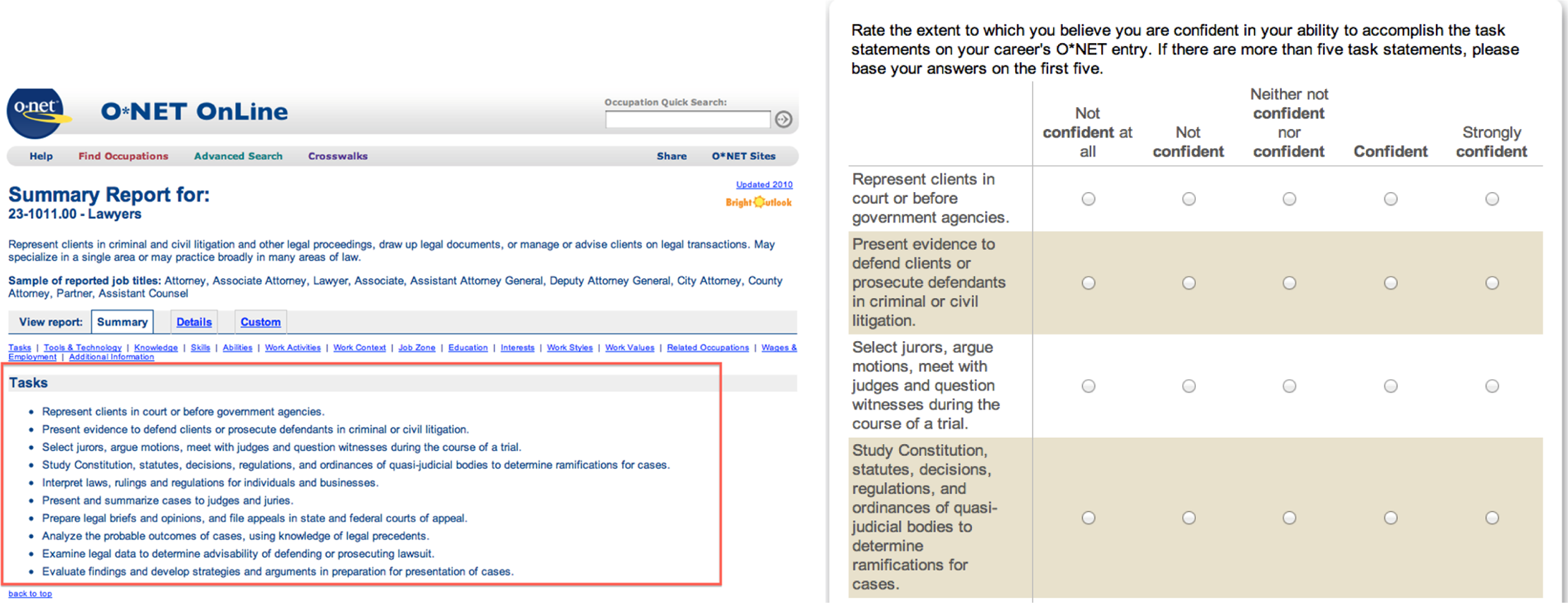
Example O*NET task statements embedded in survey.
Career self-efficacy
Career self-efficacy was assessed with five questions (α = .86) developed for this study that used O*NET OnLine task statements corresponding to the participant’s chosen job. Participants were asked to indicate a career they would like to perform and then indicate the extent to which they believe they were confident in their ability to accomplish the task statements specified on the O*NET entry. Examples of this process are shown in Figure 2 (5-point Likert-type scale, from not confident at all to strongly confident).
Outcome expectations
Outcome expectations were assessed with questions adapted from Lent and Brown’s (2006) 8-item scale (α = .87). This scale phrases questions in the form of “doing/becoming…will be/allow me to…” (Blanco, 2011; Lent & Brown, 2006). Sample items include “Becoming a ____ will cause me to earn an acceptable salary” (5-point Likert-type scale, from strongly disagree to strongly agree).
Calling
Calling was assessed with Dobrow and Tosti-Kharas’ (2011) 12-item scale (α = .91). Sample items include “I am passionate about” and “I would continue being a ___ even in the face of severe obstacles” (5-point scale, from strongly disagree to strongly agree).
Interests
Interests refer to the extent to which participants are interested in performing the tasks associated with a career. Interests were assessed with questions developed from O*NET online task statements (5 items, α = .77). Participants were asked to indicate how interested they would be in performing the tasks on the specified career’s O*NET entry (5-point Likert-type scale, from strongly disagree to strongly agree).
Goals
Goals refer to the participants’ goals of engaging in careers and activities. Goals were measured by asking how much participants intend to performing several career activities including professional development, attaining additional education, and applying to a job (5 items, α = .88). Sample items include “I intend to apply for a job relevant to becoming a/an ___” (5-point scale, from strongly disagree to strongly agree).
Analysis
We conducted structural equation modeling analyses using Mplus 7 (Muthén & Muthén, 2012) to test our hypotheses. Calling, outcome expectations, and intentions were analyzed as latent constructs. Self-efficacy and interests were analyzed as measured variables, as both constructs were assessed with questions developed from O*NET online task statements, and we did not believe that the items reasonably acted as indicators of overall latent constructs. We reduced the number of indicators for our latent constructs using item parcels to ensure that the items were normally distributed and reliable (Bandalos & Finney, 2001). We used common factors analysis (principal axis factoring) with Promax rotation to determine which items would be allocated to which parcel. We combined the items with the highest and lowest loadings for each latent construct and then combined the items with the next highest and lowest loadings, and so forth, which is consistent with structural equation modeling analyses practices (Coffman & MacCallum, 2005; Restubog, Florentino, & Garcia, 2010). Self-efficacy and interests were analyzed by calculating the means of each scale, as the items represented specific tasks related to careers and do not reasonably act as indicators of overall latent constructs.
Results
The means, standard deviations, and correlations among the study variables are shown in Table 1. Results of the structural equation modeling analyses are presented in Figure 1. The χ2 test for the proposed model was significant, χ2(109) = 331.75, p < .01, which indicates poor model fit. The other fit indices indicated “marginal” fit between the proposed model and the data (root mean square error of approximation [RMSEA] = .08; standardized root mean square residual [SRMR] = .06; comparative fit index [CFI] = .92). Although the currently proposed model does not meet most conservative empirically derived or “rule of thumb” measures of goodness of fit, other researchers have called this level of fit “modest” (Varela & Landis, 2010, p. 633), “reasonable” (Weissbein, Huang, Ford, & Schmidt, 2010, p. 428), “adequate” (Karim & Behrend, 2013), and “acceptable” (Ambrose & Schminke, 2003, p. 299; Lent et al., 2008, p. 57).
Means, Standard Deviations, and Correlations Among Study Variables.

Note. N = 314.
*p < .05, *p < .01.
Given the size and complexity of the model, we valued parsimony and thus chose not to add additional constraints to improve model fit. Moreover, the inclusion of paths suggested by modification indices resulted in testing relationships that are not supported by theory. Instead, we tested two alternative models that were less complex than the original model. The first alternative model did not include the interaction between self-efficacy and calling. The χ2 test for this alternate model was significant, χ2(111) = 338.15, p < .01, which indicates poor model fit. We then tested a second alternative model that only included significant paths. The χ2 test for the second alternative model was significant, χ2(96) = 302.62, p < .01, which indicates poor model fit. The first alternative model and the proposed model are not nested and we thus could not conduct a χ2 difference test; however, the second alternative model demonstrated significantly worse fit, χ2(13) = 29.13, p < .05. The other fit indices for both alternate models had fit between the proposed model and the data that were identical to the original model (RMSEA = .08; SRMR = .06; CFI = .92). As both alternative models failed to improve on the “marginal” fit achieved with the theory-based model, we chose to retain the original model structure.
Hypothesis 1a predicted that calling would be positively related to outcome expectations. This path was statistically significant (β = 0.57, p < .01, d = 1.39). Thus, Hypothesis 1a was supported. Hypothesis 1b predicted that calling would moderate the effects of self-efficacy such that the relationship between self-efficacy and outcome expectations decreases as calling increases. The path between the product term of self-efficacy and calling and subjective outcome expectations (self-efficacy × calling → outcome expectations) was statistically significant (β = −0.14, p < .01, d = 0.28). The relationship between self-efficacy and outcome expectations was less positive among those with stronger calling. Self-efficacy had a weaker effect on outcome expectations among those who had stronger calling. Thus, Hypothesis 1b was supported. Hypothesis 2 predicted that calling would be positively related to interests. This path was statistically significant (β = 0.60, p < .01, d = 1.50). Thus, Hypothesis 2 was supported. Hypothesis 3 predicted that calling would be positively related to career goals. This path was statistically significant (β = 0.30, p < .01, d = 0.63). Thus, Hypothesis 3 was supported.
Hypothesis 4 predicted that calling would have a stronger relationship with outcome expectations, career interests, and career goals than self-efficacy did. To test this hypothesis, we conducted a Wald Test of Parameter Constraints for the path from self-efficacy and the construct of interest and the path from calling to the construct of interest. The path between calling and outcome expectations was significantly larger than the path between self-efficacy and outcome expectations, χ2(1) = 12.53, p < .01, d = .41. The path between calling and interests was significantly larger than the path between self-efficacy and interests, χ2(1) = 31.14, p < .01, d = .66. The path between calling and career goals was not significantly larger than the path between self-efficacy and career goals, χ2(1) = 1.90, p = .17, d = .16. Thus, Hypothesis 4 was partially supported, such that calling has a stronger relationship than self-efficacy does with outcome expectations and career interests, but not career goals.
Discussion
Social cognitive theory has suggested that self-efficacy is the key component in career choice that affects a person’s outcome expectations, interests, and goals when choosing potential careers. Calling theory addresses meaningful passions toward and personal identification with a career. Despite their similar intentions, calling theory and SCCT have not been examined in context with one another. This gap in the literature needs to be addressed to increase the usefulness of SCCT in addressing cases where people with high self-efficacy still opt out of careers and people with low self-efficacy continue with unsuccessful career behaviors. This study expands the career choice literature by examining the effects of calling on outcome expectations, career interests, and career goals.
We have provided evidence that calling provides unique predictive power for career outcome expectations, interests, and goals. Specifically, calling was more strongly related to outcome expectations and career interests than self-efficacy, but it was not more strongly related to goals. Moreover, calling moderated self-efficacy such that self-efficacy was less related to outcome expectations when calling was high. These findings suggest that the presence of a calling is an important element in the career choice process.
Implications
This study improves our understanding of the ways in which people make decisions when choosing their careers. By integrating calling theory and SCCT, we hope that future researchers will be able to develop an enhanced understanding of the roles self-efficacy and calling play in career choice. We have demonstrated that calling provides incremental validity for career choice attitudes. Understanding the unique effects of self-efficacy and calling can help us to understand the roles that preparation and inspiration play when individuals think about potential careers.
This study can act as an initial step toward understanding the interplay between the rational and emotional components of career choice. Career choice research has thus far focused on the rational decisions that people make when choosing their careers. The strong relationships calling holds with career choice variables demonstrates that there is an additional component that people consider when choosing careers that is not a rational judgment. Instead, people pick careers that they identify with and those that make them feel inspired. This study supports that notion and identifies calling as one possible indicator of the affective component of career choice.
Beyond the theoretical implications, this study also provides an improved framework for Industrial/Organizational psychologists, educators, and career counselors to draw on when mentoring students or developing career support programs. One specific area where this enhanced framework can lead to future solutions is in addressing the gap in STEM careers for minorities. As President Obama and other policy makers have stated that the United States urgently needs to produce more American professionals in the areas of STEM (Obama, 2010, 2013), our greater understanding of career choices can help to bridge this gap. By providing support for the strong impact that calling has on career-related attitudes, we have highlighted a new area to develop career choice and development programs to address this gap in STEM careers. Recent research on STEM education and STEM-focused high schools suggests that schools that focus on career preparation by giving students opportunities to engage in formalized and informal career-related activities yield positive outcomes (Lynch, Kaminsky, Behrend, Spillane, & Burton, 2014). Sadler, Sonnert, Hazari, and Tai (2012) suggest that high school is when active career preparation begins and that high school students undergo experiences that affect which subject areas they are interested in pursuing. This study’s finding helps to explain why that may be while also providing new ways to mentor high school students and prepare them for future careers. Rather than focus solely on self-efficacy, educators and practitioners can leverage this study’s findings to develop calling-focused career programs for members of underrepresented groups. This approach has been used by religious organizations, but it shows promise for all types of careers (Dik & Steger, 2008). Dik and Steger suggest that calling-infused workshops can be successful at improving career decision-making self-efficacy and appraisals of meaning of life. As high school is a critical time for the development of relevant interests, STEM-focused high schools can develop calling-focused career workshops for their students—especially those in underrepresented populations.
Limitations and Future Research
While Hypotheses 1–3 were supported, we were only able to find partial support for Hypothesis 4. We were unable find evidence supporting calling as a stronger predictor of career goals than self-efficacy. We have identified two potential reasons why the hypothesis was not fully supported. First, the measure of goals might not have been appropriate for all respondents, as it references specific activities (e.g., attending school) that may have limited relevance for respondents already invested in their careers. Thus, a future study could correct this by developing broader measures of goals or by limiting the sample to a younger group of individuals. The second potential reason is that we mischaracterized the relationship between calling and goals. While we based this hypothesis on the idea that calling activated higher order goals than self-efficacy, it is also possible that this relationship changes when people consider real-world decision making. That is to say, calling may strongly affect the formation of outcome expectations and interests, but that self-efficacy ultimately plays a stronger role in determining what types of career-related goals they set. Thus, a person with a high calling and low self-efficacy may be interested in a career, but fail to set goals related to entering that career. As these findings conflict with our earlier portrayal of the persistent individual with high calling and low self-efficacy, we believe that these findings warrant further examination in future career choice research.
This study has additional limitations in its methodology and scope that should be examined in future studies. First, the study was conducted with a sample older than that of one of the primary populations of interest. While the study intended to investigate the overall effects of calling and self-efficacy, including career switchers, special attention should be paid to high school and college students who are in the early stages of picking their careers. Future research should attempt to address this by reaching out to educational institutions. Second, the current study demonstrates the power that calling can have on career choice but does not examine nonlinear effects of calling. For example, there are additional implications of this knowledge that are affected by the potential “dark” side of calling. As calling is linked to career goals, it is possible that people may attempt to join careers that they are not well suited for. For example, someone with low self-efficacy and high calling will still have high outcome expectations, as demonstrated in Figure 1. This type of person may waste time and energy, only to be disappointed in their eventual career. Dobrow and Tosti-Kharas (2012) demonstrated that people with strong calling were more likely to ignore negative career advice than those with weaker calling. Cardador and Caza (2012) also argue those with strong calling may follow difficult career paths that result in lowered subjective well-being. Given these negative sides of calling, career counselors must be wary of viewing calling as a panacea. Future research should examine this possible negative effect of calling on career outcomes.
Footnotes
Acknowledgments
The authors wish to acknowledge David Costanza for providing comments on an earlier draft of this article, and Max Silverman and Madison Marcus for their assistance in data coding.
Declaration of Conflicting Interests
The author(s) declared no potential conflicts of interest with respect to the research, authorship, and/or publication of this article.
Funding
The author(s) received no financial support for the research, authorship, and/or publication of this article.