



Abstract
By investigating parental support as a distal variable and critical consciousness (CC) as a proximal variable, the authors targeted specific factors that may increase the perception of agency and, ultimately, motivated choice behavior in 11th and 12th graders (N = 137) in an urban high school. The current study adds to the base of support for social cognitive career theory (SCCT) with diverse populations. However, parental support—which served as a sample/age-relevant proxy for learning experiences and distal supports—was only shown to significantly predict variance in outcome expectations (OEs), not self-efficacy. The final regression model included emotional support, OEs, CC, and CC as a moderator and explained 41.2% of the variance in intentions, with the interaction between CC and OEs contributing a significant 2.6% additional variance. Interestingly, CC lessened the positive effect of high OEs on intentions. The authors contextualize the results within the relevant research bases and discuss implications for future research and practice.
In comparison to their counterparts, inner-city adolescents are likely to face unique sociocontextual barriers to career exploration and decision making. In their review on the stressors associated with growing up in a poor urban environment, Deardorff, Gonzales, and Sandler (2003) summarized the pervasive nature of stressors across domains including “economic distress within families, economic deprivation in schools and neighborhoods, increased parental distress and family dysfunction, increased peer hassles and discrimination, and violence in homes and communities” (p. 206). These environmental stressors have been shown to have a profound impact on the perception and exercise of agency across different tasks and activities that prove developmentally vital to long-term outcomes and general well-being. For example, Turner and Ziebell (2011) found that even though inner-city adolescents held beliefs about the importance of academic achievement, those beliefs did not correlate with high academic performance, in part because pervasive stress can lead to the belief that success is not a product of effort. Likewise, when it comes to career decision making, this lack of perceived agency can lead to avoidance behavior with respect to appropriate developmental tasks that take place during adolescence.
The tasks associated with career exploration and choice can be overwhelming for young people, given the sheer number of career options available and the ever-changing nature of the world of work, highlighting the critical need for adolescents to develop confidence in their career decision–making skills. In 2010, for example, U.S. colleges and universities offered almost 1,500 different academic programs to students (Simon, 2012). Since the more education one has the more money the person is likely to make and the less likely he or she is to be unemployed (Bureau of Labor Statistics, 2013), the potential effects of career exploration on future well-being are self-evident, especially for those populations attempting to climb the social ladder. Therefore, the ability for adolescents to participate in career exploration and make developmentally appropriate career decisions has arguably never been more important.
Practical and structural barriers can impede career development, but research suggests that certain factors may mitigate the effects on human agency and decrease avoidance behavior. Parental support, for example, may lead to greater decision-making self-efficacy, more positive outcome expectations (OEs), and subsequently, increased career exploration. In addition, research suggests that increased awareness of contextual barriers, in the form of critical consciousness (CC; Diemer, 2009), may be a support—facilitating their negotiation and increasing an adolescent’s engagement with school- and career-related learning experiences. Social cognitive career theory (SCCT; Lent, Brown, & Hackett, 1994) provides a model that emphasizes the ways in which humans exercise agency in career development and the personal and environmental influences on this agency (McWhirter, Crothers, & Rasheed, 2000). By investigating parental support as a distal variable and CC as a proximal variable, we are hoping to target specific factors that increase the perception of agency and, ultimately, motivated choice behavior in adolescents.
SCCT
With its foundations in Bandura’s (1977) social learning and self-efficacy theories and later in his social cognitive theory (Bandura, 1986, 1989), SCCT posits that career development processes—including those which take place during adolescence—are inextricably bound to the social contexts within which they occur. Consistent with Bandura’s scholarship, SCCT explains motivation and behavior through “emergent interactive agency,” wherein individuals exercise some control over their fates but are also limited in their agency by socioenvironmental factors.
Within this model, SCCT is concerned with career development on two levels, both of which affect the perception and practice of agency: cognitive personal and environmental. According to SCCT, there are three cognitive–personal mechanisms of agency particularly pertinent to career development that mediate the relationship between past and future behavior: (1) self-efficacy, (2) OEs, and (3) goal representations (Lent et al., 1994).
Self-Efficacy and OEs
The primary mechanism of human agency is self-efficacy (Bandura, 1989). Self-efficacy is defined as the confidence one has in their ability to master a given task or activity, and Bandura (e.g., 1977, 1986, 1989) proposed that it is an important proximal determinant of human behavior. Self-efficacy helps to explain “people’s choice in activities, how much effort they will expend, and […] how long they will sustain effort in dealing with stressful situations” (Bandura, 1977, p. 194, 1989). In addition to the direct effect it has on these outcomes, self-efficacy helps dictate the parameters of cognitive processing including the development of OEs (“If I do this, this will happen.”). In other words, those with high self-efficacy beliefs are more likely to imagine scenarios with positive outcomes, while those with low beliefs are more likely to imagine the opposite. These OEs are simultaneously influenced by and working alongside self-efficacy to influence behavior.
Goals
People’s capacity of forethought serves as an important basis for self-regulation of behavior in the present (Bandura, 1989). The resultant goals, or cognitive representations of sought-after future outcomes, are another way in which humans self-direct their behavior. For example, recent research with adult participants found that being able to imagine the future work self clearly predicted proactive career behavior (Strauss, Griffin, & Parker, 2012). Even more relevant to the current study, Yeager, Bundick, and Johnson (2012) found that high school students with intrinsic future work goals are far more likely to find school activities meaningful.
Human Agency and Career Choice
The SCCT choice model has been consistently supported by research across interest areas and diverse populations in the last nearly 20 years (e.g., Flores, Robitschek, Celebi, Andersen, & Hoang, 2010; Fouad & Smith, 1996; Lent et al., 2001; Rogers & Creed, 2011; Sheu et al., 2010). Researchers have specifically targeted self-efficacy related to the process of career decision making (e.g., Creed, Patton, & Prideaux, 2006; Solberg, Good, Fischer, Brown, & Nord, 1995; Taylor & Betz, 1983) under the assumption that low self-efficacy in career decision making leads to avoidance of career exploration activities, continued indecision, and, therefore, lack of commitment to choice behavior. Research with adolescents suggests a positive correlation between career decision–making self-efficacy (CDMSE) and partaking in career exploration activities (Gushue, Scanlan, Pantzer, & Clarke, 2006; Rogers & Creed, 2011). CDMSE has also been shown to have a positive relationship with stable patterns of career choice (Gianakos, 1999). Therefore, one of the purposes of the study is to further test the SCCT choice proposition using CDMSE to predict goals and intent to engage in career exploration activities. The underlying aim is to reduce avoidance of career decision–making activities with the belief that career exploration leads to future goal orientations and, therefore, self-regulation of behavior in the present.
Contextual Supports and Barriers to Choice
The discussion has hitherto concentrated on personal factors affecting career choice, but no overview of SCCT or its underlying theories would be complete without highlighting the importance of the social context. There is a complex interplay of internal and external influences that affect the different mechanisms of human agency. If self-efficacy, OEs, and goals are the primary personal factors explaining choice, then it is important to know what additional variables interact to help explain the differences in these constructs for different individuals. According to social learning theory, self-efficacy expectations, which have a direct influence on OEs and goals, are learned from four primary sources of information: (1) performance accomplishments, (2) vicarious experience, (3) verbal persuasion, and (4) emotional arousal. In conceptual models of SCCT, these sources of information have the most immediate influence on self-efficacy and OEs and are aptly called “learning experiences” (Propositions 10 and 11; Lent et al., 1994).
Contextual barriers and supports are categorized based on their proximity to choice behavior. Background or distal contextual variables (social, economic, cultural, political, etc.) help to determine the amount and nature of learning experiences. Proximal contextual variables are those which exert influence closer to choice behavior. These variables moderate the conversion of interests into goals and goals into action as well as directly affect goal and/or choice action. Conversely, distal or background influences only indirectly affect choice behavior via their direct influence on the different mechanisms of agency (self-efficacy, OEs, and goals). For a more comprehensive analysis of contextual supports and barriers in SCCT, see Lent, Brown, and Hackett (2001).
For the purposes of the current study, we have chosen to test a distal and proximal contextual variable. Learning experiences and their direct antecedents (distal) will be explored in relation to self-efficacy and OEs in the form of measuring parental support. Proximal influence will be explored by measuring the degree to which CC moderates the relationship between the aforementioned mechanisms of agency and motivated choice behavior.
Parental Support
During adolescence, which sets the stage for a formative phase of interest development and goal setting, young people have differential access to sources of information affecting self-efficacy. For example, in inner cities, and partly because of higher unemployment rates, there is a lack of opportunity for career-related learning experiences—including access to career role models—which stunts the development of high self-efficacy expectations. Here we see how context, specifically distal contextual affordances, places limits on the perception and exercise of human agency. However, we also see how barriers can be defined by an absence of a support. If we are to understand how self-efficacy develops, we must understand what those supports are and the nature and magnitude of their influence on human agency. In the lives of children and adolescents, no form of social influence is more fundamental than that of parents (Cheung & Pomerantz, 2012).
The study of the effects of parental support and involvement has taken place across disciplines in education and the social sciences (e.g., Center on Education Policy, 2012; Cheung & Pomerantz, 2012; Sheridan et al., 2012). Researchers seem to agree that families are an essential support system for the healthy learning and development of children and adolescents and that, ultimately, parent involvement leads to higher achievement (Cheung & Pomerantz, 2012). Because parent involvement has been shown to lead to higher achievement, it has been identified by researchers and policy makers as a major inroad to reducing achievement gaps for underprivileged students. In fact, some research has suggested that parental involvement is actually more effective with low-socioeconomic status (SES) students than with more privileged populations (Domina, 2005).
The influence of parents on the career decision–making and exploration processes has been documented in the literature. For example, parental support has been shown to increase self-efficacy for engaging in career decision making (Kush & Cochran, 1993), predict career-related self-efficacy and choice behavior (Turner, Alliman-Brissett, Lapan, Udipi, & Ergun, 2003; Turner & Lapan, 2002; Turner, Steward, & Lapan, 2004), and be the top “environmental” influence on career expectations for both boys and girls (Paa & McWhirter, 2000). However, much of the current research connecting parents with their children’s career processes have been done with middle school students and underclassmen in high school. Turner, Alliman-Brissett, Lapan, Udipi, and Ergun (2003) hypothesized that, “[b]ecause environmental support systems tend to become more heavily influenced by peer relationships in later adolescence […] there may be weaker associations between perceived parental support and the confidence to engage in developmentally appropriate career-related tasks in older youth” (p. 92). However, others have held that parents “remain central even as peers become prominent” (Cheung & Pomerantz, 2012, p. 821). We will test these competing views by sampling 11th and 12th graders from an inner-city high school.
CC
CC is based on the work of Paulo Freire (1973) and his mission to help Brazilian peasants “read the world” in order to understand mechanisms of injustice and how best to change them (Watts, Diemer, & Voight, 2011). CC and similar constructs like sociopolitical development (SPD) can be defined as the process by which one develops an understanding of an unjust world and is therefore compelled to change it (Watts & Abdul-Adil, 1997). CC and SPD have also been defined as sociopolitical manifestations of critical thinking. CC has been linked with positive career development outcomes among urban adolescents (Diemer & Blustein, 2006) and low-SES youth of color (Diemer et al., 2010) as well as with a positive influence on career expectations for poor youth of color and subsequent occupational attainment as young adults (Diemer, 2009). These findings suggest that CC and SPD hold the promise of helping marginalized youth navigate the pervasive stressors associated with their various contexts and perceive higher levels of agency (Diemer, Rapa, Park, & Perry, 2014).
By testing CC as a proximal moderating variable within the SCCT model, we are hoping to learn more about the nature of its influence on agency in career development. With this review of the literature in mind, our research questions are as follows: (1) Does parental support predict the perception of agency in adolescents? (2) What are the significant predictors of goal-directed career decision–making behavior in adolescents? and (3) Does CC moderate the relationship between feelings of agency and goals/intentions?
Method
Participants
Participants were 137 high school juniors and seniors (n = 70 and 67, respectively) from an inner-city high school in a large Midwestern urban city. Fifty-nine students identified as male, 77 as female, and 1 as other. Seventy-eight percent of the sample reported that they qualified for free or reduced lunch. However, only 43% identified themselves as working class or poor, while 57% self-identified as middle or upper-middle class. Seventy-eight percent of the participants were Hispanic or Latino, 10% were White, and the remaining 12% reported other racial and ethnic minority identifications.
Procedure
Students were offered the survey instruments in a computer lab group setting during a guided study hall period. An informed consent form in English and Spanish was sent home to parents and preceded the survey measures. The form was translated and back translated by four members of the second author’s research team to ensure content comprehension. If parents wished to opt their child out of the survey, they could do so by signing the form and sending it back to school. Students not wishing to participate in the study were able to use study hall time as they normally would. Participants completed instruments measuring demographic information, career-related parent support, and career decision making.
Measures
Demographics
Participants filled out five questions measuring grade level, gender, racial/ethnic identification, SES, and class identification, and one question asking them their plans for after high school (college, technical school, work, military, travel, and other).
Parent support
Parent support was measured using the Career-Related Parent Support Scale (CRPSS; Turner et al., 2003). The CRPSS was developed to measure students’ perceptions of how their parents provided career-related support and was originally validated with an ethnically diverse, inner-city sample. Participants are asked to answer items on a 5-point Likert-type scale (1 = strongly disagree to 5 = strongly agree). Four subscales corresponding to Bandura’s (1977) four sources of self-efficacy information are included. In the original sample used to validate the scale, internal consistency estimates on the subscales ranged from .80 to .85 (see Turner et al., 2003 for comprehensive demonstration of reliability and validity evidence). Scale 1 (Instrumental Assistance [IA]) corresponds to past performance accomplishments and measures parents’ support of skill development. The internal consistency reliability for the current study is .81. Sample items are “My parents give me chores that teach me skills I can use in my future career” and “My parents teach me things that I will someday be able to use at my job.” Scale 2 (Career-Related Modeling [CM]) corresponds to vicarious learning. The internal consistency reliability for the current study is .84. Sample items include “My parents show me the kind of things they do at work” and “My parents have taken me to their work.” Scale 3 (Verbal Engagement [VE]) corresponds to Bandura’s social persuasion. The internal consistency reliability for the current study is .78. Sample items include “My parents encourage me to learn as much as I can at school” and “My parents told me they expect me to finish school.” Scale 4 (Emotional Support [ES]) corresponds to Bandura’s construct of emotional arousal and measures “parents’ support of the affect experienced by adolescents in relationship to their educational and career development” (p. 85). The internal consistency reliability for the current study is .88. Sample items include “My parents talk to me when I am worried about my future career” and “My parents talk to me about how fun my future job could be.”
Career decision making
Career decision–making factors were measured using the Middle School Self-Efficacy Scale (MSSES; Fouad, Smith, & Enochs, 1997). Items on the MSSES were modified from the Career Decision Self-Efficacy Scale (CDSES; Taylor & Betz, 1983) to apply to middle school students. The CDSES was originally validated with an internal consistency reliability of .97. For the current study, we used three scales from the MSSES, the first one measuring self-efficacy, the second measuring OEs, and the third measuring goals/intent to participate in career exploration. The MSSES has been validated with ethnically diverse (including majority Hispanic), inner-city populations. Original internal consistency estimates were .79 for measuring self-efficacy and .74 for measuring OEs and goals/intent (see Fouad et al., 1997 for comprehensive demonstration of reliability and validity evidence). Internal consistency estimates for the current study are .85 for measuring self-efficacy, .88 for OEs, and .83 for goals/intent. On the self-efficacy subscale, participants are asked to answer items on a 5-point Likert-type scale measuring confidence (1 = not confident to 5 = very confident). Instructions for the self-efficacy section included the stem, “If given the proper training” and sample items include “I can find information in the library about careers that interest me” and “I can select one career from a list of possible occupations.” OEs and goals are measured using a 5-point Likert-type scale, with responses ranging from strongly disagree to strongly agree. Sample OEs items include “If I do well in school, then I will be prepared for different careers” and “If I try hard, I will get good grades.” Sample goals/intentions items include, “I intend to get all the education I need for my career choice” and “I plan to talk to many people about careers.”
CC
CC was measured using a 4-item SPD scale operationalized by Diemer et al. (2010) using questions from the National Educational Longitudinal Study (NELS). Diemer and Hsieh (2008) used similar indicators to operationalize SPD in a study with low-SES adolescents of color. The internal consistency reliability for the current study is .84. Questions contained the stem “How important is it to” and included “Help others in the community?” “Work to correct social and economic inequality?” “Be an active and informed citizen?” and “Volunteer at a community center or social action group?” Participants are asked to answer items on a 5-point Likert-type scale measuring perceived importance (1 = not important at all to 5 = very important).
Results
Means and standard deviations for all study variables are presented in Table 1. There were no significant gender differences on any of the scales, and no differences between juniors and seniors on any scales with the exception of self-efficacy with juniors indicating less confidence in their CDMSE (X = 3.69 and 4.08, respectively). Because the rest of the scales indicated no gender or age differences, the remaining analyses were conducted on the entire participant pool.
Means, Standard Deviations, Reliabilities, and Correlations Among Variables.

Note. IA = Instrumental Assistance; CM = Career-Related Modeling; VE = Verbal Engagement; ES = Emotional Support; SE = self-efficacy; OEs = outcome expectation; CC = critical consciousness.
**Correlation is significant at .01 level (two-tailed).
*Correlation is significant at .05 level (two-tailed).
Two regression analyses were conducted to examine Research Question 1, the first on parental support predictors of CDMSE and the second on parental support predictors on OEs. Overall, the four sources of parental support explained only 3.7% of the variance in CDMSE, with none of the individual sources of support having a significant contribution (see Table 2). The four sources of parental support, however, explained 36%, F(4, 132) = 18.58, p < .0001), of the variance in career decision–making OEs (Table 3). The strongest individual predictor was ES (β = .194, p = .004). Interestingly, self-efficacy was not found to be a significant predictor of OEs when controlling for the influence of the four sources of parental support.
Research Question 1—Self-Efficacy: Model Summary.

Note. ES = Emotional Support; RM = career role model; VE = Verbal Engagement; IA = Instrumental Assistance.
aPredictors: (Constant), ES, RM, VE, and IA.
Research Question 1—Outcome Expectation: Model Summary.

Note. VE = Verbal Engagement; IA = Instrumental Assistance. aPredictors: (Constant), ESupport, RModeling, VE, and IA.
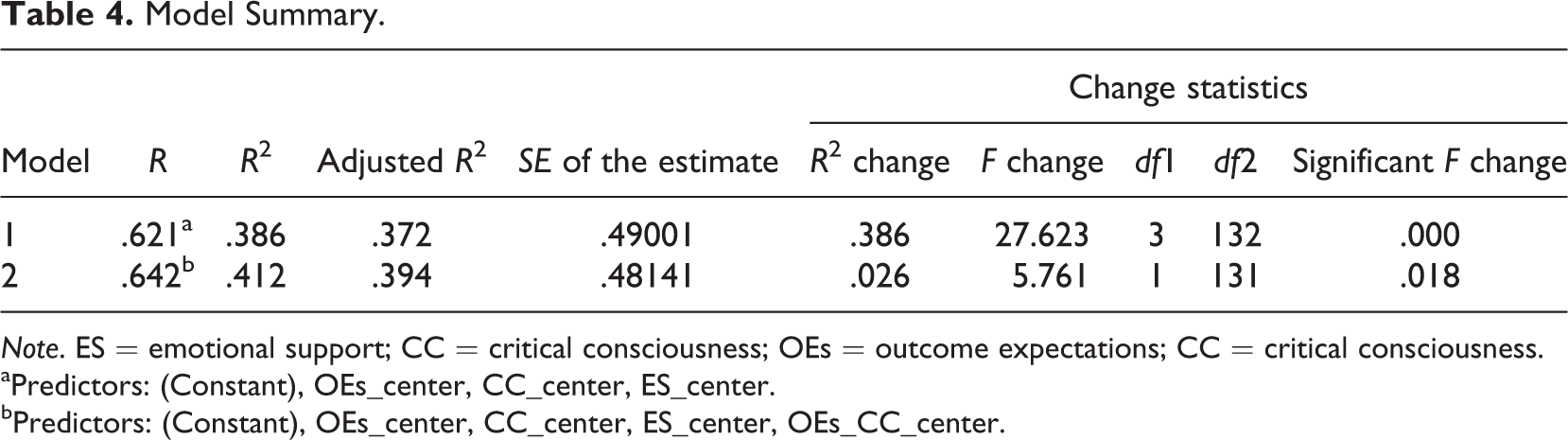
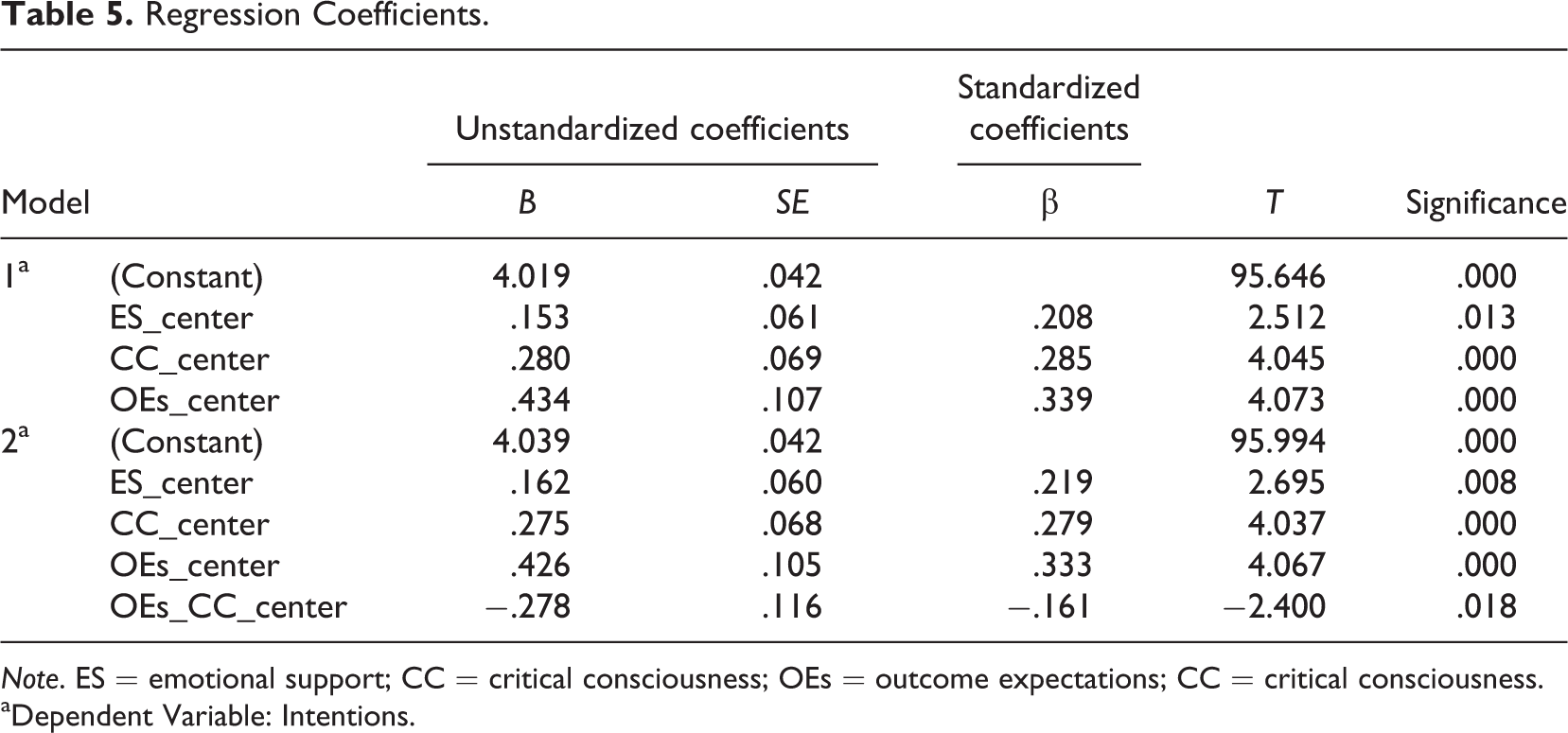
To test Research Question 2, we regressed intentions on four sources of parental support, self-efficacy, OEs, and CC. The final model from this analysis included OEs (p < .001), CC (p < .001), and ES (p = .013) as significant predictors of intentions. Note that it did not include self-efficacy (p = .225). In order to test for a moderation effect (Research Question 3), a hierarchical regression model was employed to investigate the interaction between OEs (our significant agentic variable) and CC. Both the independent variable (OEs) and the moderator (CC) were centered, and the interaction term was created by multiplying centered OEs and CC. When running the hierarchical regression model, OEs and CC were entered in the first block and the interaction between them was entered in the second block. Therefore, the significance of the interaction term can be determined (Baron & Kenny, 1986). As depicted in Table 4, the R 2 change was significant (R 2 change = .026), F change (1, 131) = 5.761, p = .018), indicating that CC moderates the relationship between OEs and intentions. The overall model explained 41.2% of the variance in intentions, with the interaction contributing a significant 2.6% additional variance. We then split the moderator (CC) into high CC group (1 SD above the mean) and low CC group (1 SD below the mean). As shown in Figure 1, although for subjects in both high and low CC group intentions decrease as OEs increases, intentions decrease faster for subjects in the high CC group. Interestingly, even though the regression coefficients (Table 5) for OEs and CC were both positive, the regression coefficient for the interaction was negative. That is, a one-unit increase in CC was associated with a .278 unit decrease in the regression coefficient for OEs. That is, higher OEs seem to be associated with stronger intentions, but the relation is weaker when CC is higher. This kind of interaction is called an interference or antagonistic interaction (Cohen, Cohen, West, & Aiken, 2003), which may imply OEs and CC may have compensatory effects on intentions, so both variables relate to intentions positively. Yet the importance of high OEs may be lessened by high CC and vice versa. The interaction buffers the effect of OEs and CC on intentions.
Model Summary.
Note. ES = emotional support; CC = critical consciousness; OEs = outcome expectations; CC = critical consciousness.
aPredictors: (Constant), OEs_center, CC_center, ES_center. bPredictors: (Constant), OEs_center, CC_center, ES_center, OEs_CC_center.
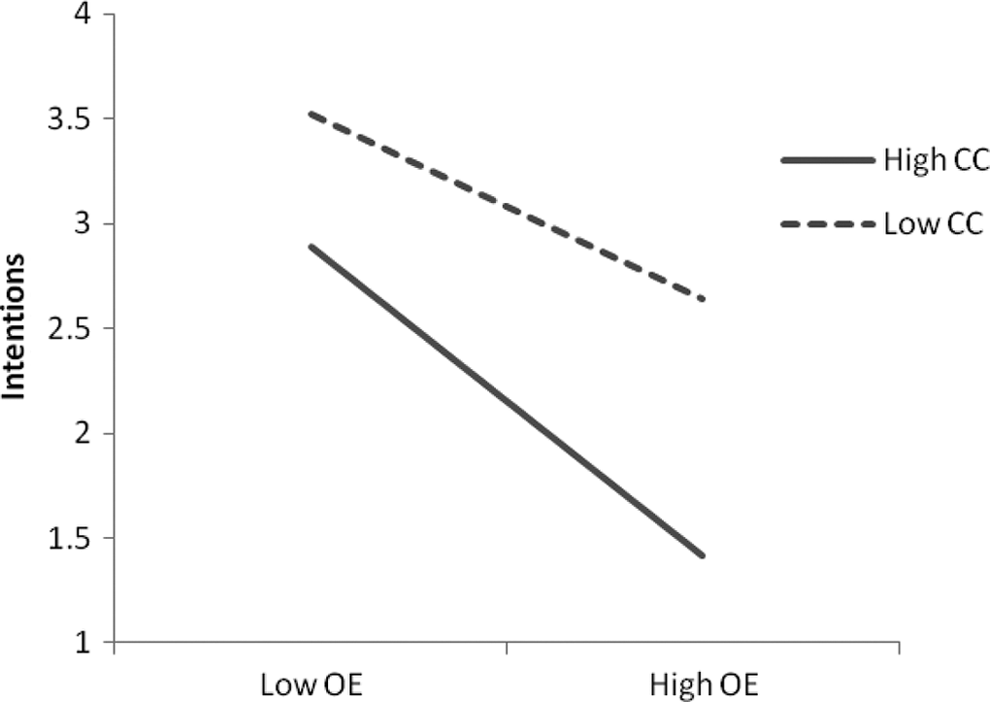
The interaction between outcome expectations and critical consciousness.
Regression Coefficients.
Note. ES = emotional support; CC = critical consciousness; OEs = outcome expectations; CC = critical consciousness. aDependent Variable: Intentions.
Discussion
The current study adds partial support to the SCCT model with diverse populations. That is, while parental support did predict agency in the form of OEs, which in turn predicted intentions, self-efficacy was neither significantly predicted by the current distal variable nor a significant predictor of the outcome. The latter finding may be consistent with Flores and O’Brien’s (2002) study, which also failed to demonstrate that learning experiences (indirectly measured by way of measuring parent-related contextual influences) contributed to self-efficacy in a sample of Mexican American adolescent women. Considering Flores and O’Brien’s sample was comprised of seniors in high school, both of these findings may be consistent with what other scholars have said about the importance of parental influence giving way to that of peers in older adolescence (Turner et al., 2003). However, since there was no measure of peer influence in the current study, this is speculation.
On the other hand, parental support did significantly predict OEs. Three of the four sources of parental support (all but Role Modeling) shared a significant positive correlation with OEs. ES (.56) had the strongest influence with IA (.50) not far behind. Fouad and Guillen (2006) noted the lack of attention paid to OEs and encouraged more research to explicate the relationship of OEs to other variables in the social cognitive career model. The results of this study suggest that parental support is a stronger contributor to OEs than self-efficacy and that OEs may be a stronger predictor of intentions than self-efficacy
The final three-predictor model, which explained 38.6% of the variance in intentions, included ES, OEs, and CC. The interaction between OEs and CC proved to be a significant contributor explaining 2.6% additional variance bringing the final variance explained by the predictors to 41.2%. However, the relationship was not what we expected and leaves the role of CC in the model needing further examination. In conceptualizing the study and reviewing the literature, we predicted CC would be a proximal support. That is, if students were more aware of societal barriers, they would be more equipped to overcome them and motivated to do so. On the contrary, our findings suggest that the effects of high OEs are lessened when CC is also high. Does that mean that CC is effectively a proximal barrier to action? We are hesitant to take that position, especially given the positive correlation between OEs and CC but intuitively, it is not hard to imagine such a relationship. For example, if a student has high OEs, but perceives more barriers as a result of a heightened awareness of systemic inequity, is he or she actually less likely to be motivated to action? Indeed, in a recent review of the literature on CC, Watts et al. (2011) wrote “research does not provide an answer” for what leads people to act on their critical reflection (p. 47). It is conceivable that revealing the true nature of an unfair system to adolescents without much power to change that system may result in a kind of learned helplessness. That said, we do not hold that CC is a net risk factor or a barrier but instead needs to be incorporated into an intervention along with measures to reduce power differentials. These findings may highlight the importance of using what power counselors, educators, and other facilitators have to couple consciousness-raising efforts with providing pathways to action for students while advocating and engaging in activities that lead to the disruption of social structures that limit their agency.
Limitations and Future Directions
In the current study, a CC scale was used that had previously been operationalized using an existing data set. As Diemer has noted when using the same or similar scale, “the limited number of SPD indicators in ELS circumscribed the operationalization of this construct” (Diemer et al., 2010, p. 632). In other words, current conceptualizations of the CC construct are much more robust than the applicable NELS questions were able to accommodate. Notably absent from the NELS questions were items to measure the awareness of inequity, although one of the questions does ask about the importance of ameliorating it. It is also worth noting, as Diemer et al. (2010) did, that CC and SPD are conceptualized as facilitating a response to one’s own oppression, rather than to the oppression of others. As researchers move forward within this line of inquiry, it will be important to more accurately and holistically operationalize CC. We recommend that any authors interested in investigating this construct consult the work of Diemer and his colleagues.
Footnotes
Declaration of Conflicting Interests
The author(s) declared no potential conflicts of interest with respect to the research, authorship, and/or publication of this article.
Funding
The author(s) received no financial support for the research, authorship, and/or publication of this article.