




Abstract
The purpose of this study was to examine the psychometric properties of the Korean version of the Career Decision-Making Difficulties Questionnaire (CDDQ) among 854 college students. Confirmatory factor analyses partially confirmed the original 10-factor structure of the instrument and demonstrated metric equivalence across gender. The dysfunctional beliefs subscale was particularly inconsistent. Cronbach’s α reliabilities ranged from .66 to .88 for the CDDQ subscales and α = .92 for the CDDQ total score. The test–retest reliability for a 1-month interval was .88. The correlation between CDDQ and the Career Decision Self-Efficacy Scale was r = –.54 (p < .01), which was convergent with previous studies. The undecided college students reported higher CDDQ scores than the decided college students. All the results suggested that CDDQ is a reliable instrument for assessing career decision-making difficulties in the Korean context. Implications for career interventions and research are discussed.
Keywords
Making a career decision is often defined as an important and complex task that many individuals must face during their lifetime (Amir & Gati, 2006; Gati, Krausz, & Osipow, 1996; Germeijs & Verschueren, 2006; Lancaster, Rudolph, Perkins, & Pattern, 1999; Osipow, 1999). This process is particularly difficult for young adults as long as they are experiencing a critical decision for establishing their future career path (Mann, Harmoni, & Power, 1989). According to a U.S. national survey mentioned by Gianakos (1999), around 50% of college students report difficulties in making career decisions.
Career indecision has become a growing concern in the field of vocation psychology over the last few decades (Kelly & Lee, 2002; Osipow, 1999; Osipow & Gati, 1998; Super, 1957). One of the most important challenges was to connect empirical and theoretical approaches of career indecision (Gati et al., 1996; Osipow, 1999). In fact, early measures of career indecision were mainly elaborated independently of theoretical models. Tinsley (1992) emphasized the need for developing career indecision measurement based on rigorous theoretical conceptualization. Subsequently, Gati et al. (1996) elaborated an empirically tested decision theory–based taxonomy of career decision-making difficulties and developed the scale. These authors then developed the Career Decision-Making Difficulties Questionnaire (CDDQ) in order to test the validity of the proposed taxonomy (Gati et al., 1996; Gati & Saka, 2001a; Lancaster et al., 1999; Osipow, 1999; Osipow & Gati, 1998).
Conceptualization of the CDDQ
The structure of the CDDQ may be described as a hierarchical model including broad categories of career decision-making difficulties divided into 3 major categories and 10 specific difficulties subcategories (Lancaster et al., 1999). The major categories are lack of readiness, which occurs prior to the beginning of the career decision-making process, and lack of information and inconsistent information, which can occur throughout the process (Gati et al., 1996; Osipow & Gati, 1998). More specifically, the lack of readiness includes the following three subcategories of career decision-making difficulties: (a) lack of motivation, (b) general indecisiveness, and (c) dysfunctional beliefs relative to the career decision-making process. Lack of information includes four distinctive subcategories, namely (d) lack of knowledge about the stages of career decision-making process, (e) lack of information of the self such as career preference and personality trait, (f) lack of information about the occupations, and (g) lack of information about the ways of obtaining additional information. Finally, the last major categories include three sources of inconsistent information, namely (h) unreliable information, (i) internal conflicts, and (j) external conflicts.
The original CDDQ was composed of 44 items and its validity was primarily tested using cross-cultural samples including 259 Israeli young adults and 304 U.S. college students (Gati et al., 1996). Results confirmed the taxonomy of 10 categories of career decision-making difficulties. For the Israeli sample, the Cronbach’s α reliabilities of major categories were .70 (lack of readiness), .93 (lack of information), .91 (inconsistent information), and .95 for the total scale, while the test–retest estimates were .67, .74, .72, and .80, respectively. Most of the previous studies reported a lower reliability level for the lack of readiness, ranging from .55 to .70 (Gati et al., 1996; Gati & Saka, 2001a, 2001b; Lancaster et al., 1999; Leung, Hou, Gati, & Li, 2011; Mau, 2001; Osipow & Gati, 1998; Tien, 2001; Zhou & Santos, 2007). Lancaster et al. (1999) indicated that the reliability of the dysfunction beliefs subcategory was particularly equivocal, and further research was recommended to understand this subcategory (Gati & Saka, 2001a). The CDDQ was revised and reduced to 34 items by Gati and Saka (2001a). Equivalence between the paper-and-pencil and the Internet forms of the CDDQ was explored and confirmed by Gati and Saka (2001b). The CDDQ is currently considered as a reliable instrument for assessing and diagnosing career decision-making difficulties (Amir, Gati, & Kleiman, 2008; Gati, 2013; Osipow, 1999). Indeed, it was demonstrated that the students who had not made a career decision reported more career decision-making difficulties than the students who had made a career decision (Gati & Saka, 2001a; Lancaster et al., 1999; Mau, 2001; Tien, 2001, 2005). Additionally, CDDQ scores were negatively correlated to Career Decision Self-Efficacy (CDSE) Scale scores (Betz, Klein, & Taylor, 1996) in previous studies (Amir & Gati, 2006; Gati et al., 1996; Morgan & Ness, 2003). Lancaster et al. (1999) also found a positive correlation between the CDDQ total score and anxiety (r = .18, p < .01). Several theoretical models suggest the implications of anxiety and negative affect in career indecision (Brown & Krane, 2000; Brown et al., 2012; Callanan & Greenhaus, 1990; Chartrand, Robbins, Morrill, & Boggs, 1990; Saka & Gati, 2007; Tak, 2006; Tak & Lee, 2003). However, gender differences on CDDQ scores were not systematically demonstrated (Hijazi, Tatar, & Gati, 2004; Lancaster et al., 1999; Zhou & Santos, 2007). In gender differences among Israeli high school students, Gati and Saka (2001a) found that boys reported higher level of difficulties in external conflicts and dysfunctional beliefs compared to girls. The CDDQ score differences across grade levels were also investigated by Tien (2005) among Taiwanese college students, who found that freshmen report higher CDDQ scores than other grade levels. These results were consistent with the previous findings, suggesting that freshmen may experience strong career indecision when beginning university (Gati et al., 1996; Morgan & Ness, 2003).
Cross-Cultural Validity of the CDDQ
The CDDQ was also widely used as a reliable instrument for assessing career decision-making difficulties in various cultural contexts. According to Gati (2013), the CDDQ was adapted and validated in 32 different languages including Arabic (Hijazi et al., 2004), Dutch (Germeijs & Verschueren, 2006), Slovenian (Pečjak & Košir, 2007), French (Massoudi, Masdonati, Clot-Siegrist, Franz, & Rossier, 2008), Italian (Di Fabio & Kenny, 2011), Greek (Koumoundourou, Tsaousis, & Kounenou, 2011), Romanian (Bîrle & Perţe, 2011), and Chinese (Creed & Yin, 2006; Mau, 2001; Tien, 2005; Zhou & Santos, 2007). Based on previous validation studies, the original and theoretical structures of the taxonomy of the 10 categories of career decision-making difficulties were often confirmed in other cultures such as in Israel (Gati et al., 1996), United States (Lancaster et al., 1999; Osipow & Gati, 1998), Taiwan (Mau, 2001; Tien, 2005), and Spain (Lozano, 2007). In contrast, Creed and Yin (2006) identified a two-factor model including lack of information and inconsistent information among Chinese adolescents. These authors reported low reliability and low corrected item-total correlations for the third major category—lack of readiness—suggesting the removal of this category for the CDDQ structure. Vahedi, Farrokhi, Mahdavi, and Moradi (2012) also reported some difficulties in confirming the 10-factor structure of the CDDQ among Iranian college students through the inconsistence of lack of readiness subcategories. More particularly, Mau (2001) reported poor factor loadings for the dysfunctional beliefs subcategory for both Taiwanese and U.S. college students. Globally, these results express the need to carefully explore the validity of the lack of readiness factor in cross-cultural adaptations of the CDDQ. From what we know, the validity of the CDDQ in Asian cultures was only limited to Chinese-speaking populations, pointing out several inconsistencies with respect to the factorial structure of the instrument (Creed & Yin 2006; Mau, 2001; Tien, 2005). The results suggest looking carefully at the career decision-making process in such contexts for understanding the relevance of the model developed by the original authors (Sovet & Metz, 2014). Overall, the investigation of a Korean adaptation of the CDDQ could provide additional and valuable support for the cross-cultural validity of this instrument and be useful for conducting comparisons about career indecision among College students from diverse cultural contexts.
Career Decision-Making in the South Korean Context
Based on the Confucian principles, education is considered as an important value in the Korean society (Shin, 1986). However, sociopolitical changes have turned gradually this cultural value into an obsession for academic achievement (Seth, 2002). Consequently, from a young age, many Korean students attend cram schools in addition to their regular hours in order to prepare for the college entrance exam (Jung & Lee, 2010). Actually, most of them experience high pressure, devoting all their time in studying hard (Ahn & Baek, 2013), thus having few opportunities to explore their career interests (Lee, 2001). In this process, Korean parents play a critical role in the development and the academic achievement of their children by their continuous sacrifices and support (Park & Kim, 2006). Consistently, Korean parents encourage their children to focus on maintaining good grade. In addition, collectivist and Confucian values in South Korea promote the importance of taking decision with approval from the family for the purpose of maintaining cohesion and loyalty in the family context (Hofstede, 2001; Leong, 1991).
Giving this context, few programs are designed for helping Korean students in their career exploration before entering college (Hwang, Kim, Ryu, & Heppner, 2006). Being admitted in a prestigious college would be considered more important than choosing a satisfying major (Tak, 2012). Career centers are available in most of the universities and colleges providing large range of services for college students, but they tend to indulge in more job placement activities than career counseling practices (Yang, Lee, & Ahn, 2012). Making career decisions is considered as the most important source of stress among Korean college students (Choi et al., 2011; Tak, 2006). Therefore, career indecision becomes a large concern for those populations facing many difficulties in choosing a suitable career path (Tak, 2012).
Purpose of the Study
This study examined the psychometric properties of the adaptation of the CDDQ (Gati et al., 1996) among Korean college students. Several aspects will be explored, providing an extensive validity study of the CDDQ. First, confirmatory factor analysis and measurement invariance across gender groups will be performed in order to assess the construct validity. According to Mau (2001), a structure similar to that of the original taxonomy is expected to be found. Convergent, criterion-related, and discriminant construct validity will also be analyzed using the CDSE Scale–Short Form (CDSES-SF; Betz et al., 1996) and demographic data, including grade and career decision status. Negative correlations with CDSES-SF (Amir & Gati, 2006; Morgan & Ness 2003; Osipow & Gati, 1998) and higher CDDQ scores for college students who had not reached a career decision (Gati & Saka, 2001a; Mau, 2001; Osipow & Gati, 1998) as well as for freshmen college students (Gati et al., 1996; Morgan & Ness, 2003; Tien, 2005) are expected to be found. Reliability and temporal stability will also be reported.
Method
Sample
The participants included 854 Korean undergraduate students enrolled in one small private college and two public universities located in different urban regions across the country (306, 301, and 247 participants at each respective establishment). The participants included 350 males (41%) and 484 females (53%; 20 participants [2%] did not report their gender) aged from 17 years to 31 years old (M = 21.17, SD = 2.42). The participants comprised 303 freshmen (35%), 156 sophomores (18%), 205 juniors (24%), and 182 seniors (21%). Participants in the study listed a variety of majors (61 different majors were identified). The most important majors reported were psychology (37%), business (9%), and social work (7%). Six hundred and eight participants (71%) reported having a career plan or an idea of an occupation, while 223 participants (26%) reported having no idea and 23 participants did not report this information. One hundred and nine participants (14%) agreed to complete the CDDQ a second time in a 1-month retest interval.
Measures
CDDQ
Career decision-making difficulties were assessed using the CDDQ (Gati et al., 1996). The original 44-item scale was revised into a 34-item version (Gati & Saka, 2001a). The CDDQ is divided into the following three scales: lack of readiness (10 items—three subscales), lack of information (12 items—four subscales), and inconsistent information (10 items—three subscales) following the theoretical model presented in the introductory section of this article. Among the 34 items, two validity items were included in order to control the credibility of the respondents (Amir & Gati, 2006). The total score may provide a global measure of perceived difficulties in the process of career decision making, while scales and subscales may provide additional and specific information about these perceived difficulties. All the items were rated using a 9-point Likert scale ranging from does not describe me (1) to describes me well (9). The sum of 32-item CDDQ ranges from 32 to 288, and high scores are interpreted as a high level of career decision-making difficulties. However, the mean score ranging from 1 to 9 was used in our data analysis. At the end of the questionnaire, an additional item was provided, “Finally, how would you rate your degree of difficulty in making a career decision?” using a 9-point Likert-type scale ranging from low (1) to high (9). This item will be used as a single item and the overall measure of career decision-making difficulties for assessing the convergence with the CDDQ scales and subscales. Previous studies dealing with several measures of career indecision also reported high convergence (Germeijs & Verschueren, 2006; Lancaster et al., 1999; Savickas, Carden, Toman, & Jarjoura, 1992; Tak, 2006; Tinsley, Bowman, & York, 1989).
The Korean version of the CDDQ was created following a similar procedure used for developing a Chinese version, as described by Creed & Yin (2006). Permission to perform the Korean version of the CDDQ was primarily accorded to the current authors by the original author of this scale, Itamar Gati. The CDDQ was then translated first by a Korean native speaker who had obtained his education in England. The back translation was performed by another Korean native speaker who obtained a doctoral degree in the United States and was experienced in psychological scale adaptation. The Korean version of the CDDQ was also revised by both researchers and graduate students majoring in counseling psychology. The final back translated version of CDDQ was returned to the original author to obtain approval and permission for it to be administered for research purposes in South Korea.
CDSES–SF
The CDSES-SF (Betz et al., 1996) assesses CDSE. The scale is composed of 25 items, which provide a positive measure of beliefs about abilities for completing specific tasks relative to career decisions based on a 5-point Likert-type scale ranging from no confidence at all (1) to complete confidence (5). The Korean version was validated by Lee and Lee (2000). In an initial validation, Osipow and Gati (1998) used this scale as a criteria for testing convergent validity, with CDDQ reporting negative and high correlations, r(403) = –.50 and p < .001. Additional studies confirmed their results (Amir & Gati, 2006; Morgan & Ness, 2003). In our study, Cronbach’s α was .91.
Positive and Negative Affect Schedule (PANAS)
A negative affect was assessed using the Negative Affect Scale from the PANAS (Watson, Clark, & Tellegen, 1988). The Negative Affect Scale is composed of 10 items that provide a measure of negative emotions experienced over the past week based on a 5-point Likert-type scale ranging from very slightly or not at all (1) to extremely (5). The Korean version was validated by Lee, Kim, and Lee (2003). A negative affect-related measure was included as a fit for criterion-related validity by Lancaster et al. (1999). Tak (2006) also reported that high negative affect was associated with high career indecision among Korean college students. In our study, Cronbach’s α was .83.
Procedure
All the participants were recruited during a session introducing the psychology course presented by the local instructors. After providing the participants with general and legal information and receiving their consent, paper-and-pencil survey forms were distributed to students, which were returned after completion. Participants who agreed to complete the additional survey form reported their e-mail address and completed an online version of the CDDQ 1 month later. Previous research concluded the structural equivalence of CDDQ between paper-and-pencil and Internet versions (Gati & Saka, 2001b), permitting us to use both methods as conveniently.
Results
The data were computed using SPSS 21.0 (Gaur & Gaur, 2009) and AMOS 18.0 (Arbuckle, 1995–2009).
Internal Validity, Reliability, and Stability
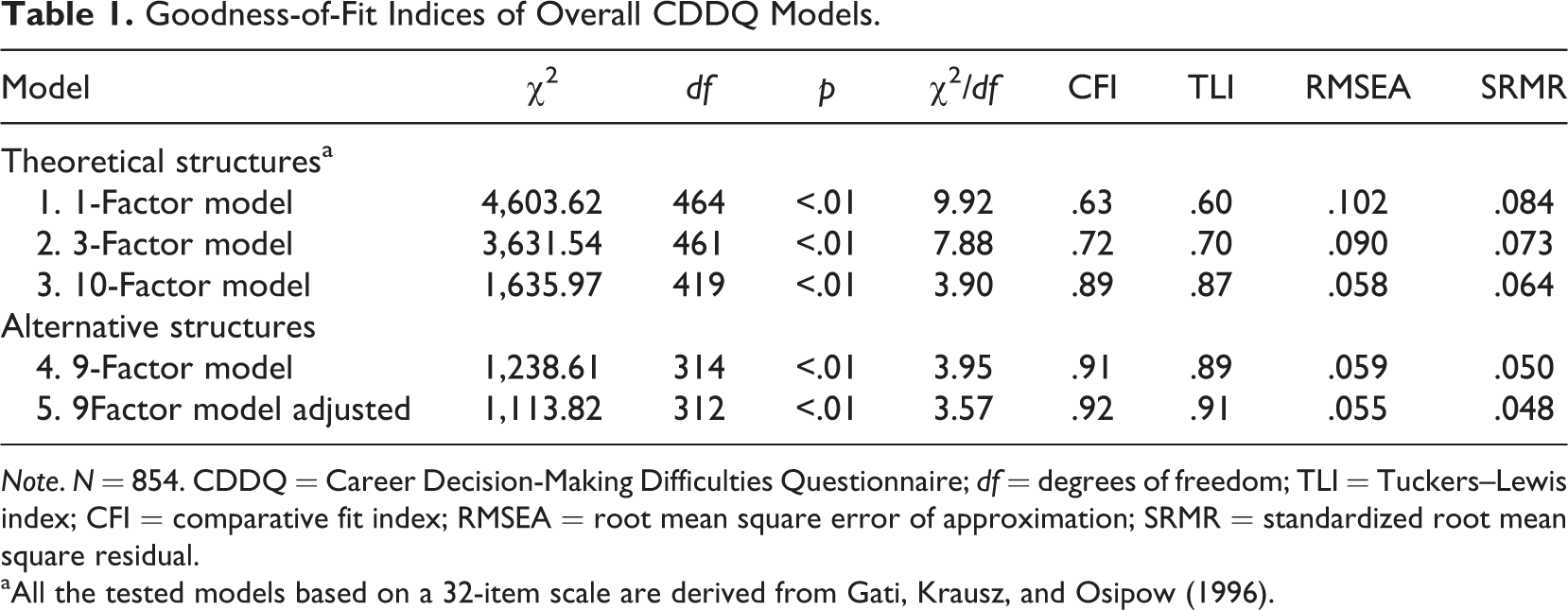
In order to explore the internal validity, appropriateness of factor analysis of the 32-item CDDQ was primarily examined. The Kaiser–Meyer–Olkin measure was .83, suggesting high sampling adequacy, and the Bartlett’s test of sphericity was significant with χ2 (496) = 11,523.64, p < .001, suggesting accepting values for factor analysis. More specifically, the values of the diagonals of the anti-image correlation matrix ranged from .57 to .96 (Mdn = .92), revealing lowest values for 3 of the 4 items included in the dysfunctional beliefs subscale, while .60 is considered as a suitable minimum cutoff value (Pett, Lackey, & Sullivan, 2003). At the step, all the items were conserved for conducting confirmatory factor analysis using structural equations modeling despite several items composing the dysfunctional beliefs subscale showing potential weakness. Because this subscale showed several inconsistences in previous studies, we decided to explore extensively its fit for a better understanding (Lancaster et al., 1999; Mau, 2001). According to Osipow and Gati (1998), the CDDQ may be interpreted theoretically at the following three-dimensional levels: global level (1-factor model), scale level (3-factor model), and subscale level (10-factor model). All of these models were initially examined. Second, adjusted and alternative models were also tested to identify an adequate structure fitting with our Korean college students’ sample.
Following the recommendations of many authors (Hu & Bentler, 1998; Kline, 1998; Sun, 2005), several goodness-of-fit indices were reported to determinate the fit of each model: χ2, the ratio χ2/df, the Tucker–Lewis index (TLI), the comparative fit index (CFI), the root mean square error of approximation (RMSEA), and the standardized root mean square residual (SRMR). According to Hu and Bentler (1999), the χ2 value should be not significant, but its sensitivity to a large sample size suggests the use of a ratio χ2/df less than 3 as a reliable alternative fit (Kline, 1998). Additionally, the TLI and CFI values should be greater than .95, but .90 is also considered as an acceptable threshold, while the RMSEA value should be smaller than .06, and the SRMR value should be smaller than .08 (Hu & Bentler, 1999).
As can be seen in Table 1, all three theoretical models tested indicated an inadequate fit, even though the 10-factor model showed significant improvement in its fit compared to the other two. Consequently, we decided to adjust the structure of the 10-factor model in order to achieve a model with an appropriate fit, testing several alternative structures derived from the 10-factor model.
Goodness-of-Fit Indices of Overall CDDQ Models.
Note. N = 854. CDDQ = Career Decision-Making Difficulties Questionnaire; df = degrees of freedom; TLI = Tuckers–Lewis index; CFI = comparative fit index; RMSEA = root mean square error of approximation; SRMR = standardized root mean square residual.
aAll the tested models based on a 32-item scale are derived from Gati, Krausz, and Osipow (1996).
First, all factor loadings of the dysfunctional beliefs subscale revealed low values ranging from .15 to .92 (Mdn = .41); we therefore decided to completely exclude this factor and its 4 items for testing a fourth model based on a 9-factor solution. Covariances between residual errors were also analyzed to improve our model (Byrne, 2001). Thus, inside the Self subscale, high covariances between residual errors of Items 16 and 17 (i.e., self as relative to career preference) and Items 18 and 19 (i.e., self as relative to personality traits) with r(854) = .42, p < .01 and r(854) = .21, p < .01, were, respectively, observed. Consequently, a 9-factor model was adjusted and showed acceptable fits. We decided to conserve the latter model including 28 items (Model 5) as the best solution in this sample. All factor loadings in this model ranged from .48 to .88 (Mdn = .73) and were significant at p < .001, suggesting good contribution of each item to their respective latent variable.
As can be seen in Table 2, the Cronbach’s α of the 28-item CDDQ was .92, while it ranged from .66 to .88 (Mdn = .75) for all the CDDQ subscales, suggesting adequate reliability (Nunnally & Bernstein, 1994). In parallel, Cronbach’s α of the dysfunctional beliefs subscale was .52. The test–retest reliability for a 1-month interval was .82 (95% confidence interval, CI [0.73, 0.88]) for lack of readiness scale .81 (95% CI [0.72, 0.87]) for lack of information scale, .86 (95% CI [0.79, 0.90]) for inconsistent information scale, and .88 (95% CI [0.83, 0.92]) for the CDDQ total score. These first analyses provided support for good internal validity, reliability, and temporal stability. Additionally, the scores distributions of the two validity items were examined. Of the items expected to be above 4, 86% participants rated the first item (i.e., I like to do things my own way) over this criterion. However, of the items expected to be below 5, only 42% participants rated the second item (i.e., I always do what I am told to do, even if it goes against my own will) under this criterion.
Means, Standard Deviations, as, and Correlations With 1-Item Scale and Career Decision Self-Efficacy Scale for Each Subscale of the 28-Item CDDQ.

Note. N = 854. 1-item scale = overall evaluation of career decision-making difficulties; CDM = career decision making; CDSE = Career Decision Self-Efficacy; NA = negative affect; CDDQ = Career Decision-Making Difficulties Questionnaire.
**p < .01 (one-tailed).
Measurement Invariance Across Gender Groups
In order to compare male and female students of our sample, we decided to analyze the measurement invariance using multigroup confirmatory factorial analyses (Byrne, 2001). Based on the method described by Chen, Sousa, and West (2005), three levels of equivalences were tested, that is, (a) configural invariance, which is considered as the first level, including nonconstraining parameters; (b) factor loadings invariance, which provides evidence of metric equivalence in constraining all the factor loadings to be equal across groups; and (c) intercepts invariance, which is measured after having determined invariant configural and factor loadings model and provides evidence of scalar equivalence across both groups. The configural invariance model showed acceptable fit indices, χ2(624) = 1,552.68, p < .01, χ2/df = 2.49, CFI = .91, TLI = .89, RMSEA = .042, and SRMR = .052. This suggested that the model fits well across gender groups. The factor loadings invariance model also showed acceptable fit indices, χ2(652) = 1,595.10, p < .01, χ2/df = 2.45, CFI = .91, TLI = .90, RMSEA = .042, and SRMR = .057. However, the comparison of the two models revealed significant differences with Δχ2(28) = 42.42, p = .04, suggesting that at least one factor loading is different across gender. After the examination of factor loading values, we allowed Item 2 (i.e., Work is not the most important thing in one’s life and therefore the issue of choosing a career doesn’t worry me much) to be freely estimated in the two groups and found nonsignificant differences between the two models, Δχ2(27) = 34.85, p = .14. This suggested that the CDDQ demonstrates partial metric equivalences across gender groups. In the next step, the intercepts invariance model also demonstrated adequate fit indices, χ2(679) = 1,672.05, p < .01, χ2/df = 2.46, CFI = .90, TLI = .89, RMSEA = .042, and SRMR = .059. However, significant differences were observed with the initial model, Δχ2(55) = 119.37, p < .01. This suggested differential functioning at a scalar level across gender. Based on the mean scores of the subscales, it was observed that female college students reported a higher number of career decision-making difficulties than male college students. Only three subscales indicated significant differences, namely general indecisiveness subscale, t(832) = −3.88, p < .01, η2 = .02; ways of obtaining additional information subscale, t(832) = −2.16, p < .05, η2 < .01; and occupations subscale, t(832) = –2.54, p < .05, η2 < .01. Nevertheless, the effective sizes may be considered as relatively small (Cohen, 1988).
Convergent and Criterion-Related Validity
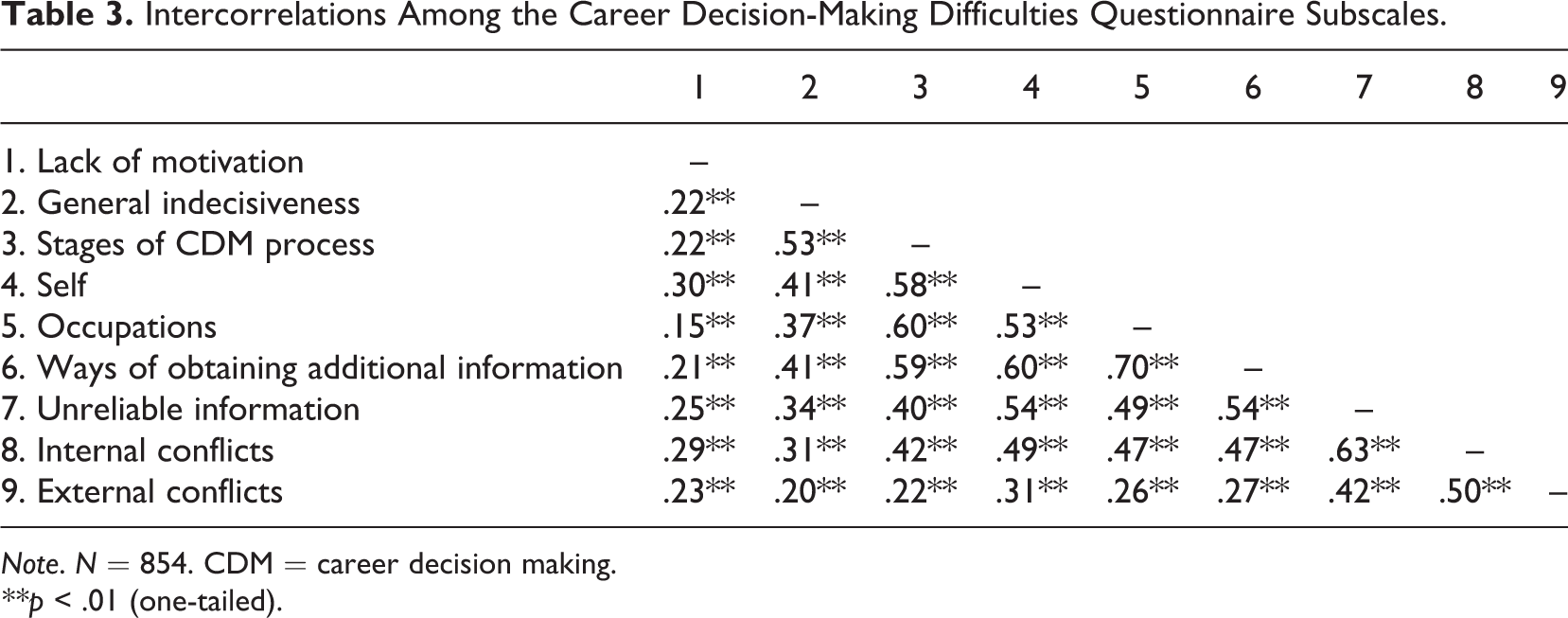
The correlations among the CDDQ subscales are presented in Table 3, which ranged from .15 to .77 (Mdn = .41). The following three elements were used for exploring the convergent validity of the CDDQ: item-total, 1-item scale, and CDSE correlations (see Table 2). At a subscale level, significant, positive, and high correlations ranging from r(854) = .45 to r(854) = .80 (p < .01, Mdn = .74) were found with the CDDQ total score, while r(854) = .68, r(854) = .92, and r(854) = .84 (p < .01) were found for lack of readiness, lack of information, and inconsistent information scales, respectively. Significant, positive, and high correlations between CDDQ subscales and 1-item scale relative to career decision difficulties were also found. These ranged from r(854) = .18 to r(854) = .54 (p < .01, Mdn = .45), but higher correlations were observed for both lack of information and inconsistent information scales compared to the lack of readiness scale, suggesting that the first two scales are more influential in career decision difficulties. The nine CDDQ subscales accounted for 41% of this 1-item scale variance, R 2 = .41, F(9, 844) = 66.07, p < .001.
Intercorrelations Among the Career Decision-Making Difficulties Questionnaire Subscales.
Note. N = 854. CDM = career decision making.
**p < .01 (one-tailed).
Examination of the correlations between the CDDQ subscales and the CDSE showed significant negative and high correlations, ranging from r(854) = −.23 to r(854) = −.54 (p < .01, Mdn = –.36). Additionally, a correlation of −.54 was observed between the total score of CDDQ and CDSE. In contrast, a low and positive correlation was reported between dysfunctional beliefs subscale and CDSE, r(854) = .08, p < .05. Finally, the positive correlations between the CDDQ subscales and the Negative Affect Scale were observed, ranging from r(854) = .13 to r(854) = .35 (p < .01, Mdn = .22). A low and positive correlation was reported between the dysfunctional beliefs subscale and the Negative Affect Scale, r(854) = .07, p < .05.
Discriminant Validity
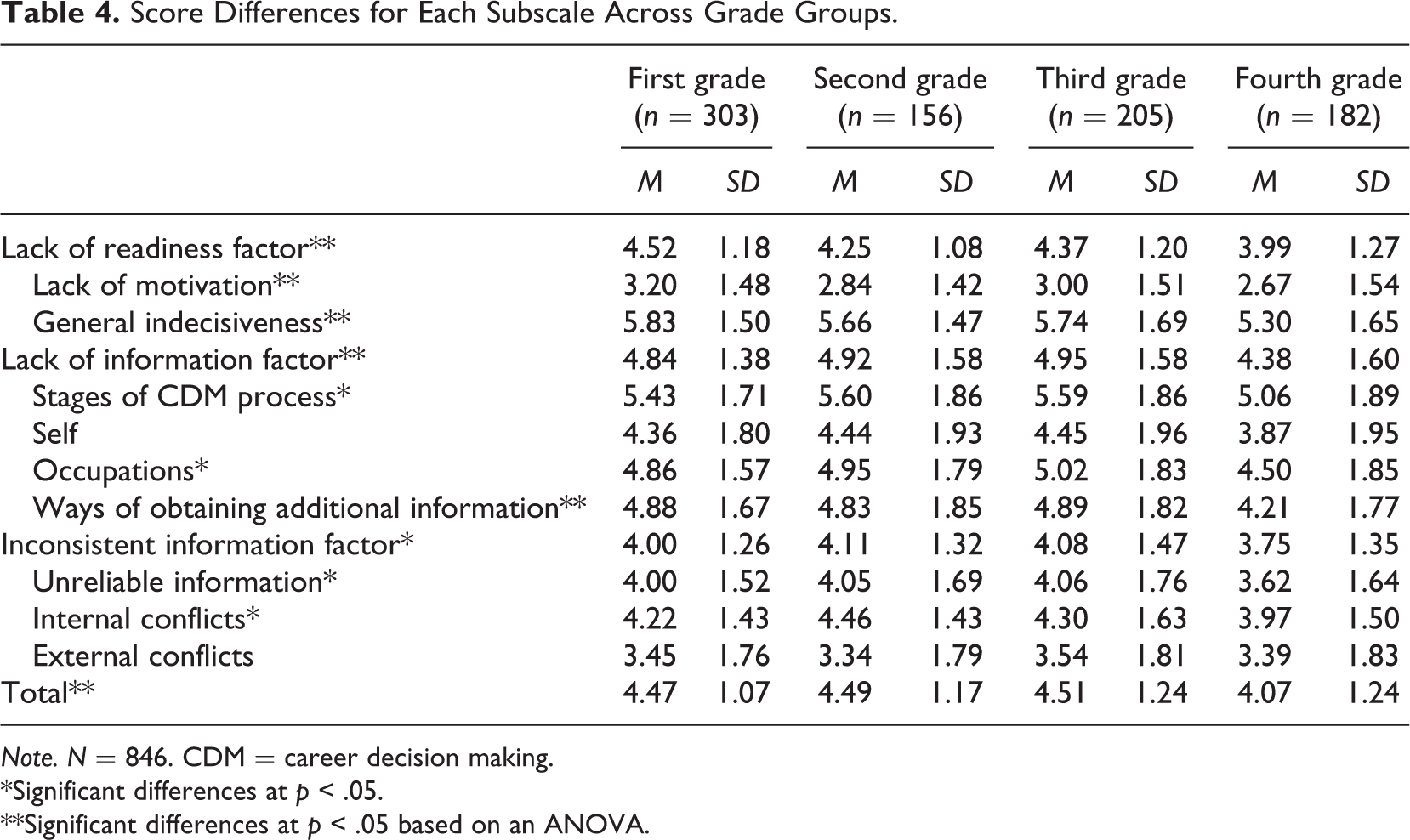
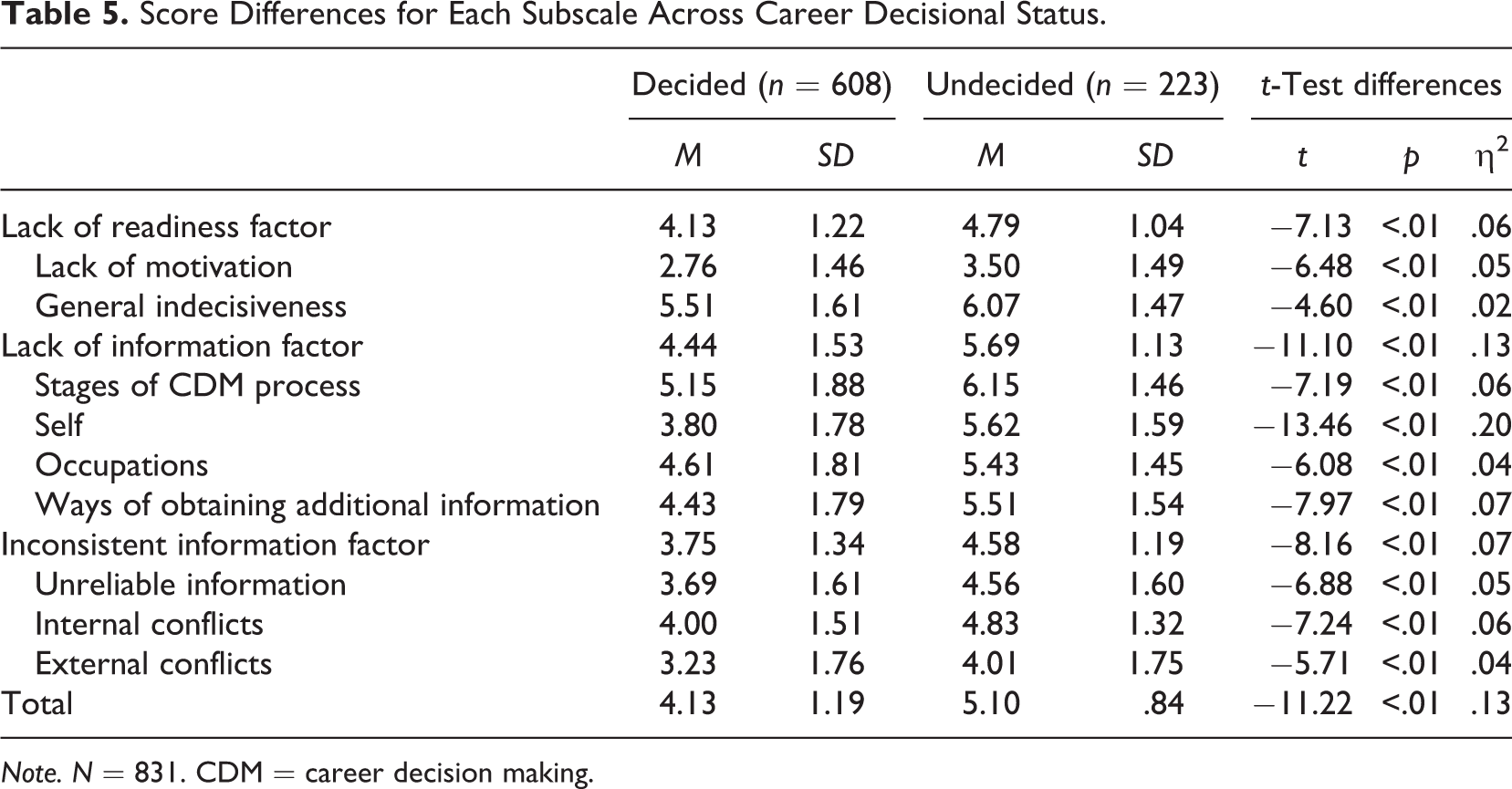
Following our literature review, the discriminant effects of two items of socio-demographic data on the CDDQ scores distribution were explored using score differences analyses: grade and career decisional status (see Tables 4 and 5, respectively).
Score Differences for Each Subscale Across Grade Groups.
Note. N = 846. CDM = career decision making.
*Significant differences at p < .05.
**Significant differences at p < .05 based on an ANOVA.
Score Differences for Each Subscale Across Career Decisional Status.
Note. N = 831. CDM = career decision making.
Analysis of mean score differences for each CDDQ subscale per grade revealed significant differences for 8 of the 10 subscales: lack of motivation, F(3, 842) = 5.21, p < .01, η2 = .02; general indecisiveness, F (3, 842) = 4.54, p < .01, η2 = .02; stages of career decision-making process, F(3, 842) = 3.52, p < .05, η2 = .01; Self, F(3, 842) = 3.87, p < .01, η2 = .02; occupations, F(3, 842) = 3.24, p < .05, η2 = .01; ways of obtaining additional information, F(3, 842) = 6.38, p < .01, η2 = .02; unreliable information, F(3, 842) = 2.95, p < .05, η2 = .01; internal conflicts, F(3, 842) = 3.21, p < .05, η2 = .01; and the CDDQ total score, F(3, 842) = 6.09, p < .01, η2 = .02. The Tukey’s post hoc tests showed significant tendencies for first-grade students to report higher career decision difficulties than fourth-grade students in general. Interestingly, third-grade students seemed to report a similar level of career decision difficulties to those of the first-grade students. However, small effect sizes were observed for all the significant differences.
Second, analyses of the effects of career decisional status on CDDQ scores showed that college students who had not made a career decision reported higher career decision-making difficulties than college students who had made a career decision. All the variables showed significant differences at p < .01. Effect sizes between moderate and large were observed, ranging from η2 = .02 (general indecisiveness subscale) to η2 = .18 (self subscale), with a median effect size of η2 = .05. The effect sizes were particularly large for lack of information scale and the total scale (for both, η2 = .13). Additionally, no significant differences were found for dysfunctional beliefs subscale, t(830) = 1.80, p > .05, suggesting an inconsistent result compared to the other subscales.
Furthermore, the interaction effects between career decisional status and grade were tested on the CDDQ total score using a 2 × 4 independent analysis of variance (ANOVA; see Table 6). The ANOVAs showed significant effects of grade, F(3, 820) = 2.96, p < .05, η2 = .01, and significant effect of career decisional status, F(1, 820) = 114.31, p < .01, η2 = .12. However, no significant interaction effect was found between these two independent variables. College students who had not reached a career decision reported higher career decision-making difficulties than college students across grades who had reached a career decision.
Two-Way ANOVA for CDDQ According to Grade and Career Decisional Status.

Note. CDDQ = Career Decision-Making Difficulties Questionnaire; SS = Sums of squares; MS = Mean squares.
Discussion
The purpose of the present study was to investigate the validity of the CDDQ (Gati et al., 1996) among Korean college students. Examination of internal validity confirmed the taxonomy of difficulties relative to career decision making, as elaborated by Gati et al. (1996) and found in various cross-cultural contexts (Lancaster et al., 1999; Lozano, 2007; Mau, 2001; Osipow & Gati, 1998; Tien, 2005; Zhou & Santos, 2007), despite some minor changes where necessary for stabilizing the structural model. Indeed, the dysfunctional beliefs subscale was removed from the model. Moreover, the results also demonstrated adequate reliability and temporal stability. Similar to most of the previous studies using the CDDQ, the lack of readiness scale presented a marginal acceptable Cronbach’s α (Gati & Saka, 2001a, 2001b; Gati et al., 1996; Lancaster et al., 1999; Leung et al., 2011; Mau, 2001; Osipow & Gati, 1998; Tien, 2001; Zhou & Santos, 2007). Those results may be explained by the broad concepts included in both lack of motivation and general indecisiveness subscales.
The CDDQ also showed a measurement invariance across gender groups, suggesting a similar structure of career decision-making difficulties in both groups at a metric level. Some minor gender differences were observed, which concurred with the previous studies (Hijazi et al., 2004; Lancaster et al., 1999; Zhou & Santos, 2007). Negative and highly significant correlations with CDSE were found, also suggesting the appropriate fit of adequate convergent validity (Amir & Gati, 2006; Morgan & Ness, 2003; Osipow & Gati, 1998), while low and moderate correlations with negative affect were found, which concurs with the previous studies (Brown & Krane, 2000; Brown et al., 2012; Callanan & Greenhaus, 1990; Chartrand et al., 1990; Lancaster et al., 1999; Saka & Gati, 2007). Additionally, college students who had not made a decision reported higher career decision-making difficulties than college students who had made a decision, also suggesting strong support for the discriminant validity of the CDDQ (Gati & Saka, 2001a; Lancaster et al., 1999; Mau, 2001; Tien, 2001, 2005).
The dysfunctional beliefs subscale showed many indices of inconsistence, that is, low reliability, low factor loadings, no significant differences across career decisional status, and low correlation with CDSE. As noted in the introductory section, difficulties in the validation of this subscale were also encountered in previous studies (Creed & Yin 2006; Gati et al., 1996; Gati & Saka, 2001a; Lancaster et al., 1999; Mau, 2001; Osipow & Gati, 1998; Vahedi et al., 2012). Further analyses revealed that most of the answers given by the respondents were below 5 (using the 9-point Likert-type scale), representing between 68% and 85% of the answers. In contrast, for Item 10, 67% of the answers were above 5. The differences between the scores’ repartition may confirm the inconsistency observed between the final item and the 3 other items, as was highlighted during the confirmatory factor analyses. More specifically, these items refer to the choice of career as a lifelong perspective (i.e., Item 9, I believe there is only one career that suits me). However, analysis of Korean culture demonstrated that the Korean government has been promoting lifelong learning and encouraging job mobility since 1996 through their educational reforms. Today, most Korean college students do not think they need to pursue only one career throughout their life. Additionally, according to an Organization for Economic Cooperation and Development (2002) report, the average male job tenure in South Korea is 5.7 years. Thus, we may suppose that most Korean students consider their career to be a protean career (Hall, 2004) or even as a life design (Savickas et al., 2009), which may suggest a nonrelevance of dysfunctional beliefs subscale in the contemporary context of globalization and a changing world. However, further investigations should be conducted to examine this assumption.
Limitations
Several limitations to this study should be addressed. First, the cross-validity of the Korean version of the CDDQ should be explored among diverse representative groups such as high school students, young adults, or even young veterans from the military service (Gati, Ryzhik, & Vertsberger, 2013; Gati & Saka, 2001a; Lancaster et al., 1999; Osipow & Gati, 1998). Future studies are needed to extend the validity of the Korean version of CDDQ among these populations and provide additional reliable support. Moreover, according to the context of South Korea, effects of college prestige/ranking, family influence, academic achievement, and socioeconomic status on career indecision should be investigated among college students (Park & Kim, 2006; Sovet & Metz, 2014; Tak, 2006, 2012).
Both paper-and-pencil and Internet forms were used for examining the temporal stability. However, investigations are required to confirm the equivalence of the two survey formats among this population (Gati & Saka, 2001b). Finally, the relevance of the taxonomy of career decision-making difficulties through the Korean culture should be closely explored (Leong & Pearce, 2011; Mau, 2001). For instance, we found that CDDQ and overall measure of career decision making share only 41% common variance. It suggests that additional dimensions should be included in order to take into account cultural aspects of the concept in South Korea (Tak & Lee, 2003). In the same manner, emotional aspects of career decision-making difficulties such as anxiety and pessimism view could provide better understanding of the difficulties faced by Korean college students (Brown et al., 2012; Choi et al., 2011; Saka & Gati, 2007). The examination of the CDDQ should also be extended in other cultural contexts in order to determinate the cross-cultural validity of this taxonomy (Mau, 2001).
Perspectives
Our study provides valuable evidences of the cross-cultural validity of the CDDQ in South Korea. It could serve as a useful instrument for identifying career indecision among Korean college students and to help them find a way to solve and overreach their difficulties relative to the career decisional process. The computer-assisted career guidance systems developed by Gati, Saka, and Krausz (2001) may be particularly interesting as a preventive career intervention according the previous studies conducted in the country (Kim & Kim, 2001). The lack of career exploration is often reported by Korean high schools as a consequence of academic pressure toward university entrance (Hwang et al., 2006). The need for effective career interventions in the direction of college students is particularly crucial in facing the changing job market in Korean society (Yang et al., 2012). Finally, regarding the results of our study, the CDDQ seems to be a reliable instrument for assessing career decision-making difficulties among Korean college students.
Footnotes
Acknowledgments
We would like to thank Professor Itamir Gati for his assistance in the development of the Korean version of the CDDQ. We are also very grateful to Professors HAN Young-Seok (Hoseo University, Asan), PARK See-Young (Cheonbuk National University, Cheonju), and SEOK Dong-Heon (Daegu National University, Daegu) for their generous help in the data collection process.
Declaration of Conflicting Interests
The author(s) declared no potential conflicts of interest with respect to the research, authorship, and/or publication of this article.
Funding
The author(s) disclosed receipt of the following financial support for the research, authorship, and/or publication of this article: This research was supported by the Korea Foundation for their contribution of a grant given to the authors.