



Abstract
Workers exposed to job insecurity and job changes are ever increasing, however, studies among temporary workers are underrepresented in the literature. This study adopts a positive approach to the topic investigating the individual factors leading temporary workers to take advantage from their flexible jobs. This study, carried on among 471 temporary workers, hypothesized that self-efficacy and internal locus of control are associated with work satisfaction and with the perception of situational opportunities. Moreover, self-efficacy is posited to indirectly relate to work satisfaction through the perception of situational opportunities and career enhancement strategies. Findings attested a direct association between internal locus of control and satisfaction and an indirect association between self-efficacy and work satisfaction.
Over the last years, organizations responded to the increasing need of flexibility, cost reduction, and continuous changes by adopting forms of contingent work (Kirk & Belovics, 2008), which help companies to avoid the cost of hiring permanent employees. In this scenario, temporary work agencies have quickly developed (Connelly & Gallagher, 2004; Galais & Moser, 2009; Kirk & Belovics, 2008), since they rapidly provide companies with specialized and short-term workers. Beyond the benefits for organizations, due to the high workforce flexibility, the development of temporary work also entails some critical implications for workers, such as instability, frequent changes, requirement of constant training, and adaptability to different contexts (Boyce, Ryan, Imus, & Morgeson, 2007).
Most of the studies within this field have focused on the negative consequences of working in a highly transitory environment, such as reduced well-being (Galais & Moser, 2009), low job satisfaction, and low organizational commitment (Connelly & Gallagher, 2004; De Cuyper, Notelaers, & De Witte, 2009). However, few contributions have investigated the positive factors that may lead temporary workers to take advantage of and value the temporary work experience, and therefore be more satisfied with their flexible jobs (Slattery, Selvarajan, & Anderson, 2006; Tan & Tan, 2002). In particular, the psychological resources necessary to adapt to career transitions and work changes (such as those faced by the temporary workers) have not been investigated enough (Heppner, 1998).
Since among permanent workers job satisfaction is mostly affected by individual characteristics (Judge & Bono, 2001; Luthans, Avolio, Avey, & Norman, 2007), it is reasonable to think that these factors may also act similarly among temporary workers. Specifically, personal characteristics related to the “control over circumstances” mind-set, namely, self-efficacy and internal work locus of control, allow people to adapt more effectively to the work context, particularly during stressful events, changes, adverse or unpredictable work circumstances (e.g., Gist & Mitchell, 1992; Kozlowski, Gully, Nason, & Smith, 1999; van den Heuvel, Demerouti, Bakker, & Schaufeli, 2010). Such conditions are typical among temporary workers who are confronted with unstable work contracts, continuous changes in tasks and social environments related to the different work assignment (Boyce et al., 2007; De Cuyper & De Witte, 2006). Therefore, we posit that self-efficacy and internal work locus of control may play a crucial role in predicting temporary work satisfaction.
Nevertheless, self-efficacy and locus of control may operate through different processes. We argue that people with internal work locus of control, as they feel that events depend on their behavior (Wang, Bowling, & Eschleman, 2010), are more inclined to have a better outlook of the work environment and thus to be more satisfied, as compared to the people with external work locus of control. Similarly, self-efficacy is associated with a more positive perception of situational opportunities (Mohammed & Billings, 2002). However, the perception of the opportunities inherent in the temporary work experience is also likely to mediate the relationship between self-efficacy (but not internal locus of control) and career enhancement strategies, namely, the proactive behaviors related to learning and networking strategies enacted by the employee in order to actively enhance his or her own future career. According to Bandura (1997), self-efficacy enables cognitive, motivational, affect, and choice processes, which produce certain behaviors (such as handling opportunities offered by the job, adapting to different contexts and to continuous changes, and facing conflict and competition with colleagues) in order to achieve the desired results (Bandura, 1997). Thus, self-efficacious workers are likely to behave as active agents who reach and take advantage of resources in their context by capitalizing on their experiences in order to pursuit their goals and perform successfully. Although there is strong evidence concerning the role of self-efficacy in activating specific behaviors (Bandura, 1997; Stajkovic & Luthans, 1998), locus of control, pertaining to a casual attribution of general events, has a weak influence, if any, on work behavior (Bandura, 1991).
In light of these arguments, this study, conducted among an overlooked population in vocational research proposes a positive approach to the study of temporary work and includes three novel elements. First, it compares the contribution of self-efficacy and internal locus of control to the perception of situational opportunities and to satisfaction with the temporary job. Second, it emphasizes the active role of self-efficacy in fostering behaviors related to future career development (such as networking and information seeking), and thus satisfaction with the temporary work experience. Third, it proposes a self-efficacy temporary work scale in order to measure the specific self-beliefs of being able to master the changing tasks and the dynamic social work environment characteristic of temporary jobs.
Self-Efficacy, Locus of Control, and Work Satisfaction Among Temporary Workers
A substantial body of research among permanent workers has attested that personal resources have a positive impact on job satisfaction (Judge & Bono, 2001; Luthans et al., 2007). In particular, self-efficacy, that refers to the extent to which the individual feels confident in having the capabilities to successfully face specific events and circumstances of their work context (Bandura, 1997), has shown to be directly related to job satisfaction in several business sectors (i.e., telecommunications, manufacturing, and service; Judge & Bono, 2001; Luthans et al., 2007). Given the high expectancy of success due to the belief in personal capabilities, self-efficacious people have been found to be more satisfied with their work (Avey, Reichard, Luthans, & Mhatre, 2011; Luthans et al., 2007). In fact, they approach events and challenges with a positive state of mind (Luthans et al., 2007), which allows them to emphasize the positive aspects of their experience and to be more resilient in the face of failures, since they are confident to have the abilities to create their own success.
Internal work locus of control (Rotter, 1966; Spector, 1982) is defined as the belief that work events depend on factors internal to the person. Individuals with a high internal locus of control believe that their success depends on themselves and feel to have more control upon events, therefore making them more satisfied with their life and job, as compared to people with external locus of control (Spector, 1982; Wang et al., 2010). Recent meta-analyses (Judge & Bono, 2001; Wang et al., 2010) have highlighted a strong relationship between internal work locus of control and job satisfaction.
Therefore, we believe that temporary workers, being confident to have the capabilities to handle the different aspects of their work experience and to persist when facing difficulties and failures, are likely to be more satisfied with their work experience. Similarly, temporary workers with internal locus of control are also more likely to be satisfied, because they feel that results depend on individual’s actions.
Self-efficacy, Locus of Control, and the Perception of Situational Opportunities
Social cognitive theory posited an agentic perspective of human development (Bandura, 2000; Wood & Bandura, 1989) in which the person, the environment, and the behavior are rooted in an interdependent and mutual causal structure labeled triadic reciprocal causation (Bandura, 1986). As active agents, people are both products and producers of their environment (Bandura, 1997), because they can exert a transformative action on it and an intentional influence on the events of their life. According to Bandura (1997), self-efficacy may be considered the main self-regulating mechanism of the human agency. Self-efficacy beliefs influence how people think, feel, make decisions, motivate themselves, and persevere in the face of difficulties and challenges. Moreover, self-efficacy may trigger the cognitive representation of the situation emphasizing the aspects that better fit individual expectations and psychological state (Mohammed & Billings, 2002). Experimental research attested that self-efficacy increases the perception of situational opportunities and decreases the perception of situational threats (Krueger & Dickson, l994; Mohammed & Billings, 2002). Also field studies showed that people with high self-efficacy have a more positive perceptions of their work and social environment (Borgogni, Dello Russo, Petitta, & Vecchione, 2010; Consiglio, Borgogni, Alessandri & Schaufeli, 2013).
Temporary work features (such as frequent changes in tasks, job location, job requirements, new supervisors, and colleagues from one assignment to the next) are quite different, as compared to the permanent ones (Boyce et al., 2007; De Cuyper & De Witte, 2006). Some authors (Nauta, van Vianen, van der Heijden, van Dam, & Willemsen, 2009; van den Heuvel et al., 2010) recently suggested that self-efficacy plays a crucial role also under unstable conditions. Hence, we assume that self-efficacious temporary workers are more likely to recognize the situational opportunities inherent in the temporary work experience as favorable aspects of the work experience for future learning and development.
As explained previously, since individuals with high internal work locus of control see events as being contingent on people’s behavior, they may be inclined to perceive the environment more positively than people with an external work locus of control (Judge, Locke, & Durham, 1997; Judge, Locke, Durham, & Kluger, 1998). On the contrary, externals may perceive a more threatening environment, since they believe that events are managed by external influences beyond their personal control, such as others’ actions or accidental events. Therefore, the attributional style may be of particular importance among temporary workers, embedded in unpredictable and challenging work conditions, broadly characterized by uncertainty (Boyce et al., 2007). Thus, we posit that internals, being confident that results are not related to external conditions but are proportional to the individuals’ efforts, may see the temporary work as a challenging experience with more abundant opportunities.
Self-Efficacy in Action: The Mediating Role of the Perception of Situational Opportunities
Internal locus of control, even if it is believed to be related to a more positive view of the work environment, is not supposed to foster proactive behaviors (Bandura, 1991). Self-efficacy represents a crucial dimension also for adaptive and transformative action within a changing work context (van den Heuvel et al., 2010), namely, the temporary work.
Temporary workers have numerous occasions to increase their knowledge and develop new skills by handling different tasks and by interacting with different people from one assignment to the next (Boyce et al., 2007). Studies on a similar population, namely, newcomers (Bravo, Peirò, Rodriguez, & Whitely, 2003; Morrison, 1993), have highlighted that the successful learning of newcomers is linked to informational networks with peers and supervisor. In fact, seeking out information may help newcomers to face the requirements of the new job and, on the other hand, to develop skills and competencies useful to adapt to different contexts and situations (Bravo et al., 2003). Similarly, temporary workers need to seek information, not only once, but every time they have to integrate in a different organization. Consistent with Bravo (2003), we believe that the adjustment to the new work environment entails active behaviors, such as networking and information seeking, which may be considered as a strategy for improving not only learning in the present job but also future development and career. In agreement with Penley and Gould (1981) and Feij, Whitely, Peirò, and Taris (1995), we define career-enhancing strategies as a set of extra-role, voluntary and planned behaviors (e.g., information and feedback seeking by peers and supervisors, networking…) aimed to improve learning and developing his or her future career path (Bravo et al., 2003; Morrison, 2002; Penley & Gould, 1981).
Self-efficacy has been studied in relation with several aspects of career, such as early phases of career choice (Betz & Hackett, 2006), prediction of career interests (Nauta, 2007), and career exploration behaviors (Gushue, Clarke, Pantzer, & Scanlan, 2006), whereas less attention has been given to the role of self-efficacy in improving career-enhancing strategies. On the other hand, in new and uncertain contexts, work success largely depends on the active role of the individual in enacting information and feedback seeking and networking behaviors (Bravo et al., 2003; Mihail, 2008; Morrison, 2002; Penley & Gould, 1981). As Wood and Bandura posited (1989), self-efficacy can be one of the strongest individual predictors of career development, learning and work success by leading employees to proactively construe their own paths of career. Since self-efficacy affects how individuals perceive and behave in the work context, we posit that self-efficacious temporary workers, as they are more likely to anticipate all the potential value inborn in situational opportunities, will better seek out and exploit them. Specifically, they will be more willing to maximize their learning and networking in order to enhance their career by searching for feedback from supervisors, seeking information from colleagues, and creating contacts in order to increase future job occasions.
Toward Work Satisfaction: The Mediating Role of Strategies for Enhancing Career
The growing of contingent forms of work has substantially modified individual paths of career, entailing people to actively adapt to an uncertain job market by analyzing their career opportunities and selecting the best strategies for increasing their own professional development (Mihail, 2008). Career success has been largely studied and linked to job satisfaction (Judge, Cable, Boudreau, & Bretz, 1995). However, few contributions suggested that people having an active role in planning and enhancing their professional and personal development are more likely to be satisfied with their work, since they feel they can influence their career development and achieve intrinsic and extrinsic rewards (Harris & Ogbonna, 2006; Judge, 2009).
All in all, we believe that temporary workers’ self-efficacy is associated with work satisfaction also indirectly, through the mediating role of the perception of situational opportunities and the enactment of career-enhancing strategies targeted to maximize their learning and development. Specifically, we posited that self-efficacious people perceiving more opportunities inherent in the temporary work experience develop strategies aimed to exploit them, enhancing their career path from one job assignment to the next and thus are more likely to be satisfied of their temporary work experiences.
Method
Participants and Procedures
Temporary workers from 16 different local offices of one of the main Italian temporary employment agencies were involved in the research. Local agencies were contacted by researchers, requesting authorization to contact these workers. When the workers received their pay check, research aims were explained, and a self-reported questionnaire was administered in the local agencies. Participation was completely voluntary and the questionnaire guaranteed the anonymity. A total of 471 workers (50.4% males and 49.6% females) completed the questionnaire. The age of the respondents ranged from 18 to 20 years (8.4%), 21 to 30 years (61.5%), 31 to 35 years (19.1%), and over 36 years (11%). Moreover, 6.7% had a university degree, whereas the majority have completed only high school (53.7%). The last temporary job assignment for 17.8% of the respondents lasted less than 1 month, 37.4% from 1 to 2 months, 21.4% from 4 to 6 months, and 23.4% more than 6 months.
Measures
The questionnaire consisted of 22 statements measured on a 9-point Likert-type scale (from 1 = strongly disagree to 9 = strongly agree).
Temporary workers’ self-efficacy
Consistent with Bandura’s recommendations (2006) for construct specificity, a tailored Self-Efficacy scale for temporary workers was created. Two focus groups, each with 10 workers, were previously conducted using the critical incidents technique (Flanagan, 1954), in order to identify the main challenges and difficulties that temporary workers have to face, regardless of their particular job function. The areas that emerged were related to the ability to adapt and to handle the changing work context, to manage new, competitive, or even conflicting relationships with colleagues, and to earn recognition and appreciation by the company. Five items were worded as individual’s belief of being able to carry on such specific behaviors (e.g., I’m always able to face competition with others and I’m always able to adapt myself to each different work context).
Internal work locus of control
Four items, concerning the individual’s belief that results and success in work are controlled by his or her own actions, were selected and adapted from existing validated scales (Pierro & Tanucci, 1992; Spector, 1988; e.g., Everything happens to me, it depends on me and work results are always proportional to the work effort).
Perception of situational opportunities
Five statements were generated to measure the respondents’ perception of the opportunities offered by working with a temporary contract. Using the same focus groups of workers, we explored which were the perceived opportunities offered by the temporary work experience and translated them into statements. In particular, we considered the possibility to develop new relationships, knowledge and competencies, as well as opportunities for future professional growth and job placement (e.g., Temporary work offers me the chance to improve my career and Temporary work gives me the opportunity to enter the labor market).
Career-enhancing strategies
In order to measure a set of concrete work behaviors oriented to improve individual skills and competencies and obtain professional growth, 3 items, adapted from previously validated scales (Depolo, Fraccaroli, & Sarchielli, 1995; Morrison, 1993; Penley & Gould, 1981), were used (e.g., I often ask my colleagues advice to about training or experiences needed to enhance my future job’s perspectives and I create a contact network to get help or advice in order to increase my opportunities of future employment).
Work satisfaction
We investigated the perceived satisfaction derived by the temporary work experience gained until now, with regard to the different tasks and jobs held, the work contexts and training received, and the professional and economical growth acquired through the different assignments. Five statements from Smith, Kendall, and Hulin’s (1969) Job Satisfaction scale were adapted in order to fit with the features of temporary work (e.g., I’m satisfied regarding the possibility to enhance my income from one assignment to another and I’m satisfied with the professional training I receive before undertake a new assignment).
Statistical Analysis
A confirmatory factor analysis (CFA) was carried out on all items using Mplus 5 (Muthén & Muthén, 2007). We first specified a measurement model in which the observed variables loaded on the posited five latent variables (namely, self-efficacy, internal work locus of control, perception of situational opportunities, career-enhancing strategies, and work satisfaction) based on the assumption that they represent distinct, but correlated, constructs. This was a congeneric model in which neither cross-loadings nor correlated errors were allowed. In order to investigate the factorial validity of the constructs measured and the degree of possible overlapping among them, the posited measurement model was compared with the following two alternative models: (1) a one-factor model in which all the items loaded on one general factor (Harman, 1967) in order to test whether the majority of the variance can be accounted for by one general factor, representing the influences of method bias (Podsakoff, MacKenzie, Lee, & Podsakoff, 2003) and (2) a four-factor model in which self-efficacy and internal locus of control items loaded on the same factor and all the other observed variables loaded on their posited factor. In fact, given the potential overlapping between the two concepts, both referred to personal beliefs, this model intended to test whether self-efficacy and locus of control measures represented two separate dimensions. The posited relationships among the variables were investigated by means of a structural equation model (SEM), using maximum likelihood estimation method for parameter estimation. To evaluate the goodness of fit of the model, we used multiple fit indices for both measurement and structural models, namely, χ2, the root mean square error of approximation (RMSEA), the Tucker–Lewis index (TLI), the comparative fit index (CFI), and the standardized root mean square residual (SRMR). Finally, the Δχ2 was calculated to compare the nested models.
Results
Descriptive Statistics
The zero-order correlations and the Cronbach’s α coefficients of all the scales are presented in Table 1. All the Cronbach’s α coefficients exceeded the cutoff value for sufficient reliability (Nunnally & Bernstein, 1994), ranging between .848 and .612, thus, revealing acceptable reliability for all factors.
Means, Standard Deviations, Correlations Among Variables, and Cronbach’s α Coefficients.
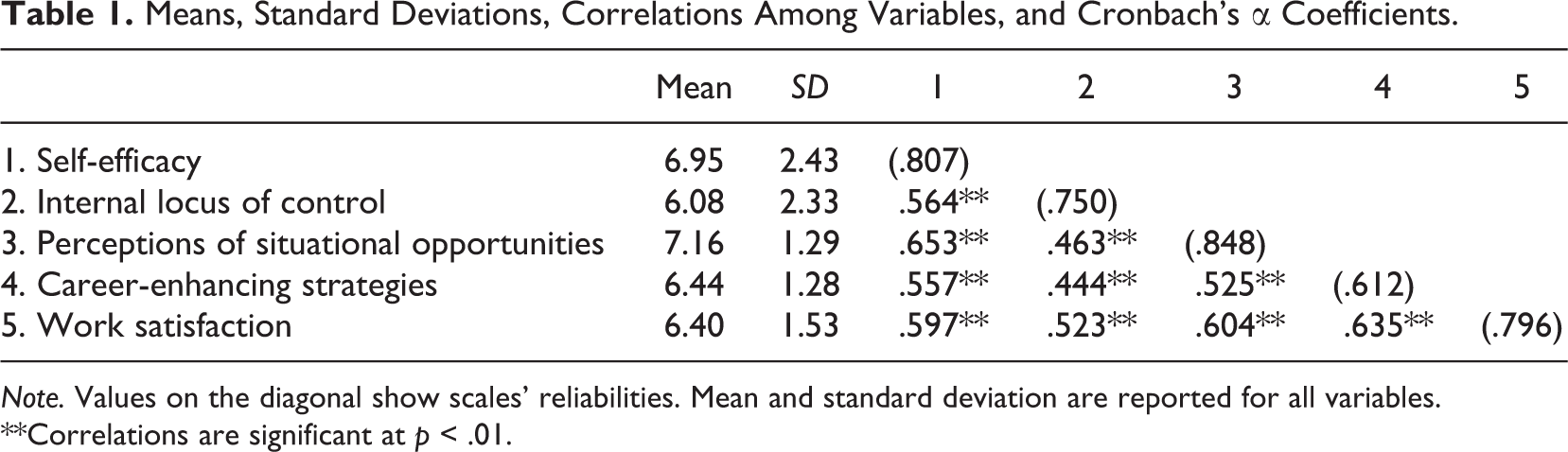
Note. Values on the diagonal show scales’ reliabilities. Mean and standard deviation are reported for all variables.
**Correlations are significant at p < .01.
Measurement Models
Findings supported the appropriateness of each item in relation to the hypothesized latent factor with factor loadings. Factor loadings were all significant and ranged from .349 to .841. In particular, for self-efficacy loadings ranged from .583 to .707; for locus of control from .483 to .749; for perception of situational opportunities from .645 to .841, for career-enhancing strategies from .389 to .770, and for work satisfaction from .638 to .764.
Multiple goodness-of-fit indexes of the hypothesized five factors model revealed that the model fitted the data well, χ2 (179, N = 471) = 426.993, p = .00, CFI = .935, TLI = .923, RMSEA = .056, SRMR = .043, with the only exception of the χ2 significance. This was likely due to the sensitivity to a large sample size (Bollen & Long, 1993). Moreover, the five-factor model fit better than the one-factor model, in which all variables were forced to load on one general factor, χ2 (189, N = 471) = 932.433, p = .00, CFI = .804, TLI = .782, RMSEA = .095, SRMR = .065. Similarly, a second alternative model, namely, a four-factor model in which the variables pertaining to self-efficacy and locus of control were forced to load on the same factor, fitted the data worse than the targeted one, χ2 (183, N = 471) = 560.479, p = .00, CFI = .900, TLI = .886, RMSEA = .069, SRMR = .051. In order to compare nested models, the χ2 difference test was computed. Results (Δχ2 = 505.440, Δdf = 10, p > .001; Δχ2 = 133.49, Δdf = 4, p > .001 respectively) supported the comparative best fit of the hypothesized model. All in all, the factorial validity of all measures and the distinction between self-efficacy and internal work locus of control were corroborated.
Structural Model
The structural relationships among factors were explored by adding the hypothesized structural paths to the measurement model, which adequately fitted the data, χ2 (182, N = 471) = 469.413, p = .00, CFI = .924, TLI = .912, RMSEA = .060, SRMR = .052. As shown in Figure 1, the parameter estimates partially confirmed the hypothesized relationships among the variables. Internal work locus of control was positively related to work satisfaction (β = .19, p < .001; Hypothesis 1b), whereas, contrary to our expectations, no direct relationship was found between self-efficacy and work satisfaction (Hypothesis 1a). Self-efficacy was positively related to the perception of situational opportunities (β = .70, p < .001; Hypothesis 2a), whereas internal work locus of control was not (Hypothesis 2b). The perception of situational opportunities mediated the relationship between self-efficacy and career-enhancing strategies (β = .53, p < .01; Hypothesis 3). The indirect effect of the three variables between self-efficacy and work satisfaction through the perception of situational opportunities within the temporary work experience and career-enhancing strategies was significant (total indirect effect β = .39, p < .001; Hypothesis 4). The model explained 82% of the variance of work satisfaction.
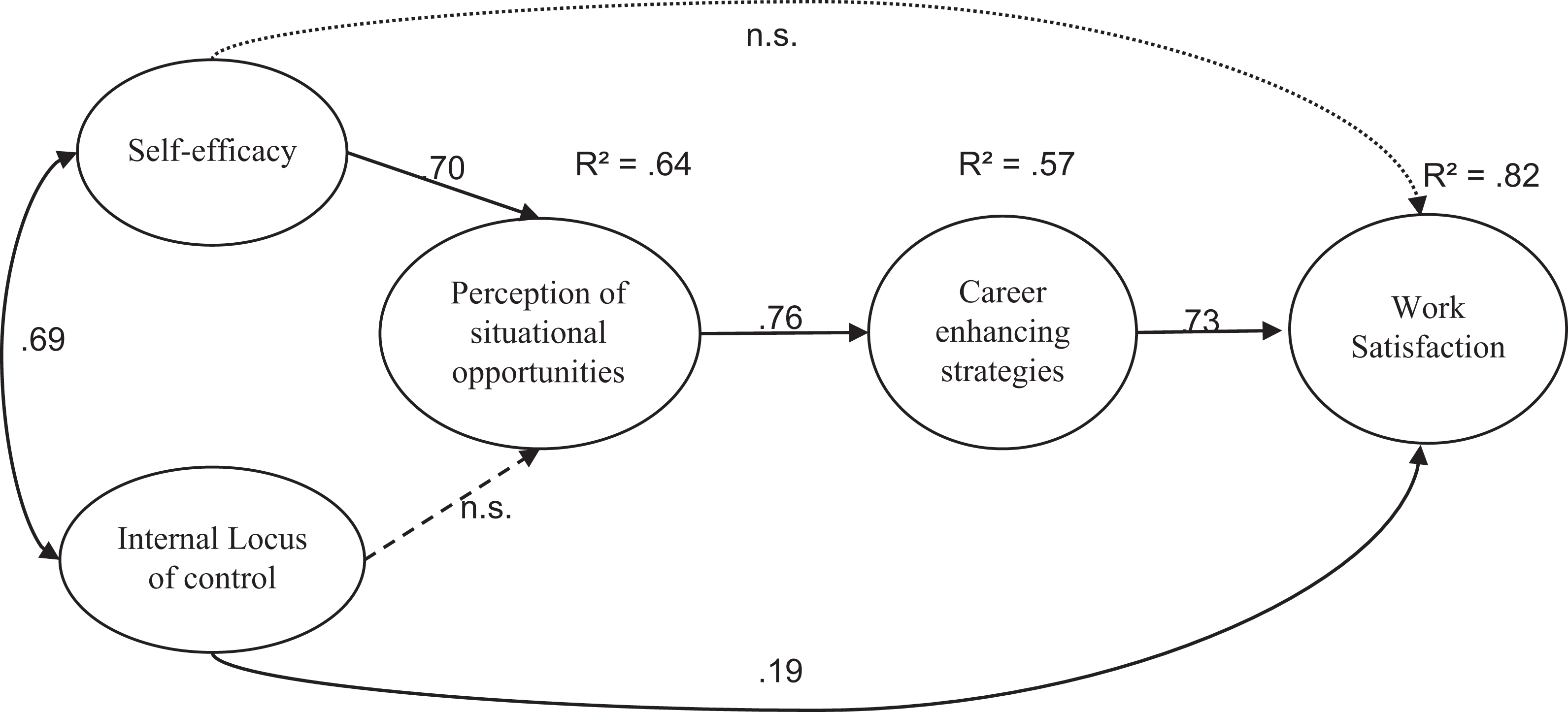
The posited model: parameter estimates. Dotted lines indicate not significant paths. All the parameter estimates are significant at p < .01. The indirect effect of self-efficacy on career-enhancing strategies through perceptions of the temporary experience is significant at p < .01 and equal to β = .53. The indirect effect of self-efficacy on work satisfaction through perceptions of the temporary experience and career-enhancing strategies is significant at p < .01 and equal to β = .39.
Discussion
This study aimed to emphasize the positive side of temporary work by highlighting what makes temporary workers satisfied. This was done by investigating the differential way through which two individual characteristics, namely, self-efficacy and internal work locus of control, are related to work satisfaction within the context of temporary work.
Our results supported the idea that both characteristics are associated with work satisfaction, even if in different ways. As hypothesized, internal locus of control has a direct relationship with work satisfaction, whereas self-efficacy has an indirect relationship with it, through the mediating role of the perception of situational opportunities within the temporary experience and career-enhancing strategies. These findings seem to confirm Bandura’s suggestions (1997) regarding the difference between internal locus of control and self-efficacy. Although both characteristics are related to the perceived control of the environment, only self-efficacy likely plays a dynamic role in activating behaviors that foster learning and development. Moreover, in our sample of temporary workers, the relationship between self-efficacy and work satisfaction found in many studies among permanent workers (Judge & Bono, 2001; Luthans et al., 2007) seems to be fully mediated by the perception of situational opportunities and career-enhancing strategies.
Given the unstable working conditions of temporary workers (Boyce et al., 2007; De Cuyper & De Witte, 2006), the situational opportunities offered by the job context are maybe less abundant, as compared to the conditions of permanent employees. In fact, self-efficacy helps people to exercise some measure of control even in environments of limited opportunities and many constraints (Bandura, 2000), as in the case of temporary jobs. Self-efficacious workers seem to approach the temporary jobs with a different “frame of mind,” which facilitates the identification of the opportunities inherent in the temporary work and in turn likely improves active strategies that promote learning and development, thus feeling more satisfied with the temporary work itself compared to inefficacious ones.
Finally, contrary to our expectations, internal work locus of control was not associated with the perception of situational opportunities. Hence, self-efficacious, but not internals, are more likely to perceive an uncertain context as challenging and as a possible source of job opportunities for the future. All in all, the belief that events depend on personal behaviors, which characterize internals, does not seem to be linked to the ability to recognize the potential and future value of opportunities. On the contrary, the belief about ones capabilities to influence the context, namely, self-efficacy, seems to lead people to undertake transformative actions in their environment by selecting and exploiting the opportunities in their favor. Hence based on our results, self-efficacious temporary workers are more likely to have a more positive perception of the temporary work experience and thus take advantage of it, by implementing strategies to enhance their future career, which in turn leads to higher satisfaction. Therefore, based on our results, the main difference between self-efficacious and internal employees likely relies in the inherent proactive role of the former in the construal process of the surrounding context. We could argue that self-efficacious employees seem to be more satisfied as a result of their action within the context, whereas internals, even if satisfied, do not necessarily adopt active strategies or proactive behaviors (such as networking or seeking information from colleagues or supervisor) in order to influence the likelihood of such (future) events.
All in all, our results may also be interpreted in the light of the general evolution of jobs and career paths that have become unpredictable and characterized by multiple transitions (Krieshok, Black, & McKay, 2009). Therefore, our model may also potentially apply to other kinds of workers who are confronted with instable careers, changing jobs, uncertain work environments such as other kinds of temporary workers directly employed by the company.
Limitations and Future Perspectives
The main limitation of this study is the cross-sectional nature of the data that warns us to cautiously interpret the relationship among the variables without making any casual inference. Even if a theoretical rationale for the relationship among the variables was provided, future studies should gather data in different waves in order to investigate the model longitudinally.
Second, since we collected only self-reported data, we are aware that our results might be biased from common method variance. However, the aim of our study was to investigate primarily self-beliefs, perceptions, and attitudes, and these constructs are by definition aspects that only the individual can report (Caprara & Cervone, 2000). Moreover, since our findings revealed that the model in which all observed variables loaded on one general latent factor did not fit the data well, it is unlikely that common method variance represents a serious concern in our study (Harman, 1967).
Future research should include objective data to investigate the relationship between individual characteristics and organizational behaviors using indicators of future career and performance, in order to test the influence of self-efficacy and locus of control on effective career enhancement and learning.
Moreover, since we explored such relationships only among an underrepresented sample population in vocational research, such as temporary workers, future studies could compare temporary and permanent workers, in order to explore if the type of contract moderates the relationships between individual characteristics and job satisfaction and career-enhancing strategies.
Finally, future studies may explore the role of personal characteristics that may be relevant to adapt and manage career transitions and changing jobs, such as career adaptability (Super & Knasel, 1981) or openness (Costa & McCrae, 1992) that could catalyze or buffer the positive impact of self-efficacy on satisfaction or enhancement strategies.
Practical Implications
The results of this study suggest that two individual characteristics, namely, self-efficacy and internal work locus of control, play a role for work satisfaction among temporary workers. Above all, the study has shown that self-efficacious temporary workers are active agents able to capitalize the utmost from work experiences and to foster behaviors related to their future career development. These findings have several implications for temporary agencies, which select and hire temporary workers, as well as for the managers of organizations in which they work. The main issue is related to the improvement of self-efficacy as a key resource for temporary workers’ future career. As van den Heuvel and colleagues (2010, p. 129) suggested, self-efficacy may be considered “a lower order, malleable, element of personality.” Therefore, it may be developed and enhanced, due to its nature of belief or judgment that can change over time. According to Bandura (1997), self-efficacy may be improved and strengthen mainly through four processes, namely, mastery experience, modeling, social persuasion, and physiological states’ control corresponding, respectively, to enactive, vicarious, social, and psychological sources. For example, temporary work agencies may improve group training targeted to promote social modeling and support between more and less experienced temporary workers. Employees could also be encouraged to see temporary work as an opportunity for their future career and to help the ones less efficacious through mentoring and coaching programs. Increasing self-efficacy would also imply increasing workers satisfaction. This could be particularly important also because it is well known that self-efficacy and job satisfaction may, in turn, influence crucial organizational behaviors, such as performance and absenteeism (e.g., Johns, 1997; Locke, 1970; Spector, 1997). Interventions could benefit from using our self-efficacy scale, purposely created to measure the specific self-beliefs regarding the ability to manage the changing tasks and dynamic work environment typical of temporary jobs, that could be used as a practical tool in such programs. Temporary agency staff could investigate the initial level of self-efficacy among temporary workers and monitor the increases or decreases through the different assignments. Moreover, given the positive relationship between career-enhancing strategies and satisfaction, temporary work agencies could also train workers to see the benefits of seeking information and networking throughout the different temporary work experiences.
Footnotes
Declaration of Conflicting Interests
The author(s) declared no potential conflicts of interest with respect to the research, authorship, and/or publication of this article.
Funding
The author(s) received no financial support for the research, authorship, and/or publication of this article.