



Abstract
This study examined the validity of Psychology of Working Theory (PWT) in a context of sub-Saharan Africa. A sample of 334 Togolese primary school teachers completed the French versions of the Decent Work Scale (DWS), the Togolese adapted form of the Satisfaction With Life Scale, the Job Satisfaction Scale (JSS), and several items about meaning at work and other personal and contextual variables (e.g., subjective salary conditions). The results suggest that both the DWS and the JSS are valid in this specific cultural setting. Although a person-centered variable (i.e., safe working conditions) was related to job satisfaction, only those variables that would have positive effects on workers’ family members and relatives (i.e., access to health care, adequate compensation, free time and rest, and complementary values) were related to life satisfaction. Overall, the results supported the validity of PWT. Implications for labor policy, individuals, employers, and counseling are discussed.
Keywords
Decent work is crucial for individuals’ development and well-being. The notion of decent work was defined within the 87th Session of the International Labor Conference in 1999 and was made an immediate priority of the International Labor Organization (ILO, 1999). In the ILO Director-General’s report, decent work was conceptualized as work that must be founded on the following four essential pillars: basic rights, employment and incomes, social security, and social dialogue (ILO, 1999). Ghai (2003) suggested assessing decent work through the above four objectively measured indicators. The suggested features have been argued to allow the assessment of access to decent work at a broader level, based on global indicators, which may serve as a guide for policy action. In 2013, the ILO suggested considering 10 key elements to describe decent work: (1) employment opportunities, (2) adequate earnings and productive work, (3) decent working time, (4) combining work, family, and personal life, (5) work that should be abolished, (6) stability and security of work, (7) equal opportunity and treatment in employment, (8) safe work environment, (9) social security, and (10) social dialogue. A few years ago, the notion of decent work was included in the United Nations’ 2030 Agenda for Sustainable Development (United Nations, 2015). According to the ILO recommendations, states should be responsible for promoting decent work through laws, policies, and institutions (ILO, 2013). However, numerous international reports and publications have highlighted that access to decent work remains a big issue in the world and that governments and organizations should increase their efforts in this regard (e.g., Cooke et al., 2019; ILO, 2013).
The 21st century is characterized by rapid and ongoing evolutions of social, economic, and technological structures, several crises and high-speed globalization that significantly impact peoples’ career and lives. In most countries, those mutations have not been supported by sufficient public policies in favor of populations, leading to increased vulnerability and social injustice. Subsequently, individuals are more responsible for managing their career and lives, which has some social justice implications (e.g., Fouad et al., 2006; Massoudi et al., 2018). It follows that underrepresented and marginalized people are more likely to face career development issues as they have limited access to employment (Blustein, 2008, 2013). Turning to the issue of decent work, a central question in this line of inquiry is how could such individuals access decent work? The recently developed Psychology of Working Theory (PWT; Duffy et al., 2016) represents an attempt to answer this question, focusing on people who work and those who want to work.
PWT
Insufficient attention has been paid to the psychological or microlevel factors that may drive decent work, and PWT is an attempt to fill this gap (Blustein et al., 2017; Blustein et al., 2016). This theory was derived from the Psychology of Working perspective (Blustein, 2008, 2013), which emerged from a critical review of the accumulated body of research on working published prior to the 21st century. Indeed, past research on working has been found to have (1) circumscribed “the range and depth of how working is studied in psychology and how individuals and organizations can achieve well-being in their working lives” (Blustein, 2013, p. 6), (2) focused in majority on people who do have choice in their working lives, to the detriment of those who do not, and (3) underestimated the role of social barriers in the questioning of unequal access to work. This perspective has launched a call to scholars to shine a spotlight on contextual factors that may contribute to the deprivation of individuals’ access to opportunity. In combining the Psychology of Working with empirically based research findings on several constructs, PWT (Duffy et al., 2016) suggests that the impact of social constraints (e.g., poverty, discrimination, or challenging labor markets) on the access to decent work could be mediated by individual strengths (e.g., career adaptability and work volition). Moreover, these relations have been hypothesized to be moderated by the four potential variables of proactive personality, critical consciousness, social support, and economic conditions. According to this perspective, decent work promotes work fulfillment and well-being through the satisfaction of people’s basic needs. As such, PWT can be viewed as an encompassing theory, a new effort at explaining the processes through which all who work and who want to work could achieve decent work and well-being in diverse contexts (Blustein et al., 2019). The usefulness of PWT has been demonstrated among populations facing challenging work transitions or several contextual barriers (e.g., marginalization, discrimination). Therefore, it is reasonable to expect its validity across populations living in economically constrained environments like the one of sub-Saharan Africa.
An emergent measure of decent work, the Decent Work Scale (DWS; Duffy et al., 2017), has been recently proposed within PWT. Subsequently, increased attention has been paid to the investigation of decent work from the psychological perspective in European and Latin America countries such as Turkey, Italy, the UK, Portugal, Switzerland, Brazil, and France (e.g., Buyukgoze-Kavas & Autin, 2019; Di Fabio & Kenny, 2019; Dodd et al., 2019; Ferreira et al., 2019; Masdonati et al., 2019; Ribeiro et al., 2019; Vignoli et al., 2020). Most of these studies have provided empirical support for the conceptualization of decent work as designed within PWT and have provided additional features for the understanding of the concept in the above contexts through qualitative investigations among local populations. However, knowledge about decent work from the perspective of less industrialized countries, especially from African populations, is still lacking (Cooke et al., 2019).
The Togolese Context
Togo is a French-speaking country in West Africa with nearly 8 million inhabitants, bordered by Benin (east), Ghana (west), Burkina Faso (north), and the Atlantic Ocean (south). In the past, this country experienced a period of buoyant economic growth from the late 1950s, through its independence (1960), and until the mid-1970s due to the boom in phosphate, its principal natural resource (Napo, 2006). However, from 1980, the country experienced an economic crisis, which led to the implementation of structural adjustment programs (e.g., budget reduction) in the early 1990s, but also internal sociopolitical tensions. These events have seriously impacted the living conditions of the Togolese people; the lowest life satisfaction score has been reported across its population, with an average score of 3.2 out of 10 in 2006 according to the Gallup World Survey (Diener & Biswqs-Diener, 2008; Gogué, 1997). In 2000, the country joined the Heavily Indebted Poor Countries Initiative.
The Togolese labor market is characterized by high unemployment among university graduates (32%), and one quarter of the population faces difficulties in achieving a satisfactory education-to-work transition (Organization for Economic Co-operation and Development [OECD], 2016). The labor market is precarious, particularly for youth, who represent more than 60% of the population (considering people aged 25 and less). For example, in 2008, within the hiring competition for public jobs, approximately 40,000 applications were recorded for the 3,000 positions initially advertised (République Togolaise, 2008); similarly, in March 2019, 25,586 applications were recorded for 1,552 positions advertised by the Ministry of Agriculture, Animal Production and Fisheries (République Togolaise, 2019). These macro factors could considerably influence individuals’ career decisions and career paths in contexts such as Togo (Atitsogbe et al., 2018). Indeed, most Togolese graduates are motivated to take public employment rather than private or self-employment (Atitsogbe et al., 2019). One explanation for this result is that sustainable and decent jobs, according to the terminology of the ILO (e.g., social security, sustainable employment, decent working time), are mostly provided by the public sector; the private sector and self-employment are seen as riskier because, in many cases, they offer no social security or health insurance. Moreover, there is no mechanism in place to allow self-employed people to contribute to their retirement through savings. In such a context of opportunity rarity, social networks have been found to have a significant weight in accessing employment. For example, according to the recent OECD report on Togo (2016), 40% of higher education graduates rely on family relationships when seeking work, instead of standard job seeking strategies. As Senaya and Akakpo-Numado (2017) reported in a study conducted among adult workers, 45 (90%) of the 50 participants reported finding their job through social relationships. Moreover, it has been documented that people with low social capital are likely to face discrimination and several contextual barriers that can deprive them of access to employment (Blustein, 2013; Blustein et al., 2002).
Efforts have been made by the Togolese government over the years to promote decent work through lawmaking (e.g., the Togolese labor law). For example, in 2011, the government introduced compulsory health care for public sector employees, which systematically also covers their family (spouse and children). A recent study conducted among 279 public workers revealed that 93.7% reported high levels of satisfaction with this compulsory health-care scheme (Bakai et al., 2019). From January 2019, primary and secondary school teachers benefited from a 5% salary increase. In 2017, the School Assur program was launched to provide health care for all primary school students attending public schools, with the prospect of extending it to all students. However, there is still a need to extend these policies to the entire population and, in particular, to the most vulnerable people. Moreover, more could be done to improve the other aspects of decent work, as defined by the ILO, especially regarding the private and informal sectors (Heintz & Pollin, 2003). Regarding research on decent work, a recent qualitative study among adult workers and university students revealed four main features defining decent work from the perspective of this population: provide basic requirements (fair compensation, health and safety, adequate work environment, availability of working tools and instruments, respect of legal norms, respects of local traditions, appropriate schedule), enable one’s professional development (learning, skills development), make one feel productive, and be a source of pleasure (Kazimna et al., 2020). Moreover, the authors identified five categories of needs that decent work should meet: vital (daily needs, accommodation), psychological (autonomy, self-esteem, meaning), social (social usefulness, contribution to society), engagement, and status-related, and they concluded for the existence of both universal and culture-specific features of decent work.
Working Conditions of Primary School Teachers
It is well documented that teachers in low-income countries face several challenges at work. As Wolf et al. (2015) reviewed, these teachers often deal with increasing workloads, low and infrequent compensation, and a lack of recognition, career development opportunities, equipment, accountability, and voice. Togolese teachers, especially those teaching in primary and secondary schools, are more likely to face such difficulties. Since 2010, the educational and training system has been marked by important crises. These teachers usually demonstrate their dissatisfaction through strikes to ask for better work conditions. Beyond salary, other factors make teaching in primary schools challenging, including overcrowded classes due to an insufficiency of classrooms, which may contain more than 100 students in urban areas, an insufficiency of materials such as reading or exercise materials, and a high weekly workload, which is evaluated at 28 hr (République Togolaise, 2013; United Nations Educational, Scientific, and Cultural Organization [UNESCO], 2010). These school teachers can be titulaires, auxiliaires/trainees, contractuels, or volunteers. Titulaires are officials with public servant status, who benefit from a permanent contract, health care, and a pension plan. Auxiliaires with less qualification were usually recruited to compensate for the lack of staff in public schools; they could obtain public servant status after 5 years of teaching experience. From 2015, their status was changed to that of trainees’, and they were able to benefit from health care and pension plans. They could hold titulaire status after 1 year’s experience and successfully passing an exam. Contractuels, recruited mostly on short-term contracts in private institutions, are not systematically provided abovementioned advantages, as their situation depends on their employers. Volunteers are recruited through a national volunteering program on a once-renewable 1-year contract to teach in public schools. They benefit from health care but not pension plans. Community volunteers are recruited and paid by community schools or a parent’s association. These teachers have the least enviable conditions as most of them do have no health care or pension plan. As noted, the most preferred status is that of titulaire followed by trainee and private contractuels. Less advantaged contractuels and volunteers tend to search for better private employers or rely on public recruitment, which creates frequent turnover within these categories. Women are underrepresented in teaching in Togo. According to the 2016–2017 educational dashboard, there were 37,985 teachers in total, 16.4% of whom were women. There were 24,490 (64.5%) primary school teachers working in public schools versus 13,178 (34.7%) working in private schools (Direction de la Planification, de l’Education et de l’Evaluation, 2018).
The Present Study
This study aimed to investigate the validity of PWT in the Togolese context by testing its theoretical assumptions among individuals dealing with the precarious nature of work. In Togo, primary school teachers experience adverse working conditions in terms of unfavorable working environment (overcrowded classes), or income or job insecurity. As such, they represent a relevant sample to consider. Drawing on previous research, this study sought to evaluate the links between demographic variables (i.e., age, gender, social status, and type of employer), subjective and objective job characteristics (i.e., job insecurity, seniority, and subjective salary conditions), decent work and its components, and the outcome variables of work meaning, job satisfaction, and life satisfaction.
Because professional advancement and work conditions such as income usually increase by year, because women are dramatically underrepresented not only in teaching but also in higher positions, and because public employment is viewed as presenting more advantages than private employment in this context, we expect that age (Hypothesis 1), seniority (Hypothesis 2), gender (Hypothesis 3), and the type of employer (Hypothesis 4) will be positively associated with decent work (Atitsogbe et al., 2019). Given the connection between access to decent work conditions and the attainment of well-being, we expect that job insecurity will be negatively associated with decent work (Hypothesis 5) and that social status (Hypothesis 6) and subjective salary conditions (Hypothesis 7) will be positively associated with decent work (Allan et al., 2019; Di Fabio & Kenny, 2019; Masdonati et al., 2019). Furthermore, we expect direct positive paths from decent work features to work meaning (Hypothesis 8), job satisfaction (Hypothesis 9), and life satisfaction (Hypothesis 10). Finally, given that in less industrialized countries, job characteristics such as financial means or subjective salary conditions are known to be linked with well-being (e.g., Sovet et al., 2016), one could expect such relations to be mediated by the construct of decent work. Therefore, beyond PWT, we hypothesize that decent work will mediate between job characteristics (i.e., job insecurity, salary conditions, and seniority) and the outcome variables (i.e., work meaning, job satisfaction and life satisfaction; Hypothesis 11; Figure 1). Beforehand, the appropriateness of DWS and the JSS will be investigated in our sample as there is no previous validity study on these scales in the study context.

Hypothesized mediation model: From job characteristics to outcomes via decent work. Note. Nonsignificant paths were deleted for clarity purposes.
Method
Participants
A sample of 334 teachers in the Lomé-Golfe educational region from both public (n = 64; 19.2%) and private (n = 270; 80.8%) primary schools participated in this study. The sample consisted of 309 (92.5%) men and 25 women aged 23–61 (M = 39.30, SD = 7.73). At the country level, the proportion of women teaching in primary school is estimated at 16.4% (UNESCO, 2010). Among this sample, 48.2% respondents were teaching the fifth grade, and 51.8% were teaching the sixth grade. Among these teachers, 136 (40.7%) were titulaires, 89 (26.6%) were contractuels, 69 (20.7%) were volunteers, 38 (11.4%) were auxiliaires, and 2 (0.6%) were trainees. Regarding seniority, 114 (34.1%) had been teaching for more than 15 years. Approximately 249 (74.6%) were married, and 279 (83.5%) were parents. Regarding education level, 143 (42.8%) had graduated from the first cycle of secondary school (sixth to ninth grade), 144 (43.1%) were high school graduates (10th–12th grade), and 47 (14.1%) held a BSc, MSc, or higher degree. PWT suggests considering some demographic variables as antecedents of decent work. In light of this suggestion, information about job insecurity (the type of contract), subjective salary conditions, and seniority was collected.
Procedure
The sample was constituted using a weighted stratified sampling method (Magnani, 1999) from five of the seven education inspection services of the Lomé-Golfe region. Three hundred fifty-seven participants derived from the above sampling method were selected randomly from a recent national education database. After being granted permission from school directors, the selected primary school teachers of the fifth and sixth grades were informed about the objectives of the study. They all volunteered for the study and were surveyed by the second author. The participants either completed a paper and pencil questionnaire onsite or took the questionnaire home and sent it back within 4 weeks. In total, 340 of the 357 questionnaires were collected. Six questionnaires with more than 10% missing data were excluded. Our final sample thus consisted of 334 participants.
Instruments
Decent work
Decent work was assessed using the DWS (Duffy et al., 2017) that was translated and validated into French initially in Switzerland (Masdonati et al., 2019). Another French translation was provided by Vignoli et al. (2020). This scale consists of 15 items equally divided into five subscales: Safe Working Conditions, Access to Health Care, Adequate Compensation, Free Time and Rest, and Complementary Values. Internal consistencies for the subscales ranged from .79 to .97 in Duffy et al. (2017), from .73 to .94 in Masdonati et al. (2019), and from .70 to .93 in Vignoli et al. (2020). The two latter studies show that French versions of DWS have good fit and validity in Switzerland and France. All items were rated on a 7-point Likert-type scale, ranging from strongly disagree (1) to strongly agree (7). Cronbach’s α values found in the present sample were .66 for safe working conditions, .84 for access to health care, .45 for adequate compensation, .54 for free time and rest, and .73 for complementary values. As noted, reliabilities were low for adequate compensation and free time and rest. Removing Item 9 “I am rewarded adequately for my work” from the Adequate Compensation subscale and Item 12 “I have free time during the work week” from Free Time and Rest subscale led to increased reliabilities of .83 and .66, respectively.
Meaning at work
Meaning at work was assessed using the single item “Do you find meaning in your work?”, designed specifically for this study. This item was dichotomous, with response options Yes or No. We created this single-item measure for at least two reasons. First, to our knowledge, there is no validated scale assessing this construct in Togo or in sub-Saharan Africa. Moreover, authors have argued work meaning is a culture-dependent construct (e.g., Cooke et al., 2019). As the conceptualization of this construct in the African context has not been investigated, and given the lack of an available instrument, the use of this item was the most accessible solution for the present study.
Job satisfaction
To assess job satisfaction, the JSS (Judge et al., 1998), including 5 items, was used. Items were rated using a 7-point Likert-type scale ranging from strongly disagree (1) to strongly agree (7). Masdonati et al. (2019) and Vignoli et al. (2020) reported satisfactory reliabilities of .84 and .82, respectively, among French-speaking Swiss and French adult workers. Cronbach’s α value for this 5-item scale in our sample was .64. However, Item 3, “Each day of work seems like it will never end” (reverse-scored), was excluded as it was found to contribute to the scale to a lesser extent in our sample. This resulted in an adapted 4-item form of the JSS, with an α of .76 in the current sample.
Satisfaction with life
Life satisfaction was assessed using the Satisfaction With Life Scale (SWLS; Diener et al., 1985) that was previously adapted to the Togolese context (Sovet et al., 2016). This 5-item scale evaluates subjective well-being. Sovet and colleagues (2016) investigated the validity of the SWLS among undergraduate university students in Togo. They found that the first item of the original scale “In most ways, my life is close to my ideal” had a poor factor loading and proposed an alternative item “Globally, my life is close to the ideal life I imagine,” which showed good reliability with the other items of the scale (α = .81). The scale was found to be valid for use in the Togolese context. Each item was rated on a 7-point Likert-type scale ranging from strongly disagree (1) to strongly agree (7). The composite score of the 5 items’ scores provides an overall life satisfaction score. Cronbach’s α value for this scale was .66.
Social status was measured by asking participants to indicate the size of their annual salary among nine options ranging from 1 (less than approximately US$800) to 9 (more than approximately US$6,700).
Type of employer. Participants were asked to indicate whether their employer is a public institution (1) or private (2).
Job insecurity was assessed by recoding professional status data. Titulaire holders benefit from a permanent contract, which the other status holders do not. Therefore, job insecurity was coded (1) for permanent contract and (2) for other cases.
Subjective salary conditions were assessed through the single item “How do you perceive your salary conditions?”, rated on a 5-point Likert-type scale ranging from 1 (very bad) to 5 (very good). This item assesses more general aspects including pay, benefits (e.g., family allowance), and also the regularity of payment during the contract (is the salary regularly paid without interruption?), which is an important component of perceived salary conditions in this context. This construct correlated with the DWS subscale of Adequate Compensation, but not to a level that they would be considered overlapping (r = .12).
Seniority. Participants were asked “For how long have you been teaching?” using a 5-point Likert-type scale ranging from less than 1 year (1) to more than 15 years (5).
Socioeconomic status, type of employer, job insecurity, salary conditions, and seniority were each assessed through single-item measures that were designed specifically for this study.
Analyses
First, descriptive statistics including means, standard deviations, Cronbach’s α, skewness (S), kurtosis (K), and bivariate correlations were computed for all variables. S and K values between −2 and +2 are indicative of a roughly normal distribution. Second, a series of confirmatory factor analyses (CFAs) were conducted to assess the structural validity of the DWS, JSS, and SWLS using AMOS Version 25.0 and maximum likelihood estimation. Several fit indices were considered: χ2 per degree of freedom (χ2/df), the goodness of fit index (GFI), the comparative fit index (CFI), the Tucker-Lewis index (TLI), and the root mean square error of approximation (RMSEA). According to widely accepted methodological standards, values of χ2/df ≤ .3; GFI, CFI, and TLI ≥ .90 (Byrne, 2010), and RMSEA ≤ .08 or .05 (Hu & Bentler, 1999) are considered indicative of an acceptable or good fit. Finally, structural equation modeling (SEM) procedures were performed to evaluate the links between job characteristics (i.e., subjective salary conditions, seniority, and job insecurity) and work-related outcomes (i.e., work meaning, job satisfaction, and life satisfaction), considering decent work as a potential mediator and controlling for the demographics of age, social status, and type of employer. The indirect effects mediated by decent work were tested based on 5,000 bootstrap samples and 95% bias-corrected confidence intervals (Shrout & Bolger, 2002).
Results
Descriptive Statistics
The descriptive statistics for all variables are provided in Table 1. The ranges of S and K suggested that the distributions are roughly normal. Concerning the demographics, high (values above .50) positive correlations were found between age and seniority and between the type of employer and job insecurity. Medium negative correlations (ranging from .30 to .50 in absolute value) were found between social status and job insecurity, age and job insecurity, and between the type of employer and social status. The overall decent work score was highly correlated with the five DWS subscale scores. Medium correlations were found between adequate compensation and free time and rest, between safe working conditions and job satisfaction, between job satisfaction and work meaning, and between overall decent work and job satisfaction.
Means, Standard Deviations, Internal Reliabilities, and Intercorrelations for All Scales.

Note. S = skewness. K = kurtosis. α = Cronbach’s alpha coefficient.
a Single and dichotomous measure, and for which point-biserial correlations are presented.
*p < .05. **p < .01. ***p < .001.
Validity of the DWS, the JSS, and the SWLS in the Togolese Context
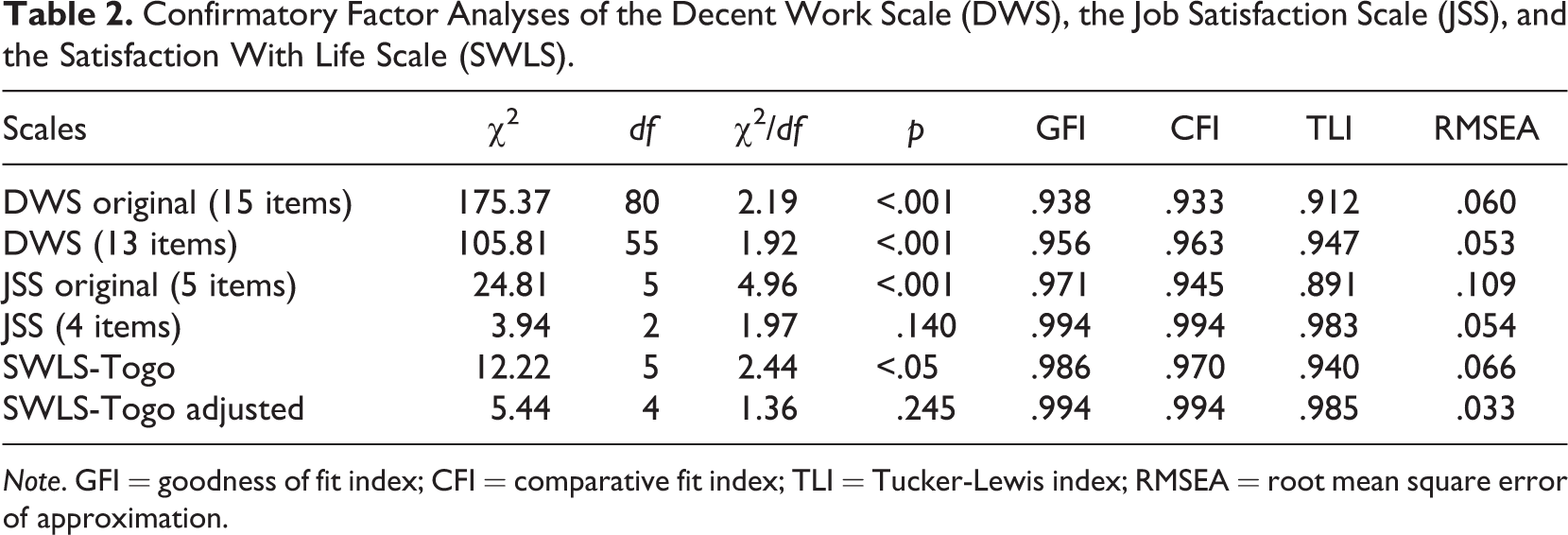
The factor structure was assessed for each scale through CFAs. The fit indices for the three scales are reported in Table 2. A five-factor correlational model, a higher order model, and a bifactor model were tested, respectively, for the DWS (Duffy et al., 2017), whereas a unidimensional model was considered for both the JSS and the SWLS. The DWS correlational model exhibited good fit indices with standardized loadings ranging from .77 to .87 (Mdn = .77): χ2(80) = 105.81, p < .001, GFI = .956, CFI = .963, TLI = .947, RMSEA = .053. The higher order model presented a decline in fit, compared to the correlational model, with TLI slightly below .90: χ2(60) = 184.60, p < .001, GFI = .923, CFI = .908, TLI = .881, and RMSEA = .079. Standardized loadings for the 13 items ranged from .50 to 1.14 (Mdn = .77); those of the three subscales with 3 items each (Safe Working Conditions, Access to Health Care, and Complementary Values) were .68, .55, and .54, respectively, whereas those of the subscales with 2 items (Adequate Compensation and Free Time and Rest) were very low, at .07 and .14, respectively. Finally, the bifactor model was tested. To be identified, the model needed additional constraints for items of the two subscales with 2 items. This model did not fit well: χ2(54) = 175.70, p < .001, GFI = .928, CFI = .910, TLI = .871, and RMSEA = .082. For the five subscales, loadings for the 13 items ranged from .31 to .85 (Mdn = .68). For the general factor, item loadings ranged from .00 to .07 for the 4 adequate compensation and free time and rest items, and from .34 to .56 for the 9 other items (Mdn = .46). As noted, the correlational model had the best fit and was retained (Table 2). However, it is important to note that the higher order model and the bifactor model nearly reached acceptable fit.
Confirmatory Factor Analyses of the Decent Work Scale (DWS), the Job Satisfaction Scale (JSS), and the Satisfaction With Life Scale (SWLS).
Note. GFI = goodness of fit index; CFI = comparative fit index; TLI = Tucker-Lewis index; RMSEA = root mean square error of approximation.
The unidimensional structure of the JSS provided a good fit, with factor loadings ranging from .47 to .77 (Mdn = .73). Finally, the SWLS also provided a good fit. The factor loadings for this scale ranged from .34 to .72 (Mdn = .58). We took into account the only modification index higher than 4 and did allow error terms of Items 1 and 4 to covary. This resulted in a better fit.
Demographics, Job Characteristics, and DWS Subscales
A previous investigation has shown that demographic variables (e.g., age, social class) and job characteristics (e.g., job insecurity) could predict decent work (Masdonati et al., 2019). Drawing on the findings of the above study, we expanded our hypotheses by testing the predictive effects of demographic variables (i.e., age, sex, social status, type of employer) and job characteristics (i.e., job insecurity, subjective salary conditions, and seniority) on the DWS subscales through multiple regression analysis. The results showed that these variables all together explained a relatively low part of the variance in the DWS subscales: safe working conditions, R 2 = .07; access to health care, R 2 = .03; adequate compensation, R 2 = .03; free time and rest, R 2 = .06; and complementary values, R 2 = .07. With respect to the demographic variables, age (Hypothesis 1) was related only to safe working conditions (β = .18, p = .017), while sex (Hypothesis 3), type of employer (public or private; Hypothesis 4), and social status (Hypothesis 6) did not predict any of the DWS subscales. Regarding job characteristics, contrary to our expectations, job insecurity (Hypothesis 5) was related to none of the DWS subscales. Subjective salary conditions (Hypothesis 7) were related to the DWS subscales except that of free time and rest: safe working conditions (β = .17, p = .003), access to health care (β = .13, p = .020), adequate compensation (β = .15, p < .010), and complementary values (β = .12, p = .029). Seniority (Hypothesis 2) was only related to safe working conditions (β = −.16, p = .034) and complementary values (β = −.28, p < .001).
Decent Work, Work Meaning, Job Satisfaction, and Life Satisfaction
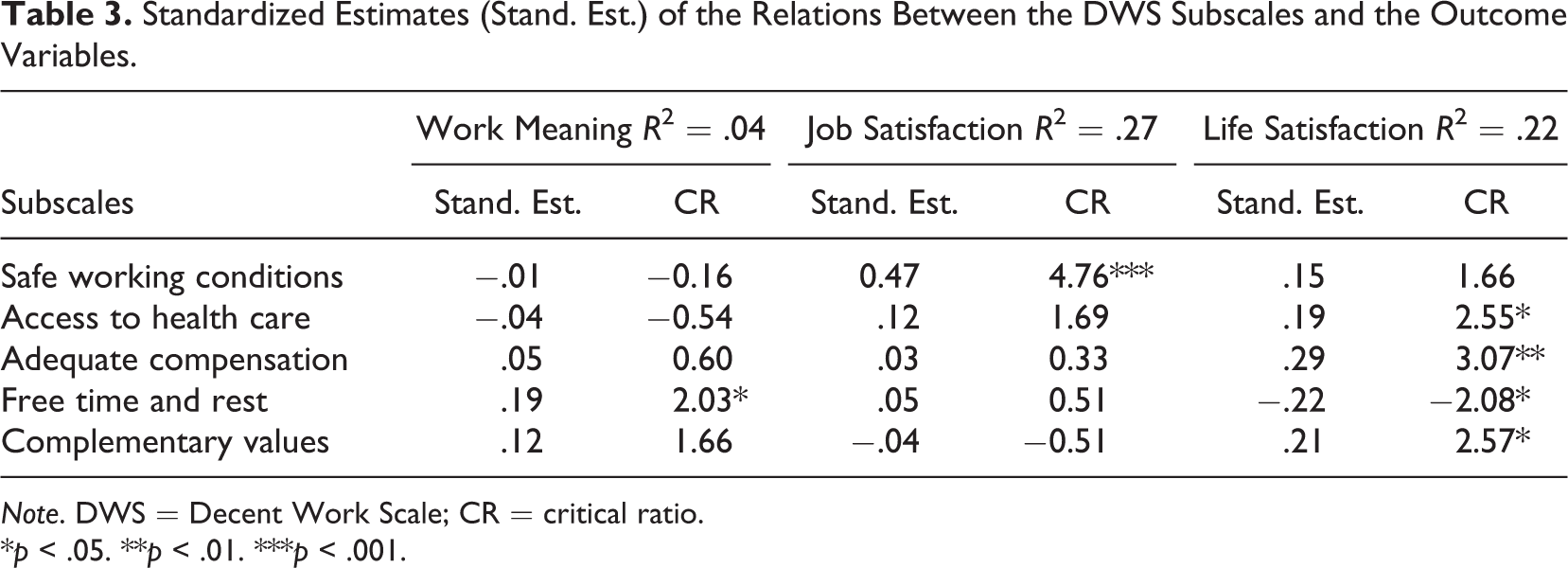
SEM procedures were performed to evaluate the relatedness of the DWS subscales to the outcome variables. Therefore, direct paths from the DWS subscales to the outcome variables were tested considering the latent variables except work meaning. This model had a poor fit: χ2/df = 2.05, GFI = .904, CFI = .902, TLI = .879, and RMSEA = .056. An adjustment was made by adding two covariance links based on modification indices above 20. The model then showed significant improvement in fit: χ2/df = 1.83, GFI = .914, CFI = .923, TLI = .904, and RMSEA = .050. As shown in Table 3, the DWS subscales explained 4% of the variance in work meaning, 27% of the variance in job satisfaction, and 22% of the variance in life satisfaction. Safe working conditions were related to job satisfaction (β = .47 p < .001), but job satisfaction failed to be predicted by the four other DWS subscales (Hypothesis 9). Access to health care (β = .19, p = .011), adequate compensation (β = .29, p = .002), free time and rest (β = −.22, p = .038), and complementary values (β = .21, p = .010) predicted life satisfaction (Hypothesis 10). Finally, regarding Hypothesis 8, only free time and rest predicted work meaning (β = .19, p = .042).
Standardized Estimates (Stand. Est.) of the Relations Between the DWS Subscales and the Outcome Variables.
Note. DWS = Decent Work Scale; CR = critical ratio.
*p < .05. **p < .01. ***p < .001.
Decent Work as a Mediator Between Job Characteristics and Satisfaction
Beyond PWT assumptions, we hypothesized a mediating effect of decent work between job characteristics and the outcome variables of work meaning, job satisfaction, and life satisfaction, when controlling for demographics (Hypothesis 11). Beforehand, nonsignificant paths from the predictors to the three outcomes were removed, as based on Shrout and Bolger’s (2002) recommendations for mediation testing. According to these authors and as reviewed by Nilforooshan and Salimi (2016), a full mediation is observed when the following three conditions are met simultaneously: (1) a significant total effect of the predictor on the criterion, (2) a significant indirect effect of the predictor on the criterion via the mediator, and (3) a nonsignificant direct effect of the predictor on the criterion after having introduced the mediator in the model. Partial mediation is observed when the two last conditions are met simultaneously.
As shown in Figure 1, the mediation model included the observed scores of the predictors (subjective salary conditions, seniority, and job insecurity), the decent work latent variable (composed by loading the observed subscales on a general factor), the latent variables of the outcomes of job satisfaction and life satisfaction, and the observed score of the outcome variable of work meaning. When the demographics of age, social status, and type of employer were controlled, the paths linking them to the mediator and the outcomes were nonsignificant, and the overall fit was not adequate: χ2/df = 1.85, GFI = .925, CFI = .910, TLI = .882, and RMSEA = .050. Removing the nonsignificant paths related to controlled variables but keeping them as covariates with the predictors provided a good fit: χ2/df = 1.713, GFI = .925, CFI = .918, TLI = .900, and RMSEA = .046. Mediation was tested considering 5,000 bootstrap samples and 95% bias-corrected intervals. The mediation of decent work was tested for three relations: subjective salary conditions → job satisfaction, subjective salary conditions → life satisfaction, and seniority → job satisfaction. The results indicated that decent work did not mediate the relation between seniority and job satisfaction. However, decent work did partially mediate the relation between subjective salary conditions and job satisfaction: significant standardized total effect (β = .33, p < .001), indirect effect (β = .16, p = .001), and direct effect (β = .17, p = .017). Decent work also partially mediated the relation between subjective salary conditions and life satisfaction: standardized total effect (β = .41, p < .001), standardized indirect effect (β = .11, p = .002), and standardized direct effect (β = .30, p < .001). These findings indicated that Hypothesis 11 was partially confirmed.
Discussion
The main purpose of the present study was to test some of the theoretical assumptions of PWT using a Togolese sample of primary school teachers. The appropriateness of the scales used was examined beforehand. The results showed that the DWS and the two considered outcome scales of the JSS (the adapted 4-item version) and the SWLS (the Togolese adapted form) fit the data well. Drawing on theory and previous studies, a set of demographic variables and both objective and subjective job characteristics were linked to the DWS subscales and the outcome variables of work meaning, job satisfaction, and life satisfaction to capture the importance of these variables in explaining decent work and the outcomes. Moreover, the DWS subscales predicted the outcome variables. Finally, as we hypothesized, decent work mediated the relations between subjective salary conditions and both job satisfaction and life satisfaction.
Regarding the validity of the DWS and the JSS that were used for the first time in this context and in line with previous studies conducted in several cultures (e.g., Duffy et al., 2017; Masdonati et al., 2019), our sample replicated the five-factor structure and the unidimensional structure for these scales, respectively, supporting their appropriateness for use in this context. However, for the DWS, analyses revealed a very weak loading of positively worded items when mixed with negatively worded items on a scale. Such mixing has been documented as a serious source of response bias (Chyung et al., 2018). Moreover, reversed items usually do not function very well in the African context, which may be due to cultural or language reasons, or to a “yes” bias, as observed by Hansen et al. (2020) in the Kenyan population. Moreover, the JSS item “Each day of work seems like it will never end” seems not to have been understood the same way as it has been in studies in Western populations and may need to be reworded. A more explicit alternative such as “Each day of work seems very long to me” could be tested in further investigations. For further research, a nonreversed and adapted version of these items could be considered (Chyung et al., 2018; Van de Vijver, 2016). Although the DWS correlational model had the best fit, it is interesting to note that the higher order model and the bifactor model nearly reached acceptable fit. The slight deviation from the norm is acceptable here for both the higher order model and the bifactor model given that two subscales had two indicators instead of three. Some authors recommend using more than two indicators per variable (see Worthington & Whittaker, 2006). Further investigations including reliable items and more indicators per subscale will provide more insight into this issue.
For demographics, our findings indicated that being employed in the public sector is associated with higher social status and lower job insecurity. This outcome may explain why young Togolese graduates seeking jobs prefer those in the public sector (Atitsogbe et al., 2019). A negative association was found between age and job insecurity, suggesting that teachers reach more stable positions with tenure.
Our hypotheses involving decent work features were partially confirmed, with the exceptions of Hypotheses 5, 3, 4, and 6. Hypothesis 5 anticipated a negative relation between job insecurity and decent work features. In fact, our findings showed no significant relation between job insecurity and DWS subscales. This should be considered in light of our specific sample. As mentioned, public primary and secondary school teachers in Togo with a secure job (permanent contract) typically strike for decent working conditions, while teachers in private institutions instead seek better employers. In such a context, job insecurity appeared not to be a significant contributor to decent work. As noted, job insecurity correlated relatively highly with sex (Hypothesis 3), type of employer (public or private; Hypothesis 4), and social status (Hypothesis 6), which may explain the lack of significant relations between these demographics and DWS subscales.
We found that age (Hypothesis 1) and social status (Hypothesis 6) were related positively to some DWS subscales (i.e., safe working conditions and/or access to health care), suggesting that teachers increasingly access jobs that provide good working conditions and advantages year by year and that their working experience has much to do with gaining such access. Subjective salary conditions were positively related to four DWS subscales, except that of free time and rest (Hypothesis 7), making subjective salary conditions the most important predictor of decent work features among Togolese teachers. Higher levels of seniority were associated with lower levels of safe working conditions and complementary values (Hypothesis 2). An explanation for these findings could be that teachers gain more responsibilities year by year and/or experience difficulties with their tasks with aging, thereby leading them to perceive their working conditions as being more challenging and less safe (Wolf et al., 2015).
A previous investigation based on PWT has supported the predictive role of decent work over work meaning (i.e., Allan et al., 2019). However, according to our findings, only the DWS subscale of Free Time and Rest contributed significantly and negatively to work meaning (Hypothesis 8). This interesting pattern needs to be discussed. One explanation for this could be that the more people have free time, the less they are engaged in occupational activities, leading to a decrease in meaning they can find in working. As it has been demonstrated that meaningful work positively correlates with work engagement (Steger et al., 2013), the decrease in work meaning related to high levels of free time and rest in our study may make sense. It is also possible that this relation is moderated by variables such as workers’ activity rate (e.g., full-time vs. part time). Concerning the relation between free time and rest and work meaning, some authors have reported negative (e.g., Ferreira et al., 2019), some positive (e.g., Di Fabio & Kenny, 2019), and some no relation (e.g., Duffy et al., 2017). This could suggest that this relation can be affected by potential micro- and macro level moderators or mediators (e.g., activity rate, capitalist oriented vs. noncapitalist economies) and needs to be further investigated and clarified, taking the context into particular consideration. Other studies have observed that some DWS subscales are not related to work meaning, namely, Safe Working Conditions, Access to Health Care, Adequate Compensation, and Free Time and Rest (Buyukgoze-Kavas & Autin, 2019; Di Fabio & Kenny, 2019; Dodd et al., 2019; Duffy et al., 2017; Ferreira et al., 2019; Ribeiro et al., 2019). Except for one study (i.e., Ferreira et al., 2019), a nonsignificant effect of access to health care on work meaning is observed cross-culturally.
In line with all previous investigations, safe working conditions were related to job satisfaction (e.g., Di Fabio & Kenny, 2019; Ferreira et al., 2019; Ribeiro et al., 2019). However, and contrary to what was expected and observed in previous studies, none of the four other DWS subscales were positively related to job satisfaction (Hypothesis 9). Indeed, one of the assumptions within PWT is that the relation between decent work and well-being is mediated by the satisfaction of needs such as survival needs, social connection needs, and self-determination needs (Duffy et al., 2016). These three groups of needs are critical in contexts such as Togo and may play an important role in the relation between decent work features and job satisfaction. Further investigations in this direction could illuminate these processes.
It is interesting to note that the DWS subscale of Safe Working Conditions failed to significantly contribute to life satisfaction (Hypothesis 10), which did not replicate previous findings (Ferreira et al., 2019). Moreover, access to health care, adequate compensation, and complementary values positively predicted life satisfaction, while free time and rest negatively predicted life satisfaction in our sample. There are a couple of explanations for these findings. Togolese public sector workers are provided health insurance, which automatically benefits their immediate family members, including their spouse and their declared children, with 80% health coverage. Regarding compensation, as in most collectivist cultures, workers usually provide financial support to their extended family (e.g., parents, uncles, aunts, cousins, nephews, in-laws), and providing such support is socially recognized. As Turaki (2006) summarized, in Africa, “People are not individuals, living in a state of independence, but part of a community, living in relationships and interdependence” (p. 36). Therefore, in such a context, it makes sense that the most significant drivers of life satisfaction transcend individuals and benefit their extended family or community. Contrary to the positive relation hypothesized, our findings revealed that lower levels of free time and rest were associated with higher levels of life satisfaction. In fact, in contexts of less job opportunity, the fact of being professionally busy (less free time and rest) would contribute to the improvement of individuals’ social status (as reported in Table 1), which would subsequently lead to higher levels of life satisfaction (Sovet et al., 2016).
A meta-analysis has shown a marginal effect of perceived salary conditions on job satisfaction (Judge et al., 2010). The present study demonstrated that decent work partially mediated the relations between subjective salary conditions and the two well-being outcomes of job satisfaction and life satisfaction, suggesting that decent work could be considered an important variable in clarifying the process through which the perception of income is related to satisfaction in different domains (Hypothesis 11). These findings contribute to expanding the literature and studies regarding PWT at a broader level.
Implications for Policy, Individuals, Employers, and Counseling
We found that safe working conditions were key predictors of job satisfaction, whereas access to health care, adequate compensation, free time and rest, and complementary values accounted mostly for teachers’ life satisfaction. As seen, the latter four decent work features also have positive impacts on workers’ families and relatives. In contexts such as Togo, where family is important and where individuals depend on each other, it will be useful to give more importance to these features in developing and implementing public policies for promoting well-being among these populations. For instance, health care should not be reserved only for a certain category of persons. This initiative could be generalized and made available for all, as suggested by several researchers (e.g., Bakai et al., 2019). New policies could support the transition from informal businesses to formal business to raise the number of decent jobs (Heintz & Pollin, 2003). This research also has several implications for employers, specifically highlighting how important it is to employees to have access to decent jobs, as satisfaction with job and life are found to be significant predictors of organizational outcomes such as job performance, organizational citizenship, work engagement, and even persistence in teaching (e.g., Mau et al., 2008). In helping clients to access decent work in contexts like Togo, career counselors could consider working with them on decent work features. More precisely, they could investigate with clients how important these features are to them and how their access to jobs that provide these features would positively impact their own life and that of their relatives, given that in collectivist cultures, working is often motivated by the need to care for the extended family, as well as the worker’s immediate family (Evans, 2010).
Limitations and Further Directions
There are some limitations to this study. The correlational model of the DWS showed the best fit, supporting the use of the DWS subscales as independent scores for prediction. Although the higher order model and the bifactor model showed slight discrepancies from acceptable fit standards, we considered a latent general factor for decent work in the mediation model, despite recommendations to demonstrate best fit for both models beforehand (Duffy et al., 2017). Had an appropriate number of indicators been considered, more would have been known about the fit of both models. Thus, the appropriateness of a general factor needs to be further investigated. Decent work has been argued to be a top-down initiative from a Western perspective, international organizations, and authors have highlighted that it should be contextualized, as sociocultural values significantly influence both individuals’ attitudes toward work and the meaning they could find in working in a given cultural context (e.g., Cooke et al., 2019). Regardless of working conditions, some key decent work features such as professionalism, productivity, and enjoyment were reported as important in the study context (Kazimna et al., 2020). Although our findings suggest that the DWS is suitable for use in such a context, integrating local perspectives to a mainstream measure such as the DWS could allow for additionally capturing specific and local aspects of decent work.
Our findings regarding work meaning should be taken with caution. Several empirical studies conducted in different contexts based on PWT have shown that work meaning correlates positively and to a relatively high extent with decent work (e.g., Duffy et al., 2017; Ferreira et al., 2019). However, this outcome failed to replicate in our study, as reported elsewhere (i.e., Buyukgoze-Kavas & Autin, 2019). The gap between our findings and the abovementioned studies may derive from the fact that we assessed work meaning through a single dichotomous item (i.e., “Do you find meaning in your work?”). Moreover, meaning has been documented as a culturally constructed notion, and it may be that this single item did not capture what the Western notion of work meaning is across our sample. Furthermore, survival needs are very prominent in contexts such as Togo (Atitsogbe et al., 2019), and being able to sustain oneself is probably the most important meaning that work can provide. Of course, these explanations should be taken with caution. Further research considering a validated measure of this construct would provide more insight regarding the relations between this variable, decent work, and other constructs within PWT in this context.
Less industrialized countries such as Togo are characterized by a large and dominant informal labor market, in which the proportion of decent jobs is dramatically low. Efforts need to be made to investigate decent work in the informal sector and across multiple groups. In this vein, more attention needs to be paid to less-investigated populations, such as non- and low-educated people, that constitute a significant proportion of the populations across West Africa.
Finally, regarding theory adaptation to context, as seen, life satisfaction was predicted only by decent work features that could change workers’ families and relatives’ lives in a positive manner. In fact, in Sovet et al. (2016), Togolese university students cited several factors that accounted for their satisfaction with life, such as finance, health, family, and friends. The first two elements have been considered within PWT through the DWS. The third element has been taken into consideration in some ways by the recently developed need satisfaction scales (Autin et al., 2019). The issue of how to better integrate the latter two elements in PWT needs to be investigated (e.g., the notion of family has very wide coverage in Africa) to provide an adaption of PWT to this context in particular and to collectivist cultures in general.
Conclusion
This study showed that macro level (e.g., job insecurity) and microlevel (e.g., subjective salary conditions) factors were related to some decent work features and that decent work was related to well-being outcomes. These outcomes provide support for the validity of PWT in our sub-Saharan African context. Interestingly, unlike person-centered decent work features, only features that could have a positive effect on workers’ family members and relatives, such as access to health care, adequate compensation, free time and rest, and complementary values, were significantly related to life satisfaction in our sample. It will be useful to shape and strengthen Labor policy in this context, considering these predictors of workers’ well-being. Overall, this study has established that the DWS captures the concept of decent work as defined within PWT in Togolese teachers. However, further investigations integrating local perspectives are needed. Our findings also showed that the JSS is suitable for use in Togo, but one item within this scale needs to be adapted. Moreover, this study expanded the use of SWLS beyond Togolese university students and across workers.
Footnotes
Acknowledgments
We thank David Blustein (Boston College) for his help and comments on an earlier version of this manuscript.
Declaration of Conflicting Interests
The author(s) declared no potential conflicts of interest with respect to the research, authorship, and/or publication of this article.
Funding
The author(s) disclosed receipt of the following financial support for the research and/or authorship of this article: The contribution of Kokou A. Atitsogbe was supported by a Swiss Government Excellence PhD scholarship no. 2015.0639/Togo/OP. The contribution of Jérôme Rossier was made within the Research for Development (r4d) program financed by the Swiss National Science Foundation and the Swiss Agency for Development and Cooperation (grant no IZO8ZO_177295).
