



Abstract
The current study examines the relative impact of vocational interests and prestige on medical students’ aspired work environments. The following areas were included: family doctor, specialist in a private practice, specialist in a hospital, scientific researcher, and dentist. We also added the category “undecided students.” The sample consisted of 788 medical students in their preclinical years. Multinomial logistic regression analysis showed that the impact of vocational interests and prestige varied as a function of the medical students’ aspired work environments. Students with investigative interests particularly aspired to become scientific researchers (compared to the reference category of family doctor), whereas students interested in prestigious careers aspired to become specialists in a private practice (but not specialists in a hospital). Students with realistic interests particularly aspired to become dentists or specialists in a hospital. This article is concluded by a discussion of the impact of the person–environment fit on students’ career decisions.
Choosing a work environment, either within a clinical field or within a nonclinical area of professional expertise, is a decision of major importance. Certainly in the medical domain, it has far-reaching consequences for students’ future careers. It is a decision that not only determines the medical students’ future workscopes but also factors such as working hours, income, and lifestyle. It is generally assumed that students with greater insight into their personality, interests, and abilities and who have realistic assumptions about their future work environments have less problems in making career decisions (Holland & Gottfredson, 1976). After graduation, medical students are confronted with a vast variety of job opportunities and have to decide whether they want to opt for either a medical specialty or a nonclinical profession. Previous research has indicated that students generally choose between a more person-oriented versus a more technique-oriented specialty (Taber, Hartung, & Borges, 2011). Women, for example, appear more inclined to have social, artistic, and conventional interests (e.g., administering information), preferring more person-oriented careers. Men, on the other hand, usually opt for more technique-oriented careers that involve working with things (Su, Rounds, & Armstrong, 2009). On average, men attain higher values on realistic (e.g., manipulation of technical equipment) and investigative (e.g., exploration of scientific phenomena) interest scales than women. Thus, vocational interest measurements tell us more about a person’s preferred activities and may be helpful in the decision-making process of selecting a suitable work environment.
Another influential factor in the career decision-making process is “prestige” (Gottfredson, 1996). Prestige is a concept particularly associated with elements such as the socioeconomic status of an occupation, level of education, level of difficulty, and level of responsibility (Sodano & Tracey, 2008; Tracey & Rounds, 1996). Dawis (1991, as cited in Tracey & Rounds, 1996) viewed prestige as a work value, which is especially focused on the relative importance that things have for a person, other than on how much he or she likes a thing in the case of interests. The various occupations within the medical field are generally associated with high levels of prestige (Rosoff & Leone, 1991). These specialties differ in the prestige rankings depending on their characteristics (Creed, Searle, & Rogers, 2010). Surgery, for example, is often considered to be the most prestigious specialty, whereas public health specialties and nonspecialist hospital practices are often associated with lower prestige levels (Creed et al., 2010; Rosoff & Leone, 1991).
To date, only a few studies have investigated the specialty choice of medical students on the basis of Holland’s vocational interest scales (e.g., Borges & Savickas, 2002; Borges, Savickas, & Jones, 2004; Elam, 1994). Hence, to our knowledge, little is known about the person–environment (P-E) fit between medical students’ vocational interests and their aspired work environments. However, as aforementioned, prestige seems to be a major aspect in deciding upon one’s medical career path. As regards the prediction of medical students’ specialty choices, none of the above-mentioned studies have as yet combined vocational interests with the work value of prestige.
The aim of this study has been three-fold. First, we were interested in describing the vocational interests of a large sample of medical students. Second, we investigated these students’ levels of orientation toward prestige in comparison to their vocational interests. With respect to prestige, we focused on social status and socioeconomic aspects. Here, we concentrated on those aspects that we regarded as the most influential ones within the medical field. Our third and main purpose was to investigate the joint associations of interests and prestige with the aspired work environments of early medical students. In this context, the aspired work environments consisted of the categories, namely, family doctor, specialist in a private practice, specialist in a hospital, scientific researcher, and dentist.
This study contributes to the literature by adding a new scale, namely, prestige, to the vocational interest scales in a specific context, which is the medical field. As stated by Creed, Searle, and Rogers (2010), in making career decisions, the element of prestige is an important consideration for medical students. Medical work environments are associated with different levels of prestige. A mismatch between the aspired and the achieved level of prestige may lead to dissatisfaction (Gottfredson, 1996). The current study provides some new insights into the relevance of investigating these issues. These insights will improve our understanding of medical students’ career choices.
P-E Fit
The concept of the P-E fit is based on the assumption that the behavior of individuals is dependent on the congruence between these individuals’ characteristics and the characteristics of the preferred environment. Holland (1997) argues that “each personality type has a characteristic repertoire of attitudes and skills for coping with environmental problems and tasks” (p. 2). Based on this idea, Holland developed an instrument by which the interests of individuals can be described in relation to their preferred environment. The following six categories or types are provided to describe individuals’ personalities in relation to preferred environments: realistic, investigative, artistic, social, enterprising, and conventional (RIASEC). The investigative type of person, for example, favors tasks that require observational and systematic working behaviors resulting in the acquisition of competencies. The artistic type likes to be creative. With regard to values, such a person is open to the feelings of other people. The social type, on the other hand, prefers to inform or help other people, which he or she does in a systematic and ordered manner. As Holland (1997) explained, these types are an expression of personality and describe a person’s characteristic behaviors, including his or her specific values and self-concepts.
According to the theory, congruent behaviors are reinforced more than incongruent ones (Holland & Gottfredson, 1976). If an individual’s RIASEC scores fit the environment, it is presumed that this person is less susceptible to stress (Furnham & Schaeffer, 1984), is more satisfied (Assouline & Meir, 1987; Tranberg, Slane, & Ekeberg, 1993) and performs better (Tracey & Robbins, 2006). In addition, congruence between a person and an environment contributes to career stability (Donohue, 2006). However, negative or nonsignificant relationships between congruence and outcome variables have also been reported (for an overview, see Spokane, 1985; Spokane, Meir, & Catalano, 2000). So even though Holland’s theory is widely used to examine the choice of occupations, little attention has as yet been paid to the choices of individuals within occupations. However, if an individual’s specialization is taken into account, more knowledge is acquired of congruence–satisfaction relationships (Assouline & Meir, 1987; Meir & Yaari, 1988).
In view of our research goals, we subsequently first discuss prestige in connection with the RIASEC scales before presenting studies dealing with the influence of prestige on career choices within the medical field.
Prestige
Prestige is shown to be a key factor in vocational choices (Tracey & Rounds, 1996). This means that people’s career choices are influenced by the status of occupations (Gottfredson, 1996). However, there are differences among people in the importance they attach to having an influential position and earning a lot of money. In addition, Gottfredson and Duffy (2008) argued that “high-level environments are usually more difficult to enter and persist in than are lower level environments” (p. 50). Furthermore, they stated that a person’s aspirations and his or her coping abilities to deal with complex demands are also influential factors in making vocational choices.
Referring to the congruence hypothesis, a mismatch between the aspired and the achieved level of prestige might cause dissatisfaction (Gottfredson, 1996). People who are less interested in prestigious occupations are presumably more satisfied with more concrete jobs (Gottfredson, 1996). Tracey and Rounds (1996) demonstrated that the RIASEC scales vary in terms of prestige. Occupations that mainly demand realistic or conventional activities are more often characterized as being less prestigious. Investigative and artistic occupations, on the other hand, seem to incorporate higher levels of prestige, as reported by Deng, Armstrong, and Rounds (2007). They argue that people who strive for prestige may tend to prefer occupations that contain activities of a more investigative and artistic nature.
In addition to the data/idea and the things/people dimensions as identified by Prediger (1982), which underlie the structure of the RIASEC scales, prestige was identified as “new” dimension (Tracey & Rounds, 1996). Consequently, it was proposed to integrate prestige into the interest measurement instrument (Sodano & Tracey, 2008; Tracey & Rounds, 1996).
Description of Medical Specialties
Since medical education presumably offers more job options than any other area of study, choosing a specialty area that matches one’s skills and interests is a complex task (Iserson, 2003). Moreover, medical specialties vary in terms of their work settings, skill requirements, vocational aspects, and perceived level of prestige. Even though the medical profession in general is commonly considered as highly prestigious (Furnham, Pendleton, & Manicom, 1981; Rosoff & Leone, 1991), the medical specialties differ in their levels of prestige (Creed et al., 2010; Taber et al., 2011). Surgeons, for example, are seen as the most prestigious group within the medical field (Creed et al., 2010). In the same study, specialists are viewed as being the best paid of all other clinical groups (e.g., general practitioners, and occupational therapists) and as having the most powerful status. This finding is in line with the results of other studies (e.g., Kiker & Zeh, 1998), which indicate that the specialist domain is perceived as more prestigious than the nonspecialist practice and public health. There is a growing number of medical students, however, who have decided to pursue nonclinical careers (Kim, Park, Lee, & Choi, 2013). This nonclinical group is more interested in research and/or inclined to explore new areas than the clinical group. These two groups, however, do not differ with respect to the perception that prestige is a major merit of the medical profession.
With regard to vocational interests, Gottfredson and Holland (1996, as cited in Borges et al., 2004) described the work of family practice as characterized by investigative, social, and artistic activities. Surgery, on the other hand, was defined as entailing investigative, social, and enterprising activities. Thus, just like other professions, medical specialties also differ as regards their RIASEC characterizations.
Interests may change with practical experience. However, dental students as well as working dentists mainly appeared to be interested in investigative and realistic activities. A meaningful difference between the groups was that the dental students were less enterprising but also less conventional than the working dentists (Emling, Green, & Stevens, 1980). In a longitudinal study, Borges, Savickas, and Jones (2004) classified medical occupations into more technique-oriented professions (e.g., surgery) and more social-oriented professions (e.g., family medicine). Their results showed that the majority of the medical students scored the highest on the investigative and social scales, irrespective of their specialty choice.
The Present Study
The present study has focused on the aspired work environments of medical students, using the RIASEC scales and the additional scale prestige. First, we mapped out the vocational interests of medical students based on the theory of Holland. We expected these students to score higher on investigative, social, and artistic scales than on conventional, enterprising, and realistic scales (Hypothesis 1). Second, we expected these students to score high on the prestige scale, comparable to their scores on the investigative, social, and artistic scales (Hypothesis 2). The scale center (3 on a 5-point Likert-type scale) was used as a comparative value to evaluate this hypothesis. The difference between the mean of the scales and the comparative value of 3 was supposed to be larger for the investigative, social, and artistic scales than for the conventional, enterprising, and realistic scales. The social, investigative, and artistic scales are therefore referred to as the more pronounced scales, whereas the conventional, enterprising, and realistic scales are considered as the less pronounced scales. In our hypothesis, we expected prestige to belong to the more pronounced scales. The assumption that prestige is a pronounced characteristic of medical students is based on former studies that pointed out its importance (Creed et al., 2010; Rosoff & Leone, 1991). Third, gender differences in vocational interests and prestige levels were explored. In line with Su, Rounds, and Armstrong (2009), we expected that women would report higher levels of social, artistic, and conventional interests, and men report higher levels of realistic and investigative interests (Hypothesis 3). Furthermore, we did not expect gender differences in students’ enterprising interests (Su et al., 2009). No hypothesis was formulated for prestige differences among the students. In the literature (Creed et al., 2010; Norredam & Album, 2007; Rosoff & Leone, 1991), prestige is generally connected with the specialty choice of students showing that some specialties are perceived as being more prestigious than other specialties. The studies indeed report that men more often choose a more prestigious specialty than women. However, no direct gender comparisons were conducted in these studies.
Fourth, after obtaining a general overview of the medical students’ vocational interests and prestige, we focused on the associations between these scales and the students’ aspired work environments. We differentiated among the following aspirations: (becoming) a family doctor, a specialist in a private practice, a specialist in a hospital, a scientific researcher, and a dentist. A category for undecided students was also included. Based on the literature, we assumed prestige to play a significant role in students’ specialty choices regarding their aspired work environments, both in hospitals and in private practices with family doctors as references group (Hypothesis 4). This assumption was formulated on the basis of former results, which showed that surgery (usually practiced in hospital) was considered the most prestigious specialty choice, whereas public health medicine was ranked at the bottom of the list (Creed et al., 2010). Furthermore, we expected that realistic interests would significantly influence students’ choice of dentist as their aspired work environment, in contrast to family doctors (Hypothesis 5). This assumption was based on the operationalization of the scale representing the definition that realistic interests involve hands-on activities. Finally, we expected investigative interests to predict the choice of a nonclinical aspired work environment as made by scientific researchers as opposed to the reference group (Hypothesis 6). This hypothesis was based on a definition by Holland of the investigative type of person as someone who is focused on acquiring scientific competences (Holland, 1997).
Method
Participants
The sample consisted of 788 medical students from five different universities in Austria and Switzerland in their preclinical years. The students were approached by the responsible faculty staff to take part in a self-administered interest questionnaire for helping upcoming students in their study choices. The participation was voluntary and free of charge. The age of the students was on average 21 years, while 54.6% were female (n = 430) and 45.4% were male (n = 358). Of the students, 56.7% (n = 447) were in their first and 43.3% in their second study year (n = 341). The participation rate in the self-administrated assessment was approximately 30%.
Measures
Vocational interests and prestige
Following the framework of Holland, our new questionnaire was developed to measure the vocational interests of medical students. On the basis of Furnham’s (2001) statements, we adapted the interest items to the unique circumstances of medical education. The purpose was to fit the items to the work environments of physicians. As a result, our vocational interest scales measured a narrower range compared to the scales of Holland: social interests (14 items, e.g., helping others), focused on supporting and understanding people, investigative interests (13 items, e.g., understanding natural scientific phenomena), aimed at students’ interests in academic work activities, and artistic interests, emphasizing creativity (10 items, e.g., developing new ideas). Also the activities associated with conventional interests (7 items, e.g., administering information), enterprising interests (6 items, leading a company), and realistic interests (5 items, getting familiar with technical equipment) referred to higher educated activities in our scales. Additionally, a prestige scale (7 items) was added to consider the specific work circumstances in the medical field. As aforementioned, prestige is a rather broad construct that comprises many aspects. We particularly focused on the status associated with the profession (e.g., degree of appreciation and status symbol) and on socioeconomic aspects (e.g., having a leading position at work and earning a lot of money). The scales’ answer options all ranged from 1 (not interested at all) to 5 (very interested). Missing answers were not allowed. The scales were considered to be reliable with Cronbach’s α varying from .78 for conventional interests to .92 for social interests.
Confirmatory factor analysis was used to test the structure of the questionnaire, which contained six vocational scales (social, investigative, artistic, conventional, enterprising, and realistic) and prestige. The analysis was based on the whole sample of 859 medical students, it was not restricted to students in the preclinical years. The maximum likelihood method was performed to estimate the questionnaire’s construct validity. In line with Hu and Bentler (1999), the model fit indexes had to approximate .06 for root mean square error of approximation (RMSEA), and the incremental fit indexes .95 for Tucker–Lewis index (TLI) and comparative fit index (CFI). Our questionnaire provided a reasonably good model fit in terms of the absolute fit index: RMSEA = .061, 90% confidence interval [CI] = [0.060, 0.063], p < .001. The CFIs (TLI = .83, CFI = .84) were below the suggested cutoff values, indicating an increased change of type II errors.
Career aspirations
The career aspirations of the students were measured by asking them about their aspired work environment after university graduation. A list of five different work environments together with an option not yet decided was presented. The aspired work environments included clinical professions (family doctor, specialist working in a private practice, and specialist working in a hospital), a nonclinical profession (scientific researcher), and a medically related job (dentist). Although the dentist profession is considered as a separate occupation next to human medicine, all medical students share their first two study years before pursuing their areas of choice. The integration of these broader categories allowed us to obtain information particularly on the students’ aspired work environments rather than on their specialty choices. The category of family doctor (our reference category) was the only specialty choice in our data. The other categories represented clinical work options, namely, specialist in a private practice and specialist in a hospital. Within these work options, there is again a broad variety of specialties.
The group of undecided students in our sample was relatively large. A quarter of the 788 medical students (n = 197) in their preclinical years had not chosen an aspired work environment yet. From those who had made a choice (n = 591), 50.1% aspired to work in a hospital as a specialist (n = 296) and 24.9% in a private practice as a specialist (n = 147). Fewer students wanted to become a family doctor (9.1%, n = 54), a dentist (10.2%, n = 60), or a scientific researcher, either at a university or in industry (5.8%, n = 34).
Data Analyses
We will present the descriptive data analyses and the correlations among the scales at the beginning of the Result section. We performed multinomial logistic regression analyses to investigate the associations between vocational interests and prestige in the students’ work environment choices. We decided to take family doctors as the reference group. In doing so, a comparison was possible between the relative impact of our predictive variables on the category representing the only real specialty and on the respective other, broader categories of specialists working in different environments. The reported odds ratios (ORs) of the interest scales indicate the relative importance of the predictors on the outcome variable. If the scores on the interest scale increase (or decrease) by one unit, the odds of the predicted variables will change by the factor of the ORs. Positive values (B coefficients) increase the chance of the predicted variable, whereas negative values decrease this chance (Backhaus, Erichson, Plinke, & Weiber, 2011). In addition, we present the CIs of all predictors. If they do not cross 1, there is confidence that the ORs in the population lie somewhere between the lower and the upper bounds of their intervals.
Results
Medical Students’ Vocational Interests
Table 1 shows the correlations between the vocational interests and the prestige. We see that all correlations were low (r < .30) except for the relations between enterprising interests and conventional interests (r = .31, p < .01), enterprising interests and realistic interests (r = .32, p < .01), and enterprising interests and prestige (r = .51, p < .01). Table 1 also provides the descriptive statistics for the vocational interest scales and prestige. For the RIASEC scales, the medical students scored the highest on social (M = 4.19, SD = .55, difference between the mean scale score and the value of 3 as the center of the scale [DIFF] = 1.19), artistic (M = 3.82, SD = .68, DIFF = 0.82), and investigative interests (M = 3.73, SD = .57, DIFF = 0.73), followed by realistic (M = 3.53, SD = .73, DIFF = 0.53), conventional (M = 2.86, SD = .66, DIFF = –0.14), and enterprising interests (M = 2.84, SD = .72, DIFF = –0.16). The social, artistic, and investigate scales had higher DIFF values than the realistic, conventional, and realistic scales. Therefore, we referred to these scales as the more pronounced RIASEC scales. Prestige (M = 3.85, SD = .63, DIFF = 0.85) was very similar to the artistic interest scale (DIFF = 0.82), one of the more pronounced scales.
Correlations, Descriptive Statistics for the Total Sample (N = 788), for Women (n = 430) and Men (n = 358).

aDIFF = difference between the mean scale score and the value of 3 as the center of the scale. bAnalysis of variance for interest scales across gender. cEffect sizes of gender differences.
*p ≤ .05; **p ≤ .01.
With regard to gender, female students had significantly higher scores on the social (M = 4.31, SD = .48, d = .49), artistic (M = 3.90, SD = .69, d = .25), and conventional interests (M = 3.01, SD = .63, d = .52) than male students. Male students, on the other hand, were significantly more interested in investigative (M = 3.82, SD = .55, d = .30) and in realistic activities (M = 3.78, SD = .69, d = .65), and also scored higher on prestige (M = 3.91, SD = .69, d = .16) than female students. No significant gender differences were found for enterprising interests. We identified the largest gender differences for realistic interests, followed by conventional and social interests.
The Relation Between Students’ Interests and Their Aspired Work Environments
Table 2 shows the means and standard deviations for the aspired work environments of our medical student sample. In general, we see that among the vocational RIASEC scales, social, investigative, and artistic interests have the highest scores. This result, however, does not apply to students who aspired to become a dentist. These students appeared to be less investigative and had higher realistic scores compared to the other students. Regardless of the aspired work environment, all medical students had relatively high prestige scores. This finding particularly applied to those who aspired to become a dentist or a specialist in a private practice or in a hospital. Students heading for a scientific profession had the highest investigative interests, whereas those aspiring to become family doctors or specialists in a private practice or in a hospital scored the highest on social interests. We also performed an analysis of variance on the interest scales for the students’ career aspirations. The difference was significant for the social, F(5,247.50) = 5.26, p < .001, η2 = .03, the investigative, F(5,356.99) = 19.78, p < .001, η2 = .11, the enterprising, F(5,782) = 7.04, p < .001, η2 = .04, and the realistic interest scales, F(5,314.48) = 6.14, p < .001, η2 = .04, and for prestige, F(5,782) = 7.44, p < .001, η2 = .05; Brown–Forsythe F ratio is indicated in the cases where the assumption of variance homogeneity was violated. The reported effect sizes show that the biggest differences among the career aspirations were found for the investigative scale with an explained variance of 11%. A subsequent postdoc test (S-N-K) indicates that the group that aspired to become a scientific researcher (M = 4.50, SD = .38) scored significantly higher than students who wanted to become a specialist in a hospital (M = 3.73, SD = .57) or in a private practice (M = 3.72, SD = .43) or the undecided students (M = 3.74, SD = .54) and the ones who pursued to become a dentist (M = 3.48, SD = .68) or the group of aspiring family doctors (M = 3.50, SD = .49).
Descriptive Statistics for Career Aspirations.
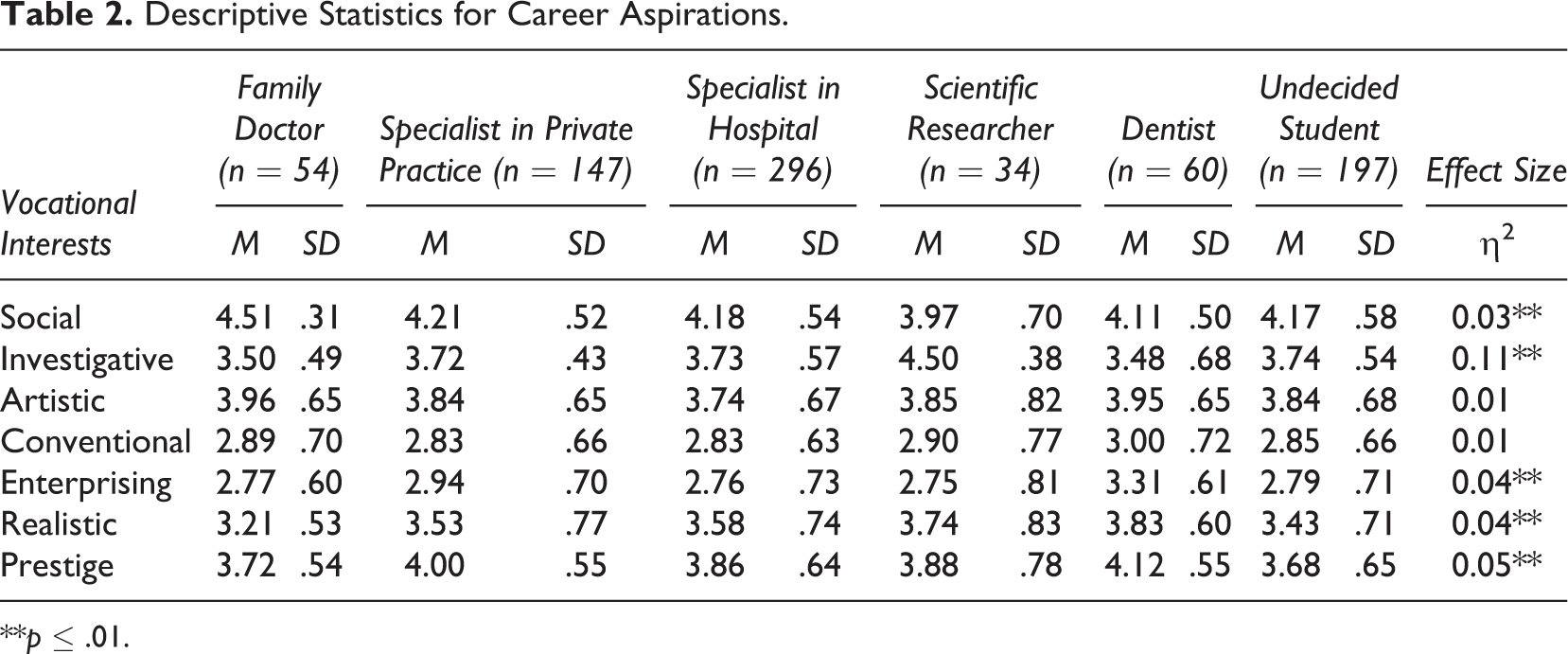
**p ≤ .01.
Furthermore, we were interested in the scale differences between the decided (n = 591) and the undecided group (n = 197). The interest profiles of the two groups were similar, both represented by high scores on social, artistic, and investigative interests. However, even though the effect sizes were very small, there were significant differences between the groups as regards prestige, F(1,786) = 19.87, p < .00, η2 = .03, and realistic interests, F(1,786) = 5.23, p = .02, η2 = .01. The decided students had higher scores (for prestige: M = 3.91, SD = .62; for realistic interests: M = 3.57, SD = .73) than the undecided students (for prestige: M = 3.68, SD = .65; for realistic interests: M = 3.43, SD = .71). Thus, medical students with clear career aspirations showed more interest in realistic activities and prestige.
Next, we present the results of the multinomial logistic regression analysis. Table 3 shows the relative impact of vocational interests and prestige on the students’ aspired work environments, with family doctors as reference group. The ORs for social interests were lower than 1 for students who aspired to become a specialist in a private practice (OR = 0.41, p < .001) or in a hospital (OR = 0.39, p < .001), a scientific researcher (OR = 0.25, p < .001), or a dentist (OR = 0.31, p < .001), in contrast with those aspiring to become a family doctors. An opposite impact was found for investigative interests, with ORs larger than 1 for students who aspired to become a specialist in a private practice (OR = 1.61, p = .010) or in a hospital (OR = 1.62, p = .005), or a scientific researcher (OR = 14.95, p < .001). The two other relationships which turned out to be significant as compared to the reference group were the connection between realistic interests and students aspiring to become a specialist in a hospital (OR = 1.45, p = .030) or a dentist (OR = 1.90, p = .004), and the association between prestige and students focused on becoming a specialist in a private practice (OR = 1.54, p = .033). Since none of the CIs of the ORs crossed 1, we can be confident that within the population the true values lie somewhere between the lower and the upper bounds of the intervals.
Multinomial Logistic Regression Analysis for Aspired Work Environments of 591 Students.

Note. OR = odds ratios; 95% CI = 95% confidence interval. All variables are z-transformed. Reference category is family doctors (n = 54).
Discussion
The current study examined the characteristics of the vocational interests of medical students by applying the theoretical framework of Holland, complemented by a prestige scale. Our attention particularly directed at the relation between these variables and the students’ aspired work environments after university graduation.
Individuals with particular vocational interests have a unique potential to get along with the requirements of environmental settings (Holland, 1997). Based on Holland’s descriptions of interest types, people with high investigative scores, for example, like to inspect phenomena in a systematic way. In general, we adjusted the RIASEC scales to the work requirements of medical students by integrating mostly academic activities. In this way, our artistic scale measured creativity in the sense of finding new solutions and being open-minded. The content of our social scale was similar to that of Holland, focusing on people’s interest in helping others. Our study revealed that medical students scored higher on the social, investigative, and artistic scales than on the conventional, enterprising, and realistic scales. This result confirms Hypothesis 1.
We paid special attention to the role of prestige, which is considered as a major career factor in the medical field (Creed et al., 2010; Rosoff & Leone, 1991; Shortell, 1974). In the literature, prestige is generally discussed as a rather broad construct (e.g., Gottfredson, 1996; Sodano & Tracey, 2008; Tracey & Rounds, 1996). In our study, we concentrated on both status and socioeconomic aspects. We did not integrate aspects such as general educational level or level of training, because we exclusively dealt with medical students. We integrated prestige into our interest questionnaire in order to investigate its specification in connection with the RIASEC scales. Our results showed that medical students scored relatively high on the added prestige scale. Comparing the mean scores of the scales with the scale center allowed us to rank the scales. These values revealed that the specification of prestige was very similar to the artistic scale, which confirmed Hypothesis 2.
Consistent with the meta-analysis of Su et al. (2009), men were found to be more technique oriented (significantly higher realistic and investigative interest scores) than women, who were more person oriented (significantly higher social, artistic, and conventional interest scores) than men. No significant differences between men and women were found for the enterprising scale, which confirmed Hypothesis 3. Gender differences for prestige were found in our sample. Female students scored significantly lower than male students even though effect sizes were small. Lower scores on prestige might be another reason why females more often choose less prestigious professions (e.g., Creed et al., 2010; Norredam & Album, 2007). Other reasons discussed in prior studies are lifestyle factors (e.g., preference for working less and spending more time with family).
In addition, our study investigated the predictive value of vocational interests and prestige for the aspired work environment of medical students. In doing so, we assumed that prestige was particularly related to the aspired work environments of specialists in a private practice and in a hospital (Hypothesis 4). This hypothesis was only partly confirmed. It did apply to students who aspired to work as specialists in a private practice, but not to students who wanted to work as specialists in a hospital. The nonsignificance of prestige to specialists working in a hospital contradicts the finding that surgery, which is the most commonly practiced in hospitals, is one of the highest ranked medical specialties (Creed et al., 2010). One may argue, however, that working as a self-employed specialist is perceived as more prestigious than being employed in a hospital. Our results further demonstrated a significant association between realistic interests and the aspired work environment of students who wanted to become a dentist. This finding confirmed Hypothesis 5. Furthermore, the relation between realistic interests and the wish to work in a hospital after university graduation was also significant. The realistic interests scale primarily measured students’ interests in using technical equipment. Our results therefore support the argumentation of Borges et al. (2004) that realistic types prefer more technique-oriented specialties which require working with one’s hands and using technical equipment. In agreement with Hypothesis 6, investigative interests were significantly associated with the aspiration to become a scientific researcher. In fact, this association was the strongest one found in our study.
The above-mentioned results are based on comparisons with a reference group consisting of students who wanted to become family doctors. This group had the highest social interests compared to the other categories. Family doctors presumably have more patient contacts than physicians, who work in a different environment. This might be an explanation for the negative associations between social interests and the other aspired work environments investigated in this study.
Practical Implications
The current study has integrated prestige as an additional scale into an interest questionnaire, as proposed by other scholars (Sodano & Tracey, 2008; Tracey & Rounds, 1996). In our opinion, the addition of prestige is relevant in medical samples because here prestige turned out to be significantly associated with certain medical work environments. The inclusion of prestige in studying medical students’ vocational interests broadened our understanding of these students’ aspired work environments. The findings show the importance of not only focusing on how much particular activities are enjoyed by individuals (interest scales) but also integrating job factors (such as prestige) in this context. Davis (1991, as cited in Tracey & Rounds, 1996) introduced the distinction between interests and value scores. In our study, however, prestige actually measured something different than the interest scales did. Only enterprising interests correlated with prestige at a moderate level. Thus, as it was operationalized here, the integration of prestige has provided further information about the importance of status and socioeconomic aspects in the job aspirations of medical students.
Finally, our finding that the interest and prestige scores differed depending on the students’ career aspirations could be used for counseling purposes. Students might well profit from this information. Knowing more about one’s interests in relation to prestige could be helpful in making a better choice as regards one’s future work environment. After all, the relatively high number of undecided students who have already entered the medical education system is considered as a serious issue. These students often show higher levels of anxiety, a psychological constructs referred to by, for example, Fuqua, Seaworth, and Newman (1987). Thus, assisting undecided students in their career decisions might increase their insights and give them a clearer career focus. As regards the congruence hypothesis, a better, more suitable job choice might contribute to one’s future work performance and satisfaction. And this choice will presumably also account for the fit between the prestige aspired and that ultimately achieved.
Limitations and Future Research
Our sample consisted of preclinical students whom we asked about their aspired work environment. However, although research (e.g., Holland, 1997; Wille, Tracey, Feys, & De Fruyt, 2014) has identified vocational interests as relatively stable personality characteristics, the choices made by the medical students may still change during their medical education trajectory. Second, the aspirations of preclinical students might differ from the choices ultimately made by university graduates. Longitudinal data are therefore needed to further evaluate these issues and to increase our insights into the complex nature of the career decision process. So far, it is still unclear how experiences influence students during their clinical clerkships as regards their career preferences and career decisions. Furthermore, also external motives (e.g., family planning, number of working hours, and financial considerations) and constraints (e.g., job availability) are important factors in one’s ultimate job choice. These motives may be even more important in the medical field, with its high time pressure and working loads (Simpson & Grant, 1991; Tyssen, Vaglum, Gronvold, & Ekeberg, 2005). Third, because a newly developed questionnaire was used (which was, however, largely based on the original scales of Holland, 1996, 1997), a replication study is desirable. Nevertheless, all in all, we believe that the results of this study provide valuable and useful new knowledge about the aspirations of medical students with respect to their future work environments.
Conclusion
The current study has built upon the theory of Holland, arguing that the relative impact of vocational interests and prestige differ among medical students’ aspired work environments. The most meaningful result is that prestige supplements medical students’ most distinctive vocational interests (social, investigative, and artistic interests). More particularly, prestige contributes to the prediction of students’ aspired work environments. In this way, our study explicitly adds to the formerly published P-E fit studies in the medical context.
Footnotes
Declaration of Conflicting Interests
The author(s) declared no potential conflicts of interest with respect to the research, authorship, and/or publication of this article.
Funding
The author(s) received no financial support for the research, authorship, and/or publication of this article.