



Abstract
The Career Interest Test (CIT) is a 63-item forced-choice instrument designed to measure seven career interests. Although the measure possesses favorable psychometric properties, there have been recent calls for the development of a shortened version of the inventory. The present article reports on research conducted to develop a short form of the CIT. Using archival data from over 180,000 respondents, categorical confirmatory factor analyses were conducted with limited information methods. Items with the highest absolute factor loadings for each career interest were retained for the short form of the inventory, comprising 21 items, and renamed the 21-CIT. The large within-subject correlations between career interest scores on the full CIT and 21-CIT indicate that the short form provides a comparable degree of content coverage for the career interests. We consider implications for career research and practice as well as suggest directions for future research.
The Career Interest Test (CIT; Athanasou, 2000, 2007) is a widely used measure of an individual’s career interests expressed as occupations, fields of study, and work activities. The CIT is integrated into myfuture, Australia’s Career Information & Exploration Service (www.myfuture.edu.au), which is provided online and free of charge. As an integrated module of myfuture, the CIT serves as a career interest exploration activity that may be undertaken as a self-assessment by an individual or as a career education or career counseling activity that is prescribed by a professional.
Myfuture is designed to serve the Australian community as a tool to support the delivery of professional career development services, including career counseling and career education. It provides, for example, reliable labor market information on occupations and industries compiled from trustworthy sources including the Australian Bureau of Statistics and Graduate Careers Australia. Furthermore, myfuture is designed to facilitate an individual engaging in self-directed career exploration activities. A user may create a personal account—a career profile—and engage in a range of career exploration activities. The Myfuture service was established by the federal Australian Government as an initiative to provide accessible career-related resources, particularly for individuals and communities who did not have easy access to career services, given the vast geographical dispersion of the Australian population. Education Services Australia (ESA), which is a not-for-profit company owned by the federal, state, and territory governments, administers myfuture and manages its upkeep.
A review of the CIT commissioned by ESA (McIlveen, 2012) called for a shortened form that would reduce respondents’ burden because the CIT takes approximately 30 min to complete. A shortened form of the CIT would allow for easier, quicker, and cheaper administration of the instrument, so that it could be administered and discussed in a single career counseling session or within career education classes. Therefore, the aim of the research reported in this article was to conduct an analysis of archived CIT data, supplied by ESA, so as to produce a short form of the inventory.
Properties of the CIT
The CIT consists of 63 forced-choice items distributed across three domains: jobs (i.e., occupational titles), courses (i.e., disciplinary subjects taught at college/university), and activities (i.e., work tasks characteristic of an occupation), with 21 items in each domain. For example, respondents are asked to choose between accountant or journalist jobs, photography or botany courses, and sell medicines or fly a plane activities. The CIT items were designed to provide a measure of an individual’s underlying career interest preferences. It is assumed that an individual’s underlying career preferences will inform their choice on each item. The seven career interests with corresponding activities and occupations are shown in Table 1.
Career Interests and Corresponding Preferences and Possible Occupations.
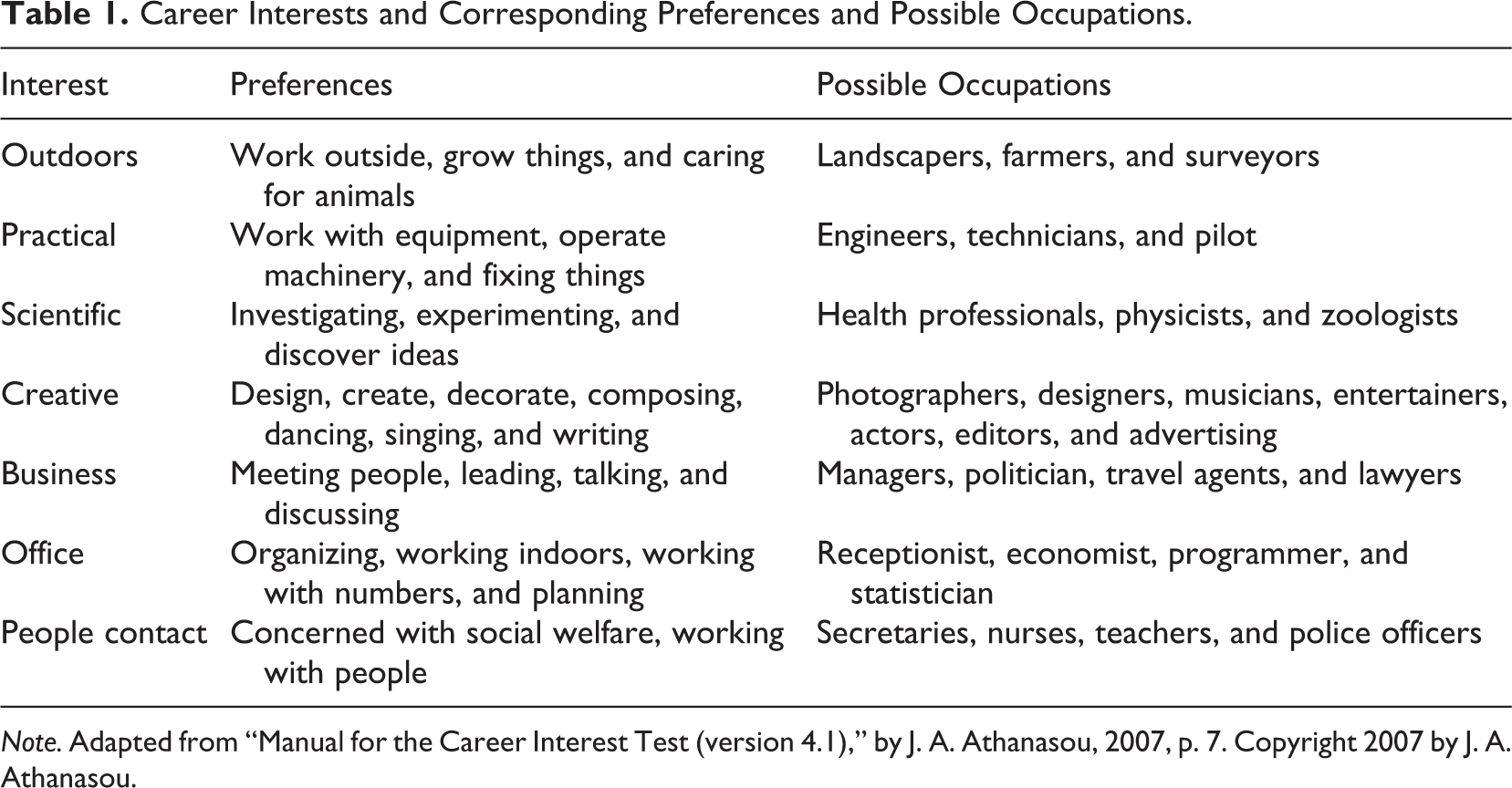
Note. Adapted from “Manual for the Career Interest Test (version 4.1),” by J. A. Athanasou, 2007, p. 7. Copyright 2007 by J. A. Athanasou.
The CIT is based on the conceptual principles of Holland’s (1997) hexagonal model of Realistic, Investigative, Artistic, Social, Enterprising, and Conventional (RIASEC) interests and Prediger’s (1982) two-dimensional model of career interests, People/Things and Ideas/Data. Prediger (1982) suggested that two work task dimensions underlie Holland’s RIASEC hexagon: Data/Ideas (working with data vs. ideas) and Things/People (working with things vs. working with people). Prediger, Swaney, and Mau (1993) suggest that the two work task dimensions provide a means of extending Holland’s RIASEC hexagon. The two dimensions have been successfully used to map occupation groups/relationships with Holland’s RIASEC hexagonal model (Prediger, 1996) and with other personality dimensions (Tokar, Vaux, & Swanson, 1995). The CIT practical career interest is analogous to Holland’s realistic vocational orientation, scientific with investigative, creative with artistic, people contact with social, business with enterprising, office with conventional, and outdoor with elements of both realistic and investigative.
Tracey and Rounds (1995) investigated the career preferences of high school and college students to determine whether career preferences fit a uniform circular model based on the People/Things and Ideas/Data dimensions. Tracey and Rounds suggested that the two-dimensional People/Things and Ideas/Data model is a good representation of career interests. However, they argued that the career interests themselves are not discrete types and that the overlapping nature of career interests means that any number of career interests could be included in a model. They recommended using between six and eight career preferences in a model to allow suitable discrimination and adequate representation of the career clusters. Tracey and Rounds suggested that any more than eight career preferences would make the model too cumbersome with relatively small differences between career clusters.
The CIT is an enhanced version of an earlier inventory produced by Athanasou (1986) for the Australian context, namely, A Vocational Interest Survey (AVIS). The AVIS is based on Holland’s RIASEC hexagonal model. AVIS includes six career interest areas: practical, scientific, and clerical (equivalent to Holland’s realistic, investigative, and conventional vocational orientations, respectively) and artistic, social, and enterprising (equivalent to Holland’s vocational orientations with the same name). The instrument consists of lists of career-related jobs, courses, and activities organized under the banner of the relevant career interest. For each AVIS item, the respondent chooses whether they like ( = 1) or dislike ( = 0) the career-related option. The scores for each career interest were used to rank the career interests in order of preference. For the CIT, respondents choose between two statements representative of a job, course, or activity, rather than marking each representative statement as like/dislike.
In the CIT, each career interest is represented in 18 of the 63 items, with 3 items comparing the same two interests, for example, Items 1, 22, and 43 represent the career interests of outdoor and practical. The choices made at each item contribute to a total score for the seven career interests. The score for each career interest is calculated from the total number of endorsed statements that correspond to that career interest. For example, on Item 1, the choices are builder or driver, contributing to the career interests of practical and outdoor, respectively. If the respondent chooses builder, then their total for the practical career interest will increase by 1; however, if driver is chosen, then the total for the outdoor career interest would increase by 1. A respondent receives a total score for each of the seven career interests (range 0–18), with higher scores indicating a greater preference for the career interest. The career interest scores are used to rank the career interests, with the highest rankings indicating a preference for those career interests. The career interests with the highest rankings are suggestive of a respondent’s preferences and provide a starting point for career and job exploration.
To aid users’ interpretation of the CIT, Athanasou (2007) proposed a criterion-referenced guide for an individual’s score for each career interest: very low, 0–3; low, 4–7; medium, 8–11; high, 12–14; and very high, 15–18. The scores in the very high and very low range are the most indicative of an individual’s preference or dislike for a career interest, respectively. Scoring and interpretation are ipsative not normative, and scores are intended for individual reference only. Therefore, the administrative guidelines for the CIT emphasize idiographic interpretation.
McIlveen’s (2012) review of the measurement properties of the CIT (Version 4.1) found that the distributions of total career interest scores were near normal across the three domains of jobs, activities, and courses. Also, career preference intercorrelations ranged from no meaningful correlation to medium correlations, consistent with the relative position of the career interests on the two work dimensions. The current research extends the aforementioned review and presents the measurement properties of a short form of the CIT. The aim of this exploratory, secondary data analysis, study is to develop a shortened form of the CIT that shows a comparable degree of construct coverage to the full version of the CIT.
Method
Participants
ESA supplied a completely anonymous archival data set with a total of N = 187,996 cases. Sixty cases had missing values on all items and were deleted. All other responses were within the expected range for each variable. Actual age is not recorded at the time a user creates a career profile on myfuture. Instead users indicate an approximate age based on educational groupings: younger secondary student, n = 38,890 (20.7%); older secondary student, n = 112,711 (60.0%); recent school leaver (last 2–3 years), n = 5,664 (3.0%), a further education and training student, n = 5,616 (3.0%); an adult, n = 25,085 (13.3%); and no category (missing), n = 30 (0.02%). Within the Australian schooling system, a younger secondary student is enrolled in junior high school (i.e., Grades 7–10) and may be aged between 13 and 16 years and an older secondary student enrolled in senior high school (i.e., Grades 11 and 12) and may be 16–18 years. The overlap of 16 years of age at the cusp of Grades 10 and 11 is due to some students starting elementary school 1 year earlier. Given that the data set was completely anonymous, it was not possible to determine if a respondent had completed the CIT more than once.
Procedure
The data were subjected to categorical confirmatory factor analyses (CFAs) to compute the factor loadings for each item comparing the same two career interests. The specific details of this analytic procedure are included in the analysis section subsequently. Items with the greatest absolute factor loading (|λ|) were retained in the 21-CIT because they showed the strongest relationship with the underlying latent career preference. All 18 items contributing to the total score for a career interest were used in the estimation of the models to provide the best estimate of individuals’ underlying career interest preference for the two career interests. Where 2 items compare the same two career interests, the items are linearly dependent and show local dependence. This dependence is accounted for by freely estimating corresponding residual covariances.
Analyses
It is presumed that each person has an underlying latent preference level for each of the seven career interests (Athanasou, 2007). While the CIT career interest scores are determined using the observed categorical measures (chosen or not chosen), it is presumed that the underlying career preference is a continuous variable. This is analogous to an intelligence test, where test items may be scored as categorical responses that contribute to a measure of intelligence, which is a continuous trait.
Analyses such as continuous CFA with normal theory maximum likelihood estimation require an interval or ratio measure for the observed dependent variables (Bovaird & Koziol, 2012; Finney & DiStefano, 2006; Wirth & Edwards, 2007). Indeed, a continuous CFA model is misspecified when applied to categorical indicators (e.g., ordinal or dichotomous variables) and is therefore not appropriate when analyzing the items constituting the CIT. This is because categorical variables cannot be linear functions of underlying factors that are presumed to be continuous (Edwards, Wirth, Houts, & Xi, 2012). To account for this nonlinearity, two approaches are available. First, and the most common approach used in the CFA literature, is to assume that underlying each categorical variable y is a continuous, normally distributed latent response variate y*. The categorical CFA is intended to describe the presumed linear link between the factor and this response variate (Rhemtulla, Brosseau-Liard, & Savalei, 2012). A second approach is to specify a model that directly relates the probability of an observed response on the categorical indicator to the values of the latent factor using a special case of the generalized linear model with an appropriate link function, such as a probit or logistic function (Edwards et al., 2012). This latter approach is most commonly observed in the item response theory literature. Although both approaches to the modeling of the dichotomous CIT variables would be suitable for the present analyses and, indeed, are mathematically equivalent, we selected the first approach as it is more commonly used in the CFA literature.
The estimation of a categorical CFA model with dichotomous manifest indicators, assuming underlying continuous latent response variates, is typically based on limited information methods. These methods use only the information contained in the lower order margins of contingency tables for parameter and model estimation as opposed to the whole multivariate categorical distribution of observed data as used in full information methods. For dichotomous data, limited information methods first estimate indicator thresholds, which describe the point on the latent response variates underlying the dichotomous item at which the observed score changes from the first category to the second and then the sample tetrachoric correlations. The categorical CFA model is subsequently fitted to the tetrachoric correlation matrix. Although prima facie it would seem that full information methods have an advantage over limited information methods in parameter estimation due to the use of all available information, for binary data, the performance of limited information methods is at least equivalent to full information item response models (Forero & Maydeu-Olivares, 2009; Knol & Berger, 1991).
All analyses were conducted in the present study using Mplus 6.12 (Muthén & Muthén, 2011). The limited information categorical estimation procedure used was robust diagonal weighted least squares (DWLS) operationalized as the weighted least squares means and variance adjusted (WLSMV) estimator in Mplus, under theta parameterization. The DWLS estimator obtains the model parameter estimates by minimizing the fitting function, FDWLS, using a diagonal weight matrix as shown in Equation 1:

In addition to estimating these categorical factor models, Pearson correlations were computed on total scale scores to determine the relationship between scores for each of the career interests from the CIT and the reduced 21-CIT. High correlations would be suggestive of substantial overlapping variation and, by extension, little loss in construct coverage provided by the shortened scale.
Results
The loadings of the CIT items on their respective factors are shown in Table 2. The factor loading values provided information as to which response variates underlying the items showed the strongest relationship with the underlying latent career interest preferences. The large sample size (N = 187,966) meant that all factor loadings, even those of trivial magnitude, were likely to be statistically significant. Therefore, greater emphasis was placed on the absolute magnitude of factor loadings in the retention of items for the short form. The absolute factor loading values estimated using DWLS were used to determine 19 of the 21 items retained in the 21-CIT.
Factor Loadings for CIT Items.

Note. N = 187,966. CIT = career interest test; CI = confidence interval; LL = lower limit; UL = upper limit; |λ|cs = absolute value of completely standardized factor loading. All factor loadings are significant at p < .001.
aThese values are based on standardized estimates. Items shown in bold font were retained.
The initial factor model analysis of the items (3, 24, and 45) contributing to the creative and scientific career preferences did not result in an admissible solution. The factor model analysis with Item 3 removed resulted in an analysis that terminated normally and provided admissible factor loading values for Items 24 and 45 (see Table 2). The analyses did not result in an admissible solution in subsequent factor model analyses when Item 24 or Item 45 was removed from the model. Item 24 (“photography” vs. “botany”) showed greater standardized and unstandardized factor loadings than Item 45 and was subsequently retained in the 21-CIT. The options for the 3 items comparing the creative and scientific career preferences were also inspected to review how well they represented the career preferences. The option dentist on Item 3 may be an ambiguous discriminator for the scientific career preference and may be more reflective of the people contact career preference. The option photography on item 24 appears to be representative of the creative career interest, which Athanasou (2007) describes as including creating, composing, and designing. Similarly, the option botany appears to be representative of the scientific career interest, which Athanasou describes as including a preference for investigating and discovering ideas. These further analyses supported the decision to drop Item 3 from the factor loading analyses and retain Item 24 in the 21-CIT.
Items 20 and 62 showed an equally strong relationship with the underlying latent career interest preferences office and people contact (|λ| = .637/.626 and .641/.620, respectively). The option representing the people contact career preference for Item 20 (occupational therapist) is a specific occupation; however, the Item 62 option (help sick people in hospital) represents a career activity that may be performed by an occupational therapist as well as other health-related and people-based occupations. Therefore, Item 62 was retained in the 21-item shortened form of the CIT. Other researchers (e.g., Kuder, 1977; Prediger, 1996) also recommend using activities rather than occupation titles where possible, as specific occupations may not be clearly understood by participants. The medium positive sample tetrachoric correlations between Items 20 and 62 suggest that the items overlapped in their measurement of the career interests. Finally, Pearson correlations were calculated to investigate the relationship between career interest scores for each career interest from the full CIT and the 21-CIT. The correlation values (r = .718–.898) indicated a strong degree of convergence between an individual’s score on the CIT and the 21-CIT for each career interest (see Table 3).
Correlation Between Career Interest Scores on the Full CIT and the Shortened 21-CIT.

Note. N = 187,966. CIT = career interest test. All values are significant at p < .001.
Discussion
The original CIT is a publicly available and widely used instrument designed to provide an indicator of an individual’s career interests. The outcome of the current study is a shortened form of the CIT that has comparable construct coverage to the full form of the test. The large effect sizes shown in the correlations between career interest scores on the full CIT and the 21-CIT indicate that the shortened form of the CIT provides a valid estimate of an individual’s score for each of the career interests.
Holland’s (1997) RIASEC framework has received considerable attention in Australia (Lokan & Taylor, 1986), including an Australian version of the Self-Directed Search (Shears & Harvey-Beavis, 2001); however, Prediger’s (1982) People/Things and Ideas/Data framework is not as well known. The original CIT and current research into the development of the 21-CIT are examples of the conceptual value of Prediger’s framework and Holland’s framework. Moreover, the results of the current study affirm both frameworks’ capacity to generalize to other nations, in this case Australia. Recent research and development extends Prediger’s model to include the factor Prestige (Tracey & Sodano, 2013). Although not a focus of the current research, future research may attempt to discern a Prestige factor among the items of the CIT, perhaps by contrasting high- and low-prestige occupations. Also, we recommend that there be investigations into the relationship between Athanasou’s (2007) seven career interests in relation to the two-dimensional People/Things and Ideas/Data model.
More than a decade since the Organization for Economic Cooperation and Development (OECD, 2002) reviewed Australia’s career guidance policies, the difference between Australia’s career information system then and now is quite remarkable. Australia’s Career Information and Exploration Service, and its main portal site, myfuture, provides access, free-of-charge, to high-quality career development resources. The CIT has played an important role in the evolution and delivery of those resources, evident in the fact of more than 180,000 online administrations in the period of time encompassing the current archived data set. Doubtless, the OECD would find evidence of a world-class national career information system that is widely accessible. Given consumers’ demand for ease of access and usability of career resources, at one-third the number of items of the original CIT, the 21-CIT will allow for even easier, quicker, and cheaper administration of a career interest tool and concomitantly enhance usability and accessibility of myfuture as a resource for the community.
With respect to the limitations of the current research, the large population of the data set provides grounds for confidence that the data are relatively representative of the broader Australian population. Unfortunately, the data set did not include actual age in years, instead membership of an age category was available as the nearest indicator. Furthermore, while the factor structure is consistent with expectations and theory, there is no way to determine convergent validity with the current data set. Therefore, we recommend that the psychometric properties of the 21-CIT be investigated, including comparing the 21-CIT with other career interest inventories to establish its convergent validity.
Footnotes
Acknowledgments
We acknowledge the generosity of Professor James Athanasou who created the CIT and provided it freely to the Australian public via myfuture.
Declaration of Conflicting Interests
The author(s) declared no potential conflicts of interest with respect to the research, authorship, and/or publication of this article.
Funding
The author(s) disclosed receipt of the following financial support for the research, authorship, and/or publication of this article: This project was supported by Education Services Australia, a not-for-profit company owned by the Ministers of Education of the Australian Commonwealth.