



Abstract
The present study examined the relations between work stress and both the presence of and search for meaning in life. Three components of meaningful work—positive meaning, meaning-making, and greater good motivations—were investigated as potential moderators. As hypothesized, work stress had a significant, negative relation with the presence of meaning in life, and a significant, positive relation with the search for meaning in life. Furthermore, the meaning making component of meaningful work moderated the relation between work stress and the presence of meaning in life. Specifically, meaning making served as a buffer where greater meaning making at work was associated with weaker relations between work stress and the presence of meaning in life. None of the three components of meaningful work moderated the relation between work stress and the search for meaning in life. Practical implications and directions for future research are discussed.
Work-related stress is a feature of the modern workplace that can derail career development and harm well-being (Zunker, 2012). Numerous studies have documented the deleterious effect work stress has on workers, linking it positively to variables such as burnout and depression (Ramirez, Graham, Richards, Cull, & Gregory, 1996; Tennant, 2001) and negatively to job satisfaction and psychological well-being (Daniels & Guppy, 1994; Guinot, Chiva, & Roca-Puig, 2014). As a result, scholars have identified several moderators of these relations, such as social support (e.g., Viswesvaran, Sanchez, & Fisher, 1999). One area of well-being that work stress might also affect is meaning in life (Dunn & O’Brien, 2009). Meaning in life is considered to be a major part of human flourishing and well-being (Seligman, Steen, Park, & Peterson, 2005), and life meaning is associated with positive outcomes such as work enjoyment and life satisfaction, and a lack of meaning in life is linked with psychological distress (Steger, Frazier, Oishi, & Kaler, 2006). Several researchers argue that work is an important contributor to meaning in life (Allan, Duffy, & Douglass, 2015; Savickas, 1997), but this process might be disrupted by work stress. However, as suggested by Park’s (2010) meaning making model, the ability to make meaning out of work stress might prevent its negative impact on life meaning. Specifically, having meaningful work might moderate the negative relation of work stress and meaning in life. Therefore, the current study examines how work stress relates to meaning in life and how aspects of meaningful work—positive meaning, meaning making, and greater good intentions—serve to moderate this relation.
Theoretical Background
The meaning making model (Park, 2010) offers a framework for understanding how work stress might relate to meaning in life. Although the meaning making model focuses primarily on responses to traumatic life events, Park’s central idea is that when people experience stress, it creates a discrepancy between their understanding of the event and their global frameworks for understanding life in general. The distress caused by this discrepancy motivates people to make meaning out of the event, which maintains their overall sense of meaning in life. Supporting this, studies have found a negative relation between stressful events and meaning in life (Janoff-Bulman, 1992; Krause, 2004, 2005) and that positive coping strategies buffer this negative relation (Boyraz & Lightsey, 2012).
Meaning in the Work Domain
One major area where people experience stress is at work (e.g., Tennant, 2001). Although the meaning making model (Park, 2010) focuses on stressful events, chronic stress may erode meaning in life over time. For example, people may ask themselves how life can be meaningful if work is so chronically stressful and difficult. This notion is supported by at least one study finding a negative relation between daily stress and the presence of meaning in life and a positive relation between daily stress and the search for meaning in life (Dunn & O’Brien, 2009).
Following from the meaning making model (Park, 2010), effective meaning making should maintain a sense of meaning in life and decrease the need to search for meaning in life. In other words, meaning making should moderate the relation between work stress and meaning in life: People who effectively create meaning should have little to no relation between work stress and meaning in life, whereas people who do not create meaning should have a strong, negative relation between work stress and meaning in life. A chronically stressful emergency room environment, for example, may threaten health care workers’ meaning in life if they do not cope in adaptive ways. This lack of coping may coincide with an increased search for meaning in life. One positive way of coping might be to understand the work stress as part of saving lives, which might in turn protect against this loss of meaning. Subsequently, the search for meaning in life should decrease.
One way people might cope with their work stress is to view their work as meaningful or serving some greater purpose. Scholars have conceptualized and defined meaningful work in several different ways (Steger, Dik, & Duffy, 2012). Steger et al. drew from the key tenets of meaningful work and conceptualized it as consisting of three primary facets: (1) positive meaning in work, the subjective sense that one’s work has personal significance; (2) meaning making through work, the degree to which work helps people make sense of the world and contributes to personal growth; and (3) greater good motivations, the belief that one’s work positively impacts others.
Meaningful work relates to a number of well-being and work-related outcomes. Meaningful work positively correlates with life satisfaction, life meaning, and positive affect and negatively correlates with depression and anxiety (Arnold, Turner, Barling, Kelloway, & McKee, 2007; Steger et al., 2012). In regard to work-related outcomes, people who view their work as meaningful tend to exhibit higher levels of intrinsic work motivation (Steger et al., 2012), job performance (Harris, Kacmar, & Zivnuska, 2007), career commitment (Duffy, Dik, & Steger, 2011), and lower withdrawal intentions and rates of absenteeism (Bunderson & Thompson, 2009; Steger et al., 2012).
Although no known study has examined meaningful work as a moderator of the relation between work stress and well-being, two studies have investigated meaningful work as a moderator. One study found meaningful work to moderate the quadratic relation between age and the presence of life meaning and the linear relation between age and the search for life meaning (Allan et al., 2015). Specifically, people with greater meaningful work reported greater life meaning in mid-life but not at the beginning or end of life. Also, people of all age-groups reported less search for meaning in life when they had higher meaningful work. Another study found meaningful work to moderate the relation between abusive supervision and job performance (Harris et al., 2007); specifically, under abusive supervision, employees with high meaningful work had significantly higher self-reported performance scores than employees low in meaningful work. This study exhibits how meaningful work might protect against the impact of negative stressors: those with differing levels of meaningful work might possess resources that allow them to better cope with work stress.
The Present Study
Using the meaning making model (Park, 2010) as a guide, the goals of the present study were to (a) examine the relations between work stress and the presence of and search for meaning in life and (b) evaluate if the three components of meaningful work—positive meaning, meaning making, and greater good motivations—moderated these relations. Based on the literature reviewed above, we hypothesized that work stress would negatively relate to the presence of meaning in life and positively relate to the search for meaning in life. However, following Park’s model, meaning making should allow individuals to preserve their overall sense of meaning and protect against threats to the presence of meaning and increases in the search for meaning. As discussed above, chronic work stress might threaten people’s sense that their lives are meaningful, which might increase the search for meaning in life. However, if workers are able to make sense of their work stress (e.g., see it as part of personal growth, helping others, etc.), they may be able to maintain their overall sense of meaning in life, making it unnecessary to search for meaning.
Therefore, we sought to examine how the components of meaningful work, as described by Steger, Dik, and Duffy (2012), moderate the relation between work stress and meaning in life. The meaning making through work component of meaningful work is a candidate for a moderator, because this facet of meaningful work most closely mirrors Park’s (2010) idea of meaning making. Specifically, it reflects the degree to which people’s work contributes to their personal growth and allows them to make sense of the world. However, the positive meaning and greater good motivations components are also possible moderators. First, people with high positive meaning in work may be better able to handle work-related stress because they have already constructed meaning from their work. This facet of meaningful work fits well with meanings made in Park’s model. Namely, for people high in positive meaning, work stress may already have been translated into positive personal meanings, which would protect against work stress’s negative impact on meaning in life. In regard to greater good motivations, people high in this facet may not be as affected by work stress because they interpret it as a necessary part of helping others. Again, they would have effectively made meaning out of their stress. Therefore, we hypothesized that all three components of meaningful work would moderate the relation between work stress and meaning in life.
In regard to the search for meaning in life, people facing work stress are likely to face discrepancies between stressful events and their global meaning, which could cause an increase in their search for life meaning. However, similar to the arguments above, the components of meaningful work may moderate this relation. Again, meaning making through work would allow people to make sense of the discrepancies and protect them from increases in the search of life meaning. Second, people with high positive meaning have likely already derived meaning from their work which allows them to better adapt to work stress and prevent any increases in the search for life meaning. Lastly, since people who score high on greater good motivations likely view work stress as a necessity in helping others, these people may be more capable of coping with work-related stress, which might lead to stable levels in the search for meaning in life. Therefore, we hypothesized that the three components of meaningful work would moderate the relation between work stress and the search for meaning in life. Specifically, only people low in the three components of meaningful work would have a positive relation between work stress and the search for meaning in life.
Age was included as a covariate in the regression analyses. It is the only consistent demographic predictor of meaning in life (Allan et al., 2015; Steger et al., 2006; Steger, Oishi, & Kashdan, 2009), and people in different age-groups report substantially different levels of meaning in life (Steger et al., 2009), especially at different levels of meaningful work (Allan et al., 2015). Other variables such as gender, race, and religion do not show consistent relations with life meaning (Steger et al., 2009). Therefore, given the wide range of ages represented in the study’s sample, controlling for the variance associated with age was warranted.
Method
Participants
Our sample consisted of 376 adults ranging in age from 18 to 73 (M = 37.61, SD = 12.91) and self-identifying as female (n = 209, 55.6%), male (n = 160, 42.6%), transgender (n = 3, 0.8%), other (n = 2, 0.5%), or omitted (n = 2, 0.5%). In terms of race/ethnicity, most participants identified as White/Caucasian (n = 293, 77.9%), while those remaining identified as African/African American (n = 34, 9.0%), Asian/Asian American (n = 19, 5.1%), Hispanic/Latino/a American (n = 18, 4.8%), Asian Indian (n = 4, 1.1%), Middle Eastern (n = 2, 0.5%), Native American (n = 1, 0.3%), other (n = 4, 1.1%), or omitted (n = 1, 0.3%). In terms of educational attainment, 0.5% (n = 2) of the sample had less than high school, 1.9% (n = 7) had some high school, 8.2% (n = 31) were high school graduates, 6.4% (n = 24) had trade or vocational school diplomas, 37.2% (n = 140) had some college, 35.6% (n = 134) had a college degree, and 10.1% (n = 38) had a professional degree. Our sample captured 212 unique job titles from a wide range of industries and administrative levels. Some industries sampled include education, retail, insurance, manufacturing, health care, and transportation. Some of the most frequent job titles were administrative assistant (n = 14, 3.8%), manager (n = 14, 3.8%), student (n = 12, 3.2%), customer service representative (n = 10, 2.7%), teacher (n = 10, 2.7%), salesperson (n = 9, 2.4%), cashier (n = 8, 2.1%), engineer (n = 8, 2.1%), writer (n = 7, 1.9%), analyst (n = 6, 1.6%), server (n = 6, 1.6%), inventory control (n = 5, 1.3%), nurse (n = 5, 1.3%), and programmer (n = 5, 1.3%).
Instruments
Meaning in life
The 10-item Meaning in Life Questionnaire (MLQ; Steger et al., 2006) was used to assess participants’ current level of life meaning and search for life meaning. The MLQ is comprised of a 5-item presence subscale and a 5-item search subscale, and example items include “I understand my life’s meaning” and “I am searching for meaning in my life.” Participants responded to items on a 7-point Likert-type scale ranging from 1 = absolutely untrue to 7 = absolutely true. Item responses from each subscale were summed to calculate total scores, where higher scores indicated greater perceived meaning in life and greater perceived search for meaning in life. Steger, Frazier, Oishi, and Kaler (2006) demonstrated the scale’s validity by finding the MLQ subscales to positively correlate with variables such as life satisfaction, intrinsic religiosity, extroversion, and agreeableness. In the instrument development study, internal consistency reliabilities ranged from α = .81 to α = .92. In the present study, the estimated internal consistency reliabilities were α =.92 and α = .93.
Work stress
An adapted version of the 10-item Perceived Stress Scale (PSS; Cohen, 1988) was used to assess the degree to which participants felt stressed at work. Participants responded on a 5-point Likert-type scale ranging from 0 = never to 4 = very often. The original version of the PSS measured perceived stress in the general life domain and included questions such as “In the last month, how often have you been upset because of something that happened unexpectedly?” and “In the last month, how often have you felt difficulties were piling up so high that you could not overcome them?” Since the focus of the present study was work stress, we adapted items to focus on the work setting. Examples of how we adapted items are “In the last month, how often have you been upset because of something that happened unexpectedly at work?” and “In the last month, how often have you felt difficulties were piling up so high at work that you could not overcome them?” Responses to our adapted 10-item scale were summed to calculate total scores, where higher scores indicated greater perceived stress at work. Cohen (1988) established the validity of the PSS by finding the PSS to correlate in the expected directions with measures such as life satisfaction, physical illness, and other measures of appraised stress. In the instrument development study, the PSS had an internal consistency reliability of α =.75, and in the present study the estimated internal consistency reliability was α =.89.
Meaningful work
The 10-item Work as Meaning Inventory (WAMI; Steger et al., 2012) was used to assess the degree to which participants felt their work was meaningful. Participants responded on a 7-point Likert-type scale ranging from 1 = strongly disagree to 7 = strongly agree. As described above, the WAMI has three subscales: positive meaning (4 items), meaning making (3 items), and greater good motivations (3 items). Example items for the three subscales, respectively, are “I have a good sense of what makes my job meaningful,” “My work helps me make sense of the world around me,” and “The work I do serves a great purpose.” Responses to each item were summed to calculate the total subscale scores, with higher scores representing higher levels of meaningful work. Steger et al. (2012) conducted a confirmatory factor analysis and found each subscale to load on separate factors and to load onto one larger meaningful work factor. Each subscale also positively correlated with job satisfaction, career commitment, and presence of life meaning. In the instrument development study, the WAMI subscales had high estimates internal consistencies of α = .89 (positive meaning), α = .82 (meaning making), and α = .83 (greater good motivations). In the present study, the estimated internal consistencies were α = .92 (positive meaning), α = .91 (meaning making), and α = .82 (greater good motivations).
Procedure
Participants were recruited through the online data collection system Mechanical Turk (MTurk). MTurk is a website that allows people to take surveys for small monetary rewards.
Scholars have examined the generalizability and quality of data obtained via MTurk, with studies finding that MTurk samples tend to be more representative of the general population than college student samples (Buhrmester, Kwang, & Gosling, 2011). Also, studies have indicated that samples recruited through MTurk are as reliable and diverse as community samples (Buhrmester et al., 2011; Goodman, Cryder, & Cheema, 2013). In summary, studies examining MTurk have largely concluded that it produces valid data that are comparable to laboratory and other Internet recruitment methods (Buhrmester et al., 2011; Sprouse, 2011), and people generally complete surveys for enjoyment, rather than monetary gain (Buhrmester et al., 2011). Given the evidence supporting the use of MTurk, we deemed this an adequate method of recruitment for this study. By using MTurk, we were able to recruit a diverse sample of employed adults.
A link including an informed consent document and the survey itself was posted on MTurk. Participants were given US$0.30 for answering the survey, which took approximately 10–15 min. A total of 457 people initiated the survey. However, 31 participants only completed demographic items or were missing large amount of data (>75%), and 46 participants did not respond correctly to 3 embedded validity items. Furthermore, 4 participants were unemployed so did not qualify for the study. This left the final sample of 376 participants. Of these, 39 had missing data on at least one of the scales. The majority of these participants were missing just 1 item (n = 34), with five missing 2 items. Following the procedure outlined by Parent (2013), we used mean imputation to generate values for these 37 participants. Specifically, the scale point closest to the mean score of the overall scale was used as a substitute for missing data. As discussed by Parent, mean imputation does not differ from more advanced methods of data imputation when there is a small amount of missing data (i.e., <10%), as in this study, where only 44 total items for the entire sample were missing out of a possible 10,920 (<.01%).
Results
Preliminary Analyses
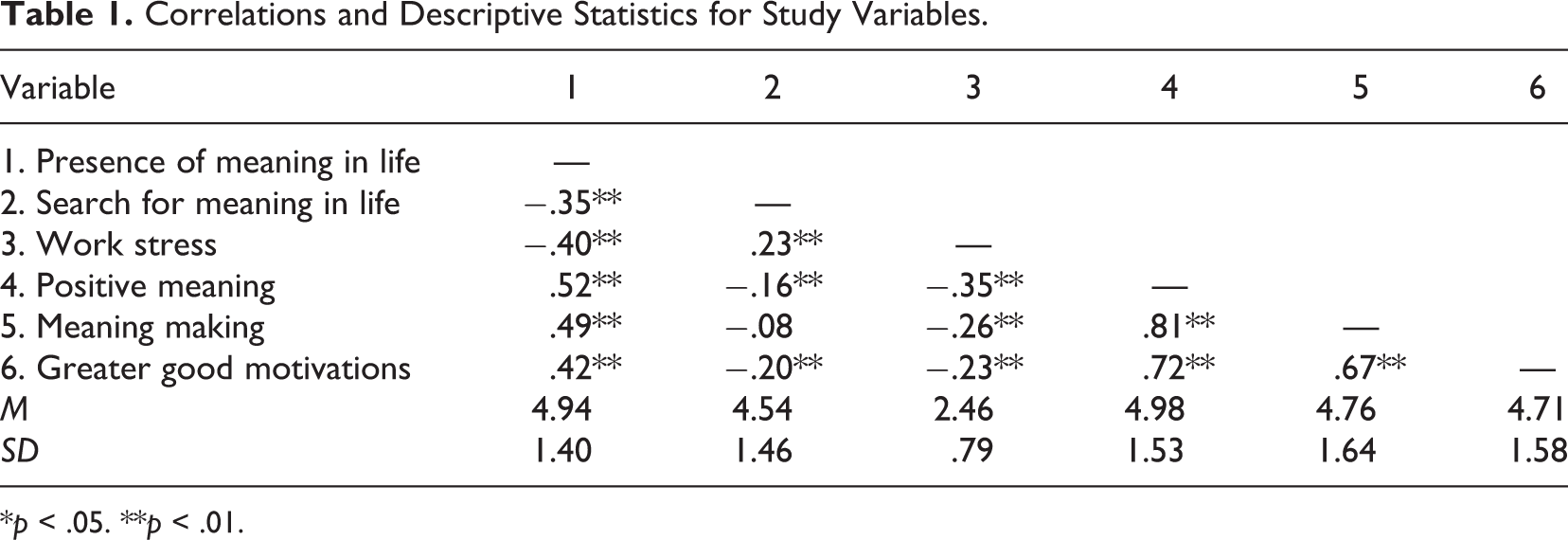
All variables were inspected for outliers. Only one value on one variable (meaning in life) exceeded 3.5 SDs from the mean, so this case was removed. None of the score distributions for the variables had absolute values of skewness or kurtosis over 1, so no variables required transformation. Table 1 displays the correlations and descriptive statistics for all study variables. Work stress was negatively correlated with the presence of meaning in life (−.40) and positively correlated with the search for meaning in life (.23). Positive meaning (.52; −.16), meaning making (.49; −.08), and greater good motivations (.42; −.20) were positively related to the presence of meaning in life and negatively related to the search for meaning in life, respectively. However, the relation between meaning making and the search for meaning in life was not significant. Additionally, age was significantly related to the presence of meaning in life (.11), the search for meaning in life (−.11), work stress (−.18), and positive meaning (.13) but was unrelated to meaning making (.00) and greater good motivation (.03).
Correlations and Descriptive Statistics for Study Variables.
*p < .05. **p < .01.
Moderation
Following the directions of Frazier, Tix, and Barron (2004), two hierarchical regressions were conducted predicting both the presence and search for meaning in life. In Step 1, work stress was entered into the equation, followed by the meaningful work subscales in Step 2, and the interaction terms in Step 3. To reduce multicollinearity, variables were transformed into z scores before being multiplied together to create interaction terms.
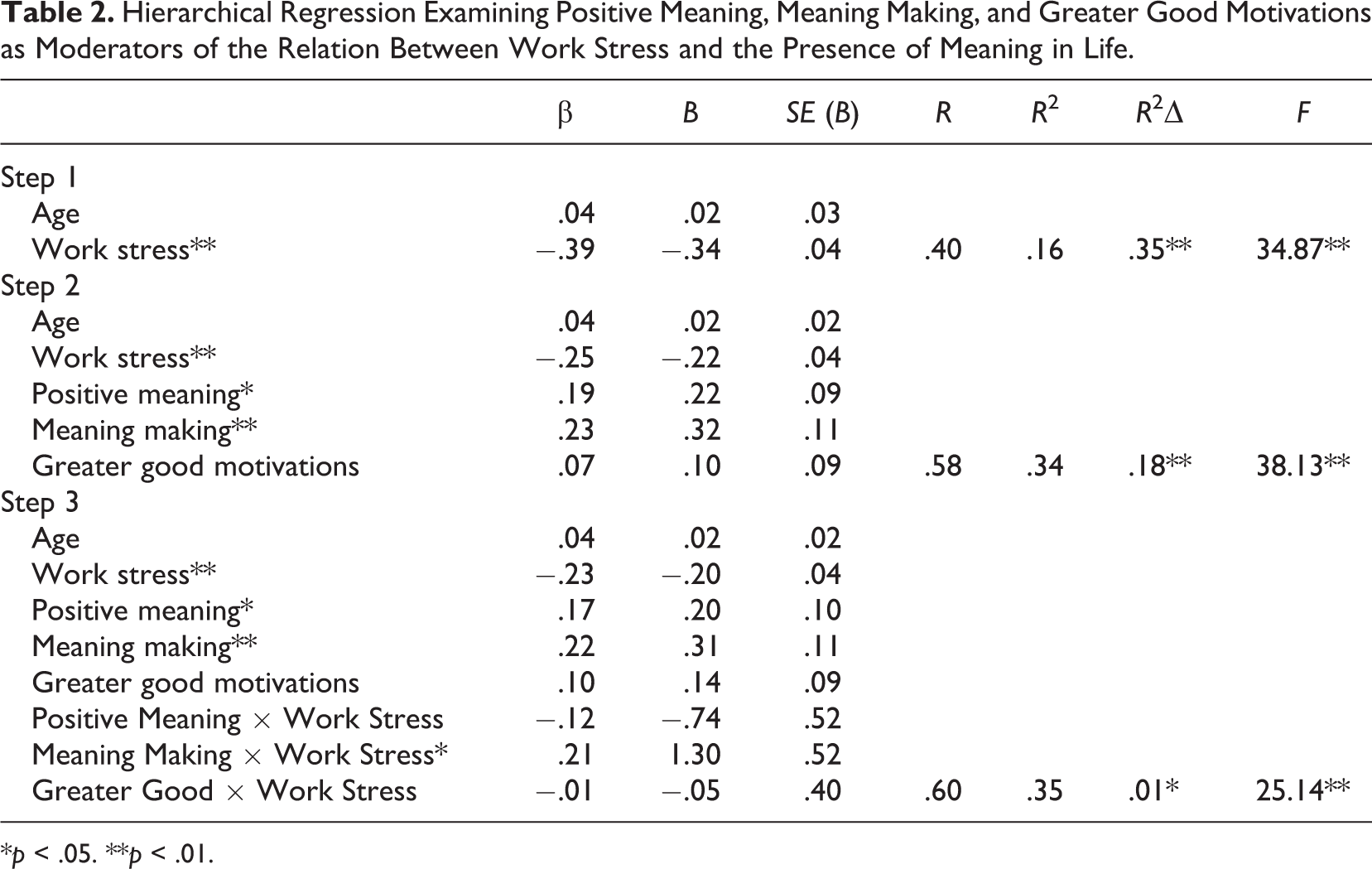
Table 2 displays the first regression predicting the presence of meaning in life. In Step 1, work stress negatively predicted the presence of meaning in life. In Step 2, work stress negatively predicted the presence of meaning in life, and positive meaning and meaning making positively predicted presence of meaning in life. Finally, in Step 3, work stress, positive meaning, and meaning making had the same relations with meaning in life, but these were qualified by a significant interaction between meaning making and work stress. The positive direction of the interaction indicated that the relation between work stress and meaning in life decreased when meaning making was higher. Figure 1 depicts this moderation. All three of these steps added a significant amount of variance explained in the presence of meaning in life for a total of 35% in the final model.
Hierarchical Regression Examining Positive Meaning, Meaning Making, and Greater Good Motivations as Moderators of the Relation Between Work Stress and the Presence of Meaning in Life.
*p < .05. **p < .01.
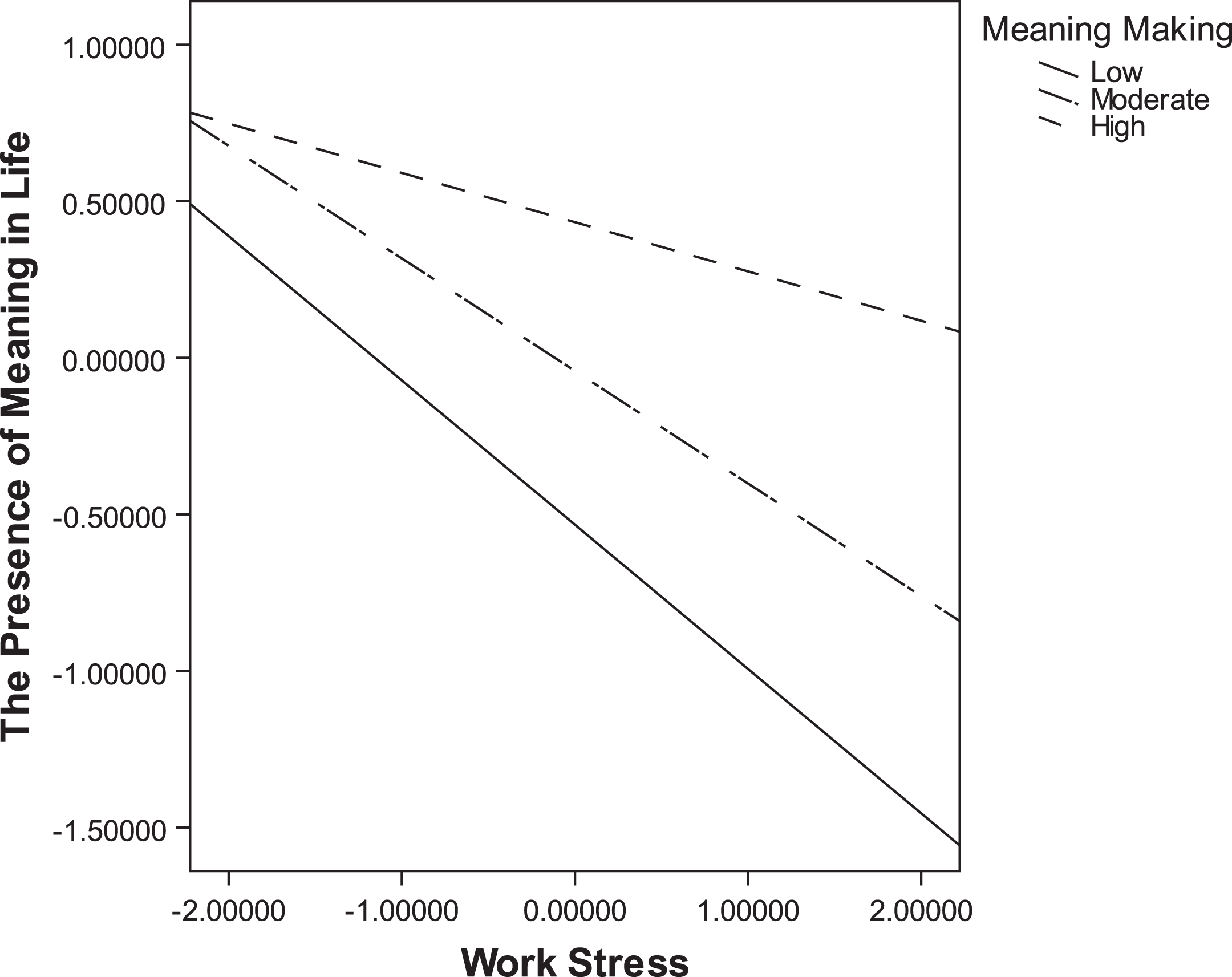
Moderation of the relation between work stress and meaning in life by meaning making. The presence of meaning in life and work stress is presented in z-scores. Meaning making groups were created at less than, greater than, and between a half standard deviation from the mean.
Table 3 displays the second regression predicting the search for meaning in life. In Step 1, work stress positively predicted the search for meaning. In Step 2, only work stress significantly predicted the search for meaning in life. Finally, in Step 3, work stress and meaning making positively predicted the search for meaning in life, and greater good motivations negatively predicted meaning in life. No interactions were significant. Only the first two steps in the regression led to a significant change in variance explained. The final model explained 10% of the variance in the search for meaning in life.
Hierarchical Regression Examining Positive Meaning, Meaning Making, and Greater Good Motivations as Moderators of the Relation Between Work Stress and the Search for Meaning in Life.

*p < .05. **p < .01.
Discussion
The goal of the current study was to examine the link between work stress and life meaning and how this link was moderated by three components of meaningful work: (1) positive meaning, or feeling one is doing personally significant work, (2) meaning making through work, or how work helps people make sense of the world and grow, and (3) greater good motivations, or viewing one’s work as helping others (Steger et al., 2012). Based on past research, we hypothesized that work stress would be negatively related to the presence of life meaning and positively related to the search of life meaning, both of which were supported by our data. Matching findings from previous research on daily stress (Dunn & O’Brien, 2009), the more stress individuals feel at work the less they view their lives as meaningful (moderate relation) and the more they are searching for meaning (weak relation).
Park’s (2010) meaning making model was used to build hypotheses around how meaning specifically in the work domain might moderate the stress-life meaning relations. Regarding the search for life meaning, none of the three meaningful work moderators were significant, and in total only 9% of the variance in searching for life meaning was explained by work stress and the three meaningful work components. What this suggests is that work stress is minimally related to searching for meaning and that this relation it is not impacted by how one experiences meaning specifically within work. Therefore, it may be that other variables outside of the workplace (such as personality characteristics, cognitive style, mental health issues, and religiousness; Steger, Kashdan, Sullivan, & Lorentz, 2008; Steger et al., 2010) might be more important in understanding if an individual is searching for meaning. Additionally, experiencing meaning at work may not provide a buffer to the limited, but significant, impact of work stress on searching for meaning.
However, the link between work stress and the presence of life meaning is more substantial and offers partial support of Park’s (2010) central claims. Work stress, the three meaningful work components, and the three interactions account for 35% of the variance in the presence of life meaning. In Step 3 of the regression work stress, positive meaning, meaning making, and the meaning making by work stress interaction were all significant. Indeed, these two meaningful work components and the interaction accounted for additional 19% of the variance in the experience of life meaning. The link between meaningful work and life meaning matches previous research, finding the two constructs to be strongly correlated (Allan et al., 2015; Steger et al., 2012) and suggests that meaning experienced in the work domain may be a key factor promoting general life meaning.
Of the three potential interactions, only the meaning making by work stress interaction was significant. This interaction also only accounted for only 1% of the variance in life meaning, so it should be interpreted with caution. Regardless, the more meaning making people did at work, the weaker the relation was between work stress and the presence of life meaning. This finding supports Park’s (2010) contention that individuals who are able to make meaning out of stress are more likely to sustain a sense that life is meaningful. Consider the items that make up the meaning making subscale: “I have a good sense of what makes my job meaningful,” “I have discovered work that has a satisfying purpose,” and “I view my work as contributing to my personal growth.” People answering high on these items may have a strong understanding of the purpose of their work. Although work stress still negatively relates to life meaning among this group, they may be able to buffer this effect, perhaps by framing the stress as a part of their work purpose.
Practical Implications
Counselors working with people experiencing work stress may consider the impact this has on their clients’ meaning in life. If clients present with work stress, counselors might ask them how it impacts their overall meaning and fulfillment in life. If clients indicate that their work stress is harming their sense of meaning in life and have decided to stay in their current jobs, counselors may help them make sense and meaning out of their stressful experience. For example, counselors might engage clients in conversations about the meaning of their work more generally. Some questions might be “How does your work contribute to your personal growth?” and “In what ways is your meaningful work?” These questions reflect the meaning making subscale and might help clients increase their meaningful work and protect against work stress’s negative impact on meaning in life. As an example, a client might experience work stress but come to understand that her work makes her a stronger person, despite the stress. In fact, the work stress might signal to her that she can persevere in the face of hardship. This understanding of work stress as contributing to personal growth might protect against its negative impact on meaning in life.
Limitations and Future Directions
The results of the present study must be considered in light of a number of limitations that provide directions for future research. First, this study was cross-sectional, and, thus, causal relations could not be determined from our data. Although the positioning of our variables was based on Park’s (2010) meaning making model, future research should examine the relation of the study variables over time so that causal relations can be established. Second, a majority of the sample identified as White and highly educated. In order to fully understand how the study variables relate, scholars should investigate how the results differ in diverse populations in different contexts. Relatedly, the results may differ in different work environments, such as high stress jobs or jobs that facilitate more or less meaning. A third limitation is that the data from this study were collected from the online data collection service MTurk. This method samples a wide range of people from diverse jobs and backgrounds (Buhrmester et al., 2011), and studies of this method have found it to be as valid as traditional internet sampling (e.g., Buhrmester et al., 2011; Sprouse, 2011). Regardless, MTurk may exclude people who do not have easy access to computers or the time to complete online surveys in their spare time. Additionally, related to the previous point, the broad sample prevents understanding how the study variables relate in different populations. Therefore, replication is crucial before stronger conclusions can be drawn from this study.
Fourth, work stress and the three components of meaningful work only accounted for 9% of variance in the search for meaning in life, suggesting that variables outside of the workplace influence one’s search for life meaning. The present study did not examine variables outside of the workplace, but future studies should look at variables like personality characteristics, mental health issues, and religiosity in an attempt to reveal what predicts the search for meaning in life. Relatedly, the significant interaction between work stress and meaning making only accounted for 1% of the variance in life meaning. Therefore, the practical significance of this finding is in question and replication is needed to feel confident in the buffering effect of meaning making.
Conclusion
In summary, the current study adds to the literature by highlighting the link of work stress and meaningful work to life meaning and more specifically how work stress and meaningful work interact to predict life meaning. People reporting greater work stress were more likely to be searching for life meaning and less likely to be experiencing life meaning. Conversely, meaningful work positively linked to life meaning and negatively linked to the search for life meaning. This suggests that although work might be a source of life meaning (Savickas, 1997), work stress might affect this process. However, meaning making at work buffered the effect of work stress on life meaning—the more individuals were able to make meaning at work, the less of an effect work stress had on overall life meaning.
Footnotes
Declaration of Conflicting Interests
The author(s) declared no potential conflicts of interest with respect to the research, authorship, and/or publication of this article.
Funding
The author(s) received no financial support for the research, authorship, and/or publication of this article.