



Abstract
In recent years, the constructs of work meaning and work meaningfulness have been differentiated, and multidimensional measures of the latter have been developed. In the present study, we administered one such measure—the Comprehensive Meaningful Work Scale (CMWS)—to a gender-balanced and age-diverse sample of managers and conducted a multivariate analysis of CMWS scores that explored the contributions of participants’ gender and their adult career stage. As hypothesized, the CMWS subscale scores were negatively correlated with participants’ scores on an independent measure of work stress. Results also revealed a significant multivariate effect associated with their career stage that was limited to one CMWS subscale (i.e., “balancing tensions”), with managers in their “prime work years” (i.e., 40–54) evidencing less favorable scores than those in either the “settling in” (i.e., 25–39) or “approaching retirement” (i.e., 55–65) stages. The implications of these findings for future research on work meaningfulness are discussed.
Over the past two decades, there has been growing interest in understanding work as a domain wherein individuals can express their unique character strengths and thus derive some sense of personal fulfillment and meaning (Dik et al., 2015; Pratt & Ashforth, 2003) and in conceptualizing meaningful work as a fundamental human need (Yeoman, 2014). Across this same interval, efforts to assess the meaningfulness of work have also evolved and measures incorporating multiple dimensions associated with the existential sense of work purpose, significance, and social contribution have recently been developed and validated (Lips-Wiersma & Wright, 2012; Steger, Dik, & Duffy, 2012). Indeed, the availability of these multidimensional measures now permits more sensitive study of the associations of work meaningfulness with individual differences such as age and gender as well as to development-related variables, such as one’s adult career stage. Yet to date, beyond the use of gender, age, family status, and other background variables as covariates, the contributions of gender and career stage to scores on these more nuanced measures of work meaningfulness have not been conjointly studied. At a minimum, such inquiry is needed in order to determine if one’s gender and career stage individually or interactively predict significant variance on particular dimensions of work meaningfulness.
More generally, preliminary cross-sectional research involving these variables may also suggest how individuals’ specific experiences of meaningful work may vary over time as a function of their gender and career stage, thereby guiding future longitudinal studies of work meaningfulness. Our study sought to pursue these inquiry goals. In the sections that follow, we briefly describe the evolution of efforts to assess work meaning that have led to the conceptualization and measurement of work meaningfulness. We then comment on current findings in this literature that support our closer examination of the contributions of gender and career stage to currently measureable dimensions of this multivariate construct.
The Evolving Assessment of Work Meaning and Meaningfulness: From Valued Work Activities to the Construction of Purpose
In their comprehensive review of literature on work meaning, Rosso, Dekas, and Wrzesniewski (2010) observed that: although…researchers have examined this topic from a bewildering array of angles…they all explicitly or implicitly weigh in on two key issues: where the meaning of work comes from (i.e., the sources of meaning), and how it is that work becomes meaningful (i.e., the underlying psychological and social mechanisms). (p. 93)
In a parallel fashion, the assessment of work meaning has also evolved. Early efforts focused on identifying sources of work meaning, whereas later efforts were directed toward measuring work meaningfulness by either using brief ad hoc scales (Arnold, Turner, Barling, Kelloway, & McKee, 2007) or relying on value ratings of particular work activities such as task identity and engagement as proxies of the construct (Piccolo & Colquitt, 2006). These developments, in turn, have contributed to the recent emergence of two multidimensional self-report measures of individuals’ subjective experiences of work meaningfulness (Lips-Wiersma & Wright, 2012; Steger et al., 2012).
In fashioning their multidimensional Work and Meaning Inventory (WAMI), Steger, Dik, and Duffy (2012) argued that meaningful work could be understood as “experiencing positive meaning in work, sensing that work is a key avenue for making meaning, and perceiving one’s work to benefit some greater good” (p. 322). Beginning with an initial pool of 40 items that were subjected to successive confirmatory factor analyses on independent samples of university employees, Steger et al. found support for their proposed three-factor structure underlying their 10-item WAMI, with subscales, respectively, labeled positive meaning, meaning making through work, and greater good motivations. Although Steger et al. found no gender differences in WAMI subscale scores within their predominantly female sample, they observed that WAMI scores were negatively associated with psychological distress (i.e., anxiety, hostility, and depression) and that after controlling for related constructs such as withdrawal intention, organizational commitment, and “calling,” older workers were more likely to report positive meaning in their work. They also found that when these related constructs were controlled, WAMI scores incrementally enhanced the prediction of job satisfaction. Duffy, Autin, and Bott (2015) subsequently found that WAMI scores mediated the relationship between work volition and job satisfaction.
Arguing that available measures of meaningful work were imprecise and “did not account for the ongoing dynamic of achieving a sense of wholeness or coherence” (p. 656), Lips-Wiersma and Wright (2012) used both qualitative and quantitative methods to develop their multidimensional measure, the Comprehensive Meaningful Work Scale (CMWS). Qualitative methods (e.g., psychobiographical interviews of participants’ work histories and job changes; diary studies of day-to-day meaningful work experiences) were used to identify underlying themes and to generate an initial pool of 71 items that were then pilot tested on a sample of 167 employees from a wide range of unskilled/blue-collar, managerial, semiprofessional, and professional occupations. Forty items that were rated as important by the pilot sample were then successively subjected to exploratory (Study 1) and confirmatory factor analyses (Study 2) on large, independent samples of workers. These analyses resulted in a 28-item measure composed of 7 factors respectively that assess content (e.g., “serving others”) and process dimensions of the construct (e.g., “inspiration”), with factor-derived subscale scores demonstrating moderate positive intercorrelations. Lips-Wiersma and Wright further observed that CMWS total scores were negatively related to scores on independent measures of burnout and depressive symptoms and positively related to scores on measures of life meaning and work engagement. The scale developers additionally reported that women demonstrated significantly higher total CMWS scores than did men and that CMWS total scores were not significantly correlated with age. However, it is important to note that the associations of gender and age with individual CMWS subscale scores were not specifically examined.
In sum, whereas both the WAMI and the CMWS have emerged as psychometrically sound measures of work meaningfulness, we opted to use the CMWS in the present study given this instrument’s more differentiated assessment of the content and process dimensions of this construct.
Gender, Career Stage, and Work Meaningfulness
We contend that the current availability of multidimensional measures of work meaningfulness such as the CMWS now permit a more sensitive exploration of the influence of gender and career stage on particular dimensions of work meaningfulness. To be sure, vocational and organizational psychologists have long argued that one’s career/life stage is likely to exert important influences on their work experiences. Super (1957), for example, proposed that the bulk of one’s adult work years (or roughly from age 25 to 64) was essentially spanned by two major career/life stages: establishment (25–44 years) and maintenance (45–64 years). In the establishment stage, workers are developmentally tasked to “settle in” and adopt an ascendant work orientation for advancing within their chosen occupations. Correspondingly, workers in the maintenance stage are more developmentally pressed to update their work skills or engage in other forms of work role “innovation” and career management (i.e., “holding on”) to preserve their acquired seniority and status as older workers. These distinct stage-specific tasks could reasonably be expected to impact perceptions of work meaningfulness. Across both stages, Super’s career stage model further assumes that work role experiences are likely to intersect in complex ways with parenting and other family caregiving responsibilities.
Using Super’s life span, life stage theory to support their study of the effects of role congruence and role conflict within a working sample of postcollege graduates (66% of which had at least one child), Perrone, Webb, and Blalock (2005) found that women reported participating in more parenting and housework than did men. Elsewhere, in a European study of 305 “early career” (i.e., 3- to 4-year postdegree) business school graduates (52% of whom were men), family responsibilities and work centrality were negatively related for women but not for men (Mayrhofer, Meyer, Schiffinger, & Schmidt, 2008). Similarly, Bagger, Li, and Gutek (2008) found that gender moderated the interaction of family identity salience and family interference with work such that this interaction was significantly stronger for women relative to men in their sample. Viewed collectively, these contemporary research findings raise the possibility that gender and career stage may interact to affect the existential experience of work meaningfulness. Relatedly, in an earlier longitudinal study of men and women with masters of business administration degrees (MBAs), Schneer and Reitman (1994) found indirect support for this speculation. Although these researchers observed no gender differences in the perceptions of work environment support among early career participants (i.e., those within 5 years of receiving their MBAs), by “mid-career” (10–15 years postdegree), women were less satisfied with their managerial jobs and viewed their work environments as less supportive than did their male counterparts.
Sterns and Miklos (1995) argued that career stage models of the adult work years should combine age norms with psychosocial, organizational, and life span approaches. Drawing on these arguments, James, McKechnie, and Swanberg (2011) recently proposed an age-normed, five-stage model (18–24 = “emerging adult” workers, 25–39 = “settling in,” 40–54 = prime work years, 55–65 = “approaching retirement,” and 66 years of age and older as “retirement-eligible”), with the middle three stages representing the spectrum of active adult workers captured by Super’s establishment and maintenance stages. Although James et al. (2011) did not validate their model by using a multidimensional measure of work meaningfulness, they did examine career stage differences on an 8-item measure of work engagement that assessed workers’ positive attitudes and emotions toward their employer (e.g., “I feel like I am an important part [of this organization]).” They further observed that settling in workers were less engaged than employees approaching retirement, which suggests that, over the adult working years, career stage may indeed affect appraisals of work meaningfulness.
Lastly, our interest in exploring the conjoint contributions of gender and career stage to features of work meaningfulness is also tied to open questions regarding the stability of the work meaningfulness construct. Although Lips-Wiersma and Wright (2012) reported that the CMWS total scores were stable over a 2-month interval (test–retest r = .80), Harpaz and Fu (2002) found mixed support for the stability of earlier measures of work meaning. More specifically, whereas certain features such as work centrality and entitlement were highly stable, more subjective aspects of work meaning such as employees’ expressive orientation (an index that focused on the intrinsically important aspects that work provides people with) evidenced weaker stability over time. Given that the construct of work meaningfulness is closely associated with such subjective appraisals, there is reason to explore whether male and female adult workers at different career stages evidence similar or different scores on particular dimensions of work meaningfulness, especially given the multivariate nature of the construct.
The Present Study
Toward this end, we had a relatively gender-balanced and age-diverse sample of business managers complete the CMWS along with a measure of work stress. Participants were classified on the basis of their chronological age into the appropriate adult career stages in James et al.’s (2011) model, and a multivariate analysis of variance (MANOVA) of their CWMS scores was conducted to assess whether their gender and career stage independently or interactively contributed to their scores on particular dimensions of work meaningfulness. We advanced two hypotheses based on Lips-Wiersma and Wright (2012) findings that CMWS scores were significantly and positively intercorrelated and that CWMS total scores were significantly related (negatively) to scores on measures of work burnout and depressive symptoms. In particular, we hypothesized that (a) the CMWS subscale scores would be moderately intercorrelated and (b) scores on each of the CMWS subscales would be negatively related to work stress. However, as prior studies of multidimensional measures of work meaningfulness had not conjointly examined the contributions of gender and adult career stage, our approach here was exploratory and we did not advance any specific hypotheses regarding these predictors.
Method
Participants and Procedures
Participants were 208 business managers (101 women and 107 men) who were recruited through an established research panel-hosting solicitation service wherein individuals interested in participating in research sign up to be alerted of future studies. In exchange, participants receive token compensation through the website reward system. The researchers worked closely with a panel research recruiter to determine eligibility criteria across demographics and job status in managerial roles. Once a pool of eligible persons was identified, these individuals were electronically contacted (at random) and those interested in participating signed up for the study. These persons were provided with the link to the study’s research website for an anonymous online study of “workplace attitudes and work stress among managers.” The average age of the initial sample was 46.94 years (SD = 13.81, range = 20–89 years), and participants were involved in managerial roles across a wide array of occupational domains and industries including retail, health care, education, information technology, accounting and finance, utilities, and hotel and hospitality services. Racial/ethnic representation within the sample was as follows: non-Hispanic White (81.2%), African American/Black (6.7%), Asian Pacific Islander/Asian American (5.3%), Hispanic/Latino (3.8%), multiracial (1.9%), Native American (0.5%), and Other (0.5%). A majority of this sample (61%) reported having 6 or more years of experience in their current managerial role and also reported that they had earlier obtained either an undergraduate (43.8%) or a graduate degree (26.4%). These individuals were then classified according to James et al.’s (2011) career stage model on their basis of their chronological age. Given our interest in examining gender and career stage differences in work meaningfulness across the adult work years (i.e., 25–65), and due to their insufficient numbers in our sample, those persons classified as either emerging adult workers (n = 11) or retirement-eligible (n = 18) were excluded from further analysis, and only those within the settling in (n = 56), prime work years (n = 70), and approaching retirement (n = 53) groups were retained, resulting in a final N of 179 participants (90 women and 89 men).
Following their access to the study’s research website and their review and acceptance of informed consent materials, participants completed the survey measures described below.
Measures
Demographic questionnaire
This brief measure solicited information about participants’ gender, age, race/ethnicity, educational level, current occupational field, and years of experience in their managerial position.
Work Stress Scale (WSS)
This 16-item self-report measure contains three subscales that, respectively, assess work stress associated with role-specific demands (e.g., “Time pressures I experience”), organizational tensions (e.g., “The degree to which politics rather than performance affects organizational decisions”), and idiosyncratic stresses (e.g., “The extent to which my position presents me with conflicting demands”) that are rated on a 5-point scale ranging from 1 (produces no stress) to 5 (produces a great deal of stress). Cavanaugh, Boswell, Roehling, and Boudreau (2000) reported that WSS subscale scores were moderately correlated, obtained acceptable reliabilities (Cronbach’s αs > .70), and were positively correlated with Neuroticism scores within a large (N = 1,886) sample of managers. More recently, Yao, Muhammed, and Demerouti (2015) found that WSS scores contributed to emotional exhaustion within their sample of 524 full-time employees. In the present sample, all three WSS subscale scores were moderately to highly intercorrelated (range of rs: .56–.78, all ps < .0001) and were thus summed to produce a total work stress score with a Cronbach’s α of .93.
CMWS
This 28-item multidimensional measure of work meaningfulness contains seven subscales that respectively assess the following dimensions of the construct: Unity with others (6 items, e.g., “I can talk openly about my values when we are making decisions”), serving others (4 items, e.g., “I feel I truly help our customers/clients”), expressing full potential (4 items, e.g., “I am excited about the available opportunities for me”), developing and becoming self (3 items, e.g., “I don’t like who I am becoming at work” [reverse scored]), reality (3 items, e.g., “We are tolerant of being human”), inspiration (4 items, e.g., “I feel inspired at work”), and balancing tensions (4 items, e.g., “I have a good balance between the needs of others and my own needs;” Lips-Wiersma & Wright, 2012). The authors reported that all CMWS subscale scores were moderately correlated (average r = .36) and that CMWS total scores demonstrated a Cronbach’s α of .92. As noted earlier, they also generated preliminary validity support for their measure by finding that CMWS total scores correlated negatively with scores on measures of burnout and depressive symptoms and positively with scores on measures of intrinsic motivation and work engagement.
Results
Preliminary Analyses
Prior to conducting the primary analyses, the data were checked for missing values, univariate and multivariate outliers, and normality violations. No missing values were observed, and given that only scores on a single CMWS subscale (reality) evidenced a modest negative skew (skewness statistic = −1.25), these scores were not transformed. No extreme univariate outliers were detected; however, two extreme multivariate outliers were identified, and these cases were dropped from further analyses.
Table 1 presents the intercorrelations of participants’ age, CMWS subscale scores, and work stress scores, along with the Cronbach’s αs associated with the latter two measures. Of note, participants’ age was not significantly related to any CMWS subscale score and, as hypothesized, CMWS subscale scores were moderately to robustly correlated with one another. Also as hypothesized, CMWS subscale scores were each significantly and negatively related to participants’ work stress scores. Lastly, to determine if gender and career stage were also significantly related to work stress (and thus whether work stress should be controlled in the primary analyses), we conducted a 2 (gender) × 3 (career stage) analysis of variance (ANOVA) of work stress scores. These results indicated that neither gender, career stage, nor their interaction was significantly associated with work stress. We thus proceeded to our primary analyses.
Correlations Among and Descriptive Statistics for Key Study Variables.
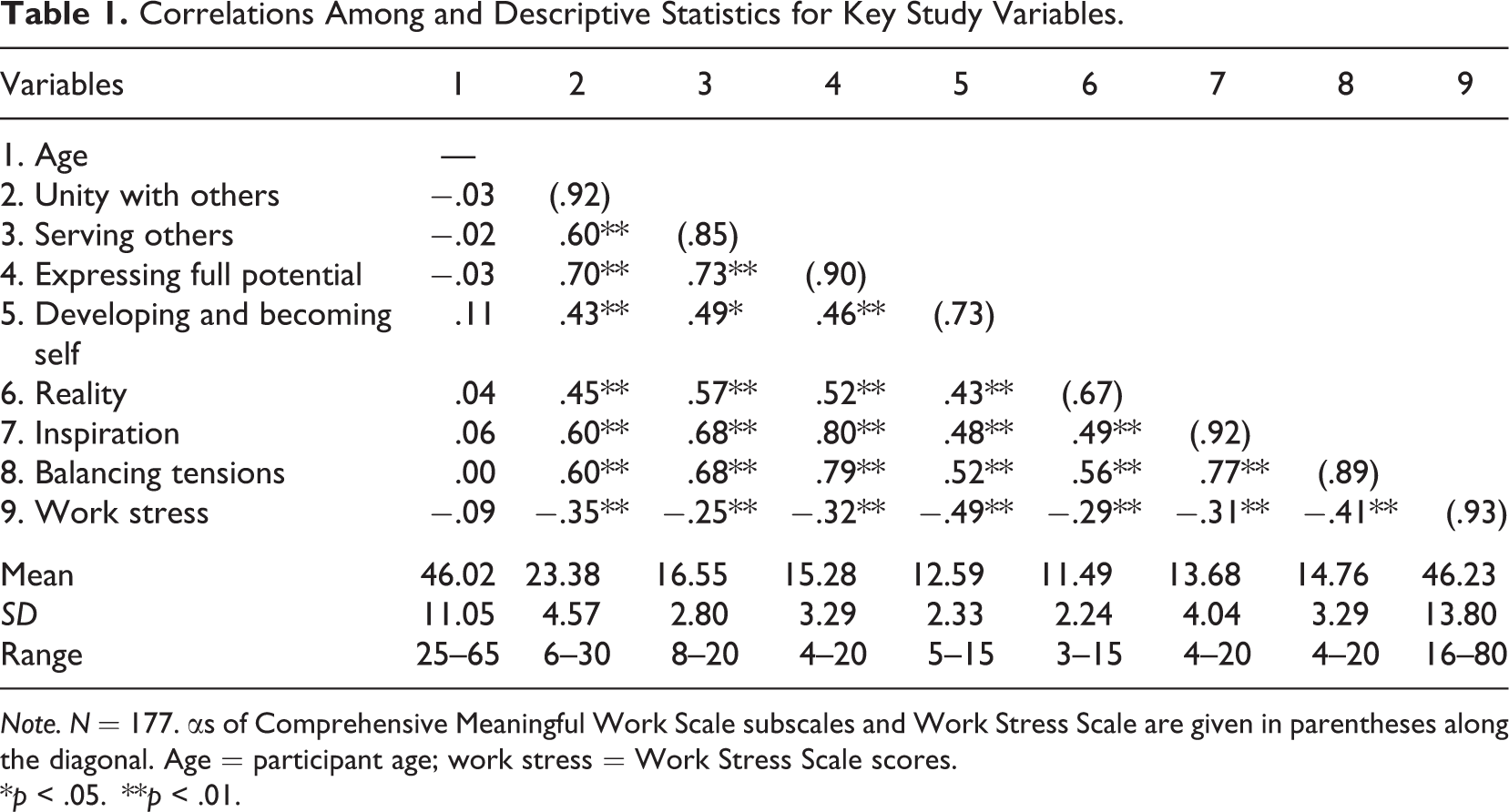
Note. N = 177. αs of Comprehensive Meaningful Work Scale subscales and Work Stress Scale are given in parentheses along the diagonal. Age = participant age; work stress = Work Stress Scale scores.
*p < .05.
**p < .01.
Primary Analyses
Table 2 presents the results of our 2 (gender) × 3 (career stage) MANOVA of the 7 CMWS subscales. Results indicated a significant multivariate effect for career stage, Wilks’s F(14, 330) = 1.90, p < .05, η2 = .07, and a trend toward a multivariate effect for gender, Wilks’s F(7, 165) = 2.00, p < .06, η2 = .08. No significant multivariate effect associated with the interaction of gender and career stage was observed. With regard to the observed career stage effect, follow-up univariate and post hoc group comparison (Tukey’s b) tests indicated this effect was limited to CMWS balancing tensions scores, with participants in the prime work years group demonstrating significantly lower scores on this subscale (M = 13.83) than either participants in the settling in (M = 15.31) and approaching retirement stages (M = 15.43).
Multivariate Analysis of Variance of Comprehensive Meaningful Work Scale Subscale Scores by Gender and Career Stage.
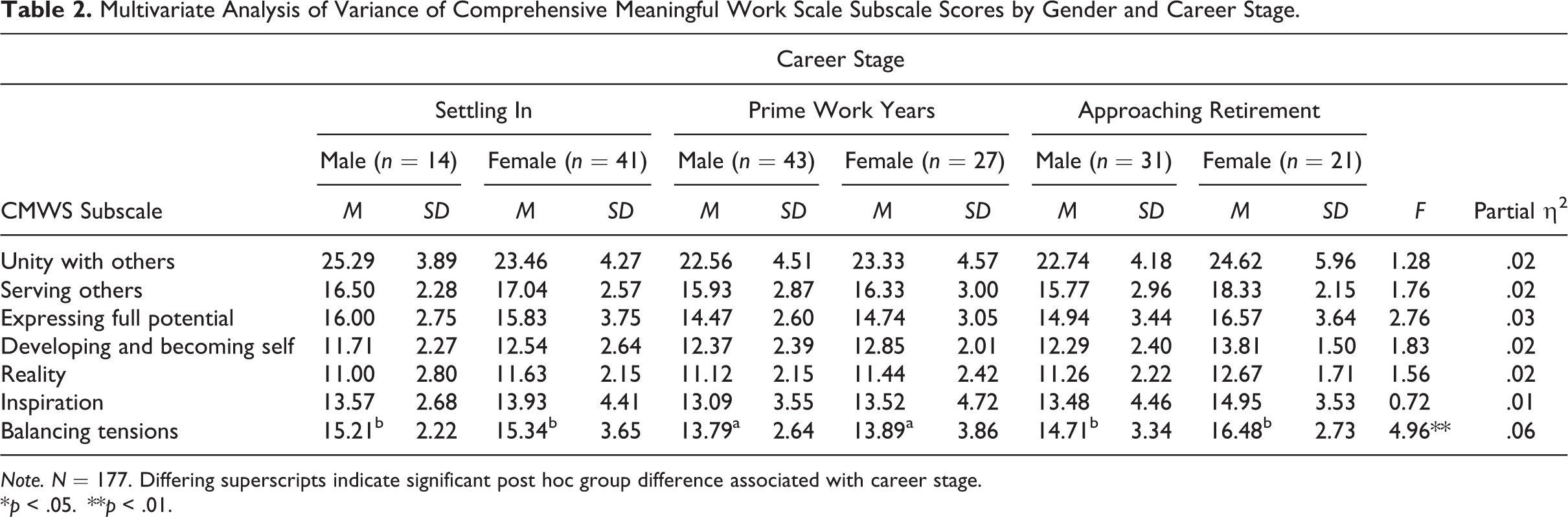
Note. N = 177. Differing superscripts indicate significant post hoc group difference associated with career stage.
*p < .05.
**p < .01.
Given the exploratory nature of our investigation, the near-significant multivariate gender effect was further examined. Follow-up univariate tests of this effect indicating that women scored higher than men on the CMWS subscales of serving others (M women = 17.13, M men = 15.97), developing and becoming self (M women = 15.93, M men = 15.24), and reality (M women = 11.82, M men = 11.15).
Discussion
In recent years, the constructs of work meaning and work meaningfulness have been conceptually differentiated (Rosso, Dekas, & Wrzesniewski, 2010) and multidimensional measures of work meaningfulness have been developed and validated (Lips-Wiersma & Wright, 2012; Steger et al., 2012). The present study extended this line of inquiry by conducting a multivariate analysis of scores on one such measure, the CMWS (Lips-Wiersma & Wright, 2012), within an age-diverse sample of male and female managers. In particular, we (a) examined whether CMWS scores were significantly related to participants’ scores on an independent measure of work stress (a validity-related variable not specifically assessed in prior studies of multidimensional measures of work meaningfulness) and (b) whether participants’ gender and adult career stage significantly contributed to one or more of the dimensions of work meaningfulness assessed by this particular measure.
Our correlational findings supported our hypotheses that CMWS subscale scores would be significantly intercorrelated and that each subscale score would be negatively correlated with self-reported work stress in our sample. The latter finding, in particular, provides an additional criterion validity support for the CMWS by indicating that, when individuals regard their work as providing them with a sense of community and social purpose, and functioning as a supportive, tolerant, and inspiring context for developing and expressing their uniqueness and potential, they correspondingly report lower levels of work stress. This finding thus suggests that high levels of work meaningfulness may confer health benefits to employees by mitigating the experience and ill effects of work stress. Our correlational findings further indicated that, at least during the active adult work years (i.e., 25–65 years of age represented by our sample), our participants’ chronological age was not significantly related to their scores on the various CMWS dimensions of work meaningfulness.
By contrast, our MANOVA findings did reveal a significant multivariate career stage effect for the set of CMWS scores that was limited to the balancing tensions subscale and demonstrated that participants in the prime work years (i.e., age 40–54) stage reported significantly less favorable scores on this dimension than did their counterparts in either the settling in or approaching retirement stages. Clearly, as managers in their prime work years are likely in positions of significant organizational responsibility while still caring for children and adolescents (and quite possibly, aging parents as well) at home, it seems reasonable that this career stage may pose particular challenges to their “balancing the needs of self and others.” Elsewhere, in a large (N = 18,120) sample survey of federal employees, Buffardi, Smith, O’Brien, and Erdwins (1999) found that, whereas the negative effects of child care were limited to their participants’ dissatisfaction with leave benefits and work–family balance, the additive elder-care responsibilities shouldered by “sandwich generation” workers caring for both children and aging parents were associated with a broader array of work frustrations (i.e., lower levels of job satisfaction, perceived organizational support, pay, etc.). Our finding suggests the possibility that, during the mid-career years, individuals may experience a “dip” in this dimension of work meaningfulness that is worthy of more careful study.
Our MANOVA of participants’ CMWS scores also revealed a trend (p < .06) toward a multivariate effect for gender that was further explored. When CMWS scores were examined at the univariate level, we found that, relative to their male peers, women scored higher on the subscales assessing serving others, developing and becoming self, and reality. Recall here that Steger et al. (2012) found no gender differences on the subscales of their multidimensional measure of work meaningfulness (i.e., WAMI), whereas Lips-Wiersma and Wright (2012) reported gender differences on CMWS total scores but did not test the multivariate effect of gender on the set of CMWS subscales. Although our marginally significant multivariate gender effect dictates caution in interpreting our univariate findings, it is plausible that the gender-related CMWS variation we observed at the univariate level may reflect item wording differences between these alternative measures of work meaningfulness. More specifically, we suspect that, unlike the items in the briefer WAMI which are cast in gender-neutral language (e.g., “The work I do serves a greater purpose”), the wording of several CMWS items (including some composing the above subscales) may favor a gendered response by emphasizing such workplace values as caring (e.g., “we support each other”) and helping (e.g., “I feel I truly help our customers/clients”). Future studies involving direct comparisons of WAMI and CMWS measures are needed to test this speculation.
Although our study extends validity support for the CMWS and provides preliminary evidence of a career stage effect associated with a particular dimension of work meaningfulness during the prime work years, further inferences regarding these findings must be considered alongside several study limitations. First, as we sampled an experienced, well-educated, and predominantly White (81%) group of managers, our findings may not generalize to other employees with less or no supervisory responsibilities unless these findings are replicated within studies of more ethnically and occupationally diverse worker samples. Second, our study’s single time point correlational design precludes a clear interpretation as to whether the observed career stage effect in “balancing tensions” was indicative of a developmental (i.e., “time”) or “cohort” effect; such clarification requires the use of longitudinal studies that employ multiple time-point assessments of work meaningfulness and concurrently gather information regarding participants’ family status and caregiving responsibilities.
Third, while our findings underscore the potential utility of James et al.’s (2011) career stage model which partitions Super’s establishment and maintenance career/life phases into three discrete stages (i.e., settling in, prime work years, and approaching retirement), we nonetheless restricted our study of CMWS scores to managers in these three stages and, due to their insufficient numbers in our sample, we did not consider those in either the emerging adult or retirement-eligible stages of their model. As the James et al. (2011) model relies on chronological age in assigning persons to adult career stages, we would also recommend that subsequent studies using this model gather information concerning participants’ work history and anticipated work plans over the next 5–10 years. Such information might enhance the accuracy of their classification by identifying adult career changers who are “recycling” through an earlier stage or those who are planning an early (or delayed) retirement. Lastly, we exclusively relied on self-report measures for assessing our study constructs which may have been vulnerable to social desirability–related distortions and biases; hence, future studies should consider gathering samples that permit a more complete evaluation of James et al.’s five-stage model and that additionally incorporate informant ratings by peers and subordinates of a target manager’s work performance, engagement, and effectiveness.
Despite its limitations, our study is, to the best of our knowledge, the first effort to concurrently explore the contributions of gender and career stage to the scores of adult workers on an existing multidimensional measure of work meaningfulness. The construct of work meaningfulness embraces a highly subjective and existential appraisal of the meaning of one’s work as a life pursuit, one that has been associated in expected directions with work volition and engagement, job satisfaction, burnout, and stress. As such, it will be important for future researchers to examine how fluctuations in individuals’ organizational, job, family, and developmental circumstances may affect the nature and consequences of these appraisals on their work-related choices and actions over time.
Footnotes
Declaration of Conflicting Interests
The author(s) declared no potential conflicts of interest with respect to the research, authorship, and/or publication of this article.
Funding
The author(s) received no financial support for the research, authorship, and/or publication of this article.