



Abstract
Family influence is a key factor in career development and considerably more so in some cultures than others. Assessing the extent to which family plays a role in college students’ career development within collectivistic cultures may thus significantly contribute to the extant literature by offering varying perspectives on the relationships between familial influence, career preparation satisfaction, and life satisfaction. The present study examined the cultural validity of the Family Influence Scale (FIS) through a sample of 420 South Korean college students. The FIS was then used in a test of family influence as the main distal contextual factor in the Social Cognitive Career Theory—Life Satisfaction Model. Overall, results supported the cultural validity of FIS and also the hypothesized model. Family informational support, family expectations, family financial support, career decision-making self-efficacy, expectancy of outcome, career preparation behavior, and career preparation satisfaction were each found to significantly relate to life satisfaction, accounting for 57% of the variance. Implications for research and practice are discussed.
Keywords
Scholars have long been interested in examining the wide spectrum of influences that affect the career decision-making process of college students. Among these factors, family influence has received increasing attention (e.g., Paa & McWhirter, 2000; Whiston & Keller, 2004), particularly examining the role of family across cultures. Cross-cultural vocational psychology researchers have argued that family is one of the most influential factors in decision making, especially within collectivistic cultures (e.g., Flores, 2009; Fouad & Bingham, 1995; Fouad et al., 2010). While Western vocational psychology has traditionally focused on the individual’s interests and values in career decision making, increasing work with culturally diverse samples is suggesting that in certain cultures, social expectations play a more significant role in one’s career development than other factors (e.g., Fouad et al., 2010). Indeed, more collectivistic cultures tend to endorse higher familial influence in one’s decision making, especially with respect to one’s vocational choices (e.g., Bratcher, 1982; Fuligni, 2007). Research findings also suggest that parental support may play a more critical role in the career development of adolescents and young adults of color relative to Caucasian or European Americans (Whiston & Keller, 2004).
Koreans are one such ethnic group that is highly influenced by family. Researchers have studied a number of constructs related to family in Korea, such as family expectations (Kwon, 2003), family support (Yang, 2000), family cohesion (Park, 1999), family function (Song & Jang, 2010), and family adaptability (Lee, Chung, & Lee, 2013). Familial influence plays a critical role in Korean youth, especially with respect to most undergraduate students’ not being fully emotionally or financially independent of their parents (e.g., living at home). As such, examining family influence on South Korean students’ career development can contribute to the extant literature by providing a better understanding of how familial influence is associated with career preparation satisfaction and life satisfaction.
There have been efforts to examine family influence on career decision making among Korean college students. Often, however, family influence assessment actually focuses on a single component of family influence (e.g., parental attachment or family strength) rather than examining the broader picture (Tak, Kim, & Goo, 2012). As there is a growing need to examine family influence on career development, several instruments have also been developed in the United States. The available tools, however, focus, to a large extent, on a single component of familial influence (e.g., parental or sibling support) rather than examining overall familial influence (e.g., Ali, McWhirter, & Chronister, 2005).
This study examined the influence of family on career decision making within the context of the Social Cognitive Career Theory (SCCT). The SCCT (Lent, Brown, & Hackett, 1994, 2000) is anchored in Albert Bandura’s self-efficacy theory (1977) and extends Bandura’s general social cognitive theory to academic and career behavior. The original SCCT model proposed that career development is influenced by the belief that the individual develops self-efficacy and outcome expectations through four major sources: (a) personal achievements, (b) vicarious learning, (c) social persuasion, and (d) physiological and affective states (Bandura, 1997). This process reinforces one’s self-efficacy or belief in future success through the application of one’s abilities. More recently, Lent and Brown (2006, 2008) posited a model of work satisfaction that integrates person and situation in the context of SCCT.
In the SCCT work and life satisfaction model, family influence lies at the intersection of these different contextual factors. Although there have been studies examining the role of family in students’ math and science performance from SCCT perspective (Ferry, Fouad, & Smith, 2000; Turner, Steward, & Lapan, 2004), few studies have examined the influence of family in a general and systematic way as it relates to career and life satisfaction. To address this, Fouad and colleagues (2010) developed the Family Influence Scale (FIS), a 22-item measure that identifies the degree to which family members influence the career decision making—including support, family, and cultural expectations—of students from a broad range of ages.
Although a novel effort designed to examine the importance of family influence, the FIS has not been evaluated for use in Korea. It is meaningful to examine familial influence as a background and contextual factor in the Lent and Brown’s (2006) model of work satisfaction, especially because Korean undergraduate students’ career and life satisfaction has been found to be highly influenced by familial aspects (Nam & Ha, 2012, p. 28). It is also important to note that family influences Korean students’ academic achievement or deviation more so than in China and Japan (Lee & Kang, 2010, p. 291). We hypothesized that family influence would be considered a distal category of contextual influence rather than a proximal contextual influence since family influence is prevalent from very early on in collectivistic cultures. It is especially critical during active periods such as when students make educational or career decisions (Lent, Brown, Brenner, et al., 2001).
The purpose of this study is twofold. First, we attempted to validate the FIS in a Korean college population and to evaluate whether the FIS could be used to understand students’ perceptions of family influence on their career decision-making self-efficacy (CDMSE) and in turn career preparation satisfaction and life satisfaction. This study examined how family influence is associated with other influences on career decision making such as Career Decision-making Self-efficacy, Career Indecision, Satisfaction with Life, and Subjective Individualism and Collectivism. We also examined how this association varies by gender, age, and socioeconomic status (SES). It is hypothesized that, if someone is strongly influenced by his or her family, it is more likely he or she will experience high CDMSE. In addition, if someone has a higher sense of family influence, that person might perceive fewer career barriers. The second overall purpose of the current study was to explore the relationship between different factors in the FIS and to test Lent and Brown’s work and the life satisfaction (2006) model within a sample of Korean college students, this as an additional way to examine the construct validity of the FIS. Specifically, we compared the direct and indirect effects of the predictor variables and compared our model with an alternative model. Given the paucity of research on the examining direct effect of family on career issues from social cognitive perspective, our alternative model tested whether family influence directly affects participants’ career satisfaction and life satisfaction.
Method
Procedure
The second author visited three normal universities and one teacher’s college in South Korea, recruiting student participants through Education and Psychology classes. Participants were told that the investigator was interested in studying the influence of career decision making on South Korean undergraduate students, and one of the authors met with students at the four universities. The students were given instrument packets, including consent forms and questionnaires counterbalanced to avoid order effects from fatigue. The second author provided detailed instructions on how to complete the survey, and an opportunity for questions and answers was offered. Data were collected during the first week of the fall semester of the school year. Participation was voluntary.
Participants
The participants were 422 South Korean undergraduate students. Two surveys having more than 10% missing data were removed from further analyses (Schlomer, Bauman, & Card, 2010); thus, the final sample was composed of 420 college students. We used mean imputation for dealing with missing data for other participants when there was less than 10% missing data (Little & Rubin, 1987). Overall, 183 (43.6%) were men, 236 (56.2%) were women, and 1 did not respond to the question about gender. The age range was 18–33, and the average was 22.74 (SD = 2.23). The number of first-year undergraduate students was 59 (14%), second year 132 (31.4%), third year 138 (32.9%), and fourth year 88 (21%), with 3 nonresponding. With respect to the SES of their birth families, 18 identified that they were from low SES (0.3%), 84 from middle–low SES (20%), 201 from middle SES (47.9%), 89 from middle–high SES (21.2%), and 16 from high SES, (3.8%), with 12 nonresponding (2.9%).
Instruments
Career decision-making self-efficacy
The Career Decision-Making Self-Efficacy–Short-Form Scale (CDSE-SF) is a 25-item, 5-Likert scale that assesses the individual’s degree of confidence in successfully engaging in tasks associated with making a career choice and with commitment to that career. It is a shortened form of Taylor and Betz’s (1983) CDMSE Scale (Betz, Klein, & Taylor, 1996). This scale was validated in the Korean population. There are five subscales: career information, goal setting, future planning, problem solving, and self-assessment. Sample items included “I can choose a major that I like from a list of many different majors”; “I can continue to work on my major or my career goal in spite of difficult situations”; and “I can determine what I can afford to sacrifice or what is challenging in order to achieve a career goal.” Higher scores indicate higher levels of CDMSE. For the participants in this study, the internal consistency reliability for the CDSE-SF was .90 and .62, .75, .72, .65, and .73 for the subscales, respectively. Because some of the subscale reliabilities were low, only total CDSE-SF scores were used in the study.
Career indecision
The participants completed the Korean Career Indecision Inventory (K-CII; Tak & Lee, 2001), which measures the degree to which one’s indecision is associated with the career decision-making process (Tak & Lee, 2001) and consists of 22-item 5-Likert items. This instrument consists of five domains: lack of job information (6 items), lack of self-clearance (4 items), indecision (4 items), lack of perception of necessity (4 items), and external barriers (4 items). High scores on the scale indicate higher levels of career indecision. Example items included “I tend to be indecisive when I have to decide something important”; “There are many people who disapprove of the future career that I am considering”; and “I am unsure of what my interests are.” For the participants in the present study, the internal consistency reliability for the K-CII was .93 and .90, .93, .84, .83, and .83 for each of the subscales, respectively.
Life satisfaction
The participants completed the Satisfaction with Life Scale (SWLS; Cho & Cha, 1998), which measures global satisfaction with life in general. It is a 5-Likert, 5-item scale originally by Diener, Emmons, Larsen, and Griffin (1985) and was modified for us in Korean by Cho and Cha (1998). Sample items included “My life, in general, is similar to my ideal life”; “I have achieved the things that I wanted (so far) in my life”; and “If I were born again, I would live my life just as I have.” Higher scores indicate higher life satisfaction. The internal consistency reliability for the SWLS for the participants in the present study was .84.
Subjective individualism and collectivism
The Subjective Individualism and Collectivism Scale (SICS) consists of 32 items, 5-Likert scale that ask participants to indicate their level of agreement or disagreement with statements that assess their predilection toward individual or group orientation (Triandis, 1995). This scale was translated, validated, and modified for a Korean population by Cho and Cha (1999). Subscales include Horizontal Individualism (HI), Vertical Individualism (VI), Horizontal Collectivism (HC), and Vertical Collectivism (VC). Sample items included “I often do ‘my own thing’”; “Things that have happened to me are the result of what I have done in the past”; and “If my family has financial difficulties, I will help as much as I can.” The internal consistency reliability for the SICS for the participants in the present study was .73 for the entire scale, .74 for HI, .74 for VI, .80 for HC, and .62 for VC, respectively.
Family influence
The degree to which the participants’ perception of how their family of origin influences career and work choices was measured with the FIS (Fouad et al., 2010). This 22-item, 5-Likert instrument was translated by the first and second authors. With respect to the translation process, we carefully followed the translation methodology that was recommended by Ægisdóttir, Gerstein, and Cinarbas (2008). Three bilingual persons in the committee compared the translations until an agreement was reached on an optimal translation. Two people in the committee were familiar with both Korean and American culture. Separately, the translated version of the instrument was independently translated back to English (Ægisdóttir, Gerstein, & Cinarbas, 2008). Two additional individuals involved in the translations together decided on the best back-translated version of any disputed items of the scale when comparing them to the original English versions (Ægisdóttir et al., 2008). The academic background of the people who were involved in the translation and back-translation was in Education and Counseling Psychology. When there were items that were not identical in the two same-language versions of the instrument, we worked together with the translation committee until an equivalence was reached (Ægisdóttir et al., 2008). As an example, the original item “My family expects people from our culture to choose certain careers” was first back-translated into “My family expects the people of our culture to select a particular job,” while another version was “My family expects me to choose a job that Koreans generally prefer; that is, a stable job (a job that you have for sure).” The committee decided to choose “My family expects me to choose a job that Koreans generally prefer”; thus, the item was geared more toward Korean culture, while the original item was more reflective of American culture where it is assumed that there are several different cultures rather than one homogeneous culture. Sample items in the FIS included “My family showed me what was important in choosing a career”; “My family expects me to make career decisions so that I do not shame them”; and “If I have a difficulty in career situation, my family will support me financially.” The FIS demonstrated appropriate reliability, Cronbach’s α for the subscales and for the full measure that ranged from .82 to .89, indicating good internal consistency.
Expectancy of occupation
Expectancy of occupation was used to assess outcome expectations. This assesses expectancies for success regarding completing the required course of study, getting hired into the desired occupation, maintaining employment in that occupation, and career advancement (Brooks & Betz, 1990). Expectancy of occupation is a construct that was suggested by Vroom (1996) and is considered an important factor that may affect an individual’s career choice. This instrument was used to measure outcome expectation with respect to career achievement. This scale was found to be more relevant than the outcome expectation scale with the South Korean population in a previous study; it explains South Korean College Students’ career-related behaviors better (Lee, 2009). Sample items included “The career I have chosen will give me the things that I want”; “I can complete the education that is necessary for my career”; and “I will do better than others if I actually get the job of my choice.” The internal consistency reliability for the expectancy of occupation for the participants in the present study was .82.
Career preparation behavior
The degree to which people are engaged in behavior that prepares them for a career was assessed with the Career Preparation Behavior (CPB) scale. It is an 18-item, 5-Likert (changed from 4-Likert) scale. This scale was originally developed by Kim (1997), but Kim (2003) modified the original instrument by adding 2 items that reflect the increased technological information exchange resulting from increased online information in Korea and also reflect increased use of university counseling centers. Sample items included, “I have talked with my friends about my major/career in the last several weeks”; “I have made plans to visit an agency that is related to a career of my choice”; and “In the last several weeks, I have explored information regarding the career in which I have been interested.” Higher scores indicate a higher level of CPB. The internal consistency reliability for the CPB for the participants in the present study was .90.
Career preparation satisfaction
The participants completed a Career Preparation Satisfaction Scale (CS), which is a 2-item, 5-Likert scale that assesses individual’s career preparation satisfaction. This instrument is based on Lounsbury, Park, Sundstrom, Williamson, and Pemberton (2004)’s CS and was translated and validated in the Korean population by Jung and Cho (2012). Sample items included “I feel clearly where I am going with respect to my career direction and “I am satisfied with my career path that has taken me.” The internal consistency reliability for the CS for the participants in the present study was .81.
Results
Confirmatory Factor Analysis (CFA)
A CFA was conducted to examine how the original 4-factor FIS structure fits with Korean College students. We compared two models: (1) Model 1 where all 4 factors are correlated with each other and (2) Model 2 with correlations permitted among informational support and financial support. When comparing Models 1 and 2, we choose Model 2 which had a better model fit: χ2(115) = 400.19, CDMIN/DF = 3.48, goodness-of-fit index (GFI) = .90, comparative fit index (CFI) = .92, Tucker–Lewis index (TLI) = .90, and root-mean-square error of approximation (RMSEA) = .077.
Demographic Differences in FIS
We calculated analyses of variance on each subscale to determine significant group differences on the FIS subscales with gender, grade, and SES as fixed factors. Because of the large number of analyses, we set an a priori α level of .01 to interpret the significant differences. We found a significant difference in self-described social class in information support, F(2,407) = 9.17, p < .001, with high social class participants indicating greater informational support (M = 3.5) than low social class participants (M = 2.9). As might be expected, we also found a significant difference between groups on financial support, F(2, 407) = 9.3, p < .001, with high social class participants (M = 4.2) higher on this scale than low social class participants (M = 3.7, respectively). In addition, we found a significant difference between groups on the family expectations, F(1,407) =6.7, p = .01, with female participants (M = 3.99) higher on this scale than male participants (M = 3.75, respectively). There were no significant interactions for gender, grade, and SES. These findings support the construct validity of the scales.
Measurement Model
Prior to testing the structural model to examine the construct validity of the FIS, we examined a measurement model for the observed indicators for each of the eight latent constructs. The satisfaction with life, career preparation satisfaction, career preparation behavior, expectancy of occupation, family expectation, and financial support each contained 5, 2, 3, 4, 5, and 4 items, respectively, and, as such, each item was used to represent one observed indicator. For CDMSE, parcels were created according to the five subscales of the CDSE-SF (Betz & Tayler, 1996), which are career information (5 items, α = .62), goal setting (5 items, α = .75), future planning (5 items, α = .72), problem solving (5 items, α = .65), and self-assessment self-efficacy (5 items, α = .73). For informational support in the FIS, following recommendations by Weston and Gore (2006), parcels were created by conducting an exploratory factor analysis for the items in each scale and assigning items to parcels in a countervailing order according to the magnitude of the factor loading in order to have relatively equal loadings for each parcel. The estimated internal consistency reliabilities for each of the informational support parcels were as follows: Parcel 1 (3 items, α = .83), Parcel 2 (3 items, α = .82), and Parcel 3 (2 items, α = .76). For the CPB, parcels were created by conducting an exploratory factor analysis for the items in each scale and assigning items to parcels in a countervailing order according to the magnitude of the factor loading in order to have relatively equal loadings for each parcel. The estimated internal consistency reliabilities for each of the CPB parcels were as follows: Parcel 1 (6 items, α = .69), Parcel 2 (6 items, α = .75), and Parcel 3 (6 items, α = .74).
After the parcels were created, a CFA using maximum likelihood estimation was conducted, with items/parcels assigned to the appropriate latent construct. We examined the goodness of fit with the following indices: a χ2, a CFI, and the RMSEA. A nonsignificant χ2 suggests good fit, but χ2 is biased by large sample sizes, such as the one used in this study. The CFI, which compares the proposed model to a null model in which no study variables are related, is a more reliable measure. Values greater than .90 indicate a good fit (Hu & Bentler, 1999).
Primary Model/Structural Equational Modeling
We tested the hypothesized model (see Figure 1) using structural equation modeling with AMOS 18 (Arbuckle, 2007). The analysis was conducted with the entire data set (N = 420). Normality of distribution was examined to assess the appropriateness of conducting structural equation modeling. According to Kline (2005), researchers are advised to transform the variables that have absolute values of skewness >3 and kurtosis >10. Skewness among the variables was not more than 3 (−.954 to .319), and kurtosis was not more than 7 (–4.013 to 3.562), so we did not need to transform any variables and the normality assumption was satisfied. We therefore were able to conduct structural equation modeling. The results for the structural equation modeling indicate that the model has an appropriate fit, with GFI (.85), CFI (.89), TLI (.88), and RMSEA (.06) (see Figure 2).
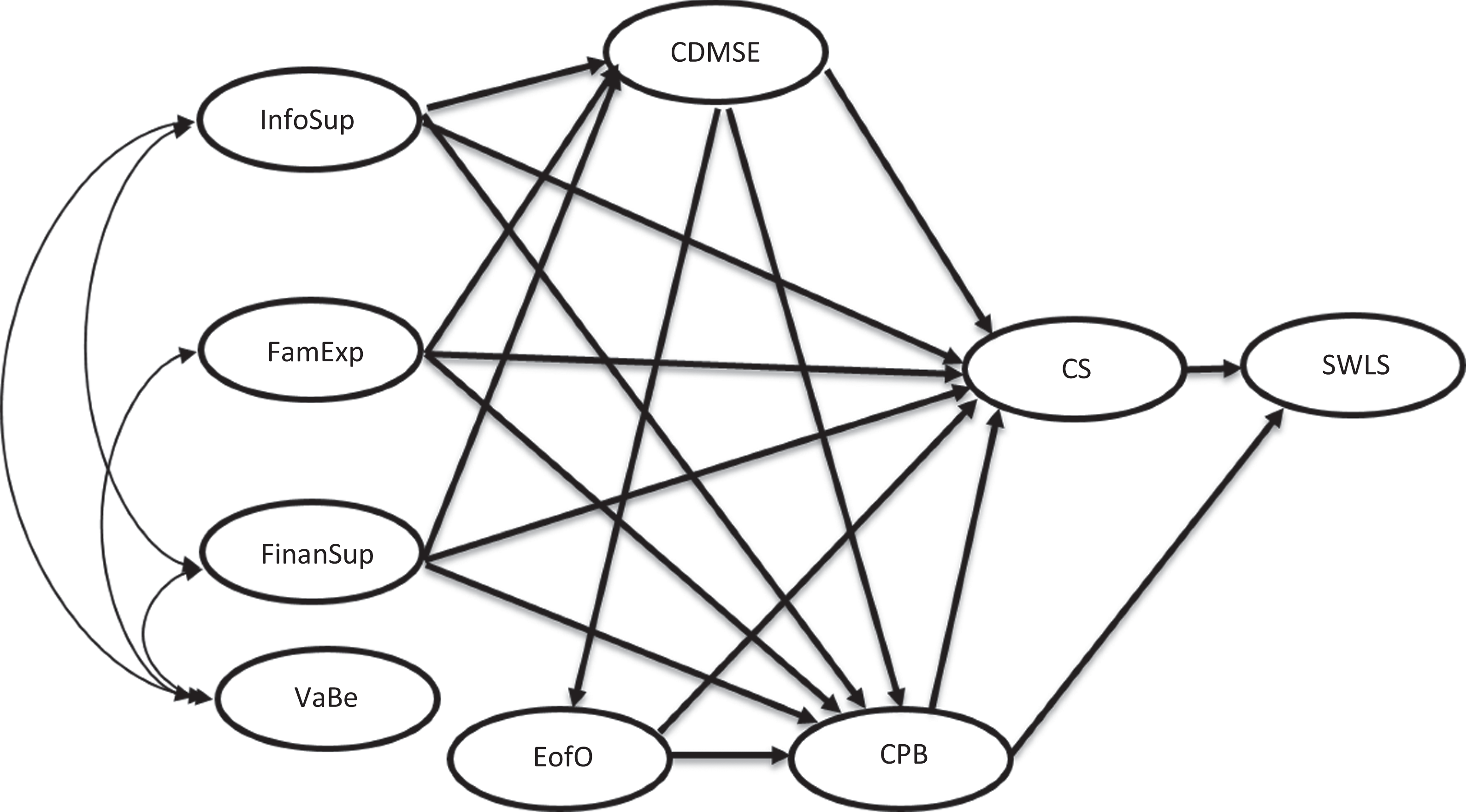
Proposed model.
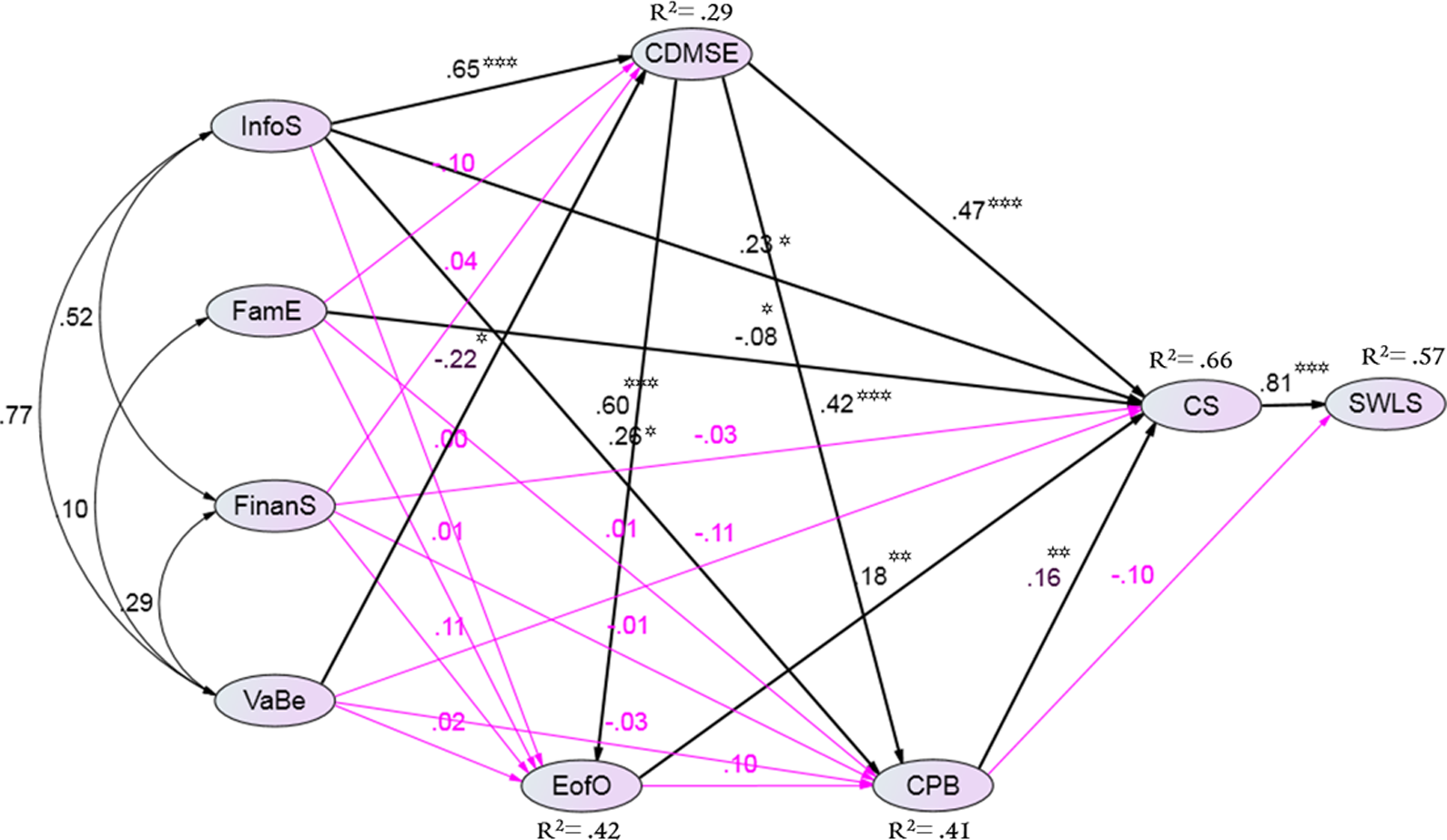
Structural path coefficients for the full sample.
Alternative Model
It is recommended that alternative models be tested, especially given the complexity of the hypothesized model (MacCallum, Wegener, Uchino, & Fabrigar, 1993), we tested an alternative, plausible model and compared it with the hypothesized model. We examined the literature to generate another model that is theoretically grounded. There are alternative models of the role of contextual influences on career decisions: a direct-effect model where proximal supports and barriers have direct effects on goals (SCCT) versus a partially mediated model where both direct effects and indirect effects of contextual factors are examined on career decisions. From previous literature, it was found that partially mediated models tend to produce better fit to the data than did the direct-effects model when career interest was the main focus (e.g., Lent, Brown, Brenner, et al., 2001; Lent, Brown, Schmidt, et al., 2003). However, there is minimal empirical research that examined the comparison between partially mediated model and direct-effects model of contextual factors in work satisfaction model. Therefore, we proposed that an equally plausible model would be one in which areas of family influence have direct effects on career preparation satisfaction. As the primary and alternative models are nested, we used χ2 difference to compare the two models. The alternative model also had fair fit, χ2(411) = 1,258.25, p < .001; CFI = .88; RMSEA = .07, p < .001, but was not as strong as our hypothesized model; χ2(407) = 1,155.08, p < .001; CFI = .90; RMSEA = .06, p < .001. As such, we used our original model to calculate indirect effects.
Indirect Effects
Following Shrout and Bolger’s (2002) bootstrapping recommendations, the standard errors and confidence intervals of the indirect effects estimates were calculated in order to develop more reliable estimates of the standard errors of the indirect effects within the model. Following Arbuckle’s (2007) recommendation, the indirect effects were based on bias-corrected, confidence intervals generated from 10,000 bootstrapped samples using AMOS 18. We examined the following indirect effects: informational support on job satisfaction as mediated by the CDMSE, expectancy of occupation, and CPB; informational support and family expectation on life satisfaction as mediated by the CDMSE, expectancy of occupation, CPB, and career preparation satisfaction. The effect of informational support on career preparation satisfaction was found to be significantly mediated by the CDMSE and the expectancy of occupation (CI [.329, .659]). In addition, the effect of informational support on life satisfaction was found to be significantly mediated by CDMSE, expectancy of occupation, and career preparation satisfaction (CI [.339, .772]). Also, the effect of family expectation on life satisfaction was found to be significantly mediated by career preparation satisfaction (CI [−.201, −.009]).
Discussion
There is a dearth of studies regarding family influence in vocational psychology in terms of a theory-driven understanding of how family influences people’s career and life satisfaction (Whiston & Keller, 2004). Despite its critical role in career development, various aspects of family influence have not been deeply explored in the literature. The current study is one of the first to focus on how family influence relates to career preparation and life satisfaction among South Korean college students. This study also tested the validity of the SCCT in explaining the career and life satisfaction of South Korean college students.
On a basic level, most of our hypotheses were confirmed and matched findings from prior research. The FIS was positively associated with HC and VC, and this was consistent with previous research showing that family influence is especially salient in more collectivistic cultures (e.g., Fuligni, 2007) (see Table 1). There was also a strong positive association between career preparation satisfaction and life satisfaction. This supports the bidirectional path of job satisfaction and life satisfaction in Lent and Brown (2008)’s model and Lounsbury et al.’s (2004) finding of a positive relationship between career preparation satisfaction and life satisfaction. In addition, this result supports a previous finding in which South Korean college students’ career preparation satisfaction was positively associated with life satisfaction (Jung & Cho, 2012).
Descriptive Statistics and Correlation Analysis Between FIS Subscales and Other Variables.
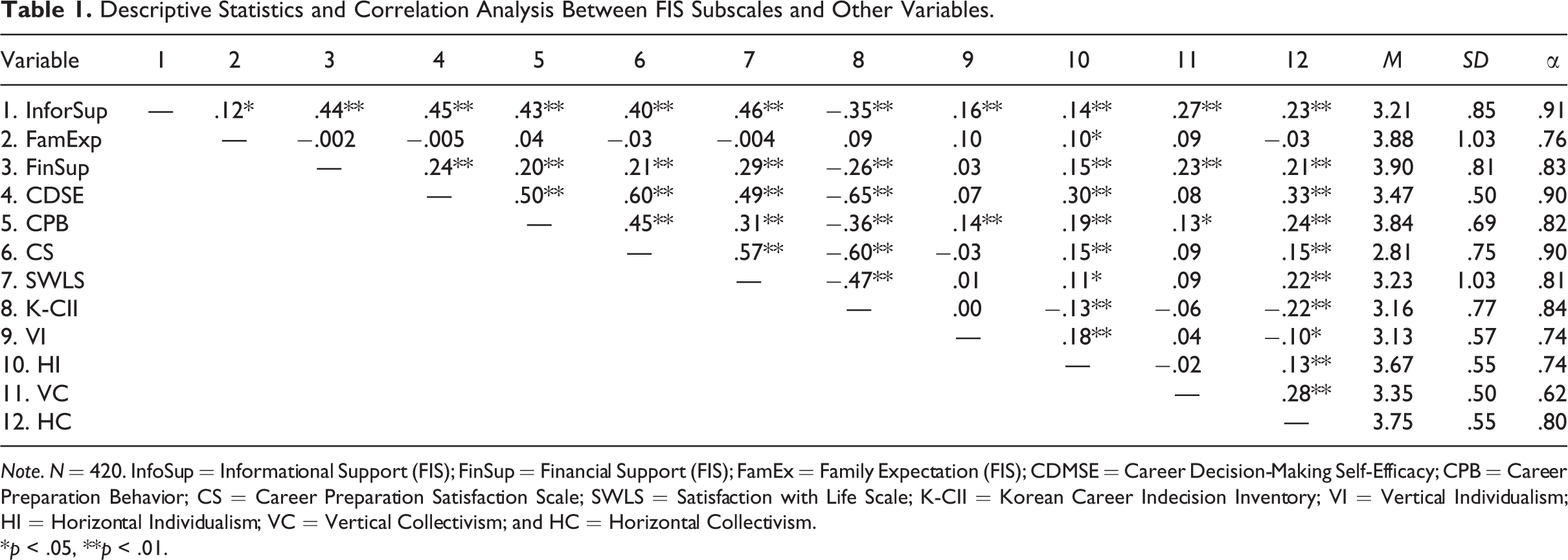
Note. N = 420. InfoSup = Informational Support (FIS); FinSup = Financial Support (FIS); FamEx = Family Expectation (FIS); CDMSE = Career Decision-Making Self-Efficacy; CPB = Career Preparation Behavior; CS = Career Preparation Satisfaction Scale; SWLS = Satisfaction with Life Scale; K-CII = Korean Career Indecision Inventory; VI = Vertical Individualism; HI = Horizontal Individualism; VC = Vertical Collectivism; and HC = Horizontal Collectivism.
*p < .05, **p < .01.
It was also found that informational family support is strongly associated with one’s CDMSE, which supports the general idea that family support influences both career self-efficacy beliefs and career decision making (e.g., Nota, Ferrari, Solberg, & Soresi, 2007).
The present findings highlight the direct and indirect ways in which family influence, CDMSE, expectancy of outcome, and CPB relate to career and work satisfaction. More specifically, greater informational support was associated with higher CDMSE, which in turn was related to higher career preparation satisfaction, which was then associated with higher life satisfaction. Higher informational support was also associated with a higher level of CPB. Higher family expectations, on the other hand, were associated with lower career-decision self-efficacy.
Overall, these direct and indirect effects highlight the complex ways in which family influence factors relate to career preparation and life satisfaction. This is consistent with previous findings that family influence impact South Korean college students’ career development (Lee, 2013), and family support in various forms—informational support, material support, emotional support, and appraisal support—has direct effect on career decision self-efficacy and CPB (Lim, 2012). Kim, Yoo, and Lim (2011) also found out that CDMSE mediates the relationship between multirole plan attitude and life satisfaction, indicating career-related variables impact life satisfaction.
Family is one of the most salient factors in Korean students’ career development, and various aspects of familial influence (e.g., perceived family communication, perceived family support, family function, and family strength) have been found to be associated with career-related variables (CDMSE and career maturity; e.g., Lee, 2013; Park & Lee, 2002; Tak et al., 2012). Examining the role of family influence in career preparation satisfaction within the context of overall life satisfaction therefore provides us with an important perspective on students’ career development and their subjective well-being. In addition, although 5 items were removed from the full FIS, this reduced version of FIS in current study was found to have appropriate cultural validity when used with a different population and used for distal environmental factors in the SCCT model.
Practical Implications
Practitioners are encouraged to actively address clients’ perceptions of family influence in relation to achieving a satisfying career and life more generally. Doing so may help clients feel understood, validated, and empowered to navigate both familial influence and individual career-related plans/wishes.
Clinicians working with clients who report higher familial influence may first explore how such forces are manifested in a client’s life, identity, and his or her feelings about them. They might examine the ways in which families exert their influence, especially the kind of career-related messages that may accompany family relationships and become internalized by the client. For example, it may be helpful for the client to evaluate his/her experience of family expectations and whether they are negatively affecting self-efficacy or positively support career-related beliefs. Exploring the types and accuracy of information clients garner from their families may also be significant in clarifying the underlying feelings, motives, and rationale behind particular career decisions. Indeed, informational support was especially important for our sample population in terms of self-efficacy, career preparation satisfaction, and life satisfaction, consistent with prior research demonstrating informational parental support as the most important variable in South Korean high school students’ career maturity and CDMSE (Lee, 2013). For clients who experience barriers to such informational support (e.g., resource limitations), clinicians may provide appropriate connections to resources and psychoeducation relevant to career aspirations and decisions. Finally, clinicians might want to examine the variety of communicative modalities that exist between a client and his or her family in relation to career development. In line, Young, Friesen, and Dillabough’s (1991) study suggested that both young adults and their parents felt it was necessary to include open communication among family members regarding facilitating career development.
Limitations and Future Directions for Research
The present study needs to be considered in light of a number of limitations. First, we used a convenience sample. Our study could thus be constrained by sample characteristics. Second, although our findings may be relevant to students in other parts of Asia and the Asian-American community given the pervasive importance of collectivism and family in these populations, additional empirical work will be necessary to determine their validity and generalizability.
Third, the directionality of our variables in relation to the SCCT satisfaction model can only be assumed due to the cross-sectional nature of our data. Given the developmental role of family influence to career and life satisfaction, future studies might longitudinally explore the facilitative factors and barriers across the career development process in various populations. In addition, the variables within this model accounted for 57% of the variance in life satisfaction, leaving 43% unaccounted for. Researchers are encouraged to examine additional variables that may account for added variance in the life satisfaction of the Korean college population, with possibilities that include personality traits, parental attachment, and social support. In addition, because we did not collect information on majors, we were unable to examine potential differences in individual variables or model fit across different major groups (e.g., social science, natural science, etc.).
Fourth, while the current study provides a certain degree of cultural validity of FIS within Korean college population, caution is warranted because our analysis is based on a 17-item instrument, not the full 22-item FIS. Because of this, future researchers and practitioners need to be careful in comparing or generalizing the results of the current study.
Footnotes
Declaration of Conflicting Interests
The author(s) declared no potential conflicts of interest with respect to the research, authorship, and/or publication of this article.
Funding
The author(s) received no financial support for the research, authorship, and/or publication of this article.