



Abstract
Critical consciousness of inequity and racism may be a significant asset for Latina/Latino youth’s educational persistence and vocational development. This study describes the development and testing of a new measure of critical consciousness in two samples of Latina/Latino adolescents. Study 1 presents an exploratory factor analysis of the critical consciousness items in a sample of 476 Latina/Latino students from 65 high schools. Study 2 presents confirmatory factor analyses of the items in a separate sample of Latina/Latino students from 74 high schools for the English (n = 680) and Spanish (n = 190) versions of the measure. A two-factor structure (Critical Agency and Critical Behavior) provided a good fit to the data. Relationships between Critical Agency, Critical Behavior, and variables such as postsecondary education plans, vocational outcome expectations, engagement (in school, extracurricular activities, Spanish language, and helping others), and thoughts of dropping out provide initial evidence of construct validity. Strengths, limitations, and future directions are discussed.
Critical consciousness is the most common English translation of “conscientização,” defined by Brazilian educator Paolo Freire as “learning to perceive social, political, and economic contradictions, and to take action against the oppressive elements of reality” (1970, p. 19). Core components of critical consciousness have been identified as critical awareness of inequity and injustice, political efficacy or agency for responding to injustice, and critical activism, or engaging in behaviors to counter or change conditions of injustice (Watts, Diemer, & Voight, 2011; Watts & Guessous, 2006). Critical consciousness may be a significant asset for Latina/Latino high school students, who navigate well-documented constraints and barriers as they pursue their education (e.g., Hill & Torres, 2010; Lopez, 2009; McWhirter, Valdez, & Caban, 2013). Awareness of disparities and inequity coupled with agency and action may empower Latina/Latino adolescent students to resist stereotypes, challenge inequities, and persevere in school (Cammarota, 2007; Diemer & Blustein, 2006).
The work of Diemer and his colleagues first connected critical consciousness, which they also refer to as sociopolitical development, with the career development of marginalized youth. Poor and working-class urban adolescents higher in critical consciousness had more clarity in their vocational identities, higher commitment to their future careers, and greater work role salience (Diemer & Blustein, 2006). They suggested that urban adolescents’ critical consciousness of inequity may better enable them to critically assess and act upon the barriers within their environments, including taking steps to further their vocational development. In subsequent work, Diemer and Hsieh (2008) described several components of low socioeconomic status (SES) youth of color’s sociopolitical development: awareness of and motivation to change situations of inequity, awareness of the influence of inequity in their own lives, motivation to help others in the community, and participation in group action to address inequity. Using a national longitudinal data set, they operationalized youth of color’s critical consciousness with existing items about participation in social action groups, perceived importance of helping others in the community, engagement in discussions with parents about current political and social issues, and the importance of correcting social inequality. All but the latter indicator of critical consciousness significantly predicted higher vocational expectations, and they recommended attention to critical consciousness in future efforts to eradicate the achievement gap (Diemer & Hsieh, 2008).
Additional research with low SES high school youth of color, derived from national longitudinal data sets, yielded additional support for the role of critical consciousness. Consciousness of and motivation to reduce sociopolitical inequality during high school accounted for significant variance in vocational expectations and adult occupational attainment 8 years later (Diemer, 2009) and had direct and indirect positive effects on work salience and vocational expectations (Diemer et al., 2010). Thus, an emerging body of evidence suggests that critical consciousness is an asset for youth of color who face systemic constraints to their career development.
Racial/ethnic disparities in Latina/Latino educational and vocational outcomes have been associated with a host of systemic and sociopolitical barriers, including racism, poverty, inequitable treatment in schools, and a constricted structure of opportunity (Hill & Torres, 2010). Latina/Latino students who recognize such external constraints to their educational and vocational pathways might opt out of the education system altogether, contributing to high drop-out rates (Conchas, 2001; Fine, 1991). But when this awareness is combined with agency and a commitment to fighting against inequities—critical consciousness—it may be a powerful asset or in the words of Watts, Griffith, and Abdul-Adil (1999, p. 255), an “antidote to oppression.”
Critical Consciousness Measurement
In spite of interest in the construct of critical consciousness that spans several decades, only very recently have independent efforts to develop specific measures of adolescent critical consciousness been introduced (Diemer, 2014; Diemer, Rapa, Park, & Perry, 2014). The benefits of a valid and reliable measure include the opportunity to further investigate correlates of critical consciousness, to assess the effects of interventions designed to enhance critical consciousness, to connect different dimensions of critical consciousness (e.g., agency vs. behavior) with different outcomes, and to increase comparability across studies. In order to be most useful, such a measure should be easy to administer, brief, sensitive to change, and domain-specific such that it captures the relevant dimensions of critical consciousness for the target population. Encouraged by the growing body of evidence that critical consciousness may benefit youth career development, and consistent with a call for strength-based orientations in research addressing Latina/Latino youth (Acevedo-Polakovich et al., 2013), we set out to develop a measure of critical consciousness in the context of a pilot intervention project with Latina/Latino youth. The purpose of the present study is to describe the development and initial validity testing of this measure using exploratory (Study 1) and confirmatory (Study 2) factor analyses as well as testing associations between critical consciousness dimensions and relevant vocational development variables.
We began in 2009 with a set of 10 items that we developed to assess critical consciousness among participants in a pilot after school intervention we developed and conducted for Spanish speaking Latino/Latina high school students (McWhirter et al., 2010). The high school at which the intervention was conducted was designated by the Oregon Department of Education as “Needing Improvement” in meeting state education standards (Oregon Department of Education, 2009). The school served a predominantly White low- and middle-income student population, with a growing number of Latina/Latino students who were also recent immigrants, some of whom were undocumented. The high school drop-out rate in Oregon was then, and continues to be, quite high, particularly among Latina/Latino students and English Language Learners (Oregon Department of Education, 2014). Our aim was to promote the educational persistence of Spanish-speaking Latina/Latino students through provision of academic and vocational support and through enhancing participants’ advocacy skills and critical consciousness.
Critical consciousness items were developed after an extensive review of the literature on Latinas/Latinos in the education system, barriers they encounter, and the available literature on critical consciousness. Items were intended to reflect the components of critical consciousness development described by Diemer and Hsieh (2008). Thus, items focused on participants’ awareness of racism and discrimination in general and in their own lives, the importance of and motivation for helping their community and ending racism, and participation in discussions with family and in community or school groups seeking to end discrimination or promote equality. Our focus was on racism and discrimination, as we expected this to be the most salient aspect of inequity experienced by our Latina/Latino adolescent participants. A team of four doctoral students, of whom two were bilingual and bicultural Latinas and two were Spanish fluent White females, reviewed the items for face validity and comprehension. The small sample size of our program participants (n = 19) precluded evaluation of the psychometric properties of this pilot measure. Prior to initiating Study 1, we made a variety of item modifications and additions. For example, we added more items and we altered wording of other items to reduce item similarities and improve item clarity. This resulted in the set of 17 items administered in Study 1.
Study 1
In this first study, our aims were to explore the factor structure of our 17-item measure of adolescent critical consciousness (MACC) in a sample of Latina/Latino high school youth and to test whether higher critical consciousness would be associated with plans to obtain postsecondary education and higher vocational outcome expectations (VOE). Prior findings of Diemer (2009), Diemer and Blustein (2006), and Diemer et al. (2010) showed positive associations between urban youth’s consciousness of and motivation to reduce structural inequities and their educational attainment, as well as commitment to their future career, work role salience, and VOE. Thus, our hypotheses were that critical consciousness (1) would distinguish between Latina/Latino students planning to attend college and those who did not plan to attend college and (2) would be positively associated with VOE. The lack of validated measures of adolescent critical consciousness has limited research in this area, and extant work has not tested or identified evidence of gender differences in adolescent critical consciousness of racial inequality. Thus, our third hypothesis was that we would not find gender differences in critical consciousness.
Method
Participants and Procedures
Data for Study 1 are derived from existing anonymous data collected by conference staff in conjunction with a 1-day regional Latina/Latino youth leadership conference in the spring of 2012. Approximately 1,100 high school students attended the conference. It was the largest gathering of Latina/Latino high school students in the state, with participants from 65 or more different high schools. Because the surveys were distributed and collected by conference staff and did not include personal or identifying information, the University Institutional Review Board determined that this project did not meet criteria for human subjects review. Conference participation criteria and selection varied across the participating schools. The purpose of the annual conference is to foster leadership, cultural pride, and awareness of college and career resources for Latina/Latino high school students. Staff distributed a conference evaluation and questionnaire (alternating Form A or Form B) in both English and Spanish, and students completed the measure in their preferred language. Students who did not wish to complete a questionnaire turned in a blank form. English responses to Form A, which contained the critical consciousness items, were used for the present study. A total of 476 questionnaires were completed by 137 male (29%) and 339 female (71%) Latina/Latino students, ranging in age from 14 to 19 years (M = 16.4, SD = 1.1). Approximately 85% of Latinos in Oregon are of Mexican origin (Pew Hispanic Center, 2011).
Measures
Demographics and plans
Participants self-reported gender and age, and indicated their ethnicity and their education plans immediately after high school by selecting all applicable options from a list.
VOE
The 12-item Vocational Outcome Expectations–Revised scale (VOE-R, McWhirter & Metheny, 2009; Metheny & McWhirter, 2013) measures respondents’ expectations associated with the outcomes of vocational planning and choices. Evidence of reliability, validity, and a unifactorial structure is presented in Metheny and McWhirter (2013). Sample items include “I will have a career/occupation that is respected in our society,” and “I will achieve my career/occupational goals.” Response options range from 1 (strongly agree) to 4 (strongly disagree). Item scores were reverse coded and averaged across the 12 items such that higher scores indicate more positive VOE. An internal consistency α of .93 was obtained in the present sample.
MACC
This 17-item measure was intended to reflect aspects of critical consciousness of racial inequality relevant to Latina/Latino adolescents: consciousness of racism and inequality (5 items; “Racism and discrimination affect people today”), agency and motivation for making a difference (6 items; “There are ways that I can contribute to my community”), and participation in actions promoting equality or against discrimination (6 items; “I am involved in activities or groups that promote equality and justice”). Response options range from 1 (strongly agree) to 4 (strongly disagree). Prior to analyses, these items were reviewed and assigned to subscales by 7 doctoral students familiar with the literature on Latino education and critical consciousness. Two of the items originally considered as actions were suggested to be better reflections of agency, because they described future intentions to act rather than current behavior. Item scores were reversed such that higher scores indicate higher critical consciousness.
Results
Preliminary analyses examined variable distributions and potential biases associated with missing data. Skewness and kurtosis values were acceptable (Curran, West, & Finch, 1996). Rates of missing data ranged from 8% to 12%. Most participants (74%) completed all (17) items. Those that completed all items were compared to those that did not (26%) on study demographic characteristics. No significant differences were found with the exception of gender, χ2(1,475) = 5.57, p = .018; females were more likely to complete all items. To maximize statistical power and reduce bias, a single imputed data set was created using the IVEware program (Raghunathan, Solenberger, & Van Hoewyk, 2002). Although it is not possible to know for sure that data are missing at random (MAR), the MAR assumption can be made more tenable as the imputation model is made more general. The inclusion of additional predictors in the imputation model can reduce bias and make the MAR assumption more plausible (Allison, 2009; He, Zaslavsky, Landrum, Harrington, & Catalano, 2010; Rubin, 1996). Therefore, the imputation model included auxiliary variables (e.g., age and gender) in addition to the VOE and MACC items.
Exploratory Factor Analyses (EFAs)
The Kaiser–Meyer–Olkin (KMO) measure of sampling adequacy (.85, p < .001) and Barlett’s test of sphericity (p < .001) indicated that the sample was suitable for factor analysis (Hair, Anderson, Tatham, & Black, 1995). An EFA of the items was conducted, using principal axis factoring with an oblimin rotation, given that factors were expected to correlate. To determine the optimal number of factors, we utilized the criteria of Eigenvalues > 1, examination of the scree plot, interpretability of the factors, and parsimony. Communalities ranged from .07 to .71. An initial five-factor solution explained 52.6% of the variance, but yielded a factor with a single item. The scree plot suggested two-, three-, or four-factor models were plausible. We compared pattern matrices of two-, three-, or four--factor models. In all three models, there were 4 items with pattern coefficients <.32. The four-factor model also contained a single-item factor, and the four- and three-factor models each had 2 cross-loading items. The two-factor model had no cross-loading items, thus the two-factor model was deemed most parsimonious and retained. Next, items were removed one at a time, starting with the lowest pattern coefficient, until all items loaded at .4 or higher on one factor. This resulted in 8- and 2-item factors, respectively, with pattern coefficients ranging from .47 to .71 (see Table 1). Factor 1, with 8 items, was labeled Critical Agency (α = .80). Factor 2 was labeled Critical Behavior. With only 2 items, the Spearman–Brown prophesy formula was used to calculate internal consistency (Eisinga, Te Grotenhuis, & Pelzer, 2013), yielding a coefficient of .61.
Final Pattern Coefficients for Exploratory Factor Analysis of 17 Critical Consciousness Items.
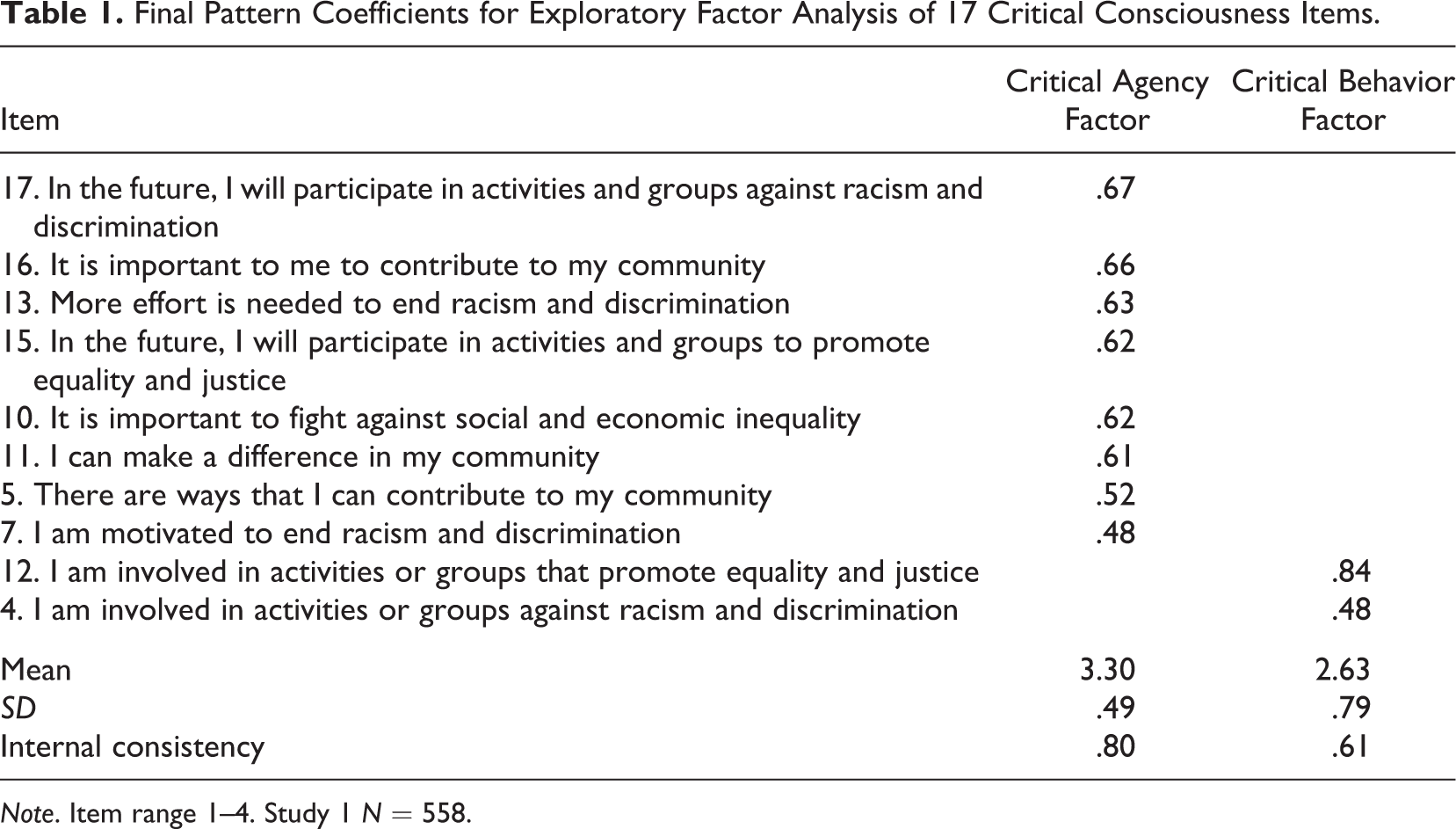
Note. Item range 1–4. Study 1 N = 558.
Follow-Up Analyses
Next, we calculated Critical Agency and Critical Behavior subscales by computing the means of the respective subscale items. We conducted a multivariate analysis of variance (MANOVA) with these subscales as the two dependent variables (DVs), and postsecondary education plans (no school plan, 2-year degree, or 4-year degree) and gender (male and female) as the independent factors. Box’s M of 19.1 was not significant (p = .23), thus Wilks’s Λ was used as the multivariate effect indicator. There was no interaction effect, F(4, 858) = 1.61, p = .17. Significant effects were found for both gender, F(2, 428) = 6.68, p = .001, η2 = .03, and postsecondary school plans, F(4, 858) = 3.67, p = .006, η2 = .017. Follow-up univariate tests indicated that Latina girls had higher Critical Agency scores than Latino boys, F(1, 435) = 12.34, p < .001, η2 = .028. For postsecondary plans, there were significant differences for both Critical Agency, F(2, 434) = 4.34, p = .014, η2 = .02, and Critical Behavior, F(2, 434) = 4.28, p = .015, η2 = .02. Post hoc Scheffe’s tests indicated that Latina/Latino students planning to attend 4-year colleges had significantly higher Critical Agency than both those planning to attend 2-year colleges and those not planning to pursue education after high school. For Critical Behavior, results of Scheffe’s tests indicated that Latina/Latino students planning to attend 4-year colleges had significantly higher scores than those planning to attend 2-year colleges, but did not differ in Critical Behavior from those not planning to pursue higher education. Finally, examination of bivariate correlations indicated that VOE was correlated with both Critical Agency (r = .43, p < .001) and, to a lesser extent, Critical Behavior (r = .17, p < .001), indicating that Latina/Latino students higher in Agency and Behavioral aspects of critical consciousness had more positive outcome expectations associated with further education and career achievements.
Discussion of Study 1
The Study 1 EFA resulted in a 10-item, two-factor structure of Critical Consciousness. This structure differs from Watts et al.’s (2011) suggestion of awareness, agency, and behavior as three distinct components of critical consciousness, in that we did not find a distinct “awareness of inequity” factor. Two items we conceptualized as indicators of awareness were included in the Critical Agency factor. As expected, Critical Agency was highest for those planning on attending 4-year postsecondary institutions. Critical Behavior distinguished between those with 4-year and 2-year college plans. Both Critical Agency and Critical Behavior were significantly and positively correlated with VOE, though the magnitude of the relationship was quite low for Critical Behavior. The Latina girls had higher Critical Agency scores than the Latino boys. Perhaps this is a function of gender role socialization for contributing to the welfare of others or that Latina girls’ experience of sexism enhances their agency and motivation for addressing inequity relative to that of boys. The data do not allow exploration of these possibilities.
The Critical Behavior factor included only 2 items and had a relatively low internal consistency. A factor with fewer than 3 items is generally weak and unstable (Little, Lindenberger, & Nesselroade, 1999; Velicer & Fava, 1998), thus we developed an additional Critical Behavior item. In light of state and national attention to issues of immigration and higher education access to undocumented students, the new item focused on participation in demonstrations or signing petitions regarding justice issues.
Study 2
Rationale and Hypotheses
The aim of Study 2 was to assess the underlying structure of a revised measure of critical consciousness, and to provide initial evidence of validity. Specifically, we hypothesized that results would support a two-factor model consisting of 8 agency/consciousness items and 3 behavior items, respectively. For comparison purposes, we tested whether a one-factor model would provide a better fit to the data. Given the unexpected gender difference in Critical Agency in Study 1, we tested whether this difference was replicated in the Study 2 sample. We hypothesized that Critical Agency and Behavior would again be associated with postsecondary education plans, this time controlling for self-reported grades. We hypothesized that Latina/Latino students high in Critical Agency and Critical Behavior would have higher self-reported general grades, and, considering that the conference is intended to foster leadership, would be more likely to have attended the conference more than once than those low in Critical Agency and Behavior.
Past research with urban minority youth has found positive associations between critical consciousness and engagement with the opportunity structure (Diemer et al., 2010) and with political engagement (Diemer & Li, 2011). We wished to explore whether motivation, agency, and actions to address racism and inequity might also translate to other types of engagement salient to the daily lives of Latina/Latino high school students: school, extracurricular activities, helping at home, and language engagement. We hypothesized that these types of engagement would be associated with higher levels of critical consciousness. Finally, in light of ongoing concerns about the Latina/Latino high school drop-out rate, we tested for a relationship between critical consciousness and thoughts of dropping out. We hypothesized that the potentially demoralizing effect of awareness of inequity and racism would not be associated with thoughts of dropout (Conchas, 2001) for those students with higher Critical Agency and Critical Behavior.
Participants and Procedures
Study 2 data are derived from existing anonymous data collected in 2014 by conference staff in conjunction with the same 1-day regional Latina/Latino leadership conference in the Pacific Northwest described in Study 1. A total of 870 questionnaires were completed by Latina/Latino students from 74 different high schools, ranging in age from 13 to 20 years (M = 16.3, SD = 1.26). A Spanish translation of the survey was created by the first author, back-translated by a Spanish fluent doctoral student, and reviewed by a Spanish language editor. Participants completing the survey in English included 253 male (37%) and 427 female (63%); those completing the survey in Spanish included 58 male (30.5%) and 132 female (69.5%) students. The majority were attending the conference for the first (66%) or second (25%) time. All other procedure content is identical to Study 1.
Measures
Demographics and plans
In addition to the Study 1 demographic and plans items, participants were asked “How many times have you attended this conference, including today?” and “What are your grades, in general?” with response options of “Mostly” As, Bs, Cs, Ds, or Fs. Participants noted on a 5-point scale how true for them were the statements “In the past, I considered dropping out of school” and “I might drop out.”
Engagement
A set of 19 items focused on engagement at school and at home were developed for the conference to better understand student participants’ behavioral engagement in a variety of activities salient to Latina/Latino youth. Participants responded to the question “How often do you do the following?” with six response options: never, rarely, sometimes, often, very often, and always. An EFA (principal axis factoring and oblimin rotation) of these items in the present sample was used to group items into subscales for analyses. A four-factor model explained 52% of the variance and was conceptually clear; factor properties and sample items were School Engagement (7 items, α = .76, “Complete all of my homework”), Spanish Engagement (3 items; α = .77, “Speak Spanish”), Extracurricular Engagement (5 items, α = .70, “Participate in clubs at my school”), and Helping Engagement (4 items, α = .67, “Take care of younger children”).
MACC
The 10 items from Study 1 were administered along with the additional item developed to reflect Critical Behavior.
Results
Preliminary analyses examined variable distributions and potential biases associated with missing data. Skewness and kurtosis values were acceptable (Curran et al., 1996). Rates of missing data ranged from 2% to 4%. Most participants (91%) completed all 11 items. Those who completed all items were compared to those who did not (9%) on study demographic characteristics. No significant differences were found with the exception of grades, χ2(5,849) = 12.10, p = .033; lower grades were associated with missing responses. Following the same logic and procedures described in Study 1, one imputed data set was created.
The hypothesized two-factor (Critical Agency and Critical Behavior) structure produced by the Study 1 EFA, plus the additional item hypothesized to load on the Critical Behavior factor, was tested for stability with the 680 participants that completed the English version of the assessment. Model specification included scaling of the latent variables by fixing one observed measure per factor to 1.0 and allowing the factors to covary; no cross-loadings of items or correlated item residuals were permitted. The resulting overidentified model with 34 degrees of freedom was fit to the data with the Mplus software (version 7.11, Muthén & Muthén, 1998–2012) and estimated with the maximum likelihood function.
Evaluation of the CFA model included assessment of overall goodness of fit, localized areas of misfit in the solution, and interpretability, size, and statistical significance of the model’s parameters. Model fit was based on recommended cut-off values by Hu and Bentler (1999); confirmatory fit index (CFI) > .95, root mean square error of approximation (RMSEA) < .06, and standardized root mean residual (SRMR) < .08. Standardized residuals and modification indices were used to help identify areas of model misfit. Given the large sample size, scrutiny of modification indices relied on the expected parameter change (EPC) values rather than statistical significance. Model respecification was undertaken to improve parsimony and interpretability of the model. We compared one-factor and two-factor structures. Lastly, the model structure was tested on data from the 190 participants who completed the measure in Spanish, to evaluate how well the factor structure was maintained with the Spanish translation.
The 11-item two-factor model showed marginal fit to the data, and the single-factor model provided a poor fit (see Table 2). Examination of the modification indices for the two-factor model indicated that Item 8 had a cross-loading with the behavior factor and had the largest standardized EPC and the largest set of standardized residuals across all items. Therefore, Item 8 was dropped and the model was reestimated. The fit indices improved to an acceptable level and the decrease in the sample size adjusted Bayesian Information Criterion (14349 − 13219 = 1130) was substantial. Additionally, the parameter estimates make statistical (e.g., no Heywood cases) and substantive sense (e.g., moderate to large correlation between the Critical Behavior and Critical Agency factors).
Summary of Model Fit.
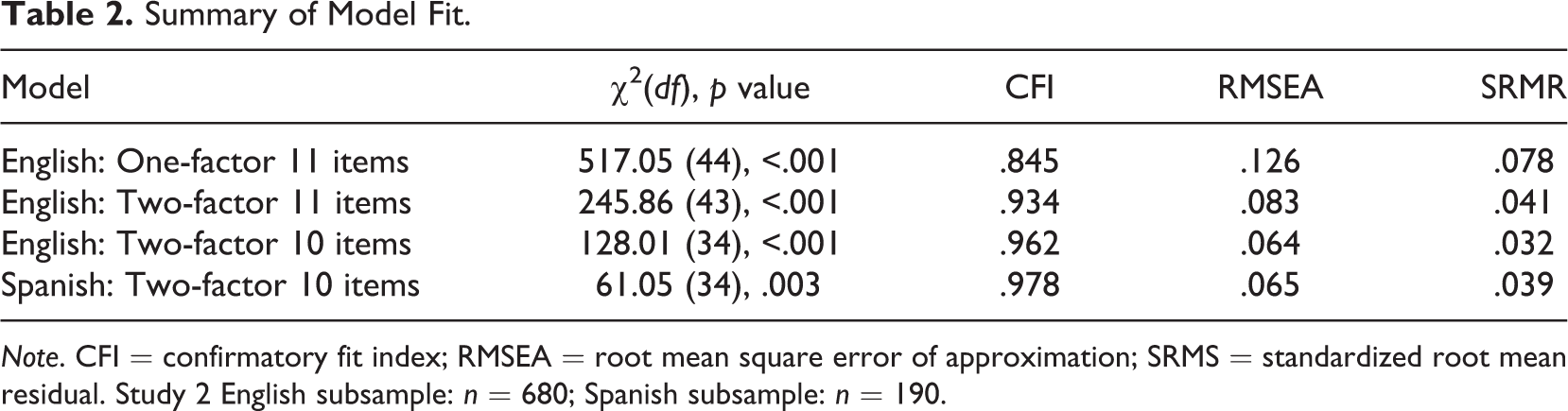
Note. CFI = confirmatory fit index; RMSEA = root mean square error of approximation; SRMS = standardized root mean residual. Study 2 English subsample: n = 680; Spanish subsample: n = 190.
Table 3 contains the standardized regression weights, standard errors, and factor correlations associated with the final two-factor CFA model. All parameter estimates are statistically significant at p < .001, positive, and large in magnitude, indicating each variable is related to the latent constructs with which it is associated.
Final Confirmatory Factor Analysis Results for English and Spanish Measure.
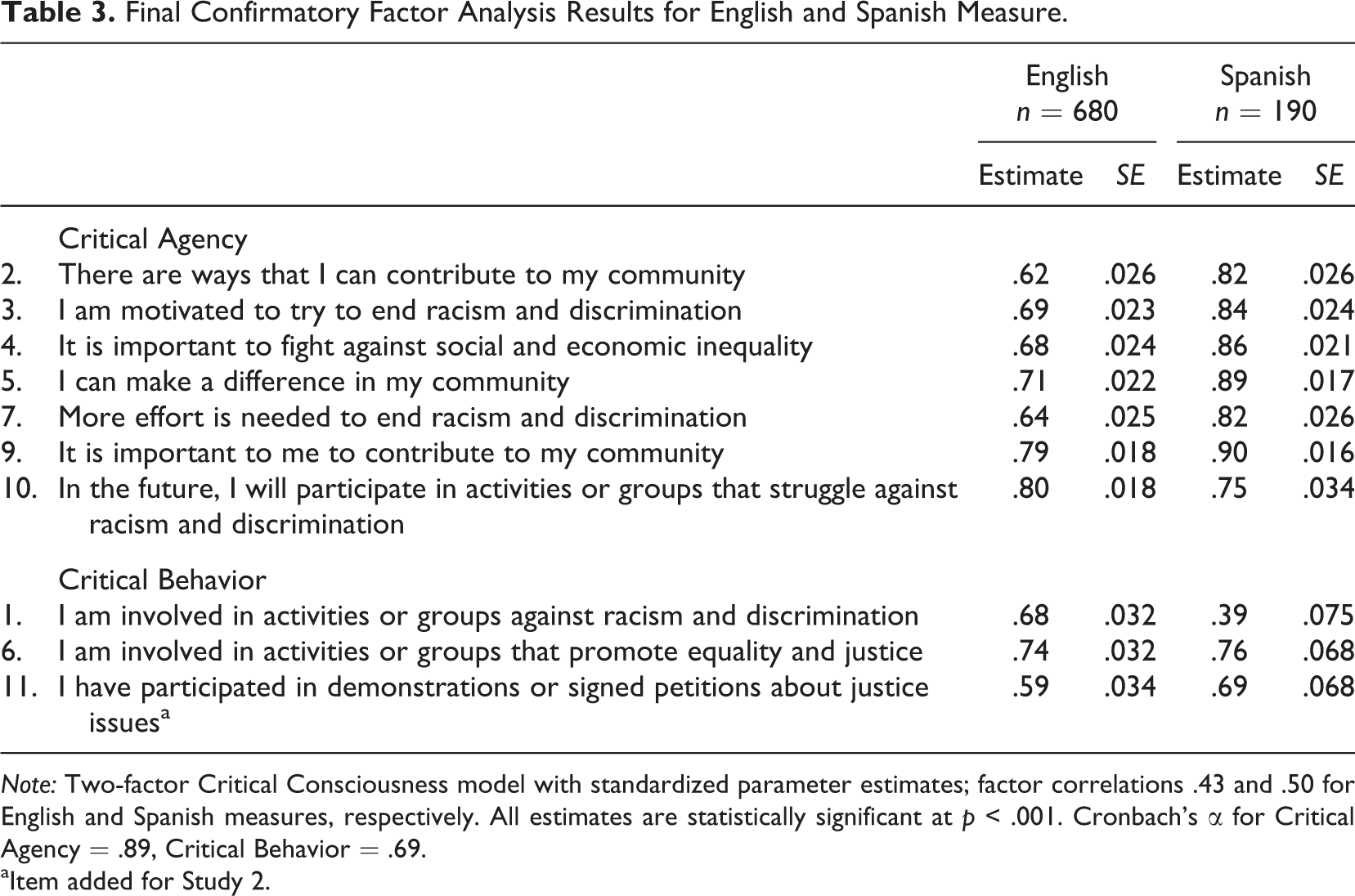
Note: Two-factor Critical Consciousness model with standardized parameter estimates; factor correlations .43 and .50 for English and Spanish measures, respectively. All estimates are statistically significant at p < .001. Cronbach’s α for Critical Agency = .89, Critical Behavior = .69.
aItem added for Study 2.
The final model was then imposed on the sample that completed the survey in Spanish. The fit of the model was comparable to the English version, and like the English version, all parameter estimates were statistically significant and positive. The magnitude of the relationships between the English and Spanish versions differ somewhat in that the Spanish version showed stronger correlations between factors and items, with the exception of Item 1 (see Table 3).
Follow-Up Analyses
Next, we conducted a series of analyses to test the construct validity of the measure. First, we conducted a one-way analysis of variance (ANOVA) to determine whether levels of critical consciousness differed as a function of measure language. There were no language differences for Critical Agency, F(1, 868) = .054, p = .82, or Critical Behavior, F(1, 868) = 1.93, p = .17. Based on this finding, in conjunction with our finding of the same factor structure of Critical Agency and Critical Behavior in the Spanish language data, we combined the English and Spanish data for all subsequent analyses.
We conducted a MANOVA with Critical Agency and Critical Behavior as the DVs and gender (male and female), and language (English and Spanish) as the independent factors. Box’s M was significant at p < .001, thus Pillai’s Trace was used as the multivariate effect indicator. There was no interaction effect, F(2, 865) = 1.45, p = .24, η2 = .003, nor were there main effects for gender, F(2, 865) = 3.39, p = .03, or language, F(2, 865) = 1.58, p = .21. Next, we conducted a multivariate analysis of covariance (MANCOVA) to test whether Critical Agency and Critical Behavior differed as a function of postsecondary education plans (no school plan, 2-year degree, or 4-year degree), controlling for the effect of grades. Box’s M was not significant. There was a main effect for postsecondary plans (Wilks’s Λ = .966, F(4, 1678) 7.39, p < .001, η2 = .017, and the covariate of grades had a significant effect on the combined DV (Wilks’s Λ = .986, F(2, 838) = 6.02, p = .003, η2 = .014). Univariate ANOVA results indicate that only the DV of Critical Agency was significantly associated with postsecondary school plans, F(2, 843) = 11.72, p < .001, η2 = .027, and the covariate of grades, F(1, 843) = 12.02, p = .001, η2 = .014. Comparison of adjusted means indicate significant differences in Critical Agency for each level of postsecondary schooling plans, adjusting for grades, with the lowest Critical Agency for those not planning to pursue postsecondary education immediately after high school, and the highest for those planning to enroll in 4-year colleges. Critical Behavior did not differ as a function of postsecondary plans after adjusting for grades (Table 4).
Adjusted Means and Standard Deviations of Critical Agency and Critical Behavior by Postsecondary Plans, Adjusted for Grades.
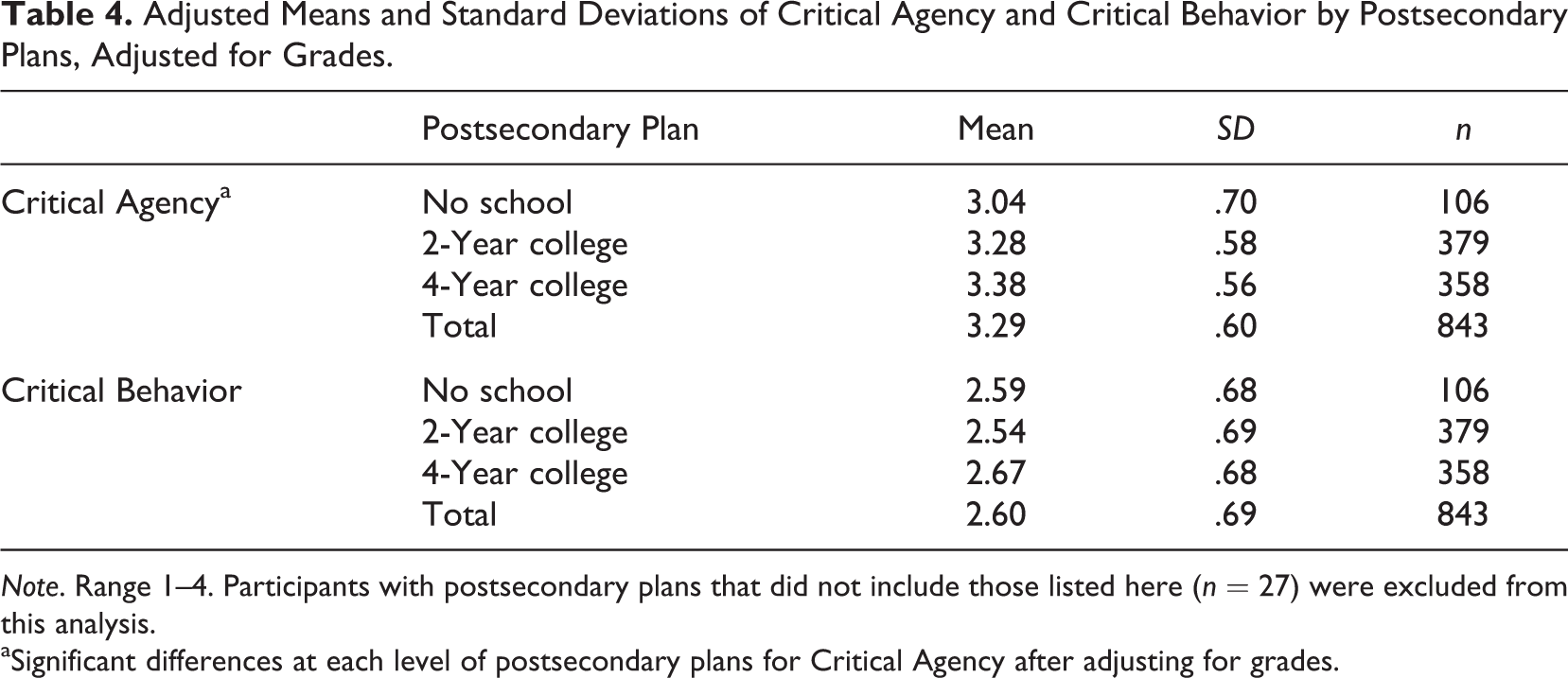
Note. Range 1–4. Participants with postsecondary plans that did not include those listed here (n = 27) were excluded from this analysis.
aSignificant differences at each level of postsecondary plans for Critical Agency after adjusting for grades.
Next, we classified participants as high, medium, or low Critical Agency and Critical Behavior on the basis of scores in the upper, middle, and lower third of means for each subscale. We compared participants high in both Critical Agency and Behavior (high CC; n = 127) to participants low in both Agency and Behavior (low CC; n = 118) with respect to grades (Mostly As and Bs vs. Mostly Cs and Ds) and conference attendance (first time vs. second, third, or fourth time). Box’s M was not significant at p < .001, thus Wilks’s Λ was used as the multivariate effect indicator. There was a significant multivariate effect, Wilks’s Λ = .81, F(2, 242) = 14.10, p < .001, η2 = .104. Examination of between-subjects effects and cell means indicated that, as expected, high CC participants had higher grades, F(1, 245) = 13.96, p < .001, η2 = .054, and had attended the conference more often, F(1, 245) = 13.7, p < .001, η2 = .053, than low CC participants.
We next examined differences in engagement between the high CC and low CC groups. School engagement, extracurricular engagement, helping engagement, and engagement in Spanish served as the four DVs. Box’s M was not significant at p < .001, thus Wilks’s Λ was used as the multivariate effect indicator. There was a significant multivariate effect, Wilks’s Λ = .81, F(4, 240) = 13.88, p < .001, η2 = .19. Examination of between-subjects effects and cell means indicated that high CC participants had higher School Engagement, F(1, 245) = 20.67, p < .001, η2 = .078, Extracurricular Engagement, F(1, 245) = 43.62, p < .001, η2 = .133, Spanish Engagement, F(1, 245) = 9.15, p = .003, η2 = .036, and Helping Engagement, F(1, 245) = 37.36, p < .001, η2 = .133, than low CC participants. Finally, we conducted Pearson product moment correlations and found significant but very small negative correlations between Critical Agency and past thoughts of dropping out (r = −.13, p < .001) and present thoughts of dropping out (r = −.15, p < .001). Critical Behavior was not correlated with either dropout item.
General Discussion
This study contributes to the growing literature base on the potential value of critical consciousness for Latina/Latino youth educational persistence and vocational development. We present initial validity data for a new measure of critical consciousness, and evidence of a relationship between the two dimensions of critical consciousness (Critical Agency and Critical Behavior) and specific educational and vocational outcomes. This measure was specifically developed for and tested with Latina/Latino high school students. The combined results of both studies support a two-factor model. Critical Agency combines commitment to and efficacy for taking action against racism and discrimination. It is akin to Watts and Guessous’s (2006) sense of agency and commitment to make change. Critical Behavior reflects the action component of critical consciousness and can be described as actions to promote justice and end racism.
Our two-factor structure differs from the awareness, efficacy, and action components of critical consciousness proposed by Watts, Diemer, and Voight (2011). Rather than a distinct “awareness of inequity” factor, Critical Agency includes 2 awareness items. It may be that for this group of youth, agency to address racism and discrimination only manifests in conjunction with recognition of racism and inequity. It may also be that we simply did not develop appropriate items for capturing critical awareness.
Critical Agency was strongly and favorably associated with postsecondary plans to attend 4-year colleges in both Studies 1 and 2. In Study 2, Critical Agency was significantly different for each postsecondary pathway, and this association remained even after adjusting for the influence of grades. These results are consistent with our hypotheses, and with prior findings that indicators of critical consciousness were associated with urban minority adolescents’ work role salience, career commitment, and positive vocational expectations (Diemer & Blustein, 2006; Diemer et al., 2010). Contrary to our expectations, although Critical Behavior scores differed between those with 2-year and 4-year college plans in Study 1, it was not significantly associated with postsecondary plans in Study 2 after controlling for grades. Further, in Study 1, Critical Behavior scores did not differ between those with no postsecondary education plans and those with 4-year college plans. As such, Study 2 differences in postsecondary plans in the high versus low CC groups were likely due to the effects of Critical Agency alone.
Perhaps participation in demonstrations and in groups promoting equity and reducing racism among high school students is more subject to practical constraints (e.g., transportation and home responsibilities) and thus less connected to outcomes such as postsecondary plans. In prior research, perceived support (from peers, family, schools, and community) for challenging racism, social injustice, and sexism among urban ethnic minority adolescents was associated with higher critical awareness of inequity, but not with higher levels of action to address inequity (Diemer, Kauffman, Koenig, Trahan, & Hsieh, 2006). These authors suggested that different school contexts might operate to support or constrain sociopolitical action. Future research might explore potential home and school constraints on behavioral manifestations of critical consciousness among Latina/Latino adolescents, as well as differential associations between these 2 subscales and educational and vocational development outcomes.
Critical Agency and Critical Behavior did not vary by gender or by the language in which the survey was completed in Study 2. Attention to gender differences should continue in future studies of Latina/Latino adolescent critical consciousness, particularly, given increasing gender differences in educational expectations, college enrollment, and the differential effects of social capitol on expectations (Wells, Seifert, Padgett, Park, & Umbach, 2011).
Our comparison of the highest and lowest Critical Agency/Behavior groups showed higher critical consciousness was associated with attending the conference more than once. The conference is intended to enhance leadership, instill pride, and highlight access to resources for college and careers. It is possible that conference attendance builds critical consciousness; it is also possible that students higher in critical consciousness seek to attend the conference more often. The present data do not allow for exploring these possibilities. We also found that higher critical consciousness was associated with positive school outcomes such as grades, school engagement, and extracurricular engagement. Our findings contrast with those of Fine (1991) and Conchas (2001), who suggested that critical consciousness of structural inequities may reduce motivation and decrease engagement with school and work. Our participants with a stronger commitment to addressing inequity and higher participation in justice efforts also appear to be more invested in doing well in school and participate more in extracurricular school and community activities. These key types of engagement reduce the likelihood of dropping out of high school (Davalos, Chavez, & Guardiola, 1999; Ream & Rumberger, 2008), and as such may be more promising correlates of critical consciousness than our items assessing the past and present thoughts about dropping out. Fine (1991) and Conchas (2001) focused on critical awareness of inequity rather than critical agency to address inequity, which may explain the differences in our findings. It is possible that a lack of variability in responses to our 2 dropout items artificially suppressed the relationship between critical consciousness and dropout in this sample.
Students high in both critical consciousness subscales had higher engagement in speaking Spanish (speaking and understanding Spanish and translating for family members), and higher engagement in helping behaviors such as caring for younger children and helping others at school, than their low critical consciousness counterparts. The documented challenges of serving as family translators and responsibilities at home have been identified as barriers for Latina/Latino youth (Martinez, McClure, & Eddy, 2009) and yet also are activities that connect young people to their families and communities, provide important roles to play in others’ well-being, and have been linked with academic benefits (Buriel, Perez, De Ment, Chavez, & Moran, 1998; Villanueva & Buriel, 2010; Weisskirch, 2005). It may be that engagement in caring for their families and communities increases awareness of and motivation to challenge the larger ecology of inequity, while they carry out responsibilities and make contributions that enhance their agency. Awareness of parental sacrifices (e.g., immigration and working multiple jobs) for their children’s future opportunities has been described by Latina high school girls as a strong motivator for persisting in school (McWhirter et al., 2013).
Strengths, Limitations, and Future Directions
Overall, the pattern of relationships between Critical Agency, Critical Behavior, and the other study variables supports the initial construct validity of the MACC as a measure of Latina/Latino adolescents’ critical consciousness. This research has a number of strengths, including the use of two relatively large samples, each of which included participants from a large number of high schools. Both exploratory and confirmatory factor analyses were used to test the measure, and a Spanish translation of the measure yielded the same two-factor structure. Study 2 findings showed that the critical consciousness domains of Critical Agency and Critical Behavior did not differ as a function of gender or the language in which the measure was completed.
This is the first measure of critical consciousness to be developed and tested with Latina/Latino youth. The MACC is focused on one of many potential domains of critical consciousness, racial inequity. This measure would not be useful for assessing critical consciousness in other salient domains, such as sexism, or to assess more specific manifestations of racial inequities such as health disparities. The measure is brief, which may increase its utility, but at the same time may reduce its stability with respect to the 3-item behavior factor. The development of additional critical behavior items could add stability to this subscale.
It is important to note that data were collected at a single time point for each sample, so no causal inferences can be drawn. Data were not missing completely at random, and it is possible that results were affected by the missing data. Although we did not find a ceiling effect in the measure, or evidence of a constricted range in scores, it is possible that Latina/Latino students who attend this conference have higher levels of critical consciousness, and less score variability, than might be found for other Latina/Latino high school students in this region.
Generalization of the results should be done with caution. This sample of Latino/Latino students is from a state in the Pacific Northwest in which only 12% of residents are Latina/Latino and approximately 85% of the Latina/Latino population is of Mexican origin. Results may differ for Latina/Latino high school students in other regions with greater proportions of Latina/Latinos and/or greater proportions of Latina/Latinos with non-Mexican origins. Finally, the Latina/Latino high school students who were able to attend this conference may differ from other Latina/Latino high school students in the region, for example, they may be more engaged with their teachers and/or perceived by their teachers to be better behaved than Latina/Latino students who did not attend the conference.
Continued testing of the properties of the measure in other samples of Latina/Latino youth is warranted. Future research with this measure should include validation of the Spanish version of the measure with larger samples of Latina/Latino youth, invariance testing across the English and Spanish versions of the measure, testing in samples of Latina/Latino students who are not conference participants, and testing for associations between scores on this measure and other indicators of critical consciousness.
Summary and Conclusion
Prior research has identified critical consciousness as a potentially powerful and transformative resource for Latina/Latino youth as they navigate structural barriers and pursue their educational and vocational pathways. The present study introduces a measure of critical consciousness designed for and validated with Latina/Latino high school youth and provides additional support for associations between critical consciousness and important indicators of Latina/Latino youth’s educational persistence and career development. A reliable and valid measure of critical consciousness for Latina/Latino youth is an important tool for continued research on this potential asset to Latina/Latino educational attainment and vocational development.
Footnotes
Authors’ Note
To obtain a copy of the measure or correspond about the article, please contact Ellen McWhirter:
Acknowledgments
The authors wish to thank Karyn Lewis and Jeff Gau for statistical support and consultation.
Declaration of Conflicting Interests
The author(s) declared no potential conflicts of interest with respect to the research, authorship, and/or publication of this article.
Funding
The author(s) disclosed receipt of the following financial support for the research, authorship, and/or publication of this article: This research was support in part by funds from a Faculty Excellence Award to Ellen McWhirter from the University of Oregon.