



Abstract
Threatening stereotypes have been theorized as having negative consequences for domain identification among members of the stigmatized groups. The present research tested this disidentification hypothesis among college women (N = 650) in academic majors that should be vulnerable (i.e., science and engineering) and immune (e.g., humanities and education) to these theorized effects. Results of structural equation modeling analyses were consistent with theoretical expectations, as stereotype threat was negatively and indirectly associated with the adoption of self- and task-approach achievement goals through its relationship with science identity for science and engineering majors but not women in nonstereotyped majors. For the latter group, stereotype threat bypassed science identity and was instead both directly and indirectly related to approach motivation. Implications for academic/career motivation, science identity, and career counseling intervention are discussed.
Keywords
Numerous calls have been made by legislators, educators, policy makers, and other stakeholders to increase the number of college graduates in science, technology, engineering, and mathematics (STEM). To achieve this goal, it is necessary to increase participation among women who have traditionally been underrepresented in particular STEM disciplines. In 2012, women received 18.2% of bachelor’s degrees in computer science, 19.2% in engineering, and 19.1% in physics, thus highlighting the most notable fields in which women are underrepresented (National Science Foundation [NSF], 2015). The disproportionately low number of women receiving STEM undergraduate degrees translates directly to their underrepresentation in the workforce. Women possess less than 25% of jobs within STEM fields, yet they hold approximately half of all jobs in the United States workforce (U.S. Department of Commerce, 2011). Although efforts have been made to increase female representation in this job sector, a variety of barriers exist for underrepresented groups, which heighten challenges to success for women. In the present study, we examine stereotype threat as a specific social barrier that can hinder women’s development in this increasingly important career field.
Stereotype Threat and Science Disidentification
There is broad consensus among career development theorists that the formation of a strong vocational identity is critical to the attainment of career satisfaction and success (Blustein, 1994; Savickas, 1985; Vondracek, 1992). Gottfredson (1981, 2002) viewed this process from a developmental perspective, contending that career decisions are influenced by the extent to which one perceives an occupation as being consistent with his or her self-concept. A critical stage in this model occurs approximately between the ages of 6 and 8, when children begin to develop conceptions of gender roles based in part on observations of the types of careers men and women choose. As a consequence, careers that are viewed as being inconsistent with one’s gender role attitudes and eliminated from contention in favor of those that protect valued social (e.g., gender) identities (Gottfredson, 1996). However, Gottfredson’s theory only explains how people come to identify with certain careers through development and socialization before they settle on a career direction, not how they may disidentify with a career domain after a career choice is made (e.g., choice of academic major). Indeed, Gottfredson (1996) acknowledged that her theory does not address issues of career change during adulthood.
Stereotype threat theory (Steele, 1997; Steele & Aronson, 1995), like Gottfredson’s theory, emphasizes the importance of social identity in areas that impact career development (e.g., academic performance), yet it articulates the mechanisms by which people psychologically disengage from particular domains and activities. Stereotype threat is defined as a situational threat that is activated when people are at risk of confirming a negative stereotype which impugns their ability in a certain domain (Steele & Aronson, 1995). In order to be vulnerable to stereotype threat, one must identify with both the stigmatized group and the stereotyped domain. In the present study, we consider women as a stigmatized group in the academic domain of science. Women are not necessarily stigmatized in sciences in which they represent numerical majorities (e.g., biology; Sonnert & Holston, 1996), but they have long been the subjects of the stereotypical belief that they do not have the ability to succeed in math-intensive sciences such as physics and chemistry. Although engineering is not a science per se, principles and practices of engineering are heavily rooted in science, and women have been negatively stereotyped and underrepresented in this field as well. Research indicates that stereotype threat is associated with decreased performance (e.g., Good, Aronson, & Harder, 2008; Smith & White, 2002) and performance expectations (e.g., Sekaquaptewa & Thompson, 2003) as well as lower motivation (e.g., Fogliarti & Bussey, 2013) and maladaptive career goal attainment beliefs (Von Hippel, Issa, Ma, & Stokes, 2011).
Academic identity can be a major determinant of one’s overall sense of self, particularly for people who make a deep commitment to their academic pursuits. Having a view of oneself that is contingent upon succeeding academically can be a risky venture, however, because doing so can expose one’s self-esteem to damage in the event that he or she does not perform to a desired standard. There is empirical evidence to support this view, as researchers have shown that self-esteem varies directly with academic competence information, with negative information triggering decreases in how students feel about themselves and positive information triggering increases in the same (Crocker, Sommers, & Luhtanen, 2002). Relevant to the current study, this negative self-esteem effect has been shown to be particularly salient among women in stereotyped STEM disciplines (Crocker, Karpinski, Quinn, & Chase, 2003).
If exposed to a stereotype long enough, those who are stigmatized may begin to question whether the stereotype is legitimate, possibly triggering within them increased doubts about their competence. This can cause stigmatized group members to disidentify with the group, the domain in question, or both as defensive strategies designed to protect self-esteem (Steele, 1997). Disengagement from science specifically may lead women to consider other academic majors and/or career choices that do not pose a threat to their gender identity. Researchers have consistently documented evidence of disidentification in STEM domains such as science (e.g., Woodcock, Hernandez, Estrada, & Schultz, 2012) and math (e.g., Aronson et al., 1999; Davies, Spencer, Quinn, & Gerhardstein, 2002), however, little research has examined the magnitude of disidentification for different academic group members who may value the same domain in varying ways. Furthermore, researchers in this area typically utilize experimental methods to manipulate threat conditions in the laboratory, and little research has involved measurement of women’s naturally occurring perceptions of threat. We sought to address this issue in the present research by examining disidentification processes among students majoring in science, engineering, and other disciplines (referred to hereafter as non-STEM majors) using a correlational design. In sum, science disidentification produced by chronic stereotype threat could redirect individuals’ career aspirations and paths to nonstereotyped domains, resulting in greater underrepresentation of women in STEM careers.
Achievement and Career Motivation
Motivational constructs have been noted as playing an influential role in the career development of women. Despite the fact that achievement motivation has a direct bearing on the ways in which people both choose and function in careers, few vocational researchers have examined the construct as an outcome of potential interest. Achievement and career motivation have also often been operationalized and measured in the same way (see, e.g., Amabile, Hill, Hennessey, & Tighe, 1994), thus it seems valuable to explore how the achievement goals college women set for themselves might ultimately affect the career choices they make. The present research thus represents, in part, a response to Farmer’s (1976, 1997) call for vocational psychologists to investigate achievement motivation as a particular form of career motivation. Farmer’s (1985) early work in this area focused on mastery motivation, a regulatory mechanism aimed at satisfying need for achievement through attainment of internally established standards of excellence (McClelland, Atkinson, Clark, & Lowell, 1953). It is this type of motivation that we examine in the current study.
Elliot and McGregor (2001) have more recently conceptualized the mastery approach goal construct, a combination of the classic mastery (McClelland et al., 1953), and approach (Atkinson, 1957) motivation constructs, as representing the desire to develop skill and demonstrate competence to self. However, Elliot, Murayama, and Pekrun (2011) noted that mastery approach goals do not necessarily convey information about the referent one uses to evaluate performance. The self may be used to determine how a current performance may compare to previous performances, or the task itself may be used to assess whether the absolute demands of the activity have been met. Elliot et al. (2011) thus separated the mastery approach goal into two distinct goal types: (a) task-approach goals, which are characterized by an aim to develop absolute mastery of a particular task and (b) self-approach goals, which are characterized by a desire to improve one’s skill relative to previous performances on a task.
Very little research has been conducted to date on these goals, however, early studies have revealed promising results. Elliot et al.’s (2011) work suggests that self- and task-approach goals are predictive of increased perceptions of energy in class, intrinsic motivation, learning efficacy, and task absorption among students. These findings have been partially replicated as task- and self-approach goals were recently shown to be positively associated with both intrinsic interest and the belief that ability is malleable (Mascret, Elliot, & Cury, 2015). A much more extensive body of work supports the predictive utility of mastery approach goals, as they are related to greater intrinsic motivation (Elliot & Murayama, 2008; Hulleman, Durik, Schweigert, & Harackiewicz, 2008) and academic performance (Grant & Dweck, 2003).
The Current Study
The purpose of the present research was to empirically examine a potential process by which threatening gender stereotypes undermine women’s identification with science. One way to examine this disidentification process is to investigate the extent to which negative stereotypes indirectly undermine achievement motivation for science. Understanding these motivational effects at an intrapersonal level is important because stigmatizing experiences in science achievement situations may represent an initial point at which women begin to consider alternative career paths. We specifically focused on two types of achievement goals as outcomes, self-approach and task-approach goals, given that the adoption of mastery goals has adaptive consequences for academic interest (e.g., Harackiewicz, Barron, Tauer, & Elliot, 2002) and interest in research (Deemer, Martens, & Podchaski, 2007), the latter of the two being particularly important for individuals who may be considering careers in scientific research. Because negative stereotypes are theorized to be most threatening for those who highly identify with a targeted domain (Steele, 1997; Steele & Aronson, 1995), we reasoned that stereotype threat would be associated with significant decrements in science identity among science and engineering majors but not women in non-STEM majors (e.g., humanities and business). In turn, positive relationships were expected to be observed between science identity and both forms of approach goals (see Figure 1).
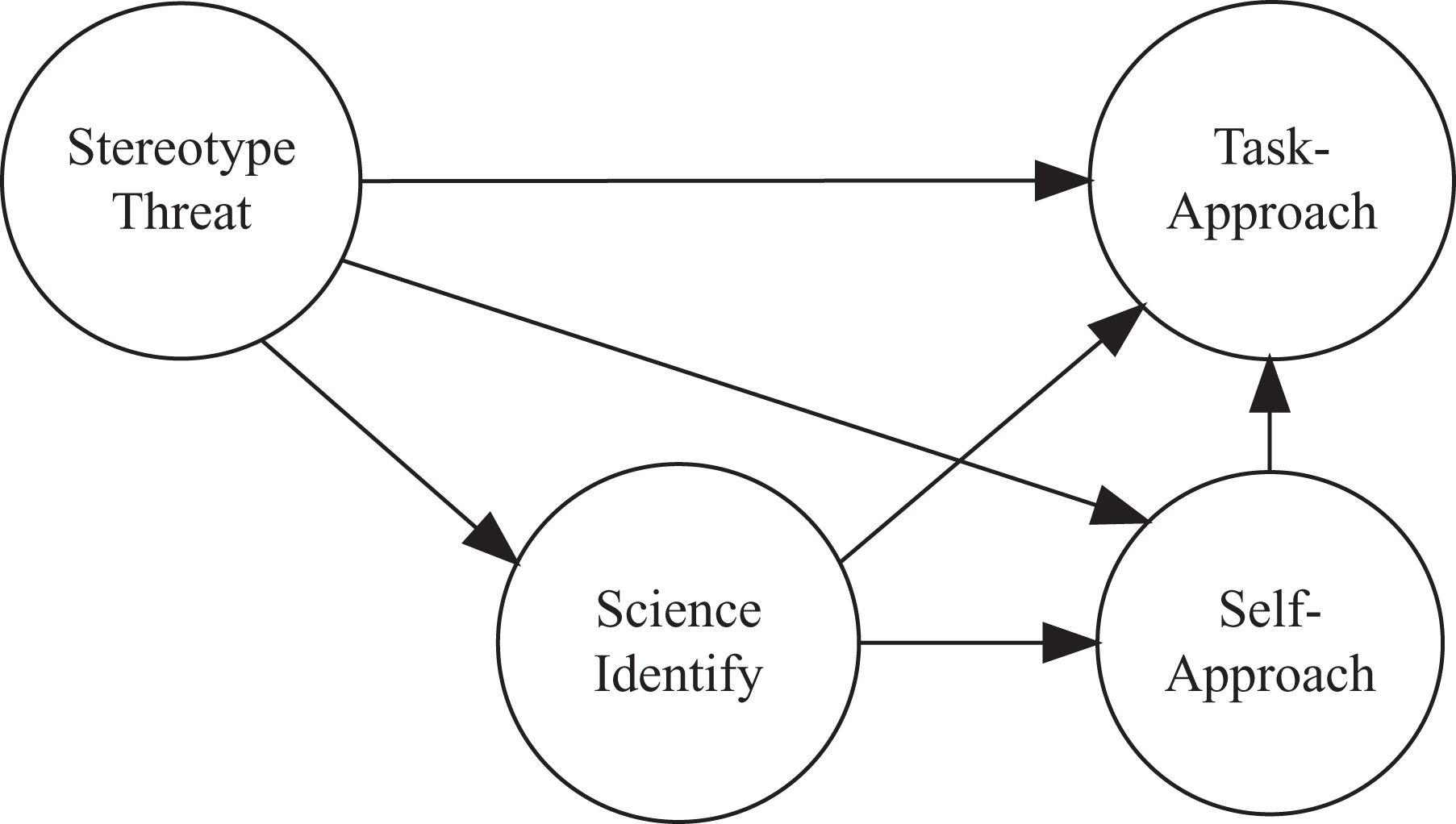
Structural equation model depicting effects of stereotype threat on women’s science identity and motivation.
Thus, we hypothesized that science identity would mediate the relationship between stereotype threat and both self-and task-approach goals among science and engineering majors. Although women in non-STEM majors may not be direct targets of gender-science stereotypes, they can still be affected by them through their identification with other women in the classroom (Wout, Danso, Jackson, & Spencer, 2008). Their identification with science is not likely to be affected because they are not science majors and are thus less likely to value science, but threat exposure may nevertheless trigger reduced motivation for science. For non-STEM majors, stereotype threat was predicted to bypass science identity and predict the adoption of task-approach goals through its association with self-approach goals. Finally, we take the position that a general aim of striving for continual improvement gives rise to more focused aims of mastering particular tasks, therefore self-approach goals were posited as an antecedent of the more task-specific type of goal. Thus, it was hypothesized that self-approach goals would mediate the relationship between science identity and task-approach goals for science and engineering majors.
Method
Participants
Participants comprised 681 female college students enrolled at a large public university in the midwestern United States. Age ranged from 18 to 64 (M = 19.86, SD = 2.53). In terms of race/ethnicity, 74% identified as White, 13.2% identified as Asian/Asian American, 3.7% identified as Black/African American, 3.2% identified as multiracial, 3.1% identified as Latina, 1.2% identified as Arabic/Arab American, 1.2% identified as other, and 0.4% identified as Native American. Reported academic classifications were as follows: 32% freshmen, 30.5% sophomores, 19.8% juniors, 16.3% seniors, 0.7% post-baccalaureate, and 0.6% graduate students. Two hundred and seven participants reported majoring in biology, 159 in engineering, 79 in education, 51 in chemistry, 43 in biochemistry, 25 in business, and 17 in physics. Seventy-four participants majored in humanities, agriculture, and social sciences, and 26 were undecided. Overall, the three groups that were examined in the substantive analyses comprised 318 science majors, 159 engineering majors, and 204 non-STEM majors.
Measures
Stereotype threat
The Stereotype Vulnerability Scale (SVS; Spencer, 1994) was used to measure stereotype threat in the present study. The SVS is an 8-item scale in which participants respond to the anchor statement “Because of your gender … ” on a 5-point Likert-type scale ranging from 1 (strongly disagree) to 5 (strongly agree). An example item includes “Some people believe that you have less ability.” Consistent with theoretical expectations, previous research indicates that women in male-dominated majors score significantly higher than men on the SVS, thus supporting the scores’ construct validity (Steele, James, & Barnett, 2002). Steele, James, and Barnett (2002) also obtained evidence that SVS scores possess good internal consistency reliability (α = .84). A Cronbach’s α coefficient of .92 was obtained in the current study.
Academic achievement goals
The 3 × 2 Achievement Goal Questionnaire (AGQ; Elliot, Murayama, & Pekrun, 2011) was used to measure self- and task-approach motivation. The AGQ is an 18-item questionnaire in which the participants respond to the anchor question “How true is this goal statement of you?” on a 7-point Likert-type scale ranging from 1 (not true of me) to 7 (extremely true of me). The AGQ consists of six subscales, with 3 items measuring each of the goal constructs: (a) task approach (e.g., “To get a lot of questions right on the exams in this class”), (b) task avoidance (e.g., “To avoid incorrect answers on the exams in this class”), (c) self-approach (e.g., “To perform better on the exams in this class than I have done in the past on these types of exams”), (d) self-avoidance (e.g., “To avoid doing worse on the exams in this class than I normally do on these types of exams”), (e) other approach (e.g., “To outperform other students on the exams in this class”), and (f) other avoidance (“To avoid doing worse than other students on the exams in this class”). Evidence of construct validity has been demonstrated through confirmatory factor analytic testing indicating that the 3 × 2 model performed significantly better than several other models in which the items were configured to load onto various factors (e.g., all approach items together, all task-based items together, etc.; Elliot et al., 2011). Reported Cronbach’s α coefficients from Elliot et al.’s (2011) work were as follows: .88 for task-approach goals, .86 for task-avoidance goals, .83 for self-approach goals, .87 for self-avoidance goals, .92 for other-approach goals, and .91 for other-avoidance goals. Cronbach’s α coefficients in the present study were .91 for self-approach goals and .87 for task-approach goals. Elliot et al.’s (2011) research yielded a significant positive correlation (r = .29, p < .05) between self- and task-approach goals.
Science identity
Doosje, Ellemers, and Spears’ (1995) Group Identification Measure was used to assess science identity. The original measure consists of 4 items measuring academic identity. Deemer, Smith, Thoman, and Chase (2014) adapted these items and added a fifth to increase conceptual coverage of the construct. The items are as follows: (a) “I identify with other science students,” (b) “I see myself as a science student,” (c) “I am glad to be a science student,” (d) “I feel strong ties with science students,” and (e) “I feel that being a science student is an important reflection of who I am.” Participants rate the statements on a 7-point scale ranging from 1 (strongly disagree) to 7 (strongly agree). The psychometric properties of the adapted measure have been supported through significant positive associations with measures of science self-efficacy and motivation to conduct research and good internal consistency of its scores (α = .85; Deemer, Smith, Thoman, & Chase, 2014). Cronbach’s α was .94 in the present study.
Academic major
Participants were classified into one of the three groups (science, engineering, and non-STEM) based on their reported academic major. Science majors were operationally defined as those participants who reported majoring in the life or physical sciences, while engineering majors were categorized as such if they reported majoring in any type of engineering discipline (e.g., electrical, mechanical, and civil). The third category, non-STEM majors, comprised students representing disciplines in the humanities, education, social sciences, agriculture, and business.
Procedure
All data were collected using an online survey. A list of 100-, 200-, 300-, and 400-level undergraduate courses in biology, chemistry, and physics was compiled and submitted to the registrar’s office at the institution where data were collected. Targeted courses were selected such that classification levels were equally represented. Requests for participation were e-mailed en masse by the registrar’s office to students enrolled in these courses. Contained within the e-mail message was a link to an informed consent page, which in turn contained a link to the survey itself. After completing the survey, participants received a US$10 electronic gift card as remuneration.
Results
Data Screening
Descriptive statistics are presented in Table 1. Thirty-one cases were identified as having completely missing data on one or more measures and were thus removed from the data set. We then created dummy variables reflecting missingness and used them to predict between-group differences in the outcome variables (Enders, 2010). Results of t-test analyses were nonsignificant (all p values > .05), thus indicating that the data met the missing completely at random (MCAR; Rubin, 1976) assumption. All cases with partially missing data were thus retained, resulting in a final N of 650. The substantive analyses were performed using maximum likelihood estimation with an expectation–maximization algorithm, which estimates missing values under MCAR conditions (Schafer, 1997).
Descriptive Statistics for the Study Variables.
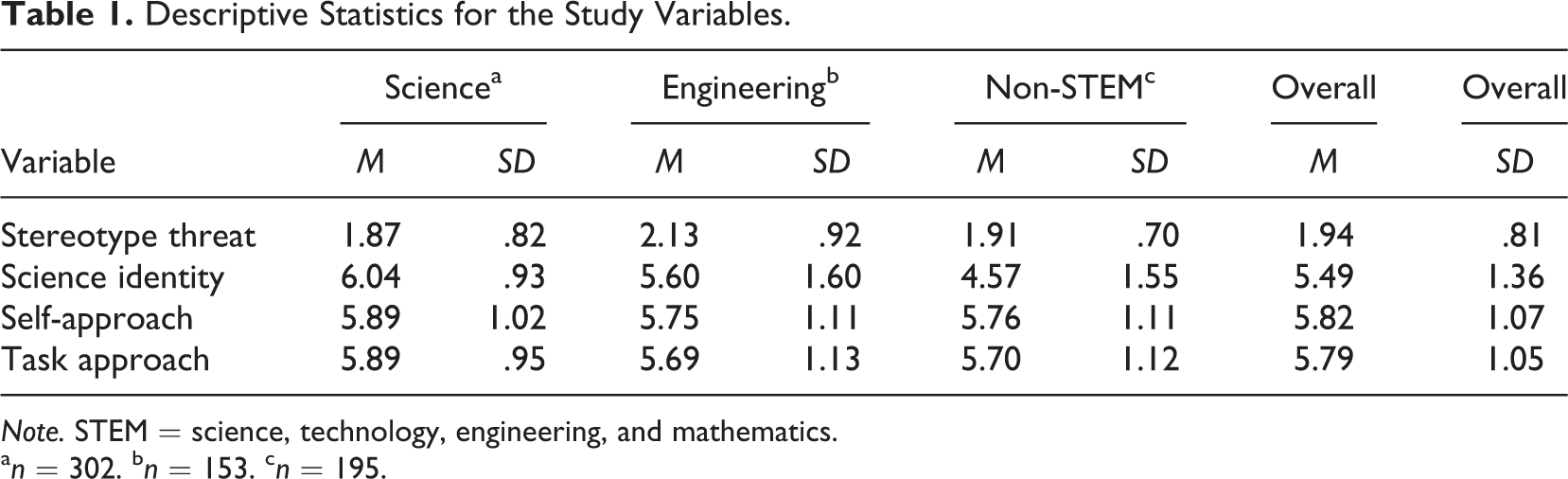
Note. STEM = science, technology, engineering, and mathematics.
a n = 302. b n = 153. c n = 195.
Testing the Measurement Models
We first performed invariance tests of the four-factor model. All measurement and structural model analyses were performed using Mplus 7.3 (Muthén & Muthén, 1998-2015) statistical software. Invariance testing consists of estimating nested measurement models with increasingly restrictive equality constraints to determine whether they perform similarly across groups. The hypothesized model is estimated in each group separately, then factor loadings (metric invariance), intercepts (scalar invariance), and residuals (residual invariance) are fixed to equality and tested in a series of multiple group analyses (Meredith, 1993). However, the residual invariance test has been noted as being overly stringent (Byrne, Shavelson, & Muthén, 1989), thus our aim here was simply to demonstrate partial invariance by establishing the equivalence of the factor loadings across the major groups. Fit indices used in the present study included the (a) model chi-square test, (b) comparative fit index (CFI), (c) Tucker-Lewis index (TLI), (d) root mean square error of approximation (RMSEA), and (e) standardized root mean square residual (SRMR). Hu and Bentler (1999) have suggested that CFI and TLI values of greater than .90 and SRMR values equal to or less than .08 indicate acceptable model fit. Steiger (2007) has suggested that RMSEA values .07 or less indicate good model fit.
Factor variances were fixed to unity to establish a common metric for the variables. The nested models were compared using the chi-square difference test; however, we also used the ΔCFI value given that the chi-square difference test is sensitive to sample size (Vandenberg & Lance, 2000). Based on Cheung and Rensvold’s (2002) recommendation, ΔCFI values ≤.01 were interpreted as indicating noninvariance. The four-factor model provided a less than optimal fit for the science, χ2(146, N = 302) = 514.56, p < .001, CFI = .88, RMSEA = .09 (90% confidence interval [CI]: [.08, .10]), TLI = .86, SRMR = .06; engineering, χ2(146, N = 153) = 405.08, p < .001, CFI = .88, RMSEA = .11 (90% CI: [.10, .12]), TLI = .86, SRMR = .06’ and non-STEM, χ2(146, N = 195) = 425.87, p < .001, CFI = .86, RMSEA = .10 (90% CI: [.09, .11]), TLI = .83, SRMR = .07, major groups. Standardized factor loadings were acceptably high, ranging from .59 to .98 for all items across the three academic groups.
Factor correlations are reported in Table 2. Inspection of the modification indices suggested that model fit could be improved by correlating three pairs of residuals. We made these adjustments and, because the correlation between the self- and task-approach factors was so high, explored the possibility that these goals represent a unitary construct. We fixed this covariance to 1 and compared a nested three-factor model to the freely estimated four-factor model using chi-square difference testing. Results indicated that the four-factor model offered a significant improvement over the three-factor model for all major groups: science, Δχ2(1) = 9.86, p = .002; engineering, Δχ2(1) = 15.57, p < .001; and non-STEM, Δχ2(1) = 7.42, p = .006. Therefore, the separate self- and task-approach goals were retained for the substantive structural equation modeling (SEM) analysis. Fit statistics for the single-group, configural, metric, and scalar invariance models are presented in Table 3. The fit of the metric invariance model was shown to be no worse than that of the configural model (ΔCFI = .004) but the scalar invariance model provided a significantly worse fit to the data than the metric invariance model (ΔCFI = .011). The scalar invariance model was therefore rejected in favor of the metric invariance model.
Factor Correlations by Major Type.
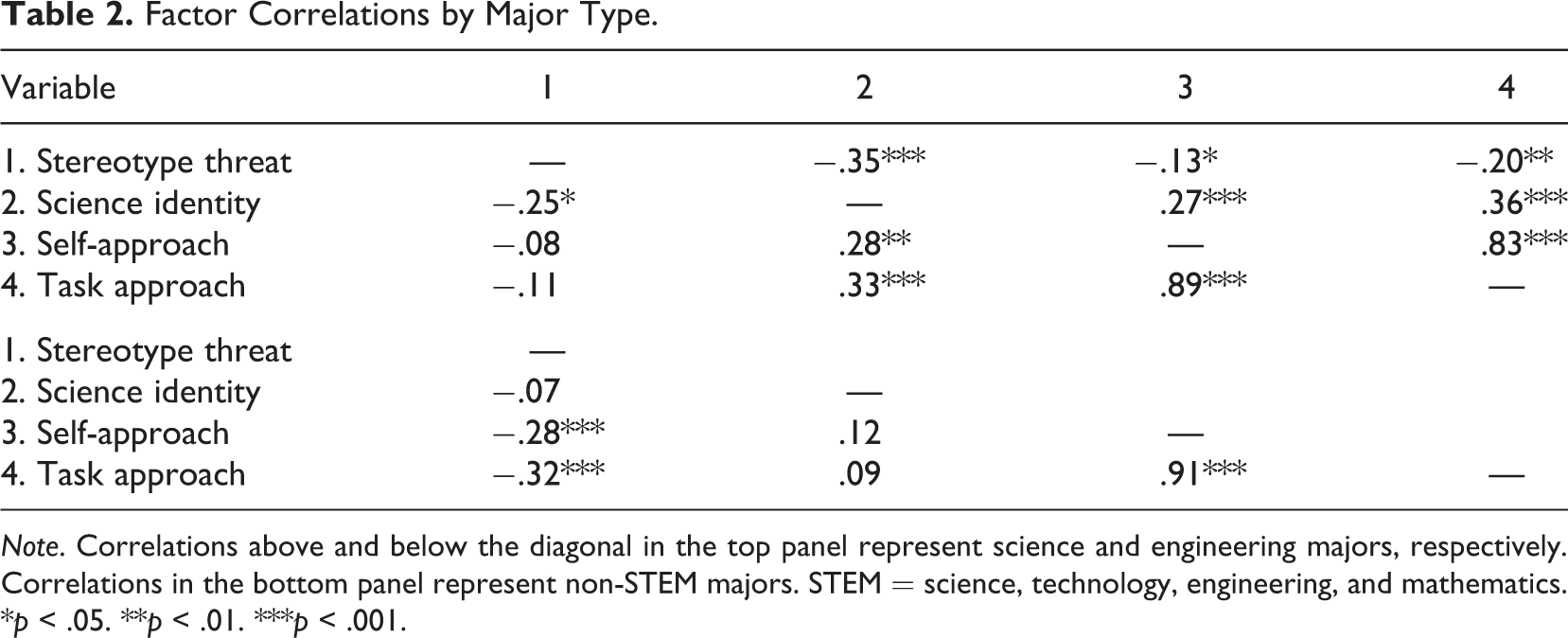
Note. Correlations above and below the diagonal in the top panel represent science and engineering majors, respectively. Correlations in the bottom panel represent non-STEM majors. STEM = science, technology, engineering, and mathematics.
*p < .05. **p < .01. ***p < .001.
Summary of Fit Statistics for the Single- and Multi-Group CFA Models.
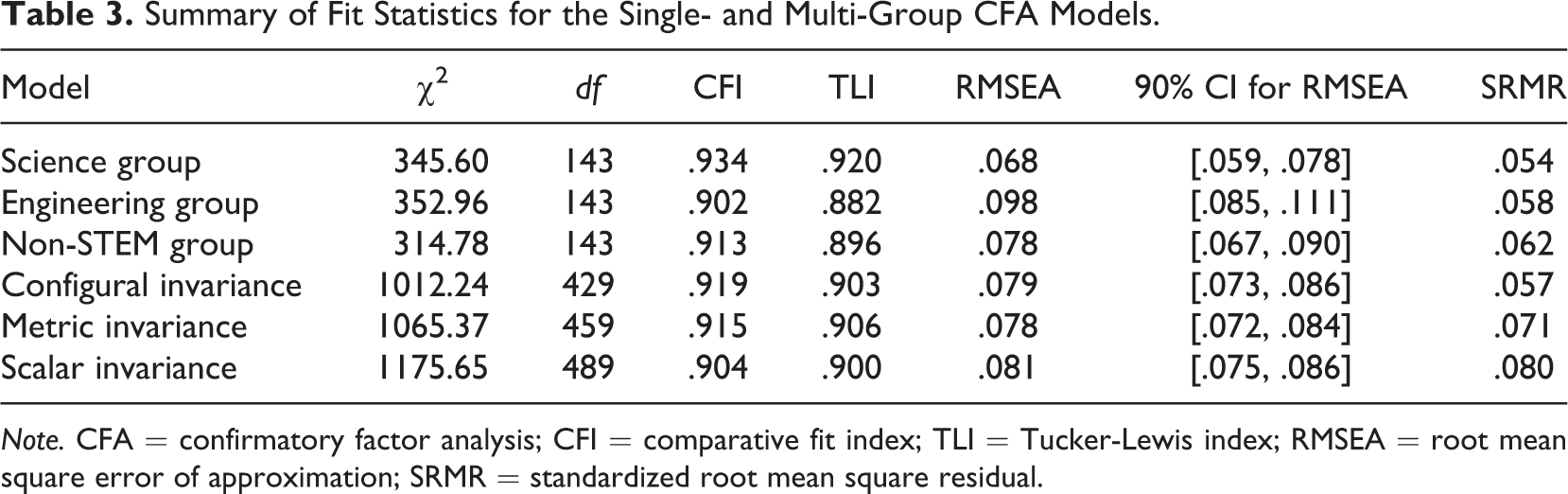
Note. CFA = confirmatory factor analysis; CFI = comparative fit index; TLI = Tucker-Lewis index; RMSEA = root mean square error of approximation; SRMR = standardized root mean square residual.
Testing the Structural Models
SEMwas performed to test the hypothesized relations among the latent constructs. The indirect effect hypotheses were evaluated by testing the products of the direct path coefficients in each group separately. Direct and indirect effects are reported in Table 4. The science model fit the data well, χ2(143, N = 302) = 345.60, p < .001, CFI = .934, RMSEA = .068 (90% CI: [.059, .078]), TLI = .920, SRMR = .05. Stereotype threat was a significant negative predictor of science identity (β = −.35, p < .001), which was in turn significantly related to both self-approach (β = .26, p < .001) and task-approach (β = .13, p = .008) goals. Thus, as hypothesized, the indirect pathways from stereotype threat to self-approach goals (β = −.09, p = .005) and task-approach goals (β = −.04, p = .020) were both significant when science identity was the mediating mechanism.
Standardized Path Coefficients and Effect Sizes for the Mediation Models.
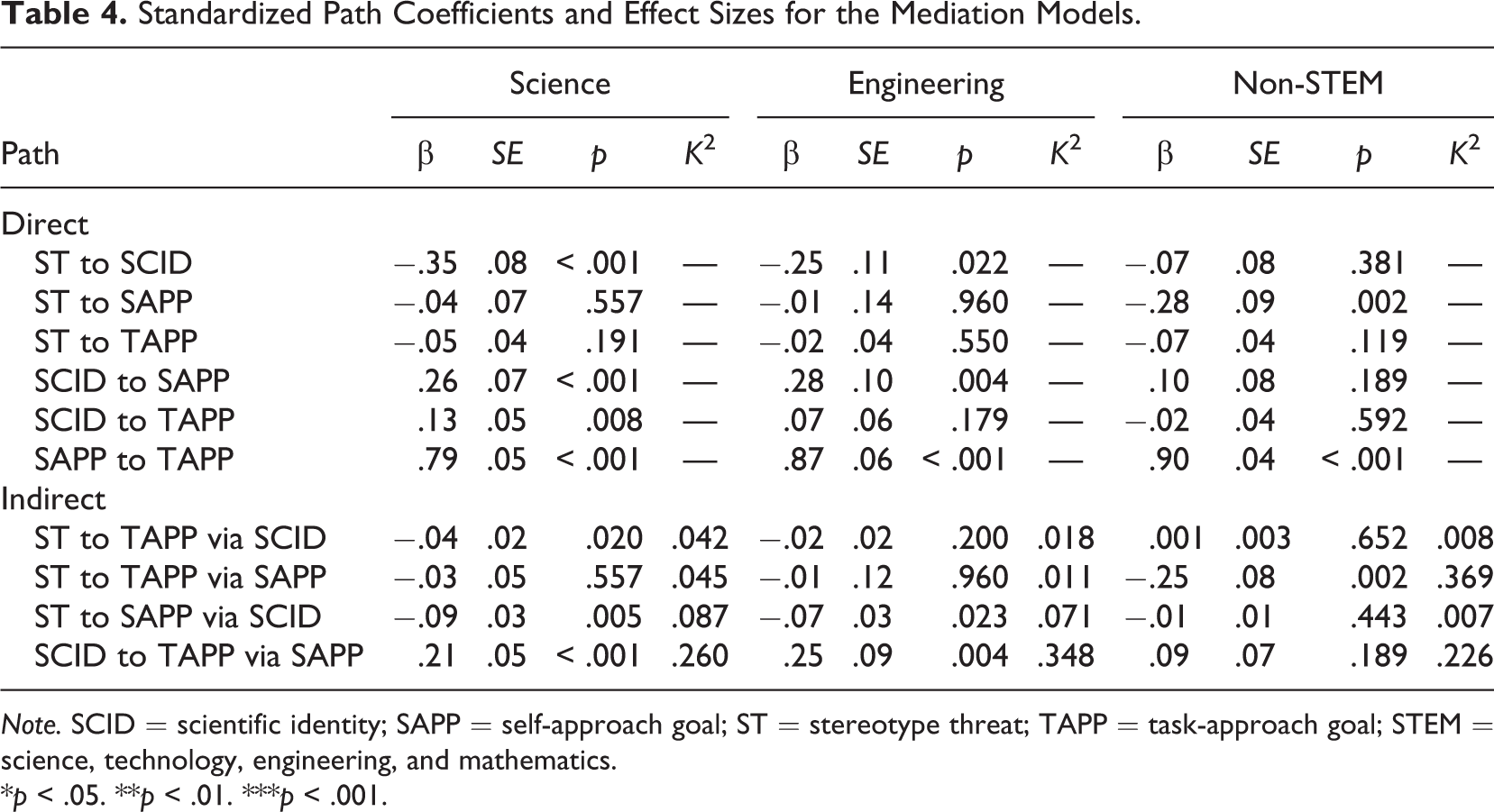
Note. SCID = scientific identity; SAPP = self-approach goal; ST = stereotype threat; TAPP = task-approach goal; STEM = science, technology, engineering, and mathematics.
*p < .05. **p < .01. ***p < .001.
Model fit statistics were less optimal within the engineering group, χ2(143, N = 153) = 352.96, p < .001, CFI = .902, RMSEA = .098 (90% CI: [.085, .111]), TLI = .882, SRMR = .06. Inspection of specific parameters indicated that stereotype threat was a significant negative predictor of science identity (β = −.25, p = .022) but was unrelated to both self-approach goals (β = −.01, p = .960) and task-approach goals (β = −.02, p = .550). As predicted, stereotype threat was indirectly associated with self-approach goals via science identity (β = −.07, p = .023) but, contrary to expectation, the stereotype threat→science identity→task-approach pathway was not significant (β = −.02, p = .200). Model fit for the non-STEM group offered a slight improvement over the engineering group model, χ2(143, N = 195) = 314.78, p < .001, CFI = .913, RMSEA = .078 (90% CI: [.067, .090]), TLI = .896, SRMR = .06. The only significant direct relationships observed in this model were those between stereotype threat and self-approach goals (β = −.28, p = .002), and self-approach goals and task-approach goals (β = .90, p < .001). The indirect relationship between stereotype threat and task-approach goals via self-approach goals was also significant (β = −.25, p = .002). Overall, our hypotheses that science identity would mediate relations between stereotype threat and approach goals for science and engineering majors, but not non-STEM majors, were supported.
Finally, we calculated kappa-squared (K 2) coefficients to estimate the effect sizes of the mediated relationships. K 2 represents the proportion of the total indirect effect that is possible within single-mediator pathways (Preacher & Kelley, 2011). The effect sizes involving science identity as a mediator were largest among the science and engineering majors. The effect sizes for the mediated relationship between stereotype threat and both self-approach and task-approach goals were .087 and .042, respectively, whereas they were negligible (K 2 < .01) among non-STEM majors.
Discussion
The role of identification in the formulation of stereotype threat is somewhat complex. Identifying with a group or domain is a necessary prerequisite for threat vulnerability but, paradoxically, stereotypes have the harmful effect of causing targeted persons to psychologically distance themselves from the activity. The prerequisite role suggests that identification functions as a moderator, whereas the consequence role indicates that identification may function as an outcome variable. Some research has examined identification as an outcome of stereotype threat, but there has been a dearth of research focusing on identification’s utility as a mediating variable. In addition, recent theoretical advances in achievement motivation now afford researchers the opportunity to study new and unique consequences of stereotype threat and disidentification. Predicting approach motivation in the college science classroom is critical to understanding how and why women maintain movement along STEM career paths. The present findings provide evidence that students who should be expected to disidentify from science do, in fact, respond in this way, whereas this effect was not observed among students who are not concerned about being stigmatized.
Consistent with our hypotheses, science identity mediated the relationship between stereotype threat and both forms of approach goals among science majors. Although the effect sizes for these relationships were small, stereotype threat clearly potentiates reductions in achievement motivation by first triggering some degree of disidentification. The magnitudes of the effect sizes indicate that this indirect relationship was twice as strong for self-approach goals as it was for task-approach goals. Perhaps science identity has less of an influence on task-approach goals because this type of motivation affords one a number of attribution options in the event that one does not perform as expected. Poor performance can be externally attributed to characteristics of the task, bad luck, poor teaching, and so on, rather than a failure of the self. Motivation under task-approach goals may therefore depend more on situational factors than one’s identity status.
Among engineering majors, the identity mediation hypothesis was supported for self-approach goals but, contrary to expectation, not when task-approach goals were the outcome of interest. Stereotype threat was a significant negative predictor of science identity, thus indicating that engineering students are vulnerable to disidentification, but science identity was not in turn related to task-approach goals. A similar explanation for the discrepant findings for task- and self-approach goals may be applied to this group. Self-approach goals call for ongoing expenditure of personal resources in the pursuit of skill development, therefore perceptions that progress toward goal attainment is not being made could elicit doubts about whether enough effort is being exerted, the proper learning strategies are being used, and so forth. A strong link between science identity and self-approach goals should be expected because they both involve reflections of self-concept. In contrast, task-approach goals are concerned with finite tasks and behaviors that may not trigger concerns about competence in and of themselves should performance fall short of expectations. It is interesting to note, however, that the mediated relationship between science identity and task-approach goals was strongest among engineering students. A small to medium effect size was detected for this group, whereas the effect sizes were somewhat smaller for science and non-STEM majors. Thus, engineering students who identify highly with science are more likely to have a broader goal of developing proficiency in this domain, as well as high motivation for specific tasks.
Results for the non-STEM group indicated that stereotype threat essentially bypasses science identity and influences task motivation almost entirely through its relationship with self-approach goals. In fact, the strength of this indirect relationship was found to be higher than in any other mediated pathway in the study. This finding is thus consistent with our hypothesis in that, from a career development perspective, non-STEM students are presumed to be much less invested in STEM and therefore should not be subject to disidentification. The relative unimportance of science identity to non-STEM majors is substantiated by the fact that it was not a significant predictor of either type of achievement goal in this group. In contrast, college students are by nature academically achievement oriented, therefore it makes intuitive sense that stereotype threat would predict decreased motivation even among students who are not necessarily the targets of stigmatizing attitudes and behavior. Such students may still have some form of identity at stake insofar as they are striving to prove to themselves that they are competent in science, thus being peripherally linked to a stereotype may undermine their desire to develop their science skills and ultimately lead to diminished interest in science in general. To this end, it would be worthwhile in the future to examine the motivational effects of disidentification among science students with general academic identity as a mediating variable. Secondarily, we believe this finding that stereotype threat was differentially related to the two forms of approach goals confirms our decision to conceptualize the sequence of effects in the structural model as those in which the energization of behavior flows from more global manifestations of motivation to those that are more proximal to the science achievement situation.
Implications for Career Counseling
Our results have the potential to inform career intervention work aimed at preserving science identity and inoculating women against the effects of stereotyping, particularly in university counseling center settings. Career counselors who work with women who frequently encounter bias in their academic environments could encourage clients to shift their focus from their identification with science in situations where this identity is threatened, to a held identity (e.g., gender and ethnic) that strengthens and reinforces a sense of belonging to community of science students. Helping clients to identify situational cues that signal identity threat would provide a foundation from which to begin to make external attributions in the event that performance on an exam or homework assignment does not meet one’s expectations. In this scenario, attributing an undesirable outcome to the anxiety-inducing effects of a stigmatizing environment rather than some stable internal attribute (e.g., low natural ability) would serve as a prophylaxis against threats to self-esteem (Ben-Zeev, Fein, & Inzlicht, 2005; Johns, Schmader, & Martens, 2005). In terms of behavioral interventions, career counselors could recommend that clients seek to initiate or strengthen relationships with their male peers in the classroom. This suggestion is based on research demonstrating that the development of intergroup relationships is associated with a greater sense of academic belonging and university satisfaction among underrepresented minorities (Mendoza-Denton & Paige-Gould, 2008). Thus, increasing intergroup interaction could help men develop more realistic appraisals of their female counterparts’ science abilities and thereby correct any biases they may have. Of course, the onus of forging better intergroup relations should not fall on women alone. Through outreach and consulting efforts, practitioners working in university counseling center settings could advise science instructors to utilize group-based projects that promote greater cooperation, perceptions of belonging, and interpersonal understanding (E. G. Cohen, 1994; Walton & Cohen, 2011).
Limitations and Conclusion
Some limitations to the present study should be mentioned. The fact that self- and task-approach goals were so highly correlated raises the question of whether they represent a unitary construct. This association was particularly strong for engineering and non-STEM majors. However, they were found to be empirically distinct when evaluated in the context of the measurement models. Given that research on the 3 × 2 goal framework is in its early stages, it is unclear under what circumstances and for whom these constructs may function differently. Further inquiry into the factors that differentially trigger the adoption of approach goals is needed. Another limitation can be found in the disparities in the within-group sample sizes, as nearly twice as many science majors participated in the study as engineering majors. The relatively low sample size for engineering majors could have yielded low power to detect significant effects, thereby increasing the possibility of committing type II error. We addressed this issue, however, by computing effect sizes for each of the hypothesized mediated pathways. The effect sizes for the nonsignificant indirect effects observed in this group were small when compared to Cohen’s (1988) conventional standards of .02, .15, and .25 for small, medium, and large effect sizes, respectively. Thus, we believe that decisions to not reject the null hypotheses in these instances were justified. Moreover, our structural model was fairly simple and parsimonious, therefore, in our view a substantially large sample was not required to obtain stable parameter estimates.
College women intent on pursuing a career in STEM often have to contend with the stereotype that they lack competence in these disciplines, particularly in math-intensive disciplines in which they tend to be outnumbered (e.g., physics and engineering). Chronic exposure to this attitude can have a detrimental effect on how women see themselves and their role in their chosen professions. The current study yielded evidence of this effect by demonstrating that threatening stereotypes trigger a disconnection of self from the STEM domain and diminution of achievement motivation. However, additional research is needed to determine whether diminished science identity reflects an adaptive coping response designed to protect one’s self-esteem or a more enduring psychological disengagement that heralds an eventual departure from STEM. To test this proposition in the future, it would be important to obtain concurrent measures of women’s intentions to persist in their academic majors. It may be that some women temporarily minimize the importance of science and/or engineering but fully intend to pursue careers in these fields. Negative stereotypes may also engender a focus on avoiding future stigmatization, therefore it would be valuable to examine the linkage between identity and avoidance goals. It is our hope that the current research stimulates investigation of these and other important research questions focused on understanding the antecedents and consequences of science identity.
Footnotes
Declaration of Conflicting Interests
The author(s) declared no potential conflicts of interest with respect to the research, authorship, and/or publication of this article.
Funding
The author(s) received no financial support for the research, authorship, and/or publication of this article.