



Abstract
This study explored similarities and differences of negative career thoughts in a sample of 1,562 Americans and 3,811 South Koreans by analyzing mean scores, item endorsement rates, and factor structures of the career thoughts inventory (CTI). A comparison of mean scores of the CTI scales showed that Koreans scored significantly higher on all scales than did Americans among high school, college, and adult participants. However, a comparison of ranks of item endorsement rates indicated that they were very similar. A confirmatory factor analysis indicated that the original three-factor solution of the normative data was a good fit for the United States across all age-groups but was not for the normative data of the respective age-groups from South Korea. Follow-up exploratory factor analyses identified possible alternative internal structures of the Korean CTI. Implications of the findings regarding plausible cultural influences on negative career thoughts as well as the use of the CTI in career counseling with members of the United States and Korean cultures are discussed.
Keywords
Career thoughts are one of critical factors that influence individuals’ career decision making (S. D. Brown & Lent, 1996; Enright, 1996; Krumboltz, 1994; Sampson, Peterson, Lenz, Reardon, & Saunders, 1996a; Stead, Watson, & Foxcroft, 1993). Extant studies show that dysfunctional career thoughts may negatively influence every stage throughout the career decision-making process (Krumboltz, 1994; Nevo, 1987; Sampson et al., 1996a; Saunders, Peterson, Sampson, & Reardon, 2000), and they are positively related to low self-esteem and self-efficacy (S. D. Brown & Lent, 1996) as well as to anxiety and depression (Saunders et al., 2000; Walker & Peterson, 2012). Moreover, negative career thoughts are positively associated with increased job avoidance behavior and low job satisfaction (Judge & Locke, 1993), and high career indecision (Kleiman et al., 2004).
Such negative impacts of dysfunctional thoughts can be explained by cognitive behavioral theory (CBT; Beck, Rush, Shaw, & Emery, 1979). According to CBT, dysfunctional cognitions result in negative behaviors or emotions because they constantly distort incoming stimuli and instill automatic errors in systematic thinking. Moreover, the assimilation of dysfunctional cognitions makes it difficult for individuals to process contradictory evidence for their erroneous thoughts. As a result, problematic behaviors and emotions occur as reactions to these inculcated dysfunctional cognitions. Likewise, in the area of career decision making, negative career thoughts distort incoming career-related information and lead to dysfunctional career perceptions, behaviors, or negative emotions, as well.
Some career theories have delineated the influence of dysfunctional career thoughts on career decision making. For instance, Krumboltz (1979) asserted in his learning theory of career decision making that self-observation generalizations and task approach skills are developed by learning experiences that ultimately guide individuals’ career decision making. Therefore, if individuals build faulty self-observation generalizations, they are likely to experience difficulties in career decision making. In addition, cognitive information processing (CIP) theory, proposed by Peterson, Sampson, and Reardon (1991), holds that if cognitive monitoring over a decision-making process becomes dysfunctional, individuals would possess an unreliable or uncertain understanding of self which may result in an inappropriate choice of occupational goals. Thus, these theories underscore the importance of understanding clients’ career thoughts and how these thoughts are related to their career decision-making difficulties.
Furthermore, according to cognitive information theory (Peterson, Sampson, & Reardon, 1991), social, economic, and family contexts are vitally important in acquiring a full understanding of a career problem (Peterson, Leasure, Carr, & Lenz, 2009–2010). Individuals’ career thoughts may vary in terms of how they are manifested according to one’s cultural background (Cook, Heppner, & O’Brien, 2002; Fouad & Byars-Winston, 2005; Osipow & Fitzgerald, 1996). Moreover, Leong and Hartung (1997) pointed out that culturally different clients have varying perceptions of career problems because of their unique context in terms of what constitutes normality. Moy (1992) also showed that Asian Americans place higher value on interdependence, collectivism, and family involvement when they make a career decision making, whereas White Americans less so.
Recent studies have also revealed cultural differences pertaining to relationships between and among career thoughts. Hess, Tracey, Nota, Ferrari, and Soresi (2009), when exploring the factor structure of the career beliefs inventory (CBI; Krumboltz, 1991), showed that Italian high school students may have a different structure of career beliefs than do Americans. They found that item compositions of the factors retained from a sample of Italian high school students were different from the items associated with the factors of the American samples. Björnsdóttir, Kárdal, and Einarsdóttir (2010) also showed that the structure of career thoughts of Icelanders is different from Americans when conducting an exploratory factor analysis (EFA) of the Icelandic version of the career thoughts inventory (CTI; Sampson et al., 1996a).
Although the aforementioned studies have indicated differences among cultures in terms of how negative career thoughts may be revealed across cultures, there is a need for more definitive research to be undertaken. While career thoughts have been considered to be an important factor in career decision making, few if any studies have conducted direct comparisons of career thoughts across cultures. Moreover, we believe cross-cultural exploration of career thoughts is needed to advance our understanding of diverse individuals’ career development and decision making. Our intention is that the study herein presented will provide career counseling practitioners with an awareness of the importance of their clients’ cultural context and how their cultures may influence their respective decision making processes. Career counselors must be mindful that clients make career decisions within their own cultural context (D. Brown, 2002; Cook et al., 2002; Fouad & Byars-Winston, 2005), and that lack of understanding about clients’ culture and its relationship to career decision making may become a deterrent to effective career counseling (Leong & Brown, 1995; Watson, 2006).
Purpose of the Study
The present study sought to explore cross-cultural similarities and differences of negative career thoughts in the United States and South Korea by employing the U.S. version of the CTI (Sampson et al., 1996a) and the Korean version of the CTI (K-CTI; Lee, Choi, & Park, 2003). The CTI is an assessment instrument designed to measure negative career thoughts on the basis of the CIP theoretical approach proposed by Peterson et al. (1991) and Sampson, Reardon, Peterson, and Lenz (2004).
For the present study, normative data that were collected for the standardization of the U.S. and Korean versions of the CTI were used. The data were obtained from high school students, college students, and adults in both cultures. Three principal research questions were formulated that undergird the cross-cultural comparison. The first research question concerned whether the two cultural groups indicate different levels of endorsement related to negative career thoughts. This question was addressed by comparing the CTI mean scores between cultures with respect to high school, college, and adult samples. On the basis of prior research (Vandervoort, Divers, & Madrid, 1999), the Korean samples were expected to score differently than the U.S. samples, but uncertain of the direction of the relationships. The second research question examined the extent to which the rank order of high to low levels of endorsements of negative career thoughts was similar between cultures. In other words, are high-priority career issues consistent between cultures? Again, we were uncertain of the presence or strength of the relationship. The third research question concerned the internal structure of the respective versions in terms of whether the original three-factor structure identified by Sampson et al. (1996a) fit the data obtained from South Koreans. This question was pursued by performing a confirmatory factor analysis (CFA) of the Korean version along with a replication of the U.S. version. A CFA of the U.S. version using the normative data set has not been reported in the research literature by the authors, although Leierer, Strauser, and Gander (2012) confirmed the factor structure on an independent data set. We expected that the factor structures of the K-CTI generated from the three age-groups would be different from original factor solution, given the potential influence of culture on the meaning of items included in the CTI and prior research (Björnsdóttir, Kárdal, & Einarsdóttir, 2010; Hess, Tracey, Nota, Ferrari, & Soresi, 2009). If so, we would then explore the relationships among items of the K-CTI within each age-group using EFA to identify possible alternative factor structures.
Method
Participants
The two samples were composed of 1,562 Americans (626 males, 934 females, two individuals’ gender was not identified) and 3,811 South Koreans (1,846 males, 1,963 females, two individuals’ gender was not identified). Both samples were obtained from the studies on standardization of the CTI and Korean version of the CTI. The American sample consisted of 571 high school students (36.3%), 595 college students (38.1%), and 396 adults (25.4%), whereas the Korean sample included 1,449 high school students (38.0%), 1,327 college students (34.8%), and 1,035 adults (27.2%). The mean ages of American sample were 17.50 (SD = .87) for high school students, 22.32 (SD = 4.67) for college students, and 39.23 (SD = 11.67) for adults, while the mean ages of the Korean sample were 16.48 (SD = .97) for high school students, 21.61 (SD = 2.61) for college students, and 30.55 (SD = 7.54) for adults. For the data collection, the authors of the U.S. and Korean versions of the CTI solicited high school teachers and guidance counselors, college faculty, representatives of private organizations, and clergymen. Under consent of individual participants, schools, and organizations, the CTIs were administered by the authors or trained graduate students.
Measure
The CTI (Sampson et al., 1996a) includes 48 items measuring negative career thoughts using a 4-point Likert-type scale ranging from 0 (strongly disagree) to 3 (strongly agree). The CTI produces a CTI total score, which is derived from the summation of all 48 items, and scores on three subscales: decision-making confusion (DMC, 14 items), commitment anxiety (CA, 10 items), and external conflict (EC, 5 items). The CTI total score indicates the overall level of negative career thoughts in career decision making. The DMC score indicates difficulties in beginning or maintaining the decision-making process due to a lack of understanding of the decision-making process itself or to disabling emotions such as depression or anxiety. The CA score reflects inability to implement a specific career choice that is generated from anxiety about the decision-making outcomes. The EC score reveals difficulties in balancing individuals’ own self-perceptions with those of significant others in weighing the desirability of career alternatives (Saunders et al., 2000; Walker & Peterson, 2012).
Cronbach’s α reliability coefficients for the CTI total score ranged from .96 to .97, DMC from .91 to .94, CA from .85 to .91, and EC from .74 to .81 for high school, college, and adult samples (Sampson et al., 1996a). Test–retest reliability coefficients for high school and college students combined ranged from .77 to .63, spanning 4 weeks. Moreover, evidence of convergent validity of the CTI was demonstrated by comparing its scores with scores of other instruments, such as the My Vocational Situation (MVS; Holland, Daiger, & Power, 1980), the Career Decision Scale (CDS; Osipow, Carney, Winer, Yanico, & Koschier, 1987), the Career Decision Profile (CDP; Jones, 1989), and the Revised NEO Personality Inventory (NEO PI-R; Costa & McCrae, 1992). The results of these studies showed that the CTI scales were negatively correlated with positive constructs, such as vocational identity, certainty, and knowledge about occupations and training, and positively associated with indecision across all age-groups.
The authors of the K-CTI (Lee et al., 2003) translated the 48 items of the CTI into Korean without making any alterations to the order, number and content of items, or to the subscales. Thus, the K-CTI includes a 48-item total score and scores of the three subscales (DMC, CA, and EC), the same as the original CTI. In order to establish the psychometric properties of the K-CTI, Lee, Choi, and Park (2003) computed Cronbach’s α coefficients for the total scale and subscales in three different age-groups. The α coefficients ranged from .94 to .95 for the total scale, .87–.90 for the DMC, .60–.62 for the CA, and .82–.85 for the EC. Test–retest reliability was .75 for the total scale, .76 for DMC, .61 for CA, and .55 for EC in a sample of college students measured across 4 weeks. Evidence of convergent validity was demonstrated by correlating the translated CTI with translated versions of the MVS and the CDS. Correlations with the K-CTI were of similar magnitude as the original CTI.
Data Analysis
Normative data for the study were obtained by the respective authors of the original CTI and the K-CTI. The U.S. normative data were collected from adults, college students, and 11th- and 12th-grade high school students who reside in southern, Midwestern, western, and northeastern region of the United States (Sampson et al., 1996a). The Korean normative data were obtained from adults, college students, and 10th-, 11th-, and 12th-grade high school students who live in all provinces of South Korea (Lee et al., 2003).
A series of data analyses were conducted according to five stages. First, multivariate analyses of variance (MANOVA) were computed for each age-group to examine whether there are group differences in the CTI total score and subscale scores (Research Question #1). Second, Spearman’s ρ coefficients were derived for each age-group to examine the extent to which the item endorsement rates are correlated between two cultural groups (Research Question #2). Third, CFAs were performed for each age level to test whether the original three-factor solution fit the U.S. and Korean normative data (Research Question #3). Fourth, if the CFA results indicate the original three-factor solution do not fit the normative data of either culture, EFAs would be conducted to explore possible alternative factor structures. To conduct the respective CFA and EFA, two random samples would be obtained from the total normative sample(s). The first random sample of 50% would be used for the CFA, and the second random sample would be utilized for the subsequent EFA.
Results
Cultural Differences in CTI Scores
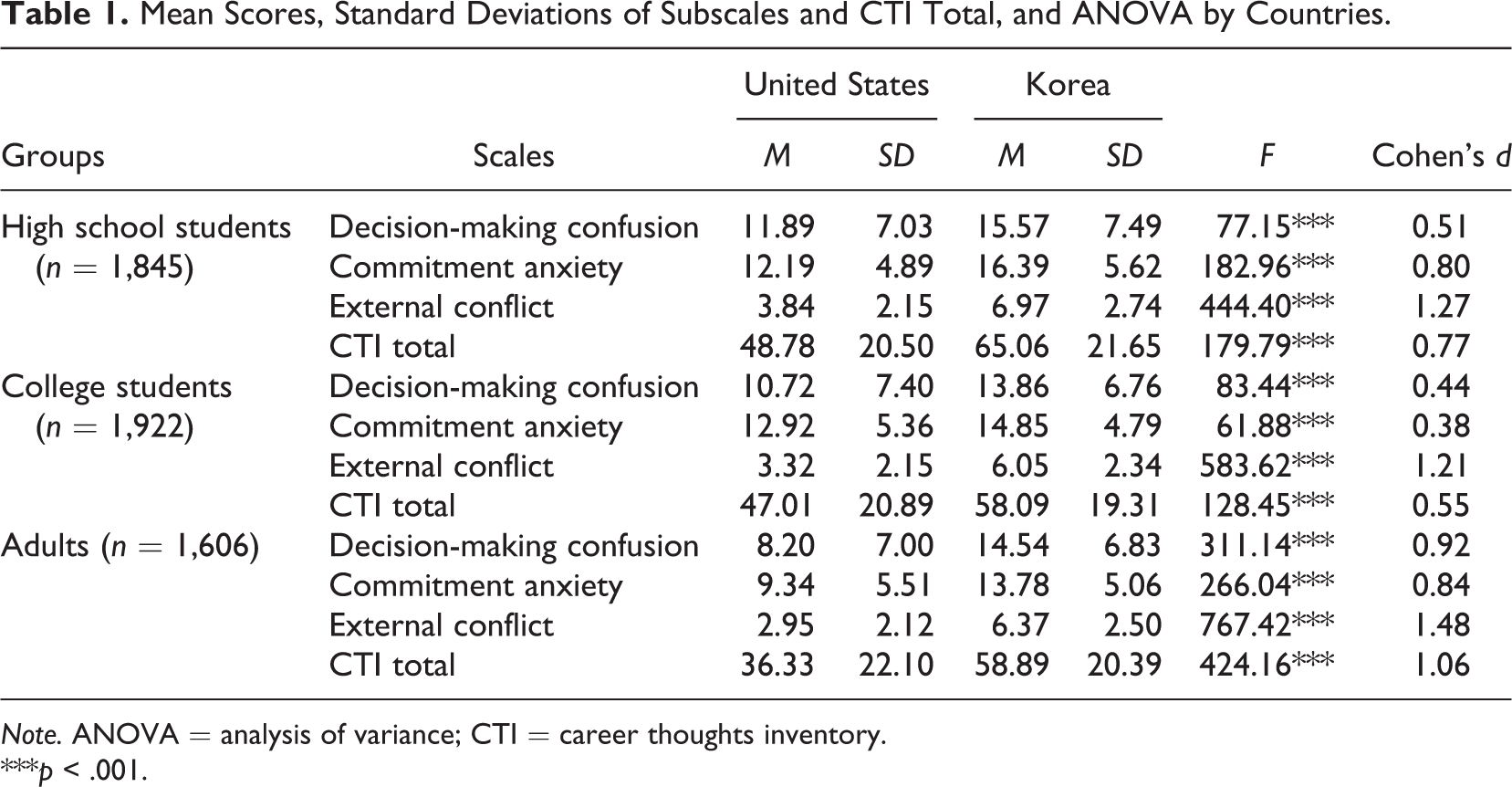
The DMC, CA, and EC subscale scores, and the CTI total score were derived by country across all three age-groups. Potential differences in the subscale scores were tested by using MANOVA and the difference in the CTI total score was tested using analysis of variance. The results, presented in Table 1, showed significant main effects for all subscale scores across all age-groups, high school students: Wilk’s λ = 0.79, F(3, 1,841) = 167.98, p < .001; college students: Wilk’s λ = 0.75, F(3, 1,918) = 213.78, p < .001, adults: Wilk’s λ = 0.68, F(3, 1,602) = 256.36, p < .001. An examination of the means revealed that Korean participants scored significantly higher than U.S. participants on the DMC, CA, and EC subscales as well as the total score. In particular, the largest mean score difference between the two cultures was found on the EC subscale in all age-groups, as indicated by the respective effect sizes (i.e., Cohen’s d). These findings indicate that South Koreans are more likely to agree with the statements representing negative thoughts contained in the CTI than are Americans at all three age levels.
Mean Scores, Standard Deviations of Subscales and CTI Total, and ANOVA by Countries.
Note. ANOVA = analysis of variance; CTI = career thoughts inventory.
***p < .001.
Endorsement Rate of CTI Items by Culture
Spearman’s correlational analyses for each age-group were conducted to examine the extent to which the item endorsement rates are correlated between the two cultural groups. For the analysis, the authors ranked all 48 of the items of the CTI and K-CTI based on their respective endorsement rates and derived correlation coefficients between two cultures. The results showed that Spearman’s ρ coefficient values were .64, .67, and .65 for high school students, college students, and adults, respectively. They were statistically significant at the .001 level. These findings indicate that the relationships between item rank orders of two groups are large in terms of Cohen’s standard (Cohen, 1988).
To gain a qualitative perspective on the respective endorsement rates by culture, the five most highly endorsed items in descending order for each age-group are presented in Table 2. As presented in the table, the most highly endorsed item found in all age-groups of both countries was Item #2 (almost all occupational information is slanted toward making the occupation look good). Apparently, lack of trust in occupational information is universal among all age-groups in both cultures. Item #32 (I can’t be satisfied unless I can find the perfect occupation for me) was highly endorsed by high school students and college students of both cultures, demonstrating the common problem of perfectionism in career choice. Further, Items #31 (deciding on an occupation is hard, but taking action after making a choice is harder), #37 (my age limits making my occupational choice), and #38 (the hardest thing is settling on just one field of study or occupation) were highly endorsed by Korean and American adults, suggesting that commitment to a choice, age, and choosing among career possibilities are common decision difficulties for adults of both cultures. Interestingly, Items #17, 21, 22, 30, 32, 35, 38, and 47 were associated with the CA subscale, which connotes the common challenge of implementing an educational or occupational choice.
The Most Endorsed Items by Koreans and Americans Across Three Age-Groups.

Note. CA = commitment anxiety; EC = external conflict.
CFA With the Original Factor Structure
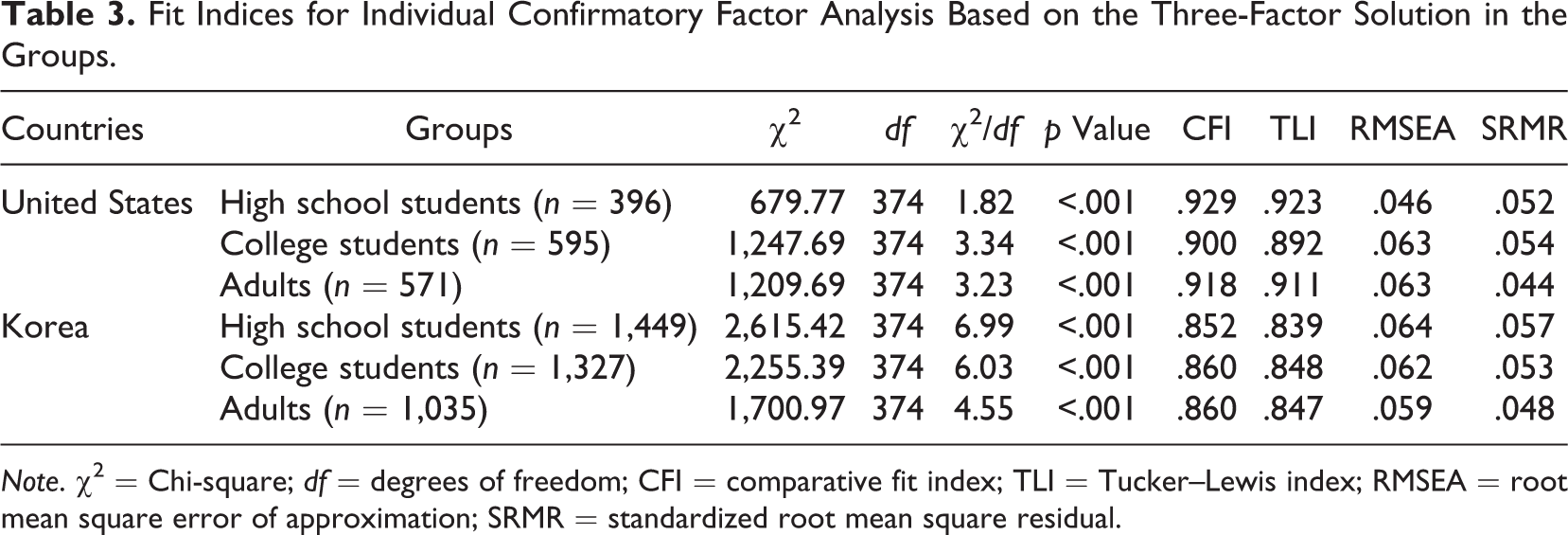
CFAs were performed to examine whether the three-factor solution fit the data for each of the three age-groups (high school students, college students, and adults) in the two cultural samples. The 29 items comprising the DMC scale (14 items), CA (10 items), and EC (5 items) were used in the following analyses. According to the results, as shown in Table 3, the three-factor model fit the data well for the U.S. participants. However, in the analysis of the Korean data set, the fit indices revealed somewhat conflicting results (see Table 3). χ2 values were statistically significant (likely due in part to the large sample sizes), and the ratios of χ2 to degree of freedom were much higher than 3, and the comparative fit index (CFI) and the Tucker–Lewis index (TLI) values were less than the criterion of .90 for adequate fit (Kline, 2005). On the other hand, the root mean square error of approximation (RMSEA) and the standardized root mean square residual (SRMR) ratios were less than the criterion of .08 for good fit (Kline, 2005). Because three of the five fit indices did not meet the criteria for a good fit, the conclusion was that the three-factor model did not fit the Korean data sets. Because of this anticipated finding, an EFA was conducted to identify a possible alternative factor structure of K-CTI in the three respective age-groups.
Fit Indices for Individual Confirmatory Factor Analysis Based on the Three-Factor Solution in the Groups.
Note. χ2 = Chi-square; df = degrees of freedom; CFI = comparative fit index; TLI = Tucker–Lewis index; RMSEA = root mean square error of approximation; SRMR = standardized root mean square residual.
EFA
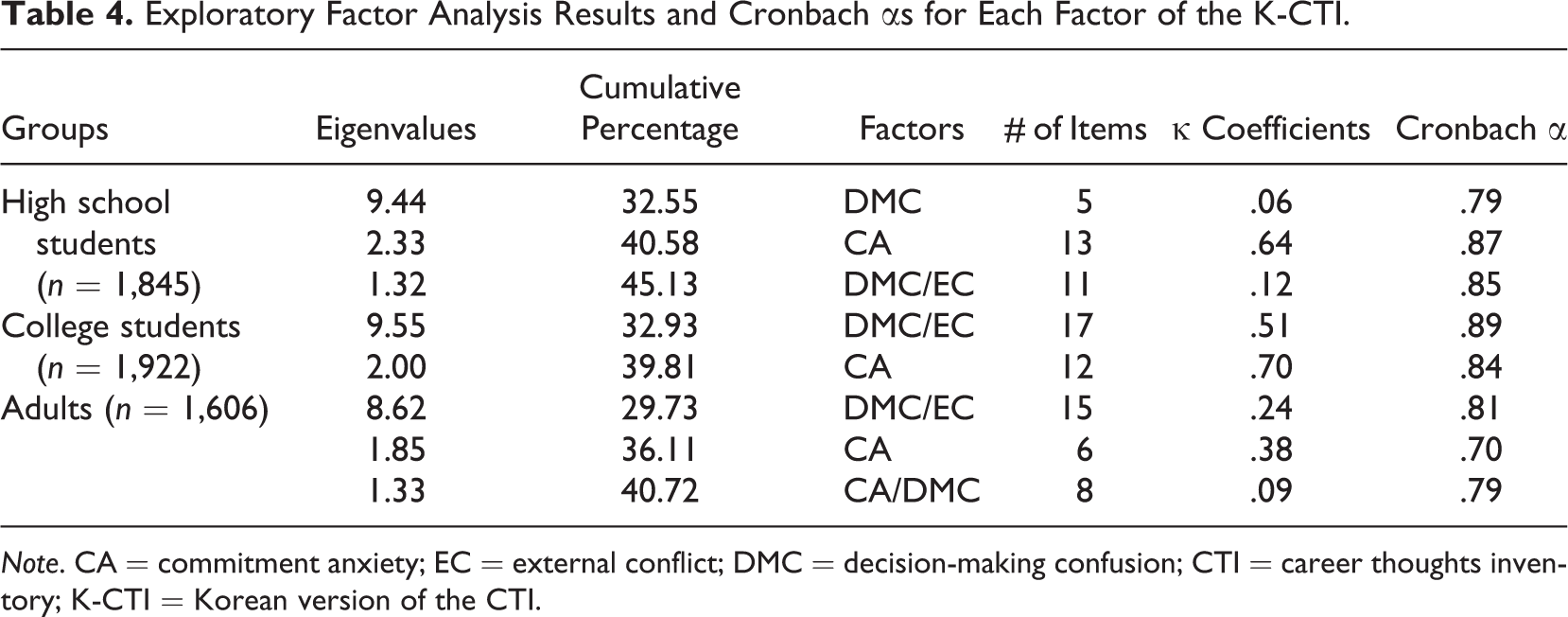
An EFA was performed using the maximum likelihood estimation method with Oblimin rotation. Before exploring factor patterns for each group, the number of factors was determined by examining the scree plot (Cattell, 1966), the number of eigenvalues larger than 1.0 (Kaiser, 1960), and the 95th percentile of the eigenvalues obtained by parallel analysis (Glorfeld, 1995). Finally, the parsimony and interpretability of the retained factor structures were considered. The EFA results are presented for each group in Table 4. The data set was suitable for factor analysis in all age-groups. The Kaiser–Meyer–Olkin (KMO) measures of sampling adequacy were all excellent at above .92 and Bartlett’s tests of sphericity were significant at level of .001 (Tabachnick & Fidell, 2007).
Exploratory Factor Analysis Results and Cronbach αs for Each Factor of the K-CTI.
Note. CA = commitment anxiety; EC = external conflict; DMC = decision-making confusion; CTI = career thoughts inventory; K-CTI = Korean version of the CTI.
High school students
First, a three-factor model was retained to represent the relationships among the 29 CTI items in the Korean high school student sample. The results indicated that the three retained factors explained approximately 45.1% of the total variance in the CTI scores. The absolute value of the factor loadings associated with each item ranged from .32 to .74. The rotated pattern matrix for the three factors indicated that 5 DMC items (Items #1, 3, 4, 5, and 12) were grouped as the first factor. The second factor contained all CA items along with 2 DMC items (Items #16 and 36) and 1 EC item (Item #46). The third factor contained 7 of the 14 DMC items together with 4 EC items (Items #6, 9, 14, and 23).
College students
The results showed that a two-factor solution was the most interpretable in the Korean college student group and accounted for approximately 39.81% of the variance of the variables. Absolute values of the factor loadings associated with each item ranged from .32 to .79. The rotated pattern matrix indicated that 13 of the 14 DMC items were grouped as the first factor along with 4 EC items (Items #6, 9, 14, and 23). All CA items loaded on the second factor with 1 DMC item (Item #36) and 1 EC item (Item #46).
Adults
The EFA results showed that a three-factor solution was best in terms of interpretability and parsimony of the model in the Korean adult group. This model accounted for approximately 40.72% of the variance in the CTI scores. Factor loadings associated with the items ranged from .19 to .66. The rotated pattern matrix indicated that 10 DMC items were grouped as the first factor with 3 EC items (Items #9, 14, and 23) and 2 CA items (Items #21 and 22). Five CA items were grouped as the second factor with 1 DMC item (Items #36). Finally, four other CA items were grouped as the third factor with 3 DMC items (Items #16, 27, and 28) and 1 EC item (Item #6).
Comparing Korean and U.S. Factors
κ coefficients were calculated to examine whether there were similarities between the respective U.S. and Korean factor structures, applying interpretive standards developed by Landis and Koch (1977), where .00–.20 κs are categorized as “slight,” .21–.40 as “fair,” .41–.60 as “moderate,” .61–.80 as “substantial,” and .81–1.00 as “almost perfect.” In order to compute κ coefficient, the authors first conducted an EFA for the U.S. data using the maximum likelihood estimation method with Oblimin rotation. This procedure enabled the retained Korean factor structure be compared to the original CTI. We then compared factor structure obtained from each data set by classifying all items in regard to whether they loaded on the Korean factor and/or on the U.S. factor. Each item was assigned to one of the four categories: (a) in both the Korean and the U.S. factors, (b) in the Korean factor only, (c) in the U.S. factor only, or (d) in neither factor. This process was repeated for all 48 Korean and U.S. item pairs.
The results, as presented in Table 4, showed that κ coefficients for high school students were .06 (first factor), .64 (second factor), and .12 (third factor). These findings indicate that cross-culture correspondence for the first and third factors are slight, but agreement across cultures for the second factor, primarily CA items, is substantial according to Landis and Koch (1977). For college students, κ coefficients were .51 (first factor) and .70 (second factor), which shows that cross-cultural agreement between two groups’ factor structures is substantial. Finally, κ coefficients for adults were .24 (first factor), .38 (second factor), and .09 (third factor). The Korean second and third factors were compared with the second factor of the U.S. factors because most items loaded on the Korean second and third factors were paired with the second factor of the United States. The results reveal that cross-culture correspondences of the first two Korean factors are fair, but cross-cultural agreement of the third factor is slight.
Cronbach’s αs were derived to examine the internal consistency, as an indicator of homogeneity of items, of the alternative factors created by the EFAs. The coefficient αs (see Table 4) were .79, .87, and .85 for high school students; .89 and .84 for college students; and .81, .70, and .79 for adults. With the exception of the second factor for adults (CA), the reliability coefficients were considered strong estimates of internal consistency of the alternative factors.
Discussion
This study examined cross-cultural similarities and differences in negative career thoughts measured by the CTI (Sampson et al., 1996a). For the study, the CTI total and subscale scores between American and South Korean subjects were compared along with an exploration of the factor structure of the original CTI and the K-CTI. Data analyses were conducted using U.S. and Korean normative data, which were collected from high school students, college students, and adults.
Results showed that South Koreans scored significantly higher on the CTI total scores as well as the respective subscales than did U.S. participants in all age-groups. Specifically, Koreans scored considerably higher on the EC scale than did U.S. participants (Cohen’s d = 1.21–1.48). These results may imply that career decision making appears to be a much more complicated and stressful task for South Koreans than for Americans. Moreover, responses to items relating to EC suggest that the balance between self-interest and the interest of significant others is particularly anxiety provoking for Koreans at all three age levels.
We posit that career decision making could be more complicated for Koreans because they have more factors to consider in their decision making than do Americans. Koreans possess collectivistic culture and interdependent self-view. Thus, they consider others, especially in-group members, as an important factor in their decision making, and greatly emphasize an importance of smooth and harmonious interpersonal relationship with significant others (Markus & Kitayama, 1991; Triandis, 1996). Moreover, for Koreans, career decision making entails not only implementing their self-concept but also balancing individual needs with the needs of the primary reference group (Leong & Hartung, 1997). Meanwhile, Americans with individualistic culture and independent self-view are inclined to lean toward their own preferences and desires in career decision making (Leong & Hartung, 1997). Therefore, Koreans’ career decision making becomes more complex since they are expected to consider their own personal preferences in addition to the opinions and preferences of significant others.
Furthermore, career decision making could be more stressful for Koreans because they may be likely to experience cognitive dissonance in the decision-making process. Ironically, although Koreans prefer to consider in-group members in their decision making, they have been taught in schools that individualistic career decision making is the optimal strategy. According to the first authors’ examination of high school and middle school textbooks on career development published in South Korea, most textbooks emphasized independent decision making, which is inconsistent with Korean norms regarding the career decision-making process. Moreover, according to Bae, Lee, Hwang, Lee, Cha, and Jeong (2015), Korean parents deliver mixed messages to their children, teaching that the children should focus on their own interests and ability in planning their future career, although the parents still want their children to take consideration of family perceptions and opinions in career planning. Thus, Koreans are likely to become more stressed and therefore endorse negative thoughts in career decision making because they are situated in a confusing and conflicting cognitive and affective process. According to Hoshino-Browne et al. (2005), individuals experience cognitive dissonance when their cultural self-concepts are threatened as a result of a situation where they are expected to make a decision in a different manner than their cultural traditions.
Finally, Koreans’ modesty bias may well contribute to a higher level of negative career thoughts than Americans. According to Smith and Bond (1998), Asians tend to underestimate their ability. Thus, Smith and Bond pointed that Asians’ modesty bias, also referred to as self-effacing bias, make it difficult to conduct cross-cultural research on rating data and to understand and interpret the possible meanings of the results. The modesty bias has been supported in many empirical studies. For example, Furnham, Fong, and Martin (1999) and Furnham, Hosoe, and Tang (2001) showed that Singaporeans and Japanese estimated their IQ a third to two thirds of a standard deviation lower than their actual IQ score. However, Americans and British estimated their IQ higher than did Asians, which approximated their real IQ score. This cross-cultural difference was replicated when they estimate their parents’ or siblings’ IQ score. In the present study, examination on the highest differentiating items (see Table 2) also shows that Koreans’ modesty bias on their understanding of themselves and occupations or decision-making ability could well have influenced item endorsement rates.
Examination of the most highly endorsed items showed a striking similarity of specific negative career thoughts between Koreans and Americans. As presented in the results (see Table 2), the most highly endorsed items by both Koreans and Americans were associated with the CA, and Spearman correlation coefficients indicated a high level of consistency between the Korean rank order of items and the American rank order at all three levels. This result suggests that Koreans and Americans share similar priority concerns regarding career decision making, although Koreans may have a higher general level of endorsement of negative career thoughts than Americans. For example, Item #2 (almost all occupational information is slanted toward making the occupation look good) was highly endorsed by both cultural groups regardless of age, which indicates that both Koreans and Americans have doubts about the veracity of occupational information. Also, Item #32 (I can’t be satisfied unless I can find the perfect occupation for me) was highly endorsed by both Korean and American high school students and college students, which may imply that high school students and college students from both cultural groups pursue perfectionism in career decision making. Meanwhile, Item #37 (my age limits my occupational choice) was highly endorsed only by adults. This finding demonstrates that adults from both cultures may possess concerns about their age as a factor in career choice.
CFAs of the CTI and K-CTI revealed that the original three-factor solution did not fit the Korean normative data although it fits the U.S. normative data. This result indicates that the relationship among items of the K-CTI is different from the relationship among items of the CTI. From subsequent EFAs, three-factor solutions (different item composition from the original factor structure) were retained for Korean high school students and adults, and a two-factor solution was found for Korean college students. More specifically, the EC items were not separated as an independent factor in all age-groups. Most EC items were grouped with DMC items. This finding suggests that EC could be an integral part of the process of linking self-knowledge and occupational knowledge to form career options for Koreans. For East Asians as with Koreans, family is significantly involved with career choice (Tang, Fouad, & Smith, 1999). In particular, East Asians are likely to restrain their verbal and ideational fluency when they have different thoughts from elders in order to show their respect for them (I. Liu, 1986). In addition, East Asians may exhaust their cognitive capacity when considering varying views of significant others, especially when they have conflicts with them (Y. T. Liu & Hsu, 1974). Consequently, Koreans are likely to experience confusion in formulating viable career options thereby endorsing both DMC and EC items in the same manner, resulting in a single factor brought about by their strong desire to maintain harmonious relationships with family members.
The factor model derived from the EFA for Koreans revealed some uniqueness of career thoughts among the respective age levels. First, in a sample of Korean high school students, the DMC items, such as Items #4 (I’ll never understand myself well enough to make a good career choice.), #5 (I can’t think of any fields of study or occupations that would suit me), and #12 (I don’t know why I can’t find a field of study or occupation that seems interesting), which basically concern lack of self-understanding and occupational knowledge, were grouped as the first factor. This result suggests that Korean high school students are developmentally in the “Exploration” stage as proposed by Super (1957) or in the “Analysis” phase of decision-making process, CASVE cycle, proposed by Peterson et al. (1991) where individuals try to clarify self-knowledge and acquire occupational knowledge that enable them to form options.
The CA items were grouped as the second factor with 2 DMC items (Items #36 and 16) and 1 EC item (Item # 46). However, loading values of those DMC and EC items were relatively low (.46, .43, and .42), which indicates that those items are weakly associated with the second factor. Finally, DMC items, such as Items #11 (I’m so frustrated with the process of choosing a field of study or occupation I just want to forget about it for now), #28 (the more I try to understand myself and find out about occupations, the more confused and discouraged I get), and #13 (I’ll never find a field of study or occupation I really like), loaded on the same factor with 4 EC items (Items #9, 23, 14, and 6). These particular DMC items are related to experiencing emotions, such as frustration, confusion, discouragement, and hopelessness, which may be experienced in attempting to formulate career options. The retained factor structure from a Korean high school student sample shows that three domains of career thoughts that may impact the career decision-making process: (1) lack of understanding about themselves and knowledge of occupations to formulate career options, (2) concern about commitment to implementing a choice, and (3) negative thoughts and emotions related to EC.
Regarding the model for Korean college students, most DMC items were grouped as one factor with 4 EC items (Items #6, 9, 14, and 23), suggesting that the first factor in the college student model be labeled DMC with EC. The second factor consisted of the CA items and 1 DMC item (#36). Based on these findings, two principal domains of career thoughts possessed by Korean college students entail (1) DMC with EC and (2) CA.
Finally, in the model for Korean adults, the 10 DMC items were grouped in a strong first factor with 3 EC items (Items #9, 23, and 14) as occurred in a college sample. Further, DMC Item #36 (I’ll never understand enough about occupations to make a good choice) loaded on the second factor along with 5 CA items, such as Items #32 (I can’t be satisfied unless I can find the perfect occupation for me), #35 (I worry great deal about choosing the right field of study or occupation), and #38 (the hardest thing is settling on just one field of study or occupation). These items appear to be associated with hopelessness and perfectionistic thoughts. As alluded to above, changing occupations in Korea is difficult and not culturally supported by Koreans. Also, Koreans still possess an attitude that one’s employment should be lifelong. Therefore, the choice of initial employment is fought with anxiety and apprehension, fostering a state of CA. The third factor for adults was composed of 4 CA items and 3 DMC items. The CA items were Item #26 (my opinions about occupation change frequently), Item #17 (my interests are always changing), and Item #29 (there are so many occupations to know about, I will never be able to narrow down the list to only a few), and the DMC items are Item #27 (I’m so confused, I’ll never be able to choose a field of study or occupation), Item #16 (I’ve tried to find a good occupation many times before, but I can’t ever arrive at good decisions), and Item #28 (The more I try to understand myself and find out about occupations, the more confused and discouraged I get).
The CA items seem to be related to a feeling of frustration brought about by perceiving many possible options or changing options, and the DMC items appeared to be associated with negative emotions such as hopelessness and confusion. This result suggests that Korean adults are likely to struggle with narrowing down possible options, which could result in confusion or even hopelessness. Consequently, Korean adults would experience the following issues in career decision making: (1) DMC including EC with family members, (2) perfectionism making the “right” choice, and (3) narrowing down possible options to a viable few. This implies that Korean adults are likely to experience difficulty in transitioning from the Synthesis phase of the CASVE cycle, which entails formulating and narrowing options to a select view, to the “Valuing” phase in which individuals must balance perceptions of self and significant others to arrive at a first choice.
Implications for Career Counseling
Based on the outcomes of the study, career counseling practitioners who provide Koreans or Korean Americans with career counseling services are encouraged to consider the following elements, as they assist individuals with career problem solving and decision making. First, practitioners should carefully examine Korean or Korean American clients’ response styles for the items when they endorse items agree or strongly agree on the CTI or K-CTI. Because Koreans’ responses to the items on the CTI or K-CTI could well be influence by their culture and modesty bias, the practitioners should interpret high scores on the total scale and subscales with caution since they may have a tendency to be somewhat inflated in terms of dysfunctional career thinking in general. Nevertheless, each item endorsed as agree or strongly agree should be taken at face value and discussed with a client. We view each item as a potential block to effective career decision making.
Second, practitioners should be sensitive to the influence of family relationships in career counseling when they work with Korean or Korean American at all age levels. As presented in the results, family becomes an especially important factor for many Koreans and Korean Americans in their career decision making. In particular, family influences can add frustration and confusion to career decision making of all age-groups in Korea. Practitioners should understand how EC may impact the career decision-making process.
Third, the EC (EC) score should be interpreted carefully when working with Korean or Korean American clients. The EC items combined with the DMC to form a single factor in all three levels of the Korean sample. Thus, a high score on the EC scale could indicate an elevated level of confusion in all early phases of career decision making brought about by conflict with family members. For Koreans, scores on the EC scale may well serve to identify a possible source of confusion in linking self-knowledge and occupational knowledge to form viable options in career decision making.
Finally, common to both cultures, practitioners need to understand clients’ perfectionistic tendencies in the career decision-making process. As revealed in the results of item endorsement rates, the pursuit of a perfect choice with fought with anxiety. In such a case, practitioners could assist clients in mitigating their anxiety levels through the use of cognitive reframing techniques and implementing the identify–challenge–alter and act approach outlined in the CTI workbook (Sampson, Peterson, Lenz, Reardon, & Saunders, 1996b).
Limitations and Recommendations
The present study possesses some limitations, although we believe the results shed light on cross-cultural variability on career thoughts. First, the normative data sets used in the study were collected approximately two decades ago for the development of the CTI and 10 years ago for the K-CTI. Thus, the results may not accurately represent contemporary aspects of career thoughts in both cultures. Therefore, in future studies, the use of more contemporary data sets is recommended. Second, because the study used the set of 48 items of the American CTI standardized in a sample of Americans as a baseline, the study findings may not reveal culturally specific aspects of Koreans’ career thoughts. The items of the CTI were derived by American authors representing American thought processes and content. Thus, the EFA results provide an indication of the differences in career thoughts between cultures, but they do not include career thoughts that might be unique to Koreans. Therefore, we recommend conducting a study replicating the process used to develop the American CTI but employing developers native to South Korea. Finally, content validity of the K-CTI may be challenged due to possible errors or distortions in translation process. Although Korean authors of the K-CTI translated the original 48 CTI items into Korean according to the strict procedure proposed by Geisinger (1994), the meaning of translated items cannot be viewed as being exactly the same as the items in English. As a result, the findings of the present study may be influenced to some degree by possible translation error instead of actual cultural differences. Therefore, a study contrasting meanings of like items across cultures would be worthy of pursuit.
In conclusion, this study contrasted the occurrence of negative career thoughts between two cultures, United States and Korea, using a common 48-item instrument. Items were formulated to measure dysfunctional career thought that might impede career problem solving and decision making according to CIP theory (Peterson et al., 1991; Sampson, Reardon, Peterson, & Lenz, 2004). Our intention for conducting the study was not only to identify similarities and differences in the occurrence of career thoughts between cultures but also to inform career practitioners of both cultures in applying cultural sensitivity in interpreting responses to the CTI and in using the results of the inventory in career problem solving and decision making. Thus, our hope is that the information in this study will be useful in cross-cultural career counseling in both the United States and Korea.
Footnotes
Declaration of Conflicting Interests
The author(s) declared no potential conflicts of interest with respect to the research, authorship, and/or publication of this article.
Funding
The author(s) disclosed receipt of the following financial support for the research, authorship, and/or publication of this article: This research was supported by the National Research Foundation of Korea Grant funded by the Korean Government (NRF-2014S1A2A1A01027929) and Konkuk University’s research support program for its faculty on sabbatical leave in 2014.