



Abstract
The underrepresentation of women in leadership positions is a nagging problem in American society. Young women’s leadership intentions drive them to assume leadership opportunities despite barriers. The role of one particular personality trait most identified with leadership, namely, social potency, was examined in directly and indirectly predicting leadership intentions. 124 female college students were sampled. As hypothesized, social potency directly predicted leadership self-efficacy, leadership interest, and one of the two indicators of leadership intentions. Moreover, social potency indirectly predicted leadership intentions through leadership self-efficacy. A bootstrap procedure yielded significant indirect effects of social potency on leadership self-efficacy, leadership interest, and leadership intentions.
Young women at universities are on the cusp of moving into diverse careers and many of them have leadership intentions. However, the path to assume leadership roles is fraught with implicit bias against women (see meta-analytic review by Roth, Purvis, & Bobko, 2012). Some of these young women will challenge the stereotype that leaders are masculine (see the meta-analytic review by Koenig, Eagly, Mitchell, & Ristikari, 2011). Moreover, some of these young women in their future careers will challenge the underrepresentation of women in leadership roles in business and government (e.g. Marchant, Bhattacharya, & Carnes, 2007). For these reasons, in this study we chose to focus on the leadership intentions of female students exclusively. Leadership intentions were defined as the aspiration to engage in a particular “leadership” action or series of “leadership actions” (Lent, Brown, & Hackett, 1994). The contribution of this article is to examine the role of personality in predicting leadership intentions.
Conceptual Framework and Empirical Foundation
Social Cognitive Career Theory (SCCT; Lent et al., 1994) posits that intentions are a precursor to choice actions that are defined as actions to implement a choice like accepting a leadership position or performing leadership actions. In the SCCT model, personality is considered an exogenous variable that influences intentions directly and indirectly through self-efficacy and interest. Moreover, self-efficacy is thought to predict interest that in turn predicts intentions.
When the SCCT literature is narrowed to leadership intentions specifically, the literature is sparse. One notable study was located that focused specifically on our population of interest, namely, university female college students. Yeagley, Subich, and Tokar (2010) tested the SCCT model with cross-sectional data in explaining leadership intentions for elite positions (e.g., CEOs). They showed that elite leadership self-efficacy indirectly predicted elite leadership intentions through elite leadership interests. Elite leadership self-efficacy did not directly predict leadership intentions. Yeagley and colleagues (2010) did not include personality.
Personality has rarely been examined as a predictor of career-related intentions although several studies have shown that the Big Five significantly differentiated educational aspirations or intentions (e.g., Rottinghaus, Lindley, Green, & Borgen, 2002) and choice actions (Larson, Wei, Wu, Borgen, & Bailey, 2007). The 11 specific traits subsumed under the Big Three (i.e., positive emotional temperament, negative emotional temperament, and constraint; Tellegen, 2000; Tellegen & Waller, 2008) significantly differentiated choice actions as well (Larson et al., 2010). In short, some of the Big Five personality traits and some personality traits subsumed under the Big Three have been shown to contribute to differentiating among some intentions and choice actions. It seems reasonable that personality traits could directly and indirectly predict leadership intentions depending on the personality trait under examination. The purpose of this study was to focus on one particular personality trait, social potency.
Social Potency
The compelling argument to investigate Social Potency specifically in its contribution to leadership intentions needs to be grounded in the development of Social Potency as one of the 11 primary personality traits embedded in the Big Three (Tellegen, 2000; Tellegen & Waller, 2008). Social Potency as a personality trait captures attributes often identified with leaders. Social Potency is defined as social dominance or interpersonal power and a desire to make an impact on others (Tellegen, 2000). People who are strong in this personality trait are described as forceful, decisive, fond of influencing others, and fond of leadership roles (Tellegen & Waller, 2008). In conceptualizing Social Potency, Tellegen distinguished it from a broader extroversion construct which encompassed three distinct personality traits, namely, power or dominance (Social Potency), love/affiliation (social closeness), and control versus impulsivity (control). Social Potency and social closeness resemble the two fundamental dimensions of Interpersonal Theory (e.g., Kiesler, 1983; Leary, 1957; Wiggins, 1979). Interpersonal theory presents two axes, with one axis being social dominance/power and one being love or affiliation. This separation is important in examining leadership self-efficacy, interest, and intentions, because leadership should conceptually be linked to social dominance and not be linked to affiliation or social closeness. Moreover, Social Potency in comparison to the broader trait of extroversion, should more strongly relate to leadership self-efficacy, leadership interest, and leadership intentions. The emphasis on examining more specific personality traits with leadership rather than the broad domain of extroversion has been called for in the literature (e.g. Judge, Piccola, & Kosalka, 2009; Ng, Ang, & Chan, 2008).
Social Potency was selected for this study for another reason beyond uniquely capturing social dominance or social power. Personality traits connected to leadership intentions should capture more than social dominance; they should include something about the desire to be impactful. In the development of Social Potency, Tellegen and others (e.g., Tellegen, 2000; Tellegen & Waller, 2008) wanted to capture what they called interpersonal effectance motivation, which can be defined as the agentic tendency that captures people’s desire or motivation to impact and engage other people effectively. Social Potency operationalizes the interpersonal motivation or desire to make an impact on others (Tellegen, 2000; Tellegen & Waller, 2008). When one thinks of leadership self-efficacy, interest, and intentions, one often thinks of people’s confidence, interest in, and goals to impact other people.
It seems that Social Potency encompassing both interpersonal power or dominance and interpersonal effectance motivation or agency is well situated to contribute directly and indirectly to leadership intentions. Although we did not locate studies that presented empirical evidence of Social Potency’s linkage to leadership self-efficacy, interest, or intentions, Tellegen and Waller (2008) reported an unpublished study that showed that Social Potency was positively related to engagement in leadership activities (Kamp, 1986). In spite of the apparent connection to leadership constructs, Social Potency has mostly been used by researchers to identify clinical populations that have problems with the dominance behavioral system such as externalizing disorders and narcissistic traits (see Johnson, Leedom, & Muhtakie, 2012 for a review). It seems reasonable that Social Potency would directly and indirectly predict leadership self-efficacy, interest, and intentions.
Mediators of the Relation of Social Potency and Leadership Intentions
Leadership self-efficacy
Scholars have argued that the way distal personality traits influence vocational behaviors are through proximal motivational states. One of those motivational states, self-efficacy has been identified by Bandura (1989) as a motivational mechanism that determines how and whether an action will be pursued. Lent, Brown, and Hackett (1994) in their development of SCCT posited that vocational self-efficacy would influence one’s interest which in turn would influence one’s intentions and ultimately her or his choice actions. As mentioned above, Yeagley and colleagues (2010) applied SCCT to predict elite leadership choice actions through leadership self-efficacy and leadership interest. However, they did not measure any personality traits. The unique aspect of this study is the addition of personality, specifically Social Potency, as a direct and indirect contributor to leadership intentions through leadership self-efficacy.
No studies were located that showed Social Potency contributed to leadership intentions directly or indirectly through leadership self-efficacy. However, a few relevant studies are consistent with this line of thinking. Social Potency has been shown to moderately relate to a broader domain of self-efficacy that includes leadership self-efficacy (see Betz et al., 2003; Tellegen & Waller, 2008), namely, enterprising self-efficacy (Larson & Borgen, 2006). Enterprising self-efficacy can be defined as confidence in selling, persuading, or managing other people (Holland, 1997). The only other indirect evidence in the literature comes from the linkages of extroversion and leadership self-efficacy (Hartman & Betz, 2007; Ng et al., 2008) and extroversion and enterprising self-efficacy (Larson et al., 2007; Nauta, 2004; Rottinghaus et al., 2002; Schaub & Tokar, 2005). It seems reasonable that leadership self-efficacy would mediate the relation of Social Potency and leadership intentions.
Leadership interest
Leadership interest is the second potential mediator between Social Potency as an exogenous variable and leadership intentions according to SCCT (Lent et al., 1994). Vocational interest has been viewed as what drives people to approach (and avoid) certain occupations, activities, and environments (e.g., Ackerman & Heggestad, 1997; Mount, Barrick, Scullen, & Rounds, 2005). No studies were located that showed leadership interest to be a mediator of Social Potency and leadership intentions. Some studies provide indirect evidence. The only relevant mediation study that we located was by Schaub and Tokar (2005) who provided evidence that extroversion mediated the relation of enterprising self-efficacy and enterprising interest (i.e., interest in selling, persuading, or managing people). When examining studies that measured Social Potency, researchers have shown it to correlate moderately with enterprising interest (Larson & Borgen, 2002; Staggs, Larson, & Borgen, 2003, 2007) and moderately with specific enterprising interests like interest in public speaking and interest in law/politics (Larson & Borgen, 2002; Staggs et al., 2003, 2007). It seems reasonable that leadership interest would mediate the relation of Social Potency and leadership intentions.
Purpose of the Study
The primary purpose of this paper was to examine the role of one particular personality trait most identified with leadership, namely, Social Potency, in directly and indirectly predicting leadership intentions. Figure 1 presents the hypothesized paths. As seen by Figure 1, we included two dimensions of leadership intentions that captured intentions to act as a leader in a group setting and intentions to pursue leadership opportunities This is consistent with Lent et al.’s (1994) definition of intentions to perform actions (e.g., taking charge in a group) and to implement a choice (e.g., applying for leadership position). We also included the SCCT assertion that personality would directly predict leadership self-efficacy and would directly and indirectly predict leadership interest through leadership self-efficacy. The additional SCCT assertion was also examined as a secondary purpose, leadership self-efficacy would directly and indirectly predict leadership intentions through leadership interest and leadership interest would directly predict leadership intentions.
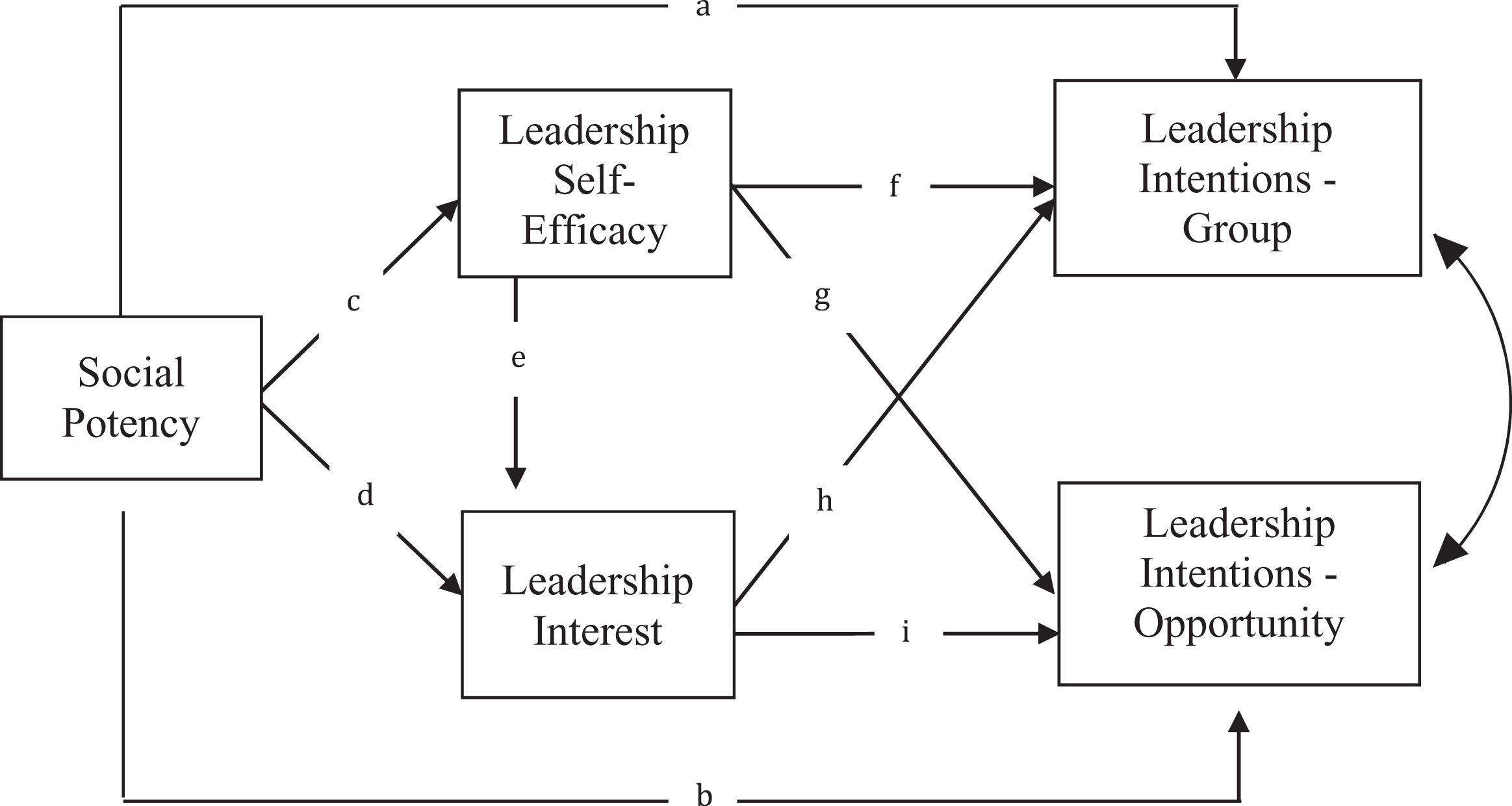
Hypothesized mediation model.
Our four sets of hypotheses correspond to the nine paths presented in Figure 1. First, we hypothesized that Social Potency would directly contribute to leadership self-efficacy, leadership interest, and both indicators of leadership intentions (Paths a–d). Second, we hypothesized that Social Potency would indirectly significantly predict leadership interest through leadership self-efficacy (Paths c + e). Third, we hypothesized that Social Potency would indirectly significantly contribute to leadership intentions through leadership self-efficacy (Paths c + f and Paths c + g) and leadership interest (Paths d + h and Paths d + i). Fourth, we hypothesized that (a) leadership self-efficacy would directly (Paths f and g) and indirectly (Paths e + h and Paths e + i) significantly contribute to leadership intentions through leadership interest, and (b) leadership interest would directly significantly contribute to leadership intentions (Paths h and i).
Method
Participants
Students taking introductory psychology courses at a large Midwestern university originally participated in mass testing for course credit. The students were invited via e-mail to participate in the present study for additional course credit. Of these individuals, 152 female students took the online departmental survey. Of those 152 students, 124 students had complete data. These women identified as European American (87.1%), an international student (3.2%), multiracial (3.2%), Latino/a American (2.4%), Asian American/Pacific Islander (2.4%), and African American (1.6%). One participant (0.8%) chose not to indicate his or her race/ethnicity. The ethnic representation in this sample is consistent with the ethnic representation of the female student body. Participants were 50% first year students, 30.6% second year students, 12.1% third year students, 6.5% fourth year students, and 0.8% fifth year or more students. The mean age was 19.09 years (SD = 1.56 years). A power analysis (Cohen, 1992) indicated 76 people were required for a medium effect at p = .05.
Measures
Social Potency
The social potency (SP) primary scale from the multidimensional personality questionnaire (MPQ; Tellegen, 2000) was used to assess the participant’s stable personality trait that may predispose them toward or away from leadership positions. The scale has 25 true/false statements that were developed through the factor analysis of the MPQ and conveyed “broad interpersonal effectiveness and a desire to make an impact on others” (Tellegen & Waller, 2008). Scores can range from 0 to 25, with higher scores indicating greater tendency to express Social Potency. An example item scored true is “When it’s time to make decisions, people usually turn to me.” Social Potency has been validated with moderate self-other correlations, heritability estimates showing a strong genetic component, and stability over a 10-year period (Tellegen & Waller, 2008). Convergent validity estimates show Social Potency to be moderately correlated with leadership activities of college students (Kamp, 1986) and enterprising interests (Staggs et al., 2003, 2007). Social Potency strongly correlated with enterprising self-efficacy (Larson & Borgen, 2006). The internal consistency, Cronbach’s α, ranged from .87 to .89 (Tellegen & Waller, 2008) in four validation samples and was .85 for the present sample.
Leadership interest
The leadership scale from the Oregon Vocational Interest Scale (ORVIS) leadership subscale (Pozzebon, Visser, Ashton, Lee, & Goldberg, 2010) was used to measure the self-reported interest in various leadership activities. The leadership subscale has 12 five-point Likert items that describe various leader-related activities (e.g., “lead other people”), with higher scores indicating more interest in the activity. The internal consistency for the leadership interest subscale was .86 for a college sample (Pozzebon et al., 2010). The Cronbach’s α for the present sample was .87. Construct validity estimates show that leadership interest was significantly higher for business majors than other majors (Pozzebon, Ashton, & Visser, 2014) and strongly correlated with another leadership interest scale (Pozzebon et al., 2010).
Leadership self-efficacy
The Leadership Basic Confidence Scale (BCS) from the Expanded Skills Confidence Inventory (ESCI; Betz et al., 2003) was used to assess the participant’s leadership self-efficacy. This scale has 10 five-point Likert items (e.g., “inspire others through my leadership,” with higher scores indicating more confidence. Three-week test–retest reliability of the leadership BCS was .89 in a study of college students (Robinson & Betz, 2004). The leadership BCS’s internal consistency was .88 in a college sample (Rottinghaus, Betz, & Borgen, 2003). The Cronbach’s α for the current sample was .89. Leadership self-efficacy has been shown to relate moderately to extroversion (Hartman & Betz, 2007) and to enterprising interests and enterprising self-efficacy (Betz et al., 2003).
Leadership intentions
Leadership intentions were measured in two ways to capture intentions to act as a leader in a group and intentions to pursue leadership opportunities. Leadership intentions—group was developed for this study and included five 5-point Likert items that operationalized leadership actions that participants reported they would perform in a group setting (i.e., make sure the group accomplished a task, take charge of group to complete task, assign and supervise group members, take the role of leader, and be an effective leader). Higher scores indicated greater intentions to perform these leadership behaviors in a group setting. A principal axis factor analysis yielded one factor with an eigenvalue above 1, with factor loadings ranging from .60 to .87. The mean score correlated moderately with the Social Potency primary scale, had a 4-week test–retest reliability of .72, and Cronbach’s α was .92 in this sample.
Leadership intentions were also operationalized by the Leadership Intentions Scale (Davies, Spencer, & Steele, 2005); in this study we refer to it as Leadership intentions—opportunity. Participants were asked to indicate the likelihood on a 6-point Likert-type scale of their participation in five leadership opportunities including (a) request more information about leadership positions, (b) attend a leadership development workshop, (c) apply for a leadership role on their own, (d) apply for a leadership position if notified about it, (e) apply for a leadership position if specifically nominated, and (f) accept a leadership role if it were offered. Mean scores were computed, with higher mean scores indicating greater intention to pursue these leadership opportunities. The Cronbach’s α in this sample was .91. An exploratory principal axis factor analysis of items from both scales confirmed that these were two distinct factors of leadership intentions, with the group factor loadings ranging from .60 to .79 and the opportunity factor loadings ranging from .64 to .86, accounting for 68% of the variance.
Procedure
After approval from the Institutional Review Board, female participants from introductory psychology students at a large Midwestern university were asked to participate through an online departmental mass testing survey. They completed the Social Potency primary scale from the MPQ (Tellegen, 2000). Those women who indicated they wanted to be contacted subsequently received an e-mail that contained information about the study and the link to the online survey. Thirty percent of the women who were invited to participate from the original mass testing process completed the survey. The departmental mass testing procedure is structured for multiple studies simultaneously so no one study would garner more than 30% of the total pool. Their ethnic representation was similar to the ethnic representation at the university as a whole. They completed demographic questions as well as the measures operationalizing leadership self-efficacy, leadership interest, and leadership intentions.
Results
Preliminary Analyses
Table 1 presents the means, standard deviations, and correlations of the variables under examination. All predictor variables significantly positively correlated with both indicators of leadership intentions.
Summary of Means, Standard Deviations, and Intercorrelations for All Studied Variables.

Note. N = 124. Social potency = social potency primary scale, scores range from 0 to 25 with higher scores indicating more social potency; Leadership interest—Oregon Vocational Interest Leadership Scale, scores range from 1 to 5, with higher scores indicating more leadership interest; Leadership self-efficacy = expanded skills confidence inventory leadership Basic Confidence Scale, scores range from 1 to 5 with higher scores indicating more leadership confidence; Leadership intentions—group = Leadership Group Intentions Scale, scores range from 1 to 5 with higher scores indicating greater intentions to perform group leadership behaviors; Leadership intentions—opportunity = Leadership Intentions Scale, scores range from 1 to 6 with higher scores indicating greater intentions to take advantage of leadership opportunities.
**p < .01.
Main Analyses
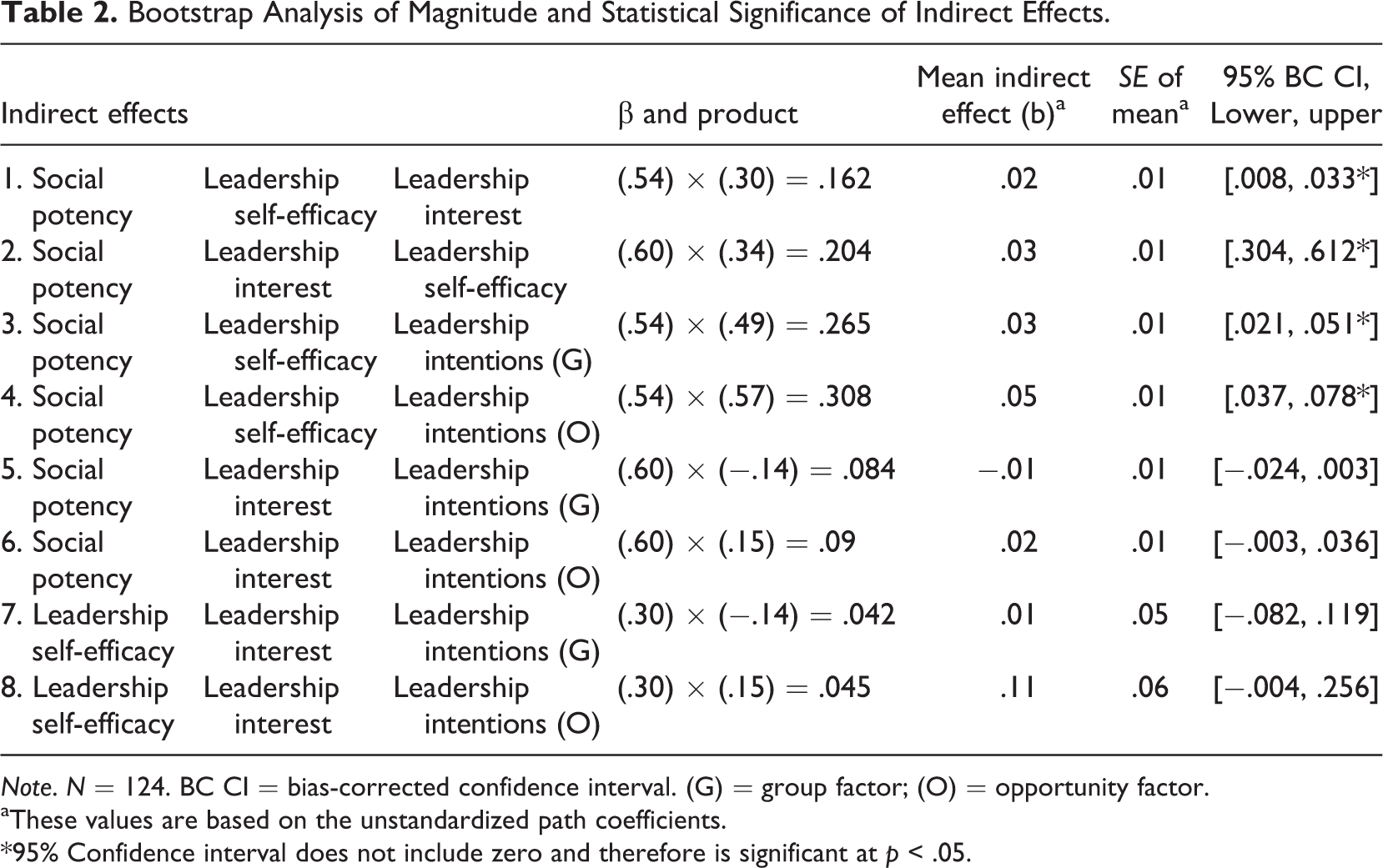
Social Potency was the exogenous variable; leadership intentions (leadership intentions—group and leadership intentions—opportunity) were the two criterion variables; leadership self-efficacy and leadership interest were the two proposed mediators in the model as can be seen in Figure 1. Figure 2 contains the standardized β coefficients for the direct and indirect effects on the relation between Social Potency and leadership intentions (leadership intentions—group and leadership intentions—opportunity) as mediated by leadership self-efficacy and leadership interest. To determine if the eight indirect (mediation) effects were significant, a bootstrapping procedure developed by Preacher and Hayes (2008) was conducted using Social PotencySS that generates 1,000 samples and determines the probability that the mean indirect effect across all those samples would be significantly different than 0 for each mediation effect. The Social PotencySS Version 22 macro program developed by Preacher and Hayes (2008) was used to test the mediation model and to generate the bootstrapping procedure. The procedure allows a researcher to test the significance level of the mediation (indirect) effects. The results from this bootstrapping procedure are presented in Table 2. Table 2 presents the magnitude and statistical significance of the specific and total indirect effects of Social Potency (#1 through #6) and leadership self-efficacy (#7 through #8) using the bootstrapping procedure.
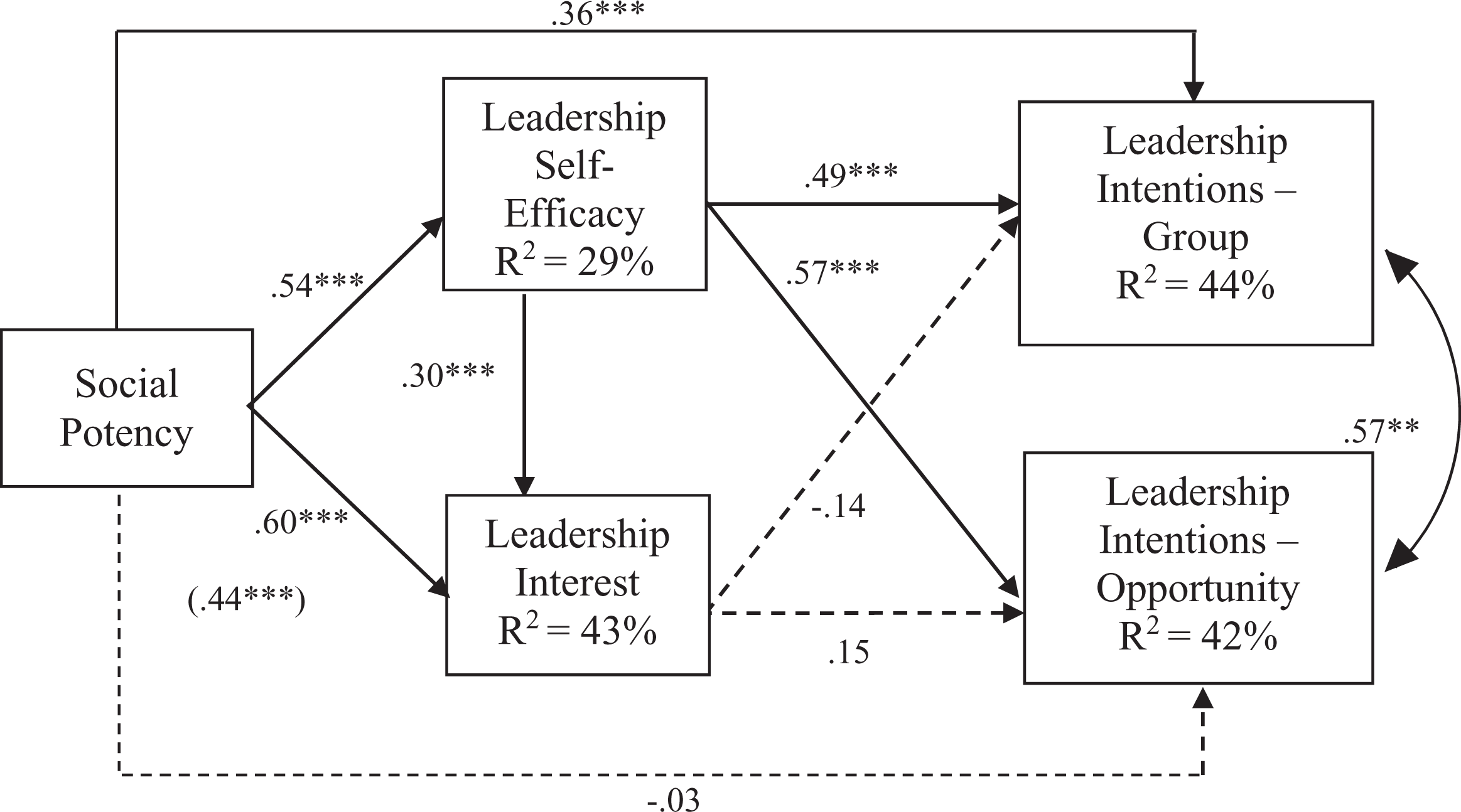
Final mediation model. The β in parentheses is the direct effect after removing the variation due to leadership self-efficacy. **p < .01, ***p < .001.
Bootstrap Analysis of Magnitude and Statistical Significance of Indirect Effects.
Note. N = 124. BC CI = bias-corrected confidence interval. (G) = group factor; (O) = opportunity factor.
aThese values are based on the unstandardized path coefficients.
*95% Confidence interval does not include zero and therefore is significant at p < .05.
Social Potency Direct Effects
Social Potency had a direct effect on leadership self-efficacy and on leadership interest as can be seen by the solid lines going from Social Potency to each of those constructs in Figure 2 (Paths c and d in Figure 1). The standardized β coefficients outside the parentheses are the direct effects of Social Potency on leadership self-efficacy and leadership interest (βs = .54, .60). The standardized β coefficient inside the parentheses is the direct effect of Social Potency on leadership interest after the variation due to leadership self-efficacy was removed. As can be seen by Figure 2, all three standardized beta coefficients were significant. That is, Social Potency had a direct effect on leadership self-efficacy and leadership interest. The strength of these direct effects can be interpreted by examining the standardized β weights (.54, .60), meaning that a 1 standard deviation (SD) difference in Social Potency scores predicts .54 SD difference on leadership self-efficacy scores and predicts .60 SD difference on leadership interest scores (Cohen, 1992).
Social Potency also had a significant direct effect on one of the two indicators of leadership intentions, namely, leadership intentions—group which was Path a in Figure 1 and can be seen by the solid line in Figure 2. The magnitude of the effect can be interpreted as a 1 SD difference in Social Potency scores predicts a .36 SD difference in leadership intentions—group scores. Social Potency did not have a direct effect on leadership intentions—opportunity (Path b in Figure 1) as can be seen by the dotted line going from Social Potency to leadership intentions—opportunity in Figure 2. In short, the first hypothesis received partial support; Social Potency had a unique direct effect on leadership self-efficacy, leadership interest, and one of the two indicators of leadership intentions (Paths a, c, and d in Figure 1).
Social Potency’s Indirect Effects on Leadership Interest
For the second hypothesis, the authors posited that Social Potency would indirectly affect leadership interest through leadership self-efficacy (Paths c + e; Figure 1). The specific mean indirect effect of Social Potency on leadership interest through leadership self-efficacy was significant as can be seen by #1 in Table 2. Significance is also demonstrated in Table 2's last column. The bias-corrected confidence interval (BC CI) generated from the 1,000 samples did not include 0. In short, leadership self-efficacy served as a significant mediator between Social Potency and leadership interest; Hypothesis 2 was supported.
Figure 2 also presents the magnitude of the variance in leadership interest that is accounted for by Social Potency and leadership self-efficacy. The effect size is large (Cohen, 1992) in that 43% of the variance in interest is accounted for.
Social Potency’s Indirect Effects on Leadership Intentions
The third hypothesis was that Social Potency would indirectly significantly positively relate to leadership intentions through leadership self-efficacy (Paths c + f and Paths c + g) and through leadership interest (Paths d + h and Paths d + i) as shown by Figure 1. Regarding leadership self-efficacy as the mediator, the specific mean indirect effect of Social Potency on both indicators of leadership intentions through leadership self-efficacy was significant as seen by Table 2, #3 and #4. The bootstrapping procedure showed that the specific mean indirect effects of Social Potency on leadership intentions through leadership self-efficacy were significant in that the BC CIs did not include 0.
Regarding leadership interest as the mediator, Social Potency did not indirectly significantly relate to either indictor of leadership intentions through leadership interest as can be seen by Figure 2. The specific mean indirect effects of Social Potency on leadership intentions through leadership interest were nonsignificant as can be seen by Table 2, #5 and #6. The bootstrapping procedure was insignificant as shown by 0 in the BC CI column in Table 2. In short, Hypothesis 3 was partially supported; Social Potency did have a significant indirect effect on both indicators of leadership intentions through leadership self-efficacy (Figure 1: Paths c + f and Paths c + g) but Social Potency did not have a significant indirect effect through leadership interest (Figure 1: Paths d + h and Paths d + i).
Leadership Self-Efficacy and Direct and Indirect Effects and Leadership Interest’s Direct Effect
For the fourth hypothesis, the authors predicted that leadership self-efficacy would have direct and indirect effects on leadership intentions and leadership interest would have direct effects on intentions. As can be seen by Figure 2, leadership self-efficacy had a significant direct effect on both indicators of leadership intentions that are Paths f and g in Figure 1. The magnitude of the effects can be interpreted as 1 SD difference in leadership self-efficacy scores predicts .49 SD difference in leadership intentions—group scores and a .57 SD difference in leadership intentions – opportunity scores. Regarding indirect effects which are Paths e + h and Paths e + i in Figure 1, leadership self-efficacy did not have a significant indirect effect on either indicator of leadership intentions through leadership interest. These insignificant indirect effects are reported in Table 2, #7 and #8. The bootstrapping procedure showed that the specific mean indirect effects of leadership self-efficacy on leadership intentions through leadership self-efficacy were not significant in that the BC CIs included 0. As can be seen by Figure 2, leadership interest did not have a significant direct effect on either indicator of leadership intentions (Paths h and i in Figure 1).
In short, the fourth hypothesis received partial support. As expected, leadership self-efficacy had a direct effect on both indicators of leadership intentions. However, leadership self-efficacy did not have an indirect effect on leadership intentions through leadership interest nor did leadership interest have a direct effect on leadership intentions.
Discussion
The primary purpose of this investigation was to examine the role of Social Potency as a direct and indirect contributor to young women’s leadership self-efficacy, leadership interest, and leadership intentions. Our rationale was embedded in the unique definition of Social Potency as capturing both social dominance and interpersonal effectance motivation. We saw these two domains as more precisely capturing what leadership is about than the broader Big 5 trait of extroversion.
Direct Effects of Social Potency
As expected, Social Potency in this sample had a direct effect on leadership self-efficacy as shown by Figure 2. In this sample, young women who had more leadership confidence also were more likely to describe their personality as socially dominant and as someone who can engage with others in making effective change. Our finding is consistent with SCCT and with the broader literature that has shown Social Potency to be related to Holland’s enterprising self-efficacy (Betz et al., 2003; Larson & Borgen, 2006). It is also consistent with leadership self-efficacy specifically being related to extroversion (Hartman & Betz, 2007; Ng et al., 2008). Although prior studies had shown the overlap of broad constructs, namely, extroversion and enterprising self-efficacy (Larson et al., 2007; Nauta, 2004; Rottinghaus et al., 2002; Schaub & Tokar, 2005), this study was important in moving the field beyond examination of general domains to precisely examine the domain of leadership using SCCT as the theoretical framework. This was the first study to determine if a personality trait tailored to describe leadership qualities would predict women’s confidence in pursuing leadership activities.
We also determined that this leadership personality trait, namely Social Potency, also directed predicted how interested these young women were in pursuing leadership activities. We knew from prior research that Social Potency moderately related to the broad domain of enterprising interest (Larson & Borgen, 2002; Staggs et al., 2003, 2007) and related to specific types of enterprising interests like public speaking and law/politics (Larson & Borgen, 2002; Staggs et al., 2003, 2007). In this study we learned that Social Potency directly strongly related to how interested young women were in pursuing leadership activities. This finding is important because it moves the research from general areas overlapping with leadership to focus on leadership specifically.
Finally, we anticipated that Social Potency would directly relate to whether young women in our sample would intend to pursue leadership activities. We learned that Social Potency had a direct effect on leadership intentions when it was defined as intending to lead in a group setting but did not have a direct effect on leadership intentions when it was defined as intending to pursue leadership opportunities. One explanation for this discrepancy may have to do with what Low and Rounds (2006) conceptualized as the role of personality traits, namely that personality traits may provide information as to how someone would perform in a position rather than provide information as to whether they would pursue that position. Perhaps intentions to lead a group are more in line with how leaders behave in the role. Future research would need to explore that assertion.
Indirect Effects of Social Potency
Besides demonstrating in this sample that Social Potency directly contributed to leadership interest, we also showed that it indirectly contributed to leadership interest through leadership self-efficacy. The magnitude of the effect was large. This finding is consistent with SCCT and with prior related research showing extroversion to have an indirect effect on enterprising interest through other sociocognitive variables (Nauta, 2004; Schaub & Tokar, 2005). Our findings are important because it provides evidence that Social Potency is a necessary construct to include in understanding young women’s leadership interest above and beyond leadership self-efficacy.
Moreover, we provided evidence in this sample that besides having a direct effect on leadership intentions, Social Potency also had an indirect effect on leadership intentions through leadership self-efficacy. This indirect finding is consistent with SCCT. Given Social Potency has not been examined as an indirect contributor to leadership intentions, future studies are needed to buttress these results. It appears that Social Potency is a critical construct to examine in explaining young women’s leadership intentions.
Leadership Self-efficacy and Leadership Interest
Consistent with SCCT, in this sample leadership self-efficacy directly contributed to leadership intentions. However, inconsistent with SCCT, leadership self-efficacy did not indirectly contribute to intentions through leadership interest and leadership interest did not directly contribute to leadership intentions. Our findings are also inconsistent with Yeagley and colleagues (2010) who found the reverse. Elite leadership self-efficacy indirectly contributed to elite leadership intentions through elite leadership interest but leadership self-efficacy did not have a direct effect. Moreover, elite leadership interest directly predicted elite leadership intentions. They did not examine Social Potency. Future research is needed to obtain a clearer picture of the direct and indirect effects of leadership self-efficacy and leadership interest on leadership intentions when personality is included in the investigation.
Limitations and Future Studies
Although Social Potency was measured at Time 1 and the hypotheses were grounded in theory, the remaining predictor variables, namely leadership self-efficacy and leadership interest, were measured at the same time as the criterion variable, leadership intentions. Future studies that are longitudinal or experimental in nature would be helpful to provide information as to causality. Moreover, more ethnically diverse samples would have allowed the researchers to examine ethnicity as a potential moderator. These results are also limited to young women although this was intentional due to the authors’ focus on women at the beginning of their emerging careers as they make plans for their future.
Future studies can build upon the foundation that has been laid showing Social Potency to be a salient construct in predicting young women’s leadership aspirations. Future researchers may want to determine the indirect effect of Social Potency on key outcomes that pertain to leadership specifically or more generally to vocational outcomes that are defined by interpersonal social dominance and/or interpersonal motivation to impact other people.
Reaching out to industrial organizational psychologists and researches in business colleges would be productive for future studies. For example, researchers could include transactional and transformative leadership styles as variables along with Social Potency and SCCT variables. Transactional leadership is identified through contingent reward (i.e., providing rewards for satisfactory performance), active management by exception (i.e., intervening and giving critiques on a group member’s mistakes as they happen), and passive management by exception (i.e., waiting to intervene until crisis) (Eagly, Johannesen-Schmidt, & van Engen, 2003). In contrast, transformative leadership is defined as the process of “establishing oneself as a role model by gaining followers’ trust and confidence,” (Eagly & Carli, 2007, p. 128).
Implications
Career counselors are used to providing clients with information about their interests and self-efficacy across the RIASEC. They also may incorporate personality traits like the Big Five in helping clients better understand themselves as they navigate making educational and vocational choices like picking classes and selecting a major. In this article, we provided evidence that including Social Potency in counselors’ tool boxes may be beneficial when working with young women who have the potential to become future leaders. These clients would benefit from learning more about their social dominance and their agentic tendency that motivates them to impact and engage other people effectively. In this article, we also showed the benefit of counselor’s ascertaining particular interests and confidence beyond the RIASEC like leadership interest and confidence. Young women who are given tailored assessment results regarding their Social Potency and their confidence and/or interest in pursuing leadership activities would be well informed in their educational and career planning.
Conclusion
We were interested in exploring the role of a personality trait specifically chosen because it captured the tendency to see oneself as socially dominant and interpersonally effective. In short, our findings provided strong support for the role of Social Potency in directly and indirectly contributing to leadership self-efficacy, leadership interest, and leadership intentions in this sample of young university women. These results are important in that they are the first published findings to show that Social Potency contributes uniquely to leadership intentions.
Footnotes
Acknowledgments
We would like to thank Meifen Wei for her statistical consultation with data-analysis. We also would like to acknowledge Lauren Lain for her help in conducting this study and preparing this manuscript.
Declaration of Conflicting Interests
The author(s) declared no potential conflicts of interest with respect to the research, authorship, and/or publication of this article.
Funding
The author(s) received no financial support for the research, authorship, and/or publication of this article.