




Abstract
The Leadership/Teamwork Self-Efficacy Scale has been shown to be an effective tool for measuring interpersonal competence beliefs in science, technology, engineering, and mathematics academic settings. However, little is known about its psychometric properties. The present research explored the measure’s longitudinal factor structure in the context of an energy science intervention for high school students. Results of multiple group confirmatory factor analysis yielded evidence of a two-factor structure, as the measure demonstrated strong measurement invariance and excellent test–retest reliability. Results also indicated that latent leadership and teamwork means increased significantly from pretest to posttest, thus also highlighting the efficacy of the intervention in promoting these attributes. Development of leadership and teamwork skills is discussed from trait-based and contextual perspectives.
Keywords
Although climate change has long received global attention as an urgent issue, worldwide energy data do not reflect an optimistic outlook for the future. While global primary energy consumption grew by 2.9% in 2018, sustainable forms of renewable energy such as wind, solar, and hydroelectric still only make up about 14% of the global energy supply (International Energy Agency, 2019). Renewable power grew by 14.5% in 2018, which is a pace below historical average (Dudley, 2019). To promote progress in dealing with climate change, greater effort needs to be directed at developing and adopting sustainable energy (carbon-free) technologies.
The development of sustainable energy technologies requires a large number of energy specialists to research and develop innovative techniques. However, there is a growing shortage in the energy workforce, both in the United States and worldwide. For instance, 76.9% of U.S. employers in energy-related industries found it hard to hire qualified workers in 2018, an increase of 7% from 2017 (National Association of State Energy Officials, 2019). According to the Global Energy Talent Index report (Airswift & Energy Jobonline, 2019), there is a skills shortage in almost every sector of the global energy industry (e.g., oil and gas, nuclear, renewables). To meet these demands, it is imperative to identify and develop the next generation of leaders in energy science. More importantly, problem-solving, teamwork, and leadership are three of the skills that are most highly affected by the talent shortages in the global energy workforce (Airswift & Energy Jobonline, 2019), which means that not only are more energy workers needed but also workers with leadership skills and the ability to work collaboratively with others in addressing sustainable energy development.
Adolescent Leadership and Teamwork Skills
The ability to work collaboratively toward common goals is an important social skill for adaptive career functioning. Perhaps nowhere has this point been illustrated more clearly than in science, technology, engineering, and mathematics (STEM) careers. Indeed, the “science of team science” (Hall et al., 2018) has gained attention as an emerging and much-needed area of scientific inquiry, given the increasing prominence of collaborative research across disciplines (Wuchty et al., 2007). This shift in the way science is typically conducted has been paralleled in the engineering field as well. Consideration of the interface between complex technologies and the diverse sociocultural contexts in which they are used requires a systemic approach in which groups of experts bring novel ideas, values, strategies, and critical thinking skill sets to bear on design projects. Communication, leadership, and creativity have thus been identified as essential skills for engineers of the 21st century (National Academy of Engineering, 2004). Related “soft skills” such as teamwork and problem-solving have also been shown to increase students’ academic success and career advancement, especially in the STEM disciplines.
While career interventions aimed at developing leadership skills are often initiated during the postsecondary years when individuals begin to more fully immerse themselves in vocational content domains, it may also be prudent to target the facilitation of these skills during adolescence, when social support and collaboration are critical to the development of one’s social and vocational identity development (Harter, 2012; Hirschi et al., 2011). Effective leaders are capable of developing affiliative social connections (Whitehead, 2009) and trust with others, and they “lead by example” by demonstrating congruence between their words and actions (Avolio & Gardner, 2005). Leadership and collaboration activities in STEM learning and vocational settings may be particularly important for adolescents psychosocially because they afford a sense of unity and achievement that is different from the satisfaction that can be obtained from independent work alone. This can further increase their interest in STEM careers and in the process advance not only their own career development but also their peers’ career development as well. However, the vast majority of leadership research has focused on adult rather than adolescent populations (Avolio & Vogelgesang, 2011), and virtually, none addresses adolescent leadership development in STEM contexts (Morgan et al., 2019).
Leadership and Teamwork Self-Efficacy
For people to enhance their teamwork and leadership skills, it is important that they develop the belief that they can perform those skills effectively in social situations. Bandura (2000) emphasized the importance of group-relevant forms of self-efficacy because groups represent organizational mechanisms by which efficacy-building information can be efficiently transmitted from person to person. Studies on these forms of self-efficacy have yielded promising results in STEM environments. For instance, Lent et al. (2006) found that collective efficacy was positively associated with group cohesion and performance among engineering students, and peer self-efficacy percepts have been linked to increased science interest and career intentions (Deemer et al., 2017).
Extensive studies in the vocational literature have highlighted the importance of self-efficacy in leadership as well. In a military study, cadets with a higher level of leadership self-efficacy had more positive leadership ratings by objective observers after a 6-week leadership training intervention (Chemers et al., 2000). Leadership self-efficacy has also been shown to mediate the relationship between Big Five personality traits (i.e., neuroticism, extroversion, openness, agreeableness, conscientiousness) and leader effectiveness, especially when job autonomy is high and job demands are low (Ng et al., 2008).
Leadership self-efficacy can also predict leaders’ improvement behaviors and group success. For example, managers with a higher level of leadership self-efficacy tended to make more effort toward organizational improvements (Paglis & Green, 2002). Watson et al. (2001) also found that higher levels of leadership self-efficacy among basketball team captains predicted the collective efficacy scores of the whole team. For adolescents, these forms of efficacy can shape unique pathways toward career goal choice and attainment through their proximal influence on outcome expectancy beliefs and vocational interests (Lent & Brown, 2013).
Measurement of Teamwork and Leadership Self-Efficacy in STEM
Although teamwork and leadership self-efficacy are important for career development, few researchers have studied these constructs in STEM career contexts. Empirical advancements in this area may be limited by the paucity of tools designed to measure these forms of self-efficacy. However, one tool—the Leadership/Teamwork Self-Efficacy Scale (LTSES; Chemers et al., 2011)—has shown promise as a reliable measure of these constructs and a modest nomological network of associations with related constructs. For instance, Chemers et al. (2011) showed that the LTSES operates as a function of research experiences and scientific community involvement and has exhibited convergent validity through positive associations with science self-efficacy, science career commitment, and science identity (Syed et al., 2018).
Despite preliminary indications that the LTSES exhibits good psychometric properties, there are conceptual and empirical reasons for further exploring the construct validity of the scale. From a conceptual perspective, it is possible to have high confidence in one’s teamwork skills while having little confidence in one’s leadership skills. Conversely, people who have confidence in their leadership skills are likely to have some leadership experience, which necessarily involves developing competence (and, presumably, interpersonal self-efficacy) in collaborative settings. In other words, teamwork self-efficacy may be a necessary prerequisite for the development of leadership self-efficacy. Thus, the relationship between leadership and teamwork self-efficacy may not always be consistent. We suspect that the LTSES actually measures leadership and teamwork self-efficacy as two distinct constructs, but the factor structure of the scale has not been thoroughly examined in the literature, as confirmatory factor analytic work to date has only examined how well it represents a unidimensional construct (Syed et al., 2018).
The current study was thus guided by two objectives. First, we set out to explore the longitudinal factor structure and general psychometric properties of the LTSES. Second, within this psychometric analysis framework, we sought to examine the efficacy of an energy science intervention by assessing whether the scale is capable of detecting change in high school students’ efficacy perceptions over time. The purpose of the intervention was not only to increase students’ technical and scientific competence but also to expose them to potential careers and leadership roles in energy-related STEM occupations. We hypothesized that the LTSES (a) would evidence a distinct two-factor structure, (b) would demonstrate strong longitudinal measurement invariance from pretest (i.e., Time 1 [T1]) to posttest (i.e., Time 2 [T2]), and (c) students’ perceptions of leadership and teamwork self-efficacy would increase significantly from T1 to T2.
Method
Participants
A total of 134 adolescents participated in the study (74 boys and 60 girls). All participants were rising juniors and seniors in high school with a mean age of 16.56 (SD = .64; range = 15–18). With respect to racial/ethnic identity, 73.9% of sample identified as White, 16.4% identified as Asian or Asian American, 4.5% identified as multiracial, 2.2% identified as Latino/a, 1.5% identified as Black or African American, 0.7% identified as Arabic or Middle Eastern, and 0.7% identified with some other race or ethnicity. There were 21 cases with completely missing data at certain time points—three cases at T1 and 18 cases at T2. Because there were no cases with missing data at both time points (i.e., no systematic missingness), these cases were retained, and data were assumed to be missing at random. Hence, missing values were dealt with using a full information maximum likelihood estimator in conjunction with the expectation–maximization algorithm.
Energy Science Intervention
The students participated in a week-long STEM enrichment program that was designed to foster the development of their scientific and technological skills. Energy science was used as the contextual backdrop for the program because energy is an interdisciplinary topic, and this program is uniquely structured in a way that goes beyond disciplinary boundaries. Learning activities were situated in a general context of collaboration and community throughout the program in order to facilitate this cross-disciplinary interaction. Thus, a second but equally important purpose of the program was to facilitate career and potential leadership interest in energy science. This was accomplished by highlighting the collaborative nature of energy science through lectures, hands-on research and group projects, field trips, presentations and panel discussions with energy industry leaders, faculty, and graduate students that detailed the attributes and training one needs to succeed in the field. Technical topics covered in the program focused generally on issues such as energy utilization, energy efficiency, and power generation. A key program activity that was designed to engender collaboration and leadership involved students working in teams of approximately four participants (range of 2–6 per team) on an energy-related research project. Group sizes varied due to logistical challenges such as limitations on experimental lab work space. Group composition was predetermined as students were randomly assigned to the groups by administrators before the program began to streamline logistics. The administrators strove to create groups that were as balanced as possible with respect to gender and race/ethnicity. One teacher was assigned to each group to facilitate learning and collaboration among the students.
Three of Tuckman’s (1965) stages of small group development (“forming,” “norming,” and “performing”) served as conceptual bases for the development of leadership and teamwork self-efficacy. 1 The forming stage was characterized by an icebreaker session in which the participants familiarized themselves with each other on the first day of the program. Following this, participants negotiated their role assignments within the groups by discussing their strengths and weaknesses relative to various research tasks (e.g., leadership, background research, data collection and analysis, presentation of results). The students themselves therefore chose leaders within their groups. Program instructors also led a session on the first day of the program, which focused on the best practices of a good scholarly presentation and working in teams. Member roles and group norms were further elaborated as part of the norming stage as participants collaborated on various activities throughout the week. The performing stage was encapsulated by the conduct of the research throughout the week and presentation of the groups’ findings on the final day of the program. The projects covered advanced topics in energy research, and these were as follows: (a) fabrication of photovoltaic solar cells, (b) fabrication of rechargeable batteries, (c) converting biomass into biofuels, (d) understanding nuclear fuel and radiation decay chains, (e) studying the performance of hydrogen fuel cells, (f) energy-efficient cooling solutions, and (g) synthesis of nanofibers for thermoelectric applications.
Measures
Teamwork and leadership self-efficacy
Students’ perceptions of their interpersonal skills were measured using the LTSES (Chemers et al., 2011). The LTSES is an 11-item scale that was specifically designed to measure perceived ability to collaborate with and lead others within a research team context. Items are measured on a 5-point Likert-type scale ranging from 1 (strongly disagree) to 5 (strongly agree). An example item includes “I know how to be a good team member.” LTSES scores have exhibited good internal consistency in samples of undergraduate (α = .90) and graduate (α = .90) students (Chemers et al., 2011). Chemers et al. also obtained evidence of the scale’s concurrent validity through positive and significant associations with science identity and science career commitment. The item “I can train or supervise students and/or technicians in the laboratory” was not included in the current analysis because participants did not have any supervisory experience in research. Thus, only 10 items were subjected to factor analysis.
Procedure
Students were selected for admission to the program on the bases of academic ability and an essay in which applicants detailed their reasons for applying to the program along with their academic, career, and leadership interests in energy science fields. All applicants who were admitted to the program were recruited for participation in the study, and all accepted the invitation through provision of their written assent. Because the participants were under the age of 18, parental consent was obtained as well. All data were collected via paper-and-pencil surveys administered at two time points. The T1 survey consisted of the LTSES and a brief demographic questionnaire and was administered before the start of program activities on Day 1. The T2 survey consisted of the LTSES only and was administered immediately upon the conclusion of program activities on Day 6. The study was approved by the researchers’ university institutional review board.
Data Analytic Strategy
We performed a longitudinal exploratory factor analysis (EFA) of a 2 (Factor: teamwork and leadership) × 2 (Time: T1 and T2) model to identify a parsimonious set of LTSES items for further analysis. Longitudinal EFA is a form of exploratory structural equation modeling (Asparouhov & Muthén, 2009) that affords researchers the advantages of both traditional EFA and confirmatory factor analysis (CFA). With this approach, researchers derive the EFA benefits of specifying item cross-loadings and rotating factor loading matrices while retaining the CFA benefits of using model fit indices and evaluating latent variables that are corrected for measurement error. We used the following indices to evaluate the fit of all models in the current study: (a) model χ2 test, (b) comparative fit index (CFI), (c) root mean square error of approximation (RMSEA), and (d) standardized root mean square residual (SRMR). CFI values of greater than .90 and SRMR values of less than .08 indicate acceptable model fit (Hu & Bentler, 1999). RMSEA values of less than .05 are considered good, while values ranging between .05 and .08 indicate reasonable model fit (Marsh et al., 2004). All factor analytic models in the current study were tested using Mplus Version 7.3 (Muthén & Muthén, 1998–2016) statistical software with full information maximum likelihood as the estimation method. An oblique geomin rotation method was used for the longitudinal EFA.
We then performed a series of measurement invariance tests using multiple group CFA to determine whether the LTSES measures the same constructs over time. The invariance testing process involves fitting a series of nested models in which cross-group equality constraints are imposed on certain parameters in an increasingly restrictive fashion. Three types of measurement invariance were examined in the current study (Little, 1997; Meredith, 1993): (a) configural invariance, (b) weak invariance, and (c) strong invariance. Establishment of configural invariance requires that the number of factors and pattern of factor loadings are identical across time. Establishment of a well-fitting configural model is a necessary precondition for further invariance testing. If the model is found to fit the data well in each group, then factor loadings are constrained to equality across groups in a test of metric invariance. Establishment of both configural and metric invariance represents evidence of weak invariance. Assuming that weak invariance is supported, further cross-group constraints are imposed on the indicator intercepts in a test of scalar invariance. Establishment of scalar invariance represents evidence of strong invariance, which is a prerequisite for testing latent mean differences across groups. Meredith (1993) described the fourth type of invariance, strict invariance, in which residual variances are constrained to equality across groups. However, some scholars argue that this test is overly restrictive (Byrne et al., 1989; Widaman & Riese, 1997); therefore, we did not attempt to establish residual invariance. We performed χ2 difference tests on the nested models, but because this test is sensitive to sample size, we included Cheung and Rensvold’s (2002) criterion of ΔCFI ≤ .01 as an additional index of measurement invariance. To identify the configural and metric invariance models, we freely estimated their factor variances, fixed the loadings of the first indicator of each factor to 1, and fixed all factor means to 0. To identify the scalar invariance model, the same procedure was followed with the exception that the T2 factor means were freely estimated. For all models tested, we correlated the residuals of the same indicators measured at T1 and T2.
Results
Longitudinal EFA
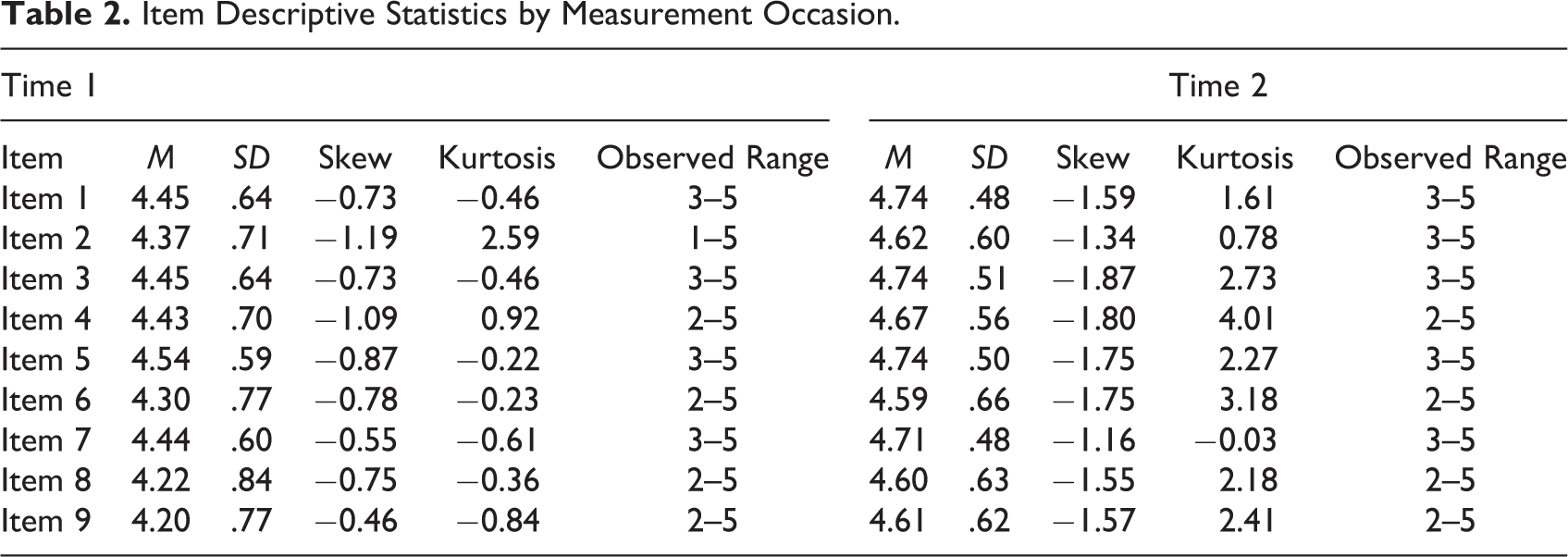
All 10 items were specified to cross-load on latent teamwork and leadership factors at their respective measurement occasions. Results revealed a good fit of the model to the data, χ2(138) = 237.01, p < .001; CFI = .942; Tucker–Lewis index (TLI) = .920; SRMR = .057; RMSEA = .073 (90% confidence intervals [CI] [.057, .089]). Items 1, 2, 3, 5, and 10 loaded on the T1 and T2 teamwork factors, and Items 4, 6, 7, 8, and 9 loaded on the T1 and T2 leadership factors. Factor loadings ranged from .52 to .80 and .55 to .92 for the teamwork and leadership factors, respectively (see Table 1). Item 10 purports to measure leadership (“I am able to allow other team members to contribute to the task when leading a team”), yet it loaded on the teamwork factor; therefore, we chose not to retain it for further analysis. Descriptive statistics for the nine items are presented in Table 2, and interitem correlations are displayed in Table 3. Overall mean scores for teamwork self-efficacy were 4.45 (SD = .52) and 4.71 (SD = .43) for T1 and T2, respectively. Overall mean scores for leadership self-efficacy were 4.32 (SD = .62) and 4.63 (SD = .50) for T1 and T2, respectively. We then estimated the composite reliability of the item scores by computing omega (ω) coefficients (McDonald, 1978) for each subscale. Test–retest reliabilities were found to be excellent for both leadership (T1 ω = .93; T2 ω = .94) and teamwork (T1 ω = .90; T2 ω = .91) self-efficacy.
Longitudinal Exploratory Factor Analysis Results for the Leadership Self-Efficacy Scale.
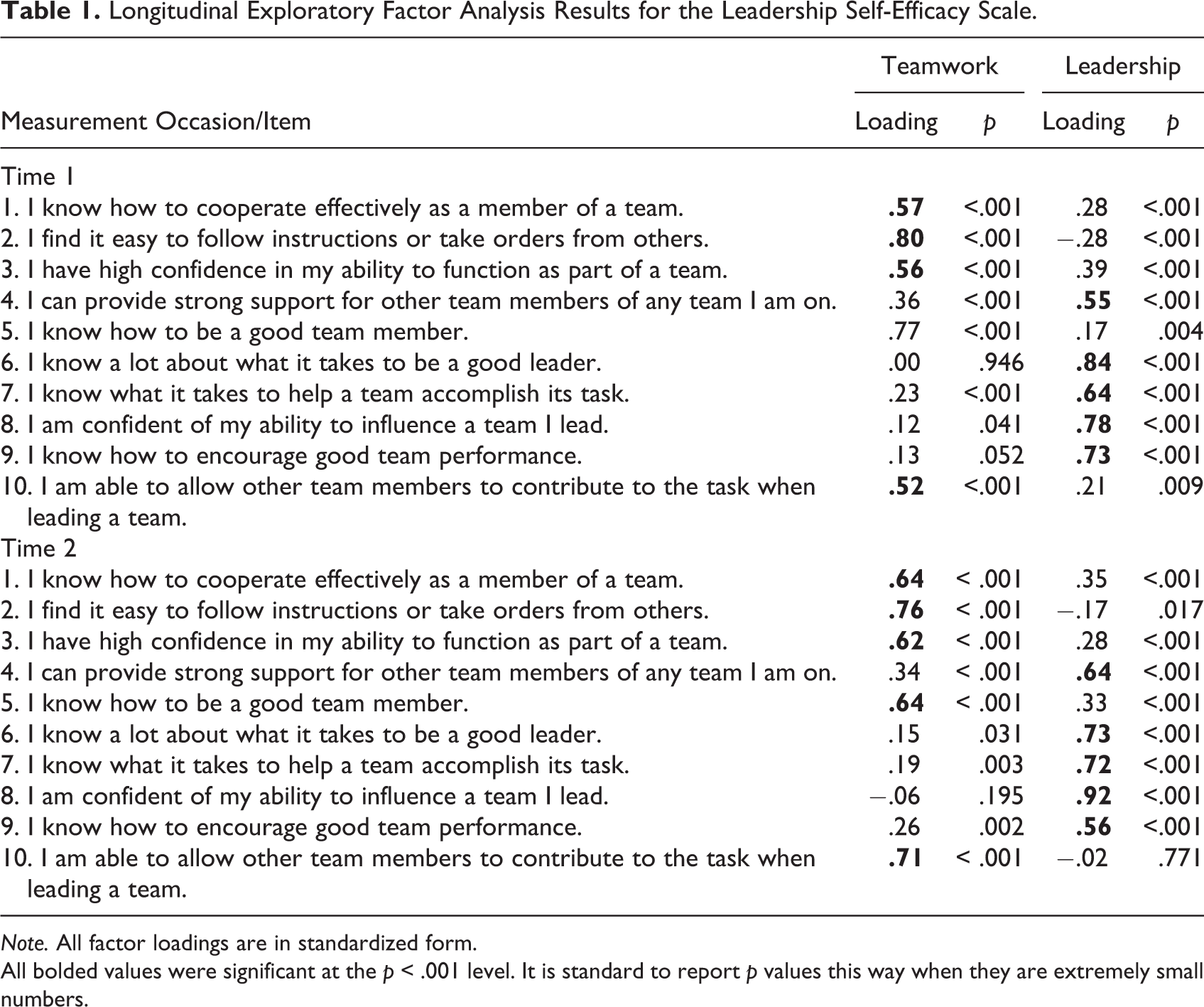
Note. All factor loadings are in standardized form.
All bolded values were significant at the p < .001 level. It is standard to report p values this way when they are extremely small numbers.
Item Descriptive Statistics by Measurement Occasion.
Interitem Correlations for the Time 1 and Time 2 LTSES Items.
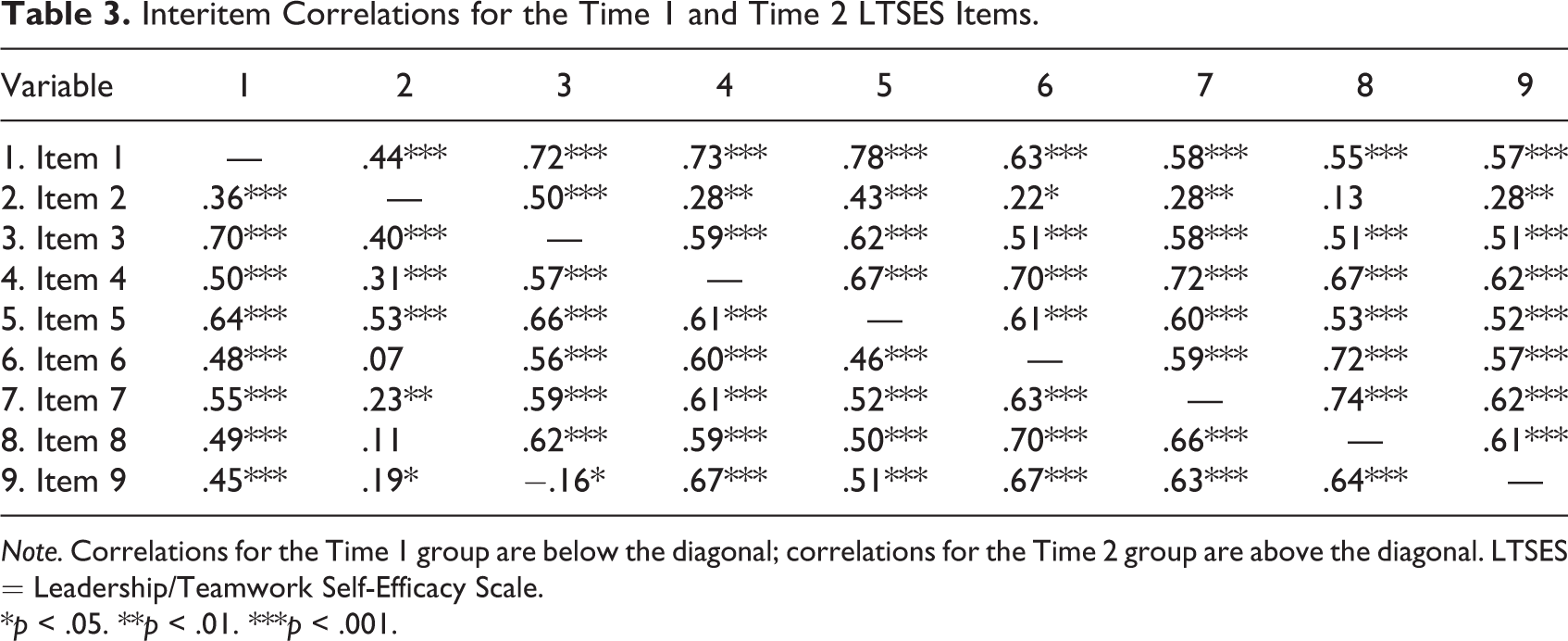
Note. Correlations for the Time 1 group are below the diagonal; correlations for the Time 2 group are above the diagonal. LTSES = Leadership/Teamwork Self-Efficacy Scale.
*p < .05. **p < .01. ***p < .001.
Measurement Invariance Analysis
Before proceeding to the invariance tests, we fit the two-factor model to the data for the T1 and T2 groups separately. Results indicated that both the T1 model, χ2(26) = 40.20, p = .037; CFI = .967; TLI = .955; SRMR = .058; RMSEA = .065 (90% CI [.016, .102]), and T2 model, χ2(26) = 30.80, p = .236; CFI = .985; TLI = .979; SRMR = .047; RMSEA = .040 (90% CI [.000, .087]), fit the data well. Summary fit statistics for the configural, weak, and strong invariance models are presented in Table 4. Configural invariance was tested by simultaneously estimating the model for the T1 and T2 groups while freely estimating the factor loadings and item intercepts. Results indicated that the model offered a good fit to the data as the RMSEA and SRMR values were <.07 and the CFI value was >.95. To test for metric invariance, we constrained the factor loadings to equality across the T1 and T2 groups and compared this model to the configural invariance model. The SRMR value was found to exceed .07, but the RMSEA and CFI values were within acceptable ranges; therefore, the model was considered to fit the data reasonably well. Results of χ2 difference testing indicated that the metric invariance model fit the data no worse than the configural invariance model, Δχ2(7) = 3.80, p = .80, ΔCFI = .004, thus providing support for weak invariance. Next, we imposed cross-group equality constraints on the item intercepts to assess for scalar invariance. Results indicated that the SRMR was somewhat elevated (.092), but the RMSEA value was <.05 and the CFI value was > .95; therefore, the model was deemed to represent a reasonable fit to the data. Results of χ2 difference testing indicated that the more restrictive scalar invariance model fit the data just as well as the metric invariance model, Δχ2(7) = 7.39, p = .39, ΔCFI = −.001, thus supporting the strong invariance hypothesis. Figure 1 depicts the standardized factor loadings and factor correlations for the strong invariance model.
Model Fit Statistics for Test of Longitudinal Measurement Invariance.
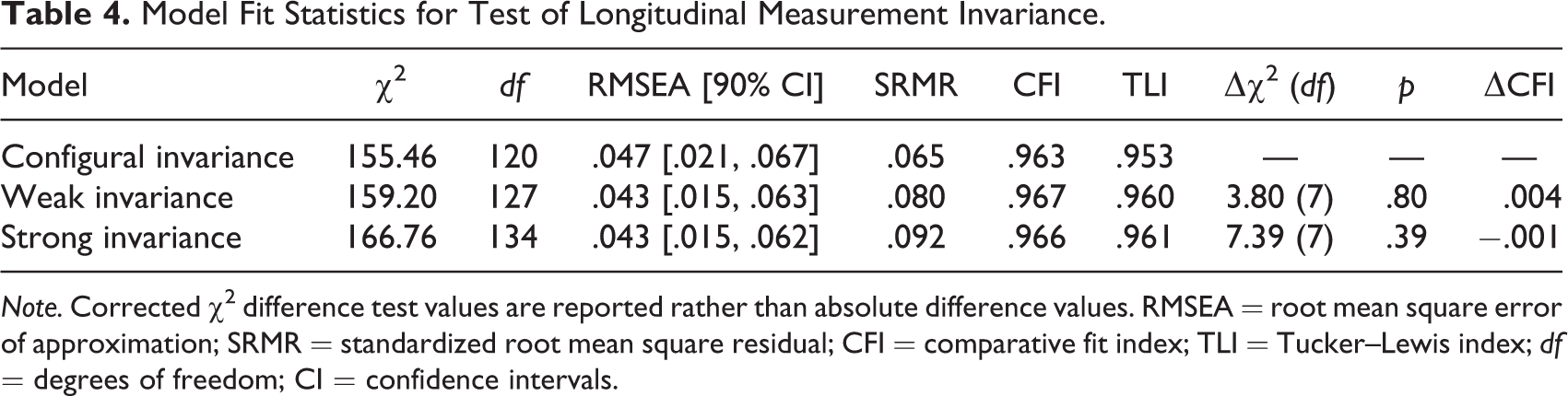
Note. Corrected χ2 difference test values are reported rather than absolute difference values. RMSEA = root mean square error of approximation; SRMR = standardized root mean square residual; CFI = comparative fit index; TLI = Tucker–Lewis index; df = degrees of freedom; CI = confidence intervals.
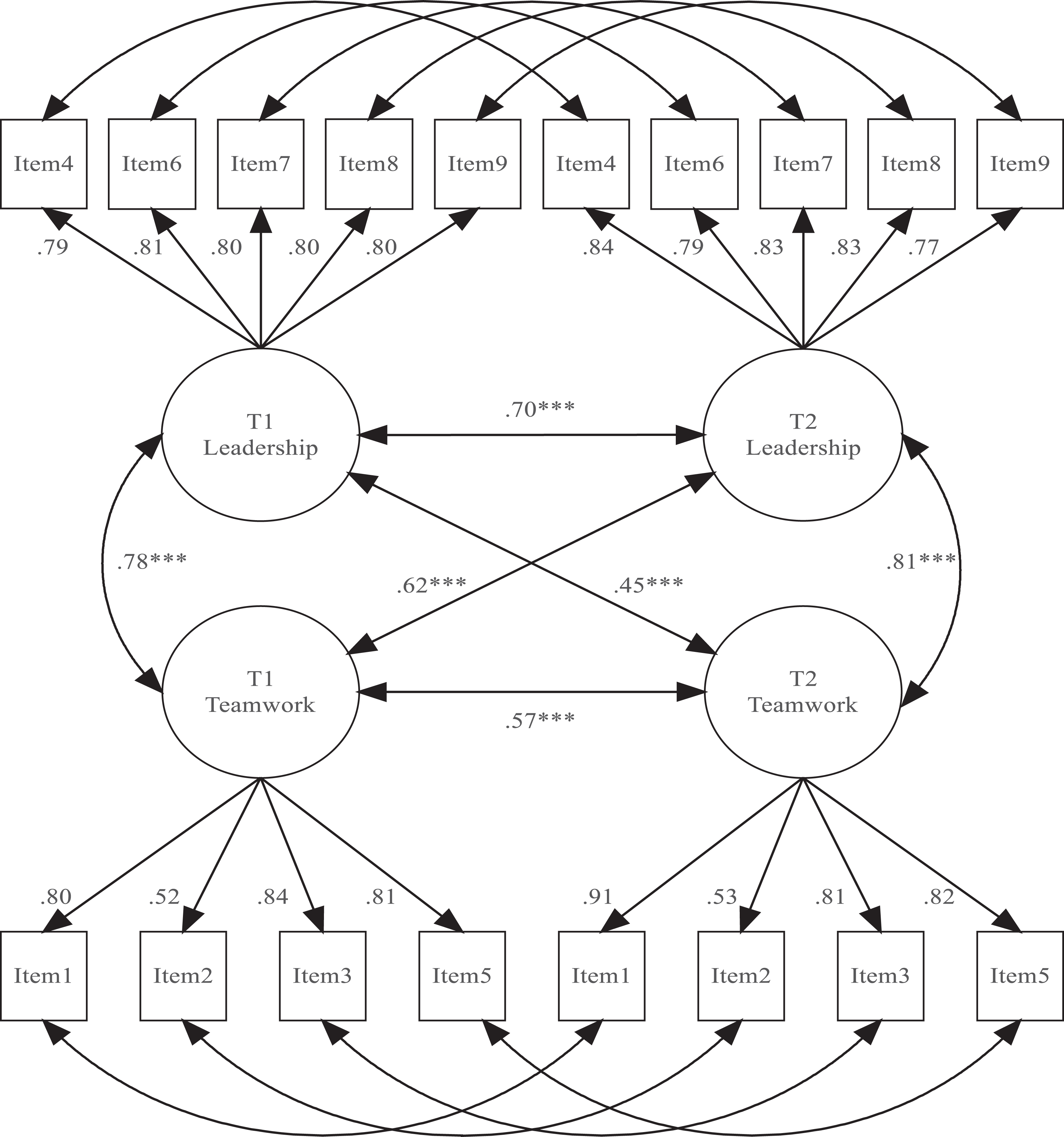
Standardized factor loadings and correlation coefficients for the two-factor longitudinal confirmatory factor analysis model. All factor loadings were significant at p < .001; T = time. ***p < .001.
Latent Mean Differences
Having established strong invariance of the LTSES, we proceeded to test for mean differences between the T1 and T2 constructs. Parameter estimates from the strong invariance model were used as the bases for these tests. Given that the latent means were fixed to 0 in the T1 group and freely estimated in the T2 group, the latent means for the T2 group represent mean differences. Results revealed significant T2–T1 differences for teamwork (estimate = .31, p < .001) and leadership (estimate = .28, p < .001), thus supporting Hypothesis 3. We computed Cohen’s d (Cohen, 1988) effect sizes for the mean differences using the pooled SDs of the factors. Pooled SDs were computed using the formula
Correlation Analysis
Although we did not propose any hypotheses regarding the time-related associations of the teamwork and leadership factors, we examined within- and between-factor correlations to assess the degree of stability and change in their relationships. Results of the within-factor analyses indicated a high degree of stability in leadership perceptions from T1 to T2 (r = .70, p < .001), but this relationship was slightly weaker for teamwork (r = .57, p < .001). Results of the between-factor analysis suggested that participants who perceived themselves to be effective team members at T1 were highly likely to perceive themselves to be good leaders at T2 (r = .62, p < .001). The reverse relationship was slightly weaker: Participants who perceived themselves to be good leaders at T1 showed a modest tendency to perceive themselves as good team members at T2 (r = .45, p < .001).
Discussion
The complex nature of the societal grand challenges and associated scientific challenges currently facing the global workforce has necessitated a greater reliance on team-based interdisciplinary research. There exists a large body of literature on the importance of group work in vocational settings such as business and industry, but little research has focused on group work conducted in scientific settings (Hall et al., 2018). This is unfortunate because understanding how to navigate team situations will be an important skill for future STEM professionals as they move forward in their careers. The current study broadly aimed to understand how to measure group dynamics that are integral to team science by exploring the longitudinal factor structure of the LTSES.
A longitudinal EFA of the LTSES revealed two factors the scale purports to measure—teamwork and leadership. All factor loadings from this analysis exceeded .50, and the items demonstrated excellent test–retest reliability. The two-factor model appeared to maintain a stable pattern of factor loadings across time as the items that loaded on the teamwork and leadership factors at T1 loaded on the same factors at T2. This pattern of factor loadings was confirmed in a subsequent analysis, as a test of configural invariance suggested the 9-item model provided a good fit to the data in both the T1 and T2 groups. Additional tests indicated that both the factor loadings and indicator intercepts were found to be invariant, thus supporting our hypothesis that the leadership and teamwork constructs would be comparable across time (i.e., exhibit strong invariance).
The hypothesis that the means of the latent constructs would differ significantly across time was also supported. Our findings indicated that there was a slightly larger increase in participants’ perceptions of teamwork self-efficacy as compared to leadership self-efficacy. The relative magnitude of these differences can perhaps be explained in terms of the degree of teamwork and leadership tasks the participants were exposed to during the program. All of the participants performed tasks and assumed roles that contributed to the overarching aims of the entire group and the specific aims of the research project teams. Examples of cooperative tasks included assisting other participants in learning scientific concepts, performing technical and data analytic procedures, and providing social support and encouragement when necessary. Every participant engaged in some form of teamwork but not all participants assumed leadership roles, as they were either assigned at the outset of the program by the group members themselves or they were adopted over time by participants with natural leadership interests. Leadership emerges in dynamic group settings naturally rather than in a way that is imposed by others.
The differential growth in teamwork and leadership self-efficacy that was observed in the current study may be explained from the perspective of Bandura’s (1997) four sources of self-efficacy: (a) performance accomplishments, (b) vicarious learning, (c) social persuasion, and (d) physiological arousal. Whereas all of these social cognitive inputs likely shaped participants’ teamwork self-efficacy, those who did not assume the role of leader (or did not perceive themselves to be in a leadership role) would not have benefited from the positive performance feedback that would have followed leadership mastery experiences. People may be persuaded by others to believe they have leadership skills and they may learn from observing others in leadership roles, but neither of these inputs can be substituted for actual mastery experiences, which represent the most influential source of efficacy information (Bandura, 1997).
The results of the latent correlation analyses revealed several interesting findings. The correlations for teamwork and leadership self-efficacy across measurement occasions were positive and robust; however, the T1–T2 correlation for leadership self-efficacy was slightly stronger than the corresponding correlation for teamwork self-efficacy. Higher across-time correlations among latent variables are reflective of trait-like constructs (Steyer et al., 1992, 1999), thus leadership self-efficacy may represent more of a stable individual difference, whereas teamwork self-efficacy may be more subject to the influence of situational factors. Indeed, studies have consistently shown that leadership is linked to the five-factor model traits of extroversion, openness to experience, and conscientiousness (e.g., Judge et al., 2002). In future research, it would be interesting to investigate whether the gradual acquisition of leadership self-efficacy among adolescents contributes to the formation of enterprising interests given that this vocational interest type is characterized by gregariousness, self-confidence, and ability to persuade and/or direct others (Holland, 1997).
Our results indicated that there was a modest positive correlation between T1 leadership self-efficacy and T2 teamwork self-efficacy, whereas the correlation between T1 teamwork self-efficacy and T2 leadership self-efficacy was slightly stronger. Students who believed they possessed the skills to function effectively as leaders at the beginning of the program were somewhat likely to hold efficacy perceptions regarding their teamwork ability at the conclusion of the program. This may be explained in part by the trait perspective of leadership described above: Students who find that they have a natural proclivity for and interest in leadership may find it difficult to later transition to the role of team member, perhaps because it requires them to subordinate themselves to the needs and goals of others in the group. In the current study, some students may have found it challenging to shift from directing and organizing their research project groups to taking direction from other peers as the program progressed. In contrast, participants who held strong teamwork efficacy beliefs at T1 were relatively more likely to feel strong leadership efficacy beliefs at T2. Thus, while our findings suggest that leadership self-efficacy possesses the stability of a trait-like construct, it also appears to be a malleable in that it is capable of being developed.
Self-efficacy as a team member may be an important antecedent of leadership self-efficacy because it affords a degree of competence beliefs for rudimentary interpersonal tasks that can be built upon when later assuming positions of greater responsibility. This developmental sequence allows people to benefit from reinforcement that results from encouraging and supporting one’s team members while affording them the opportunity to learn vicariously from other leaders without being burdened by the perceived pressure and anxiety associated with being in a leadership position. This may have been a pattern shared by participants who perceived themselves to be more efficacious as team members than as team leaders at T1.
There are several notable limitations to the current study that should be mentioned. First, we cannot make any definitive claims as to the underlying cause of growth in the self-efficacy constructs. The energy science intervention is a likely source of this change, but it may be that students’ efficacy perceptions grew naturally over time. This would need to be explored further using an experimental design in which an intervention group is compared to a control group. Second, the sample was somewhat small by latent variable modeling standards, thus the extent to which we can generalize our findings to the population of adolescents interested in energy science is somewhat limited. Despite this, the models estimated in the current study were all found to fit the data very well, which speak to the impressive psychometric properties (i.e., excellent reliability, high factor loadings) of the LTSES. Finally, the current study was limited in terms of the range of validity analyses performed. We explored the longitudinal factor structure and test–retest reliability of the LTSES, but additional research is needed to examine the scale’s convergent and discriminant validity as well.
Practical Implications and Conclusions
The current findings hold important practical implications for career assessment and intervention. From a person–environment fit perspective, school counselors may use the LTSES as a type of career exploration tool by helping high school students to better understand the growth and/or stability of their interpersonal efficacy beliefs across time and STEM learning situations. Because the LTSES was originally validated on a sample of graduate and undergraduate students (Chemers et al., 2011), vocational psychologists working in university counseling centers might also consider using the tool for similar purposes among college students who are either majoring in, or are considering majoring in, a STEM discipline.
In sum, the LTSES appears to be a concise and effective tool for measuring teamwork and leadership self-efficacy among adolescents in an informal academic learning program. Our findings suggest that this measure maintains a two-factor structure over time and exhibits evidence of structural noninvariance as the means of the latent constructs increased significantly over the course of the energy science intervention. This speaks to the psychometric strength of the scale but also highlights its capacity to detect changes in contexts in which it is implemented. Secondarily, the energy science program that served as a contextual backdrop for the current study appeared to meet its objective in facilitating students’ perceptions as efficacious contributors to their groups’ performances. However, a more controlled study would be needed to determine whether growth in these forms of self-efficacy can be attributed to the intervention or simply to chance. An important next step would also be to assess the psychometric properties of the LTSES in other settings. Given the importance of teamwork and leadership in adult vocational settings (e.g., management), it seems that this tool would be useful for researchers and practitioners in these areas as well.
Footnotes
Authors’ Note
Any opinions, findings, and conclusions or recommendations expressed in this article are those of the authors and do not necessarily reflect National Science Foundation views.
Acknowledgments
The authors would like to thank Maureen McCann of Purdue University for her constant encouragement throughout the study and Tolulope Omotoso, Vivien Lai, and Gerald Krockover for their support in the program.
Declaration of Conflicting Interests
The author(s) declared no potential conflicts of interest with respect to the research, authorship, and/or publication of this article.
Funding
The author(s) disclosed receipt of the following financial support for the research, authorship, and/or publication of this article: The Energy Academy was supported by the Purdue University Energy Center, ArcelorMittal, Bowen Energy, Consumers Energy, General Electric, Tipmont REMC, and Siemens Technologies. This research was supported by grants from the Duke Energy Foundation, U.S. Office of Naval Research (N00014-18-1-2397), and National Science Foundation (DRL-1721054).
