



Abstract
The present study examined the relationships between vocational interests, personal styles, and subjective well-being (SWB) using the Strong Interest Inventory (SII) among 4,945 working adults across eight occupational samples, including administrative assistant, realtor, elementary schoolteacher, sales manager, graphic designer, attorney, automobile mechanic, and a science, technology, engineering, and mathematics field composite. Regression analyses demonstrated that the General Occupational Themes (GOTs) and Personal Style Scales (PSSs) each explained significant and independent variance in SWB. Occupation-specific hypotheses for GOTs and PSSs were also supported for four of the eight occupations. This study enhances the understanding of the contribution of interests to life satisfaction and provides further validation for the 2005 SII, specifically the newest PSS, Team Orientation. Future research, theory, and practice implications are also discussed.
Keywords
Work is a central domain in a person’s life (Blustein, 2006) and provides individuals with a sense of purpose and meaning (Diener, 1984). Satisfaction with one’s career can also contribute to an increase in subjective well-being (SWB; Gottfredson & Duffy, 2008). SWB is conceptualized as a cognitive interpretation of overall life satisfaction as well as an emotional component of elevated positive affect and absence of negative affect (Diener, 1984). Likewise, dissatisfaction with one’s career can negatively impact overall SWB (Gottfredson & Duffy, 2008). The current study aimed to advance the knowledge of SWB in relation to career styles as operationalized by the Personal Style Scales (PSSs) of the 2005 Strong Interest Inventory (SII; Donnay, Morris, Schaubhut, & Thompson, 2005). The study also examined the contribution of career styles above and beyond vocational interests organized by Holland’s (1997) six RIASEC types: Realistic, Investigative, Artistic, Social, Enterprising, and Conventional.
Although a large literature base examines SWB, including its relation to age (Latten, 1989), gender (Kahneman & Krueger, 2006), ethnicity (Diener, Sandvik, Seidlitz, & Diener, 1993), and personality traits (Diener, 1996; Jovanovic, 2011), few studies have connected SWB with career-related constructs. The present study begins to address this gap by investigating how scales of the SII related to a composite measure of SWB consisting of life satisfaction and happiness. Life satisfaction is considered a cognitive-based, global evaluation of how satisfied an individual is with his or her life, whereas happiness is commonly defined as a subjective, positive mood-state related to how an individual affectively perceives the world (Diener, 1984). Myers and Diener (1995) stated that individuals with high SWB have a cognitive consideration of their global sense of satisfaction with life plus an affective component of pleasant emotions and appraisal of events. Those with low SWB view their lives as undesirable and can experience negative emotions such as depression or anger. Cotter and Fouad (2011) linked positive and vocational psychology by examining connections between SWB and Holland’s RIASEC types, focusing on the Enterprising and Social, and found no significant correlations between the types and SWB.
SWB has been studied in relation to numerous work-related constructs. Russell (2008) highlighted the impact of SWB on such constructs as job satisfaction, work performance, and work outcomes but also discussed the impact of work performance on SWB. Tait, Padgett, and Baldwin (1989) found a positive relationship between SWB and job satisfaction, and Judge and Locke (1993) provided evidence for the presence of a reciprocal relationship, asserting that individuals with a higher level of SWB collected and recalled information about their job and level of satisfaction differently from those with a lower level of SWB. In terms of work performance, Spector (1997) found that individuals with a higher level of SWB tended to be more cooperative and helpful in their occupation, managed their time more efficiently, and demonstrated less absenteeism.
SWB has been conceptualized in relation to multiple career theories but has resonated most strongly with the person–environment fit theories (Dawis & Lofquist, 1984; Holland, 1997). When an individual enters an occupation whose characteristics closely match the individual’s, congruence occurs between the person and his or her environment, increasing the level of satisfaction felt with the occupational choice and his or her SWB (Gottfredson & Duffy, 2008). Likewise, when an individual’s abilities and values match a work environment’s requirements and reinforcers, there is higher correspondence between the two, increasing work satisfaction and SWB.
The SII (Donnay et al., 2005) is the most commonly utilized measure of vocational interests and frequently the measure of choice by practitioners for career counseling interventions. The General Occupational Themes (GOTs) were added to the SII in 1974 as an empirical representation of Holland’s (1997) six RIASEC personality types and occupational environments (Donnay, 1997): Realistic, Investigative, Artistic, Social, Enterprising, and Conventional. First incorporated into the 1994 revision of the SII, the PSSs included four empirically derived scales, one of which adapted the discontinued Adventure Basic Interest Scale (BIS): the Work Style, Learning Environment, Leadership Style, and Risk Taking/Adventure Scales (Donnay, 1997). The PSSs sought to connect vocational interests with personality by measuring broad dimensions of living and working (Harmon, Hansen, Borgen, & Hammer, 1994). During the 2005 revision of the SII, a fifth PSS, the Team Orientation Scale, was added while the Risk Taking/Adventure scale was altered to the Risk Taking scale, intended to incorporate various types of risk taking aside from physical risks (Donnay et al., 2005). The PSSs are intended to encourage individuals to explore the way they learn, work, play, or live, in relation to their work environments or interactions with others in general.
The PSSs are bipolar scales that demonstrate a preference at each pole for a specific personal style (Donnay et al., 2005). The Work Style Scale focuses on an individual’s interaction style in a work setting by distinguishing between individuals who prefer working with ideas, data, or things, from those who prefer working with people. The Learning Environment Scale indicates an individual’s preference for an academic learning environment as opposed to a more practical environment. The Leadership Style Scale focuses on the differentiation between those who prefer meeting, directing, or leading others, and those who prefer completing tasks themselves rather than directing another to do so. The Risk Taking Scale distinguishes between individuals who demonstrate a willingness to take risks and be spontaneous, and those who prefer to avoid risk and maximize personal safety. When conceptualizing the term risk, the Risk Taking scale includes various types of risk other than physical, such as financial or social risks. Finally, the Team Orientation Scale indicates an individual’s preference for team-based activities as opposed to individual activities. Although the PSSs have been studied in relation to career constructs (Lindley & Borgen, 2000), the present study was the first to link the PSSs to SWB.
In determining the hypothesized significant relationships between the PSSs and SWB for the eight occupations, the current study was informed by reviewing the SII Technical Manual (Donnay et al., 2005) and the given numerical values for Work Activities, Education, Work Values, and Work Style on the O*NET (U.S. Department of Labor, 2012). The O*NET is an online database that provides information on hundreds of occupations gathered through the O*NET Data Collection Program, initiated in June 2001. Workers from randomly selected businesses encompassing a broad range of occupations completed rating scales regarding the importance of work activities and values, which were then presented as numerical values between 0 and 100 on the O*NET website (U.S. Department of Labor, 2012). Hypothesized PSSs were determined by examining reported correlations between an occupation’s GOT and the five PSSs from the SII Technical Manual and reviewing the level of work activities, values, or style present in the O*NET description. A specific PSS was hypothesized to have a positive or negative relationship with SWB within an occupation if the corresponding O*NET item was in the top or bottom quartile.
Objectives and Hypotheses
The purpose of this study was to expand the interface between vocational and positive psychology by exploring career styles, vocational interests, and SWB. Although previous research was conducted on the relationship between vocational interests and SWB (Cotter & Fouad, 2011), this study was the first to examine career styles operationalized with the PSSs and their relationship with SWB. Due to the recent addition of these scales to the SII, another purpose of this study was to examine the validity of the PSSs.
Since this was the first study to examine relationships between the included constructs, it was important also to examine how the GOTs relate to SWB due to their foundational core within the literature and their ability to supply important information regarding person–environment fit. After determining the overall relationship between the GOTs and SWB, the present study examined whether the PSSs add incremental variance to SWB above and beyond that of the GOTs, including the GOTs first to provide more direct information regarding interests and SWB, and then adding in the PSSs to explore the possible relationship between an individuals’ personal and career styles and SWB.
Eight occupations that represent each of the six GOTs, five PSSs, and varying requisite levels of education were included. As the first study to include both GOTs and PSSs in relation to SWB, the eight occupations demonstrate prominent GOTs to create a research foundation utilizing more pure interest representations involving only one- or two-letter Holland codes based on the SII. These occupations also allow for the inclusion of hypotheses related to all five PSSs. Due to the surge of support in the past decade to increase student interest, specifically among women, in the male-dominated science, technology, engineering, and mathematics (STEM) fields, we included a STEM field composite consisting of computer scientist, civil engineer, and mathematician occupational samples. These occupations were combined due to the low sample sizes for the individual occupations. The eight occupations are: administrative assistant, STEM field composite, realtor, elementary schoolteacher, sales manager, graphic designer, attorney, and automobile mechanic.
Hypothesized GOT and PSS predictors of SWB for each occupation are listed in Tables 1 and 2, respectively. General hypotheses are: The GOT codes explain a significant portion of the variance in SWB; the PSSs explain a significant portion of the variance in SWB; and the use of a model utilizing GOTs and PSSs explains significantly more variance in SWB above and beyond the use of GOTs alone. Since previous studies demonstrated relationships between demographic variables and SWB, gender, age, and years in occupation are included in the first block of analyses for each hypothesis to investigate possible relationships with SWB.
Hypothesized General Occupational Theme Scale Predictors of Subjective Well-Being.
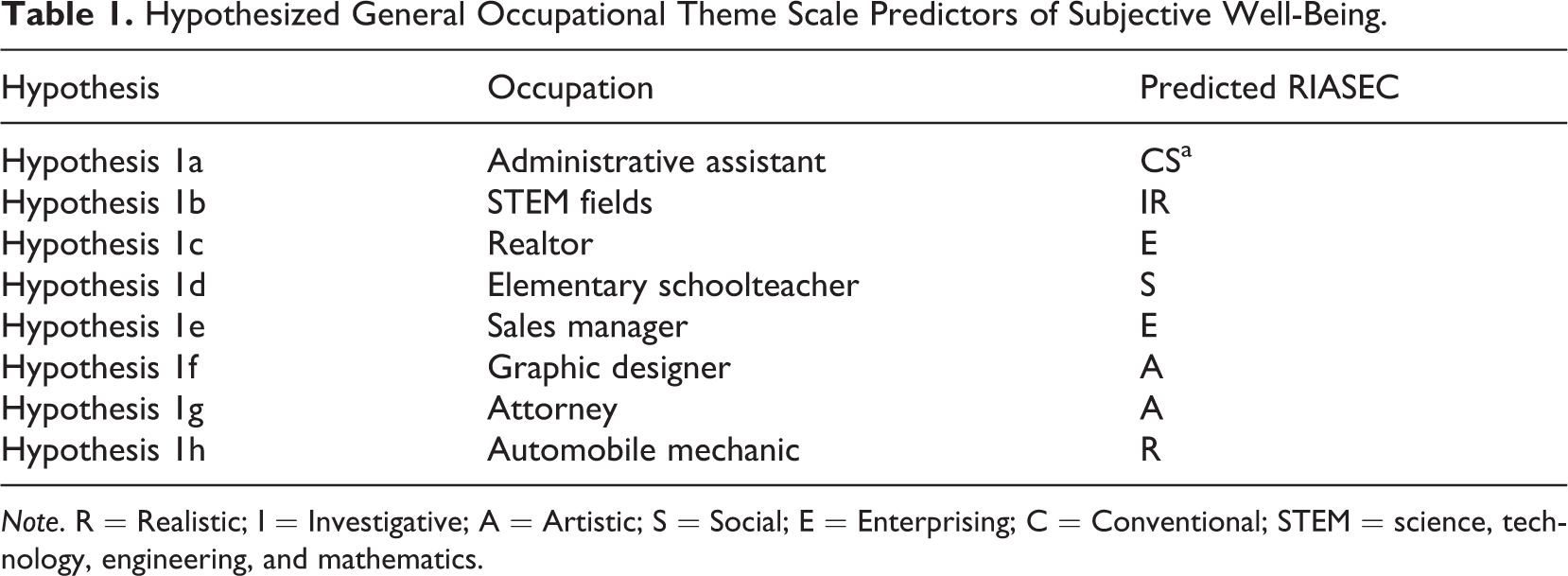
Note. R = Realistic; I = Investigative; A = Artistic; S = Social; E = Enterprising; C = Conventional; STEM = science, technology, engineering, and mathematics.
Hypothesized Personal Style Scale Predictors of Subjective Well-Being.
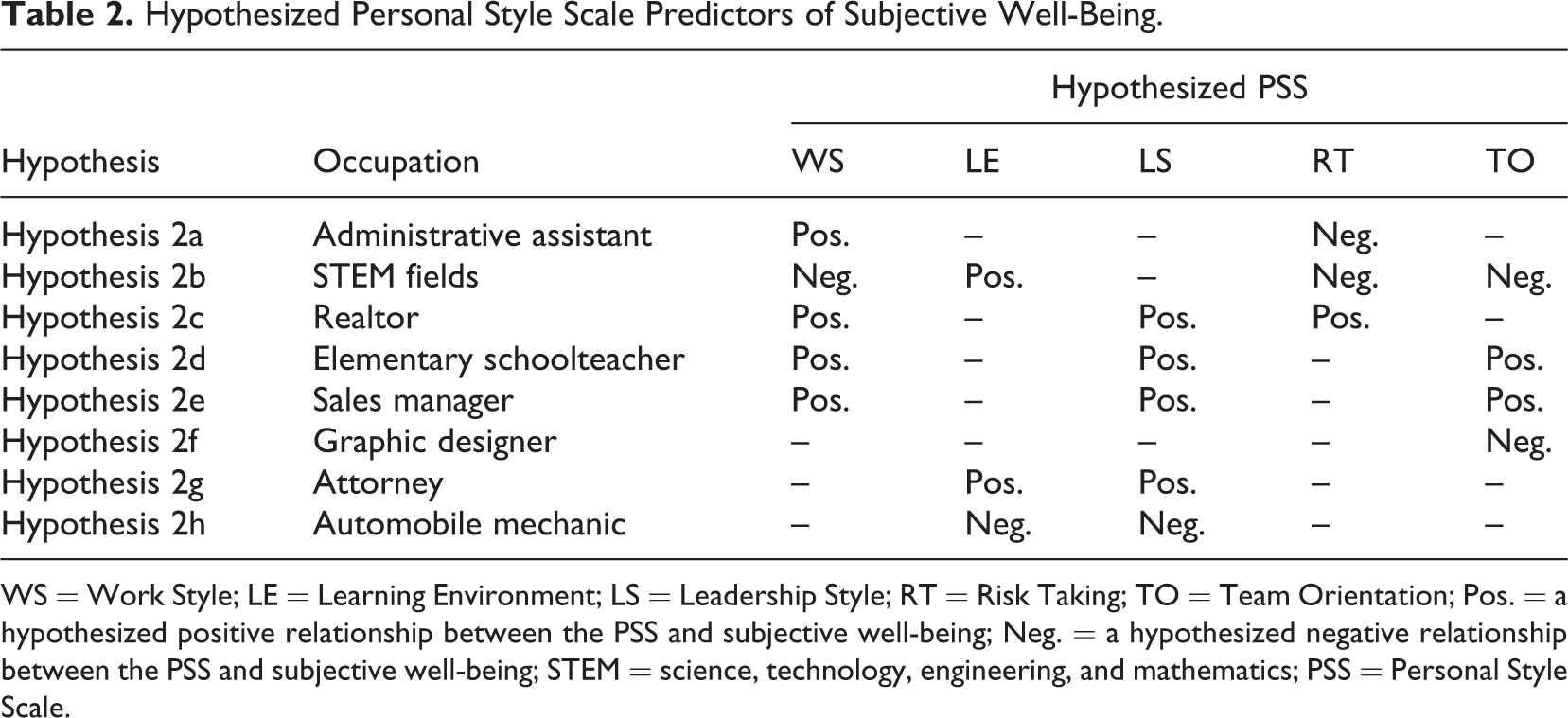
WS = Work Style; LE = Learning Environment; LS = Leadership Style; RT = Risk Taking; TO = Team Orientation; Pos. = a hypothesized positive relationship between the PSS and subjective well-being; Neg. = a hypothesized negative relationship between the PSS and subjective well-being; STEM = science, technology, engineering, and mathematics; PSS = Personal Style Scale.
Method
Participants
The present study utilized data from people who took the 2005 SII on the SkillsOne website (https://www.skillsone.com/), managed by CPP, Inc. The dataset provides information on a broad sample of working adults with various work experiences. The sample included 5204 (3790 women and 1415 men) adults employed in eight occupational categories who completed the SII between May 2008 and May 2012. These occupations were administrative assistant, a STEM field composite consisting of computer scientist, civil engineer, and mathematician, realtor, elementary schoolteacher, sales manager, graphic designer, attorney, and automobile mechanic. The sample included 274 Asian or Pacific Islanders, 254 African Americans, 3514 Caucasian Americans, 32 Indian, 506 Hispanic/Latino(a) Americans, 382 Native Americans, 51 Middle Eastern, and 107 reporting Other. See Table 3 for demographic information listed by occupation.
Demographic Data for Eight Independent Occupational Samples.

Note. AA = African American/Black; NA = Native American; API = Asian or Pacific Islander; W = White/Caucasian; I = Indian; L = Latina/Latino; ME = Middle Eastern; O = other; YIO = years in occupation; STEM = science, technology, engineering, and mathematics.
aParticipants could select more than one racial/ethnic group, therefore the numbers may not equal 100%. bStandard deviations are in parentheses for age and years in the occupation.
Measures
Strong Interest Inventory
The Strong Interest Inventory (SII; Donnay et al., 2005) assesses vocational interests and was designed to identify satisfying occupations. The SII provides information on various aspects of an individual’s vocational interests and personal style, and includes measures of six General Occupational Themes (GOTs), 30 Basic Interest Scales (BISs), 122 Occupational Scales (OSs), and five Personal Style Scales (PSSs).
The GOTs were added to the SII in 1974 and have Cronbach’s αs ranging from .90 to .95, and test–retest reliability ranging from .84 to .89 for a 2–7 month period (Donnay et al., 2005). Concurrent validity was found for differentiating college majors for men and women (Gasser, Larson, & Borgen, 2007), and predictive validity for job satisfaction (Rottinghaus, Hees, & Conrath, 2009).
The PSSs were first added to the SII in 1994 and updated in 2005 to include the current five scales of Work Style, Learning Environment, Leadership Style, Risk Taking, and Team Orientation (Donnay et al., 2005). The PSSs utilize a bipolar scale that demonstrates a distinct preference at each pole for the personal style in terms of work or educational settings and broader life experiences. The scales have a mean of 50, with scores between 45 and 55 indicating no preference for either pole. Scores falling either above 55 or below 45 demonstrate a significant preference toward the given pole. A higher score on the Work Style Scale indicates a preference for working with people versus data, things, and ideas. A higher score on the Learning Environment Scale indicates preferring academics, lectures and reading to learn as opposed to learning by doing. Higher Leadership Style Scale scores indicate being more comfortable taking charge and directing others, whereas lower scores reflect leading by example. Higher scores on the Risk Taking Scale indicate a preference toward risks, taking chances, and original ideas versus playing it safe. Finally, a higher score on the Team Orientation Scale relates to a preference for working on teams and collaborating with others instead of working independently. Donnay, Morris, Schaubhut, and Thompson (2005) reported Cronbach’s αs ranging from .82 to .87 for the five PSSs and test–retest reliability, ranging from .77 to .90 for a 2- to 7-month period, and .70 to .91 for an 8- to 23-month period. The Work Style, Learning Environment, Leadership Style, and Risk Taking Scales have evidence of predictive validity for college major (Miller, 2010), career satisfaction (Hees, 2010), and occupational choice (Donnay & Borgen, 1996), and concurrent validity with the MBTI (Tuel, 1997), whereas only limited research has been conducted on the recently constructed Team Orientation Scale. Hees (2010) reported predictive validity of Team Orientation with career satisfaction.
Subjective Well-Being
Using the SkillsOne website, respondents answer 2 separate items relating to life satisfaction and level of happiness. The life satisfaction item “All things considered, how satisfied are you with your life as a whole these days?” uses a 10-point scale, ranging from 1 (Completely Dissatisfied) to 10 (Completely Satisfied). A separate level of happiness item “Taking all things together, would you say you are …?” uses a 4-point scale, ranging from 1 (Not at all happy) to 4 (Very happy) (Donnay et al., 2005). Test–retest reliability for single-item measures of SWB components ranged from .40 to .66 (Diener, 1984). To create an overall composite measure of SWB, the life satisfaction and happiness items were combined as a way of incorporating both the cognitive and affective components of SWB. Since the single items are scaled on differing ranges, prior to creating the composite measure, the items were standardized into z-scores, then summed and averaged to create an overall measure of SWB. The utilization of single-item satisfaction measures is present in SII research studies (Hoeglund & Hansen, 1999; Rottinghaus et al., 2009), and Wanous, Reichers, and Hudy (1997) concluded that due to the straightforward nature of the related construct of job satisfaction, single-item measures can be considered comparable to longer scales. Moreover, Pavot and Diener (1993) noted that the use of single-item SWB measures offers temporal reliability, with multiple-item measures providing increased reliability. The current study strengthened upon the single-item approach by utilizing a composite measure of both life satisfaction and happiness.
Data Analyses
A series of linear regressions were conducted separately for each occupational group to examine the independent and joint contribution of the GOT and PSS variables on SWB. For each analysis, demographic variables of age, gender, and years in the occupation were included as the first block of analyses and then built upon by adding the GOTs or PSSs. The following GOT predictor variables were used: Realistic, Investigative, Artistic, Social, Enterprising, and Conventional code scores in order to determine possible relationships present other than those hypothesized. In order to examine the PSS hypotheses, the following predictor variables were used: Work Style, Learning Environment, Leadership Style, Risk Taking, and Team Orientation scores in order to determine possible relationships present other than those hypothesized. Hierarchical regressions broken down by each occupational group were also completed to determine whether the PSSs contributed unique variance to SWB for each occupation.
Results
The entire dataset were sorted by occupational category and analyzed as a way to compare differences in means and standard deviations between occupations. SWB means among occupational samples ranged from −.295 to .272. Attorney demonstrated the lowest mean SWB (−.295), followed by realtor (−.258), automobile mechanic (−.095), and graphic designer (−.051). Sales manager demonstrated the highest mean SWB (.272) followed by elementary schoolteacher (.178), STEM fields (.096), and administrative assistant (.012). 1
A summary of significant regression results predicting SWB from GOTs for each occupation is provided in Table 4. Specific significant results based on each GOT per occupation are provided herein. 2 For administrative assistant, there was a significant positive relationship between SWB and the Social GOT, t(2379) = 5.219, p < .001, rp = .106, Enterprising GOT, t(2379) = 2.183, p = .029, rp = .045, and Conventional GOT, t(2379) = 4.410, p < .001, rp = .090. There was a significant negative relationship between SWB and the Investigative GOT, t(2379) = −3.421, p = .001, rp = −.070, and Artistic GOT, t(2379) = −4.923, p < .001, rp = −.100. For elementary schoolteacher, there was a significant positive relationship between SWB and the Social GOT, t(732) = 7.935, p < .001, rp = .281. There was a significant negative relationship between SWB and the Artistic GOT, t(732) = −3.036, p = .002, rp = −.112.
Summary of Significant Multiple Regression Results for Predicting Subjective Well-Being From GOTs for All Occupations.
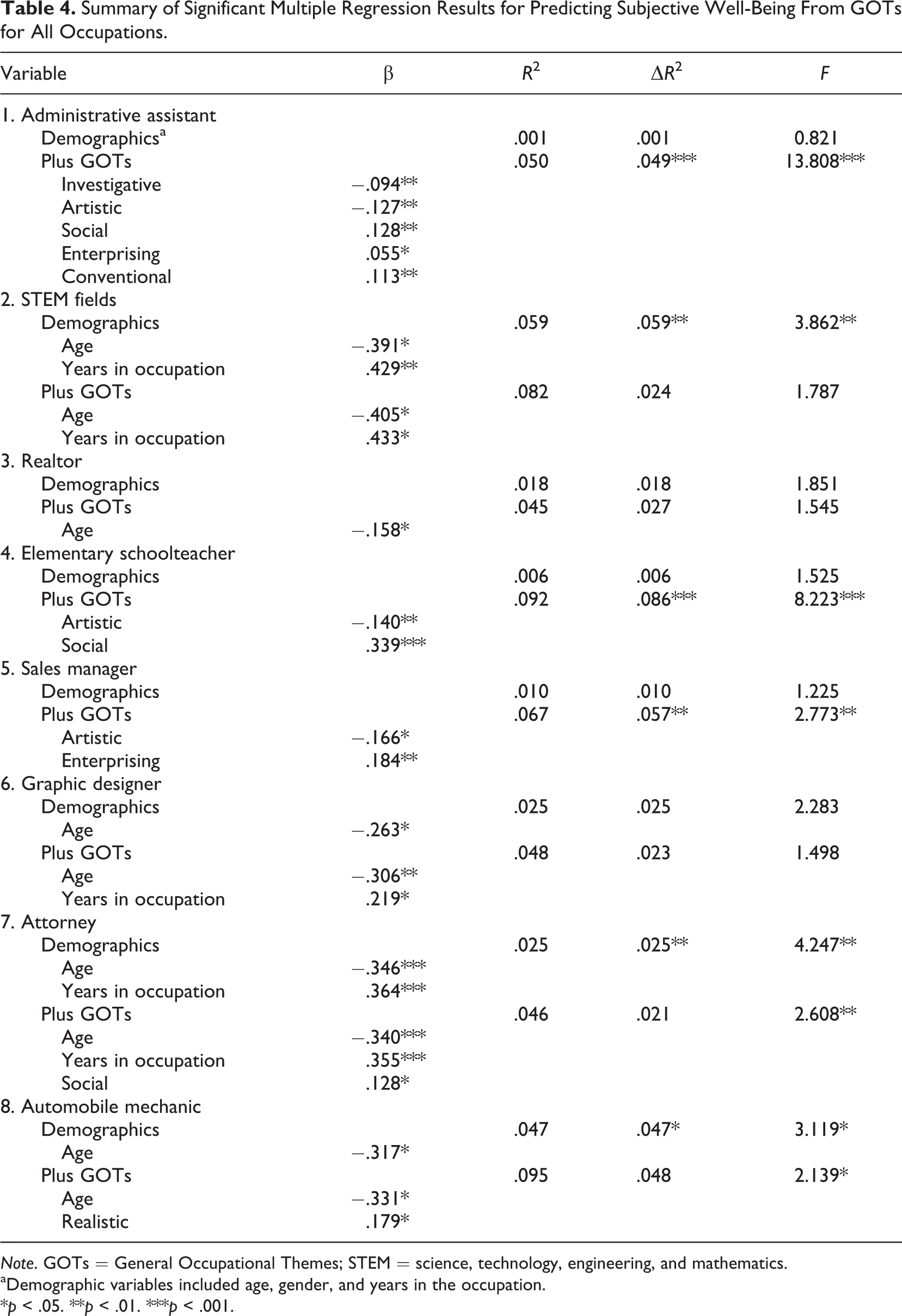
Note. GOTs = General Occupational Themes; STEM = science, technology, engineering, and mathematics.
aDemographic variables included age, gender, and years in the occupation.
*p < .05. **p < .01. ***p < .001.
In the regression for sales manager, there was a significant positive relationship between SWB and the Enterprising GOT, t(345) = 2.760, p = .006, rp = .147. There was a significant negative relationship between SWB and the Artistic GOT, t(732) = −2.398, p = .017, rp = −.128. For attorney, there was a significant positive relationship between SWB and the Social GOT, t(485) = 2.512, p = .012, rp = .113. For automobile mechanic, there was a significant positive relationship between SWB and the Realistic GOT, t(184) = 2.101, p = .037, rp = .153. There were no significant GOT results for the STEM fields, realtor, or graphic designer occupations.
A summary of significant regression results predicting SWB from PSSs for each occupation is provided in Table 5. As with the GOTs, specific significant results for PSSs are provided herein. 3 For administrative assistant, there was a significant positive relationship between SWB and the Work Style PSS, t(2380) = 3.677, p < .001, rp = .075, Leadership Style PSS, t(2380) = 2.695, p = .007, rp = .055, and Team Orientation PSS, t(2380) = 4.346, p < .001, rp = .089. There was a significant negative relationship between SWB and the Learning Environment PSS, t(2380) = −5.506, p < .001, rp = −.112.
Summary of Significant Multiple Regression Results for Predicting Subjective Well-Being From PSSs for All Occupations.

Note. PSS = Personal Style Scale; STEM = science, technology, engineering, and mathematics.
aDemographics included age, gender, and years in the occupation.
*p < .05. **p < .01. ***p < .001.
For the STEM fields, there was a significant positive relationship between SWB and the Leadership Style PSS, t(180) = 2.346, p = .020, rp = .172. In the regression for elementary schoolteacher, there was a significant positive relationship between SWB and the Work Style PSS, t(733) = 6.576, p < .001, rp = .236. For attorney, there was a significant positive relationship between SWB and the Leadership Style PSS, t(486) = 2.874, p = .004, rp = .129. For automobile mechanic, there was a significant negative relationship between SWB and the Learning Environment PSS, t(185) = −1.978, p = .049, rp = −.144. There were no significant PSS results for the realtor, sales manager, or graphic designer occupations.
A summary of significant hierarchical regression results predicting incremental variance in SWB of the PSSs above and beyond the GOTs is provided in Table 6. In the sample as a whole, the GOTs above the demographic variables accounted for a significant amount of variance in SWB, ΔR 2 = .037, ΔF(6, 4935) = 31.927, p < .001, and the model was significantly improved after adding the PSSs, ΔR 2 = .015, ΔF(5, 4930) = 15.260, p < .001. As noted in Table 6, the PSSs added incremental variance for the administrative assistant, sales manager, graphic designer, and attorney occupational samples.
Summary of Significant Hierarchical Regression Results for Predicting Subjective Well-Being From GOTs and PSSs for All Occupations.

Note. GOTs = General Occupational Themes; PSSs = Personal Style Scales; STEM = science, technology, engineering, and mathematics.
aDemographics included age, gender, and years in the occupation.
*p < .05. **p < .01. ***p < .001.
Overall, the GOTs accounted for a significant amount of variance in SWB in five of the eight occupational samples. Results demonstrate that participants with GOT types more dissimilar from their occupational choice reported lower scores on SWB (e.g., Artistic and Investigative GOTs for administrative assistant; Artistic GOT for sales manager), whereas significant, positive GOT results demonstrated that individuals whose vocational interests better match their occupation (e.g., Social GOT and elementary schoolteacher; Realistic GOT and automobile mechanic; Enterprising GOT and sales manager) reported higher SWB scores.
The PSSs also accounted for a significant amount of variance in SWB in the entire sample and five of the eight occupational samples. However, it should be acknowledged that due to the much larger sample size for administrative assistant as compared to all other included occupations, the entire sample regression results for both the GOTs and PSSs were driven by the size of this occupational sample. Additionally, due to the large size of the overall sample, p levels are only used as descriptors for the results as opposed to evidence of significant relationships.
When the GOTs and PSSs were examined hierarchically, the PSSs added a significant amount of incremental variance to SWB above and beyond the GOTs and demographic variables in the entire sample and four of the eight occupational samples. In the STEM field and attorney hierarchical regressions, there were significant relationships between the PSSs and SWB, with no significant relationships between the GOTs and SWB. Multicollinearity was more prevalent in the hierarchical regressions due to the inclusion of both GOTs and PSSs, with graphic designer and automobile mechanic having high VIFs for 10 variables.
Discussion
The present study included several goals for enhancing the understanding of the empirical interface between vocational psychology and positive psychology. By exploring major constructs from each field—vocational interests, personal styles, and SWB—this study was the first to connect career styles operationalized as the PSSs of the SII with SWB. The findings of the present study yield multiple implications for career theory and practice, including additional validation of the 2005 SII scales and increased understanding of how individual differences and other career factors can relate to SWB. Overall, this study provides additional support for the importance of matching an individual’s characteristics to his or her work environment and for the newest PSS, Team Orientation.
Results replicated previous validity research and theory while demonstrating the incremental utility of including the PSSs. The GOTs explained a significant portion of variance in SWB and the PSSs explained incremental variance in SWB, at times contributing variance to SWB when the GOTs did not. The demographic variables of age and years in the occupation also contributed variance to SWB in multiple occupational samples.
The GOT hypotheses for four of the eight occupational samples were supported (administrative assistant, elementary schoolteacher, sales manager, and automobile mechanic), with additional significant relationships also present. These results are consistent with person–environment theories (Dawis & Lofquist, 1984; Holland, 1997), and add additional evidence for the importance of matching an individual’s interests and environmental characteristics, contributing to overall well-being. In the administrative assistant sample, the additional significant relationships for Enterprising, Artistic, and Investigative were likely a result of the large sample size present. Of the remaining four occupations, STEM fields, realtor, and graphic designer demonstrated no significant relationships between the GOTs and SWB. There was a positive relationship between the Social GOT and SWB in the attorney sample. Although this result is inconsistent with the hypothesized GOT (Artistic), it makes theoretical sense, as attorneys commonly work with people, and Social is adjacent to Artistic in Holland’s hexagon.
The PSS hypotheses for four of the eight occupational samples were partially supported (administrative assistant, elementary schoolteacher, attorney, and automobile mechanic). Of the remaining four occupations, realtor, sales manager, and graphic designer demonstrated no significant relationships between the PSSs and SWB. In the STEM fields, those who prefer directing others (high Leadership Style PSS) demonstrated a higher level of SWB. This result seems counterintuitive in that STEM fields are typically seen as autonomous occupations requiring little interaction with others, yet review of the job duties for each field indicate the presence of managing others, leading research teams, and heading innovation task forces. These results demonstrate that although a field’s characteristics may broadly define overall interests, specific job duties may affect SWB more than the broad characteristics in detailing the match between a person’s interests and their environment.
Analyses were completed for each specific occupation to determine which samples contributed to the overall incremental validity of the PSSs. Of the eight individual occupations, four showed that PSSs added a significant amount of variance. For administrative assistant sample, the PSSs added 1.7% variance, 3.1% variance was added in the sales manager occupation, 4.6% in the graphic designer sample, and 2.5% in the attorney occupational sample.
The results of the GOT and PSS regressions demonstrate that these scales account for significant variance in SWB, with GOTs and PSSs in specific occupations exhibiting positive and negative relationships with SWB. Additionally, the PSSs added incremental variance in SWB above and beyond the GOTs in the sample as a whole, and in four of the eight specific occupations. These results highlight the importance of the GOTs and PSSs to more clearly understand the relationship between individual factors and SWB within occupational samples.
The results of the present study confirm the importance of considering Holland codes when examining SWB, as well as other constructs of personal styles and demographic variables. The PSSs contributed significant variance to SWB above the GOTs, ranging from 1.3% to 4.7% across the eight occupations, and in some cases were the only factors to contribute significant variance in the hierarchical regressions, illustrating the need to examine additional factors outside Holland themes when examining SWB. The demographic variables also demonstrate the importance of considering an individual’s age and tenure in a given occupation, as these factors impacted overall SWB without consideration for vocational interests or styles in multiple occupational samples.
Overall, this study provides support for utilizing both the GOT and PSSs in considering overall SWB. As the results demonstrate, those individuals whose vocational interests and styles more closely matched those of the work environment reported higher levels of SWB, likely due to the degree of correspondence in their occupation. The PSSs also added information not encapsulated in the Holland codes for some occupations. However, other occupations did not have significantly increased variance by adding the PSSs, supporting the need to consider the GOTs and PSSs, individually and in combination, when considering overall SWB or other constructs.
The results have implications for theory, research, and practice based on the SII and SWB. This study provides support for and expands the person–environment fit theories from Holland (1997) and Dawis and Lofquist (1984), and also contributes to the budding literature base that links vocational and positive psychology by demonstrating the importance of matching a person’s interests and abilities to their work environment for overall well-being.
Although this study has broadened the research on the SII by linking the fields of vocational and positive psychology, there are still numerous research opportunities that can focus on the SII in relation to SWB. This study utilized archival data to explore individual’s personal styles in relation to SWB, and did not include additional assessments. Future researchers may benefit from having participants complete both the SII and another personality-based measure, such as the NEO-PI-3 (McCrae, Costa, & Martin, 2005), to provide additional validity evidence for the PSSs, but also more clearly understand how the PSSs relate to overarching personality traits and the impact this has on SWB. Likewise, having participants complete a multi-item measure of SWB, either by completing separate satisfaction/affect measures such as the Satisfaction With Life Scale (Diener, Emmons, Larsen, & Griffin, 1985) and the Authentic Happiness Inventory (Seligman, Steen, Park, & Peterson, 2005), or one broad measure of SWB, would provide more information to strengthen the measurement for this construct.
Since the present study was the first to explore the relationship between the PSSs and SWB, regression analyses were utilized as a determination of the presence of positive or negative relationships. It would be beneficial for future research to more closely examine these relationships by determining whether the GOTs or PSSs can discriminate between high and low levels of SWB for incumbents in specific occupations. Additionally, the current study focused on eight occupations that were shown in the SII Technical Manual to relate to specific Holland codes or PSSs. Future research should expand the scope of occupations selected to include occupations that include multiple Holland codes, as well as GOTs that are dissimilar in interests (e.g., E-I-S), in order to better explore the impact the GOTs have on SWB, and how discrepancies between codes may affect SWB.
The present study provides continued support for the importance of understanding one’s vocational interests and styles to make beneficial career decisions and in turn improve overall SWB. As the SII is commonly utilized with career counselors, results of the present study support the importance of interests organized by Holland types with the GOTs, but also the PSSs to offer a more holistic view of the individual. In this way, the person can develop increased self-awareness to be utilized when exploring occupations and better pinpoint specific job duties, values, or skills necessary in a work environment that are congruent with his or her style and will more likely provide a positive atmosphere that improves SWB.
Work is an integral aspect in life, providing both meaning and purpose that contribute to overall SWB (Diener, 1984). Individuals strive to achieve happiness by making choices and taking actions that move them toward higher SWB. By recognizing one’s work preferences, individuals can select occupations that offer the values they desire and require knowledge/duties they have, thus increasing the correspondence between the self and work environment, and increasing overall SWB (Dawis & Lofquist, 1984). Likewise, incongruence or dissatisfaction with one’s career can negatively impact SWB for individuals (Gottfredson & Duffy, 2008). This knowledge makes self-awareness even more important to allow individuals to make informed decisions to better their lives and increase SWB.
Since its inception in 1927, the SII has become a cornerstone for career-based interest inventories in and out of the career counseling room (Walsh & Betz, 2004), and speaks to the need for continued research and revisions to ensure the effectiveness of the assessment. This study supports the validity of the 2005 SII, with specific regard to the GOT and PSS. Counselors can benefit from recognizing the importance of the PSSs, in combination with the Holland codes and individually, when supporting clients toward increased congruence with their work environment and increased SWB overall. As the SII continues to be updated to reflect the ever-changing world of work, continued research will aid in further advancing the field’s understanding of SWB and its relation to vocational psychology.
Footnotes
Declaration of Conflicting Interests
The author(s) declared no potential conflicts of interest with respect to the research, authorship, and/or publication of this article.
Funding
The author(s) received no financial support for the research, authorship, and/or publication of this article.