



Abstract
This study presents a new scale to measure work values. The Work Values questionnaire (WVal) consists of 10 sets of 5 value items that respondents rank for importance. Each item expresses 1 of the 10 basic values of the Schwartz theory in the work context. Seven hundred fifty-nine employees from 94 organizations responded to the WVal. Confirmatory factor analysis (CFA) assessment of the 10 work values exhibited adequate factorial distinctiveness as well as high internal reliability. Multidimensional scaling analyses yielded a circular motivational structure of relations among the 10 work values similar to the higher order values in the basic values’ theory. We note and discuss meaningful differences in the importance of work values associated with gender, age, organizational tenure, and professional role. The study supports the applicability of the Schwartz basic value theory to the organizational setting, with some variations traceable to the work context. We discuss research possibilities and practical applications of the WVal.
Introduction
Numerous researchers have used work values to understand individual differences in organizational behavior. They have applied work values, for example, to study vocational and career choices (e.g., Judge & Bretz, 1992), job satisfaction (e.g., Kashefi, 2005), job performance (e.g., Parsons, Cable, & Wilkerson, 1999), managerial decision-making (e.g., Sharfman, Pinkston, & Sigerstad, 2000), and team climate (e.g., Knezevic & Ovsenik, 2001). Researchers argue that individuals’ work values are fundamental for managing their motivation and commitment (e.g., Kooij, Jensen, Dikkers, & de Lange, 2010) and affect the ways they relate to their organization (e.g., De Vos, Buyens, & Schalk, 2005). Moreover, much of the literature on person–organization fit conceptualizes fit as the congruence between individual values and organizational values (e.g., De Clercq, Fontaine, & Anseel, 2008; Kristof, 1996).
Given the extensive use of the work values construct, it is critical to have a clear conceptualization of them and reliable and valid instruments to measure individuals’ work values. In the current research, we view work values as expressions of broad personal values in the organizational context (Ros, Schwartz, & Surkiss, 1999). Thus, they are goals or conditions that individuals seek to reach in their job (Super, 1980).
Research on the measurement of individual work values has produced a wide variety of taxonomies (e.g., Elizur, 1984; Johnson, 2001; Super, 1980). Some scales emphasize personal preferences (e.g., Work Aspect Preference Scale; Pryor, 1981), whereas others take the moral aspect of values into account (e.g., Belief about Work Questionnaire; Buchholz, 1978). Some scales focus on a narrow set of values (e.g., the Survey of Work Values; Wollack, Goodale, Wijting, & Smith, 1971) or even on a single value domain (e.g., the Protestant Ethic Scale; Blood, 1969), whereas others assess more than 15 distinct values (e.g., the Super Work Values Inventory, Super, 1970; the Minnesota Importance Questionnaire, Gay, Weiss, Hendel, Dawis, & Lofquist, 1971). Most of the scales measure empirically driven taxonomies and capture varied numbers and types of dimensions. De Clercq, Fontaine, and Anseel (2008) noted the lack of a comprehensive yet integrated framework to identify and map the relations among different types of work values. The Atlas model, based on Holland’s RIASEC types 1 (Rounds & Armstrong, 2014), takes a step in this direction by linking values to work interests and professional roles. However, what is still missing is a model grounded in a sound theory of the human functioning that locates work values in the framework of general life values.
Research on basic values, in contrast, has largely converged on a comprehensive framework that applies across cultures, namely, the theory of basic personal values (Schwartz, 1992). This theory proposes a model of 10 motivationally distinct values arrayed on a circular continuum. Each value expresses a different goal. Extensive empirical evidence from samples around the world supports this model (e.g., Schwartz, 2006; Schwartz & Boehnke, 2004). De Clercq and colleagues (2008) suggest that this model may provide a comprehensive and sound framework for mapping both individual and organizational values. Few studies have tried to apply the theory of basic personal values to develop scales for measuring work values. However, a validated scale able to capture specifically the Schwartz’s 10 values contextualized to work is still lacking.
The Schwartz Theory of Basic Personal Values
Schwartz (1992) defined values as “concepts or beliefs,” which “pertain to desirable end states or behaviors, … transcend specific situations, … guide selection or evaluation of behavior and events, and … are ordered by relative importance” (p. 4). Kooij and colleagues noted that values differ from needs and motives in acting as “secondary drivers of action that are determined by needs as well as socialization, cognition, and experience” (Kooij, de Lange, Jansen, Kanfer, & Dikkers, 2011, p. 199). Values are distinct from such psychological concepts as attitudes, which apply to more concrete objects (Hitlin & Piliavin, 2004), and needs and motives, which are “energetic” concepts directly connected to action.
Schwartz’s (1992) model identifies 10 basic personal values presumably recognized by and motivating for individuals across cultures. Each value expresses an underlying motivation or goal that is more or less compatible or in conflict with each of the other values. The values are arrayed on a circular motivational continuum such that the closer any two values on the circle, the more compatible they are with one another; and the more distant, the more they are in conflict. Figure 1 presents the 10 values in the circular continuum. Compatible values (e.g., security and conformity) can both be attained through the same action (e.g., following routine). Conflicting values (e.g., security and stimulation) cannot easily be attained in the same action if it is possible at all (e.g., attaining stimulation usually requires breaking routines). Research in more than 70 societies has largely supported the distinctiveness of the 10 basic values and their theorized relationships (Schwartz, 2006).
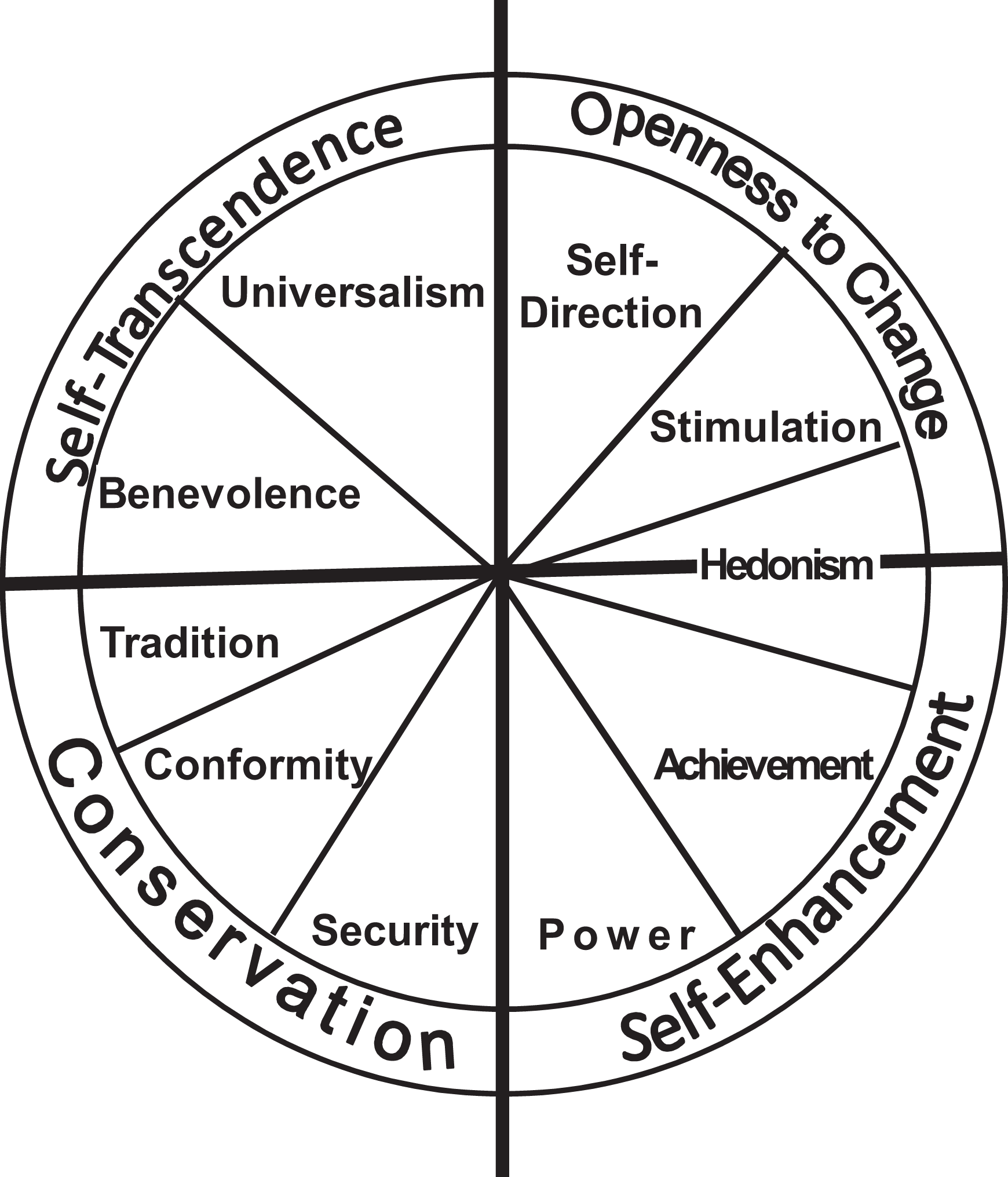
The structure of relations among value types according to the theory. Adapted from Schwartz (2015).
The 10 values are organized along two axes, each one representing a bipolar dimension whose poles constitute a higher order value. The first axis opposes self-enhancement values, which emphasize pursuing one’s relative success and dominance over others (i.e., achievement and power), with self-transcendence values, which emphasize accepting others as equals and concern for their welfare (i.e., universalism and benevolence). The second axis opposes conservation values, which emphasize submissive self-restriction, preserving traditional practices, and protecting stability (i.e., conformity, tradition, and security), with openness to change values, which emphasize independent thought, action, excitement, and change (i.e., self-direction and stimulation). Hedonism values lie between openness to change and self-enhancement and include elements of both, though they are usually closer to openness.
Various instruments have successfully measured the 10 basic personal values in samples from over 80 countries (Schwartz, 2006). However, these instruments are designed to measure basic values in a context-free manner. They are intended to capture the values, as they apply across all situations and life domains. As such, they do not capture the uniqueness and specificity of value expression in the domain of work. The aim of a work values scale is to capture the goals people seek to attain in their work life, in the work or organizational setting. Thus, work-related value scales should be contextualized to the work domain.
Applications of the Schwartz Theory to the Work Context
Some past studies have linked the theory of basic values to the work context. Ros, Schwartz, and Surkiss (1999) made a first attempt to explore the extent to which work values relate to the Schwartz’s basic values. They defined work values as “specific expressions of general values in the work setting” (Ros et al., 1999, p. 54). They considered work values, like basic values, as beliefs concerning desirable end states or behaviors that are ordered by importance as guiding principles. However, work values serve to evaluate work outcomes and settings and choices among work alternatives. They specified four types of work values (intrinsic, extrinsic, social, and prestige) found in past literature that correspond to the four higher order personal values (openness to change, conservation, self-transcendence, and self-enhancement, respectively).
Krumm, Grube, and Hertel (2013) also integrated the traditional work values domains (intrinsic, extrinsic, social, and prestige) with the Schwartz basic values model. They sought to validate a new instrument, the Munster Work Value Measure (MWVM), which adds a fifth domain of generativity (concern for guiding and helping the next generation). The MWVM covers 21 work values that include not only Schwartz’s 10 basic values but also an additional 11 values. It operationalizes each Schwartz value with 1 (for achievement) to 4 (for power) subdimensions.
Spony (2003) sought to integrate the basic values theory with Hofstede’s conceptual framework (Hofstede, 1980). He wished to assess the cumulative impact of individual and cultural values at the organizational rather than the individual level. He administered his Work-related Value Questionnaire, consisting of 142 items, to British and French managers. Multidimensional scaling (MDS) analyses confirmed the circular structure of 10 value subscales and demonstrated the reliability of their measurement.
To our knowledge, only two studies sought to create a new measure applied to the work context that was specifically framed within the Schwartz basic value framework (Arciniega & González, 2000; Avallone, Farnese, Pepe, & Vecchione, 2010). Arciniega and González (2000) created the EVAT scale to measure the four higher order Schwartz values with 16 verbal portraits that refer to various work scenarios (Arciniega, González, Soares, Ciulli, & Giannini, 2009). Research in Italy, Mexico, and Spain supported the four-factor structure and cross-cultural measurement invariance of the EVAT (Arciniega et al., 2009). Later, Avallone, Farnese, Pepe, and Vecchione (2010) developed the 30-item Work Values Questionnaire (WVQ) to measure the 10 basic values in the work context by adapting items from the Portrait Values Questionnaire (Schwartz, 2005). However, a factor analysis of responses yielded a six-factor structure (openness to change, conservation, self-enhancement, self-transcendence, security, and pleasantness) that only partially captured the 10 basic personal values. The WVQ did not distinguish between the two self-enhancement values (power and achievement) or the two self-transcendence values (benevolence and universalism). This is problematic because De Clercq and colleagues (2008) indicate that the values that constitute each of these higher order values have distinct meanings in the work context.
All in all, some contributions have integrated the Schwartz basic values with different work values taxonomies (e.g., Krumm, Grube, & Hertel, 2013), others have mapped only the four higher order values (Arciniega et al., 2009) or a reduced number of Schwartz values (Avallone et al., 2010) into the work context. As far as we can determine, no validated instrument is able to reliably assess the expression of all 10 basic values in the work context and to map their relationships.
Most work values researchers have employed a rating format. The only exception is Krumm et al. (2013) who employed both rating and ranking formats. Rating and ranking methods have distinct advantages and disadvantages (Ovadia, 2004). However, ranking is less vulnerable to social desirability and faking strategies, two especially important issues in organizational contexts (Moorman & Podsakoff, 1992).
The present study introduces a new questionnaire, the “WVal” designed to measure each of the 10 basic personal values in the Schwartz (1992) theory, as they may be expressed in the work domain. The WVal uses ranking in order to minimize effects of social desirability and faking strategies. Ranking forces respondents to express their preferences among different work values that may be subjectively close in their importance, thereby yielding better discrimination. This research addresses several questions regarding the WVal: (a) Does it yield 10 distinctive work value factors that parallel the 10 basic personal values? (b) Do the relations among the 10 work values exhibit a pattern of conflict and compatibility similar to that of the basic personal values? (c) Are its psychometric properties adequate? (d) How are the work values related to personal (gender and age) and organizational (e.g., tenure and professional role) characteristics of respondents? Moreover, the relative importance scores of the values within the various groups can provide initial norms for future applications.
Method
Sample and Procedures
Participants were 759 employees of 94 different organizations in Italy, 27.8% public organizations and 72.2% private companies. Forty-six percent of these organizations worked in the utilities sector; 18% in the security sector; 8% in the transportation sector; 7% in the communication and information technology sectors; 5% in the retail sector; 5% in the educational, health, and welfare sector; and the remaining 11% in other sectors. Participants were 56.0% male, 16.2% aged 18–35, 31.4% aged 36–45, 37.1% aged 46–55, and 14.4% over 55. 2 Regarding education, 54.4% had a university degree, 43.2% had completed high school, and 2% had completed junior high school. Regarding occupational domain, 20% were in administration, 19% were in security, 19% were in technical or operational occupations, 15% were in human resources, 12% were in business, and 13% were in other domains. Regarding organizational role, 19.5% were clerks, 54.2% were middle managers, and 6.9% were top managers (19.4% missing data). Tenure in the organization was more than 15 years for 45%, 8–15 years for 26%, and less than 8 years for 29%. The sample was homogeneous with respect to race (Caucasian) and ethnicity (Italian).
The survey was carried out online. First, each organization provided a list of e-mail addresses for their employees. The researchers then contacted a sample of addresses and requested the employees to participate in a study of values in the work context, providing a link to access to the survey. Participation was voluntary and confidentiality was guaranteed. Of the participants originally contacted, 52% completed the survey.
Measures
Scale construction
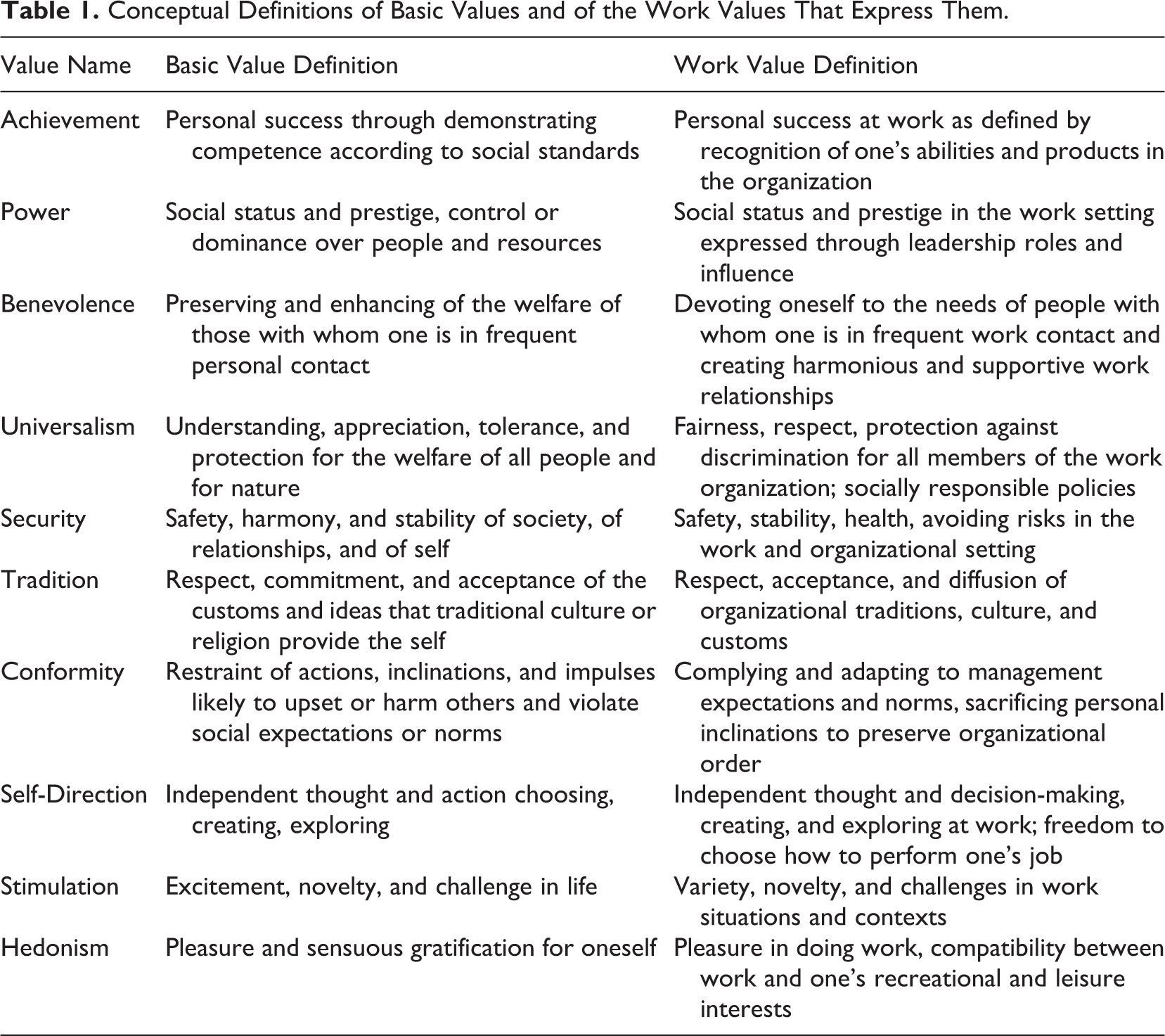
In order to generate work value items that express each of the 10 basic personal values, we first developed a conceptual definition for each work value based on the conceptual definition of each basic value. Table 1 presents the definitions of each basic value (adapted from Schwartz et al., 2001) followed by the definition we developed for the parallel work value. Based on the work value definitions, we initially generated 110 items, 11 for each value.
Conceptual Definitions of Basic Values and of the Work Values That Express Them.
We generated clusters of 5 items, with each item operationalizing a different value. According to the basic value theory, the relative importance of values, compared with one another, influences behavior. Following this reasoning, respondents ranked the items in each cluster according to how important they considered it to be. This enabled them to compare the importance of each value with several others without having to rank a large number of items at the same time. This ranking strategy is less vulnerable than rating to socially desirable responding, which is especially problematic for tools used in organizational contexts (Moorman & Podsakoff, 1992).
We formed 22 clusters of 5 items each. In order to balance the comparisons, we constructed the clusters, so that each value (through one of its posited items) was compared to the other nine values between 4 and 6 times. We gave these clusters to two organizational psychologists who had studied the definitions of the 10 values. These psychologists served as independent judges who assigned each item to 1 of the 10 values and evaluated the social desirability of the item on a 5-point Likert-type scale ranging from 1 (very low social desirability) to 5 (very high social desirability). We retained the 85 items that both judges assigned to their intended value. We then used the social desirability ratings to construct new clusters of five values consisting of items that had received similar social desirability ratings (ratings that differed by no more 1 point on the Likert-type rating scale). This process reduced the item pool to 50 items.
The WVal
The final questionnaire consists of 10 clusters of 5 items each. Each value is compared with all the other nine values from 1 to 5 times. The following stub precedes each cluster of items: It is important to me at work …. Respondents rank the 5 items from the most (Rank 1) to the least important (Rank 5). Below are examples of 1 item per value and, in parentheses, the number of items that operationalize the value. Achievement (5) “… to be able to demonstrate my personal abilities.” Power (4) “… to be able to guide other people’s actions.” Benevolence (6) “… to take care of my colleagues.” Universalism (4) “… that each person is treated fairly.” Security (5) “… that everyone in the organization has guaranteed job security.” Tradition (6) “… to follow the customs and values handed down in the organization.” Conformity (7) “… to carry out my assigned roles, doing what my position requires.” Self-Direction (3) “… to have the freedom to decide what to do.” Stimulation (5) “… to have a wide variety of different things to do.” Hedonism (5) “… to be able to do work that I enjoy.”
Analytical Strategy
We reverse scored the item ranks, so that higher scores represent greater importance (e.g., Rank 1 was scored 5). We assessed the distinctiveness of the 10 work values with confirmatory factor analysis (CFA) of the items. We used the robust maximum likelihood estimator in MPlus, with standard errors and tests of fit that are robust in relation to nonnormality and nonindependence of observations (Muthén & Muthén, 2012). This estimator accommodated for the ordinal nature of the items (Muthén & Muthén, 2012). 3
Because respondents ranked the 5 items in each cluster, the items were negatively interdependent. Once a respondent ranked some items, the ranks available for the others in the cluster were constrained, forcing some items to correlate negatively. Such negative dependence among items violates the “local independence” principle (Bollen, 1989) and manifests itself through significant residual correlations among items (see Alessandri, Vecchione, Donnellan, & Tisak, 2013, for a discussion). These residual correlations are a measurement artifact that is unrelated to the substantive construct variance (Alessandri, Vecchione, Tisak, & Barbaranelli, 2011). To control the effect of violating the local independence principle, we used the correlated uniqueness (CU) model (Kenny & Kashy, 1992; Marsh, 1989). Including the CUs among items is appropriate in circumstances like the present case where there is a strong “a priori” reason to expect them (Jöreskog, 1979; Marsh & Hau, 1996).
To assess model fit, we used the χ2 statistic, the comparative fit index (CFI), the standardized root mean square residual (SRMR), and the root mean square error of approximation (RMSEA) with associated 95% confidence intervals. We treated CFI values greater than .90, SRMR values less than .08, and RMSEA values less than .08 (Kline, 2010) as adequate.
We assessed the structural relations among the values using MDS on the factor scores obtained from the CFA. We were particularly interested in whether the structure of relations among the work values in two dimensions reproduced the higher order values of the basic personal values model and arrayed them in the same order around a motivational circle. We performed the MDS analysis with the PROXSCAL procedure in SPSS20, using a custom starting configuration, following Bilsky, Janik, and Schwartz (2011). We evaluated the quality of the two-dimensional representation with Stress-I, dispersion accounted for, and Tucker’s coefficient of congruence.
We assessed the associations between individuals’ work values and their personal and organizational characteristics with multivariate analyses of variance (MANOVAs). We used the factor scores for the 10 values in separate MANOVAs for sex, age, tenure, and professional role, controlling each time for the effects of the other characteristics. When there were significant overall differences on variables with more than two levels, we ran Tukey post hoc tests.
Results
Confirmatory Factor Analysis
We specified a model of 10 correlated latent factors, each representing one of the hypothesized value domains. CUs were specified among all pairs of items belonging to the same cluster. This model fits the data reasonably well: χ2(1,037) = 5,551.67, p < .01, CFI = .901, RMSEA = .080 (CI 95% [.078, .082]), SRMR = .078. All items had significant loadings on their respective latent factors, ranging from .29 to .74, averaging .41 (SD = .19) across the 10 latent factors (Table 2). Very few modification indices were significant after Bonferroni correction for chance. None indicated the presence of secondary loadings that were higher than the primary, hypothesized loadings of items. We did not free any additional parameters because there was no a priori reason to pursue model modification and the gain associated with freeing secondary loadings was minimal. Some latent work value factors that were expected to share motivational emphases (e.g., tradition and conformity) correlated quite highly. However, further analyses indicated that models that treated the correlated factors as distinct were preferable. 4 All the residual correlations were significant, but negative dependence was moderate across the 10 clusters (mean = −.25; SD = .09; min = −.14; max = −.37). We assessed the internal consistency reliability of the work value factors by calculating factor score determinacy coefficients (Muthén & Muthén, 2012). These exceeded .80 for all factors, ranging from .82 (achievement and universalism) to .92 (security), and averaging .87 (SD = .03).
Loadings of Items on the Latent Work Value Factors and Correlations Between the Latent Factors From the Confirmatory Factor Analysis.

Note. Reliabilities are on the main diagonal.
*p < .05.
MDS
Figure 2 displays the two-dimensional projection of the 10 work values from the MDS. This projection reproduced the relations among the values well, as indicated by Stress-1 of .10, dispersion accounted for of .99, and Tucker coefficient of congruence of .99. The work values formed regions that correspond to the four higher order values of Schwartz’s model. Moreover, these regions showed the same compatibilities and oppositions found in the basic values model, with the exception of the hedonism value. The conservation values (conformity, tradition, and security) on the upper right opposed the openness to change values (self-direction and stimulation) on the lower left. The self-enhancement values (power and achievement) on the upper left opposed the self-transcendence values (benevolence and universalism) on the lower right.
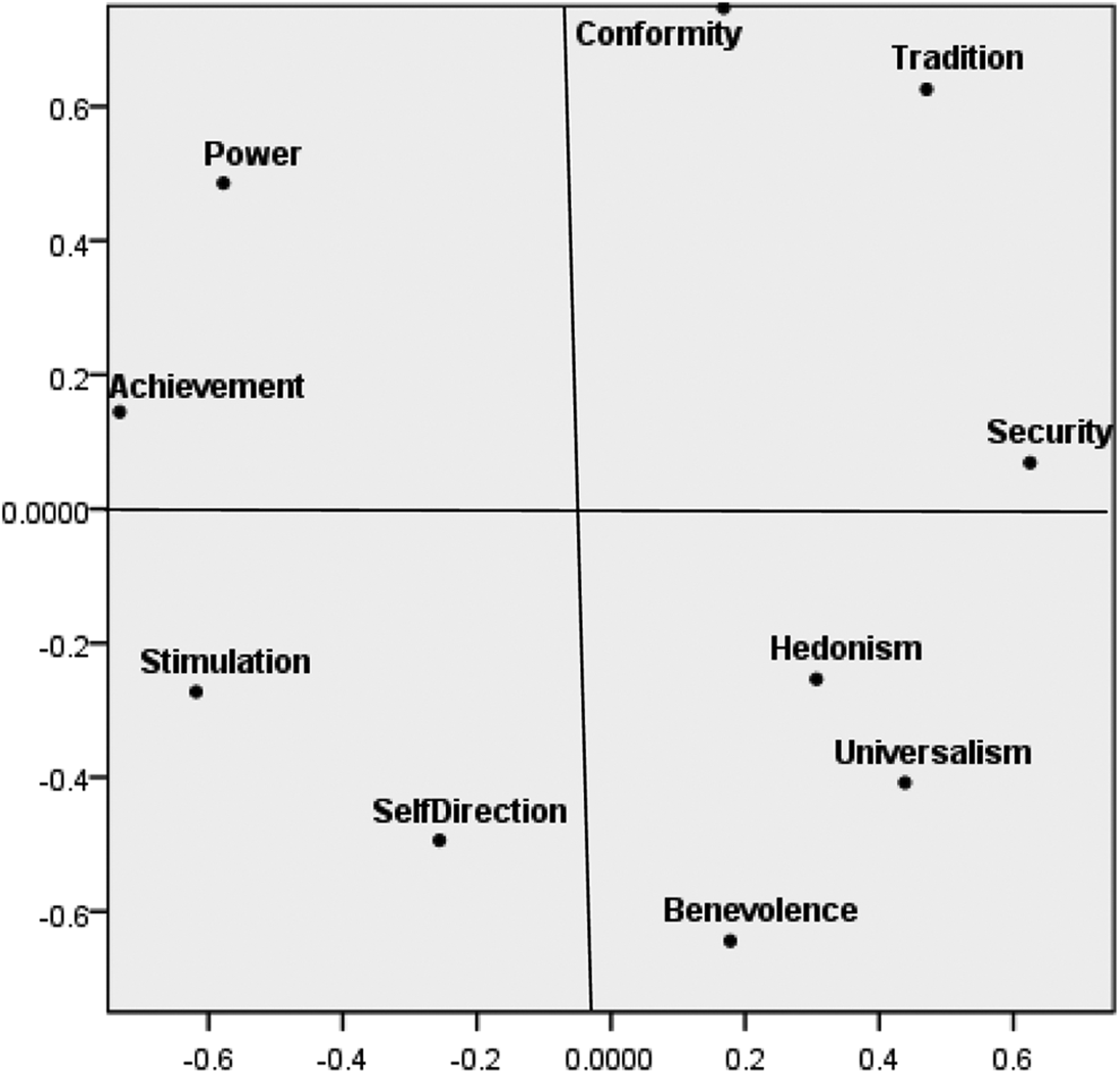
Multidimensional scaling on the 10 work values.
Within the higher order value regions, however, the order of the work values differed somewhat from the order of the basic personal values. Security moved closer to the self-transcendence values and conformity moved closer to the self-enhancement values. Moreover, benevolence moved closer to the openness to change values. Finally, hedonism moved from between openness and self-enhancement to the self-transcendence region near universalism and toward the center of the projection. These changes may reflect the contextualization of values in a work setting.
Associations of Work Values With Personal and Organizational Characteristics
The four panels of Table 3 present the significant differences in the importance of the 10 work values between subgroups of gender, age, tenure, and professional role. The comparison for each characteristic is from a MANOVA controlling the other characteristics. We also indicate the most and less important values within each subgroup.
Mean Importance of 10 Work Values in Subgroups of Gender, Age, Tenure, and Professional Role.

Note. N = 604. Within each category, means with different subscripts differ significantly; means with no subscripts do not differ. Comparisons for each characteristic controlling all of the others.
*p < .05. **p < .01.
The top panel reveals that men assigned more importance to power, conformity, and tradition values in the work setting than women did and that women assigned more importance to stimulation, self-direction, benevolence, universalism, and hedonism values than men did. Only the importance of security and achievement values did not differ as a function of gender. Among men, power was the most important value in the work setting and hedonism the least important. Among women, self-direction and stimulation were most important and tradition least important.
The second panel reveals that there were age differences only for achievement, benevolence, and hedonism values. Younger employees ascribed more importance to achievement and hedonism values than older employees did, but less importance to benevolence values. For the younger employees (18–35), achievement and hedonism were the most important values and benevolence the least important. In contrast, for the oldest employees (>55), benevolence was most important and achievement and hedonism least important.
The third panel reveals that employees who had worked in their organization for more than 15 years ascribed more importance to security and less to power and stimulation values than those with less tenure in the organization. Those with the least tenure (0–7 years) valued conformity more than employees with tenure between 8 and 15 years did. For those with the least tenure, power was the most important value and security the least important. In contrast, for those with the greatest tenure, benevolence was the most important value and hedonism the least important.
The bottom panel reveals only two differences between top and middle managers in the importance attributed to values. Top managers ascribed more importance to universalism and security values than middle managers did. However, lower white-collar employees (clerks) ascribed more importance to security, universalism, and hedonism values than the managers did and less importance to power and stimulation values. For the clerks, hedonism was most important and power least important. The managers showed the opposite preferences, power most important and hedonism least important.
Discussion
Psychometric Properties of the WVal and Relations Among the Work Values
This study provided substantial support for the WVal. Our first aim was to test the factorial validity and reliability of the WVal for measuring 10 work values that express the 10 values in the theory of basic personal values (Schwartz, 1992). The CFA provided evidence for the distinctiveness of the 10 factors we hypothesized, while taking into account the nonindependence of observations within each cluster. The internal consistencies of the 10 scales were also adequate. By using a latent variable model, we were able to disentangle true variance in the items from noise introduced by the response procedure. These two components were quantified by the factor loadings and the residual correlations among items. Our method for overcoming the interdependence of items due to ranking enabled us to use ranking of the values in the work setting. This minimized social desirability and reduced faking in the responses, two issues of special import in organizational contexts (Moorman & Podsakoff, 1992).
Our second aim was to explore the relations among work values and to examine how they resemble or differ from the structure of relations among basic personal values. Relations among the work values showed the same structure of four higher order values, forming two bipolar dimensions, characteristic of basic personal values. However, the position of hedonism values in this structure was very different. In the motivational circle of basic values, hedonism is located between achievement and stimulation and strongly correlated with the latter. In the motivational circle of work values, it was located near universalism, distant from and negatively correlated with stimulation values.
Clearly, the motivational meaning of the hedonism work value we measured differed from the meaning of the basic value whose motivational goal is pleasure and sensuous gratification. The work setting is not a context in which one ordinarily expects to pursue pleasure and sensuous gratification. This led us to operationalize hedonism in the work setting as seeking to enjoy one’s work, to have a good time on the job, and to balance work with personal life and interests. Attaining these outcomes would make work more pleasurable for the individual. However, it implies a work environment that is nonthreatening, supportive, comfortable, and healthy for others too. This type of hedonism motivation promotes the goals of well-being and security for all. This very different meaning of hedonism as a work value would explain its close association with universalism and its proximity to security, the two values that share these goals.
Within two of the higher order values, there were also variations from the order of the basic personal values (cf. Figures 1 and 2). Lets consider the reversal of the positions of security and conformity in the conservation higher order value. Security work values were adjacent to universalism instead of to power, and conformity values were adjacent to power instead of close to benevolence. The basic values theory explains the location of security adjacent to power as expressing their shared goal of precluding threat and unpredictability, security by avoiding such situations and power by controlling them (Schwartz, 2006). In the work setting, security may refer mainly to job security and a safe environment for all. This is most compatible with the emphasis of universalism values on organizational fairness and equal opportunities. Security and universalism were most important to the lower white-collar employees, those whose jobs are least secure, whose job conditions depend most on the fairness of others. Power was least important to lower white-collar employees, probably because exercising power was not an available way for them to preclude threat. In contrast, middle managers emphasized power most and security and universalism values least. For them, power is both available and critical for controlling threat. Seeking security by avoiding unpredictable situations is an inappropriate response. These characteristics of the work setting can explain the location of security as a work value.
The basic values theory explains the location of conformity values near to benevolence as due to their shared focus on positive outcomes for others, benevolence out of concern for others’ welfare, conformity out of concern for avoiding negative responses to self, particularly those with whom one interacts regularly. The work setting is more hierarchical than most other everyday settings (e.g., family and friends) in which conformity is expressed. Although conformity may retain the same basic meaning in work settings, it is more directed toward superiors. Emphasizing conformity may signify readiness to comply and identify with the power structure, thereby maintaining or enhancing one’s position. This may explain the closeness of conformity and power work values.
In the self-transcendence higher order value, the benevolence and universalism work values reversed the positions they hold in the basic values theory. The location of universalism may be due to factors noted above in connection with hedonism and security. However, the location of benevolence, which emphasizes concern for others, adjacent to self-direction, which emphasizes independent thought and action, is puzzling. We offer no explanation for this finding. This is the first study to explore the expression of the 10 basic values in the work domain. Our explanations of variation in the relations among the values must therefore be viewed as tentative. Future studies in other samples are needed to establish the organization of work values more definitively.
Differences in Work Values Among Sociodemographic and Organizational Subgroups
The associations between the work values and individuals’ personal and organizational characteristics provide some support for the usefulness of the WVal. Recall that in each analysis, we controlled the effects of all characteristics other than the target characteristic in order to isolate the effects of the latter.
Numerous gender differences emerged, but some differed from the gender differences found with basic personal values. The most consistent gender differences in basic personal values replicated with work values. In our sample, men ascribed more importance to power and achievement values than women did and women ascribed more importance to universalism and benevolence values than men did (Schwartz & Rubel, 2005). However, reversing the typical gender differences with basic values, women considered the openness to change work values of stimulation, self-direction, and hedonism more important than men did, whereas men considered conformity and tradition values more important than women did. These reversals may reflect the difference between most of the women in our sample and the general population. These women had likely chosen to pursue professional roles in organizations and been socialized into them. This is a nonconventional career path that led mainly to positions as managers. Such a choice, reinforced by socialization to meet the challenges of their work, is consistent with openness values but inconsistent with an emphasis on conformity and tradition.
The finding that hedonism and achievement work values were more important to younger than to older employees and benevolence work values less important also replicated findings with basic values (Schwartz, 2006). The findings for benevolence are also consistent with findings of previous studies with work values (Avallone et al., 2010; Krumm et al., 2013). In contrast to basic values, however, stimulation work value did not decrease in importance with age in the work setting nor did security, conformity, and tradition work values increase with age. The absence of age differences in stimulation and in the three conservation values may reflect the nature of the current work environment. Nowadays, the organizational practices and task requirements to which employees are exposed, irrespective of their age, change frequently or even continuously. The need for both younger and older employees to adapt their values to such change may reduce the differences between them.
In our sample, those with substantial tenure in the organization (>15 years) value power and stimulation less and security more than those with less tenure. Most of those who have remained with the same organization for a long time may have found a comfortable niche in the organization. This niche grants them a degree of power and of variety that satisfies their aspirations, so it is important to them to maintaining the status quo. Those with shorter tenure are more likely still to aspire to more challenging and rewarding positions in or out of the organization and are therefore less concerned with maintaining the status quo. Compared with those who have been in the organization from 8 to 15 years, those with less tenure value conformity more highly. This may reflect greater demands on those with less tenure to learn and comply with the expectations of their supervisors and the shorter time they have had to adapt to these expectations. Note that the greater importance of conformity to those with less tenure is not due to greater youth or lower professional roles. We controlled both of those in the analysis.
For 5 of the 10 work values, there were significant differences among the professional levels in the organizations. In each case, the middle managers were the extreme group. They attributed significantly more importance to power and stimulation and less to hedonism than the lower white-collar employees did and less importance to universalism and security than both those lower in the organizational hierarchy and top management did. The greater importance of power and stimulation suggests that middle managers are the ones who strive most to rise in the organization and seek exciting challenges (Jin & Rounds, 2012). The lesser importance of hedonism, universalism, and security to them implies that they are more willing to accept a competitive, uncomfortable, and uncertain environment as the cost of the struggle to rise to a higher status position. In contrast, the importance of security, universalism, and hedonism to lower white-collar employees may reflect a concern that their organization should provide for a safe, fair, and comfortable work environment.
Limitations and Implications for Future Research and Practice
We note three limitations of the current study that future research should address. First, we have no evidence regarding the generalizability of our findings. Despite the large size of the sample, future studies with different types of samples are needed to establish whether the organization of work values and the differences in the work values we observed as a function of organizational and sociodemographic variables generalize. Moreover, further studies are needed to determine whether the differences between the structure of relations among work values and the structure of basic personal values that we observed are due to differences between our sample and the samples studied in research on basic values. Sample differences may also account for differences between the current study and studies of basic values in the effects of gender and age on value priorities. In order to evaluate these possibilities, one would ideally administer both the WVal and a basic personal values instrument to the same samples, both a general adult sample and one of employees of organizations.
Second, this study examined individuals’ personal and organizational characteristics that might affect their work values. However, the main interest in work values is in how they may influence individuals’ work behavior and organizational outcomes (e.g., Kooij et al., 2010; Parsons et al., 1999). The next step for research is to investigate the contribution of the 10 values that the WVal measures in predicting significant organizational variables and outcomes (such as career choices, turnover intentions, work engagement, and job performance).
Third, although we demonstrated the construct and discriminant validity of the WVal in a large sample of individuals and organizations, this study was limited to one country. Studies of the WVal in other countries are needed.
Another direction for future research with the WVal is to examine the stability of work values over time and in response to the movement of individuals within and across organizations. For example, how fast and to what extent do various work values change in response to promotions or job changes or in response to movement between organizational settings with different cultural atmospheres.
If our results replicate in other samples, the WVal could be used in various applied settings. Compared with available alternatives that provide scores only for the four higher order values (e.g., Arciniega et al., 2009) or of a reduced number of Schwartz’s values (Avallone et al., 2010), the WVal seems to capture work values that correspond to all 10 basic personal values. This is likely to permit richer interpretation and prediction that is more accurate. Moreover, the circle of motivational relations among the 10 work values and among the higher order values that the WVal captures may likely provide greater understanding of the value underpinnings of work attitudes and behavior. Knowing how the work values are interrelated motivationally makes it possible to treat them as an integrated whole when interpreting their associations with other variables. Reasoning that suggests that a particular work value is likely to promote an attitude or action suggests which other values are likely to inhibit or also to promote that attitude or action.
The WVal is likely to be relevant for personnel selection and career counseling, development and training projects, and Human Resources (HR) management decisions regarding employees’ career paths, among other applications. In assessment programs, it may add a rich set of work values to the characteristics typically examined as influences on employees’ choices and actions. In development and training programs, having employees examine their own work values based on the WVal could increase awareness of their own priorities, aid them in understanding their choices and behavior, and help them to set optimal priorities. The averages and distributions of WVal work value scores in an organization or its subdivisions could indicate the prevailing values in the employees’ work context. Comparing employees’ work value scores with the prevailing values can identify the extent of person-–organization fit and pinpoint problematic areas.
Footnotes
Authors’ Note
The participation of the fifth author in preparing this article was in the framework of the Basic Research Program at the National Research University Higher School of Economics (HSE) and supported within the framework of a subsidy granted to the HSE by the Government of the Russian Federation for the implementation of the Global Competitiveness Program.
Declaration of Conflicting Interests
The author(s) declared no potential conflicts of interest with respect to the research, authorship, and/or publication of this article.
Funding
The author(s) received no financial support for the research, authorship, and/or publication of this article.