



Abstract
This study set to provide an age- and culturally-appropriate measure of career calling for Korean young adults. We conducted a literature review and identified a suitable, 15-item Career Calling Scale for Emerging Adults. We translated all items into Korean, back-translated into English, and verified for accuracy. An exploratory factor analysis revealed three factors reflecting those of the original scale (other-oriented meaning, active engagement, and personal meaning; Stage 1; N = 152), and a confirmatory factor analysis supported that these loaded on a higher order factor of career calling (Stage 2; N = 260). The scale showed good internal consistency, and scale validity was supported by finding positive correlations with well-being and a second measure of career calling and a negative correlation with career indecision. The findings support our argument that career calling, viewed as a salient and meaningful career goal, is a relevant concept for Korean young adults.
In modern society, exploring career options and making career-related decisions are vital developmental tasks for young people who are in the process of transitioning between adolescence and early adulthood (Arnett, 2004). During this process, young people tend to relinquish their adolescent goals and set new, more salient goals relevant to their education, future career, and family life. In South Korea, young adults have an especially hard time with career decision-making (Tak, 2006), which has resulted from recent changes in societal priorities that promote longer career exploration, finding meaning through work, and establishing a clear self-identity, including that related to one’s career (Arnett, 2004; Hunter, Dik, & Banning, 2010). Korean young people also need to consider their upbringing within a culture that values collectivism and conformity to social norms and encourages achievement of a prestigious education and high social standing through one’s chosen career (Heine, Lehman, Markus, & Kitayama, 1999; Lee, Kam, & Bond, 2007).
Accordingly, career decision-making is an important and stress-provoking task for many modern Korean young adults, as they often need to juggle between their career interests and personal dreams and those perceived as respectable and important by the family and society, before identifying with, and investing time and effort in their future career preparation and education. Thus, it is crucial to assist young Korean adults in developing clear and meaningful career goals that generate purpose for the individual and community; in other words, they must develop a “career calling,” which will aid them in successfully managing the transition to work, developing their career, and achieving career success (Hall & Chandler, 2005).
Career calling is a concept with a long history, but with only recently renewed research interest in the vocational, career counseling, and organizational psychology fields. Although no single definition of career calling exists, in young adults, it is argued to reflect identifying a strong, long-term, abstract career goal that is deeply meaningful to the individual, oriented toward helping others, and manifested in future career-oriented actions and attitudes (Duffy & Dik, 2013; Praskova, Creed, & Hood, 2015a). Career calling is a developmental and dynamic construct that begins to develop well before one enters the workplace, matures (or diminishes) over time, and becomes increasingly more salient for young college and nonstudying individuals, as they embark on developing and pursuing their careers (Duffy & Dik, 2013; Praskova et al., 2015a). Career calling is considered important for fostering positive career attitudes, behaviors, and well-being (Hall & Chandler, 2005). Accordingly, career calling has been associated positively with career goal self-efficacy and career identity (Allan & Duffy, 2014; Dobrow & Tosti-Kharas, 2011; Praskova, Creed, & Hood, 2015b), work effort and use of career strategies (Praskova, Creed, & Hood, 2015c), and academic and life satisfaction in young adults (Duffy, Allan, & Bott, 2012; Duffy, Allan, & Dik, 2011) in Western countries. In Korea, it has been associated positively with career and life satisfaction (Lee, 2014; Shim & Yoo, 2012; J. Shin, Lee, & Yang, 2015; Yang & Lee, 2012), higher organizational commitment (Yoon, Lee, Sohn, & Ha, 2013), and lower intention to leave the organization in working adults (Lee, 2011).
In Korea, where organizational research has indicated increased career dissatisfaction, higher turnover rates, lower work commitment, and lower perceived organizational pride than ever before (Lee, 2011; New Briefing, 2014), career calling research, education, and counseling for young adults could be beneficial in optimizing well-being and career-related outcomes. However, there has been little career calling research in Korea due to the lack of suitable psychometric tools to measure it. Thus, the present study aimed to provide researchers with a brief measure of career calling suitable for young Korean adults.
History and Conceptualization of Career Calling in the West
Career calling is deeply ingrained in Western culture and was originally seen as a specific request from God for a person to fulfill a particular task or a role (Colozzi & Colozzi, 2000) with the purpose of serving others and the community (Dalton, 2001). The concept of a career calling has changed over time along with the push to obtain self-fulfillment and enjoyment through a career that is personally meaningful (Bellah, Madsen, Sullivan, Swindler, & Tipton, 1985; Novak, 1996). During this process, various definitions emerged.
Adopting a traditional perspective, Dik and Duffy (2009) defined career calling as a “transcendent summons” toward a meaningful career that serves other-oriented values and goals. Adopting a modern perspective, career calling has been defined as an orientation toward work and a consuming and meaning passion to engage in particular work for the fulfillment itself and its contribution to society (Bellah, Madsen, Sullivan, Swidler, & Tipton, 1996; Dobrow & Tosti-Kharas, 2011). Hall and Chandler (2005) emphasized the importance of subjective experience and internal, psychological engagement in finding meaning and purpose in one’s career choices. Elangovan, Pinder, and McLean (2010) have taken a more active approach, defining calling as a course of action in pursuit of prosocial intentions.
More recently, Praskova, Creed, and Hood (2015a) reviewed and integrated existing conceptualizations of career calling applicable to young adults. The authors argued that career calling among young adults is manifested differently to that of working adults who can realize their calling in the workplace (Duffy & Autin, 2013; Praskova et al., 2015a). In their view, career calling for young adults reflects career goal setting, which is salient in this developmental stage, and is linked to proactive identification and pursuit of an important future career. Specifically, they defined career calling as “a mostly self-set, salient, higher order, career goal, which generates meaning and purpose for the individual, and which has the potential to be strengthened (or weakened) by engaging in goal-directed, career-preparatory actions and adaptive processes aimed at meeting this goal” (p. 3). In order to assess career calling in young Korean adults who are in the same developmental stage as young adults in the West, we have endorsed Praskova et al.’s (2015a) conceptualization.
History and Conceptualization of Career Calling in Korean Culture
Koreans’ understanding of the concept of career calling, although largely influenced by the influx of Western culture and Christianity in the 1960s, does not originate from Christian beliefs; rather, it originates from Buddhist and Confucian beliefs. People with faith in Buddhism (i.e., who endorsed nonlabor as a way to reach Nirvana) typically adopted a passive stance toward work and accepted it as a frustrating but necessary aspect of life to be done with the help of others. Durae (Kim & Park, 2006), or the united cooperative organization typically found in collectivist cultures that foster communal/helping work ethics, originates from this belief. Confucian beliefs, which emphasized education and the practice of courtesy over physical labor, led working-class Koreans to believe that hard work was meant for them; this still influences the thoughts of many working Koreans today. Relatedly, career calling is captured in today’s Korean Doosan Encyclopedia by the terms soomyung, defined as fulfilling an order from a ruler to perform a specific task with the aim to serve the greater good, and cheonjik, which refers to one’s work choice as a destiny (Bae, 2006) or a lifelong mission to pursue work challenges, acquire expanded work experiences, and understand one’s future occupation.
Since the Korean War, which brought with it a flood of Western influences, negative beliefs about hard work have shifted. Hard work has come to be perceived as a foundation for the future, which has sparked a nationwide motivation to become educated and succeed through one’s work (Jang et al., 2006), as well as engage in careers that can fulfill personal goals. With the current focus on establishing societal harmony, aspects of work, including helping others, finding a sense of meaning, and exhibiting perseverance and effort, are all seen as important in deciding on a future career.
There is little research on career calling in countries with similar vertical collectivist traditions as Korea (Triandis, 1995; Ho, Fu, & Ng, 2004) to give full account on how the concept is understood by people living in these cultures today. However, Zhang, Dik, Wei, and Zhang (2014) interviewed 210 Chinese university students and identified four aspects of career calling: guiding force (sense of duty or destiny, mission, collective expectation), meaning and purpose (personal meaning and value, sense of fulfillment), active tendency (active pursue), and altruism (positive impact, benefiting others). Similarly, Kwon and Kim (2014) interviewed 243 Korean working adults and found that career calling involves motivation for contribution and devotion (work that benefits families and society and is oriented toward love, consideration, and kindness), cheonjik, work values (attachment and pride for one’s work, self-fulfillment, subjective satisfaction), and goal orientation (achieving life meaning and purpose through work). Both studies identified the constituent themes of career calling, which were conceptually similar to those identified in the West (e.g., Praskova et al., 2015a). This suggests the cross-cultural relevance of the concept and the possibility of utilizing a measure of career calling developed outside South Korea.
Career Calling Measures
A range of measures of career calling is currently used in research. However, most, although viable for use in certain situations, are not suitable for use with young adults living in South Korea. The most widely used measure, the Brief Calling Scale (Dik, Eldridge, Steger, & Duffy, 2012), is a unidimensional scale that does not sufficiently capture the complexity of the construct, as argued by both Western and Korean scholars (Ha, Choi, Eun, & Sohn, 2014; Praskova et al., 2015a). It comprises 4 items in two subscales (the search for a calling and the presence of a calling; 2 items each). Additionally, one of the items (“I have a calling to a particular kind of work”) allows for individual interpretation of the term calling and, thus, can lead to misinterpretation of the concept. Other unidimensional scales include the Neoclassical Calling Questionnaire (Bunderson & Thompson, 2009), where all 6 items assess work as a passion and one’s destiny, and the 12-item Calling Scale (Dobrow & Tosti-Kharas, 2011), which assesses several aspects of career calling, however, is considered unidimensional.
Next, the Calling and Vocation Questionnaire (Dik et al., 2012) comprises 24 items in two subscales (“the search for a calling” and “the presence of a calling”; 12 items each), each reflecting three dimensions of career calling: transcendent summons, purposeful work, and prosocial orientation. Although this is a useful, multidimensional scale, its emphasis on the divine origins of a career calling that stresses religious beliefs (e.g., “I was drawn by something beyond myself to pursue my current line of work”) makes this scale less appropriate for use with Koreans, who frequently ascribe destiny, societal duty, and/or internal origins to their callings.
Perhaps the most problematic limitation of existing measures is that most were not developed specifically for young adults who are in the midst of their future career development; rather, the item wording better suits adults already at work. These include the Calling and Vocation Questionnaire (“I believe that I have been called to my current line of work”; Dik et al., 2012, p. 19), the multidimensional calling measure (“Doing my job I can realize my full potential”; Hagmaier & Abele, 2012, p. 43), and the Neoclassical Calling Questionnaire (“Working with animals feels like my niche in life”; Bunderson & Thompson, 2009, p. 56).
The only measure that, upon review, overcomes these limitations (i.e., is multidimensional, relevant to young adults, does not emphasize divine or external origins of a calling) and is consistent with how career calling is understood by Korean young people is the Career Calling Scale for Emerging Adults (Praskova et al., 2015a). This scale comprises 15 items across three theory-driven domains, including other-oriented meaning, personal meaning, and active engagement in developing a calling. The scale was validated with two groups of young adults from a large regional city in Australia. Exploratory and confirmatory factor analyses of the items supported the loading of the three subscales onto a higher order factor of career calling. The scale has shown expected correlations with several important constructs for this career developmental period, including higher life satisfaction and more positive perceptions of future employability (Praskova et al., 2015a), and greater goal-directed work effort, career strategies, life meaning, and career adaptability over time (Praskova et al., 2015b). Because this scale seemed suitable for use with Korean young people, we set out to develop a Korean version of it. We first translated the scale and then examined its cross-cultural applicability, reliability, and validity using two independent samples of young Korean adults. Measures to validate the scale were drawn from the nomological network of career calling: career indecision, life meaning, and an existing measure of career calling.
Stage 1: Development of the Korean Version of the Career Calling Scale for Emerging Adults
Method
Scale Development
The 15 items of the Career Calling Scale for Emerging Adults (Praskova et al., 2015a) assess three distinct dimensions of career calling (i.e., three subscales with 5 items each). The “other-oriented meaning” subscale reflects a calling associated with a future career that would benefit others and contribute to the community. The “personal meaning subscale” reflects how the calling should be personally rewarding. Finally, the “active engagement” subscale reflects the purpose, enthusiasm, and inspiration associated with pursuing the calling. Each item is rated on a 6-point Likert-type scale (1 = strongly disagree to 6 = strongly agree). In the scale development process, we used the traditional back-translation method (Cha, Kim, & Erlen, 2007; Hui & Traindis, 1985). First, the items were translated into Korean by two bilingual (Korean and English) academic researchers who were independent from the research team. The items were then back-translated into English by two experts in career psychology who were proficient in English. Finally, the second author (and developer of the original scale), checked the back-translated version against the original items. The necessary amendments were made to optimize the content and accuracy of the items.
Participants
Participants were 152 young adults enrolled in various psychology courses in a large private university in Seoul, South Korea. There were 91 female (62.30%) and 55 male students (36.20%; 1.5% did not report their gender), who had a mean age of 21.75 years (SD = 1.89; range = 17–26 years) and had been enrolled at the university for an average of 1.96 years. The majority were enrolled in liberal arts and science degrees (28.90%), followed by social science (10.50%), business (9.20%), engineering (9.20%), bio-system (5.90%), and other degrees (33.20%; 3.10% did not report their major).
Procedure
This study was approved by the university’s institutional review board. All students who were enrolled in psychology courses over the course of one semester were considered for study participation and were offered course credit for their participation (credit alternatives for nonparticipation were also offered). Students who wished to participate signed up for the study through the SONA system (confidential online sign-up system managed by the university, which assigns unique identification numbers to potential participants). Those who signed up received a link to an online survey (hosted by SurveyMonkey), which contained the study information page, the 15 items of the Korean version of the Career Calling Scale for Emerging Adults, and demographic information asking for age, gender, university degree, and years since enrollment. Students read about the purpose of the study, that their participation was voluntary, that no identifiable information would be collected, and that they could withdraw from participation at any time without penalty. The survey took approximately 5 min to complete, and submission of the study was taken as consent to participate.
Results
Preliminary Analysis
Skew and kurtosis were assessed using IBM SPSS Version 21. All items were found to conform to the assumptions of correlation-based factor analyses. The values for all items of the Korean version of the Career Calling Scale for Emerging Adults ranged from −.52 to .91 (skew) and −.86 to .98 (kurtosis). Since the skew values were within ±1.00 SD, the item distributions were deemed normal.
Exploratory Factor Analysis
An exploratory factor analysis using the principal axis factoring method with a promax rotation was computed to assess factorial structure of the scale, as we expected the domains to correlate to form an overall career calling measure (Hair, Black, Babin, & Anderson, 2010; Praskova et al., 2015b). The Kaiser–Meyer–Olkin measure of sample adequacy was .85 and Bartlett’s test of sphericity was significant (p < .001), indicating that the sample was suitable for factor analysis. This analysis extracted a three-factor solution with eigenvalues above 1 and scree plot supporting three strong factors, explaining 61.95% of the total variance in career calling (see Table 1). All items clustered on the factors as predicted by the theory (except for Item 7, which loaded onto Factor 2 instead of Factor 3; see Table 1), showing factor loadings above .40 on the factor concerned and no significant cross-loadings (i.e., above .40) on other factors. Ultimately, 5 items formed Factor 1, explaining 36.55% of the variance in career calling (item-total correlation range = .41–.87); 6 items formed Factor 2, explaining 15.53% of the variance (range = .27–.60); and 4 items composed Factor 3, explaining 9.86% of the variance (range = .33–.69). The factors showed positive and moderate interfactor correlations of r = .40 (Factors 1 and 2), r = .38 (Factors 1 and 3), and r = .49 (Factors 2 and 3), and positive, moderate-to-strong correlations with the total scale (range = .53–.77). Factor 1 included items that reflected meaning in one’s career calling that related to assisting others, Factor 2 included items that reflected active engagement in the pursuit of one’s calling, and Factor 3 included items on personal meaning in one’s career calling.
Factor Loadings and Variance Explained in the Career Calling Scale.
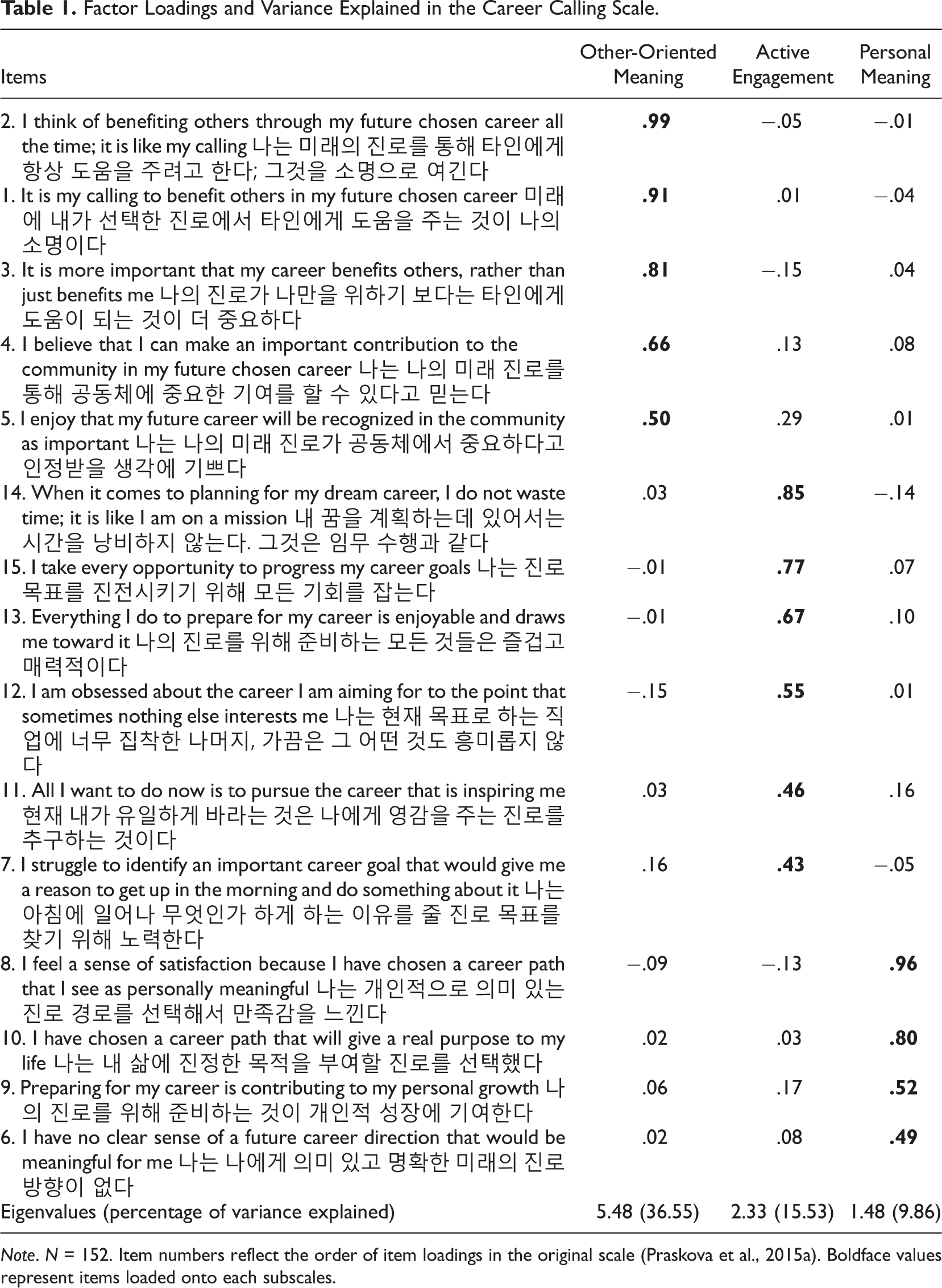
Note. N = 152. Item numbers reflect the order of item loadings in the original scale (Praskova et al., 2015a). Boldface values represent items loaded onto each subscales.
Scale Reliability Analysis
The reliability of the Korean Version of the Career Calling Scale for Emerging Adults was assessed by calculating internal consistency coefficients (Cronbach’s α), which were as follows: .87 (total), .89 (other-oriented meaning), .71 (active engagement), and .79 (personal meaning). These values suggest good internal consistency of items with the entire scale and each subscale.
Stage 2: Confirmatory Factor Analyses and Validation of the Korean Version of the Career Calling Scale for Emerging Adults
Stage 1 of the study revealed that the Korean version of the Career Calling Scale for Emerging Adults was internally consistent and multidimensional, showing three robust subscales that were theoretically sound and aligned closely with those of the original scale (Praskova et al., 2015a). Therefore, we sought to confirm its factorial structure and further validate it. To do so, we drew on the nomological network of career calling. Theoretically, young people with stronger career calling have made a choice about a particular career direction (Germeijs & De Boeck, 2003) and set career goals that were internally motivated (Wrzesniewski, McCauley, Rozin, & Schwartz, 1997). Thus, they should be less career indecisive and more career mature. Theoretically, also, young people with a stronger career calling are happier, experience greater enjoyment in life and study (Hall & Chandler, 2005); thus, they should report greater life satisfaction. Previous research supports these relations (Duffy & Sedlacek, 2010; Praskova et al., 2015c; Steger, Pickering, Shin, & Dik, 2010).
Method
Participants and Procedure
A second sample of 260 emerging adults enrolled in the same university was recruited using the same participant recruitment and data collection procedure as in Stage 1 (the SONA system was set to prevent students from signing up to the same study twice). There were 149 (57.30%) female and 111 (42.70%) male students, with a mean age of 21.60 years (SD = 3.40; range = 17–27 years) and a mean duration of university enrollment of 1.87 years. Students were enrolled in liberal arts and science (25.40%), engineering (11.90%), social science (11.20%), business (9.60%), economics (8.50%), international college (5.40%), and other degree programs (28%). The online survey took approximately 15 min to complete.
Measures
The online questionnaire for this part of the study comprised an information sheet, the 15 items of the Korean Version of the Career Calling Scale for Emerging Adults developed in Stage 1, measures for use in assessing construct validity (i.e., measures of career indecision, career maturity, life satisfaction, and career calling), and demographic information (same as at Stage 1). For all scales, the higher the score, the higher the level of that particular construct.
Career calling
Two scales were used to assess career calling: the 15-item Korean version of the Career Calling Scale for Emerging Adults developed in Stage 1 and the Korean version of the 12-item Presence of a Calling Subscale of the Calling and Vocation Questionnaire (Dik et al., 2012) translated by Shim and Yoo (2012). This subscale, rated on a 4-point Likert-type scale (1 = strongly disagree to 4 = strongly agree), assesses three domains of transcendent summons (e.g., “I believe that I have been called to my current line of work”), purposeful work (e.g., “my work helps me live out my life’s purpose”), and prosocial orientation (e.g., “the most important aspect of my career is its role in helping to meet the needs of others”). The subscale showed good Cronbach’s α of .85 for the full scale when assessed with Korean university students (Shim & Yoo, 2012), and, in support of scale validity, the authors found positive correlations with career maturity, career decision-making self-efficacy, and life satisfaction. The α for the present study was .84.
Career indecision
The 22-item Korean Career Indecision Inventory (Tak & Lee, 2003) was used to assess five aspects of career decidedness: lack of self-identity (4 items, e.g., “I don’t know what my interests are”), lack of career information (6 items, e.g., “I don’t know how to gather information about careers”), indecisiveness (4 items, e.g., “I am an indecisive person in all matters”), lack of necessity recognition (4 items, e.g., “I don’t feel any necessity in making a decision about a future career at this time”), and external barriers (4 items, e.g., “my parents oppose the occupation I really wanted to pursue”). The items were rated on a 5-point Likert-type scale (1 = strongly disagree to 5 = strongly agree). Lee (2006) reported a good Cronbach’s α of .89 for the full scale in a sample of Korean university students. In support of scale validity, this scale showed negative associations with career decisiveness and certainty and positive relationships with anxiety and depression (Tak & Lee, 2003). The Cronbach’s α for the present study was .90.
Career maturity
The 45-item Korean Career Attitude Maturity Scale developed by Lee and Han (1997) was used to measure career maturity in emerging adults; specifically, we measured career decision-making attitudes. The scale, rated on a 5-point Likert-type scale (1 = strongly disagree to 5 = strongly agree), comprises five subscales (9 items each) of decisiveness (e.g., “I have made a firm decision on my career”), finality (e.g., “I consider financial return before any other reasons when choosing a job”), certainty (e.g., “I am confident that I can do well whatever job I have”), preparedness (e.g., “I am interested in getting information on my planned career”), and independence (e.g., “I will choose a job that my parents want”). The scale showed good reliability for the full Career Attitude Maturity Scale (.89), and, in support of validity, showed expected positive associations with self-identity, self-efficacy (Lee & Han, 1997), and career consciousness in Korean university students. The Cronbach’s α for the present study was .89.
Life satisfaction
The 5-item Satisfaction with Life Scale (Diener, Emmons, Larsen, & Griffin, 1985) translated into Korean by Ahn and Suh (2006) was used to assess subjective well-being. This scale, rated on a 7-point Likert-type scale (1 = strongly disagree to 7 = strongly agree), comprises items such as “In most ways my life is close to my ideal.” The authors reported a Cronbach’s α of .82 in a sample of Korean university students. In support of scale validity, positive associations with self-efficacy and career satisfaction were found (Song, Lee, Choi, Heo, & Lee, 2014). The α for the present study was .84.
Results
Confirmatory Factor Analysis
We performed a confirmatory factor analysis using IBM AMOS Version 21 and a second sample of emerging adults to validate the factor structure found in Stage 1 of the scale development. Four models were tested: (a) a unidimensional model where all items loaded onto a single factor, (b) a single-order model where each item was loaded onto three factors, (c) a second-order model where the three factors loaded onto a higher order factor, and (d) a bifactor model where items load onto one of the three factors and a general factor. We used the goodness-of-fit criteria recommended by Hair, Black, Babin, and Anderson (2010) and Hu and Bentler (1999), including the χ2 (χ2 with a significant p value), comparative fit index (CFI ≥ .95), Tucker–Lewis index (TLI ≥ .95), goodness-of-fit index (GFI > .90), and root mean square error of approximation (RMSEA ≥ .06).
As expected, the unidimensional model, χ2(866.41) = 697.93, p < .001, GFI = .62, CFI = .54, TLI = .46, and RMSEA = .18, and the single-order model, χ2(87) = 227.82, p < .001, GFI = .87, CFI = .89, TLI = .87, and RMSEA = .09, showed poor fit statistics. The higher order model showed an improved fit; however, it did not reach the recommended fit criteria, χ2(87) = 210.60, p < .001, GFI = .90, CFI = .93, TLI = .91, and RMSEA = .07. Observation of the modification indices showed that error terms of Items 4 (“I believe that I can make an important contribution to the community in my future chosen career”) and 5 (“I enjoy that my future career will be recognized in the community as important”) covaried (r = .63). Careful examination of the 2 items revealed that both were theoretically related and loaded onto the same factor (other-oriented meaning). Item 4 assessed the confidence in one’s ability to contribute to the community through work that is perceived as important, whereas Item 5 reflected their enjoyment in being recognized for this contribution. Thus, we allowed these two related item errors to covary (Kenny, 2011; Kline, 2005). This adjusted model showed good fit indices: χ2(86) = 167.17, p < .001, TLI = .95, CFI = .96, and RMSEA = .06. The bifactor model showed good fit as well, χ2(75) = 156.10, p < .001, GFI = .93, CFI = .95, TLI = .93, and RMSEA = .07. The χ2 values of two models were compared by subtracting the χ2 and df for the adjusted model from the χ2/df of bifactor model (Bentler & Bonett, 1980). The comparison yielded difference that was statistically nonsignificant at the p < .05. Therefore, the higher order model was endorsed for its structural conciseness.
Construct Validity and Scale Reliability
To evaluate the construct validity, we assessed internal consistency (Cronbach’s α) of the scale based on the second sample and used Pearson’s correlational analyses to test the associations between career calling and constructs identified as theoretically related to career calling. As shown in Table 2, the full scale (.85) and its subscales (range = .75–.89) indicated good reliability coefficients. All tested variables showed significant associations with the Career Calling Scale in the predicted directions. In support of the concurrent validity, career calling was negatively associated with career indecision (full scale r = −.39; subscales r range = −.59 to −.14), which indicated that individuals with higher career calling were less indecisive. Career calling was also positively correlated with career maturity (full scale r = .54; subscales r range = .28 to .67), showing that people with higher career calling had more developed career attitudes. Finally, career calling was positively but weakly correlated with life satisfaction (full scale r = .25; subscales r range = .13–.24), indicating that emerging adults with higher career calling reported a higher general sense of well-being. In support of the convergent validity, the two scales of career calling showed a positive, moderate-to-strong correlation with one another (r = .64). As expected for conceptually similar concepts, this was the strongest correlation among the associations for total scores.
Descriptive Data, Internal Consistency, and Bivariate Correlations for Variables Used.
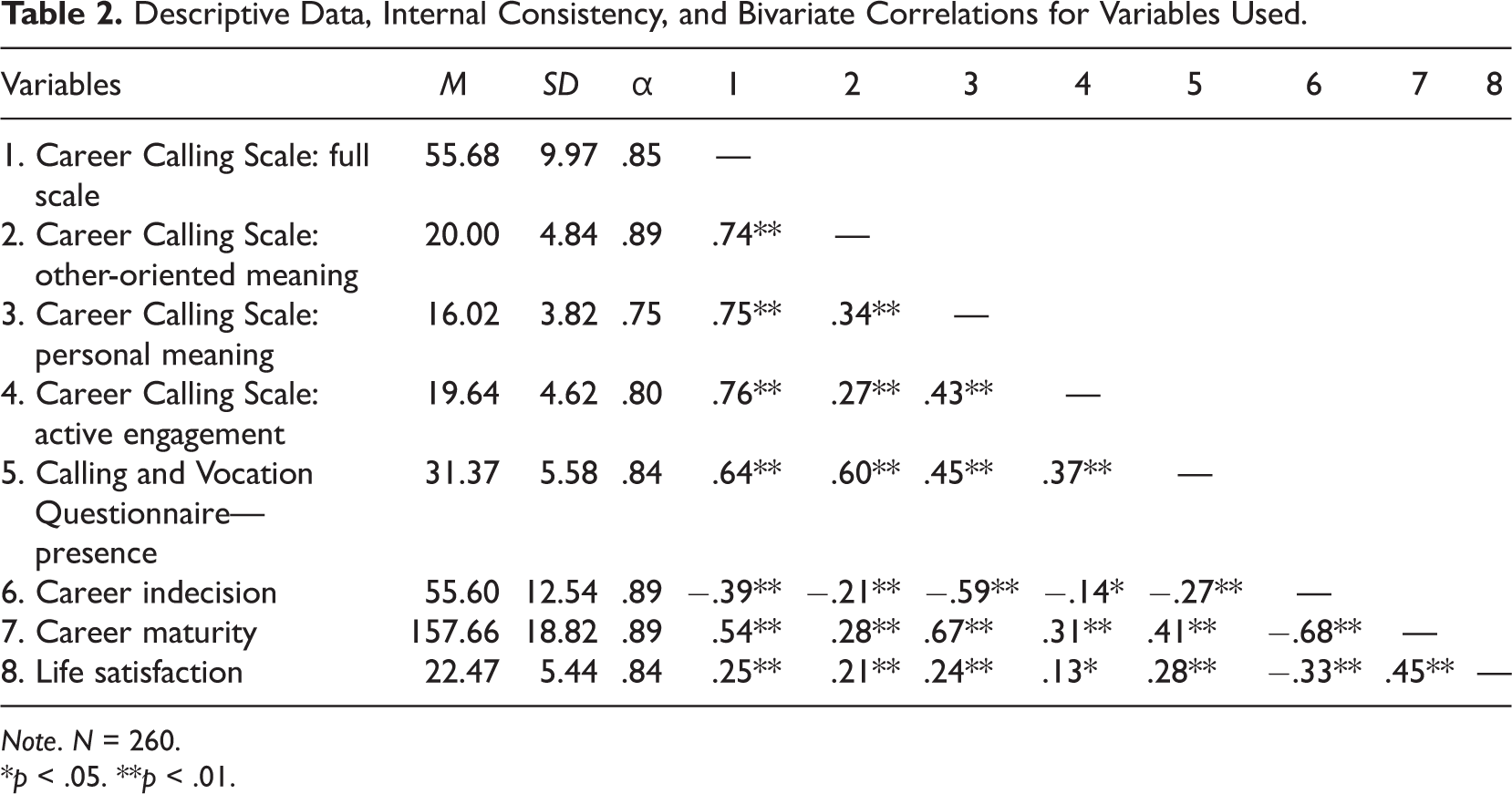
Note. N = 260.
*p < .05. **p < .01.
Additional incremental validity was tested with two hierarchical regression analyses in IBM SPSS 21 (Haynes & Lench, 2003). We examined, whether, as would be expected, this new and developmentally appropriate career calling measure for Korean young adults predicted career-related attitudes in this population over and above that of another measure of a career calling (i.e., the presence of a calling scale; Shim & Yoo, 2012), whose original, English version of the measure has not been specifically developed for this population (Dik et al., 2012). The predictors were the two measures of career calling, and the outcome variables were career indecision and career maturity. The presence of a calling measure was entered in Step 1 of the regression analysis, while the newly developed career calling measure was added in Step 2. Analyses were run for each outcome variable separately. As reported in Table 3, when career indecision was the outcome variable, at Step 1, the presence of a calling accounted for 7.10% of the variance, F(1, 258) = 19.82, p < .001. At Step 2, career calling explained an additional 7.90% of the variance, F Ch(1, 257) = 25.10, p < .001. At this final step, the presence of a calling no longer significantly contributed (p = .69) to the overall model, which now accounted for 15% of the variance in career indecision. When career maturity was the outcome variable, at Step 1, the presence of a calling accounted for 16.50% of the variance, F(1, 258) = 51.14, p < .001. Career calling at Step 2 explained an additional 13.10% of the variance in career maturity, F Ch(1, 257) = 47.89, p < .001. Again, at Step 2, the presence of calling no longer significantly contributed (p = .11) to the overall model, which now accounted for 30.0% of the variance in career maturity. The results indicate that the newly validated Career Calling Scale is a more suitable measure for explaining emerging adults’ career-related concerns in Korean context.
Hierarchical Regression Analyses for Career Calling Predicting Career Attitudes.).
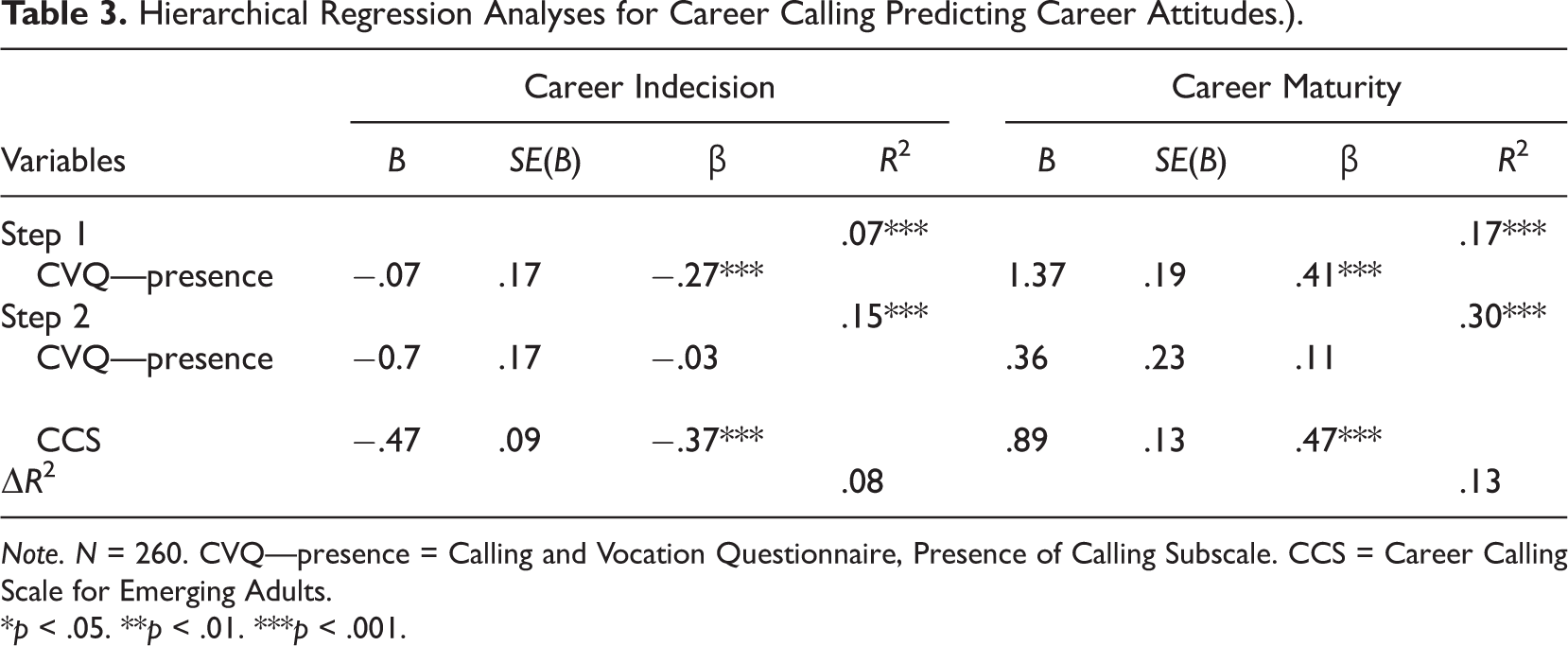
Note. N = 260. CVQ—presence = Calling and Vocation Questionnaire, Presence of Calling Subscale. CCS = Career Calling Scale for Emerging Adults.
*p < .05. **p < .01. ***p < .001.
Discussion
The aim of the present study was to deliver a suitable tool for measuring career calling in Korean young adults. We did this by translating into Korean and then evaluating an existing, multidimensional measure of career calling whose dimensions reflected career development of a calling in Korean youth. As previously argued (Dik & Duffy, 2009; Elangovan, Pinder, & McLean, 2010; Praskova et al., 2015a), this Korean version of the Career Calling Scale for Emerging Adults demonstrated a multidimensional, higher order structure of career calling in. The three factors that were extracted and then confirmed coherently fitted the theoretical assumptions of the career calling construct as relevant to young people in the process of their career development, but also were in line with the Korean traditional conceptualizations of a career calling (Bae, 2006) and research that examined this (Kwon & Kim, 2014). As expected, while the factors correlated positively with one another, they could be differentiated. Together, they formed an overarching factor of career calling. We noted very good internal consistency for the full scale and the three subscales confirmed in two independent samples, which makes the scale suitable for research and screening purposes.
The Korean version of the Career Calling Scale for Emerging Adults (full scale and its subscales) also demonstrated excellent scale validity through correlations with theoretically related constructs. Young people who had stronger career calling reported greater career maturity, higher life satisfaction, and less career indecision, thereby providing evidence of concurrent validity. These findings underscore the importance and relevance of the career calling construct for Korean young people. Specifically, the associations found in this study were also identified in Western research (Germeijs & De Boeck, 2003; Hall & Chandler, 2005; Wrzesniewski et al., 1997). We further found that, as expected, the strongest association was between the newly developed Career Calling Scale for Emerging Adults and the Korean version of the presence of a calling scale (Shim & Yoo, 2012), providing evidence of convergent validity. The scale also indicated that it better predicted career outcomes than the Korean version of the presence of a calling subscale (Shim & Yoo, 2012). Overall, we offer a valid, cross-culturally relevant, and age-appropriate tool that can be used with Korean young people to assess career calling as a strong career goal that is personally meaningful, oriented toward helping others, and involving active engagement in one’s career development and the pursuit of that career goal.
The structure of the Korean version of the Career Calling Scale for Emerging Adults was remarkably similar to the structure found in the original scale development study (Praskova et al., 2015a); however, some differences were observed. On an item level, while 14 items loaded onto the theoretically expected factors (and were congruent with the original scale), Item 7, “I struggle to identify an important career goal that would give me a reason to get up in the morning and do something about it,” did not load onto the expected factor of personal meaning; instead, it loaded onto active engagement. On closer examination, this item was reverse-scored, obtained high accuracy rating, and did not show problematic cross-loadings in our analyses. Thus, although this disparity might be sample-specific or might represent general difficulty interpreting negatively worded item, responding to this item might also be culturally driven. For example, the item could have been interpreted differently by young adults from different cultural backgrounds. The young adults in Praskova et al.’s (2015b) study who were brought up in Western traditions promoting setting of individualistically set goals could have focused on the “identification of an important career goal” component of the item, which reflects personal meaning. In contrast, Korean young adults were brought up in a culture emphasizing public self/collective representation through pursuit of high work engagement, performance, and achievements, and this might have made them focus on the more active, “doing something about [the goal],” component. In support of the above argument, people from collectivist, Asian countries are more likely to see themselves from the outsider’s perspective (Cohen & Gunz, 2002), develop interdependent self-construal, and place greater emphasis on the external, publicly noticeable features (Singelis & Brown, 1995), such as demonstrating valued behaviors and desired performance. Westerners, on the other hand, develop an independent self-construal that focuses on realizing internal attributes and promoting one’s own goals (Singelis & Brown, 1995). To clarify this further, future research on the scale could involve exploration of the responses to, and the behavior of, each individual item using item response theory using new samples.
On the factorial level, we found that Factors 2 and 3 were reversed when compared to the structure of the original scale (Praskova et al., 2015a); in our study, Factor 2—active engagement (Factor 3 in the original study) accounted for a greater amount of variance in career calling in Korean young people than did Factor 3—personal meaning (Factor 2 in the original study). However, such variability is likely when two factors contribute to an overall scale with a similar amount of variance as seen in the original study (cf. Praskova et al., 2015a) and when new samples are tested. Nevertheless, it is plausible that, for Korean young people, personal meaning in pursuit of career goals is viewed as less important and is less emphasized than in the individualistic cultures (Dik & Duffy, 2009). Future studies involving samples from both individualistic and collectivistic cultures could clarify this.
Limitations
Although most Korean people will enter higher education (South Korea has a reported university entrance rate of 78.30%; Weekly Dong-A, 2014), our sample comprised students from a single, large, private, city university in South Korea. To increase the generalizability, future research should include universities from both rural and urban areas, as well as from both public and private universities, and include young adults who do not continue into university and those who enter other training pathways. Second, although gender did not correlate with career calling or other variables in our study (range r = −.06–.04), we had fewer male than female students. Thus, future research should aim for a better sample composition. Finally, while previous research identified how career calling was viewed by Korean working adults (Kwon & Kim, 2014) and Chinese young adults (Zhang, Dik, Wei, & Zhang, 2014), we did not fully explore how career calling was perceived by young Korean adults. Future qualitative studies need to confirm and/or further develop the structure of the career calling.
Implications and Future Directions
Until now, most existing Career Calling Scales were not suitable for use in Korean research with emerging adults because they emphasized divine or external sources of calling, were unidimensional, and were not age appropriate. However, the Korean version of the Career Calling Scale for Emerging Adults has overcome these limitations. Thus, the findings of our study will have important implications for the use of this scale in future research as well as in the career counseling and education of young adults in South Korea. Career counselors could use this measure as a brief screening tool alongside an interview to better understand the level and explore the nature of the set and pursued career goals in young adults. Counselors and educators could focus on promoting identification of career goals or a range of career options aligned with interests, goals, and values that are personally meaningful to the individual and are seen as important by their external world. This may be especially important for young adults in South Korea, many of whom decide on a university degree based on extrinsic motives (i.e., the expectations of their parents, the guarantee of high-paying jobs or status) and for whom leaving their personal callings unanswered could lead to greater dissatisfaction in later working life, as increasingly seen in Korean adults (Korea Economics, 2009). While encouraging, our study suggests positive associations of career calling with career attitudes and life satisfaction, to determine whether career calling predicts future career and well-being outcomes, longitudinal research is needed. Research on what predicts career calling is also warranted, as the evidence from the West is scarce (Duffy & Dik, 2013) and is absent from Korean research. Greater understanding of the traits, contexts, and learned behaviors that could shape the development of career calling, such as self-confidence (Hall & Chandler, 2005), parental occupation, attachment (Dik & Duffy, 2009), and engagement in helping behaviors (Conklin, 2012), may be of a great help to counselors in assisting young people to develop their calling. With an understanding of both the antecedents and consequences of career calling, professionals in vocational and educational fields will be able to provide better service to those in need of career-related advice.
Footnotes
Acknowledgments
The authors would like to acknowledge Professor Peter Creed (School of Applied Psychology and Menzies Health Institute Queensland, Australia) for his comments on previous version of this article.
Declaration of Conflicting Interests
The author(s) declared no potential conflicts of interest with respect to the research, authorship, and/or publication of this article.
Funding
The author(s) received no financial support for the research, authorship, and/or publication of this article.