



Abstract
Research suggests that perceiving a calling toward a particular career is relatively frequent among college students in Western cultures. However, little is known about how this applies to other cultural contexts. This study assessed the perception of career as a calling in the Chinese culture. Study 1 reports the development of the Chinese Calling Scale (CCS), based on a sample of 788 Chinese college students, and identifies three dimensions of a calling: altruism, guiding force, and meaning and purpose. Measurement invariance of the CCS across gender is supported. In Study 2, the convergent and criterion validity of the CCS is examined based on a sample of 387 college students. The CCS is strongly related to an existing calling measure and moderately related to life meaning and life satisfaction. Study 3 examines the relation between calling, hope, life meaning, life satisfaction, and career decidedness among 518 college students. The findings reveal that hope significantly mediated the relation of calling with career decidedness, life meaning, and life satisfaction. In summary, this study provides a new scale to assess calling in Chinese culture and is the first to explore how calling relates to dispositional hope.
In vocational psychology, the study of calling has flourished since 2007 (Duffy & Dik, 2013). Since then, researchers have established that a considerable number of college students and working adults report a calling toward a particular career and have found consistent evidence that calling relates to several positive life outcomes (e.g., life satisfaction, meaning in life, career maturity; see Duffy & Dik, 2013, for a review). Studies have defined calling in several ways and clearly revealed that the prevalent conceptualization of calling in the scientific literature is rooted in the Western cultural background (Dik & Duffy, 2009). Indeed, Zhang, Dik, Wei, and Zhang (2015) found that the understanding of calling in Chinese college students showed several differences compared with the definition in Western samples. However, overall, the study of calling in non-Western samples is sparse to date (Duffy & Dik, 2013), especially in Asian populations. Of particular concern is how to assess calling and explore its effects in non-Western samples. Thus, the first aim of the current study was to develop a suitable scale for use in assessing calling in Chinese samples and to test the reliability and validity of this newly developed scale. Second, we wanted to explore whether dispositional hope acts as a mediator in the link between calling and life meaning, life satisfaction, and career decidedness. Hope, defined as cognitions regarding one’s expectations and ability to achieve goals (Snyder, 2002), is increasingly considered an important psychological resource for career development (Hirschi, 2014). However, while some research has explored why calling is linked to positive outcomes, such as career decidedness or life satisfaction, hope has not yet been considered an important factor in this regard. In summary, our study makes several contributions to the literature. First, we provide a new, short, reliable, and valid measure to assess calling among Chinese college students. Second, we provide new knowledge about the dimensionality and prevalence of callings among Chinese samples. Third, we enrich the scientific understanding of how calling is related to important career and well-being variables in the Chinese culture. Fourth, we provide initial support for the notion that calling is significantly related to greater hope.
Definition and Measurement of Calling
Attempts to measure the perception of calling must begin with a clearly articulated definition, as is the case with any construct. In Western culture, some definitions of calling are based on strong religious roots, such as Dalton’s (2001) definition of calling as a means of serving God or following God’s summons to a certain career. The relation between a sense of calling and religiousness has only recently become a focus of study (e.g., Dik, Duffy, & Tix, 2012; Steger, Pickering, Shin, & Dik, 2010), but many scholars have noted that calling has become an increasingly secularized concept. For example, Hall and Chandler (2005) defined calling as a purpose of one’s life, and Dobrow and Tosti-Kharas (2011) defined calling as a consuming, meaningful passion that people experience toward a life domain. Dik and Duffy (2009) proposed a definition that considered calling’s historic roots while offering a secular, multidimensional approach. Specifically, they defined calling as “a transcendent summons, experienced as originating beyond the self, to approach a particular life role in a manner oriented toward demonstrating or deriving a sense of purpose or meaningfulness and that holds other-oriented values and goals as primary sources of motivation” (Dik & Duffy, 2009, p. 427). Dimensions similar to these were found in a qualitative study of college students by Hunter, Dik, and Banning (2010), while in another conceptual essay, Elangovan, Pinder, and McLean (2010) also identified three facets: action orientation, sense of purpose, and prosocial intention. More recently, using a qualitative study, Hagmaier and Abele (2012) identified a five-category conceptualization of calling in a German adult sample: (a) identification with one’s work, (b) sense and meaning, (c) person–environment fit, (d) value-driven behavior, and (e) transcendent guiding force. However, only three dimensions were confirmed in their subsequent quantitative analysis.
Several measurement instruments have been developed that correspond with these diverse conceptualizations of calling. Although the recent development of rigorous measures represents an improvement over early research on calling, which lacked multidimensional measures with strong psychometric support, the accumulating diversity of scales creates its own challenges. To date, at least five measures have been developed for assessing the experience of calling. The first was the unidimensional scale developed by Dobrow and Tosti-Kharas (2011), which consisted of 12 items based on a definition of calling as a consuming, meaningful passion people experience toward a domain. The second was the multidimensional Calling and Vocation Questionnaire (Dik, Eldridge, Steger, & Duffy, 2012), a scale that assesses three dimensions of calling: transcendent summons, purposeful work, and a prosocial orientation. The third was the Brief Calling Scale (BCS; Dik, Eldridge, et al., 2012), which includes 4 items to assess the presence of and search for a calling. The fourth was Hagmaier and Abele’s (2012) multidimensional calling measure, which uses 9 items to assess three dimensions: identification and person–environment fit, transcendent guiding force, and sense and meaning/value-driven behavior. The fifth was the Career Calling Scale (Praskova, Creed, & Hood, 2014), which uses 15 items to assess three dimensions: other-oriented meaning, personal meaning, and active engagement. However, these measures were all derived from definitions of calling as understood in Western culture.
Understanding Calling in Chinese Culture
Calling, which can be generally translated as “Shiming” in Mandarin, is a sacred word in Chinese culture, while calling in the career domain tends to be more secular (Zhang et al., 2015; Zhang, Wei, & Zhang, 2012). In traditional Chinese culture, pursuing a calling emphasizes fulfilling a mission or expectation from a higher power, such as family, a superior authority, or a transcendent power (Zhang et al., 2015). Considering these traditional roots, Zhang et al. (2015) conducted a qualitative study to explore how Chinese college students interpret the meaning of having a calling. They identified four dimensions: (a) guiding force, a guiding influence to develop one’s career (e.g., duty, mission, destiny, or a “should-do” feeling); (b) meaning and purpose, describing the connection of a calling with a broader sense of meaning in life; (c) altruism, a motivation to make a difference to others or society via one’s career; and (d) active tendency, reflecting effortful and active behavior related to one’s calling. In general, these dimensions showed several similarities to the findings obtained from Western samples. However, there were also some differences. In particular, there is less of an emphasis on religion and spirituality and a greater emphasis on a sense of duty and family expectation in China. In an empirical study, Zhang, Wei, Zhang, and Li (2013) found that college students pursuing a degree in teaching who have a greater sense of calling to be a teacher experienced a higher life meaning, academic satisfaction, and life satisfaction. Their study used the unidimensional domain calling scale developed by Dobrow and Tosti-Kharas (2011). However, as outlined above, there are some aspects of what is considered a calling in the Chinese culture that may not be reflected in Western calling scales. In the current study, we address the lack of a specific scale to assess this construct in the Chinese culture by developing a calling scale that is suitable for this culture and providing evidence of its reliability and validity.
Hope as a Mediator Between Calling and Related Outcomes
According to the definition by Snyder (2002), hope includes two core components: (a) agency thinking (i.e., the cognitions that convey one’s capacity to reach one’s goals) and (b) pathways thinking (i.e., the plans and strategies to meet one’s goals). Previous studies have established that calling is related to life satisfaction, life meaning, career planning, and career decidedness (e.g., Duffy & Sedlacek, 2007, 2010; Hirschi & Herrmann, 2013). In the present study, we propose that these relations are mediated by hope. A calling should activate hope because a calling provides a positively specified goal and because people with a calling should have a stronger conviction that they can achieve their goals and successfully pursue the pathways leading to those goals. This conviction, in turn, would enhance their psychological well-being and career development. Indirect support for this assumption stems from empirical studies finding that hope is related to positive outcomes in various domains (e.g., life satisfaction, Wong & Lim, 2009; academic achievement, Day, Hanson, Maltby, Proctor, & Wood, 2010). In the career domain, dispositional hope was found to be positively associated with career decidedness and career self-efficacy (Hirschi, 2014). More specifically, Duffy, Allan, and Dik (2011) found that work hope, a context-specific form of hope, served as a mediator between calling and academic satisfaction. That is, having a calling was linked to career-related goals, motivation, and plans, which in turn correlates with a higher level of academic satisfaction. We expand upon these findings by investigating the relation among hope, calling, career decidedness, life satisfaction, and life meaning in the Chinese context using the calling measure newly developed herein.
The Current Research
The three studies reported in this article offer the first empirically driven effort that we are aware of to directly investigate the measurement of calling in China. In Study 1, to explore the dimensionality of calling in Chinese culture, we developed a scale to assess a calling based on a large sample of Chinese college students. In Study 2, we evaluated the convergent and criterion validity of the newly developed scale based on an independent sample of Chinese college students. In Study 3, we examined the relation of calling with hope, career decidedness, life meaning, and life satisfaction using a third unique sample. Together, these studies offer an initial exploration of the validity of the calling construct in Chinese culture.
Study 1: Development and Initial Validation of the Chinese Calling Scale (CCS)
Previous findings among Western samples have revealed that calling seems to be a multidimensional construct (e.g., Dik, Eldridge, et al., 2012; Hagmaier & Abele, 2012). To gain an insight into how the Chinese understand having a calling, Zhang et al. (2015) conducted a qualitative study to explore the construct of calling in Chinese culture. They found that the general construct of calling in the Chinese culture was fairly similar to the definition in previous Western studies, though the contents of the individual dimensions showed several cultural differences. Specifically, they identified four dimensions of calling: (a) guiding force, (b) meaning and purpose, (c) altruism, and (d) active tendency. Guiding force conveyed that calling functions as a guiding influence or big-picture mission that one must discern, accept, and endeavor to fulfill. Meaning and purpose presented the connection of a calling to a broader sense of meaning in life. Altruism captured the orientation to help others and serve both society and nation. Active tendency reflected effortful and active behaviors related to one’s calling. The four dimensions identified in this study were used to generate an initial pool of 29 items overall, with 7 items assessing each of guiding force, meaning and purpose, and altruism and 8 items assessing active tendency. The content and wording of all items were reviewed by eight Psychology students, two doctoral students, and six master’s students. This led to several items being revised and rewritten to ensure the clarity and content validity of all items. A 5-point Likert-type scale response format was selected to indicate the extent to which participants see their careers as a calling, ranging from 1 (strongly disagree) to 5 (strongly agree).
Method
Participants and Procedure
We contacted the college staff from five comprehensive universities in China to obtain their support of our survey. With the staff’s help, a total of 850 college students were invited to participate. A final sample of 788 college students completed the paper-and-pencil survey in class, with a response rate of 93%. No compensation was offered as an incentive. Participants reported a mean age of 19.63 years (standard deviation [SD] = 1.42, ranging from 15 to 30 years). Most of the participants were female (74%). Slightly more than one third (37%) of participants were freshmen, 29% were sophomores, 32% were juniors, 1% were seniors, and 1% did not indicate the year in school.
Measures
We used the initial generated pool of 29 items to assess a calling.
Results and Discussion
Exploratory Factor Analysis (EFA)
A randomly selected half of the sample (N = 394) was used. Prior to running the EFA, we calculated the reliability and corrected item-total correlation (CITC) of the items for each hypothesized dimension, resulting in 3 items being removed due to their low CITC with the respective dimensions (<.30). The remaining 26 items were included in the EFA. We used principal axis factoring with oblique rotation because we expected the factors to be correlated. The Kaiser–Meyer–Olkin measure of sampling adequacy was .94, and Bartlett’s test of sphericity χ2 was significant (p < .001), suggesting a factorable matrix. Based on Kaiser’s criterion (Eigenvalues > 1), five factors should be extracted, while the scree plot suggested that a three-factor solution was most appropriate. Parallel analysis and Velicer’s minimum average partial test suggested a two-factor solution. However, the five-factor solution produced spurious factors and numerous cross loadings. A comparison between the two- and three-factor solutions revealed that the three-factor solution produced a considerably clearer pattern of factor loadings than did the two-factor solution. Thus, a three-factor solution was retained. Because our objective was to develop a short measure of calling, we carefully examined the resulting factor solution to identify the most suitable items. We applied several rules to guide this process of item selection to obtain a scale with items that are good indicators of their specific dimensions but are distinct from other dimensions. Specifically, we removed items that displayed no primary rotated loading of greater than .40 on any factor and any items that displayed cross loadings greater than .20 (Cudeck & O’Dell, 1994; Kahn, 2006). This resulted in a three-factor solution with 12 items that was examined again in an attempt to shorten the scale further. All but 1 item (Item 28) displayed a factor loading higher than .50. Thus, we removed Item 28 from the final scale. The factor loadings of the final 11 items ranged from .55 to .82, and no cross loadings were higher than .20 (Table 1). None of the active tendency items were retained in the final scale because in the three-factor solution that we obtained, all active tendency items were found to either display a low loading on their primary factor of guiding force or a substantial cross loading on a second factor. The three factors were positively correlated (r = .43–.54, p < .001). The three dimensions explained 50.1% of item variance and were labelled altruism (4 items), guiding force (4 items), and meaning and purpose (3 items). The internal consistencies for this sample were acceptable, with an α of .84 for the entire scale and an α of .77 for each of the three dimensions.
Factor Loadings of the Chinese Calling Scale.
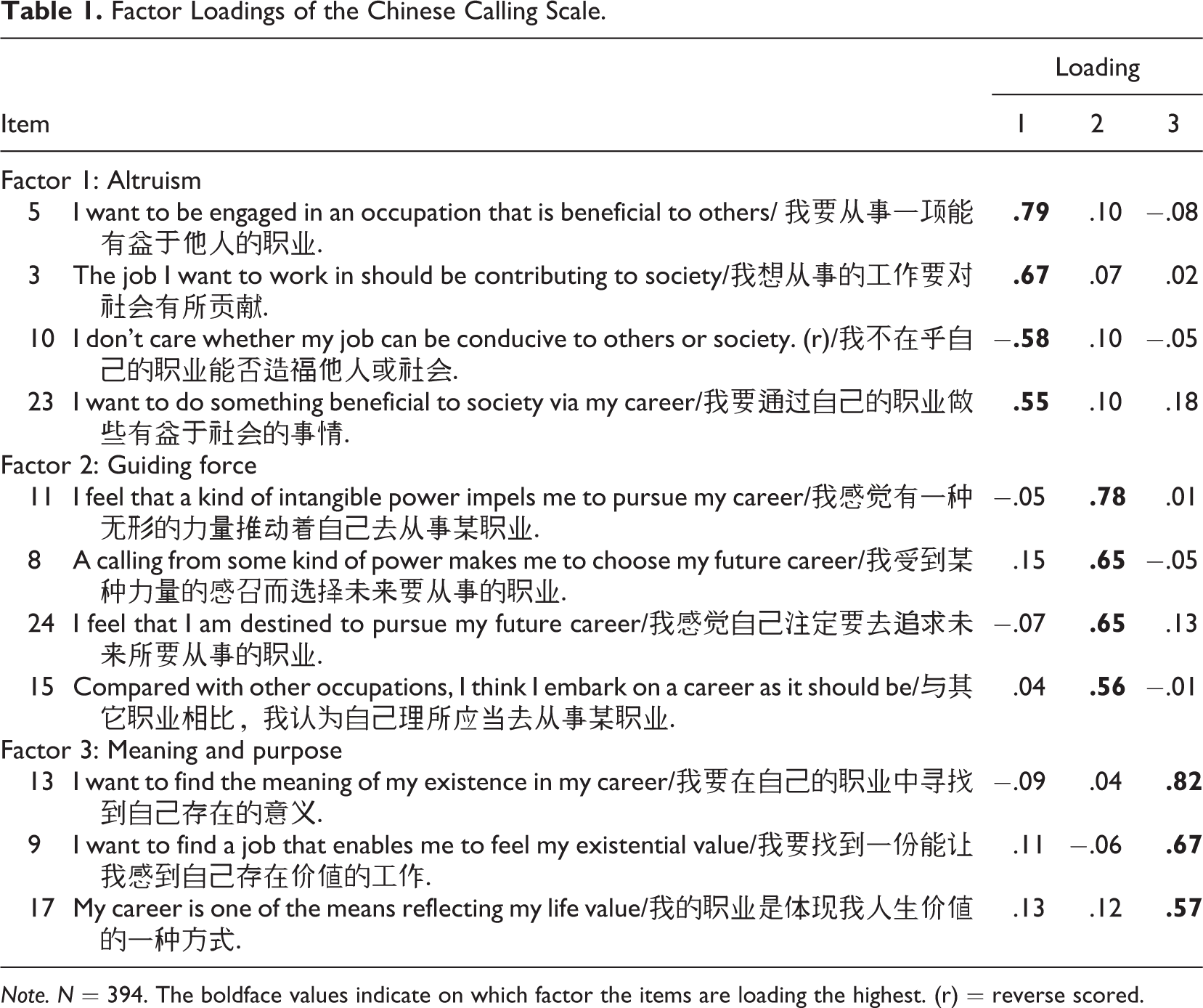
Note. N = 394. The boldface values indicate on which factor the items are loading the highest. (r) = reverse scored.
Confirmatory Factor Analysis (CFA)
To confirm the internal structure of the CCS obtained in EFA, we used Mplus 7 (Muthén & Muthén, 1998/2012) to conduct a CFA of the 11 CCS items with the second half of the sample (N = 394). A three-factor model with correlated latent variables was specified. Each of the 11 items was assigned to the one factor, where it had displayed the highest loading in the EFA. The maximum likelihood method with robust standard errors (MLR) was applied. Evaluation of the acceptability of the model was based on the χ2 test statistic and a number of fit indices: the comparative fit index (CFI), Tucker–Lewis index (TLI), the root mean square error of approximation (RMSEA), and the standardized root mean square residual (SRMR). For the CFI and TLI, values greater than 0.90 indicate an acceptable fit (e.g., Bentler, 1990; Quintana & Maxwell, 1999). For the RMSEA and SRMR, values of 0.08 or below (Hu & Bentler, 1999) indicate a reasonable fit of the model. Our results indicated that the three-factor model fits the data well, S-Bχ2= 64.61, df = 41, CFI = 0.974, TLI = 0.965, RMSEA = 0.038 (90% confidence interval [CI]: [0.019, 0.055], and SRMR = 0.037. To establish that the three-factor model is more suitable than alternative factor structures, we conducted a comparison with a one-factor model, where all items loaded on a single factor and no correlated error terms between items were specified. As expected, the one-factor model did not reach appropriate levels of fit (S-Bχ2 = 286.02, df = 44, CFI = 0.730, TLI = 0.663, RMSEA = 0.118, 90% CI: [105, 0.131], SRMR = 0.087). The χ2 difference test indicated that the difference in fit between the three-factor model and one-factor model was statistically significant (ΔS-Bχ2 = 182.60, Δdf = 3, p < .001). The internal consistencies were acceptable in this sample (α was .83 for the whole scale, .76 for altruism, .79 for guiding force, and .70 for meaning and purpose).
Measurement Invariance for Gender
A measurement invariance analysis for gender was conducted on the 11 Chinese Calling items in the second half of the sample (N = 394) using Mplus 7 (Muthén & Muthén, 1998/2012). Two approaches were used to compare the nested models. First, we used the corrected scaled difference test developed by Satorra and Bentler (2001). Second, because χ2 changes are sensitive to the number of items and sample size (Chen, 2007), the CFI criteria (i.e., ΔCFI ≤ 0.01; see Cheung & Rensvold, 2002) were used to compare the across-group invariance. Table 2 presents the model fit indices for all tested models. Invariance across gender was supported for each model comparison, except when testing for the invariance of the residuals. Finding support for partial measurement invariance suggests that the CCS assesses a similar construct for Chinese males and females and that comparisons between both groups can be made based on this scale (Steenkamp & Baumgartner, 1998). Furthermore, by comparing the latent means, we can show that there is no gender difference between males and females with regard to having a calling.
Invariance Comparisons of Chinese Calling Scale Across Gender.
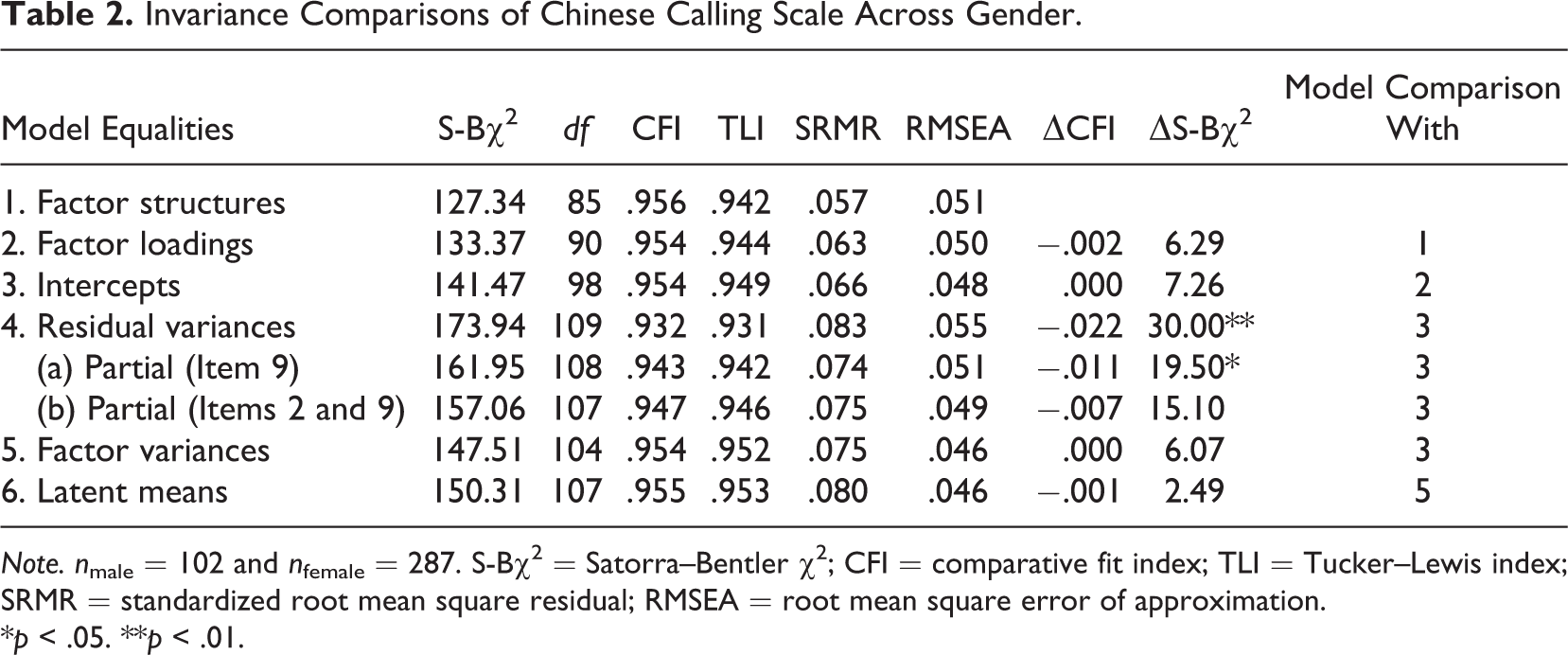
Note. n male = 102 and n female = 287. S-Bχ2 = Satorra–Bentler χ2; CFI = comparative fit index; TLI = Tucker–Lewis index; SRMR = standardized root mean square residual; RMSEA = root mean square error of approximation.
*p < .05. **p < .01.
Study 2: Examining the Convergent Validity and Criterion Validity of the CCS
Study 2 aimed at testing the convergent validity of the new scale by investigating the relations between the CCS and established measures. The BCS developed by Dik, Eldridge, Steger, and Duffy (2012) was included due to its cultural unbiasedness. We hypothesized that calling assessed by the CCS is strongly related to the BCS-Presence subscale. Second, to establish initial evidence of the scale’s criterion-related validity, we also administered scales measuring meaning in life and life satisfaction. Research has found consistent evidence showing calling to be related to meaning in life and life satisfaction (e.g., Dik, Eldridge, et al., 2012; Duffy, Allan, & Bott, 2012). We hypothesized that calling assessed by the CCS will be positively related to life meaning and life satisfaction.
Method
Participants and Procedure
We contacted the college staff from four comprehensive universities in China to obtain their support for our survey. With their help, we invited 500 students to participate in our paper-and-pencil survey in class with a response rate of 77%, N = 387. No compensation was offered as an incentive. Participants reported a mean age of 18.99 years (SD = 0.94, ranging from 17 to 22 years). Most of the participants were female (70%). Approximately two thirds (69%) of the participants were freshmen, 27% were sophomores, 3% were juniors, and 1% did not report their year in school.
Measures
Table 3 shows the reliability coefficients, means, and SDs of all measures.
Correlations, Reliabilities, Means, and Standard Deviations of the Assessed Variables.
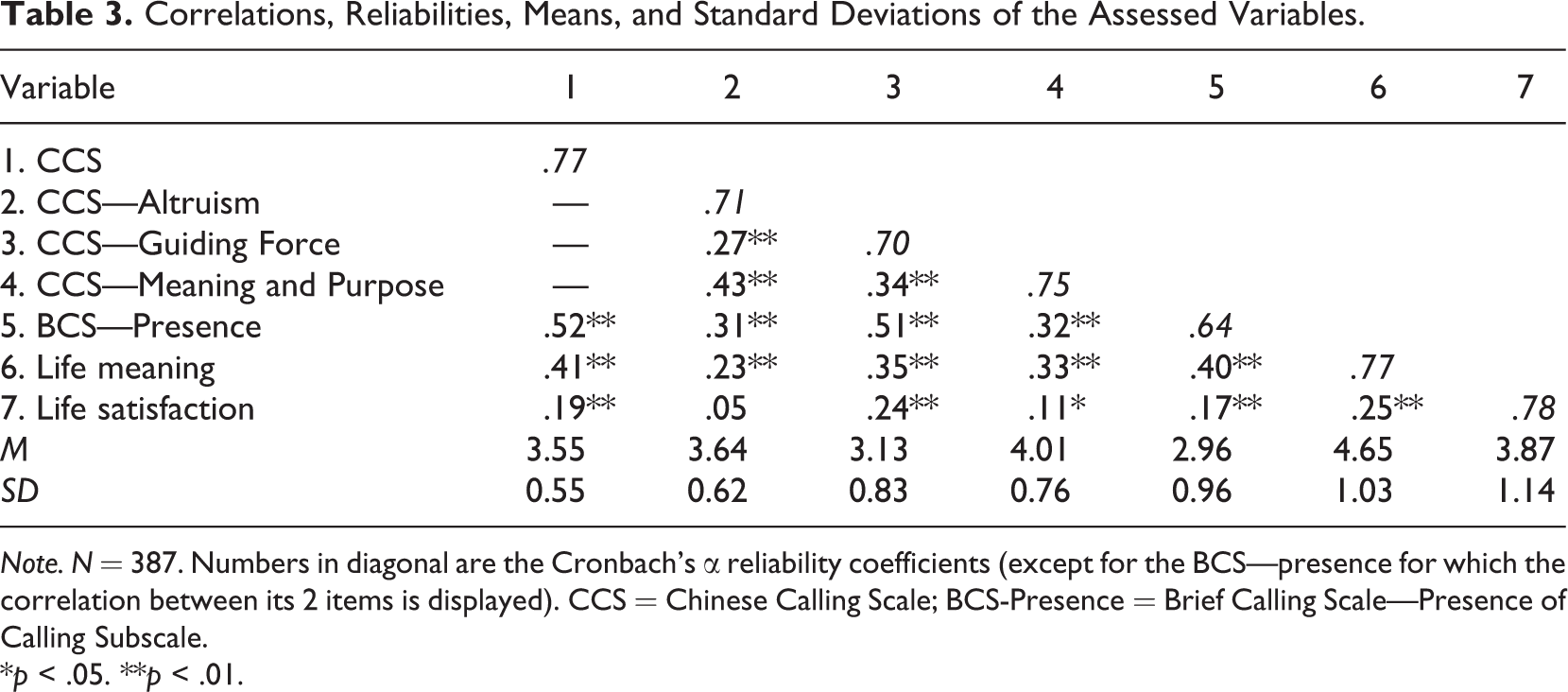
Note. N = 387. Numbers in diagonal are the Cronbach’s α reliability coefficients (except for the BCS—presence for which the correlation between its 2 items is displayed). CCS = Chinese Calling Scale; BCS-Presence = Brief Calling Scale—Presence of Calling Subscale.
*p < .05. **p < .01.
Calling
Calling was assessed by two scales. First, the 11-item CCS as described in Study 1 was used. Second, the 2-item presence of calling subscale of the BCS (Dik, Eldridge, et al., 2012) was used: “I have a calling to a particular kind of work” and “I have a good understanding of my calling as it applies to my career.” We adapted standard steps in translating the measure to ensure the equivalency of meaning of the English and Chinese BCS items. First, the English-language items were translated into Chinese by the first author and evaluated for appropriateness by six master’s-level graduate students in personality psychology. Next, the Chinese versions of the items were translated back into English by a faculty member in the English Department. The back-translated English version was compared with the original English version by two of the authors of the current study. The final Chinese versions were confirmed after consensus was reached among the group. Items were answered on a 5-point scale ranging from 1 (not at all true of me) to 5 (totally true of me). Previous studies found the 2 items to be highly correlated (e.g., r = .81, Duffy & Sedlacek, 2007; r = .65, Duffy, Allan, Autin, & Bott, 2013). Dik, Eldridge, et al. (2012) reported findings showing that the BCS was highly related to other instruments assessing calling.
Life meaning
We used the Chinese version by Wang and Dai (2008) of the Meaning in Life Questionnaire (MLQ; Steger, Frazier, Oishi, & Kaler, 2006). This questionnaire is a 10-item measure to assess both the presence of and the search for life meaning. The response scale ranged from 1 (absolutely untrue) to 7 (absolutely true). In the current study, only the 5 items of the MLQ Presence subscale were used. The reliability of the MLQ Presence scale was high in Western samples (α = .81–.92 and 1-month test–retest reliability of r = .70; Steger et al., 2006) and in a Chinese sample (α = .85; Wang & Dai, 2008). Steger, Frazier, Oishi, and Kaler (2006) reported high correlations between the MLQ Presence score and the scores of other meaning in life measures (e.g., the purpose in life test). Research has also found consistent evidence that life meaning was related to calling and life satisfaction (e.g., Dik, Eldridge, et al., 2012).
Life satisfaction
The Chinese translation of the Satisfaction with Life Scale (SWLS; Cai, Lin, Wu, Yan, & Huang, 2008; Diener, Emmons, Larsen, & Griffin, 1985) was administered to measure a global satisfaction with life. The scale uses a 7-point scale ranging from 1 (strongly disagree) to 7 (strongly agree). The authors reported good internal consistency (α = .87) and a 2-week test–retest reliability (r = .82; Diener et al., 1985). A Chinese study reported good reliability (α = .80, Zhang et al., 2013) and found that life satisfaction was significantly related to calling.
Results and Discussion
First, the correlation coefficients between the CCS, its three dimensions, and the BCS-Presence subscale were computed (Table 3). The results showed that the correlation between the CCS and the BCS-Presence was high and significant. The three dimensions of the CCS were also moderately and significantly related to the BCS-Presence. These results support the convergent validity of the CCS. The results also showed that the CCS was significantly related to life meaning and life satisfaction (Table 3). The correlation with life meaning was significantly (p < .001) higher than that with life satisfaction. Given that previous research has established a positive relation among calling, life meaning, and life satisfaction (e.g., Dik, Eldridge, et al., 2012; Duffy et al., 2012), our findings replicate these relations within a Chinese sample and provide evidence for the criterion-related validity of the newly developed CCS.
Study 3: Examining Hope as a Mediator Between Calling and Career Decidedness, Life Meaning, and Life Satisfaction
The aim of this study was to provide further evidence of the validity of the CCS and to explore the effects of calling in a Chinese sample. Based on previous findings (e.g., Duffy et al., 2012; Hirschi & Herrmann, 2013), we hypothesized that calling would be positively related to career decidedness, life meaning, and life satisfaction. In addition, given that calling reflects a pursuit of an important goal, which may motivate a greater sense of hope, we hypothesized that calling would be positively related to hope. Furthermore, because hope may be beneficial for finding one’s meaning, certainty, and satisfaction, we hypothesized that hope mediates the relations between calling and career decidedness, life meaning, and life satisfaction, respectively.
Method
Participants and Procedure
We contacted the college staff of three comprehensive universities in China to obtain their support for our survey. With the staff’s help, we invited 700 college students to participate in our paper-and-pencil survey. A final sample of 518 students completed the survey in class, with a response rate of 74%. No compensation was offered as an incentive.
Participants reported a mean age of 20.20 years (SD = 1.12, ranging from 18 to 24 years). Most of the participants were female (78%), and 60% were freshmen, 25% were sophomores, 14% were juniors, and one person did not indicate the year in school.
Measures
Table 4 shows the reliability coefficients, means, and SDs of all measures.
Correlations, Reliabilities, Means, and Standard Deviations of the Assessed Variables.
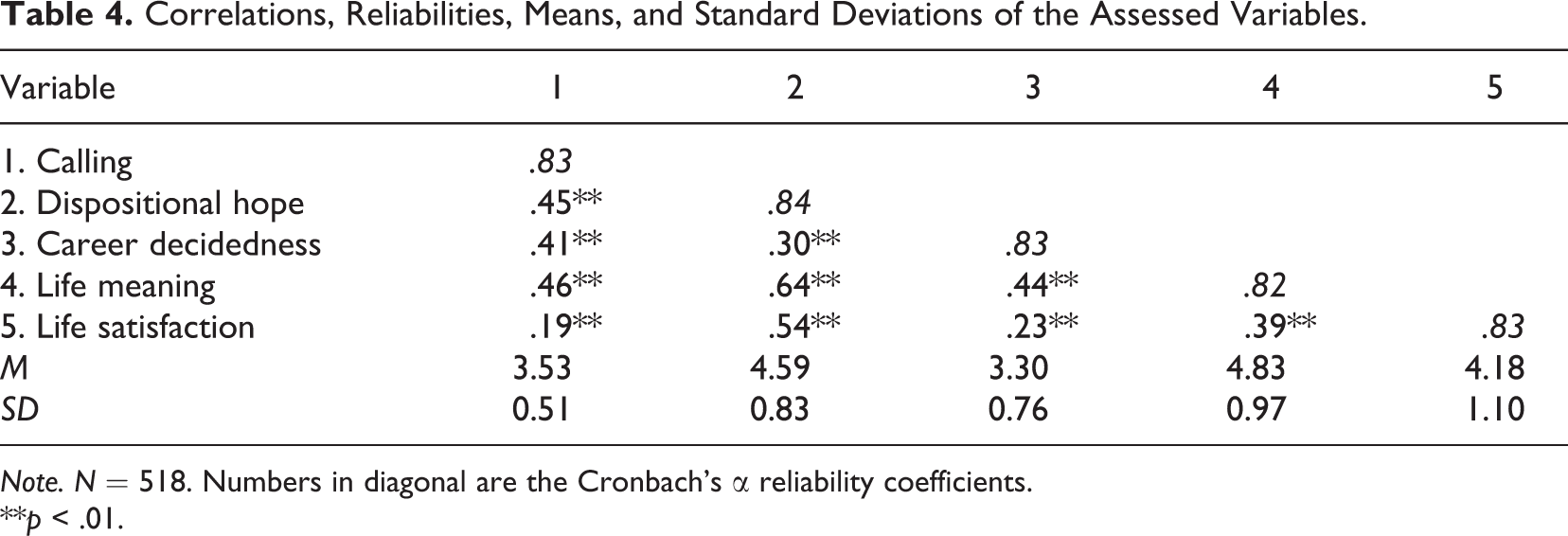
Note. N = 518. Numbers in diagonal are the Cronbach’s α reliability coefficients.
**p < .01.
Calling
The 11-item CCS, as described in Studies 1 and 2, was used.
Hope
The Chinese version of the Dispositional Hope Scale (DHS, Snyder et al., 1991; Sun, Ng, & Wang, 2012) was used, which assesses agency and pathways thinking with 4 items each. Items were answered on an 8-point scale ranging from 1 (definitely false) to 8 (definitely true). Snyder et al. (1991) reported the αs of the two subscales ranging from .71 to .76 and .63 to .80 for agency and pathways thinking, respectively. The convergent validity of this scale has also been supported by many studies (see Snyder, 2002, for a review). Researchers have found the DHS to correlate with measures of career decidedness, career self-efficacy, and proactive career behaviors (e.g., Hirschi, 2014).
Career decidedness
The degree to which participants felt certain in their careers was assessed by the 6-item Career Decidedness Scale (CDS, Lounsbury, Hutchens, & Loveland, 2005). We translated this measure into Chinese by adapting the standard steps described in Study 2. Participants answered items on a 5-point scale ranging from 1 (strongly disagree) to 5 (strongly agree). Research has demonstrated that reliability estimates have been adequate (α = .90, Lounsbury et al., 2005). The CDS score has been found to be highly and negatively correlated with career indecision, as measured by the Career Decision Scale (r = −.78; Lounsbury et al., 2005), and to be moderately correlated with measures of life satisfaction and career self-efficacy (e.g., Lounsbury et al., 2005; Restubog, Florentino, & Garcia, 2010).
Life meaning
The MLQ (Steger et al., 2006) described in Study 2 was used.
Life satisfaction
The SWLS (Diener et al., 1985) described in Study 2 was used.
Results and Discussion
Preliminary Analyses
Correlations were computed to examine the extent to which calling was associated with the other constructs. As hypothesized, positive associations, moderate in magnitude, were found between calling and hope, career decidedness, life meaning, and life satisfaction (Table 4).
Next, to confirm that the variables included in the hypothesized model are distinct, we examined the measurement model, which included the following: a latent factor of calling indicated by its three dimensions, as manifest sum scores of the respective items; a latent factor of hope indicated by its two dimensions, as manifest sum scores of the respective items; a latent factor of career decidedness indicated by its 6 items; a latent factor of life meaning indicated by its 5 items; and a latent factor of life satisfaction indicated by its 5 items. The MLR was applied using Mplus 7 (Muthén & Muthén, 1998/2012). The model fit was nearly acceptable (S-Bχ2 = 585.47, df = 179, CFI = 0.894, TLI = 0.876, RMSEA = 0.066, 90% CI: [060, 0.072], SRMR = 0.058). Modification indices indicated that the error terms between two pairs of negatively worded items of the CDS (Item 2 with Item 6; Item 5 with Item 6) should be released. Because these correlated error terms seem to be due to the item format, it is justifiable to release them to obtain an acceptable model fit (Byrne, Shavelson, & Muthen, 1989). After releasing these error terms, the model fit was acceptable (S-Bχ2 = 481.64, df = 177, CFI = 0.920, TLI = 0.906, RMSEA = 0.058, 90% CI: [052, 0.064], SRMR = 0.054). All items and subscales displayed loadings on their hypothesized factor of .40 or higher.
Mediation Analysis
The mediation model with the standardized path coefficients is shown in Figure 1. Bootstrapping, with 1,000 bootstrap samples and bias-corrected CIs, was used to test the significance of the indirect effects (Preacher & Hayes, 2008; Shrout & Bolger, 2002). The indirect effects are shown in Table 5. The results indicate that calling had a significant indirect effect on career decidedness, life meaning, and life satisfaction mediated through hope. The total model was found to account for 67% of the variance in life meaning, 40% in life satisfaction, and 34% in career decidedness.
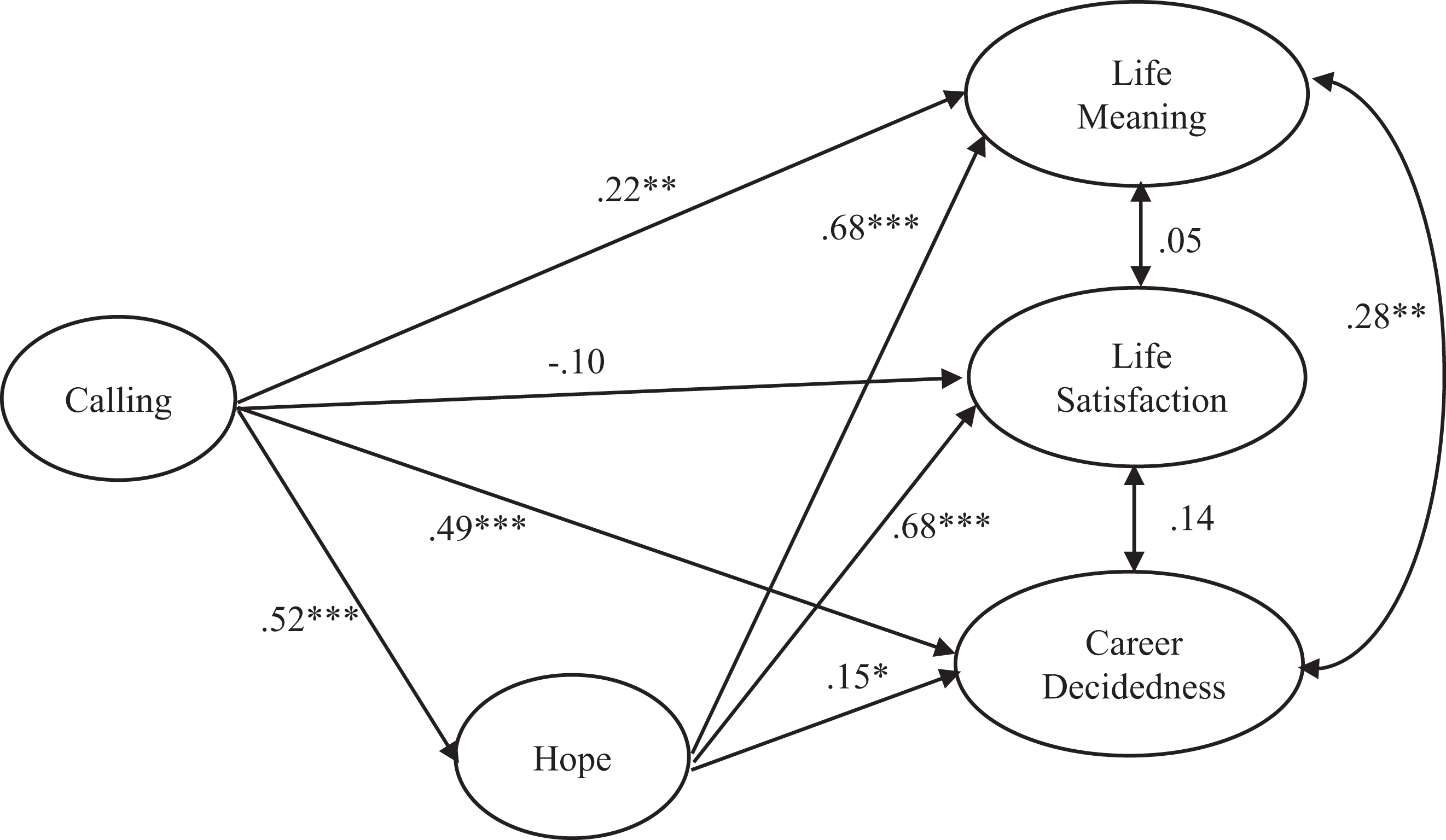
Mediational model (N = 518). Note. Hope serves as a mediator between calling, life meaning, life satisfaction, and career decidedness. *p < .05. **p < .01. ***p < .001.
Multiple Mediation Effects of Calling on Career Decidedness, Life Meaning, and Life Satisfaction Through Hope.
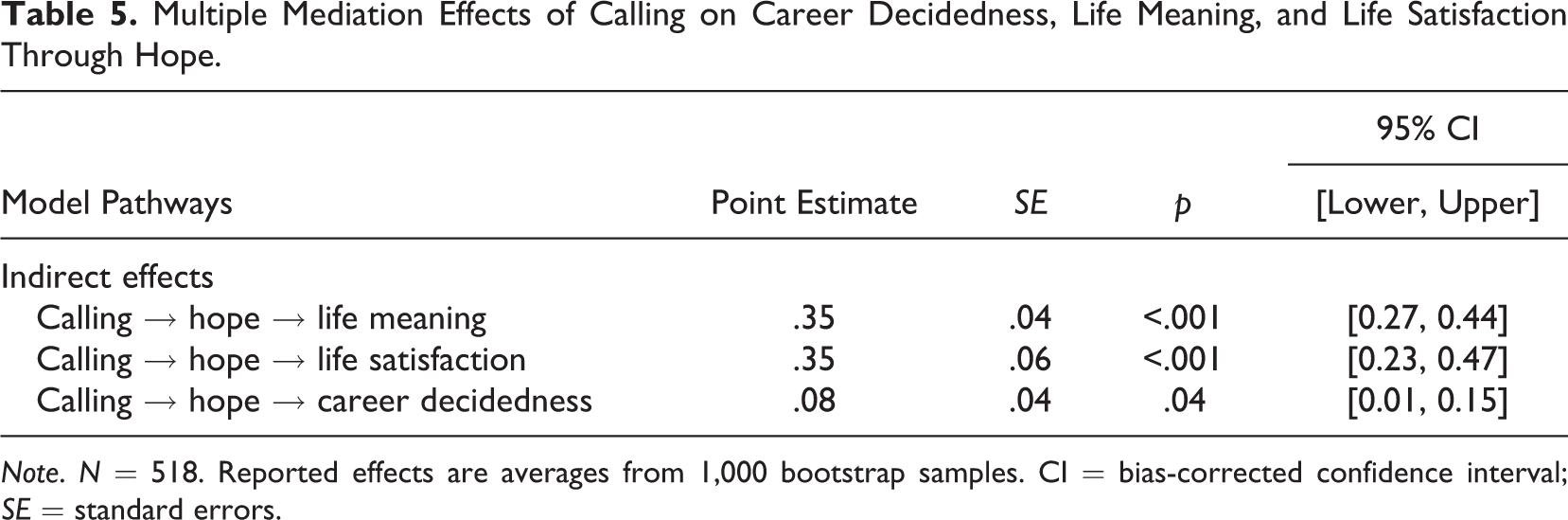
Note. N = 518. Reported effects are averages from 1,000 bootstrap samples. CI = bias-corrected confidence interval; SE = standard errors.
General Discussion
The purpose of this study was to explore and assess the concept of calling in Chinese culture. Three studies conducted in Chinese college students revealed that the newly developed CCS is a reliable and valid three-dimensional measure of calling. We further revealed that hope serves as a mediator in the relation between calling and career decidedness, life meaning, and life satisfaction. These findings add several notable insights to the literature that explores calling and its effects in non-Western culture.
First, we empirically confirmed the findings of Zhang et al. (2015) in Chinese college students. Specifically, based on EFA and confirmed in a CFA, we identified three dimensions of a calling in our Chinese student samples that closely correspond to the dimensions found in the qualitative study by Zhang et al. (2015). Altruism represents the tendency to help others and make a difference in society through one’s career, especially in the larger community and society. Guiding force describes the extent to which individuals feel a guiding influence to develop their career, for example, a should-do feeling. Meaning and purpose presents the connection between a calling and a broader sense of meaning in life.
However, the fourth dimension, active tendency, which was suggested by qualitative research in Chinese students (Zhang et al., 2015) and included in the initial item pool of the CCS, was not confirmed empirically. Praskova, Creed, and Hood (2014) proposed a similar dimension “active engagement” and confirmed it empirically in emerging adults. A possible explanation for this difference is the potential influence of the dimension of guiding force, which was not included in the study by Praskova et al. (2014). As noted above, the items of active tendency did not form a separate fourth factor but instead loaded onto the guiding force factor and displayed cross loadings on purpose and meaning in our study. Therefore, these items were removed. Rather than being one dimension of calling, this active engagement in career decision making should more likely be considered an outcome of calling in Chinese college students. This would explain why calling was linked to a range of beneficial career-related criterion variables (Zhang et al., 2015). Another potential reason may be that active tendency was less frequently mentioned, in comparison with the other three dimensions in the qualitative study by Zhang et al. (2015), indicating that active tendency may not be a salient component of measuring career calling in Chinese college students.
Second, our research demonstrated measurement invariance of the CCS across genders, thus suggesting that the CCS’s factors have the same meaning for males and females and allowing for the scale to be used to compare between both groups. We did not find a significant gender difference for calling in the current study, which is consistent with the findings obtained in Western samples (e.g., Duffy & Sedlacek, 2010).
Third, the convergent validity of the CCS was supported by its moderate relation with the BCS. In addition, the criterion-related validity was confirmed by testing the relation between the CCS score and life meaning and life satisfaction. In line with previous studies (e.g., Dik, Eldridge, et al., 2012; Duffy et al., 2012), we found that calling was positively and significantly associated with life meaning and life satisfaction, providing initial evidence for the criterion-related validity of the CCS.
Finally, we examined the relation of hope and calling. We specifically explored whether hope mediates the relation that calling has with life meaning, life satisfaction, and career decidedness. We found support for our hypotheses, which suggests that higher levels of calling promote higher general hope, which in turn relates to greater life meaning and life satisfaction. Our findings are consistent with previous research that has linked hope with life meaning (e.g., Mascaro & Rosen, 2005) and life satisfaction (e.g., Marques, Lopez, & Mitchell, 2013) and calling with work hope (Duffy, Allan, & Dik, 2011) in Western samples.
In addition, the findings support the hypothesized mediating role of hope in the link between calling and career decidedness. Our finding is consistent with the notions that calling is related to career maturity (see Duffy & Dik, 2013, for a review) and that hope is an important resource for motivating students to engage in career development and making clear career decisions (Hirschi, 2014). It seems that the Chinese college students who perceive their career to be a calling likely experience a greater sense of hope, which may motivate them to experience higher decidedness in their career decisions. However, the indirect effects of calling on career decidedness through hope were smaller than its effects on life meaning and life satisfaction. A potential explanation may be that hope, life meaning, and life satisfaction were all general well-being variables. Due to this conceptual link, these variables may have displayed higher correlations with each other than with career decidedness, which is a construct in the vocational domain.
Limitation and Future Research
Several possible limitations of the present study should be mentioned. First, the majority of those sampled were female. Although the construct of the CCS was demonstrated to be similar across genders in the current study, a more gender-balanced sample would be preferable in future research. Second, the scale was developed based on a Chinese college student sample. Future research should explore whether the scale is equally applicable among Chinese working adults. Third, data in this research were cross sectional, thereby precluding causal inferences. To explore how calling influences outcome variables, longitudinal or experimental research is needed. Fourth, two scales, the BCS and CDS, were translated into Chinese for this study and used for the first time. Thus, while the translations were carried out carefully and the measures were previously used in diverse samples and found to be unidimensional, the validity of the Chinese versions has not yet been examined thoroughly. Finally, as a newly developed scale, the CCS should be tested and evaluated in more studies. Using this scale, future studies may investigate the nature and effect of calling on related outcomes in a Chinese cultural context.
Footnotes
Declaration of Conflicting Interests
The author(s) declared no potential conflicts of interest with respect to the research, authorship, and/or publication of this article.
Funding
The author(s) received no financial support for the research, authorship, and/or publication of this article.