



Abstract
Since the passage of the Rehabilitation Act of 1973, federal and state governments have played a significant role in the employment of individuals with disabilities. In the present study, one aspect of that relationship was analyzed—individuals with disabilities who received vocational rehabilitation (VR) services to become self-employed. The authors utilized a two-level hierarchical generalized linear modeling to analyze national data from the Rehabilitation Services Administration for fiscal years 2008–2012. Among several significant (p < .001) predictors of successful VR self-employment case closure across the years, ethnicity had the largest effect, followed by gender. Although the findings from this study build on those from a previous study, conclusions about the predictors are tentative. Nevertheless, the findings add to a sparse literature on VR self-employment of individuals with disabilities, and the authors discuss the study’s implications for researchers and VR and provide suggestions for further research.
Keywords
Individuals with disabilities in the United States have continued to fare poorly in employment. The U.S. Department of Labor reported that, as of February 2016, the unemployment rate of individuals with disabilities was 12.5% and 4.9% for individuals without disabilities. In addition, the labor force participation rate for individuals with disabilities was 19.5% and for individuals without disabilities was 68.2% (www.dol.gov/odep). Government has taken steps to address this problem, beginning with the Rehabilitation Act of 1973 and most recently, with passage of the Workforce Investment and Opportunities Act (2014) and subsequent amendments, whose purpose was “to empower individuals with disabilities to maximize employment, economic self-sufficiency, independence, and inclusion and integration into society … and to ensure that the Federal Government plays a leadership role in promoting the employment of individuals with disabilities” (20 U.S. Code § 9201). The Act established a mandate for state vocational rehabilitation (VR) agencies to provide employment-related services to individuals with disabilities, to help them obtain and retain employment, including self-employment. Thus, the present study focused on the role of VR in the self-employment of individuals with disabilities.
Literature Review
Since the mid-1970s, millions of individuals with disabilities in the United States have obtained employment through VR agencies. Despite that prevalence, refereed empirical research studies about employment of individuals with disabilities through the analyses of VR data over time are sparse. Such studies about self-employment are rarer. This was noted in a comprehensive review of the research literature (Yamamoto, Unruh, & Bullis, 2012), which reported that most of the refereed empirical studies were qualitative in design, in which the authors collected data through in-person interviews or surveys of VR clients and counselors but did not collect or analyze VR agencies’ data. Moreover, these studies, with small numbers of participants, focused on themes of self-employment experience of individuals with disabilities and the role of VR. One theme was the reasons individuals with disabilities gave for choosing self-employment over other options, including (a) discrimination and lack of opportunity (Blanck, Sandler, Schmeling, & Schartz, 2000; Hagner & Davies, 2002), (b) less stigmatization than other employment in the pursuit of “the American Dream”, (c) unsatisfactory previous employment experiences (McNaughton, Symons, Light, & Parsons, 2006), and (d) simply as a matter of personal choice (Callahan, Shumpert, & Mast, 2002).
The second major theme noted in the review was that the small number of studies also focused on challenges individuals with disabilities faced trying to become self-employed. Challenges included (a) lack of access to adequate financing from conventional sources, (b) perceived or actual reduction in government benefits due to their self-employment income, (c) societal prejudice, (d) negative public attitudes and low expectations, (e) educational barriers in inadequate school transition and vocational programs, (f) technological barriers in the access and use of devices, and (g) policy and regulation in business and personal supports (Callahan et al., 2002; McNaughton et al., 2006; President’s Committee on Employment of Individuals with Disabilities, 2000; Rizzo, 2002).
Recently, Yamamoto and Alverson (2013) conducted the first and only refereed empirical study of VR self-employment by analyzing federal VR data across multiple years. Utilizing multilevel analysis (i.e., hierarchical generalized linear modeling [HGLM]), they found several significant (p < .001) predictors of successful client VR case closure in self-employment, of which ethnicity and gender were reported to have had the largest effects. Further, they also found that across the United States, VR self-employment rates for fiscal years (FYs) 2003–2007 were between 2% and 2.5%, concurring with previous studies which found that since the 1990s, national VR self-employment rates have generally remained between 2% and 3% (Ipsen, Arnold, & Colling, 2005; Schriner & Neath, 1996). In context, Rissman (2003) asserted that “flows into self-employment occur during recessions and flows out of self-employment occur during economic expansions” (as cited in Hipple, 2004, p. 14).
Revell, Smith, and Inge (2009) authored, to date, the only refereed publication of empirical research comparing financial aspects of VR employment across all states and for multiple years. In 2007, the last year of their analysis, Revell et al. (2009) reported the national average weekly VR self-employment earnings at closure were US$396, whereas the national average weekly earnings for all VR employment closure outcomes were US$350. Connecticut had the highest average weekly self-employment closure earnings of US$896, compared to its average weekly earnings for all employment closures of US$538. Mississippi, the state with the highest VR self-employment closure rate had average weekly self-employment closure earnings of US$439 and average weekly earnings for all employment closures of US$423.
Blanck, Sandler, Schmeling, and Schartz (2000) completed the only empirical mixed-method research study of VR self-employment, analyzing a number of characteristics of VR clients with disabilities, service characteristics, and self-employment/entrepreneurship outcomes. Its focus was on a special statewide entrepreneurship program in Iowa for VR clients with disabilities. The study found that Caucasian males with more than a secondary education had the most successful businesses and that the overall “rate” of successful program closure far exceeded the 2–3% national VR self-employment rates.
Despite the small number of studies in the research literature, there are indications that self-employment can be a viable employment option. Over the last two decades, self-employment has become more prevalent among individuals with disabilities due in part to the (a) shift in the U.S. economy from industrial manufacturing to a high-technology, information and service-oriented economy and (b) philosophy and movement of consumer choice and self-determination in employment for individuals with disabilities (Colling & Arnold, 2007; Palmer, Schriner, Getch, & Main 2000; Rizzo, 2002; Schriner & Neath, 1996; Seekins, 1992; Walls, Dowler, Cordingly, Orslene, & Greer, 2001). Moreover, the U.S. Department of Labor (2014) reported that, among those who were employed, individuals with disabilities were more likely to be self-employed than individuals without disabilities, 11% to 6%.
As part of a larger study about self-employment of individuals with disabilities who received VR services across the United States, the present study posed three a priori research questions to gain further understanding of and to close the gaps in knowledge about VR self-employment. Moreover, by analyzing recent VR data, specifically the years during and immediately after the ‘Great Recession’, the questions also sought to uncover important patterns and changes over time.
Research Questions
In the present study, we investigated three a priori research questions:
Method
Research Design
The present study utilized a nonexperimental design with a descriptive–quantitative analysis of the extant federal data. This design was the most appropriate for the study, given its scope and purpose (see Shadish, Cook, & Campbell, 2002). The value of a descriptive study is being able to portray the characteristics of a population, group, or phenomena as it exists to generate a firm empirical basis for subsequently explaining or changing it (Tamhane & Dunlop, 2000).
The present study was a discrete and independent part of a larger mixed-method research project, which was entirely focused on self-employment of VR clients with disabilities. The present study also investigated the same three research questions as a previous study of VR self-employment (see Yamamoto & Alverson, 2013), which had analyzed extant federal data from the Rehabilitation Services Administration (RSA), the same data source, but for different years, 2003–2007.
Data Collection
The first author contacted the RSA to obtain VR data for all 50 states and Washington DC for FYs 2008–2012. These data comprised individual case-level information on all VR clients. The RSA annually collects VR data from each state, called “RSA-911,” following the end of the government’s FY.
The RSA provided data to the first author in three CD-ROMs. The data were in plain text (.txt) format and deidentified—no Social Security numbers, state ID numbers, or city/county residential information. These data were transferred to the SPSS Version 22 software for Windows (International Business Machines [IBM], 2013) to create structured SPSS data files for statistical analysis. Next, these data were aligned with their corresponding variables according to the RSA data variable dictionary (RSA, 2008). Each year’s data were inspected for missing or impossible values (i.e., keystroke error).
Defining Terms
Some of the terminology in the present study was not unique to VR or VR data, such as gender and ethnicity, but others were, such as significant disability status or the cost of VR services. In addition, VR “case” was defined by the RSA (2008) as the official record generated by a VR counselor for each prospective client. A case can be closed for any reason, but a successful closure occurs only after a client achieves an employment outcome, a job with or without supports including self-employment. Case closure with an employment outcome typically occurs when a VR counselor determines, with discretionary authority, that his or her client has demonstrated stable employment for at least 90 days. Lastly, the VR self-employment case-closure rate in the present study was defined as the number of closed cases with a self-employment outcome divided by the total number of all closed employment cases in a year.
Data Analysis
After screening the RSA data, the first author exported them to HLM 7.0 (Scientific Software International [SSI, 2014]) software for analysis. The data were considered hierarchically structured because they were “organized at more than one level” (Tabachnick & Fidell, 2007, p. 781), that is, individual VR clients “nested” within services in their home state. Hierarchically structured data need to be analyzed at different levels to avoid (a) violating the statistical assumption of independence and inflating Type I error and (b) applying group-level analysis to the individual, known as ecological fallacy (Tabachnick & Fidell, 2007, p. 782), or applying individual-level analysis to the group, known as atomistic fallacy (Hox, 2002, as cited in Tabachnick & Fidell, 2007, p. 782).
Hierarchical linear modeling, or HLM, specifically refers to the analytic technique and software by Raudenbush and Bryk (2002) in which “each of the levels in this structure is formally represented by its own submodel. These submodels express relationships among variables within a given level, and specify how variables at one level influence relations occurring at another” (p. 7). In the present study, a two-level HGLM, a nonlinear analysis of binary or multinomial outcome (criterion) variable (Raudenbush & Bryk, 2002), was produced for each FY. The level of statistical significance of the present study, given its data source and exploratory nature, was set at p < .01.
The Level-1 model of any HGLM contains three parts: (a) sampling model, (b) nonlinear link function, and (c) structural model. The sampling model is

The Level-1 structural model included an outcome variable, η ij , representing the log odds of VR clients achieving self-employment case closure. Predictors were selected from a review of the literature. The six Level-1 predictors, X ij were (a) gender, (b) ethnicity, (c) cost of VR services, (d) level of educational attainment at closure, (e) dollar amount of public supports (e.g., Temporary Assistance for Needy Families [TANF], Social Security Disability Insurance [SSDI]) at closure, and (f) significant disability status. The CostVR and PubSupp predictors were centered at the group (i.e., Level-2 state) mean. Centering is used when 0 is not a meaningful value in order to ensure stable estimation of model parameters (Raudenbush & Bryk, 2002). The subscript i referred to the VR client, the Level-1 unit of analysis. The subscript j referred to the state, the Level-2 unit of analysis. The six slopes, β1j to β6j , represented the change in the log odds of self-employment closure associated with a unit increase in the predictor, Xpij , holding constant (i.e., controlling the effects of) the other predictors.
The HGLM at Level 2 further analyzed each Level-1 coefficient β as its own outcome variable. At Level 2, the unconditional model is






In the conditional Level-2 model, the lone predictor was AvgUnemp, a state’s average annual unemployment rate. This predictor was grand mean centered. The γ00 intercept term represented the mean log odds of self-employment closure for a non-White male client who had received his home state’s average cost of VR services, whose educational attainment at closure was no more than a high school level, received his state’s average dollar amount of public supports at closure, identified as not having a significant disability, and lived in a state with a “typical” self-employment closure rate, a random effect u 0j value of 0. The u 0j term represented random variation of the intercept, γ00, across states, controlling for AvgUnemp. The γ01 slope term represented the change in the log odds of self-employment closure associated with a unit increase in the unemployment rate for states with the same u 0j value. The remaining six terms, Level-1 slopes β1j to β6j , became Level-2 “outcome” variables with intercepts, γ10 to γ60, respectively, without the AvgUnemp predictor. These intercepts represented the mean change in the log odds of self-employment closure for VR clients in the same state who differed by one unit on the predictor, X 1j to X 6J , holding constant the other five Xij predictors and the u 0j value. These six slope coefficients, then, were tested in the model as fixed effects at Level 2, invariant across states (see Raudenbush & Bryk, 2002; Raudenbush et al., 2011). The Level-1 and Level-2 conditional models produced the following combined complete model:

In an HGLM, two results are produced, parameter estimates for a unit-specific model and estimates for a population-average model. Choosing one over the other is based upon the research questions specified for the analysis (Raudenbush & Bryk, 2002; Raudenbush et al., 2011). For this study, the unit-specific model was chosen because it would answer the question of how a predictor might affect state log odds or likelihood of self-employment closure, holding constant the other predictors and the Level-2 random effect value, u 0j . A population-average model would answer a different question, of how a predictor affects the nationwide (i.e., averaged across states) log odds or likelihood of self-employment closure, holding constant the other predictors but not u 0j , the random effects across states.
For the unit-specific results, model-based standard errors and robust (Huber corrected) standard errors were compared. Considerable divergence between these errors is an indication of misspecification in the distribution of u
0j
random effects, which would affect inferences about the γ
xx
regression coefficients (Raudenbush & Bryk, 2002). Finally, the results were examined to assess how closely the Level-1 variance followed the assumed variance of the sampling model,
Results
Data Screening
Data screening revealed that approximately 3–4% of analyzed variables across the five FYs had missing data. The missing data were determined to be missing at random (see Schafer & Graham, 2002) and imputed (i.e., replaced) in SPSS Version 22 for Windows (IBM, 2013) using a recommended statistical method, multiple imputation.
A summary of the frequencies for the four RSA demographic predictors is presented in Table 1. Results indicated the largest number of employment closure cases occurred in FY 2008, with 202,297 closures, including self-employment and other employment. The smallest number of closures occurred in FY 2010, with 169,258 closures. Across the 5 years, gender of employment closures ranged from 43% to 45% female and 55% to 57% male. Ethnicity ranged from 23% to 24% non-White and 76% to 77% White. Significant disability status ranged from 6% to 7% without a significant disability and 93% to 94% with a significant disability. Educational attainment at closure ranged from 56% to 57% of clients with up to secondary level and 43% to 44% of clients with postsecondary level. Table 2 summarizes the VR case-closure status (i.e., employment and nonemployment) and the closure rates for the 5 years.
Client Characteristics of VR Case Closures for FY 2008–2012.

Note. VR = vocational rehabilitation; FY = fiscal year.
VR Case Closure Status and Rates for FY 2008–2012.

Note. VR = vocational rehabilitation; FY = fiscal year.
HGLM
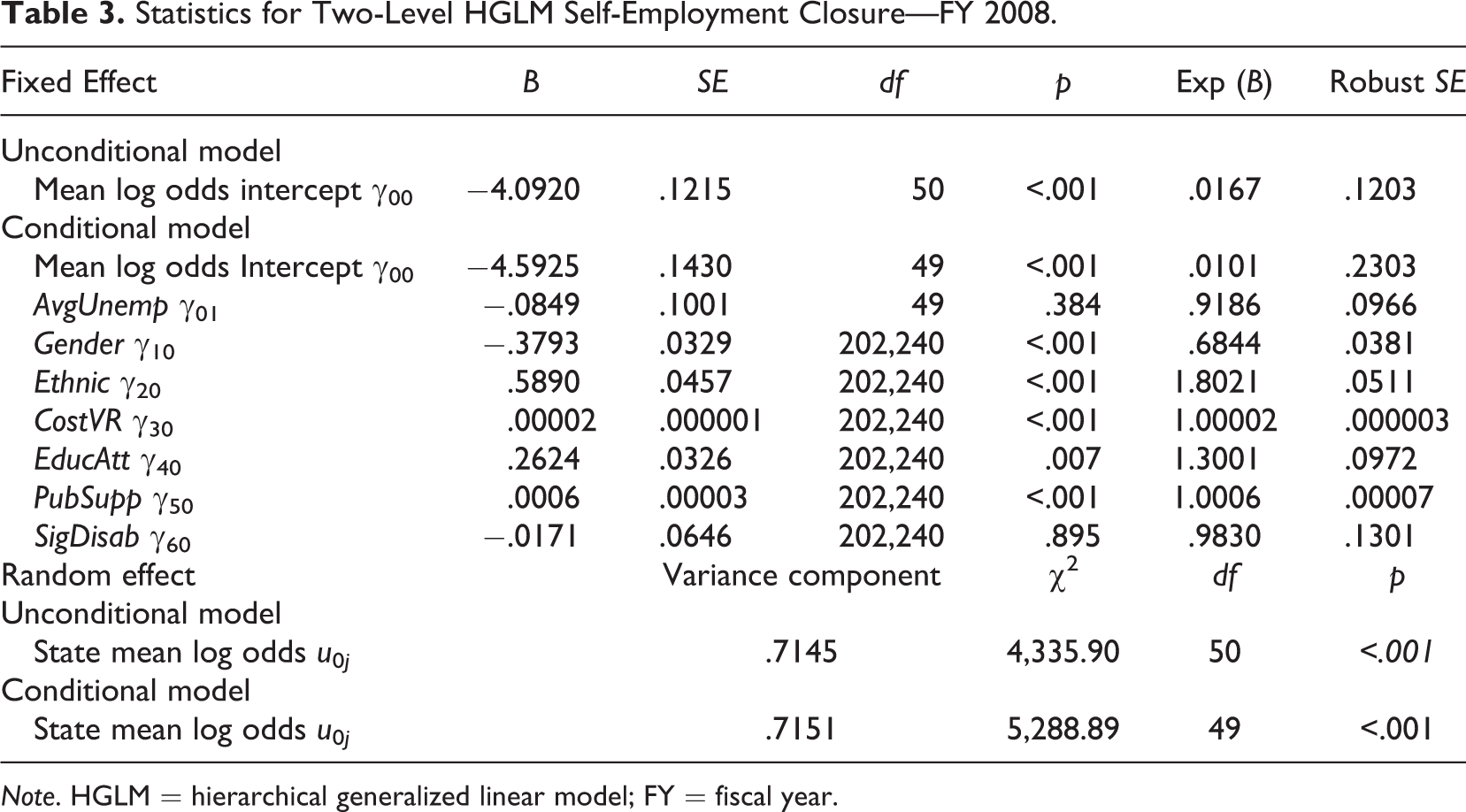
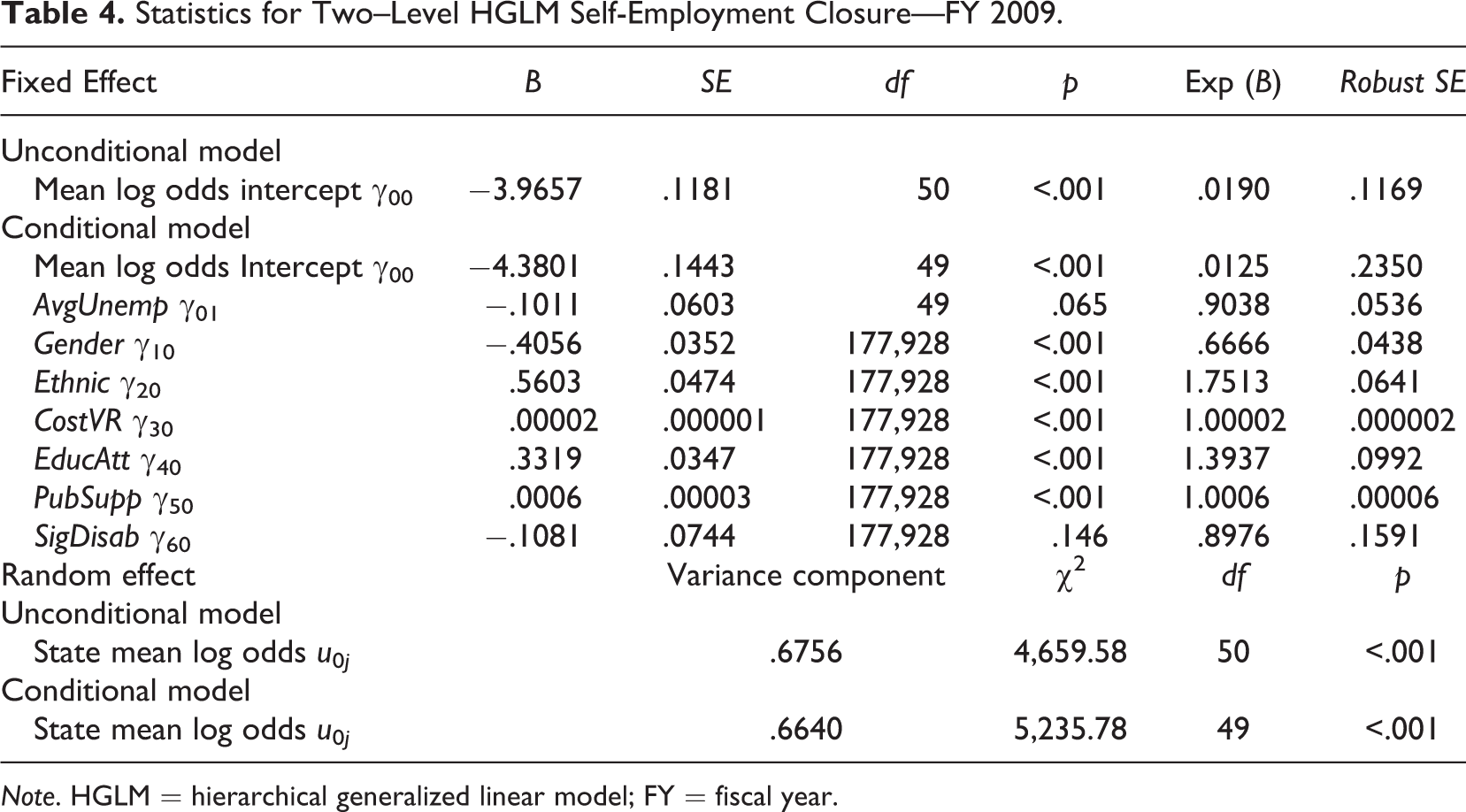
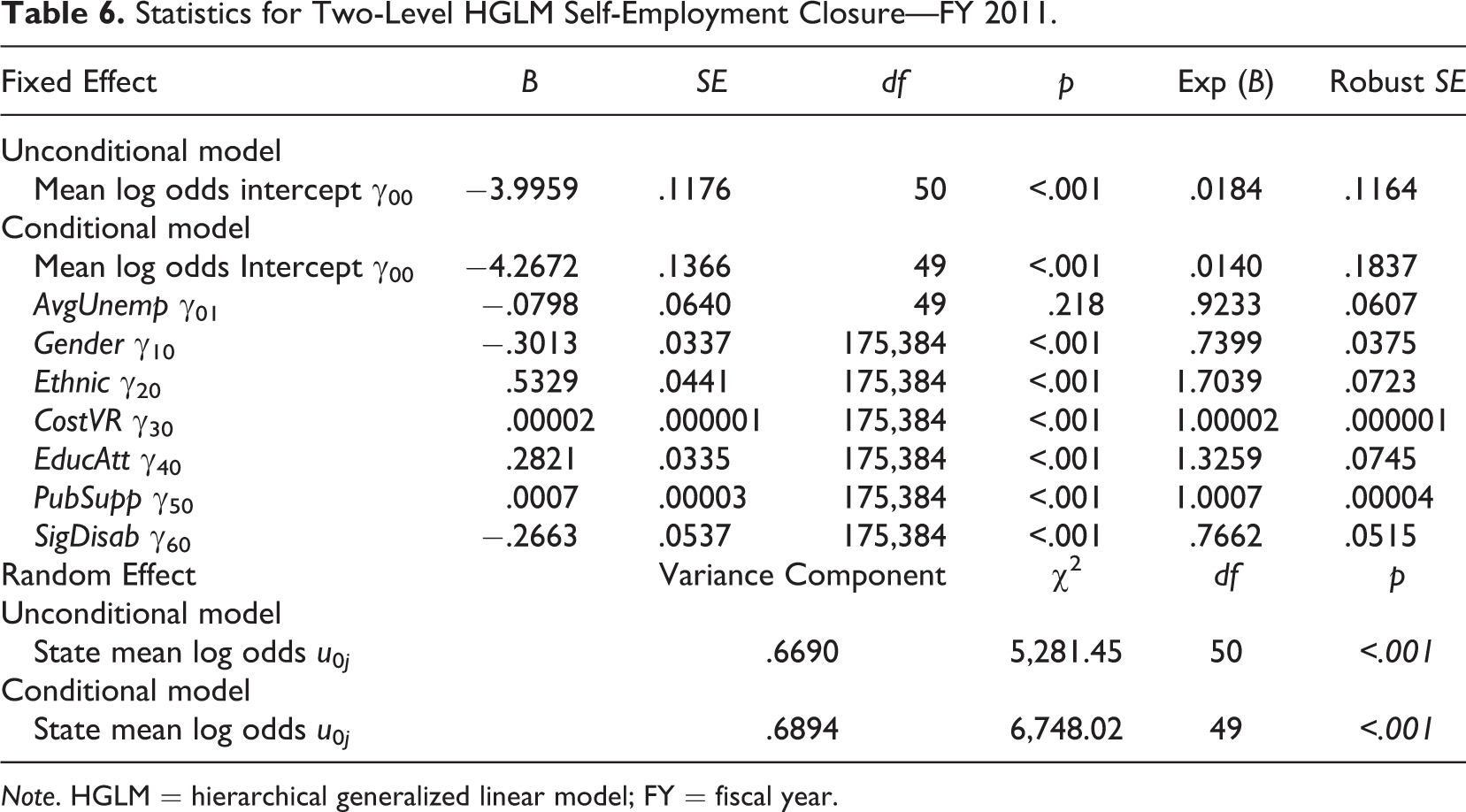
The results of the HGLM analysis are presented next for the three research questions. The results are also reported by FY in Tables 3–7.
Statistics for Two-Level HGLM Self-Employment Closure—FY 2008.
Note. HGLM = hierarchical generalized linear model; FY = fiscal year.
Statistics for Two--Level HGLM Self-Employment Closure—FY 2009.
Note. HGLM = hierarchical generalized linear model; FY = fiscal year.
Statistics for Two-Level HGLM Self-Employment Closure—FY 2010.

Note. HGLM = hierarchical generalized linear model; FY = fiscal year.
Statistics for Two-Level HGLM Self-Employment Closure—FY 2011.
Note. HGLM = hierarchical generalized linear model; FY = fiscal year.
Statistics for Two-Level HGLM Self-Employment Closure—FY 2012.

Note. HGLM = hierarchical generalized linear model; FY = fiscal year.
In FY 2009, significant predictors of self-employment closure were the same across the states. The estimated model-based and robust standard errors differed slightly for ethnicity model based (SE = .0474) and robust (SE = .0641) and gender model based (SE = .0352) and robust (SE = .0438). The difference was largest for the educational attainment at closure predictor model based (SE = .0347) and robust (SE = .0992). These differences, however, did not result in a change to predictor significance between the two models, as both were significant at p < .001.
In FY 2010, significant predictors of self-employment closure were the same across the states. The estimated model-based and robust standard errors differed slightly for gender model based (SE = .0337) and robust (SE = .0388) and ethnicity model based (SE = .0443) and robust (SE = .0500). The standard errors differed somewhat for educational attainment at closure model based (SE = .0333) and robust (SE = .0843), changing significance level from p < .001 to p = .002. Standard errors differed most for significant disability status model based (SE = .0559) and robust (SE = .1140), changing the predictor from significant at p < .001 to not significant at p = .083.
In FY 2011, significant predictors of self-employment closure were the same across the states. The estimated model-based and robust standard errors differed slightly for gender model based (SE = .0337) and robust (SE = .0375) and significant disability status model based (SE = .0537) and robust (SE = .0515). The standard errors differed somewhat for ethnicity model based (SE = .0441) and robust (SE = .0723) and educational attainment at closure model based (SE = .0335) and robust (SE = .0745). These differences, however, did not result in a change to predictor significance between two models as both were significant at p < .001.
In FY 2012, significant predictors of self-employment closure were the same across states. The estimated model-based and robust standard errors differed slightly for significant disability status model based (SE = .0532) and robust (SE = .0596). The standard errors differed somewhat for gender model based (SE = .0332) and robust (SE = .0473), ethnicity model based (SE = .0436) and robust (SE = .0703) and educational attainment at closure model based (SE = .0329) and robust (SE = .0933). These differences did not result in a change to predictor significance in the results of the two models, as both were significant at p < .001.
Finally, the measure of overdispersion (>1.0) and underdispersion (<1.0) of Level-1 variance, as indicated by the scalar variance component
Discussion
In this section, we discuss the results of the HGLM analyses for the three research questions, describe the limitations of the present study, and outline implications for stakeholders.
Research Questions
The purpose of this study was to identify predictors of VR clients’ successful self-employment case closures across recent years. To accomplish this purpose, we statistically analyzed the RSA data set using HGLM. As Gelman (2007) noted, “All models are wrong, and the purpose of model checking (as we understand it) is not to reject a model but rather to understand the ways in which it does not fit the data” (p. 349).
Among the significant predictors (p < .001) across the 5 years, ethnicity was the predictor with the strongest effects (i.e., odds ratio) on self-employment closure, followed by gender and educational attainment. Ethnicity was associated with higher log odds of self-employment closure, holding constant other predictors and the random effect u
0j
. The estimated regression coefficient values of ethnicity,
Gender is associated with lower log odds of self-employment closure, holding constant other predictors and the random effect, u
0j
. The estimated regression coefficient values of gender,
Educational attainment was associated with higher log odds of self-employment closure, holding constant other predictors and the random effect, u
0j
. The estimated regression coefficient values of educational attainment,
The two remaining significant predictors across the 5 years were (a) cost of VR services and (b) dollar amount of public supports. Although these predictors cannot be compared directly across the years because the dollar values were not adjusted for inflation (e.g., consumer price index), their effect on clients’ self-employment closure can be interpreted. Cost of VR services was associated with higher log odds of self-employment closure, holding constant other predictors and the random effect, u
0j
. Estimated regression coefficients of the predictor,
Public supports were associated with higher log odds of self-employment closure, holding constant other predictors and random effect, u
0j
. Estimated regression coefficients of public supports,
The results of the analysis for Research Question 1 reveal that, although individual characteristics place some VR clients ahead of others in their likelihood of self-employment case closure, and that White male clients with postsecondary education are most likely to achieve VR self-employment closure, which confirms previous studies (e.g., Yamamoto & Alverson, 2013), VR clients still are significantly more likely to achieve case closure in other employment. Case closure in self-employment continues to be extremely rare within VR, between 2% and 3% annually in the United States since the 1990s (Ipsen et al., 2005; Schriner & Neath, 1996). This is also consistent with a previous analysis of predictors of VR self-employment closure (see Yamamoto & Alverson, 2013). The very low closure rate, which has remained consistent over many years including during the recent recession and recovery, could be explained by bureaucratic inertia or other factors within the VR system, in light of the higher rates of self-employment for individuals with disabilities outside the VR system (President’s Committee on Employment of People with Disabilities, 2000).

National VR self-employment rates for FY 2008–2012.

National VR case closure rates for FY 2008–2012.
As described in the Method section, a two-step HGLM was used to analyze the RSA data, first by specifying an unconditional model (i.e., analysis without predictors), followed by a conditional model in which predictors were specified. In the unconditional models across the 5 years, the estimated log odds of self-employment closure,
When examining differences among states’ conditional models for VR self-employment rates across the 5 years, the estimated variance of the states’ mean log odds of self-employment closure,
Limitations
No causal inferences can or should be drawn from the present study. As with any study using extant data, the data source is a limitation of the present study. The RSA requires each state to examine the data they submit for accuracy using two available editing programs (RSA, 2008), however, there is neither a mechanism for ensuring compliance nor a mechanism for ensuring all 50 states and DC conform to the same standard of data collection and reporting. These RSA data were constrained by the limited number and types of variables, and the analysis included a small number of recent years, FY 2008–2012.
Another limitation is that model misspecification in the HGLM analysis may be present as suggested by differences in the model-based and robust standard errors. Although only one predictor, significant disability status, was significantly affected, other predictors at Level 1 and Level 2 could improve model fit, while also taking due care to ensure model parsimony and avoid overfitting—predictors such as socioeconomic status or state-level economic covariates. Additional random Level-2 effects, such as those for ethnicity and educational attainment, also could be tested in subsequent analyses. In the present study, only the intercept (log odds of self-employment closure) was specified to randomly vary across states by a priori research questions.
Implications for Researchers
Understanding which variables contribute to successful VR case closure in self-employment is important for researchers, in order to understand how self-employment experience and outcomes in the VR system can differ based on the association and effects of particular individual and system factors. This study was unique in terms of its analytic approach and scope, with more than a million cases across five FYs analyzed using HGLM. Because these data are an annual “census” of VR services in the United States, they should be analyzed regularly to describe the status of self-employment and its correlates at client and state levels for multiple years to enable empirical replications and cross validations. Researchers can use these analyses to develop and test specific theories about self-employment of individuals with disabilities through VR. This study set the stage for additional analyses, as the most recent FY data from the RSA become available, to empirically confirm or refute these findings.
Although adhering to the parsimony principle, “given two different models with similar explanatory power for the same data, the simpler model is preferred” (Kline, 2005, p. 137), future research should examine additional variables that could influence self-employment closures. For example, additional variables potentially affecting self-employment closures could include client age at closure or some variable related to a client’s decision to become self-employed. Within the systems domain, the state’s cost of living, or the types of industries in the state may also affect self-employment closures. Additional support variables could include the availability of or proximity to other agencies that affect self-employment closures.
As noted previously, this study does not delve into the reasons for why self-employment case closures are not higher within the VR system. Rather, we are establishing an empirical baseline of VR self-employment closure patterns across the United States over time from which further analyses can begin to develop meaningful theoretical explanations. Given the paucity of empirical studies on the topic and the potential personal and economic impacts of employment choice and self-determination on individuals with disabilities, understanding why VR self-employment closures are very low would be informative to the field and should be the subject of future empirical studies.
Footnotes
Declaration of Conflicting Interests
The author(s) declared no potential conflicts of interest with respect to the research, authorship, and/or publication of this article.
Funding
The author(s) disclosed receipt of the following financial support for the research, authorship, and/or publication of this article: This study was supported by a research fellowship from the National Science Foundation, grant number SMA-1103370.