



Abstract
The purpose of the present study is to extend the literature on social cognitive career theory (SCCT) by examining (a) the applicability of SCCT for African Americans with constructs defined in terms of Holland’s realistic, investigative, artistic, social, enterprising, and conventional (RIASEC) themes and (b) the role of specific learning experiences (performance accomplishments, vicarious learning, and verbal persuasion) in the formation of corresponding self-efficacy and outcome expectations. Structural equation modeling (SEM) results based on a sample of 208 African American college students revealed support for hypothesized relations of self-efficacy with outcome expectations, self-efficacy and outcome expectations with interests and choice goals, and interests with choice goals for all six RIASEC themes. Results revealed partial support for the hypothesized relations of learning experiences with self-efficacy and outcome expectations. Finally, results indicated limited support for the hypothesis that verbal persuasion would be a stronger positive predictor of self-efficacy and outcome expectations than would performance accomplishments and vicarious learning. These findings offer preliminary support for the applicability of SCCT in explaining African American college students’ RIASEC-based interest development and career choice goals. Implications of the findings for career counseling interventions and future research are discussed.
African Americans continue to be underrepresented in the career development literature; consequently, there is a relative scarcity of knowledge about African Americans’ career development process and how best to facilitate their career learning and growth (Owens, Lacey, Rawls, & Holbert-Quince, 2010; Walsh, Bingham, Brown, & Ward, 2001). One reason for this scarcity is that some influential career theories (e.g., Holland, 1997) may not adequately account for the background and contextual factors that contribute to the career development of racial/ethnic minority groups, including African Americans. Social cognitive career theory (SCCT; Lent et al., 1994) is one career theory that has shown success in accounting for the unique career development experiences of diverse populations (e.g., Byars-Winston, Estrada, Howard, Davis, & Zalapa, 2010; Flores, Robitschek, Celebi, Anderson, & Hoang, 2010; Gainor & Lent, 1998; Lent et al., 2005; Lent, Lopez, Sheu, & Lopez, 2011; Lent, Sheu, Gloster, & Wilkins, 2010; Waller, 2006).
SCCT
Based on Bandura’s (1986) social cognitive theory, SCCT emphasizes the role of self-efficacy and outcome expectations in the formation of career-related interests and choice goals and the attainment of career-related performance outcomes. SCCT posits that one’s interests, choices, and performance are impacted (directly, indirectly, or both) by contextual factors throughout the academic and career development process (Lent, Brown, & Hackett, 2000). For example, SCCT asserts that person inputs (e.g., gender) and background contextual factors (e.g., social class) contribute to self-efficacy beliefs and outcome expectations through relevant learning experiences (i.e., personal performance accomplishments, vicarious learning, verbal persuasion, and physiological states). These self-efficacy beliefs and outcome expectations subsequently contribute to the formation of academic and career-related interests, which, in turn, influence the development of relevant choice goals and eventual performance.
Given its consideration of contextual as well as internal personal factors, SCCT has been utilized by a small number of scholars to examine the career development of predominantly or exclusively African American samples, with results generally supportive of SCCT-based propositions (Alliman-Brissett & Turner, 2010; Gainor & Lent, 1998; Lent et al., 2005, 2011; Lent, Sheu, et al., 2010; Waller, 2006). Much of the published SCCT research on African Americans has focused on the development of math- and science-related interests and choices because African Americans continue to be underrepresented in science, technology, engineering, and math (STEM) occupations (National Science Foundation, 2013). Although SCCT studies of African Americans’ consideration of STEM careers clearly are important, little is known about how SCCT applies to other non-STEM-related domains for African Americans.
Research examining relations among SCCT constructs measured for Holland’s (1997) realistic, investigative, artistic, social, enterprising, and conventional (RIASEC) themes has generally supported the application of the SCCT framework to non-STEM domains (Flores et al., 2010; Lent, Brown, Nota, & Soresi, 2003; Lent, Paixão, da Silva, & Leitão, 2010; Schaub & Tokar, 2005; Sheu et al., 2010). However, the applicability of SCCT to the RIASEC domains for African Americans specifically remains unclear. Given the ubiquity of Holland’s (1997) RIASEC themes in popular career assessment inventories, the importance of testing hypothesized relations among SCCT constructs scored for the RIASEC domains is obvious. Thus, the general purpose of this study is to extend current understanding of SCCT’s applicability to RIASEC domains for African American college students.
The Role of Learning Experiences in SCCT
Recall that self-efficacy beliefs and outcome expectations—the central sociocognitive variables in SCCT—are posited to be directly and uniquely influenced by each of four corresponding, career-relevant learning experiences (personal performance accomplishments, vicarious learning, verbal persuasion, and physiological states). SCCT further posits that personal performance accomplishments are the strongest unique predictor of self-efficacy and outcome expectations. Curiously, these important SCCT relations have received limited empirical scrutiny, and only one published study (Gainor & Lent, 1998) has examined the relationships with African Americans. In partial support of SCCT propositions, Gainor and Lent (1998) found that African American college students’ math self-efficacy was uniquely predicted by verbal persuasion and physiological arousal but not by prior performance accomplishments or vicarious learning. In addition, they found that only verbal persuasion uniquely predicted math outcome expectations. In a similar study based on mostly White students, Lopez, Lent, Brown, and Gore (1997) found that math self-efficacy was uniquely predicted by personal performance accomplishments and verbal persuasion but not by vicarious learning or physiological arousal. The inconsistent findings of this pair of studies call into question SCCT’s propositions regarding the influence of learning experiences on self-efficacy and outcome expectations; however, their generalizability to other domains is limited because both studies focused exclusively on the math domain.
Extending this line of inquiry, Schaub and Tokar (2005) and Williams and Subich (2006) related learning experiences to self-efficacy and outcome expectations scored for Holland’s (1997) RIASEC themes. Consistent with SCCT propositions, results of both studies generally revealed moderate to strong positive relationships of learning experiences to self-efficacy and outcome expectations and suggested that the relationship of learning experiences to outcome expectations is at least partially mediated by self-efficacy. Williams and Subich (2006) also found that performance accomplishments explained more variance in self-efficacy (but not outcome expectations) than did the other learning experiences, thus providing partial support for these SCCT hypotheses. Although the results of this pair of studies support several SCCT hypotheses regarding the role of learning experiences, they are limited by the predominantly White samples on which they were based. Given the unique learning experiences of racial–ethnic minorities, including African Americans (Gainor & Lent, 1998; Hackett & Byars, 1996), research on the role of RIASEC-based learning experiences in the development of corresponding efficacy beliefs and outcome expectations among diverse populations clearly is warranted.
Examining the experiential sources of self-efficacy and outcome expectations may be of particular importance for African Americans. In their discussion of math-based careers, Alliman-Brissett and Turner (2010) suggested that African Americans’ experience of racism (e.g., harmful academic treatment) may result in differential access to career-related experiences (e.g., encouragement to take advanced math classes) that would foster interest in and help prepare them for math-based careers. Similarly, Hackett and Byars (1996) discussed how socialization experiences frequently encountered by African Americans (particularly women) may affect the career-relevant learning experiences to which they are exposed, which can either facilitate or hinder the development of self-efficacy and positive outcome expectations. For example, African Americans often experience unpredictable environments where rewards and punishments regarding their performance are inconsistent or inaccurate. Such feedback may weaken the SCCT-posited associations of personal performance accomplishments with self-efficacy and outcome expectations. Hackett and Byars (1996) also noted that African Americans’ limited exposure to culturally similar (and therefore more influential) career role models may diminish the impact of vicarious learning on self-efficacy and outcome expectations. Conversely, one of the most powerful sources of self-efficacy among African American children is verbal encouragement/discouragement, with girls being particularly influenced by verbal messages from their mothers (Hackett & Byars, 1996). The suggestion that parental verbal persuasion may be a particularly salient source of African Americans’ career self-efficacy and outcome expectations has received preliminary empirical support. Recall that verbal persuasion was one of two learning experiences (along with physiological arousal) to uniquely predict African American students’ math self-efficacy, and it was the only unique predictor of their math outcome expectations (Gainor & Lent, 1998).
In sum, it is unclear to what extent each of the learning experiences posited by Bandura (1986) contributes to African Americans’ self-efficacy and outcome expectations for domains other than math. Thus, the present study extends current understanding of the sources of African Americans’ self-efficacy beliefs and outcome expectations by relating RIASEC-based learning experiences to corresponding self-efficacy beliefs and outcome expectations in a sample of African American college students.
Present Study
The general purpose of the present study is to further current understanding of the applicability of SCCT for African Americans. We examined the relationships of the SCCT variables of learning experiences, self-efficacy, outcome expectations, interests, and career choice goals, as depicted in Figure 1. This study extends the empirical research on SCCT with African Americans by (a) assessing SCCT constructs for Holland’s (1997) RIASEC typology and (b) examining the unique contributions of different learning experiences to African Americans’ self-efficacy beliefs and outcome expectations. We chose not to include physiological arousal—Bandura’s (1986) fourth source of self-efficacy and outcome expectations—because previous research (Tokar, Buchanan, Subich, Hall, & Williams, 2011) has called into question the construct validity of the physiological arousal subscales of the learning experiences questionnaire (LEQ; Schaub, 2004), the only currently available measure of RIASEC-based learning experiences. Based on SCCT and the extant empirical research (e.g., Gainor & Lent, 1998), we examined the following hypotheses for each of the six RIASEC themes: (1) each of the learning experiences will have a direct and positive relation to self-efficacy and outcome expectations, and part of the relation of learning experiences to outcome expectations will be mediated through self-efficacy; (2) self-efficacy will have a direct and positive relation to outcome expectations; (3) self-efficacy and outcome expectations each will have a direct and positive relation to interests, and part of self-efficacy’s relation to interests will be mediated through outcome expectations; (4) self-efficacy and outcome expectations each will have a direct and positive relation to choice goals, and those relations will be partially mediated through interests (self-efficacy’s relation to choice goals also will be partially mediated through outcome expectations); (5) interests will have a direct and positive relation to choice goals; and (6) verbal persuasion will be a stronger positive predictor of self-efficacy and outcome expectations than will performance accomplishments and vicarious learning.

Standardized path coefficients for the realistic/investigative/artistic/social/enterprising/conventional models. PA = performance accomplishments; VL = vicarious learning; VP = verbal persuasion. *p < .05.
Method
Participants
The sample consisted of 208 students (130 women and 78 men) enrolled at a large, public, Midwestern university. Participants ranged in age from 18 to 43 years (M = 21.1, SD = 2.9). The majority (98.1%) of participants identified as African American, with 1.9% identifying as biracial/multiracial. In terms of socioeconomic status, the largest percentage of the sample (24.4%) identified as middle class. The median self-reported grade point average was 2.8 (SD = 0.44) out of a 4.0 scale, and the median self-reported Scholastic Aptitude Test score was 1091.2 (SD = 175.5). In all, 59 academic majors, categorized into 10 academic areas, were represented in this sample.
Instruments
LEQ
Learning experiences were measured with the LEQ (Schaub, 2004), a rationally derived measure that consists of 120 items designed to measure recollections of the aforementioned four types of learning experiences for the six Holland (1997) themes. Each RIASEC theme includes 20 items (five for each type of learning experience) rated on a 6-point scale ranging from 1 (strongly disagree) to 6 (strongly agree). A sample item includes, “I have made repairs around the house” (realistic performance accomplishments). Subscale scores are calculated by summing the items, with higher scores indicative of more learning experiences. In the current study, only the performance accomplishments, vicarious learning, and verbal persuasion subscales were used. Williams and Subich (2006) reported LEQ subscale α reliability estimates ranging from .58 to .86 (mdn α = .70) and found LEQ subscale scores to be positively related to scores on corresponding measures of self-efficacy and outcome expectations.
Occupational Outcome Expectations (OOE)
Outcome expectations were assessed with the OOE (Gore & Leuwerke, 2000), a self-report measure that includes 84 occupational titles, with 14 representing each of Holland’s (1997) six RIASEC types. Respondents indicated the “degree to which they would get what they wanted” from each of the occupational titles using a 9-point scale ranging from 1 (not very much) to 9 (very much). Outcome expectation scores for the Holland types are the summed responses of the 14 items for each scale. Possible scores ranged from 14 to 126, with higher scores corresponding to more positive outcome expectations. Gore and Leuwerke (2000) reported OOE α reliability estimates ranging from .91 (realistic) to .96 (conventional), and Gore (1996) found OOE scores to be positively related to scores on corresponding measures of self-efficacy, interests, and choice goals.
Occupational Self-Efficacy (OSE)
Self-efficacy was measured with a slightly modified version of Gore and Leuwerke’s (2000) occupational self-efficacy beliefs (OSB) measure. The modified OSB consisted of the same 84 occupational titles as those comprising the OOE, with the same 14 occupations representing each of Holland’s (1997) RIASEC themes. However, to simplify the directions and scoring, a modification to the instructions was made. Following Lent, Brown, Nota, and Soresi (2003), who developed a self-efficacy measure from a subset of Gore and Leuwerke’s (2000) OOE items, the instructions read, “Indicate how much confidence you have in your ability to become a successful worker in each of these occupations.” Responses were given on a 9-point scale (1 = no confidence, 9 = complete confidence) with higher scores indicating greater self-efficacy beliefs. Self-efficacy scores for the Holland types were calculated by summing the responses of the 14 items for each scale, with possible scores ranging from 14 to 126. Gore and Leuwerke (2000) reported α reliability estimates ranging from .89 (artistic) to .95 (investigative) for scores on the OSB. Gore (1996) found OSB scores to be positively related to scores on corresponding measures of outcome expectations, interests, and choice goals.
Interests
Interests were assessed using the same 84 occupational titles used in Gore and Leuwerke’s (2000) self-efficacy and outcome expectations measures. Following the template of Lent et al.’s (2003) interest measure (a modified version of Gore and Leuwerke’s [2000] self-efficacy and outcome expectations measures), the interest measure asked participants to indicate how much “You think you would like or dislike the work activities that people in each of these occupations perform.” Responses were given on a 9-point scale ranging from 1 (strongly dislike) to 9 (strongly like) with higher scores indicating greater corresponding interests. Vocational interest scores for the Holland types were calculated by summing the responses of the 14 items for each scale, with possible scores ranging from 14 to 126. Lent et al. (2003) reported α reliability estimates ranging from .80 (realistic) to .94 (conventional) for scores on their interest measure. In addition, Lent et al. (2003) found scores on the measure to be related to scores on measures of social supports, social barriers, self-efficacy, outcome expectations, and choice considerations in ways consistent with SCCT hypotheses.
Choice Goals
Choice goals were assessed with the same 84 occupational titles from Gore and Leuwerke’s (2000) self-efficacy and outcome expectations measures. Consistent with Lent et al.’s (2003) 42-item occupational consideration measure (a modified version of Gore and Leuwerke’s self-efficacy and outcome expectations measures), participants were asked to indicate “how seriously you would consider” each occupation “as a possible career for yourself.” Responses were given on a 9-point scale ranging from 1 (not very seriously) to 9 (very seriously), with higher scores indicating greater corresponding choice goals. Choice goal scores for the Holland types were calculated by summing the responses of the 14 items for each scale, with scores ranging from 14 to 126. Lent et al. (2003) reported α reliability estimates ranging from .85 (realistic and artistic) to .94 (conventional) for scores on the choice consideration measure. In addition, Lent et al. (2003) found scores on the measure to be related to scores on measures of social supports, social barriers, self-efficacy, outcome expectations, and interests in ways consistent with SCCT hypotheses.
Procedure
A total of 219 participants individually completed a research packet containing the measures described above. The order of the instruments was counter-balanced to control for possible order effects. Participants completed the instruments at a cultural center and were paid US $10 for completing the survey packet. Data of 11 participants were excluded from analyses because of excessive missing data or their data evidenced a pattern of careless or extreme responding (e.g., a long series of alternating extreme responses [e.g., “1” then “9” responses on a 1–9 rating scale]), resulting in a final usable sample of 208 participants.
Sample Size
Several sources were consulted to determine the minimum sample size needed for SEM and confirmatory factor analyses (CFAs). Weston and Gore (2006) recommended at least 200 participants for any SEM analysis. MacCallum, Browne, & Sugawara (1996) provided a method for determining the required sample size to achieve desired power based on degrees of freedom and the null hypothesis being tested (e.g., close model fit, not-close model fit). Using MacCallum et al.’s framework, a minimum sample size of 155 is necessary to achieve power of .80 to evaluate the hypothesis of close fit for the hypothesized structural model (df = 78), and a minimum sample size of 165 is necessary to achieve power of .80 for the hypothesized measurement model (df = 72). Therefore, we concluded that our final sample size of 208 was adequate for the primary analyses.
Results
Preliminary Analyses and Descriptive Statistics
Descriptive analyses revealed that 0.83% of the total item–level data points to be scored for the seven variables of interest were missing. Missing data ranged from a low of 0.18% for vicarious learning and verbal persuasion learning experiences to a high of 1.21% for outcome expectations. Results of Little’s (1988) test indicated that the data were missing completely at random (MCAR), χ2(62,890) = .000, p = 1.00. Missing data were handled using participant mean substitution, a method that has been shown to perform equivalently to more sophisticated methods (e.g., multiple imputation), particularly in data sets such as the current one with low levels of missing data and a sizable (i.e., N
Scores for all variables satisfied assumptions of univariate normality (i.e., absolute skew
Descriptive Statistics and Internal Consistency Estimates for All Measures.
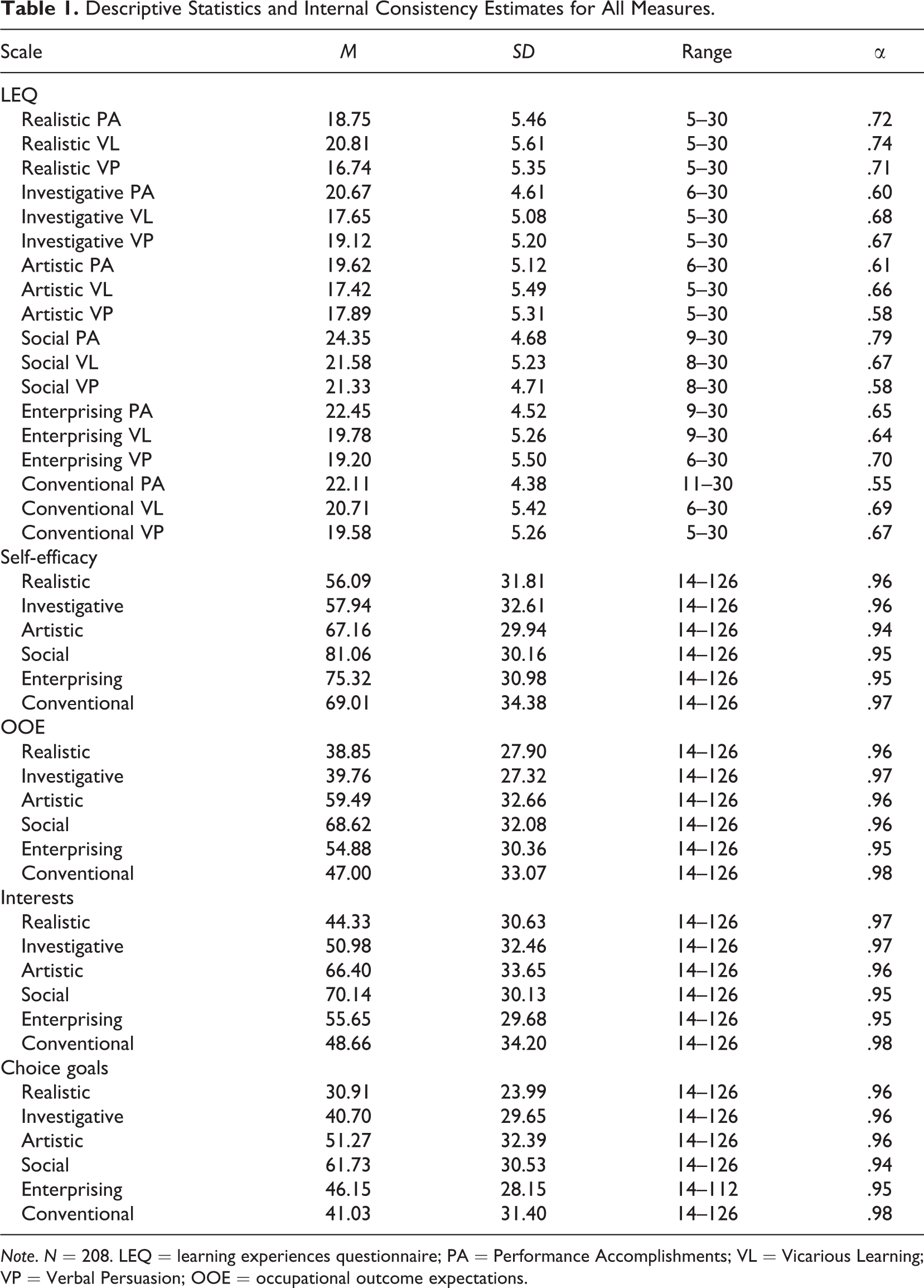
Note. N = 208. LEQ = learning experiences questionnaire; PA = Performance Accomplishments; VL = Vicarious Learning; VP = Verbal Persuasion; OOE = occupational outcome expectations.
We created three observed indicator variables (i.e., item parcels) for the latent variables of self-efficacy, outcome expectations, interests, and choice goals. Due to the small number of items composing each LEQ subscale, we used measured indicators for the three learning experiences variables (i.e., performance accomplishments, vicarious learning, and verbal persuasion). Balanced parcels were created by factor analyzing to a single-factor solution the items composing each measure (e.g., realistic self-efficacy) and then combining items based on their factor loadings (e.g., items with the highest, lowest, and median loadings were averaged to form a parcel; see Russell, Kahn, Spoth, & Altmaier, 1998).
Measurement Models
Prior to testing our hypothesized structural model, we performed a series of CFAs to evaluate three alternative structural representations of the data. For all models tested, the learning experiences variables were represented as single manifest variables while 12 item-parcel indicators (i.e., three for each of the four latent constructs) served as observed indicators of the latent variables. The first model tested was a four-factor oblique model (see Figure 1). The second model tested was a correlated two-factor model that included a latent construct represented by self-efficacy and outcome expectations (with three self-efficacy parcels and three outcome expectations parcels as measured indicators) and a latent construct represented by interests and choice goals (with three interests parcels and three choice goals parcels as measured indicators). The third model tested was a one-factor model that included a latent construct represented by self-efficacy, outcome expectations, interests, and choice goals (with 12 manifest indicators, i.e., the four sets of three parcels developed from measures of self-efficacy, outcome expectations, interests, and choice goals). Each of the three models was tested for each of the six RIASEC themes.
It was important to test the alternative measurement models because our measures of self-efficacy, outcome expectations, interests, and choice goals were based on the same 84 occupational titles. Thus, it was possible that those four sets of RIASEC measures represented fewer than four latent constructs. We tested the two-factor model to examine the possibility that the self-efficacy and outcome expectations measures might reflect a more general sociocognitive mechanism (i.e., self-efficacy + outcome expectations) construct. Similarly, it seemed possible that interests and choice goals might be better represented by a single career intentions (i.e., interests + choice goals) construct. We tested the one-factor model because it seemed possible that self-efficacy, outcome expectations, interests, and choice goals measures might represent more general RIASEC-themed constructs (e.g., realistic self-efficacy + outcome expectations + interests + choice goals).
Model-data fit was evaluated using the χ2 goodness-of-fit test, comparative fit index (CFI), root mean square error of approximation (RMSEA), and standardized root mean square residual (SRMR). CFI values
CFA results revealed that the four-factor measurement model provided at least an adequate fit to the data (based on CFI and SRMR values) for each of the six RIASEC themes (see Table 2). Conversely, the alternative two-factor and one-factor measurement models demonstrated poor model-data fit. Furthermore, results of the Satorra–Bentler scaled χ2 difference test indicated that the four-factor model fit the data significantly better (p < .0001) than did either the two-factor model or the one-factor model for each of the six RIASEC themes. Although results of model comparisons indicated that the hypothesized four-factor model provided the best relative fit to the data, RMSEA values exceeded the recommended cutoff of .10 for the artistic and social models. Therefore, to achieve a conventionally good fit to the data, we made a number of minor modifications to the four-factor artistic and social measurement models based on the empirical modification indices as well as conceptual considerations. Specifically, for each model, we allowed five sets of errors (i.e., uniquenesses) to covary. These sets of errors were allowed to covary because in each case the corresponding indicator variables shared a minimum of two occupational titles, which constituted an additional, legitimate source of common variance. The minor modifications resulted in an adequate fit for the artistic and social models (see Table 2; it should be noted that the additional correlated errors did not meaningfully alter the other parameter estimates in the measurement or subsequent structural models). Factor loadings for the six 4-factor measurement (including modified artistic and social) models were as follows: realistic (.93–.97), investigative (.90–.98), artistic (.90–.97), social (.90–.96), enterprising (.88−.98), and conventional (.95–.98). Collectively, CFA results supported the representation of self-efficacy, outcome expectations, interests, and choice goals as four related but distinct constructs for each RIASEC theme.
Summary of Six Realistic, Investigative, Artistic, Social, Enterprising, and Conventional Model Fit Indices.
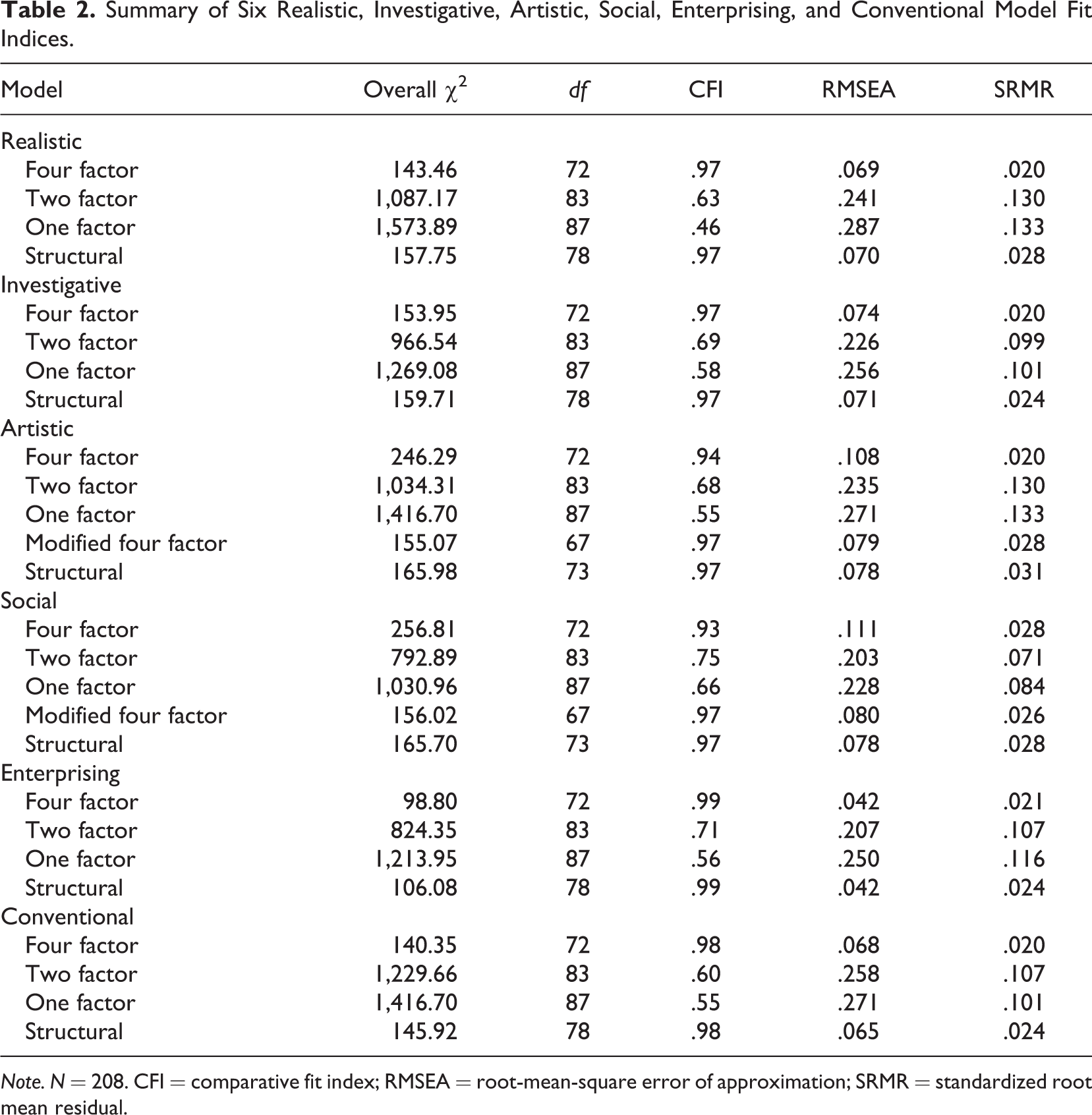
Note. N = 208. CFI = comparative fit index; RMSEA = root-mean-square error of approximation; SRMR = standardized root mean residual.
Structural Models
SEM was conducted using Mplus Version 7.0 and the MLR estimation method to test the fit to the data of our six hypothesized RIASEC models (see Figure 1). Standardized path coefficients were examined to test the significance (p < .05) of the hypothesized direct effects. A bootstrapping procedure was used to test the significance of the hypothesized indirect effects. This procedure generated 1,000 bootstrap draws of the original data and computed bias-corrected 95% confidence intervals (CIs) for the indirect effects. CIs not containing zero indicate statistically significant (p < .05) indirect effects.
Model-data fit
The enterprising model fit the data well, whereas the realistic, investigative, artistic, social, and conventional models demonstrated adequate fit to the data (see Table 2). For each of the RIASEC models, a large proportion of variance in choice goals was accounted for by the combination of learning experiences, self-efficacy, outcome expectations, and interests. Total R2 values for the models were .63 (realistic), .71 (investigative), .62 (artistic), .72 (social), .73 (enterprising), and .74 (conventional).
Direct and indirect effects
As shown in Figure 1, the path coefficients revealed mixed support for the hypothesized direct effects involving learning experiences. Past performance accomplishments had a significant and positive direct effect on self-efficacy in the realistic (β = .42), artistic (β = .27), social (β = .21), and enterprising (β = .16) models, as hypothesized, but not in the investigative or conventional models. Results failed to support the hypothesized positive direct effect of performance accomplishments on outcome expectations in the realistic and artistic models and, contrary to our hypothesis, revealed a significant inverse direct effect of performance accomplishments on outcome expectations in the investigative (β = −.24), social (β = −.17), enterprising (β = −.24), and conventional (β = −.25) models. Vicarious learning had a significant and positive direct effect on investigative self-efficacy (β = .19), as hypothesized, but did not have a significant direct effect on self-efficacy in the other five models. As hypothesized, vicarious learning was a positive unique predictor of investigative (β = .15) and social (β = .18) outcome expectations; however, vicarious learning did not have a significant direct effect on outcome expectations in the artistic, enterprising, or conventional models and had a significant inverse direct effect on outcome expectations in the realistic model.
In support of our hypothesis, verbal persuasion had a significant and positive direct effect on self-efficacy in the artistic (β = .20), social (β = .16), and conventional (β = .26) models, and a significant and positive direct effect on outcome expectations in the realistic (β = .21) and enterprising (β = .18) models. Contrary to our hypothesis, however, verbal persuasion did not directly predict self-efficacy in the realistic, investigative, or enterprising models, or outcome expectations in the investigative, artistic, social, or conventional models.
Results also revealed partial support for the hypothesized indirect effect (via self-efficacy) of learning experiences on outcome expectations. Self-efficacy mediated the effect of performance accomplishments on outcome expectations in the realistic (β = .24), artistic (β = .19), and social (β = .15) models, the effect of vicarious learning on outcome expectations in the investigative model (β = .13), and the effect of verbal persuasion on outcome expectations in the artistic (β = .14) and conventional (β = .16) models (see Table 3). Collectively, findings indicated that the relation of performance accomplishments to outcome expectations was partially mediated by self-efficacy in the social model and fully mediated in the realistic and artistic models. The effect of vicarious learning on outcome expectations was partially mediated by self-efficacy in the investigative model. Finally, the effect of verbal persuasion on outcome expectations was fully mediated by self-efficacy in the artistic and conventional models.
Bootstrap Tests of Indirect Effects.
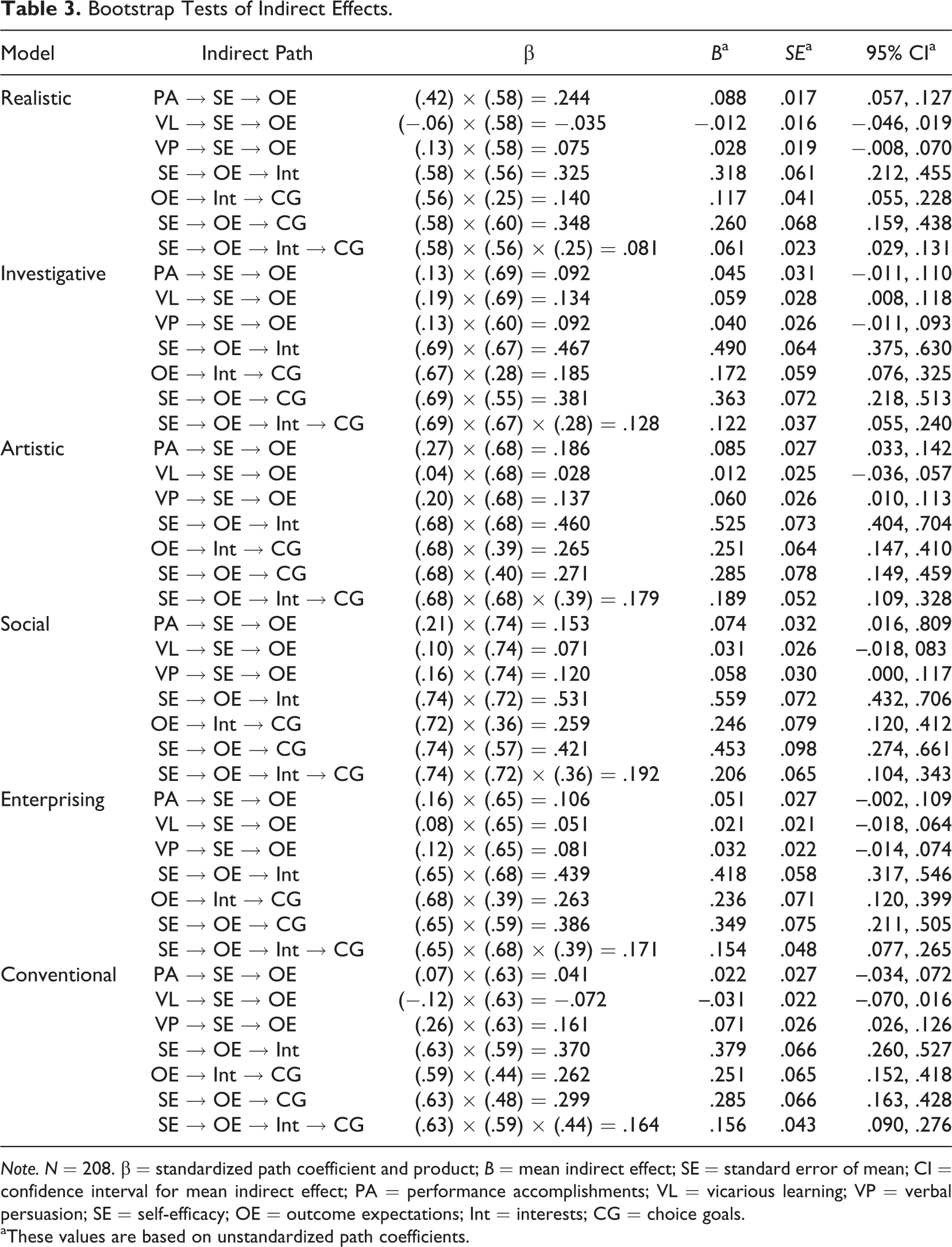
Note. N = 208. β = standardized path coefficient and product; B = mean indirect effect; SE = standard error of mean; CI = confidence interval for mean indirect effect; PA = performance accomplishments; VL = vicarious learning; VP = verbal persuasion; SE = self-efficacy; OE = outcome expectations; Int = interests; CG = choice goals.
aThese values are based on unstandardized path coefficients.
In all six models, self-efficacy had a positive and statistically significant direct relationship with outcome expectations (βs ranged from .58 to .74), as hypothesized. Also consistent with our hypotheses, significant and positive direct effects were found between outcome expectations and interests (βs ranged from .56 to .72) and between outcome expectations and choice goals (βs ranged from .40 to .60) for all six RIASEC models. As expected, interests partially mediated the influence of outcome expectations on choice goals in all six models (indirect effects ranged from .14 for realistic to .27 for artistic). Thus, outcome expectations related to choice goals both directly and indirectly for all six RIASEC themes.
Contrary to our hypothesis, none of the six RIASEC models revealed a significant direct relation between self-efficacy and interests (βs ranged from -.04 to .06). Consequently, the hypothesis that interests would partially mediate the relation between self-efficacy and choice goals was not further assessed through bootstrapping analyses. However, the indirect effect of self-efficacy on interests (via outcome expectations) was significant for each of the six models (indirect effects ranged from .33 for realistic to .53 for social). Thus, self-efficacy had all of its significant effect on interests through outcome expectations.
Contrary to our prediction, all six RIASEC models revealed a nonsignificant direct relation between self-efficacy beliefs and choice goals. For all six models, the effect of self-efficacy beliefs on choice goals was fully mediated by outcome expectations and interests. Specifically, the indirect path from self-efficacy to choice goals through outcome expectations was significant for each of the six models (ranging from .27 for artistic to .42 for social), as was the indirect path from self-efficacy to choice goals via both outcome expectations and interests (ranging from .08 for realistic to .19 for social). Thus, self-efficacy for each of the six Holland themes had all of its significant effect on corresponding choice goals indirectly through outcome expectations and interests. Lastly, a significant and positive direct relation was found between interests and choice goals for all six models (βs ranged from .25 to .44), as hypothesized.
Parameter estimate comparisons
Next, we compared the relative contributions of performance accomplishments, vicarious learning, and verbal persuasion to self-efficacy and outcome expectations in each of the RIASEC models in order to test our hypothesis that verbal persuasion would be the strongest predictor of self-efficacy and outcome expectations. These comparisons involved subtracting two standardized parameter estimates (e.g., the path coefficient from realistic performance accomplishments to realistic self-efficacy minus the path coefficient from realistic vicarious learning to realistic self-efficacy) and dividing the difference by the corresponding pooled standard errors. For each comparison, the result was a z-score, with z-critical = 1.96, p = .05, two-tailed. Z-tests were performed on pairs of parameter estimates that included at least one statistically significant and positive path coefficient.
Results indicated that performance accomplishments contributed significantly more strongly to self-efficacy than did vicarious learning in the realistic (z = 4.64, p < .001) and artistic (z = 1.961, p = .049) models but not in the social (z = 1.10, p = .271) or enterprising (z = .76, p = .447) models. Performance accomplishments had a stronger direct effect on self-efficacy than did verbal persuasion in the realistic (z = 2.67, p = .008) model but not in the artistic (z = .62, p = .535), social (z = .41, p = .682), or enterprising (z = .41, p = .682) models. Finally, verbal persuasion had a stronger direct effect on self-efficacy than did vicarious learning (z = 3.10, p = .002), but not performance accomplishments (z = 1.62, p = .105), in the conventional model.
Results revealed that vicarious learning contributed significantly more strongly to outcome expectations than did performance accomplishments in the investigative (z = 4.01, p < .001) and social (z = 4.15, p < .001) models; however, vicarious learning’s contribution to outcome expectations was not significantly greater than that of verbal persuasion in either the investigative (z =1.16, p = .246) or social (z = 1.91, p = .056) models. Verbal persuasion had a stronger direct effect on outcome expectations than did performance accomplishments (z = 3.16, p < .01) and vicarious learning (z = 4.07, p < .001) in the realistic model. Finally, verbal persuasion contributed significantly more to the prediction of outcome expectations than did performance accomplishments (z = 4.33, p < .001), but not vicarious learning (z = 1.61, p = .107), in the enterprising model.
Overall, these results revealed that performance accomplishment was the strongest unique predictor of self-efficacy in the realistic model, whereas verbal persuasion was the strongest unique predictor of outcome expectations in the realistic model. These results provide limited support for our hypothesis that verbal persuasion would be the strongest positive predictor of self-efficacy and outcome expectations.
Discussion
The purpose of the present study was to further current understanding of the applicability of SCCT for African Americans. We examined the relationships of the SCCT variables of learning experiences (i.e., performance accomplishments, vicarious learning, and verbal persuasion), self-efficacy, outcome expectations, interests, and choice goals for each of Holland’s (1997) RIASEC themes. Overall, we found that SCCT appears to be an appropriate theoretical framework for understanding African American students’ career development. Results provided support for a number of hypothesized relations in the SCCT career choice model when the constructs were defined in terms of RIASEC domains. Specifically, for all six RIASEC-themed models the results supported (a) the direct and/or indirect relations of one or more learning experiences to self-efficacy and outcome expectations; (b) the direct relation of self-efficacy to outcome expectations; (c) the direct and/or indirect relations of self-efficacy and outcome expectations to interests and choice goals; and (d) the direct relation of interests to choice goals. Finally, the results provided limited support for the hypothesis that verbal persuasion would be the strongest positive predictor of self-efficacy and outcome expectations. Following is a more detailed discussion of the major findings.
The Applicability of SCCT for African Americans Using Holland’s RIASEC Themes
Results of the SEM analyses revealed that the overall fit of the six models varied little by RIASEC theme, with all six models demonstrating an adequate or good fit to the data. In addition, results revealed mixed support for the hypothesized relations involving corresponding learning experiences, self-efficacy beliefs, outcome expectations, interests, and choice goals for each of the six Holland themes. Contrary to prediction, self-efficacy had most of its effect on interests and choice goals via outcome expectations and the combination of outcome expectations and interests, respectively. The observed total mediation of the effect of self-efficacy on interests (via outcome expectations) is both contrary to SCCT and inconsistent with previous findings based on mostly (Schaub & Tokar, 2005; Sheu et al., 2010) or exclusively (Lent et al., 2003) White/European samples. The current findings suggest that in our sample of African American college students, the effect of self-efficacy for RIASEC-based occupations on the development of corresponding interests is transmitted via the anticipated consequences of pursuing those occupations. This finding suggests that for African American college students it may be likely that self-efficacy beliefs play a more vital role in the formation of positive outcome expectations in comparison to the direct development of interests and choice goals.
Interestingly, the only hypothesized relation that demonstrated significant direct and indirect effects (via interests) across all six RIASEC themes involved the paths from outcome expectations to choice goals. Similar results have been found in studies that included African Americans as part of the sample (Fouad & Smith, 1996; Gainor & Lent, 1998; Lent et al., 2005; Sheu et al., 2010), as well as other studies using exclusively White/European samples (e.g., Lent et al., 2001, 2003). These results are consistent with SCCT’s proposition 4, which states that the relationship between outcome expectations and choice goals is both direct and indirect, via vocational interests. Somewhat surprisingly, however, the direct effect of outcome expectations on choice goals was as strong as (in the artistic model) or stronger (in the other five models) than the direct effect of interests on choice goals. According to Lent, Brown, and Hackett (1994), the relationship between outcome expectations and choice goals will be direct when individuals perceive their opportunity structure as one that does not afford them the option to set goals based on their interests. These individuals will set goals and make decisions based on their perceptions of the expected outcomes of a particular choice. For example, individuals who perceive their choices as being constrained by such things as academic performance or financial considerations are less likely to be influenced by their interests than by their outcome expectations. Our results suggest that the current sample of African American students may have perceived some barriers to the translation of their interests into choice goals. As posited by SCCT, the interest–goal relation will tend to be “weaker among those who perceive less favorable conditions” (Lent et al., 1994, p. 107).
The Role of Learning Experiences in SCCT
Given the paucity of research examining the relations of learning experiences to self-efficacy and outcome expectations, particularly with diverse samples, we sought to determine how each of Bandura’s (1986) specific learning experiences contributed to corresponding self-efficacy and outcome expectations for RIASEC domains with an African American sample and whether or not, as suggested by Hackett and Byars (1996), verbal persuasion may be more important than performance accomplishments in the formation of self-efficacy and outcome expectations for African American individuals. Overall, results involving relations of specific learning experiences with self-efficacy and outcome expectations indicated partial support for both the present study’s Hypothesis 6 (and thus Hackett & Byars’, 1996, predictions) and SCCT. Consistent with our hypothesis, verbal persuasion had the largest positive effect on realistic outcome expectations. However, consistent with SCCT, performance accomplishments had the largest positive effect on realistic self-efficacy. An unexpected finding was the consistent inverse (or nonsignificant) relation between performance accomplishments and outcome expectations. One possible explanation for the unexpected inverse relation between performance accomplishments and outcome expectations is statistical suppression. Comparing the bivariate correlations and predictor–criterion relations between these variables in the investigative (r = .07, β = −.24), social (r = .17, β = −.17), enterprising (r = .05, β = −.24), and conventional (r = −.15, β = −.25) models revealed support for a suppression effect in the investigative, social, and enterprising models. These findings, coupled with the significant indirect (via self-efficacy) yet positive effect of performance accomplishments on outcome expectations in the realistic, artistic, and social models, suggest that most of the positive effect of past performance accomplishments on African American students’ positive expectations for pursuing realistic, artistic, and social occupations is channeled through their confidence in their ability to succeed in those occupations.
Taken together, these findings suggest that for African American college students, the relative contributions of their learning experiences to subsequent self-efficacy beliefs and outcome expectations are domain specific. Importantly, contrary to SCCT, verbal persuasion—not personal performance accomplishments—contributed more strongly (and positively) to outcome expectations in the realistic model. This finding is somewhat consistent with those of Pearson and Bieschke (2001), who found in their qualitative study of familial factors influencing the career success of 14 African American women that verbal persuasion and vicarious learning, not performance accomplishments, were the most important learning experiences contributing to high self-efficacy and positive outcome expectations. The current findings and those of Pearson and Bieschke strongly suggest that further examination of the unique contributions of African Americans’ learning experiences to self-efficacy and outcome expectations is warranted.
Implications for Counseling
Although not all of our hypotheses were supported, results of this study support the applicability of SCCT by career researchers and counselors with African Americans. In terms of identifying important factors in the development of self-efficacy and outcome expectations, it is important for career counselors to adequately address the nature of their clients’ learning experiences. There is some support for the assertion that verbal persuasion is a vital learning experience for African American individuals and that encouragement about one’s abilities from mentors, family members, and significant others will help to enhance one’s self-efficacy and outcome expectations for RIASEC-based activities (Hackett & Byars, 1996; Pearson & Bieschke, 2001). Findings also suggest that role models are an important influence in the development of African Americans’ investigative self-efficacy as well as investigative and social outcome expectations. Career counselors should encourage their African American clients to identify and/or seek out family members and other positive role models, particularly those involved in investigative (e.g., STEM) careers and related activities, as these are careers in which African Americans are greatly underrepresented (Gainor & Lent, 1998; Lent et al., 2005).
Finally, the results of this study suggest that examining the role of outcome expectations is important when exploring African American clients’ career development. Results of this study suggest that outcome expectations contribute uniquely to the development of interests and choice goals. Thus, assessing clients’ expected outcomes for pursuing different academic/career goal(s) will be important to gain a more accurate understanding of their vocational choices.
Limitations and Implications for Future Research
Several limitations of this research should be addressed. First, this study used a cross-sectional design, and data were collected at a single point in time. Thus, causal relationships could not be established. Future researchers are encouraged to cross-validate the present study’s findings on independent samples and to consider using alternative (e.g., longitudinal, experimental) designs that can either test temporal precedence or causal relationships among the variables. Another limitation is that precursors of learning experiences were not included. In an effort to more thoroughly understand the role of learning experiences in SCCT for African Americans, it will be important for future researchers to examine how person inputs (e.g., personality) and background contextual factors (e.g., parental socioeconomic status) influence RIASEC-based learning experiences. An additional limitation is the use of duplicative occupational titles to measure self-efficacy, outcome expectations, interests, and choice goals for each of the RIASEC themes, which may have resulted in inflated parameter estimates involving these core SCCT variables. Indeed, some parameter estimates obtained in the current data (e.g., the direct effects from outcome expectations to interests and choice goals) were appreciably higher than those reported by Sheu et al. (2010) in their meta-analytic path analysis of SCCT constructs measured for RIASEC themes. Future researchers are encouraged to explore whether these differences were due to linked measurement of SCCT constructs or differences in the sample characteristics (e.g., race/ethnicity).
There are several additional directions for future research. First, given that this is one of only a handful of studies examining SCCT using an African American sample, it will be important for future researchers to conduct additional studies on African Americans as well as other racial/ethnic minority groups to establish the validity, and thus applicability, of SCCT for diverse populations. Second, given the domain-specific findings regarding the unique contributions of learning experiences to corresponding self-efficacy beliefs and outcome expectations, future researchers are encouraged to revisit the complex role of learning experiences in SCCT. Finally, researchers are encouraged to examine other variables of the SCCT model, including background (e.g., parental support, socioeconomic status) and proximal (e.g., educational climate) contextual factors that may facilitate or hinder African Americans’ career development.
Footnotes
Authors’ Note
Matthew D. Abrams and David M. Tokar contributed equally to this project. This article is based on the doctoral dissertation of Josephine Dickinson, under the direction of David M. Tokar.
Acknowledgments
We thank Sue Hardin, Sandy Perosa, John Queener, and Linda M. Subich for helpful feedback on this project. We also thank Phil Allen for statistical consultation, and Craig Libman and Sarah Sanders for help with data management.
Declaration of Conflicting Interests
The author(s) declared no potential conflicts of interest with respect to the research, authorship, and/or publication of this article.
Funding
The author(s) received no financial support for the research, authorship, and/or publication of this article.