



Abstract
Lent and Brown proposed a social cognitive career self-management process model that extended prior social cognitive career theory (SCCT) content models to explain the conditions under which people will engage in career management behaviors (e.g., career exploration). We tested the SCCT self-management model in the context of workplace sexual identity management. The model hypothesizes that engagement in sexual identity management strategies in the workplace is facilitated by strong sexual identity management self-efficacy beliefs and positive outcome expectations for engaging in sexual identity management behaviors. The model also posits that additional person and contextual variables will influence engagement in sexual identity management behaviors directly as well as indirectly via self-efficacy beliefs and outcome expectations. Using a sample of 152 sexual minority participants drawn from community Internet mailing lists, partial and full mediation models of workplace sexual identity disclosure were tested using theoretically relevant person input (i.e., concealment motivation) and contextual (i.e., workplace climate) variables. Results supported a partially mediated model suggesting that concealment motivation and workplace climate influence workplace disclosure directly as well as indirectly through self-efficacy and positive outcome expectations. Policy and social justice implications for the results are discussed and future research directions are considered.
Keywords
Social cognitive career theory (SCCT; Lent, Brown, & Hackett, 1994) is a theoretical framework that uses Bandura’s social cognitive theory (1986, 1997) to explain how a complex interplay among socially learned behavior, personal characteristics, and contextual variables influences interests, career goals, and occupational choices. Recently, Lent and Brown (2013) introduced an SCCT model of adaptive career behavior that has yet to receive sustained empirical attention. Although similar to its predecessors, this process model is unique in that it aims to understand adaptive career behaviors (i.e., actions that are taken in order to achieve intended career outcomes) as opposed to the types of work that individuals enter (e.g., to be a mechanic or housepainter). Sexual identity management is an excellent example of an adaptive career behavior that would benefit from being integrated into a testable theoretical framework that could specify both antecedents and consequences of engaging in sexual identity management behaviors in the workplace. Presently, there are large gaps in the sexual identity management literature, including few theoretical explanations and even fewer empirically tested models.
Managing sexual identity in the workplace is characterized by the daily choices that lesbian, gay, bisexual, or other sexual minorities are forced to make about revealing or concealing their sexual identity in the face of potential discrimination and hostility. The management of sexual identities in the workplace is an adaptive career behavior in that sexual minority persons must think about whether and how to disclose personal details about their sexual orientation due to the work-related consequences of these disclosures. Therefore, the purpose of this study is to test Lent and Brown’s (2013) SCCT self-management model using workplace sexual identity management as an adaptive career behavior.
Overview of the SCCT Self-Management Model
SCCT models of interest development, choice making, and performance (Lent, Brown, & Hackett, 1994, 2000) focus largely on such content-oriented questions as the types of activity domains toward which one gravitates and finds success. The self-management model is distinct from the previous SCCT models because of its focus on process-oriented behaviors that concern positive functioning and self-regulation in regards to career-related actions (e.g., engagement in career exploration in the face of job loss). Figure 1 shows the general self-management model as applied to workplace sexual identity management. The core SCCT variables remain central to the self-management model and include (a) beliefs about one’s ability to perform the adaptive career behavior (i.e., sexual identity management self-efficacy beliefs), (b) anticipated results of engaging in these behaviors (i.e., sexual identity management outcome expectations), (c) goals and actions taken to reveal one’s sexual identity at work, (d) environmental variables (e.g., supports and barriers to revealing one’s sexual identity at work), and (e) personal characteristics (e.g., attributes that may facilitate or hinder revealing one’s sexual identity at work). The self-management model postulates that the influences of these environmental and individual factors on disclosure status are largely indirect via self-efficacy beliefs and outcome expectations but do allow for direct effects as well (partial mediation).
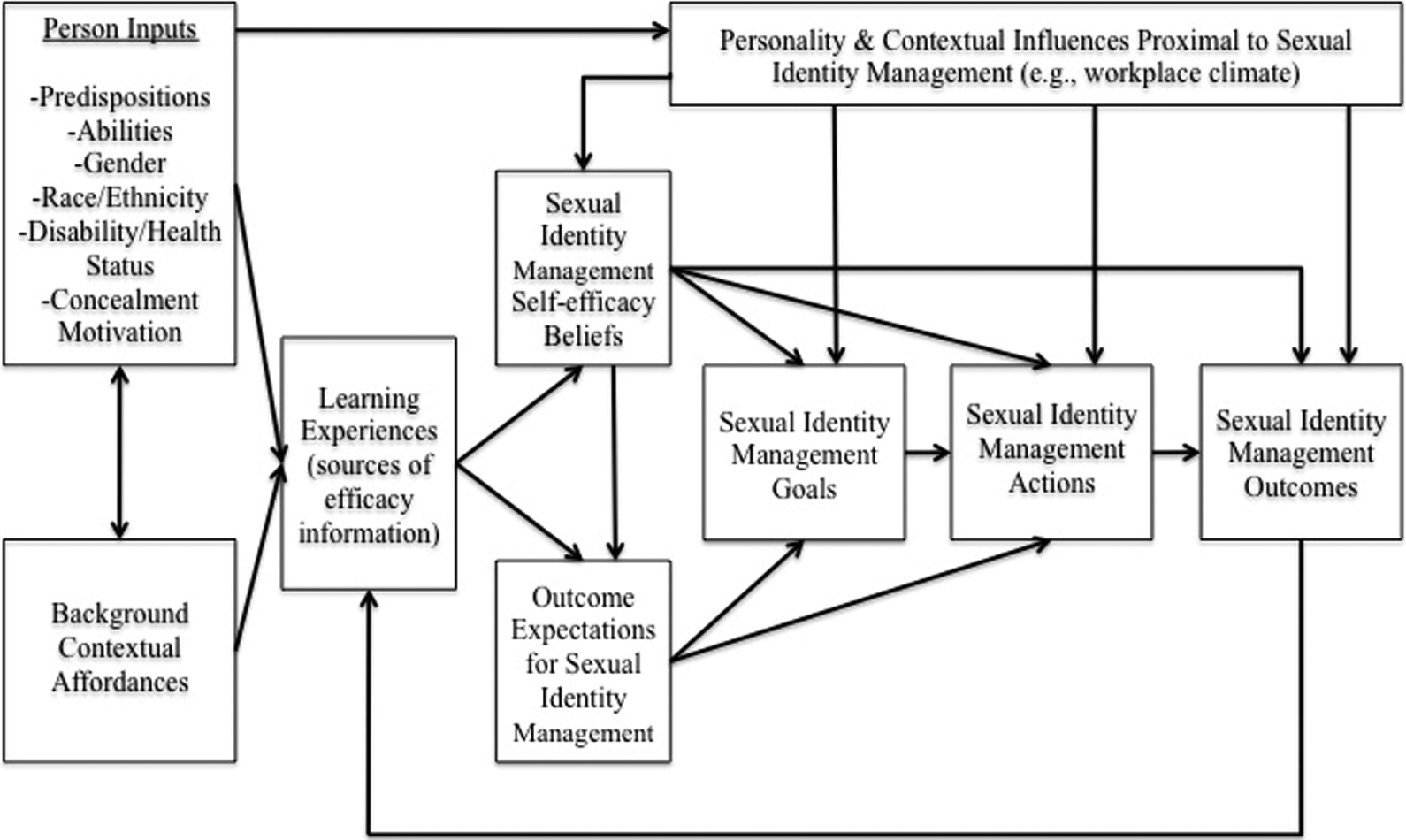
Social cognitive model of workplace sexual identity management.
Sexual Identity in the Workplace
In the United States, no federal laws guarantee protection against employment discrimination based on sexual orientation. Thus, for sexual minority workers, disclosing sexual identity (i.e., being out) in the workplace may carry serious implications such as discriminatory wages, termination, withheld promotions, underutilization of abilities, negative work evaluations, harassment, social isolation, and even violence (Croteau, 1996; Fassinger, 1996). Both workplace environments and geographical regions influence the likelihood of these potential consequences for sexual identity disclosure at work (Fassinger, 1996). Although there is a dearth of literature examining sexual minority workplace experiences, Croteau’s (1996) review of existing research demonstrated pervasive experiences of discrimination (i.e., about 25–66% of lesbian, gay, and bisexual workers reported negative actions toward them because of their sexual orientation). There is also a long history of institutionalized occupational discrimination based on sexual orientation (Biaggio et al., 2003; Griffin, 1992; Ragins & Cornwell, 2001; Woods, 1994), and, as a result, when sexual minorities inhabit a workplace climate that condones negative consequences for sexual minorities, they may adapt by concealing or suppressing their identities.
Concealing sexual identity in the workplace may, therefore, be adaptive in order to establish a sense of safety or protection against possible negative consequences (e.g., denial of promotion). Despite the adaptive functions of this behavior, the burden of concealing a stigmatized identity carries psychological risk. Concealment has been linked to heightened psychological distress (Cole, 2006; Cook, Arrow, & Malle, 2011), lower levels of life satisfaction and well-being (Lane & Wegner, 1995), increased health risks (Kalichman & Nachimson, 1999), and engagement in extensive energy draining activities (e.g., concealing identity management strategies; Ellis & Riggle, 1996; Griffith & Hebl, 2002). Concealment has also been linked to depressive symptoms and lower self-esteem (Frable, Platt, & Hoey, 1998; Sedlovskaya et al., 2013).
Although moving toward disclosure may not be the most adaptive behavior for all sexual minorities (especially for those working in a nonsupportive environment), revealing sexual identity is associated with several psychological benefits. Being open about sexual identity is associated with increased psychological adjustment, well-being, self-esteem, and positive affect (Beals, Peplau, & Gable, 2009; Chrobot-Mason, Button, & DiClementi, 2001). Moreover, coming out in the workplace is often linked to sexual minority individuals feeling less isolated at work and perceiving a greater sense of collegial support (Fassinger, 1996). Griffith and Hebl (2002) found that disclosing sexual orientation at work and working for an organization perceived to be more “gay supportive” are positively related to job satisfaction and negatively related to job anxiety. In fact, Button (2001) found that sexual minorities reported higher levels of satisfaction and commitment and fewer experiences of discrimination in organizations with affirming policies versus nonaffirming policies.
This study tests the SCCT career self-management model using sexual identity disclosure as an adaptive career behavior and workplace climate as a contextual variable to explore its influence within the SCCT career self-management model. We should emphasize that by “adaptive,” we mean efforts made by the individual to manage workplace behavior toward desired outcomes. The effort at adaptation does not, of course, guarantee that the desired outcomes will be achieved. Moreover, our examination of sexual identity disclosure does not imply that any single strategy is appropriate for all persons or under all conditions. Rather, we wish to promote understanding of the antecedents of individuals’ decisions to disclose, or not disclose, their sexual identities at work.
The Management of Sexual Identity in the Workplace
The current test of the SCCT self-management model builds on earlier work by Lidderdale, Croteau, Anderson, Tovar-Murray, and Davis (2007) to identify contextual and person variables as well as outcome expectations that may be most relevant to the coming out process at work. Lidderdale et al., for example, argued that a social cognitive perspective may be particularly useful for understanding individual differences, personal cognitions, and the sundry social and cultural contexts that influence sexual identity management and highlighted several contextual and person variables that may influence the sexual identity management strategies in which individuals might engage at work.
Salient contextual factors for managing sexual identity in the workplace include the following: (a) the context of the immediate work situation, (b) workplace climate, (c) nature of the work role, (d) interpersonal factors, and (e) community context (Lidderdale, Croteau, Anderson, Tovar-Murray, & Davis, 2007). Salient person inputs include race, gender, ethnicity, age, and health status. Motivation to conceal sexual identity has also been suggested as a person input that is also relevant to self-management of identity in the workplace (Lidderdale et al., 2007). Both contextual and person variables, according to SCCT, promote self-management actions both directly and indirectly (Lent & Brown, 2013). A supportive workplace climate, for example, may strengthen self-efficacy beliefs and outcome expectations toward performing more risky (i.e., where outcomes are uncertain and potentially injurious) identity management strategies, thereby indirectly influencing the actions taken. On the other hand, concealment motivation may be associated with less robust efficacy beliefs and more negative outcome expectations for performing risky identity management strategies, thereby also indirectly influencing actions taken (but in a direction opposite to workplace climate). Thus, the current study specifically sought to understand whether workplace climate (as a contextual variable) and concealment motivation (as a person characteristic) relate to cognitive-person factors (i.e., self-efficacy beliefs and outcome expectations), and also if they are directly linked to sexual identity disclosure behaviors.
In the context of this study, workplace climate refers to the formal and informal aspects of an organization that affect workers’ experience on the job (Liddle, Luzzo, Hauenstein, & Schuck, 2004). Specific to sexual minority workers, formal aspects of a supportive workplace climate may include nondiscriminatory hiring, advancement, and retention policies, while informal aspects may include the presence of supportive coworkers (Liddle et al., 2004). Sexual minority workers are more likely to make an identity disclosure at work in the presence of a sexual minority supportive environment (Ragins & Cornwell, 2001). Several studies also link gay-supportive workplace climates with greater well-being (Driscoll, Kelley, & Fassinger, 1996; Griffith & Hebl, 2002; Ragins & Cornwell, 2001; Waldo, 1999).
Concealment motivation refers to the general (i.e., noncontextual) censoring and suppressing of one’s sexual identity. As mentioned earlier, concealing one’s stigmatized identity has been consistently associated with psychological distress and negative affect (Sedlovskaya et al., 2013). One possible explanation for these negative psychological outcomes is that the desire to reduce stress associated with a stigmatized identity by making a disclosure conflicts with the motivation to conceal due to anticipation of negative consequences. This prevents making an adaptive resolution or successfully integrating difficult life experiences (Larson, Chastain, Hoyt, & Ayzenberg, 2015). With regard to sexual orientation disclosure, higher levels of outness (i.e., lower concealment motivation) have been linked with fewer depressive symptoms (Lewis, Derlega, Berndt, Morris, & Rose, 2001; Smith & Ingram, 2004), higher psychological adjustment (Miranda & Storms, 1989), and greater well-being (King & Smith, 2004) among sexual minority men and women.
The Current Study
Figure 2 displays the portion of the SCCT self-management model that we tested in this study. In line with the SCCT self-management model, we hypothesized that sexual minority individuals reporting more gay-affirmative workplace environments would possess stronger self-efficacy beliefs for disclosing their sexual identities in the workplace, would endorse more positive outcome expectations for making a disclosure, and would be more likely to decide to disclose their sexual identities in the workplace. We believed that self-efficacy beliefs and outcome expectations would partially explain the relationship between workplace climate and disclosure of sexual identity in the workplace as suggested by the SCCT self-management model. In other words, we believed that workplace climate would operate indirectly on identity disclosure through self-efficacy beliefs and outcome expectations and would also be linked directly to disclosure.
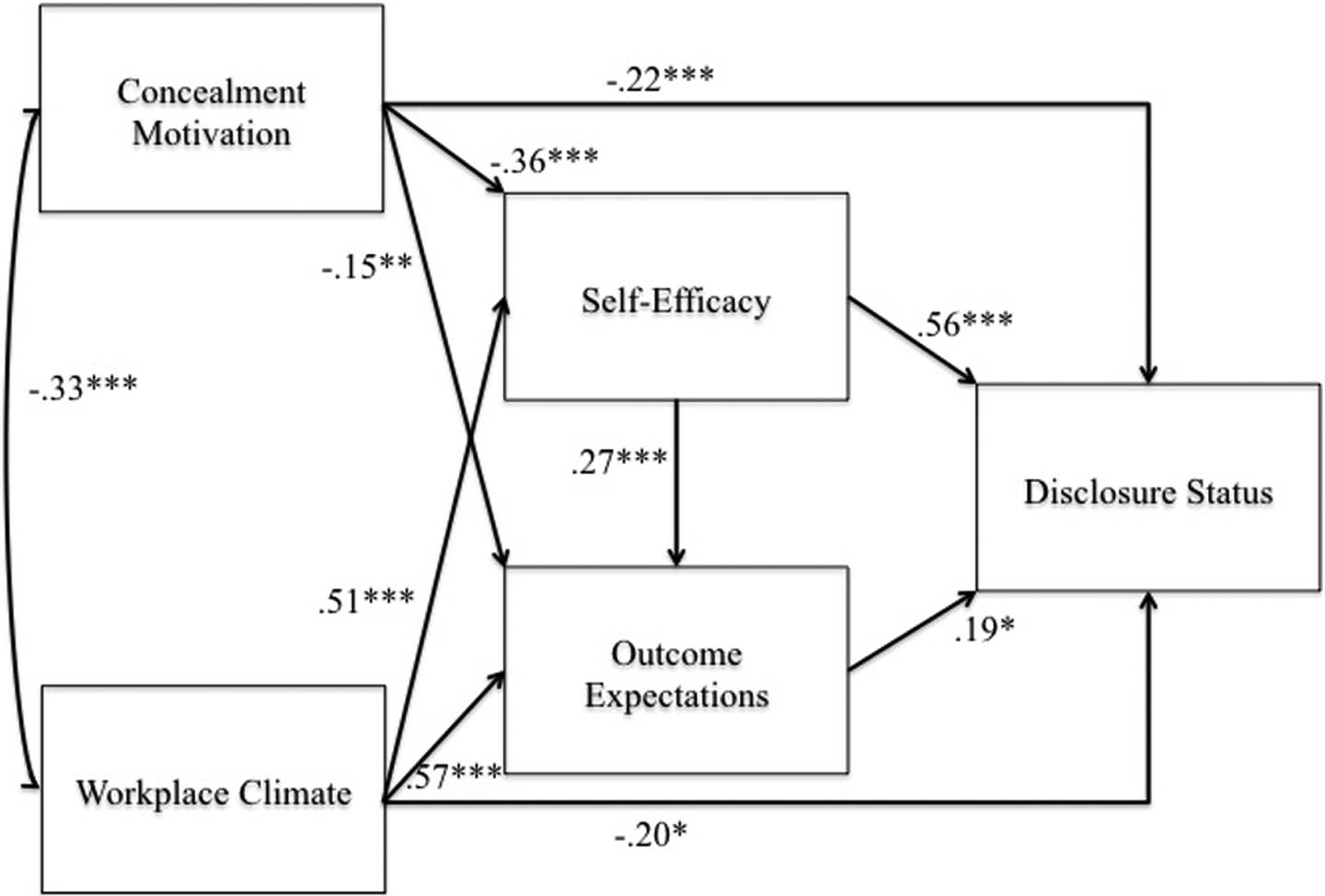
Social cognitive career theory partial mediation model with standardized path coefficients.
Parallel to workplace climate, we hypothesized the same pattern of relationships of concealment motivation to disclosure in the workplace but in the opposite direction. That is, we expected that concealment motivation would be negatively related to self-efficacy beliefs and outcome expectations for disclosure of sexual identity in the workplace. We anticipated finding a similar pattern of mediation whereby concealment motivation and its relationship to disclosure is partially explained by self-efficacy beliefs and outcome expectations about making this type of disclosure. We also tested an alternative model, which predicted that sexual identity management self-efficacy beliefs and outcome expectations fully mediate, or explain, the relationship between the contextual and person variables (i.e., workplace climate and concealment motivation) and identity disclosure.
Method
Participants
Participants were recruited online via e-mail listserv announcements to lesbian, gay, bisexual, and transgender (LGBT) community organizations. All participants were informed that the study was an investigation of sexual identity management strategies in the workplace. In order to be eligible for the study, participants were required to be 18 or older, U.S. citizens or residents, and employed. The online survey included informed consent, and participants were eligible to enter into a drawing for one of two US$25 Amazon gift cards for their participation.
A total of 175 participants completed the study. Near the end of the survey, one question included on the outcome expectations measure called for a specific response (i.e., “Please select disagree”) and was used to identify possible random responding. Twenty-three participants were removed from data analysis due to an incorrect response to this item. None of the remaining 152 participants had a substantial amount of missing data to warrant exclusion (i.e., no participant had more than 20% of missing responses for each measure), and missing item responses for the answered items on the scale in question were averaged to generate values for missing data.
Participants were recruited from all 50 states plus the District of Columbia. Their mean age was 34.9 years (SD = 13.4), with a median age of 30.0 years and a range of 18–70 years. Gender breakdown for the sample was 59.4% female, 37.1% male, 1.1% female-to-male transgender, 0.6% male-to-female transgender, and 1.7% “other.” Common other responses included “genderqueer,” “intersex,” and “nonbinary.” Racial breakdown for the sample was 75.4% Caucasian/White, 11.4% Hispanic, 9.7% African American, 5.1% American Indian, 4.6% Asian American, and 3.4% Other. Participants reported their level of education by selecting from one of the following categories: less than a high school education (0.6%), high school diploma or general education diploma (24.0%), some college or an associate’s degree (7.4%), a 4-year degree (38.3%), and graduate education (29.7%). Participants reported their annual income by selecting from one of the following categories: less than US$25,000 (28.0%), US$25,000–US$49,999 (37.1%), US$50,000–US$74,999 (20.6%), US$75,000–US$99,999 (7.4%), US$100,000–US$249,999 (5.1%), and over US$250,000 (1.7%). Participants not presently involved in an intimate relationship composed 38.8% of the sample, 13.1% reported dating and not cohabitating, 24.0% reported dating and cohabitating, and 18.3% reported a legally recognized marriage. Most of the sample (78.3%) reported full-time employment, while the remainder of the sample reported part-time employment.
Measures
Workplace climate
The 20-item Lesbian, Gay, Bisexual, and Transgendered Climate Inventory (LGBTCI; Liddle et al., 2004) assesses the degree to which an LGBT employee’s workplace environment is perceived as supportive or hostile. The measure’s stem for all 20 items is “At my workplace …” and sample items include “LGBT employees must be secretive,” “LGBT employees are comfortable talking about their personal lives with coworkers,” and “LGBT employees feel free to display pictures of a same-sex partner.” Participants responded to the items on a 4-point scale (1 = doesn’t describe at all, 4 = describes extremely well). Six negatively worded items were reverse scored, and these items were summed together with the remaining 14 items to compute a total score (higher scores reflect a more LGBT-supportive work environment). Cronbach’s α for this sample was .95, and past studies have yielded similar reliability estimates of .96 among samples of LGB and LGBT employees (Huffman, Watrous-Rodriguez, and King, 2008]; Liddle et al., 2004). LGBTCI scores correlate negatively with a measure of LGB workplace discrimination, demonstrating construct validity (Liddle et al., 2004).
Concealment motivation
The Concealment Motivation subscale of the Lesbian, Gay, and Bisexual Identity Scale (LGBIS; Mohr & Kendra, 2011) consists of three statements involving behaviors typically engaged in by a person who is not “out.” Items included “I prefer to keep my same-sex romantic relationships rather private,” “I keep careful control over who knows about my same-sex romantic relationships,” and “My sexual orientation is a very personal and private matter.” Participants responded to the items on a 6-point response scale (1 = disagree strongly, 6 = agree strongly), and the 3 items on the subscale were summed to compute a total score. Cronbach’s α for this sample was .85. In two separate samples, Mohr and Kendra (2011) reported correlations of this subscale with world outness (−.55, −.58), self-concealment (.40, .51), and ego-dystonic homosexuality (.34, .43).
Sexual identity management self-efficacy
Self-efficacy for sexual identity management strategies was assessed using a 15-item measure adapted from (a) the 8 items on the explicitly out subscale of Anderson, Croteau, Chung, and DiStefano’s (2001) Workplace Sexual Identity Management Scale and (b) the 9 items on Button’s (2001) measure of organizational discrimination toward sexual minorities. Two pairs of items contained overlapping content, and 1 item from each pair was removed to yield a final total of 15 items. Participants were asked how confidently they could engage in each of 15 tasks in the workplace and responded to the items on a 5-point response scale (1 = no confidence, 5 = very confident). One sample item read, “acknowledge my sexual identity whenever it comes up.” All 15 items were summed to compute a total score, and Cronbach’s α for this sample was .96. Our measure of sexual identity management self-efficacy was negatively correlated with concealment motivation (−.51), providing initial evidence for the construct validity of this new self-efficacy scale.
Sexual identity management outcome expectations
Since we could find no measures exploring sexual identity management outcome expectations, a 19-item measure was constructed using existing literature. The stem “If I move toward disclosing my sexual identity at work, I would …” preceded all items, and participants responded to each item on a 5-point response scale (1 = very unlikely, 5 = very likely). Sample items included “feel more ease at work,” “be verbally harassed by the people I work with,” and “feel more comfortable talking about my romantic relationships at work.” Negative outcome expectations were reverse scored. The positive outcome items and reverse-scored negative outcome items were summed to compute a total positive outcome score. Cronbach’s α for this sample was .75. This measure correlated with concealment motivation (r = −.48), providing initial evidence of construct validity
Sexual identity disclosure status
In order to measure disclosure status, a single-item question was asked of all participants: “Please rate the degree to which you are out at work on the following 5-point scale”: (1) I do not plan to come out at work, (2) I am currently unsure if I want to come out at work, (3) I intend to come out at work in the near future, (4) I am partially out at work, and (5) I am fully out at work. We chose to use a single-item measure of disclosure because the degree of outness seems to be a straightforward criterion; additionally, many dimensions of sexual minority identity may be assessed with as little as 3 items (Mohr & Kendra, 2011). In a similar vein, career decision status, or level of career decidedness, is often measured validly with 1- or 2-item measures (Osipow, Carney, Winer, Yanico, & Kisochier, 1976). This measurement strategy also allowed us to avoid item overlap with the measure of self-efficacy, which otherwise might have included the same tasks associated with sexual identity disclosure, albeit using different directions and response formats.
Data Analytic Procedure
In order to examine whether self-efficacy and outcome expectations partially or fully mediated the relationships of workplace climate and concealment motivation to sexual identity disclosure, two different path analyses were conducted. The first model (partial mediation) is just identified and proposes that self-efficacy and outcome expectations are partially mediating variables. This model therefore allows for direct paths from workplace climate and concealment motivation to sexual identity disclosure. This is congruent with the assumptions of the SCCT’s self-management model because self-efficacy and outcome expectations should at least partially mediate the relationship between the two exogenous variables and disclosure. The second model (full mediation) hypothesizes that the relationships of the two exogenous variables to sexual identity disclosure are fully explained by self-efficacy and outcome expectations. Tests of this model fixed the paths from concealment motivation and workplace climate to identity disclosure in Figure 2 to zero. Upon identifying the better fitting model, a bootstrap analysis using 5,000 bootstrap samples was conducted in order to calculate bias-corrected 95% confidence intervals (CIs) of the parameter estimates.
Results
Intercorrelations among the observed variables are reported in Table 1 along with descriptive statistics for each measure. These intercorrelations were consistent with the self-management model. In other words, concealment motivation was negatively correlated with a supportive work environment, sexual identity management self-efficacy, positive outcome expectations, and disclosure. Workplace climate was positively correlated with sexual identity management self-efficacy, positive outcome expectations, and disclosure. Self-efficacy was positively correlated with outcome expectations and disclosure, and outcome expectations were positively correlated with disclosure. All of these intercorrelations ranged from medium to large as defined by widely accepted benchmarks (Cohen, 1992).
Intercorrelations, Descriptive Statistics, and Internal Consistencies of Observed Variables.
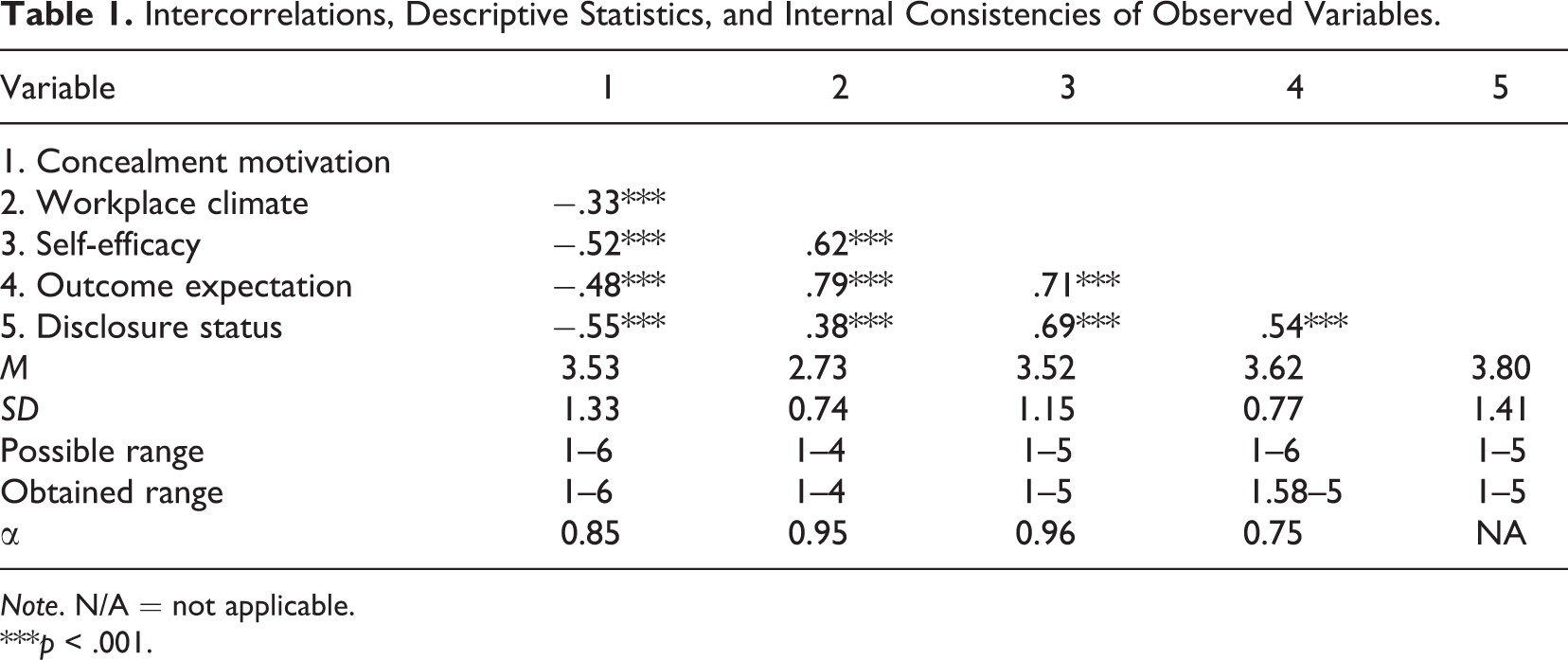
Note. N/A = not applicable.
***p < .001.
Path Analyses
LISREL 8.8 (Jöreskog & Sörbom, 2006) was used to test the two competing models using robust maximum likelihood estimates to adjust for multivariate nonnormality (Bryant & Satorra, 2012). The fully mediated model appeared to adequately fit the data according to Hu and Bentler’s (1999) two-index criteria (confirmatory fit index [CFI] = .97 and standardized root mean residual [SRMR] = .05). Root mean square error of approximation (RMSEA), .22, was well above acceptable thresholds defined by past literature (e.g., Bentler & Bonett, 1980; Browne & Cudeck, 1993) and the Satorra-Bentler χ2 value for the fully mediated model was 16.05 (df = 2, p < .001), also suggesting less than adequate fit.
Because the partial mediation model was just identified (i.e., contained no fixed paths), fit indices yielded a perfect fit to the data. Therefore, comparing these perfect fit indices to those of the full mediation model would not be meaningful. Since the models are nested, a Satorra-Bentler χ2 difference test and change in CFI were used to determine the better fitting model (Meade, Johnson, & Braddy, 2008). These results suggest that the partial mediation model was, in fact, a better fit, Δχ2(2) = 16.05, p < .001; ΔCFI = .03. Additionally, inspection of the standardized path coefficients supported all paths hypothesized by the partial mediation model (see Figure 2) though, contrary to hypotheses, the path leading from workplace climate to disclosure status had a significant negative coefficient. The most logical explanation for this finding is statistical suppression (i.e., the positive bivariate relationship between workplace climate and disclosure status became negative in the presence of the other predictors; see Gaylord-Harden, Cunningham, Holmbeck, & Grant, 2010).
Bootstrap procedures (5,000 bootstrap samples, bias-corrected percentiles) were used to test the hypothesized indirect effects (Mooney & Duval, 1993; Preacher & Hayes, 2008). When analyzing bootstrap results, outcomes are interpreted as significant if the confidence intervals do not include zero (Preacher & Hayes, 2008). The results indicated a significant indirect link between concealment motivation and disclosure status (B = −.10, 95% CI [−.15, −.07]) via the mediating role of self-efficacy as well as a significant indirect link between concealment motivation and disclosure status (B = −.06, 95% CI [−.09, −.04]) through the mediating role of outcome expectations. In examining workplace climate as the independent variable, bootstrap analyses revealed a significant indirect effect with disclosure status through the mediating role of self-efficacy (B = .04, 95% CI [.03, .06]) as well as a significant indirect effect with disclosure status through the mediating role of outcome expectations (B = .05, 95% CI [.03, .07]). In examining self-efficacy as a mediator of outcome expectations, a significant indirect effect was found for both concealment motivation (B = −1.21, 95% CI [−1.67, −.86]) and workplace climate (B = .22, 95% CI [.14, .31]).
Discussion
The present study tested a key person input variable identified by previous sexual minority literature (i.e., concealment motivation) and a contextual workplace variable that has been previously studied in the sexual minority workplace literature (i.e., workplace climate) in the context of testing Lent and Brown’s (2013) SCCT self-management model. Additionally, we tested the indirect effects of concealment motivation and workplace climate through disclosure self-efficacy and disclosure outcome expectations on disclosure status.
Path analysis supported a partial mediation model of sexual identity management in the workplace. That is, when modeled with a direct path to disclosure status, concealment motivation had a negative relationship to levels of sexual identity disclosure in the workplace (disclosure status). This finding suggests that motivation to protect one’s privacy as a sexual minority significantly and inversely relates to the likelihood of disclosing in the workplace directly as well as indirectly via self-efficacy beliefs and outcome expectations. The direct effect replicates and extends past findings of a negative bivariate correlation between concealment motivation and degree of outness (e.g., Mohr & Kendra, 2011) but provides a somewhat less biased estimate of this relationship because the variance that concealment motivation shares with self-efficacy beliefs and outcome expectations has been removed. Results also supported SCCT hypotheses that the relationship between concealment motivation and degree of outness is partially mediated by sexual identity management self-efficacy beliefs and outcome expectations. That is, in addition to reducing the likelihood of sexual identity exposure in the workplace, concealment motivation is also associated with expectations for negative (or less than positive) outcomes as a result of exposure and reduced self-efficacy beliefs.
Results also provided support for the mediating roles of self-efficacy and outcome expectations between workplace climate and disclosure. Specifically, the paths leading from workplace climate to self-efficacy and outcome expectations showed strong effect sizes. The net suppression effect exhibited by workplace climate on disclosure status was unexpected. One possible explanation for this effect is the significantly higher standardized path coefficients leading from workplace climate to disclosure self-efficacy and positive disclosure outcome expectations. Paulhus, Robins, Trzesniewski, and Tracy (2004) described how a suppression effect may occur when the introduction of new variables (i.e., self-efficacy and outcome expectations) increases the validity of another predictor (i.e., workplace climate) already in the model. In this instance, while workplace climate and disclosure status are moderately correlated (.38), workplace climate has a much stronger bivariate correlation with self-efficacy (.62) and outcome expectations (.79). By the same token, self-efficacy and outcome expectations are also strongly correlated at the bivariate level with disclosure status, .71 and .69, respectively. These results are in line with previous literature that suggests a greater likelihood of suppression effects when correlations among predictor variables are strong (Cohen, Cohen, West, & Aiken, 2003).
These findings provide support for Lent and Brown’s (2013) social cognitive career self-management model. Whereas previous SCCT models emphasized content aspects of career behavior, the self-management model focuses on process aspects of career behavior. In relation to the present study, these results are directly applicable to workers in the establishment or maintenance developmental periods of their careers (Super, 1953, 1980; Super, Starishevky, Mattin, & Jordaan, 1963). For example, as sexual minority employees become socialized in their workplace environments and build job niches, they will eventually be confronted with making conscious decisions to indirectly or directly disclose their sexual identity.
The SCCT self-management model appears to provide a theoretical framework that explains several antecedents to identity management behavior. Specifically for disclosure, increasing disclosure self-efficacy and positive disclosure outcome expectations may be two paths that lead to increased comfort in sexual identity disclosure at work. In order to increase self-efficacy beliefs and outcome expectations about disclosure, our results suggest that fostering a supportive workplace climate may be one helpful avenue. These results also provide a partial explanation for past findings, showing that supportive workplace climates are positively associated with sexual identity disclosure at work (Fassinger, 1996). It would seem that affirming environments foster stronger and more robust disclosure self-efficacy beliefs and more positive expectations of the consequences of such disclosure. Thus, advocacy implications point to the importance of promoting an affirmative workplace climate for sexual minority employees. This finding also bolsters previous research that has both called for an emphasis on workplace supports (Chojnacki & Gelberg, 1994; Liddle et al., 2004) and has found such constructs to be significantly and positively associated with job satisfaction (Velez & Moradi, 2012). The possible concomitant and long-range effects of these relationships on job satisfaction and also mental health outcomes are areas for further investigation using the SCCT framework.
Results also suggest motivation to conceal one’s sexual minority identity is negatively related to disclosure self-efficacy and positive disclosure outcome expectations, in addition to the formal act of disclosing. By concealing a sexual minority identity, an employee may lack the confidence to come out at work and may also have a bleak outlook on the consequences of coming out. The parameter estimates obtained in this study between workplace climate and concealment motivation suggest the possibility that a positive workplace environment may be an avenue to reducing concealment motivations. Although the effect may be in the opposite direction (i.e., that concealment motivation is associated with reduced perceptions of supportive workplace climates), the former possibility deserves future research attention in the workplace climate literature.
It is also important to consider the study’s limitations. Because all participants were recruited via Internet mailing lists, external validity may be limited. Specifically, over 75% of the sample identified as Caucasian and 39% reported holding a graduate degree. In order to test the generalizability of these results across other samples, efforts should be made to reach out to racially and educationally diverse populations. Also, nearly 60% of the sample identified as female. Thus, future research might want to ensure greater gender diversity. The study also employed a single-item measure of disclosure status that captured the entire continuum of outness and thus incorporated both disclosure status goals and actions. By doing so, the measure was applicable to all participants, regardless of whether a person intended to disclose their status in the near future or already disclosed their status. Finally, the cross-sectional nature of this study precludes drawing causal inferences from the present results. Future research using longitudinal designs is necessary to test SCCT’s hypotheses about the temporal relationships among core variables.
These limitations notwithstanding, the results provide tentative support for Lent and Brown’s (2013) social cognitive career self-management model in the context of workplace sexual identity disclosure—a relevant adaptive career challenge for sexual minority employees. The present findings also call for an awareness of workplace conditions that foster an affirmative environment for sexual minority employees. From a social justice perspective, efforts should be made to ensure supportive environments for sexual minorities since these seem to influence individuals’ willingness to disclose both directly and indirectly via self-efficacy beliefs and outcome expectations. The short- and long-range impact that disclosure may have on individuals’ job satisfaction and mental health deserves concentrated research attention in the future.
Footnotes
Acknowledgments
The authors thank Dr. Steven D. Brown for his input at all stages of this study, and Blake Baltazar, Plamena Daskalova, Gwendolyn Foehringer, Taylor Morris, Meghan Roche, Ethan Rucker, and Kathryn Thomas for their feedback on an earlier draft of this article.
Declaration of Conflicting Interests
The author(s) declared no potential conflicts of interest with respect to the research, authorship, and/or publication of this article.
Funding
The author(s) received no financial support for the research, authorship, and/or publication of this article.