



Abstract
Perceived employability has been found to be related to the career development and well-being of both working adults and university students. In a first initiative to examine perceived employability among nonlocal Chinese university students, we collected data from a sample of 246 graduating students who had come from Mainland China to study in Hong Kong. After controlling for demographic variables and migration intentions, we found that perceived employability was explained by career exploration, relational support, acculturative hassles, and the assimilation strategy of acculturation. Career exploration was also found to mediate the relationship between the assimilation strategy of acculturation and perceived employability. We discuss the implications of these findings for theory building and career guidance practices regarding the perceived employability and career guidance of nonlocal and international Chinese students.
In the ever-changing and unpredictable workplace, people have become increasingly concerned about remaining employable. Perceived employability has been defined as “the individual’s perception of his or her possibilities of obtaining and maintaining employment” (Vanhercke, De Cuyper, Peeters, & De Witte, 2014, p. 5), and research into it (e.g., De Cuyper, Raeder, Van der Heijden, & Wittekind, 2012) has already made significant progress. The perception of being employable is currently regarded as a personal resource, with the effect of enhancing one’s subsequent well-being (e.g., Berntson & Marklund, 2007) and reducing an employee’s feeling of job insecurity (De Cuyer et al., 2012). This perception is influenced by one’s own education, skills, and attitude (e.g., Wittekind, Raeder, & Grote, 2010) and has been found to both precede and be differentiated from self-efficacy (Berntson, Näswall, & Sverke, 2008). Perceived employability is subjective and conceptually different from objective employment, though recent research attempted to demonstrate correlation between the two (e.g., Caricati, Chiesa, Guglielmi, & Mariani, 2016). Besides serving as a protective factor for one’s well-being, perceived employability affects employment assistance seeking (Chen & Lim, 2012) and job search behaviors (Onyishi, Enwereuzor, Ituma, & Omenma, 2015). Job search behaviors, in turn, have already been founded to influence employment outcomes such as the numbers of job interviews and offers acquired (e.g., Moynihan, Roehling, LePine, & Boswell, 2003; Saks & Ashford, 2000; Vansteenkiste, Verbruggen, & Sels, 2016).
Especially when it is applied to university undergraduates, perceived employability refers to “the perceived ability to attain sustainable employment appropriate to one’s qualification level” (Rothwell, Herbert, & Rothwell, 2008, p. 2). Among university students, this can be distinguished from ambition and university commitment, attributable to the demographic variables of age, gender, and the university attended (Rothwell et al., 2008), and associated with career planning and career identity (Praskova, Creed, & Hood, 2015). Qenani, MacDougall, and Sexton (2014) further found that different demographic, personality, and educational factors contributed to perceived employability among college students in the United States.
Although the employability of international and nonlocal university students is widely discussed, the construct of perceived employability as conceptualized by authors like De Cuyper and Rothwell has not been applied empirically among international and nonlocal university students to the best of our knowledge. We believe that such application for the first time will further contribute to theory building and practice. International and nonlocal students are undergoing a cultural and career transition. The career development of international students involves the process of exploring opportunities to study in a foreign country, studying in a foreign country, and transferring the skills gained in international education to work settings (Human, Ruane, Tims, & Ndala-Magoro, 2011). At present, the career development of international students is an emerging research area in the West (e.g., Human et al., 2011). However, the literature does not sufficiently account for the career development and career mobility of international and nonlocal students in Asia and different Chinese societies. This study thus examines employability and mobility in a host society, Hong Kong, with less cultural distance but significant cross-cultural differences for nonlocal Chinese students. Like international students in the West (Arthur & Nunes, 2014), nonlocal students in Hong Kong are facing critical questions regarding whether they should stay abroad or return to their homelands. They may acquire more career-related experience before deciding whether they would return to Mainland China. They can choose to remain in Hong Kong or move to a foreign country upon graduation. Against this context of uncertainty and the possibility of mobility, we have examined how various demographic, vocational, relational, and acculturative factors differently account for the students’ perceived employability.
Hong Kong is a large cosmopolitan city, a special administration region under Chinese sovereignty, and previously a British colony. Its citizens have been accustomed to a Western-style administration, education, and rule of law. At this stage, however, Hong Kong, like some of its neighboring countries in East Asia, is undergoing a major process of internationalization with regard to higher education. Because it aspires to become a regional education hub, Hong Kong has announced progressive plans to expand the percentage of its nonlocal students to 20% of the tertiary student population. Further, new immigration measures are being enacted to attract quality students from the wider geographic area. In 2014, over 70% of Hong Kong’s nonlocal undergraduate students were from Mainland China (University Grants Committee, 2016).
China adopts the socialist system and policies. However, under its “one country two systems” policy, Hong Kong shall retain its previous capitalist system and lifestyle for 50 years since reunification with China as a special administrative region in 1997. In terms of language, English is widely used in Hong Kong, and it is the medium of instruction in most universities. In their daily lives, Hong Kong people speak a Chinese dialect called Cantonese. When Mainland Chinese come to study in Hong Kong, they have brought diverse lifestyles and traditions from different provinces, which are different from those of Hong Kong as a Westernized cosmopolitan city. They may have difficulties in adjusting to English as a medium of instruction in universities to different extents. As they are settling in Hong Kong, they may not understand Cantonese unless they have learnt it or lived in areas close to Hong Kong. A report recently released by the Central Policy Unit (2014) of the Hong Kong Government , based on in-depth interviews with mainland students, revealed the difficulties of nonlocal Chinese students in adjusting to the language and academic requirements, and social relations with local students. Pan and Wong (2011) found that acculturative stressors from the language, cultural, academic, and social domains experienced by nonlocal Chinese students in Hong Kong negatively affected their well-being. Accordingly, in addition to theory building, we aim to inform career guidance practices for nonlocal Chinese students in Hong Kong and beyond.
The Role of Acculturative and Vocational Variables
How can the employability of nonlocal students be advanced when they are adjusting to a different cultural environment and are considering the possibility of migration? Other than demographic variables, there are vocational and acculturative variables that might further affect this situation.
Acculturation
Acculturation is “the dual process of cultural and psychological change that takes place as a result of contact between two or more cultural groups and their individual members” (Berry, 2005, p. 698). When applied to ethnic minorities and immigrants, acculturation includes socialization into the mainstream culture of a society (e.g., Yoon et al., 2013). It involves changes in cultural identity, worldview, and capabilities that might affect one’s employability (Chen, 2015). Samnani, Boekhorst, and Harrison (2013) posited that acculturation involves identity formulation. With higher identification with the host culture, one may develop new social networks and explore career opportunities in organizations more extensively in the host country, affecting their perception of career prospects in the host country. Moreover, acculturation may also enhance one’s cultural intelligence, which is defined as one’s capability to function and perform effectively in culturally different situations (Earley & Ang, 2003). With higher cultural intelligence, individuals understand cultural differences and engage better in cross-cultural communication in their encounters with people from a different culture. They are likely to perceive higher employability to work in environments beyond their original culture.
In operationalizing acculturation, we examine acculturation stress and acculturation strategies. Smith and Khawaja (2011) reviewed the literature on the experiences of international students and highlighted the relevance of acculturative stress within the language, educational, and social domains of a society, in addition to the need for social support and psychological adaptation among international students. Pan and Wong (2011) found that the acculturative hassles resulting from cultural differences were predictive of negative affect among nonlocal Mainland Chinese students in Hong Kong, whereas acculturative hassles from academic work predicted negative affect among nonlocal Mainland Chinese students in Hong Kong and Australia. These findings suggest that if nonlocal Chinese students can successfully cope with the various acculturative hassles they encounter, their well-being is less likely to be negatively affected. However, one must ask whether such successful coping induces perceived employability. To the best of our knowledge, this has not been specifically tested before. Naturally, the more nonlocal students are able to cope with the hassles of acculturation, the less they will feel bothered by them. Further, we propose that the more confident they are in coping with acculturative hassles, the more comfortable they will be in working outside their homelands, and the higher employability they will perceive.
According to Sam (2006), most acculturation research has taken place in culturally pluralistic societies that have diverse cultural or ethnic groups. The various ways groups of individuals seek to acculturate, depending on the orientation of their own group to other groups, are known as acculturative strategies (Berry, 2010). International students use four main strategies to adapt to host cultures. Assimilation involves adopting host-country cultural norms while not maintaining one’s original culture, and integration entails maintaining one’s original culture while adopting the cultural norms of the host culture. Separation involves maintaining one’s original culture and rejecting the host culture, while marginalization relates to the rejection of both the original culture and the host culture. Pan and Wong (2011) found the acculturative strategy of marginalization related to a higher negative affect among nonlocal Chinese students in Hong Kong and Australia, whereas the assimilation strategy was related to low negative affect among nonlocal Chinese students in Australia. Acculturation and its strategies have also been discussed in the context of career development. Reviewing the literature, Miller and Kerlow-Myers (2009) found that acculturation had been linked to career outcomes such as career decision self-efficacy and occupational stress among racially, ethnically, and culturally diverse populations. A correlation has also been found between acculturation and career beliefs from a sample of international Asian students attending a university in the United States, though the correlation was low possibly due to the appropriateness of their measurement for this group (Mahadevan, 2010). In a qualitative study, Sangganjanavanich, Lenz, and Javier (2011) highlighted the importance of acculturation in the job search process among international students in the United States. In this light, it is possible that the more nonlocal students adopt the host culture, the more likely they will be able to develop careers beyond their homelands, and the higher their perceived employability will be. Acculturation is the process of learning the cultural traits and patterns of another group when making contact with another culture. We postulate that when a nonlocal student adopts a host culture, he or she is likely to be utilizing an integrative or assimilation strategy. As a result of using the strategies, student will develop higher cultural competence and be more open to career opportunities in a different cultural context and thus perceiving higher employability.
Career Exploration
The perception of one’s employability is susceptible to contextual and individual factors (Qenani, MacDougall, & Sexton, 2014; Veld, Semeijn, & Vuuren, 2015). Thus, we look at related social context and individual behavior to understand the formation of the perception. In addition to acculturation, we examine how much the career development of nonlocal students affects their perceived employability in terms of the extent to which they have engaged in career exploration and obtained career support. Career exploration is defined as a process of understanding oneself and the environment as well as how the two interact to produce desirable outcomes (Porfeli & Skorikov, 2010), and it is desirable for people preparing for and also uncertain about the world of work. Thus, if nonlocal Chinese students engage in career exploration in the host country, they are likely to be able to understand and appraise more their career opportunities in the host country, resulting in higher perceived employability. In Hong Kong, career exploration has been found predictive of career decidedness and self-efficacy among university students (Cheung & Arnold, 2014). Moreover, it has also been shown to connect to perceived employability among students in higher education in the United Arab Emirates (Forstenlechner, Selim, Baruch, & Madi, 2014). Thus, we further propose that career exploration has an effect on perceived employability among nonlocal Chinese university students in Hong Kong.
In a model for facilitating career exploration, Cheung (2015) proposed that career exploration behaviors are susceptible to contextual influences and affects how one orients to future. Considering the cultural context and experiential outcomes of career exploration, we further examine the relations among acculturation, career exploration, and perceived employability. In day-to-day encounters with another cultural group and its members, one adopts strategies regarding how to acculturate (Berry, 1997). These acculturation strategies include components both attitudes and behaviors or preferences and actual practices in intercultural encounters (Berry, 2006a). Therefore, taking an acculturative strategy to adopt the host culture, a nonlocal student may take up career exploration behavior in the host country in addition to changing the career perception. It makes sense that the more the cultural characteristics of a host country are adopted by nonlocal university students, the more likely they will be to engage in career exploration activities in the host country. Although acculturation had been linked to career outcomes, such as career decision self-efficacy and occupational stress among racially, ethnically, and culturally diverse populations (Miller & Kerlow-Myers, 2009), its impact on career exploration behavior has not been examined directly among these populations to our knowledge. We are thus interested to take initiative to address to this. Moreover, we have postulated that career exploration behavior may also affect their levels of perceived employability in Hypothesis 3. In this light, we propose to test the indirect effect of acculturation strategies on perceived employability through the mediating effect of career exploration. As both the strategies of integration and assimilation involve adopting the host culture, we propose to test their mediating effects, respectively. The strategies of integration and assimilation are postulated to predict career exploration, which in turn affect perceived employability. The specific hypotheses are:
Relational Support in Career Development
Then, we turn to career support from significant relationships as a predictor of perceived employability. Drawing from theories about social support, we postulate that relational support will lead to perceived employability irrespective of levels of acculturation and career exploration. The importance of relational experience as a contextual factor is gaining recognition increasingly in career development theorizing and practice (e.g., Schultheiss, Kress, Manzi, & Glasscock, 2001; Flum, 2001). According to Cobb (1976), social support included both physical and psychological help individuals obtain from connections in reducing stress and enhancing social adaptation. Cutrona and Russel (1990) classified it into dimensions of emotional support and instrumental support and conceptualized it as enhancing quality of life irrespective of levels of adversity (Cutrona, 1996). Drawing from theories about social support, we postulate that supportive relationships from the parents, peers, and teachers of the nonlocal students will provide both emotional support and instrumental career support such as advice and information, thus enhancing the students’ perceived employability. Relational support has been found to explain more variance of career exploration as compared to achievement motivation among university students in Hong Kong (Cheung & Arnold, 2010). Wittekind, Raeder, and Grote (2010) found that career support within organizations contributed to perceived employability. However, this requires an examination in educational settings. We propose to make a first effort to examine whether relational support from different sources like teachers, peers, and family cumulatively accounts for perceived employability.
Method
Participants and Procedures
A cross-sectional quantitative research design was adopted to recruit targeted participants from five public universities in Hong Kong. The participants had to (a) be currently enrolled in undergraduate programs in one of the five University Grants Council-funded universities, (b) have come from Mainland China to Hong Kong to study, and (c) be in their last semester of study, so that they would be giving more thought to their career development. We coordinated with the responsible administrative departments of the universities and the respective associations for Mainland Chinese students and scholars in the five universities funded by the Hong Kong government. Invitations were sent to nonlocal Chinese students through e-mails in January 2015, and potential participants were invited to complete an online questionnaire in Chinese. Based on statistics provided by respective government departments, the total number of Mainland Chinese students graduating that year from the five universities we investigated was around 1,200. In the invitation e-mails, the objective of this study and the voluntary nature of participation were explained. A token of thanks in the form of a cash coupon of 50 Hong Kong dollars to each respondent upon full completion of the questionnaire was also mentioned. In total, 246 valid responses were obtained. The participants’ average age was 21.98 (SD = 0.89). The participants were more or less evenly distributed among the five universities. A large number of the participants were business and management majors (41.1%), followed by engineering and technology majors (17.8%), social sciences (15.9%), arts and humanities (12.6%), and others (1.6%). Of all participants, 67.5% indicated that they would possibly migrate, 28.5% indicated that they would definitely migrate, and only 4.7% indicated that they would definitely not migrate. The detailed demographic information is presented in Table 1.
Demographic Information of Participants.
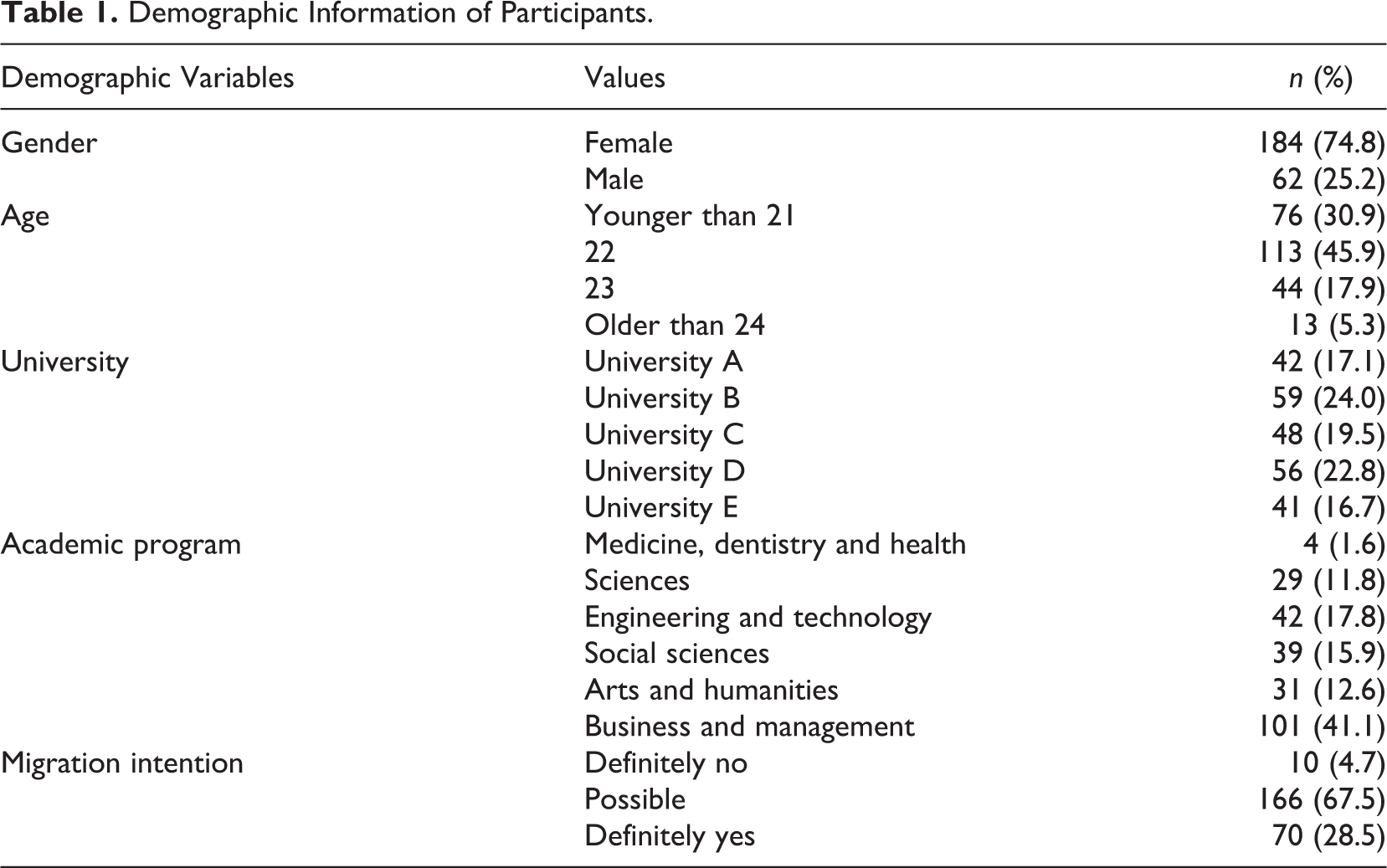
Measurement
Demographic characteristics. Gender, age, institutional, and academic information were collected in the first part of the online questionnaire.
Employability
The 16-item self-perceived employability scale was adopted in this study to measure the extent to which individuals perceived themselves to be employable. The original items were in English. The translation and back translation method was employed to develop a Chinese version. The scale was developed by Rothwell, Herbert, and Rothwell (2008) for university students, and they reported Cronbach’s α coefficient of .84 for it. The scale taps four domains of employability-related factors and their interactions, including self-belief, university, fields of study, and the labor market. Sample items are as follows: “I am generally confident of success in job interviews and selection events,” “employers are eager to employ graduates from my university,” “a lot more people apply for my degree than there are places available,” and “people in the career I am aiming for are in high demand in the external labor market.” The participants were required to rate their answers on a 5-point Likert-type scale ranging from (1) strongly disagree to (5) strongly agree. The scale demonstrated cross-cultural validity with a multicultural sample of British, Black, Asian, and Chinese postgraduate students (Rothwell, Jewell, & Hardie, 2009) and also with Taiwan University students (Huang, 2014). Cronbach’s α coefficient was .90 in the present study.
Acculturation strategies
Acculturative strategies were measured by the Acculturative Strategy Scale (AS-C-HK; Chan, 2001). Based on Berry’s (1997) conceptual framework, Chan (2001) developed the AS-C-HK Scale to measure the use of acculturation strategies in Hong Kong. Subsequent to a series of individual and focus group interviews, he first generated indigenous items on culturally specific topics for the scale. Then, selected items were validated in a large sample of 1,860 young new arrivals from Mainland China to Hong Kong from 59 schools. The acculturation strategy was found to affect young migrants’ mental health. The scale includes 28 items on seven culturally specific topics. Each topic was followed by four responses that were based on the two dimensions of the acculturative strategy proposed by Berry (1997). The participants were asked to indicate the extent to which they agreed with the items, on a 4-point Likert-type scale from (1) totally disagree to (4) totally agree. The scores were calculated by summing up across the topics within each alternative. Four types of acculturative strategies were identified, namely, integration, assimilation, separation, and marginalization. Sample items were, “I’m willing to be good friends with people from Mainland China as well as local people” for integration, “I try not to use my own dialect to communicate with others as I think I have become part of the local community” for assimilation, “Although I am living in Hong Kong, I try to keep my old life style” for separation, and “I am always worried about my appearance. Whichever way I dress, neither local people nor Mainland people would treat me as one of them” for marginalization. Applying this scale, Pan and Wong (2011) found the acculturative strategy of marginalization related to a higher negative affect among nonlocal Chinese students in Hong Kong and Australia, whereas the assimilation strategy was related to low negative affect among nonlocal Chinese students in Australia. Moreover, acculturative strategies as measured by the scale significantly predicted the cultural adaptation of Chinese migrant students in Hong Kong (e.g., Chan, 2001; Ng, Tsang, & Lian, 2013), thus demonstrating good validity for use. Cronbach’s α coefficients of the subscales in this study were .76 for integration, .80 for assimilation, .64 for separation, and .81 for marginalization.
Acculturative hassles
Acculturative hassles were measured by the Acculturative Hassles Scale for Chinese Students (AHSCS; Pan, Yue, & Chan, 2010). AHSCS includes 17 items with 4 factors: language deficiency, social interaction, academic work, and cultural differences. Sample items are as follows: (1) “I am not able to express my ideas in English fluently” and (2) “I don’t have a new social network in the host country.” Participants were asked to indicate to what degree they had experienced adjustment problems in their host society. Responses ranged from not at all (0) to a lot (3). The overall score for the scale was calculated by averaging all of the items, with a higher score indicating a higher level of acculturative hassles. Cronbach’s α coefficient of .89 was obtained in this study. The AHSCS score was found to be positively correlated with the General Health Questionnaire-12 (16) and negatively correlated with life satisfaction (Pan et al., 2010).
Career exploration
The measurement of career exploration we adopted was based on the conceptualization of career exploration by Porfeli and Skorikov (2010). They differentiated between diversive exploration and specific exploration. Diversive career exploration involves learning broadly about the world of work and the self, whereas specific career exploration involves an in-depth investigation focused on aligning one’s perceptions of self and career prospects. In our current study, we intended to investigate the impact of career exploration as a mediator. To measure how far one engage into the exploration process, we have adapted from measures of career exploration from Porfeli and Skorikov (2010). Two items of diversive (in-breadth) exploration and 3 items of specific (in-depth) exploration were included to form a scale of career exploration for use in this study. A sample item for diversive exploration is, “I frequently find myself looking for new career opportunities.” A sample item for specific exploration is, “When I am actively involved in thinking about my career, it takes a great deal to interrupt me.” In previous study (Porfeli & Skorikov, 2010), they were found to connect to career indecision, confidence, and planning in theoretically expected ways. The original items were in English. The translation and back translation method was employed to develop a Chinese version. The participants were asked to rate on a 5-point Likert-type scale, ranging from 1 (strongly disagree) to 5 (strongly disagree) about how far they engaged in career exploration activities and initiatives. In the present study, Cronbach’s α of .81 was obtained for this scale. It is also found correlated with perceived employability (r = .27, p < .01), career support from teachers (r = .20, p < .01), and career support from peers (r = .16, p < .05).
Relational support
In discussing social support for college students, McGrath, Gutierrez, and Valadez (2000) summarized that it can broadly be measured by the amount, source (parents, family, etc.), and type (e.g., availability and helpfulness) of support. Social support ratings by type and source have been widely applied in understanding various types of behavior. This study aimed at understanding both the source and amount of social support for career development. Three items were designed to measure career support by teachers, peer, and family with 1 item for each kind of relational support (Cheung & Arnold, 2010). Participants were asked to “indicate the level of career support” they had from teachers, peers, and family, respectively, ranging from no support to maximum support on a 5-point scale.
Data Analysis
To test the hypotheses, we performed two sets of analyses. First, to test the effect of acculturative hassles strategies, career exploration, and relational support on self-perceived employability, we performed hierarchical regression analysis, which allows determining the different amounts of variance accounted for by the different groups of predictors. In the hierarchical regression analysis, demographic variables and migration intentions were first entered into the regression equation in order to control for possible confounding influences. The four strategies of acculturation and acculturative hassles were entered in the second block to test their overall effect on self-perceived employability. Career exploration was then entered in the third block to determine its effect over and beyond acculturative factors. As discussed in the literature, relational support might account for significant variance in employability due to the fact that in the Chinese culture, personal relationships are highly valued (Littlewood, 1999). Thus, even beyond acculturative factors and vocational variable (career exploration), relational support may have its unique contribution to self-perceived employability in the Hong Kong context. In this regard, we put the three sources of relational support in the last block.
Second, to test the mediating effect of career exploration on the relationship between acculturation strategies and self-perceived employability, we followed the method of Baron and Kenny (1986) to perform regression analyses. According to Baron and Kenny, a mediating effect would exist only in the presence of the following criteria: (1) the effect of the independent variable (IV) on the dependent variable (DV) is significant, (2) the effect of the IV on the mediator is significant, and (3) when the mediator is added to the IV as an explanatory variable of the DV, the effect of the mediator is significant. In addition, we considered a scenario where the effect of the IV on the DV is significantly reduced. When the reduction is so large that the effect of the IV becomes nonsignificant or zero, the mediator is said to have full mediation.
We performed three hierarchical multiple regression analyses for career exploration to examine the three criteria step by step: (a) regressing perceived employability on the IV to be tested (Criterion 1), (b) regressing career exploration on the IV to be tested (Criterion 2), and (c) regressing perceived employability on both the IV and career exploration (Criterion 3). To control for the potential effects of the demographic variables on self-perceived employability, these variables were entered into the first block in each regression model. Finally, the Sobel test (Baron & Kenny, 1986) was used to test the significance of the mediation effect.
Results
Preliminary Analyses
The participants were most likely to use integration acculturative strategies (M = 3.25, SD = 0.41, see Table 2), followed by separation (M = 2.34, SD = 0.40), assimilation (M = 2.06, SD = 0.46), and marginalization (M = 1.82, SD = 0.50). They reported some engagement with career exploration (M = 3.40, SD = 0.66). Assimilation (r = .27, p < .01), acculturative hassles (r = −.18, p < .01), career exploration (r = .27, p < .01), teacher support (r = .28, p < .01), and peer support (r = .26, r < .01) were significantly correlated with self-perceived employability.
Bivariate Correlations and Means of Main Study Variables.
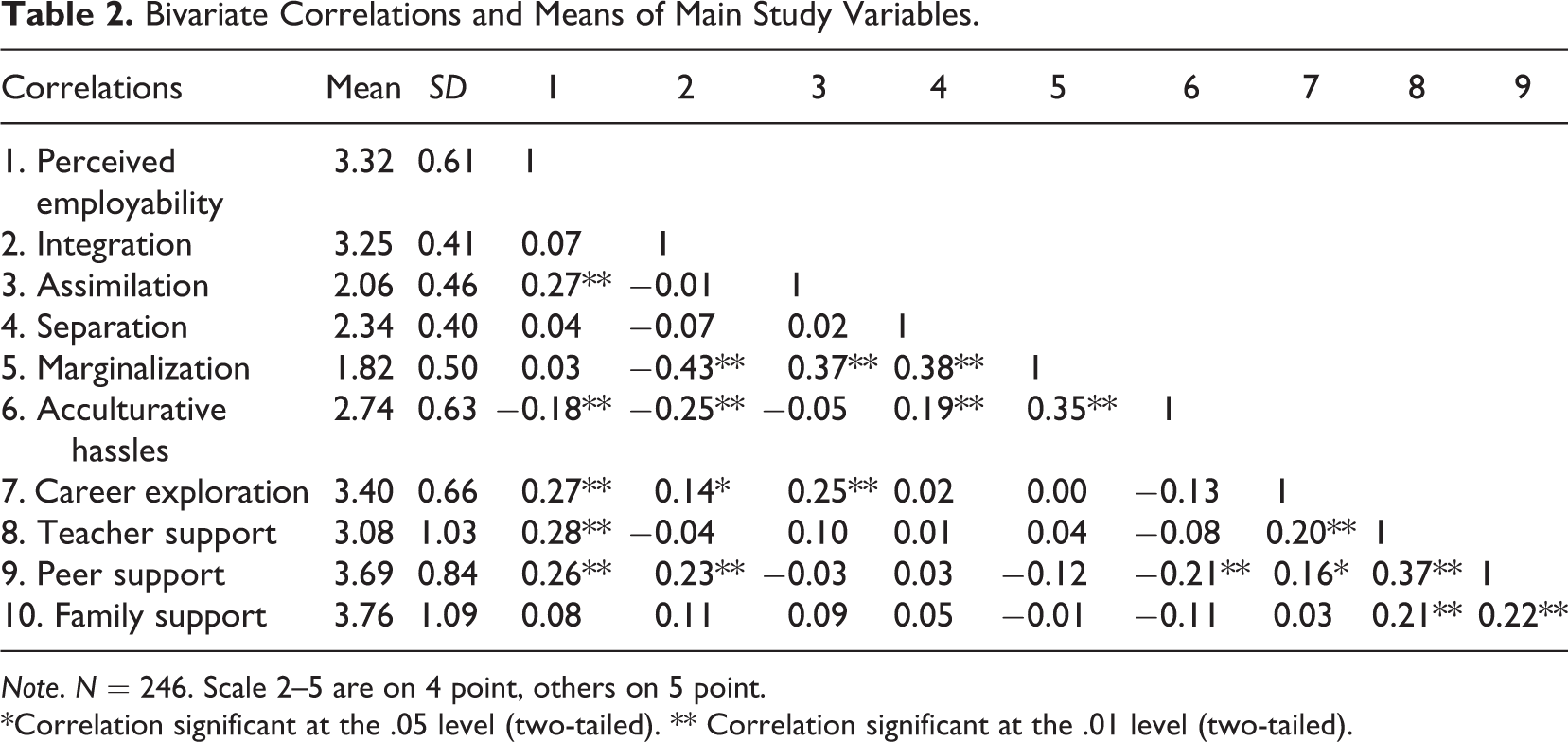
Note. N = 246. Scale 2–5 are on 4 point, others on 5 point.
*Correlation significant at the .05 level (two-tailed). ** Correlation significant at the .01 level (two-tailed).
Regression Analysis
After controlling for the demographic characteristic and migration intentions, acculturative hassles and the four acculturative strategies were entered in Block 2. Career exploration was entered into Block 3. In the last block, the three sources of career support were put into the regression equation. After the second block of acculturative hassles and acculturative strategies are entered, the model additionally accounted for 10% of the variance of perceived employability. In this block, notably, acculturative hassles (β =−.17, p < .01, see Table 3) accounted negatively for variance of perceived employability and assimilation strategy positively (β = .28, p < .001). Thus, Hypotheses 1 and 2B regarding acculturative hassles and assimilation strategy, respectively, were supported. The other three acculturative strategies did not show significant influences on self-perceived employability in the present study. Therefore, Hypothesis 2A regarding the integration strategy was not supported. The third block explained around 4% of the total variance in self-perceived employability and career exploration was a significant predictor (β =.20, p < .01). Thus, Hypothesis 3 of relation between career exploration and perceived employability was supported. In the last step, three types of relational support are put into the regression equation, explaining a further 5% of perceived employability. In this block, both teacher support (β = .17, p < .05) and peer support (β = .13, p < .05) significantly predicted perceived employability. Accordingly, Hypothesis 5 concerning relation support was supported. Together, the four blocks of IVs accounted for 29% of the variance in self-perceived employability.
Results of Hierarchical Regression Analysis of Predictors of Employability.
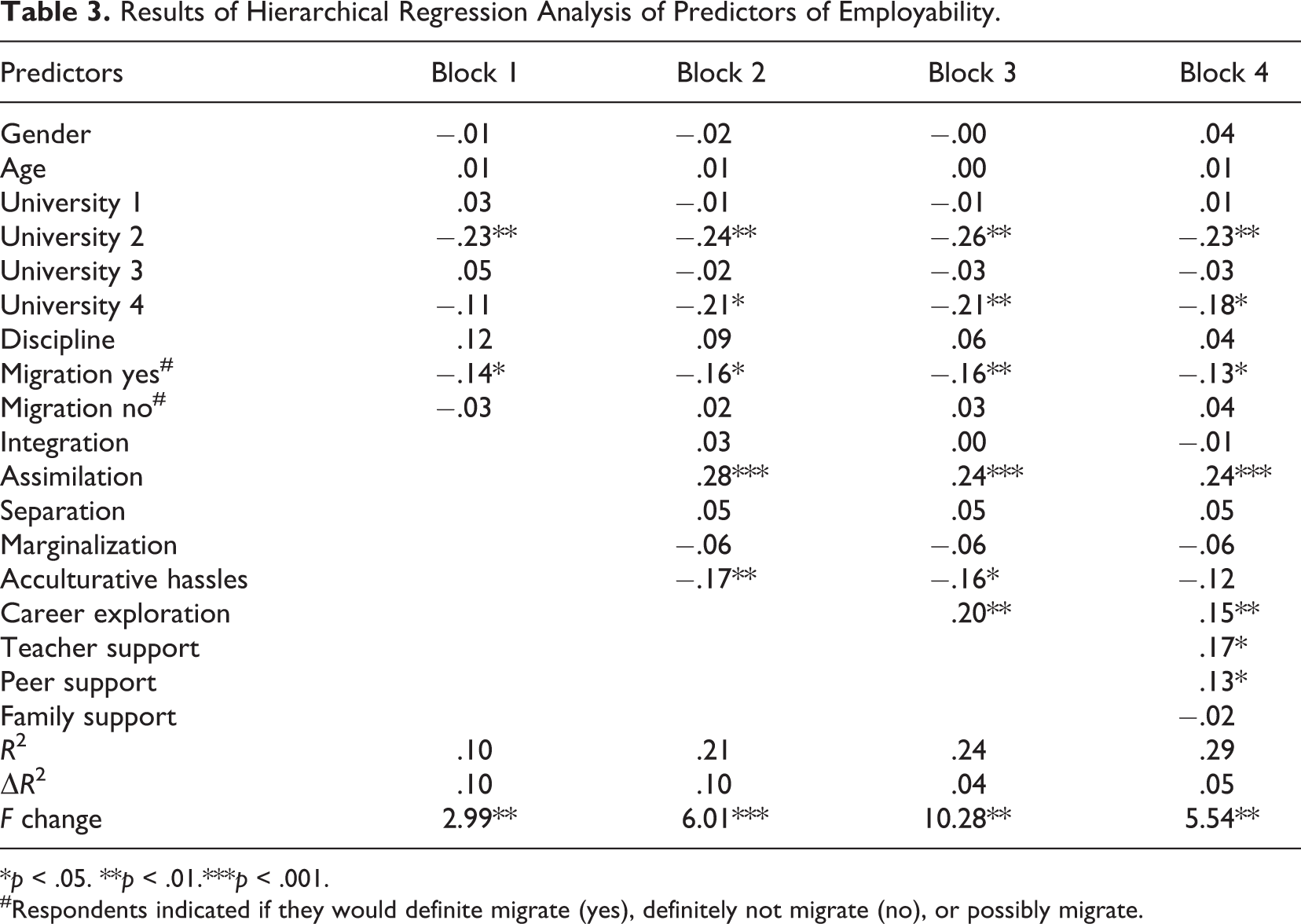
*p < .05. **p < .01.***p < .001.
##Respondents indicated if they would definite migrate (yes), definitely not migrate (no), or possibly migrate.
Mediation Analyses
From the regression analysis above, the integration strategy did not significantly predict perceived employability. Thus, it was clear that the mediation effect of career exploration (Hypothesis 4B) on the relationship between integration strategy and perceived employability did not exist, and the related hypotheses not supported. Thus, only the mediation effect of the career exploration on the relationship between assimilation strategy and perceived self-perceived employability (Hypothesis 4A) was tested.
To test this effect, three mediation analyses for mediation were performed. The results of the three mediation analyses are presented in Table 4. In Regression A, the assimilation strategy explained a significant 6% of the variance in perceived employability beyond the control variables. In Regression B, the assimilation strategy explained a significant 5% of the variance in career exploration, and in Regression C, career exploration added a significant 4% of the variance in perceived employability above and beyond the control variables and assimilation strategy. In addition, there was a decline in magnitude for the assimilation strategy (.26 vs. .21) in terms of its standardized beta weights, obtained in Regressions A and C. The Sobel test endorsed that the indirect effect (via career exploration) of assimilation strategy (standardized value = .05, Sobel’s test value = 2.93, p < .01) was significant. These results jointly indicated that career exploration partially mediated the relationship between assimilation strategy and perceived employability. Therefore, Hypothesis 4A was supported.
Hierarchical Regressions of Career Exploration and Perceived Employability.
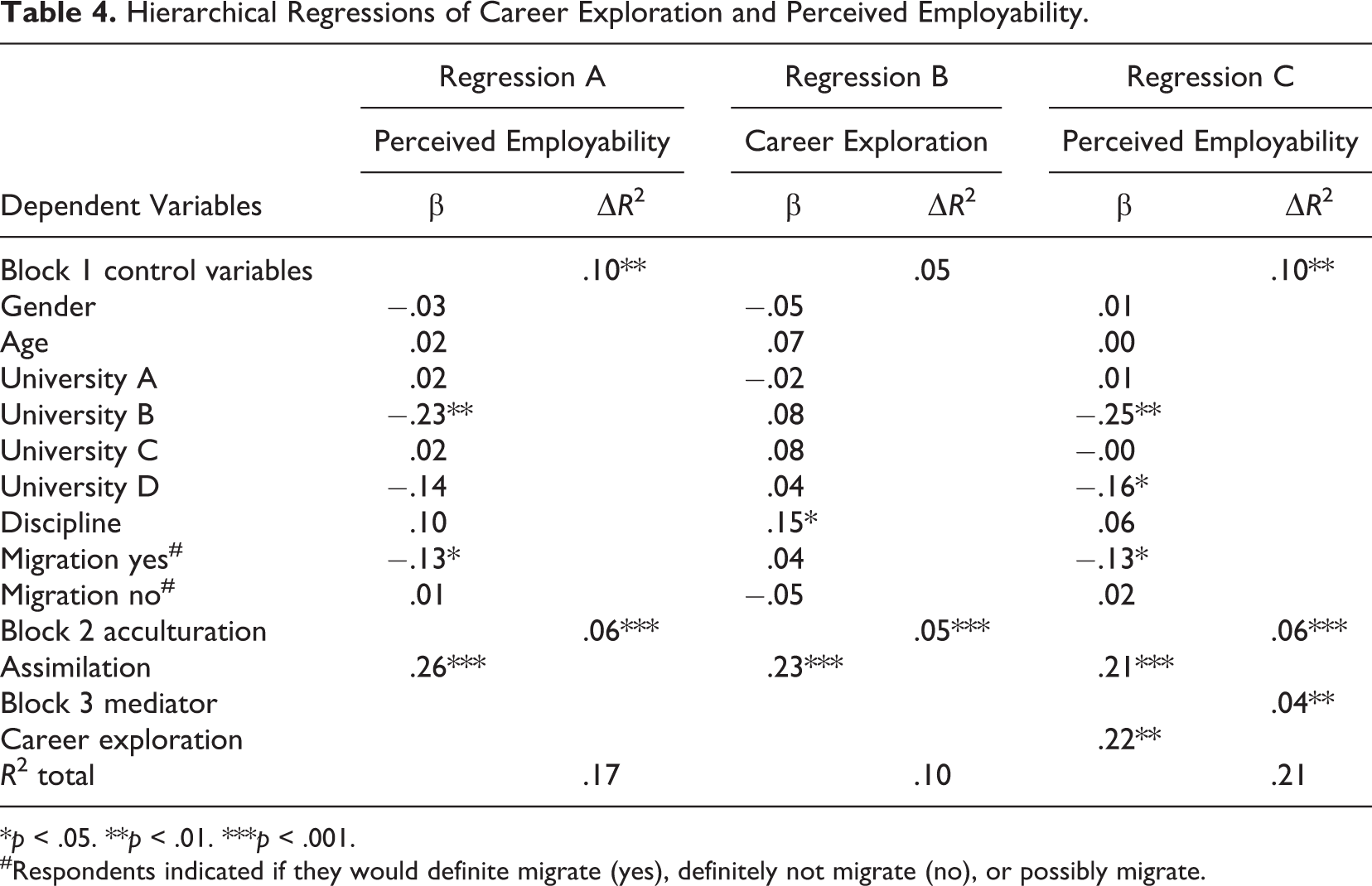
*p < .05. **p < .01. ***p < .001.
##Respondents indicated if they would definite migrate (yes), definitely not migrate (no), or possibly migrate.
Discussion and Conclusions
Determining the Effect of Acculturation
In this study, the differential effects of acculturative variables were initially tested and established. Acculturative hassles were found to be a significant predictor of perceived employability in Block 3 but not significant in Block 4 as the relational variables were entered. To understand the impact of acculturation on perceived employability, we have to look beyond acculturative stress to examine acculturative strategies. Among the acculturation strategies, only assimilation contributed to perceived employability. Summarizing his studies, Berry (2006b) found that among the strategies, only integration had demonstrated a substantial relationship with adaptation. Integration is often regarded as the most successful strategy, followed by assimilation and separation, with marginalization being the least successful. Ward and Deuba (1999) noted, however, that while integration predicted better psychological adaptation, assimilation was related to better sociocultural adaptation. Understandably, if nonlocal students are adapted to the cultural and social norms of the host society, they will be in a better position to prepare for employment in that society. Therefore, the role of acculturation in developing employability is established. Further, adopting an assimilation strategy facilitates career exploration in a host society, which in turn enhances perceived employability. In sum, the direct and indirect effects (via career exploration) of the acculturation strategy on perceived employability are supported.
Accounting for Perceived Employability
The hierarchical regression analyses demonstrated the significance of the variables in each category. We initially established a framework to understand the employability of international and nonlocal students from the vocational, relational, and acculturative perspectives. In terms of the vocational variables, we found that perceived employability is related to career exploration. Moreover, the acculturation strategy of assimilation is shown predictive of career exploration, and the mediation role of career exploration between the relationship of acculturation and perceived employability is also supported. The result enhances our understanding of career exploration of nonlocal Chinese students by establishing acculturation as its contextual factor and also relating it to the outcome of perceived employability. In this study, we have addressed the call to examine the specific contextual influences of career exploration (Zikic & Hall, 2009) and also made further investigation into its outcomes among Chinese students (Cheung & Arnold, 2014). We hope to stimulate further research in career exploration.
The effect of relational support on the career development of university students is already established in Hong Kong (Cheung & Arnold, 2010, 2014). In this study, its relationship with perceived employability gets support as we proposed in Hypothesis 5. In Table 2, peer support is found negatively correlated with acculturative hassles and positively correlated with the strategy of integration, while teacher support was not correlated with acculturative variables. In other words, only peer support was found associated with better cultural adaptation. Teacher support has been found to be predictive of career exploration in Hong Kong (Cheung & Arnold, 2010). As compared with the West, Chinese teachers have a greater tendency to take up a moral role in shaping and guiding the behavior of their students (Ho, 2001). Hence, they are more likely to give more practical guidance and career advice to nonlocal students rather than to help them with cultural adjustment. In sum, we have established more understanding regarding the significance of relational support, and it is worthwhile to investigate further the characteristic of different sources of relational support regarding employability development of nonlocal and international students in future.
Implications for Practice
The complexities of the various factors and their differential effects in accounting for perceived employability also inform practice. The focus on individual career exploration and career support is not enough. In addition to helping students cope with acculturative hassles, interventions are needed to promote adaptation to host cultural practices. Existing counseling and career services appear inadequate to meet the needs of nonlocal Chinese students. Universities are advised to tailor make an integrative, one-stop unit to coordinate career services for nonlocal students, not just in terms of academic and cultural adjustment but also for helping them with career planning and learning how to develop an interest in the local language, way of life, and career opportunities. As Arthur and Nunes (2014) proposed, counselors need to address the clarification of values or help nonlocal students explore the evolving value systems related to their cultural identities and goals, which are crucial to the students’ career planning and mobility. To do so, counselors and career practitioners in Hong Kong need to acquire cultural competence for practice beyond the host culture to the cultures the nonlocal Chinese students are from. Such cross-cultural competence needs to be emphasized in the selection and training of counselors and student affairs professionals assigned to nonlocal students. While the issue of cultural competence in profession counseling in Hong Kong and other Chinese communities has been much explored and discussed (e.g., Lau, 2000; Tan, 2009), we suggest professional associations in counseling and student affairs in Hong Kong to promote the understanding of the needs of nonlocal Chinese students as a culturally diverse group as well as culturally appropriate interventions for them through conferences and other professional development activities.
As perceived employability is found influenced by acculturative and vocational variables, different forms of interventions can be developed to foster perceived employability. Currently, career exploration courses (Cheung & Jin, 2016) and work internships (Cheung, 2007) have been found effective in fostering career exploration among university students in Hong Kong. We suggest to design such a kind of intervention to foster both career exploration and perceived employability of nonlocal students. Moreover, we have also provided supportive evidence of the reliability and validity of scales of career exploration (Porfeli & Skorikov, 2010), perceived employability (Rothwell et al., 2008), and indigenous measurements of acculturation strategy (Chan, 2001) and hassles (Pan et al., 2010) in this study. We suggest practitioners and scholars work together to utilize these tools to understand the effectiveness of appropriate counseling interventions for nonlocal Chinese students, such as changes in levels of acculturative stress and perceived employability.
Limitations
The objective of this study is to establish and compare the differential effects of acculturative and vocational variables on perceived employability. The cross-sectional, quantitative method we adopted served this purpose well. Nonetheless, there are several limitations. First, all of the measures were self-reported ones, limiting the reliability of the results to a single form of measurement. Second, as the results are from a cross-sectional design, the relationships should be followed up longitudinally to establish casual relationships in the future. Third, the responses were obtained through an online questionnaire, and the sample represented more business students and those who were responsive to requests from universities and student associations. Nonetheless, it is a meaningful sample given the institutions involved and the fact that the students were in their final year of study. The sample also allowed us to develop an understanding of how students think as they are nearing graduation and to compare the significance of variables of career exploration, relational support, and assimilation strategies for perceived employability. Using the sample, we could effectively control for and compare variance among the different factors. Further, and significantly, we could clarify the relationship between acculturation and perceived employability.
Concluding Remarks
This study has aimed to extend the theorizing of perceived employability in the context of nonlocal university students. As a result, we have not only established the effect of acculturation on perceived employability but have also found that it accounts for more variance in perceived employability as compared to both individual career development and relational career support. It highlights the importance of the direct and indirect effects of acculturation on the development of perceived employability. It is thus a first effort to establish the role of acculturation in the study of perceived employability, extending our understanding of the role of acculturative and vocational variables on perceived employability for the nonlocal Chinese students for the first time. Therefore, it will be useful in further theory building in the employability development of international and nonlocal university students.
Footnotes
Declaration of Conflicting Interests
The author(s) declared no potential conflicts of interest with respect to the research, authorship, and/or publication of this article.
Funding
The author(s) disclosed receipt of the following financial support for the research, authorship, and/or publication of this article: The work described in this paper was fully supported by a grant from the Research Grants Council of the Hong Kong Special Administrative Region, China [Project No. CityU 11401214].