



Abstract
The purpose of this study is to explore the meaning of work for Black, sub-Saharan African immigrant adult students pursuing a 4-year college degree. Career development practitioners are in a unique position to help these students make significant life-career decisions. Seven students enrolled at an urban university located in the Midwest were interviewed. Emphasis was placed on sociocultural, historical, political, and other contextual factors that affected life-work choices. Work was viewed holistically as a combination of both paid and unpaid roles. Work narratives were collected and interpreted using Gadamerian hermeneutics grounded in a constructivism paradigm. An analysis of narrative approach was used. Three main findings emerged as themes: Meaning of work was shaped by contextual factors; work experiences were closely connected to family and community; and students’ identities and work roles evolved over time. Theoretical implications and practical strategies for career counselors, with a focus on social justice, are discussed.
Career development professionals serve an important role toward facilitating a successful transition for new immigrants intending to pursue work and educational opportunities in the United States and Canada. The foreign-born population in the Unites States alone continues to swell at over 37.9 million (legal and undocumented) immigrants (Camarota, 2007). More specifically, the African immigrant population soared in recent years and is one of the fastest growing. Between the years of 2004 and 2007, there were over 106,000 African refugee arrivals (Jefferys & Martin, 2008). Despite this significant population growth, there is a paucity of research done on the immigrant student experience—especially on adult, immigrant students and their experiences in higher education, including perceived meanings of work (Alfred, 2003; Lee & Sheared, 2002). Overall, the race and ethnicity of adult college students continue to shift (Levine, 2007). In particular, immigrants from many countries leave their homes and journey to the United States and Canada to seek educational opportunities that await them. Census data suggest that the number of adult immigrant students pursuing postsecondary education opportunities will likely increase in the future. As the demographics of the nation continue to change over the next century, it will be extremely important that underserved immigrant groups, including African immigrants, become more represented in institutions of higher education and a range of work settings. Career development practitioners will continue to play a vital role in helping students become more prepared to enter this increasingly diverse workplace (Feller & Whichard, 2005; Fenwick, 2008).
The central research question for this study is, What is the meaning of work for Black, sub-Saharan African immigrant adult students pursuing an undergraduate 4-year degree? In particular, the primary rationale for this study is that there is a need for more interpretive research on the immigrant student lived experience, especially on adult immigrant students and decisions they make about work choices (Stebleton, 2007). I decided to focus on this student population due to the increasing number of recent African immigrants to the university and surrounding area where this study was conducted. Sub-Saharan African immigrants hail from those countries that are located south of the Saharan desert, including west and east Africa. Many adult immigrants pursue higher education opportunities, hence the desire to focus specifically on college students. Research has been conducted on the African American college student experience (Sealy-Ruiz, 2007; Stewart, 2009), but inquiry into the recent African immigrant student experience is scant. More specifically, there are no specific studies conducted on the work-related issues, and the meaning of work for African immigrant students. How might the perceived meaning of work connect to other aspects of career development, such as decision making and role balance issues? By focusing on issues of meaning, career counselors, including practitioners at university and college centers, will be in a better position to assist African immigrant clients as they adjust to their new work-life roles.
In particular, I examined the various work-related roles (e.g., student work, domestic work, family responsibilities, and others) that these students assume after arriving in their new homes. Sub-Saharan Black African immigrant adult students likely attach diverse meanings to concepts of work and career. For example, Mkhize and Frizelle (2000) claimed that external factors (e.g., community influences, family responsibilities) have a significant impact on many Africans as they make decisions about work, career, and unpaid roles. It is the external factors that often hold more importance over internal factors (i.e., collectivism over individualism) in African society. The external factors are often ignored or undermined by Western career development practitioners and educators. Therefore, applying Western traditional constructs and models of career development to this student population is likely doing a disservice (Blustein, Kenna, Murphy, DeVoy, & DeWine, 2005).
New Work Perspectives: A Framework
Richardson (1993) contended that career development professionals have spent too much time attempting to fit people into the right jobs or careers. Instead, she advocated that focus should be on how work (paid and unpaid) fits into people’s lives “in which work is considered to be a central human activity that is not tied to or solely located in the occupational structure” (p. 427). From this perspective, too many individuals are excluded by a focus on career with its middle-class, Western assumptions. Furthermore, Richardson (2001) suggested that researchers who focus on work-related issues need to examine the role of work across multiple social domains (e.g., family, community, and others) using a social constructionist paradigm with a strong cross-cultural perspective. When viewed through this lens, there is a distinction between career and work. Career is assumed to be paid work only within an occupational structure. For purposes of this study, work is defined holistically as the constellation of roles that these participants engage in throughout their lives, including nonpaid roles (Super, 1980).
Similarly, Blustein proposed a psychology-of-working perspective that helps to provide an alternative to traditional career development models (Blustein, Kenna, Gill, & DeVoy, 2008). This approach was created “in response to a clear need within the field of career counseling to address the lives of those who traditionally have been forgotten because of their social class or as a result of racism and other forms of social oppression” (p. 294). The majority of individuals worldwide do not have the privilege to pursue work choices based on self-interests or self-concept needs (Peterson & Gonzalez, 2005). Likewise, there is a range of barriers, including racism, discrimination, sexism, and other obstacles that often hinder successful employment. Blustein (2006) suggested that traditional career approaches need to expand beyond occupational choice and implementation (e.g., trait and factor models). Based on this recommendation, the current study aims to take a take more holistic view of work by exploring the “totality of human lives” (Blustein et al., 2008, p. 299). One way that career development practitioners can begin to understand the African immigrant population is by becoming more aware of African philosophy and work traditions.
African Philosophy and Work Perspectives
Africa is an extremely diverse continent with over 50 countries, 900 million people, and more than 2,000 spoken languages. Each country has its own historical narrative including colonization, political strife, and cultural traditions (Diop, 1974; Fanon, 1968). Despite these differences, there are some commonalities of African tradition as it relates to educational thought and philosophy, mainly the emphasis on the collective good and extended kinship (Reagan, 2005; Schiele, 2000). There is less focus on individual achievement and status in most African communities; there is a holistic aspect of identity. The community takes precedence, and there tends to be a heavy emphasis on learning from others that occurs primarily in informal settings but also in formal workplaces. Nafukho (2006) discussed the impact of a traditional African view of adult learning in the workplace. More specifically, he proposed the use of a concept titled, ubuntugogy. Bangura (2005) defined ubuntugogy as “the art and science of teaching and learning undergirded by humanity to others” (p. 13).
Other African influences and traditions include proverbs, peer alliances and self-help groups, witchcraft, folklore, and mythical stories. Ntseane (2007) acknowledged key components of African indigenous knowledge including an emphasis on participatory education, informal and practical instruction as far as general education is concerned and holistic lifelong learning that tends to be communal in nature. There is heavy emphasis on spirituality, wisdom, dreams, proverbs, metaphors, and stories, and vision as ways of knowing in many African cultures. African immigrants, like many other immigrant groups, experience a range of transition issues that affect work and life-career decision making.
Career Development and African Immigrant Transition Issues: Overview of Literature
Career development practitioners realize the need to expand their knowledge bases and to recognize the contextual and cultural factors that affect the career development process (Blustein, 2006). An overview of the literature on contextual factors, work, and other issues related to African immigrant transition is outlined in the subsequent sections.
Role of Contextual Factors
Contextual factors often affect learning and life-career planning and include, but are not limited to: sociocultural, political, economic, historical, religion, spirituality, and other polyrhymic realities (i.e., multiple, ongoing aspects of African ways of being) according to Taylor (2008). Yakushko, Backhaus, Watson, Ngaruiya, and Gonzalez (2008) argued that there are numerous contextual factors that affect the career development concerns of recent immigrants and refugees. Several of these factors outlined by Yakushko et al. can affect mental health and career decision-making. They include place of origin, social support, conditions of migration, demographic factors, socioeconomic status, and others. Recent immigrants and refugees often endure traumatic events that occurred in their home countries of origin. These events may stem from genocide, persecution, civil strife, HIV/AIDS, poverty, lack of food and water, and other unforeseen circumstances. In addition to these contextual factors, recent immigrants, including African immigrants, often experience discrimination, racism, and other barriers.
Discrimination, Racism, and Other Barriers
Next, recent immigrants may experience discrimination and other barriers that hinder occupational success (Blustein, 2006). Some of these barriers relate to acculturation and acculturative stress, cultural issues, and English language acquisition (Brilliant, 2000). Others relate to discrimination and racism. Yakushko (2009) argued that recent immigrants frequently experience racial and cultural discrimination in the United States upon migration. Xenophobia tends to be more prevalent during times of political, economic, and social instability. There are several career counseling case studies in the literature that explored discrimination and psychology-of-working issues including the Case of Mr. Ebo (Niles & Arthur, 1991) and the Case of Leonard (Blustein et al., 2008). Additionally, there are other perceived barriers that immigrants often experience. These barriers could include perceptions of narrow opportunities for advanced mobility (Flores & O’Brien, 2002), difficulty finding mentors (Shinnar, 2007), and lack of social capital. Additionally, issues of cultural shock and loss of occupational status in their home countries can affect the general adjustment of immigrants. Other potential issues relate to changes in family demands, child care, generational differences, and gender role expectations (Yost & Lucas, 2002). These dramatic changes can lead to high divorce rates of African couples upon migration (Babou, 2009). Issues of identity and immigration can also affect the transition process for new African immigrants to their new homes.
Identity and Immigration
African immigrant clients often experience issues related to colonialism and identity (Diop, 1974). According to Appiah (1992), there are psychological and sociological aspects of the history of slavery and colonialism that simply cannot be ignored. The historical impact continues to influence the identity of many African immigrants (Asante, 1990). Furthermore, many African immigrants struggle with unique identity issues. Diemer (2007), in his qualitative study of African American men, called this experience two worlds—the challenge of living and working in a predominately White world while having to maintain one’s cultural and racial identity. Nwadiora (1996) argued that many Africans need to maintain a triple identity or what could be titled three worlds. First, most African immigrants want to be identified as Africans. Second, there is a difference between being African and African American, and society does not always distinguish the two experiences due to racism and discrimination. Third, most African immigrants work in the White culture but want to maintain their own cultural traditions and heritage. This ongoing challenge can be stressful for African immigrants due to a perpetual negotiation of identity. Bhabha (1994) described this concept of negotiation as hybridity. Hybridity can be viewed as a combination of identities that the students need to negotiate, including the balance of responsibilities they assume in their new home and simultaneously at home in their countries of origin. From this perspective, many immigrant students, may experience an intersection of multiple identities (Mellow, van Slyck, & Eyton, 2003), and at any given moment different aspects of identity may be more or less salient (Abes, Jones, & McEwen, 2007). Similarly, Rendón (1996) noted that for many immigrants to the United States they assume the role of border crossers, with one foot in their home culture and the other in their new environment. As a result, this lack of stability and tension remain an ongoing challenge and can negatively affect their college experience.
Currently, there is a lack of research on the African immigrant college student experience. There is a need to explore the lived experiences of African immigrant adult students and their perceived meaning of work from a more holistic work perspective (Peterson & Gonzalez, 2005; Richardson, 1993, 2001). This calls for the application of nontraditional career approaches. South African scholars Mkhize and Frizelle (2000) argued that traditional career research ignores the needs of the majority of Africans and does not explore historical and social contexts. Narrative as a hermeneutic–dialogical research method is one example used to explore the lived experiences (what is referred to as Erlebnis) of immigrants.
Method
Overview of Hermeneutics and Work
Hermeneutics is a tradition grounded in interpretive research-based philosophy and epistemology. Hermeneutics has been called both the science and art of interpretation (Palmer, 1969). The overarching goal is to understand and interpret a given text (e.g., book, diary, narrative, film, and art). Bangura (2005) called for scholars of African studies to use hermeneutic research designs to better understand the African experience. Career development researchers have claimed that whoever lives out a career creates a meaningful text that can be understood in greater depth (Young & Collin, 1988). Hermeneutics is an ideal methodology to use in career research because one can explore the impact of historical and political forces on career as well as sociocultural factors, including issues of power, politics, and gender (Mkhize & Frizelle, 2000). This interpretive approach, with a focus on story, is rooted in African educational traditions and practices (e.g., oral histories) and therefore appropriate to use when conducting research on African populations (Johnson-Bailey, 2006). Young (1984) was one of the first to advocate for an inclusion of hermeneutics in the career development field. Work, or vocation, does not occur in a vacuum but rather in relation to other variables (e.g., people, events, and circumstances) in a variety of contexts. In particular, the emphasis should be on the understanding and meaning gleaned from a life story. These meanings have implications for the counseling process between counselor and client.
It is important to articulate a research stance or paradigm (Morrow, 2005; Ponterotto, 2005). In the current study, I adhered to a constructivism–interpretivist central paradigm. As noted by Ponterotto, the constructivist position is integrated with a hermeneutical approach; the emphasis is on the meaning (Verstehen) or understanding of a social phenomena. The constructivism paradigm’s primary objective is to gain understanding or a reconstruction. As applied to this study, a constructivist paradigm was used to develop a deeper understanding of the meaning that individuals attribute to work and work-related choices in their lives. This approach is vastly different from the positivistic approach where technical knowledge is sought, and generalizations and predictions are produced. More specifically, context and other environmental variables are salient in making important choices about work, especially in diverse cultural contexts (Hartung, 2002). The majority of career development theories are grounded in a traditional, positivistic worldview, and the constructivism paradigm departs from this stance significantly (Chen, 2003).
For purposes of this study, I used a Gadamerian hermeneutic perspective (Gadamer, 1975). Based on this paradigm, there is no ideal methodology or objective process that can be used in the interpretation of text. Consensus is not a primary goal of Gadamer and other hermeneutic scholars. Rather, the emphasis is on prejudices that the reader brings to the understanding of the text, and how these prejudices are grounded in language. For example, Gadamer (1975) was considered moderate in his philosophic views of hermeneutics. He believed that interpretation of text should be rigorous, scholarly, and disciplined. The interpreter has a point of view, and he or she cannot step outside the social world. The text stands in history as does the reader. The reader is limited by language and the experiences are shaped by cultural and historical contexts and factors. The interpretation is as much about self-understanding as it is about understanding the text itself. Gadamer was significantly influenced by Heidegger who followed a similar philosophy with a focus on Being itself (Heidegger, 1962). The approach that I took for this project was moderate hermeneutics in the Gadamerian perspective. Bangura (2005) proposed that a Gadamerian approach is appropriate to use in African studies because, “hermeneutics insists on both the cultural context as well as the historical contingencies of events as necessary in bringing about a true understanding of the different lived experiences” (p. 38). The goal was to reveal these lived histories through a work narrative.
As a way of owning one’s perspective (Elliott, Fischer, & Rennie, 1999), I (the principal investigator) am not an African immigrant student, and I did not actually live the experiences articulated by the student participants. I became interested in the narratives of African immigrant students through numerous interactions on the campus where I was employed at the time of this study. I worked as a career adviser and faculty member, and my interactions occurred inside and outside the classroom. With regard to my biases, I believed African immigrant students had rich stories to tell. It was assumed that they led hectic lives in terms of balancing expectations within two homes, in the United States and back in their countries of origin. Based on this prior informal knowledge and bias, it was important for me to acknowledge and bracket my assumptions and beliefs before formally initiating my research inquiry. I did this through informal personal writing and ongoing discussions with a research colleague who served as an auditor on the project (Elliott, et al., 1999; Ponterotto & Grieger, 2007).
Research Design
The study started by recruiting students who were interested in participating in the project. Approval from two academic institutions was granted before the project commenced.
Participants
Seven participants were interviewed for this study. The students were recruited from an urban university in the Midwest. An informational, recruiting sheet describing the study was created and provided to student service professionals. Flyers were posted around the main campus and included an announcement in the student newsletter on two occasions. Faculty and student service staff professionals were told that they could distribute the flyers to students who might be interested in the study. Participants were selected using criterion sampling (Patton, 2000). The prospective participants were screened to see whether they were a good fit for the study. Additionally, a form of snowball sampling was used. Participants were asked whether they knew of other African students who would be willing to participate in the study. For obvious ethical reasons, students in any courses taught by me during the research project were not allowed to participate in the study.
Student service professionals were asked to distribute information about the study to prospective students. I instructed staff not to record or follow up with any student who was given information about the research study. Students were told that their participation or lack of participation would in no way affect their status at the university. An informed consent process, approved by the Institutional Review Board (IRB), was reviewed and signed by all participants. Students who completed the study were given a $20 gift certificate to the university bookstore. This institution has a racially diverse student population with 25% students of color. Of the seven participants included, five were male and two were female. Their ages ranged from 26 to 45 years old; the mean age was 35 years. Pseudonyms were used for all participants.
The students emigrated from different parts of Africa, including East and West Africa (see Table 1 ). All of the participants lived in the United States for less than 10 years at the time of the interview. Participants had to meet the following criteria: (a) adult, African-born students pursuing an undergraduate 4-year degree in any discipline (age 22 years or older); (b) immigrants to the United States since 1990 (defined as “recent immigrants” for this project); (c) individuals with previous work experience in their home countries; and (d) individuals with at least moderate conversational English-speaking skills. Due to the stringent criteria for inclusion, several potential student candidates were not allowed to participate, and multiple efforts were made to increase the size of the participant pool.
Characteristics of Student Participants
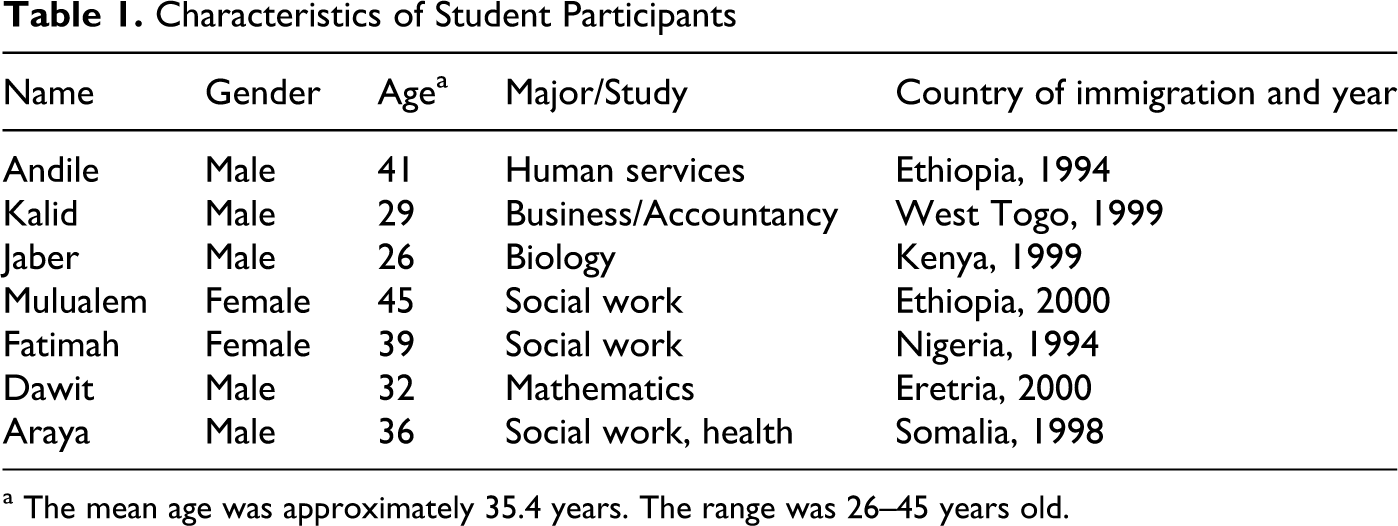
a The mean age was approximately 35.4 years. The range was 26–45 years old.
The title immigrant is often used as a general term to describe individuals who migrate to the United States from other countries. For purposes of this study, there were no technical distinctions made between immigrant, refugee, and asylee when recruiting students for participation. Of the seven students interviewed for the study, five self-identified as refugees. No international students were allowed to be interviewed.
Instrument
The interview protocol used a semistructured format (Mkhize & Frizelle, 2000). Questions focused on the students’ college experience and the meaning of work (paid and unpaid) across the life span. Students were encouraged to talk about work holistically. Each interview started with a lead question, “Tell me how you came to be a student at this university.” The format was loosely structured around three main areas: students’ present, past, and future. Appropriate follow-up and probing questions were asked as the interview continued. These probing questions focused on the following: recollections of work experiences, early fantasies about occupation or work, motivations, historical and sociocultural or political factors, cultural influences, the roles of values as it relates to work, and specifically the meaning of work to self, family, and community. Examples of these types of questions are included in the Appendix.
Procedure
All participants were interviewed individually at least one time. Each interview lasted approximately 60–90 min. Several students were contacted a second time to clarify responses. Interviews were audiotaped with the participants’ informed consent, and the interview was transcribed into text called a work narrative. Career narratives serve as an effective approach to gaining valuable information about an individual’s life and career story (Cochran, 1997). It should be noted that I decided to use the language of work rather than career. Therefore, I used the term work narratives. My aim was to focus on the role and meaning of work across an individual’s life with a focus on both paid and unpaid work (Richardson, 1993). Additionally, narrative can create a place for historically marginalized voices to be expressed and heard.
Data analysis
Each interview text was analyzed using four separate readings, focusing on a separate dimension with each reading. Researchers in the area of moral development used a similar method for interpreting narratives in their work on moral conflict and choice (Brown & Gilligan, 1991). I read each interview transcript four times, focusing on a separate dimension with each reading. Different colored pens were used to underline segments of the text in correspondence to each of the four readings. Notes were made on the interview transcripts and main points were summarized and clustered on a separate document. In the first reading, the primary goal was to gain an overall understanding of the plot of the narrative. I paid attention to recurrent images, metaphors, themes, and contradictions within the story. Mkhize and Frizelle (2000) encouraged career researchers “to reflect on the impact the story has on us as people who are in a privileged and powerful position of reading others’ stories” (p. 5). It is important throughout all readings to focus on the notion of voice: to interpret the voice that is really talking and to focus on the messages becoming evident from these various voices, or perspectives. In the second reading, the focus was on the speaking subject or the emerging sense of self. I listened for the voice of the “I” or more individualistic self versus the voice of the more collective “We.” Often, there is tension between these multiple voices, and I paid attention to how these voices were negotiated and reconciled. The third reading focused on how the self is expressed in relation to others, real or imagined. The attention is on relationships, how the participant feels, acts, and thinks in relation to others (real or imagined). The objective of the fourth and final reading was to explore the more global sociocultural context of the meaning of work. This includes issues relating to political, historical, cultural, and social contexts. Other related issues tie to gender, oppression, power, and the role of community and family in how one perceives the meaning of work.
All four of the readings were integrated and interdependent. This method is a relational one, and the readings did not stand independently. After completing each reading, I typed a one-page summary sheet for each participant and each reading. Analysis was conducted within readings and between readings. For purposes of this study, I conducted an analysis of narrative. The goal was to move from narrative to common themes using a thematic analysis. Uncovering themes is not an easy or linear process (van Manen, 1997). Although this is not intended to be a hermeneutic phenomenological study, I did use elements of van Manen’s highlighting approach (i.e., reading the text line-by-line) for isolating thematic statements (pp. 92-93). This process helped to lend credibility and trustworthiness to the analysis of the results (Morrow, 2005).
Results
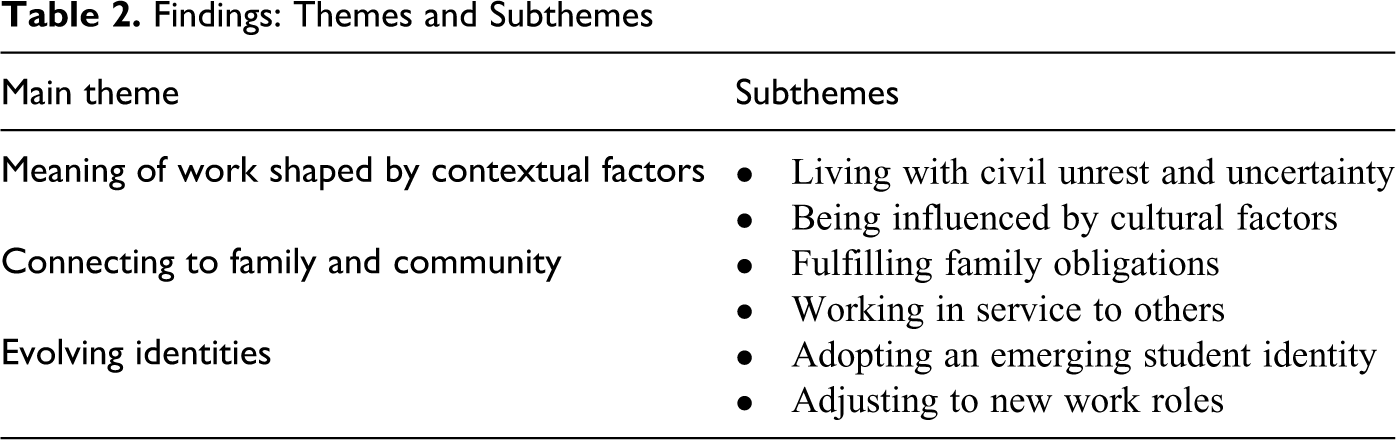
The findings of this research study were organized into three major categories and subthemes based on the data analysis (Table 2 ). First, Black sub-Saharan African immigrant adult students’ meanings of work are shaped by contextual factors. Second, their work choices and experiences are deeply connected to family and community issues. Third, students changed during their experience as college students; their identities evolved over time in terms of their work roles. The findings in this manuscript are reported by integrating Africa-specific quotes along with U.S.-specific quotes (i.e., pre vs. post immigration); this decision was intentional as to reflect the interconnectedness of these students’ lives as new immigrants (Stebleton, 2004).
Findings: Themes and Subthemes
Meaning of Work Shaped by Contextual Factors
These influences have the potential to significantly affect the meaning of work and life in general. The meaning of work shaped by contextual factors theme is organized according to two subthemes: living with civil unrest and uncertainty and influence of cultural factors (Counsell, 1999).
Living with civil unrest and uncertainty
All of the participants talked about the challenges of making work-related decisions in countries that were politically unstable. Each student discussed the impact of these sociopolitical and historical events in terms of the meaning of work-related decisions (both paid and unpaid).
Some of the events occurred when participants were young and in their formative years. Andile, a 41-year-old male student from Ethiopia, wanted to be a journalist when he grew up, but he changed his mind: When I was a child, I remember, I was dreaming to be a journalist. Because I used to have a radio at home, I heard people reading news in the Amharic language. For some reason that never happened, but now when I think back, I am glad that I did not actually pursue that profession because it’s very tough to be a journalist in a country that is not free. You can’t express your feelings, so I am glad in that respect.
Several of the students continue to be influenced after resettlement by historical circumstances in their home countries. These historical factors affect current sociopolitical affairs in many African countries, causing instability about the future. Mulualem, a 45-year-old woman from Ethiopia, came to the United States as a refugee because she was perceived as a threat in Kenya. When asked whether the political circumstances have influenced the meaning of her work choices she replied, It has [an] impact on me and my profession because the type of work I’m doing is helping people. You are helping (to) solve their problems—individuals, community groups, and families. I become very close to them and involved. Back, when we were in Kenya, there were a lot of refugee students, children, and women who have been detained and tortured by that government. They were not able to escape. Because I was there before, I was able to take some of the wounded to the hospital.
Being influenced by cultural factors
There are additional cultural factors and circumstances that the African immigrant students encountered. These variables include gender role expectations, discrimination, poverty, competition, and other environmental issues. The contextual factors can be viewed as being systemic and institutionalized within the structure and assumptions of many African cultures (Mbiti, 1969).
Issues relating to gender influenced several students. For example, Fatimah, a 39-year-old female student from Nigeria, was shaped by gender role expectations at an early age in her family and community. In her own words, “I became the mom of the house” as a young girl. Fatimah described, In the (Nigerian) culture as a growing girl or a growing person, you have certain roles that you have to do or perform, and so you are expected to do it accordingly. That’s what is expected of you—like a boy is to get a wheelbarrow, and go to the stream, and fetch water in the morning, and sweep while the girls cook and take care of the home. So, that’s the culture.
Most of our men, they feel that all of the responsibility of the work in the home is for the women, and they just throw all that on women. Women are doing everything. She is the one to clean the house, clean the dishes, cook food, and do all of those kinds of domestic work. Everything is on her neck! And if you don’t do it well, they will criticize you (as) being a lazy woman, so you have to look active so that they will not see you. [laughter]
Connecting to Family and Community
All of the participants discussed the importance of their families and community ties when asked about the meaning of work. The connecting to family and community theme can be expressed through two subthemes: fulfilling family obligations and working in service to others.
Fulfilling family obligations
All the participants talked about meeting family obligations, including financial responsibilities (Asante, 1990). They have family members in their respective home countries who expect some type of financial assistance currently or in the future. Araya, the 36-year-old male from Somalia, talked about his obligation to family: For example, my wife’s father and mom, they are in Somalia still, so I take care (of them). I am required to send them a monthly bill and my uncles from my mother’s side, and both my father’s side. Also, sometimes you get called by your cousin. I remember one time my cousin called me from Somalia to tell me, “I need some money,” so it’s your obligation to help them. So, we try to help them.
Working in service to others
Like the family, the extended community is an integral part of identity. The collective we or commitment to the group takes priority over the individualistic I. The concept of personhood is not achieved within the individual, but through lifelong interactions and service to others (Mentiki, 1984). For example, Araya did extensive work in the refugee camps: It really meant a lot because only when you see the suffering of a very large population, it will have an impact on you. You will see that the women are just fending for themselves; they are being raped and then they are brought to the hospital and they don’t get a lot of help in terms of let’s say (a) counselor. I would come to the refugee camp, and then I will try to help them on translations.
Sometimes I think when I was a machinist, I used to shape metal into different shapes, but now I think I am trying to shape human minds instead of metal or solid things. Even (if) this job is not a very well paying job, it is the cause.
Evolving Identities
The students in the study immigrated to the United States, at different times. Irrespective of their arrival date, all students talked about the transition to their new lives in the United States. Over time, their identities as students and workers (both paid and nonpaid roles) evolved and changed. Furthermore, the students in this study continue to experience change in the United States as immigrants. Many of the African immigrants begin to see themselves as deserving and worthy college students, often for the first time in their lives. They begin to believe that the goal of achieving a baccalaureate degree is attainable as they progress toward personal and professional aspirations (Bangura, 2005). The evolving identities theme is divided into two subthemes: adopting an emerging student identity and adjusting to new work roles.
Adopting an emerging student identity
It was apparent that as the participants became adjusted to their new lives, they became more comfortable and confident over time with themselves in their new roles. For example, all participants adopted the role of student and became more self-aware of what that meant for them.
Andile mentioned that he did not imagine that he would ever reach this stage in his degree completion. I actually didn’t think that I would come this far. It’s a huge step for me to come this far, because I work a full day, for 8 sometimes even 9, 10 hours, working with children and their families. This is not really an easy thing. But what is most favorable is, I’m free here. I don’t have anything to worry (about).
Fatimah talked about coming into her own as a college student. She did not have the chance to pursue a college degree until she immigrated. Like Andile, Fatimah talked about how her journey has been a challenge—especially with English as her second language. It’s very interesting that I am in college, but I’m really happy about it. It’s not an easy road for me because I’m struggling with the language. As I was growing up, I didn’t speak the real English. And so it’s a lot (more) difficult for me to put some of my thoughts on paper, but I’m trying my best. I think I can do it.
Adjusting to new work roles
Many of the students indicated that their expectations of work and work roles have changed. Students mentioned struggling with ongoing issues such as balancing work and life responsibilities, understanding new work roles in a different culture, adapting to the culture of work (e.g., the concept of time), finding employment, and other related transitions (Essandoh, 1995). Several students indicated how some of their work roles changed when they immigrated. For example, some male students indicated that they help around the home in the United States. For example, Araya indicated that his unpaid work roles changed after immigrating to the United States: When we came to the United States, it’s different because families are not as extended or dependent the way they are up there, where families are together. The families are still dependent, but they live differently. So it’s (my) wife and children, and me only. So if the wife is sick, then I have to cook. So the circumstances have changed now.
Discussion
This study explored the meaning of work for Black sub-Saharan African immigrant adult students who are pursuing a 4-year degree at a university. I viewed the three main themes (shaped by contextual factors, connecting to family and community, and evolving identities) described in the study as interrelated and interdependent. There are four main discussion points that will be outlined.
First, the African immigrant students’ experiences were largely shaped by contextual or environmental factors that influenced choices about work. Contextual variables, both proximal and distant, can include any events or circumstances that affect an individual’s life (Vondracek, 2001). Examples include war, civil unrest, political factors, poverty, discrimination, gender barriers, persecution, violence, competition in educational settings, family and cultural influencers, and other related issues. The findings of this study suggest that contextual factors are vitally important to consider in the work-life decision-making process of this African immigrant adult student population. Work decisions and the meanings assigned to these choices is complex.
Second, the participants in this study placed a great deal of significance on the family and community in terms of the meaning of work. Decisions regarding work reflect the communal or collective nature of many African societies and families, or the social embeddedness of work and career (Mkhize & Frizelle, 2000). Paid work was not viewed distinctly from other family and communal tasks. This idea of effort for the community good is similar to the ubuntugogy concept described previously. All of the participants in this study are giving back to their family members in some way, such as financial support.
Third, the participants sought to contribute to community in diverse ways. Like the emphasis on family, the students had a strong bond to the community, and they viewed themselves as an integral part of the community (Mentiki, 1984). They grew up with the expectation that it was important to contribute to the work of the community; this work was often unpaid (e.g., taking the goats to the stream, helping with a wedding in the village). In terms of future objectives, some of the students intended to pursue human service professions and directly serve their communities whereas other students intended to contribute to their communities through indirect efforts (e.g., research, setting up a scholarship fund).
Fourth, the African students in this study encountered some transition and change in terms of their perception and meaning of work after immigrating to the United States. Over time, they began to evolve as students and workers in a new culture. Most of the students struggled but transitioned into their new work roles and their identities as college students. They became familiar with organizational structures, including work expectations. For these students, there was frequently a tension between the individualistic goals of pursuing a college education in the United States and the collectivistic expectations of family and community. This overlap between evolving identities and family–communal responsibilities was evident. Based on the findings of this study, there are several strategies that career development professionals, including practitioners at universities and colleges, can apply.
Applications for Career Development Practitioners
There are six practical recommendations for career development professionals that result from this research study. First, career counselors need to be ready to explore the host of contextual factors, including potential mental health issues, which affect immigrants’ career and employment transitions. This was evident in the student narratives. Many African immigrants endure life changing events that are traumatic and highly emotional (e.g., loss of a family member, separation from children). Career counselors need to be a resource for immigrants who are willing to explore the intersection of personal or mental health issues with career issues. These psychosocial issues, according to Yakushko et al. (2008), can include a range of factors including language proficiency, immigration status, and other conditions of migration. The implications of these events often affect immigrants’ mental health. For example, Schaal and Elbert (2006) examined trauma and posttraumatic stress in Rwandan adolescents 10 years after the genocide that occurred in Rwanda in 1994. They discovered that 41% of the participants had witnessed the murder of their own mother or father whereas 44% met the criteria for posttraumatic stress disorder. Given the severity of these life experiences, it is imperative that career counseling interventions consider the impact of the influence of mental health issues from an integrative approach (Hinkelman & Luzzo, 2007). Blustein et al. (2008) called this integrative approach an inclusive psychological practice where there is an intentional melding between the worlds of mental health and work-related issues.
For more serious mental health concerns such as posttraumatic stress disorder, depression, and personality disorders, the career counselor may be in a better position to serve as a broker by referring the client to an appropriate provider if deemed necessary. Dealing with contextual factors may involve addressing perceived and real feelings of racial discrimination. Discrimination will continue to persist and career counselors assume an impactful position in which to help African immigrant clients. Similarly, African immigrant college students may not actively seek out counseling and career-specific services but rather handle stressors in more culture-specific ways that are tied to African community (Nwadiora, 1996). Instead, career practitioners may want to consider reaching out to immigrant students in less intrusive ways as appropriate (e.g., group counseling, addressing issues within a career exploration class).
Second, based on the student narratives in this study, new African immigrant students may need help navigating organizational systems, including academic institutions, job site expectations, application processes (e.g., financial aid), and other new experiences. This skill set involves developing knowledge about career options; discussing how to obtain and maintain a job; learning cultural expectations about work; and developing interpersonal teamwork skills to be successful in the new workplace (Yakushko et al., 2008). For instance, African clients may need to become more aware of differences of time orientation between African and Western cultures (e.g., several students indicated that being on time took on new significance in the United States). Additionally, immigrant students often struggle with bureaucratic and administrative tasks such as financial aid, immigration status documentation, applying for graduate school admission, and other related tasks. Institutional barriers should not stand in the way of immigrant students’ long-term objectives. Career development professionals are in a logical position to help immigrant students address these types of challenges, including helping students who might be unfamiliar with application procedures such as graduate school planning and job employment processes. Additionally, students often need to make adjustments—voluntarily or involuntarily—to their immigration status, and these changes inevitably influence financial aid eligibility and other factors as it relates to student and immigrant status.
Third, career development practitioners can effectively use new approaches and assessment tools that are more appropriate for African immigrant clients (Brott, 2001, 2005). For example, many career development practitioners use the traditional planful decision-making strategy (Dinklage, 1967). This model uses a logical, rational approach based on trait-and-factor theoretical foundations. As such, the planful strategy may not be appropriate for some African students given the uncertainty in their lives. Many immigrants have learned to be pessimistic about their future career plans, often due to contextual factors (Counsell, 1999). They assume an external locus of control, and as a result, they have learned not to make concrete, long-term plans just as several students described. In terms of using language as a tool, the use of metaphor as well as proverbs can be especially helpful to gain alternate understandings of career (Amundson, 2008; Pryor & Bright, 2009). For instance, Inkson and Amundson (2002) provided an anecdote where several immigrants described their transition experience as being comparable to a car that was caught in sand. These immigrant students felt stuck at times despite their best efforts to keep moving forward by stepping on the accelerator, only to sink further into frustration and despair. Also, career counselors may want to explore spirituality influences on African student identity and decision making (Stewart, 2009). Many students will use this spirit core to make work-related decisions based on purpose and meaning that is closely connected to cultural traditions and ways of thought. This may include making career-related choices based on expectations and messages from extended family, spiritual leaders, and community, including the reaching of certain decisions about major and occupation based on prestige or honor (Essandoh, 1995).
Fourth, the African students in this study shared stories about events that led them to their current situation. These consequent outcomes often involved serendipity. Career counselors can help new immigrants learn to recognize chance events and turn them into positive work and educational opportunities. Chance events or serendipitous occurrences can lead to new and unpredictable opportunities; this is often attributed to luck (Pryor & Bright, 2005). However, individuals need to know how to recognize and take advantage of these chance opportunities (Guindon & Hanna, 2002). More specifically, Mitchell, Levin, and Krumboltz (1999) created a model based on chance events called planned happenstance. Career counselors can teach clients to implement planned happenstance principles into their own lives and produce desirable chance events (Krumboltz & Levin, 2004). Also, Gelatt’s (1991) concept of positive uncertainty may be a useful tool to use with African immigrant populations due to the level of uncertainty present in their lives.
Fifth, it is important to explore the various aspects of work (both paid and unpaid) in people’s lives across social domains rather than focus solely on career. Most notably, the African immigrant adult students in this study did not use the language of career. The idea of career is a Western construct that holds minimal relevance for these participants. Instead, it is more useful to explore the meaning of work, both paid and unpaid, and not tie work to an occupational structure. This argument makes sense for this African student population because work tends to be a part of the everyday flow of life. The flow of multiple work roles—rather than a traditional focus on occupation or career—tends to be the norm in collective cultures around the world, not solely in African countries (Pringle & Mallon, 2003). Many career development theories continue to hold the individual as the unit of study. Pringle and Mallon argued that these individual-focused theories will continue to have limited applicability to other cultures outside of the middle-class focus.
Finally, it is important for career development practitioners who serve African immigrants to learn more about African culture. Likewise, it is vital that career counselors foster professional development around multicultural counseling skills (Parham, 2002; Sue & Sue, 2003). Career counselors can help clients explore the factors that influence work decisions for their clients, including values that stem from the collective perspective, or what Mkhize and Frizelle (2000) called the social embeddedness of career. Yakushko et al. (2008) suggested a series of necessary competencies to work with immigrant clients, including African immigrants. As such, these competencies include challenging personal assumptions, using a team approach to treatment, using interpreters, and creating workshops and structured groups so that clients assume an affiliation with other immigrant students who might be experiencing comparable transitions. Finally, career counselors can learn more about immigrant populations, including African groups, by intentionally seeking out new personal growth opportunities for professional development. These learning options might include attending international film festivals, following current national and international events affecting Africans (locally and abroad), and learning more about African history.
There were several limitations of the current study. First, the small sample size was comprised of adult African immigrant, college students from several sub-Saharan countries rather than a distributed representation of the continent. Students at this particular institution were primarily recent immigrants from East and West Africa. Gadamerian hermeneutics focuses on meaning and is less concerned about sample size (i.e., there is not a recommended number of participants). The purpose of a hermeneutic study is to gain a deeper understanding of a lived experience, not to generalize or make predictions based on results. As such, readers should exercise caution and not extrapolate these findings to other African groups or immigrant populations. Second, due to the already stringent criteria for participant inclusion, I did not make a distinction between students who self-identified as refugee versus immigrant status; they were combined. African international students were not included. Convincing arguments can be made that each of these groups has their own unique experiences and warrant further individual study. Third, there were only two women included in the study. Women assume important leadership roles in African society and are affected by a range of contextual factors. More African female voices would have likely added to the richness of the student narratives (Reagan, 2005).
In regard to future inquiry, additional research studies on work should be conducted using interpretive methodology, including hermeneutics and phenomenology. More specifically, future studies can focus on other immigrant populations or specific African countries (e.g., all participants from Nigeria or Ethiopia). Watson and Stead (2002) called for an approach that is “increasingly involved in qualitative, participatory, action-oriented, and indigenous” in research and practice (p. 30). For example, indigenous approaches should take into consideration the multitude of external and sociocultural factors that were evident in the current study. Prilleltensky (1997) contended that research in the future should be more collaborative and encourage power sharing and participation. He called this approach emancipatory communitarian and argued that as researchers we have a moral obligation to work toward the common good. The constructivist paradigm works effectively for researching non-Western immigrant populations. The work narrative (my term) method used in the current study was adapted from work done by Mkhize and Frizelle (2000) and is recommended in future studies of immigrant populations. Work narratives allow immigrants to tell their personal stories using voices that may have been oppressed in the past. Researchers may opt to interview participants on several occasions over an extended period of time.
Additionally, mixed method approaches can be used to explore college immigrant student work issues. An expanded inquiry would likely involve recruiting students from multiple academic institutions, employing a larger sample size, exploring immigrant student populations at 2-year institutions such as community colleges, and incorporating quantitative methods to complement the student work narratives. Career researchers might also focus on traditional-age immigrant groups to see how their experiences might differ from adult, nontraditional students.
A Call to Service
Frank Parsons and other early career development pioneers founded the profession based on their work with immigrants’ causes and devoted themselves to efforts that were socially conscientious (Baker, 2009; Parsons, 1909). Career development professionals can continue to serve as agents of social change, especially because the origins of these professions were grounded in social justice work and educating for social progress (Burns, 2009; Zytowski, 2001). Given these historical implications, it is important that career counselors continue to help the immigrants of this century. The need for research on underserved populations, including immigrant populations, remains strong (O’Brien, 2001).
More specifically, career development practitioners serve an important role in helping African immigrant adult students adjust to their new lives, including the transition to new work, student, and home roles. A holistic approach to work that extends beyond traditional paid roles ideally serves this population best. Many individuals, including African immigrant students, are excluded by an emphasis on traditional career beliefs, primarily a Western perspective with its corresponding assumptions of privilege and self-determination. New perspectives on work, including innovative assessment tools and helping strategies that are culturally sensitive, are necessary for practitioners to develop and hone. By looking at the meaning of work across diverse roles, contextual frameworks, and social domains, career development professionals can help African adult immigrant students navigate life-career decisions more effectively and efficiently.
Footnotes
Appendix
Portions of this article are based on data used in an unpublished doctoral dissertation.
The author declared no potential conflicts of interest with respect to the authorship and/or publication of this article.
The author received no financial support for the research and/or authorship of this article.