



Abstract
In the present study, we examined the centrality of work in midlife adults and how it relates to their psychological well-being. Using the psychology of working theory (PWT), we tested a portion of the outcome of PWT in a sample of 1,888 midlife adults, finding good overall model data fit. Of the three needs work provides, survival, relatedness, and self-determination were each found to explain unique predictive variance. This suggests that adults who are most psychologically healthy have their survival needs met through their work, feel connected with people at work, and meet their self-determination needs through the experience of being engaged in activities at work. Implications of these findings for future research and career counseling are considered.
Background
Career and vocational development research have largely focused on the career decision-making process for those entering the workplace. Midlife careers—between one’s 40s and 60s—represent the least charted demographic in vocational psychology, despite this being the integral part of an average person’s working life. For example, during this time, many significant work and family-related decisions are made, and people go through various transitions in the roles they assume (Greller & Stroh, 1995). When researchers studied midlife people’s work, assumptions were often made with negative outcomes or dysfunctional behavior such as life stress and midlife crisis (Jans, 1989; Morgan, Patton, & Baker, 1985), lack of career fulfillment (Carr, 1997), work–life conflict (Grzywacz, 2000), and drinking problems (Grzywacz & Marks, 2000a). Despite vocational psychology’s emphasis on work and well-being (Brown & Lent, 2016), research on how work influences the positive aspects of human functioning at midlife and older is limited (Ryff, 2014).
Using a nationally representative sample of employed adults in midlife, we examined the three needs that work provides based on Blustein’s (2006, 2008) Psychology of Working Framework (PWF): need for survival, need for relatedness, and need for self-determination. As PWF has now evolved into the psychology of working theory (PWT; Duffy, Blustein, Diemer, & Autin, 2016), we investigated the relationship between these three needs and psychological well-being as outlined in the theoretical model in PWT, an empirically testable theory that is based on the core proposition of PWF as well as psychological well-being theory (Ryff, 1989).
Theoretical Framework
Psychology of working
The role of work in the lives of individuals is undoubtedly critical. People spend a significant amount of time working, whether it is actually the time spent at work, time preparing oneself for the workforce, or making plans for retirement. The importance of work is especially pronounced when examining those who do not work—how they suffer because of it—economically, socially, and personally. For example, the research on the impact of unemployment on people’s well-being has received a significant amount of empirical attention. One of the recent meta-analyses including 237 cross-sectional and 87 longitudinal studies (Paul & Moser, 2009) revealed that there are clear mental health consequences of unemployment. The average overall effect size was d = .51, indicating that the unemployed were significantly more distressed than the employed.
Although it is readily acceptable that work plays an essential role in one’s life, psychological discussions of work have been limited (Blustein, 2008). The PWF addresses the impact of work as a critical factor in people’s psychological health (Blustein, 2006, 2008). In the PWF, Blustein proposes that work meets three needs. One of the needs is access to resources that help to ensure continued survival (Blustein, 2008). Blustein articulates that the need for survival is an essential human experience and motivation derived from Maslow (1943). Although the focus of earlier theories such as Maslow’s tend to be on the “higher order” needs, the focus for the vast majority of workers is on providing for ourselves and loved ones (Blustein, 2006). The second need in the PWF is social connection. Blustein emphasizes the “relational approach” to working, stating that “the perspective that is emerging from diverse lines of inquiry is based on the notion that human beings have a natural, inherent striving for connection, attachment, and intimate relationships” (2006, p. 95). The third need that working has the potential to fulfill is self-determination (Blustein, 2006, 2008). When people are in control of their decision-making, they are likely to feel authentic with themselves, this is what Blustein refers to as social determination (Blustein, 2008).
Recently, Duffy, Blustein, and their colleagues constructed an empirically testable PWT, incorporating core elements of PWF as well as vocational psychology, multicultural psychology, intersectionality, and the sociology of work (Duffy et al., 2016). One of the key aspects of PWT centers on the notion of “decent work.” Decent work is where employees feel valued, safe, treated, and respected as fully embodied persons, provided with adequate compensation and access to health care (Duffy et al., 2016). In PWT, the primary aspects are operationalization of the predictors and the process of securing decent work and how achieving decent work impacts people’s work fulfillment and well-being via need satisfaction. In this study, our major purpose was to examine the outcome elements of PWT, which consisted of two core assumptions of the PWF: (1) Work is an essential aspect of life and an essential component of mental health and (2) the three needs (needs for survival, needs for relatedness, and needs for self-determination) that work has the potential to fulfill would impact people’s psychological well-being. It is of note that need satisfaction is proposed to be an outcome of securing decent work within PWT (Duffy et al., 2016). Admittedly, the operationalization of decent work in our study was not possible because our data set was not intended to capture the various aspects of decent work as defined in PWT. Instead, we chose to study employed adults. We acknowledge that it is not ideal but acceptable, given that this is the first study to examine the core propositions of PWT.
While PWF has generated a significant amount of research using qualitative methods (Guerrero & Singh, 2013; Hees, Rottinghaus, Briddick, & Conrath, 2012), quantitative examinations of PWF are very limited (Allan, Autin, & Duffy, 2014; Duffy et al., 2016). This study is one of the first to have examined core assumptions of PWF by testing three of the 32 propositions in PWT. These three propositions are the degree to which each of the three needs (survival and power, social connectedness, and self-determination) are related to psychological well-being.
Psychological well-being
The study of well-being has been largely dominated by two perspectives in the literature: subjective well-being, derived from the hedonic approach (Diener, 1984), and psychological well-being, derived from the eudaimonic approach (Ryan & Deci, 2001). In their article on PWT, Duffy and colleagues defined well-being as “a person’s cognitive and affective evaluation of his or her life,” with higher well-being indicative of higher life satisfaction, higher positive affect, and lower negative affect from hedonic approach, a definition derived by Diener, Oishi, and Lucas (2002). In PWF, however, Blustein places a high emphasis on people’s experiences of authoring the direction of their lives, which is defined as “self-determination” and is fundamental to eudaimonic well-being. Therefore, this study examined the relationship between the eudaimonic nature of well-being and three needs that work provides.
Among eudaimonic scholars, Ryff (1989) proposed a theoretical model of well-being in response to prior researchers’ lack of focus on the “deeper question” of “what constitutes essential features of well-being” compared to reports of affective happiness, life satisfaction, and positive affect (Ryff, 2013). She operationalized psychological well-being into six dimensions: self-acceptance, positive relations with others, autonomy, environmental mastery, purpose in life, and personal growth. Self-acceptance refers to holding positive attitudes toward oneself in the context of positive psychological functioning. Positive relations with others indicate one’s ability to love and maintain warm, trusting interpersonal relationships. Autonomy is described as one’s ability to have an internal locus of evaluation. Environmental mastery is conceptualized as the “individual’s ability to choose or create environments suitable to his or her psychic condition” (Ryff, 1989, p. 1071). Purpose in life is defined as individual holding beliefs that “give one the feeling there is purpose in and meaning to life” (Ryff, 1989, p. 1071).
While the relationship between need satisfaction at work and well-being generated a considerable amount of research (Duffy et el., 2016), most of the studies are theoretical in nature (Deci & Ryan, 2008; Gagné & Deci, 2005; Grant, 2007; Ryan & Deci, 2001), and even when empirically investigated, scholars tended to conceptualize well-being from the hedonic approach, often using the Life Satisfaction Scale (Patrick, Knee, Canevello, & Lonsbary, 2007; Simon, Judge, & Halvorsen-Ganepola, 2010). There is little research that investigates the relationship between need satisfaction at work and eudaimonic well-being (Ryff, 2014; Strauser, Lustig, & Ciftçi, 2008). Ryff noted that although the psychological well-being perspective led to proliferation of research in various areas including aging, developmental psychology, health, and personality, little work-related research looking at psychological well-being from the eudaimonic perspective exists. To the best of our knowledge, the current study is the first to have examined the three distinct needs that work provides and eudaimonic well-being at the same time, combining PWT and Ryff’s eudaimonic model of psychological well-being.
In the present study, we explored how three needs in PWT link to psychological well-being among employed adults in their midlife. To date, no study has examined this question in a midlife adult population. This is also the first study to have tested some of the core assumptions of PWT with a quantitative approach. Furthermore, this study fills another important gap in psychological well-being literature by investigating how work influences the positive aspects of human functioning from the eudaimonic well-being perspective. Based on the PWF and the PWT, we hypothesized that each of the three needs that work provides would yield significant direct paths to psychological well-being.
Method
Participants
Participants took part in the second wave of the Mid-Life Development in the United States (MIDUS), a national study of health and well-being conducted by the University of Wisconsin research center (MIDUS II; Ryff et al., 2006). Participants were solicited from a random digit dial, nationally representative sample of adults aged 35–86, selected from working telephone numbers. Collected in 2004–2006, the MIDUS II is a follow-up study of 1995/1996 MIDUS I, where respondents were drawn from a random digit dial, nationally representative sample of adults aged 25–74, selected from working telephone numbers. Of the 7,108 participants in MIDUS I, 4,693 participated in the second-wave phone questionnaire, yielding a mortality-adjusted response rate of 75% for MIDUS II. Participants in the second wave were between the ages of 35 and 86. The MIDUS data set has been used in previous vocational psychology studies (Cho, Tay, Allen, & Stark, 2013; Grzywacz, 2000; Grzywacz & Marks, 2000a, 2000b) with specific interest in the work–family interface. We used the sample from the second wave who were currently working, which consisted of 1,888 individuals who were 49.58 years old on average (SD = 9.34) and 49.7% female. Race composition was 91% White, 3.6% African American, 3.1% Hispanic, 1.4% Native American/Alaska Native Aleutian, 0.5% Asian, 0.3% Native Hawaiian/Pacific Islander, and 0.1% Other.
Measures
Need for survival
The degree to which work helps to ensure continued survival was measured by three items in the data set. These items are “rate current financial situation,” “rate control over financial situation,” and “having difficulty with monthly bills (reverse coded).” Items were answered on a 11-point scale ranging from 0 (worst) to 10 (best), 11-point scale ranging from 0 (none) to 10 (very much), and a 4-point scale ranging from 1 (very difficult) to 4 (not at all difficult), respectively. In the present study, the estimated internal consistency reliability of this latent variable was .71.
Need for relatedness
The degree to which work fulfills the relational needs was measured by five items. These items are “coworker support, coworkers listen to work related problems, supervisor gives needed information, supervisor helps support, and supervisor listens to work-related problems.” Items were answered on a 5-point scale ranging from 1 (all the time) to 5 (never). All of these items were reversed in sign so that higher numbers represent a stronger need for relatedness. In the present study, the estimated internal consistency reliability of this latent variable was .83.
Need for self-determination
The degree to which work has the potential to fulfill one’s self-determination was measured by three items in the data set that include “control amount of time on task at job,” “say in work decision,” and “say in planning in environment and skill discretion.” All three items were reversed in sign so that higher numbers represent a stronger need for self-determination. Items were answered on a 5-point scale ranging from 1 (all the time) to 5 (never). In the present study, the estimated internal consistency reliability of this latent variable was .72.
Psychological well-being
The 42-item Ryff’s (1989) Psychological Well-Being Scale was used to evaluate psychological well-being by the following six intercorrelated dimensions according to a multidimensional approach: self-acceptance, positive relations with others, autonomy, environmental mastery, personal growth, and purpose in life. Items were rated on a 7-point Likert-type scale (from 1 = strongly disagree to 7 = strongly agree). Twenty Psychological Well-Being Scale items were positively worded and 22 were negatively worded. Prior to analysis, negatively worded items were reverse scored so that high values indicated well-being. Previous studies have also explored the factor structure of the Psychological Well-Being Scale, highlighting the coexistence of different models that differ in their linear and hierarchical structures and item loadings (Abbott, Ploubidis, Huppert, Kuh, & Croudace, 2010; Burns & Machin, 2009; Cheng & Chan, 2005; van Dierendonck, Díaz, Rodríguez-Carvajal, Blanco, & Moreno-Jiménez, 2008). Of these, the six correlated first-order factor model represents one of the models that better fits the data and as such we used composite scores of each subscale. For the purpose of this study, we combined the six dimensions into one, informed by a measurement study of the Psychological Well-Being Scale, where the study found that there are “very high overlap” among six dimensions from multiple national surveys (Springer & Hauser, 2006). Internal consistency coefficients ranged from .86 to .93 for the six subscales, and test–retest reliability coefficients over a 6-week period ranged from .81 to .88 (Ryff, 1989). Ryff found evidence of validity through associations with other measures of well-being including Rosenberg Self-Esteem Scale (Rosenberg, 1979, in Alfred, Hammer, & Good, 2014). In addition, psychological well-being was positively correlated with life satisfaction (.63), negatively related with depressive symptoms (−.58; Lease, Horne, & Noffsinger-Frazier, 2005). In the present study, the estimated internal consistency reliability of each subscale ranged from .71 to .85.
Data Analysis
We analyzed our data with structural equation modeling (SEM) techniques using the Lavaan package in R [Lavaan version 0.5-22]. We split the sample in half at random to determine our final model with the first sample and then cross validate the model with the second sample. The first model was an a priori confirmatory factor analysis (CFA) model with the first half of the sample to examine whether the psychological well-being, survival, relatedness, and self-determination were measured appropriately. Indicators for the psychological well-being construct were the six aforementioned subscales. Indicators for the survival, relatedness, and self-determination construct were the three, five, and three aforementioned items, respectively. We allowed the four latent variables to correlate. Under the relatedness construct, error variances among the two of the indicators regarding relationships with coworkers were allowed to correlate among each other. Similarly, the three indicators regarding supervisor relationships were allowed to correlate as well. Next, based on the fit and modification indices (MI) of the first CFA model, we allowed the error variances of some indicators to correlate in the second CFA model fitted using the same sample to improve fit.
After identifying a well-fitting CFA model, we fitted a full SEM model where psychological well-being was predicted by survival, relatedness, and self-determination. We also allowed survival, relatedness, and self-determination to correlate. We then cross validated our SEM model fit using the second sample. After a successful cross validation, we combined the two halves of the sample and fitted a final SEM model. Mardia’s test of multivariate normality using list-wise-deleted data provided evidence that our data violated the assumptions of multivariate normality (skewness = 18.08, χ2 = 2,889.6, p < .001; kurtosis = 408.6, z = 28.0, p < .001). Therefore, in order to obtain accurate confidence intervals, we used the bootstrap techniques with our final SEM model. Bootstrap consisted of generating 1,000 samples and calculating the standard errors and confidence intervals using the percentile method.
Outliers were examined graphically but were not found. Missing data were treated as missing at random. All participants with at least partial data were included in the analyses, where 64.1% had complete data. All CFA and SEM models were estimated using the maximum likelihood approach. All reported correlation and regression coefficient estimates were completely standardized. Model fit was assessed using χ2 test of model fit, comparative fit index (CFI), Tucker–Lewis index (TLI), root mean square error of approximation (RMSEA), and standardized root mean square residual (SRMR). The following standards were used to reflect the most stringent rule of thumb for optimal fit: CFI and TLI values of .95 or higher, RMSEA value of .06 or lower (Hu & Bentler, 1999; MacCallum & Austin, 2000). For classifying results as “acceptable fit,” the following values were used: between .90 and .95 for the CFI and TLI, for the RMSEA between .06 and .08 (Bentler, 1990; Williams, Vandenberg, & Edwards, 2009). Critical α level was set at .05.
Results
Confirmatory Factor Analysis
The first CFA model on our first sample had good fit, χ2(109) = 325.62, p < .001, CFI = .96, TLI = .95, RMSEA = .05, and SRMR = .04. The factor loadings were all high, which showed that all indicators were important to the model. Factor loadings ranged from .65 to .85 for survival, .55 to .64 for relation, .56 to .77 for self-determination, and .55 to .91 for psychological well-being. We examined the MI to possibly improve model fit. We found that correlating the error variances between the psychological well-being indicators growth and purpose (MI = 21.1) as well as between growth and purpose (MI = 53.4) may meaningfully improve model fit. Therefore, we allowed these errors to correlate in the second CFA model, which improved model fit significantly, χ2Δ(2) = 58.93, p < .001, while all fit indices indicated good fit, χ2(107) = 266.69, p < .001, CFI = .97, TLI = .96, RMSEA = .05, and SRMR = .04. The factor loadings were all high, ranging from .65 to .85 for survival, .54 to .65 for relation, .56 to .77 for self-determination, and .55 to .91 for psychological well-being.
First Full SEM
We fitted the full SEM model on our first sample based on the final CFA model. The full SEM model fit was identical to our final CFA model because the only differences were that the correlations between psychological well-being and the three other latent variables were changed to regression paths, χ2(107) = 266.69, p < .001, CFI = .97, TLI = .96, RMSEA = .05, and SRMR = .04. Path coefficients predicting psychological well-being was .38 for survival, .23 for relation, and .11 for self-determination.
Cross-Validation Model
We fitted the full SEM model on our second sample in order to confirm that our model modifications can be generalized to a completely different sample. The model fit was as good as it was in the first sample, χ2(107) = 251.96, p < .001, CFI = .97, TLI = .96, RMSEA = .04, and SRMR = .04.
Final Full SEM
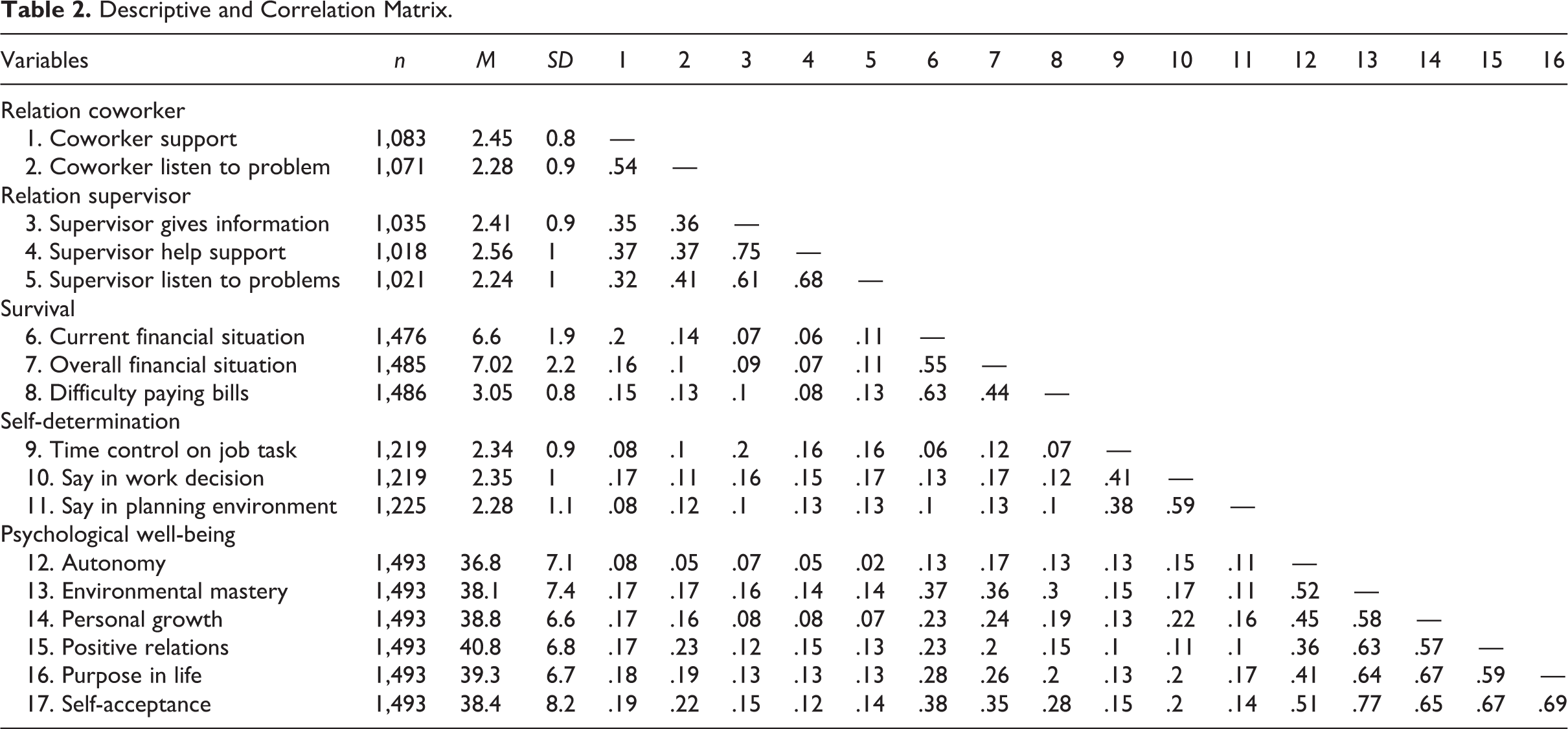
We fitted our final full SEM model by combining the first and second sample and using the bootstrap technique. The model fit remained good, χ2(107) = 349.67, p < .001, CFI = .98, TLI = .97, RMSEA = .04, and SRMR = .03. The model parameter estimates and confidence intervals among the latent variables are shown in Figure 1. All other parameter estimates, including factor loadings and the correlations among indicators, are shown in Table 1. Descriptive statistics and intercorrelations among the study variables are provided in Table 2. All factor loadings, regression coefficients, and correlations were significant (p < .001), except for the correlation between the two coworker relationships indicators (p = .175). The correlations among survival, relation, and self-determination were small, ranging from .20 to .29. Controlling for the effects of each other, survival explained psychological well-being the most (.45), followed by relation (.21), and finally self-determination (.16).
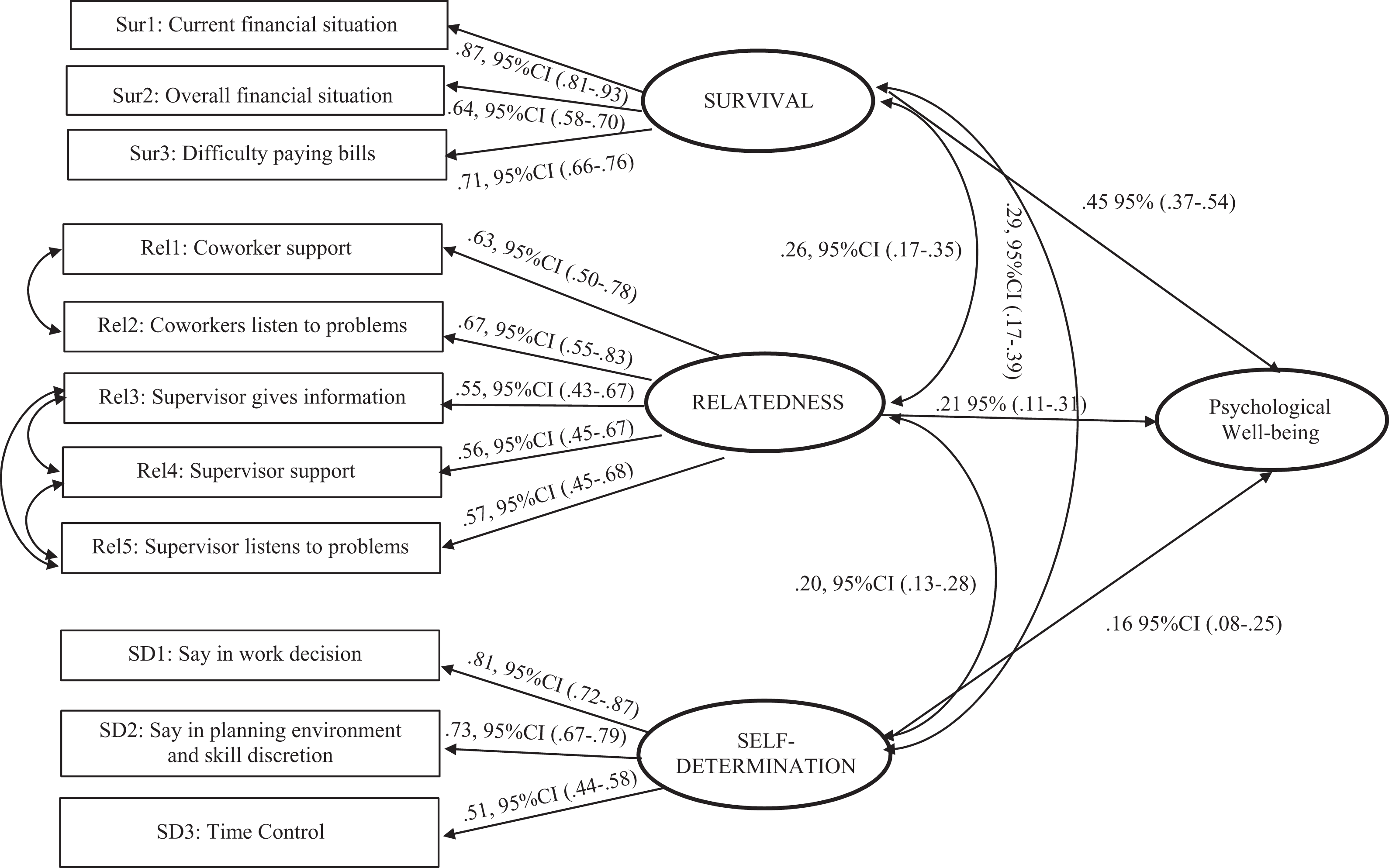
Standardized slopes for three needs work provide within psychology of working theory predicting psychological well-being.
Final Structural Equation Modeling Factor Loadings and Correlations.
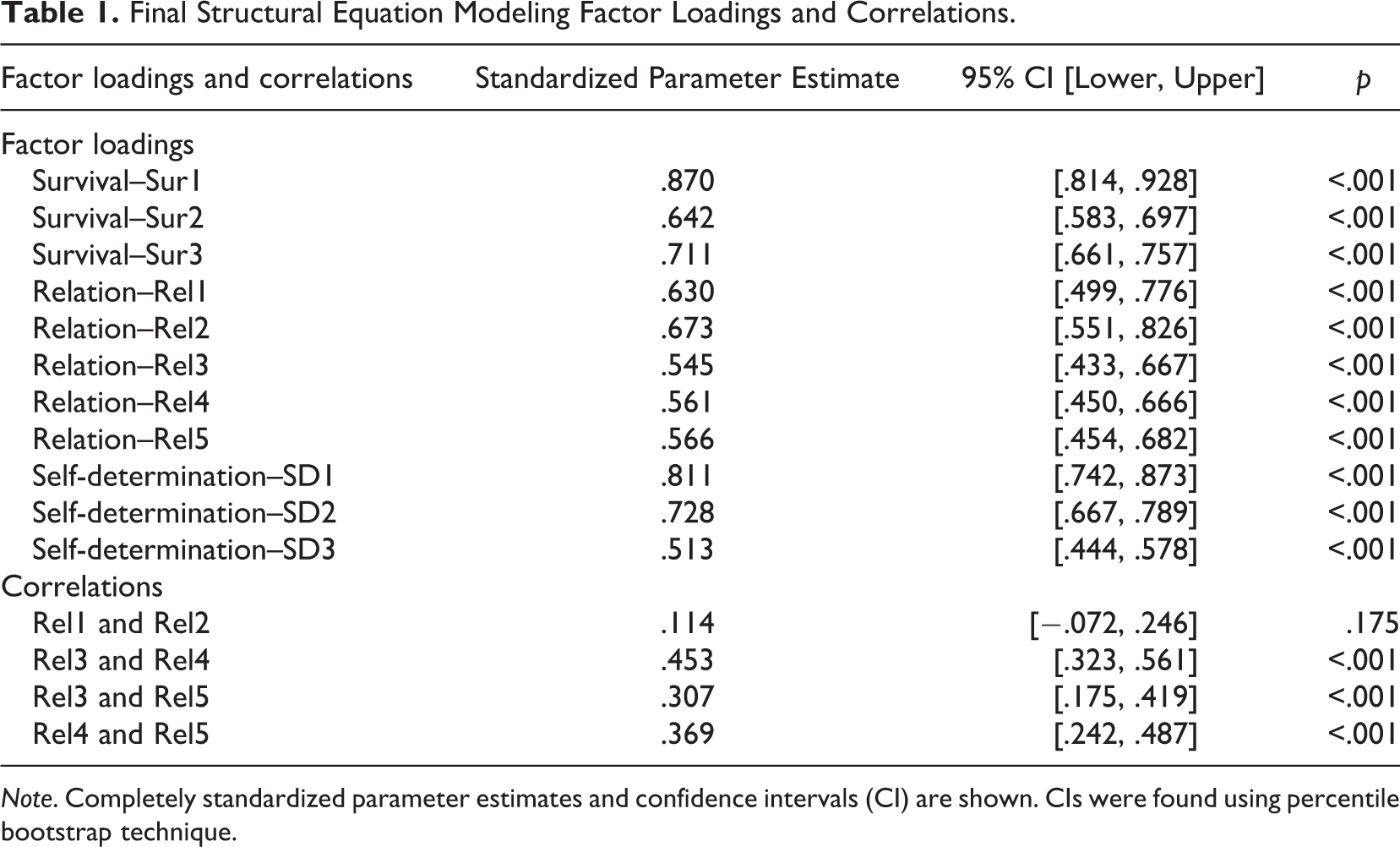
Note. Completely standardized parameter estimates and confidence intervals (CI) are shown. CIs were found using percentile bootstrap technique.
Descriptive and Correlation Matrix.
Discussion
The goal of this study was to explore how three needs in the PWT link to psychological well-being in a nationally representative sample of midlife working adults. This is one of the first studies to quantitatively examine tenets of the PWT and also one of the first studies to examine the relationship between work needs and psychological well-being for midlife adults. To date, no study has investigated this question in a nationally representative midlife adult population.
We found that, indeed, survival, relationship, and self-determination needs that work provides were related to psychological well-being for midlife adults. Interestingly, survival needs were the most strongly related to psychological well-being, suggesting that a basic level of financial security was more strongly related to eudemonic well-being than the need for relatedness or self-determination. This result is in keeping with some of the midlife career literature in that economic or financial factors often trigger the decision to seek a midlife career transition (Juntunen, Wegner, & Matthews, 2002). In addition, midlife adults, compared to any other age-group, likely consider family responsibility in career decisions because financial security ensures the survival for the individuals and those they assume responsibility for (Juntunen et al., 2002). The items related to compensation in this study assess one aspect of decent work as hypothesized by Duffy, Blustein, Diemer, and Autin (2016). Duffy et al. hypothesized that decent work is an “important component of well-being and access to opportunity” (p. 130). Decent work is defined by four categories. The first is that jobs are created, providing opportunities for individuals to work. The second is work that guarantees the rights of workers and the third is that workers have the right to social dialogue about their work. The fourth attribute is that it provides for adequate compensation as well as access to health care. In this study, all three types of needs were significant paths in the model, supporting the relationships between work needs and well-being hypothesized in the PWT (Duffy et al., 2016).
It should be noted, however, that the items measuring survival needs in the study were confined to monetary concerns, while other underlying components of survival such as social capital and working conditions were not included (Duffy et al., 2016). These included items represented the compensatory aspect of decent work as hypothesized by Duffy et al. (2016) and played the largest role in predicting well-being. Our findings not only corroborated previous work on the link between income and happiness (Diener, 2000; Kahneman & Deaton, 2010) but also highlighted the magnitude of impact survival needs have on one’s well-being compared to the other two needs. We also demonstrated that the relationships between the three needs and well-being hypothesized in the PWT (Duffy et al., 2016) are plausible based on the significant paths shown in the model.
Practical Implications
The results from this study have several implications for vocational psychologists and career counselors alike. First, career counselors are encouraged to actively address midlife adult clients’ psychological well-being in the context of their work. It is imperative that career counselors consider the various needs work provides within PWT and how each need might impact the clients’ mental health. Second, a midlife client’s financial aspect of work is likely an important predictor of his or her psychological well-being. We recommend that career counselors should explore the clients’ perceptions of survival needs that work provides in relation to achieving a satisfying career and life more generally. Career counselors can assess clients’ current employment status and situation based on clients’ survival needs, highlighting the important connection between clients’ work life and their psychological well-being. Doing so may help clients understand the relationship between their work and their well-being, so that they can have a holistic view of their lives, families, and work (Juntunen et al., 2002). Finally, considering that this is a preliminary investigation of PWT with a midlife population, career counselors and vocational psychologists need to further examine how PWT can apply to midlife clients. For example, it would be important to investigate the meaning of decent work among this population and how various aspects of decent work influence midlife clients’ psychological well-being.
Limitations and Future Research
Limitations of the current study should be acknowledged. First, a major limitation is concerned with the validity of certain constructs. The data for this study was from a large, nationally representative longitudinal study of working adults in midlife. The strength of this is that it was a large sample and nationally representative. The primary limitation of this is that the study had a number of variables, none of which were directly testing the PWT. The researchers in this study identified the variables that they hypothesized measured needs for survival, self-determination, and relatedness from the data set. Thus, there is no evidence of validity for the scales created for this study. Second, the research design is cross-sectional in nature, and thus, any causal conclusions should be viewed with caution. Third, all data were self-reported, so this single source of information may have inflated interitem correlation due to common method variance (Podsakoff & Organ, 1986).
While using archival data restricted our ability to choose measurements, we believe that the benefit of our data outweighs the weakness in that we were able to provide generalizable findings from a nationally representative sample of midlife adults in the United States and to test the hypotheses concerning PWT, a newly developed theory. In addition, the association between midlife people’s work-related variables and psychological well-being have rarely been studied, so the present study adds to the body of research showing that work is important to people’s psychological well-being from a midlife perspective.
Researchers are encouraged to replicate this study with other validated measures of Survival, Relatedness, and Self-determination Scales. This study also indicated that the relationship between aspects of decent work (compensation) is related to work needs that influence well-being in midlife. It would be ideal to study the entire model (predictors, mediators, moderators, and outcomes) to see how it fits the lived experiences for midlife adults. In addition, it would be helpful to test the PWT with populations outside of North America to investigate the cultural validity of the theory as Duffy, Blustein, and their colleagues pointed out (Duffy et al., 2016).
Footnotes
Declaration of Conflicting Interests
The author(s) declared no potential conflicts of interest with respect to the research, authorship, and/or publication of this article.
Funding
The author(s) received no financial support for the research, authorship, and/or publication of this article.