



Abstract
This article investigated the moderating role of creative self-efficacy (CSE) on the relationship between career exploration and career decision-making difficulties among French undergraduate students (N = 415). Drawing a parallel between the career decision-making process and the notion of creative problem-solving, we reasoned that career exploration without CSE—that is, the confidence in one’s own ability to solve original and complex problems—can be associated with career decision-making difficulties. Our study shows that among students who have low levels of CSE, environmental exploration, and self-exploration regarding career options are respectively associated with dysfunctional beliefs regarding one’s career path and general indecisiveness. We discuss the implications of the results.
Making a career decision can be considered a highly creative process. Today’s career environment presents individuals with challenging new opportunities, and career exploration may require relatively high levels of confidence in one’s ability to creatively integrate the available options into a viable new career path. Thus, one could argue that, among individuals active in the career exploration process, those who have higher levels of creative self-efficacy (CSE) beliefs (Beghetto, 2006; Tierney & Farmer, 2002) tend to experience few difficulties in career decision-making, while those with relatively low levels of CSE beliefs may be especially at risk for career decision-making difficulties. In the present work, we therefore set out to study the interaction between career exploration and CSE beliefs on career decision-making difficulties.
Career Exploration and Career Decision-Making Difficulties
Career exploration is receiving more and more attention in the literature as an antecedent of career decision-making difficulties (Vignoli, 2015; Xu, Hou, & Tracey, 2014; Xu & Tracey, 2014). Career exploration can be defined as behaviors providing access to new information about one’s own vocational characteristics or information about job and organizational characteristics (Stumpf, Colarelli, & Hartman, 1983). For example, before making a career decision, an individual will typically look for information about his or her own vocational interests and skills (i.e., career self-exploration [SE]) or the activities one can expect to be doing in a specific job (i.e., career environment exploration). In general, it is assumed that higher levels of career exploratory behaviors are associated with less difficulties regarding career decision-making (Xu et al., 2014; Xu & Tracey, 2014), because it is assumed that exploration reduces uncertainty and with it, difficulties as well.
However, there are indications that career exploration can also be positively associated with career decision-making difficulties. For example, Xu and Tracey (2014) have reported a positive relation between career environmental exploration (EE) and decision-making difficulties due to dysfunctional career beliefs. The relationship between career exploration and career decision-making difficulties may thus not be as straightforward as it seems.
Making a career decision is increasingly difficult. Fifty years ago, most people had less career options, and careers were more linear (Arnold, 2001). It was relatively easy to explore almost exhaustively all possible career paths, and the “best choice”—that is a choice that one would be relatively confident about—would be relatively obvious. In contrast, in the beginning of the 21st century, careers have very little chance to be linear. People have more career options than ever, and they are aware that their job will probably change several times during their working lives. New jobs, new technologies, new knowledge, or new competitors shape the lives of many workers who will have to creatively adapt to rapid global changes. In addition, social values have changed and impact the career decision process. For example, starting a family before the age of 25–30 and being a homeowner are not as commonly valued as they used to be, and job descriptions and education goals are less tightly defined (Hakim, 2000). Modern Western society allows individuals to set personal priorities, goals, and values for themselves, meaning that possible career options have increased enormously. This makes career decisions highly complex, as there could be several best choices.
Career decision-making difficulties refer to challenges that individuals experience when in the process of making career-related decisions (Gati, Krausz, & Osipow, 1996), such as choosing between different educational paths. According to Gati, Krausz, and Osipow (1996), individuals can report career decision-making difficulties stemming from chronic indecision and from the information gathered in the career exploration process. More specifically, individuals may feel a general indecisiveness (GI) when making decisions, and they may report a lack of motivation (LM) to make a decision. Furthermore, individuals may hold so-called dysfunctional beliefs (DB) and lack of realism regarding their future career; that is, unrealistic beliefs about the perfect job that has yet to cross one’s path. Finally, individuals can experience career decision-making difficulties due to perceptions of inconsistencies in the gathered information and/or due to perceptions of not enough information (Gati & Saka, 2001; Xu et al., 2014; Xu & Tracey, 2014). The available evidence suggests that people may experience decision-making difficulties in all or some of these dimensions.
In what follows, we propose that individuals who are actively exploring career options need positive CSE beliefs (Tierney & Farmer, 2002) in order not to experience too many difficulties in their career decision process.
Career Decision and CSE
Self-efficacy beliefs can pertain to different domains. Generally speaking, self-efficacy refers to the confidence that one has in one’s ability to complete tasks and attain one’s goals (Bandura, 1977). As such, individuals with low levels of self-efficacy beliefs may be less confident that they can handle complex challenges such as making career decisions. Previous researchers have specifically focused on career decision-making self-efficacy beliefs, that is, the confidence that individuals have regarding their ability to make career decisions and have found that this specific form of self-efficacy is associated with the extent to which individuals engage in career exploration (Betz & Voyten, 1997; Dawes, Horan, & Hackett, 2000; Foltz & Luzzo, 1998); those with lower levels of career decision-making self-efficacy beliefs were less likely to engage in career exploration, fearing that they might not be able to come to a decision, than those who had higher levels of career decision-making self-efficacy.
The focus of the current article is specifically on CSE. CSE does not pertain so much to one’s confidence in making decisions but refers to the belief that one possesses the ability to solve complex and creative problems (Tierney & Farmer, 2002). CSE beliefs derive partly from the subjective sense of mastery and confidence and from the actual experience of having repeatedly and successfully solved creative problems (Tierney & Farmer, 2002). This can be explained through a positive feedback mechanism in which positive creative problem-solving experiences enhance efficacy beliefs, which in turn enhance individual’s persistence and motivation when confronted with new creative problems (Tierney & Farmer, 2002). In support of this, at work, CSE has been found to be correlated with supervisor-rated creative performance (Tierney & Farmer, 2002, 2004), with task expertise and supervisors’ expectations of employee creativity (Tierney & Farmer, 2004).
Why would CSE beliefs be associated with career decision-making difficulties among career explorers? In today’s world, many career solutions are quite creative, and career choices resemble solving a complex and creative problem. What is typical for creative problems is that they are relatively unfamiliar, and they do not (seem to) contain all the elements necessary for a final synthesis. Moreover, in creative problems, the number of elements and the set of possible solutions are relatively large, and the solution is typically an original and unexpected outcome (Popov, 1992; Sternberg, 1999). Mednick (1962, p. 221) defined the process of creative problem-solving as “the forming of associative elements into new combinations that meet specific requirements and are in some way useful.” Solving a creative problem involves being able to change perspective on the elements of the problem in order to find ways of combining them in an original and appropriate way. The more mutually remote the elements of the new combination, the more creative the process or solution (Mednick, 1962).
The problem of career choice fits this definition because individuals are often confronted with large numbers of individual pieces of information when exploring career options, and they need to be able and willing to change perspective on the problem to arrive at new and original solutions. Consider the example of an individual who wants to become an entrepreneur in the field of information technology and wants to live close to work. This individual may be, for example, confronted with choosing between the opportunity for an entrepreneurship far from home or working as a manager in an information technology company close to home. Both options are not ideal. One creative solution would be to try a so-called intrapreneurship. An intrapreneur works much the same way as an entrepreneur—implementing innovative and risky processes—however, an intrapreneur does that within the organization in which he or she is an employee. Being an intrapreneur is considered a compromise between being an entrepreneur and being an employee. In the present article, we argue that using seemingly remote “career elements” to create a new opportunity like intrapreneurship, requires not only creative skill but also confidence in one’s creative skills—that is, CSE. Indeed, literature shows that creative problem-solving requires not only ability but above all confidence in one’s creative skills (Beghetto, 2006; Tierney & Farmer, 2002). During career exploration, individuals with low levels of CSE may feel overwhelmed and therefore decide to pass a potentially fruitful career opportunity and instead look for other options, postponing the decision-making process. In today’s career environment, which presents individuals with challenging new opportunities, career exploration may require relatively high levels of CSE to aid in the decision-making process.
In sum, CSE may play a crucial role in individuals’ experience of career decision-making difficulties while exploring their career. We argue that among active career explorers, especially those individuals with relatively low levels of CSE beliefs may be at risk for decision-making difficulties. Specifically, we argue that career explorers with low levels of CSE beliefs may experience stronger career decision-making difficulties than career explorers with high levels of CSE beliefs. Note that our reasoning is fundamentally different from the above described study (Betz & Voyten, 1997; Dawes et al., 2000; Foltz & Luzzo, 1998) in which career decision-making self-efficacy beliefs were investigated as a predictor of career exploration itself. We investigate CSE beliefs as a potential moderator in the link between career exploration and career decision-making difficulties.
To test this hypothesis, we explore for each dimension of career decision-making difficulties as conceptualized by Gati et al. (1996), whether among high career explorers, CSE predicts career decision-making difficulties. Specifically, we test whether among active career explorers, low self-efficacy is positively associated with GI, and a lack of realism in one’s career-related beliefs and cognitions. Furthermore, we test whether low levels of CSE beliefs are positively associated with bad information gathering and/or faulty processing of career information, all of which leading to the experience of decision-making difficulties.
Method
Participants
The sample consisted of 415 French third-year business administration students (M age = 20.73, SD age = 0.95, ranging from 19 to 25 years). In the sample, 42.65% of the participants were male (n = 177) and 57.35% were female (n = 238). In the European Union, the first 3 years of business administration university are general and students have to choose their master specialization (marketing, finance, etc.) during the third year of their education. When filling in the Career Decision-making Difficulties Questionnaire (CDDQ), students were asked to think about the difficulties they experienced during the process of choosing their master specialization. Even though the number of options is relatively small (about 10 options), choosing a master specialization can be a very complex decision for a student as many aspects have to be taken into account such as personal interests, characteristics of the job market, academic workload, and so on. Exploring career decision-making difficulties in this population is therefore relevant.
Measurement
Career exploration survey (CES)
We used two subscales aimed at investigating the exploration process in the CES (Stumpf et al., 1983; Patry, 2009). These two subscales measure the tendency to engage in six different behaviors related to career EE (6 items: e.g., “Obtained information on the labor market and general job opportunities in my anticipated career area”) and the tendency to engage in five different behaviors related to career SE (5 items: e.g., “Reflected on how my past integrates with my future career”) activities in the past 3 months. Because our hypotheses were specifically related to self and EE, we used neither the other subscales investigating the exploration process nor the subscales investigating the reactions to exploration and the beliefs regarding exploration. We used 5-point Likert-type scale ranging from 1 (very little) to 5 (very much). The CES has been shown to have good psychometric properties with satisfactory levels of scale score reliability (.83 for EE and .88 for SE in the original validation) and construct validity (Stumpf et al., 1983). The CES exhibited satisfactory scale score reliability in our sample (Cronbach’s α were .77 for SE and .82 for EE, respectively).
Creative Self-Efficacy Scale (CSES)
The CSES is a 4-item self-report questionnaire (Tierney and Farmer, 2002). Examples of items are “I have confidence in my ability to solve problems creatively” and “I am good at finding creative ways to solve problems.” Participants respond to the questionnaire using a 5-point Likert-type scale from 1 (strongly disagree) to 5 (strongly agree). Validation studies have shown that the CSES has satisfactory scale score reliability (with an observed Cronbach’s α of .75), structural and construct validity (Tierney & Farmer, 2002). In an organizational context, correlations around .25 were observed between the CSES and manager-rated creative performance and around .10 between the CSES and general job self-efficacy (Hammond, Neff, Farr, Schwall, & Zhao, 2011; Tierney & Farmer, 2002). When predicting job performance, the scale has been shown to have an incremental influence beyond job self-efficacy (Tierney & Farmer, 2002). In an educational context, correlations around .40 (r = .40, r 2 = 16, p < .001) were observed between CSES and teachers’ feedback on creativity (Beghetto, 2006) and around .35 (r = .35, r 2 = 12, p < .001) between CSES and teacher-rated creative performance (Choi, 2004). Contrary to the CES and the CDDQ, we did not have a French translation of the CSES. Two French native speakers translated the 4 original items into French and an independent English native speaker then translated them back into English for validation purpose. The scale showed satisfactory scale score reliability in our sample (Cronbach’s α = .70).
The CDDQ
We used the CDDQ (Gati et al., 1996; Massoudi, Masdonati, Clot-Siegrist, Franz, & Rossier, 2008). This questionnaire is based on Gati’s theory of career decision-making difficulties. The questionnaire assesses 10 dimensions of career indecision (Gati et al., 1996): LM (3 items: e.g., “I know that I have to choose a career, but I don’t have the motivation to make the decision now”), GI (3 items: e.g., “It is usually difficult for me to make decisions”), DB (4 items: e.g., “I believe there is only one career that suits me”), lack of information regarding the stages of the career decision-making process (LP, 3 items: e.g., “I find it difficult to make a career decision because I do not know what steps I have to take”), lack of information regarding the self (LS, 4 items: e.g., “I find it difficult to make a career decision because I still do not know which occupations interest me”), lack of information regarding occupations (LO, 3 items: e.g., “I find it difficult to make a career decision because I don’t know what careers will look like in the future”), lack of additional information (LA, 2 items: e.g., “I find it difficult to make a career decision because I do not know how to obtain additional information about myself (e.g., about my abilities or my personality traits)”), unreliable information (IU, 3 items: e.g., “I find it difficult to make a career decision because I have contradictory data about the existence or the characteristics of a particular occupation or training program”), internal conflicts (IIN, 5 items: e.g., “I find it difficult to make a career decision because I’m equally attracted by a number of careers and it is difficult for me to choose among them”), and external conflicts (IE, 2 items: e.g., “I find it difficult to make a career decision because people who are important to me (such as parents or friends) do not agree with the career options I am considering and/or the career characteristics I desire”).
In the original model, there are three second-order factors. Lack of readiness (LR) is extracted from LM, GI, and DB. Lack of information (LI) is extracted from LP, LS, LO, and LA. Finally, inconsistent information (II) is extracted from IU, IIN, and IE. In our study, we did not use the original model but relied on a new model proposed by Xu and Tracey (2014) in which LR is broken down into three separate correlated factors: LM, GI, and DB. This is because, just like Xu and Tracey, we found that the new model had a better relative fit to our data (Akaike information criterion [AIC] = 33,231.78) than Gati’s original model (AIC = 33,237.15). In sum, our model of career decision-making difficulties comprises the five following factors: LM, GI, DB, LI, and II.
We used 9-point Likert-type scale ranging from 1 (does not describe me) to 9 (describes me well). Previous research has shown that the CDDQ has acceptable psychometric properties (Cronbach’s α ranging between .67 and .90) and construct validity (Willner, Gati, & Guan, 2015). In our sample, the subscales exhibited similar levels of scale score reliability (Cronbach’s α for LM, GI, DB, LI, and II were .73, .67, .70, .92, and .86, respectively). Some subscales can be considered as having relatively low levels of scale score reliability in our study and in previous studies using the CDDQ (Willner et al., 2015; Xu & Tracey, 2014). This can be considered as a limitation of the CDDQ, although it is a questionnaire that has been used successfully in many empirical studies.
Procedure
Students were invited to participate in this study as an extra credit opportunity. In order to avoid common method bias and to have more evidence for causal relationships (Podsakoff, MacKenzie, Lee, & Podsakoff, 2003), we collected the data in two phases separated by 4 weeks. Participants first filled in the CES (Stumpf et al., 1983) and the CSES (Tierney & Farmer, 2002), and after 4 weeks, they filled in the CDDQ (Gati et al., 1996). Between the first and the second data collection point the dropout rate was 5%. Participants filled in all questionnaires online. Anonymity and confidentiality were guaranteed. The setting of the online survey required from participants that they answered all items before they could submit their responses. Consequently, we had no missing data among participants who participated in both phases of the data collection.
Analysis
Measurement and structural models were tested within the framework of structural equation modeling (SEM; Schreiber, Nora, Stage, Barlow, and King, 2006), and we used Mplus 7 (Muthén & Muthén, 2012) to perform the analyses. SEM is a more precise test compared to using simple sum scores because it corrects for unreliability of the measurements (Byrne, 2013). To model EE, SE, CSE, LM, GI, and DB, we used the items of the scales as indicators. Following the specifications of Xu and Tracey (2014), we used the sum scores of the subscales of LI and II as indicators of the latent variables LI and II. We then tested the structural model with latent factor interactions between EE/SE and CSE. We used the latent moderated structural equations approach (Klein & Moosbrugger, 2000). Because this model does not provide traditional model fit indices (Klein & Moosbrugger, 2000), we estimated the structural models in two steps to circumvent this problem as suggested by Klein and Moosbrugger (2000). The first step consists in estimating the structural model without the interaction term (Model 0) and assess model fit with traditional indices. The second step consists in estimating the structural model with the interaction term (Model 1) and comparing the likelihood of the Model 0 with the likelihood of Model 1 using a log-likelihood ratio test. A significant log-likelihood ratio test indicates that Model 0 represents a significant loss of fit compared to Model 1 and that the fit of Model 1 is better.
Regarding absolute model fit, we followed the recommendations of Schumacker and Lomax (2004) and used four statistical indices: The χ2/df ratio (should be less than three), the comparative fit index (CFI should be more than .90), the standardized root mean square residual (SRMR should be less than .08), and the root mean square error of approximation (RMSEA should be less than .08). We can only report the χ2/df ratio, the CFI, the SRMR, and the RMSEA of the structural model without the interaction terms. In a second step, we tested whether adding the latent interaction term increased the fit. We also used the AIC (Burnham & Anderson, 2002) to compare models. The AIC is based on information theory and is an indicator of the relative quality of a statistical model for a given set of data (Burnham & Anderson, 2002). The AIC is a relative indicator of “parsimony,” which can be defined as the extent to which a model captures the true relationship between the variables of interest while preventing from overfitting the data (Burnham & Anderson, 2002). Following Burnham and Anderson’s (2002) recommendations, we considered a difference between the AIC of two competing models greater than two, as evidence for the superiority of the model with the lowest AIC.
In the structural model, the variance and of each latent variable was set to 1 to facilitate the interpretation of the interaction effect. We report standardized model coefficients. Robust standard errors derived from maximum likelihood estimations are used throughout the analyses.
Results
Preliminary Analyses
Descriptive statistics are reported in Table 1. The analysis of the bivariate correlation matrix revealed that EE was associated with lower levels of indecision due to LM (r = −.23, r 2 = .05, p < .01). Thus, EE was associated with less motivational difficulties in making career decisions. The matrix, however, also shows that SE was associated with higher levels of GI (r = .15, r 2 = .02, p < .01) and DB (r = .19, r 2 = .04, p < .01). Finally, CSE was associated with higher levels of EE (r = .20, r 2 = .04, p < .01) and SE (r = .19, r 2 = .04, p < .01).
Descriptive Statistics.

Note. N = 415. EE = environmental exploration; SE = self-exploration; CSE = creative self-efficacy; DB = dysfunctional beliefs; GI = general indecisiveness; LM = lack of motivation; LI = lack of information; II = inconsistent information; SD = standard deviation.
*p < .05. **p < .01.
Main Analyses
Measurement model
We first tested the measurement model. The measurement model showed acceptable fit (χ2/df = 816.86/436 = 1.87, CFI = .92, SRMR = .052, and RMSEA = .046). Furthermore, all factor loadings were significant and medium to large in magnitude. We concluded from this first analysis that the data were reflective of our theoretical expectations regarding the structural validity of the constructs under investigation.
Structural model
We then tested the hypothesized structural model. The absolute fit indices of the model without the interaction terms were the same as those of the measurement model because our structural model was saturated. We performed a log-likelihood ratio test to check whether adding the interaction terms would result in significant increase of fit. The test yielded a significant result, χ2(10) = 24.626, p < .01, showing that not including the interaction terms in the model reduces the fit. This analysis was corroborated by AIC comparisons: The measurement model’s AIC (= 49,543.757) was more than two points greater than the structural model’s AIC (= 49,539.130). In sum, adding the interaction effects in the model is relevant because it significantly improves the overall fit. The significant estimates of this model are reported in Figure 1.
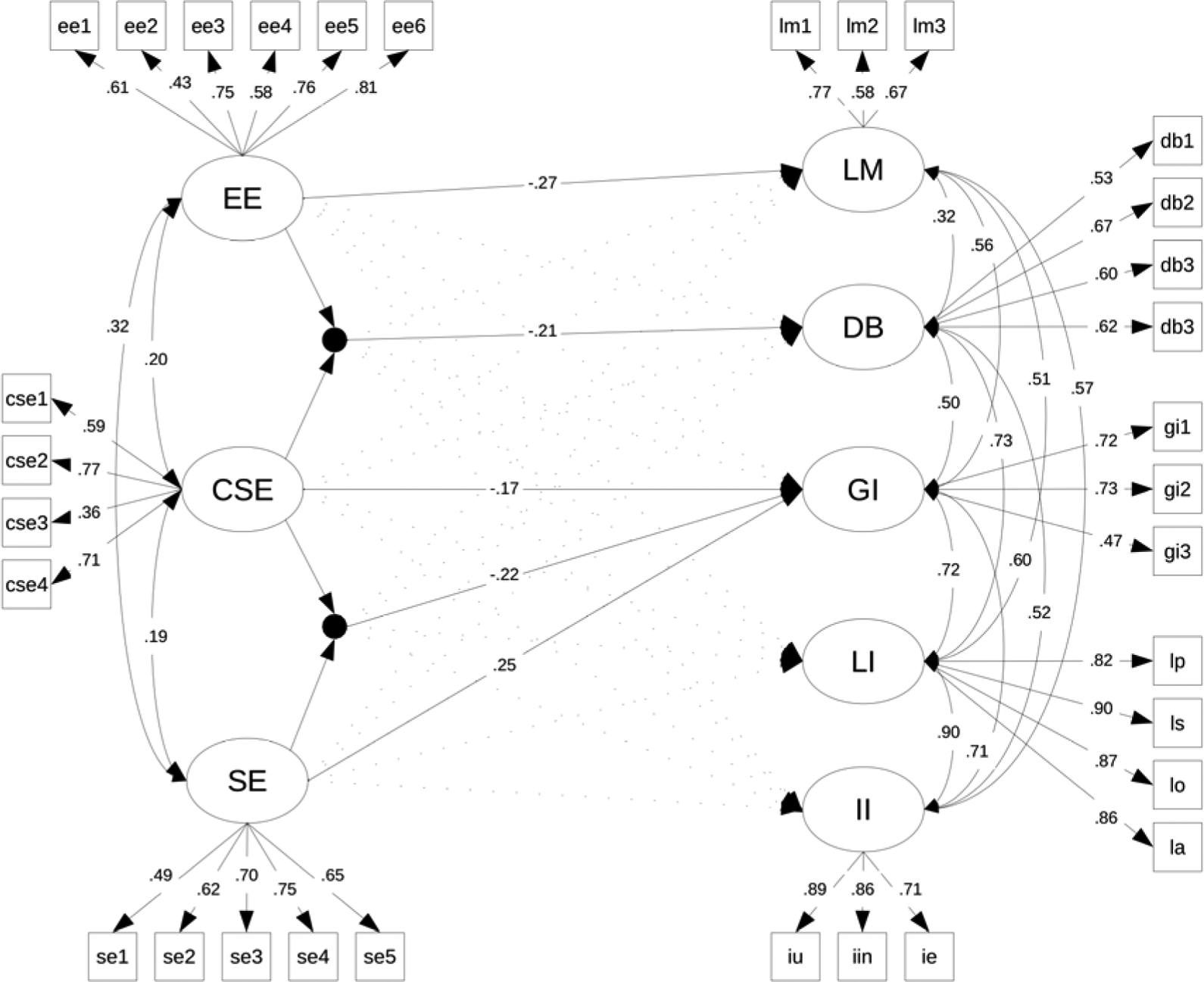
Estimates of the final model. Nonsignificant paths are represented with dotted lines. EE = environmental exploration; SE = self-exploration; CSE = creative self-efficacy; DB = dysfunctional beliefs; GI = general indecisiveness; LM = lack of motivation; LI = lack of information; II = inconsistent information.
Our analyses revealed that EE was associated with lower levels of career indecision due to LM (β = −.27, p < .001). Furthermore, SE was associated with greater GI (β = .25, p < .01). CSE was negatively associated with GI (β = −.17, p < .05). None of the other direct paths from CSE to the dimensions of career decision-making difficulties were significant. We then investigated the moderating effects of CSE on the relationship between career exploration and career decision-making difficulties. We found that CSE significantly moderated the effect of EE on DB (β = −.21, p < .01). The sign of the estimate suggested that a high level of CSE reduced the effect of EE on DB, which is consistent with our expectations. To further investigate the interaction effect, we conducted simple slope analyses (Bauer & Curran, 2005). We computed simple effects of EE on DB at one standard deviation below and one standard deviation above the mean of CSE. A significant positive effect of EE on DB was found among individuals with low levels of CSE (β = .50, p < .01). Importantly, EE had no such effect on DB among individuals with relatively high levels of CSE (β = −.32, p = .14).
We also found that CSE significantly moderated the effect of SE on GI (β = −.22, p < .05). The sign of the estimate suggested that a high level of CSE reduced the effect of self-exploration on dimensions of GI. This result is consistent with our expectations regarding the general role of CSE on the effect of career exploration and career decision-making difficulties. We ran simple slope analyses to investigate the interaction effect of SE and CSE on GI. A significant positive effect of SE on GI was found among individuals with relatively low levels of CSE (β = .93, p < .001). However, again, SE had no such effect on GI among individuals with high levels of CSE (β = .05, p = .86). No other interaction effect was significant.
Discussion
Our results showed that career exploration was negatively associated with career decision-making difficulties due to LM. This suggests that in our sample those who were active career explorers did not feel that a LM was an obstacle to making career decisions. At the same time, we also found that individuals who engage in career SE reported higher levels of GI, suggesting that individuals can indeed be motivated to make a decision and yet experience indecision. More importantly, consistent with our interaction hypothesis, this effect was attenuated by CSE. Notably, career SE and GI were unrelated among individuals with high levels of CSE, only among those with low levels of CSE was career SE associated with GI. Moreover, also consistent with our expectations, we found that, among high career environment explorers, those with lower levels of CSE reported higher levels of DB compared to those with higher levels of CSE.
These findings are important because DB and GI are core and chronic factors contributing to the postponing of making a decision. DB are irrational and unrealistic expectations about future career options, such as thinking that one chooses a career once and for all, or that only one occupation can fulfill all one’s aspirations. DB limit an individual’s cognitive processing of information by inhibiting cognitive processes which support the decision-making process (Peterson, Sampson, Reardon, & Lenz, 2002) and have been shown to be associated with anxiety and negative affect experienced during the career decision-making process (Saunders, Peterson, Sampson, & Reardon, 2000). Both GI and DB can jeopardize the whole decision-making process by impairing motivation and could even affect how career information is gathered and interpreted (Gati et al., 1996; Peterson, Sampson, & Reardon, 1991). Our study is the first to show a relation between CSE beliefs, and dysfunctional career beliefs and GI among active career explorers.
Our study relates to previous work conducted by Xu and Tracey (2014) that focused on ambiguity tolerance in the career decision process. They showed that, among high environmental career explorers, those with high levels of ambiguity tolerance experienced lower levels of decision-making difficulties related to II gathered in the career exploration process compared to those with lower levels of ambiguity tolerance. The researchers concluded that in order to help individuals with career indecision, career counselors could work with clients on their tolerance for ambiguity in gathered career information. Our study extends this preliminary work and shows that career counselors can potentially also help clients with the more chronic aspects of career decision-making difficulties (i.e., GI and DB) by building confidence in clients’ ability to solve complex problems. Altogether, our findings add to the idea that career exploration should not be considered as a simple predictor of career decision-making outcomes. It seems that depending on individual characteristics such as ambiguity tolerance and CSE beliefs, career exploration can either benefit or hamper the decision-making process, and career counselors need to be aware of this.
For career counselors, it could be beneficial to have a more in-depth understanding of the associations that we found between career exploration, on the one hand, and GI and DB, on the other hand, among individuals with low levels of CSE. We have two suggestions that could help career counselors to design specific interventions. First, individuals who lack CSE and who are actively exploring career options may develop DB and GI as a psychological defense during the process of career exploration. Making clients aware of their fears regarding career decisions could help clients to let go of this destructive tendency, and counselors could pay special attention to this.
Second, active career explorers with low levels of CSE may suffer from career confusion, similar to the concept of consumer confusion (Walsh & Yamin, 2005) due to the difficulties they experience in integrating large amounts of information into realistic career options. Consumer confusion is described in terms of cognitive errors in inferential processing that leads some consumers to form inaccurate beliefs about the function, attribute, or performance of a brand or a product due to unprocessed information overload (Walsh & Yamin, 2005). Consumer confusion is usually explained by the fact that consumers have bounded rationality and can only process a limited amount of information (Walsh & Yamin, 2005). Active career exploration might have a similar effect on career decision-making, especially among those with low levels of CSE. Career counselors who are working with clients who have low levels of CSE could therefore pay extra attention to helping their clients to organize, structure, and integrate the information that they have gathered into viable career options.
Our study is based on a sample of undergraduate college students, and our results may not generalize to other populations. Further research could therefore aim at replicating our findings in other populations. Future research could also investigate the joint contribution of ambiguity tolerance and CSE when predicting career decision-making difficulties. Based on Xu and Tracey (2014) and our findings, we would expect that ambiguity tolerance will mostly explain information-related aspects of career decision-making difficulties, whereas CSE will mostly explain chronic aspects of career decision-making difficulties. Further, research could also aim at going beyond self-efficacy beliefs and investigate the role of creative abilities as measured by the consensual assessment technique (Amabile, 1983; Storme, Myszkowski, Çelik, & Lubart, 2014) during the career decision-making process.
Footnotes
Declaration of Conflicting Interests
The author(s) declared no potential conflicts of interest with respect to the research, authorship, and/or publication of this article.
Funding
The author(s) received no financial support for the research, authorship, and/or publication of this article.