



Abstract
During early adolescence, individuals engage in exploring educational opportunities, beginning to develop a career identity, contemplate future careers, and make tentative career decisions. Choices made during this period may have a strong effect on one’s academic and career future, and in many countries, young adolescents must make important and sometimes final academic and career choices that impact the rest of their lives. Despite this, research on early adolescence is severely lacking. To address this gap, a validation study of the Childhood Career Development Scale (CCDS) was conducted with a young adolescent Italian sample. Consistent with previous research with younger samples, support was found for an eight-factor structure of the CCDS. Convergent validity was supported by positive associations with exploration, students’ ideas, attitudes, and behaviors regarding their academic and career future and career self-efficacy. These findings support Super’s dimensional model of childhood career development through early adolescence as originally theorized.
Keywords
Adolescence has been identified as a developmental life phase in which individuals explore the world of work to evaluate potential options in preparation for the later transition from school to work (Super, Savickas, & Super, 1996). During early adolescence, in particular, individuals engage in exploring educational opportunities, begin to develop a career identity, contemplate future careers, and make tentative career decisions (Betz, 2006; Flum & Blustein, 2000; Jantzer, Stalides, & Rottinghaus, 2009). The choices made during this period may have a strong effect on one’s academic and career future. In many countries, young adolescents must make important and sometimes final academic and career choices that impact the rest of their lives (Nota & Soresi, 2004). In addition, evidence suggests that adolescent career development is related to well-being and adjustment (Skorikov, 2007) and career development and achievement throughout the life span (Wiesner, Vondracek, Capaldi, & Porfeli, 2003). Despite this, research on early adolescence is severely lacking (Jantzer et al., 2009). Hence, scholars have argued for a less splintered approach to childhood and adolescent career development research (Hartung, Porfeli, & Vondracek, 2005; Watson & McMahon, 2005). Due to the shifting landscape of work resulting from globalization and the rapid growth of technology (Schultheiss & Van Esbroeck, 2009), the importance of developing and adjusting models, approaches, and resources to match the career education and counseling needs of early adolescents has become even more evident (Stead & Schultheiss, 2010).
These contemporary challenges are emphasized by the life design approach (Nota & Rossier, 2015; Savickas et al., 2009) which highlights the increased need for skills and knowledge related to nonlinear dynamics, ecological contexts, and multiple subjective understandings of the complex dynamics associated with the evolving world of work. This approach emphasizes the need to support youth in becoming experts in the coconstruction and life design processes so that they can anticipate and successfully navigate career transitions and possess hope for a foreseeable future (Guichard, 2015; Hartung, 2015; Nota, Ginevra, & Santilli, 2015). Thus, preparing youth for the challenges of the 21st century requires knowledge of early career construction (Savickas et al., 2009).
To better equip adolescents with the skills and attitudes necessary to navigate future career landscapes, it is crucial to advance our understanding of the early adolescent career development process. Although immediate occupational choices are not typically a reality for most early adolescents, it is imperative that they are able to recognize the relationship between their academic preparation and their future career (Johnson, 2000). Without an awareness of how school relates to the world of work, children and adolescents appear less cognizant of the information and skills needed for future success than those who do possess this awareness (Johnson, 2000). Despite theoretical assumptions that acknowledge the development of career-related constructs during childhood and early adolescence (Super, 1990), prevailing scholarship has not sufficiently explored the career development and decision-making of early adolescents or its relationship with later career progress. Hence, there is a critical need to bridge the gap in theoretical and empirical scholarship on early adolescent career development to respond effectively to the need for early adolescents to develop the skills necessary to make career decisions (Porfeli & Vondracek, 2009).
Early adolescent career development research has been limited by a lack of psychometrically sound assessment instruments to evaluate career progress and inform and assess the outcomes of early adolescent career interventions. Despite calls for more empirically robust and theoretically based measures, and a revitalized focus on early career development (e.g., Hartung, Porfeli, & Vondracek, 2005, 2008; McMahon & Watson, 2008; Schultheiss, 2008; Skorikov & Patton, 2007), no theoretically derived career development instruments exist for young adolescents. Based on Super’s (1990) theoretical model of childhood career development, the Childhood Career Development Scale (CCDS) was developed to assess the career progress of fourth- through sixth-grade children (approximately 6–11 years old; Schultheiss & Stead, 2004). Although this measure was developed to advance theory and research necessary to establish an empirically based conceptual knowledge of the career development process in childhood, the need to expand its application beyond childhood to early adolescence has become evident.
Validating the CCDS on an early adolescent sample would provide evidence to support its use in research aimed at filling the gap in career development knowledge related to the transition from childhood through the early adolescent period. This is particularly important in countries such as Italy, where early academic and career decisions are the norm for young adolescents. Therefore, in addition to extending the measure for use with young adolescents, this study also represents another step in determining the cultural relevancy of Super’s (1990) theory and the CCDS. Thus, the aim of this investigation was to fill these gaps by assessing the factor structure and construct validity of the CCDS (Schultheiss & Stead, 2004) in a sample of young Italian adolescents. Specifically, theory (Super) suggests that the nine dimensions of childhood career development are related to career exploration, concerns about the future, and a developing awareness of the importance of achieving in school and work as well as a growing capacity for self-efficacy beliefs. As such, this investigation examines the relationship between Super’s dimensional model as measured by the CCDS, and career exploration, concerns about one’s school and career future, and self-efficacy related to one’s confidence and ability to make decisions and succeed. Specifically, it was hypothesized that developmental progress as measured by higher scores on the CCDS would be significantly positively related to career exploration, concerns about one’s school and career future, and self-efficacy related to one’s confidence and ability to make decisions and succeed.
From Super’s Life Span Theory to Life Design Through Career Adaptability
Super (1957) conceptualized career development as unfolding across the life span from birth to death. The first stage of his model, the Growth Stage, concerns children from birth to age 14 and consists of three substages. These include: fantasy (age 4–10 years; needs are dominant and role playing is important), interest (age 11–12; likes are the major determinant of aspirations and activities), and capacity (age 13–14 years; abilities, training, and job requirements are considered). Later, Super (1990) proposed a nine-dimensional model of childhood career development which included curiosity (i.e., a need motivating inquisitive behavior), exploration (i.e., inquisitive behavior aimed at gaining information about oneself and the environment to satisfy curiosity), information (i.e., awareness of the importance and use of occupational information), key figures (i.e., important people that serve as role models), interests (i.e., awareness of likes and dislikes), locus of control (i.e., degree of internal sense of control), self-concept (i.e., awareness of self), time perspective (i.e., awareness of the past, present, and future in planning), and planfulness (i.e., awareness of the importance of planning). In this model, it is assumed that curiosity leads to exploration and subsequently to gaining information, identification with key figures, and further exploration. Success with this process is thought to result in the development of interests and an internal sense of control over one’s present and future. As interests and an internal locus of control emerge, self-esteem and time perspective strengthen. Planfulness is then thought to develop and lead to the ability to identify and solve problems and make decisions (Super, 1990). The CCDS (Schultheiss & Stead, 2004) is a theoretically and empirically derived instrument that was constructed to assess these constructs in Super’s nine-dimensional model.
The growth stage was subsequently updated (Savickas & Super, 1993; Super et al., 1996) to include four tasks specific to this stage: becoming concerned about the future (concern), increasing personal control over one’s life (control), developing an awareness of the importance of achieving in school and work (conviction), and acquiring competent work habits and attitudes (competence). Hence, it was assumed that children and early adolescents learn productive work habits and attitudes and thereby grow in their capacity to work and increase their self-confidence and ability to solve problems and make decisions. Adolescents increasingly must develop in the career domain by exploring opportunities, planning career paths, and coping successfully with school and work tasks—making career planning and exploration central to the construct of career maturity (Janeiro, 2010; Super, 1957). Career maturity refers to possessing the attitudinal and cognitive readiness to make educational and vocational decisions (Hartung et al., 2008). The attitudinal dimension of career maturity concerns the development of planning and exploratory behaviors that promote effective career decision-making (Crites, 1971; Hartung et al., 2008). The cognitive dimension of career maturity refers to acquiring knowledge about the content and process of career decision-making and the world of work (Hartung et al., 2008; Westbrook, Elrod, & Wynne, 1996).
The theory of career construction (Savickas, 2002, 2005), an extension of Super’s (1957) theory, focuses on career adaptability, defined as an individual’s readiness and resources for coping with current and anticipated tasks of vocational development (Savickas, 2002). Career adaptability is viewed as an alternative to career maturity (Savickas, 1997) and incorporates planning, decision-making, problem-solving, confidence, and exploration. The research on early adolescents is reviewed next.
Early Adolescent Research
Research on early adolescence has been emphasized because it is during this developmental stage that youth begin to develop vocational preferences and make educational and career decisions. Some researchers (e.g., Brown & Lent, 2006; Fouad, 1995, Jantzer et al., 2009) have noted that patterns may emerge early in this developmental period, which may be difficult to change. For example, students may become less flexible over time in terms of their self-efficacy beliefs and outcome expectations. Alternatively, career exploration by young adolescents may culminate in the acquisition of a deeper self-knowledge, which helps them to develop more self-efficacy for exploration (Raskin, 1994). Exploration has been noted as a central component in the development of a vocational identity, particularly as it relates to self-efficacy for committing to potential careers and acquiring work-related information (Betz, 2006; Flum & Blustein, 2000).
In a group of Italian children, Ferrari et al. (2015) studied the predictive role of career exploration on the perception of occupational knowledge and actual occupational knowledge of middle school students. Perception of occupational knowledge was defined as the amount of knowledge children think they have about a list of jobs, and actual occupational knowledge as the amount of information children know about careers and occupations. They found that exploration predicted perception of occupational knowledge and actual occupational knowledge across Holland’s categories, especially for those occupations that children were moderately familiar with (Ferrari et al., 2015). In a previous study with Italian children, Rohlfing, Nota, Ferrari, Soresi, and Tracey (2012) asked students to evaluate their knowledge of 36 occupations. They found that students’ perceptions of their overall knowledge of occupations did not differ across third through sixth grade or by gender.
Other research has explored the relationship between decision-making self-efficacy, career decision-making outcome expectations, and career decision-making intentions goals and vocational identity statuses (Jantzer et al., 2009). The findings indicated that career decision-making outcome expectations partially mediated the relationship between career decision-making self-efficacy and career decision-making intentions goals. This suggests that the amount of confidence that young adolescents have in their ability to make career decisions is associated with their intentions to create career goals and that this relationship is affected by the adolescent’s belief about the outcomes of their actions. Evidence indicates that those individuals with more career decision-making self-efficacy, career decision-making outcome expectations, and career decision-making intentions goals are more likely to be in the identity achieved versus identity diffused vocational identity status. Thus, these adolescents may be more likely to have made a tentative career choice. This research further indicated that those in the moratorium status acknowledged the importance of engaging in career planning and were more likely to have higher career decision-making outcome expectations and career decision-making intentions and goals than those in the diffused identity status.
There is also evidence to support the notion that those young adolescents, who have more fully engaged in exploration, display less career indecision than those who explore minimally or not at all (Vondracek, Schulenberg, Skorikov, Gillespie, & Wahlheim, 1995). A longitudinal study of Swiss eighth-grade students investigated predictors of the development of career adaptability over a 10-month period (Hirschi, 2009). Specifically, of the four motivational variables that were assessed, two were found to significantly predict increased adaptability, more favorable emotional dispositions, and more positive social context beliefs over time. Although goal decidedness and capability beliefs were not significant predictors, it was contended that this may have occurred because these two variables were highly correlated with each other and to career adaptability. Findings also suggested that increased career adaptability over time was significantly positively associated with an increased sense of power (internal control) and increased life satisfaction.
In a subsequent study, Hirschi (2011) investigated the development of career choice readiness (i.e., developmental tasks that involve planning, exploring, and deciding; Phillips & Blustein, 1994) by following a group of Swiss adolescents every 5 months across a 2-year period. Findings suggested that higher self-esteem and generalized self-efficacy, together with fewer perceived barriers, predicted higher career choice readiness. The development of career choice readiness over time was significantly predicted by an increase in career information. These findings suggest that providing adequate information about the world of work may be a major factor in increasing readiness (Hirschi, 2011). Other research suggests that differences in the development of career choice readiness and the level of career decidedness are related to dysfunctional beliefs, trait anxiety, basic personality traits, career decision-making self-efficacy, and external barriers (e.g., Akos, Konold, & Niles, 2004; Creed, Patton, & Prideaux, 2006; Nota, Ferrari, Solberg, & Soresi, 2007).
Research with young adolescent middle school students is essential to facilitate the academic and career decision-making faced by many early adolescents but particularly those in educational contexts that demand early decisions. Given the limited but growing knowledge of developmental antecedents of future career progress of young adolescents, having an instrument that is theoretically based and linked to a new vision of career development could be especially useful for informing recommendations for developmental and preventative interventions that help adolescents better cope with current and future challenges. Moreover, an instrument that could be used with youth from diverse nations and cultures will be beneficial, given the impact of globalization on societies. Thus, the purpose of this investigation is to assess the factor structure of the CCDS (Schultheiss & Stead, 2004) and to assess the relationship between career development progress, career exploration, ideas and attitudes on school and career future, and career-related self-efficacy.
Method
Participants
Sample 1
Participants were 164 boys and 164 girls attending middle school in Central and Northern Italy. Their mean age was 12.31 years (SD = 0.89), and the majority of participants were Italian (89%), followed by Eastern European (8.2%), African (1.6%), Asian (0.3%), and other Western European countries (0.9%). With regard to socioeconomic status (SES), 30.0% were low SES, 62.3% were middle, 7.7% were high.
Sample 2
Participants were 125 boys and 133 girls attending middle school in Central and Northern Italy. The mean age was 12.05 years (SD = 0.82). The majority of participants were Italian (93.9%), followed by Eastern European (4.3%), South American (1.2%), Asian (0.4%), and African (0.4%). With regard to SES, 26.4% were low SES, 58.9% were middle, 8.1% were high, and 6.6% were unreported.
Measures
Demographic information
Participants’ age, gender, grade, ethnicity, and SES were obtained. SES was measured by classifying parents’ jobs into three categories. Low SES was characterized by jobs such as laborers and low-skilled artisans, middle SES by office jobs and jobs necessitating a high school diploma, and high SES by managerial positions and other jobs necessitating a university degree.
CCDS
The CCDS (Schultheiss & Stead, 2004) is a 52-item, 5-point Likert-type scale that assesses children’s career development across eight subscales. In the development of the measure, curiosity and exploration items formed one factor instead of two. Thus, Super’s (1990) nine dimensions are represented across eight subscales (see Schultheiss & Stead, 2004). The CCDS was translated into Italian and then back-translated into English by another translator. The back-translated version was compared to the original English version of the instrument to determine its equivalence. Any scale items that were not perceived to be equivalent were translated and back-translated again until no differences existed in the original and back-translated versions. A description of each dimensional scale and reliability estimates from the extant literature (Schultheiss & Stead, 2004) is offered next.
Planning includes 11 items that measure an awareness of the importance of planning: (α = .84). A sample item is “It is important for me to plan things out before I do them.” Self-concept includes 6 items that assess an awareness of self-knowledge (α = .84). A sample item is “I know what type of person I am.” Information consists of 6 items that assess an awareness of the importance and use of occupational information (α = .72). A sample item is “I want to get more information about jobs.” Interests includes 6 items that measure an awareness of what one likes (α = .68). A sample item is “I know what sports I like to play.” Locus of control includes 7 items that assess the degree to which one feels an internal sense of control over one’s life (α = .79). A sample item is “I have control over how much I study for tests.” Curiosity/exploration consists of 7 items that assess inquisitive thoughts and behaviors related to school learning (α = .66). A sample item is “I am curious about the things I learn in school.” Key figures consist of 5 items that acknowledge role models or people whom one looks up to (α = .68). A sample item is “I want to do the same job as someone I look up to.” Time perspective includes 4 items that reflect a future time perspective (α = .69). A sample item is “I think a lot about what I will be when I grow up.”
Construct validity of the eight components was provided by an exploratory factor analysis that accounted for 39% of the total variance in the items in a sample of fourth- through sixth-grade students (Schultheiss & Stead, 2004). The eight-factor structure generally mirrored Super’s dimensions, except that two dimensions loaded on the same factor as they had in previous research (i.e., exploration and curiosity; Schultheiss & Stead, 2004). The loading of exploration and curiosity on the same factor was consistent with theory (Super, 1990), which suggests that exploration of self and the environment reflects an attempt to satisfy the need for curiosity. Stead and Schultheiss (2010) provided further evidence for reliability and concurrent and construct validity with a South African sample. Higher scores on the CCDS were related in predictable ways to a more fully developed sense of industry and competence, higher self-esteem, and a general internal locus of control.
Career Exploration Scale (CES)
The CES (Tracey, Lent, Brown, Soresi, & Nota, 2006) is a 10-item Likert-type scale that measures the extent to which children engaged in exploratory behaviors. Participants were asked to indicate how often they engaged in each behavior over the last 3 months, from 1 = never to 5 = lots of times. A sample item is “Talked to my friends about jobs or careers.” Reliability estimates from Tracey et al. (2006) and Sample 2 of the present study, respectively, were α = .80 and .76. Evidence for validity was suggested by predictable relationships of the CES with the correspondence index that measures the extent to which scores fit a circular order model (Tracey et al., 2006).
Ideas and Attitudes on School/Career Future (IASCF)
The IASCF (Ferrari, Nota, & Soresi, 2002; Soresi & Nota, 2001, 2003a) was developed based on the work of Jones (1989), Osipow, Carney, Winer, Yanico, and Koschier (1980), and Savickas and Jarjoura (1991). It consists of 17 Likert-type, reverse-scored items that assess students’ ideas, attitudes, and behaviors regarding their future, as it relates to school and career across three subscales (i.e., level of assurance, commitment, and certainty). Participants were asked to rate the degree to which each statement described their usual way of thinking and behaving on a scale from 1 (does not describe me at all) to 5 (describes me very well). Level of Assurance consists of 9 items that assess the level of assurance associated with self-knowledge and academic/vocational information. A sample item is, “I find it difficult to see clearly what I like and what interests me. This is why I can’t decide yet.” Level of commitment consists of 5 items that assess the level of commitment to, and involvement in, the decision-making process. A sample item is, “It is useless to think about a future job for myself. One way or another I will certainly find something to do.” Level of certainty consists of 3 items that assess the level of certainty associated with one’s future work or professional identity. A sample item is “I still can’t picture what I will do as an adult.” Reliability estimates from the extant literature (Nota & Soresi, 2004; Soresi & Nota, 2001) and for Sample 2 in the present study, respectively, are as follows: level of assurance (α = .83, .84, .88), level of commitment (α = .64, .61, .66), and level of certainty (α = .65, .62, .66). Validity evidence was provided by a series of exploratory and confirmatory factor analyses that supported the 3-factor structure, accounting for 45.40% of the total variance (Soresi & Nota, 2001).
How Much Confidence Do I Have in Myself? (HMC)
The HMC (Nota, Ferrari, & Soresi, 2005; Soresi & Nota, 2003b) consists of 20 five-point, Likert-type items that assess self-efficacy across four subscales that measure specific underlying factors or dimensions: choice and decision-making, emotional management of difficult situations, persistence and capacity to complete difficult and complex tasks, and capacity or ability to succeed. Estimates of internal consistency from the literature (Nota et al., 2005; Soresi & Nota, 2003b) and Sample 2 of the current study, respectively, are provided for each subscale. Self-efficacy about one’s capacity to make a choice and decision-making (α = .75, .82) consists of 8 items that concern how much confidence one has in oneself. A sample item is “When I have something to decide I know what to do to make a good choice.” Self-efficacy about one’s capacity to emotionally manage difficult situations (α = .78, .82) includes 9 items. A reverse-scored sample item is “I am afraid that I will not be able to deal successfully with the difficult situations I may come across in the future.” Self-efficacy about one’s persistence and capacity to complete difficult and complex tasks (α = .69, .77) includes 5 items. A reverse-scored sample item is “When I study something new I give up if I don’t understand it right away.” Self-efficacy about one’s capacity or ability to succeed (α = .75, .76) includes 6 items. A sample item is “I think I have the ability to succeed at school.” Validity evidence was provided by a series of exploratory and confirmatory factor analyses that supported the three-factor structure, accounting for 36.33% of the total variance (Nota et al., 2005; Soresi & Nota, 2003b).
Procedure
Participants were solicited from middle schools in Central and Northern Italy and asked to complete a demographic questionnaire, the CCDS, CES, IASCF, and the HMC. Participation was voluntary and completed during the regular vocational guidance activities delivered by the schools. Schools were public and located in three different regions in Northern Italy, Lombardia, Trentino Alto Adige, and Friuli Venezia Giulia, and one region in Central Italy, Tuscany. Small group administration was conducted in the children’s classrooms by psychologists. The students were given packets of questionnaires to complete in class. Administration lasted approximately 25 min. Every participant received a personalized report of the survey results.
Results
A principal factors analysis (PFA) was conducted on Sample 1 so as to use the fewest number of factors to explain the largest amount of variance with each factor in the data set (Tabachnick & Fidell, 2013). The Kaiser–Meyer–Olkin measure of sampling adequacy was .856, which is >.6, therefore indicating that the data were factorable (Tabachnick & Fidell, 2013). Oblique rotation, which augments the variance of factor loadings, was employed. A PFA with oblique rotation provided an initial solution of 8 factors with eigenvalues >1.00. The final number of factor loadings was based on the scree test, eigenvalues >1.0, parallel analysis, and the best interpretable solution. This resulted in a solution of 8 factors (see Table 1) with 41 items being retained.
Principal Factors Analysis of Childhood Career Development Scale Items.
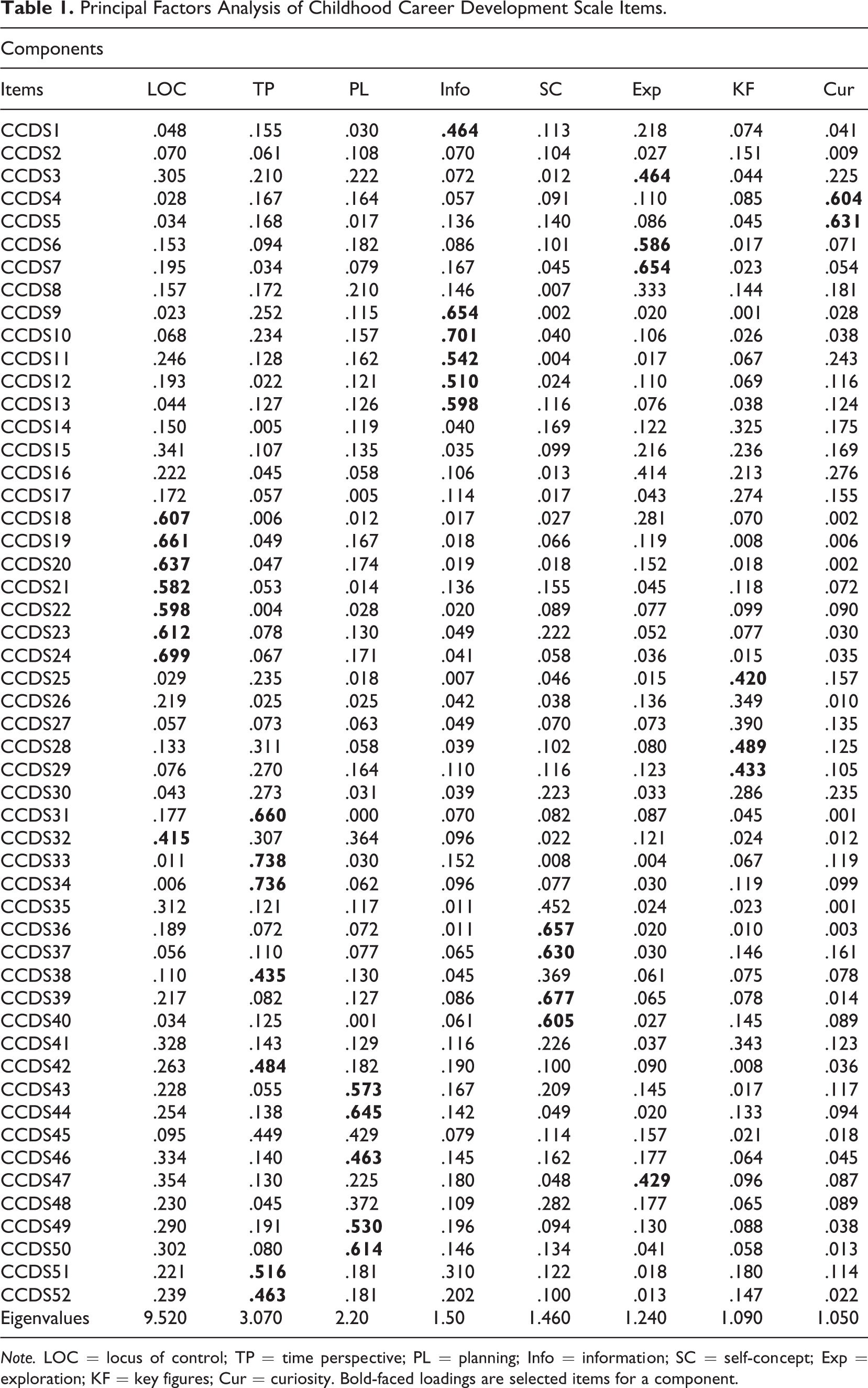
Note. LOC = locus of control; TP = time perspective; PL = planning; Info = information; SC = self-concept; Exp = exploration; KF = key figures; Cur = curiosity. Bold-faced loadings are selected items for a component.
The Cronbach’s α coefficient and item numbers are provided for each factor. Factor 1 was labeled locus of control and included 8 items (α = .84; items 18, 19, 20, 21, 22, 23, 24, 32) that referred to the extent to which one has a sense of control over one’s life (e.g., I have control over how much effort I put into my work). Factor 2, labeled time perspective, consisted of 7 items (α = .81; Items 31, 33, 34, 38, 42, 51, 52) that referred to a future time perspective (e.g., I think a lot about what I will be when I grow up). Factor 3, labeled planning, was comprised of 5 items (α = .80; Items 43, 44, 46, 49, 50) and reflected an awareness of the importance of planning (e.g., It is important for me to have a plan when I do a project). The fourth factor, labeled Information, was comprised of 6 items (α = .78; Items 1, 9, 10, 11, 12, and 13) that reflected the importance and use of occupational information (e.g., It is important for me to get information about jobs). Factor 5 was labeled self-concept, and was comprised of 5 items (α = .78; Items 35, 36, 37, 39, and 40) that referred to self-knowledge and awareness (e.g., I know what I am like). Factor 6 was labeled exploration and included 5 items (α = .72; Items 3, 6, 7, 16, and 47; e.g., I read books to learn new things) that reflected a desire to gain new knowledge and information. Factor 7, labeled key figures, included 3 items (α = .64; Items 25, 28, and 29) and referred to role models or people who have played an important and meaningful role in individuals’ lives (e.g., I want to do the same job as someone I look up to). Factor 8 was labeled curiosity and included 2 items (α = .74; Items 4 and 5) that indicated an awareness of what one likes (e.g., My family says that I am curious about things).
To confirm the eight-factor structure of the CCDS from Sample 1, a CFA was conducted on CCDS items from Sample 2. The factor model comprised 8 latent variables from 41 observed variables and was estimated using maxium likelihood estimation (MLM) with Satorra-Bentler chi square statistic. Errors of measurement between observed variables were uncorrelated. The chi-square test of model fit was χ2 (751, n = 258) = 1168.233, p < .001. The following indices suggested an adequate model fit, the Root Mean Square Error of Approximation (RMSEA) was .046, the Confirmatory Fit Index (CFI) was .87 and the Tucker-Lewis Index (TLI) was .86. The standardized Root Mean Square Residuals (RMR) was satisfactory (.067 <.08), also suggesting a good fitting model (Tabachnick & Fidell, 2013). Post hoc model modifications were performed to improve the model fit. Paths predicting Exploration Items 6 with 7, Self-Concept Items 37 with 40, and Locus of Control Items 21 with 22 resulted in a chi-square test of model fit, χ2 (748, n = 258) = 1066.657, p < .001. As a result, the final model was significantly improved, χ2 diff (3, n = 258) = 101.576, p < .0001, and its indices were RMSEA = .041, a standardized RMR = .066, CFI = .90, and TLI = .89. The correlation between the hypothesized model and final model parameter estimates (item pairwise n = 41) was r = .95 (p = .0001), suggesting that there was little change in parameter estimates. These findings provide confirmatory evidence that the CCDS among Sample 2 comprises eight dimensions as determined from Sample 1.
Additional analyses were conducted on the data from Sample 2. Means, SDs, Cronbach’s α, and correlation coefficients are provided in Table 2. Canonical correlation analysis was then used to analyze the data. The first linear composite included the CCDS scales, and the second linear composite included the CES, IASCF, and HMC scales. The full canonical model was statistically significant, Wilks λ = .25, F(64, 1391) = 5.90, p < .001 and accounted for 75% [1 – Wilks λ (.25)] of the variance between canonical composites.
Correlation Matrix and Descriptive Statistics of Scores From Sample 2.
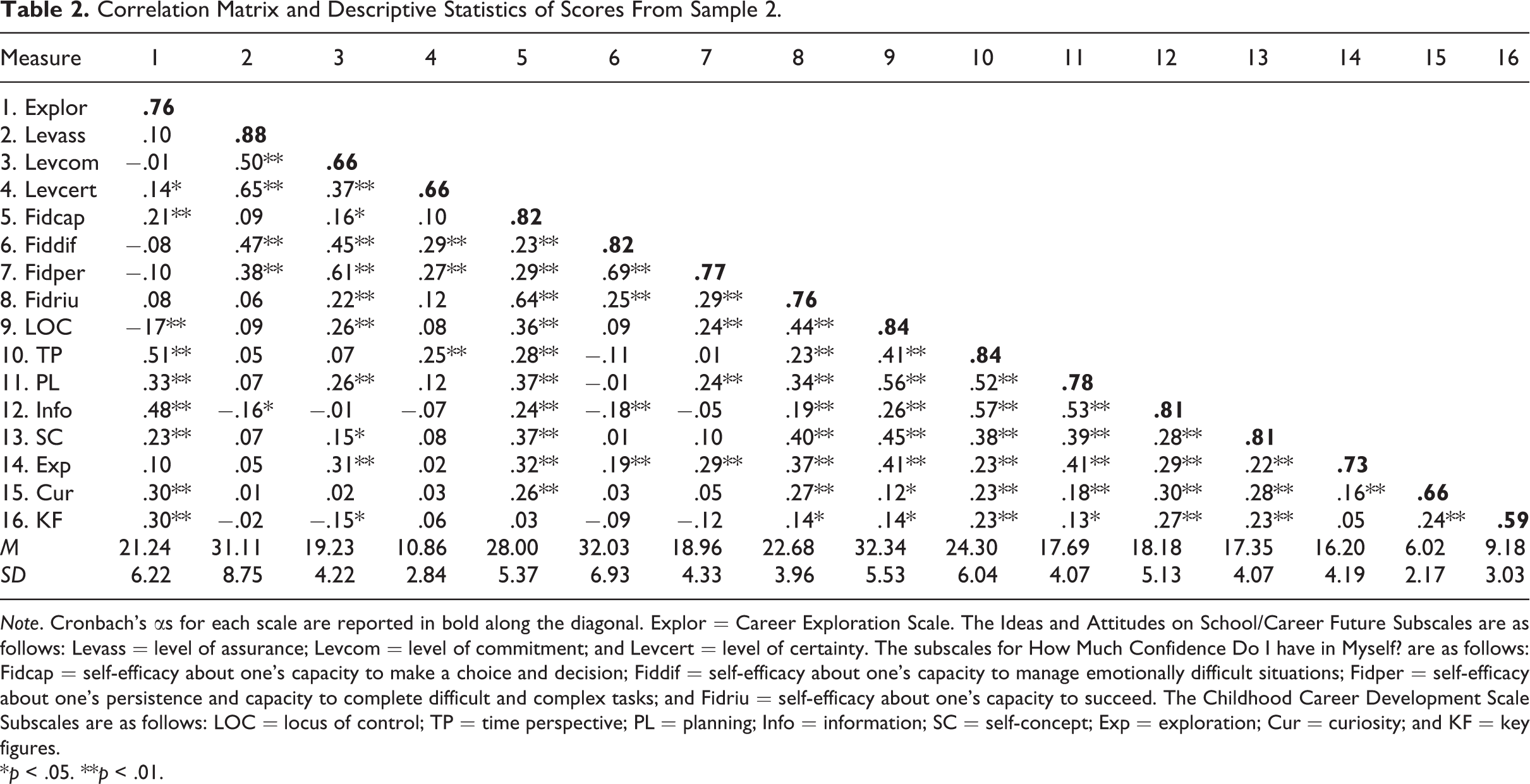
Note. Cronbach’s αs for each scale are reported in bold along the diagonal. Explor = Career Exploration Scale. The Ideas and Attitudes on School/Career Future Subscales are as follows: Levass = level of assurance; Levcom = level of commitment; and Levcert = level of certainty. The subscales for How Much Confidence Do I have in Myself? are as follows: Fidcap = self-efficacy about one’s capacity to make a choice and decision; Fiddif = self-efficacy about one’s capacity to manage emotionally difficult situations; Fidper = self-efficacy about one’s persistence and capacity to complete difficult and complex tasks; and Fidriu = self-efficacy about one’s capacity to succeed. The Childhood Career Development Scale Subscales are as follows: LOC = locus of control; TP = time perspective; PL = planning; Info = information; SC = self-concept; Exp = exploration; Cur = curiosity; and KF = key figures.
*p < .05. **p < .01.
A dimension reduction analysis was performed to assess the precise nature of the relationship between (a) the eight dimensions of the CCDS and (b) career exploration; three dimensions of students’ ideas, attitudes, and behaviors regarding their school and career future; and four dimensions of self-efficacy. The full model yielded three significant canonical roots (p ≤ .001); however, only two were judged to be interpretable based on the very small eigenvalues (i.e., <.15) and small variance-accounted-for indices of effect size R c 2 (.13) of the third root (Vacha-Haase & Thompson, 2004). The first and second roots explained 49% and 33% of the shared variance within their roots, respectively. The structure coefficients representing the correlations between the dependent and independent variables and the canonical variables for each root are presented in Table 3. Loadings of .45 or greater were interpreted consistent with Sherry and Henson (2005).
Structure Coefficients for Significant Canonical Roots.
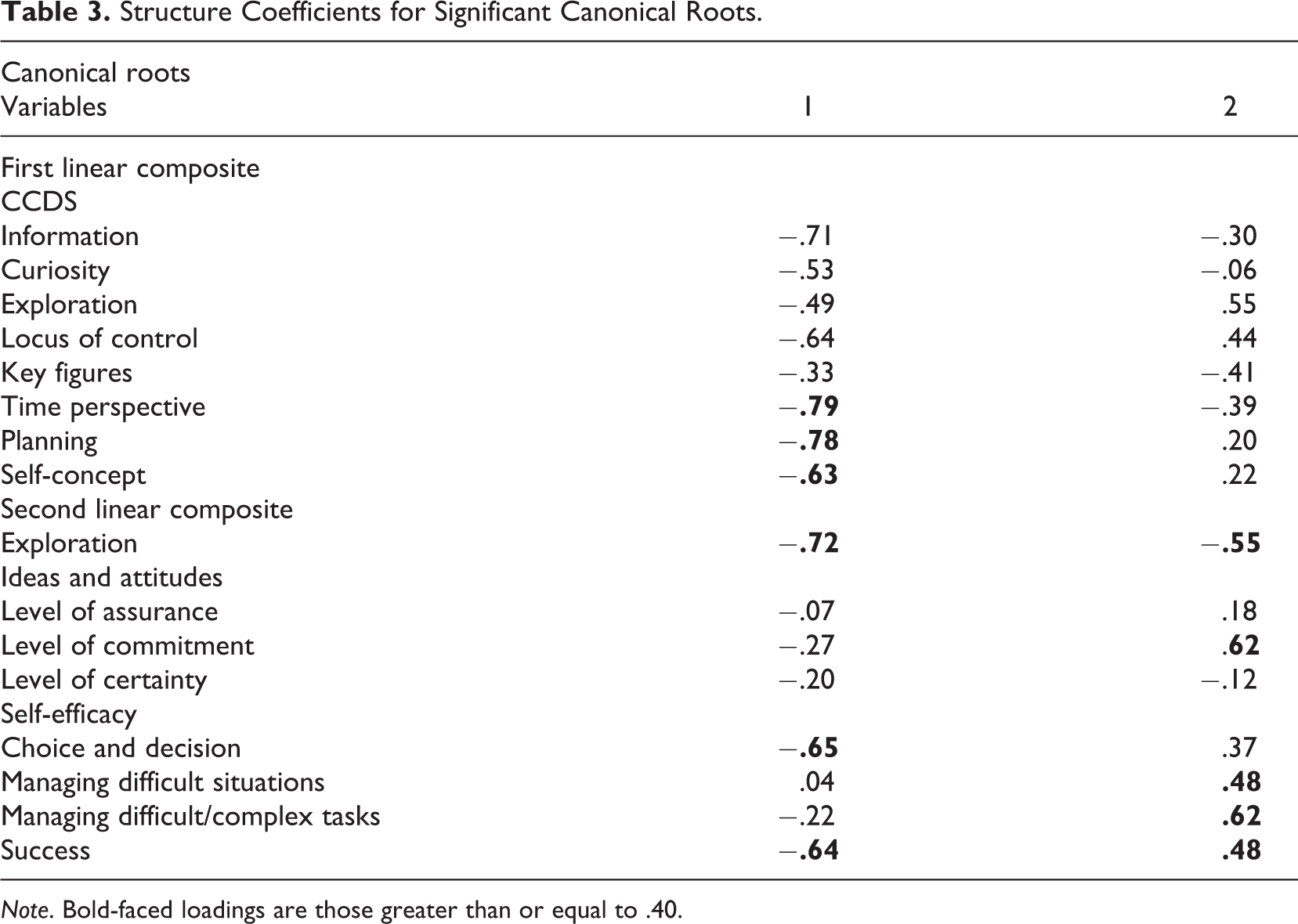
Note. Bold-faced loadings are those greater than or equal to .40.
The first significant canonical root, Wilks’s λ = .25, F(64, 1391) = 5.90, p < .001, accounted for 49% of the variance. As presented in Table 3, this root was characterized by large negative loadings of information, time perspective, and planning, and moderately negative loadings of curiosity, exploration, locus of control, and self-concept. The other side of the model was characterized by a large negative loading of exploration, and moderately large negative loadings of self-efficacy for choice and decision, and success. This suggests that those Italian middle school students who reported less awareness of the importance of occupational information, a future time perspective and planning, fewer inquisitive thoughts and behaviors related to school learning, less self-knowledge, and an external locus of control also tended to report engaging in fewer career exploratory behaviors and less self-efficacy related to the decision-making process and their capacity and ability to succeed.
The second significant canonical root, Wilks’s λ = .49, F(49, 1228) = 3.75, p < .001, accounted for 33% of the variance. As presented in Table 3, this root was characterized by a moderate positive loading of exploration and on the other side of the model was characterized by a moderate negative loading of exploration and moderate positive loadings of level of commitment and self-efficacy for managing difficult situations, managing difficult and complex tasks, and success. This suggests that those with more inquisitive behaviors related to school learning also tend to report engaging in less career exploration, having a higher level of commitment to the decision-making process, and more self-efficacy for managing difficult situations, completing difficult and complex tasks and capacity for success.
One of the findings from the second root was somewhat unexpected. It was expected that exploration related to school learning would be positively associated with career exploration. This unexpected finding could suggest that inquisitive behaviors related to school learning are not necessarily related to similar inquisitive exploratory behaviors related to careers. Indeed, research suggests that career exploration shifts from diverse to specific during the childhood and adolescent years (Patton, 2017). It has been suggested that the developmental course of child and adolescent career exploration is consistent with emerging interests, needs, aspirations, values, environmental opportunities, and social and familial expectations (Patton). Future research is needed to further examine this relationship.
Finally, key figures, which assessed the availability of role models or other people who have played a meaningful role in their individual’s life, did not load significantly onto either canonical root. This unanticipated finding might suggest the need for further scale development to better assess the various roles (e.g., beyond role modeling) of important people in early adolescent career development.
Discussion
Support was found for an eight-factor structure of the CCDS in an Italian middle school sample. Despite consistency in the number of factors between the current sample and a U.S. elementary sample (Schultheiss & Stead, 2004), the content of the factors across these samples was slightly different. Specifically, curiosity and exploration formed one factor in the U.S. elementary sample, whereas these constructs emerged as two separate factors in the current Italian sample. The emergence of two separate factors is consistent with theory (Super, 1990) which suggests that curiosity and exploration are two distinct constructs, wherein curiosity represents a need that leads to inquisitive behavior and exploration represents the activities engaged in to satisfy that need. Of note, however, the Curiosity scale demonstrated low reliability (α = 74 and .66 for Samples 1 and 2, respectively), suggesting further research is needed to clarify the assessment of these constructs. The differences in factor structure across these samples might also suggest differences in how these constructs develop and change over time through childhood and early adolescence. Hence, this might indicate a need to examine the invariance of CCDS scores across the childhood and early adolescent years (cf., Tracey & Sodano, 2017).
Contrary to expectations, interests did not emerge as a separate factor as it had in the U.S. elementary sample and as theory (Super, 1990) has suggested. There are a couple of possibilities for why this may have occurred. First, as defined by the CCDS, the original interest items assessed an awareness of one’s likes and dislikes broadly across school- and nonschool-related areas. Second, little is known about childhood and early adolescent development of interests (Tracey & Sodano, 2017). Hence, the CCDS interest subscale is not a broad-based interest scale and thus may not be well suited to measure how interests develop. Future research might help to clarify the role of interests in early career developmental progress.
The current Italian sample also had a total of 11 fewer items load on the factors, when compared to the younger U.S. sample. This may have occurred in part because the criteria used to retain items on a factor were more stringent in the current investigation than in the previous one. In this investigation, items that loaded on more than one factor were not included on either factor; whereas in previous research (Schultheiss & Stead, 2004), items were retained on the factor with the highest loading.
Consistent with expectations, general support was found for the concurrent validity of the CCDS. With few exceptions, CCDS subscales were related in predictable ways to career exploration, all four dimensions of self-efficacy, and level of commitment in the decision-making process. Neither level of assurance associated with self-knowledge and academic/vocational information nor level of certainty associated with one’s future work or professional identity was significantly related to young adolescents’ career development as assessed by the CCDS. These findings may suggest that these two constructs are not relevant to career progress in this developmental stage. Instead, as theory (Super, 1990) would suggest, young adolescents actively engaged in the career exploration process are not expected to be assured about their knowledge of self and the world of work or to be certain about their future work or professional identity.
Limitations and Future Directions
Although the findings of this investigation suggest support for the validity of the CCDS with an Italian sample of young adolescents, several limitations are evident. The low reliabilities of some of the scales (i.e., level of commitment, level of certainty, curiosity, and key figures) may have contributed to some of the unexpected findings. This may suggest the need for future research to improve the reliabilities of these scales. The CCDS was validated on a sample of young adolescents from Central and Northern Italy. This limits the generalizability of the findings to early adolescents from other national contexts. In addition, all data were self-report and cross-sectional in nature. Future research might include other methods of assessment across multiple points in time to assess longitudinal developmental progress. Despite these limitations, this investigation marks the first attempt to validate a career development assessment instrument across the childhood and adolescent years. The reliability and validity data reported here indicate that the measure holds up well to psychometric standards and provide a promising means of assessing early developmental career progress.
Overall, the findings offer support for Super’s (1990) dimensional model through early adolescence. Continued research on early adolescent career development, and its related antecedents and outcomes, is encouraged to better assess developmental progress from childhood through adolescence. Specifically, future research could explore the relationship between Super’s model and career adaptability. This might help to bridge the gap between traditional and new approaches to understanding early career development and help to inform interventions that could better respond to emerging educational and career challenges. The CCDS could also be used in combination with other measures that evaluate optimism and hope to better identify strengths and weaknesses that could be addressed in career construction counseling and intervention. As suggested by the life design approach, this area of research could inform prevention efforts that are advantageous for individuals and communities (Ferrari, Sgaramella, & Soresi, 2015).
A measurement tool such as the CCDS, that can be used flexibly throughout childhood and adolescence, would facilitate both cross-sectional and longitudinal career research. The CCDS could be useful in conducting needs assessments to inform program planning and the development of effective career interventions. This would be particularly useful for adolescents who live in educational contexts which demand early academic choices that will effect later career options.
Footnotes
Declaration of Conflicting Interests
The author(s) declared no potential conflicts of interest with respect to the research, authorship, and/or publication of this article.
Funding
The author(s) received no financial support for the research, authorship, and/or publication of this article.