



Abstract
The purpose of this study was to investigate the psychometric properties of a measure of career aspirations for use with college men (i.e., the Career Aspiration Scale–Revised [CAS-R]). Two studies were conducted to assess the psychometric properties of the CAS-R with a total of 414 undergraduate men. The results of the confirmatory factor analysis indicated that the three-factor solution assessing achievement, leadership, and educational aspirations had adequate model fit. Furthermore, when the CAS-R was used with undergraduate men, support for validity was demonstrated and two of the three CAS-R subscales had adequate test–retest reliability. Future directions regarding research and practice with this measure were discussed.
The majority of families in the United States with children under the age of 18 reside in dual-income households (Pew Research Center, 2015). One of the salient challenges facing parents in these families is managing work and family responsibilities. The negotiation of work and family identities has important consequences for personal well-being and career outcomes (Meeussen, Veldman, & Van Laar, 2016; Van Steenbergen & Ellemers, 2009) and is influenced by the prevailing gender norms in one’s social context (Rudman & Phelan, 2010). When experiencing conflict between family and career roles, women often are willing to sacrifice their career aspirations for their partners and children (Ganginis Del Pino, O’Brien, Mereish, & Miller, 2013) or, alternatively, attempt to “have it all” by maintaining high career ambitions and family aspirations. Conversely, when experiencing work–family conflict, young men may follow more traditional gender role patterns, lowering their family aspirations and increasing their career aspirations, particularly when they perceive their partners as responsible for family roles (Meeussen et al., 2016).
Given that gender role socialization plays an important role in both the development and execution of career goals, research that addresses men’s career aspirations may provide clues for how both men and women navigate career goals and decision-making as well as how heterosexual couples make dual-career decisions. Recently, a measure of career aspirations (defined as the degree to which individuals seek leadership roles, advanced education, and recognition in future careers) was revised and evaluated with young women to provide a tool for career interventions and scholarly research in vocational psychology (Gregor & O’Brien, 2016). It is increasingly important to have reliable and valid measures of career aspirations for both men and women to advance research and clinical practice. Thus, the purpose of the current study was to investigate the psychometric properties of a measure of career aspiration for use with young men.
The Career Aspiration Scale–Revised (CAS-R; Gregor & O’Brien, 2016) improved upon prior assessments of career aspirations that used a single item (i.e., to what career do you aspire?; Beal & Crockett, 2010; Chang, Chen, Greenberger, Dooley, & Heckhausen, 2006; Dubow, Huesmann, Boxer, Pulkkinen, & Kokko, 2006) or lacked adequate psychometric properties (Gray & O’Brien, 2007). The CAS-R assesses leadership, educational, and achievement aspirations and was found to have adequate reliability and validity when used with female undergraduate and graduate students (Gregor & O’Brien, 2016). However, the factor structure and psychometric properties of the measure when used with men remain unknown.
This study draws from the expectancy–value model of achievement choice (Eccles, 1987, 2011; Eccles et al., 1983). This model presumes that an individual’s choice, persistence, and performance can be explained by expectations for success and subjective task values that often are tied to perceived social and cultural expectations. With regard to occupational choices, these values influence academic and career pursuits. One explanation for gender disparities in career attainment is the influence of gender role socialization on career values, for example, the expectation that women have primary responsibility for children and home (Betz, 2006; Ganginis Del Pino et al., 2013), while men are expected to be the primary financial providers (McGill, 2014) in heterosexual partnerships. For many men, societal expectations may lead them to endorse a stronger commitment to work, pursue leadership or managerial roles, or prioritize financial earnings over their commitment to child and family responsibilities (Meeussen et al., 2016). However, the assumption that all men, because of societal expectations and stereotypes, want to focus their lives and energy on career pursuits is likely inaccurate. Research is needed that examines the career aspirations of men and determines how these aspirations relate to career, family, relationship, and mental health outcomes. To conduct this research, a psychometrically sound measure of career aspirations is needed.
Several constructs that likely would relate to career aspiration among college men (and thus could be used to assess construct validity) include work role salience (WRS), achievement motivation, and leader identity. WRS was defined as the centrality of career or work in one’s adult life (Greenhaus, 1973) and has been shown to be an important predictor of desire for leadership in one’s career, career commitment, and career path (Aryee & Tan, 1992; McClintock-Comeaux, 2007; Gregor & O’Brien, 2015). Relatedly, achievement motivation has been defined as the desire to accomplish something of value or importance to the individual and has been linked to career salience and leadership aspirations (Gregor & O’Brien, 2015). Leader identity was defined as the degree to which an individual perceives one’s self as having the characteristics of an effective leader (Ashford & DeRue, 2012) and was linked to career-specific leadership aspirations (Gregor & O’Brien, 2015; Stiehl, Gatzka, Elprana, & Felfe, 2015). Consistent with prior research, we expected that men who have a strong sense of work identity, place high importance on their career, work hard to accomplish tasks of value, and see themselves as leaders will have high career aspirations.
To summarize, the overall purpose of this study was to investigate the factor structure and psychometric properties of the CAS-R with undergraduate men. In the first study, we hypothesized that the factor structure of the CAS-R would be replicated with college men as we expect that women and men would not differ in how leadership, educational, and achievement aspirations are conceptualized. Furthermore, we anticipated that scores on the measure would demonstrate adequate reliability and validity. In the second study, we hypothesized that the CAS-R would evidence adequate test–retest reliability. This research is important as a psychometrically sound instrument is needed to assess career aspirations among college men in future vocational research and career interventions.
Study 1
The purpose of the first study was to analyze the factor structure of the CAS-R with a sample of undergraduate men and assess the reliability and construct validity of the measure. Consistent with prior research (Gregor & O’Brien, 2016), we hypothesized that the three-factor solution would display good model fit. Adequate reliability estimates (above .70) were expected for the subscales. We anticipated that scores on the CAS-R subscales would correlate positively with scores on measures of WRS, achievement motivation, and leader identity.
Method
Participants
Data were collected using an online Qualtrics survey at two points in time from male undergraduate students at a large mid-Atlantic university. Initially, the measures were administered in a survey that undergraduate students completed for extra credit in their courses. The survey included measures from graduate student and faculty investigators within the department of psychology. This survey was completed by 150 male undergraduate participants (with no missing data and no problematic response patterns). At a later date, a survey was administered for extra credit that did not include measures from other investigators. Two hundred and seventy-two students accessed the survey; 18 students did not meet or answer the screening questions regarding the criteria for participation (male, 18 years old, and enrolled at the university). An additional 8 participants did not answer any items on the survey and 37 participants failed to answer one or more of the validity questions correctly. Thus, the final sample consisted of 359 participants (150 from the first round of data collection and 209 from the second round of data collection). The participants represented all years of study and had an average age of 19.80 (SD = 2.56). The majority of participants were White, non-Hispanic (54.9%), with 23.4% being Asian/Asian American, 10.0% African American, 5.3% Hispanic, 4.2% Biracial, and 2.2% Other, which was representative of the undergraduate students enrolled at this university. The majority of students were heterosexual (93.9%), single (never married; 97.2%), and not in a committed relationship (72.4%).
Procedure
For the first round of data collection, several measures (i.e., the CAS-R, WRS Scale–Short Form, Greenhaus, 1973, and a demographic questionnaire) were included in a large online Qualtrics survey administered by the department of psychology that consisted of several additional instruments from other research projects within the department. Undergraduate students were invited to complete the survey for extra credit in their courses. For the second data collection, undergraduate students enrolled in introductory psychology courses were provided with the opportunity to complete our online survey for course credit. The survey included the aforementioned instruments and the Work and Family Orientation Questionnaire (WOFO; Spence & Helmreich, 1983) and the Affective-Identity subscale of the Motivation to Lead Scale (MTL; Chan & Drasgow, 2001).
Measures
Career aspiration
The CAS-R (Gregor & O’Brien, 2016) consists of three subscales assessing aspirations for leadership (degree to which do you aspire to leadership roles or influence in your field, e.g., I hope to become a leader in my career field), advanced education (degree to which you aspire to advanced education, training, and competency in your field, e.g., I plan to reach the highest level of education in my field), and achievement (degree to which you aspire for recognition, responsibility and promotion in your field, e.g., I want to be among the very best in my field). Items were rated on 5-point Likert-type scale ranging from 0 (not at all true of me) to 4 (very true of me). After reverse coding several items, scores on the items for each scale were summed.
The psychometric properties of the CAS-R were tested across three studies with a total of 583 undergraduate and graduate women and the results supported a three-factor model of career aspirations. Internal consistency estimates ranged from .81 to .82 (achievement aspirations), .87 to .89 (leadership aspirations), and .85 to .90 (educational aspirations), and the CAS-R subscales were correlated in the expected direction with WRS and achievement motivation (Gregor & O’Brien, 2016). In the current study, the internal consistency reliability estimates were .80, .84, and .89, respectively.
WRS
The WRS Scale–Short Form is a 6-item self-report measure developed by Greenhaus (1973). The WRS assesses attitudes toward work and career (e.g., I would consider myself extremely career minded) on a 5-point Likert-type scale ranging from 1 (strongly disagree) to 5 (strongly agree). Responses were summed, with high scores indicating strong career salience. Prior research found support for reliability (α = .73; Diemer & Blustein, 2007) and validity, as the WRS was correlated with commitment to career, career aspirations, willingness to prioritize partner and children, and leader identity (Diemer & Blustein, 2007; Gregor & O’Brien, 2015; Gregor & O’Brien, 2016). In the current study, the internal consistency reliability estimate was .62.
Achievement motivation
The WOFO is a 19-item self-report measure developed by Spence and Helmreich (1983). The WOFO measures achievement motivation across two dimensions: “work or mastery” (e.g., Once I undertake a task, I persist and I find satisfaction in working as well as I can) and “competitiveness” (e.g., I enjoy working in situations involving competition with others). Participants responded to items on a 5-point Likert-type scale from 1 (strongly agree) to 5 (strongly disagree). High scores indicated strong levels of achievement motivation. Adequate reliability estimates were found with samples of undergraduates (α = .76; Harackiewicz, Barron, Carter, Lehto, & Elliot, 1997; α = .80; Gregor & O’Brien, 2015); and relationships were found in the expected directions with other measures including attitudes toward women, leader identity, and career salience (Gregor & O’Brien, 2015; Platow & Shave, 1995). In the current study, the Work–Mastery subscale had adequate reliability (α = .82).
Leader identity
The Affective-Identity subscale of the Motivation to Lead Scale (MTL; Chan & Drasgow, 2001) was used to assess perceptions of self as a leader (e.g., I am the type of person who likes to be in charge of others). Participants responded to 9 items on a 5-point Likert-type scale ranging from 1 (not at all like me) to (very much like me). High scores indicated a strong leader identity. Reliability estimates for this subscale have been found in samples of undergraduate and graduate students (α = .82; Bobbio & Rattazzi, 2006; α = .92; Gregor & O’Brien, 2015), while validity has been established in the prediction of leadership potential (Chan & Drasgow, 2001). In the current study, the leader identity scale had adequate reliability (α = .85).
Demographic questionnaire
Data were collected regarding age, race, gender, sexual orientation, year in college, future career plans, and partnership status.
Results
Four independent samples t tests were conducted to investigate differences on the three career aspiration subscales and the total score of the career salience measure from the data collected at two different times. There were no differences in achievement, t(357) = −1.02, p = .31; leadership, t(357) = −1.28, p = .20; educational aspirations, t(357) = −1.54, p = .13; or career salience, t(357) = 1.60, p = .11. These data were collapsed for subsequent analyses. A statistical power analysis, using the guidelines set by MacCallum, Browne, and Sugawara (1996), indicated that 359 participants were adequate for a confirmatory factor analysis (CFA) with a statistical power of 0.80, a model of close fit with 75 degrees of freedom, and an overall α = 0.05. An item response theory (IRT) maximum likelihood CFA was run using Mplus Version 7.11 to examine the hypothesized three-factor model. The IRT-CFA approach translated ordinal-level measurement into interval-level data and conformed to the statistical assumptions of the CFA (Partchev, 2004).
To evaluate model fit, the recommendations proposed by Hu and Bentler (1999) and MacCallum et al. (1996) for the comparative fit index (CFI) and Tucker–Lewis index (TLI) were used to assess goodness of fit. The 24-item three-factor model demonstrated adequate fit with the undergraduate men; Satorra-Bentler (SB) χ2(241, N = 359) = 991.24, p < .05, RMSEA = .09, CFI = .94, TLI = .93; factor loadings can be found in Table 1. The correlations among factors ranged from .46 to .80. Means, standard deviations, ranges, and reliability estimates for Study 1 can be found on Table 2.
Factor Loadings for the Career Aspiration Scale–Revised From Study 1.

Note. The measure can be obtained from the primary author and used for no charge for research or counseling purposes.
aIndicates a reverse-coded item.
Means, Standard Deviations, Range, αs, and Correlations for CAS-R Study 1.
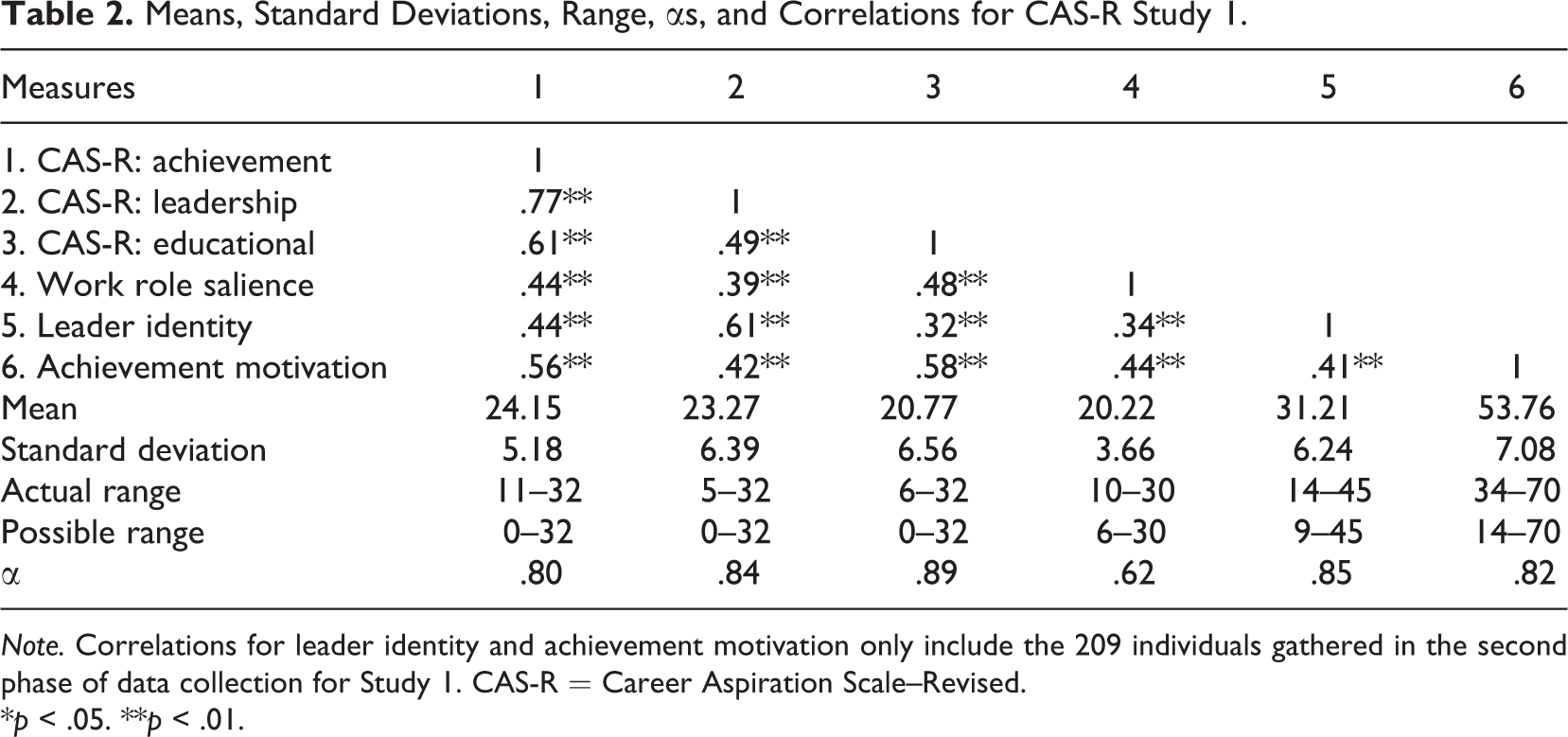
Note. Correlations for leader identity and achievement motivation only include the 209 individuals gathered in the second phase of data collection for Study 1. CAS-R = Career Aspiration Scale–Revised.
*p < .05. **p < .01.
As hypothesized, scores on the leadership, education, and achievement subscales were related positively to scores on the WRS, suggesting that men who were more likely to value their career were more likely to want to lead others, desire recognition in their career, and further their education in their field. As hypothesized, the subscales of the CAS-R also were related positively to leader identity and achievement motivation. These findings indicated that men who were willing to work hard to complete difficult tasks and saw themselves as leaders were likely to indicate interest in achievement, leadership, and educational aspirations.
Study 2
The purpose of the second study was to assess the test–retest reliability of the CAS-R with college men. Test–retest reliability estimates above .70 were expected.
Method
Procedure
Data were collected in two ways. First, participants were recruited in person from two advanced-level undergraduate research courses. During the last 10 min of class, a research assistant invited male students to participate in a survey related to their career goals. Students were notified that the survey would be given to them twice, the second occuring 2 weeks after the first administration. Additionally, participants were recruited online through a research participant pool system within the department of psychology. Those who were eligible to participate were directed from the system website to a Qualtrics questionnaire. After completing the first administration of the survey, online participants were asked to provide their e-mail addresses. The researchers then sent an e-mail after 2 weeks with a prompt directing them to the second administration of the survey. Participants who completed both surveys received 0.5 extra credit points.
Participants
Ninety undergraduates completed CAS-R at Time 1 (24 in person, 66 online). Thirty-five participants were deleted due to incomplete data (missing Time 2; 4 in person, 31 online). The final sample consisted of 55 undergraduate males (20 in person, 35 online). Participants ranged in age from 18 to 24 years (M = 20.27, SD = 1.56). The majority of participants were White, non-Hispanic (59.3%), with others identifying as Asian/Asian American (14.8%), Black/African American (11.1%), biracial/multiracial (11.1%), and Hispanic/Latina (3.7%). Most participants identified as heterosexual (94.5%) and were not in committed relationships (72.7%). The sample was diverse across year in school, with 23.6% first-year, 20.0% second-year, 34.5% third-year, 10.9% fourth-year, and 11.0% fifth-year students or beyond. Regarding their course of study, participants reported a variety of majors, such as psychology, criminology, public health, engineering, marketing, business, and computer science. A majority of the sample had decided on a career path (69.1%). Of note, while 42.6% of the sample stated that career pursuits and family pursuits were equally important to them, many (44.4%) stated that family was more important than career pursuits.
Measures
The CAS-R (previously described) and a demographics form were administered.
Results
The means, standard deviations, ranges, and reliability estimates for the CAS-R at Time 1 and Time 2 can be found in Table 3. Two of the three subscales of the CAS-R exhibited adequate test–retest reliability (i.e., .75 for the leadership subscale and .82 for the education subscale); the test–retest reliability of the achievement subscale was lower than expected (.64). All of the internal consistency estimates were above .70 with the exception of the achievement subscale (Time 1: α = .48, Time 2: α = .68).
Means, Standard Deviations, Range, αs, and Correlations for CAS-R Study 2.
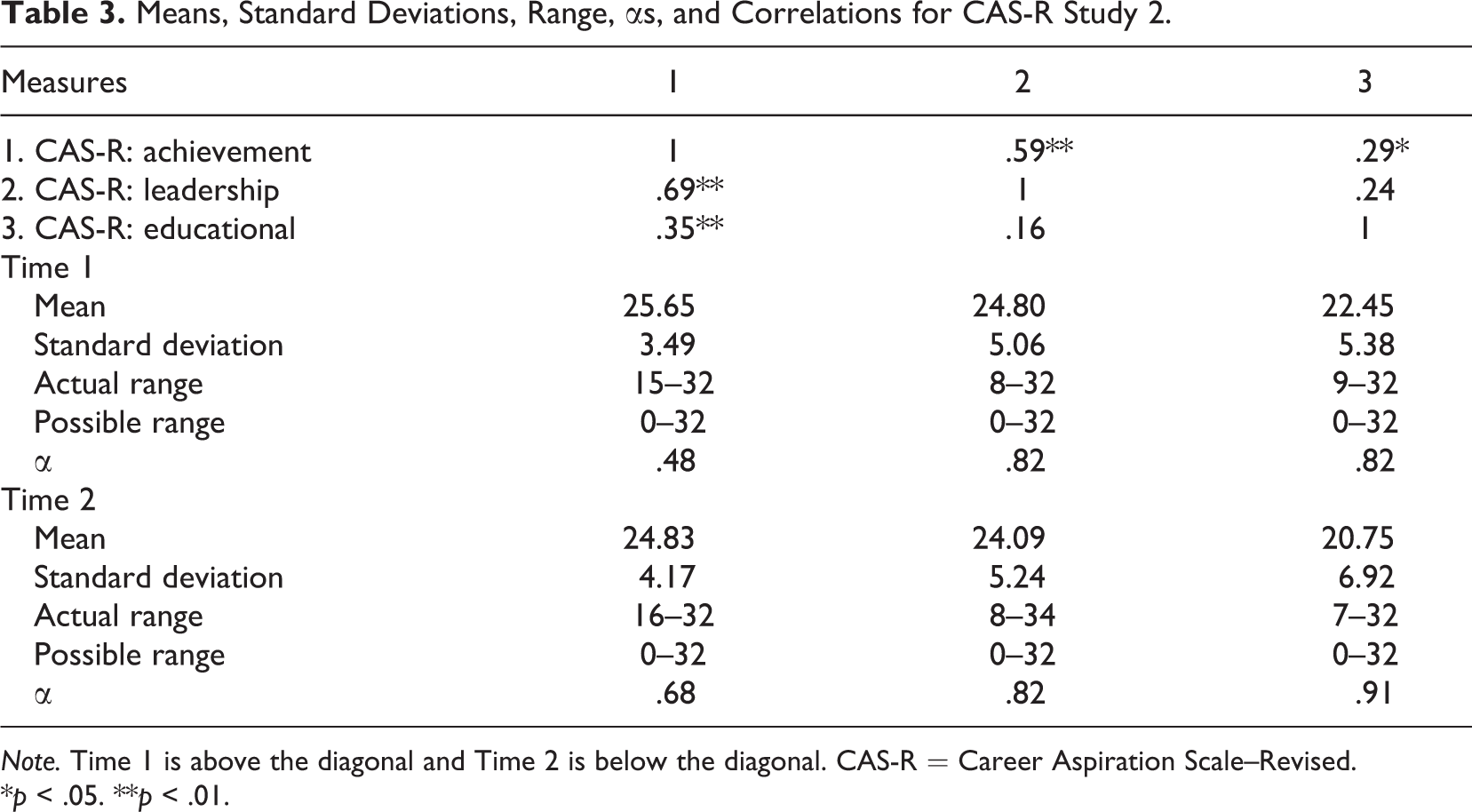
Note. Time 1 is above the diagonal and Time 2 is below the diagonal. CAS-R = Career Aspiration Scale–Revised.
*p < .05. **p < .01.
Post Hoc Tests
Post hoc independent sample t tests were conducted to investigate differences in gender on the three career aspiration subscales utilizing the data from this sample of men and a sample of 330 female undergraduate students from a large Midwestern university from a previously published study (Gregor & O’Brien, 2016). There were no differences between women and men on achievement, t(687) = .43, p = .67; leadership, t(687) = −1.06, p = .29; or educational aspirations, t(687) = 1.77, p = .08.
Discussion
The results of this study provided preliminary support for the psychometric properties of the CAS-R when used with undergraduate men. CFA results suggested adequate model fit for the hypothesized three-factor solution comprised of leadership, achievement, and educational aspirations. Moreover, two of the three subscales demonstrated adequate internal consistency reliability and test–retest reliability over a 2-week period. The validity of the measure when used with college men was supported by the expected positive associations with WRS, achievement motivation, and leader identity.
This study contributes to the literature by providing initial support for an instrument that assesses the career aspirations of young men, which in turn may advance research regarding how men’s aspirations influence their work–life management and other career-related decisions. Often, it is assumed (based on stereotypes and gender role socialization) that all men aspire to significant vocational achievement, at the expense of time with family. These assumptions, when untested, may exert pressure on young men to focus on career achievement and neglect other life experiences and opportunities. For those young men for whom this focus is incongruent, feelings of inadequacy or depression might result. Moreover, knowledge that other young men may want to pursue a variety of goals beyond career may allow those who do not share these goals to feel less isolated and to have “permission” to pursue their goals.
Support for the validity of the CAS-R subscales was found as men for whom work was important endorsed achievement, leadership, and further educational aspirations in their future careers. Moreover, among the men who participated in the second round of data collection, those who saw themselves as leaders and those who valued hard work and enjoyed mastering challenges also desired leadership, achievement, and educational attainment in their careers. This may be of particular importance as career aspirations may predict career attainment and participation in further career-related education in adulthood (Schoon & Polek, 2011).
While the leadership and education subscales of the CAS-R overall demonstrated adequate internal consistency and test–retest reliability, the internal consistency and test–retest reliability for the achievement subscale was lower than expected. McCrae, Kurtz, Yamagata, and Terracciano (2011) argued that traits are more reliably measured when they are central to an individual’s identity (McCrae, Kurtz, Yamagata, & Terracciano, 2011). As the majority of the sample in the second study identified family as equally or even more important than their careers, it may be that career achievement aspirations were less salient, and therefore less stable, among this group of undergraduate men. Of note, validity check questions were not included in this administration of the measure. As participants’ level of attention was not assessed, it is possible that the individuals taking the CAS-R did not attend carefully to the items on the survey. Given the uncertainty behind this low internal consistency estimate, future research should investigate the use of the achievement subscale with male populations.
Finally, undergraduate men and women did not differ on their aspirations for achievement, leadership, or education. This is contrary to prior research, which found that young women had lower career aspirations when compared to their male counterparts and were more likely to compromise their careers for their partners or family responsibilities (Kerr, Foley-Nipcon, & Zapata, 2005). One possible explanation for our findings is that the young people in our sample may not realize the demands of managing leadership positions, continuing education, and achievement goals as well as parenthood and other familial responsibilities. Alternatively, it is possible that younger generations of women have started close the gender gap around career aspirations and feel optimistic about their abilities to navigate work and family roles. Recent demographic data suggested that young women are surpassing men in the importance they place on their career (Pew Research Center, 2012). However, women remain concentrated in low-status, low-prestige occupations (Landivar, 2013; U.S. Census, 2010), which raises questions about what might prevent young women’s aspirations from being realized.
It is important to note that although the men included in this study were representative of undergraduate students at this university and undergraduate students generally in the United States (National Center for Education Statistics, 2016), they were mostly White heterosexual men. Thus, generalizability to other groups of men is limited. Moreover, the generalizability of our findings is limited to college students. In the future, the CAS-R should be administered to individuals in different stages of career development, particularly those who are employed. Additionally, the CAS-R should be given to more diverse samples, including men of color to assess further the stability of the factor structure and psychometric properties of the measure.
An additional limitation of this study was the measurement of career aspirations at a single point in time. Longitudinal designs using the CAS-R are needed to better understand how aspirations may change. Moreover, given that many romantic partnerships must negotiate dual-career decisions, the use of couples’ data may help to elucidate how career aspirations may impact negotiation of work and family roles within dyads. Last, our study was limited by the low reliability of the WRS measure; future research should consider using the long form of the WRS or investigate other possible measures of this construct.
It is important to note that the CAS-R has great potential for use in educational, workforce, and clinical settings. Given that students are evaluating their career options during their middle school, high school, and undergraduate years, the CAS-R could be administered as a vocational guidance tool to assess desire for achievement along with interest inventories, to provide well-rounded career profiles. Additionally, the CAS-R provides distinctive aspects of career aspiration (e.g., leadership vs. education) that may help students to differentiate the type of involvement they want in their future careers and nonwork lives. Moreover, specifying a type of career achievement could promote exploration, discussion, and assessment of potential strengths and barriers that may influence attainment. Also, for students who are having difficulties making career choices in college, assessment of their career aspirations may provide clues to help navigate decision-making and provide opportunities to explore activities that may fit with their desires for increased leadership, education, or achievement. Last, it is possible that interventions with men, women, or couples could help to promote more egalitarian decision-making around the balance of work and family responsibilities and may help to reduce the tendency for women to sacrifice their career goals before entering the workforce.
To conclude, this study provided initial support for a measure of career aspirations that assesses aspiration in three different domains—leadership, achievement, and education—when used with mostly White, heterosexual undergraduate men. This study contributes to prior research that supported the use of this measure with undergraduate and graduate women (Gregor & O’Brien, 2016). It is our hope that CAS-R will be used by counselors to provide assessment, exploration, and encouragement for individuals struggling with career decision-making as well as by vocational researchers to advance the literature on career aspirations and dual-career families.
Footnotes
Authors’ Note
A version of this study will be presented at the 2017 annual convention of the American Psychological Association.
Declaration of Conflicting Interests
The author(s) declared no potential conflicts of interest with respect to the research, authorship, and/or publication of this article.
Funding
The author(s) received no financial support for the research, authorship, and/or publication of this article.