



Abstract
The purposes of this study were to translate the revised version of a measure of career aspirations, the Career Aspiration Scale–Revised (CASR), into Korean and to evaluate the factor structure and psychometric properties of the Korean version of the revised measure. First, the CASR was translated into Korean using multiple translation strategies (Korean version of the Career Aspiration Scale-Revised [K-CASR]). Then, the psychometric properties of the K-CASR were examined with data from 377 college women in Korea. After the removal of several negatively worded items (due to a possible method effect), the 18-item version of the K-CASR demonstrated good model fit with the hypothesized three-factor structure (achievement, leadership, and educational aspirations). The K-CASR also exhibited moderately high internal consistency and stability. Convergent validity was supported by positive correlations with achievement motivation, career orientation, and career goal engagement. Implications for future research and counseling were discussed.
Women’s career development is complex and needs to be understood through a multidimensional lens that considers social, cultural, and psychological influences (Fouad & Kantamneni, 2008). Although women have made considerable advances in participation in higher education and professional fields throughout the world, many occupations continue to be segregated by gender, and women have yet to achieve pay equity and equality in the world of work. In Korea, increasing numbers of young women actively engage in economic activities and aspire to achieve in their careers, despite significant challenges and barriers to participation and success in the labor force (J.-H. Son, 2013). To study the career development of Korean women and advance knowledge regarding the role of culture in career aspirations, adequate instrumentation is needed. Therefore, this study sought to provide an updated and improved measure of career aspirations for use with Korean women by translating a revised measure originally developed in the United States into Korean and evaluating the psychometric properties of this instrument.
In the United States, women’s career aspirations were historically operationalized dichotomously as working within the home or outside the home, being employed in traditional versus nontraditional careers or having a career versus family orientation (Betz & Fitzgerald, 1987). However, these prior conceptualizations fail to capture the complex processes of women’s career aspirations (Fassinger, 1990). According to the Expectancy-Value Model of Achievement-Related Choices (Eccles, 2009, 2011), women make decisions based on their expectations for success and subjective task values that are often tied to perceived social and cultural expectations of women’s roles. Because of these internalized gender roles, women are more likely to enter traditional fields in which they are expected to have high competence and subjective values (e.g., teacher or nurse). Thus, some women in traditional occupations may aspire to leadership roles or higher achievement within these careers. In 1996, O’Brien developed the Career Aspiration Scale (CAS) to assess career aspirations, defined as the degree to which women aspire to leadership positions and continued education in their careers.
Preliminary support was found in the United States for the psychometric properties of the CAS, and factor analyses supported a two-factor structure for the measure (educational and leadership aspirations; Gray & O’Brien, 2007). However, the educational aspirations scale had low internal consistency, and support for the two-factor structure of the scale was relatively weak, especially for American women of color (Gray & O’Brien, 2007). The measure also did not capture women’s aspiration to achieve recognition in their careers. Thus, researchers revised the scale, added additional items, and evaluated the factor structure of the new measure (Gregor & O’Brien, 2016). Findings with American women supported a three-factor model with scales assessing leadership, educational, and achievement aspirations. The revised version of Career Aspirations Scale (CASR) had sound psychometric properties and was correlated in the expected directions with related career variables including achievement motivation with a sample of young women in the United States (Gregor & O’Brien, 2016).
In the current study, the concept of career aspiration was investigated with Korean women, given the need to understand this construct in Korea and across cultures. In 2012, the employment rate of Korean women in their 20s surpassed men for the first time (Statistic Korea, 2013). In addition, the number of women employed in nontraditional and high-ranking positions has increased (Y.-J. Choi & Im, 2010). However, the rate of Korean women’s employment declines after they turn 30 years old (Statistic Korea, 2013). Because the average age of marriage in Korea is around 30 years (Statistic Korea, 2013), demands associated with family may have a profound impact on women’s career achievements. Although many young Korean women aspire to achieve in their careers, their aspirations may not be encouraged when they have children.
Societal and cultural factors appear to contribute to this notable trend. South Korea ranks the lowest of all Organization for Economic Cooperation and Development (OECD) member countries in terms of gender equality in the workplace due to the paucity of women in high-level jobs and the largest gender wage disparity (OECD, 2010). Korean women are pressured to prove their qualifications and legitimacy in the workplace, and they are judged more harshly when compared to men in the same positions (Park, 2007). In addition, cultural expectations based on traditional Confucian beliefs for women burden employed women, as they have primary responsibility for taking care of family members including children, spouse, in-laws, and extended family (Y. Choi & Kim, 2007). Recent research found that Korean employed women experienced less support from their employers and spouses and reported more depression when compared to women in the United States and Israel (O’Brien, Ganginis Del Pino, Yoo, Cinamon, & Han, 2014). In this challenging culture for women’s employment, it is important to understand how young women develop career aspirations and how these aspirations change over time as women negotiate multiple roles (employer, spouse, mother, and daughter-in-law). Studying career aspirations in women in Korea could advance understanding regarding the decline in employment over time for women who experience conflict between the desire for career achievement and the myriad responsibilities associated with married life in this culture.
In 2002, the original CAS was translated into Korean (S. W. Choi, 2002) and was administered to multiple Korean populations, including college women and men (H.J. Lee, 2014; J.-A. Lee & Hwang, 2012; Park & Lee, 2008). A meta-analysis of research on social-cognitive career theory with Korean college students found that 8 of 44 studies used the CAS as an outcome variable (Y. Kim & Ahn, 2012). Despite its wide application, several issues emerged regarding the reliability and validity of the measure as it was translated and used.
First, a single researcher translated the initial CAS into Korean without a back-translation process or systematic translation review. Translation requires a comprehensive and systematic approach to increase cross-cultural validity across two measures (Ægisdóttir, Gerstein, & Çinarbaş, 2008). To maximize the utility of translated measures, there is a critical need to determine whether the translated measure is operating in a similar way to the original measure (Miller & Sheu, 2008). There was no empirical support for the measurement equivalence of the translated version of the initial CAS.
Second, the Korean version of the original CAS was used with the total score representing a single career aspiration construct although several studies in the United States suggested that the subscales should be used to capture the multi-dimensional nature of career aspirations (Gray & O’Brien, 2007; Gregor & O’Brien, 2016). Moreover, researchers noted that achievement aspirations were not measured in the original CAS (and the translated version).
Third, no Korean translation exists of the newly revised CASR. Researchers have made several improvements to the original scale (which was translated into Korean), but the updated measure has not yet been translated for use with Korean women.
Historically, many vocational psychologists have translated measures from English to another language for use in research with non–English-speaking populations. Translating measures allows researchers to explore how certain behaviors manifest in similar or different ways across cultures. To ensure equivalence across measures, several methodological issues should be considered in the translation and evaluation procedures (Ægisdóttir et al., 2008).
Importantly, translated items should convey the same meaning in both languages and they should be readable and natural to the participants who speak the target language. When English is translated into Korean, a liberal translation (i.e., a broad translation based on the whole meaning of an item) rather than a literal translation (i.e., word-for-word translation) is recommended due to the different sentence structure in the two languages (Willgerodt, Kataoka-Yahiro, Kim, & Ceria, 2005). For example, the English word “leadership” sounds more natural in the Korean language when it is written as foreign word (“리더십”) with Korean letters because there is no direct word to convey the semantic meaning of “leadership” in Korean.
The most common method to translate a measure has been the translation-back translation method conducted by a bilingual translator, but this approach raises several concerns. For example, a bilingual translator may automatically correct slight errors in translation when reading the target because she or he has ability to understand both languages. To improve the quality of translation, Brislin (1986) suggested decentering, which refers to a continuous translation and back-translation process. In this approach, both the original language and the target language versions are considered equally important. In addition, a translation committee that is comprised of translators, translation reviewers, and translation adjudicators can work collaboratively on a translation procedure instead of having the translation completed by a single translator (Harkness, van de Vijver, & Moher, 2003). The committee approach improves translation by incorporating multiple rounds of modification with diverse perspectives.
In addition to careful translation of a measure, the reliability and validity of the instrument for use with the population of interest must be examined. To study the validity of the Korean version of the CASR (K-CASR), key constructs that are hypothesized to be associated with career aspirations should be measured and the correlations with these scales and the K-CASR assessed. Achievement motivation, defined as the desire to achieve, would be expected to relate to aspirations in one’s career as measured by the K-CASR. Prior research in the United States found moderate correlations between career aspirations and achievement motivation with female graduate students (Gregor & O’Brien, 2016). Additionally, career aspirations likely would be associated with career orientation (i.e., the importance of career in their lives; Battle & Wigfield, 2003). Researchers in Korea found that career orientation was related to facilitative factors in women’s career development including career decision-making self-efficacy for Korean women (Y.-H. Kim, Yoo, & Lim, 2011). Finally, career goal engagement (defined as involvement in the process of achieving individual career goals) was correlated positively with Korean students’ plans to acquire more skills and knowledge of their vocational skills (Boo, 2012).
To summarize, the purpose of this study was to translate a revised measure of career aspirations and to assess the adequacy of this instrument for use with Korean female college students. First, the CASR was translated into Korean using several translation strategies. Then, the factor structure and the psychometric properties of the K-CASR were examined with a sample of Korean female college students. We expected adequate internal consistency reliability and test–retest reliability estimates for the subscales (as scores on the subscales were reliable and stable over a short period of time with U.S. samples; Gray & O’Brien, 2007). In terms of convergent validity, we hypothesized that the K-CASR would have positive correlations with scales that assess achievement motivation, career orientation, and career-goal engagement.
Translation
This study used several translation strategies (Ægisdóttir et al., 2008; Brislin, 1986; Harkness et al., 2003). First, a translation committee was formed that consisted of two translators, three translation reviewers, and three translation adjudicators. The translators were bilingual doctoral students in counseling psychology in the United States who speak English and Korean fluently. A counseling psychology doctoral student who speaks Korean and English (the principal investigator of the study), an English-speaking counseling psychologist who was the original author of the CAS and CASR, and a Korean–English bilingual doctoral student in linguistics who has linguistic knowledge of the differences in English and Korean participated as translation reviewers. The three translation adjudicators were professors who specialized in career counseling in Korea and who can speak both languages. In addition, six native Koreans, who were not majoring in psychology, were invited to provide feedback about the items.
The translation procedures involved several steps. First, the English items on the CASR were translated from English into Korean by a single bilingual translator. Then, another bilingual translator back-translated the Korean items into English. The translation reviewers discussed and revised the K-CASR by repeated examinations of translated and back-translated items. Although most items had similar meanings, differences between the two versions appeared (e.g., nuances in the degree to which items described purposeful plans or activities in terms of pursuing continuing education). A few of the original items sounded unnatural to the native Korean speakers, so these items were modified to keep the original meaning and be more natural to Korean speakers.
The revised items were distributed to the three translation adjudicators. The translation adjudicators rated on a 5-point scale the degree to which each K-CASR item reflected the meaning of career aspirations given the definition, from 1 (it does not represent the concept at all) to 5 (it represents the concept very well). An average score of 3 (it moderately represents the concept) among three raters was selected a priori as a cutoff score for assessing the conceptual equivalence of the items. All of the items received average scores greater than or equal to 3, indicating that the items reflected the construct of career aspirations for college women in Korea. In addition, six Korean speakers who were not majoring in psychology read all items and mostly indicated that the meaning of items was clear to them.
Method
Procedure
Ten 4-year universities in Korea (in the Seoul, Gyongki, Chungcheng, and Kwangju areas) were identified where the principal investigator had contacts to assist in the recruitment of the participants. The principal investigator and a coinvestigator in Korea contacted several instructors and asked if they would distribute the survey to female college students in their undergraduate education or psychology classes. The surveys and consent forms were sent to the instructors who agreed to help with data collection.
The instructors introduced and distributed the survey either during the break or at the end of class according to the directions from the research team. The students read the informed consent form and those interested in participating completed the 20-minute survey. A pen was given to the students as small compensation for their participation. After completion of the survey, the students placed the survey in an envelope that was located on the table around the corner of the classroom. Students who did not complete the survey were asked to place the blank survey in the same envelope. The last student, who submitted the survey, was asked to seal the envelope. Then, the instructors sent the envelope to the coinvestigator.
Two weeks after administration of the first survey, 31 participants from 2 of the classes who completed the first survey were invited to complete the K-CASR again to assess test–retest reliability. Twenty-nine women participated in the Time 2 test that took 5 minutes.
Initially, 425 surveys were distributed, and 399 surveys returned to the research team (response rate: 93.88%). Three participants who identified as being married, one participant who was 42 years old, and 12 surveys that did not pass two validity check items were excluded. Consistent with recommendations from Schlomer, Bauman, and Card (2010), 6 participants with more than 10% missing data were not retained, leaving 377 surveys in the statistical analyses. Missing data analyses indicated that 0–1.1% of the items were missing in the 377 surveys. Expectation maximization was used to impute missing values (SPSS version 22).
Participants
The sample consisted of 377 female college students from nine 4-year universities in South Korea. The universities varied in terms of regions and university rankings (three from top-ranking universities, three from moderately ranked universities, and three from less prestigious universities). The ages of the participants ranged from 18 to 28 years (M = 20.66, SD = 1.70) and all were single. Regarding class levels, 16.4% of the participants were first-year students, 23.1% were sophomores, 32.6% were juniors, 19.6% were seniors, 2.4% were fifth-year students, and 5.8% did not report class level. The majors of participants were varied, but most were majoring in the social sciences (32.4%) and education (27.1%). In terms of educational plans, participants aspired to obtain bachelor’s (32.6%), master’s (27.3%), doctoral (32.6%), or other professional degrees such as law school (2.1%). Most participants were from the middle class as social class scores were 6.49 (SD = 1.62) in their community and 5.99 (SD = 1.70) in Korea.
Measures
Career aspiration
The newly translated K-CASR was used to measure career aspirations. The CASR consists of three subscales including leadership, educational, and achievement aspirations (Gregor & O’Brien, 2016). The leadership aspirations subscale measures the degree to which women aspire to a leadership position within their career (e.g., “I hope to become a leader in my career field.”). The educational aspirations subscale refers to the degree to which women aspire to continue education or training within their career (e.g., “I would pursue an advanced education program to gain specialized knowledge in my field.”). Last, the achievement aspirations subscale measures the degree to which women aspire to significant achievements and recognition within their career (e.g., “I aspire to have my contributions at work recognized by my employer”).
Participants indicated their degree of agreement with 24 items on a scale from 0 (not at all true of me) to 4 (very true of me). To score the measure, negatively worded items were reverse coded, and the total score of each subscale was summed. High scores reflected strong career aspirations. In previous research, Cronbach’s α coefficients ranged from .71 to .88 with graduate female students in the United States, and positive correlations were found among the subscales and measures of achievement motivation and career salience (Gregor & O’Brien, 2016).
Achievement motivation
Kwon (1997) translated the Work and Family Orientation Questionnaire by Spence and Helmreic (1983) into Korean using back-translation procedures. The achievement motivation scale included 19 items on a scale from 1 (strongly disagree) to 5 (strongly agree), for example, “I prefer to work in situations that require a high level of skill.” The scale was originally developed to assess three dimensions of achievement motivation: competitiveness, mastery, and work, but the work and mastery subscales were combined due to high correlations between two dimensions (Spence & Helmreic, 1983). This study used the work/mastery (14 items) and competitive (5 items) subscales. Scores on the items were summed; high scores reflected strong levels of achievement motivation. In this study, the internal consistency reliability estimates were .79 for work/mastery and .83 for competitiveness. The achievement motivation scales had positive correlations with self-esteem, employment motivation, and work satisfaction with a sample of working mothers in Korea (Kwon, 1997).
Career orientation
Battle and Wigfield (2003) developed the Family and Career Scale to assess family versus career orientation of young women in the United States. Sixteen items were answered on a scale ranging from 1 (strongly disagree) to 5 (strongly agree). Half of items were reverse-scored and then items were summed. An example item was “I think women should have a career whether they have children or not.” A high score indicated strong levels of career orientation. Battle and Wigfield (2003) reported an internal consistency estimate of .89 with a sample of college women in the United States. The Korean version of the Family and Career Scale was developed by Y.-H. Kim, Yoo, and Lim (2011) using back-translation. An internal consistency estimate of .77 was found with a sample of Korean college women (Y.-H. Kim et al, 2011). In this study, the Cronbach’s α coefficient was .80. Career orientation correlated negatively with willingness to compromise their career plans for family in the United States (Ganginis Del Pino, O’Brien, Mereish, & Miller, 2013) and correlated positively with multiple role planning and self-efficacy for career decision-making among young Korean women (Y.-H. Kim et al., 2011).
Career goal engagement
The scale to assess career goal engagement was developed in Korean by Boo (2012) and includes two components: individual commitment to achieve the career goal and perceived competence to actualize the career goal. The scale consisted of 8 items on a Likert-type scale ranging from 1 (strongly disagree) to 5 (strongly agree). An example item was “I spend a great deal of time to achieve my career goal.” With a sample of high school students in Korea, a moderate level of internal consistency was reported (Boo, 2012). The Cronbach’s α coefficient was .90 in this study. In addition, the validity of the scale was supported by a positive correlation with a scale measuring motivation to acquire more skills and knowledge for career (Boo, 2012).
Demographic scale
Participants were asked to provide their age, gender, education plan, major, marital status. Socioeconomic status was assessed with 2 items about social class in one’s community and in Korea; the items were rated on a scale from 1 (at the bottom) to 10 (at the top).
Random response check items
Two questions to screen for random responding were included in the survey (Osborne & Blanchard, 2011). The participants were required to endorse a specific response for these questions (e.g., “Please select 4 for this question”).
Results
Confirmatory Factor Analyses
Confirmatory factor analyses (CFA) were conducted with Mplus version 6 (Muthén & Muthén, 1998–2010) to examine the 24-item three-factor model of the K-CASR (achievement, leadership, and educational aspirations) that was found with samples of American women (Gregor & O’Brien, 2016). The comparative fit index (CFI), root mean square error of approximation (RMSEA), and standardized root-mean-square residual (SRMR) were selected a priori to assess model fit. CFI values greater than or equal to .90, RMSEA values less than .08, and SRMR values less than or equal to .09 were considered indicative of good model fit between the hypothesized model and the observed data (Hu & Bentler, 1999). The data were nonnormally distributed with skew values ranging from −2.24 to −.07, and kurtosis values ranging from −.1.05 to 5.49. Therefore, the maximum likelihood robust estimation procedure was used.
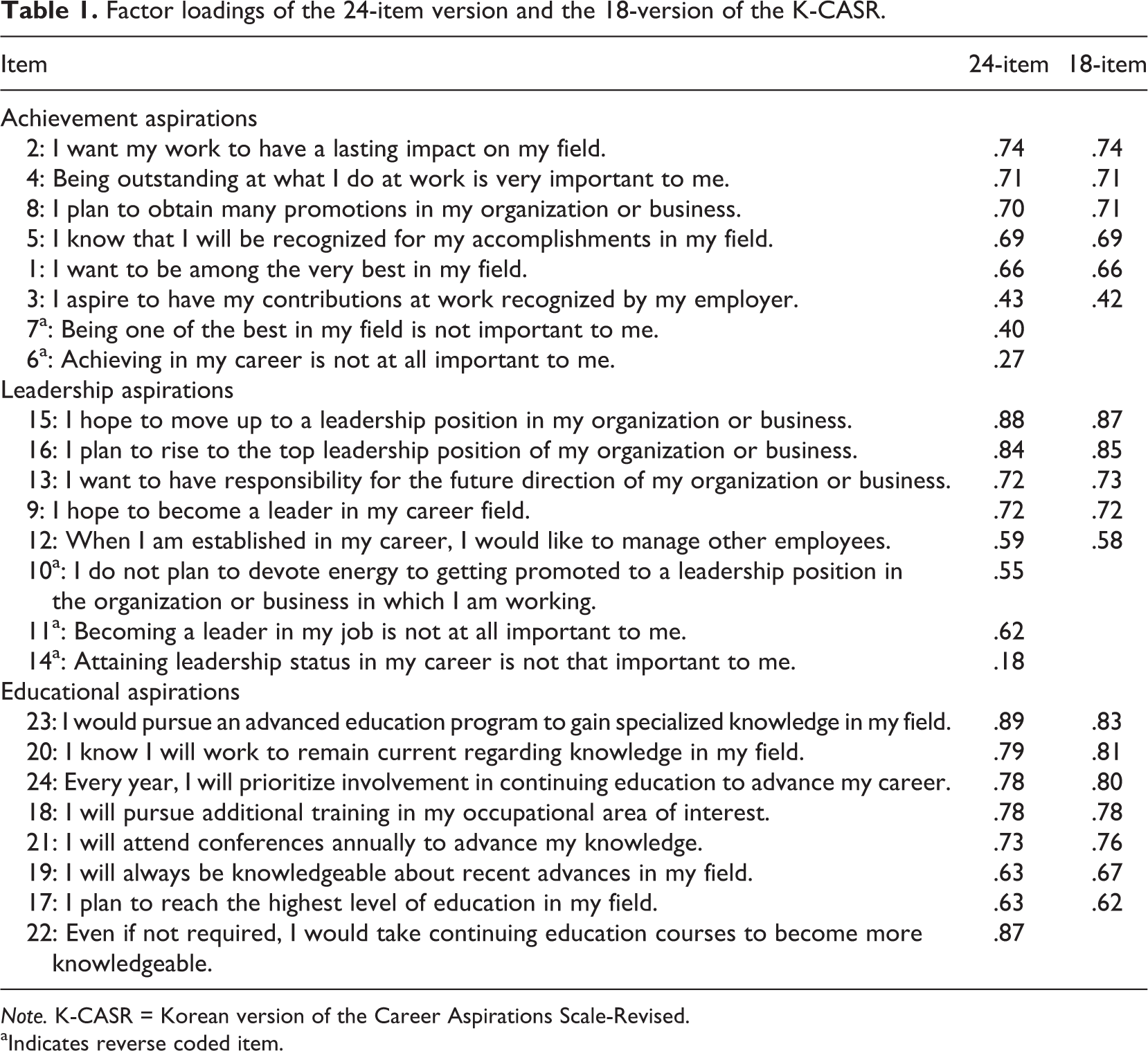
The 24-item three-factor model did not exhibit acceptable model fit indices as the CFI and RMSEA did not meet the standards for a well-fitting model, χ2 (248, N = 377) = 982.477, p < .01, CFI = .832, and RMSEA = .089, 90% confidence interval (90% CI) [.083, .094]. Only the SRMR indicated good model fit (SRMR = .077). See Table 1 for the factor loadings in the three-factor structure.
Factor loadings of the 24-item version and the 18-version of the K-CASR.
Note. K-CASR = Korean version of the Career Aspirations Scale-Revised.
aIndicates reverse coded item.
Model Modification
We modified the hypothesized model to enhance fit. First, one of the two highly correlated items was deleted from the K-CASR as the correlation between Item 22 (“Even if not required, I would take continuing education courses to become more knowledgeable.”) and Item 23 (“I would pursue an advanced education program to gain specialized knowledge in my field.”) was r = .86. Given the similarity in wording, the lack of continuing education courses in Korea and the high interitem correlation, Item 22 was deleted from the model.
Furthermore, we examined the possibility of a wording effect given that most of the negatively worded items had low factor loadings including Items 14 (.17), 6 (.27), and 7 (.40). It was possible that the reverse-scored items on this measure might not operate in the intended way with the sample of Korean young women. To test this hypothesis, another factor was set to represent the wording effect among the five negatively worded items. The alternative model that included the wording effect exhibited improvement in fit over the theorized model, χ2 (219, N = 377) = 577.072, p < .01; CFI = .908; RMSEA = .066; 90% CI: [.059, .072]; SRMR = .047.
Because a wording effect was found, we tested an alternative model without the reverse-scored items. The three-factor structure of the 18-item K-CASR resulted in acceptable model fit indices, χ2 (132, N = 377) = 441.996, p < .01; CFI = .905; RMSEA = .079; 90% CI: [.071, .087]; SRMR = .052. The factor loading estimates ranged from .42 to .87 across items (Table 1). Finally, 6 items on the achievement aspirations subscale, 5 items on leadership aspirations, and 7 items on educational aspirations were retained in the K-CASR. The 18-item version of the K-CASR was used to test the relationship with other measures, given that inclusion of negatively worded items is not desirable, as they create reliability and validity concerns and scoring can be unnecessarily complicated when the method effect is taken into consideration (Barnette, 2000; Woods, 2006).
Descriptive Statistics and Correlations
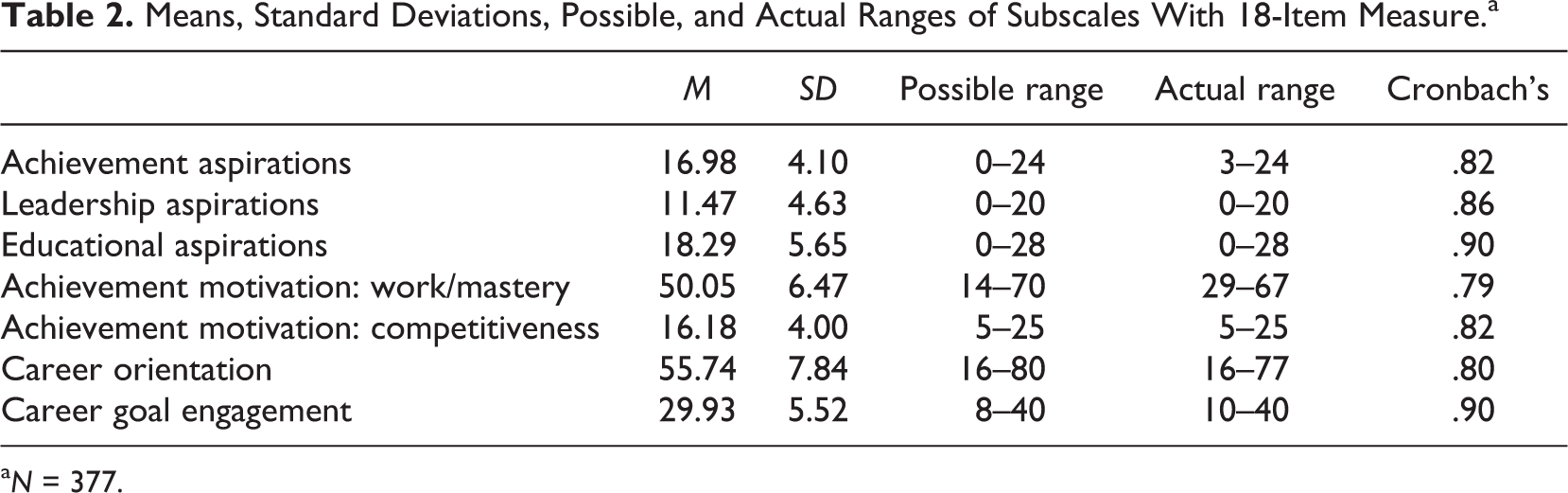
The means, SDs, ranges, and reliability estimates of the measures can be found in Table 2. On average, the participants reported moderate career aspirations and moderate levels of achievement motivation, career orientation, and career goal engagement. Internal consistency estimates were high on all subscales (achievement = .82, leadership = .86, and educational aspirations = .90).
Means, Standard Deviations, Possible, and Actual Ranges of Subscales With 18-Item Measure.a
a N = 377.
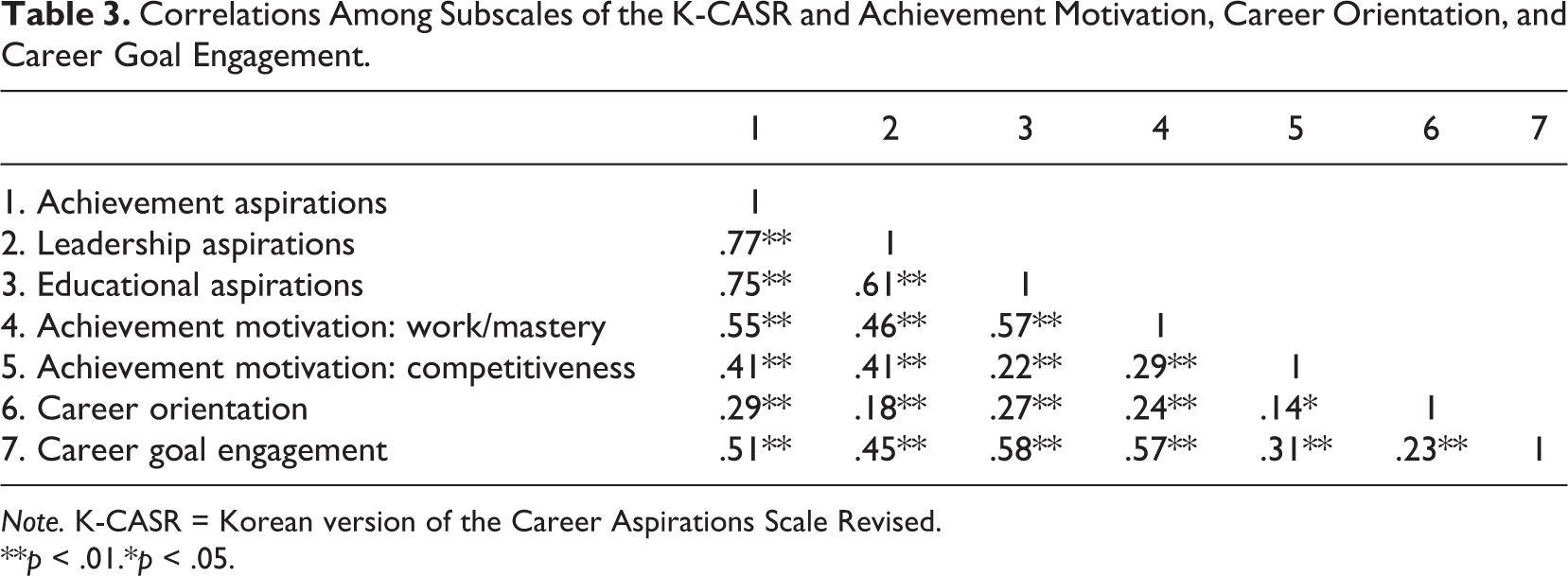
We tested whether the achievement aspirations, leadership aspirations, and educational aspiration subscales were associated with relevant variables in the hypothesized directions. The bivariate correlations indicated that all three subscales were correlated positively with achievement motivation (work/mastery), achievement motivation (competitiveness), career orientation, and career goal engagement as hypothesized (see Table 3).
Correlations Among Subscales of the K-CASR and Achievement Motivation, Career Orientation, and Career Goal Engagement.
Note. K-CASR = Korean version of the Career Aspirations Scale Revised.
**p < .01.*p < .05.
Test–Retest Reliability
We analyzed the data of 29 participants who completed the K-CASR twice (initially and 2 weeks later) to determine whether the measure exhibited stability over time. Correlations between the administrations of the measures were as follows: .76 for achievement, .83 for leadership, and .78 for educational aspirations, suggesting that subscale scores were stable over a short period.
Discussion
The purposes of this study were to translate and evaluate a revised measure of career aspiration for Korean women. The translated measure exhibited good psychometric properties when used with 377 undergraduate Korean women. The three-factor structure was replicated, suggesting that this measure consists of items assessing achievement, leadership, and education aspirations. Internal consistency and test–retest reliability estimates supported the reliability of the measure, and relationships in the hypothesized direction with career-related variables supported the convergent validity of the revised instrument when used with Korean college women.
This study contributes to the literature by providing a model of how to translate a measure for use in another culture. A translation committee approach and an ongoing international collaboration among researchers from the United States and Korea ensured an accurate translation and maximized the appropriateness of each item for use in Korean culture. Moreover, three vocational psychologists in Korea participated in the translation and served as translation adjudicators. This intensive process resulted in a psychometrically sound measure that can be used with confidence with Korean undergraduate women.
This study also adds to the literature by replicating the three-factor solution found in samples of American graduate and undergraduate women (Gregor & O’Brien, 2016). Career aspirations are better represented as a three-dimensional construct than a single construct in both American and Korean culture. This factorial invariance can serve as support for Korean and American women interpreting the construct in a similar fashion. However, a method effect associated with the negatively worded items emerged in the Korean sample. Korean participants appeared to respond differently to these items (apart from the underlying constructs) when compared to American respondents. Method effects related to negatively worded items have been found in self-report surveys in psychology (Barnette, 2000; DiStefano & Motl, 2006). Also, a scholar commenting on cultural differences in survey response patterns noted the tendency of Asian participants to avoid extremely negative responses (that may result in a restricted range of responses; Chen, 2008). Given that most of the negatively worded items in the K-CASR had restricted ranges, Korean college women may have avoided endorsing explicit negative statements regarding their aspirations. This finding was consistent with research on the Korean version of the Brief Fear of Negative Evaluation Scale in which the function of positively and negatively worded items was different (Hong, Moon, & Jo, 2011). The equivalence of positively and negatively worded translated items should be investigated in future studies.
In addition, the convergent validity of the K-CASR was supported by relatively strong associations among the subscales and achievement motivation, career orientation, and career goal engagement. Women with high aspirations were more likely to have motivation to master a task and outperform their peers, which is consistent with prior research indicating that women with high career aspirations had high confidence in academic tasks (H. J. Lee, 2014). In terms of career orientation, college women with high career aspirations tended to prioritize their careers over family. Additionally, women with high career aspirations were likely to engage in activities to pursue their careers and to have positive perceptions regarding their ability to achieve their career goals. Exploration of factors that facilitate women’s success in their careers can further the research in vocational psychology, given that previous studies regarding Korean women’s career development mostly focused on barriers and difficulties in their career choices (e.g., S. Lee & Yu, 2009; E. R. Son & Kim, 2002).
Interestingly, the Korean college women in this study exhibited moderate aspirations in leadership, achievement, and education, despite varied college majors, geographical locations in Korea, and university rankings. Given the many cultural barriers for women’s career accomplishments in Korea, it is notable that many young women aspired to achieve in their careers. It would be interesting to track the trend of women’s career aspirations over their life stages to understand the decline in employment among Korean women after having a family. Given the paucity of female leaders in the Korean society, future research can focus on how young women develop leadership aspirations and how these aspirations might be encouraged.
Several limitations are important to note. Contemporary career theories highlight the importance of sociocultural factors in the career development of women. Our sample consisted of college women enrolled in 4-year universities who had moderate career aspirations. Therefore, these findings cannot be generalized to other Korean women such as those married, with children, in different age-groups, or with less privileged backgrounds. Furthermore, because the majority of the participants in the current study majored in traditional fields for women, these findings cannot be generalized to college women in nontraditional fields such as science or engineering. Women in nontraditional fields may have more challenges in their career development (e.g., lack of role models); future research is necessary to examine the underlying factor structure and validity evidence of the K-CASR with different groups of Korean women and with college women in nontraditional fields.
In the future, the K-CASR can be used when developing a comprehensive model to explain women’s career development in Korea. In particular, a longitudinal study is needed to examine how women’s career aspirations change over time and are associated with diverse career outcomes (e.g., wages, promotions, job satisfaction, or termination/resigning employment). This type of research is needed to understand how career aspirations influence the career choices that women make when they face conflict between work and family. For example, an employed mother with high career aspirations may want to continue her work instead of compromising her goals to become a future leader in her field. On the other hand, if there is a curvilinear relationship between career aspirations and positive career outcomes, women with extremely high career aspirations might be more depressed when their career aspirations cannot be fully achieved due to career barriers or family responsibilities.
Additionally, the K-CASR can be used in international research to explore women’s career aspirations across countries. Cross-cultural studies can provide a rich explanation of how cultural values and societal structures shape women’s career development. Because the K-CASR was translated from an measure developed in the United States, the instrument can be used to compare the career aspirations of Korean and American women. Specifically, it would be interesting to examine cultural influences on the development of career aspirations of young women and changes in this construct over time in both the United States and Korea.
Career counselors can also utilize the K-CASR to facilitate young women’s career exploration through psychoeducational interventions and counseling. In particular, career counselors can assess the career aspirations of academically talented women and explore perceived external and internal barriers to achieve leadership or recognition. Additionally, the three dimensions of career aspirations can be used to develop short-term and long-term plans to enable clients to achieve their career goals. However, the utilization of the K-CASR in career counseling should be empirically evaluated to assess the efficacy of these clinical interventions.
Antoine de Saint-Exupery wrote, “If you want to build a ship, teach people to long for the endless immensity of the sea.” As vocational psychologists, we should not overlook the importance of inspiring young Korean women to long for leadership, achievement, and advanced education in a culture that has not always supported women in powerful roles. Then, young women likely will build their ships to reach beyond traditional societal expectations and make salient contributions to Korean society.
Footnotes
Authors’ Note
The findings of this study will be presented at the annual convention of the American Psychological Association in August, 2015.
Declaration of Conflicting Interests
The author(s) declared no potential conflicts of interest with respect to the research, authorship, and/or publication of this article.
Funding
The author(s) received no financial support for the research, authorship, and/or publication of this article.