



Abstract
We examined the changes in career decision-making self-efficacy (CDSE) and vocational identity (VI) and their reciprocal associations among 1,026 senior high school students, comprising 493 from Hong Kong (age in 10th grade: M = 16.31, SD = 0.65; 238 girls) and 533 from Shanghai (age in 10th grade: M = 16.50, SD = 0.56; 237 girls). They completed measures for assessing their CDSE and VI annually from 10th to 12th grades. Latent growth curve analyses indicated that both CDSE and VI significantly increased over time in the Hong Kong sample. Cross-lagged path analyses indicated that the reciprocal positive effects between CDSE and VI over time were supported in both samples. These findings indicated that CDSE and VI are generally dynamic and interrelated dimensions for Chinese adolescents’ career development with some regional differences.
Keywords
Vocational identity (VI) is theoretically understood (Erikson, 1968; Super, 1990) and empirically supported (e.g., Negru-Subtirica, Pop, & Crocetti, 2015; Porfeli, Lee, Vondracek, & Weigold, 2011) as a crucial outcome construct and its formation is critical to adolescents’ career development. Individuals with a strong VI often have a clear and stable awareness of their goals, interests, and talents (Holland, Daiger, & Power, 1980) and are more likely to successfully identify suitable occupational options for themselves (Holland, 1996; Saunders, Peterson, Sampson, & Reardon, 2000; Scott & Ciani, 2008). Moreover, a strong VI often contributes to healthy psychosocial adjustment and to subjective well-being (Hirschi, 2012; Hirschi & Herrmann, 2012; Vasile & Albu, 2011), college major choice congruence (S. A. Leung, 1998), and even job satisfaction (Holland & Gottfredson, 1994).
Consistent with the propositions of social cognitive career theory (SCCT; Lent, Brown, & Hackett, 1994), individuals’ career self-beliefs or levels of efficacy have been empirically supported to be an antecedent of and contributor to the formation and construction of interests and goals (e.g., Bozionelos et al., 2015; Lent et al., 2016). Furthermore, numerous studies have revealed the significant and positive relationship between career decision-making self-efficacy (CDSE) and VI (Hammond, Lockman, & Boling, 2010; Solberg, Good, Fischer, Brown, & Nord, 1995). Some authors (e.g., Gushue, Clarke, Pantzer, & Scanlan, 2006; Gushue, Scanlan, Pantzer, & Clarke, 2006; Jantzer, Stalides, & Rottinghaus, 2009; Jo, Ra, Lee, & Kim, 2016; Koumoundourou, Kounenou, & Siavara, 2012) have also specifically demonstrated that CDSE is an antecedent variable of VI in cross-sectional studies across various cultural settings.
However, because the formation and construction of CDSE and VI are dynamic processes (Betz, 2006; Super, 1963; Whiston, Li, Goodrich Mitts, & Wright, 2017) and adolescence is the crucial period for these processes (Erikson, 1968), the aforementioned cross-sectional studies might not have effectively revealed the real relationship between career self-efficacy and VI. According to the SCCT model (Lent et al., 1994), personal attributes and career development outcomes interact with each other. Therefore, a possible reciprocal relationship between career self-efficacy and VI should be studied longitudinally, especially for adolescents in the process of constructing their VI. However, with a few exceptions (e.g., Cordeiro, Paixao, Lens, Lacante, & Luyckx, 2015), scant longitudinal studies have been conducted to empirically examine the reciprocal association between adolescents’ career self-efficacy and VI.
Culture is a substantial distal factor that may affect the development of individuals’ beliefs and interests regarding self-efficacy (Lent et al., 1994). Individuals’ interactions and interpretations with their environments contribute toward them actively constructing and making meaning for their careers (Savickas, 2002). The effects of culture on CDSE (Mau, 2000) and VI (Abraham, 1986) are empirically supported in the related literature. Although all ethnically Chinese individuals are affected by traditional Chinese culture (mainly Confucian culture), adolescents from different regions should differ in how they relate to the current social, economic, political, and educational conditions (C. Y. W. Leung, McBride-Chang, & Lai, 2004). In response to increasing demand for cultural research to focus on intraculture variations (see Kagitcibasi, 2007), the present study used a longitudinal design to compare the dynamic characteristics of and reciprocal relationships between career self-efficacy and VI between adolescents from Hong Kong and Shanghai. These regions were chosen because they possess dissimilar local sociocultures.
Changes of VI and CDSE
From the perspective of career development or construction, VI is generally defined as one outcome variable in an individual’s career development. Additionally, CDSE is referred to as one antecedent variable for VI (Lent et al., 1994; V. Skorikov & Vondracek, 1998). Although few researchers have investigated the possible cross-lagged interactions between career self-efficacy and VI, some interventions have demonstrated an increased influence on individuals’ efficacy in making career decisions and regarding their VI; moreover, evidence from longitudinal research has also indicated dynamic changes to both factors.
For example, by using the recent three-factor model of VI introduced by Porfeli, Lee, Vondracek, and Weigold (2011), Cordeiro, Paixao, Lens, Lacante, and Luyckx (2015) reported a decrease in exploration and an increase in commitment in a sample of Portuguese 12th graders in a two-wave longitudinal study lasting 9 months. Similarly, Hirschi (2012) investigated two cohorts of Swiss adolescents of 8th–9th and 11th–12th grades. The results indicated that most students showed a progressive shift in VI statuses (viz., achievement, foreclosure, moratorium, and diffusion) over time. Alternatively, by using Holland’s model, Ohashi (2009) reported a significant increase in VI after a short-term intervention among a Japanese high school student sample.
Regarding self-efficacy, numerous empirical studies have reported that certain career coaching programs or intervention courses may increase CDSE levels in high school (Chiesa, Massei, & Guglielmi, 2016; Creed, Lee-Ann, & Patton, 2005; Jordan, Gessnitzer, & Kauffeld, 2016) or college (Cheung & Arnold, 2014; Essig & Kelly 2013; Fouad, Cotter, & Kantamneni, 2009; Grier-Reed & Skaar, 2010; Scott & Ciani 2008) participants. For example, Chiesa, Massei, and Guglielmi (2016) determined that a structured-group career intervention significantly increased CDSE in 280 Italian high school students. Similarly, Jordan, Gessnitzer, and Kauffeld (2016) reported significantly positive effects from a group coaching session on CDSE among German high school students. In addition, several longer term longitudinal studies have reported similar outcomes. For instance, an increase in CDSE among Australia eighth graders was observed by Creed, Lee-Ann, and Patton (2005) in a 2-year longitudinal study.
The aforementioned empirical evidence indicates that both CDSE and VI are largely dynamic in adolescents and college students. These results have often been separately reported in the literature; however, both are central career constructs and should, in theory, develop in coordination for individuals (Lent et al., 1994). V. B. Skorikov and Vondracek (2011) argued that developmental changes in VI over short periods of time cannot be detected and that a clear developmental progression over longer periods of time occurs during adolescence. Therefore, as the crucial constructs of career development, especially in adolescents, CDSE and VI should be thoroughly explored using an integrative and longitudinal design over a substantial period of time.
Relationships Between CDSE and VI
A significant relationship between CDSE and VI has been empirically supported among high school students and college students (Germeijs, Luyckx, Notelaers, Goossens, & Verschueren, 2012; Gushue, Clarke, et al., 2006; Hammond et al., 2010; Solberg et al., 1995). For instance, Germeijs, Luyckx, Notelaers, Goossens, and Verschueren (2012) reported that Belgian 12th graders in the achievement or foreclosure cluster had higher CDSE than did their counterparts in the moratorium or diffusion cluster. Hammond, Lockman, and Boling (2010) noted that CDSE was positively associated with VI for Black U.S. undergraduates.
CDSE has often been regarded as a predictor of VI and examined in cross-sectional studies (Gushue, Clarke, et al., 2006; Gushue, Scanlan, et al., 2006; Jantzer et al., 2009; Jo et al., 2016; Koumoundourou et al., 2012). Jantzer, Stalides, and Rottinghaus (2009) reported that U.S. eighth graders with high levels of CDSE were more likely to have an achieved VI. The same pattern was observed in Black U.S. high school students (Gushue, Scanlan, et al., 2006), Latino U.S. high school students (Gushue, Clarke, et al., 2006), and Greek high school students (Koumoundourou et al., 2012). Additionally, Jo, Ra, Lee, and Kim (2016) noted a positive effect of CDSE on VI for a Korean undergraduate sample.
Cross-sectional designs cannot truly reflect the dynamics of career development (Rutter, 1994) and do not reveal the causal relationships among those career variables (see V. B. Skorikov & Vondracek, 2011, for a review). Although Lent, Brown, and Hackett (1994) argued for reciprocal relationships among those career variables in the SCCT framework, only a few related works have been reported (Cordeiro et al., 2015; Negru-Subtirica et al., 2015). Using a two-wave longitudinal design for a sample of Portuguese 12th graders, Cordeiro et al. (2015) reported CDSE to positively and reciprocally affect exploration and commitment-making in light of Marcia’s (1966, 1993) two-dimensional model of identity. Negru-Subtirica, Pop, and Crocetti (2015) reported a reciprocal relationship between career adaptability and VI in a Romanian adolescent sample; however, career self-efficacy was not included in the analysis. According to Liu et al. (2016), strong tests of a reciprocal relationship require repeated assessment over at least three time points. Therefore, more research should be conducted to further knowledge of the reciprocal association between CDSE and VI.
Cultural Effects on CDSE and VI
Lent and Hackett (1987) argued that career research should be conducted using populations from diverse cultures. SCCT further assumes that environmental variables, such as culture, economic conditions, and parental behaviors, can moderate and directly affect the career development processes by which people make and implement career-relevant choices (Lent et al., 1994; Lent, Brown, & Hackett, 2000). Empirically, some cross-cultural evidence (e.g., Abraham, 1986; Chapman & Nicholl, 1976; Gloria & Hird, 1999; Mau, 2000) indicates that culture has an effect on CDSE and VI. For example, Mau (2000) reported that Taiwanese college students scored significantly lower than did U.S. students for CDSE. Abraham (1986) reported that Mexican American participants were more foreclosed in their VI than were their Anglo-American peers regardless of socioeconomic status. A New Zealand study (Chapman & Nicholl, 1976) reported that more Anglo-New Zealand students had achieved a VI than had indigenous ones regardless of socioeconomic status.
However, these effects of cultural differences on CDSE and VI have not always been supported. For example, Lopez and Ann-Yi (2006) observed no racial or ethnic differences in CDSE among White, Latino, and Black U.S. undergraduates. Leong (1991) reported no cultural group differences in VI between Anglo-American and Asian American students. These inconsistent findings mainly derive from cross-sectional research. In consideration of the dynamic process of career development and the aforementioned inconsistent findings, cultural comparison longitudinal studies are warranted in the domain of career development. Furthermore, in fact, no matter those results for cultural differences on CDSE and VI are consistent or inconsistent, most of them mainly come from Western populations (e.g., Abraham, 1986; Chapman & Nicholl, 1976; Gloria & Hird, 1999).
Accordingly, in the present study, we chose two different Chinese localized settings (Hong Kong and Shanghai) to examine the probable regional differences in the stability and change in senior high school students’ CDSE and VI and their reciprocal associations. The following two paragraphs briefly introduced the basic context differences of the two Chinese regions in social developmental history, socioeconomic level, and career education situations, which may significantly contribute to the career development of the participants in our study.
Hong Kong, as a former colony of the United Kingdom and a special administrative region of China, possesses features of both Eastern and Western cultures. According to the World Bank (2017), its per capita gross domestic product in 2017 was US$48,848, significantly higher than the national Chinese figure of US$9,482. By comparison, Shanghai is a fast-growing city in China and its per capita in 2017 was US$18,749 (National Bureau of Statistics of China, 2018).
Furthermore, as a postmodern society, Hong Kong provided abundant career education for senior high school students (Education Bureau, 2014; Ho & Leung, 2016; Zhang, 1999). According to the result of 2016 Organization for Economic Cooperation and Development (OECD) Teaching and Learning International Survey (TALIS) at Junior School Teachers, the score reported by Shanghai participants on the item of “conducting student career guidance and counseling” was significantly lower than the mean of the score reported by the participants from all 36 countries/regions which took part in the TALIS (e.g., England, Japan; Shanghai TALIS Center, 2016). This result may suggest that career education should be seriously improved among Shanghai students. Shanghai exemplifies Chinese modernization is attempting to construct a career education system at the senior high school level; however, substantially more work (e.g., developing a general syllabus for career education and professional training for career counselors) is required (Fan & Leong, 2016; Zhang, 1999; Zhou, Li, & Gao, 2016). Under the current education system, students from Shanghai in the present study are required to choose a specific subject area during 11th grade (Zhou et al., 2016), whereas Hong Kong students are required to make the corresponding decision in ninth grade (Education Bureau, 2014).
Present Study
The present three-wave longitudinal study had two goals. The first was to investigate and compare the stability and change in CDSE and VI between the senior high school student samples from Hong Kong and Shanghai over time. The second was to examine the reciprocal association between CDSE and VI and compare the patterns in the relationship between the same two samples. This comparison was designed to reveal any sociocultural effects on adolescents’ career development processes.
Adolescents’ career maturity is assumed to progress during the process of career development. Furthermore, in consideration of the aforementioned positive findings in the longitudinal literature (e.g., Chiesa et al., 2016; Hirschi, 2012), we expected increasing trends for both VI and CDSE among senior high school students in the present study. Because some correlational or reciprocal results in the associations between CDSE and VI were mainly based on cross-sectional (e.g., Jantzer et al., 2009; Jo et al., 2016; Koumoundourou et al., 2012) or two-wave longitudinal (e.g., Cordeiro et al., 2015; Negru-Subtirica et al., 2015) designs, we aspired to longitudinally examine whether a reciprocal relationship between CDSE and VI was supported among Chinese senior high school students in the present study.
In addition, as demonstrated by the aforementioned findings (e.g., Abraham, 1986; Chapman & Nicholl, 1976; Gloria & Hird, 1999; Mau, 2000), individuals’ careers develop differently depending on the specific cultural setting (Lent et al., 1994). As such, in consideration of the influences of socioeconomic factors (e.g., family income) and career education environment on adolescent career development (Lent et al., 1994), we also expected that the changes in CDSE and VI, as well as the relationship between them, to differ significantly between Hong Kong and Shanghai.
Method
Participants and Procedure
Students from four high schools in Hong Kong and three high schools in Shanghai were invited to participate. Data from participants were collected in three waves of measurement from 10th grade to 12th grade. An incentive for school participation was a summary school report on students’ vocational development profiles. Additionally, individual students were promised their vocational development profile at the end of the longitudinal study upon entering 12th grade.
An initial total of 1,026 tenth graders completed the questionnaires, consisting of 493 Hong Kong students (age in 10th grade: M = 16.31, SD = 0.65; 238 girls) and 533 Shanghai students (age in 10th grade: M = 16.50, SD = 0.56; 237 girls). At their 11th grade, 417 (84.58%) Hong Kong students and 438 (82.18%) Shanghai students participated in the follow-up assessments. At their 12th grade, 399 (80.93%) Hong Kong students and 267 (50.09%) Shanghai students participated in the third-wave data collection. Results from attrition analyses indicated nonsignificant differences among all study variables between students who participated in all waves and those who participated in only one or two waves.
Instruments
CDSE
The CDSE Scale—Short Form (CDSE-SF; Betz, Klein, & Taylor, 1996) was employed to assess participants’ confidence in making career-related decisions. The CDSE-SF consists of 25 items covering five dimensions: self-appraisal, occupational information searching, goal selection, making plans for the future, and problem-solving. A sample item is “How much confidence do you have that you could accurately assess your abilities?” The participants were asked to indicate their agreement on a 5-point scale ranging from 1 (no confidence at all) to 5 (complete confidence). Higher scores indicate greater confidence. The reliability for the CDSE-SF was .94 in a previous study (Betz et al., 1996) and .93 for the Chinese-language version (Hampton, 2006). In this study, the reliabilities of the full scale from 10th grade to 12th grade were .91, .92, and .94, respectively.
VI
We used the VI subscale of the My Vocational Situation Scale (Holland, Daiger, et al., 1980) to assess the degree of stability and clarity presented in an individual’s VI. The VI subscale consists of 18 items and uses a true or false response format. It is scored as the number of false answers after reversing the direction of four items. A high VI score indicates “a clear sense of identity” and a low VI score indicates “a diffused sense of identity.” High VI scorers are generally believed to be independent, organized, self-confident, mature, and competent at managing their lives effectively. Holland, Gottfredson, and Power (1980) reported that the reliability (K-R 20) of VI was .86 for both male and female high school students. In the present study, the Cronbach’s αs for VI from 10th grade to 12th grade were .86, .85, and .86, respectively.
In addition to the vocational measures, we collected information on the demographic backgrounds of the students, including age, sex, and year of study.
Data Analysis
Zero-order correlational analysis was first conducted to examine the pattern of relationships among the research variables in the two samples. Repeated measure multivariate analysis of variance (MANOVA) procedures were used to examine the time and regional differences of the research variables. Latent growth model (LGM) analyses were employed to investigate whether significant changes existed longitudinally. Because intercept and linear slope were examined with a three-wave data set in the current study, the degree of freedom (df) should be 1. However, if df is 1, it may be problematic and possibly misleading to use RMSEA as fit index (Kenny, Kaniskan, & McCoach, 2014). Taasoobshirazi and Wang (2016) also argued, if df is 1, when Root Mean Square Error of Approximation (RMSEA) is considered, even the sample size is large enough (e.g., 400), the corresponding model rejection rates still are high (14.20%). As such, only Comparative Fit Index (CFI) and Standardized Root Mean Square Residual (SRMR) were fit indices referred to our LGM analysis. At last, cross-lagged analyses were conducted to examine reciprocal longitudinal associations among the research variables by using Mplus (Version 7.4; L. K. Muthén & B. O. Muthén, 1998–2012). Missing data were handled in Mplus using full information maximum likelihood estimation.
Results
Preliminary Analysis
The values of skewness and kurtosis for both research variables across the three time points ranged from 0.31 to 0.02 and from −1.10 to 0.11, respectively. The values indicated that the distributions of all research variables did not violate the normal distribution (Finney & DiStefano, 2013). MANOVA indicated that no significant differences existed for all of the variables for 10th graders between those participants who finished all three-wave data collections and those who missed data collection in 11th grade or 12th grade, Wilks’s Λ = 1.00, F(2, 939) = 1.00, p > .05.
The overall effects of time, region, and sex as well as their interactions were examined through mixed repeated measure MANOVA. According to the Cohen’s (1988) guidelines for interpreting F-test effect size (small = .01, medium = .059, and large = .138), only time differences, Wilks’s Λ = 0.94, F(4, 544) = 9.33, p = .00, η2 = .06, and regional differences, Wilks’s Λ = 0.94, F(2, 546) = 20.85, p = .00, η2 = .06, were further considered in the subsequent analyses. No other significant main effects or interaction effects were observed.
Descriptive statistics of the research variables from 10th grade to 12th grade in the two regions are listed in Table 1. The results indicated that the Hong Kong students scored significantly lower on the CDSE-SF than did the Shanghai students, with a medium effect size, only in 10th grade. Region differences of CDSE and VI at other time points were not supported due to small effect sizes. As listed in Table 2, significantly positive correlations among both research variables across the three time points were largely supported for the two student samples.
Descriptive Statistics and Regional Differences of the Research Variables.

Note. The figure after the variable name refers to the time point of data collection in the present longitudinal study. For comparing the regional differences of the research variables, superscript H indicates that the mean is significantly higher than the corresponding mean labeled with superscript L, which is significantly lower than the corresponding mean labeled with superscript H. CDSE = career decision-making self-efficacy; VI = vocational identity; df = degree of freedom.
*p < .05. **p < .01.
Correlations Among Career Decision-Making Self-Efficacy and Vocational Identity.
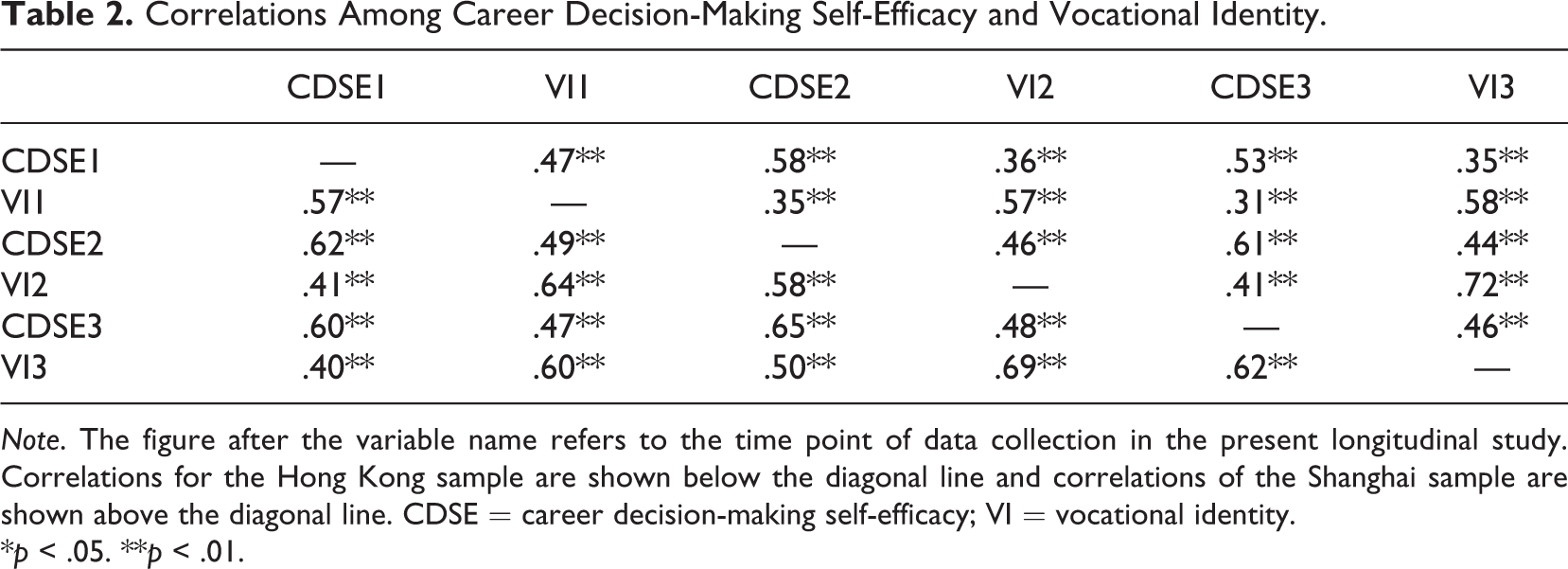
Note. The figure after the variable name refers to the time point of data collection in the present longitudinal study. Correlations for the Hong Kong sample are shown below the diagonal line and correlations of the Shanghai sample are shown above the diagonal line. CDSE = career decision-making self-efficacy; VI = vocational identity.
*p < .05. **p < .01.
LGM Analyses on CDSE and VI
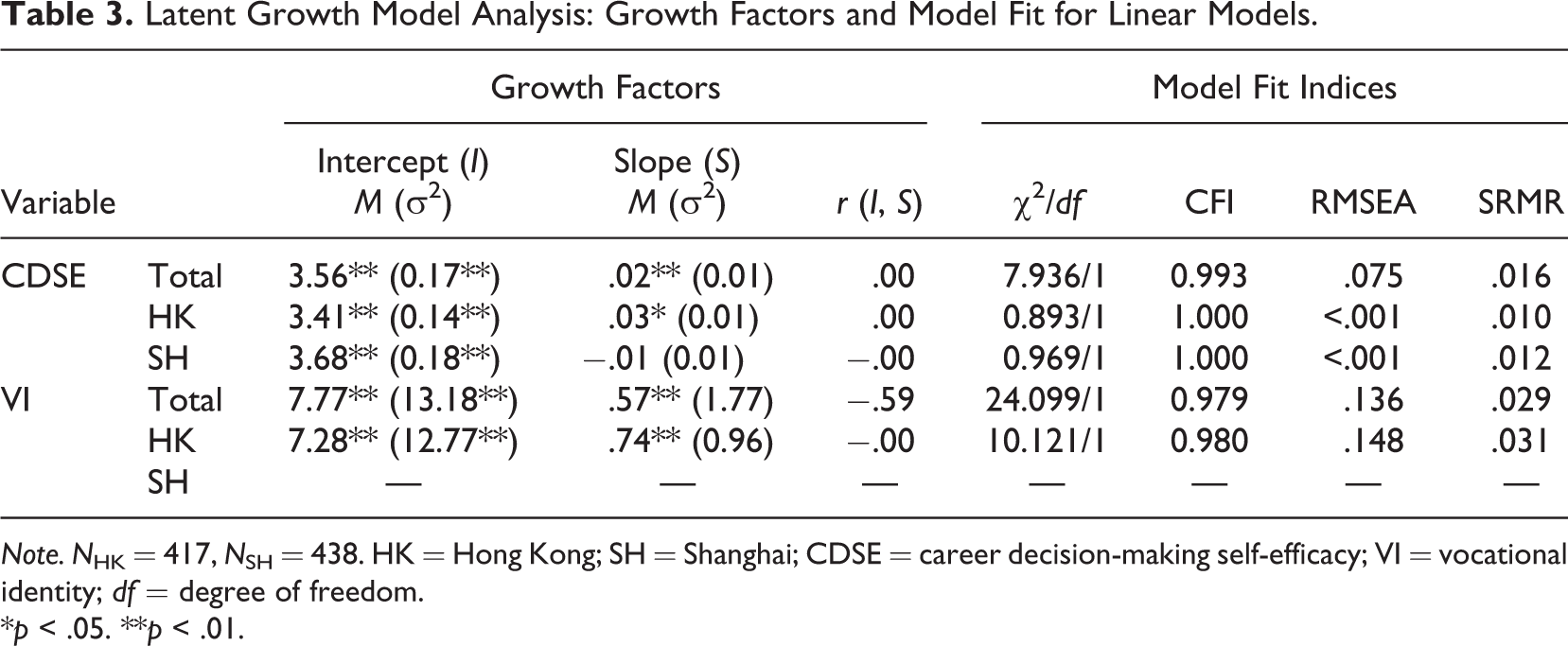
LGM analyses in Mplus Version 7.4 were conducted using a maximum likelihood estimator to test linear changes in CDSE and VI.
The model fit indices (i.e., CFI and SRMR) indicated excellent data fit for all linear growth models (Table 3). In the Hong Kong sample, CDSE had medium–high initial levels that significantly increased over time. VI was characterized by low initial levels that significantly increased over time.
Latent Growth Model Analysis: Growth Factors and Model Fit for Linear Models.
Note. N HK = 417, N SH = 438. HK = Hong Kong; SH = Shanghai; CDSE = career decision-making self-efficacy; VI = vocational identity; df = degree of freedom.
*p < .05. **p < .01.
In the Shanghai sample, CDSE had high initial levels, but the nonsignificant linear slope indicates that CDSE remained stable from 10th grade to 12th grade. The change of VI in the Shanghai sample displayed a nonlinear pattern with an increase from 10th grade to 11th grade and decrease from 11th grade to 12th grade.
Because the slope of CDSE was significant in the Hong Kong sample but nonsignificant in the Shanghai sample (viz., the slopes of CDSE in two samples were different) and the nonlinear growth model of VI in Shanghai sample could not be examined due to the limited three-wave data, we did not conduct regional multigroup analysis for the linear growth models.
Cross-Lagged Analyses of CDSE and VI
To examine the reciprocal longitudinal associations between CDSE and VI, we conducted cross-lagged analyses in Mplus. Specifically, we tested the cross-lagged associations (e.g., CDSE measured in 10th grade predicting VI processes in 11th grade and VI in 10th grade predicting CDSE in 12th grade) after controlling for the following: (a) 1-year stability paths (e.g., VI in 10th grade predicting VI in 11th grade), (b) 2-year stability paths (e.g., VI in 10th grade predicting VI in 12th grade), and (c) within-time correlations among all the variables.
To obtain more parsimonious models, we tested whether the cross-lagged effects were time invariant (i.e., based on an assumption of being stationary). Thus, we compared the model in which cross-lagged paths were free to vary with the model in which they were fixed across time. To determine significant differences between these two models at least two of the following three criteria had to be matched: Δχ2 significant at p < .05, ΔCFI ≥ −0.01, and ΔRMSEA ≥.015 (Negru-Subtirica et al., 2015). The model in which cross-lagged effects were time invariant was not significantly different from the model in which these effects were estimated freely, namely, in the Hong Kong sample: Δχ2(2) = 1.645, p > .05, ΔCFI = 0.00, and ΔRMSEA = .00; in the Shanghai sample: Δχ2(2) = 0.059, p > .05, ΔCFI = 0.00, and ΔRMSEA = .00. Thus, we could retain the more parsimonious time-invariant models as the final ones.
Our findings indicated that in the Hong Kong sample (χ2 = 1.83, df = 4, CFI = 1.00, RMSEA < .001, SRMR = .010) and the Shanghai sample (χ2 = .92, df = 4, CFI = 1.00, RMSEA < .001, SRMR = .007), CDSE had reciprocal positive effects on VI over 2 years.
We conducted multigroup analysis to test whether cross-lagged paths from CDSE to VI and from VI to CDSE were significantly moderated by region. Results indicated that the unconstrained model in which parameters were free to vary across groups was not significantly different from the constrained model in which the parameters were fixed across groups, Δχ2(14) = 10.65, p > .05, ΔCFI = 0.00, ΔRMSEA = .00. Therefore, region did not moderate relations in the path model. The cross-lagged relationship of CDSE and VI was displayed in Figure 1.
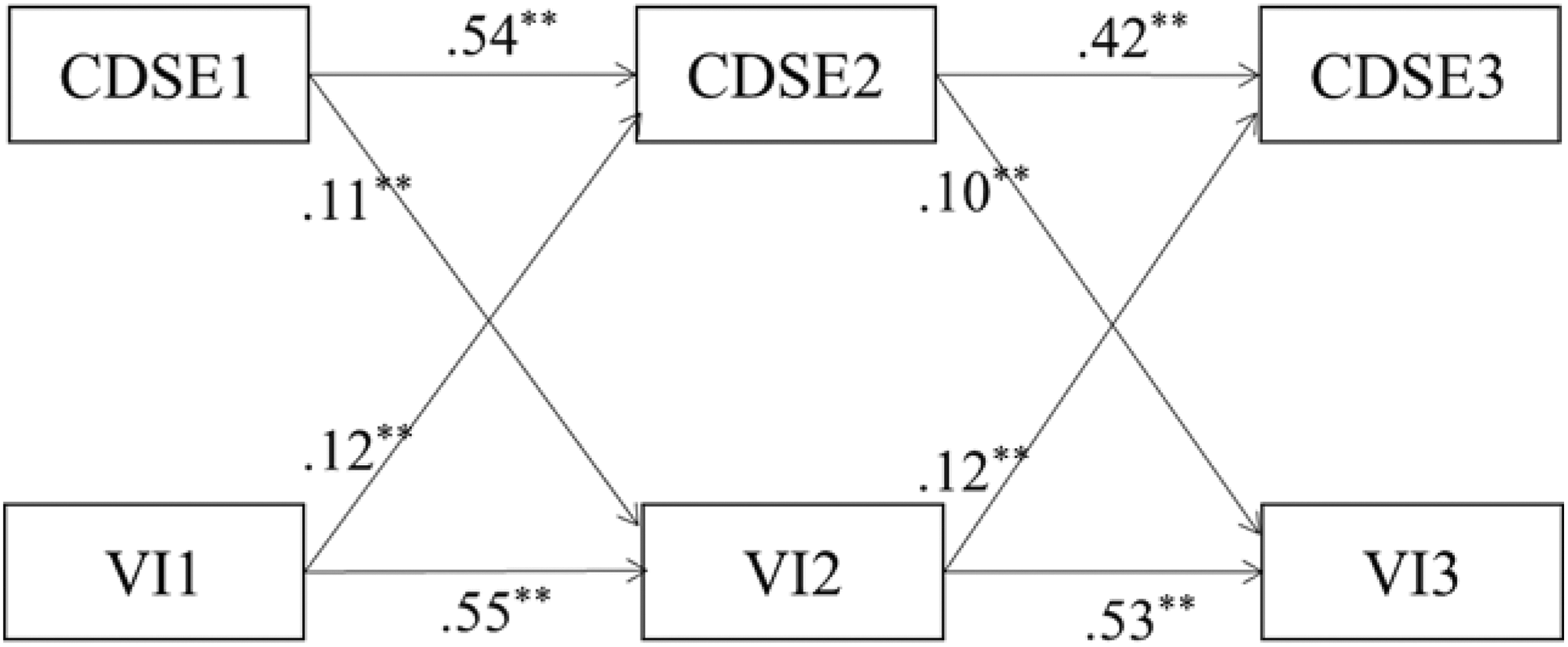
Cross-lagged model of career decision-making self-efficacy and vocational identity from 10th to 12th grades (N HK = 417, N SH = 438). The figure after the variable name refers to the time point of data collection in the present longitudinal study. All coefficients were standardized βs. For clarity, within time correlations, 2-year stability paths were not reported. HK = Hong Kong; SH = Shanghai. *p < .05. **p < .01.
Discussion
Studies have suggested a positive effect of CDSE on VI mostly from a cross-sectional perspective (e.g., Jantzer et al., 2009; Jo et al., 2016; Koumoundourou et al., 2012). Our three-wave longitudinal study investigated how CDSE and VI change in the process of adolescents’ career development and whether they have reciprocal associations during the course of two academic years in different Chinese localized settings.
Development of Chinese Adolescent CDSE
Partially consistent with our hypothesis, the adolescents exhibited significantly different levels of CDSE in the two Chinese localized settings studied, mainly at the earlier year of senior high school (viz., 10th grade). Specifically, the Hong Kong participants started with medium–high levels of career self-efficacy, whereas the Shanghai participants started with higher levels. In practice, senior high school students in Hong Kong are requested to make subject or occupational decisions and choose a specific subject area in ninth grade (Education Bureau, 2014). This happens much earlier than it does for Shanghai students. The earlier timing of career choices may reduce confidence in the career decision-making of Hong Kong students because they have less time to perform information collection or planning than Shanghai students who make similar choices in 11th grade (Zhou et al., 2016). These results are in agreement with the previously reported evidence that an early occupational choice is often based on unrealistic self-assessment, which is associated with inadequate career decision-making skills and can thus change quickly (Brown, Glastetter-Fender, & Shelton, 2000; Vondracek & Skorikov, 1997)
The good fit of the LGM for CDSE in the Hong Kong sample suggested an increasing confidence as the school year progressed, which indicated positive progress in CDSE and may reflect a useful career education system for senior high school students in Hong Kong. The result reinforced previously reported evidence from Hong Kong undergraduates (Cheung & Arnold, 2014) and Australian students of any grade (Creed, et al., 2005), which may reflect the exposure to and adoption of Western sociocultural ideologies and practices in Hong Kong.
With regard to the stable state of CDSE among Shanghai participants over 3 years, further investigation is required. Correspondingly, many related studies (e.g., Fan, Cheung, Leong, & Cheung, 2014; S. A. Leung, Hou, Gati, & Li, 2011) of Chinese college students’ career development have not demonstrated desirable career development performance in practice. For example, S. A. Leung, Hou, Gati, and Li (2011) found that those Chinese mainland university students, comparing with Hong Kong counterparts, experienced higher degrees of cultural values conflict exhibited a higher level of career decision-making difficulties. In fact, the college students in those related studies matured similarly to the adolescents in our present study. Therefore, one possible problem for career development or education among the students from Shanghai or other regions of mainland China is how an effective career transition from high school to college can be properly performed.
Development of Chinese Adolescent VI
Compared with the Shanghai sample, the Hong Kong sample displayed lower initial levels of VI from Grade 10 to Grade 11. However, these differences were only showed very small effect sizes (η2 = .02/.03). Therefore, the differences of VI between the two research samples are needed to be further confirmed. In Grade 12, the similar VI scores of both the Hong Kong and Shanghai 12th-grade samples (F = 0.54 and η2 = .00) may be linked to a universal fact that individuals typically form a relatively clear and stability identity by the end of adolescence regardless of the previous development process.
The results also indicated a dynamic process of VI formation in Hong Kong student adolescents over 3 years. These findings are consistent with previous studies that reported that VI displayed a clear developmental progression over long periods of time (see V. B. Skorikov & Vondracek, 2011, for a review). The Shanghai adolescents exhibited an increase growth pattern from 10th grade to 11th grade but a decrease one from 11th grade to 12th grade. Because the Shanghai students were requested to make subject or occupational decisions and choose a specific subject area in 11th grade (Zhang, 1999; Zhou et al., 2016), the strong pressure to do so may have prompted them to increase their contemplation and awareness of occupational goals and interests, even VI, to some extent. The later decrease in the growth pattern may indicate students’ detachment from their previous vocational commitments and may reflect active reflection during VI formation. This nonlinear change pattern at Shanghai students’ VI may suggest that there is a possible curvilinear growth. However, because of the limited three time points of VI, we could not examine the nonlinear model analysis for the Shanghai sample in this study.
Longitudinal Reciprocal Relationship of CDSE and VI
As expected, the present study supports the reciprocal association between CDSE and VI over time. The relationship pattern applied equally to students from Shanghai and Hong Kong. Specifically, strong career decision-making confidence increased the stable and clear degree of adolescents’ vocational perception of goals, interest, and talent over time. The results were consistent with previously reported findings about the antecedent role of CDSE for VI (Gushue, Clarke, et al., 2006; Gushue, Scanlan et al., 2006; Jantzer et al., 2009; Koumoundourou et al., 2012; Jo et al., 2016). We also observed that increased VI predicted stronger confidence in career decision-making across the three waves. Thus, the findings suggested that CDSE and VI constitute a transactional system comprising parts mutually reinforcing one another, at least in the time frame of the present study (10th–11th grades). The similar patterns of association between CDSE and VI across the Shanghai and Hong Kong samples indicated that their reciprocal relationship transcends the sociocultural factor. The time-invariant model also indicated a stable reciprocal pattern of CDSE and VI. As Cordeiro et al. (2015) research on the relationship between career self-efficacy and VI among Portuguese 12th graders, our findings added to knowledge about Chinese adolescent career development and could provide empirical evidence for the hypothesis of the possible reciprocal relationship of other career-related variables, which was proposed by Lent et al. (1994).
Theoretical Contributions and Practical Implications
Our three-wave longitudinal study of Chinese adolescents’ career development provided at least two aspects of theoretical contributions. First, our study identified different change patterns in CDSE and VI among Chinese adolescents from different Chinese localized settings. Our findings further supported the results concerning the development trends of adolescents’ career self-efficacy and VI in the literature (e.g., Creed et al., 2005; Jordan et al., 2016; Ohashi, 2009; V. Skorikov & Vondracek, 1998). Additionally, the results highlighted the influence of Chinese localized cultural diversity on adolescent career development. Second, the findings provided additional support for the hypothesis that career-related variables may have a reciprocal relationship with one another (Lent et al., 1994). The results are in agreement with the findings of Cordeiro et al. (2015), who investigated the possible reciprocal relationship of CDSE and VI by using a two-wave longitudinal study. Therefore, our study contributed to the theoretical reflection of the relationship between career variables because it empirically and longitudinally examined possible reciprocal relationships during an extended period of time.
Erikson (1959) argued that adolescents struggle to define their identities. Correspondingly, from the perspective of career education or guidance, vocational orientation is a challenging process for senior high school students, especially in times of consequential change and in light of innumerable career possibilities. The present results indicated several practical implications for teachers and counselors working in career education with senior high school students. First, the results suggested that the decision-making of a specific subject area in ninth grade might be earlier and students could postpone their subject decision. Compared with adolescents from Shanghai, although Hong Kong adolescents received higher quality career education (e.g., regularly career-knowledge courses and career guidance; Ho & Leung, 2016) and reported subsequent increase in CDSE, the early occupational choice may damage student confidence in career decision-making activities due to an unrealistic self-assessment. Second, the nondynamic process of CDSE and possible curvilinear growth pattern of VI among Shanghai adolescents, together with the inadequate career development performance of Chinese mainland college students (e.g., higher level of career decision-making difficulties; S. A. Leung et al., 2011), suggest that effective career interventions and counseling very needed in Shanghai or mainland China. In particular, some indigenous factors, such as economic and educational conditions and the parental role in adolescent career development, should be considered (Fan et al., 2014).
The third point is based on the finding that CDSE and VI are cross-lagged interaction systems mutually reinforcing one another. Students who believe that they can make decisions are more likely to exhibit a clear and stable pattern of VI. Therefore, career teachers should provide and encourage adolescents to experience multiple activities and help them explore their capacities for making career decisions. Doing so might encourage students to construct positive beliefs and improve their self-confidence about career decision-making. Increasing career self-efficacy may also consequently improve students’ contemplation and awareness of occupational goals and interests. Therefore, as a possible outcome, students’ career actions may develop their VI. Furthermore, a clear and stable VI could reinforce students’ self-confidence in making career-related decisions due to a positive interactional circle. Consequently, a positive interactional system between career self-efficacy and identity may effectively increase adolescent career adaptabilities and improve their career construction in practice.
Limitations and Future Directions
The present study should also be considered in light of some limitations that might suggest fruitful directions for future research. First, although the current study was a three-wave longitudinal design that lasted 2 years from 10th grade to 12th grade, this period of time still seemed insufficient, particularly for the Shanghai sample. We could not examine the possible curvilinear growth pattern of VI in the Shanghai sample by using the limited three-wave design. Therefore, future longitudinal studies should continue exploring the change pattern of adolescents’ VI over a longer time frame. Second, we only employed adolescents’ self-report measures. Although self-reports on CDSE and VI have been widely used in previous studies (e.g., Jo et al., 2016; Koumoundourou et al., 2012), integrating objective indicators and reports provided by people of influence (e.g., parents, teachers, and friends) could have strengthened the current findings. Third, the present study examined senior high school students in two major Chinese cities. However, the current patterns may be distinctive to these cities due to different economic and educational resources. Thus, future research should examine more regions with different Chinese localized cultures.
Footnotes
Declaration of Conflicting Interests
The author(s) declared no potential conflicts of interest with respect to the research, authorship, and/or publication of this article.
Funding
The author(s) disclosed receipt of the following financial support for the research and/or authorship of this article: This study was supported by The National Social Sciences Found of China (14BS081) and The Hong Kong Government Research Grants Council Earmarked Grant the GRF Grant 2012/13 (CUHK 441812).