



Abstract
Developing a vocational identity is one of the most important tasks facing any adolescent, and vocational identity has become a focus of attention in career education and guidance for decades. However, few studies have been conducted on this topic in China due to a lack of relevant measures. The purpose of this study was to validate a Chinese version of the Vocational Identity Status Assessment (VISA) using 1,650 Chinese technical college students. The 30-item VISA–Chinese Version was found to have sound reliability and validity and with measurement invariance across age groups. This study contributes to the vocational identity literature by demonstrating the usefulness of VISA–Chinese Version.
Keywords
Vocational identity is believed to develop alongside other domains of personal identity during adolescence (Erikson, 1968; Skorikov & Vondracek, 1998). It is a significant construct within career theory (Porfeli, Lee, & Vondracek, 2013), and it has been found to have close relationships with psychological well-being (Hirschi, 2011b), mental health (anxiety and depression; Holland, Johnston, & Asama, 1993), academic performance (Pop, Negru-Subtirica, Crocetti, Opre, & Meeus, 2016), and career development and decision-making (Gushue, Clarke, Pantzer, & Scanlan, 2006; Li, Hou, & Jia, 2015; Vondracek & Skorikov, 1997).
In China, an extremely large number of students study in technical schools every year. In 2015, approximately 4.4 million students were taught in 2,545 technical schools (Ministry of Human Resource and Social Security [MHRSS], 2016), and the employment rate of technical college graduates has remained at a high level (>97%) for several years (Ji, 2016; Lin, 2013; MHRSS, 2016). The technical education system includes diverse programs. For example, there is a 3-year program for junior skilled workers for junior secondary school leavers, a 3- and a 5-year program for senior skilled workers for senior and junior secondary school leavers, respectively, and a 4-year program for probational technicians for senior secondary school leavers. Due to new industrialization and the upgrading of the industrial structure, the Chinese government has strongly encouraged the training of more highly qualified workers and skilled technicians (“Outline of the National Medium- and Long-Term Talent Development Plan,” 2010). However, for a combination of cultural, historical, and social reasons, people in the community tend to view technical education students as having subpar academic performance at school (Liu, 2014). Compared to college and university graduates, technical education students tend to have more restricted career paths, fewer opportunities for promotion, lower salaries, and lower social status after they graduate. They are also reported to have poorer motivation for learning (Liu, 2014) and lower self-consistency (Ye, 2014). All of these factors may hinder the development of vocational identity in technical education students, yet the development of vocational identity (and identity in general) is vital (Erikson, 1959, 1968). For this reason, it is becoming increasingly important to conduct further research on vocational identity status in this understudied population and how this might be more effectively enhanced.
Even though the development of vocational identity is known to be essential (Hirschi, 2011a), few studies on the topic have been conducted in China, partly because of limited access to appropriate methods and materials for assessing vocational identity. Therefore, the aim of this study was to validate an existing instrument with sound psychometric properties used in the West, the Vocational Identity Status Assessment (VISA; Porfeli et al., 2011), for use with Chinese technical education students.
Literature Review
Vocational Identity
In the developmental and psychological perspectives, the concept of vocational identity was derived from that of general identity (Erikson, 1959, 1968). According to Erikson, developing a strong and stable sense of identity is crucial to all adolescents. Based on Erikson’s work, Marcia (1966, 1980) and Luyckx, Goosens, Soenens, Beyers, and Vansteenkiste (2005) further defined and operationalized two core processes, exploration and commitment, that are involved in identity formation. Later, Meeus and Crocetti (Crocetti, Rubini, Luyckx, & Meeus, 2008a; Crocetti, Rubini, & Meeus, 2008b; Meeus, 2011) added a third process, identity, which refers to career reconsideration (for a review, see Beyers & Luyckx, 2016; Porfeli et al., 2011; Porfeli et al., 2013).
On the basis of the concept of general identity, Holland, Gottfredson, and Power (1980) defined vocational identity as “the possession of a clear and stable picture of one’s goals, interests, and talents” (p. 1911). They assumed that problems with vocational identity could be linked to career decision-making difficulties and low career decision-making confidence (Holland, Gottfredson, & Power, 1980; Holland et al., 1993). However, Holland’s definition of vocational identity is limited because it overlooks the essential exploration dimension (Porfeli et al., 2013).
To obtain a more comprehensive understanding of vocational identity, Porfeli and his colleagues examined the literature on identity status (Crocetti et al., 2008a, 2008b; Luyckx, Goosens, Soenens, Beyers, & Vansteenkiste, 2005; Marcia, 1966, 1980; Meeus, 2011) and suggested a three-process acquisition of vocational identity that includes career exploration (comprising both in-depth and in-breadth exploration), career commitment (comprising commitment making and identification with commitment), and career reconsideration (comprising the commitment flexibility and career self-doubt; Porfeli et al., 2011, 2013). Here, the term “career exploration” embraces “exploring the self and the world of work broadly and deeply to ascertain the general features of the self and to learn about possible career alternatives that may exhibit a good fit with those features” (Jordaan, 1963, as cited in Porfeli et al., 2013, p. 136). Career commitment involves two components: making a decision on the career path and then adhering to that choice (Porfeli et al., 2013). Career reconsideration involves “re-examining current commitments and comparing available alternatives in an effort to find a better fit of the self and the world of work” (Porfeli et al., 2013, p. 138).
Measurement of Vocational Identity
Several measures focusing on vocational identity have been developed. A subscale called Vocational Identity within the My Vocational Situation Scale (MVS; Holland et al., 1980) was developed. It contains 18 items in a true–false forced-choice format. Although this measure has been widely used in studies (e.g., Gushue et al., 2006; Li et al., 2015), it has been criticized for two reasons. First, it assesses feelings about current career situations rather than the stable awareness of vocational goals and interests, and second, the dichotomous response of the MVS provides researchers with limited information on psychometric properties (Gupta, Chong, & Leong, 2015). For these reasons, a new instrument, vocational identity measure, which has a 5-point Likert-type response format, was developed to evaluate Holland’s definition of vocational identity as a stable construction (Gupta et al., 2015). A limitation of these two scales was that they lacked a focus on career exploration as an important dimension. The 30-item VISA (Porfeli et al., 2011) was developed with three categories (career commitment, exploration, and reconsideration). There are two subdimensions in each category (career commitment making and identification with career commitment in the commitment category, in-breadth and in-depth career exploration in the exploration category, and commitment flexibility and career self-doubt in the career reconsideration category). VISA is regarded as an updated measure with sound psychometric properties that is grounded on solid identity models and provides a comprehensive framework for assessing vocational identity. The English and Italian versions of VISA have both proven to be promising tools for assessing vocational identity (Porfeli et al., 2011; Sestito et al., 2015).
Vocational Identity Research in China
Few studies on the topic of vocational identity have been conducted in China even though the development of vocational identity is known to be essential to adolescents and young adults (Hirschi, 2011a). Among the limited number of Chinese studies, Ouyang, Jin, and Tien (2016) explored Chinese college students’ collective vocational identity in Macau using a qualitative research method (in-depth interviews with 19 college students who had lived in Macau for over 15 years). Their findings are difficult to generalize to other Chinese cultures because of the unique nature of Macau as a former Portuguese colony until 1999. Furthermore, as a qualitative study, it failed to provide objective statistical evidence that could be compared in other settings.
Another study of vocational identity investigated 112 Taiwanese graduate and undergraduate students who studied in the United States (Shih & Brown, 2000). Using the MVS instrument, the study revealed that age and acculturation level positively predicted vocational identity (Shih & Brown, 2000). Although this study contributed to the literature by exploring the relationship between acculturation and vocational identity in the Chinese population, its results cannot be generalized to the overall Chinese population because of the special sample used. The MVS also provided fairly limited vocational identity information.
The other notable Chinese study was conducted by Jin, Watkins, and Yuen (2009), who surveyed 785 Chinese graduate students in Beijing, China, and found that personality traits such as neuroticism and conscientiousness had significant direct effects on vocational exploration and commitment and that these relationships were also mediated by career decision self-efficacy (CDSE). Furthermore, contrary to expectations, a positive association was found between CDSE and the tendency to foreclose (Jin, Watkins, & Yuen, 2009). However, this study failed to provide more information on relationships among personalities, CDSE, and other types of vocational identity such as career exploration and reconsideration (Porfeli et al., 2011).
In sum, there have been relatively few studies on vocational identity in Chinese student populations, and they revealed limited information regarding vocational identity and its relationship with other psychological and career variables. This is partly due to the qualitative methodology used and a lack of measurements that provide sufficient information on vocational identity. In order to facilitate better research in this field in China, it is therefore necessary to develop a new measure of vocational identity or to adapt existing measures from the West. The existing instrument VISA (Porfeli et al., 2011) was chosen because it includes information on career commitment, exploration, and reconsideration and because it has shown sound psychometric properties.
The Study
Given that development of vocational identity is significant to adolescents and young adults in China, the objective of this study was to validate a Chinese version of the VISA (Porfeli et al., 2011). Specifically, the study aimed to (a) evaluate the factor structure of VISA–Chinese Version, (b) provide evidence of reliability through reporting the Cronbach’s αs of each subscale, (c) assess the measurement invariance across age groups, and (d) provide evidence of convergent validity of VISA–Chinese Version by assessing the relationships among vocational identity and the three variables, career adaptability, career exploration, and talent development self-efficacy.
The present study aimed to extend researchers’ understanding of vocational identity in two important ways. First, VISA had not previously been validated in an Eastern country with a collectivistic society, specifically in a population of Chinese technical college students. Second, while research has shown vocational identity to be associated with domain-specific self-efficacy (Gushue et al., 2006; Nauta, 2007; Nauta & Kahn, 2007), this study evaluated the relationship between vocational identity and new variables, namely career exploration and talent development self-efficacy.
Rationale
The construct validity of the Chinese version of VISA was assessed in this study in two ways. First, studies have documented that career exploration and career commitment were positively associated with career adaptability, while career self-doubt was negatively associated, and commitment flexibility had no significant link (Negru-Subtirica, Pop, & Crocetti, 2015; Porfeli & Savickas, 2012). This study therefore examined the convergent validity of VISA through hypothesizing that the six types of vocational identity would have similar relationships with career adaptability. Second, as previous research has suggested positive relationships between general/vocational identity and career-related self-efficacy (Gushue et al., 2006; Jo, Ra, Lee, & Kim, 2016; Nauta, 2007), it is hypothesized in this study that there will be significant relationships between vocational identity and career exploration and talent development self-efficacy.
As an essential part of establishing the validity and psychometric properties of VISA with a Chinese population, it is necessary to evaluate its measurement invariance across age groups. The evaluation of the measurement invariance of any scale is important because it determines whether each item used in the instrument means the same thing to participants of different groups (e.g., males vs. females; children vs. adults; Cheung & Rensvold, 2002). If there is no measurement invariance across different groups, then between-group differences in scores cannot be unambiguously interpreted (Cheung & Rensvold, 2002). With respect to VISA, scalar invariance across ages in American high school and university samples was not established, making it difficult to determine later whether age-group differences in vocational identity were due to the content of items in the scale or to real age-factor influences (Porfeli et al., 2011).
General Methods
Two studies were conducted, and the statistical methods used were consistent with those used by Porfeli, Lee, Vondracek, and Weigold (2011). This enabled comparable psychometrical results between the American and Chinese versions of VISA.
The analysis in Study 1 (N = 448) included (a) an exploratory factor analysis (EFA) to evaluate the factor structure of the scale and selection of items and (b) an examination of internal consistency reliability. Based on the results, 3 items (Items 5, 7, and 8) were revised before the second study was conducted.
The analysis in Study 2 (N = 1,202) consisted of (a) an evaluation of the correlational model of the VISA–Chinese Version via confirmatory factor analysis (CFA), (b) an evaluation of the measurement invariance for age groups, and (c) an assessment of convergent validity between the VISA subscales and validated indicators for career adaptability and career exploration self-efficacy.
Item Translation and Back-Translation
A VISA–Macau Chinese Version (Ouyang, Wang, & Jin, 2014) had already been developed, but because of slight differences between Macau and Mainland China in Chinese idioms and expressions (people in Macau used Cantonese while those in mainland China speak Mandarin), the VISA–English Version was translated afresh into Chinese for this study. A professional translator majoring in English linguistics was invited to translate the VISA into Chinese, and a second bilingual and bicultural independent translator was invited to back-translate the preliminary Chinese draft. The original English version of the VISA and the back-translated version were compared by a third native English speaker. Finally, the translators discussed all of the items together, and any that appeared to have differences between the original VISA and the translated Chinese versions were modified.
At the next stage, the Chinese version was shown to 23 technical college students (age = 19–21 years) who were not part of the main study. The purpose was to check the clarity of each item. Feedback from these students led to some minor adjustments in wording to any items that were ambiguous.
Study 1
The aim of this study was to evaluate the factor structure of the VISA–Chinese Version and to determine its main psychometric features.
Participants
The 474 participants were recruited from two technical colleges in Shenzhen (N = 320, 68%) and Zhuhai (N = 154, 32%). From this group, 448 complete and usable sets of data were obtained (responding rate: 94.5%; age range = 15–24 years; mean age = 18.3 years; SD = 1.7 years). The sample comprised 63.4% male students, and 91.3% of students came from the program of senior skilled workers. The students’ majors were diverse including marketing, business secretarial work, biology, gardening, electrical engineering, automatic control, electronic technology, optoelectronic technology, vehicle maintenance technology, communication network application, and animation design.
Measure
Vocational identity
The VISA (Porfeli et al., 2011), which consists of 30 items, was used to assess individuals’ vocational identity in three dimensions: career commitment, career exploration, and career reconsideration. Each dimension has two subdimensions. The commitment dimension includes career commitment making and identification with career commitment, the exploration dimension includes in-breadth career exploration and in-depth career exploration, and the reconsideration dimension includes commitment flexibility and career self-doubt. Each subdimension includes 5 items. VISA uses a 5-point Likert-type scale with responses ranging from 5 (strongly disagree) to 1 (strongly agree). The Cronbach’s αs for the VISA subscales in this study ranged from .74 to .83.
Procedure
Ethical approval was obtained from the university before the survey. Data were collected in pencil-and-paper format by teachers during class periods. All of the participants were informed that (a) it was entirely voluntary to participate in this study of adolescents’ career development, (b) they could withdraw at any time without any negative consequences, (c) their answers would be confidential and there were no right or wrong answers, and (d) their participation would be highly appreciated. Their written consent to take part was obtained before the survey. The assessment was completed within 10 min.
Results
The EFA was conducted following the recommendations of Worthington and Whittaker (2006). Missing values were addressed using listwise deletion. The Kaiser–Meyer–Olkin value of .88 and the Bartlett’s test of sphericity approximate, χ2(435) = 5,300.8; p < .001, indicated that the data were good for factor analysis (Tabachnick & Fidell, 2001).
Extraction was conducted using principal axis factoring with Promax rotation. Both the eigenvalues (larger than 1) and the scree spot indicated six factors that explained 59% of the total variance. Items that met the following criteria were included (a) factor loadings larger than .40 and (b) cross-factor loadings lower than .30.
The EFA results show that the factor structure of the VISA–Chinese Version differed slightly from that of the original English version. First, Item 15 (“I need to learn a lot more before I can make a career choice.”), which was expected to load on the dimension of commitment flexibility, loaded on the dimension of in-depth career exploration instead, with an acceptable factor loading of .506. Similarly, Item 5 (“I have invested a lot of energy into preparing for my chosen career.”), which was expected to load on the dimension of career commitment making, loaded on identification with career commitment instead, with a low factor loading of .305. Moreover, Items 7 and 8 had factor loadings lower than .40. Item 7 also had a cross-factor loading higher than .30 (Table 1). The rest of the items had moderate to high factor loadings ranging from .42 to .89, with cross-factor loadings lower than .30. The translations of Items 5, 7, and 8 were thus modified based on the original English version.
Vocational Identity Status Assessment—Chinese Version: Factor Loadings From the Exploratory Factor Analysis in Study 1 (N = 443) and the Confirmatory Factor Analysis in Study 2 (N = 1,202).
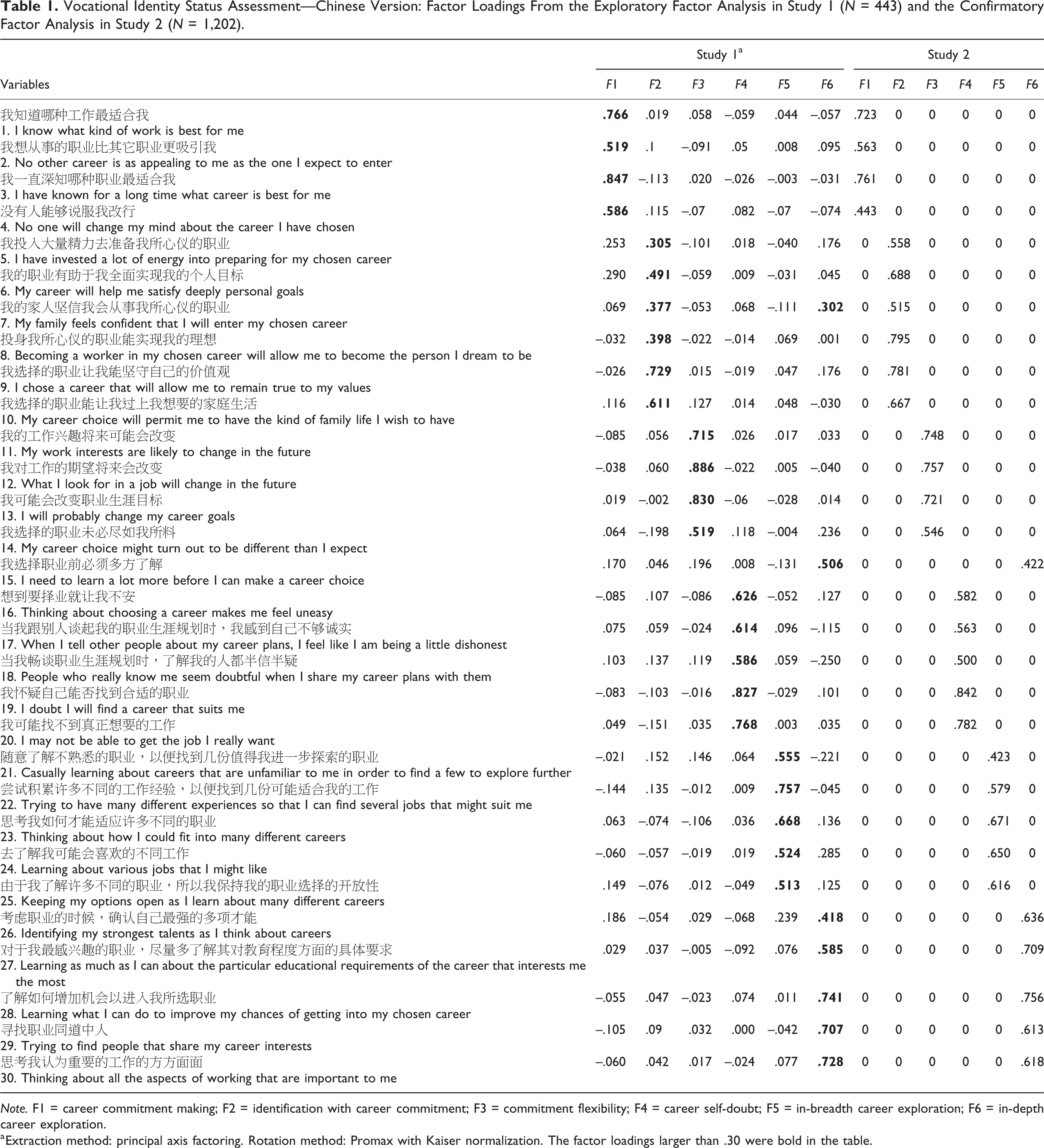
Note. F1 = career commitment making; F2 = identification with career commitment; F3 = commitment flexibility; F4 = career self-doubt; F5 = in-breadth career exploration; F6 = in-depth career exploration.
a Extraction method: principal axis factoring. Rotation method: Promax with Kaiser normalization. The factor loadings larger than .30 were bold in the table.
Significant correlations were found across interfactors, except for the interrelationships between the commitment dimensions (i.e., career commitment making and identification with career commitment) and reconsideration dimensions (i.e., commitment flexibility and career self-doubt; Table 2).
Descriptive Statistics, Reliability Coefficients, and Correlations of the Vocational Identity Status Assessment Subscales—Chinese Version in Study 1.
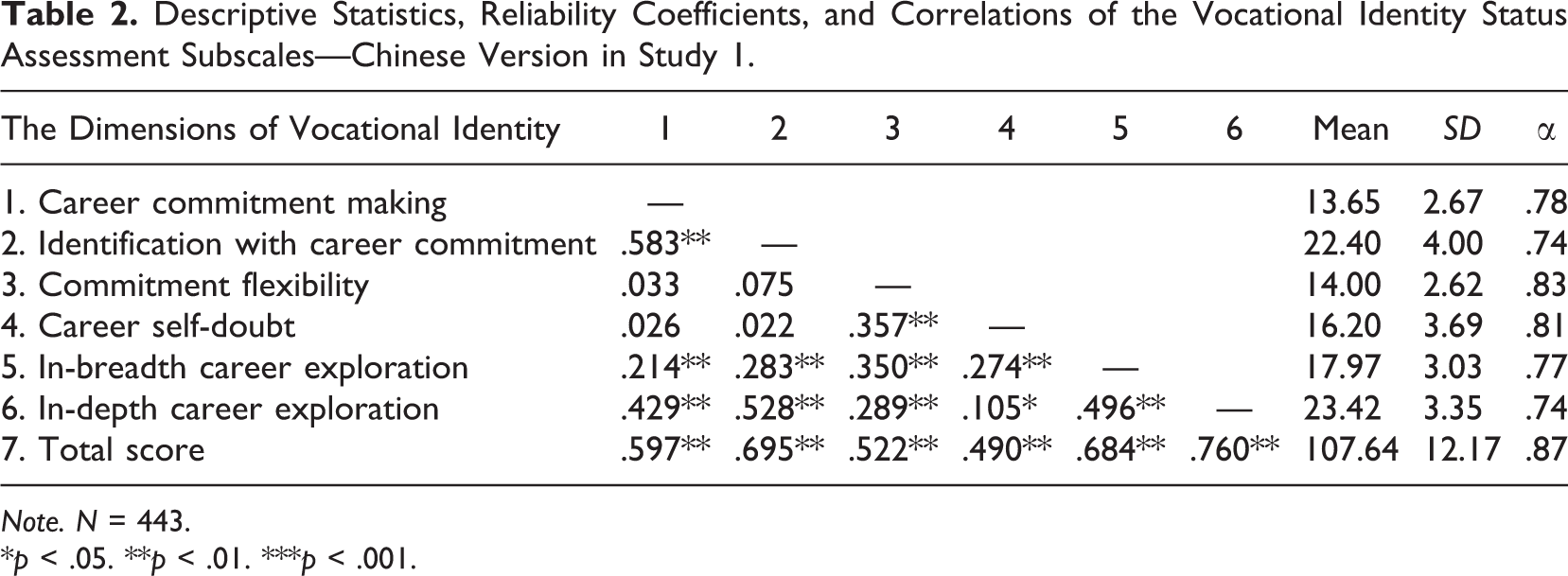
Note. N = 443.
*p < .05. **p < .01. ***p < .001.
The Cronbach’s αs of the six subscales based on the factor structure explored in this study indicated acceptable internal consistency reliability, ranging from .74 to .83 (Table 2). Given these initial indications of a favorable and solid scale, the translation of Items 5, 7, and 8 was revised. A further confirmation of the scale structure was sought in Study 2.
Study 2
With the revised VISA–Chinese Version, the aim of this second study was to assess the structure of the Chinese version with CFA. The measurement invariance of VISA by age groups was also evaluated. Convergent validity was evaluated by examining the correlations between vocational identity and validated indicators (i.e., career adaptability and career exploration and talent development self-efficacy).
Participants
Approximately 1,250 students from four technical colleges in four cities participated in this survey, and 1,202 participants finished the VISA–Chinese Version (responding rate: 96%; age range = 15–25 years; mean = 18.4 years; SD = 2.4 years). Data were collected from Shenzhen (46.3%), Guangzhou (21.5%), Zhuhai (17.3%), and Zhongshan (14.9%), all in Guangdong Province, China. Of the respondents, 76.9% completed the pencil-and-paper form of the investigation while the rest finished the online version. The sample was predominantly male (56.3%). In regard to their program types, 3.9% were from the program for junior skilled workers, 86.6% were from the program for senior skilled workers, and 7.6% were from the program for probational technicians (with data missing from 1.9%). The students had diverse majors including marketing, biology, gardening, automatic control, mold design, numerical control, electrical engineering, and vehicle maintenance technology.
Among all of the participants, 495 individuals (aged 15–23; mean age = 18.7 years, SD = 1.7) also completed questions in the Career Adapt-Ability Scale (CAAS), Career Exploration Self-Efficacy subscale (CESS), and Talent Development Self-Efficacy subscale (TDSS; see the Measures section for detailed information). These participants came from three technical colleges in three representative cities: Shenzhen (37%), Guangzhou (37%), and Zhuhai (26%). This sample was predominantly male (61%), with 4.8% from the program for junior skilled workers, 87.3% from the program for senior skilled workers, and 5.1% from the program for probationary technicians (data missing for 2.8%).
In sum, data from the entire sample (N = 1,202) were used for analyses of CFA and measurement invariance. The data of the nested sample (N = 495) were used for evaluation of the convergent validity.
Measures
Vocational identity
This construct was assessed with the 30-item VISA–Chinese Version (Porfeli et al., 2011). Items 5, 7, and 8 were retranslated according to the psychometric properties from Study 1. The instrument assesses individual’s vocational identity in three dimensions: career commitment, career exploration, and career reconsideration. Each dimension has two subdimensions. The commitment dimension includes career commitment making (4 items) and identification with career commitment (6 items), the exploration dimension includes in-breadth career exploration (5 items) and in-depth career exploration (6 items), and the reconsideration dimension includes Commitment flexibility (4 items) and career self-doubt (5 items). The instrument uses a 5-point Likert-type scale (5 = strongly disagree; 1 = strongly agree), with higher total scale or subscale scores indicating greater career commitment, exploration, and reconsideration. The Cronbach’s αs in this study ranged from .70 to .82.
Career adaptability
The CAAS–Short Chinese Version (CAAS–Short Version; Maggiori, Rossier, & Savickas, 2017; Savickas & Porfeli, 2012; Yuen & Yau, 2015) was used to measure individuals’ career adaptability in four dimensions (career concern, career control, career curiosity, and career confidence) with 3 items in each dimension. This short version has already been proven to produce reliability and validity similar to the original longer version (Maggiori et al., 2017). It uses a 5-point Likert-type scale (5 = strongest; 1 = not strong), where higher scores indicate greater psychosocial resources. The Cronbach’s αs for the total scale were .94 for the German version and .92 for the French version (Maggiori et al., 2017). The α of the total scale was .92 in this study.
As this short version was being used for the first time in a Chinese context, the factor construct was assessed with the CFA in a sample of 939 technical college students. The result of four-factor model indicated an acceptable model fit, with the comparative fit index (CFI) =.927, the standardized root mean square residual (SRMR) = .040, and the root mean square error of approximation (RMSEA) =.097 (Marsh, Hau, & Wen, 2004).
Career and talent development self-efficacy
“Career exploration self-efficacy” and “talent development self-efficacy” were measured using the CESS (6 items) and TDSS (6 items) of the Career and Talent Development Self-Efficacy Scale (Fan,Hao, & Yuen, 2013; Yuen, Gysbers, Chan, Lau, & Shea, 2010). Specifically, CESS was used to measure student competencies related to the exploration of career paths, goals, and relationships between career path and study life, and TDSS was used to measure student capabilities related to academic subjects and extracurricular activities. It used a 6-point Likert-type subscale (1 = extremely lacking in confidence to 6 = extremely confident) that was first developed in Hong Kong, where higher subscale scores represented greater career exploration and talent development self-efficacy. The internal consistencies for these two subscales were .84 and .84 in this study.
Procedure
The procedure was the same as that in Study 1, except that there was an additional type of survey method used. Students participated in either the pencil-and-paper format or the online survey. For the online survey, students were asked to open a specified web page on their smartphones. The authors attempted to minimize any potential confounding effects of the two survey methods through controlling the survey environment: Both surveys were collected during class periods by their teachers. The assessments were completed within 20 min.
Results
Preliminary analysis
The robust maximum likelihood (ML) estimation method was used to assess the goodness of fit of the VISA–Chinese Version because of the normality of the data (Finney & DiStefano, 2006): The skewness of all of the items ranged from .079 to .873, and the kurtosis ranged from 0.016 to 1.774, indicating that the data were normally distributed because the absolute values of skewness were less than 1, and those of kurtosis were less than 7 (Byrne, 1998). The full information ML method was used to address any absences. The missing rates ranged from .1% to .7%.
Several different models were compared to select the optimal one. The following structural equation modeling fit indices (including their cutoff values) for each model are reported here: (a) CFI and Tucker–Lewis index (TLI; >.90), (b) RMSEA (<.10), and (c) the SRMR (<.08; Hu & Bentler, 1999; Marsh et al., 2004; Quintana & Maxwell, 1999). The Akaike information criterion (AIC) and Bayesian information criterion (BIC) values were also reported to compare nonnested models.
CFA
Two CFA models were evaluated. Model 1 followed the original structure of the VISA (Porfeli et al., 2011), including 5 items in each factor: career commitment making (items 1–5), identification with career commitment (items 6–10), commitment flexibility (items 11–15), career self-doubt (items 16–20), in-breadth career exploration (items 21–25), and in-depth career exploration (items 26–30). The result for Model 1 indicated a poor model fit, χ2(390) = 1,644; p < .001; CFI = .890; TLI = .877; RMSEA = .052; SRMS = .057; AIC = 82,102.374; BIC = 82,637.007.
Model 2 followed the structure explored in Study 1, in which Items 5 and 15 loaded instead on dimensions of identification with career commitment and in-depth career exploration, respectively. This model fit was adequate, χ2(390) = 1,473; p < .001; CFI = .905; TLI = .894; RMSEA = .048; SRMS = .045; AIC = 81,930.997; BIC = 82,465.630. Regarding the criteria of goodness of fit for the nonnested models, increases of more than 10 units in the AIC and BIC values suggest a lack of empirical support (Burnham & Anderson, 2004). Here, the ΔAIC and ΔBIC (both equal to 171.377) significantly decreased, indicating that Model 2 is a better model (see Table 1 for the factor loading of CFA), so the measurement invariance based on it was examined.
Measurement invariance
The measurement invariance of the VISA–Chinese Version across age groups was assessed by comparing four nested models step-by-step (i.e., the correlational model and models examining the configural invariance, metric invariance, and scalar invariance). The participants were separated into two groups: those 18 years of age or under and those older than 18 years. Two criteria for measurement invariance are used to assess the fit indexes of two nested models: (a) The overall model fit should be acceptable (Little, 1997) and (b) a value of ΔCFI between the two nested models smaller than or equal to −.01 indicates an existing invariance (i.e., the null hypothesis of invariance should not be rejected; Cheung & Rensvold, 2002). The results in Table 3 showed that the ΔCFIs (ranging from .000 to −.003) between the two nested models were smaller than −.01, indicating that configural, metric, scalar, and error invariances existed in the VISA–Chinese Version model across ages. These results suggest that all of the items in this scale were interpreted, conceptualized, and/or responded to in the same way by technical education students of both age groups.
Fit Indices for the Age Multigroup Confirmatory Factor Model of VISA.
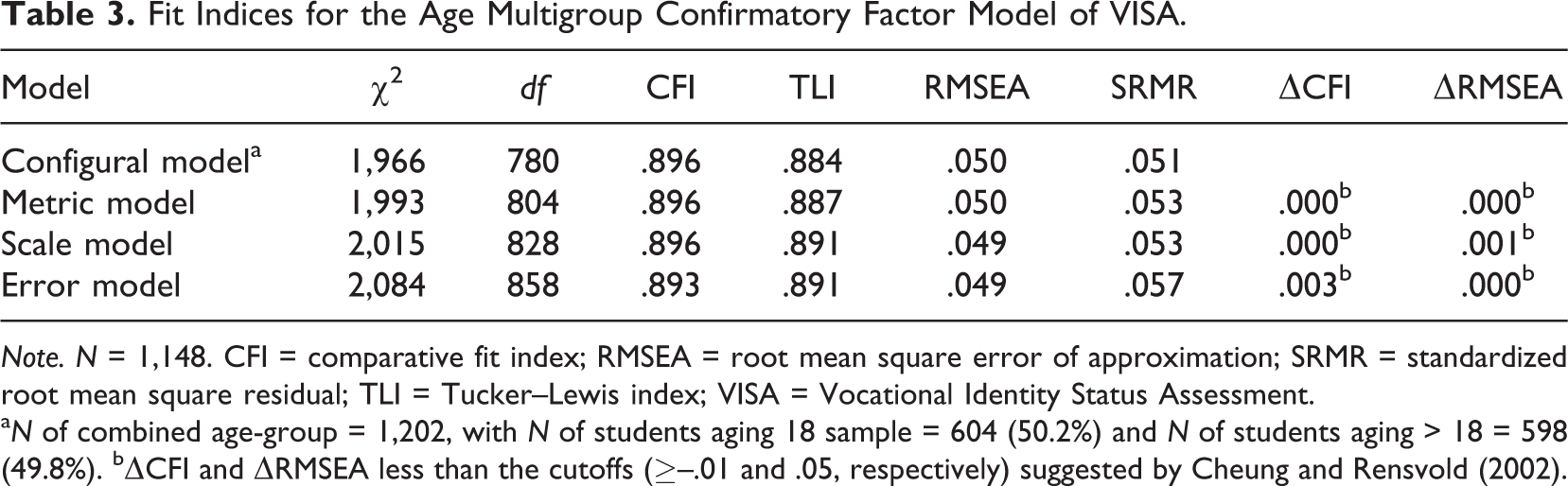
Note. N = 1,148. CFI = comparative fit index; RMSEA = root mean square error of approximation; SRMR = standardized root mean square residual; TLI = Tucker–Lewis index; VISA = Vocational Identity Status Assessment.
a N of combined age-group = 1,202, with N of students aging ≤18 sample = 604 (50.2%) and N of students aging > 18 = 598 (49.8%). bΔCFI and ΔRMSEA less than the cutoffs (≥−.01 and .05, respectively) suggested by Cheung and Rensvold (2002).
Convergent validity
To offer initial evidence for the convergent validity of the VISA–Chinese Version, we provided associations across these subscale scores with the validation scale/subscale scores, namely, the career adaptability score, and talent development and career exploration self-efficacy scores. The correlation coefficients indicated a consistent pattern of links across VISA subscales and the validation scales; four vocational identity subscale scores (i.e., career commitment making, identification with career commitment, and in-breadth and in-depth career exploration) showed positive and statistical significance with all of the validated scale scores/subscale scores (p < .01), while career self-doubt had significantly negative correlations. Commitment flexibility however had no significant associations with all the scores of the career development indicators (Table 4).
Descriptive Statistics, Reliability Coefficients, and Correlations of the Vocational Identity Status Assessment (VISA) and Validated Indicators in Study 2.
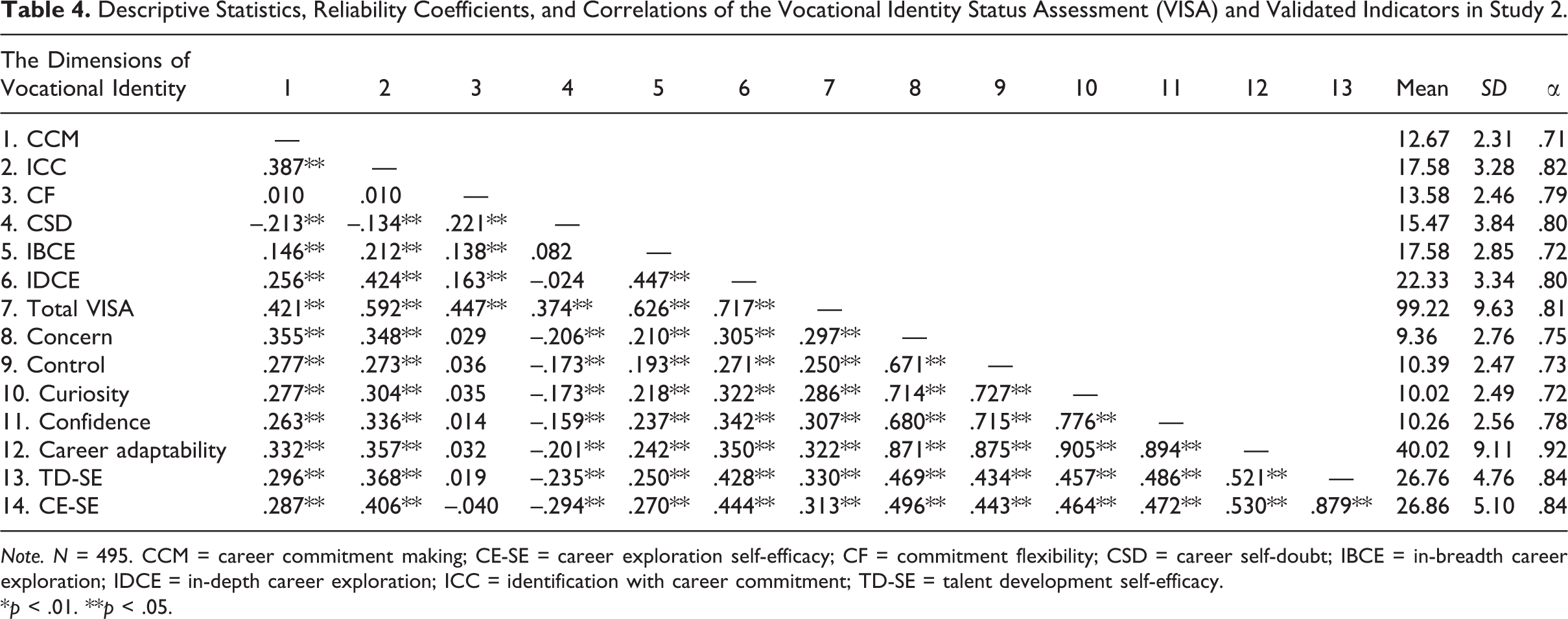
Note. N = 495. CCM = career commitment making; CE-SE = career exploration self-efficacy; CF = commitment flexibility; CSD = career self-doubt; IBCE = in-breadth career exploration; IDCE = in-depth career exploration; ICC = identification with career commitment; TD-SE = talent development self-efficacy.
*p < .01. **p < .05.
Among the scores of the six identity dimensions, identification with career commitment and in-depth exploration had the strongest and positive correlations with all of the total scores of each career-related indicator (i.e., career adaptability, career exploration, and talent development self-efficacy, with correlation coefficients ranging from .350 to .444). In addition, the identification with career commitment had stronger correlations with career and talent development self-efficacy and weaker associations with career adaptability than career commitment making did (Table 4).
Discussion and Implications
This research assessed the psychometric properties and factor structure of the VISA–Chinese Version. This version had undergone rigorous translation and back-translation processes and is concise and understandable to Chinese adolescents and young adults. The results reported here support the view that the revised 30-item VISA–Chinese Version has sound internal consistency (reliability) and convergent validity. The six dimensions from the original (Porfeli et al., 2011) were confirmed in this population and the three types of vocational identity status (career commitment, exploration, and reconsideration) from each dimension. There are three subtypes: The career commitment dimension consists of making commitments (4 items) and career commitment identification (6 items), the career exploration dimension consists of in-depth (6 items) and in-breadth (5 items) career exploration, and the career reconsideration dimension consists of commitment flexibility (4 items) and career self-doubt (5 items). The correlation between the two subfactors within a single dimension is higher than the correlations across the subfactors outside the dimensions, which is consistent with findings from the American sample (Porfeli et al., 2011).
Slight differences in the construct of VISA were found between the English and the Chinese versions. Unlike the original, in which each of the six dimensions was interpreted by 5 items, 2 items here are loaded on dimensions that are different from the original. First, Item 5 (“I have invested a lot of energy into preparing for my chosen career”) loaded on the dimension of identification with career commitment in the Chinese sample instead of on career commitment making. This suggests that Chinese technical education students viewed their investment of energy into the preparation for their chosen career as not only making a career decision but also as a connection of the self and career choice (Porfeli et al., 2013). Second, Item 15 (“I need to learn a lot more before I can make a career choice”) loaded on the dimension of in-depth career exploration in the Chinese version rather than on career flexibility in the English version. It was likely that the contents of the 2 items were interpreted differently by students from Western and Eastern cultures. For example, unlike the other 4 items in career commitment making (which measured career decidedness from the cognitive perspective), Item 5 included involvement with the career chosen, which may be perceived as a kind of career attachment of the self and career choice by Chinese participants. If so, how the cultural factors cause the different interpretations may be worthy of further research. Furthermore, the construct of the VISA–Chinese Version is worthy of further confirmation in other Chinese samples.
Measurement invariance for age was identified in this study, which was inconsistent with the results found for the English version. It is likely that there were totally different samples selected in the two studies. In Porfeli et al.’s (2011) study, the two age groups were high school and university students. Hence, it was to some extent difficult to identify whether the lack of scalar invariance in the U.S. sample was influenced by age or by other contextual factors. In this study, even though all of the participants were technical education students, the sample was quite heterogeneous, consisting of students from the program for junior skilled workers, the program for senior skilled workers, and the program for probational technicians. These students were of diverse ages at different stages of enrollment and graduation. Therefore, students who are of the same age but at different learning stages (e.g., freshmen and graduates) may develop different levels of vocational identity because they integrate their idiosyncratic and meaningful contexts into their identities (Syed & McLean, 2016). The contextual interference may be the reason for the scalar invariance across ages in this study. In sum, the measurement invariance of ages in technical education students indicates that the VISA–Chinese Version can be used and interpreted with students across ages (Cheung & Rensvold, 2002).
Evidence also indicates that the VISA–Chinese Version possesses sound convergent validity: Significant correlations were shown across the career commitment and exploration dimension and career adaptability and the career exploration and talent development self-efficacy. In contrast, commitment flexibility had no significant links to these validation indicators. These results were consistent with those of Porfeli and Savickas (2012) and Negru-Subtirica, Pop, and Crocetti (2015), who found no significant (or only slight) associations among commitment flexibility and career adaptability and its subscales.
Limitations and Future Directions
This study had several limitations. First, the validity and reliability of the VISA–Chinese Version were assessed in this study with technical college students only; thus, the psychometric properties of the instrument should be replicated with other Chinese samples such as high school students and vocational and university students using cross-sectional and longitudinal designs to obtain further evidence of reliability and construct validity. The instrument could also be evaluated in Hong Kong, Macau, and Taiwan, where the Chinese populations have somewhat different characteristics from the population of Mainland China. Second, there is a lack of evidence on the predictive value of the VISA–Chinese Version regarding students’ personal well-being, which is an issue worthy of future exploration. Third, for practical reasons, this study was not able to assess the test–retest reliability of the VISA–Chinese Version. This form of reliability could be assessed in a future study.
Conclusion
This study provides evidence that the VISA–Chinese Version is a promising tool that has shown evidence of sound internal consistency, convergent validity, and measurement invariance across age groups. Six vocational identity dimensions (e.g., career commitment making, identification of career commitment, in-depth and in-breadth career exploration, career commitment flexibility, and career self-doubt) were identified. This study contributes to the vocational identity literature by showing a sound fit of the VISA–Chinese Version in the Chinese context.
Footnotes
Authors’ Note
This article is based on the PhD research of the first author under the supervision of the second and third authors at Faculty of Education, University of Hong Kong.
Acknowledgments
The authors are grateful to Dr. Baixue Ouyang from Macau for her sharing of the Vocational Identity Status Assessment (VISA)—Macau Chinese Version and to Ms. Jiashu Zhang for her contribution to the translations of the VISA—Chinese version. Gratitude is also due to Yimei Chen, Jiehua Li, Huiyu Lou, Huijuan Li, Zhimei Li, and Yuqing Liu for their kind assistance with the data collection.
Declaration of Conflicting Interests
The author(s) declared no potential conflicts of interest with respect to the research, authorship, and/or publication of this article.
Funding
The author(s) received no financial support for the research, authorship, and/or publication of this article.