



Abstract
The present study examined the career construction theory (CCT) model of adaptation using a sample of working adults diagnosed with Chiari malformation. Specifically, we tested a mediation model in which adaptivity (i.e., proactivity, openness, and conscientiousness) fosters adaptability, which conditions adapting (i.e., competence need satisfaction at work), which leads to adaptation (i.e., work well-being and subjective well-being). Results of structural equation modeling supported all of the hypothesized direct and indirect relations between CCT constructs, thus providing strong support for the applicability of the model of adaptation among workers with Chiari malformation. Prior to testing the model of adaptation, we examined and found support for the hypothesized hierarchical structure of the Career Adapt-Abilities Scale–Short Form, a recently developed operationalization of career adaptability.
Keywords
Career construction theory (CCT; Savickas, 2005, 2013) conceptualizes human development as driven by adaptation to a social environment with the goal of person–environment integration. Viewing career construction as a series of attempts to fit a self-concept into work roles concentrates attention on adaptation to repeated transitions and challenges from school to work, from job to job, and from occupation to occupation. This adaptation is motivated and guided by the goal of bringing inner needs and outer opportunities into harmony. In keeping with CCT’s stated emphasis on coping with tasks, transitions, and traumas in occupational roles (Savickas & Porfeli, 2012), we tested the applicability of the CCT model of adaptation in a unique sample of workers for whom adaptive challenges are a well-understood part of their employment trajectory (Fischbein et al., 2015; Tokar & Kaut, 2018, 2019). Specifically, we examined the model in adult workers diagnosed with Chiari malformation, a chronic health condition with varying degrees of cognitive (e.g., attention, memory), sensory (e.g., pain, numbness/tingling), motor (e.g., balance and coordination problems), and psychosocial (e.g., depression, anxiety) complications (Fischbein et al., 2015; Watson et al., 2010). In the following sections, we briefly review the CCT model of adaptation, summarize the extant research on the model’s posited four-step sequence, describe Chiari malformation and some of the difficulties experienced by workers with the condition, and present a rationale for testing the applicability of the CCT model of adaptation in workers with Chiari malformation.
Theoretical Framework
The CCT model conceptualizes adaptation results or outcomes as influenced by a sequence of preparatory and performance components conceptualized as adaptive readiness, adaptability resources, and adapting responses (see Figure 1). This notion of adaptation assumes the intersection of intrinsic and extrinsic factors ultimately shaping employment outcomes. People experience different levels of adaptation results (i.e., employment outcomes) because they are more or less prepared to change, vary in their resources to manage change, and demonstrate more or less action when change is required. In the conceptual framework of CCT, those who are ready and willing to change (i.e., adaptivity) and possess the psychosocial resources to do so (i.e., adaptability) are better able to respond to changing conditions (i.e., adapting) and thereby secure positive outcomes (i.e., adaptation).

Career construction theory model of adaptation.
Career Adaptivity
Career adaptivity, the first variable in the CCT model (see Figure 1), is specifically defined as a psychological trait of readiness and willingness to make changes that evoke proactive efforts to address vocational development tasks, occupational transitions, and work troubles (Savickas & Porfeli, 2012). As a dispositional trait, adaptivity serves as a cognitive filter through which individuals interpret the environment and, when needed, activate adaptability resources and engage adapting responses in order to better adjust to imminent transitions. This process is engaged whether the changes are imposed by external social forces such as graduating from school or losing a job or prompted by internal affective reactions such as boredom on the job or curiosity to try something new.
Functioning as an abstract, global disposition (Funder, 1991), adaptivity involves a compound mixture of multiple specific personality traits that has more explanatory power across a broad range of situations and behaviors than does a single trait. Prior research has not settled on a standard operationalization of adaptivity. Perhaps the most conceptually comprehensive indicator of adaptivity is proactive personality, that is, a general disposition to take intentional action to effect change in one’s environment (Bateman & Crant, 1993). Highly proactive individuals show initiative in identifying opportunities, acting on them, and persevering until they bring about meaningful change. However, proactive personality disposition does not fully capture the complexity of career adaptivity from the CCT perspective. Rudolph, Lavigne, and Zacher (2017) reported that five factor model (FFM) personality dimensions could explain significant and unique variability in adaptability above and beyond the influence of proactive personality disposition.
CCT recognizes the five dimensions in the FFM of personality constitute plausible indicators of adaptivity. However, no single FFM dimension, separately considered, adequately reflects the complexity of adaptivity. Rather, Savickas and Porfeli (2012) suggest the dimensions of openness to experience and conscientiousness as a reasonable combination to indicate the characteristics of readiness and willingness to change. Openness reflects readiness to change in that it represents a propensity to explore and consider new and unfamiliar ideas and experiences required for navigating unfamiliar tasks. Rather than passively adhere to predictable routines, individuals high in openness are more ready to actively seek new and varied experiences. Conscientiousness reflects the willingness or initiative to take action that also characterizes adaptivity. Rather than procrastinate, individuals high in conscientiousness show the initiative to set goals and are organized, persistent, and motivated in achieving them. Indeed, the initiative, striving, and perseverance characteristics of conscientious individuals reflect their willingness to act in the face of disequilibrium.
Until the development of a complex measure that overcomes some of the shortcomings of existing adaptivity indicators, researchers will continue to use existing trait frameworks to represent adaptivity. In the present study, we operationally defined adaptivity using the empirically distinct indicators of proactive personality, openness to experience, and conscientiousness.
Career Adaptability
Career adaptability constitutes a self-regulatory, transactional, and malleable competency that enables workers to successfully solve unfamiliar, complex, and ill-defined problems throughout their careers (Savickas & Porfeli, 2012). In CCT, career adaptability resources “shape adaptation strategies and actions [adapting] aimed at achieving adaptation goals [adaptation]” (Savickas & Porfeli, 2012, p. 663). Thus, CCT posits that adaptability influences adaptation results via its effect on adapting responses. The problem-solving nature of adaptability, and one that is activated and engaged across the years of one’s work history, underscores the need to seek adult workers for model testing. Indeed, the construct of career adaptability denotes an individual’s self-regulative resources spanning attitudes, behaviors, and competencies for managing current and anticipated vocational developmental tasks, transitions, and traumas (Savickas, 2005). From the CCT perspective, adaptivity fosters the development and use of adaptability resources (Savickas, 2013). Workers with high levels of career adaptability show concern about preparing for future career tasks, take control of and responsibility for their career construction, have the curiosity to explore possible future selves and career opportunities, and display confidence in their ability to solve career-related problems (Savickas, 1997, 2002, 2005, 2013). Alternatively, a logical and yet seldom addressed application of this theory is that workers who face barriers or limitations in readiness (adaptivity) and utilization of resources (adaptability) are less likely to successfully engage in career problem-solving. Therefore, and given the assumption of mediation inherent in the CCT model of adaptation, it is of instrumental importance to select an operationalization that capably assesses variations in adaptabilities. A widely used and parsimonious method of operationally defining career adaptability is the Career Adapt-Abilities Scale (CAAS; Savickas & Porfeli, 2012) which has been translated and used by researchers in more than 20 countries. The present study used the CAAS-Short Form (CAAS-SF; Maggiori, Rossier, & Savickas, 2017) to operationally define these career adaptability resources that shape adapting responses.
Adapting Responses
Adapting responses denote the performance of actual behaviors that construct careers. For adolescents and emerging adults, this typically means addressing changing career conditions by performing behaviors such as exploring, planning, deciding, and committing. Most measures used by researchers to operationally define adapting responses have been designed for use by students, such as the Student Career Construction Inventory (SCCI; Savickas, Porfeli, Hilton, & Savickas, 2018). The present study required a measure of adapting behaviors appropriate for a wide age range of working adults. An important indicator of adapting responses at work is one’s level of competence at activities that maintain effective performance and facilitate goal attainment. For testing the adaptation model here, the variable of competence was of particular relevance given the purposive selection of participants, many of whom may experience disabling symptoms at work due to the chronic nature of their condition. Accordingly, we operationally defined adapting responses using the Competence subscale from the Basic Psychological Need Satisfaction at Work Scale (BPNS-W; Deci et al., 2001).
Adaptation Results
The final outcome of this model, adaptation, is believed to result from the sequential consequences of readiness, resource utilization, and responding. Adaptation results or goodness of fit is indicated by outcome variables such as decidedness, achievement, success, satisfaction, well-being, and development. Each of these variables indicates that some new equilibrium has been reached. In the present study, we examined two conceptually related yet distinct adaptation outcomes: work well-being and subjective well-being. Work well-being is a global construct reflecting the extent to which one subjectively experiences work as meaningful and feels satisfied with and engaged in one’s work. We chose to examine work well-being for both theoretical and empirical reasons. According to CCT (Savickas, 2005, 2013), adaptation is evidenced by different indicators of work well-being (e.g., success, satisfaction, engagement). In support of CCT’s prediction that adaptation results from the sequential consequences of readiness, resource utilization, and responding, research has demonstrated positive associations of adaptivity (e.g., conscientiousness, proactivity), career adaptability, and adapting responses (in the form of competence need satisfaction at work) with different indicators of work well-being, including sense of calling in one’s career (Douglass & Duffy, 2015; Guo et al., 2014), job and career satisfaction (Autin et al., 2019; Chan & Mau, 2015; Jawahar & Liu, 2017; Nickel, Roberts, & Chernyshenko, 2019; Van den Broeck, Vansteenkiste, De Witte, Soenens, & Lens, 2010; Zacher, 2014, 2015), and work engagement (Rossier, Zecca, Stauffer, Maggiori, & Dauwalder, 2012; Van den Broeck et al., 2010; Young, Glerum, Wang, & Joseph, 2018). Thus, we expect positive associations of adaptivity, adaptability, and adapting with work well-being. We operationalized work well-being using measures of job satisfaction, work engagement, and meaningful work.
According to CCT (Savickas, 2005, 2013), successful adaptation to career transitions and challenges is indicated by positive career and life outcomes. Thus, our second adaptation outcome was subjective well-being, which refers to the experience of happiness or life satisfaction. Consistent with the CCT model of adaptation, research has demonstrated positive associations of adaptivity (e.g., conscientiousness, proactivity), career adaptability, and adapting (i.e., competence need satisfaction) with life satisfaction, the cognitive-judgmental component of subjective well-being (Autin et al., 2019; Jawahar & Liu, 2017; Maggiori, Johnston, Krings, Massoudi, & Rossier, 2013; Nickel et al., 2019). Therefore, we expect positive associations of adaptivity, adaptability, and adapting with subjective well-being. We operationalized subjective well-being using a measure of satisfaction with life.
Literature Review
The construct of career adaptability, a central component in the model, has seen a proliferation of research since publication of the CAAS (Savickas & Porfeli, 2012), which has become the standard indicator of adaptability resources. More than 50 studies have used the CAAS to examine parts of the CCT model such as bivariate relations between adaptability and adaptivity, adapting, or adaptation as well as a few studies that examined relations in the sequence of adaptivity–adaptability–adaptation, leaving out adapting responses. In a meta-analytic review of these studies, Rudolph et al. (2017) synthesized empirical findings on relations of career adaptability to measures of adaptivity, adapting, and adaptation. They reported that career adaptivity related proximally to adaptability and distally to adaptation. They also reported that adaptability related to adaptation while controlling for adaptivity. They concluded that the analysis of the indirect effects of adaptivity indicators on adaptation occurs through career adaptability, thus providing initial evidence for the tenability of the process implied in the career construction model of adaptation.
Among the studies on the CCT model of adaptation, only four studies have tested the full sequence of four components. In a study with 1,566 students at an Australian university, Perera and McIlveen (2017) used mixture analysis to examine how the Big Five personality traits combine to represent adaptivity. Perera and McIlveen (2017) operationally defined adaptivity with the NEO Five-Factor Inventory (Costa & McCrae, 1992), adaptability with the CAAS, adapting with the Organized Study Scale (Entwistle, 1997), and adaptation with the Academic Major Satisfaction Scale (Nauta, 2007) and the Career Choice Status Inventory (Savickas, 1993). They concluded that, although not a direct test of mediated relations among the variables, the results aligned with the CCT model in showing that greater adapting behaviors and better adaptation outcomes related to more adaptivity and adaptability.
In a direct test of the mediation model, Merino-Tejedor, Hontnaga, and Boada-Grau (2016) studied 577 students at a university in Spain. They operationally defined adaptivity with the Self-Regulation Scale (Luszczynska, Diehl, Gutiérrez-Doña, Kuusinen, & Schwarzer, 2004), adaptability with the CAAS, adapting with the SCCI (Savickas et al., 2018), and adaptation with the Academic Burnout Scale–University Form (Boada-Grau, Merino-Tejedor, Sánchez-García, Prizmic-Kuzmica, & Vigil-Colet, 2015). They reported that the four-step sequence model (adaptivity → adaptability → adapting → adaptation) fit the data significantly better when the additional direct effects of adaptivity on adapting and adaptation as well as adaptability on adaptation were included. Thus, the partial mediation model provided a better overall fit than did the full mediation model posited by CCT. In addition, the direct effects of adaptivity and adaptability on adaptation were significant, although the direct effect of adaptivity on adapting was not. Furthermore, although the indirect effects of adaptivity on adapting and adaptation were significant, the indirect effect of adaptability on adaptation was not. Finally, contrary to the CCT model, the direct effect of adapting on adaptation was nonsignificant in the partial mediation model. Overall, the findings reported by Merino-Tejedor et al. (2016) provide only partial support for the mediation model suggested by CCT, thus warranting the continued investigation of the model of adaptation.
Two other studies tested the core CCT model using time-lag designs. Guan and colleagues (2014) used a three-wave design with 270 new graduates who just received their bachelor’s or master’s degree from a Chinese university and who intended to seek employment immediately after graduation. In the first wave, adaptivity was operationally defined with the Future Work Self Scale (Strauss, Griffin, & Parke, 2012), and career adaptability was measured with the CAAS. A month later, the students responded to a measure of adapting (Jobs Search Self-Efficacy Scale; Wanberg, Zhang, & Diehn, 2010). Two months later, the graduates reported yes or no as to whether they had signed an employment contract. The results showed that adaptivity predicted adaptability and adapting responses. However, job self-efficacy fully mediated the effect of adaptability on the adaptation of employment status. Job search self-efficacy reflects the extent to which individuals believe they could perform well in job search tasks. Thus, self-efficacy is neither an adaptability resource nor adapting behavior itself. It is a belief one can perform the adapting behaviors. As such, the CCT model places it between adaptability and adapting. The finding that self-efficacy fully mediated the effect of adaptability on adaptation calls for more research to determine whether self-efficacy is properly placed between adaptability and adapting behaviors. An alternative to test is whether self-efficacy is highly related to the confidence dimension in adaptability and as such would be considered an adaptability resource.
Zhuang and colleagues (2018) conducted a two-wave study with 165 Chinese university students. In the first wave, 1,194 students responded to the measures of adaptivity (Chinese Big Five Personality Scale–Short Form; Li et al., 2015; and approach–avoidance temperament; Elliot & Thrash, 2010). A month later, 165 of the original participants completed measures of adaptability (CAAS), adapting as search for and presence of life meaning (Meaning in Life Questionnaire; Steger, Frazier, Oishi, & Kaler, 2006) and adaptation (The Flourishing Scale; Diener et al., 2010). They reported that career adaptivity predicted career adaptability, which in turn predicted adapting responses and adaptation. While the study supported the model, the operationalization of adapting (i.e., life meaning) seems to be closer to an adaptation outcome and similar in some ways to psychological flourishing.
All four of the studies that tested the full CTT model of adaptation provided at least partial support for the framework and raised a few ideas for future research. Nevertheless, all four of the studies used university students as participants. The present study sought to test the model with a sample of employed adults to confirm its validity beyond adolescents and emerging adults. Inasmuch as the CCT adaptation model suggests a psychosocial process whose activation varies as a function of “relative changes in person-environment harmony” (Savickas & Porfeli, 2012, p. 662), it is of primary importance to test the model in more of a “field application” through the involvement of an adult sample having been in the workforce for many years. Moreover, in keeping with CCT’s emphasis on adaptation to changing and challenging environmental conditions (Savickas & Porfeli, 2012), we sought to test the applicability of the model for a sample of workers facing a number of career-related barriers and other adaptive challenges (Fischbein et al., 2015; Tokar & Kaut, 2018, 2019).
Adult Workers With Chiari Malformation
In the present study, we tested the full sequence of the adaptation model using a sample of adult workers with a chronic condition known to impact work and career success (Fischbein et al., 2015; Tokar & Kaut, 2018, 2019). We selectively sampled adult workers with a medical diagnosis known as Chiari malformation (pronounced “key-are-ee”). By concentrating on adult workers who experience a greater incidence of adaptive challenges, we hoped to more specifically assess the posited influence of adaptivity and adaptabilities on adapting responses and adaptation outcomes. In addition to extending the work on the CCT model, we wanted to contribute to our ongoing effort to understand the heretofore often neglected functional experiences of those dealing with the chronic health condition of Chiari malformation.
Individuals who are diagnosed with Chiari malformation are often characterized by an otherwise imperceptible structural malformation (i.e., shortening or reduction in volume) of the posterior region of the skull. Although not overtly recognizable, this malformation results in pressure within the cranium affecting the cerebellum and exerting unusual pressure on the brainstem itself (Massimi, Peppucci, Peraio, & Di Rocco, 2011; National Institute of Neurological Disorders and Stroke, 2017). Primary symptoms may include pain in the head and neck region, coupled with varying degrees of fatigue and weakness. These individuals are not necessarily debilitated by this malformation, although variation in malformation severity can differentially affect functional status (Fischbein et al., 2015; Meeker, Amerine, Kropp, Chyatte, & Fischbein, 2015). A commonly available surgical solution decompresses and removes portions of the skull overlying the cerebellum to alleviate pressure on the internal anatomical structures and provide some degree of symptom relief.
Nevertheless, recent studies of Chiari malformation effects underscore the negative impact this chronic health condition can have on activities of daily living (Meeker et al., 2015) including activities of work engagement (e.g., extended sitting or standing, repetitive movements, concentrating, reading, and bending down; Tokar & Kaut, 2019). Workers with chronic health conditions, including Chiari malformation, are likely to face additional challenges at work including shifts in career identity and goals, reduced work ability and performance, extended absenteeism and presenteeism (i.e., working while ill or injured), and fear of discrimination from coworkers and supervisors, to name a few (McGonagle, Beatty, & Joffe, 2014; Tokar & Kaut, 2018). Preliminary data suggest that individuals with Chiari malformation experience lower quality of life than do individuals in the general population and those with other chronic health conditions (Fischbein et al., 2015; Sixt, Riether, Will, Tatagiba, & Roser, 2009). Furthermore, workers with Chiari malformation may have a lower likelihood of securing decent work (i.e., work affording safe conditions, adequate compensation, free time and rest, access to health care, and complementary values; Duffy, Blustein, Diemer, & Autin, 2016) than do other workers (Tokar & Kaut, 2018). Given the importance of decent work to job and life satisfaction (Duffy et al., 2016; Kozan, Isik, & Blustein, 2019), workers with Chiari malformation may experience additional challenges to their work well-being and subjective well-being.
Modeling Testing and Hypotheses
In studying adult workers, we expected results similar to the four studies with university students because the CCT model hypothesizes that the adaptation sequence has only a weak association with age and tenure. People neither routinely engage nor progressively develop career adaptability resources. Rather, they activate the resources as needed to effectively manage career changes and challenges. A minimal relation of adaptability to age (r = .03) and tenure (r = .02) was confirmed by the Rudolph et al. (2017) meta-analysis.
As documented above, previous research suggests that the numerous challenges faced by workers with Chiari malformation may adversely affect their work well-being (Tokar & Kaut, 2018, 2019) and subjective well-being (Fischbein et al., 2015; Sixt et al., 2009). According to CCT (Savickas, 2005, 2013), individuals facing career barriers and other occupational challenges are those for whom adequate levels of adaptive readiness and adaptability resources are especially important in shaping adapting responses and achieving successful and satisfying adaptation outcomes. Accordingly, we expect that individual differences in these workers’ adaptive readiness and willingness to change, adaptability resources to manage change, and adapting responses when change is needed figure prominently in their experience of work well-being and subjective well-being.
Based on the mediation model suggested by CCT and corresponding empirical evidence (e.g., Merino-Tejedor et al., 2016; Rudolph et al., 2017), we hypothesized that adaptivity (i.e., proactive personality, openness, and conscientiousness) relates positively to adaptability (Hypothesis 1), adaptability relates positively to adapting responses (i.e., competence need satisfaction; Hypothesis 2), and adapting responses relates positively to adaptation results (i.e., work well-being and subjective well-being; Hypothesis 3). We further hypothesized that adaptivity relates positively and indirectly (via adaptability) to adapting responses (Hypothesis 4), adaptability relates positively and indirectly (via adapting responses) to adaptation results (Hypothesis 5), and adaptivity relates positively and indirectly (via the combination of adaptability and adapting responses) to adaptation results (Hypothesis 6). The hypothesized structural model is depicted in Figure 2.

Hypothesized structural model. Hypothesized indirect pathways are in parentheses.
In preparation for this test of the model, we examined the factor structure of the CAAS-SF (Maggiori et al., 2017). We examined whether the intended hierarchical structure of the CAAS-SF demonstrated an adequate fit in our sample of workers with Chiari malformation.
Method
Participants and Procedure
Participants were 289 employed adults (261 women, 26 men, and 2 indicating some other gender) diagnosed with Chiari malformation; 55.0% had been diagnosed with at least one additional illness (e.g., Ehlers-Danlos syndrome, hypothyroidism, and syringomyelia). Participants’ ages ranged from 18 to 61 years (M = 37.12 years, SD = 9.43 years). Participants identified as White/European American (88.6%), multiethnic (4.8%), Latinx (3.5%), Black/African American (2.1%), Asian/Asian American (0.3%), and American Indian/Alaskan Native (0.3%). The majority (92.7%) identified as heterosexual, with 4.2% bisexual, 1.4% lesbian, 1.0% some other sexual orientation, and 0.3% gay. In terms of social class, 50.5% identified as middle class, 34.9% as working class, 8.7% as upper middle class, and 5.9% as lower class. The majority (68.2%) of participants were employed full-time outside the home, with 22.1% employed part-time outside the home, 6.6% self-employed part-time at home, and 3.1% self-employed full-time at home. The mean number of hours worked per week was 33.90 (SD = 12.14). Regarding highest level of education completed, 31.5% indicated associate’s degree or trade school, 24.6% high school graduate, 22.5% bachelor’s degree, 17.0% master’s degree, 2.4% doctorate degree, and 2.1% some high school.
We recruited participants in two ways. First, an e-mail invitation containing the survey link was sent to 648 individuals from the Chiari 1000 registry (an online patient database established to promote research and data collection from individuals with Chiari malformation) who had previously expressed interest in participating in future studies. These individuals were invited to participate in an online study of the career development experiences of individuals with Chiari malformation. Second, a brief description of the study with a link to the online survey was posted on the Conquer Chiari website. Participants who met the inclusion criteria (i.e.,
Instruments
Conscientiousness and openness
We used the 20-item Mini-International Personality Item Pool (Mini-IPIP; Donnellan, Oswald, Baird, & Lucas, 2006) to measure the Big Five personality factors of conscientiousness and openness (i.e., intellect/imagination). Each of the five Mini-IPIP Scales is composed of 4 items. Participants used a 5-point Likert-type scale (1 = very inaccurate; 5 = very accurate) to indicate how accurately each item described them. In the current study, only conscientiousness and openness scores were used. Sample items include “Get chores done right away” (conscientiousness) and “Have a vivid imagination” (openness). Scores for each Mini-IPIP subscale are averaged, with higher scores corresponding to higher levels of each personality dimension. Donnellan, Oswald, Baird, and Lucas (2006) reported Cronbach’s α coefficients of .75 (conscientiousness) and .70 (openness) and demonstrated convergent validity via correlations of .90 (conscientiousness) and .83 (openness) with corresponding 10-item IPIP Big Five Scales, in a sample of 329 college students.
Proactive personality
We measured individual differences in proactive personality using Seibert, Crant, and Kraimer’s (1999) 10-item version of the original 17-item Proactive Personality Scale (PPS; Bateman & Crant, 1993). Participants used a 7-point Likert-type scale (1 = strongly disagree; 7 = strongly agree) to rate the extent to which they agreed with each statement (e.g., “I excel at identifying opportunities”). Item scores are averaged, with higher scores corresponding to higher levels of proactive personality. Seibert et al. (1999) reported a Cronbach’s α coefficient of .86 for the 10-item PPS in a sample of 496 employed adults and demonstrated support for the measure’s validity via positive relations with salary, promotions, and career satisfaction.
Career adaptability
Career adaptability was measured with the CAAS-SF (Maggiori et al., 2017), a 12-item brief form of the CAAS (Savickas & Porfeli, 2012). Both the CAAS and CAAS-SF were developed to operationalize Savickas’s (2005) multidimensional and hierarchical conceptualization of career adaptability. The CAAS-SF, like the original CAAS, is scored for four career adaptability dimensions (concern, control, curiosity, and confidence) as well as total adaptability. Participants used a 5-point Likert-type scale (1 = not strong; 5 = strongest) to indicate how strongly they have developed each of the career adaptabilities. Sample items include “Thinking about what my future will be like” (concern), “Making decisions by myself” (control), “Investigating options before making a choice” (curiosity), and “Working up to my ability” (confidence). Item ratings are averaged, with higher scores indicating higher levels of career adaptability. Maggiori, Rossier, and Savickas (2017) reported Cronbach’s α coefficients for the four subscales ranging from .76 to .83 and total scale αs of .90 in German- and French-speaking adults living in Switzerland. Maggiori et al. (2017) demonstrated evidence of the CAAS-SF’s validity via strong correlations with corresponding CAAS dimensions.
Competence need satisfaction at work
Competence need satisfaction at work was assessed with the BPNS-W (Deci et al., 2001), a 21-item self-report measure developed to assess the satisfaction of basic psychological needs (i.e., autonomy, competence, relatedness) at work. Participants used a 7-point Likert-type scale (1 = not at all true; 7 = very true) to indicate how true each statement was for them at work. In this study, only scores for the BPNS-W Competence Scale were used. A sample item from the Competence Scale is “Most days I feel a sense of accomplishment from working.” Item ratings for each subscale are averaged, with higher scores corresponding to more perceived need satisfaction. Deci et al. (2001) reported Competence subscale α coefficients of .81 and .73 in samples of 431 Bulgarian workers and 128 American workers, respectively and demonstrated support for the measure’s validity via expected relations with work engagement, anxiety, and self-esteem.
Work engagement
Work engagement was assessed with the 9-item Utrecht Work Engagement Scale (UWES-9; Schaufeli, Bakker, & Salanova, 2006). Like the original 17-item UWES (Schaufeli & Bakker, 2003), the UWES-9 can be scored for three work engagement dimensions (vigor, dedication, and absorption) as well as for total work engagement. Participants rated how frequently they experienced each statement using a 7-point Likert-type scale (0 = never; 6 = always/every day). Sample items include “At my work, I feel bursting with energy” (vigor), “I am enthusiastic about my job” (dedication), and “I am immersed in my work” (absorption). Item ratings are averaged, with higher scores indicating higher levels of work engagement. Schaufeli, Bakker, and Salanova (2006) reported a Cronbach’s α coefficient of .92 for the UWES-9 total scale in a sample of 14,521 workers from 10 different countries and demonstrated evidence of validity via inverse correlations with burnout.
Job satisfaction
We measured job satisfaction with Judge, Locke, Durham, and Kluger’s (1998) 5-item adaptation of Brayfield and Rothe’s (1951) measure of overall job satisfaction. Participants used a 7-point Likert-type scale (1 = strongly disagree; 7 = strongly agree) to rate the extent to which they agreed with each statement (e.g., “I feel fairly well satisfied with my present job”). Item ratings are averaged, with higher scores indicating higher levels of job satisfaction. Judge et al. (1998) reported a Cronbach’s α coefficient of .88 for the adapted measure in a sample of 222 university employees and demonstrated evidence of its validity via correlations approaching unity with a composite measure of job satisfaction.
Meaningful work
The experience of meaningful work was assessed with the 10-item Work as Meaning Inventory (WAMI; Steger, Dik, & Duffy, 2012). The WAMI is scored for three related yet distinct dimensions of meaningful work (positive meaning, meaning making through work, and greater good motivations) as well as total meaningful work. Participants used a 7-point Likert-type scale (1 = strongly disagree; 7 = strongly agree) to indicate the extent to which they agreed with each statement. Sample items include “I have found a meaningful career” (positive meaning), “My work helps me better understand myself” (Meaning Making through Work), and “I know my work makes a positive difference in the world” (greater good motivations). Item ratings were averaged, with higher scores indicating higher levels of meaningful work. Steger, Dik, and Duffy (2012) reported the following Cronbach’s α coefficients for WAMI subscale and total scale scores in a sample of 370 university employees: positive meaning (α = .89), meaning making through work (α = .82), greater good motivations (α = .83), and total scale (α = .93). Steger et al. (2012) demonstrated support for the validity of the WAMI subscales through anticipated correlations with job and life satisfaction, career commitment, and withdrawal intentions.
Subjective well-being
We used the 5-item Satisfaction With Life Scale (SWLS; Diener, Emmons, Larsen, & Griffin, 1985) to measure the cognitive-judgmental component of subjective well-being. The SWLS asks respondents to use a 7-point Likert-type scale (1 = strongly disagree; 7 = strongly agree) to indicate their agreement with statements (e.g., “I am satisfied with my life”) regarding satisfaction with one’s life. Item ratings were averaged, with higher scores indicating higher levels of life satisfaction. Diener, Emmons, Larsen, and Griffin (1985) reported a Cronbach’s α coefficient of .87 for the SWLS in a sample of 176 college students and demonstrated evidence of its validity via anticipated correlations with other measures of subjective well-being.
Results
Preliminary Analyses
Two-hundred and ninety of the 292 usable cases contained at least one missing item-level data point, and the overall rate of missing data was 7.85%. Little’s (1988) Missing Completely at Random test was nonsignificant (p = .054), indicating that missingness was not systematically related to any of the study variables. Following Schlomer, Bauman, and Card’s (2010) recommended best practices for handling missing data, we used full information maximum likelihood (FIML) estimation to perform all model testing. FIML uses all available data to generate unbiased parameter estimates and standard errors.
All study variables satisfied assumptions of univariate normality (i.e., skewness ≤ 3.0 and kurtosis ≤ 10; Weston & Gore, 2006). Three cases were identified as multivariate outliers based on significant (p < .001) Mahalanobis distance values and were eliminated, resulting in a final usable sample of 289.
CAAS-SF Structure
We evaluated the applicability of the CAAS-SF hierarchical structure to our sample of workers with Chiari malformation using confirmatory factor analysis (CFA). The 12 CAAS-SF items were observed indicators of corresponding concern, control, curiosity, and confidence latent variables, which in turn served as indicators of a higher order adaptability latent variable. We performed CFA using Mplus Version 8.1 (Muthén & Muthén, 1998–2018). Model-data fit was evaluated using the χ2 goodness-of-fit test, comparative fit index (CFI), standardized root mean square residual (SRMR), and root mean square error of approximation (RMSEA). CFI values ≥ .95, SRMR values ≤ .08, and RMSEA values ≤ .06 indicate a well-fitting model (Hu & Bentler, 1999). For sample sizes of less than 500, CFI ≥ .90 and RMSEA and SRMR < .10 indicate adequate model fit (Weston & Gore, 2006).
CFA results revealed that the hypothesized model fit the data reasonably well, χ2(50, N = 287) = 192.69, p < .001, CFI = .90, SRMR = .070, RMSEA = .100, 90% confidence interval [CI] = [.085, .115]; however, fit index values indicated a relatively poorer fit than that reported by Maggiori et al. (2017; e.g., CFI = .98, RMSEA = .049) in their initial test of the CAAS-SF’s structure. However, Maggiori et al. (2017) slightly improved the fit of their final model by allowing two sets of error terms to covary. In a similar manner, we retested the hypothesized model allowing two sets of error terms (corresponding to item pairs 1–2 and 8–9) to covary. These minor modifications were based on consideration of the empirical modification indices (i.e., >10) as well as the conceptual and semantic similarity of the item pairs (see Table 1). The modified model resulted in an adequate, χ2(48, N = 287) = 151.67, p < .001, CFI = .93, SRMR = .054, RMSEA = .087, 90% CI [.071, .102], and significantly improved fit, Δχ2(2, N = 287) = 41.02, p < .001. Factor loadings for all five factors were substantial and significant (p < .001; see Table 1). Item factor loadings ranged from .52 to .81 (mdn = .70), and loadings from control, concern, curiosity, and confidence factors to the higher order adaptability factor ranged from .68 to .99 (mdn = .82). Overall, CFA results supported the hypothesized hierarchical structure of the CAAS-SF in our sample of workers with Chiari malformation.
Career Adapt-Abilities Scale—Short Form Items, Descriptive Statistics, and Standardized Factor Loadings.

Note. N = 287. All factor loadings are significant at p < .001.
Descriptive Statistics and Correlations
Table 2 presents means, standard deviations, internal consistency estimates, and intercorrelations of all variables. Total adaptability associated positively with conscientiousness (r = .15), openness (r = .24), proactive personality (r = .43), competence need satisfaction (r = .35), meaningful work (r = .23), work engagement (r = .34), job satisfaction (r = .28), and subjective well-being (r = .27). Twenty-nine of 32 correlations between specific adaptability dimensions and the other variables of interest were significant and positive. In addition to its significant positive relation to career adaptability, conscientiousness related inversely with openness (r = −13) and positively with subjective well-being (r = .13). Openness also associated positively with proactive personality (r = .30), meaningful work (r = .15), and work engagement (r = .20). Proactive personality also associated positively with competence need satisfaction (r = .23), meaningful work (r = .29), work engagement (r = .29), job satisfaction (r = .20), and subjective well-being (r = .18). Competence need satisfaction also correlated positively with meaningful work (r = .59), work engagement (r = .66), job satisfaction (r = .72), and subjective well-being (r = .41). Finally, meaningful work, work engagement, job satisfaction, and subjective well-being were significantly and positively intercorrelated (rs ranged from .40 to .79).
Intercorrelations, Internal Consistencies, Means, and Standard Deviations of All Variables.
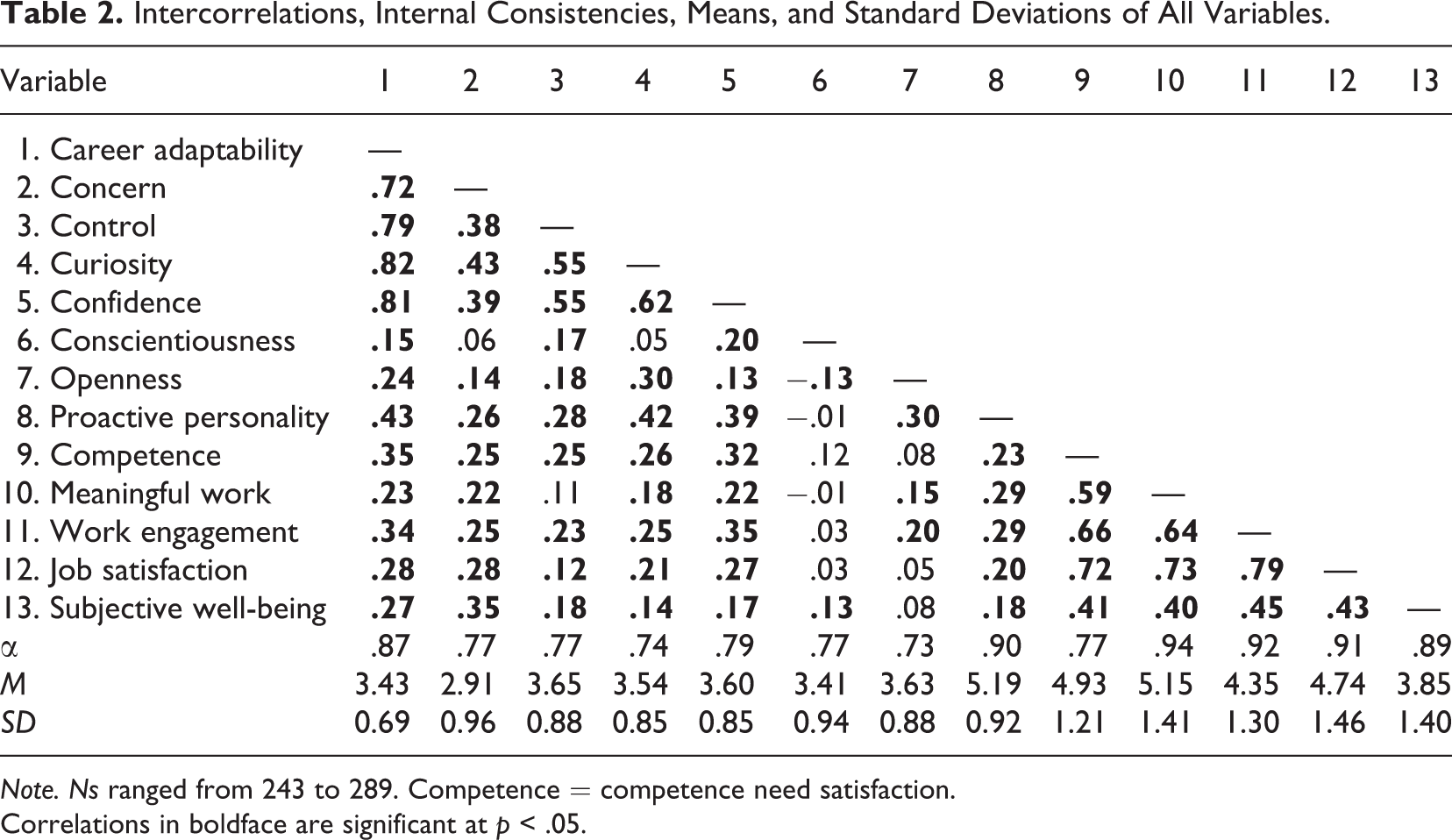
Note. Ns ranged from 243 to 289. Competence = competence need satisfaction.
Correlations in boldface are significant at p < .05.
Measurement Model
Prior to testing the hypothesized structural model (see Figure 2) using structural equation modeling, we performed a CFA to evaluate the relations between the indicator variables and the corresponding latent factors. For the hypothesized measurement and structural models, we used the four CAAS-SF subscales as observed indicators of a latent career adaptability variable and WAMI, UWES-9, and job satisfaction total scores as indicators of a latent work well-being variable. We used the four Mini-IPIP conscientiousness items, four Mini-IPIP openness items, and five SWLS items as indicators of conscientiousness, openness, and subjective well-being latent variables, respectively. We created three balanced indicators (i.e., item parcels) of proactive personality and competence need satisfaction latent variables by factor analyzing to a single-factor solution the items composing each measure (i.e., PPS and BPNS-W Competence, respectively) and then combining items based on their factor loadings (e.g., items with the highest, lowest, and median loadings were averaged to form a parcel; see Russell, Kahn, Spoth, & Altmaier, 1998).
We once again used Mplus Version 8.1 (Muthén & Muthén, 1998–2018) to evaluate the hypothesized measurement and structural models. Model-data fit was assessed using the same fit indices and cutoffs as specified above for the CFA of the CAAS-SF structure. CFA results revealed that the measurement model fit the data well, χ2(278, N = 289) = 507.02, p < .001, CFI = .93, SRMR = .057, RMSEA = .053, 90% CI [.046, .061]. All factor loadings were significant (p < .001) and substantive, ranging from .39 to .92 (mdn = .79).
Structural Model
The hypothesized structural model (see Figure 2) included direct paths from conscientiousness, openness, and proactive personality to career adaptability; from career adaptability to competence need satisfaction; and from competence need satisfaction to work well-being and subjective well-being. The model also included correlations between conscientiousness, openness, and proactive personality, and between the two adaptation results. The structural model provided a good fit to the data, χ2(289, N = 289) = 521.81, p < .001, CFI = .93, SRMR = .063, RMSEA = .053, 90% CI [.045, .060]. Figure 3 depicts the standardized parameter estimates for our hypothesized structural model. As hypothesized, conscientiousness, openness, and proactive personality had significant and positive direct effects on career adaptability, career adaptability had a significant and positive direct effect on competence need satisfaction, and competence need satisfaction had significant and positive direct effects on work well-being and subjective well-being. The variables explained 34% of the variance in career adaptability, 19% in competence need satisfaction, 73% in work well-being, and 24% in subjective well-being.
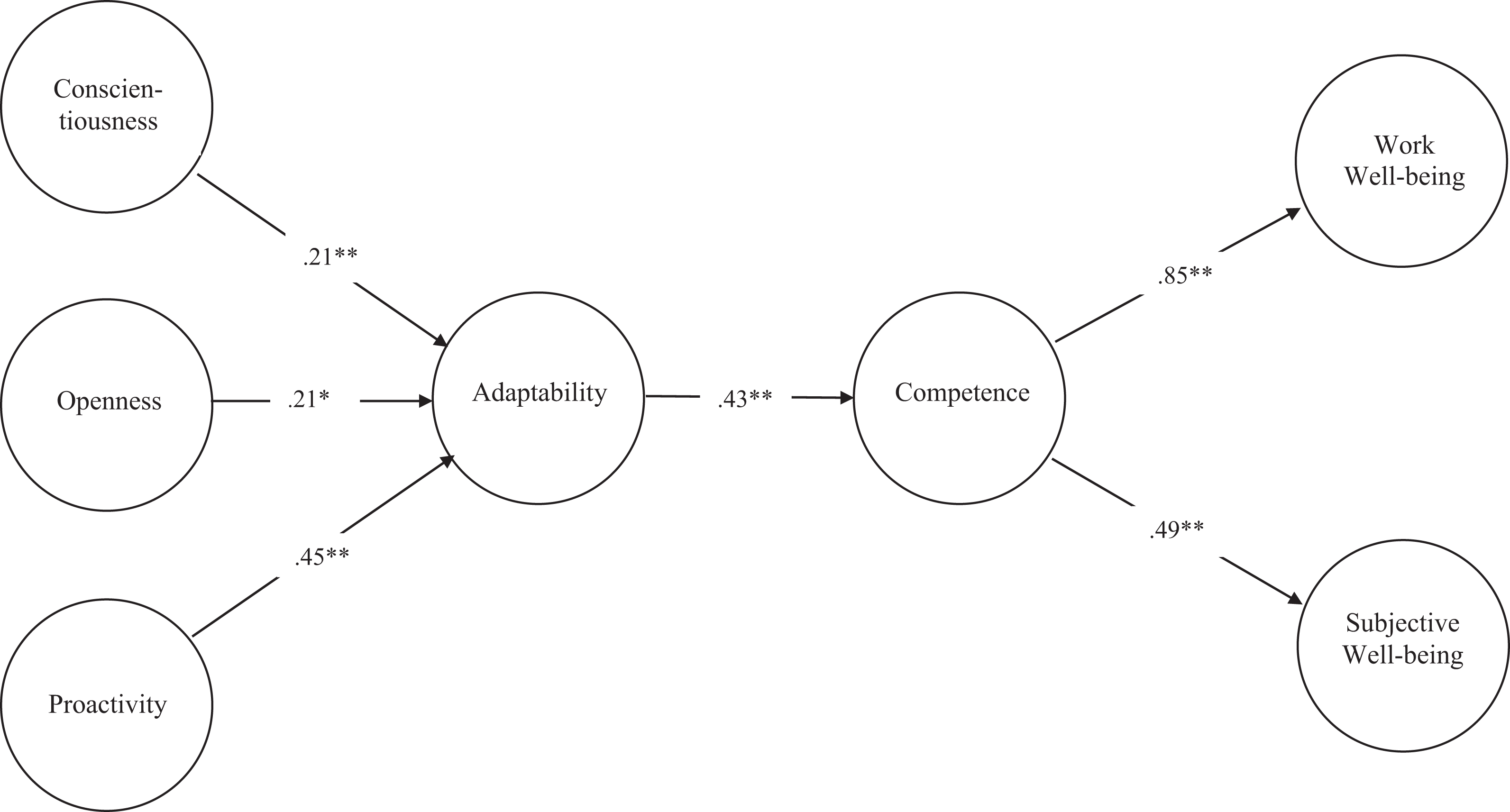
Standardized parameter estimates for the hypothesized structural model. *p < .05. **p < .01.
Although the hypothesized structural model fit the data well, we also considered an alternative model that included additional direct paths from conscientiousness, openness, and proactivity to competence need satisfaction and from conscientiousness, openness, proactive personality, and career adaptability to work well-being and subjective well-being. Results indicated that this model provided a good fit to the data, χ2(278, N = 289) = 507.02, p < .001, CFI = .93, SRMR = .057, RMSEA = .053, 90% CI [.046, .061]. However, the alternative model did not fit the data significantly better than did the hypothesized model, Δχ2(11, N = 289) = 14.79, p > .05. All hypothesized paths were statistically significant and essentially the same (in terms of direction and magnitude) as those found in the fully mediated model. None of the additional direct effects was significant. The variables explained 33% of the variance in career adaptability, 20% in competence need satisfaction, 75% in work well-being, and 25% in subjective well-being. Overall, results supported the decision to retain the hypothesized model.
Mediation Results
Next, we tested the significance of the hypothesized indirect effects using bias-corrected 95% CIs based on 5,000 bootstrap draws of the original data. CIs not containing zero indicate statistically significant (p < .05) indirect effects (Shrout & Bolger, 2002). Results of the tests of indirect effects are summarized in Table 3. As hypothesized, indirect effects of conscientiousness, openness, and proactive personality on competence need satisfaction via career adaptability were significant and positive. Also in support of our hypothesis, the indirect effect of career adaptability on work well-being and subjective well-being via competence need satisfaction was significant and positive. As hypothesized, the indirect effects of conscientiousness, openness, and proactive personality on work well-being and subjective well-being via career adaptability and competence need satisfaction were significant and positive. Collectively, mediation results indicated that adaptivity (i.e., conscientiousness, openness, and proactive personality) had its effect on adapting responses (i.e., competence need satisfaction) via adaptability resources (i.e., career adaptability) and its effect on adaptation results (i.e., work well-being and subjective well-being) via both adaptability resources and adapting responses. Furthermore, adaptability resources had its effect on adaptation results via adapting responses. All significant indirect effects are consistent with the career construction model of adaptation.
Bootstrap Tests of Hypothesized Indirect Effects.
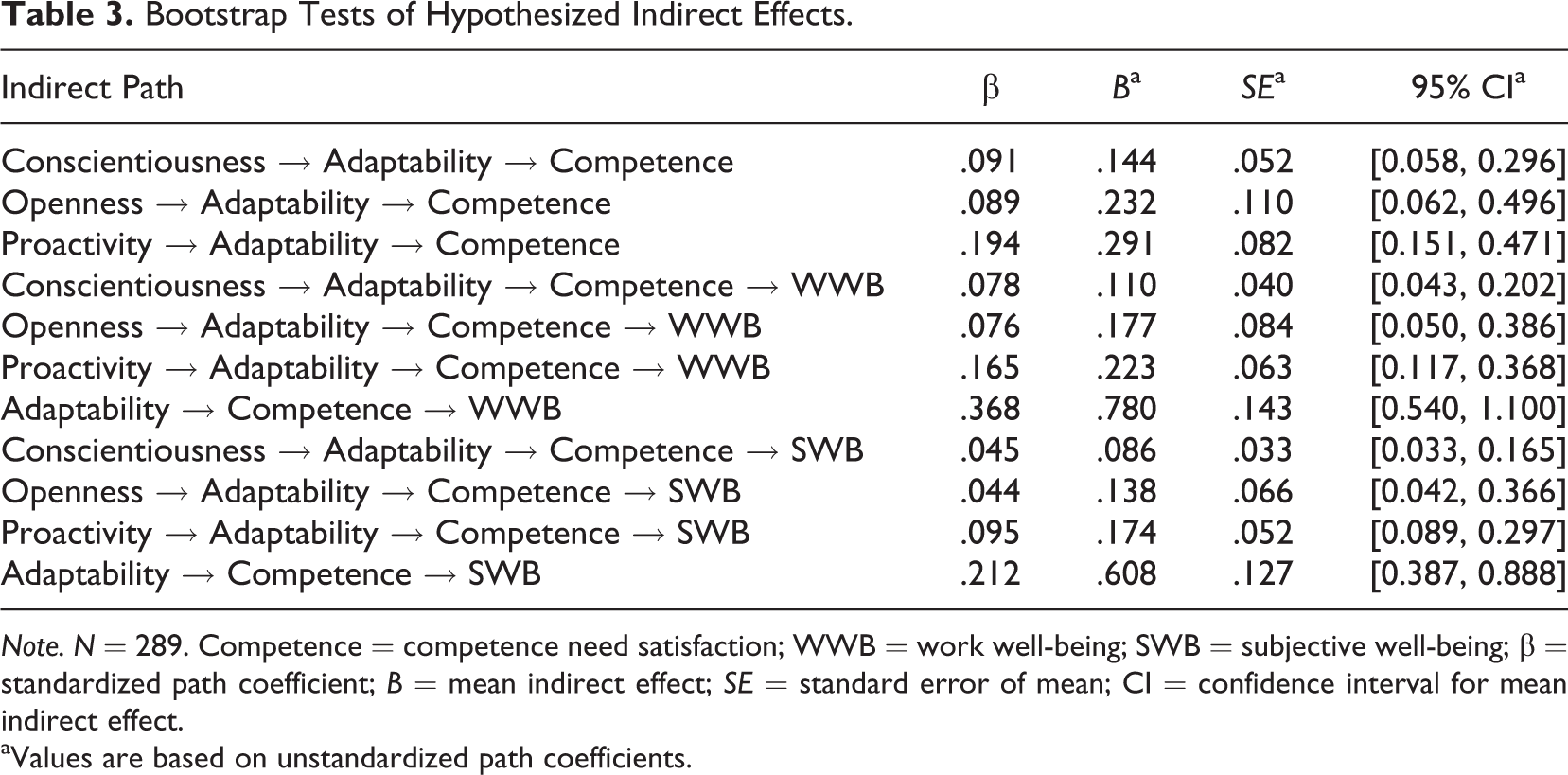
Note. N = 289. Competence = competence need satisfaction; WWB = work well-being; SWB = subjective well-being; β = standardized path coefficient; B = mean indirect effect; SE = standard error of mean; CI = confidence interval for mean indirect effect.
aValues are based on unstandardized path coefficients.
Discussion
The present study examined the CCT model of adaptation using a sample of working adults diagnosed with the chronic health condition of Chiari malformation. Specifically, we tested a mediation model in which trait-like adaptive readiness (i.e., adaptivity) fosters adaptability resources, which in turn condition adapting responses, which lead to adaptation results. Results supported all of the hypothesized direct and indirect relations between CCT constructs. Adaptivity significantly predicted adaptability, adapting responses, and adaptation results; adaptability significantly predicted adapting responses and adaptation results; and adapting responses significantly predicted adaptation results. Furthermore, all 11 significant relations of adaptivity to adapting responses and adaptation results and of adaptability to adaptation results were fully mediated, as posited by the CCT model of adaptation. Prior to testing the model of adaptation, we examined and found support for the higher order structure of the recently developed CAAS-SF. Collectively, results indicated strong support for the applicability of the adaptation model among workers with Chiari malformation. Functional limitations resulting from Chiari malformation symptomology (e.g., pain, fatigue) present workers with an array of unique challenges in the workplace. In spite of these adaptive challenges, workers who were more prepared and willing to change were better able to utilize their adaptability resources to effect change when needed, ultimately resulting in higher levels of work well-being and subjective well-being. Following is a more detailed discussion of the major findings.
CAAS-SF Structure
To the best of our knowledge, this was the first independent test of the structure of the CAAS-SF since its recent development (Maggiori et al., 2017). The CAAS-SF was developed as a brief alternative to the widely used CAAS 2.0 (Porfeli & Savickas, 2012). CFA results indicated that the proposed hierarchical structure of the CAAS-SF fit our data reasonably well. Item and higher order factor loadings were generally consistent with those reported by Maggiori et al. (2017), with two notable exceptions. Concern Item 1 loaded .52, and confidence Item 12 loaded .77, compared to Maggiori et al.’s (2017) loadings of .73 and .94, respectively. CAAS-SF subscale internal consistency estimates (ranging from .74 to .79) were consistent with estimates (ranging from .76 to .83) reported by Maggiori et al. Perhaps the most striking departure from Maggiori et al.’s findings were the lower mean scores observed in the current study. Maggiori et al. reported mean subscale scores ranging from 3.47 to 3.56 (SDs from .66 to .74) for concern, from 4.02 to 4.07 (SDs from .65 to .72) for control, from 3.58 to 3.78 (SDs from .65 to .70) for curiosity, and from 3.93 to 4.00 (SDs from .62 to .75) for confidence in samples of French- and German-speaking men and women. In comparison, workers with Chiari malformation reported means ranging from 2.91 (SD = 0.96) for concern to 3.65 (SD = .88) for control (see Table 1). The lower career adaptability means (particularly for concern about preparing for future career tasks) found in our sample suggest that workers with Chiari malformation may have perceived fewer adaptability resources than their (presumably) healthy counterparts. The low level of concern reported by participants is somewhat surprising given the numerous work-related challenges faced by these workers. Johnston (2018) speculated that adaptability resources (and responses) may become decreased when individuals are in situations perceived as threatening. Workers with Chiari malformation, who frequently face job insecurity and myriad health issues, may be preoccupied about their job and health status, thus leading to depleted adaptability resources. Overall, CFA results and descriptive statistics support using the CAAS-SF with workers diagnosed with Chiari malformation. Future researchers are encouraged to conduct additional investigations of the CAAS-SF’s validity in independent samples of workers with Chiari malformation and other chronic health conditions.
CCT Model of Adaptation
Observed relations among adaptivity, adaptability resources, adapting responses, and adaptation results provided strong support for the CCT model of adaptation in workers with Chiari malformation. As hypothesized, higher levels of adaptivity—operationalized as the dispositions of proactivity, conscientiousness, and openness—were associated with higher levels of career adaptability, adapting responses, and adaptation results. The positive associations between adaptivity and adaptability are consistent with previous research (e.g., Rudolph et al., 2017; Zacher, 2014) and suggest here that individuals living with Chiari malformation who take intentional action to effect change, strive, and persevere at achieving their goals and consider unfamiliar ideas and experiences are more ready and willing to invoke adaptability resources when needed. Positive associations of adaptivity with adapting responses (i.e., competence need satisfaction at work) were fully mediated via adaptability resources, as posited by the CCT model of adaptation. Thus, workers with Chiari malformation who possess a greater capacity and willingness to change are able to facilitate the satisfaction of competence needs at work through their enhanced adaptability resources. Significant effects of adaptivity on adaptation results (i.e., work well-being and subjective well-being) occurred via adaptability and adapting responses, which is consistent with the sequence of mediated relations implied by the CCT. These findings suggest that workers with Chiari malformation who are more ready and willing to effect positive change ultimately translate their adaptivity dispositions into higher levels of work well-being and subjective well-being by drawing on their self-regulatory strengths to develop skills and attain success in the face of numerous challenges and barriers at work.
As posited by the CCT model of adaptation, career adaptability was positively associated with adapting responses (i.e., competence need satisfaction at work) and the two adaptation results. The positive association of adaptability with adapting suggests that workers with Chiari malformation who possess the psychosocial resources to respond to career tasks and challenges are more likely to experience competence at work activities that facilitate development and effective performance. This finding is consistent with the literature positively linking adaptability to other indices of adapting, including career planning, career exploration, and occupational and career decision-making self-efficacy (Hirschi, Herrmann, & Keller, 2015; Rudolph et al., 2017). Associations of adaptability with adaptation results were fully mediated via adapting (i.e., competence need satisfaction), as posited by the CCT. Thus, workers possessing greater adaptability resources attained higher levels of work well-being and subjective well-being by developing strategies and engaging in behaviors aimed at satisfying competence needs at work.
Finally, adapting responses (i.e., competence satisfaction at work) was significantly associated with both of the adaptation responses (i.e., work well-being and subjective well-being). These findings, which align with the CCT model of adaptation, are consistent with previous studies linking competence need satisfaction at work with life satisfaction (Autin et al., 2019) and different indicators of work well-being including work engagement (Deci et al., 2001; Van den Broeck et al., 2010) and job satisfaction (Autin et al., 2019; Van den Broeck et al., 2010). According to Deci et al. (2001), the need for competence at work is satisfied when a worker is able to succeed at challenging work activities that facilitate development and effective performance and appreciated for their competence. Given that many workers with Chiari malformation experience concerns about their work ability, performance, and coworker relationships (Tokar & Kaut, 2019), it is hardly surprising that participants who felt more competent and appreciated at work reported higher levels of work well-being and subjective well-being.
Limitations and Future Directions
Our findings should be considered in light of several limitations. First, we used a cross-sectional, correlational design; naturally, we cannot make casual inferences about the relations among the variables. We encourage future researchers to consider studying the CCT model of adaptation using longitudinal or experimental designs that can test causal relations among variables as individuals develop over time and with ongoing work experiences. Second, the sample consisted of adult workers diagnosed with Chiari malformation, a fairly rare chronic health condition (Meeker et al., 2015). One could argue that workers with chronic health conditions (including Chiari malformation) are an ideal population on which to evaluate the model of adaptation because these individuals are more likely than healthy workers to face unique challenges (e.g., functional limitations resulting from their condition, marginalization, economic hardships) that may adversely affect work aspirations, performance, and satisfaction. Nevertheless, it is reasonable to suspect that the experiences of workers with Chiari malformation may not generalize to workers with other chronic health conditions. Indeed, the physical nature of Chiari malformation might impose a more restricted range of adaptive limitations, thus challenging these workers in ways unique and different from other chronic health conditions. Future researchers are encouraged to test the full sequence of the CCT adaptation model using diverse samples of adults with or without chronic health conditions.
Third, results of our study are limited to the specific indicators of the adaptation model constructs. We encourage future researchers to test the adaptation model using diverse operationalizations of adaptivity characteristics, adapting responses, and adaptation results. We also encourage more research on the work lives of individuals with Chiari malformation. Preliminary findings suggest that workers with Chiari malformation, like workers with other chronic health conditions, are at an increased risk of experiencing economic hardships and marginalization and may be less likely to experience decent work and overall quality of life than healthy workers (Meeker et al., 2015; Tokar & Kaut, 2018). Mean CAAS-SF subscale scores reported by participants in the present study suggest that workers with Chiari malformation may experience fewer adaptability resources than other workers. We encourage future researchers to examine potential barriers to career adaptability, decent work, and adaptation outcomes in workers with Chiari malformation and other chronic health conditions.
Footnotes
Acknowledgment
The authors thank the people who participated.
Declaration of Conflicting Interests
The author(s) declared no potential conflicts of interest with respect to the research, authorship, and/or publication of this article.
Funding
The author(s) disclosed receipt of the following financial support for the research, authorship, and/or publication of this article: This research was funded by a Conquer Chiari Research Grant from the Conquer Chiari Foundation.
