



Abstract
To facilitate future research on career adaptability, this study aims to validate the super-short form of the Career Adapt-Abilities Scale (CAAS-SSF) through two studies across three samples. In Study 1, the full scale is shortened to a 4-item scale based on a Chinese sample (Sample 1, N = 616), considering both reliability and validity. Study 2 aims to validate the 4-item CAAS-SSF across two additional samples: Sample 2 in China (N = 332) and Sample 3 in the United Kingdom (N = 317). Results show that the CAAS-SSF demonstrates satisfactory reliability and good fit with the unidimensional model of career adaptability. Furthermore, the super-short scale exhibits acceptable measurement invariance across gender and culture groups. Moreover, criterion-related validity of the CAAS-SSF is supported by its positive correlations with criterions (i.e., job performance, career satisfaction, and occupational self-efficacy) that parallel results of the CAAS and CAAS-Short Form. Overall, the findings support the CAAS-SSF as a reliable and valid representation of the 24-item CAAS. Limitations and directions for future research are also discussed.
Keywords
Introduction
In this era of VUCA (volatility, uncertainty, complexity, and ambiguity), employees are experiencing more frequent career transitions and unpredictable career paths (Bennett & Lemoine, 2014; Haenggli & Hirschi, 2020; Volmer et al., 2022). Within this dynamic and unstable context, career adaptability has emerged as a crucial competency for individuals to navigate challenges and changes (Ocampo et al., 2022; Savickas & Porfeli, 2012). Career adaptability, conceptualized as an individual-level psychosocial construct for comprehending career development, represents the capacity of tackling changes and uncertainty (Savickas, 1997; Savickas & Porfeli, 2012). Introduced by Super and Knasel (1981), the construct career adaptability lies in the central position of career construction theory and contains four dimensions: concern, control, curiosity, and confidence (Rudolph, Lavigne, & Zacher, 2017; Savickas, 1997; Savickas & Porfeli, 2012). Extant literature has emphasized the importance of career adaptability and extensively investigated its positive effects on individal and organizational outcomes (e.g., Haenggli & Hirschi, 2020; Maggiori et al., 2017; Ocampo et al., 2022).
To date, two scales (i.e., Career Adapt-Abilities Scale and Career Adapt-Abilities Scale-Short Form) have been introduced to assess career adaptability, both of which comprising four dimensions. The Career Adapt-Abilities Scale (CAAS), which consists of 24 items, was collaboratively constructed by scholars from different countries and proved to achieve satisfactory reliability and validity across various cultural settings (Hou et al., 2012; Savickas & Porfeli, 2012). To easier integrate career adaptability with other constructs into surveys and facilitate career counseling, Maggiori et al. (2017) shortened the CAAS, forming a briefer version with 12 items, which has been validated in various cultural samples (Soares et al., 2022; Yu et al., 2020).
While career adaptability has been measured by multidimensional scales, there is theory and empirical evidence that supports the overall construct of career adaptability. According to the career construction theory, career adaptability is conceptualized as an aggregate construct which means a composite of different aspects, indicating that four dimensions combine to become a global indicator of career adaptability (Liden et al., 2015; Savickas & Porfeli, 2012). In empirical research, career adaptability is usually operationalized in a global form, as total scores of the CAAS are used for analysis (e.g., Gregor et al., 2021; Leung et al., 2022; Pan et al., 2018). However, when focusing on overall career adaptability, the 12-item scale with multiple items per dimension is still somewhat lengthy and less suitable in settings where brevity is particularly important, such as, large-scale surveys or repeated measurement (West et al., 2021). Therefore, the introduction of the super-short form of the Career Adapt-Abilities Scale (CAAS-SSF), which consists of single factor and fewer items, could address the drawbacks of existing scales. The CAAS-SSF could further conserve resources, reduce respondents’ reluctance and fatigue to complete the survey, and improve the response quality (Schaufeli et al., 2019). It will especially be beneficial for studies with successive repeated measurement or complicated models (Szerdahelyi et al., 2022). Many studies that require consecutive measurement of variables, such as those utilizing experience sampling methodologies (ESM), often employ extremely short scales or even single items (e.g., Ayoko et al., 2023; Siebers et al., 2022), which help avoid participants’ boredom and increase response rate (Szerdahelyi et al., 2022). Super-short scales would also significantly benefit studies designed with complex models and multiple variables, since fewer questions reduce the likelihood of refusing to participate and save research sources (Schaufeli et al., 2019). Validating an ultra-short scale for career adaptability would be useful for future vocational research.
Therefore, this study intends to introduce and validate the super-short form of the CAAS through two studies, following guidelines for scale development and reduction (Hinkin, 1998; Smith et al., 2000; Stanton et al., 2002) and examples of constructing super-short scales (e.g., Maggiori et al., 2017; Martín-Fernández et al., 2022; Szerdahelyi et al., 2022; West et al., 2021). Study 1 is designed to adapt the full-length scale to the super-short form of the CAAS (CAAS-SSF), using data collected from Chinese samples. In study 1, we first theoretically defined the item number and factor structure of the CAAS-SSF, which was proposed to comprise a single factor with four items from each of the four dimensions of the CAAS. Afterwards, this study generated all possible 4-item combinations and selected the optimal one based on internal consistency reliability, confirmatory factor analysis (CFA) and expert judgment.
Study 2 aims to validate the scale using two new samples from different countries: China and the United Kingdom to enhance the generalizability of the findings. Specifically, we assessed the internal consistency reliability and factor structure of the CAAS-SSF. Furthermore, the measurement variance was evaluated across different gender and culture groups. Additionally, study 2 examined the correlations among different versions of the CAAS. Last, we investigated criterion validity of the CAAS-SSF, expecting that this scale would show the similar results as the CAAS and the CAAS-SF in terms of relationships with criterion variables.
In sum, this study expects to address the shortcomings of current longer scales for career adaptability by introducing a reliable and valid super-short form of the CAAS. With the advantage of improved efficiency and response rates, the CAAS-SSF will contribute to future academic research on career adaptability.
Career Adaptability and Measurement
Career adaptability was proposed by Super and Knasel (1981) as a replacement for the concept vocational maturity given that it was more suitable to describe adult career development. It is recognized as a pivotal concept in career construction theory (CCT), which has been appraised as a grand theory about vocational development (Rudolph et al., 2019; Savickas, 1997). Expanded from Super’s theory of vocational development, CCT adopts a new contextualist view to conceptualize development, which is driven by adaptation to the environment rather than maturation of inner structures (Savickas, 2002). CCT incorporates sixteen prepositions, integrating personality, career adaptability, and life themes and facilitating the understanding of what, how, and why of vocational behaviors (Del Corso & Rehfuss, 2011; Savickas, 2002; Yu et al., 2020).
Career adaptability just concerns “how” individuals construct and develop their careers (Maggiori et al., 2017), which is defined as “the readiness to cope with the predictable tasks of preparing for and participating in the work role and with the unpredictable adjustments prompted by changes in work and working conditions (Savickas, 1997, p.254)”. According to CCT, which depicts a complete casual chain of adaptation, people’s willing (i.e., adaptivity) and ability (i.e., career adaptability) to navigate changes will shape their career-related beliefs and behaviors (i.e., adapting responses), thus leading to the adaptation results, indicated as success, satisfaction, and development (Haenggli & Hirschi, 2020; Rudolph, Lavigne, & Zacher, 2017; Savickas & Porfeli, 2012). In this casual chain, career adaptability can be deemed as a kind of self-regulation strength or resources to effectively address complex and ambiguous challenges on career paths, thereby positively influences career development and success (Savickas & Porfeli, 2011, 2012).
Career adaptability is proposed to have four dimensions representing four distinct adaptabilities (Hou et al., 2012; Savickas & Porfeli, 2012). Concern represents the extent to which an individual is concerned about his or her vocational future (Savickas & Porfeli, 2012). The second dimension, control, means one’s being responsible for career development and having perceived control over vocational situations (Maggiori et al., 2017; Rudolph, Lavigne, Katz et al., 2017). The third dimension, curiosity, is characterized by exploring possible selves and future scenarios (Savickas & Porfeli, 2012). Lastly, confidence reflects perceived self-efficacy to solve problems and the ability to overcome obstacles (Maggiori et al., 2017). These four dimensions together compose the global career adaptability construct (Leung et al., 2022).
To assess career adaptability, two widely acknowledged versions of scales have been developed. The first is the Career Adapt-Abilities Scale (CAAS), a 24-item scale consisting of 6 items in each dimension. It was developed by an international team of vocational psychologists from thirteen countries (Savickas & Porfeli, 2012; Yu et al., 2020). With high reliability and validity across many countries, the CAAS is a well-established tool for assessing career adaptability. In empirical studies, scholars prefer using the total career adaptability scores over subscale scores (Leung et al., 2022). The second version is the CAAS-Short Form (CAAS–SF), developed by Maggiori et al. (2017) for convenience in surveys. It comprises three items per dimension, totaling 12 items. The CAAS-SF has been validated in various nations, including not only European (Soares et al., 2022) but also Asian countries (Yu et al., 2020). Although the CAAS-SF is only half the length of the original, it retains the same factor structure and similar psychometric properties to the full version (Yu et al., 2020).
Construction and Validation Procedure of the Super-Short Form of Career Adapt-Abilities Scale
To identify a reliable and valid super-short form of CAAS, we designed two studies: study 1 focuses on constructing the CAAS-SSF and study 2 aims to validate this super-short scale. The detailed descriptions of the two studies are outlined below.
To begin with, it is important to note two common pitfalls in the process of scale reduction: solely considering item content or exclusively relying on psychometric indices (Smith et al., 2000). The former pitfall might lead to invalid measurement tools, while the latter might result in scales capturing only a narrow aspect of the original construct (Szerdahelyi et al., 2022). To avoid both pitfalls, study 1 considers psychometric properties and content simultaneously, in line with the recommendations from Stanton et al. (2002) and studies of constructing short measures (e.g., Maggiori et al., 2017; Szerdahelyi et al., 2022).
In study 1, we first should determine the number of items and factor structure of the super-short measure (Step 1). This step is concerned about content validity and ensures the full spectrum of dimensions can be captured in the short measure. As suggested by Liden et al. (2015), at least one item should be included to represent each dimension of the full-length scale. Therefore, given that career adaptability is defined as a four-dimension construct, the super-short CAAS should theoretically contain four items, with one from each of the dimensions of the CAAS (Savickas & Porfeli, 2012).
Second, to select the appropriate items for the super-short scale, we will calculate reliability for all possible 4-item combinations. Internal consistency reliability is a key property of scales; so, this study adopts internal reliability as one of the conditions for screening out the candidate combinations, in line with Szerdahelyi et al. (2022). As four items should be selected from four 6-item subscales of the CAAS respectively, a total of 1296 optional combinations need to be evaluated in terms of internal consistency reliability. Combinations with Cronbach’s alpha value, a common indicator of internal consistency reliability (Cortina, 1993), lower than .70 will be discarded as unqualified (Step 2).
In addition to examining the internal consistency reliability, confirmatory factor analysis (CFA) is considered as an essential method to evaluate the short measure, in addition to examining the internal consistency reliability (Martín-Fernández et al., 2022; Szerdahelyi et al., 2022). It can be used to assess the fitness of the proposed model, indicating structural validity of the measures (Maggiori et al., 2017). Thus, this study will conduct the CFA for the item combinations retained after Step 2. Those performing a good fit (χ2/df < 3, RMSEA <.08, SRMR <.08, CFI >.9 and all factor loadings ≧ .5) for the single factor model will be selected (Step 3). After screening based on the results of reliability and CFA, there may still be several remaining item combinations. Last, the content breadth and representativeness of individual items in the remaining item combinations will be reviewed and evaluated (Step 4). The optimal item in each dimension will be included in the CAAS-SSF.
After determining the CAAS-SSF, we will validate it in Study 2 on two additional independent samples: one from China and the other from the UK. First, we will test the internal consistency reliability (Step 5) and second conduct confirmatory factor analysis (CFA) on both samples (Step 6). The super-short scale is expected to show acceptable internal consistency reliability and fitness indices in CFA.
Does the CAAS-SSF exhibit acceptable results in terms of (1a) internal consistency reliability and (1b) fit indices in confirmatory factor analysis? Additionally, examining measurement invariance or equivalence is crucial in constructing a scale as it is a way to prove that the scale could measure one construct with identical structure across different groups (Savickas & Porfeli, 2012). Career adaptability, as a psychosocial construct, can be greatly influenced by contextual factors except for individual differences (Savickas & Porfeli, 2012). Since different cultures provide different demands and opportunities for developing adaptability, people would exhibit different expressions of the career adaptability construct (Savickas & Porfeli, 2012). Besides, issues related to translation or linguistic differences may affect perceive how people perceive and respond to the items (Savickas & Porfeli, 2012). However, if conducting cross-cultural surveys and comparing career adaptability between groups, the measure needs to possess the same structure across different groups (van de Schoot et al., 2012). Measurement invariance serves as a key indicator of group comparisons (Yu et al., 2020). Through testing measurement invariance, the comparability and generalizability of the scale can be supported, enhancing the accuracy of research conclusions (Martín-Fernández et al., 2022; Vandenberg, 2002). Therefore, this study will use multigroup confirmatory factor analysis to investigate the measurement equivalence of the CAAS-SSF across gender and culture groups (Step 7). Before analysis, we will first divide each of the two samples in study 2 into two categories based on gender, allowing for comparison between males and females. Besides, we also intend to compare the Chinese sample with UK sample. Then the measurement invariance of the CAAS-SSF will be assessed across different gender and country groups in a set of models: configural (M0), metric (M1), and scalar (M2) models. By comparing M1 with M0 and M2 with M1 for each analysis unit, the differences in CFI and RMSEA should simultaneously reach the criteria (△CFI ≤.010, △RMSEA ≤.015) to indicate the CAAS-SSF maintains measurement equivalence (Meng et al., 2022).
Does the CAAS-SSF achieve sufficient measurement invariance across gender and culture groups? Furthermore, the CAAS-SSF is expected to be a valid representation of the CAAS and CAAS-SF, as reflected in significantly high correlations with both the CAAS and CAAS-SF. This step (Step 8) involves a series of correlation analyses. According to Levy (1967), the part-total correlation computed sometimes is spuriously high when developing short scales. The correction formulation proposed by Levy (1967) is aimed at solving the inflated correlations between shortened and full-length scales caused by item overlapping. Therefore, apart from uncorrected correlations, we will present the correlations calculated using Levy's (1967) corrected method.
Does the CAAS-SSF demonstrate strong associations with the CAAS and CAAS-SF in both samples? The criterion-related validity of the CAAS-SSF requires further analysis, as suggested by prior studies (Stanton et al., 2002; West et al., 2021). We will choose some career-related outcomes belonging to the established nomological network of the career adaptability as criterion variables and examine the relationships between the CAAS-SSF and these chosen variables (Step 9). To identify the suitable criterions, we referred to previous literature that has extensively discussed and established the nomological network of career adaptability (Rudolph, Lavigne, Katz et al., 2017). According to the career construction theory, which depicts the causal chain of career adaptability, people’s career adaptability influences adapting responses and in turn adaptation results (Rudolph et al., 2017b). Therefore, criterion variables can be derived from the adapting responses and adaptation results. Adapting responses refer to adaptive behaviors and beliefs to cope with tasks and conditions in occupational development or transitions (Rudolph et al., 2017b; Savickas & Porfeli, 2012). Occupational self-efficacy is one of the important adapting responses, which is defined as the subjective judgement about the ability to successfully fulfil job tasks (Rigotti et al., 2008). In a meta-analysis study (Rudolph et al., 2017b), career adaptability was found to be positively associated with occupational self-efficacy significantly. Moreover, Savickas and Porfeli (2012) originally noted that adaptability was closely related to the concept of psychological capital and characterized by having confidence to succeed at tasks (i.e., self-efficacy). Thus, occupational self-efficacy is identified as a criterion variable in this study. Adaptation represents the fitness between the person and environment and can be indicated by success and satisfaction (Rudolph et al., 2017b; Savickas & Porfeli, 2012). Specifically, the fitness indicators include job or career satisfaction, job performance, turnover intention, work engagement, entrepreneurship and subjective well-being (Douglass & Duffy, 2015; Li et al., 2015; Rudolph, Lavigne, Katz et al., 2017). Following the study of Yu et al. (2020) that aims to validate the CAAS-SF, we choose career satisfaction and job performance as another two criterion variables. Career satisfaction refers to one’s perceived satisfaction about the current career achievement (Rudolph, Lavigne, Katz et al., 2017). Studies revealed that career satisfaction and job performance have significant positive relationships with career adaptability (Chan & Mai, 2015; Rudolph, Lavigne, & Zacher, 2017; Yu et al., 2020; Zacher, 2015). To sum up, the criterion validity will be investigated by examining the relationships between the CAAS-SSF and criterions variables including job performance, career satisfaction, and occupational self-efficacy. It is expected that the criterion correlations of the CAAS-SSF parallel those of the CAAS and CAAS-SF, thus confirming its criterion-related validity. The whole procedure of constructing and validating the CAAS-SSF is summarized in Figure 1.
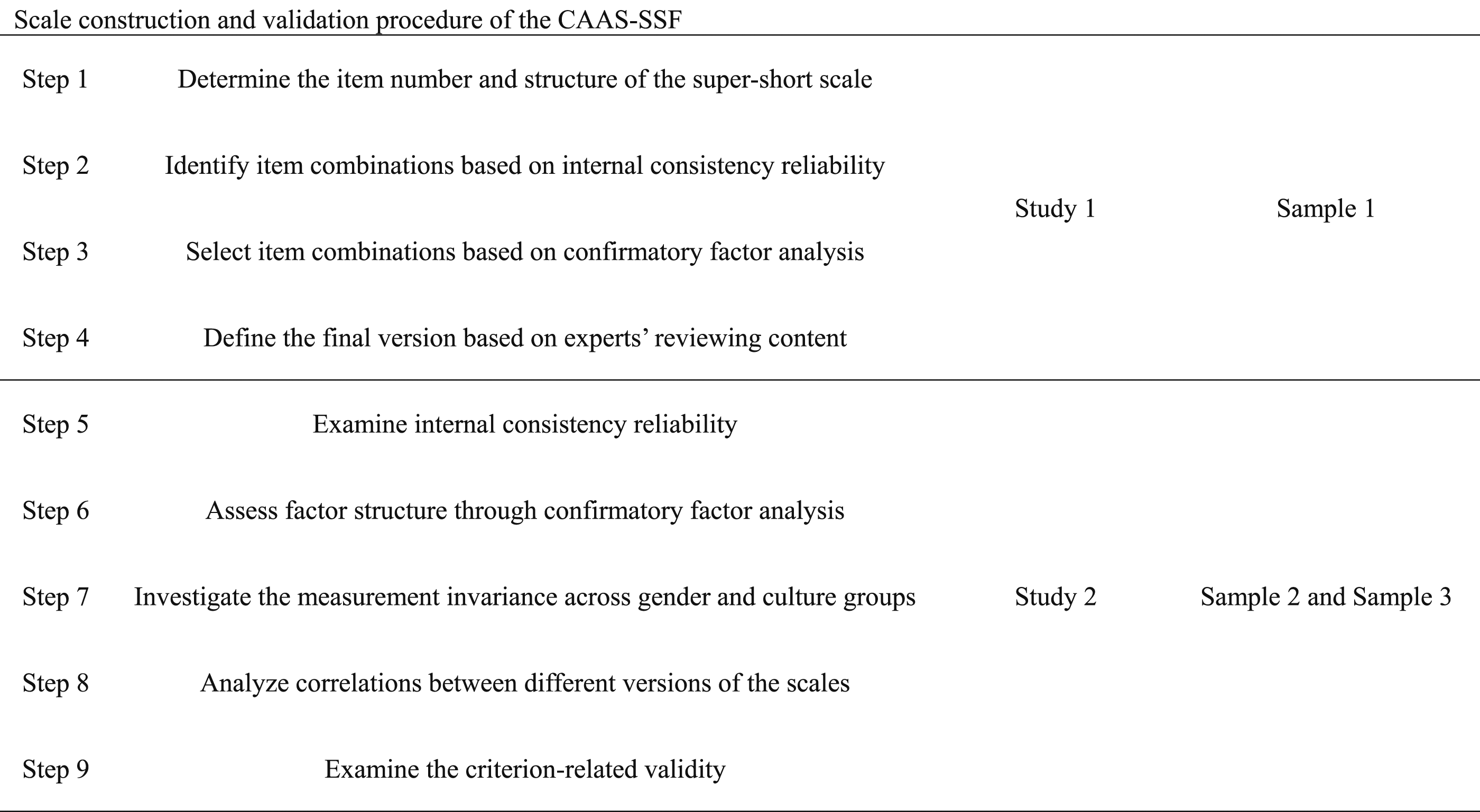
The scale construction and validation procedure of the CAAS-SSF.
Does the CAAS-SSF possess acceptable criterion-related validity as reflected in the correlations with each criterion variable similar to the CAAS and CAAS-SF?
Study 1: Construction of the Super-Short Form of Career Adapt-Abilities Scale
Sample
Sample
Data in study 1 were collected from a sample of Chinese working adults. We contacted some working people through the school-alumni network and requested their assistance in distributing online questionnaires to their colleagues. Participants were promised a compensation of .71 USD (5 CNY) for completing the survey. In mid-November 2022, we initiated the survey which contained demographic information and the 24-item CAAS. Finally, a total of 909 participants provided data for the study. After excluding cases that failed the attention check, had pattern or illogical answers, finished too quickly (average response time less than 2 seconds per question), and were identified as outliers by Mahalanobis distance test, a total of 616 valid answers were retained for analysis.
Among the 616 Chinese working adults, 43.99% (n = 271) were males and 56.01% (n = 345) were females. Most of the participants (97.6%, n = 601) held bachelor’s or higher degrees. The average age of the participants was 33.35 years, and the average job tenure was 10.07 years.
Measures
Career Adaptability
For this study, we used the Chinese version of the 24-item CAAS, which is adapted from the validated CAAS-China Form (Hou et al., 2012). Considering better understandability in the Chinese context, one sentence of the instruction was slightly modified as “Please rate how well you are performing at each of the following behaviors.” Participants responded to each item using a 5-point Likert-type scale ranging from 1 = very bad to 5 = very good. Cronbach’s alpha for the CAAS in Sample 1 was .96.
Results
Item Selection
After determining that the super-short scale should contain 4 items, we next identified the potential 4-item combinations with satisfactory reliability and validity. Since the original CAAS has four dimensions, with each dimension incorporating 6 items, a total of 1,296 possible combinations were generated. We first calculated the Cronbach’s alphas of all combination options, followed by a confirmatory factor analysis. Ultimately, 623 combinations of the super-short scale were found to meet the aforementioned requirements for Cronbach’s alpha and CFA indices. As there were many feasible 4-item combinations, priority was given to the combinations with all the factor loadings reaching .60, filtering out 255 candidate combinations. All analyses were performed with “psych” package and “lavvan” package in R 4.1.2 (R Core Team, 2019). Then we relied on content validity to verify the final CAAS-SSF, aligning with the method of previous studies (Meng et al., 2022; Szerdahelyi et al., 2022).
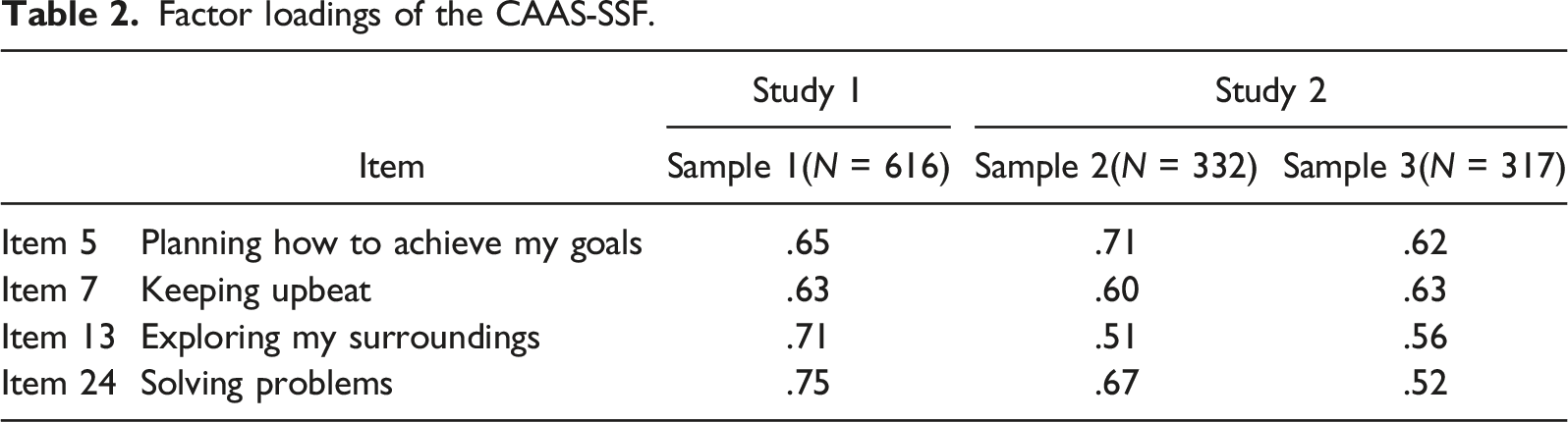
For the dimension of concern, items 1, 3, 4, 5, and 6 of the original CAAS scale were included in the viable CAAS-SSF combinations. As this dimension indicates the extent of being concerned about the future, it was concluded that item 5 could highlight the concept of concern. For the dimension of control, items 7 to 12 were included in remaining combinations. Given that control reflects the perceived control of an individual’s vocational situation and future (Maggiori et al., 2017), item 7 which means keeping a positive status could better fit the definition of control. As for curiosity, items 13, 15, 16, and 17 were reserved. Item 13 was selected to represent the curiosity dimension, which means exploring the circumstances and seeking information about potential opportunities (Savickas & Porfeli, 2012). As confidence comes from solving problems in daily work or life (Maggiori et al., 2017), this study determined item 24 to represent this dimension. In sum, the following items composed the final version of CAAS-SSF: “Planning how to achieve my goals” (Concern), “Keeping upbeat” (Control), “Exploring my surroundings” (Curiosity), and “Solving problems” (Confidence).
Reliability and confirmatory factor analysis (CFA) results of the CAAS-SSF.
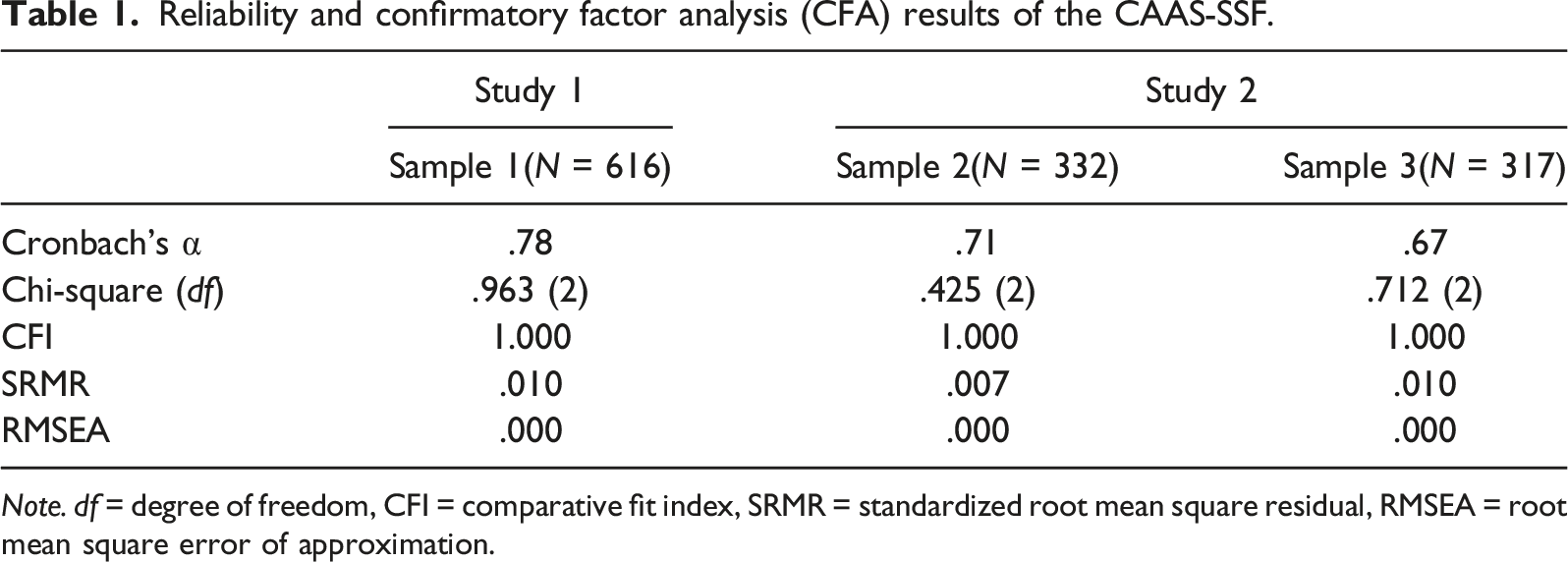
Note. df = degree of freedom, CFI = comparative fit index, SRMR = standardized root mean square residual, RMSEA = root mean square error of approximation.
Factor loadings of the CAAS-SSF.
Study 2: Validation of the Super-Short Form of Career Adapt-Abilities Scale
Samples
Consistent with previous practices of Maggiori et al. (2017), Martín-Fernández et al. (2022), and Szerdahelyi et al. (2022), we validated the CAAS-SSF on samples in different countries to demonstrate its cross-cultural applicability. In study 2, data were collected from a total of 649 participants in two countries: China and the UK.
Sample 2
Sample 2 was recruited in April 2023 through a Chinese online platform called Tencent Survey (https://wj.qq.com), which was designed for research data collection (Tang et al., 2022). Guaranteed anonymity, the participants filled out the questionnaire containing demographic information, 24-item CAAS, and criterion variables. Every participant was given .36 USD (2.5 CNY) after completing the survey. A total of 480 participants were recruited through the platform. Then we eliminated inattentive answers, pattern answers, too fast answers, outliers and illogical answers, obtaining 332 valid responses (69.2% response rate). The 332 participants had a mean age of 29.74 years (SD = 7.09) and a mean job tenure of 6.95 years (SD = 6.64). 33.43% of respondents were males (n = 111) while 66.57% are females (n = 221). Most of their education levels were bachelor degree or above (n = 236, 71.08%); and 28.92% of those were associate degree or below (n = 96).
Sample 3
In April 2023, we also collected data from 400 working adults in the UK through Prolific. The English respondents completed the survey that contained the same questions as the Chinese version but was in the English. Every participant received .71 USD (£.4) after finishing the questionnaire. According to the same criteria to screen out low quality answers for Sample 2, we finally obtained 317 valid responses (79.2% response rate). The Sample 3 consisted of 54.26% males (n = 172), 44.79% females (n = 142), and a small portion of people who did not specify their gender (n = 3, .95%). Most of them had a college (or A levels) education or above (n = 297, 93.69%). Their average age was 38.38 (SD = 11.18) years and job tenure was 18.05 (SD = 10.49) years.
Measures
The scales used in the Chinese and English sample originated from the same studies. However, the Sample 2 filled out the Chinese version of all scales, while the Sample 3 completed the English version. Both versions of the scales in Study 2 have been employed by previous scholars. Except career adaptability, all variables were graded on a 5-point Likert-type scale from 1 = strongly disagree to 5 = strongly agree to indicate the extent to which participants agree with the item statements.
Career Adaptability
The 24-item scale was used to assess career adaptability in both samples. We adopted the Chinese version used in study 1 for Sample 2. For Sample 3, we used the original 5-point Likert-type scale (i.e., 1 = Not strong, 2 = Somewhat strong, 3 = Strong, 4 = Very Strong, and 5 = Strongest) and instruction. Cronbach’s alphas for the CAAS in Sample 2 and Sample 3 were .94 and .93, respectively.
Job Performance
Job performance was measured with the 3-item scale adapted from the study of Lam et al.(2002), which has demonstrated good internal consistency reliability in previous studies (Sy et al., 2006). The original scale requires supervisors’ rating; however, in this study, participants self-reported their job performance. An example item is “I get my work done very effectively”. Cronbach’s alphas were .83 and .87, respectively for Sample 2 and Sample 3.
Career Satisfaction
Career satisfaction was measured by 5 items of the scale developed by Greenhaus et al. (1990). It has been used among Chinese samples in previous studies (e.g., Guan et al., 2015). One of the example items is “I am satisfied with the progress I have made toward meeting my goals for advancement.” Cronbach’s alpha was .93 in both samples.
Occupational Self-Efficacy
A 6-item short version scale developed by Rigotti et al. (2008) was used to measure occupational self-efficacy. It has been adopted among Chinese sample (Peng et al., 2023). Participants responded to items such as “I can remain calm when facing difficulties in my job because I can rely on my abilities.” Cronbach’s alphas in Sample 2 and Sample 3 were .87 and .79, respectively.
Results
Common Method Bias
The data from both samples in study 2 were cross-sectional, which might lead to the potential common method bias. Therefore, we performed Harman’s one-factor test to investigate the extent to which the common method bias may be evident in this study (Podsakoff et al., 2003). As for Sample 2, result showed that the total variance extracted by the common factor was 34.6%. For Sample 3, the result was 28.4%. Both the values fell below 40%, suggesting the bias issue was not severe (Doty & Glick, 1998).
Internal Consistency Reliability
As shown in Table 1, the Cronbach’s alphas of the CAAS-SSF were .71 in Sample 2 and .67 in Sample 3. The reliability value in Sample 2 reached the standard of .70; and in Sample 3, it was very close to the standard. Compared with the full-length CAAS, the internal consistency reliability of the super-short measure for career adaptability descended. Such situation is typical in scale reduction studies; because Cronbach’s alpha is function of the number of item covariances, which will rise as the number of scale items increases (Sleep et al., 2021).
Confirmatory Factor Analysis
This study conducted confirmatory factor analysis utilizing the ‘lavaan’ package (Rosseel, 2012) in the R 4.1.2. Like many other super-short scales (e.g., Liden et al., 2015; Martín-Fernández et al., 2022; Szerdahelyi et al., 2022), the CAAS-SSF was unidimensional. Therefore, the single-factor career adaptability model was assessed in CFA. Shown in Table 1, goodness-of-fit indices based on data from Sample 2 were: χ2 = .43, df = 2, RMSEA = .000, SRMR = .007, CFI = 1.000. In Sample 3, the indices are: χ2 = .71, df = 2, RMSEA = .000, SRMR = .010, CFI = 1.000. All factor loadings (see Table 2) were higher than .50. The results met the criteria set above, indicating that the single-factor model fitted the data and the CAAS-SSF possessed satisfactory construct validity.
Measurement Invariance
Related to Research Question 2, we first examined invariance across genders on Sample 2 and 3, respectively. The configural models (M0) of both samples demonstrated satisfactory fits to the data across gender groups. The indices of Sample 2 were: χ2 (4) = .99, CFI = 1.000, RMSEA = .000. Of Sample 3, the M0 indices were: χ2 (4) = 1.34, CFI = 1.000, RMSEA = .000. The results indicated a maintained factor structure of the CAAS-SSF across different gender groups and provided a baseline model for comparisons with subsequent models (Xu & Li, 2021). Next, the models of metric invariance (M1) were tested with all factor loadings of different groups constrained to be the same. Compared with M0, changes of fit indices in Sample 2 were the same as those in Sample 3: △CFI = .000 and △RMSEA = .000. All indices were lower than the cutoff values (△CFI ≤.010 and △RMSEA ≤.015), suggesting that metric and configural models did not differ significantly in Sample 2 and Sample 3. Finally, the scalar invariance (M2) models were tested with item intercepts constrained to be identical (Meng et al., 2022). In Sample 2, the differences of indices between M2 and M1 were as follows: △CFI = .000 and △RMSEA = .000. In Sample 3, the differences were as follows: △CFI = .071 and △RMSEA = .046. The changes of fit indices between M2 and M1 in Sample 2 satisfied the criterion, indicating that the scalar invariance was achieved. However, data from Sample 3 could not provide evidence for scalar equivalence across gender groups. Overall, the CAAS-SSF maintained measurement invariance across genders in Sample 2 but did not maintain gender invariance in Sample 3.
Furthermore, we examined the measurement invariance of the CAAS-SSF across countries (i.e., Chinese and English). The fit indices of configural model (M0) showed good fit to the data as χ2 (4) = 1.14, CFI = 1.000, and RMSEA = .000. And changes of fit indices between M0 and M1 (△CFI = .000, △RMSEA = .000) were below the threshold, indicating that the there was no substantial difference between configural models and metric model. Compared with M1, M2 did not vary significantly in the CFI and RMSEA indices (△CFI = .000, △RMSEA = .000). The findings indicated the CAAS-SSF achieved measurement invariance across cultures and respondents from different countries interpreted the CAAS-SSF in the same way.
Comparison of the Super-Short Form of Career Adapt-Abilities Scale and the Other Versions of Career Adapt-Abilities Scale
Descriptive statistics and correlations among variables in sample 2.
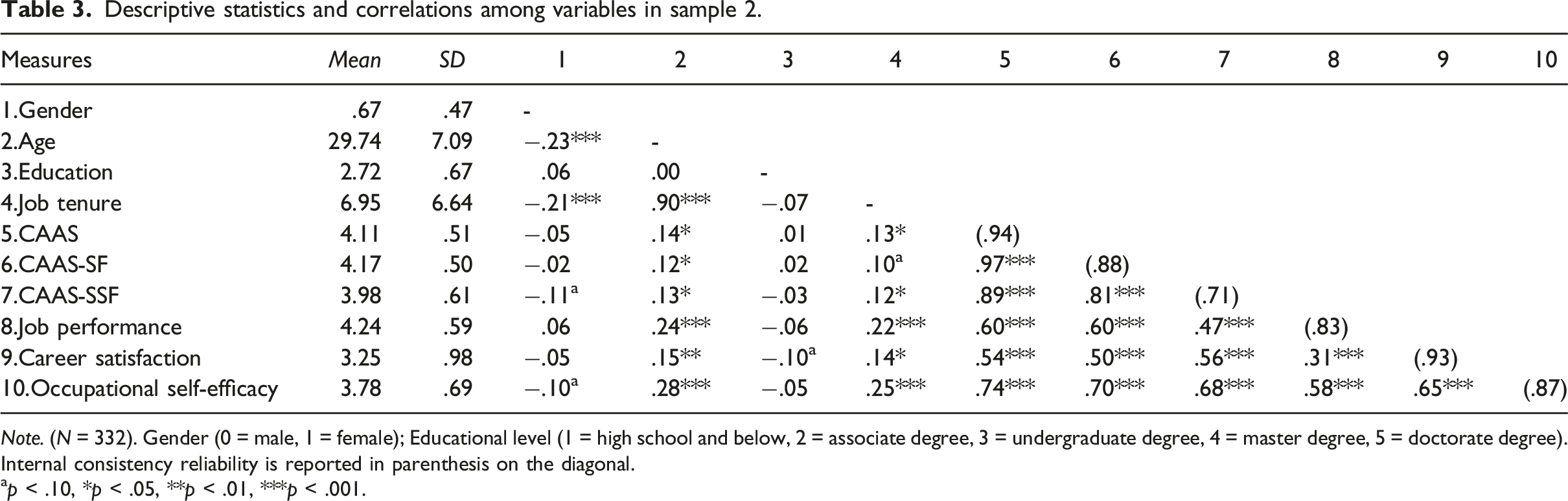
Note. (N = 332). Gender (0 = male, 1 = female); Educational level (1 = high school and below, 2 = associate degree, 3 = undergraduate degree, 4 = master degree, 5 = doctorate degree). Internal consistency reliability is reported in parenthesis on the diagonal.
ap < .10, *p < .05, **p < .01, ***p < .001.
Descriptive statistics and correlations among variables in sample 3.
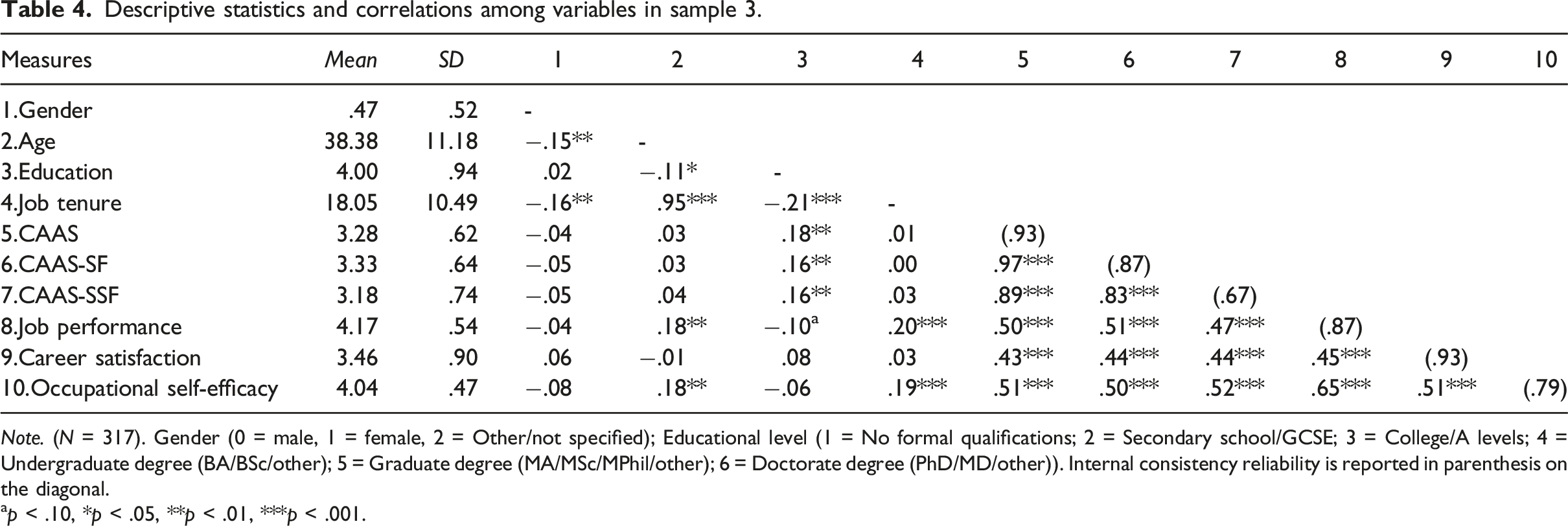
Note. (N = 317). Gender (0 = male, 1 = female, 2 = Other/not specified); Educational level (1 = No formal qualifications; 2 = Secondary school/GCSE; 3 = College/A levels; 4 = Undergraduate degree (BA/BSc/other); 5 = Graduate degree (MA/MSc/MPhil/other); 6 = Doctorate degree (PhD/MD/other)). Internal consistency reliability is reported in parenthesis on the diagonal.
ap < .10, *p < .05, **p < .01, ***p < .001.
Criterion-Related Validity
Beyond the correlations among different versions of the CAAS, we examined the correlations between the CAAS-SSF and criterion variables to investigate the criterion-related validity of the super-short scale (also see Tables 3 and 4). In both samples, the CAAS-SSF was positively related to job performance (r = .47, p < .001 in Sample 2; r = .47, p < .001 in Sample 3), career satisfaction (r = .56, p < .001 in Sample 2; r = .44, p < .001 in Sample 3), and occupational self-efficacy (r = .68, p < .001 in Sample 2; r = .52, p < .001 in Sample 3). Almost all the absolute differences in the CAAS and CAAS-SSF correlation results with the criterion variables were less than .10, generally indicating that similar patterns of relationships with criterions were shared between the CAAS-SSF and the full-length scale (Szerdahelyi et al., 2022). The only exception was that in Sample 2 the difference of correlations with job performance reached .13, slightly higher than .10. When comparing the CAAS-SSF with the 12-item CAAS-SF, the situations were the same. All criterion-related coefficients of the two scales differed by less than .10, except correlations with job performance in Sample 2. The difference in correlation with job performance was .13, very close to .10. In sum, the CAAS-SSF showed acceptable criterion-related validity as its correlations with three criterions closely approximated the results of the other two scales for career adaptability.
Discussion
Nowadays, the super-short form of scales are becoming more and more popular in research due to its convenience and efficiency (Sleep et al., 2021), with a number of scholars have dedicated effort to shorten scales for various constructs, for example narcissism (West et al., 2021), work engagement (Schaufeli et al., 2019), and psychological capital (Szerdahelyi et al., 2022). To facilitate future research on career adaptability, this study endeavors to validate the super-short scale for career adaptability (i.e., the CAAS-SSF). Drawing on previous recommendations and practices (e.g., Liden et al., 2015; Maggiori et al., 2017; Meng et al., 2022; Smith et al., 2000; Stanton et al., 2002; Szerdahelyi et al., 2022), the full scale 24-item CAAS was reduced to 4 items. And the reliability, measurement invariance, and validity of the CAAS-SSF were assessed across two samples. In general, the CAAS-SSF shows good psychometric properties.
While the CAAS-SSF demonstrates acceptable internal consistency reliability, the Cronbach’s alpha of the CAAS-SSF was slightly lower than the common cutoff value of .70 in the English sample. Cronbach’s alpha is a widely-used standard form to report the reliability of a scale; but it is an imperfect estimate. It might underestimate the internal consistency reliability of scales with fewer than 10 items (Herman, 2015). Actually, Cronbach’s alpha should be described as a lower-bound estimate of reliability (Cho & Kim, 2015). In many studies, the value of .60 is acknowledged as the acceptable threshold (Narayanamurthy & Tortorella, 2021; Taber, 2018). Therefore, though below the common threshold, the Cronbach’s alpha value can still suggest that the internal consistency reliability of the CAAS-SSF is accepted. The result is consistent with previous research, showing that the reliability of the super short form scale is lower than that of the longer version (e.g., Martín-Fernández et al., 2022; Schaufeli et al., 2019). In fact, the shrinkage of internal consistency reliability is very likely to occur in scale reduction, and it is allowed as long as falling within an acceptable range (Stanton et al., 2002).
This study has some theoretical implications. To begin with, the results provide convergent evidence regarding the measurement invariance of the scale for career adaptability. This study revealed the measurement equivalence of the CAAS-SSF across different countries (i.e., China and the UK), which suggests the structure and responses of the scale be equally valid cross-culturally (Xu & Li, 2021). Like the CAAS-SF, the 4-item super-short scale in our study could be used to reliably interpret potential differences when comparing different cultures (Maggiori et al., 2017). In terms of measurement invariance across genders, three types of invariances (i.e., configural, metric, and scalar) were supported on data from Chinese sample. Congruently with Yu et al. (2020), the Chinese samples in different gender groups interpret the questions and latent factor in the same way. However, in the UK sample, the scalar equivalence is not achieved, which may suggest that the measure exhibits mean differences across males and females (Savickas & Porfeli, 2012). Actually, many studies have noted the potential gender difference in career adaptability, i.e., females and males might display different levels of career adaptability (e.g., Gai et al., 2022; Negru-Subtirica et al., 2015; Zhang et al., 2021). Our results could enrich the research on potential gender differences in career adaptability. Against the finding, caution should be taken when considering the comparison of the CAAS-SSF across genders, especially in the UK.
Second, our study echoes suggestions in previous studies by evaluating the relationships between different versions of the CAAS and professional-related outcomes (Maggiori et al., 2017). The correlations of CAAS-SSF with criterions are aligned to those of the other two scales, supporting the criterion-related validity of the CAAS-SSF. The results show that professional-related outcomes (i.e., job performance, career satisfaction, and occupational self-efficacy) are positively related to career adaptability, which are consistent with previous studies (e.g., Rudolph, Lavigne, & Zacher, 2017; Yu et al., 2020). Moreover, the results agree with the career construction model of adaptation that career adaptability influences adapting responses (i.e., occupational self-efficacy) as well as adaption results (i.e., job performance and career satisfaction) and adapting responses are stronger related to career adaptability than adaptation results (Rudolph, Lavigne, & Zacher, 2017). Despite the satisfactory results, one thing that needs to be noted is correlation between the CAAS-SSF with occupational self-efficacy is relatively higher. However, previous scholars have revealed the relatively high correlation between career adaptability and occupational self-efficacy. For example, the correlation between career adaptability and occupational self-efficacy has been found reached over .65 in a three-wave longitudinal study (Volmer et al., 2022). Besides, Rudolph, Lavigne, Katz, and Zacher (2017) conducted a meta-analysis of 90 studies and reported the correlation of .60. The high correlation might be attributed to occupational self-efficacy being a kind of adapting responses, which is the proximal outcomes of career adaptability according to career construction theory (Rudolph, Lavigne, & Zacher, 2017; Savickas & Porfeli, 2012).
Last, given that currently there is no unified approach for shortening composite measures (Martín-Fernández et al., 2022), this study could make a valuable contribution by providing a systematic procedure to generate super-short measures. Following previous guidelines (Hinkin, 1998; Smith et al., 2000; Stanton et al., 2002) and examples of constructing super-short scales (e.g., Maggiori et al., 2017; Martín-Fernández et al., 2022; Szerdahelyi et al., 2022; West et al., 2021), this study demonstrates the procedure of shortening the full scale to super-short form, which combines qualitative (i.e., content validity analysis) and quantitative (psychometric analysis) methods (Martín-Fernández et al., 2022). Besides, this study presents a series of analyses concerning how to validate the super-short scale, ensuring the reliability and validity of the new scale. Our work may contribute to the advancement of methodological practices in scale reduction.
To sum up, evidence in the current two studies indicates that the CAAS-SSF could be a reliable and valid representation of the CAAS and CAAS-SF. However, this does not mean that the CAAS-SSF substitutes the multidimensional longer scales. The career construction theory and empirical studies support the unitary structure of career adaptability (e.g., Gregor et al., 2021; Leung et al., 2022; Savickas & Porfeli, 2012), which allows us to generate the unidimensional super-short scale to make measurement easier. Compared with longer scales, the super-short version offers a quick and efficient assessment, minimizing respondent burden and increasing the likelihood of higher response rates. Nonetheless, it is appropriate for measuring global career adaptability as it captures the overall essence of the construct (Liden et al., 2015). If delving into its specific dimensions, longer scales are recommended.
Practical Implications
Due to the brevity, the valid CAAS-SSF may offer greater utility in future studies, helping improve survey efficiency (Du et al., 2021). For example, experience sampling methodology (ESM) and daily diary methods are increasingly popular in research, which have the advantages of capturing variables more accurately and tracking the dynamic changes of variables (Fisher & To, 2012). Since these methods require consecutive and frequent measurement of variables, it is suggested to adopt ultra-short scales with few items in order to diminish participants’ fatigue and keep them responding regularly for days (Fisher & To, 2012; Szerdahelyi et al., 2022). Scholars have noted that career adaptability, as a kind of psychosocial resource, may fluctuate over time; however, the dynamic variation in career adaptability is neglected in extant research (Zacher, 2015). As ESM and daily diary methods are suitable for discussing fluctuations, our super-short measure would open up opportunities for implementing the ESM and daily diary methods in career adaptability research, thus advancing our understanding of its dynamic nature. Besides, the super-short scale can offer advantages in experiments, especially those needing repeated measures (Romero et al., 2012). The repeated measures experiment is a common method in psychology, which is often used to assess the effects of interventions (Dunlap et al., 1996; Morris & DeShon, 2002). Therefore, with the assistance of a super short scale, it becomes more convenient to implement pretests and multiple post-tests in repeated measurement experiments, allowing for the examination of long-term effects of interventions on career adaptability (Szerdahelyi et al., 2022). Moreover, for studies involving many variables or time points, measures containing fewer items are also necessary to reduce questionnaire response time and increase response rate (Ziegler et al., 2014). Facilitating wide range of studies, the CAAS-SSF will help enrich the research on career adaptability and contribute to related theories.
In addition to academic utility, the CAAS-SSF also holds practical applications. Individual’s career adaptability could serve as an effective predictor of personal career success and organizational performance, which is moldable (Haenggli & Hirschi, 2020; Yu et al., 2020). Precious scholars have highlighted the positive impact of experience and education on enhancing career adaptability (Savickas & Porfeli, 2012), suggesting that specific training programs might improve one’s career adaptability. With the use of the CAAS-SSF, career counselors and organizations can more easily and efficiently evaluate the effectiveness of trainings (Szerdahelyi et al., 2022).
Limitations and Future Research Directions
Although this study provides a psychometrically and contently valid super-short scale, it is important to acknowledge its limitations. First, scales of career adaptability are often used for two populations: undergraduates and working employees to evaluate their ability to adapt in career environment (Hou et al., 2012; Savickas & Porfeli, 2012; Soares et al., 2022; Yu et al., 2020). Yet this study only collected data from the working adults to validate the CAAS-SSF. Researchers could collect data from college students to verify the effectiveness of this super-short scale in the future.
Secondly, the measurement invariance results from the UK sample indicate the existence of gender differences in career adaptability. It is important to acknowledge that this finding is based on a single sample. Therefore, future studies are suggested to investigate the generalizability of the CAAS-SSF across genders by utilizing larger and more diverse samples.
Thirdly, considering the greater ethnic and racial diversity within the UK and racial differences on the CAAS found in previous studies (e.g., Coetzee & Stoltz, 2015), there may be variations in how individuals from different racial backgrounds perceive and respond to the items in the scale. To ensure the CAAS-SSF could be a valid tool for comparison between different racial groups, the examination of racial invariance is necessary. We recommend future research to address this limitation by investigating racial invariance of the CAAS-SSF.
Moreover, as contexts could influence people’s expression and interpretation of certain constructs, many studies on reducing scale length involve samples from multiple cultural contexts to better prove the cross-culture validity (e.g., Maggiori et al., 2017; Szerdahelyi et al., 2022). This study only validated the scale in China and the UK, whether the findings are consistent in other cultures remain uncertain. Therefore, it is important to test the CAAS-SSF in more cultural settings.
Conclusion
This study successfully validated the super-short form of the CAAS, the CAAS-SSF, among working adults in the Chinese the English context. According to the results shown in this study, the four-item brief measure showed satisfactory psychometric properties and could represent the global career adaptability construct. The CAAS-SSF that has been proved valid in this study will be valuable for future surveys as it can greatly improve efficiency and convenience, thus contributing to academic and practical domains.
Footnotes
Declaration of Conflicting Interests
The author(s) declared no potential conflicts of interest with respect to the research, authorship, and/or publication of this article.
Funding
The author(s) disclosed receipt of the following financial support for the research, authorship, and/or publication of this article: This work was supported by the National Natural Science Foundation of China (Grant no. 71772171), Public Computing Cloud, Renmin University of China, and Graduate Scientific Research Fundation of the School of Public Administration and Policy, Renmin University of China.
