



Abstract
Using a 12-week experience sampling design, this study examined the interaction between negative and positive events in predicting work engagement and burnout in a sample of nurses. Additionally, this study explored the moderating effect of affective occupational commitment as a moderator of work events and work engagement/burnout relation. Results indicated that positive and negative events, as well as their interactive effects significantly predicted both work engagement and burnout. In addition, occupational commitment moderated the association between negative events and burnout. Specifically, the association between negative events and burnout was stronger for nurses who reported high occupational commitment. Positive events did not interact with occupational commitment to predict work engagement or burnout. Similarly, occupational commitment did not moderate the link between negative events and work engagement. Implications for research and practice are discussed.
People spend the majority of their time at work. Hence, it is not surprising that the events of their workday impact their health and well-being. Work events are conceptualized as happenings in an individual’s workday that “generate an emotional reaction or mood change in people” (Weiss & Cropanzano, 1996, p. 31). Prior studies have demonstrated that negative events are precursors of low engagement and poor psychological well-being (Demerouti & Cropanzano, 2017; Nezlek & Allen, 2006). Similarly, positive events are credited with enhancing positive affect at work (Ilies et al., 2011).
Despite the acceleration of studies focusing on work events in recent years, much of this research has disproportionately emphasized the role of negative events in the workplace (Chi et al., 2013; Demerouti & Cropanzano, 2017; M. Wang et al., 2011), with less attention given to situations where people experience both positive and negative events (Gross et al., 2011). Sinclair et al. (2015) argued that the way employees perceive different work demands and resources is in part a function of discrete positive and negative events that occur at work. While studies have shown that work events can affect employee well-being (Gross et al., 2011), research also suggests that these events can have career implications for employees (Burton et al., 2010). For instance, those who experience positive events may consider their careers to be fulfilling, resulting in their intention to continue in their current line of work. On the contrary, those who predominantly encounter negative events may feel depleted and reconsider their decision to stay in their current organization or profession. Given that most work experiences involve a mix of positive and negative experiences, it is important to understand how such experiences interact to influence employee and organizational outcomes.
Although a few studies exploring the impact of discrete negative and positive work events on employee outcomes have been published in the last two decades, numerous gaps persist in this literature. Several studies assessing the role of events have relied on student populations (Gentzler et al., 2010; Langston, 1994; Nezlek & Allen, 2006). Of those that have utilized nonstudent populations, some studies have used generic measures of events, which have been modified to reflect daily variations (e.g., Junça-Silva et al., 2017; Simbula, 2010; Volmer, 2015), rather than employing instruments that capture industry- or occupation-specific negative and positive events. Considering that contextual factors play a significant role in organizational behavior (Johns, 2006), the combination of using student samples with non-context-specific measures raises potential concerns about whether event-focused research sufficiently captures how positive and negative events at work influence employees’ reactions to job-related events.
A second gap in the work events literature is that compared to research that employs between-subject designs to assess the impact of occupational stressors and resources on various individual and organizational outcomes, far fewer studies have utilized within-person designs. The association between work events and work engagement/burnout may fluctuate differently within-individuals compared to between-individuals. Therefore, within-subjects designs are needed to capture this within-person variability (Judge & Kammeyer-Mueller, 2012). Additionally, considering that the associations found at the between-person level may not hold true at the within-person level (Jayawickreme et al., 2017), within-persons research is crucial for fully understanding the relations between situational work events and important outcomes within employees over time (Wright et al., 2004).
A construct that has been largely missing from the work events literature is individuals’ affective commitment toward their occupation. Conceptualized as a psychological state (Meyer & Allen, 1991), affective occupational commitment operates as a perceptual lens through which employees interpret their work. Individuals who exhibit high affective occupational commitment are psychologically attached to and invested in their careers and consider their occupation an important part of their identity (Meyer et al., 1993). Because occupations represent a considerable portion of individuals’ lives (Lee et al., 2000), examining affective occupational commitment is critical to better understanding how work events may influence their motivation to stay engaged in their line of work in the presence of both positive and negative work events. Stated differently, affective occupational commitment may serve as a boundary condition in the work events and work engagement and burnout relation.
In light of these gaps, the overarching goal of the current study was to explore the association between negative events and positive events, as well as the interaction of these events, in predicting work engagement and burnout. In addition, we examined the moderating effect of occupational commitment in the association between work events—work engagement/burnout. Finally, we tested our hypotheses using a cross-level design that is responsive to concerns about the preponderance of and potential problems with between-person designs in understanding the effects of work-related events. We use affective events theory (AET) and job demands–resources (JD-R) model and extant empirical evidence to guide our hypotheses. We offer alternative explanations for our findings that are inconsistent with our predictions.
Theoretical Framework
In this study, we integrate AET (Weiss & Cropanzano, 1996) and the JD-R (Bakker & Demerouti, 2007) to test our hypothesized model. AET has often been utilized to understand the impact of work events on employee outcomes. Events refer to “something that occurs in a certain place during a particular period of time” (Weiss & Cropanzano, 1996, p. 31). AET considers time as an important component in the prediction of employee outcomes. The theory suggests that affective reactions fluctuate over time and can be predicted by changing events in one’s environment.
Work engagement and burnout are two outcomes that are extensively studied as indicators of employee well-being. Originally coined by Kahn (1990), the term work engagement pertains to the degree to which individuals “employ and express themselves physically, cognitively, and emotionally during role performances” (p. 694). Engaged employees are psychologically present, which entails connectedness, attentiveness, cognitive vigilance, and full presence with respect to their roles (Kahn, 1992). Burnout, on the other hand, is a psychological syndrome that encompasses emotional exhaustion, depersonalization, and reduced personal accomplishment (Maslach, 1982). Burned out employees experience a state of depletion and feel emotionally extended and drained by their work (Wright & Cropanzano, 1998). Prior research has demonstrated that job stressors are positively associated with burnout, while job resources positively predict work engagement (Hakanen et al., 2008; Kinnunen et al., 2011).
The associations of negative events with work engagement and burnout can be understood within the context of AET. According to AET, individuals cognitively appraise events at work, which results in affective reactions such as anger and joy. Positive events result in positive affect, whereas negative events activate negative affect. Therefore, an objective of this theory is to delineate predictors of these affective reactions that are associated with outcomes such as burnout and work engagement. For instance, negative events in the workplace may evoke frustration and diminished motivation, resulting in burnout and reduced engagement, whereas positive events may serve as a protective resource, reducing burnout and increasing engagement.
In line with AET (Weiss & Cropanzano, 1996), the experience of discrete events is likely to provoke both negative and positive emotions, respectively, among nurses, thereby influencing nurse burnout and engagement. A recent review of determinants of burnout among nurses revealed that traumatic events, understaffing, and poor communication with fellow nurses and physicians, among others were related to burnout (Adriaenssens et al., 2015). On the other hand, positive experiences such as positive nurse–physician relationships and favorable staffing ratios are positively associated with work engagement (Van Bogaert et al., 2013; Vera et al., 2016).
In the present study, we examined the association of positive and negative work events with burnout and engagement within employees at the weekly level. Prior research has demonstrated that people can accurately report their judgments of affect and well-being on a weekly basis (Parkinson et al., 1995; Totterdell et al., 2006). Furthermore, we argue that overall levels of employee engagement and burnout are likely to vary from week to week. Therefore, we deemed it appropriate to assess work events, work engagement, and burnout on a weekly basis. In support of this time period, prior research has shown that week-level job resources were positively related to weekly work engagement (Bakker & Bal, 2010).
Although the association of work events and burnout/work engagement has not been directly tested in nursing samples, three lines of evidence support the AET-based prediction about the effects of negative and positive work events in this population. First, at least one study has supported within-person effects of task accomplishment satisfaction on positive and negative affect in nursing samples (Gabriel et al., 2011). Second, using a prospective design, Sinclair et al. (2015) demonstrated that negative work events were negatively related to work engagement and positively associated with burnout, while positive events were positively related to work engagement. Third, studies have shown within-person effects of generic positive and negative work events on burnout and engagement in nonnursing samples (Junça-Silva et al., 2017; Simbula, 2010). Therefore, based on the theoretical rationale and empirical evidence, we proposed the following hypotheses:
While AET (Weiss & Cropanzano, 1996) stipulates that events directly influence employee outcomes, positive and negative events also may have interactive effects on work outcomes. For instance, an integration of AET with the JD-R model (Bakker & Demerouti, 2007) suggests potential attenuating effects of positive events in the association between negative events and outcomes. According to the JD-R, job demands necessitate physical and emotional effort, which can result in physiological or psychological outcomes (Bakker et al., 2005). On the other hand, job resources stimulate positive affect and attitudes, thereby enhancing work motivation (i.e., engagement). In line with the JD-R, negative events can be argued to reflect job demands, while positive events convey job resources (Sinclair et al., 2015). The JD-R model suggests that resources can buffer employees from the adverse effects of job demands on job strain. Extending this argument to the experience of work events suggests that the influence of negative events on burnout should be weaker for employees who also experience positive events. Consistent with this hypothesis, Bono et al. (2013) found that positive events buffered the link between negative events and evening stress and physical health. In light of the aforementioned theories and empirical evidence, we propose the following hypotheses:
The Moderating Role of Occupational Commitment
We propose that person-level work attitudes may influence the degree to which workplace events impact outcomes such as burnout and work engagement. Work attitudes are “(a) the knowledge structures containing the specific feelings and thoughts people have about their jobs and organizations and (b) the means by which people express themselves as workers” (Georgel & Jones, 1997, p. 399). These attitudes can facilitate behaviors through individuals’ evaluations and perceptions of the different aspects of work. Therefore, a better understanding of work attitudes is needed in the work events literature.
One work attitude that can inform employee behavior is an individual’s affective commitment to their occupation. Commitment reflects one’s identification with the goals, values, and objectives of their occupation (Kinnie & Swart, 2012). Mowday, Porter, and Steers (1982) view the construct of commitment as an exchange relationship where committed individuals “are willing to give something of themselves” (p. 27) with the expectation that the entity to which they are committed will reciprocate by providing them opportunities that satisfy their needs. Kinnie and Stwart (2012) argue that occupational commitment may be more pertinent for workers who belong to specialist units, such as nurses. Because nurses “may feel a high degree of ownership over their professional skills and knowledge” (p. 23) which may further make them marketable, their commitment may be more toward their occupation rather than their organization. In the organizational psychology literature, occupational commitment is viewed as beneficial for both the individual and the organization. Studies have shown that employees with higher occupational commitment demonstrate higher supervisor-rated performance, job satisfaction and intention to stay in their profession, as well as lower turnover intentions and actual turnover (K. Lee et al., 2000; Satoh et al., 2017; L. Wang et al., 2012).
The construct of occupational commitment has been treated as multidimensional (Meyer & Allen, 1991; Meyer et al., 1993). Specifically, commitment comprises three components, namely affective, continuance, and normative commitment (Meyer & Allen, 1991). Individuals who exhibit affective occupational commitment are psychologically attached to their work and consider their occupation an important part of their identity (Meyer et al., 1993). Conversely, employees who exhibit continuance occupational commitment largely stay in their professions due to the costs associated with leaving their line of work. Finally, those who demonstrate normative occupational commitment remain in their profession because they feel obligated to do so. Considering that affective commitment is the strongest predictor of desired organizational outcomes compared to the other two forms of commitment (Meyer, Stanley, Herscovitch, & Topolnytsky, 2002), we use affective occupational commitment in the present study as an indicator of occupational identity strength and explore the moderating role of affective occupational commitment on the association between work events and work engagement/burnout.
In the current study, we expect affective occupational commitment to serve as a buffer of the association between work events and work engagement/burnout. In Meyer and Herscovitch’s (2001) view, occupational commitment could be considered “a force that binds an individual” (p. 301) to one’s occupation. Individuals’ affective commitment toward their occupation may serve as a protective force and may give them a sense of stability, security, and belongingness to their occupation, leading them to be less affected by the events that occur in their workplace (Schmidt, 2007). According to social identity theory (SIT; Tajfel & Turner, 1986), individuals’ identities are partly defined by their occupations and organizations (Hogg & Terry, 2000). Social identity refers to peoples’ self-concept that is derived from their membership in a particular group (Tajfel, 1972). Individuals with a salient identity toward a referent (in this case, their occupation) are able to develop coping strategies that assist them with the challenges presented by their occupation. In line with SIT, affective occupational commitment should attenuate the relation between work events and work engagement and burnout. In fact, prior research has demonstrated a buffering effect of organizational commitment in the association between stress and burnout (Schmidt, 2007). In light of the theoretical rationale and empirical evidence, we posit the following hypotheses concerning the moderating role of affective occupational commitment on the relation between work events with work engagement and burnout.
Method
Participants and Procedure
The data reported in the current study came from a larger, grant-funded study focusing on nurses’ work experiences and retention (see Jennings, Sinclair, & Mohr, 2016 for further details of the study design and participant recruitment process). A sample of nurses was deemed appropriate to test our hypotheses since nurses are frequently exposed to a range of positive and negative events on a daily basis (J. S. Lee & Akhtar, 2007; Verhaeghe et al., 2006). Nurses work in an ever-changing environment and are exposed to a wide array of both positive and negative events in the workplace (Verhaeghe et al., 2006). The extant literature on nursing suggests that nursing personnel experience a host of negative events, including, but not limited to, adverse labor and birth events, death of patients, and abuse from patients and their families and friends (Costello, 2006; Elmir et al., 2017; Spector et al., 2014). In addition to negative events, nursing personnel experience positive events. For example, nurses have the opportunity to make a difference in the lives of their patients by providing care, emotional support, and information sharing, among others (Khader et al., 2010; Obeidat et al., 2009). Therefore, we expected to capture a wide array of both positive and negative events in this population compared to the general working population. While three published studies have utilized the weekly data, including a few items from the positive events measure, as well and the engagement measure (Wright, Mohr, & Sinclair, 2014; Wright, Mohr, Sinclair, & Yang, 2015; Yang et al., 2018), none of the associations of interest in this study have been previously examined.
Participants in this study included 137 full-time, acute registered nurses working in the Pacific Northwest of the United States. The majority of our participants were female (92.0%), Caucasian (92.0%), and married (69.3%). On average, our participants were 44.22 (standard deviation [SD] = 10.85) years of age and worked approximately 37.29 hr (SD = 10.05) per week. With respect to education, almost half of the sample had a Bachelor’s degree in nursing (48.9%). Most of our participants were staff nurses (92.7%) working in a hospital or acute care facility (87.6%). They worked in 29 different cities and in a diverse set of units, including medical/surgical (22.7%), critical care/neonatal intensive care (22.7%), operating room/postanesthesia care (14.5%), maternal child/obstetrics (14.5%), and emergency/trauma (11.3%). The majority worked full time (58.9%), during the day (62.4%), and on either 8-hr (42.1%) or 12-hr shifts (45.8%). Although the most common schedule for nurses was 36 hr/week (36.8%), 62% of the nurses were on-call. In fact, 40% of the nurses reported working 37 hr or more per week.
The participants were recruited through mailings and newsletters and through meetings, conferences held by nursing associations, and word of mouth. Participants were encouraged to sign up on the study website regardless of their membership in nursing associations. A total of 620 nurses volunteered to participate, 438 of whom (71%) completed the baseline survey and were compensated US$20 for their participation. The 438 nurses who completed the baseline survey were invited to participate in a 12-week online survey, which commenced in the same month as the baseline survey.
Each Sunday at noon, an email was sent to each participant with a link to the survey, taking approximately 20 min to complete and assessing the participant’s experiences during the prior week. Participants were allotted 48 hr to complete the survey. A total of 144 nurses participated in the weekly survey. Of these, seven participants completed less than three weekly assessments and were therefore removed from the analyses, leaving us with a sample of 137 participants. Participants received a compensation of US$5 for each weekly survey completed. There were no significant differences among participants who completed just the baseline survey compared to those who completed both the baseline survey and weekly assessment with respect to the background characteristics noted above. In addition, there was no association between the number of weekly assessments completed, positive events, negative events, work engagement, burnout, and affective occupational commitment.
Measures
Participants responded to demographic questions when they registered to participate in the study. During the baseline assessment, participants completed a measure of affective occupational commitment. Measures of positive events, negative events, work engagement, and burnout were completed on a weekly basis.
Weekly negative and positive events
We assessed both negative and positive events using 21 and 33 items, respectively. All items for positive and negative events were tailored to the nursing profession. Participants were asked to indicate the frequency with which they had experienced positive and negative events in the last 7 days. The negative event items were selected from the Oregon Nurse Retention Project Nurse Event Index (ONRP-NEI) a larger pool of 67 negative and 33 positive items developed for the Time 1 survey. The event items were developed through incumbent interviews and focus groups with nurses and a review of existing work events in nursing literature (Sinclair et al., 2015). This process resulted in a typology distinguishing performance-related events (those that relate to employees’ performance in their jobs) from context-related events (those that affect the social and organizational context of work). Thus, successes (e.g., I had a patient whose condition unexpectedly improved) are positive performance–related events, constraints are negative performance–related events (e.g., I did not have enough time to complete all my working tasks), supports are positive context–related events (e.g., A coworker complemented my work), and conflicts are negative context–related events (e.g., Coworkers doubted my judgment on a matter for which I had responsibility). All work events were measured on a 6-point response scale ranging from 0 shifts (0) to 5 shifts (5). Sinclair et al. (2015) argued that the negative and positive event measures comprised of discrete items that were not expected to be related to each other and, therefore, should be treated as formative indicators. While much of the psychological research utilizes reflective measures, where the participants’ score is assumed to be caused by their standing on the overall construct, formative measures assume that indicators cause the latent construct, which is assessed by the indicators (MacCallum & Browne, 1993). Therefore, Diamantopoulos and Winklhofer (2001) argue that standard validation procedures such as reliability and factor structure are not meaningful for formative measures. Hence, while we averaged the items pertaining to positive and negative events, respectively, we did not compute Cronbach’s α for either of the event measures. Sinclair et al. (2015) found that most of the item correlations within each measure were below .40 and few were greater than .60. Additionally, Sinclair et al. (2015) found that the work events were prospectively related to burnout and work engagement.
Work engagement
We assessed work engagement using the Utrecht Work Engagement Scale (UWES) by Schaufeli et al. (2006). This measure is comprised of 9 items across the three subscales, namely vigor, absorption, and dedication, each containing 3 items. Participants were asked to indicate their level of engagement across the past 7 days using items such as, “I was enthusiastic about my job” and “I was immersed in my work.” All items were rated on a 5-point response scale ranging from never (1) to always (5). This measure of work engagement has been validated in 10 countries, including Australia, Canada, and South Africa, among others (Schaufeli et al., 2006), as well as in the health-care industry (Warshawsky et al., 2012). Studies have shown that the UWES is related to job performance, job satisfaction, and organizational commitment (Saks, 2006; Xanthopoulou et al., 2008), among others. We computed a scale score for work engagement by averaging the 9 items. Cronbach’s α for this scale ranged between .91 and .96 across the 12 weeks.
Burnout
Participants reported the degree to which they were burned out using 9 items from the Shirom–Melamed Burnout Measure (Shirom & Melamed, 2006). This scale comprises three subscales, namely physical fatigue, cognitive weariness, and emotional exhaustion. Participants indicated the extent to which they experienced burnout at work over the last 7 days using a 5-point Likert-type scale ranging from never (1) to always (5). A sample item included, “I had no energy for going to work in the morning.” Prior research suggests that this measure exhibits construct validity and high reliability (e.g., Qiao & Schaufeli, 2011; Shirom & Melamed, 2006). Consistent with prior research (e.g., Armon et al., 2010), we combined the three subscales to create a composite burnout score. Cronbach’s α for the full scale ranged between .86 and .94 across the 12 weeks.
Affective occupational commitment
Participants reported the degree to which they were committed to the nursing occupation using 4 items adapted from Meyer et al.’s (1993) Organizational Commitment Scale. The word “organization” was changed to “nursing profession.” The items reflected the degree to which their commitment was due to emotional ties to the nursing profession such as, “I feel “emotionally attached to the nursing profession.” All items were assessed on a 5-point Likert-type scale ranging from strongly disagree (1) to strongly agree (5). Prior research has demonstrated construct validity of this measure of affective occupational commitment (Irving et al., 1997). Additionally, affective occupational commitment has been linked to lower occupational and organizational turnover intentions (Chang et al., 2007). Cronbach’s α for affective occupational commitment was .89.
Control variables
We controlled for age in the current study (measured during the study registration process) since it is related to work engagement and burnout (Swanberg et al., 2011; Toker & Biron, 2012). Weiss and Cropanzano (1996) acknowledge that the fluctuations in affective reactions can be further explained by stable characteristics such as personality traits. Considering that prior research has demonstrated a robust link between the four core self-evaluation traits (i.e., self-esteem, self-efficacy, locus of control, and emotional stability) and work engagement (Rich et al., 2010) and burnout (Alarcon et al., 2009), we controlled for core self-evaluations. To measure core self-evaluations, we used a 12-item measure developed by Judge et al. (2003), which includes items reflecting neuroticism, self-efficacy, self-esteem, and locus of control (gathered during the baseline survey). All items were measured on a 5-point Likert-type scale (1 = strongly disagree to 5 = strongly agree). Sample items are “When I try, I generally succeed” and “I am capable of coping with most of my problems.” This measure of core self-evaluations is positively related to task motivation and performance (Erez & Judge, 2001). Cronbach’s α for this measure was .82 in the current study.
Analytic Strategy
Since the structure of our data was hierarchical in nature, we employed two-level hierarchical linear modeling (Bryk & Raudenbush, 1992) using the lme4 package in the R programming environment (version 3.6.2; Bates et al., 2015). Measures administered on a weekly basis (i.e., positive and negative events, work engagement, and burnout) were treated as Level-1 variables and those assessed at baseline (i.e., age, core self-evaluations, and affective occupational commitment) were considered Level-2 predictors. To test our hypotheses, we employed a sequence of four steps recommended by Aguinis et al. (2013) for examining cross-level interactions. Specifically, we began by testing two null models (i.e., Step 1) for work engagement and burnout, respectively, where we did not include any predictors. The purpose of this step was to determine whether multilevel modeling was appropriate for our data. The test of null models was followed by random intercept and fixed slope models (i.e., Step 2), random slopes and random intercept models (i.e., Step 3), and cross-level interaction models (i.e., Step 4). Prior to testing our hypotheses, we group-mean centered our Level-1 variables (i.e., negative and positive events) and grand-mean centered our Level-2 variable (i.e., affective occupational commitment). Change in model fit was assessed using Δ −2 log likelihood function.
Results
Means, SDs, and between-person correlations among all study variables are presented in Table 1. Week-level variables were averaged across the 12 weeks to compute correlations between the week-level and person-level variables. Table 1 also presents within-person correlations between negative events, positive events, work engagement, and burnout. Correlation coefficients indicated that negative events exhibited a positive, but weak, association with work engagement (r = .06, p < .05) and burnout (r = .29, p < .01). Furthermore, positive events exhibited a positive association with work engagement (r = .23, p < .01) and burnout (r = .13, p < .01).
Means, Standard Deviations, Reliabilities, and Correlations Among Study Variables .
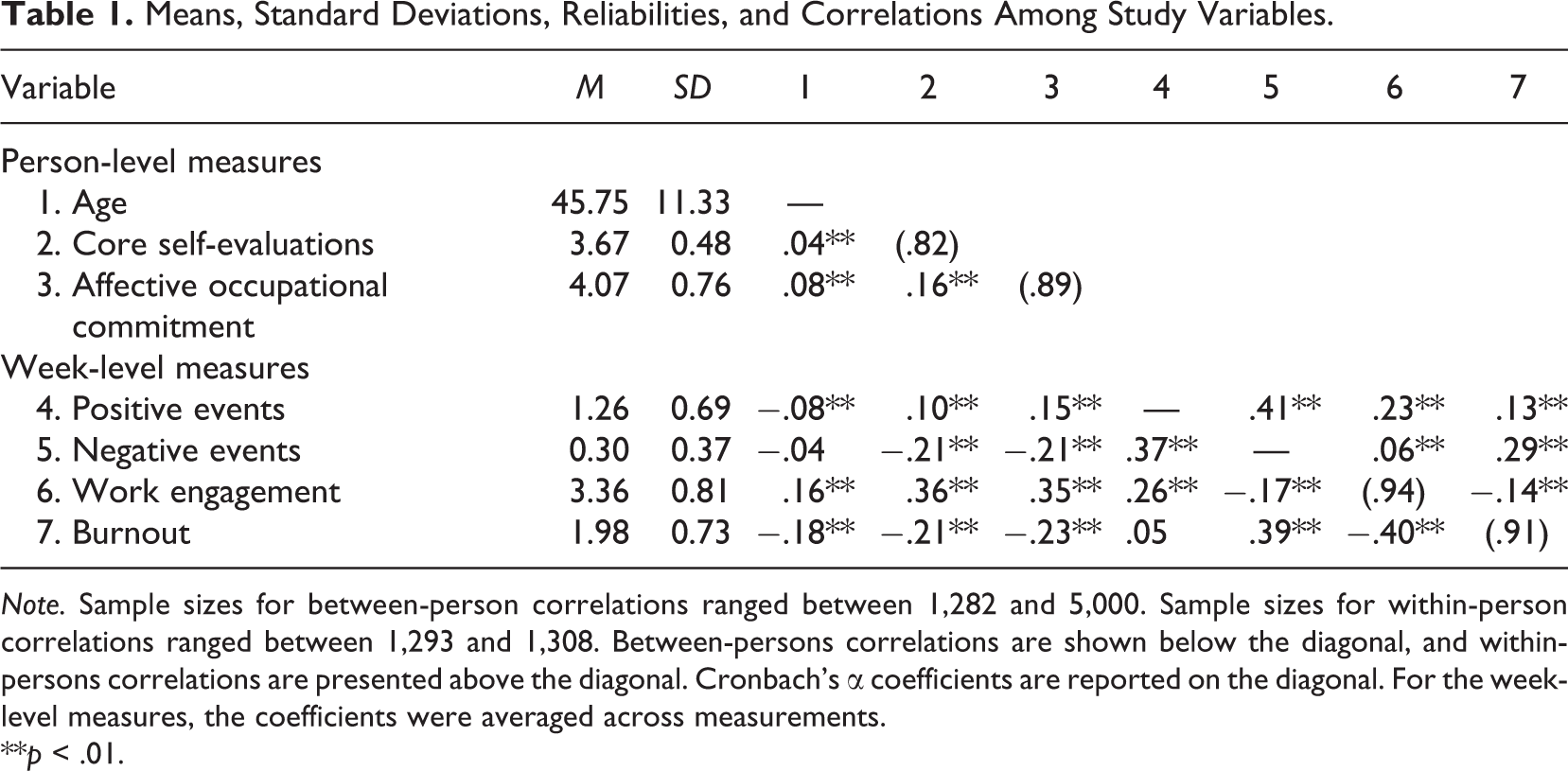
Note. Sample sizes for between-person correlations ranged between 1,282 and 5,000. Sample sizes for within-person correlations ranged between 1,293 and 1,308. Between-persons correlations are shown below the diagonal, and within-persons correlations are presented above the diagonal. Cronbach’s α coefficients are reported on the diagonal. For the week-level measures, the coefficients were averaged across measurements.
**p < .01.
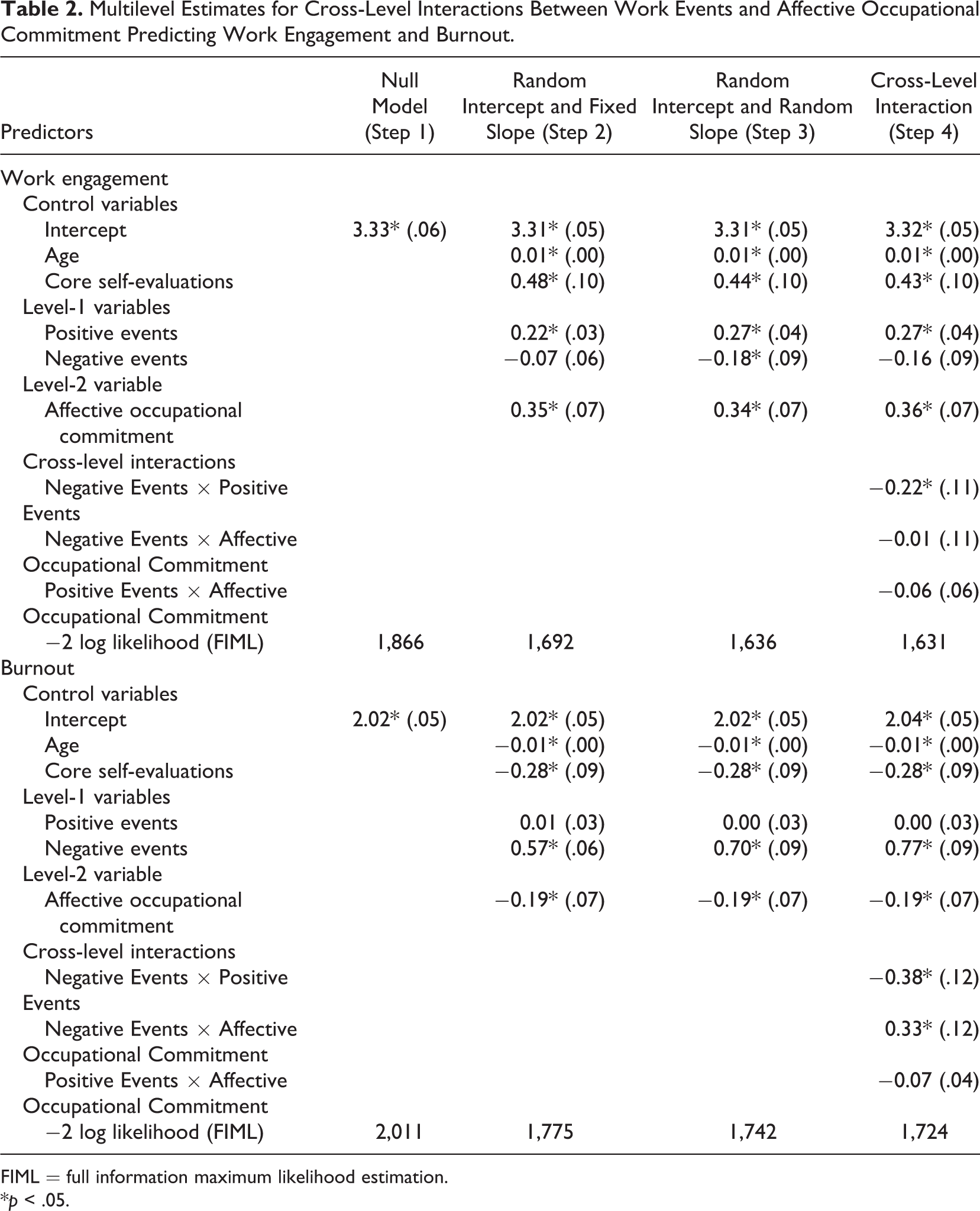
Results indicated that the ICC for work engagement was 0.74 and for burnout was 0.63, suggesting that 26% of the variance in work engagement and 37% of the variance in burnout was within-individuals across 12 weeks (see Step 1 in Table 2), thereby justifying our use of multilevel modeling. In Step 2, we entered all control, Level-1, and Level-2 variables simultaneously. As indicated in Table 2, both age (γ = 0.01, p < .05) and core self-evaluations (γ = 0.48, p < .05) were positively related to work engagement. On the other hand, age (γ = −0.01, p < .05) and core self-evaluations (γ = −0.28, p < .05) exhibited a negative association with burnout. With respect to Level-1 predictors, while positive events were positively related to work engagement (γ = 0.22, p < .05) and negative events were positively related to burnout (γ = 0.57, p < .05), there was no association between negative events and work engagement or positive events and burnout. Affective occupational commitment was positively related to work engagement (γ = 0.35, p < .05) and negatively related to burnout (γ = −0.19, p < .05).
Multilevel Estimates for Cross-Level Interactions Between Work Events and Affective Occupational Commitment Predicting Work Engagement and Burnout.
FIML = full information maximum likelihood estimation.
*p < .05.
Prior to testing cross-level interactions, Aguinis et al. (2013) recommend determining whether the slope variance for the Level-1 predictor is different from zero. To test effect, we examined whether the association between work events and the two outcomes (i.e., work engagement and burnout) varied across individuals. Specifically, we tested the random intercept and random slope model (Step 3), where we allowed the slopes of negative and positive events to vary across individuals. Results indicated that the fit of the random intercept and random slopes model (Step 3) improved significantly compared to the random intercept and fixed slope model (Step 2) for both work engagement (Δ −2 log likelihood = 56.27, degrees of freedom [df] = 5, p < .01) and burnout (Δ −2 log likelihood = 32.65, df = 5, p < .01).
Finally, we tested the cross-level interactions (i.e., Step 4), whereby we included the product terms in addition to the main effects presented in Step 3. As indicated in Step 4 (see Table 2), the interaction between negative and positive events significantly predicted work engagement. To further explore the pattern of the interactions, we plotted regression lines for high (+1 SD) and low (−1 SD) levels of positive events. As depicted in Figure 1, the simple slope between negative events and work engagement was negative and differed significantly from zero under high positive events (γ = −0.26, t = −2.78, p < .01), but not under low levels of positive events. Therefore, Hypothesis 3a did not receive support. The interaction between negative and positive events also significantly predicted burnout. Simple slope analysis revealed that the association between negative events and burnout was positive when individuals experienced low (γ = 0.94, t = 8.43, p < .01) and high (γ = 0.59, t = 5.98, p < .01) positive events (see Figure 2). However, the slope was steeper for low positive events, suggesting an attenuating effect. Hence, Hypothesis 3b was supported. With regard to Hypotheses 4a and 4b, results indicated that the interaction between positive events and affective occupational commitment did not significantly predict work engagement or burnout. Therefore, Hypotheses 4a and 4b were not supported.

Two-way interaction between negative events and positive events predicting work engagement.
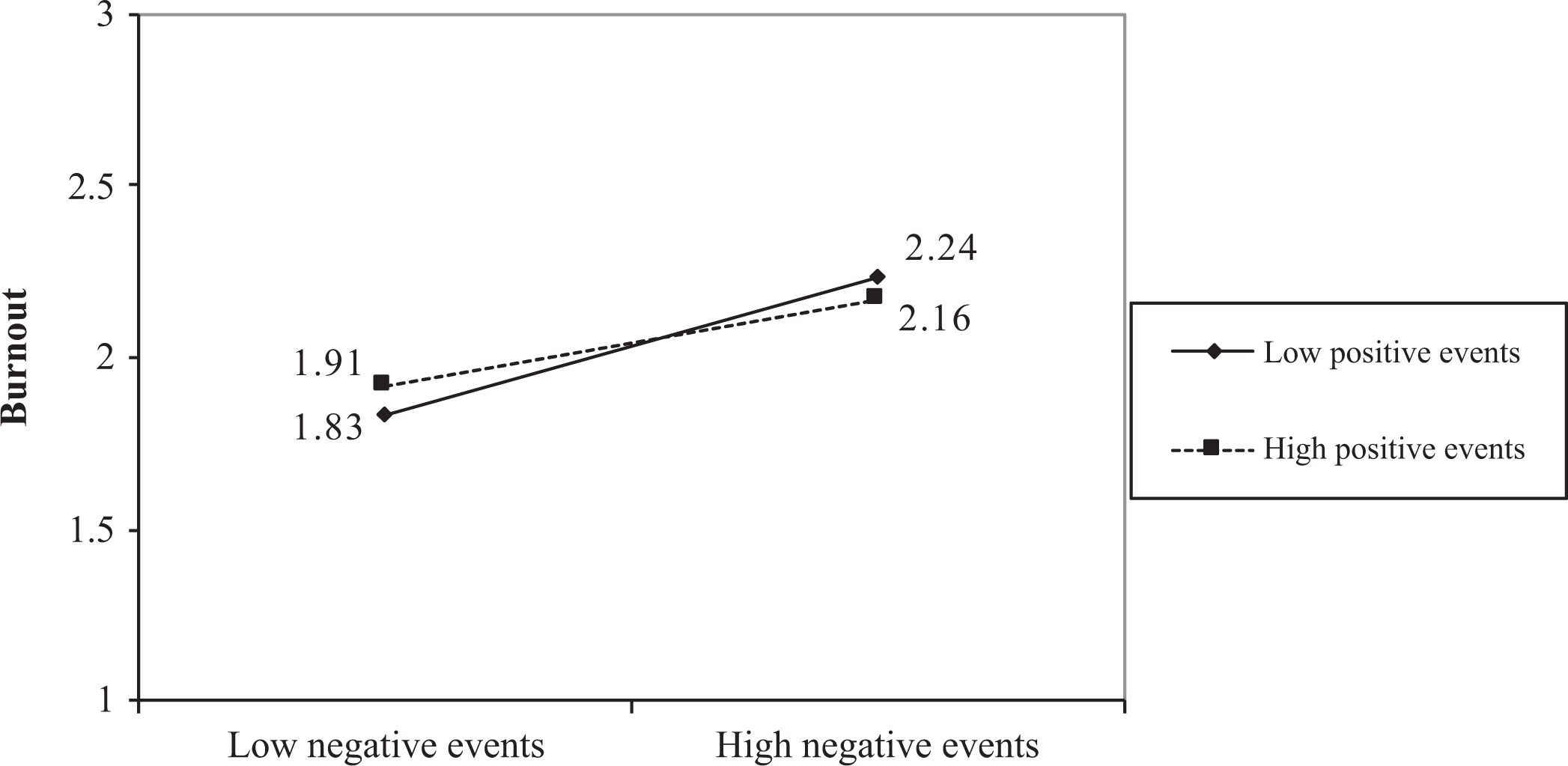
Two-way interaction between negative events and positive events predicting burnout.
Finally, to test Hypotheses 5a and 5b, we examined the multiplicative effect of negative events and affective occupational commitment in predicting work engagement and burnout. Results indicated that the interaction between negative events and affective occupational commitment did not significantly predict work engagement. However, the multiplicative effect of negative events and affective occupational commitment predicted burnout. The interaction plotted in Figure 3 revealed that the positive association between negative events and burnout was significant when affective occupational commitment was low (γ = 0.53, t = 4.73, p < .01) and high (γ = 1.01, t = 7.58, p < .01). However, the slope was steeper when the affective occupational commitment was high. These findings do not support Hypothesis 5a or 5b.
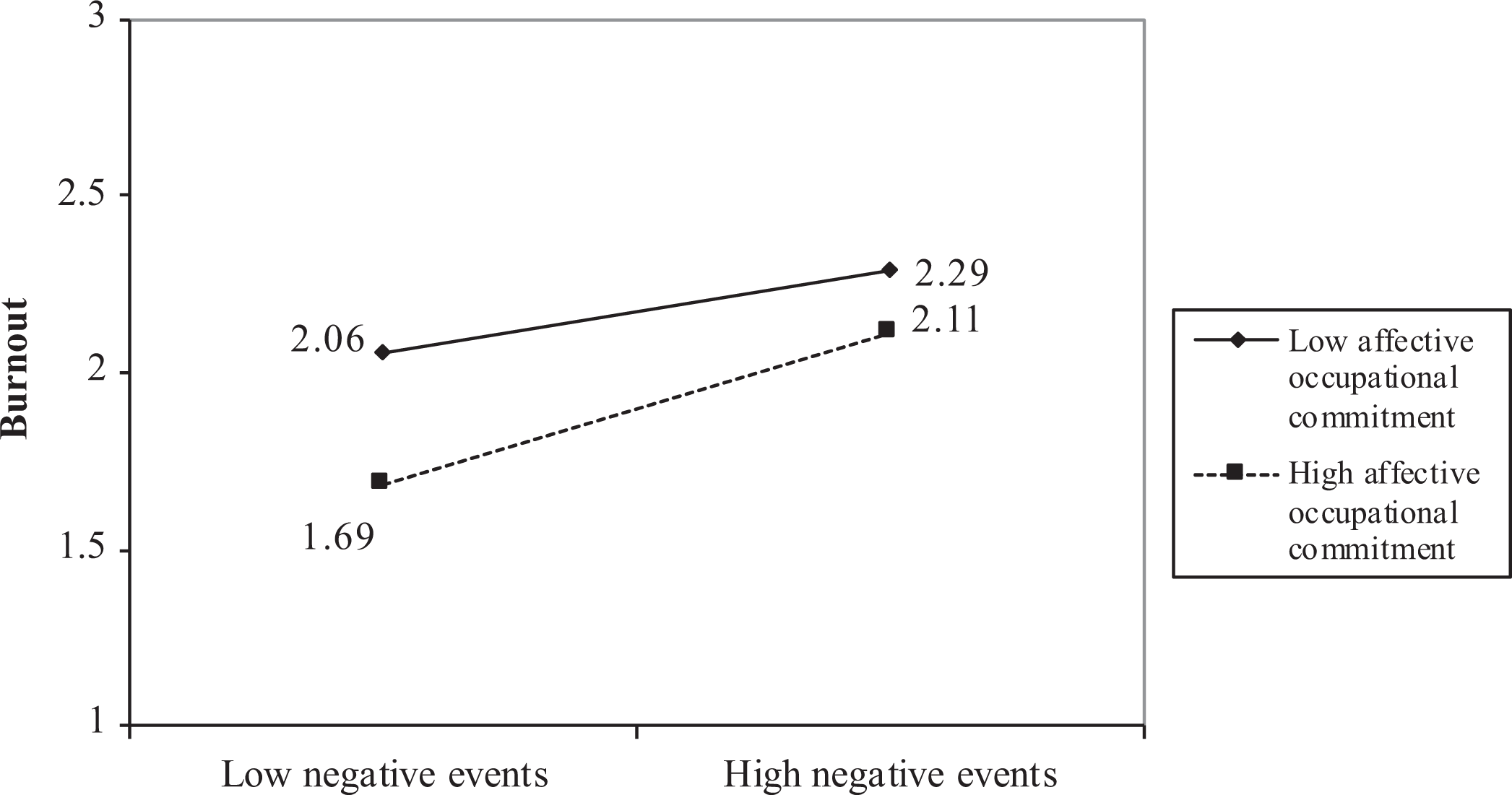
Two-way interaction between negative events and affective occupational commitment predicting burnout.
Discussion
Over the last two decades, there has been a rise in studies examining the associations between discrete work events and outcomes; however, a number of limitations continue to persist in this literature. These limitations include, but are not limited to, the examination of only negative or positive events, reliance on student samples, and utilization of generic measures of events. In addition, only a handful of studies have explored how individuals with high versus low occupational commitment respond to work events. Considering that individuals with low versus high occupational commitment may differ in their level of job attitudes (K. Lee et al., 2000), research examining the moderating effect of occupational commitment is warranted.
Our study examined the relation between negative and positive events with work engagement and burnout in a sample of nurses using measures of occupation-specific events. In addition, the current study tested the moderating effect of occupational commitment in the association between work events—work engagement/burnout. Our findings indicate that negative events were positively related to burnout, and positive events were positively associated with work engagement. Specifically, nurses who reported experiencing negative events more frequently over the week also reported higher burnout. Similarly, nurses who experienced positive events more frequently reported higher work engagement in the same week. These findings are consistent with AET (Weiss & Cropanzano, 1996) and the JD-R model (Bakker & Demerouti, 2007), suggesting that events reflect affective experiences at work that generate or deplete resources at work and subsequently impact work engagement and burnout. Specifically, negative events at work predict burnout, whereas positive events predict work engagement. While prior research has demonstrated a similar pattern of relations using a between-person design (Sinclair et al., 2015), ours is the first study to show such effects on a within-person basis.
We expected a negative association between negative events and work engagement, and positive events and burnout. Although bivariate correlations suggested that negative and positive events were positively associated with work engagement and burnout within persons, respectively, these findings could not be replicated in multilevel regression analyses. These findings suggest that positive events explain a greater degree of variance in work engagement while negative events, relative to positive events, are more predictive of burnout.
With respect to our moderation hypotheses, we found the interaction between negative and positive events significantly predicted both work engagement and burnout. Contrary to our hypothesis that positive events would buffer the association between negative events and work engagement, the relation between negative events and work engagement was stronger for those who experienced greater positive events. A potential explanation for these findings can be drawn from research conducted by Beal et al. (2005). In accordance with Beal et al.’s (2005) claim that work events occupy cognitive resources, it can be argued that positive events drain resources and, therefore, contribute to lower work engagement in nurses when they also experience negative events. Another explanation for these findings may be that nurses who are accustomed to experiencing greater positive events in the workplace may become demotivated when they are confronted with an increasing number of negative events. On the other hand, those who encounter few positive events at work are more resilient and are better able to adapt to negative events. Additionally, fewer positive events allow nurses to preserve their resources, thereby enhancing work engagement even when confronted with negative events.
The multiplicative effect between negative events and positive events also predicted burnout. Consistent with the AET (Weiss & Cropanzano, 1996) and JD-R (Bakker & Demerouti, 2007), positive events demonstrated a buffering effect in the association between negative events and burnout. These findings suggest that positive events can act as resources that reduce the adverse effects of negative events on burnout.
Finally, contrary to our predictions, we found a magnifying effect of affective occupational commitment in the association between negative events and burnout. A potential explanation for these findings may be offered by the SIT (Tajfel & Turner, 1986). Because employees with high commitment toward their occupation are highly invested in their jobs, they may be more likely to be impacted by the negative events in the workplace compared to those who exhibit low occupational commitment. Our findings mirror the results of another study which showed that organizational commitment exacerbated the link between incivility and negative affect (Kabat-Farr et al., 2016).
In the current study, affective occupational commitment did not moderate the association between negative events and work engagement or positive events and work engagement/burnout. These findings suggest uniform associations between events and work engagement (and positive events and burnout) irrespective of the level of occupational commitment. A possible explanation for the lack of moderating effect of affective occupational commitment may be the saliency of work events in the nursing profession. Stated differently, positive and negative events drive work engagement and positive events drive burnout similarly for those who exhibit high and low occupational commitment.
Theoretical and Practical Implications
Our study contributes to the existing literature on workplace events. Although several studies have explored the perceptions of JD-R in nursing personnel, much of this research has employed between-subject designs. To our knowledge, only one study has examined the impact of day-to-day events on affect in nurses (Gabriel et al., 2011). By investigating the association between weekly events and work engagement and burnout, not only does our study demonstrate that events play a role in predicting these but also adds to prior literature that has explored the relation between events, both negative and positive, and consequences of these events (Bono et al., 2013; Gross et al., 2011). Additionally, the current study augments support for the AET (Weiss & Cropanzano, 1996) and JD-R (Bakker & Demerouti, 2007) models in the nursing context.
A promising finding in the current study is the positive bivariate relation between negative events and work engagement among nurses. Considering that prior research has shown a negative association between negative events and work engagement (Demerouti & Cropanzano, 2017), our findings suggest that not all negative events are created equal and may not necessarily hinder work engagement. Future research may consider delineating the types of work events that promote versus inhibit work engagement.
An especially important theoretical contribution of the present study is the finding that positive events can undermine work engagement in nursing personnel. Considering that prior studies have predominantly demonstrated the beneficial effects of positive events on a handful of outcomes in the presence of negative events (Bono et al., 2013; Gross et al., 2011), our study is the first to suggest that positive events in the workplace may not always result in favorable outcomes. While we suspect that these findings may not be equally applicable to all occupations, especially those where positive events are not necessarily draining, future studies may consider exploring conditions under which positive events are beneficial or detrimental.
Although a sizable literature has examined occupational commitment as a predictor of organizational outcomes, only a handful of studies have evaluated its role in dealing with occupational stress (Jepson & Forrest, 2006). This study is the first to examine occupational commitment as a moderator in the association between events—work engagement and burnout using a diary design. By establishing occupational commitment as a magnifier of the negative events and burnout relation, this study highlights the negative role of commitment toward one’s profession. While occupational commitment is considered a key to positive work attitudes and job performance (K. Lee et al., 2000), our findings suggest that high levels of such commitment can be detrimental to the health of employees, especially in the existence of negative events.
The results of our study also have practical implications. The positive and negative events assessed in the current study were wide ranging, including overcoming challenges at work, providing support to patients, and positive interactions with patients, families of patients, physicians, and coworkers. While an organization may not have control over all the events nurses experience during their workweek, knowledge regarding the prominence of negative and positive events may increase its ability to play a crucial role in reducing negative events such as work overload and increasing staffing within units. Similarly, the organization can also intervene to enhance certain positive events such as interactions with their managers and coworkers by supporting team-building initiatives.
Additional practical implications come from the finding that nurses who were highly committed to their occupation experienced more adverse reactions to negative work events. Therefore, managers need to be prepared to provide resources for these nurses, including support and opportunities to process these negative events. Managers may believe nurses who are most committed to their occupation will be less likely to report burnout in the face of negative work events, whereas the present study suggests the opposite pattern. More generally, employees who are especially attached to their organization, irrespective of the particular career, may be more affected by negative work events. These employees need to be aware of the potential for increased burnout in the face of negative events and be sure to recover appropriately to mitigate these negative consequences.
Limitations and Future Directions
This study has limitations that should be addressed in future research. Our study relied solely on self-report data assessing the association between work events and work engagement and burnout. Although within-person designs reduce concerns about common method variance to a degree and some scholars (e.g., Spector, 2006) have argued that concerns about common method biases may be overstated, future studies should include objective measures of health and well-being to reduce method variance–related concerns.
The current research assessed negative events, positive events, work engagement, and burnout on a weekly basis, rather than a daily basis. Our choice in gathering data on a weekly basis was guided by the assumption that nurses may not experience negative and positive events on a daily basis, and the extant research which suggests that work engagement and burnout are fairly stable constructs (Dunford et al., 2012; Hallberg & Schaufeli, 2006) and, therefore, may not vary much on a day-to-day basis. However, we urge researchers to prospectively assess whether negative and positive events are related to work engagement and burnout using daily assessments and call for further research to pinpoint the effects of using either shorter or longer time frames in work event studies.
In the present study, positive and negative events are measured as having the same valence. For instance, in our measure of positive events, 2 sample items were “I helped save the life of a patient” and “A coworker complimented my work.” While both events are positive in nature, they may not be perceived the same way. Future research may consider capturing the valence or perceived importance of each event and examine their association with both work engagement and burnout as a test of robustness for our results.
Conclusion
This study examined the association between events, both negative and positive and work engagement and burnout among nursing personnel, as well as the moderating effect of occupational commitment in the events—work engagement/burnout relation. Results indicated that positive and negative events, as well as their multiplicative effect predicted both work engagement and burnout. In addition, occupational commitment moderated the negative events—burnout relation. We hope that these findings will stimulate additional research on reducing negative experiences while enhancing positive events for nursing personnel.
Footnotes
Acknowledgment
The authors thank the Oregon Nurse Retention Project team and the members and staff of the Oregon Nurses Association for their assistance on issues related to this study.
Declaration of Conflicting Interests
The author(s) declared no potential conflicts of interest with respect to the research, authorship, and/or publication of this article.
Funding
The author(s) disclosed receipt of the following financial support for the research, authorship, and/or publication of this article: This research was supported by grants from the Northwest Health Foundation (proposal #14180) and from the National Institute of Occupational Safety and Health (T01 OH008435-02) to Portland State University and Clemson University College of Business and Behavioral Sciences Summer Grant to the third author.
