



Abstract
The present research is focused on the measurement properties of the Decent Work Scale (DWS) in Australia and adds to the cumulative evidence of the measure’s international utility for psychological research into the role of work in people’s lives. The study contributes new evidence via a survey of a sample of workers (N = 201) who completed the DWS and criterion measures of career-related factors including job satisfaction, work engagement, and withdrawal intentions. Correlated factors, higher order, and bifactor models were tested using confirmatory factor analysis. All models were satisfactory and the bifactor model evinced preferable fit. The DWS Values Congruence subscale predicted all criterion measures. Workers’ incomes and ratings of their occupations’ prestige had no main effects or interaction effect on the DWS subscales. Recommendations for future research include testing the DWS’s relations with measures of mental health which are known correlates of career-related outcomes.
The psychological effects of job insecurity (De Witte et al., 2016), unemployment (Paul & Moser, 2009), and poor quality work (Butterworth et al., 2013; Butterworth et al., 2011) are reasons to take a psychological perspective on the qualities of decent work in peoples’ lives. The notion “decent work” is defined by the International Labour Office (ILO, 2015, 2017) as work that includes safety, access to health care, adequate remuneration, free time and rest, and congruence—or at least lack of conflict—between workplace values and those of workers and their communities. Decent work is the subject of psychological theory and research (Blustein et al., 2016) and is the conceptual centerpiece of the psychology of working theory (PWT; Duffy et al., 2016), which offers a radically inclusive perspective for career development practice (Blustein et al., 2019). PWT has been the stimulus for research into the development and evaluation of a psychometric measure, the Decent Work Scale (DWS; Duffy et al., 2017), which has been validated in different nations (Duffy et al., 2020). The present research is the first to appraise the measurement properties of the DWS in an Australian context.
Psychology of Working Theory and Decent Work
PWT describes “…how contextual and psychological variables affect an individual’s ability to secure decent work and how doing so affects the fulfilment of individual needs” (Duffy et al., 2016, p. 128). Thus, PWT specifies economic constraints and marginalization as the contextual predictors that affect the psychological predictors of decent work, namely, work volition and career adaptability. Furthermore, PWT proposes proactive personality, critical consciousness, social support, and economic conditions as moderators of the effects of economic constraints and marginalization on work volition and career adaptability. The proposed outcomes of decent work include satisfaction of survival needs (e.g., food, shelter), social connection needs, and self-determination needs (e.g., self-regulation), and ultimately, satisfaction of these needs predicts work fulfillment and well-being. Thus, PWT proposes that decent work, indirectly, via satisfaction of these needs, predicts positive psychological outcomes for workers.
Decent work and the DWS are germane to testing hypotheses drawn from PWT, and an emerging body of empirical research attests the predictive utility of the theory. Consistent with the tenets of PWT, research involving individuals who identify as minority workers revealed effects of social class (Douglass et al., 2017), economic constraints (Douglass et al., 2019; Duffy, Gensmer, et al., 2019), and financial strain (Smith et al., 2020) on decent work via work volition. Other research has affirmed the direct predictive effect of marginalization on decent work (Douglass et al., 2019; Duffy, Gensmer, et al., 2019; Duffy et al., 2018). Career adaptability has also been found to directly predict decent work (e.g., Douglass et al., 2019; Duffy, Gensmer, et al., 2019; England et al., 2020; Tokar & Kaut, 2018). In contrast, the hypothesized effect of proactive personality as a moderator within a PWT model has been rejected (Douglass et al., 2019). Recent research has identified additional predictors of decent work within a PWT frame, including working women’s sense of workplace climate (e.g., respect; England et al., 2020), LGBTQ+ workers’ workplace climate (Allan et al., 2019), and psychological ownership of their jobs (Smith et al., 2020).
With respect to the proposed outcomes of decent work specified in PWT, research has found positive correlations between the DWS and satisfaction of survival needs, social connection needs, and self-determination needs, which predicted job and life satisfaction (Autin et al., 2019). Other research affirmed decent work as a predictor of survival, social contribution, and self-determination needs, and moreover, a predictor of physical health and mental health, indirectly via needs satisfaction (Duffy, Kim, et al., 2019). As specified in PWT, decent work has been found to predict meaningful work (Allan et al., 2019). Uniformity of decent work between jobs and workplaces cannot be assumed, that is, the levels of each element of decent work may vary in different contexts. Research using latent profile analysis revealed five distinct profiles: one with acceptable and relatively higher levels of all decent work elements, contrasted against another profile with unacceptably low levels of all decent work elements; two profiles were differentiated by health care, one with higher levels of health care but lower levels of other elements, and the other with lower health care but higher levels of other elements; and another profile had relatively higher safety and health care but lower levels of time for rest (Kim et al., 2020). Consistent with PWT hypotheses, the profile with the most acceptable levels of decent work elements had higher levels of job satisfaction and life satisfaction, which contrasted to the other profiles’ levels of satisfaction.
In summary, PWT and DWS have accreted a significant body of evidence that attests their conceptual and empirical utility with respect to the predictors and outcomes of decent work measured by the DWS. Beyond the DWS’s original validation study in the United States, the measurement properties of the DWS have been tested in diverse international studies.
Measurement Properties of the DWS in Different Nations
A special issue of the Journal of Vocational Behavior (Duffy et al., 2020) reported on other nations’ versions of the DWS, including Brazil (Ribeiro et al., 2019), Italy (Di Fabio & Kenny, 2019), France (Vignoli et al., 2020), Portugal (Ferreira et al., 2019), South Korea (Nam & Kim, 2019), Switzerland (Masdonati et al., 2019), Turkey (Buyukgoze-Kavas & Autin, 2019), and the United Kingdom (Dodd et al., 2019). With some modifications to suit the respective cultural contexts, the proposed five dimensions of decent work were consistently evident in the international studies. One important contextual nuance pertains to access to health care in nations with a universal health care system funded by the state and taxpayers and not by employers; whereas in other countries, such as the United States, employers take on a responsibility for providing health care to their employees. Accordingly, there was a need for significant modification to the wording of items of the DWS Access to Health Care subscale to suit the health care systems of nations with full “universal” or partial government funding, such as South Korea (Nam & Kim, 2019), the United Kingdom (Dodd et al., 2019), and Switzerland (Masdonati et al., 2019). Likewise, for the present study, modifications were required to suit the Australian health care system.
The original U.S. version and subsequent international versions examined the DWS’s factor structure as correlated factors, higher order model, and bifactor model. The bifactor model had superior fit in the United States and Italy and equivocal fit in the United Kingdom and Portugal, whereas the correlational model was preferable in Turkey, and a higher order model was preferable in Switzerland. The present research investigated the measurement properties of DWS in an Australian context by assessing its factor structure and its relations with psychological correlates of decent work, in particular, job satisfaction, withdrawal intentions, and work engagement.
Job satisfaction
According to PWT, “…performing decent work leads to need satisfaction, work fulfillment, and well-being” (Duffy et al., 2016, p. 128). Job satisfaction is germane to a psychological understanding of work in people’s lives, as is evident in more than 100 years of research (Judge et al., 2017). Job satisfaction is associated with decent work; however, not all elements of decent work predict job satisfaction. For example, access to health care did not predict job satisfaction in multiple international samples (Di Fabio & Kenny, 2019; Dodd et al., 2019; Duffy et al., 2017), but did in others (Buyukgoze-Kavas & Autin, 2019; Ferreira et al., 2019). Adequate remuneration is a predictor of job satisfaction (Buyukgoze-Kavas & Autin, 2019; Di Fabio & Kenny, 2019; Dodd et al., 2019; Duffy et al., 2017), yet meta-analytic research reveals the relation between job satisfaction and pay as relatively small at r = .15 (Judge et al., 2010). The relation between pay and satisfaction may be moderated by individual differences in workers’ dispositional traits, such as core self-evaluations (Judge & Bono, 2001; Keller & Semmer, 2013), need for pay satisfaction and work values (Hofmans et al., 2013), and characteristic adaptations such as career adaptability (Fiori et al., 2015) and self-efficacy (Maggiori et al., 2016). Work–life balance, which may be a proxy for decent work’s condition of time and rest away from work, is associated with job satisfaction (Haar et al., 2014); however, in the DWS studies, adequate rest and time away from work did not consistently predict job satisfaction (Dodd et al., 2019; Ferreira et al., 2019). In summary, the international studies validating the DWS (Duffy et al., 2020) suggest that some, but not all, of the elements of decent work measured by the DWS predict job satisfaction.
Withdrawal intentions
Workers’ withdrawal intentions reflect their dissatisfaction with and diminished commitment to their current work and may lead to separation from work (e.g., resignation, retirement). In terms of decent work, workers are likely to experience withdrawal intentions in a workplace that is unsafe, unhealthy, offers unfair pay and insufficient time to rest and recover, and operates in ways that conflicts with their values. While this assumption may be rational in contexts where there is sufficient alternative work in the labor market, it may not hold up where there are few other opportunities for gainful work reflected by high rates of unemployment and underemployment. Research using the DWS in Turkey found that all elements of decent work predicted withdrawal intentions (Buyukgoze-Kavas & Autin, 2019). In Italy, however, access to health care did not predict withdrawal intentions (Di Fabio & Kenny, 2019); in the United States (Duffy et al., 2017) and Portugal (Ferreira et al., 2019), health care and time and rest did not predict withdrawal intentions. In the United Kingdom (Dodd et al., 2019), safety, access to health care, and time and rest did not predict withdrawal intentions. Thus, as it is with job satisfaction, there are varied predictive relations among the subscales of DWS and withdrawal intentions in different international samples.
Work engagement
The work engagement construct (Bakker, 2011; Bakker & Demerouti, 2008, 2017) has potential as an alternative outcome indicator of workers’ experiences of decent work. According to Bakker (2011, p. 265), “Work engagement is different from job satisfaction in that it combines high work pleasure (dedication) with high activation (vigor and absorption); job satisfaction is typically a more passive form of employee well-being.” A work environment with sufficient job resources (e.g., psychological climate, time for recovery, rewards, and recognition) is positively associated with engagement, whereas a work environment loaded with hindrance demands (e.g., emotional conflict and role overload) is negatively associated with work engagement (Crawford et al., 2010; Lesener et al., 2019; Rattrie et al., 2020). The Utrecht Work Engagement Scale (UWES; Schaufeli et al., 2006) was included in the Portuguese validation study (Ferreira et al., 2019), and its factors Vigor, Dedication, and Absorption were predicted by DWS’s Safe Conditions and Values subscales. The present research extends the DWS literature by assessing relations among its subscales and the UWES.
The Present Research
At the time this research was conducted, Australia’s population was approximately 25.5 million; 66.1% were participating in the labor market, 12,935,000 were in some level of employment, and the unemployment rate was 5.3% (Australian Bureau of Statistics, 2019). Australia is a federation of states and territories, each with their own constitutions and legislatures, brought together as a nation subsumed by the national, federal Australian Government. Each level of government has defined responsibilities for regulating the labor market. The Australian Government’s (2009) Fair Work Act and other legislative instruments and government agencies (e.g., the 10 National Employment Standards; Australian Government, 2019; Safe Work Australia, 2019) directly and indirectly regulate the labor market and workplaces in ways consistent with the ILO’s definition of decent work and the DWS.
Measurement models
Decent work has been a matter of interest to psychology and career development researchers in Australia (Athanasou, 2010); however, until the present research, there has been no published Australian measure of decent work to advance research and development. The DWS’s international validation studies (Duffy et al., 2020) revealed acceptable correlated factors, higher order model, and bifactor measurement model with some variations among nations (e.g., bifactor model had superior fit in the United States and Italy and equivocal fit in the United Kingdom and Portugal). We had no reason to assume any one of the models would be superior in the present data set.
Safe conditions
Australian workplaces must comply with regulations that require employers to ensure the health and safety of employees and other people who may come in contact with a workplace (Safe Work Australia, 2019). Similarly, employees are obliged to follow workplaces’ policies and procedures. The Australian Governments’ safety legislations have provisions for the imposition of fines and criminal charges in cases of breaches. Consistent with the other DWS studies, previous Australian research into safe conditions demonstrates evident links between psychosocial safety climate and psychological health problems, exhaustion, and work outcomes (Bailey & Dollard, 2019; Dollard & Bailey, 2014; Zadow et al., 2019).
Access to health care
Australia has a universal health care system, Medicare, which is funded by a compulsory 2% taxation levy in addition to income tax paid annually by employees. In addition, individuals who earn more than AUD90,000 per annum are required to pay an additional 1%–1.5% of annual income, as the Medicare Levy Surcharge, if they do not purchase private hospital insurance, in addition to the coverage provided by the universal Medicare system. Individuals whose annual incomes fall beneath a low-income threshold are entitled to pay a lesser levy or no levy. Australian employers do not fund their employees’ health care insurance; thus, the present research required amendments to the Access to Health Care items of the DWS in a way similar to other nations reported in the international DWS project (Duffy et al., 2020), such as South Korea (Nam & Kim, 2019), the United Kingdom (Dodd et al., 2019), and Switzerland (Masdonati et al., 2019). Access to Health did not predict job satisfaction and withdrawal intentions in the United Kingdom; however, it did in the South Korean validation study. We did not offer specific hypotheses regarding Access to Health Care because there was insufficient Australian empirical research to justify hypotheses about a putative relation between the Australian universal health care system Medicare and psychological outcomes associated with decent work.
Adequate compensation
At the time of this research, the average weekly earnings of Australians were AUD1,633 (Australian Bureau of Statistics, 2019) and the national minimum wage was AUD740.80 per week or AUD19.49 per hour for employees covered by registered agreements (Australian Government, 2019). It is important to note that the present research was conducted in a period of stagnated wage growth associated with relatively high levels of underemployment, low inflation, and coming off an economic boom driven by mining exports (Gilfillan, 2019). The Australian Workplace Barometer (Dollard & Bailey, 2014) study found small-to-moderate significant correlations between income and some job demands (e.g., work pressure, r = .22; work family conflict, r = .28), job resources (e.g., skill discretion, r = .34), and work outcomes (e.g., engagement, r = .11). Longitudinal Australian research using the Household, Income and Labour Dynamics in Australia (HILDA) data set found that underemployment—which may be a proxy for insufficient remuneration apropos one’s qualifications and skills—produced a strong negative effect on job satisfaction (Kifle et al., 2019). Furthermore, other HILDA research suggests that the association of salary and job satisfaction is not only about one’s own income per se but also comparisons with other workers’ incomes (Kifle, 2014).
Free time and rest
Australia’s National Employment Standards (Australian Government, 2019) stipulate a maximum number of work hours per week (e.g., 38 hr in ordinary conditions) and a range of leave entitlements, including requests for flexible working arrangements; parental leave and related entitlements, annual leave, personal/carer’s leave, compassionate leave, and unpaid family and domestic violence leave; community service leave; long service leave; and public holidays. Employees in full-time work are entitled to 4 weeks of annual paid leave. Shift workers may be provided up to 5 weeks of annual paid leave. Casual employees are not entitled to paid leave; however, some organizations may opt to provide leave. In other research using HILDA data, Australian workers’ satisfaction with their jobs was correlated with income; however, this effect must be interpreted in the context of satisfaction being related to flexibility in work hours (Cassells, 2017). Furthermore, other HILDA research also indicates a positive association between hours worked and job satisfaction, expressed by “overworkers” who exceed standard work hours and, perhaps paradoxically, resent working extra hours (Fabian & Breunig, 2019).
Complementary values
Research into Australian workers suggests that congruence between their values and their organizations’ values influences their commitment to the organization (Abbott et al., 2005; Howell et al., 2012; Rosete, 2006) and job satisfaction and intention to stay (Newton & Mazur, 2016). Workers’ commitment is diminished when organizations fail to enact espoused values (Howell et al., 2012). The community dimension of complementary values may be considered from the perspective of an emerging literature about green-person-organizational fit, which addresses corporate social responsibilities and pro-environmental values. A study of Australian workers revealed a positive association between green values congruence and satisfaction and engagement (Hicklenton et al., 2019). Given the DWS’s items specifically mention family, it is notable that levels of work–family conflict were predicted by consistency of family values among Australian workers and their supervisors (Thompson et al., 2006). Furthermore, in that study, consistency of worker–supervisor family values had an indirect effect on job satisfaction and emotional exhaustion via supervisor support.
Method
Participants
The study involved a broad convenience sample of Australians. There were N = 201 participants, n = 70 males (34.8%), n = 131 females (65.2%), with a combined mean age of 42.39 years (SD = 13.04) ranging from 19 to 70 years. Employment status included a mix of full-time employment (n = 96, 49.2%), part-time employment (n = 67, 34.4%), full-time self-employment (n = 14, 7.2%), part-time self-employment (n = 9, 4.6%), retired but involved in work activities (n = 2, 1.0%), and seeking work at the time of the survey (n = 7, 3.6%). Six participants did not reveal their employment status. Education status included incomplete high school (n = 12, 6.5%), high school certificate (n = 23, 11.4%), incomplete undergraduate degree (n = 38, 18.9%), undergraduate degree (n = 29, 14.4%), postgraduate degree (n = 56, 27.9), and trade qualification (n = 43, 21.4%). Annual household gross income (i.e., income before tax, in Australian dollars) included <AUD25,000 (n = 16, 8.0%), AUD26,000–AUD50,000 (n = 39, 19.4%), AUD51,000–AUD75,000 (n = 42, 20.9%), AUD76,000–AUD100,000 (n = 32, 15.9%), AUD101,000–AUD125,000 (n = 30, 14.9%), AUD126,000–AUD150,000 (n = 11, 5.5%), AUD151,000–AUD175,000 (n = 9, 4.5%), AUD176,000–AUD200,000 (n = 3, 1.5%), >AUD200,000 (n = 7, 3.5%), and unspecified (n = 12, 6%). Income mode was AUD51,000–AUD75,000 and median was AUD76,000–AUD100,000. Approximately half of the participants reported a period of unemployment at some time in their adult life (n = 88, 44.2%). To obtain a subjective measure of social class, participants were asked to respond to the question, “How would you describe your current social class?” using one of three responses: 1 = working class (n = 101, 50.2%), 2 = middle class (n = 96, 47.8%), or 3 = upper class (n = 4, 2.0%). To obtain a subjective measure of job prestige, participants were asked the question, “When you think about the work you do compared to others, do you believe your job is? using one of three responses: 1 = low prestige job (n = 45, 22.4%), 2 = medium prestige job (n = 118, 58.7%), or 3 = high prestige job? (n = 38, 18.9%). The sample included participants with a non-English-speaking background (n = 24, 11.9%).
The sample of participants was recruited by way of invitations distributed through the researchers’ social media accounts (e.g., Facebook). Invitations directed participants to an online survey platform designed and operated by the School of Psychology and Counselling at the University of Southern Queensland. The research was approved by the university’s Human Ethics Research Committee.
Measures
Decent work
The 15-item DWS (Duffy et al., 2017) used a 7-point Likert-type scale ranging from 1 (strongly disagree) to 7 (strongly agree) for its five subscales. The DWS’s subscales had acceptable internal consistencies (shown in parentheses) and included the following example items. Safe Conditions (α = .74): “I feel physically safe interacting with people at work”. Access to Health Care (α = .78) required replacement of the word “employer” with “country/government” to reflect the Australian health care system: “I get good health care benefits from my employer” became “I get good health care benefits from my country/government”. Adequate Compensation (α = .85): “I am rewarded adequately for my work”. Free Time and Rest (α = .88): “I have free time during the work week”. Complementary Values (α = .93): “The values of my organization align with my family values.” The DWS items for the present study are shown in Table 1. The DWS has been supported by an extensive international research program (Duffy et al., 2020), which demonstrates its measurement properties in several nations and its predictive relations with two criterion variables used in the present study: job satisfaction and withdrawal intentions.
DWS Items and Descriptive Statistics.
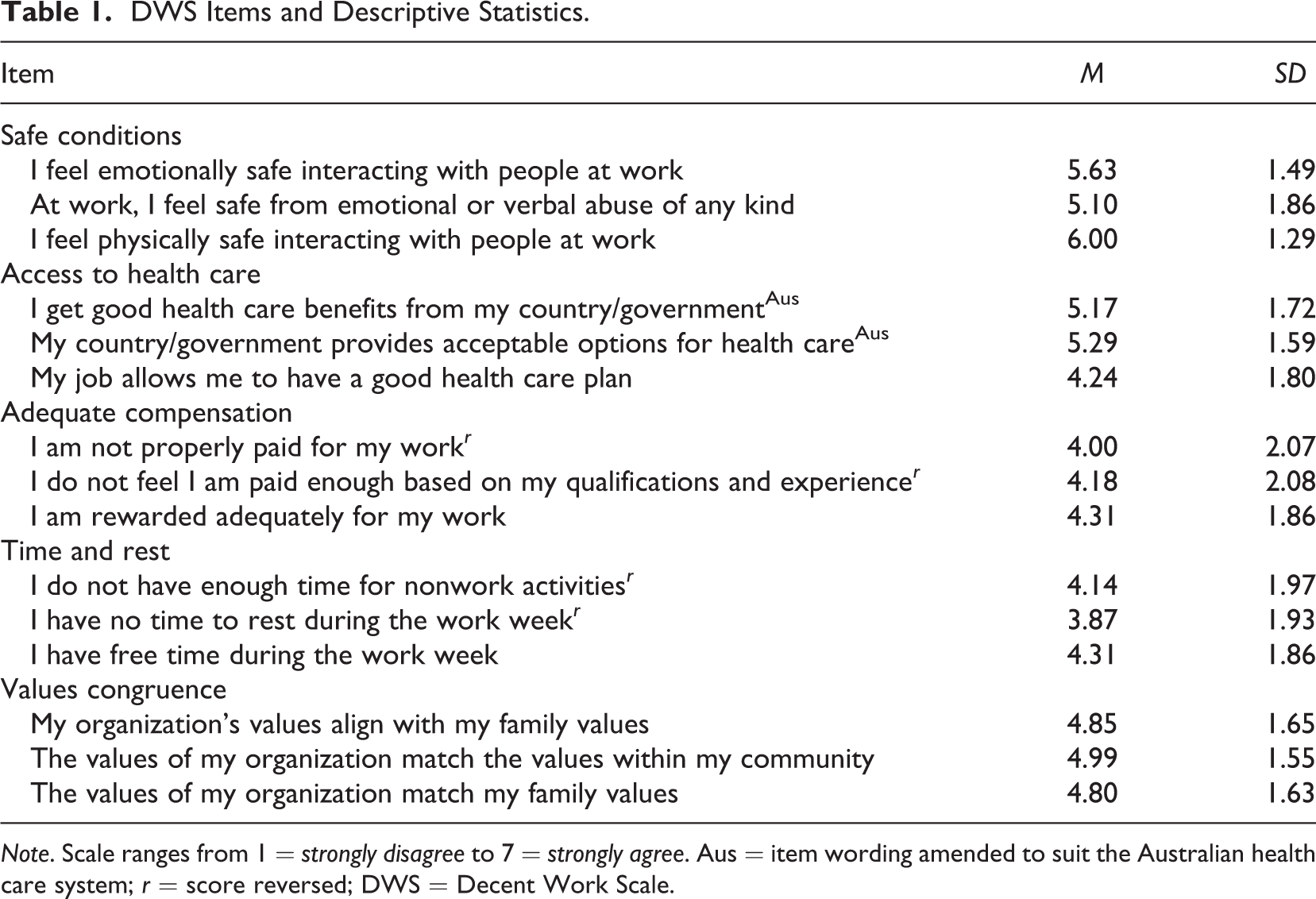
Note. Scale ranges from 1 = strongly disagree to 7 = strongly agree. Aus = item wording amended to suit the Australian health care system; r = score reversed; DWS = Decent Work Scale.
Job satisfaction
Participants’ job satisfaction was measured by the 5-item Job Satisfaction Scale (Brayfield & Rothe, 1951; Judge et al., 1998) using a 7-point Likert-type scale ranging from 1 (strongly disagree) to 7 (strongly agree) for its items (e.g., “I feel fairly well satisfied with my present job”). This measure of job satisfaction is predicted by job qualities and characteristics (Judge et al., 2000). It has been used in the international DWS studies which reveal its relations with elements of decent work (Duffy et al., 2020). The measure has also been used in Australian research involving samples of workers in different occupations and has produced acceptable internal consistencies and associations with variables such as discrimination and organizational commitment (α = .85; Zacher & Yang, 2016) and work–family conflict (α = .91; Talukder, 2019). The measure had acceptable internal consistency in the present data (α = .88).
Work engagement
Participants’ engagement in their work was measured by the 9-item UWES (Schaufeli et al., 2006) using a 7-point Likert-type scale ranging from 1 (strongly disagree) to 7 (strongly agree). The UWES subscales had acceptable internal consistencies (shown in parentheses) and included the following example items: Vigor (α = .83), “At my work, I feel bursting with energy”; Dedication (α = .87), “I am enthusiastic about my job”; and Absorption (α = .80), “I feel happy when I am working intensely.” The UWES has been used extensively in international studies (Rattrie et al., 2020; Schaufeli et al., 2006). The UWES has been used in prior Australian research involving different industries and occupations (Dollard & Bailey, 2014) and has produced acceptable total score internal consistency coefficients and associations with variables including psychosocial safety climate (α = .89; Garrick et al., 2014); organizational climate, autonomy, and support (α = .92; Albrecht et al., 2018); and turnover intentions, depression, and anxiety (α = .91; Timms et al., 2015).
Withdrawal intentions
Participants’ dissatisfaction with their work was assessed by a 3-item measure of their intentions to withdraw from their present line of work (Blau, 1985), using a 5-point Likert-type scale ranging from 1 (strongly disagree) to 5 (strongly agree) for its items (e.g., “I am thinking about leaving my current job”). This measure of intent to withdraw from work has been used in the international DWS studies (Duffy et al., 2020). There is a limited volume of Australian research using this measure of intention to withdraw; however, there is some evidence of acceptable internal consistency and associations with variables such as high perceived workload and work–life balance (α = .92; Holland et al., 2019). The measure had acceptable internal consistency in the present data (α = .86).
Plan for Data Analysis
The first aim of the present study was to assess the DWS’s factor structure. SPSS Version 25 and AMOS Version 25 were used for data analysis. The DWS data were assessed by confirmatory factor analysis using a maximum likelihood estimator. Indices of model fit were set at χ2 < .05, root mean square error of approximation (RMSEA) < .08, comparative fit index (CFI) ≥ .95, and Tucker–Lewis index (TLI) ≥ .95 (Meyers et al., 2013). Multiple regression was used for the second aim of testing the DWS’s hypothesized relations with job satisfaction, work engagement, and withdrawal intentions.
Results
Table 1 presents the descriptive statistics for the DWS’s items and Table 2 presents the measures’ respective descriptive statistics, internal consistency coefficients, and correlations with one another. There were no missing data or outliers in the scores. All absolute values of skewness and kurtosis values were <|1| for the DWS subscales and criterion variables of Vigor, Dedication, Absorption, and Withdrawal Intentions. Job Satisfaction had a moderate negative skew and positive kurtosis; however, their distributions were acceptable and not subjected to transformations.
Correlations of Decent Work Scale Total and Subscales, Job Satisfaction, Work Engagement Subscales, and Withdrawal, Descriptive Statistics, and Internal Consistency Coefficient Cronbach’s α in Parentheses.
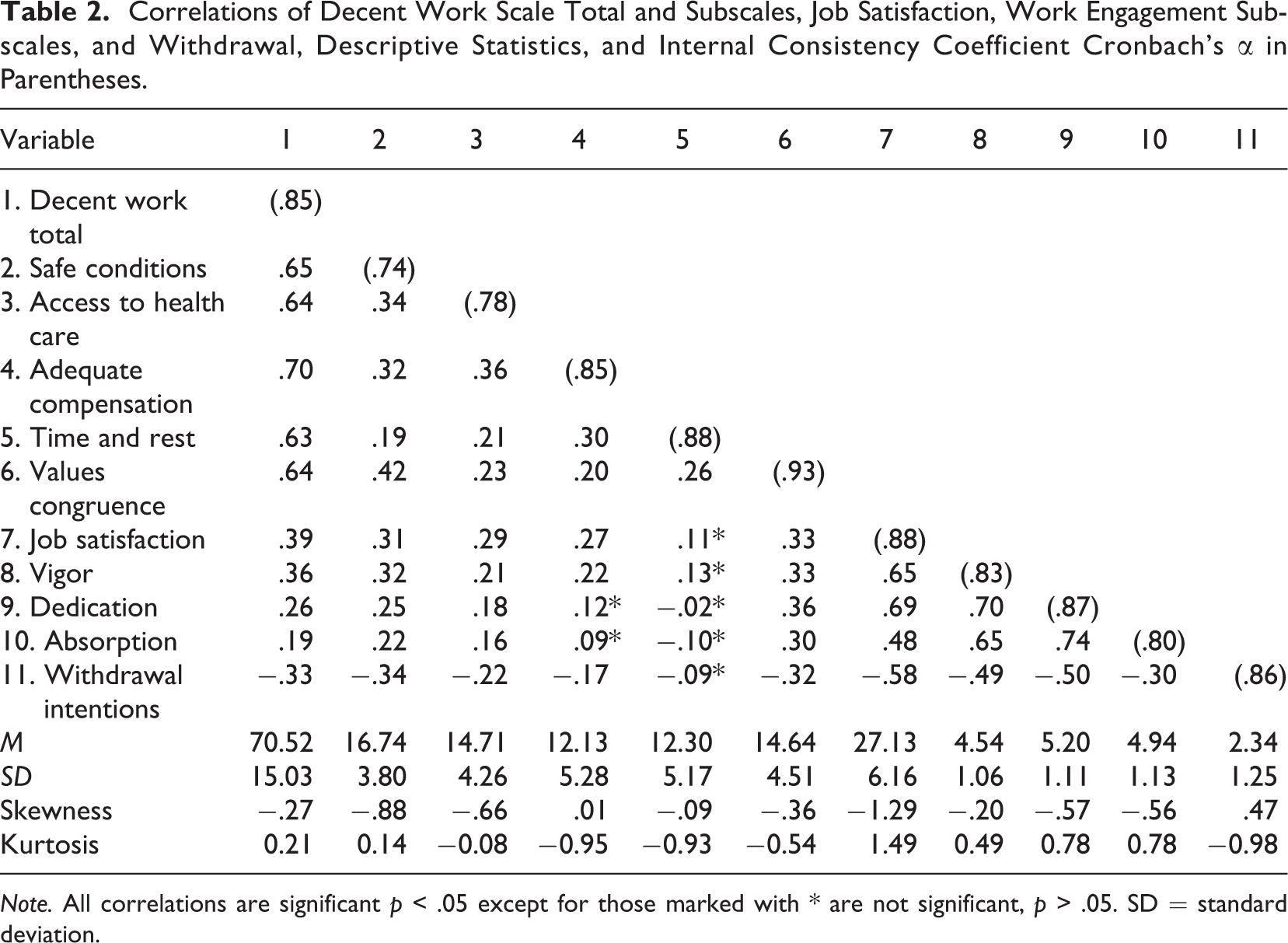
Note. All correlations are significant p < .05 except for those marked with * are not significant, p > .05. SD = standard deviation.
DWS Factor Structure
We note that previous research found differences in which model best fit correlated factors, higher order model, or bifactor model. We tested all three. For the correlated factors model, each manifest indicator was regressed onto its hypothesized factor and each factor was correlated. For the higher order model, the manifest indicator was regressed onto its hypothesized factor and, in turn, these factors were regressed onto a higher order factor. For the bifactor model, manifest indicators were regressed onto their respective hypothesized factor and, simultaneously, on a general factor, and the correlations among factors were fixed to zero, as orthogonally related to one another.
The correlated factors model produced a good fit: χ2(80) = 124.98, p = .00, TLI = .96, CFI = .97, RMSEA = .05, 95% confidence interval (CI) = [.03, .07]. The higher order model also produced a good fit: χ2(85) = 140.32, p = .00, TLI = .96, CFI = .97, RMSEA = .06, 95% CI [.04, .07]. The bifactor model produced an excellent fit: χ2(75) = 93.66, p = .07, TLI = .98, CFI = .99, RMSEA = .04, 95% CI [.00, .06]. All of the models had excellent fit; however, the nonsignificant χ2 test result for the bifactor model was suggestive of its superiority over the correlated factor and higher order factor models. The difference between the correlated factors model and the bifactor model was significant: Δχ2(5) = 31.32, p < .01; similarly, the difference between the higher order model and bifactor model was significant: Δχ2(10) = 46.66, p < .01. Thus, with respect to Hypothesis 1, no model was rejected.
Decent Work and Career-Related Variables
The significant correlation coefficients shown in Table 2 reveal the relations among the DWS total score, its subscales, and the criterion variables. Table 3 presents the findings of multiple regression analyses, with the DWS subscales simultaneously entered as predictors, revealed significant models for the criterion variables of Job Satisfaction, R = .44, R 2 = .17, F(5, 195) = .92, p = .00; Vigor, R = .41, R 2 = .14, F(5,195) = 7.71, p = .00; Dedication, R = .41, R 2 = .15, F(5, 195) = 7.99, p = .00; Absorption, R = .39, R 2 = .13, F(5, 195) = 6.86, p = .00; and Withdrawal Intentions, R = . 40, R 2 = .14, F(5, 195) = 7.39, p = .00. Coefficients in Table 3 reveal Values Congruence to be a consistent predictor of all criterion variables. In addition, Job Satisfaction was predicted by Access to Health Care and Adequate Compensation, Vigor by Safe Conditions, Dedication by Time and Rest, Absorption by Time and Rest, and Withdrawal Intentions by Safe Conditions. In summary, the findings for Hypotheses 2 (Safe Conditions) and 3 (Adequate Compensation) were mixed, Hypothesis 4 (Time and Rest) was rejected, but Hypotheses 5 (Values Congruence) was retained.
Multiple Regression Coefficients for Decent Work Subscales Predicting Job Satisfaction, Work Engagement, and Withdrawal Intentions.

Note. CI = confidence interval.
Decent Work, Income, Social Class, and Prestige
The 10 categories of gross annual income were correlated with the elements of decent work. Only Time and Rest correlated with income (ρ = −.16, p = .03). We tested for the effects of gross income, social class, and prestige. First, for ease of interpretation, the 10 gross income categories were recoded into three, lower, middle, and upper: <AUD25,000, AUD26,000–AUD50,000, and AUD51,000–AUD75,000 as the lower incomes including and below modal income; AUD76,000–AUD100,000 and AUD101,000–AUD125,000 as the middle income including the median; and AUD101,000–AUD125,000, AUD126,000–AUD150,000, AUD151,000–AUD175,000, AUD176,000–AUD200,000, and >AUD200,000 as the upper level incomes. Second, only the working class and middle class subgroups were used because there were only four cases in the upper class category. A three-way multivariate analysis of variance was used to assess the DWS subscales as dependent variables across the three independent variables: three income groups, two social class groups, and three prestige levels. A nonsignificant Box’s M = 218.608, p = .130 indicated equivalence of variance across cells. There were no significant main effects for income, Pillai’s trace = .07, F(10, 352) = 1.25, p = .259; social class, Pillai’s trace = .03, F(5, 175) = .959, p = .45; and prestige, Pillai’s trace = .07, F(10, 352) = 1.18, p = .30, and no interaction effects for income and social class, Pillai’s trace = .034, F(10, 352) = .61, p = .81; income and prestige, Pillai’s trace = .09, F(20, 712) = .86, p = .65; social class and prestige, Pillai’s trace = .04, F(10, 352) = .71, p = .72; and for income, social class, and prestige, Pillai’s trace = .09, F(20, 712) = .83, p = .68. In summary, there were no differences in decent work scores across categories of income, social class, and prestige.
Discussion
This study provides the first evidence of the measurement properties of DWS in an Australian context. The Australian version of the DWS, which uses items that reflect Australia’s universal health care system, demonstrates good fit as a correlated factors model, higher order model, and a bifactor model; however, the bifactor model is superior in the present data set. Further evidence of validity is found in the DWS’s correlations with career-related criterion measures of job satisfaction, work engagement, and withdrawal intentions. All of these variables were predicted by at least one of the DWS subscales. Values Congruence is particularly interesting because it predicts all of the criterion measures. As a whole, the present study affirms the DWS’s utility in an Australian context.
Job satisfaction is a frequently studied indicator of workers’ experiences (Judge et al., 2017). As was the case in other nations’ DWS validations studies (Duffy et al., 2020), not all of the DWS subscales predicted job satisfaction in the present data set. Job satisfaction correlated with all DWS subscales, except Time and Rest (which resulted in the rejection of Hypothesis 4). Only Access to Health Care and Values Congruence emerged as the unique predictors in the regression model. Research shows that job satisfaction has a relatively small association with pay satisfaction. Consistent with meta-analytic research (Judge et al., 2010), a small correlation was found for Adequate Compensation and Job Satisfaction. On the basis of the international DWS validation studies and previous Australian research (e.g., Dollard & Bailey, 2014), we expected a predictive relationship between Safe Conditions and Job Satisfaction. While the two variables were significantly correlated, Safe Conditions was not a significant unique predictor of Job Satisfaction in the regression model.
Work engagement is an indicator of workers’ perceptions of the qualities of their work and it is affected by the resources of a job and a workplace (Crawford et al., 2010; Lesener et al., 2019; Rattrie et al., 2020). Following PWT, and the findings of the Portuguese DWS study (Ferreira et al., 2019), we expected the DWS subscales to predict work engagement, measured using the UWES subscales, Vigor, Dedication, and Absorption. Safe Conditions and Values Congruence predicted Vigor, but only Values Congruence predicted Dedication and Absorption. Safe Conditions’ prediction of Vigor converges with Australian research into psychosocial safety climate (e.g., Dollard & Bailey, 2014). Contrary to expectations, Dedication and Absorption were negatively predicted by Time and Rest; thus, Hypothesis 4 was rejected. This finding suggests that workers’ engagement in their work is lower when they have freedom to disconnect from work. This finding may be considered in light of evidence that psychologically detaching from work allows for recovery experiences (Bennett et al., 2018). It may be worth speculating and exploring whether this finding reflects a potential u-curve relation between the variables or whether a third variable moderates the association. Notwithstanding the curious relation between Time and Rest, and Absorption and Dedication, overall, these findings lend support to using the UWES in other research based on PWT and DWS and when alternative measures of the potential positive outcomes of decent work are required.
Withdrawal Intentions’ prediction by Safe Conditions is consistent with Australian research (Dollard & Bailey, 2014). We also note that there is evidence that job characteristics and recovery are predictors of workers’ fatigue and vigor (Bennett et al., 2018); however, contrary to Hypothesis 4, Time and Rest did not predict Withdrawal Intentions. Consistent with Australian research, Safe Conditions significantly predicted intention to withdraw. Withdrawal Intention’s negative correlations with Job Satisfaction, Vigor, Dedication, and Absorption should be cautiously interpreted because an intent to quit may not necessarily be the result of disgruntlement with a particular job. The wording of the withdrawal intentions scale items, “I am thinking about leaving my current occupation” and “I am actively searching for an alternative to my occupation” should be considered: These self-referent beliefs may be expressed by workers whose current employment is quite satisfactory but who are, nonetheless, planning to take another job elsewhere for ostensibly positive reasons associated with their career development (e.g., promotion or family relocation).
A notable finding of the present study is that Values Congruence (Hypothesis 5) predicted all outcome variables. This finding is broadly consistent with those of other nations’ DWS validations studies (Duffy et al., 2020) and Australian research into values, organizational commitment (Abbott et al., 2005; Howell et al., 2012; Rosete, 2006), and job satisfaction and intention to stay (Newton & Mazur, 2016). An important methodological point should be made. The wording of the Values Congruence items refers to family and community; accordingly, interpretations of the Values Congruence subscale should be restrained to family and community and not connotatively conflated with other work-related values such as achievement, status, altruism, comfort, and safety (cf. Rounds & Jin, 2013). Recent meta-analytic research affirms a predictive relation between workplace social support and work-to-family conflict and family-to-work conflict (French et al., 2018). Thus, with respect to the present findings, a sense of congruence may reflect workers’ appraisals of their workplaces’ supportiveness for family and community life, which has positive effects on job satisfaction (Lapierre et al., 2008; Thompson et al., 2006) and work engagement (Matthews et al., 2014).
PWT (Duffy et al., 2016) associates job prestige with economic constraints, which are “…defined by limited economic resources (e.g., household income, family wealth) which represent a critical barrier to securing decent work” (p. 133). Several DWS validation studies found evidence for measurement invariance across levels of income and social class (e.g., Dodd et al., 2019; Duffy et al., 2017; Ferreira et al., 2019). We had insufficient numbers of participants to test for invariance, so we tested for mean differences across levels of annual income and prestige and found no significant differences for the DWS subscales. Thus, we tentatively conclude that the participants’ perceptions of decent work are independent of the objective indicator income and the subjective indicators of their social class and perceived prestige of their jobs. This finding may reflect Australian cultural norms of egalitarianism.
Limitations and Future Research
Earlier research into the validation of the DWS (Buyukgoze-Kavas & Autin, 2019; Di Fabio & Kenny, 2019; Dodd et al., 2019; Duffy et al., 2017; Ferreira et al., 2019; Masdonati et al., 2019) used samples with greater number of participants than the sample used in the present study. Those larger sample sizes afforded testing for invariance across demographic variables, such as gender and income. While the present study’s sample size was sufficient for establishing the factor structure of the DWS, it was not sufficient for invariance testing. Although multiple analysis of variance did not reveal main and interaction effects for income and prestige, future research using larger and more demographically diverse Australian samples should settle the question.
PWT (Duffy et al., 2016) posits economic constraints, marginalization, career adaptability, and volition as predictors of decent work and economic constraints, social support, critical conscientiousness, and proactive personality as moderators of those predictive relations, but PWT does not specify the potential role of negative psychological states or traits as either predictors or moderators. Given the evidence that quality employment positively affects mental health and that poor quality work predicts poorer mental health (Butterworth et al., 2011), and that mental illness negatively affects chances of employment (Frijters et al., 2014; Olesen et al., 2013), there is reason to investigate whether mental illness is an antecedent of the experience of decent work and vice versa. Thus, future research should explore the predictive relations between mental illness and the DWS and, moreover, use longitudinal designs to determine the direction of effects and the potential for a reciprocal effect.
Conclusion
In summary, the findings of this research are evidence of decent work’s positive associations with job satisfaction and work engagement and negative association with withdrawal intentions. These findings are mostly consistent with tenets of PWT, which holds decent work as a source of need satisfaction, work fulfillment, and well-being. In conclusion, the present research confirms the measurement properties of the DWS in an Australian sample and thereby adds to the international utility of the DWS and PWT for research into the role of decent work in people’s lives.
Footnotes
Declaration of Conflicting Interests
The author(s) declared no potential conflicts of interest with respect to the research, authorship, and/or publication of this article.
Funding
The author(s) received no financial support for the research, authorship, and/or publication of this article.
